Esoteric Christianity

For many years, I have accepted that there is an esoteric or “gnostic” * element of Christianity. Like anything, esoterism can be taken to excesses and balance is lost. There have to be two opposing forces like a sailing boat close to the wind, heeling and close-hauled, and the sailor has to put his weight on the boat’s gunwale to limit the heeling. Otherwise the boat capsizes. The skill of the sailor is balancing his weight, position in the boat, his course and the angle or setting of the sails. The nautical analogy is perfect for the spiritual life. Refusal of any institutional religion as a matter of principle leads to individualism and pride – and a big fall. There has to be balance. I also think of politics – for me, the ideal is anarchy, but the best compromise is having authorities, laws and police, but for them to be used at a minimum level. Pure anarchy is the law of the spirit, but it cannot work in society – simply because people do evil and would dominate us all.

* I refer to the Alexandrian tradition of Origen and Clement of Alexandria, developed into the theological discipline of Sophiology notably among some Russian Orthodox divines like Fr Serge Bulgakov.

Most religions in the world have esoteric dimensions. Judaism has the Kabbal, Islam has Sufism as an inner and spiritual teaching. Mysticism and the esoteric tradition seek Christ through inner experience rather than through accepting verbal doctrinal teaching and moral precepts to observe. Virtue is not either / or, but both with perhaps a little emphasis on one or the other.

Much of the modernist and anti-modernist debate in the beginning of the twentieth century discussed the relationship between God and man – transcendence against immanence. There is the question of whether God continues to reveal, or whether revelation ceased with the death of the last Apostle (Saint John) and is only transmitted via Tradition and the authority of a magisterium. The truth seems to be both. I am always suspicious of those who claim to communicate with God! On the other hand, there are rare people who are mediums, shamans and prophets.

Jesus is seen as a hypostatic union of divinity and humanity, a single being with two natures, though orthodox Christianity tends to absorb humanity into divinity, a kind of monophysism. His role is perceived as a priest and victim to feed the wrath of an angry God seeking justice. Jesus would take upon himself the karma of humanity. But, Jesus is also he who became man so that man might become God – in the words of Pope Leo the Great. He was and is the “prototype” of a new humanity, and not merely a sacrificial victim like the countless animals that were slaughtered on the altar of the Temple.

Esoteric schools tend to believe that Jesus did not spend his entire youth as an apprentice joiner. He would have travelled to many countries and would have been initiated into the various mystery religions.

The esoteric way sees the mystery of death in a much wider way than the classical Catholic and Protestant explanations of heaven and hell. There are esoteric Christian visions of the afterlife that closely resemble the traditions of Hinduism and Buddhism alongside other less known spiritual traditions in the east. Esoteric Christianity tends more towards universalism and the denial of hell as an eternal and absolute state. No one, even on the “other side” is beyond hope.

Meditation and contemplative prayer are not restricted to monks, but need to be accessible to all. In all probability, most “prayers” are worthless because they are no more than empty words and formulae. But vocal and sung prayers, and liturgical prayer, can be authentic by the Christians heart being directed in the right way.

One thing that interests me about the various esoteric traditions is the way of reading the Bible in a spiritual way, so that literalism is no longer relevant. The human spirit and the conscience have primacy over authority, whether that of a magisterium or the Bible.

The esoteric Christian looks for what we have in common with other Christians and other religions and spiritual traditions. As the Hindu holy book, the Baghavad Gita, says: No matter where they walk, it leads to Me. There is a fundamental unity of all spiritual paths. Exoteric and literalist Christians tend rather to seek to prove that they are right and everyone else is wrong or evil. In its ultimate expression, the “one true church” has the right to violate every principle of God and man in its conquest and domination of the world.

Many of these themes have been explored by individuals and groups over the centuries. Were they wrong? In all of us there is right and wrong. Who are we to judge?

Posted in Uncategorized | Tagged , , , , , | 2 Comments

Damage Control

Two things are quite significant today: the subject of my previous posting, namely the TAC in Australia and an interview granted by Bishop Fellay of the SSPX – Fellay speaks on the SSPX General Chapter.

Can the previous status quo be restored? Dialogue with Rome without any intention of going further? Ideas?

Posted in Uncategorized | Tagged , | Leave a comment

Australian TAC ad clerum

HT to Fr Stephen Smuts – Anglican Catholic Church in Australia (TAC) Ad Clerum.

This effort of bringing the Australian Anglican Catholic Church (TAC) out of “crisis mode” and into a new way forward is most commendable. As a priest of the Traditional Anglican Church in England since the resignation of Archbishop Hepworth as Primate and the abolition of the Patrimony of the Primate, in the same Communion, I support the ongoing Australian Church with my prayers and greetings. I am also happy that Fr Smuts supports this effort as well as the ordinariates in countries other than his own.

* * *

Ad Clerum

16th July 2012

From:

The Vicar General & Administrator

The Very Reverend Owen Buckton FSSM

Dear Fathers

Thanks be to God, we continue to move forward toward stability for the Anglican Catholic Church in Australia and I would like to thank you for your loyalty to all we have built upon when we gathered and worked harmoniously and honourably with our First Bishop Albert Haley, continuing the patrimony of our much loved Anglican expression of the Catholic Faith through the ACCA. You will be aware that we are in damage control, and much work remains to be done to restore real confidence and regain the respect that was partially lost… I ask your prayers and your continuing support over the coming months.

The Traditional Anglican Communion (TAC)

I have personally been very grateful over the past few months for the support and encouragement of Acting Primate Archbishop Prakash and Bishop Gill, who are honourable and holy men who uphold us in their prayers. Further, we are constitutionally bound to the TAC, according to the provisions of clause 3.4(a) of our Constitution:

This Church is and shall remain in communion with all Churches admitted to the Traditional Anglican Communion under the terms of the Concordat as amended at the meeting of the College of Bishops of the Traditional Anglican Communion on August 27, 1992, so long as such communion is consistent with the Fundamental Declarations set forth in this Constitution.

Further, clause 10 of the Constitution provides that clause 3 may only be amended by a special canon of National Synod ratified by each of the State synods. Therefore, until we have virtually unanimous agreement around Australia, we are effectively stuck in the TAC—and I’m grateful to God that we are…

Appointments

As we move from damage control mode to ‘open for business’ and ‘rebuilding’, it is necessary to announce appointments to positions made necessary by the Constitution for the good governance of the church. These appointments are made on an interim basis until such time as Synod has had the opportunity to discuss management in the long term.

Clause 7.5 of the Constitution provides:

There shall be a Registrar of the Diocese (who may be a clergyman or lay person) who shall be custodian of those documents of the Church which merit permanent preservation.

Since ‘shall’ has the same meaning as ‘must’, we need a Registrar, and I am delighted to announce the appointment, or, should I say, re-appointment of Fr Graeme Mitchell FSSM, who is, I expect, well known to you all. I have charged him with looking into the issue of your registration as marriage celebrants…

Fr Graeme is also something of a technological whiz, and in that capacity is reactivating the ‘OzTAC’ Yahoo Group, which you and your Synod lay representatives should all join…

Clause 7.3 of the Constitution provides:

There shall be a Chancellor of the Diocese, who shall be a solicitor or barrister admitted to practise by the Supreme Court of a State or Territory of Australia, or a graduate in law from a recognised University. The Chancellor shall be appointed and may be dismissed by the Bishop unless by canon the National Synod determines otherwise.

Accordingly, I announce the appointment as Chancellor of Dr Sandra McColl, BMus (Hons), LLB (Hons), MA, PhD (Melb), MLitt (Oxf), Barrister and Solicitor of the Supreme Court of Victoria and the High Court of Australia, who practises as a solicitor with an old firm in central Melbourne. Sandra is also a Member of the Insolvency Practitioners Association of Australia, and counts among her friends in professional circles liquidators and forensic accountants. I do hope you will get to know Sandra and her unique sense of humour in the OzTAC group or by email on chancellor@anglican-catholic.info

I for one don’t envy her lot, spending her business hours with lawyers and liquidators and her after hours among clergy. I do therefore ask you to uphold her in your prayers.

Clause 7.4 provides:

In the event of both the Bishop and the Vicar-General being absent from the Diocese for a period exceeding one month or of both the Bishop and the Vicar-General being unable through illness or other serious disability or incapacity to act, the Chancellor shall assume the management of the Diocese pro tem, and may appoint a priest as Acting Vicar-General who shall share with him responsibility for taking whatever measures may be necessary to maintain the good order and continuity of the life of this Church…

We need to hold a National Synod in order to discuss and formalise issues including those raised in this letter, and to make provision for future, long-term management by those who do not plan to join the Ordinariate…

Further, this Ad Clerum is not confidential and I encourage you to share it with your congregation and especially your wardens and Synod representative.

Communication

I hope that the revival of the OzTAC Group will promote communication throughout the diocese…

It is also my sincere prayer that those who have left us over the past few years may seek to rejoin us in order to assist in the rebuilding process and to co-operate in doing the Lord’s work among the people of Australia. There are many souls in this country hungry for the knowledge of God without knowing it, and for those of you who are truly lovers of souls there is a large harvest to be reaped if only we can turn our focus from our recent difficulties back to our God-given purpose.

I want you to know these have been long and difficult times for both Bishop David Robarts and myself as Administrator of our diocese as well as for the Acting Primate of the TAC, Archbishop Samuel Prakash, and Secretary to the College of Bishops, Bishop Michael Gill, and indeed for the College of Bishops of the TAC.

Your prayers and those of the faithful throughout the whole TAC have sustained us.

May Our Blessed Lord keep you in His tender love.

Father Owen Buckton FSSM

Vicar General and Administrator.

Posted in Uncategorized | Tagged , | 2 Comments

New Goliards gets more of a sense of purpose

New Goliards has been neglected of late, and I had considered incorporating all the material into this blog and closing down the other to make life simpler. I decided to wait and think things over. I have thus written a new mission statement – New Goliards – Mission. I would be grateful for a careful reading of this page and perhaps a few suggestions for improvements according to my intended spirit.

This is not a jurisdiction or community with rules, not a pseudo-church, no boss giving orders, nothing. Just ourselves and God with a fellowship of prayer and care for each other. Open to all, though there is a focus on priests more or less in difficulty or alienated from the Church that ordained them. Simply write so that I can put your name on a list of intercession.

Posted in Uncategorized | Tagged | Leave a comment

Thanks, but No Thanks

Thanks, but no thanks… These words express something very familiar in the old and now defunct issue of the Ordinariates for former Anglicans. Those who went to the Ordinariates, either out of desire or conviction that it was their duty, have done so.

I have been watching the parallel movement of the Society of St Pius X towards a canonical situation with Rome. They have just had their General Chapter, with Bishop Williamson excluded, and there have been no leaks. Bishop Fellay is expected to give an interview within a few days and express his official position. There may well be a diplomatic message saying that dialogue will continue, but that it would be meaningless and not intended to bring about any canonical reunion. Mixed bathing, yes, but without sharing the changing cubicles!

What is presently known is SSPX says no to Rome-updated from a source I am inclined to trust with some reserves. I suggest keeping an eye on Rorate Caeli over the next few days.

I have no speculation to add, as I find the position of the SSPX, especially their “totalitarianism” to be obnoxious. I find the way they have been treated by Rome since the 1970’s to be just as bad. I was once in the Institute of Christ the King, and our official position was one of accepting Vatican II, but – frankly – we did so with fingers crossed behind our backs. Quite a number of our clergy supported extreme right-wing politics and some who expressed opinions in private would have been in very serious trouble with the law in Europe if they had expressed the same ideas in public. Given the positions of some conservatives who are officially in union with Rome, I wonder if Rome gives two hoots about religious freedom, ecumenism and salvation outside the Church.

What really matters is political clout – and the pact with the Devil following having given in to the Third Temptation! Yes, Old Nick is a very slick salesman, but the bill has to be paid…

Reading another comment of Professor Perrin in the Forum Catholique, he supposes a choice between unilateral action by the Pope saying – Come in, no conditions, etc. or waiting until they say “thanks, but no thanks” and then renew the excommunications with a heavily-worded document saying the SSPX is in formal schism. It all seems surreal for a “Pope of Unity”. Why appoint Archbishop Müller and the Bugninist Bishop Arthur “Padlock” Roche at this stage? A red rag to a bull! Dr Perrin suspects that reconciliation is no longer the priority of this Pontificate. If not, what is? Is it merely some kind of palliative holding strategy à la Rowan Williams? I suspect so.

When the Ordinariates were in gestation, there were heated debates between the ordinariate-bound and those who said “Thanks, but no thanks“, namely all the continuing Anglican churches other than the TAC and what seems to be a high proportion of the TAC clergy grouped around Archbishop Prakash and Bishop Gill, and to some extent around the Anglican Church in America under Bishop Brian Marsh. The Anglican Catholic Church (Original Province) in the person of its Primate, Archbishop Mark Haverland, was clear about its position from the outset – A response from the ACC to Rome’s Offer to Former Anglicans.

Clearly, the ACC (or us for that matter) is not concerned with issues related to the idea of the Roman Catholic Church being the one true Church with the right to persecute those who are either outside her communion or to maintain orthodoxy by constraint and violence. The SSPX upholds clerical celibacy and the uniform liturgy according to the Roman books of 1962. It disapproves many of the tenets of Anglicanism such as the vernacular in the liturgy, married clergy, the use of the “heretical Cranmer” Prayer Book and Anglicanism’s more positive view of ecumenism.

But there is something in common. Experience has shown over the centuries that dealing with Rome is something like a small shopkeeper negotiating with the mega-store chain. Big carpet-bagger would simply tell the small shopkeeper to close his business and move away or apply for a job stacking shelves, perhaps with a view to promotion to department manager after a few years of loyal service. Then the shopkeeper loses all autonomy and works the big corporate way. It is a choice to make.

Optimists tell us that the new Ordinariates in England, Australia and the USA are going wonderfully. Great! I hope so, sincerely. It is not my problem; but some of those involved have got the short end of the stick, and other wonder if the offer is likely to last for long, or whether there is yet an element of “bait and switch”. I cannot affirm or deny it.

The bottom line for Anglicans is the issue of “conversion” and becoming Roman Catholics by more or less denying and abjuring their past – if not in theological terms, perhaps to some extent in practical terms. One salient point in the TAC was whether Rome would grant dispensations to those who are canonically irregular (for example for having been a Roman Catholic clerics even if the person’s spiritual origin is Anglican) on account of them having been accepted into the body negotiating with Rome. More accurately, the question would have been whether Rome accepted the integrity of the leadership of the ecclesial body in question, and therefore would trust their judgement on their clergy. That is corporate reunion, which was to prove to be a futile dream. It was not to be so. Reception is a matter of individual persons, even if they are received together in the same ceremony and reconstituted as a community once they had arrived on the “other side”. Every single priest had to be screened according to RC criteria. OK, fair enough, but the solution was some kind of compromise between individual and corporate. That was good enough for many, but not all.

The SSPX’s doctrinal position appears to be sincere, and I have have no reason to doubt that this is a serious issue, but is not the real issue one of property and priests being accepted on the basis of what they acquired in their Society rather than undergoing a new evaluation of their vocation? This question is aggravated by Archbishop Müller’s recently expressed opinion as I mentioned in my articles First the TAC, then the SSPX and Traditionalist Disappointments, namely that he would dismantle the SSPX and incorporate its clergy individually into some other organisation. I am led to believe that such a position would be the Pope’s, as the Pope appointed a man who recently expressed this position.

This seems to be the point in common. Corporate reunion. In the words of Archbishop Haverland:

Anglican and Orthodox Christians look for union and full communion without “conversion,” submission, and effective absorption and for an exercise of the Petrine Office that is compatible with the actual situation of the Church of the first millennium. The new Constitution [Anglicanorum coetibus] will do nothing to forward that goal.

Archbishop Haverland shows Anglicanorum coetibus as fundamentally addressed to “Anglo-Papalists” or those whose doctrinal position conformed exactly to Roman Catholic teaching. On the other hand, the SSPX is doctrinally orthodox in terms of dogma, but unwilling to accept the modifications introduced by Vatican II and perceived to compromise orthodoxy. Is Rome occupying the just via media to which all should adhere? If it is a moderate position, it seems to have become a very narrow one, a policy that the SSPX itself has practised ruthlessly for decades – Chinese Communism as I once heard someone say. If we don’t know where to go, it is surely best to stay put!

Another thing in common is the essential “Gallicanism” of the SSPX. Doctrine isn’t true because it is enforced by authority (unless the authority is theirs!) but because it is intrinsically true. It would still be true without the authority to enforce it. It is a position that would be characterised as Old Catholicism or sedevacantism in its reductio ad absurdam. Archbishop Lefebvre, though he was a convinced ultramontanist, had some of the old Gallican instincts left in him as he stood up to Paul VI. Anglo Catholics are more extremely “Gallican” in matters of ecclesiology and have just as much a gripe against medieval and nineteenth-century ultramontanism. Things aren’t true simply because the Pope says so! It’s a good question – do we really need a magisterium like a country needs police to keep evil-doers off the streets?

I must be some kind of 1960’s anarchist, but it is the way I think and live. If Christian faith needs constraint and force to make people believe and make it influence society and morals, then it just isn’t true. It’s a load of bunk as the atheists say, just a means of controlling people instead of respecting what is good and noble in human nature. This is where it is all situated for me, and hardly predisposed me to an “institutional” priestly vocation. I see priesthood as something else, but is priesthood not a function of the institutional church? If that is so, I am in trouble! I have to admit it.

Those of us who remain outside the RC Church certainly do run into the danger of placing our own “infallibility” in the place of the Pope’s. At least, that is what the RC apologist would say to force us to embrace the Pope’s infallibility rather than our own, which is more fallible. In reality, no one is infallible, and experience shows the Pope is extremely fallible when his main mission is to conciliate the irreconcilable just long enough for it to be no longer his problem.

The question many of us have to ask is whether it is all worth it, the jostling for power, the horse trading year after year, the roller coaster of fickle men believing their will is God’s, and so it goes on. Nero fiddles while Rome burns. Most of us are starved of the essential and have to look for God and the life of the spirit away from churches.

I am personally burned out, and I ask very fundamental questions. We have to face the reality that all churches and human organisations go the same way. It is the reality of institutionalisation, and the SSPX has gone the same way. We in the TAC hadn’t yet gone the same way because we weren’t institutionalised enough. And old Cardinal Levada had us for breakfast in no uncertain way – Watch out for the Hun in the sun! I may seem very negative to some, but my private e-mail correspondence shows that many others have got to the same stage. Where is the Gospel in all this? Where? Was Jesus a heartless bureaucrat in the Sanhedrin or the Temple clergy? No, they killed him.

As I have written elsewhere, we need to rethink the notion of “church”, keeping the communion of a community united in Christ but without the institutionalisation and the top-heavy authoritarian structures about to capsize the whole ship. I look at most of the “vagante” bodies and deplore the prelates with the high-faluting titles and folie de grandeur. The more serious independent communities run the risk of being “had for breakfast” by the ideologies they feel they have to support in the name of radical inclusiveness. In our atomised human condition, we exclude each other – hell is other people.

What of the future? Any hope? Yes, but I think it is in ourselves and our own self-knowledge. We know what is right – not what is conformed to other peoples impersonal orthodoxies – but what is right. We have been wrong for too long, and persevering in error out of a sense of orthopraxis. We need to listen to the voice of our conscience, not less in the name of exterior authority, but more…

Then maybe it isn’t all over.

Posted in Uncategorized | Tagged , , | 6 Comments

Dog Days

The Dog Days are upon us. Normally, the weather is at its hottest at this time of year. In the north of France and England, the wet weather seems to be set in for July and perhaps August too. I will have something of a respite from it by going to the La Rochelle area with my wife and boat for holidays in the first three weeks of August. The climate down there on the Atlantic seaboard seems to be a lot better – at least we hope so. Sophie will be going to the spa of Rochefort, as this will help for certain health issues, and I will inevitably be doing a lot of sailing. There are many fine Romanesque churches in the area, and many museums of maritime history.

In the calendar of the Book of Common Prayer, we find mention of the Dog Days, beginning on 6th July and ending on 17th August. I would suppose this reckoning would be according to the Julian Calendar, as England did not adopt the Gregorian Calendar until 1752. This was, with the Sundays after Trinity and other features, imported from the Use of Sarum.

Depending on whether you live in Europe, and if so, where in Europe, you will during this period live through the hot and sultry days of summer when life seems to stop and our vital energy dissipates to total lassitude as we lie on a sun-drenched beach or desperately try to find some way of cooling ourselves down at home. Here in France, we talk of La Canicule from the Latin dies caniculares, making the noun dog into an adjective. All that is something of a joke this year!

Dog days also define a time when little or nothing is happening, when business is slow, when people wait for things to happen.

As with many aspects of the Christian calendar, the Dog Days, as something to be marked and commemorated, are pagan in origin. In ancient Rome, they extended from July 24th until August 24th. In the civil life of Germany, France, Italy and some other countries, the Dog Days are still reckoned to be between these dates. The Old Farmer’s Almanac still more or less sticks to these old dates.

Charles Dickens made a mention of the Dog Days in A Christmas Carol:

Oh! But he was a tight-fisted hand at the grind-stone, Scrooge! A squeezing, wrenching, grasping, scraping, clutching, covetous, old sinner! Hard and sharp as flint, from which no steel had ever struck out generous fire; secret, and self-contained, and solitary as an oyster. The cold within him froze his old features, nipped his pointed nose, shrivelled his cheek, stiffened his gait; made his eyes red, his thin lips blue; and spoke out shrewdly in his grating voice. A frosty rime was on his head, and on his eyebrows, and his wiry chin. He carried his own low temperature always about with him; he iced his office in the dogdays; and didn’t thaw it one degree at Christmas.

In spite of this summer hiatus, it is understandable that religious organisations are keeping information away from the blogs and the Internet. Everything is going so well everywhere, so well that there is a sickening feeling among many of us that sinister things loom beneath the surface. That is human nature. Usually, when nothing seems to be going on, nothing is going on. What is suspect is that a matter causing a considerable amount of polemics is suddenly hushed up – and “all is going well”. Nothing to report – move on.

If readers know about events and developments and they are not being reported, simply because people can’t be bothered, let me know. A movement of air here and there is appreciated.

Posted in Uncategorized | Tagged | Leave a comment

Women Bishops and General Synod

I have been reading the odd articles here and there about the decision yesterday of the General Synod of the Church of England to put off the final decision to go ahead with women bishops until November 2012. It was predictable and frustrating for those who feel they want to “move on” – in one way or the other.

I remember Monsignor Broadhurst’s analogy of the frog in water being slowly heated until the frog would die of hyperthermia. Next week, the whole thing will be forgotten and no one will be talking about consecrating women bishops. Then it will all be back in the media a few weeks before the November Synod, and then the bickering and arguing will be the same as in July. Would it be any different in March 2013 or at some later date. If it is a war of attrition or guerre d’usure, then we need to think about who is going to leave out of frustration. Most clergy will not leave until it happens.

For those who have gone to an ordinariate, are continuing Anglicans or who have given up on churches, it is simple. One becomes cynical, which is understandable. The cancer patient gets another shot of morphine and the undertakers and embalmers are told to come back another day! Fiddling while Rome burns, or the gambler in the hole playing his last card? Who knows?

Roman Catholic triumphalists want “it” to go ahead as much as the protagonists of women bishops. Perhaps the stragglers can be herded and goaded into the ordinariate. Who wants to be “herded” or “goaded” any more than assailed by telephone salesmen? I could go on forever. I wrote some time ago about the kind of Catholic who advocates the hypothetical political regime that offers shooting, gassing and garrotting as an alternative to being “herded”. I don’t expect to educate anyone or win them to my point of view. I’m just done with it all!

Strangely, the proponents of women bishops seem to be of the same mindset. They need more time to convince their adversaries or wear them down. If the Church is about being herded, one way or another, then it is understandable that the only kind of people who will be in it are those with practical or financial attachments or who have abdicated their personalities. The totalitarian dictator’s dream! Of course there are those who will say I lack sound judgement for comparing the Church to totalitarianism! It is just a matter of degree… The principle is the same. The State lays down laws for what you are allowed or not allowed to do and say, not what you think. Churches claim authority over the internal forum and the conscience.

Some of my readers belong to the Church of England, and they have my sympathy, not triumphalistic taunting or bitter reproaches. Perhaps there is still hope that the entire agenda of female clergy would be rolled back for the purpose of stemming the haemorrhage and continuing a meaningful ecumenical dialogue with Rome and the Orthodox. The pragmatic mind at Lambeth, Westminster or York University may come to the conclusion that consecrating women bishops would be so costly and destructive to the Church, in view of the opposition, that it would be better to scupper it indefinitely. But is this realistic, or am I thinking too much like when “messing about in boats”? Is the Anglo-Catholic and Evangelical opposition going to get stronger and more articulate, or is it weakening? That is a question I am not qualified to answer.

Of course, if women bishops are rolled out, it will be the end of tolerance and comprehensiveness in the Church of England. It would be a church with a razor-edge “orthodoxy” like so many other churches and religious expressions. Most of us would just vote with our feet, and the institution would get no support of any kind from us. That is the dilemma Archbishop Williams has unsuccessfully tried to conciliate.

Experience shows that innovations of this kind, and other innovations that have characterised Roman Catholicism over the past forty years, or even the past four centuries, are more divisive than just carrying on as before. People feel they have to be “in the driving seat” or otherwise in control to prevent the Church going wrong, and they jostle and compete. Can the Church not be like nature? Is not a primary forest in South America (what little is left of it) more beautiful and pure than the finest French garden? But, of course, most religious people can only conceive of their churches in terms of leaders and authority – rather than communion, spiritual life and letting what is good in humanity thrive and prosper, and be fashioned and perfected by divine grace.

I certainly would be happy if they pull back from the brink, so that something of what many of us have known may remain – that happy sense in ongoing life and balance rather than oscillating between the two extremes of an insoluble dilemma.

Separation of Church and State, disestablishment, following a “train wreck” at Synod? It seems the only way. As a little boy, when I heard about bishops in the house of Lords, I could only think of my brother’s game of chess with the king, the queen and the two bishops to the knights and pawns. What has all that to do with the Gospels and the simple message of interiority and love? I have been out of the Church of England for a little over thirty years, and have never really found a spiritual home ever since.

That is not quite accurate – I have found the sea.

Posted in Uncategorized | Tagged | 21 Comments

More sailing reflections

This morning, I was musing about what it must be like to single-hand a thirty-foot yacht, to sail the boat on the open sea with no crew other than oneself and modern mechanical aids like the auto pilot.

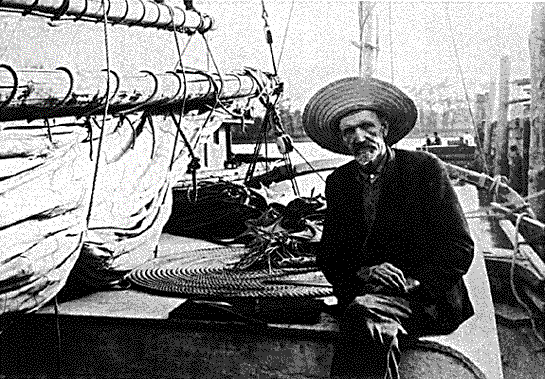
Many people have done it, like the very first to circumnavigate the globe alone – Joshua Slocum. His methods of navigation were little more than medieval. He got by without charts because his goat has eaten them! That man was a master mariner who could have sailed an old bathtub round the world with the feet still attached! Nothing stimulated my imagination more, when I was a lad, than tales of the sea, beginning with my own great-grandfather, Captain Cook and the wonderful stories of Jules Verne.

Single-handing a dinghy is not difficult in moderate conditions. I have even sailed the modern equivalent of the 420 with reefable mainsail, furling jib and an asymmetrical spinnaker (you can look up the technical jargon on Google). The main problem with single-handing a dinghy is capsize recovery, which is easy on a small boat like mine. Or, you can go for a self-righting boat – any ballasted keel boat. Those craft only turn turtle with the mast at 45° under water, a scenario which is hardly likely in the worst broach or knockdown.

Now, away from the technical aspects of sailing, I found a number of reflections from those who had single-handed yachts of thirty to forty feet on very long voyages, across the Atlantic for example. The spiritual side is touching coming from very down-to-earth men (and not a few women too).

Throughout history, individuals have endured privation and hardship in search of it. And singlehanded sailors have found it. Well, that too. But I’m talking about solitude; a momentary respite from the distractions and demands that occur when other people are around. It’s a time of peace and quiet, a chance to think and reflect, which refreshes the body, revitalizes the mind, and restores the spirit.

Whether you call it “communing with nature” or “feeling at one with the world,” there are times singlehanding can only be described as a spiritual experience — days when you marvel at the sea and sky and are awed and humbled by the majesty of nature, days when you savour the interaction of the boat with wind and waves and say to yourself. “It just doesn’t get any better than this.” According to an unpublished study by Dewey, Kahn, Yu, and Howe, these moments are covered by the inverse square rule — the intensity of the experience decreases by the square of the number of people aboard.

Singlehanding is unlikely to kill you. But it offers plenty of challenges that can make you stronger and better. Not just a better sailor, but a better person. Having to do everything yourself necessitates learning which increases self-sufficiency. Self-interest will motivate you to anticipate what could happen and plan for contingencies. When (not if) the unexpected occurs, necessity will stimulate the resourcefulness and creativity needed to deal with the situation (and, occasionally, prompt a few prayers and promises to change). Your ability to both endure discomfort and appreciate the little things in life will increase. Facing your fears and pushing your limits will boost your self-confidence; while the reality you experience will keep you humble. And, ironically, what you learn about yourself while singlehanding will make you a better companion.

Another irony is that singlehanders meet a lot of people. I think part of it is that, after being alone for a while, they are more inclined to reach out to others for companionship and conversation. But it also seems that others are more inclined to reach out to singlehanders. Maybe one person is perceived as less of a threat or burden than a group. Maybe it’s curiosity, the mothering instinct at work, empathy, or pity. Whatever the reason, the willingness of others to extend an invitation and helping hand to a singlehander and the generous degree of hospitality provided is a commonplace, yet unique and priceless, gift.

There is something precious about people of the sea. This afternoon I sailed with “Guad” from our club. We weren’t in the same boat, but me in my boat, and he in a delightful little boat called the Moth – a single large mainsail and a beauty of a hull. One could sense a kind of human solidarity that never occurs on land. I knew he had capsized before I saw that it had happened, and I immediately turned downwind to go and see if he needed help. Excellent seaman as he is, he righted the boat and was back aboard long before I got there, but he appreciated the gesture all the same.

It’s a shame the Internet isn’t the sea, and our computers boats. How much nicer blogs would be and how kinder we Christians would become! It is rare to find a sailor who behaves like those rude motorists on the road who behave as if they had bought the entire highway when they bought their expensive car. I am also wary of motor boats (those not being driven by those doing their job), unless their engine is under 20 HP and they have a sailing rig!

I am nowhere near ready for a long voyage. I don’t have the boat for it, and I have everything to learn about handling boats in port, docking and many of the skills common to motor and sailing boats. I need to learn radio hamming and navigation and improve my rudimentary knowledge of meteorology. But – I have the essential, the ability to handle a dinghy in quite rough conditions. They say that if you can handle a dinghy, you can sail anything!

Perhaps in a few years time…

Posted in Uncategorized | Tagged , | 3 Comments

Monastic spirituality in parishes

Doing my daily rounds of the blogs (perhaps when I should be in prayer), I came across On Silence and Sundays. It is a frequent observation that there doesn’t seem to be the slightest trace of spiritual life in most parishes, even where the liturgy is conservative. I have discussed the subject of monastic silence already on this blog.

Derek Olsen, the Anglican blogger in the US I referred to above, gives his journalistic sources in their reflections about silence and spiritual life. There is of course the old saying by the French Jansenist writer Blaise Pascal Qui veut faire l’ange fait la bête. Loosely rendered, those who play at being holier than thou are often the vilest sorts of people.

People putting on a display of holiness in a parish or an Anglican boys’ school are seen with suspicion, and rightly so, for Jesus tells us to retire to our secret chamber to pray and not be seen to be doing so. This is a question of discretion and intimacy – and authenticity. This is obviously the limit to the idea of importing monastic spirituality into ordinary parish life.

It is still fashionable to talk of Orthodox folk being more spiritual than Roman Catholics, Anglicans or Christians of other confessions and traditions. I have no experience of Orthodox parish life, and perhaps our Orthodox readers can enlighten us with theirs, but I suspect that there are enthusiasts who go lighting candles and jabbering on about their favourite devotions and saints. There are people who go on retreats, spend time with the priest, go to confession and daily Mass. Most keep their contact with church to a minimum.

We often discuss the finer points of apophatic theology and suchlike, but is this not a matter for clerics and enthusiasts? How do we go about promoting the interior life so that religious observance does not become mechanical and soul-less?

It is always disconcerting to go into a church before Mass and hear the same level of talk and hubbub as at the local market. We are surrounded by noise and it is very difficult to get away from it. People can no longer tolerate silence and stillness.

Something extraordinary happened in nineteenth-century France, as many things did. A parish priest sought to convert his flock, as did the Curé d’Ars before him and many other holy priests. This was the Abbé Ernest André of Mesnil Saint-Loup in the Champagne area. This priest founded a monastery and took the name Père Emmanuel by which he is better known. In 1886, his community was affiliated to the Olivetan congregation, and monks from his community in 1940 re-founded the Abbey of Bec Hellouin, so well-known to Anglicans and English Roman Catholics.

To this day in France, many lay Christians go to Mass and Office in monastic churches, preferring the silence and a place impregnated with prayer. It suffices to have a car and not too many miles to travel. One can also spend a few days as a guest for a retreat in most communities. That is certainly what I would do if I were a lay Christian seeking a place to worship God.

My “archdeacon” and parish priest of Bouloire was very influenced by the French monastic revival and the liturgical movement. The church would be sober and stripped from many of the uglier devotional trappings from the nineteenth century. He used the 1965 version of the Roman missal with many simplifications, and I have a lot of sympathy with this approach. The earlier forms of the Roman liturgy can be very finicky with the priest effectively celebrating a low Mass simultaneously with doing a high Mass with deacon and subdeacon. Medieval rites did not have the degree of rubricist rigidity as the Tridentine reform between 1570 and the 1950’s. Priests from that tradition tended to go so far in the reform movement before refusing the “hermeneutic of rupture” of the new liturgy under Pope Paul VI. Many mistakes were committed through “pastoralism” and imperfect liturgical scholarship. Mass facing the people was one of them as were some of the new bits and pieces in the 1950’s Holy Week rites.

There is the liturgy, but that is not all. At the same time, a parish priest trying to make his parish into a “lay monastery” is likely to make people “switch off”. You can only go so far. The spiritual life is of its essence personal and out of church. However, there is no opposition between the mystical life and the ways of the institutional church. Our spiritual freedom is bound to our practice of the Church’s liturgy, particular in the Mass and Office. The liturgy of the monasteries, cathedrals and parishes is the ground that nurtures our spiritual freedom.

No priest will succeed in making a parish of saints, but two things are essential – the celebration of a liturgy that invites souls to contemplation and doing everything to get people to be quiet in church, turning from profane conversation to prayer, switching off mobile phones and i-pods, making a transition from one world to another. It is not easy for any of us, as I can easily arrive at the altar with my vestments on thinking about things like shopping, work and daily business. The essential is to take just a few seconds before putting on vestments to shut up and remember what we are about to do.

This is something that increasingly strikes me when I go to weddings, first communions and the like. I often forget how noisy people are, both with other people and their electronic gadgets. I went sailing yesterday as the Tour de France took the coast road. Megaphones blaring, loud pop “music”, sirens of police cars and ambulances getting ready for any emergency. Like a scene from Apocalypse Now, six television helicopters flew over my frail mast and red sails. The engines thumped so loudly that I could feel the vibration though the tiller of my rudder. The vibrations were transmitted through the air to the water, and then through incompressible water to the nethermost parts of the earth. Imagine what it must be like for the whales and dolphins! The sea dampened out some of the noise, but the contrast between the silence of the sea and cliffs and the blare of the sporting event was quite surreal. Admittedly, I could not go out very far because there was little wind and a strong current and I had to think of safety at sea! Of course, we have to be real and tolerate people at their sporting events. But this level of noise has become so normal.

The transition from the profane to the sacred is not easy for any of us, but some of us are less attracted to limitless noise and hubbub than others.

Posted in Uncategorized | Tagged , , | 4 Comments

Happy Independence Day

I wish my American readers a happy Independence Day. May your great nation be truly free!

Posted in Uncategorized | Tagged | Leave a comment