Moving out of the rut

I am sure most of us have the experience of being in a car and having its driving wheels caught in mud. The wheel is trapped in a rut and no amount of driving the wheels by the power of the vehicle’s engine will enable you to move forward. There are various techniques, but mostly, it is a question of initiative. Very often, you can get someone with another car or a farm tractor to attach a rope and pull the trapped vehicle free. At other times, we need to manage, by “rocking” the vehicle to get backward and forward momentum. Otherwise you can dig under the trapped wheel and put in a wooden plank or some gravel to give the wheel some grip.

I think you get my meaning. In our Christian life, we often get caught in a rut by being too obsessive about a particular point. Something we like and what we find stimulating like the liturgy. Others are concerned by various doctrinal and moral issues, and there is no progress, no learning, just sterile arguments that remain the same year after year. So how do we react? Give up? Bring the boat about and sail on the other tack?

Some of us become trapped in conservative Christianity because we are attracted to the old liturgy rather than an informal ‘meal’ around a domestic table. We often get so steamed up about it, and wonder in the end what is wrong with the ‘coffee table’ Eucharists some people prefer to High Mass in a church. Is a priest not ordained for all and for the service of the world outside the church?

Like “rocking” the trapped car, I think we can do ourselves some good by being daring and looking beyond our own horizons. We are often brainwashed into thinking we can only be Christians by being in an established community – Christian civilisation as lived in a village parish or a ‘most Christian’ kingdom? Man is a social creature. But, what happens if the society we live in is no longer Christian? You either relocate to where a Christian society or micro-society can be found, or you re-think your Christianity and live it as you can in the non-Christian world.

The Internet is an illusory world, where doctrinal and moral issues are discussed in the absolute. It tends to make us think we are in a social context, but the internet is merely a means of telecommunications like letters and the telephone. It’s just a little more sophisticated and ‘modern’, but it is not real. This is why I so detest Facebook. Blogs and forums are useful only for transmitting information. You just self-publish ideas, which is what I am doing now. I used to delude myself that blogging is a ministry. It isn’t. Ministry is contact with real people and doing something real in the world other than writing.

In our ideas and paradigms, we need to rise above ‘conservatism’ and ‘liberalism’, out of the stale old arguments about women clergy, homosexuals, mass facing the people or on the old altar of a church and so forth. Christianity is about approaching God through the Gospel narratives of Jesus’ life and teachings. We Christians have done little more than maintain Christianity as a kind of universalised Judaism rather than a totally new way of living and believing.

We do well to live with the people around us, most of whom are indifferent about religious questions or simply don’t talk about them. They like us are tired of religious disputes and fratricide. Most people believe that religion is a force for evil and division between humans, and most have also come to consider politics and all institutions in the same way. Our society has atomised into individualism. Living in a village as my wife and I do, it is extremely difficult to get to know people and converse in any depth. The notion is Christian community, even among the faithful of the local parish, is alien and ever more distant. Its effect on Christian spirituality is devastating and leaves us with bleak prospects.

Relationships between human beings are the result of interests in common, trust and a fundamental predisposition for empathy. In cities, there are concentrations and identifiable groups of people who need help, the sick, jobless, addicts to alcohol and drugs, the mentally unbalanced. The most obvious solution for such people is to have recourse to social workers, doctors and psychiatrists. In the country, the difficulties of life are hidden and much more difficult to find. A Christian wanting to do good can often just be seen to be a ‘nice and available’ person, one seen as kind and open-minded. But such an attitude attracts suspicion, because people don’t usually give something without expecting something back.

Most people are convinced that religion is pointless or that all religions and spiritual traditions alike are ways to transcendence and the realisation of our deepest aspirations. An open mind reveals that some Muslims are indeed peaceful and deeply spiritual people, and less inclined to proselytise aggressively than many Catholic and Protestant Christians. There are few of those here in the Norman countryside. Most are materialists or ‘cultural Catholics’ and still get their kids baptised and catechised, given their Communion and Confirmation. Their priorities are elsewhere, and that is probably not a bad thing. Who are we to judge from the outside?

Such an observation of reality somewhat relativises the liturgical questions I often myself discuss. I celebrate Mass in my chapel, often with my family-in-law who are moderately practicing ‘cultural’ Catholics who make no bones about receiving ‘illicit’ Sacraments. It’s all the same. Who am I to dispute that? My two ladies in Dieppe are both Roman Catholics, and I fail to understand why they wanted me to celebrate Mass for them. They appear to be under no illusion about who I am or which church I belong to. Some mysteries are not made to be understood. Most of the time, I am alone like Fr Charles de Foucault in the Algerian desert. In pastoral terms, whether I do a traditional style service, Roman, Sarum or Syro-Malabar, or modern just wearing plain clothes and a stole sitting on the floor or on a stool at a low coffee table – it would make no difference. I have never done the modern style – I just see no point. So I just become like everyone else, or like their stereotype as perceived by conservative Christians half-way around the world. Or I adapt and make what I can of reality.

I have always been of the mind that I do not have the right to set myself up as an inquisition and discriminate against people by what they are or what they do. We are so incredibly diverse that the narrow dictates of culture, morality and other requirements of those who fiddle whiles Rome burns are just totally irrelevant. With the kind of people we live with, start talking religion and they will just see you as insane or a person with an agenda. Evangelisation? The word is grotesque. Jesus did not evangelise, but did wonderful things, and when people came to him to find out what it was all about, he told them. Today, we Christians cannot exorcise the possessed or heal the sick. We don’t have what it takes to make people curious. So, become all-inclusive! Our own faith won’t suffer but will become the richer for it.

It is not always easy to be kind and tolerant, and it is easier to believe than “hell is other people” than searching for the good and the transcendent in them. Our own empathy for other people will be helpful. I am still persuaded that there are two fundamental attitudes in life – love of what is good and needing to be built up, using what is imperfect to go ever upwards – or that most people are dross and have to be exploited to benefit the few or exterminated. The second attitude is totalitarianism and the product of those who have no conscience or empathy.

Experience of life brings us to search for meaning rather than the absolute certainty of a “truth”. Quantum science (very difficult to understand) relativises our conception of reality. If there are several or many universes, which would give some rational explanation to our survival or bodily death, then there are several realities. Dogmatic truth becomes like the experience of a fish that has swum in the sea being put into a goldfish bowl! Certainly, questions are of greater interest than answers. They are what drive explorers of their great voyages of discovery.

Many of us will do well to engage in humanitarian work in those places where it is done, and where volunteers are welcome. There is the usual work done for humans who suffer in one way or another, and there is also the possibility of action for resisting the harm capital and industry do to our planet. Every little bit helps, even if only by going sailing to show others that pleasure can be found without harming the environment. Not all left-wing political causes or methods are compatible with Christianity, but experience has brought me to be more in sympathy with the Left than the Right. I have no cut-and-dried answers, but I am more for being on the side of the people than the elite and the establishment.

Forming communities? Not easy in the atomised society we live in, but it would seem to me that something in common and the instinct of friendship do more than anything else. However, here in Europe, a community brought together for the sake of religious practices that is not the Catholic Church is called a sect or a cult, unless it is a Protestant denomination that has existed for several centuries or another religion like Judaism, Islam or Hinduism. Christianity seems to me to flourish better in a secular world than in one than is dominated by a religious institution. That is the genius of French laïcité and the separation of church and state, a free church in a free state.

Perhaps one thing by which Christians will stand up is by resistance to evil, to any tendency that would lead to totalitarianism, a replay of Nazi Germany or Stalin’s Soviet hell or the dystopia of mid twentieth-century authors. Today, the evil has become that much more subtle, and is potentially within each one of us. The enemy is within, and that can only be fought with prayer.

Rock, rock, rock – do it enough and the car will come out of the mud and be able once again to drive on the road.
Posted in Uncategorized | Tagged , | 5 Comments

Changing heart

I have little time this morning for a blog post, but the thoughts are there and preoccupy my mind. I expressed my concern about ‘conservative’ Christianity, and a comment came from one of our regular commenters, an independent priest. A major problem is in the underlying Augustinian theology of predestination, original sin and the legal / commercial analogies used in soteriology (theology of salvation, redemption, atonement, etc.). When you think of it, certain versions of this kind of theology would lead to anti-Semitism, ethnic cleansing, persecution of dissent – and would even to some extent inspire the evil ideologies of the twentieth century that killed millions in that mindset that considered some human beings as intrinsically better or more worthy of life than others. The Orthodox notion of deification seems so much healthier, involving sanctification in this life in anticipation of heaven – but the Orthodox Churches have their own problems.

Near-death experiences and communications by mediums with the dead show a very different view of the afterlife, and how little it depends on belonging to the right Church and believing the right doctrines.  It seems to be about cause and effect, the consequences of how we lived this life – as simple as that. If our Christianity is about avoiding hell, that’s probably where we will go!

The Sabbath is for man and not man for the Sabbath. Christianity is the way of life taught by Jesus, the discovery of God’s Kingdom which is already amongst us – if we want it. It is not merely an emotional or even a spiritual uplift, but a commitment to this world.

It seems to me that there is a fundamental choice, one of deciding whether it is all about following powerful personalities and rules, or a compassionate response to the situations of life we encounter. Perhaps both to some extent, but many of us become tired with balancing one thing against another. Conservative Christianity clings to biblical / doctrinal / canonical literalism, religious exclusivity and a heavenly afterlife as the goal of the Christian life. There is another vision, not one of believing now to “get saved” later (when we die) and setting a guard over the gate through which that happens. Another view sees Christian life as one of relationships and transformation in this present life, and being unconcerned for what happens after death.

It would be a mistake to say that one vision is wrong and the other right, but I notice that the idea of the Church being some kind of clearing house to decide which people go to heaven or wherever after they die is becoming decreasingly convincing with our contemporaries.

Conservative Christian, whether Catholic, Protestant or Orthodox tends to encourage the worst in human nature along with, occasionally, the best. Most spiritually-inclined people are unable to be literalists or exclusivists. It is just not in them. Accusing them of being ‘cafeteria’ Christians alienates them even further. Let them go away and slide away into paganism or atheism, leaving a smaller and purer church! I suppose that is a little less obvious than telling them – as Isabella the Catholic said to Spain’s Jewish people – they have less than a week to leave their homes unless they convert to the truth. This new form of Jansenism deeply shocks me and so many others.

There are many things about so-called liberal religion that are deeply shocking, particularly the power struggles of groups with an agenda, which would simply move the levers of power from one place to another. One kind of intolerance is replaced by another, and encouraged by institutions and institutionalism.

The greatest challenge will be to find beauty and freedom in Christian life, beauty in culture, contemplation and liturgy – yet with kindness, tolerance, inclusiveness and empathy for others. These are the marks and characteristics of no institutional Church, though they may be found in members of all churches and those who are outside churches. Could it be that the Church is mostly outside the Church, and that we have to ask serious questions?

Bonhoeffer was deeply shocked at the extent to which Christian churches went along with the most evil political regimes and ideologies like Nazism. His witness for the way of Jesus was to resist Hitler and sacrifice his life. Is the dwindling Church in Europe God’s way of teaching us that there is another way? Too many religious people lack spirituality, and many spiritually-minded people are alienated from churches. That way would be seeking the highest form of our faith and desire for the life mapped out by the Gospel.

We find ourselves living in countries full of empty and redundant church buildings and symbols. The prophetic voice is there but it has to be heard. Faith has to survive without clergy, rites, holy things, beliefs and teachings. We are left with prayer and righteous action for humanity and the planet on which we live. Prayer needs to give us empathy and solidarity with others, and create good ‘vibrations’. Intercessory prayer needs to ask for empowerment to do God’s work, bringing about good ourselves with our own energy and determination.

We need to return to the teaching of Jesus, the contrast between the Sermon on the Mount and the pride and hypocrisy of the Pharisees, whose behaviour is seen in too many “church” Christians.

As in the dark days of the Nazi terror and Soviet Communism closer to our own time, Christianity will be silent and hidden, yet inspiring empathy and goodness in every walk of life. If Christians are complicit in evil and the ancient sins of murder, power and money, the Church can only lose its prophetic voice and become an empty shell.

Could it be that we are simply being invited to follow Jesus in our call to serve our suffering world and bring about good at great cost to ourselves? Perhaps when we learn that, we may be allowed to recover beauty and consolation which are symbols of love.

Posted in Uncategorized | Tagged , , , | 1 Comment

May 2012 and the sea

Like my sailing blog in French, my postings are a little slow at present. There is little to report, and I see little need to repeat here what is reported elsewhere. Some blogs relate that Bishop Entwistle would be the Ordinary for Australia, and other speculations abound about Torres Strait. I feel so alienated from it all, though I am usually happy for people to find their joy and fulfilment in life. I listened to some of Monsignor Newton’s speech in Brighton about ecumenism. Again, nothing to relate to and I became too bored with what I was hearing. I am certainly suffering from the spiritual sickness of acedia!

The climate in Europe over April and May rarely rose above temperatures typical of March, and we were dogged by the same old north Atlantic depression that turned and turned but without going anywhere except over our heads. The winds just alternated between the fickle north-easterly, the cool north westerly, the brisk sou’westerly and the warm and thundery wind from the continent. We moved into settled warm weather only on the Friday before Pentecost. The weather makes a big difference for me! At last, the balmy days are here…

I was far away from all the religious controversies last Saturday and Sunday, when conditions at sea were moderate but with a fresh wind that promised a challenge to both boat and helmsman. On Saturday, it was our weekly session at sailing school, and I had the use of the school’s Laser dinghy, a fast and light racing boat. We were three catamarans and me in the Laser. We had a brisk cruise to the Cardinal, the buoy off the nuclear power station of Paluel which for boaters indicates not only the cardinal points of the compass, but also the limit beyond which boats are not allowed to approach the atomic site. Duly obeying the rules, we kept well away and continued our long close haul before turning back. It was a similar outing to the previous Saturday when we were a group consisting of the Laser, a similar boat in heavy plastic with a big sport sail which I sailed, and a catamaran – and then we had less wind.

Last Sunday, after celebrating Mass with my wife and nephew in attendance, we went to Veules. They went to do something else and I took the boat out in 13 brisk knots of wind. A sailing club of Vernon was there with a group of youngsters in Lasers and their instructor in a big powerful motor boat. The young guys sailed like aces, and so I would join them in my boat, considerably slower than a Laser but with a jib to compensate a little. It was quite fun, though some of the young sailors would tack right in front of me without looking and I would have to tack to avoid a collision. I was tacking and hauling in quite furiously as I sailed close to the wind.

All of a sudden – crack! – a piece of rope tying my rigging shrouds to the top of the mast broke and down came the mast. I had only to get everything back on board. This time, I had no need for a jury rig, the visiting club’s motor boat was just nearby. I asked its skipper for a tow to the beach, which he graciously granted me, and I was relieved that my mast was not broken and the repair would cost me nothing. As always, the lesson to learn is – check the boat’s rigging and replace all worn ropes. On a boat, the tiniest problem can cause big difficulties at sea.

For the boys in the Lasers, it was their first time on the sea, a whole different experience from protected waters. They handled the waves like magic. It is wonderful to see young men so skilled at such a tender age and with much less weight to balance the boat. I was very impressed.

Now, back on land, I have a little more translating work coming in, since May is often a parsimonious month with all the bank holidays here in France and fewer orders arriving. That is bread and butter – nothing comes free for anyone.

My recent experience of blogging and relating to conservative Anglicans and Roman Catholics give me pause to rethink many things. However, I am bound to be circumspect – as I am certain of so little these days. I am still hurt by much of the flak I took on the defunct English Catholic blog and in some other blogs. Some of the Saints said that Christian life was all about thorns and brambles, the long hard slog. They were certainly right, with the sun occasionally squeezing its consoling rays between two heavy grey cumulus clouds. However, a cloudy day can provide great sailing!

All that being said, I share the concern that conservative Christianity, when its business is truth without compassion, will fail to win the hearts of future generations. I pray that 2012 would bring a change of heart, an infusion of the grace of Pentecost. It might yet happen – we have to believe in it!

Posted in Uncategorized | Tagged , | 2 Comments

The vocations crisis

I am linking to a very interesting article that offers analysis about the dearth of priestly vocations in the Roman Catholic Church, whilst bishops and the Roman Curia continue to laicise and banish clergy for reasons other than child abuse.

The real reason for the vocation crisis – part 1, part 2.

I have always thought of celibacy as being for a purpose, but:

The Church has always recognized the importance of marriage as an institution uniquely geared to provide the aforementioned human needs. The model of family had been virtually emulated for priesthood prior to Vatican II. Even the title “Father” lent itself to the family model. However, enamored with a naïve optimism regarding the modern world, the bishops after the Council decided to imitate the techniques of contemporary business for human resource management. In doing so they created structures whereby the bishops became CEOs and their priests employees. This surreptitiously eroded the priest’s sense of security, belongingness and love, and eventually began to change his identity. Sociologists tell us that structures do shape reality. Theologians are also well aware that polity goes hand in hand with belief (Pelikan, J., 2003). The new structures began to undermine the traditional theology of the priesthood. They particularly affected the system that supported a celibate priesthood. Pious words and protestations of support for celibacy are not enough.

If bishops are serious about promoting vocations and desirous of maintaining a celibate clergy, the following changes should be made to certain policies affecting the lives of their priests.

The most important point about the second part of this essay is considering the use of what I have come to call “spiritual capital punishment” in the Church. The Church used to deal with “fallen” priests by putting them in city parishes under supervision and in primitive conditions of life, or send them to monasteries. Nowadays, they just disappear and cease to be persons.

Of course, I cannot sufficiently express my horror and disgust upon hearing about a priest sexually abusing children or other vulnerable persons, but the Church at the same time owes a pastoral approach to all sinners and those who err and for whom a pastoral approach to help them correct their lives. Of course, science seems to indicate that paedophilia is incurable as are various personality disorders involving the absence of moral conscience or empathy. But between exposing the rest of us to danger and killing them, there is a via media. The problem here is that some clergy are being “put to death” for issues of canonical irregularity that could be corrected by means of canonical dispensations and pastoral care.

How the bishops responded to their recalcitrant priests in this crisis is further indicative of how much they have departed from the family model of priesthood, and therefore more devastating for vocations. The Dallas protocols and the desire at that meeting of many bishops to quickly laicize as many problem priests as possible is symptomatic of the business model they have been working out of for years. When a worker is a problem, business gets rid of him. However, this flies in the face of everything we encourage Christian families to do. We rail against divorce. We proclaim for better or for worse. We tell parents to stick with their children even in tough times. We remind them of the Prodigal Son. But when one of the bishop’s sons is in trouble they want to cut him off, get rid of him quickly.

(…)

No doubt we have some guilty priests and others who are unjustly accused but whatever the case, is it right that they are being shunned by a Church that is their life? I remember when I was ordained, the bishop gathered the priests in attendance and said to the ordinandi, “Behold your brothers.” He didn’t add, “until they make a mistake!” In this crisis we have stripped men of their priestly identity, their church family and in many cases their livelihood by giving them a pittance to live on. So much for my loving father the bishop! Why would a young man want to risk his whole life on a family like this?

The most damaging effect of these policies is the psychological effect they have had on one of our basic beliefs about the Sacrament of Orders, “Thou art a priest forever!” All those trained in theology know the fine points of the indelible character placed on the priest’s soul. But how is this translated in the practical mind to the average person when priests are being dismissed and having laicization forced on them? It makes priesthood look like a job that offers little security, no family belongingness or love. Even the theological and spiritual elements seem to have disappeared.

A new article describes the harrowing and absurd story about how a number of Roman Catholic priests joined the Anglican Communion and were allowed to exercise their Orders. They are being forcibly laicised, a process that surely costs time and money when Curial officials could be occupied with more important questions.

Why encourage vocations? Why encourage a young man to risk becoming a pariah who is incapable even of making his way in the secular world because he was trained over many years to be a priest? Who other than the Church needs a man with a degree in theology?

Family breakdown has been identified by sociologists as the major cause of deviancy in America. It is the root of illegitimacy, low birth rates and an increase in crime. Mutatis mutandis, might we not posit the same for the current dismantled model of family in the priesthood? The divorce of bishops from their priests, the separation of priests from a parish family, as well as many illegitimate notions about priesthood and priestly life, are all major causes in the vocation crisis. Unless bishops are willing to fix the faulty structures that I have outlined above, they will further discourage vocations, alienate those already ordained and lead to the further demise of the priesthood, as we have known it. The bishops must realize that actions speak louder than words.

This is powerful stuff, and surely justification for a Goliard blog!!!

Posted in Uncategorized | Tagged | 1 Comment

Derek Olsen on the “core”

The noise is abating, though in some blogs, the same mantras are being chanted over and over again. I won’t go on myself as it is pointless. Perhaps human learning is like training horses, with an electric cattle goad and everything is in the voltage. The problem is who is doing the prodding and who is being prodded. It doesn’t seem very Christian to me.

Our American Episcopalian friend (don’t go on about his being married to a woman priest – I know) writes lovely spiritual pieces, and this one is no exception.

It’s time for us to do a lot more writing and a lot more talking about core spirituality. For me, “spirituality” means practices that nurture our relationship with God (and with one another through our connection to God) and cultivate a direct experience of God and God’s relationship to the created order. By “core” I mean practices that have a direct and intrinsic relationship to the Anglican expression of Christianity. It doesn’t mean they have to be uniquely Anglican, but it does mean that it should have a deep and abiding connection with what makes us distinctive.

(…)

I’ve heard—even from clergy who ought to know better—is about the historical development of the liturgy and how that had shaped what we have now. History is interesting (at least to me) but that’s not what people are hungry for! I believe that what the church needs to hear is how to access the spiritual riches of the Scriptures and the prayer book. In order for that to happen we need to start thinking about it and talking about it—and doing it, of course.

He outlines the problem of the liturgy in our contemporary context. People are so far from the symbolic and mystical world of the liturgy. In the history of the Church, there has been mystagogical catechesis, a special kind of teaching to explain the meaning of the liturgy, and not just its history or how the clerics “do their stuff”. Pope Benedict XVI has the constant expression new liturgical movement, not a movement of reinventing the liturgy but of helping people to relate to the liturgy.

There is a question of new wine and new bottles, or old wine in new bottles, since new wine in old bottles will make the bottles burst. I think Jesus would have done well to live in France!

I don’t want to steal Mr Olsen’s limelight, so you can comment on his blog or mine as you wish.

Posted in Uncategorized | Tagged | 1 Comment

Innocence lost

I often stand in awe of children and those who make fresh discoveries. Their sanctuary is one to be left pure and above all undefiled by those who took their bite of the Apple and were banished. Notes on the domestic church in the clouds by Arturo Vasquez.

Religion looks fresh and exciting from just outside the door, everything at a distance. Probably the best view of High Mass is from the organ gallery! Like Arturo, I stumbled into religion through music and the side of the Church that entices – the sugar cube and not the big stick!

Can the good things of life be appreciated without a yearning and sense of the transcendent? And where is the sense of transcendent found? The local parish church? The cathedral? The abbey in the bottom of the wooded valley? I remember a priest of my old Institute saying – at least the Communists have an ideal and fight for it. Most people just wallow in their selfishness.

Those of us who have been through the machine find it difficult to reconcile Palestrina’s Missa Papa Marcelli with Pope Pius V sentencing men to castration and burning at the stake for sexual immorality, monks chanting the Salve Regina with a few German bishops in the 1930’s raising their right arms and exclaiming Heil Hitler!. Admittedly, many bishops in the Third Reich resisted – heroically – and paid for it with their lives.

As much as religious authorities want to make an act of virtue, beauty, or truth evidence of their institutional narrative of the cosmos, there are a thousand other interpretations and a thousand other phenomena that say other things. That is really the problem we live: before, the religious institution (the church, etc.) could control human experience through prisons, torture, indexes of forbidden literature, general societal taboos, etc.

Jekyll and Hyde – the Church has been capable of the most sublime, but yet stooped to the lowest parts of hell. Arturo, with whom I occasionally correspond, has always laid emphasis on “popular religion”, which may not always be “orthodox” monotheism but a form of natural religion, paganism or pantheism. Man seeks what will liberate his soul from the enslavement of men in control, social systems, religious teachings and our very bodies racked with the effects of age and ill health.

I went to see and hear Verdi’s La Traviata with my wife last Sunday, for our wedding anniversary. If we humans are just machines to eat, sleep and reproduce, then why music, art, emotion, the instinct and aspiration to transcend death and suffering? One way or another, we will seek the transcendent. If we don’t find it in churches, then we will look for it elsewhere – in a boat on the sea, in the mountains or forest, or in a concert hall or the opera.

This is one thing most of us are up against – finding the transcendent in the parish church where there is little other than noise and absence. In time, we all become jaded and weary with things that cease to convince or attract. Jesus indeed said that we have to come to the Kingdom of Heaven as little children, to be born again. Being born again usually means the Sacrament of Baptism as the culmination of our conversion and long probation at the door of the Christian community. To some Christians, it means a conversion experience that sets the believer and forgiven sinner on a permanent way of salvation – which can be more or less a euphemism or a caricature. Innocence is harder and harder to cultivate as we see through the caricatures and false witnesses. Perhaps this renascità (rebirth in Italian) can take many forms as the soul seeks to go higher and higher to the Light. The Church itself is transcended.

The comments to the post often reflect the brutes who plague many a blog combox. Spiritual individualism is a temptation and so often an illusion. After all, I don’t exactly pray in my boat – I tend the sails and steer my course, ever watching out for the “devil” of broaching (a physical phenomenon caused by a wave of the sea or the wind that upsets the balance of a boat and causes it to capsize). Seamanship is understanding these forces, being able to anticipate them and handling the boat in consequence. You want to swan around safely in a motor yacht – you learn in a 420 in an 18-knot breeze and a six-foot swell at sailing school! There are some times when the sailor is simply dwarfed by the greatness of the sea that surrounds him and humbled by the greatness of God’s creation. But the moments of marvelling are brief, since lack of attention – like when driving on the road – brings difficulty and sometimes a catastrophe. Prayer is a discipline acquired by practice and asceticism, and no one should be under any illusion. It just isn’t given to all.

Perhaps we have to decide whether the quest for the transcendent, at least for most of us, is not an illusion. I which case, there is little point in a church, being redundant to everything provided by secular states and humanitarian organisations. These are things we have to weigh up for ourselves as rational adults.

Posted in Uncategorized | Tagged , | Leave a comment

The Trouble with Adjectives

Facebook keeps sending me e-mails, usually vast amounts of “I’m really keen about that cause” and other pieces of junk, but now and again one gets a link to a blog or an article.

Fr Sutter has written Ancient Worship…Timeless Faith.

Having lived in France for many years in the highly polarised atmosphere of the few French people who still bother with church, the words traditional and traditionalist have taken on a really bad connotation. They often mean that horrible nineteenth-century anti-revolutionary poison that developed into the totalitarian extreme right-wing ideologies of the early twentieth century.

The word has been frankly hacked to death, partly by its use in commercial advertising in the 1980’s for the beer we used to love drinking as students and many other products, as a symbol of quality and a human “break” from the automation and mass production of our industrial world. Traditional can tend to mean a negative reaction against modernity or the values of the Enlightenment. Traditionalism in the nineteenth century meant an offshoot from Romanticism that speculated on the relationship between faith and reason, placing more faith in tradition than in theological science. There is also the traditionalism of men like René Guénon (1886-1951) who ended up as a Sufi Muslim. This kind of traditionalism had much in common with the occultist and esoteric thinking that underpinned the twentieth-century “third position”, distributist and far-right ideologies.

I have had a tremendous amount of sympathy with some of Guénon’s work, and have an entire bookshelf of his works and other authors like Mircea Eliade, Frithjof Schuon and other less known characters. They presented a kind of esoteric and mystical underpinning of sacramental and liturgical Christianity that would provide a refreshing alternative to the fundamentalist and literalist representation of Christianity as the “third monotheism” and “religion of the Book”. This kind of thinking pervaded some of the Modernists in the 1900’s. The origins of this “mystical” current essentially go back to the alchemists and hermeticists of the sixteenth century. Guénonian traditionalism developed in Sufism, a kind of mystical Islam practised in Egypt. On the other hand, we notice the figure of Julius Evola who sailed very close to the Fascist wind in Italy and inspired some quite unsavoury extreme right wing figures and organisations. Some of these went as far as committing terrorist acts. They are not the people we would invite to dinner!

Usually, in the Anglican and Roman Catholic worlds, traditionalism means an anti-liberal reaction and the fostering of a highly conservative vision of these respective church traditions. In Roman Catholicism it is essentially Archbishop Lefebvre and his Society of Saint Pius X and all the offshoots from this movement, some of which found their way back into the official Church. Tradition for those people essentially means the Council of Trent, the polemics against Protestantism, but also the anti-revolutionary reaction against Liberalism, Freemasonry, Communism and Zionism or the more marginal “conspiracies”. This nostalgia for the Catholic reaction of the nineteenth century often brings traditionalist Catholics to collude to some extent with less Christian reactionary ideologies as happened in the period from the 1900’s to the end of World War II. Many traditionalists blame Vatican II for the “crisis” in the Church, but the real problem is the dualism created by the nineteenth century paranoia and the more realistic thinking of people who see no threat in the modern world in all its dimensions. It all came to a head when the “paranoid” ideology took the ultimate form of Nazism and was defeated in 1945.

Traditional Anglicanism is a much shallower current. It tends simply to refuse modernity and take refuge in older forms of liturgy and social norms. We often see “continuing” Anglican jurisdictions advertising traditional faith…traditional worship…traditional teaching. But how convincing is such a slogan, when most people in the 1950’s were bored with the old stuff and welcomed what began to come in during the 1960’s? As the modern movement became more daring, traditionalists hoped that more people would see the advantage of rejecting liturgical forms modelled on television entertainment and return to the beauty of holiness. Despite my own preference for old liturgical forms, I have to recognise that most Christians who still go to church prefer happy-clappy and entertaining services. They like the praise bands and the big screens and clapping along with a catchy rhythm. They are probably right and the future of Christianity. Was the original Gospel of Jesus a secularising message? That would be a sobering thought as we find expressed in Bonhoeffer’s writings.

Would another adjective for those attracted to liturgical Christianity be better than traditional or traditionalist? Many have been tried, ancient for example, or old. Age and oldness alone do not suffice, even for those of us who are not convinced by notions of progress and evolution.

The question is a difficult one, and I cannot pretend to have any definitive insight. One problem is that we try to replicate “legitimate” churches with the same degree of exclusivism as the Roman Catholic and Canterbury Communion Churches. If it works badly in America, it doesn’t work at all here in Europe. The episcopus vagans claiming the title of Patriarch of Wherever or Archbishop-Primate just looks like a silly bugger for most of us.

The key seems to be the question of the Christian community that treats its members and enquirers as human persons. The variations on the same theme pile up upon each other, and we have a sense that absolutely everything has been tried. Myself, I am tired of trying to find the “universal” and the Philosopher’s Stone. It just is not there.

I have been aware for a very long time that the worst enemies of Christianity are not Freemasons, or Jews, or Communists, nor are they jackbooted thugs, Muslims or secularist atheists. The worst enemies of Christianity are Christians, or those who think they are devoting their lives to defending their vision of Christianity. It is within each one of us for as long as we feed on our certitudes. There is the true enemy and the persecutor of the Church. We persecute ourselves.

* * *

There is intoxication in the waters of contemplation, whose mystery fascinated and delighted the first Cistercians and whose image found its way into the names of so many of those valley monasteries that stood in forests, on the banks of clean streams, among rocks alive with springs.

These are the waters the world does not know, because it prefers the water of bitterness and contradiction.  These are the waters of peace, of which Christ said: ‘He that shall drink of the water that I shall give him, shall not thirst for ever.  But the water that I shall give him shall become in him a fountain of water, springing up into life everlasting.

These are the Waters of Siloe, that flow in silence.

-Thomas Merton, The Waters of Siloe

Posted in Uncategorized | Tagged , | 2 Comments

A bruised reed shall he not break

A bruised reed shall he not break, and smoking flax shall he not quench, till he sends forth justice unto victory.

I found these two comments in David Virtue’s most recent posting about Archbishop Hepworth. Whatever his position might be now he is no longer the Primate of the TAC and perhaps may no longer be the legitimate TAC Bishop in Australia, I cannot condone the treatment he is now undergoing.

* * *

St Mary of the Angels Retro ‘80s Revisited: the Roman Catholic Church’s Unwavering Stance on Not receiving St Mary of the Angels Church into the Roman Catholic Ordinariate.

By now the readers of these gossip-filled blogs are aware that St Mary of the Angels Anglican Church – ACA will most likely not be received into the “recent” ecclesiastical structure referred to as the Anglican Use Ordinariate.

Please do forgive my sarcasm in highlighting the word recent. But the RCC has had the Anglican Use Common Identity, and has had promulgated the “Book of Divine Worship” since the 1980’s! In fact the Ordinariate sets up few changes to the original “Anglican Use” picture; namely, the establishment non-episcopal “Ordinaries” for the governance of these churches. These “Ordinaries” are not bishops and in a real sense they don’t even have jurisdiction. Oh sure, they may vest in some of the pontificals reserved for bishops. But like much of broad Anglicanism, this display of colored feathers is simply empty ornamentation. Why? Ultimate jurisdiction always resides in the relationship betwixt local bishop ordinary and priest and cannot come from a simple priestly Ordinariate. In other words, the local Roman Catholic bishop is the final arbiter on all matters ecclesiastical. This last fact is most important considering the history of the relationship between the RCC and St Mary of the Angels. An additional fact which the reader should know is that when the Roman Catholic Church looks at “Anglican Use” they see only a recent (400 years old) aberration of the Latin Rite and not a separate and unique rite. And this is why Anglican Use parishes will always be ultimately subject to the local RCC episcopal authority.

A recent 2012 letter from the Ordinariate to St Mary of the Angels laid down the fact that the Roman Catholic Church has concerns regarding unresolved issues and as such will not be planning reception of the parish within the near future. Implied in the letter is the gracious offer to receive Anglicans into local Roman Catholic parishes.

The letter was to the point. The Roman Catholic Church does indeed have an obligation to impose scrutinia on incoming clergy. And the RCC has a right to ensure that all of the affairs of incoming parishes are resolved before reception.

But the over-riding concern which I do not hear the Roman Catholic Church addressing is the pastoral outreach to the people of St Mary’s. And the sad fact is, this has all happened before with St Mary of the Angels.

I was a lay parishioner of St Mary of the Angels in the 1980’s. Between the approximate years of 1982 and 1986, the parish petitioned the RCC Archdiocese of Los Angeles for admission to the Pastoral provision of the Anglican Use. The Archdiocese kept the parish in limbo until 1986 when they authorized an Anglican Use Catholic priest to meet with the people and their parish priest. The news that this priest brought is that there would be no Anglican Use parish established in Los Angeles and that those desiring to be received into the RCC should be received into the Latin rite proper at their local parishes. The clergy were received in other dioceses and re-ordained.

Fast forward to the present: both the local Roman Ordinary and the Ordinariate have again given a cold shoulder to the parish! True, scrutinia applied to incoming clergy is necessary. True, the financial affairs of the parish must be in order. But the over-riding concern here should be pastoral. The RCC should be reaching out to these people in love.

I am horrified at the way the RCC has conducted itself! Even in the matter of scrutiny of incoming clergy they have handled these men in a careless and draconian manner. It should be noted that few clergy from TAC or any of the Traditional Anglican jurisdictions are being received as priests. These men have served long in the service of Our Lord. Point is, even if they are deemed not ready to assume the RCC priesthood, they should be accorded some dignity. How tragic.

My heart goes out to Archbishop Hepworth in his candid admission of his molestation at the hands of an RCC priest. I was raised Roman Catholic and I too was propositioned by an RCC priest. Archbishop Hepworth needs healing the depths of which the average reader here cannot well comprehend.

I have made my peace with the RCC. In a 2010 pilgrimage to Rome, I had a per-chance meeting with Cardinal Law on the steps of St Mary Major. We greeted each other warmly and extended an embrace. This pilgrimage wrought great healing and restored my love for the Roman Catholic Church. But, it will remain love at a distance. I take my Ordination vows seriously and will continue in my ministry. To forsake my Church would be to forsake Christ.

Hopefully this note will inform many who are confused about the Ordinariate and its origins. Anglicans who have trusted in the Roman Catholic Church have made a painful journey. And I believe it is most damaging to the soul to be forced to choose between one’s faith and one’s practice of religion. May God have mercy on us all.

The Reverend Father Robert H. Greene
Curate, Our Saviour’s Church – Anglican (APCK)
Los Angeles, California

* * *

Father Greene’s comment that +John Hepworth ‘needs healing…’ is one worthy of note to those who in this “coup” have really treated +John in an very un-christian manner.In my own dealings with + John, I have found him to be a very caring and pastoral priest, faithful to his calling as a priest and bishop in God’s Church and brutally honest in his dealings with me as one of his former ordinands. Admittedly my time within the TAC was not of a long duration, but I believe it should be pointed out that his commitment in working towards healing the divisions within the wider Church has been that of one who worked tirelessly towards this end. Richard Burton’s comment is also worth noting. How much longer is +Hepworth going to be hounded by those who wish to see him totally broken?

Perhaps his critics should heed the words of St Paul:

“Therefore, as God’s chosen people, holy and dearly loved, clothe yourselves with compassion, kindness, humility, gentleness and patience. Bear with each other and forgive whatever grievances you may have against one another. Forgive as the Lord forgave you.And over all these virtues put on love, which binds them together in perfect unity…”Col.3:12-14. (NIV)

Again in his letter to the Philippians, Paul urges that “Each of you should not look only to your own interests, but also to the interests of others. Your attitude should be the same as Christ Jesus.” Phil.2:4-5(NIV)

How much longer can we as Christians afford to ignore God’s call to be One? As the season of Pentecost approaches let us all pray and earnestly work towards that visible unity within His Church that our Blessed Lord Jesus lived and died for. Perhaps we should also remind ourselves that “The Church’s One foundation is Jesus Christ her Lord…”

Posted in Uncategorized | Tagged , | 3 Comments

Sarum Choir Dress

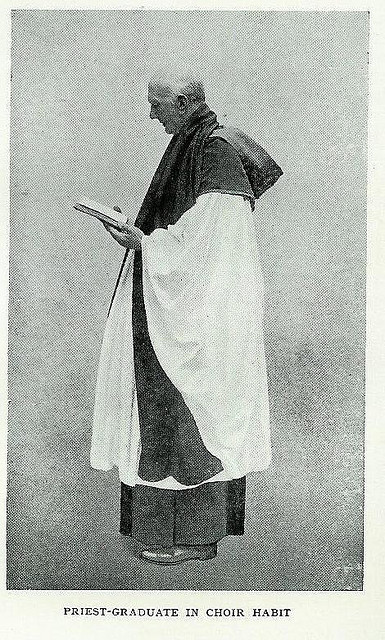
Someone wrote to me asking about Sarum choir dress, at least of secular clergy who are not cathedral canons. For the time being, I can only suspect that the Church of England did not invent a choir habit after the Reformation. In the absence of evidence to the contrary, I assume it was cassock, long surplice, academic hood and tippet.

Choir habit with full Wareham Guild hood (see below for explanation)

Choir habit with “modern” hood (see below for explanation)

Here is what I wrote in the Anglo-Catholic in February 2010:

* * *

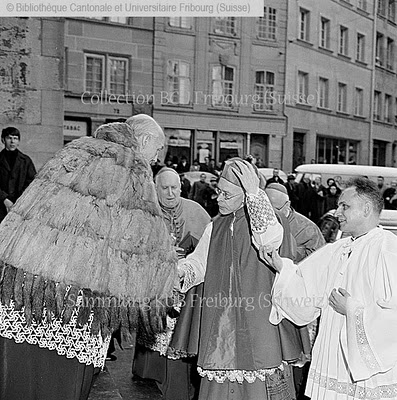
The New Liturgical Movement has just produced a fine article on the almuce, a garment worn by cathedral canons of some dioceses over the surplice or rochet. I read theology at Fribourg University (Switzerland) in the 1980’s and saw canons of the cathedral still wearing this amazing garment.

A comment to this article tells us:

In England the almuce developed into two garments (or a garment in two parts).

The academic hood is descended from the almuce, and also the preaching scarf which has also been know as a choral tippet. An English cleric in choir habit should wear, on top of the surlice, an academic hood to which he is entitled and a black preaching scarf.

Untill the 18th century the hood had a full shoulder cape, but when the clergy affected wigs they could not get the hood over their heads. The cape was split down the front and the garment thrown over the back. Judges still wear the more primitive form of the hood, and wear it with the scarf, which is descended from the pendants of an almuce.

In the 19th century the Warham Guild attempts to restore the academic hood to its former shape. Some robemakers will make a hood in the Warham shape if requested.

British Armed Forces Chaplains of all denominations wear a scarf with chaplaincy badges and medals. Medals because the scarf/tippet/almuce is an ornament of personal dignity and not a sacerdotal vestment – not a stole. Some chaplains have confused this.

Posted in Uncategorized | Tagged , , | 6 Comments

Monastic silence

I made an allusion to silence in my previous posting, and I would like to qualify this badly understood word. It figures with a high profile in the Rule of Saint Benedict:

Let us act in conformity with that saying of the Prophet: “I said I will guard my ways lest I sin with my tongue; I have put a bridle on my mouth; I was dumb and was humbled and kept silence from good things.” Here the prophet shows that if we ought at times for the sake of silence to refrain even from good words, much more ought we to abstain from evil words on account of the punishment due to sin. Therefore, on account of the importance of silence, let permission to speak be rarely given even to the perfect disciples, even though their words be good and holy and conducive to edification, because it is written: “In the multitude of words there shall not want sin.” And elsewhere: “Death and life are in the power of the tongue.” For to speak and to teach are the province of the master; whereas that of the disciple is to be silent and to listen. Therefore, if anything is to be asked of the superior, let it be done with all humility and subjection of reverence, lest one seem to speak more than is expedient.  Buffoonery, however, or idle words or such as move to laughter we utterly condemn in every place, and forbid the disciple to open his mouth to any such discourse.

The world is a noisy and stressful place. We hear a constant hubbub of the sound of machines, human conversation and what passes for “music”. It crosses the air and can be heard even from remote country areas. Nowhere is free from the world’s noise, except perhaps the sea. The sea is wonderful, because at about one league from land, no land noise is detectable to the sailor’s ear. The sounds we now hear are parts of the boat creaking or clanking against each other – which is why I prefer wooden spars to aluminium ones. There is the splashing and gurgling of the water under the boat’s hull, but these are natural sounds. We have entered the cloister of God’s presence. Silence and harmonious sound are very difficult to find.

Monastic life life is often caricatured by monks being portrayed as communicating with sign language and making a vow of silence. The “vow of silence” exists in no community I am aware of, and most monasteries allow “Brother Aidan, please pass me the hammer” or “Have you got a 14 mm spanner for this nut under the tractor engine?“. Then all monasteries have recreation times so that monks can have normal conversation and express friendship, go for walks or engage in sports. Silence is not the absence of sound or of human communication. It is a sense of reserve and economy of our words. Silence is the condition in which we can find prayer and contemplation. We focus on God by shutting out the chatter and noise intended to distract us and prevent us from getting to the essential. When we are parsimonious with words, we will be less likely to commit sins of detraction and calumny!

No religious community practices complete suppression of speech, and even the Trappists have done away with sign language. Speech without sound is no more silent than using your vocal cords and tongue in audible speech. Saint Benedict was concerned with unnecessary and superfluous chatter and talk. I always find the same scene in the supermarket – a group of five or six people so deeply engrossed in conversation that they block the alley and are totally unconcerned for people who might want to get through with their shopping trolley. The conversation seals them into an utterly selfish reality. It is striking. And when there is not enough speech, then there is the boom boom boom of hard rock, techno, or whatever they call it these days.

Here is what Abbot Delatte said about the spiritual value of silence:

When all noise is stilled, imagination becomes less active, thoughtfulness and prayer more easy. In the secret places of our souls there is produced an effect like that which result from the coming of the Angel of deliverance, described in the Book of Wisdom and applied by the Church to the coming of our Lord: “While all things were in quiet silence and the night was in the midst of her course, thy almighty word leapt down from heaven from thy royal throne…” (Wisdom 18:14-15).

There he hits it on the head. The problem is not one of communication or the enjoyment of music (real music I mean), but the role of the imagination. The imagination can make us go very wrong when it becomes sinful. We have to learn to let go, empty ourselves out and let God take over. Our souls need to be that little bit of the sea, far enough away that motorcycle engines and car horns can no longer be heard, and where the little voice can be heard. I discover that silence is about being down to earth and attending to the matter in hand. The word monastery comes from the Greek word monos meaning one. We learn to concentrate, shut out the irrelevant and get right down to the bottom of something. It can be done.

Silence and ordered harmony are precious, and are rare commodities. At least for me, silence is more of a gift than a constraint.

Posted in Uncategorized | Tagged , | 2 Comments