In the light of events surrounding the departure of many Anglicans into the ordinariates and the total side-lining of the Traditional Anglican Communion, we really do need to look yet again into the perils of following Rome in all liturgical practices. More than a century ago, Dr J. Wickham-Legg wrote:
A very little study soon convinces us of the deep division there is between the practice of modern Rome and of medieval England, and that modern Rome will only lead us astray if we trust to its liturgical decisions. Because a practice is Roman, it is not therefore of necessity good, or ancient, or Catholic.
Wickham-Legg understood that the notion of Tradition was fragile in the climate of the Roman Catholic Church since the victory of Ultramontanism. It is quite astounding to consider how so many Anglican clergy have been “aping” Rome for so long, first in the kind of Counter-Reformation-style high campery one used to find in many London and South Coast churches and then in the uncritical following of the Paul VI reform of the late 1960’s and 70’s. Critics of what has been coined as Anglican-Papalism conclude that the notion of Anglican Patrimony has no validity, since Anglicans are simply imitating Roman Catholic practice.
The fundamental difference between many high-church Anglicans appealing to the pre-Reformation English Church and Anglican-Papalists is that the first group sees the need for a kind of Catholicism different from the Counter-Reformation or post-Vatican II Church, whilst the second seeks to affirm that Anglicanism has no validity separate from Rome and that the only policy of value is to overcome the schism. This, incidentally, is the fundamental difference between most of the Continuing Anglican Churches and the TAC.
I am personally of the opinion that the Council of Trent and the Counter-Reformation represented as much of a hermeneutic of rupture as the Reformation and the post-Vatican II era in our own time. It is a fundamentally dialectic vision that creates absolutes and the kind of black-and-white thinking with which many of us cannot relate. The greatest dilemma Anglicans face is Apostolicae Curae and Papal infallibility, and the other greatest stumbling block is women bishops in the Church of England. The game is over. Scylla and Charybdis…
For those who are not Anglican Papalists or willing to accommodate a feminine priesthood, the choice is clearly some kind of “continuing Anglicanism” (which more or less incorporates Protestant formularies from the sixteenth and seventeenth centuries – or a sort of Old Catholicism that refers not to Febronianism and the Kulturkampf, but to the notion of western and eastern Orthodoxy of the first millennium.
The way we celebrate the liturgy is the most visible and symbolic way of manifesting this fundamental difference. Most Anglicans not using either the English Missal or the Novus Ordo use the Prayer Book or the Book of Common Worship, an officially authorised liturgical norm, but not “traditional”. Such Anglicans would often be denigrated by the “advanced” Anglo-Catholics as not being Catholic enough or slowed down by their Protestant roots.
As recently suggested by the Bishop of London, whilst giving his instructions concerning the use of the Roman rite by Anglicans, the Anglican-Papalist movement seems to have had its bluff called by Benedict XVI’s Anglicanorum coetibus and the Ordinariates. This development and women bishops will make for an extremely hostile environment for such Anglicans. The various conflicts in the Continuing Anglican world have their roots in historical rivalry in Victorian England between groups of “branch theorists”, Anglo-Papalists and Protestants. Those interested in reviving the Use of Sarum rivalled the Anglo-Papalists, and in their turn were labelled as practitioners of “British Museum Religion”. Dearmer’s Alcuin Club sought to dress up the 1662 Prayer Book Communion Service with full Sarum ceremonial. Eventually, the Anglo-Papalists would win out with the English Missal and Roman-style aesthetics, and as Rome changed its liturgy in the 1960’s, so did the Anglo-Papalists.
After Vatican II, Anglican Papalism seemed to be concerned for little more than promoting conversions to Rome. With Anglicanorum coetibus, there is no further justification for Anglo-Papalists to remain in the Church of England. It is the same with the Traditional Anglican Communion bishops who in October 2007 signed the Catechism of the Catholic Church and a letter saying that they believed in Papal infallibility and the Pope’s primacy of jurisdiction. Indeed Anglo-Papalists, it is generally believed, lose all credibility if they do not go over, even if some of the clergy are former Roman Catholic priests. Anglicans who have believed and practised in such a perspective can only go that way.
The only way out of this mess is to make up our minds what we are about. If it is bringing Anglicanism into line with Roman Catholicism, then they have only to go over to Rome and follow the conditions, because for Anglican converts, the clock is turned back to the 1890’s. This is why I have opened this new blog to look at another way of seeing our identity. What was the Oxford Movement about? Newman became a Roman Catholic, but Pusey and Keble didn’t. What was the difference? There had been a similar movement in the northern Protestant Churches like the Scandinavian Lutherans – and in nineteenth-century French Catholicism to improve the liturgy. Our American Continuum friends would have a point if they were a little more nuanced and flexible in their definition of classical Anglicanism.
High-church Anglicanism was a serene and intellectual movement, and although it attempted to conciliate the Thirty-Nine Articles and the mutilated rites of the 1662 Prayer Book Eucharist rite, it did not dismiss the pre-Reformation patrimony like the Evangelicals did. The proof of this is the vast amount of scholarship on medieval uses, including that of Sarum, and critical editions of the available liturgical books. They knew the old traditions were different from contemporary Rome and its petrified liturgy replete with faults and copyists’ errors set in Congregation of Rites amber.
However, the Victorians did not dare to revive the Use of Sarum per se. They would have got into serious trouble, and also they were certainly concerned for pastoral considerations. I have not heard of Sarum Masses being celebrated in the Church of England in the Victorian era, but the hundreds and thousands of English altars with riddel posts, curtains and frontals are as many witnesses to a kind of “reform of the reform” (expression coined by Benedict XVI in our own time) movement. Various symbols came to be associated with the English movement, not only the appointment of churches but also acolytes wearing tunicles like in churches just over the other side of the English Channel in places like Rouen and Bayeux.
As it, is with liturgy, so it is with theology and spirituality in general. I see no hope for the English high-church in the Church of England any more than for the Papalists going over to Rome. It is quite surprising to see Roman usages in the Continuing Anglican Churches in America. Even the most viscerally anti-Roman wear violet in Advent and Lent, veil the statues and images only in Passiontide and in violet. When they supplement the Prayer Book, they use the Anglican Missal, which is practically a straight translation of the Pius V Roman missal. So much is taken for granted.
It is for this reason, that some of us take a tremendous amount of courage from the example of the former Lutheran Bishop Roald Flemestad and his new vision involving an older and less polemical and polarised vision of Catholicism. I say no more about this for the time being, but what is plain is that not all Anglicans are aspirant Roman Catholics or Protestants. To open a new chapter in English Catholic history, I would like to propose reading the articles on this page of Essays of Western Rite Orthodoxy. Unfortunately, very few canonical Orthodox jurisdictions are open to western rites and most Orthodox have similar attitudes to converts as conservative Roman Catholics. You can come in if you deny your entire Christian past as worthless or sinful. As far as liturgy and church culture goes, the Western Orthodox vision is of great importance and gives a credible context to the revival of medieval and pre-Reformation liturgical traditions.
I believe our task now is to complete the work of men like Dearmer and go all the way to reviving the Use of Sarum as the normal fare of some churches – which could be celebrated in Latin and also in the vernacular where pastoral needs call for it (people needing time to get used to Latin, etc.). Such work is now impossible in the Anglican Communion, and there is no sign of the Roman Catholic Ordinariates for former Anglicans taking up the challenge. The Continuing Anglican Churches on the whole seem quite hostile to something they consider as simply eccentric or dotty! I have already revived Sarum in my remote private chapel in the Normandy countryside, but I can only do so much alone.
Such an aspiration needs the vehicle of a Church communion established on the basis of Old Catholic beliefs and tenets. We have to pray as though everything depends on God and work as though everything depends on us.

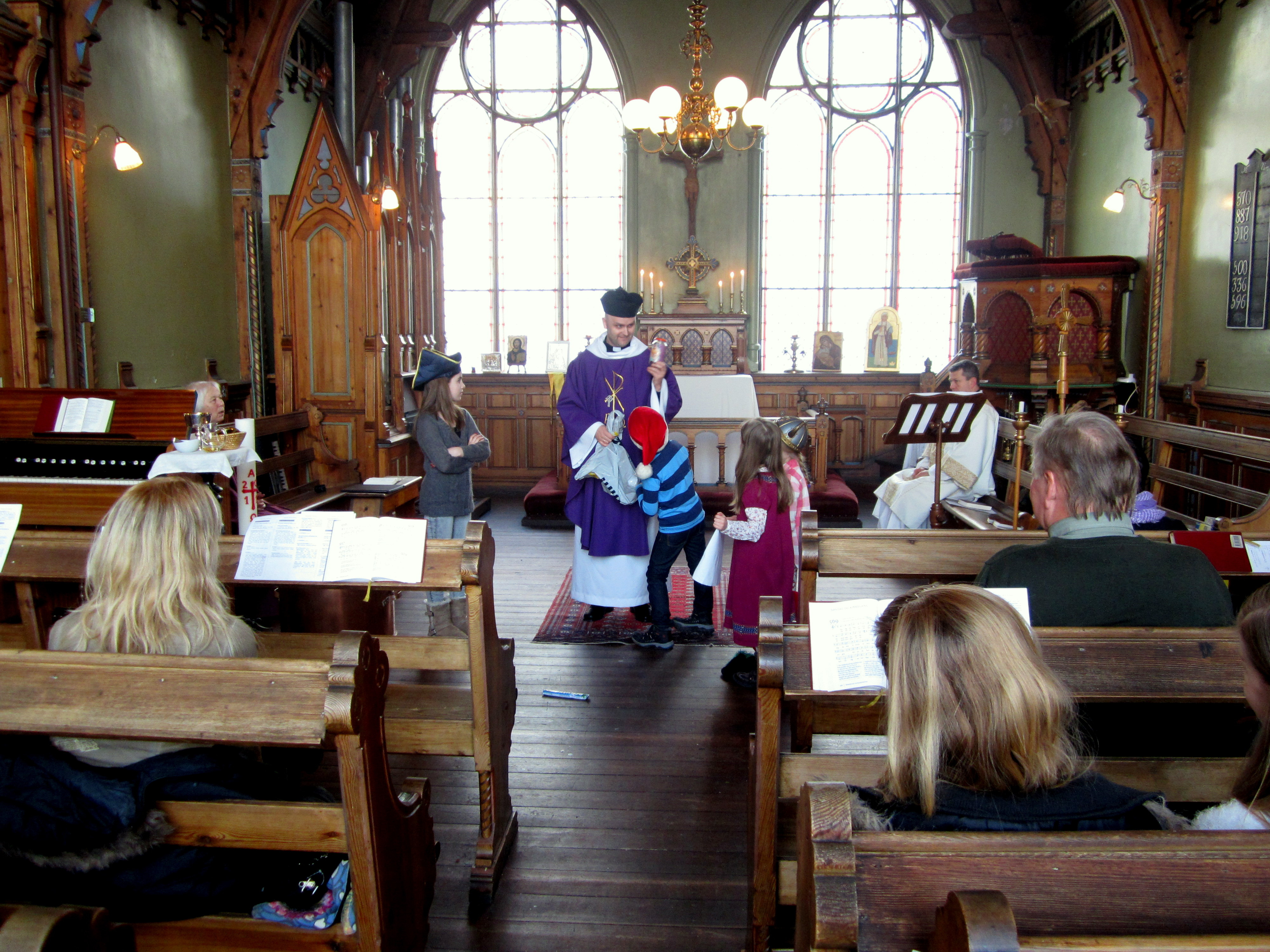 The priest here, Fr Roy Olav, is giving a lesson to the children about Carneval, literally “goodbye to meat” as we go into Lent. The object on the floor is a bar of chocolate lying there as a temptation. Indeed, Lent is about fasting and prayer, the only way to expel demons and sin.



 The Blue Flower