One or Two Ideas…

As I celebrated Mass this morning, as always sine populo, I was aware of a great feeling of gratitude to be at Mass and receiving the Sacrament.

Here in France, Italy and elsewhere, there can be no public Mass. We are spending as much time as possible at home in quarantine. The word comes from the forty days, not of Lent, but the time of the bubonic plague, thirty-seven days from infection to death. According to most scientific opinions, the time of SARS-CoV-2 which is the cause of COVID-19 is about two weeks at the outside, usually less than that. How coincidental that this quarantine coincides with Quadragesima, the forty days and nights Jesus spent in the desert before being tempted by the Devil!

To try to offer comfort to those who are having literally to give up religion for Lent, the most ironic asceticism, I can suggest that people take up the Divine Office from the Prayer Book or one of the traditional breviaries in Latin or English. You don’t need to be in church for that, simply at home at your little prayer corner or shrine.

There is then the notion of spiritual communion, like making one’s confession to God in the absence of a priest. This is a notion that is more common in Roman Catholicism than our Anglican tradition. Many things prevent us from receiving the Sacraments, especially being shut-in at home because of age or sickness or being in some canonical irregularity and still attending Mass without receiving Communion. Whatever, we can all be united with God through prayer. We express our desire to receive God even when we cannot receive the Sacraments. Priests too can fall ill and be prevented from celebrating Mass.

There is no single prescribed form. I can suggest that lay people can recite Mattins and Evensong (Lauds, Vespers and Compline) and use a form of prayer for Spiritual Communion as they prefer.

Here is a couple of examples of such a prayer for being at Mass without being able to receive Communion or being unable to be at Mass for any reason like the present epidemic. Lift up your thoughts with something like the following.

My Jesus, I believe that Thou art present in the Blessed Sacrament. I love Thee above all things and I desire Thee in my soul. Since I cannot now receive Thee sacramentally, come at least spiritually into my heart. As though Thou wert already there, I embrace Thee and unite myself wholly to Thee; permit not that I should ever be separated from Thee. Amen.

At Thy feet, O my Jesus, I prostrate myself and I offer Thee repentance of my contrite heart, which is humbled in its nothingness and in Thy holy presence. I adore Thee in the Sacrament of Thy love, the ineffable Eucharist. I desire to receive Thee into the poor dwelling that my heart offers Thee. While waiting for the happiness of sacramental communion, I wish to possess Thee in spirit. Come to me, O my Jesus, since I, for my part, am coming to Thee! May Thy love embrace my whole being in life and in death. I believe in Thee, I hope in Thee, I love Thee. Amen.

Posted in Uncategorized | Tagged , | 1 Comment

In Time of Epidemic

The announcement is made and France goes into Stage 3 of the anti-epidemic plan as of this night. Only food shops, pharmacies, banks, tobacconists and petrol stations can stay open. All other public places are shut. We are asked to stay at home except for reasons of work (I work from home). My wife will go to Rouen on Monday by car (taken there by one of the lawyers of the practice and brought back by me in the evening) to do some things that have to be done in the office, and will make pdf files from the various documents of the cases she has to deal with to work on at home for the rest of the week. She will not travel by train or bus. For some two weeks (or more), we will be holed up at home.

We got the essential shopping done about two weeks ago, supermarket and chemist’s shop, including pasta and toilet paper when no one else even thought of it. For the toilet, we can economise on paper by using one small piece and then use the shower as a bidet, washing with soap and hot water. For some time, we have avoided the bise (kiss on each cheek) and shaking hands. Hand washing is essential each time we go out, go into a public place, touch anything like a stainless steel surface. We have little bottles of hand sanitiser gel in our pockets and avoid touching the car before doing the hand wash. Sophie and I started getting concerned long before people stopped laughing it off as a gripette (little flu) invented by someone perverse for the purpose of some wicked conspiracy.

Our civil authorities have taken time to come to such serious decisions. President Macron here in France spent all last Thursday with doctors and scientists to make the best decision. He spoke as a true statesman and exhorted us to a sense of altruism and responsibility. I don’t know how long this is going to last. The worst and most worrying time will be the next two weeks.

I am used to staying home most of the time. We are groaning out of a long, mild and wet winter and I haven’t sailed since last August. So far, my translating work seems to be holding, as my agents are working from home and it all works via e-mail and internet. I have plenty of reading to do, and I have lots of practical things to do as the weather begins to improve next week (hopefully). The only danger to life is other people, something that goes against our every human social instinct.

There is no vaccine for this disease and none of us has any natural immunity. If I catch it, I may be lucky and be within the 80% who recover, otherwise my way out of this world might be little different from that of Novalis who died of consumption in 1801. I can only trust in God and his mercy in this Lent of 2020. My wife Sophie has weak lungs, having had a mild bout of pneumonia a few years ago and is mildly asthmatic. We are both ex-smokers, but it is said that lungs repair themselves very quickly once a person stops smoking, which I did in 2006. We all have to pray for each other and behave in such a way as to protect both ourselves and others from ourselves.

These measures are for our good. I am very thankful to be in France where our freedom and human sense of duty are respected. We have an excellent medical system, but one that cannot bear being overloaded. France should be an example for America and the UK. I fear that in England, little will be done to enable people to work from home, pay the bills and mortgage and get the medical help they need. Perhaps the cold realism of science will prevail.

Please follow the usual advice of social distancing, keeping distances from other people, getting used to refraining from gestures of courtesy, and above all washing your hands with 70° alcohol, soap and water. There are no miracle cures. Do not believe anyone on Facebook or anywhere else who pretends to have a miracle cure!

After all these practical considerations, we can only pray to be spared from this scourge, which can kill young healthy people as well as the elderly with health problems. Some will say it is a punishment from a vengeful God. That is not something I believe. Evil and adversity are a mystery that few can even begin to penetrate. Some evil is wreaked by human freedom and other calamities come from nature and are suffered by mankind. The idea sometimes put out about Covid-19 is that it was manufactured in a laboratory in Wahun, China, and somehow “escaped”. I am sceptical and have no way of knowing one way or the other. Even the most perverse countries have refrained from biological warfare because it can come back against them instead of destroying their enemy. It is not productive to think along these lines. The virus exists, and we might catch it!

We pray for God’s help and healing of our stricken humanity. I end this posting with the Sarum proper of St Sebastian in Time of Plague

Missa de sancto Sebastiano, tempore pestis

Officium
Egregie martyr Sebastiane, princeps et propagator sanctissimorum præceptorum, ecce nomen tuum in libro vitæ cœlestis ascriptum est: et memoriale tuum non derelinquetur in sæcula. Ps. Benedicam Dominúm in omni tempore. Gloria Patri. Egregie martyr.

Oratio
Omnipotens sempitérne Deus, qui meritis beati Sebastiani martyris tui gloriosissimi, quandam generalem pestem epidemiæ hominibus pestiferam revocásti; præsta supplicibus tuis, ut qui pro simili peste revocanda ad ipsum sub tui confidentia confugerint, ipsius meritis et precibus ab ipsa peste epidemiæ et ab omni tribulatione liberentur. Per Dominum.

Epistola
Lectio libri Sapientiæ.Ecclus 14:20, 15:3–6
Beatus vir qui in sapientia morabitur, et qui in justitia meditabitur, et in sensu cogitabit circumspectionem Dei. Cibabit illum pane vitæ et intellectus; et aqua sapientiæ salutaris potabit illum. Et firmabitur in illo, et non flectetur: et continebit illum et non confundetur; et exaltabit illum apud proximos suos. Et nomine æterno hereditabit illum Dominus Deus noster.

Gradale
O sancte Sebastiane, Christi athleta gloriosissime, qui pro Christo reliquisti terrene militiæ principatum et, suscepisti magnum supplicium intercede pro nobis ad Dominum.
℣. O sancte Sebastiane, Christi martyr egregie, cujus meritis tota Lombardia fuit liberata a pestis mortifera, libera nos ab ipsa et a maligno hoste.
Alleluya, ℣. O sancte Sebastiane, nos trementes ac flentes imploramus tuum clemens auxilium ut possimus obtinere per te pestis mortiferæ apud Christum remedium.

In tempore Paschali, Alleluya. ℣. O quam gloriosum est templum tuum, beate Sebastiane, in quo divina est promissio et peccatorum remissio, splendor et lux perpetua et sine fine lætitia.

Sequentia
Omnes una decantemus,
et martyris personemus
laudem Sebastiani;
hic a Deo est electus,
per quem morbus est ejectus
languoris pestiferi.
Nam se Christo totum vovit,
qui vult nos hunc venerari;
Christus eum nunc promovit
in patria cœlesti.
Cunctis hic subvenit mœstis,
statim est sedata pestis,
sui causa meriti;
ipsum si nunc deprecemur,
nomen quoque veneremur
martyris sanctissimi,
Morbus iste non nocebit,
sed mortiferum delebit
populum qui tenuit;
nos pro nostris tantis malis
jam absorbet pestis talis,
quam tota gens gemuit,
Sancte martyr Sebastiane,
salva nos a peste epidemiæ;
nostra gravia ob peccata,
terra ista desolata
non sit, pie quæsumus;
sed nos considera,
et in nobis cessa,
pestem jam te petimus.
Ista per te gens sit tuta,
et ne noceat acuta
febris hæc in Anglia;
ex quo nostra spes est tota,
in te martyr, nunc remota
sit pestis mortifera,
O sancte Sebastiane,
nostræ gentis Anglicanæ
conservator et tutor sis;
et Dominum deprecare,
ut a nobis revocari
valeat vesana pestis.
Ex tua sancta prece
ne sit morbus nobis nece,
sed recedat ab hac domo;
amen, dicat omnis homo.

Evangelium
Sequentia sancti Evangelii secundum Johannem.12:24–26
In illo tempore: Dixit Jesus discipulis suis; Amen, amen, dico vobis, nisi granum frumenti cadens in terram mortuum fuerit, ipsum solum manet. Si autem mortuum fuerit, multum fructum affert. Qui amat animam suam, perdet eam: et qui odit animam suam in hoc mundo, in vitam æternam custodit eam. Si quis mihi ministrat, me sequatur: et ubi sum ego, illic et minister meus erit. Si quis mihi ministraverit, honorificabit eum Pater meus, qui est in cœlis.

Offertorium
Martyr egregie, decus militiæ, athleta fidei, ora Natum Dei, ut avertat a nobis indignationem suam; martyr suffragia effunde pia, ut epidemia nec sit noxia in hac patria nec in alia, per subsidia posce tua; nos tibi talia damus praeconia, hic prece præmia da nobis pia, miles eia, alleluya.

Secreta
Subveniat nobis, Domine, tua misericordiam intercedente beato Sebastiano martyre tuo; ut ab imminentibus peccatorum nostrorum periculis, te mereamur protegente salvari, et suis precibus a peste epidemiæ, et ab omni tribulatione liberari. Per.

Communio
Beatus es, et bene tibi erit, egregie martyr Sebastiane: quia cum sanctis gaudebis et cum angelis exsultabis in æternum.

Postcommunio
Da, quæsumus, Domine, populo tuo salutem mentis et corporis; ut, interventu beati Sebastiani martyris tui, bonis operibus inhærendo tuo semper munere et suorum meritorum interventione, a peste epidemiæ et ab omni tribulatione mereamur, tua protectione defendi. Per Dominum.

Posted in Uncategorized | Tagged , | Leave a comment

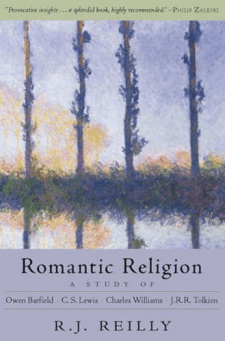
Reilly’s Romantic Religion

I have just begun to read R.J. Reilly’s Romantic Religion which is certain to make something I wrote with a similar title pale into insignificance. However, when I wrote Romantic Christianity, I was unaware of the existence of Reilly’s book. He planned his work around the four well-known twentieth-century literary figures J.R.R. Tolkien, C.S. Lewis, Owen Barfield and Charles Williams. I went from a more historical point of view and added my own thoughts. I am sure that I am promised a fascinating read with this book.

From the write-up to which I linked, I quote:

The title Romantic Religion reflects Reilly’s premise that these four thinkers share a “matured romanticism.” For them, creative imagination is central, with literary and religious views intimately related.

Matured romanticism? Certainly these four men in the twentieth century had a more profound vision than some of the nineteenth-century men Bouyer so acidly criticised for their lack of intellectual depth. When I finish this work, I intend to read Louis Bouyer’s Memoires,which were published posthumously. Indeed, Dr William Tighe warmly recommended this work. I also need to find a copy of Dom Alcuin Reid’s The Reformed Liturgy: A ‘Cadaver Decomposed’? Louis Bouyer and Liturgical Ressourcement, in: Antiphon 16 (2012). I have a suspicion that Bouyer also evolved since his days on the Vatican II committees of liturgical experts.

Just give me time to get through these two substantial tomes. There is a third! Today I found Bouyer’s Cosmos, The World and the Glory of God in my mailbox. I also need to wade through Vögelin’s Science, Politics & Gnosticism to understand what he understood about Gnosticism in order to blame it for all the evils of the modern world. Quite a few right-wing conservatives have their whipping boys, and need to be approached critically.

So, a lot of reading to do…

Posted in Uncategorized | Tagged , , | 3 Comments

Romantic and Patristic Liturgy in Louis Bouyer

The work of Louis Bouyer (1913-2004) was a unique contribution to French ressourcement theology. A convert from Lutheranism and a French Oratorian, he followed John-Henry Newman in many ways, inspired by Newman’s patristic approach rather than a slavish conversion to Scholasticism. He was particularly keen on Scripture and the Fathers. He was also intensely interested in Dom Odo Casel’s Mysteriumslehre, and the Church’s liturgy bringing about the entire mystery of Christ according to a Platonist notion of metaphysics and sacramental theology.

Bouyer took an active part in the work of Vatican II and aspired towards a restored liturgy inspired by patristic sources and notions. The spirit of the post-war French liturgical movement can be seen in many churches from the era with the abolition of any distance between the nave and the sanctuary. The result was the modern Roman Catholic liturgy celebrated on an altar facing the people and a considerable amount of licence for abritrary modifications. By 1968, Bouyer saw where it was all going as he wrote La décomposition du catholicisme with its memorable quote:

La liturgie d’hier n’était plus guère qu’un cadavre embaumé. Ce qu’on appelle liturgie aujourd’hui n’est plus guère que ce cadavre décomposé.

Yesterday’s liturgy was little more than an embalmed corpse. What we call liturgy today is little more than the same corpse in a decomposed state. Bouyer was quite waspish in his criticisms, but never far from the truth. Since I am quite enamoured of Romanticism as a world view, I find that Bouyer was critical of it in its early nineteenth-century form, even though it sought a new way out of the ultra-rationalist baroque world view of before the French Revolution. In particular, he wrote on this subject in his second chapter of La Vie de la Liturgie, Paris 1957.

Bouyer’s motivation is seen in his Lutheran background, a desire to tear the liturgy away from the sentimentalism of the nineteenth century and the early part of the twentieth. He wished the liturgy to be more biblical in its language. It was to be pastoral in character, and involve the active participation of the faithful, therefore no more choir screens or elitism in the sanctuary. He advocated the vernacular, emphasis on Communion, concelebration in religious communities, reform of the breviary and calendar and stripping down of decorative aspects in churches. Most of us have seen the results with whitewashed and minimalist churches. Bouyer was also for rolling back the history of the liturgy to the patristic era, and thus joined the Jansenists of the era of the Synod of Pistoia (1786). Paul VI would have been thrilled by these ideas as he worked with elements of the Roman Curia like Annabile Bugnini (1912-1982). However, by the mid 1960’s, Bouyer became distanced from other elements of the liturgical movement and became highly critical. See An Artist at Vatican II by Francesca Aran Murphy which contrasts Bouyer from the “philistine” Bugnini. Also read Fr Louis Bouyer on the Liturgical Reform and Its Architects.

I now come to the notion of Romanticism in the liturgy, at least in the way Bouyer understood the word as simple nostalgia for the past. His criticism is certainly at the root of the so-called “barrier” I allude to when observing a large number of people showing interest in the Sarum rite, but being unwilling to consider its actual restoration. For Bouyer, reconstruction was not an option, nor was continuing with the Tridentine liturgy, nor was the “decomposed corpse” of Roman Catholicism in his later life. On the other hand, perhaps he was also being critical of those who wanted to revive Ordo Romanus Primus and the Gregorian Sacramentary. That was precisely what Dr Ray Winch in Oxford wanted to do in an Orthodox context. The older the liturgical source, the more scant the documentation will be, and therefore there will be a need for speculative reconstruction.

We are brought to consider the quote from Göthe’s Faust:

Was du ererbt von deinen Vätern hast,
Erwib es um es zu besitzen.

What you receive from your father, earn it anew before you call it your own. Perhaps that is a perfect meditation for the rest of this Lent! If we also reflect on the darkness preceding any new middle-age, the destruction of the liturgy brings us to consider living without it until it grows again from our faith and desire for the Kingdom. However, that destruction was no more the fault of most of us living today than the mass murder committed nearly a century ago by the Nazis. Some measure of compromise is called for.

For Bouyer, Romanticism was essentially nostalgia for the middle ages. Perhaps it was in the eyes of some of the French liberals and traditionalists of the early nineteenth century. He lifted the aestheticism of some out of the mish-mash for criticism, saying that the gothic style could not be a permanent achievement in history. He did recognise that Romanticism characterised the medieval period as being:

that sensitiveness to Christian feelings and Christian motives so conspicuously lacking in the Baroque, and, since it possessed this sensitiveness, the medieval period was taken to provide a clue to the true significance of the liturgy itself. Hence the frenzy for Gothic everywhere—Gothic buildings, Gothic vestments, Gothic singing, Gothic poetry and romance, and so on.

Man sought his lost innocence as we do today. The apologetics of Chateaubriand or Lamennais leave much to desire in their theology. The Germans and English Romantics seemed to be more substantial in intellectual terms. The Roman Catholic institution is no more indefectible than it has proved to be at the time of the French Revolution or now. (Yes, I know about the argument of the “faithful remnant” – which is irrelevant to me since I am not a Roman Catholic.) Here I agree with Bouyer in that Romanticism without any real intellectual or cultural foundation is little more than childish sentimentalism. In the early nineteenth century, France was essentially a ruin in terms both of feeling, critical reasoning and science. However, there were as many Romanticisms as Romantics!

He rightly lambasts traditionalism as made famous by Chateaubriand and Lamennais which took sola tradition as opposed to rational and critical knowledge. Thus, tradition itself could only be condemned to wither away. In my own attraction to Romanticism, it has not been to French traditionalism or sentimentalism, but more towards the robust German idealist tendency. Returning to my subject, Bouyer went from this fundamental criticism of French Romanticism and traditionalism to another character in this same school, Dom Prosper Guéranger (1805-1875). Dom Guéranger was an ultramontanist as many of the French liberals were. Better to have an episcopal despot thousands of miles away than on one’s own doorstep! He advocated the Tridentine missal (and the monastic breviary) but with the

restoration of Gregorian Chant, scrupulous observance of the rubrics of all the ceremonies, and, above all, a sober and dignified kind of celebration neatly pruned of all those theatrical additions by which Baroque practice had been altering and ruining the lines of the liturgy.

It is also possible to sympathise with Bouyer’s criticism of neo-gothic architecture with its nineteenth century industrial accuracy. Viollet-le-Duc and Pugin did tend to gild the lily and over-decorate their creations.

I contrast this notion of the illegitimacy or restoring the past with my own sentiment, that of leaving the trappings in their secondary position and seeking to make the best of an impossible situation of being able to do nothing at all. Everywhere you turn, there is an obstacle. I am reminded of the sadistic punishment meted out by Gilbert and Sullivan’s Mikado to those who cheat at games:

The billiard sharp whom anyone catches,
His doom’s extremely hard:
He’s made to dwell in a dungeon cell
In a spot that’s always barred.
And there he plays extravagant matches
In fitless finger-stalls,
On a cloth untrue
With a twisted cue
And elliptical billiard balls !

Perhaps some would like God to treat us all like that, leaving us with something totally insoluble and impossible!

The Romantic period in France was insufficiently critical of baroque piety as the emphasis of eucharistic devotion over the liturgical actio and communio. Guéranger the ultramontanist was unjustifiably critical of the diversity of diocesan rites, though it is easy to understand his position on rational reductionism and the abolition of a sense of the sacred and wonder. Some of the Neo-Gallican rites were quite un-traditional and arbitrary, but to a lesser extent than the modern minimalist liturgy. Guéranger was influenced by Lamennais until the latter was condemned for his Liberalism by Gregory XVI in Mirari vos. That must have been a desperately bitter blow!

The assumption made by Guéranger that the Roman liturgy as being the only purely and perfectly Catholic of all the Christian liturgies is a notion we meet today with conservative Roman Catholics. I would give Bouyer that one, but I baulk at Bouyer’s condemnation of the influx of parts of the Gallican liturgy into what eventually became the codified Roman liturgy of 1570. Did Guéranger make a distinction between the Neo-Gallican liturgies of the seventeenth or eighteenth centuries and older local usages? I would need to return to Les Institutions Liturgiques to research the question. That being said, I can only trust Bouyer in his affirming that Guéranger made some serious historical errors in his work. I studied Guéranger’s work when I was up at Fribourg, and remember that he played fast and loose with historical fact. At the same time, he was one of the first to begin to lever the liturgy out of its rubricist sarcophagus.

Bouyer is most insistent on the intellectual hollowness, as he perceived it, of French Romanticism. He understood Romanticism as a rejection of Enlightenment rationalism. As I understand it, the Revolution itself destroyed the rationalism that gave it birth, and (some) Romantics sought to complete rationalism with the faculties of the whole human being. Returning to the monastic liturgical movement, other monks like Dom Lambert Beauduin and Odo Casel in Germany took on Guéranger’s lagacy with a greater intellectual robustness and rigour. Even there, Bouyer was critical of the idea of the monastery being made for the liturgy (which is central in the Rule of St Benedict) rather than for the congregations of parish churches.

If not to medievalism, where? The real historical medieval period led to Protestantism as the baroque liturgy led to neglect and the virtual death of European Catholicism. Bouyer was a fan of Jungmann’s Missarum Sollemnia, affirming the inadequacy of the medieval liturgy. Especially at fault were the medieval Expositiones Missae and allegory. Where was Jungmann the Jesuit going? I took in many of these ideas under the influence of my tutor as I was writing my piece on the Tridentine missal, an abridgement of which went into Dom Alcuin Reid’s Companion to Liturgy. Where was anything going? Subjectivity? Objectivity? Personalism? Collectivism?

Perhaps Bouyer himself realised that he was going nowhere, that the modern Roman liturgy did not produce a general renewal (even if some parishes using it are very dynamic in the USA and some European cities). Bouyer was above all a theologian interested in the Fathers, and who wrote fascinating books on Gnosticism, Sophiology, various biblical themes and philosophy. In spite of his acidic polemical criticism, he is one of my favourites. He was a fan of Dom Odo Casel and his theory about the Kultmysterium, the Mystery of Christian Worship.

This gave a theological basis to the liturgy, as in some of the Russian Orthodox theologians like Boris Bobrinskoy. It represented a shift away from an Arisotelian metaphysical basis to that of Plato. The Mystery was expanded from the pascha – passio to the entire salvific work of Christ including the future Parousia. Much of this theological consciousness was gone by about the thirteenth century and almost totally now. I would then ask the question of whether anyone can produce evidence that there was ever a time in history when the ordinary faithful were in any way articulate in matters of liturgical theology! Monks perhaps, but ordinary churchgoers? I would doubt it.

Was not Dom Casel also a Romantic? From his writings (I read them in English or French translation), I would see that frame of mind – but as it was incarnate in Germany. Bouyer was French and saw everything through that lens. However, Bouyer does wonder whether looking to the Fathers was not also an exercise in Romantic nostalgia like for later periods.

Were this true, it would hardly matter which historical period was used as the norm for such a hopeless endeavour! For if the stubborn rejection of the Church and the world as they are today were held to be the necessary preliminary to any authentic liturgical renaissance, this fact in itself would certainly constitute the most perfect condemnation of that renaissance.

Bingo! Bouyer and I both see the point: where can we go?

What we can do is to look to the “high” periods of history for inspiration and use them as parables like Novalis did in Die Christenheit oder Europa. I see this in the Arts & Crafts movement which was clearly inspired by medievalism and Romanticism, yet the result was of a “noble simplicity” like Beuronese art. Liturgy is not about reproducing the past or archaeologism but finding what is of enduring value. This is why I have no scruple about celebrating a Sarum mass in Roman vestments and with the baroque French chalice I was given for my ordination.

Cardinal Ratzinger who became Pope Benedict XVI is very much a part of this ressourcement school of theology to which Fribourg University introduced me. He coined the expression reform of the reform to mean the improvement of the modern Roman liturgy as is found with the Ordinariate rites with material from the Anglican Prayer Book and as done with great solemnity in the various English Oratories of St Philip Neri and French Benedictine abbeys where the spirit of Dom Guéranger continues to this day. I understand Benedict XVI’s position as trying to make a silk purse out of a sow’s ear, doing something with what he has on board. However, I would be no more satisfied in such an approach than Dearmer stuffing out the Prayer Book Eucharist as he advocated in the Parson’s Handbook. What I do advocate is taking the very complete texts we have of the Sarum and various French rites (of before the Neo-Gallican craze) and bring them into our time with little in the way of being too fussy about exact details of trappings.

Our time is one of weakness in our gnosis and faith, and it is no time to think about inventing a new rite without it being a banal representation of secular life. Our time is too deprived of spiritual references for it to be possible to inculturate the Christian message into modern secular life. This is where Romanticism in a moderate and intellectually robust version is needed to weather the storm and withstand the vacuity of most institutional Christianity. Lessons have been learned in both Roman Catholicism and Anglicanism since the 1950’s when Dix wrote The Shape of the Liturgy alongside Bouyer’s aspirations to similar ideas both sides of the Channel. We have the benefit of bitter experience and no longer so things with their naivety.

Those who are parish priests, and those of us whose ministry it is to study and write, have a duty of educating our faithful. We need first of all to teach the hermeneutic keys of Scripture as Origen indicated – not only literal and historical, but also allegorical, moral and spiritual. The liturgy alone will not accomplish this task. They need catechesis, mystagogical catechesis and notions of church history. Education is absolutely essential for anyone who aspires to follow Christ and belong to the communion of the universal Church. Thus, we can be acculturated to the liturgy and not need the liturgy to be banalised and demolished for short-term ends.

Bouyer was writing from the point of view of his time, especially the 1950’s and 60’s, and made many mistaken assumptions as time proved. His essential intuitions are profound and germane. We have much to learn from reading his many books.

Posted in Uncategorized | Tagged , , , , , , | 7 Comments

Transitus Domini

I would like to share with you a blog version of a seminar I prepared when I was up at Fribourg. This is a subject that is highly appropriate for Lent as well as Holy Week and Easter. At the time (16th February 1988) I wrote a twenty-five page study on The Theological Themes of the Easter Vigil from texts of the first five centuries. It represents an introduction of liturgical theology into our western minds. My tutor, Dr Jakob Baumgartner, had extensively studied the teachings of Melito of Sardis, especially Peri Pascha, a second-century homily on the mystery of Easter. It is quite heady stuff including some very precise ideas of biblical hermeneutics and exegesis. I have considerably abridged the text here and removed the Greek expressions, with the intention of it being of interest to Christians outside university faculties!

* * *

  1. Christian Easter and the Jewish Passover

Continue reading

Posted in Uncategorized | Tagged , , | 2 Comments

Traditional Anglican Church in Britain

I have just received an e-mail from Fr Michael Gray of the Traditional Anglican Church in Britain, containing the following:

We have been trying to make a fresh start on a web site since the previous one was corrupted.

The current draft site (Traditional Anglican Church in Britain) is (…) supervised by our Bishop Ian Gray.

They like us in the ACC are workers in the Lord’s Vineyard, and they have my warmest wishes. Though I haven’t seen him for some time, I esteem Fr Michael Silver as a friend and a kindred mind.

Here is a shortcut to their 2019 news about their Synod.

I offer them my prayers and hearty Christian love, and of course every encouragement for efforts made in the ecumenical dialogue and the present movement towards unity.

Posted in Uncategorized | Tagged , | 3 Comments

Anglican Catholicism, a twitch upon the thread

I have been looking at a fascinating thread on the Anglican Ordinariate Forum on Facebook. Some of those people reflect well, among those of a more fearful disposition. I will try to give a general gist of some of these ideas.

Before going any further, I should carefully qualify the use of the term Anglican Catholicism. The institutional Church I belong to as a priest is the Anglican Catholic Church, a legally protected title which may not be usurped by someone who does not belong to our Church. However, the term Anglican Catholicism is also generic and is often used by Ordinariate people in this broad meaning.

The discussion was initially about whether Ordinariate people should continue to use the term Anglican Ordinariate. The notion of Anglican can either be an adjective to describe a particular kind of Catholicism (whether or not in formal canonical communion with the Pope) or the Reformation reaction from Rome with the idea of founding a more evangelical community of Christians. There will never be one answer to this question because of all the different churchmanships in existence.

I will not go into questions of internal policy of the American, British or Australian ordinariates. That is none of my business and they do what they know to be best for them. However, some of the comments go into the famous Anglican patrimony or questions of identity. To some extent, some of these questions can be felt in the Continuing Anglican world. The circle the Ordinariate folk have to square is being full members of the Roman Catholic Church whilst retaining aspects of Anglican identity that do not conflict with the RC Church’s dogmatic teaching. Eastern Rite uniates have the same issue, except that their position has been defined for a much longer time.

The big problem is defining Anglicanism as a version of Protestantism or the result of a Catholic revival (under the influence of Romanticism) within the English and former Imperial establishment of what remained of the Pre-Reformation Church.

To quote from my own recent book A Twitch on the Sarum Thread,

What I find so tragic is that never were the Anglicans and Roman Catholics so close spiritually and culturally than in that period shortly predating the paroxysm of Roman triumphalism and the authoritarianism of Pius IX. The Anglicans sought their medieval roots, and the Roman Catholics sought their Recusant heritage, both from exactly the same source.

It is quite a fanciful idea because at the time, in the mid nineteenth century, as a correspondent wrote:

I would say at the time the Anglican Church was insufficiently Catholic and the Catholic Church was insufficiently English.

I think that much of the circle-squaring difficulty is exactly there. We English need to be less insular, and the Roman Catholic Church needs to cater more for local identity as it tries to do outside Europe. Europe’s identity is not uniform, and has never been. It is a question both of culture and belief.

In the FB thread, a criticism comes up of Anglo-Catholics (going to Rome) wanting to go back to Sarum and the Pre-Reformation Church and ignore the old High Church heritage. Frankly, I do not see an opposition there. I prefer a Romantic Middle Age than the idea of jumping into a time machine and setting the controls to somewhere in the fourteenth or fifteenth centuries, because we might not like it on getting there. Help! I have an infected cut and need antibiotics!!! I believe the Tractarians were interested in both the Romantic dream and the work of their predecessors in the post-Reformation times. This is how I see the Catholic revival, which does not exclude the theological and spiritual monuments of the Caroline Divines, the Non-Jurors, the old High Church Anglicans, etc.

That being said, many experiments have been tried with the liturgy, notably mixing elements of the Prayer Book and the post-Tridentine Roman rite to make the English Missal and the Anglican Missal. To what extent are these hybrid liturgical forms truly a part of Anglican patrimony, rather than reviving the best documented pre-Reformation rite – Sarum? I have my opinion, but that is not strong enough to represent a definitive answer to this question. Also, local Catholic patrimony is not about the exact words used in the liturgy or the trappings like church architecture and vestments – but the whole in a universal diversity.

To some of the Ordinariate people who have idealised or romanticised the Church they joined, they desired some “insurance policy” against the realities of ordinary parish life and the general kind of modern liturgy they would find in most street corner churches. The reality must have seemed a little less forbidding in the Benedict XVI era. It is always the convert’s dilemma, embracing the ideal whilst living with the post-Vatican II reality. Unenviable, unresolvable and something I lived through for too long. But, I can only speak for myself and those who have had similar experience.

One person made an extremely interesting point about particular identity as opposed to “bait-and-switch assimilation” by those in the Roman Catholic Church wanting absolute uniformity. Even more than Roman Catholicism in England, American Roman Catholicism has always been a “melting pot” and a system of conformity. “Romanitá can so easily be the elephant that swallows the Anglican Ordinariate flea, and does so without even intending to“. It was essentially the issue that caused the scission of the Polish National Catholic Church in the 1900’s. Ironically, the hegemony did not represent the feeling or look of native Italian Catholicism. Back in 2010-12, some of us looked at the small print and did not buy the sales patter, especially when our own archbishop was not being very truthful about the details.

Another comment distinguishes ethnicity – ἔθνος and ethos – ἦθος. Though Christianity is meant to be universal and above local differences, ethnicity and religious identity are inseparable for many. In the Eastern Orthodox tradition, this tendency when carried to extremes is called phyletism. As a native Englishman, I have been accustomed to the deep cultural differences between the North and the South, and experienced them very vividly in my youth. I am a northerner, but was attracted to the cosmopolitanism of the south rather than what I perceived as the narrow parochialism of the northerners, especially the older generations. I ended up out of the country and in another country whose culture is so close yet so far from my origins. Now, my origins are a part of my eschatological Sehnsucht.

Why remain an Anglican? With my experience, it is not so much remaining an Anglican but embracing an older form of Catholicism transcending both the Reformation and the Counter Reformation. I am a cradle Anglican and only spent about fifteen years of my life as a Roman Catholic. During that time, I was preoccupied with local traditions and “natural” folk Catholicism, Christianity dans son jus. Most of the medieval churches around where I live reflect the Norman uses as much as their English counterparts witness to Sarum, York and other local liturgical traditions. The choirs are long, adorned by choir stalls and stools for the coped Rulers. Where the rood screen disappeared, it was replaced by the Poutre de Gloire. The same kind of church layout extends to Brittany and Burgundy, even further. These churches are Roman Catholic, but first and foremost are the churches of their localities. Before the 1850’s, they represented diversity and pride in what was their own, the spirit of the community. After then, Ultramontanism crept in with post-Tridentine uniformity and rigid rubricism. However, the memory was more recent than the equivalent in England – the 1550’s when recusants were persecuted and martyred.

I don’t know what would be a better term. I am Anglican because I belong to an Anglican Church, under the jurisdiction of its bishop in England. I come from Anglicanism and identify with the native northern European culture rather than the Papalism of the nineteenth century that sought to crush Gallicanism and the various theological and philosophical tendencies grouped together in the category of Liberalism. We should be united in our diversity. There are Old Catholics and other communities with similar names that were founded on similar ideas like opposition to an exaggeration of Papal authority and a desire to represent the local Church as upheld at the Council of Constance in 1414-1418. Names are both generic and proprietary, simply conventions to enable human minds to make distinctions. In reality, we are already one Church, because the universal Church, like a Platonic Universal Idea, cannot be divided. The Blessed Sacrament can be broken up into any number of pieces, but Christ is indivisible. As we sing in the Lauda Sion on the Feast of Corpus Christi:

Fracto demum Sacramento,
Ne vacilles, sed memento,
Tantum esse sub fragmento,
Quantum toto tegitur.

Perhaps I should be the first Bishop of the Romantic Medieval Church! No, I am joking because such a denomination would be absurd. Some of our vagantes friends might add more adjectives! No, we have to stay in the Church or in any institutional community in which the Catholic Church subsists. I had quite enough of absurdities and pseudo-clericalism. I have never been happier than as a simple priest under the spiritual fatherhood of a good and pastoral Bishop. This is also a part of our patrimony that is shared with Catholicism everywhere in which nobility of spirit and generosity prevail.

I have no definitive answer for the use of words and labels, for the über-rational spirit of some Americans (and English too). We have not to forget to reason with our imagination and our profound feelings and intuition. Let us stand on that breakwater at Viana do Castelo facing the great ocean *, and contemplate the black storm with its angry wind and waves. From that darkness comes light and truth…

* * *

* I allude to a moment during a family holiday in Portugal when I was 12.

Posted in Uncategorized | Tagged , , , , , , , , | Leave a comment

Radical secularisation?

I have been having more of a look through the website of the Nordic Catholic Church, and in particular a short posting by Bishop Flemestad on The Church of the Future. The thought appears to be cogent, since it is a meme that has gone around the Roman Catholic and Anglican world for decades. I remember my seminary days in Rome (1985-86) at the Nepomucene College with a very dour American community called the Oblates of Wisdom. Msgr John F. McCarthy and Fr Brian Harrison still have a study center in America, and their writings are always interesting. Alongside this community, there were also a few French and Swiss seminarians and priests studying at the Angelicum after having left the Society of St Pius X. Hardly a day went by without hearing the “satisfying” ideas of some catastrophe from which those who assiduously said the Rosary or wore their scapular would be spared. In particular, it was to be a civil war or a clash of civilisations.

Obviously, in such a paradigm, the world has to be made to return to Christianity – but such an idea seems to be unlikely to say the least. I grapple with these ideas myself, and I look wistfully at Rod Dreher’s Benedict Option on my bookshelf which is still waiting to be read. It would seem that if the modern world is not ready to return to Christian Civilisation, an alternative world has to be devised. It seems to be Christenheit oder Europa or Berdyaev New Middle Age theme. The latter would seem to be as much of an illusion as the first. Where does that leave us? I will try to comment on a few of Bishop Flemestad’s ideas.

The collapse of faith in Western society is clear. No less palpable is the cultural collapse around us. The fragmentation of society has imprisoned the individual in “the culture of narcissism“. For the Christian an additional problem is that the moral disorientation is correlated with the destruction of the Christian patrimony.

Here in France, there is a residue of society that still attends Roman Catholic parish churches and cathedrals, nearly entirely in the cities. The traditionalists, both the Society of St Pius X and the “recognised” communities, have now become quite “mainstream” and no one talks about them outside their own circles. Outside churches, religion seems to be as irrelevant as anything outside the immediate experience of the person we are talking with. We tend to take the idea of individualism for granted – make people conform to the collective under threat of punishment, and they will be good Christians. That is the opposite of this supposed excess of individual freedom and ensuing bad morals (sex outside marriage, contraception, etc.). I suspect the contrary is more true when I see the way people dress, get themselves tattooed and sport stereotyped hairstyles. They are following the dictates of fashions and group behaviours. The world is collective, not individualist. It takes a great effort to come to self-knowledge and be oneself. To be brutally honest, when one comes to a degree of self-knowledge, it is impossible to go back to the compulsion in which we have lived in the crowd. I admit my being influenced by Berdyaev when he says: No one who has left a Christianity based on authority can return to anything but a Christianity which is free (Freedom and the Spirit). However, freedom is a gift for those who are free and noble within. This is essentially the gnosis of which authoritarians are so afraid. Therefore gnosis is condemned together with the worst Gnostic excesses in history.

Concerned about the future of the European civilisation after the second world war, T. S. Eliot argued that it is the common tradition of Christianity which has made Europe what it is and he concluded: “If Christianity goes, the whole of our culture goes”.

What kind of Christianity? Is it the humanism than Christianity engendered or the authority structure of the Roman Catholic Church able to wield authority over secular rulers? Has culture gone? It is true that people don’t seem to care about each other. They no longer read books, not even light novels, and the mobile phone has taken the place of addiction to television. We love repeating that meme, but many people do not fit the profile, even when churchy and religious things are off their radar scanner. It helps to live a little in this world to see how the opposite is true in so many of our contemporaries – those who have learned to be themselves, or at least to be on the way.

I would go even further and maintain that people seek gnosis (knowledge of themselves and the universal consciousness beyond themselves) because churches are too inadequate to give them what they seek. What man is there of you, whom if his son ask bread, will he give him a stone? Or if he ask a fish, will he give him a serpent? If ye then, being evil, know how to give good gifts unto your children, how much more shall your Father which is in heaven give good things to them that ask him? (Mt 7, 9).

This notion of radical subjectivism keeps recurring. It is not wrong, but it is not universal, even if it appears to prevail. Humanity is at its most stupid in the collectivity. We seem to be looking at things at different levels, so being simplistic is just not going to give an adequate explanation.

There are many layers in modern society, beautifully described by the – – – Gnostics when they divided humanity into those whose principle of life was spiritual, the good law-abiding and rational citizens and the mass of materialists living only for sensual pleasure. For the real Gnostics (the Valentinians), there was no transfer between the three castes, so the mass was predestined to annihilation or damnation. If anything, the most authoritarian and dour Christians are the most “gnostics” however little knowledge they actually possess. The word Gnosticism is made to mean the most contrary of concepts. It is a word that is largely without meaning.

Ends of worlds are very attractive ideas to latch onto, like the end of the modern age or the end of the middle age. For the latter, Berdyaev proposed the idea of living through the dark night of the soul in positive terms. It would bring something far more luminous than the Renaissance that ran out of fuel by the time of the French Revolution and a fortiori the Russian one. If modernity is at an end, what follows it? Boom?

After the war Christian thinkers from different denominations foresaw the displacement of Christianity by an aggressive secular humanism. Of particular interest are perhaps the Roman Catholic voices as one might think that this mighty church would have faced the future with no little self-confidence.

Christians are not the only ones to be making such predictions of doom. Just listen to the radical environmentalists and how the solution is to abolish modern technology within ten years. Imagine it. Most people would have nowhere near the skills needed for a pre-industrial revolution life. It might happen, but not in the way they think. There are also the preppers, especially in America, who hoard up on food and arms. I thought of them this week as my wife and I bought enough provisions for a month in quarantine against Coronavirus – should it actually come to that. Be prepared. Have oil in your lamps, lest we should be told to go away because the time is past. That is Christian eschatology from which so many others have borrowed with so little understanding.

Quarantine? The faithful remnant? It is all so relevant to our anxiety, but we have things to share with the world and our testimony for those who are ready. Our retreat can never be total. Berdyaev also said: Had the Gnostics won the day, Christianity would never have been victorious. It would have been turned into an aristocratic sect (Freedom and the Spirit). For me, this means that there had to be a balance, a via media, between inner knowledge and the Church’s service to humanity at large. The message I see behind Novalis’ parable Die Christenheit oder Europa is that we cannot actually go back to the pre-modern period of history, but we should project its ideal values forward into our future

However, already in 1950 Romano Guardini, a dominant Catholic intellectual in his time, wrote an analysis of the emerging European culture under the title The End of the Modern World, concluding that with the other traditions also the Christian patrimony will be lost. Strikingly, Guardini did not meet this loss by positing the return to a premodern alternative, but with a new way of living the faith. Homeless in this confusion, the Christians must distance themselves from the cultural chaos and seek together in what he called an eschatological togetherness, based on mutual love.

Indeed, we have to find a new way of living the faith, ideally as a balance between the eschatological longing for the Kingdom and our establishment in the world for the service of humanity. We live this eschatology in a small way as our way of life is presently threatened by an enemy that is so small that it cannot be seen without a very powerful microscope. There has always been the distance from the word, yet a presence in the same world in order to serve.

I already mentioned Pope Benedict XVI as a theology professor predicting a new survivalist form of the Church. It is precisely the way of Continuing Anglican churches or traditionalists, though the tightness of “quarantine” has loosened as in the history of the Church since the Peace of Constantine. The expected persecutions and troubles never happened, at least not generally.

The survival process will be painful and the small communities of those who come out of the difficulties, will have to restart from the beginning. Thus, a simple and more spiritual church will make bigger demands on the individual members.

However, one has to be an individual in order to be of use to the collective. I have already observed the stupidity of groupthink, and the need for individuality in order to make creativity possible.

Bishop Roald seems to latch onto Dreher’s Benedict Option, but what exactly is that in terms of something that could exist in reality? Some Catholic version of the Brüderhof and the serious risks of sectarian drifts, notably mental manipulation by people with twisted or psychopathic personalities? That world would certainly be much worse than the modern world we live in. It seems that emphasis is more on individuals and families taking inspiration from monastic rules than the foundation of alternative towns and cities.

Persecution? Obviously, Christians in Muslim and Salafist countries are being persecuted and killed. In the modern secular world, it is much more subtle. You can get hauled up before the courts for hate speech or for torching an abortion clinic. Religious freedom is not there so that we can become bigots, discriminatory and worse than the sinners we are condemning. Political fanaticism does more harm to the Christian way of life than anything else. We cannot lord it over the non-Christian world.

Today, we are living to see the fears come true. In fact, we are the last Christian generation having been brought up in a culture oriented towards humanistic and Christian values. The destructive effects of this moral chaos will necessarily differ according to time and place. Sure is, however, that we are now at a turning point. The radical secularisation entails that church life in the future will not be a prolongation of the past. From the crisis the church of tomorrow will emerge without privileges as small communities of engaged believers, served by tentmakers in the power of faith. In this perspective it is worth to notice that in former core Christian areas like Germany and France, pastoral theologians across the denominational divide are discussing a church model for the future based on the house church. Without the buildings of times more privileged, the altar might again be the living room table.

This is something for which we need to be prepared, as for the Coronavirus. However, we must not extrapolate. We still have opportunities to help and serve humanity, practice good works without which our faith would die. We can still build modest churches and welcome those who want to come to them to attend services. We don’t have to use living room tables. If we are incapable of doing some manual work for ourselves, how do we expect to survive without electricity or supplies from retail shops with empty shelves. If we develop our skills and learn building, woodwork, electricity, plumbing, etc., we can build small churches with beautiful altars, a sanctuary of the Mystery.

Perhaps we are jaded with diocesan structures, committees, Charitable Status Registration, insurance policies and spending money on buildings. Obviously, here in France, I have none of those things other than a converted outbuilding for the chapel. Perhaps I have failed in my mission as a priest because I have not built up a community or “planted” a church. Perhaps my vocation lies elsewhere. These are ideas that disturb my peace and make me question things so much. I participate in my Diocesan business in England, and try to contribute good ideas if I have them. As in that quote in Berdyaev, there must be a “normal” church life alongside our innermost aspirations and longings. Normal church life is always possible even if the contact is only occasional.

The crisis of faith in Western world has left all denominations bewildered, even paralysed. For struggling Old Catholics and Anglo-Catholics the challenge is to find a way forward in a common faith and tradition. Hopefully, the Union of Scranton will serve as one of the vehicles which could begin to stem the tide of a post Christian culture.

I don’t think that a crisis of faith paralysed denominations, but rather the men of those denominations became complacent. They were no longer in adequation with the faith they claimed to profess. We all share in this same inadequacy, and for this, we need self-knowledge and inner gnosis, our true individual creativity and personhood. I hope and pray that the Union of Scranton will prove to be an instrument of this new Christianity in our world. So much progress has been made between the PNCC and the G4 grouping of four main Continuing Anglican Churches, and the official position of the NCC is obviously to support this project. This is very encouraging, and I hope that the NCC will take on a little more American creativity rather than sink into European pessimism.

Perhaps I am being too hard or simplistic about these questions, committing the same faults as I am criticising. These questions are extremely complex as is the modern world and the distance between ourselves and ancient Greek philosophy. As I have suggested in Romantic Christianity, the dualism between eschatological and institutional Christianity can be balanced out to some extent as events come and go in our human history. Sometimes, the going gets tough, and sometimes we can work with other influences for good in the world. I also conceive of the possibility of a new initiatic way, a sort of disciplina arcani to surround the liturgy and the Sacraments, and something like a “church of catechumens” where people can hear Scripture and pray both with the community and alone. In such a way, preparation for the Mysteries can be progressive as it was in the early Church for the catechumens – the very origin and purpose of Lent with its scrutinies and exorcisms in preparation for Baptism. I think there have been experiments along these line in the RC Church since Vatican II, but perhaps their philosophical foundation was faulty and wrong assumptions were made. I would even add something between the “Quaker temple” and the “church of liturgical mysteries”, a kind of school for teaching not only the catechism but also elements of philosophy, history and culture.

At the basis of all this is that I do not believe that most people are “radically secular”, but deep down have a notion of transcendence and universal consciousness, a longing for something they do not yet understand, a deep dissatisfaction with scientific materialism and consumerism. We need to hold onto a certain degree of optimism about most decent people, so that we do not ourselves become the worst Pharisees.

Posted in Uncategorized | Tagged , , , , , , , , , | 1 Comment

The Nordic Catholic Church and Gnosticism

Update from 5th March 2020.

I have received various bits of new information and I am concerned not to be an obstacle in the developing relationship between our churches. Bishop Flemestad has a remarkably lucid philosophical view of the fundamental incompatibilities between orthodox Christianity and the modern world. We all need to evolve in our study and understanding of these issues, and I am far from possessing all the answers. These discussions are intended to help this process of understanding.

I am waiting for delivery of a book by Eric Vögelin to try to understand what his comprehension of ancient Gnosticism was, and whether he made the distinctions we make today in view of extensive studies of the Nag Hammadi texts and other recently discovered sources. We have then to look at modern or post-modern culture and discern whether its influences are indeed some modern form of Gnosticism or some other phenomenon to be called by a different label. A physician has to make a careful and profound diagnosis in order to prescribe the most effective treatment for his patient’s illness.

I will respect the anonymity of my correspondent, and merely summarise some of his notions, whilst adding my own thoughts.

Gnosticism was an extremely diverse and complex phenomenon in the late Jewish, early Christian and ancient pagan world. Some tendencies were quite wild, and others would be refined in time into the spiritual and mystical dimension of orthodox Christianity. The issue, which we must not forget, is to try to trace the origins of the kind of nihilism and individualism (as opposed to personalism and nobility of spirit) that were bewailed by Nietzsche and other philosophers over the past couple of centuries.

I think Bishop Flemestad’s first concern was not Gnosticism but the question of whether Christianity has any relevance for people of our time. It has for some and not for others. Some aspects of our society are homogenous, but others are extremely fragmented. Which people does a Church try to reach? Myself, I would have had a better understanding of the conference in Germany had I been present to hear the talks, ask questions (or listen to other questions and answers) and talk with people I would have met. I am concerned that some of my criticisms below may well be unjust. I am told that all the Churches of the Union of Scranton are concerned for the development of relations with the G4 Anglican Churches and the movement towards unity.

I ask my readers to read the earlier article in this light of all of us who are trying to understand issues as best as we can and showing the best possible sincerity of will to achieve unity between ourselves.

It might also be reassuring for you and your readers to learn that Bishop Flemestad (…) did in fact emphasise the priority of seeking dialogue with Continuing Anglicans with the goal of welcoming them into the Union of Scranton.

Without usurping the position of our Bishops in such matters, I think it will remain to be seen how the Union of Scranton and the G4 of Continuing Anglican Churches would be united – in the present Union of Scranton or some other entity. That will depend on those at much higher “pay grade” than I.

I am certain that our vision of Church unity will continue to show our common esteem for diversity in things like philosophical and theological speculation and study as well as pastoral methods and liturgical rites. None of us seeks to impose uniformity over the other or the fruits of our own experience. This is the wonderful thing about the kind of ecumenism that seeks unity in essentials, diversity in what is not set in stone and mutual love in all things (expression of St Augustine).

* * *

Something very interesting has come up on the side of the Nordic Catholic Church, the European member Church of the Union of Scranton with the PNCC in America.

The talk by Bishop Roald Nikolai Flemestad (NCC): The Loss of Transcendence and the Collapse of Faith is particularly fascinating.

I have two main observations. The first is their concern for sacramental unity with Orthodoxy. There is no mention of any dialogue with Continuing Anglicanism either side of the Atlantic. The second is the tendency to blame everything on Gnosticism in the same way as Pope Pius X grouped every scrap of non-scholastic theology he could find and call it all Modernism.

They call the present challenge to Christianity institutionalised individualism. It seems rather simplistic to me, since the secular world is returning to collectivism – but an anti-Christian form of it. Individualism or personalism are not necessarily nihilist or Gnostic. In history, there were several types or degrees of Gnosticism. Some were totally unacceptable to Christianity, especially the dualist types. Fathers of the Church like St Clement of Alexandria and Origen accepted some aspects of Gnosticism but not all. The distinction has to be made. Without any esoteric dimension, Christianity will become like salt that has lost its savour, to be rejected as something illusory and false. Their epistemology is also too simplistic, because some truths are foundational and others are transcendent. Their approach is quite dialectic, all-or-nothing, black and white in their opposition between the individual person and the community, or between personalism and individualism. Would they too like to find a kind of garrotte-wielding Caudillo who could be “used” for the enforcement of “true religion and virtue”?

I frankly do not find the influence of Gnosticism (Valentinian or not) in the modern world.

(…) this reorientation “back to basics” cannot be done as a nostalgic effort to “restore” an idealised past.

What does this mean? If the past is no longer relevant in any way, they have no option other than sucking up the “future”, even if it is not their future. Perhaps they are having a go at what I keep writing! Perhaps I flatter myself…

We have heard a lot about the “faithful remnant” over the years, and the novelty of it is wearing off. Instead of ironically seeing themselves as the pure ones, the meaning of the word Cathar, perhaps we can see ourselves as sowing seeds that others will harvest after we are gone. We cannot go into quarantine against this world, because we live in it. However, there is nothing wrong in our getting into little groups to try to do some good in whatever way we can.

I have always had a lot of esteem for Bishop Flemestad, but I do think they need to give more thought to things. I resorted to Romanticism, in spite of the fact that some Romantics were not Christians, atheists in some cases, because there is a general mindset that can work above the dialectics of ultra-rationalism and irrational conservatism. They don’t seem to realise that Nietzsche has also to be read and understood before he is accused of being an insane nihilist. I am not a fan of Nietzsche, but I appreciate what is germane and cogent in his work.

They are not wrong, but too narrow in their criticism. They need to go much deeper in their knowledge of historical Gnosticism and questions of personalism / individual freedom as we again may face new forms of collectivism and totalitarianism. I wish them the best in their continued research and a more balanced evaluation of things.

In some cordial correspondence with one of the French NCC priests, the elephant in the room between them and the “G4” Continuing Anglican Churches is their denial or doubt of our Orders and Sacraments. The PNCC was once in communion with the American Episcopal Church.

So the question is whether their dialogue with the Orthodox will go anywhere…

Posted in Uncategorized | Tagged , , , , , , , | 12 Comments

Romantic Reconstruction or Intellectual Prestige

The question keeps nagging away in my mind. A little handful of people in the past and today keep producing books and articles about the Rite / Use of Sarum but cannot get through the barrier represented by the fact that it is irrelevant in today’s churches. As I did a couple of Google searches, I came across this horribly expensive anthology written by a number of distinguished authors connected with the Ordinariate in some way – Newman and the Intellectual Tradition, in: Portsmouth Review, Sheed & Ward 2013. I was able to copy the following extract from a facsimile on the internet:

Newman was actually repulsed by much of what passed for prayer in the churches of his early years and said that the thought of the Anglican service made him “shiver.” The services in his own university church of St. Mary in Oxford were “intensely dreary.” The Tractarians spent little time on the liturgical romanticism of the ritual movement which was to follow. But that movement was a recovery of a patrimony not unique to the English church. Perhaps in recognition of this, ii has been suggested that the new personal ordinariates should revive the Sarum Rite to be distinct. In my Anglican days. I knew no one who had ever seen the Sarum Rite. That would just be a home-made historicism, which in part is why a proposed revival of the Sarum Rite for the new Westminster Cathedral was rejected in the nineteenth century. The personal ordinariates will fail if their concept of preserving a cultural patrimony is the creation of an Anglo-Saxon Theme Park, or an ecclesiastical Williamsburg. It would lack the spiritual dynamic the Church needs for revitalizing a dispirited segment of our anemic culture. Pope Benedict’s focus has always been on Newman rather than on Anglicanism, but in the foreword to a book Turning Towards the Lord by the Oratorian priest Father Lang, he commended the “ad orientem” position of the celebrant at the altar and described “the contribution made by the Church of England to this question and in giving, also, due consideration to the part played by the Oxford movement in the nineteenth century….” Many of the present Anglican clergy were not reared in the Anglican tradition themselves, and this adds a difficulty if the “patrimony” which the Constitution .seeks to encourage is in no small part an “ethos” which comes by a long lived experience; of a cultural heritage.

This paragraph enables me to understand the mindset of many priests and lay intellectuals in the Ordinariates in spite of the initial support of Sarum or “bits of Sarum” by Bishop Peter Elliott and Msgr Andrew Burnham among a few others. To be honest, it represents a general turn in the Anglican world towards the early twentieth century from the heritage of the Romantic movement to aping Rome in view of a corporate reunion between Canterbury and Rome. This union would not be on the basis of liturgical life but theological scholarship and a ressourcement alternative to neo-scholasticism.

Indeed, any attempt to found a liturgical revival, whether neo-medieval or neo-baroque in appearance, on the spirit of reconstruction and “play-acting” would alienate most Christians. The alternative is to accept modern forms of service. The ironic thing is the intense dreariness of modern rites, just like the 1662 Prayer Book at Oxford University in, say, the 1820’s. History comes round full circle. I have had experience with the “Bishop Elliott” type of modern Roman liturgy, from the baroque splendour of the London Oratory to the French Benedictines and a small American community in Rome where I was a seminarian in the mid 1980’s. It was all generally about the authority of the Pope and obedience, obedience and obedience. It took away my joy and conviction about being a convert. It took another ten years to have the courage to come to terms with my own reality and the limits of my own romanticism.

I am not in the Ordinariate, nor do I come from the old Forward in Faith milieux. As an Anglican in the Church of England, my role was with church music and not the liturgy. I remained blissfully ignorant for a very long time, except that I was repelled by the casual modern-language eucharists celebrated facing the people from the early 1970’s.

I am realistic enough to come to terms with the fact that the parish in the Church of England, the Roman Catholic Church or even the Anglican Catholic Church is not the place to introduce a medieval liturgy. The eccentricities of St George’s Sudbury and Chamblac in the Eure were possible, but as those priests died, the churches were closed down, absorbed into the diocesan parish ways or given over to the Fraternity of St Peter or the Institute of Christ the King for a more standard Tridentine fare and the authoritarian spirit those priests exude.

Perhaps, the Continuing Anglican world with its tolerance of liturgical diversity (mostly the 1928 American Prayer Book, the English Missal and the Anglican Missal) would be favourable ground for medieval liturgies, but outside the parish context. It would seem to be precisely the fogies and the Romantics who would be interested and who would benefit spiritually in a way they could not in parishes. The Church in general needs to come up with a half-way house between parishes and the monastic life for those who are ready for such a commitment. In some parts of the world, there are confraternities and guilds for the pastoral care of those who for some reason are outside parish life.

My own intuition is to go beyond the boundaries of present-day institutional churches that know only the diocesan and parochial models of community life. I recommend friends getting together to work on these questions, regardless of which church they belong to. Services in common should be limited to the Office, and priests of different communions can go off and do their own thing in their spare time! Keep it academic and intellectual for the time being, and spend time singing the Office and in personal prayer.

In the Oxford Movement days, Newman represented a transition between Romanticism and Roman Catholic realism. Neither the Anglican establishment nor the Roman Catholic Church was concerned in the 1840’s for any change to the liturgical status quo. Nor was Newman. He did the best thing – get out of England and go to Rome, and experience the Roman liturgy dans son jus. His concern was improving the Church’s theological work and rediscovery of the Fathers and the Catholic patrimony from before Scholasticism. He had plenty of work to do. If the Ordinariate sees itself in that role, the train seems to have left the station, given the work of theologians like Ratzinger, Bouyer, De Lubac, Fribourg University and so many others of the ressourcement. What has Anglicanism to contribute now? A lot in the nineteenth century, but much less now with what has come from France and Germany. The Ordinariate has by and large rejected the restoration of the medieval liturgy with the exception of bits and pieces to mix in with the amalgam of the American Prayer Book and the modern Roman rite. The idea of basing Anglican patrimony on scholarship is thin, given the Continental competition.

Guilds, confraternities and other names for alternative communities seem to be the way ahead, with members meeting once or several times a year for seminars, a retreat and Office in common. Such ideas need to be made to work and maintain unity. Churches and diocesan bishops may in time accept such alternative communities, as is already the case for the Charismatics and Pentecostalists. France was probably the most advanced after World War II with the foundation of alternative communities like La Mission de France and worker priests. This time, it would be about scholarship, certainly in theology and the liturgical sciences, but more about big questions of culture, philosophy and new forms of the Church as the old ones crumble away.

I welcome new ideas for a Christianity that depends more on liturgy, spirituality and the sense of the transcendent than authority and obedience – the present spirit of conservative Roman Catholicism. It isn’t even a question of who is right and who is wrong, but the desperate need for a new breath of oxygen.

Posted in Uncategorized | Tagged , , , , | Leave a comment