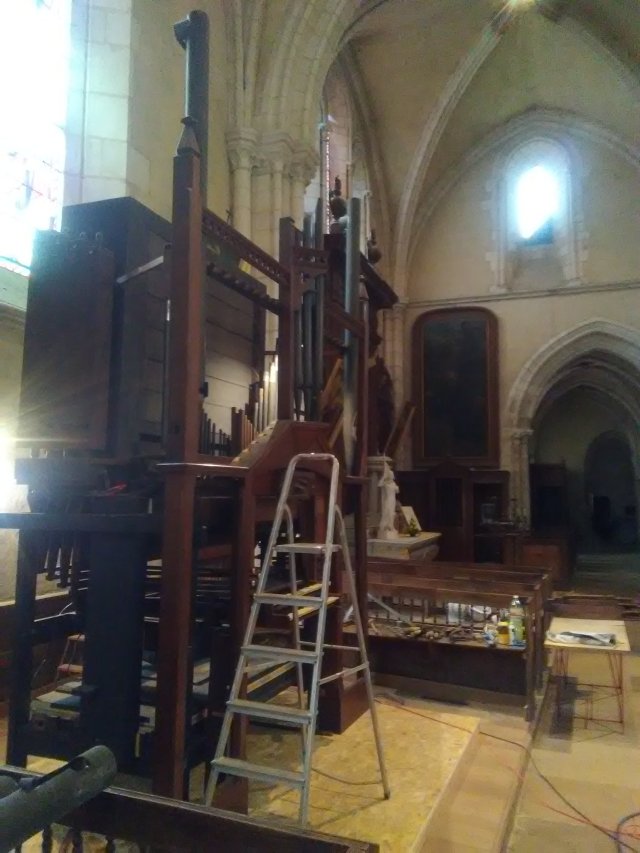
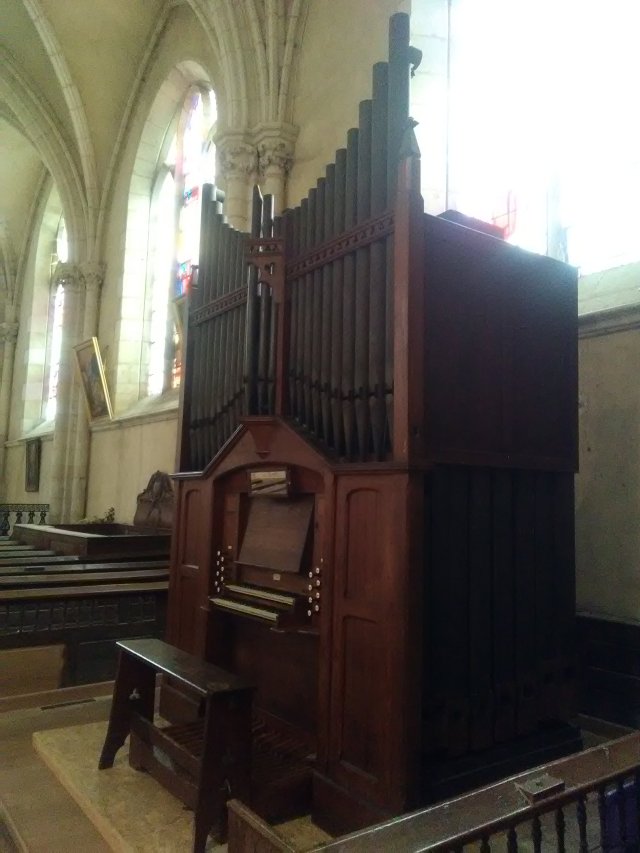
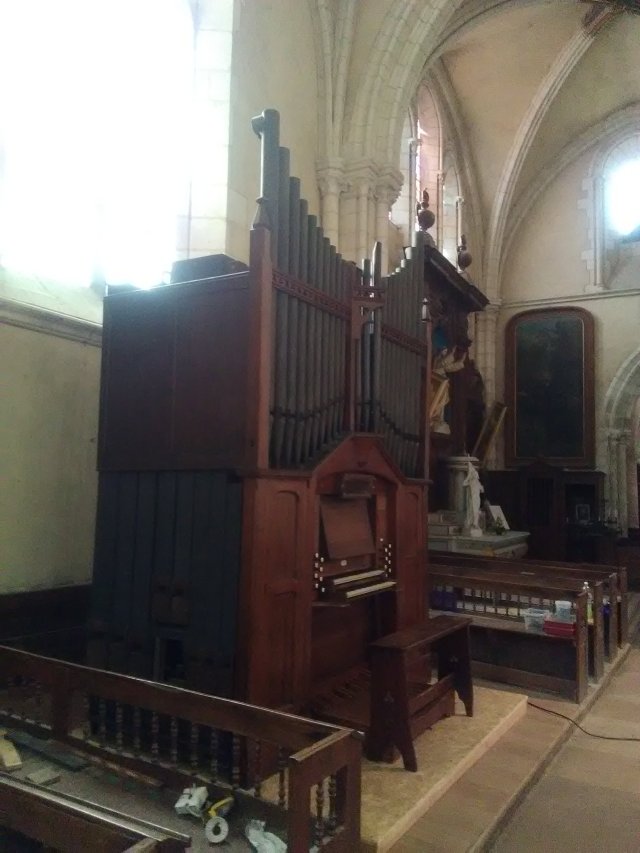
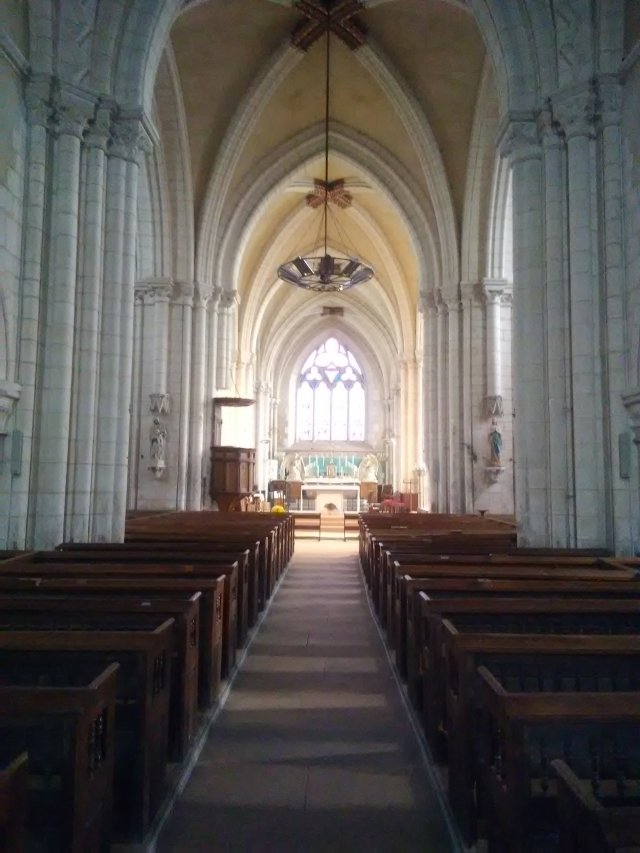
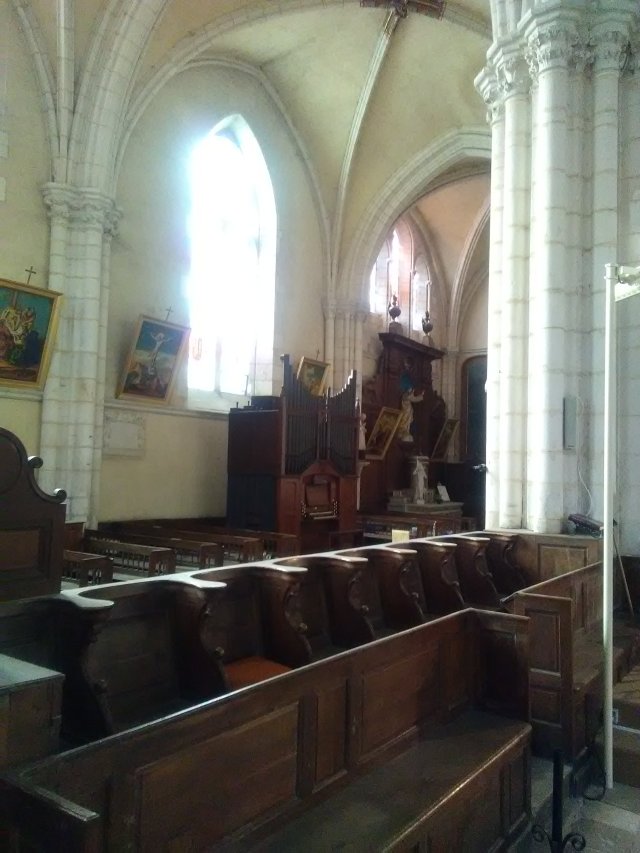
The Organ sings again

We are almost at the anniversary of when I went to London with a large van to bring another organ to France. In late January of this year, I wrote the melancholy A New Purpose after the main article on this subject New Unity. I had many reflections to express about that very original church community that seems to have gone beyond Unitarianism to atheism. Perhaps they want a new notion of the Transcendent outside the stereotypes of religions. Anyway, it is not my purpose to make any judgement.

Once the organ arrived at Vermenton, a small town near Auxerre in the Burgundy region, the problems began. The organ had to lie in pieces in the church for a whole year. An elderly man in the congregation, ignorant and stupid, was violently opposed to the organ project at Vermenton in spite of having kept his mouth shut at the parish council meeting that approved it. The priests who look after the parish had to jump through hoops to get the various authorisations from historical monument and diocesan authorities.

When I finally met this cantankerous man, he told me I was buying an organ in very poor condition, I was being conned like buying a second-hand car. I was not the person who dismantled or transported the organ and that it was going to be reassembled by a priest of the community with no experience of organ building. He knew all this from infallible Google along with some other juicy titbits about myself to get the diocese to hold me away with a barge pole!

He was gobsmacked when I related the facts to him. I was the “horse’s mouth” rather than the bits and pieces he was finding on the internet. Some officials from the diocese came and visited me, and they were most kind and pleasant. I explained that I was indeed working on an old organ, but there is nothing that cannot be repaired – quite unlike a worn-out car engine.

Now the gentleman is attributing the success of the project to himself! The hypocrisy oozes out from this modern-day Tartuffe, the perfect apologia for the need to find a new notion of God and our desire for the Transcendent.

A platform had to be built for the organ, and it was botched. It needed to be corrected in terms of the level. The carpenters came on the Monday, and I told them they had a choice: dismantle and redo their work or superimpose a perfectly level platform to the dimensions I specified and in exactly the right position. They worked whilst I set up my field workshop.

I brought the organ to playing condition about the middle of last week. The pedal bourdon still needs work because the lead pneumatic tubes of the action are in appalling condition. I will replace them with plastic tubes, which will make everything so much easier to install. I’ll do that job in January. In the meantime, the stops on the great and swell are working, as are the manual to pedal couplers. The organ is tuned and can be used for Christmas.

In spite of the report that this organ is without any real tonal distinction, I found the sound in the church of Vermenton to be “sweet” and full of character. The fifteenth on the great is the only upperwork, but the voicing is bright. I made no modifications of any kind. I simply cleaned the pipes with compressed air to get the London dust out! I am strongly of the conviction that an existing organ must be respected, not changed to make it into something else as was often done from the 1960’s. Indeed, the organ of York Minster is being almost restored to its 1931 state by Harrison & Harrison of Durham in the tradition of the great English cathedral organ. This little Victorian instrument is a part of the history of the organ builder’s craft. After all, I have no compunction about playing Bach on the piano!

After a series of problems and challenges, this little instrument seemed to console my efforts and pains as it sang into the reverberant acoustics of the church and accompanied my lone voice as I sang the Gloria Patri to a Gregorian tone. My perseverance paid off…

Specification:

Great
Open Diapason                            8
Stop Diapason Bass                    8
Claribel Flute                               8
Viol d’Amour                               8
Principal                                       4
Fifteenth                                       2

Swell
Lieblich Gedeckt                         8
Gamba                                          8
Voix Céleste                                 8
Flute                                              4
Tremulant

Pedal
Bourdon                                      16

Couplers
Swell to Great
Great to Pedal
Swell to Pedal

Here are some photos:

Posted in Uncategorized | Tagged , | 3 Comments

Liberté, Egalité, Fraternité

As I sat through the ceremony of reception today at the Préfecture of Rouen of myself and about fifty other new French citizens, I listened to the recorded propaganda message with the ears of a philosopher. The essential theme was the French motto Liberté, Egalité, Fraternité – and Laïcité, the last meaning freedom for all religions or none, and the absolute autonomy of the State in relation to any religious body – including Islam. My wife and I wondered how much of this message would be understood by most of the people originating in the former French colonies in Africa and the Sahara.

These notions come from the Revolution of 1789. My own take is much more mitigated than that of French monarchists and traditionalists. Something had to crack even if Louis XVI was trying to reform the institutions for the sake of the poor. When Marie-Antoinette suggested that those who had no bread could eat cake (brioche), she was not being sarcastic or out of touch. There was cake available at the local bakery.

Very frequently in history, a good idea is taken over by evil men. A prime example is Christianity itself, to the extent that Christ’s actual teachings and the spirit in which he meant them are almost unknown today. As Oscar Wilde said as he languished in prison:

There is something so unique about Christ. Of course just as there are false dawns before the dawn itself, and winter days so full of sudden sunlight that they will cheat the wise crocus into squandering its gold before its time, and make some foolish bird call to its mate to build on barren boughs, so there were Christians before Christ. For that we should be grateful. The unfortunate thing is that there have been none since. I make one exception, St. Francis of Assisi. But then God had given him at his birth the soul of a poet, as he himself when quite young had in mystical marriage taken poverty as his bride: and with the soul of a poet and the body of a beggar he found the way to perfection not difficult. He understood Christ, and so he became like him. We do not require the Liber Conformitatum to teach us that the life of St. Francis was the true IMITATIO CHRISTI, a poem compared to which the book of that name is merely prose.

The spirit of a great idea is all too quickly lost and replaced by its antithesis by the use of the same words. As it was with the coming of Christ, so it was with the notion of human rights and the blueprint of modern democracy. In the beginning of the revolutionary era, Wordsworth wrote:

Oh! pleasant exercise of hope and joy!
For mighty were the auxiliars which then stood
Upon our side, we who were strong in love!
Bliss was it in that dawn to be alive,
But to be young was very heaven!—Oh! times,
In which the meagre, stale, forbidding ways
Of custom, law, and statute, took at once
The attraction of a country in romance!
When Reason seemed the most to assert her rights,
When most intent on making of herself
A prime Enchantress—to assist the work
Which then was going forward in her name!
Not favoured spots alone, but the whole earth,
The beauty wore of promise, that which sets
(As at some moment might not be unfelt
Among the bowers of paradise itself )
The budding rose above the rose full blown.
What temper at the prospect did not wake
To happiness unthought of? The inert
Were roused, and lively natures rapt away!
They who had fed their childhood upon dreams,
The playfellows of fancy, who had made
All powers of swiftness, subtilty, and strength
Their ministers,—who in lordly wise had stirred
Among the grandest objects of the sense,
And dealt with whatsoever they found there
As if they had within some lurking right
To wield it;—they, too, who, of gentle mood,
Had watched all gentle motions, and to these
Had fitted their own thoughts, schemers more wild,
And in the region of their peaceful selves;—
Now was it that both found, the meek and lofty
Did both find, helpers to their heart’s desire,
And stuff at hand, plastic as they could wish;
Were called upon to exercise their skill,
Not in Utopia, subterranean fields,
Or some secreted island, Heaven knows where!
But in the very world, which is the world
Of all of us,—the place where in the end
We find our happiness, or not at all!

Novalis was another contemporary, though he lived far away in Saxony. He sympathised with the ideals of the Revolution and its trio of words which could mean the noblest of ideals or a way to bring about the Terror of Robespierre. No, in today’s recorded propaganda message, there was no mention of the tumbrils from the Conciergerie to the guillotine, the dogs lapping up the blood, the rotting corpses and severed heads awaiting burial at the Picpus cemetery. There was not a word about the tyranny of the Jacobins. The totalitarianism of the Jacobins was over in 1794, but leaving a legacy of bitterness that continues to our days. Eventually, Napoleon entered into a concordat with the Church in 1801, opening the way to a regeneration of the Church, but also of the bourgeoisie. Bonaparte enshrined the principles of the Revolution into French constitutional law. The nineteenth century in France was dreadfully unstable with the symbolic years of 1830 and 1848. Europe was on fire, as were the unifying Italian and German states. The continuous state of instability only really came to an end in 1945 and with the building up of the United Nations and the European Union.

Do we reject the revolutionary ideas as rotten to the core, or give them a more human meaning? I have known many in traditionalist Catholic circles who wanted to restore the monarchy in France. Who? The Duke of Anjou who lives in Spain or the Count of Paris, allegedly tainted by associations with Freemasonry. Monarchism in France is a little bit more serious than the alternative popes I have been writing about, but I see no future in it. Leo XIII and Pius XI encouraged French Catholics to accept the French Republic and contribute to its ideals in a Christian way. This was my reflection as I was called to receive my letter from President Macron with some beautifully presented texts.

How did Novalis cope with the new ideas coming from France in his time? The ideals of liberté, egalité and fraternité were too high for the men implementing them. As Wordsworth had found, the result was death, bondage, inequality and enmity – quite the opposite. Novalis saw the principle of the Enlightenment at the basis of the Revolution, but an idea of human reason that fails to take historical reality into account. This very day, I ask myself what the young Muslim from Tunisia or Algeria sitting a couple of seats away from me would understand by these words. The man hosting the ceremony exhorted us to integrate into French culture and be fluent in the language. I have always done my best through respect to my hosts, but differences in culture are difficult to overcome. My own cultural difference is minimal, far less than the Algerian or the Tunisian worker. These noble ideals can only come through education and Bildung.

The challenge needs to be taken up by each of us in our villages, homes, jobs and circles of friends. I believe that these ideals can be sublimated into something great, and this was my mind as I accepted the gift of citizenship from the French Republic. Its political problems are no less serious than in England. Ultra right-wing nationalism is springing up all over the world, and it can happen here too. Macron may not win the next presidential election. The traditional moderate left and right wing parties have no more credibility, any more than the extreme left of Mélenchon, a sort of “French Corbyn”. I don’t know what life would be like under Mme Le Pen. A new crisis is mounting and its future result is quite unpredictable.

I lived in France for many years without bothering about nationality, because the European Union upholds freedom of movement, including the right to live and work in another European country. When the Brexit issue came up, English people living in European countries had to take things more seriously. In my turn, I applied for a residence permit and citizenship by marriage to a French woman. The long bureaucratic process is complete and I only await my Carte Nationale d’Identité and passport. I will vote in the various elections and take my tiny part.

I said to our host at the ceremony: “Merci. J’ai beaucoup appris de votre beau pays“. Indeed, it is a beautiful and extremely diverse country, both in terms of nature and human culture. Let us start with this enchanted beauty and build on it to bring about God’s Kingdom and a land of hope, freedom and pursuit of happiness.

Posted in Uncategorized | Tagged , , , , , | 12 Comments

Sarum Calendar 2020

The Sarum Calendar for 2020 has been added to Dr William Renwick’s More Documents page. You can download it from there. It begins from 1st January, so if you need the current Advent, you need the final month of 2019. It is in English and follows the Gregorian calendar.

I warmly recommend the rest of this valuable site which is completing the resources we have for the Use of Sarum and its chant.

In case you find the site inaccessible for any reason, here are the links:

Kalendar 2019
Kalendar 2020

Posted in Uncategorized | Tagged , , , , | Leave a comment

Abusus non tollit usum

There is a story, perhaps untrue, about a public building that had all its fire extinguishers removed because it was esteemed that few people knew how to use them properly. It’s obviously better for the building to burn down and a lot of people to die than take the risk of the fire extinguishers being improperly used! Le mieux est l’ennemi du bien. What is even more alarming is that this principle is also applied in philosophy and besmirching by association.

I was truly shocked today on reading The Aryan Christ – Jung, Hitler And Today’s Postmodernist Insanity. This article, in my opinion, resumes a stereotype by which German Romanticism and Jung’s psychoanalytic theories had much in common with Hitler’s occultism and cranky ideology. Traced back far enough, all these currents of philosophy were little more than “proto-Nazism” and therefore to be dismissed as post-modernism. That’s quite a mouthful. On reading this article, I searched for signs of where all this was coming from through the author Aeneas Georg. Searching for the name reveals his tendencies as an American conservative, perhaps alt-right complete with conspiracy theories about the Rockefeller family and the Illuminati among others. One thing Georg does not mention is that Jung expressed himself about Hitler.

Jung saw Hitler as the “mouthpiece of the collective Shadow of the German people”. He was often criticised for not damning the Nazi movement, but there was a reason. He made distinctions between the cultures of western Europeans, eastern Europeans and Jewish people. The most “anti-Semitic” of Jung’s ideas was that Jewish people were more differentiated in their culture than other Europeans. He considered Hitler as a psychopath without any personality of his own. The 2003 film Hitler: The Rise of Evil shows the young Adolph as having no ideas of his own but copying those of others. Jung saw things like nationalism as discredited by World War II and the Nazi genocides, but not in themselves Nazi. Jung tended to make stereotypes of various categories of humans and national characteristics. We still do to this day when portraying English city workers in London, the Frenchman wearing a marinière and a beret, and sporting a moustache and Italians as gesticulating and stuffing their mouths with pasta. We are more careful what we say about Jewish people these days, though I remember other boys at school saying dreadful things about them – in the early 1970’s! Much of Jung’s moderate stereotyping is still to be found.

From questions of race, German Romanticism is blamed for everything. That is a travesty, for I see nothing in common between men like Kant, Göthe or Novalis and the Nazis! The Romantics were profoundly humanist and concerned for man’s good, not domination. Linking completely different movements like Romanticism, Jung, Post-modernism and Nazism is not serious. Maybe some ideas were analogies of each other, but they were not from the same species. A human being and a tree are both biological organisms, are both living, but they are not “responsible” for each others’ characteristics.

Perhaps the two different “species” are associated by the soil that nurtured them – the Germanic world of the late nineteenth century. As I write this posting, I am listening to Wagner’s Parsifal. I am a confirmed Germanophile and feel very close to that country’s Romantic and Idealist movements – but that does not make me anything like the black curse that fell upon that country from 1933 until its defeat in 1945. I am convinced that without Romanticism, the black curse would have come in the form of ultra-rationalism and materialism to the exclusion of anything else. As I have mentioned elsewhere, there is much confusion between Nietzsche’s notion of the Übermensch and the caricature given by the club-footed Untermensch Göbbels and his dark-haired master claiming to be Aryans. That said, Nietzsche is not mentioned in this article.

Germany in the 1890’s and 1900’s was said to be wanting to replace Christianity with folk paganism. Is there anything unique about Germany, when France was viciously anti-clerical at the time, as was Italy? I see nothing about Germany that is more anti-Christian than England, for example, with the growth of a new tendency of hard atheism. Darwin was English, not German. I would say that Germany did not make Hitler, but Hitler distorted the mythology to bring his people to subjection according to his own terms disguised as the old folk traditions.

German Romanticism may have referred to folk traditions, but most of the contemporaries of Göthe and Novalis were Christians, even if they had a critical attitude towards their faith. Novalis was one of the very few to promote cosmopolitanism over nationalism. Nationalism at the time was springing up all over Europe, especially in the Latin countries!

For Jung, I have not read enough about his life to affirm or deny the accusations of his moral turpitude, especially sleeping with his patients. Perhaps it did some of them some good when their problem was related to sexual repression! The idea is represented in a number of sources available on the internet. It does not represent an ideal of professional integrity according to our standards or those of any medical professional body. Jung’s moral turpitude does not necessarily discredit his work, research and writings. Jung’s gnosis and exposure to unorthodox practices would seem to have been detrimental to his mind, reminding me a little of Nietzsche’s downward plunge into the abyss.

I have become quite sceptical of psychiatry after my own journey of enquiry into Aspergers autism. My own observation was that it too clinical and appeases the materialistic notion of the human soul. We need to see spiritual and mental conditions in a more philosophical light, especially considering man’s spiritual mind over his material brain and nervous system. Jung represented a stage in my own life and decision to part company with the rigid matrix of traditionalist Roman Catholicism. I never went along entirely with all his theories, but some themes like individuation, the reconciliation of light and what Böhme would call the Ungrund, among many others, appealed to me. That did not lead me to anything like neo-Nazism! I do think that psychoanalysis can be dangerous, because a person can only confront his own truth to a given extent.

Having elevated himself to the level of God after his self-acclaimed initiation into the ‘mysteries’ in 1913, sanctity became for Jung a repressive Christian value that stifled the archaic and creative energies of the universe. In adopting Gross’ belief system, Jung was able to absolve himself of any responsibility for the hurt and misery that he caused to those around him.

What is this supposed to mean? What is sanctity? Some will answer that it is conformity to the matrix of rigid religious ideology. For me, it begins with self-knowledge and acceptance leading to a greater empathy for other human beings and love, and in turn for God. As for Jung’s “German spirituality”, does not the Church work with the culture of indigenous populations like in China and South America? Some make much ado about the recent use of a figure of a pregnant woman called Pacamama in Rome. Where did Christmas come from? From the pagan Roman cult of Sol Invictus. I have no issue with Pacamama, because this pagan fertility goddess of the Incas in this new context becomes an archetype of the Blessed Virgin Mary as pagans become Christians. Jung was very strong on archetypes – as were the Fathers of the Church. The Church has always used pagan symbols to convey the Gospel message of Christ.

Saying that Jung attracted many members of the medical profession and patients is akin to Hitler drawing in the crowds would be as logical to say that football matches in England are Nazi rallies. Maybe some of the yobbos and hooligans are despicable people, but the idea is absurd.

Certainly had Hitler never been born, or had he become a successful artist, history since the early twentieth century would not have been the same. In his case, I often wonder what would have happened in Europe since 1919. The League of Nations was never very strong as a peacemaking endeavour. Perhaps, eventually, Germany would have been allowed its autonomy after having paid the crippling reparations demanded by Clemenceau in particular. Would someone else have been able to galvanise the mass of bad feeling, bitterness and suffering in Germany after the 1929 Wall Street crash? I am no expert in alternative history.

Jung seems not to have been a perfect man, not by any means, but his work has endured, where Hitler’s has been reprimanded and banished from our world. Jung sought to heal the sick of mind. Hitler wanted to dominate and conquer, letting no moral consideration get in his way. I cannot think of two more different men.

If we look at them from a distance, the movements started by Jung and Hitler close to a hundred years ago were, at the outset, completely opposite to each other, yet both sought to destroy the existing order to bring about their version of a utopian paradise, essentially material in nature.

Nonsense! At least for Jung. He was no materialist or utopian. Then, as smoothly as snake oil:

Today, that same ideology is seen in the vocal offspring’s of Jungian thought and the ideology of postmodernists and ‘social justice warriors’ everywhere.

He now starts to mix everything together in his big pot. There may be some philosophical roots in today’s fanatical left-wing ideologies that had their roots in the past, but the comparison is crude. I see no comparison between the Nazis of the 1930’s and the mobs of young anti-Trump people on American university campuses.

How would I conclude? A little knowledge without profound interpretation is a dangerous thing. This article is underpinned with fallacy after fallacy. I especially discern an attempt to exonerate the alt-right tendency in America from association with the Nazism of the past by linking the latter with Romanticism, Jung and 1960’s anarchism.

Abusus non tollit usum. Even if something is not entirely pure and exuding the odour of sanctity, it is not necessarily all wrong. Perhaps some might say the same of Hitler, an idea which brings revulsion to the civilised person. To have some esteem for Jung does not cause disgust, even if there are better theories today with the progress of science. Some of the Romantics were atheists, but they tended to be English, not German.

Clearly, we all have more work to do to come up with something credible.

Posted in Uncategorized | Tagged , , , , | 1 Comment

Some ideas to take critically

In the light of my postings over the past few days, I am led to think of a way to keep a critical mind about authoritarian (anti-parliamentarian) politics and “diseased” religion caused by literalism and materialism. I am going to take another foray into the subject I touched upon in Umberto Eco and “Ur-Fascism”. However, I have shifted my attention from secular politics to religion.

I have always found Umberto Eco an intriguing author and philosopher. His speciality was human language. His most known work of fiction is The Name of the Rose. Another is Foucault’s Pendulum. A common theme between these two novels is a healthy scepticism to avoid getting carried away with irrational fears and theories. The main theme in the former of these works is humour. Are we able to laugh at our own shortcomings, when some take themselves so seriously as to lose all notion of reality? Laughter is a moderating and liberating emotion that enables us to moderate excess of virtue. It makes life easier to bear and brings healing to the soul.

Eco’s theory of semiotics is complex and would need years of study, comparing his work with Kant and the German Idealists. His philosophy is deeply bound up with the notion of truth. Truth is not merely the product of logical calculation or deduction, but by a habit of desire. Humour is a critical means to distinguish between truth and falsehood. Few other philosophers have isolated the value of humour as Umberto Eco did.

Humour comes in several varieties but one essential idea of it is our reaction to absurdity. Monty Python is surely the epitome of absurd surrealism – the exploding Mr Creosote, the three inquisitors dressed as pantomime cardinals, the caricature of Hitler running for a by-election in suburban England with only a handful of supporters and a gramophone playing crowd noises, the Ministry of Silly Walks and so much more. It is an extreme form of satire. If we can laugh at something, we need to take a long and critical look at it. Very often, attempts to imitate the past produce caricature and kitsch. One example is some of the alternative popes who have attracted my attention. Palmar de Troya is a caricature of Spanish Roman Catholicism and human folly. Michael I is forced to be that much more reasonable, living as he does in rural Kansas. We don’t even know who Boniface X is, and the texts he publishes on the internet show as much of the absurd as any Monty Python or Dave Allen sketch. The Pope must Die is another absurd film about the pontificate of Paul VI and Jean Paul I, and the corruption in the Vatican that continues to this day. Linus II was aware from the outset that his election to the papacy was absurd – and hid away from view. Even those who don’t go so far as pretending to be the Pope are often the most humourless lot we will ever meet.

As I have mentioned before, I am critical of some of the criteria Eco applied to contemporary forms of fascism and analogous political and religious movements. For example, an attachment to tradition is not always reprehensible. It depends on the tradition in question! Likewise, not everything modern is good. Rationalism and science have their limits: they need to be humanised, as much today as in the 1790’s to the 1820’s. Romanticism attaches great importance to the Enlightenment, reason and science, but man is much more than materialism.

Our notion of truth needs to be non-foundationalist – that is based on our desire to transcend and not to possess something that is unproven, imperfect and limited. Short of that aspiration, we need to learn that disagreeing is not always treachery or offending against truth. In necessariis unitas, in dubiis libertas, in omnibus caritas, said St Augustine. Distinctions must be made between different levels of truth and belief, and they are lacking in the traditionalist / sedevacantist narrative.

Like in politics, we are faced with populism and everything being blamed on certain categories. In the history of Christianity, the easy target has been the Jews. They are collectively accused of the Passion of Christ and the Anti-Semitism that culminated in the Holocaust has a long history. According to many narratives, they are responsible for all the conspiracies against “pure” Catholicism, for Freemasonry and various other secret societies – some not existing in reality, the Illuminati for example. There has to be that feeling of pressure and some external enemy.

Something strikes me about the kind of narratives I have described: the poverty of thought. Rather the zealot brandishes proof-texts from popes and councils from various periods of the Church’s history. No consideration is given to historical context and the surrounding issues of the time. The literal words are read like a Southern Baptist or Jehovah’s Witness takes in the words of the Bible. The letter of the law drags us down to the level of brute materialism, dualism at best. This convergence of opposites has always haunted my mind as has this notion of absolute intellectual and spiritual poverty.

The use of impoverished vocabulary is often intended to limit critical and complex reasoning, or has the secondary effect of doing so. I certainly believe that the sects and illuminated men can serve as a lesson for us all, not only to work on our own philosophical and theological culture, but also on our sense of humour – and above all being capable of laughing at ourselves and our own absurdity.

Posted in Uncategorized | Tagged , , , , , , , | Leave a comment

In Flanders Fields

This poem of John McCrae is well known and taught to children in schools.

He wrote from the point of those who were killed in the Great War. It reflects a view of war that remained too romantic and early in the war, before bitterness and cynicism set in.

In our days, many think that celebrating Remembrance Day is glorifying war. In the present toxic political climate in the UK, anything is possible. What cannot be doubted is our duty of remembering those who were sacrificed and died in their late teens or early twenties. Their souls are joined to all the souls of the Departed for whom we celebrated Mass on 2nd November.

I took the above photo in a field just a few minutes away from where I live. In summertime, poppies grow in profusion all along the northern coast of France. I live about an hour by car from the Somme where much of the bitterest fighting took place. A little over one hour the other way, westwards, and I can be on the D-Day beaches of 6th June 1944. I once had the honour of a conversation with an American veteran of Omaha Beach. The carnage was horrible and soul-maiming. To get some idea of how it was, watch Saving Private Ryan. Whether in the Somme or on the beaches, the horror and fear can still be felt.

I will pray for these poor souls, and ask them to pray for our sinful world that we may never know and suffer what they went through, not only the soldiers, airmen and sailors, but also civilians and the victims of genocide. As Christians, we believe that they live on and watch over us like the Angels. May this be our thought and prayer as the poppy petals fall at the appointed moment tomorrow.

In Flanders fields the poppies grow
Between the crosses, row on row,
That mark our place; and in the sky
The larks, still bravely singing, fly
Scarce heard amid the guns below.

We are the Dead. Short days ago
We lived, felt dawn, saw sunset glow,
Loved and were loved, and now we lie
In Flanders fields.

Take up our quarrel with the foe:
To you from failing hands we throw
The torch; be yours to hold it high.
If ye break faith with us who die
We shall not sleep, though poppies grow
In Flanders fields.

Posted in Uncategorized | Tagged , | 1 Comment

Christianity and Society

I came across the article Atheists sound the alarm: Decline of Christianity is seriously hurting society. It is quite fascinating and reminded me of the two articles (first and second) I wrote on Christian Humanism. I wrote these two from the point of view of a believer and a cradle Anglican. What is surprising is to read such ideas coming from atheists who begin to be a little less sure of themselves.

In the past, the atheist argument has consisted of saying that all religion and irrational beliefs in anything that cannot be verified by physical science (physics, chemistry and biology) is harmful to the human person and to society. All wars and violence are caused by religion. Myself, I have been forced to make a distinction between the inmost and transcendent consciousness which we call God, on one hand, and the systems of memes and “spiritual viruses” that cause us to consider each other as enemies and therefore have the right to fight against them, on the other.

My own studies of Romanticism and its philosophy in particular have brought me to consider the capital importance of the Enlightenment in its time and the need to bring back the imagination, human emotions and spirituality to bring about a new synthesis of reason and the heart. The Romantics, as a whole, did not wish to return to what was obscurantist about the period before great man like Descartes and Newton, but to re-humanise reason. This is at the heart of the present-day discussion of faith and reason. Without this balance, we have the extremes of irrational religion which is often violent, hateful and intolerant – and that of atheism and the arrogance of science as caricatured in Mary Shelley’s Frankenstein and many books and films in the modern science fiction genre.

Could it be that the romanticism of our own time is bursting through the dryness and arrogance of “pure” science to give us a view of consciousness and humanity. I see this in the work of Rupert Sheldrake as he criticises materialistic science. The French and Russian revolutions happened in Christian countries where the faith (however lukewarm it became) modelled moral life and the sense of right and wrong. In our own time, Christianity is rotting away like the churches for which no one has any further use. Atheists like Dawkins begin to see that once Christianity is gone, there is no other principle to guide people morally and ethically. Ethics are replaced by the brutal struggle of winner-take-all.

Was not the Enlightenment the very principle of Christianity and its morality? Did not humanism, the value of life and the respect of the human person come from Christianity? There are any number of religious traditions, philosophies and cultures where human life is cheap and the person counts for nothing. This is returning to our own world as money and political power rule supreme. Darkness would return to this world, as it is doing right now.

Even Richard Dawkins is more sceptical of the idea according to which we would get rid of religion and our world would become a utopia. He even thinks that Christianity can be good or even necessary for western civilisation. This is astounding coming from one of the hardest “evangelists” of hard atheism!

Indeed, we need God.

Posted in Uncategorized | Tagged , , , , | 2 Comments

Tradition and Progress

My brush with pope Boniface X has been quite thought-provoking in an odd sort of way. There always has been tension between religion – any religion – being essentially a book containing precepts and teachings, compliance with which being the condition for salvation (a pleasant afterlife rather than the traditional image of eternal hell) – that, or an incarnate and mystical life based on symbols and sacraments making eternal realities present in time. Reading authors like Dom Casel, Louis Bouyer, Josef Ratzinger, Jean Hani, René Guénon and others brought me to condense a staggering amount of knowledge and experience in these terms.

In the history of Roman Catholicism, or simply the Western Church before the Reformation, and Orthodoxy, there were schisms at various times caused largely by the corruption of the clergy. There was a number of sects that arose in the thirteenth and fourteenth centuries that rejected the sacramental system and the priesthood, or sought to bring about a new kind of priesthood. Many were based on the message of St Francis of Assisi. There were also Gnostic based groups like the Cathars. One of the most informative books I have read about them is the psychiatrist Dr Arthur Guirdham, The Great Heresy, St Helier 1977. Guirdham sets his subject in the historical context of the Lollards and Hussites who were the progenitors of the Protestant Reformation. The one common idea was to reject the tyranny of the clergy, bishops and the Pope and return to the practice of a Christian life based on individual and common prayer, nourished by the reading of the Scriptures.

However, not all the reactions from clericalism rejected the sacramental life and the liturgy. In this category we find the Raskol or Old Believers in Russia who refused the reforms of Czar Peter the Great and Patriarch Nikon of Moscow between 1652 and 1666. In France, there was the Petite Eglise that split off from the mainstream French Church in 1801 because of the Concordat between Pope Pius VII and Napoleon Bonaparte. They were both traditionalist reactions against changes they deemed to be unacceptable. They became “time capsules” of their Churches at a particular moment of history. The Amish in America came from the Reformed tradition and also set themselves in the period of time from when they emigrated from Europe to the USA. In the early Church, at the time of Saint Augustine, the Donatists showed their fierce rigour faced with Christians who had compromised in any way with the Roman Empire and the persecutors.

In more recent times, in the Roman Catholic world, there was the traditionalist reaction of Archbishop Lefevbre against the reforms of Paul VI following Vatican II in the liturgy and questions of religious freedom. However, the Society of St Pius X took a more pragmatic attitude and was prepared for certain compromises with Popes John Paul II, Benedict XVI and Francis. They kept the 1962 version of the Roman liturgy, remained in the scholastic mould for theology and Aristotelian philosophy and continued to complain about religious freedom as the enemy of “integral Catholicism”, meaning rule by the clergy and a king or a Franco or Pinochet style dictator. In the 1980’s and at some other times, there were dissidences from the Society in the form of sedevacantism or the position of Bishop Richard Williamson objecting to too much compromise with Rome. Sedevacantism itself divided into several “positions”, sometimes combined with Feeneyism, a modern form of Donatism.

The most prevalent form of sedevacantism was the most pragmatic. Most of the founders were ordained before the changes or left the SSPX. As priests with a vocation to training new priests, they needed bishops. The solution was being consecrated by a small number of “respectable” bishops in the Ngô Đình Thục succession or former clandestine prelates found in the old Soviet bloc. They justify their ministry in terms similar to those used by the SSPX: in a situation where literal observance of canon law opposes its intended purpose, the letter of the law can be broken and otherwise illegitimate ministry becomes legitimate. This principle is called epikeia (ἐπιείκεια) roughly corresponding with the notion of οἰκονομία in the Orthodox Churches. However, Roman Catholics have always had a problem with private interpretation and the risk of abuse.

Within this “liberal” branch of sedevacantism, Fr Louis-Michel Guérard des Lauriers OP, a former professor at the Angelicum in Rome, formulated his Cassiciacum Thesis based on the notion of hylomorphism, Aristotle’s theory of matter and form. Matter and form would then be applied to the person occupying the Papacy: the Holy See being materially (materialiter) occupied but formally (formaliter) vacant. The theory is clever, but few follow it. One priestly institute following it is the Istituto Mater Consilii near Turin in Italy. The priests who founded this institute are also dissidents from the SSPX.

We then go a step further and find the conclavists. In the 1990’s certain prominent sedevacantist laity like Elizabeth Gerstner and priests seriously undertook the possibility of electing a Pope by extraordinary means and producing the situation in which that Pope would be legitimate. Here is an explanation of the theory by a fairly articulate lay author. The best known, distinguished from those who believed themselves to be appointed directly by God, are:

Pope Michael (1990). Teresa Stanfill-Benns and David Bawden of Kansas in the US, called for a conclave to elect an alternative pope. They publicised their request around the world, but only six people participated in the election. On 16 July 1990, they elected Bawden who took the name Pope Michael.

Pope Linus II (1994). Another conclave, this time held in Assisi, Italy, elected the South African Victor von Pentz, an ex-seminarian of the Society of St Pius X, as Pope Linus II in 1994. Linus took up residence in Hertfordshire, England. Nothing is known about his present ministry, if any.

Pope Pius XIII (1998–2009). In October 1998, the U.S.-based “true Catholic Church” elected Friar Lucian Pulvermacher as Pope Pius XIII. He died on 30 November 2009. No successor has been named since his death.

Pope Leo XIV (2006–2007). It is not known whether this group is a spoof or an existing group. It is claimed that on 24 March 2006, a group of 34 independent bishops elected the Argentine Oscar Michaelli as Pope Leo XIV. On his death on 14 February 2007, he was succeeded by Juan Bautista Bonetti, who took the name of Pope Innocent XIV, but resigned on 29 May 2007. He was succeeded by Alejandro Tomás Greico, who took the name of –

Pope Alexander IX (2008 – present day). Alejandro Greico was born in 1983, in Buenos Aires. This group claims bishops and churches all over the world. One of my principles is to take a step back and what “What seems to be too good to be true is not true”. No radical traditionalist group could have survived for so long without being known, suffering from splits and fraught with scandal. Pope Alexander is always represented by a photo of a man’s head photoshopped onto the cassock and body of Benedict XVI. This is clear skulduggery.

Alongside that, there are well-known characters like Clemente Dominguez y Gomez who claimed to be appointed directly by God. These are clearly cult gurus and are known for abusive practices. Magnus Lundberg has extensively studied the cult of Palmar de Troya in Spain, now led by a Swiss man going by the name of Peter III.

Going further down the hole of sedevacantism, we find a phenomenon akin to the priestless (Безпоповцы) Old Believers and the French Petite Eglise. These are the Home Aloners (description given by a priest of the first category of sedevacantists mentioned above). These are lay people for whom no mainstream Catholic bishops or priests are legitimate or even valid, and nor are the various priests and bishops deriving from illicit ordinations like those of Archbishop Ngô Đình Thục. Everything is stripped away in terms of liturgical observance or access to the Sacraments other than Baptism and Marriage. Perhaps some of these people say the Office. They will pray the Rosary and other standard devotions, and they will read the Scriptures, apologetics and a certain level of philosophy and theology. The circle is closed when I hark back to my definition of Protestantism: “The one common idea was to reject the tyranny of the clergy, bishops and the Pope and return to the practice of a Christian life based on individual and common prayer, nourished by the reading of the Scriptures“. The reasons might be different in theory, but the result is the same. However, I know of no “Home-Alone” church like the Old Believers and the Petite Eglise. How long will a person persevere in such conditions before lapsing into modern life like the rest of his family and friends?

Outside Roman Catholicism and Orthodoxy, there is Continuing Anglicanism, in which I serve as a priest. Frankly, there is no comparison with the radical ideologies described above. Our bishops and their predecessors simply broke away from the Anglican Communion because of matters like the ordination of women – and formed new Churches with their proprietary names. There has been a lot of trouble in the past between quarrelling bishops, but I am happy to relate that the difficulties of the past are being repaired through the “G4”: the primates of the Anglican Catholic Church, the Anglican Province of America, the Anglican Church of America, and the Diocese of the Holy Cross signing an agreement pledging to seek “full, institutional and organic union with each other”. This grouping of the more mainstream Continuing Anglican Churches is also in dialogue with the Polish National Catholic Church and the Nordic Catholic Church led by Bishop Flemestad in Norway.

The lesson to be learned from all this is balancing the notion of Tradition with life, growth and progress. I have approached this subject from various points of view, my most recent being Ecclesial Cosmopolitanism. There is the paradoxical posting “Catholicism made me Protestant” discussing Newman’s conundrum at trying to find Papal Infallibility more coherent than Anglican Liberalism in the early nineteenth century.

There is tension between Tradition and life as there is between faith and reason. It is not by accident that John Paul II and Benedict XVI spent so much time on this question which was at the heart of the Modernist “crisis” in the 1900’s.

Newman tried a distinction between homogenous or organic growth, a hermeneutic of continuity, and changes that involved rupture and contradiction. It is a good base, not perfect, but something. I discuss many issues of continuity and change in Nostalgia and Hope. Static traditionalism is compared with the changelessness of Parmenides – “all reality is one, change is impossible, and existence is timeless, uniform, and necessary” – and the semper idem of Bossuet.

The way ahead is accepting a via media between tradition and organic change whilst resisting rupture and contradiction. In medio stat virtus. The churches of the Reformation other than the glitzy American mega churches are declining. The Old Believers have happily gone back into communion with the Russian Orthodox Church, and they are allowed to keep their liturgical particularities. The Petite Eglise is declining as the children of those families marry Roman Catholics or embrace modern secularism. Anything can flourish in America, and there are some “moderate” sedevacantist communities in France. Palmar de Troya will end up as an exotic theme park or something that makes money. The other alternative popes will die lonely deaths. Continuing Anglicanism seems to have pulled itself together, and needs more time to be more firmly established without falling into the same traps as the mainstream churches.

Wisdom is sometimes found in the most unlikely places and the deepest of man’s folly!

* * *

I have just discovered the site of a man called John C. Pontrello, an American. I haven’t been through his writings yet, but I have the impression that he on the right track and coming to a state of self-awareness and critical mind. If he ever sees what I write here, I advise him to embark on a study of serious philosophy and theology, not merely the use of proof texts for the purposes of argumentation and refutation. I have just bought the Kindle version of his book The Sedevacantist Delusion. He has obviously chosen his title based on the God Delusion of Richard Dawkins and the Science Delusion of Rupert Sheldrake which I am presently reading. Interestingly, Dawkins writes from a point of view of mechanistic and materialist science, and Sheldrake also writes from a scientific point of view but with the notion of consciousness being the intrinsic principle of both energy and matter.

I will need to read Pontrello’s book so that I can ascertain the premisses on which he bases his arguments and critical thinking, and above all where he is going. I have already read some of the short articles on his site which indicate that he recognises some psychological aspects of religious memes as viruses of the mind and complete bunk. Two reactions are then possible on emerging from Plato’s Cave: denying everything except matter like Dawkins, or finding a higher dimension of Christianity that reveals the profound message of Christ. The enquirer might then be inclined to align with the contemporary Roman Catholic Church and Pope Francis, become Orthodox, Old Catholic or Anglican – or seek among the other religious and philosophical traditions of the world.

Do I still have an axe to grind after so many years? Honestly, à chacun sa merde, let each of us find our own way and deal with our own problems. We will never sort out the problems of the world, change people’s minds or get everyone to adhere to the best and truest message. Our truth is found in our own experience of life and above all our Sehnsucht. Sedevacantism is not a problem in my Church. My Archbishop is called Mark Haverland and my Bishop is Damien Mead. We do not speculate about whether Archbishop Justin Welby truly occupies the See of Canterbury or not. The Anglican Catholic Church is a distinct Church in the same way as the Orthodox Churches are distinct from each other and fully Catholic by virtue of their faith and their episcopate.

John Pontrello does not need to worry about the pathetic psychotic claiming the papacy any more than I do. In our age, we are not used to such violent and vile language. Some of us, like Magnus Lundberg, are collectors of curiosities and exhibit these creatures for the enquiring public. I think Mr Pontrello needs to sort out his own mind and soul, decide what he feels he is called to do, and then adopt a critical attitude without trying to convince others. There, there is Wisdom!

Posted in Uncategorized | Tagged , , , , , , , , , | 3 Comments

Enigma Variations

No, this is not the beautiful music of Elgar, but another set of variations on the mystery of why so many men want to assume the role of the Pope, or find a solution to the contradiction between their belief and the observable reality.

Boniface X represents an anonymous man on the internet who obviously wants to gather a little credibility before going public. Putting it simply, he is self-styled, just like the “most Catholic” emperor.

This time, the story is different. This is the Byzantine Catholic Patriarchate based in the Czech Republic. It all looks above board: Byzantine rite and coming from Ukrainian Orthodoxy, but we need to exercise our critical minds. In the site, they say:

The Byzantine Catholic Patriarchate was established by seven bishops of the Ukrainian orthodox Greek-Catholic Church on 5 April 2011.

Elsewhere, they affirm:

It became an independent religious structure which exercises prophetic ministry in matters of faith and morals for both the Western and Eastern Churches. Archbishop Elijah OSBMr was elected Patriarch and Bishops Methodius OSBMr and Timothy OSBMr were appointed Secretary Bishops.

It seems that their primary objective is the anathematising and excommunication of the present Roman Catholic hierarchy. For some reason, they adopted Roman Catholic ecclesiology rather than continue in an Eastern Orthodox paradigm. Patriarch Elijah seems to believe this to be his prophetic mission to save Byzantine Orthodoxy by adopting a sedevacantist position. I seem to be missing something here.

This October, these Czech and Ukrainian bishops held a synod and condemned the present incumbent of the Roman See and declared it to be vacant. Patriarch Elijah then took it upon himself to elect Archbishop Carlo Maria Viganò to the Papacy.

He then wrote an open letter to Archbishop Viganò to ask him to elect election to the Papacy. The text can be found on the church website or heard on the video.

The big problem is that Archbishop Viganò is unlikely to accept this honour. Perhaps those Byzantines, a church looking for a Pope, might consider Boniface X who is looking for a church! So in these variations, we have among others Dorabella and the cathedral organist’s dog having a vigorous walk by the river in Worcester – and finally, that  fourteenth variation of triumph –

In this enigma of Catholics looking for a Pope, Popes looking for a Church and the unholy mess of the dying embers of the Empire, we look elsewhere for a sign of sanity and Christianity.

Господи, помилуй

Posted in Uncategorized | Tagged , , , , , , | Leave a comment

Ecclesial Cosmopolitanism

The older I grow, the more I see a convergence of issues and thoughts. I began to read an article by Pauline Kleingeld, who wrote another work on Novalis and his puzzling fragment Die Christenheit oder Europa. This article is Six Varieties of Cosmopolitanism in Late Eighteenth-Century Germany. The article was written as a response to nationalist feelings in many parts of the world, by appealing to Kant and a number of German Idealist philosophers. Conventionally, cosmopolitanism is divided between its moral and political dimensions. In late eighteenth century Germany, its few proponents competed against the mounting nationalism which came to prevail in various forms.

Typically the relationship between cosmopolitanism and nationalism expresses the priority we give to our country, tribe, parish, whatever we have experienced and know – or to humanity as a whole without distinctions. Kleingeld expresses her desire to escape the tendency to put all the eggs into a single basket. She distinguishes six types of cosmopolitanism: moral, political and legal, cultural, economic – and Romantic, expressed in faith and love. Certainly there will be overlapping and grey areas.

Writing the articles of the past couple of days on some unusual aspects of Roman Catholicism, it occurred to me that there can be an ecclesial cosmopolitanism linked with thought about the moral, cultural and romantic dimensions. When considering the various tendencies in Roman Catholicism and Anglicanism, crudely called traditionalism and liberalism, I see exactly the same lines drawn in the political world between liberal or conservative democracy and populism of the extreme left and right.

The so-called liberals seemed to have come up with the idea of ecumenism as an expression of religious cosmopolitanism: the abolition of all differences by mixing everything up into a homogenous and bland paste. The traditionalists would react by claiming to represent the “one true church” outside of which there is no grace, no salvation or spiritual reality. My article on pope Boniface X shows the ultimate caricature of “true church” parochialism in an institution which cannot be identified or recognised as real outside the anonymous person making the claim.

I have already written on Sedevacantism which is a system designed to find an intellectual solution to the contradiction between the Counter-Reformation understanding of the Papacy and the current reality. Ultimately, there are few choices if the logic is taken to its conclusion: abandon Christianity, abandon Papalism or attempt to restore the papacy as they understand it. As someone who spent a few years as a convert to Roman Catholicism, my option was the second one, one that is held by the Orthodox, Old Catholics, Anglicans and the churches of the Reformation. Compared with politics, it marks a populist reaction to the liberalism of the mainstream institutions in Rome and the local dioceses.

Over its entire history, the Church has struggled between its witness to the teachings of Christ and the temptation to political power. I was particularly marked by the parable of the Grand Inquisitor in the Karamazov Brothers of Dostoevsky, especially that outrageous justification of the Inquisitor “correcting” Christ. Like so many others I was faced with the choice of abandoning Christianity as something corrupted to the core and looking to religious and philosophical alternatives, or separating faith and spiritual / liturgical life from politics and coercive power. I heard so much criticism of the teaching by Vatican II on religious freedom by the traditionalists that I began to be convinced that this very freedom constituted the basis of Christ’s teaching. Some wish to make Christ a king, but when Pontius Pilate asked that very question, Christ answered that his kingdom was not of this world, above all not a political or aristocratic kingdom.

When I looked at so-called liberalism in the mainstream church institutions, I found that only the appearances were different, but everything depended on a political ideology. This time it would be based on cultural Marxism and a different form of coercion and policing. These very problems were faced by Enlightenment philosophers in the changing world of the Renaissance and the late Baroque and Rococo periods. I found the key in the Romantic reaction: accept the rationalism of the Enlightenment but restore the place of the whole human being through imagination, emotions and feelings alongside the rigours of reason. The pieces fitted into place though various providential catalysts during my university days.

Cosmopolitanism sees humanity as essentially a single moral community notwithstanding the differences of culture, language and religion. In such a perspective, all humans are worthy of rights, impartiality and tolerance. Many ideas in the late eighteenth century came from the Cynics and Stoics of the ancient world. The moral variant did not seek to bring about political reforms or revolutions, but rather a qualitative movement of human souls. The Enlightenment and cosmopolitanism worked together.

The Church is not a closed and exclusive institution, but a communion of those who are citizens of something much greater than their immediate surroundings. It was in that same period that men like Captain Cook set out to discover new cultures in depth. Some reflections from that time are remarkably modern in our twenty-first century terms.

What man [der Mensch] could become, he has everywhere become in accordance with the local conditions. Climate, location of towns, height of mountains, direction of rivers,… have sometimes favoured him from one side, sometimes limited him from another and influenced his physique as well as his moral behaviour. In this way, he has nowhere become everything, but everywhere become something different.

The one who wrote this was the naturalist and anthropologist Georg Forster (1754-94) who sailed with Cook on the Endeavour. He opposed the notion of one superior culture acting as a standard for all but rather advocated diversity, pluralism and complementarity – equality. He did, however, blame cultures that practised slavery or cruelty, and praised those that allowed individual persons to flourish. Were his own standards not hypocritical, ie. judging from the standard of western culture? Complete freedom from prejudice is an ideal more than a reality.

Kleingeld’s final category is Romantic cosmopolitanism, the aspect that emphasises the elements that make us human: “love, emotional bonds, beauty, shared faith, and mutual trust“. They had to be restored to humanity on top of reason that was emphasised by the Enlightenment. The Church is no exception to the whole of human experience. One thing that has to be understood about Novalis’ vision of a medieval world was not the desire to retreat into obscurantism but its “Parousia, the cosmopolitan ideal of a global spiritual community“. Christenheit oder Europa is a parable, not a historical rendering, and we will find this same thought in Dom Guéranger, Viollet le Duc, Pugin, Newman, Pusey, the entire Oxford Movement, the slum priests, the Pre-Raphaelites, William Morris and the entire movement as survives to this very day.

Novalis and the other Romantics cultivated this rosy notion  of the middle ages to convey a religious form of cosmopolitanism in unity, beauty, sensuality and mystery. It is a desire for return to childlike innocence and the sense of wonder. This dream contrasts with competition and the power of money and brute strength. Materialism destroys the sense of the transcendent, and out of it came the persecution of Christians and anti-clericalism. This conflicts would cause oppositions between religion and politics, religion being locked into the confines of states. Europe ended up in crisis and perpetual warfare.

Novalis looked to a new world, the cosmopolitan ideal of a global spiritual community. I do believe that Romanticism can bring about an understanding of Christianity exactly as it did in that brief moment of the 1790’s in Saxony. Again we face nationalism and new forms of populism, new challenges to humanity and peace. I am also fascinated to see huge changes in science from materialism and mechanistic determinism to quantum physics and a notion of consciousness preceding matter and energy. The changes are bringing us to a new future as we live and breathe.

I hope that Romantic cosmopolitanism will play a role in emancipating Christianity from nationalism and populism, from prejudice and hatred. The horror of two world wars in the twentieth century saw the rise of the League of Nations, United Nations, the Universal Declaration of Human Rights and the European Union. Nationalism and populism may be on the rise, but so is cosmopolitanism. Ecclesial cosmopolitanism isn’t about mixing religions, apostasy, idolatry, unlimited hedonism and all the things traditionalists complain about. It is a search for something much higher and deeper within ourselves, the icons of God’s love that are love, emotional bonds, beauty, shared faith, and mutual trust.

I can but do my best along this lonely path.

Posted in Uncategorized | Tagged , , , , , | 7 Comments