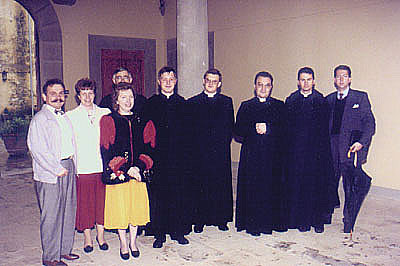
Dr Timothy Graham is a medical doctor specialising in Gastroenterology at St George’s Hospital in London. He obtained an MPhil in Philosophy in 2011 with a dissertation on the thought of Austin Farrer from Queen’s University Belfast where he had previously completed his medical training. He is a deacon in the Ordinariate of Our Lady of Walsingham, lives in Surrey with his charming Italian wife and a young family of eight children, and keeps up his interests in Scripture, Romantic philosophy and books generally when he has the time.
He is a personal friend of mine, and he originally wrote this article in 2018 for a *.pdf review that I did not continue beyond its first edition. He has authorised me to publish it in this blog. He and I are convinced that without Romanticism, from its roots in Germany to France and Britain, Christianity would have faded away in the nineteenth century, superseded by scientific materialism.
* * *
The First Signs of Freedom: William Morris’s Romantic medievalism and the Oxford Movement.
Dr Timothy Graham
In his socialist essay Art and Labour (1884) William Morris argues that given the right conditions – a pleasant place to live, education according to capacity, and “unanxious leisure” – men who were masters of their work, who owned their materials, tools and time would produce things of beauty. Instead of producing products or mere parts of products as machine-operating wage-earners for an employer who pockets the profit, a task alienating themselves from their own productions, they would produce useful things rather, for their own enjoyment. Artistry and therefore beauty would penetrate even their simplest productions of everyday things. Morris’s News from Nowhere (1890), a utopia where such a society is realised, is at first disconcerting for the narrator who has wandered into it: “you are not yet used to our life of repose amidst energy”, says the character Ellen, “of work which is pleasure and pleasure which is work.”
I have just finished reading Andrea Wulf’s book on the Jena Idealists and one of the strongest points of origin of the Romantic worldview.
As she closed the book after a chapter about the wider influence of the Jena Set after the devastating defeat of the Prussians by Bonaparte in 1806, she wrote a final reflection on the art of being selfish. It is a striking use of a word we generally associate with children and adults with some kind of personality problem or are generally devoid of empathy for others. I head this posting with a cartoon of two small brats arguing over the possession of a toy. If an adult, like the boys’ father (assuming they are brothers) or a teacher finds them, one or both will be punished for selfishness and be told that “others come before you”.
In the epilogue, Wulf speaks of an “art of being selfish.” It is hard to know what this means if not the art of civil society, the art of being oneself with others — of realizing oneself through concrete relations with others. The Jena Set, to be sure, can teach us something about this, but so can many others who came before — and after. And few of their lessons are simple or easy. Certainly not Novalis’s declaration that “without perfect self-understanding we will never learn truly to understand others.” Wulf, citing this quotation approvingly, addresses her readers in a parabasis: “Let Novalis’s sentence roll in your mind for a moment.” Then she adds, without so much as paragraph break to give it time to roll: “What he meant was that we are morally obliged to turn inwards in order to be good members of society.”
Novalis’s sentence is strange and austere. By making any understanding of the other dependent on a degree of self-understanding that could never be achieved, it shatters the very project of self-understanding. But Novalis also writes, in a passage cited by Heidegger: “The peculiar property of language, namely that language is concerned exclusively with itself — precisely that is known to no one.” If there is one thing we learn first and best from the Jena Romantics, it is that the element of freedom, and hence of political life, is not just bodies and souls and “Ichs,” but language. It is not the art of “being selfish,” but of reading and criticism, of encountering fragments in their potential and becoming. This is the last thing that Magnificent Rebels, with its glib moralizing, emotional ventriloquizing, and cinematic immediacy, could teach.
I did get vague impressions that Wulf was being quite moralising about her perception (if historical) of the behaviour of the Jena Set, particularly their “interior decor, comings and goings, squabbles, and affairs“. My impression was that the gossipy tone was to take us the readers into that far off world of the late eighteenth century in order to get a better appreciation of the philosophical content. I think she wanted to make a point about the originality of what we would call today self-consciousness. This critic, Anthony Curtis Adler, seems quite dismissive of Novalis having anything original to offer, whether in concepts or in language.
The fundamental question, as Europe emerged from centuries of feudalism, was whether human beings were property and chattel, or conscious beings with freedom and rights that came in proportion to moral duties in respect to others. Is not the aristocracy or nobility of spirit the choice of acting and behaving and something that lifts us above greed, hunger and fear of punishment? We have to negotiate within ourselves this freedom and our responsibilities as a member of a community. Do we claim freedom at the expense of the other person’s? These are questions of the social contract and our moral conscience.
As I mentioned above, selfishness is a word now associated with uneducated children or adults with a personality problem. I remember my church history professor at Fribourg teaching us a fundamental principle – that we should not judge the past by the present, that we should not commit anachronisms. The Jena philosophers used the word Ich, German for I or ego in Latin. I have not studied the works of these men personally or searched for a word like Selbstsüchtigkeit. In any case, relatively few of those documents were translated into English, and my German is far from being good enough (New Year resolution?).
In the context of later thought (sorry for the anachronism), I would see a more noble and innocent meaning. In Idealism, we find nature in ourselves, in our own personal experience, and we find ourselves in nature. I have experienced this whilst climbing up mountains in Switzerland or my native Lake District, walking a dog through a forest in springtime or sailing along the cliffs of Brittany. Ralph Waldo Emerson, the author of Self-Reliance, described this time as an age of introversion.
At the end of the same century, Oscar Wilde wrote to Lord Alfred Douglas from prison:
It is tragic how few people ever ‘possess their souls’ before they die. ‘Nothing is more rare in any man,’ says Emerson, ‘than an act of his own.’ It is quite true. Most people are other people. Their thoughts are some one else’s opinions, their lives a mimicry, their passions a quotation. Christ was not merely the supreme individualist, but he was the first individualist in history. People have tried to make him out an ordinary philanthropist, or ranked him as an altruist with the scientific and sentimental. But he was really neither one nor the other. Pity he has, of course, for the poor, for those who are shut up in prisons, for the lowly, for the wretched; but he has far more pity for the rich, for the hard hedonists, for those who waste their freedom in becoming slaves to things, for those who wear soft raiment and live in kings’ houses. Riches and pleasure seemed to him to be really greater tragedies than poverty or sorrow. And as for altruism, who knew better than he that it is vocation not volition that determines us, and that one cannot gather grapes of thorns or figs from thistles?
Indeed what about altruism in a world where others do not care about us. We do good for others because love is better than hate. However, Wilde said:
But while Christ did not say to men, ‘Live for others,’ he pointed out that there was no difference at all between the lives of others and one’s own life. By this means he gave to man an extended, a Titan personality. Since his coming the history of each separate individual is, or can be made, the history of the world. Of course, culture has intensified the personality of man. Art has made us myriad-minded. Those who have the artistic temperament go into exile with Dante and learn how salt is the bread of others, and how steep their stairs; they catch for a moment the serenity and calm of Goethe, and yet know but too well that Baudelaire cried to God — “O Seigneur, donnez moi le force et le courage De contempler mon corps et mon cœur sans dégoût”.
Wilde clearly refers to Emerson and Goethe. Walking the treadmill and eating slops in Reading Gaol was certainly a bitter test against the temptation of resentment and hatred. On his release, Wilde came to France and died in a hotel room in Paris from the illness he had contracted in prison.
From a Christian perspective, it would now be relevant to go into the notion of personalism as distinct from individualism. There is an excellent book by John D. Zizioulas, a Greek Orthodox theologian, who wrote Being as Communion, Studies in Personhood and the Church. By being a member of the communion of the Church, a human being becomes an image of God. The Ich comes by grace and not by nature, which introduces a notion of dualism the Idealists sought to reconcile. Zizioulas opposes the notion of individual from person who has acquired personhood through baptism and membership of the Church. The book is cleverly written, but I react against this prod by the apologist and the inquisitor.
Another work I have is Andrew N. Woznicki’s Karol Wojtyla’s Existential Personalism. The late Pope John Paul II insists more on enchantment and the sense of wonder, something he may have inherited from Idealism and Romanticism (though he was fundamentally a Thomist) and his bitter experience with both Nazism and Communism. Many traditionalist fanatics have accused Wojtyla of wanting to replace the supremacy of God with a “cult of man”, but such an understanding is in my mind unjust and inaccurate.
I recommend Alan Watts, Behold the Spirit, written in 1947. There are some excellent blogs on the internet. Dr Michael Martin – The Center for Sophiological Studies and The Druid Stares Back (not paywalled) and his YouTube channel. There is also Rod Dreher’s Diary, which is paywalled. I am brought to think of medieval cathedral libraries with chained books! Rod Dreher has written Living in Wonder: Finding Mystery and Meaning in a Secular Age. This book is available as a paperback or for Kindle. These works and internet resources help us see the Ich or self in a modern light. Dr Martin has a keen interest in the Jena Idealists and Novalis in particular. These are ways, in my opinion, to becoming a mature Christian.
Today is the feast of the Holy Innocents. Following a message from heaven in a dream, Joseph took Mary and the Infant to Egypt to take refuge, in an image of the First Exile of the Israelites to the same country. Herod ordered his soldiers, like a troop of the Waffen SS, to go into Bethlehem to kill all the little babies in the hope that Jesus the Messiah would be eliminated. At one point in my Mass today, I broke down in tears at the thought of such an evil act, and that such evil continues to our own days. I dried my eyes and continued the Mass.
Most of us think about the scourge of abortion, which quickly becomes a kitsch ideology of people demonstrating outside abortion clinics. Killing the innocent unborn is evil but rarely out of hatred for God and Christ, more for the convenience of the women who make such a decision. It is often more complicated than that and we are then in a harder position to judge the sins of others.
I thought more about the Holocaust, acted to perfection in the film Schindler’s List. Those people were killed out of hatred for God and their belonging to the Chosen People of Israel. What a paradox that Hitler who commanded all that through his henchmen was a talented artist!
He failed to get into the Vienna art school and art critics would have something to say about this and other works. Strangely, after Germany’s defeat in 1945, many things about the Nazis became taboo, but not Hitler’s art. What happened? It certainly brings a new element to the mystery of evil.
Something else occupies my mind, the Jena philosophers, the nest of German Idealism and Romanticism. I recently acquired Andrea Wulf’s Magnificent Rebels: The First Romantics and the Invention of the Self.
It appears to be a well-researched work and sources (mostly from private letters) are cited. The reader (at least me) gets the impression of going back in a time machine to the 1790’s in a small medieval town in eastern Germany. The period covered is very brief, up to the 1800’s (Novalis died in 1801) and the dispersion of these personalities to other cities like Leipzig and Berlin. How many other towns of 800 houses and fewer than 5,000 inhabitants attracted minds like Johann Wolfgang von Goethe, Johann Gottlieb Fichte, August Wilhelm Schlegel, Friedrich Schelling and Friedrich von Hardenberg (Novalis)? These and a few others constituted what Wulf calls the Jena set.
As I began to read (I am presently only half-way through the book), I was deeply impressed, especially by the more mature Goethe. Schlegel and his wife Caroline were translating Shakespeare’s plays into German verse. Fichte and Schiller worked on a theory of the Ich, a highly complex explanation of the relationship between the human subject and the natural world and other people. Schelling and Novalis sought to improve this theory whilst reducing the dualism between “myself” and the “other”. This dualism would be overcome by the union of the subject with nature by beauty, art and poetry. This would form the essence of the Romantic mind in its rational study of nature, yet in the light of the creative imagination.
Unfortunately, much was spoiled by the arrogance of young minds thinking they were the “chosen ones”. They were inspired by the French Revolution, at least its pre-Terror phase. So was Wordsworth with his Bliss it was in that dawn to be alive But to be young was very heaven. They began to argue against each other. This idea of the Ich seems to have gone to their head as happens today with our young people staring at their mobile phones and resisting authority. Despite this, Goethe, Schiller and Schelling remained friends. They exchanged ideas together. Schiller’s letters On the Aesthetic Education of Man would form a basis for this generation of thinkers, who called themselves Romantics. The simplest explanation of the term Romanticism would be the French word for the novel, a fictional work – un roman. A novel is entirely the idealistic creation of its author projecting ideas onto objective reality.
Of all these early Romantics, Goethe was passionate about science. He was particularly fascinated by Galvani’s discovery of electricity and its effect on living and dead animals. It is no coincidence that Mary Shelley applied these theories and experiments to her romantic creation, Frankenstein’s monster, made from pieces of dead human corpses and brought to life by electricity.
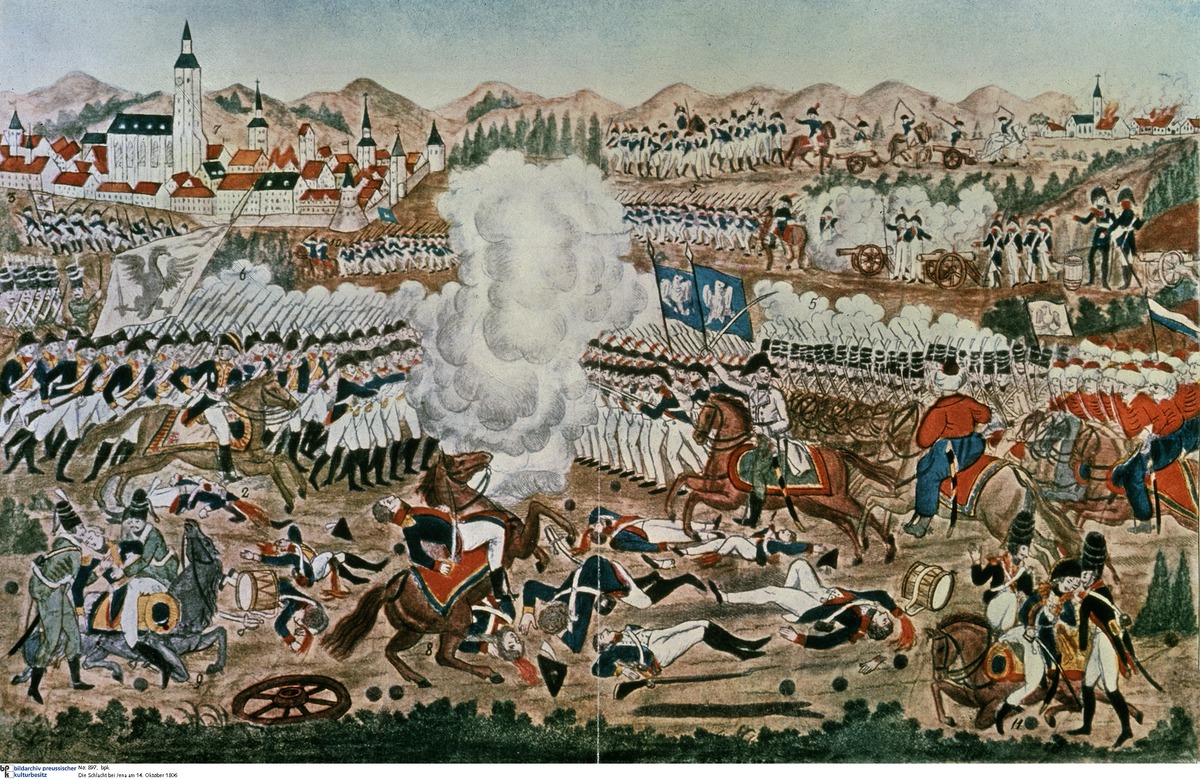
The Jena set broke up in 1803, and Napoleon’s army arrived in Jena in 1806, plundering the town and setting fire to buildings.
The French defeated the Prussian army and the victorious emperor slept that night in Goethe’s bed! Fichte admired the French Emperor and began to think about an Ich of a nation. Certainly this Ich filtered down through the decades to Nietzsche and his Ubermensch. The book ends with this devastating battle, which is something of a spoiler for me, as I have not yet got to the end of the book. I read in reviews of this book that Wulf traces the influence of the Jena set on the English Romantics, Coleridge in particular – and then the American transcendentalists (Emerson and Whitman) and the psychoanalytic theories of Sigmund Freud and C.J. Jung. Indeed, there is much discussion about the downside of individualism of the young and in society to the detriment of social and collective life. I hope to work a little on that development to “save” something of the individuated person in the face of a world that reacts to the side of collectivism away from liberal democracy.
Like Novalis’ life cut short by TB, the Jena movement was so short-lived. We leave Wulf’s pages realising that we are looking back 220 years into history. Death has covered everything of that era except the monuments, works of art, pieces of music and written documents and works from those men. Did the human imperfections, which were not the evil of men who slaughtered the Innocents of Bethlehem or millions of innocent human beings in the early 1940’s, merit the obliteration of their works and beauty through which they sought redemption? Wulf postulates that we are all Romantics in 2024. Let us not confuse the vitality of the idea with its kitsch. To quote from Rob Riemen talking specifically about politics:
In a kitsch society, politics is no longer a public arena for serious debate on what a good society is and how it can be achieved. It has become primarily a circus where people try to gain and hold on to political power and a public image.
If everything is to be judged by its reductio ad absurdam, we would have done better to stay in the Stone Age! Better still, we all become Woke and be done with it. Cancel everything! In regard to Wulf, I withhold my judgement until I finish the book and think for a few days. Perhaps we might see a parallel between Andrea Wulf as a young single mother and Caroline Schlegel who divorced and remarried with Schelling.
I began with the theme of evil and beauty, and close with an idea of sinful human weakness and beauty. We are all called to die one day and we all face God’s judgement. Hopefully, we will have produced something lasting that can be left to humanity, something beautiful, true and good.
To suffer woes which Hope thinks infinite;
To forgive wrongs darker than death or night;
To defy Power, which seems omnipotent;
To love, and bear; to hope till Hope creates
From its own wreck the thing it contemplates;
Neither to change, nor falter, nor repent;
This, like thy glory, Titan, is to be
Good, great and joyous, beautiful and free;
This is alone Life, Joy, Empire, and Victory.
A few days ago, I thought it a good idea to create a Substack account Going Substack. I set up the account with the option of not paywalling or using a lot of gimmicks. Last night, this message appeared.
We’ve removed your publication from public view due to a violation of Substack’s Spam & Phishing policy. If you believe this was a mistake, you can submit an appeal to our Trust & Safety team here.
It seems to be a problem of an algorithm or perhaps my e-mail address has been usurped. I have no way of telling. I do not scam, spam or phish. I am very careful about what I write to avoid hateful expression or anything anti-social. I have sent my “appeal” but I am not inclined to use Substack any more. I use Facebook for my “lighter” entries, and I will stick to this Blue Flower blog which has been going for 13 years and has established its modest reputation.
This was the first post I wrote on Substack with the intention of establishing something more serious and philosophical. Finally, I can do it just as well here. I am working on a new post about the Jena philosophers, and philosophers and psychologists since then, about the person and the world to which he relates.
The Beauty, Truth and Goodness thus disappears as a “trademark”, but remain as a principle in my work.
Learning from Romanticism
Light in the 1790’s and our own time
It is my pleasure to introduce this new Substack journal. Its purpose is one of promoting a school of thought and maybe even a small movement for the revival of a particular kind of Christian thought and life. The title is that of Plato’s transcendentals which describe a completely different basis to Christianity and other expressions of spiritual life. I certainly receive this idea as refreshingly different from moralising preaching and control of people. I largely reproduce my introduction to a pdf I published in 2018, and I have made a few modifications for a sense of continuity.
For many years, I have reflected on the relationship between faith and culture, a notion that has been present in many great Christian thinkers over the past couple of hundred years. I have largely come to the conclusion that the Christian message is utterly stifled by what is termed as modernity or the legacy of the Enlightenment. My own experience of life and as a Christian believer clearly brought me to the same kind of thought as the Idealists and Romantics of the end of the eighteenth century, a time when an old order fell and could not be restored. There had to be something new like when the Middle Ages gave way to the Renaissance. Man can only assimilate the truth of Christ through some experience other than being preached at with a hollow and tired message.
The same processes of thought and experience brought me to consider a succession of movements of culture and philosophy along the same lines since the French Revolution and the tumultuous upheavals of the nineteenth and twentieth centuries. Appearances and fashions change, but the underlying thoughts and conflicts remain essentially the same.
A Christian priest loves to discover divine revelation through the sources of Tradition and Scripture, through the work of the Fathers of the Church and the many theologians through the centuries. However, there comes a time when the spirit soars above the dry theological systems to embrace the beauty of creation, both by God and man. Revelation comes to us through symbols and allegory, through metaphor and poetry. Many of these signs are found in nature and speak of us of transcendence beyond our earthly experience. We respond to the Mystery with our whole person and not only by assent to doctrines and texts. Revelation is a continuing process which did not end with the deaths of the Apostles.
I will certainly discuss much more than simply a cultural and intellectual movement of the past two centuries, but a constant human experience faced with creation, nature, beauty and longing for the transcendent. German Idealism and Romanticism have many links with Neo-Platonism and even with ancient Gnosticism, and these aspects need to be studied and brought into the open, above all not condemned through ignorance and prejudice in the name of orthodoxy.
The process of conversion should be one of spiritual awakening and being on a pilgrimage. The way is shown by our instinct of Sehnsucht, an inconsolable yearning and longing for what is impossible to find in this earthly life. This is what is symbolised by the blue flower in the thought of a number of Romantic thinkers like C.S. Lewis, Novalis (Friedrich von Hardenberg) and George MacDonald. I am always sceptical about claims of sudden conversion, perhaps with the exception of St Paul. It is a process of growth and discovery, of yearning for a kind of light that illuminates people of all religions and philosophies of life. When we turn to this light, it penetrates our entire being and never leaves us unless we reject it. Christ is the full revelation of God to humanity, and expresses himself universally. He brings creation back to God in a work of recapitulation.
Our faith brings us to approach God as a child who at the same time is born and dies. We are indeed brought to face the mystery of death. Our “enlightened” times seek to prolong human life indefinitely by means of medicine and machines, and only reveal futility and the very theme of Frankenstein as imagined two hundred years ago in the year without a summer. Death is a part of Sehnsucht: our passage to the eternal Reality and universal consciousness that we cannot imagine in this life. We yearn for absolute love and beauty, which we believe we will find on passing over. Light and beauty triumph over darkness and sin. Salvation is an expression of god’s love. As is believed by the Orthodox East, it is a matter of “deification” (θέωσις) or evolution to the universal God-man who is Christ.
I wish to forsake the legalistic and juridical concept of Christian salvation, even if such terms are only metaphors and analogies. I remember reading something by Fr George Tyrrell to the effect that the soul is not brought to belief by force but by becoming aware that God is already present. St Athanasius of Alexandria said: “The Son of God became man so that we might become God“. This ancient mystical dimension of Christianity found renewal in the minds of those who were awakening from the spiritual aridity of the Enlightenment and modernity. For many years, I was tempted by Orthodoxy from having read authors like Dostoyevsky, Vladimir Soloviev and Nicholas Berdyaev, but the depth of this thought went far beyond the “ecclesial reality” I was idealising. Much of it went back, not to Holy Russia, but Jakob Böhme and to the Idealists of Jena, Leipzig and Berlin. As Böhme wrote about the Ungrund, that bottomless and indeterminate freedom of the spirit, Novalis explored the Night, as St John of the Cross before him. It is all tied together in one illuminating whole. The Night is a place of suffering and loss where God is truly revealed
One of my yearnings, as for so many before me, is a renewed Christianity, not one that is banalised and “adapted” to soulless modernity, but one of a sanctified universe and longing for eternity. Most religions lead us into a fear of death, especially what happens to us if we are bad or disobedient, but Christ reconciled us with death, something to be embraced and overcome with love. The Romantic does not fear death but yearns for what lies beyond. We must overcome materialism and the “modern” notion of science and rationalism. The idealist sees creation through spirit, and the things of God through symbols. The Blue Flower of Novalis is not a biological organism of interest to gardeners and horticulturalists, but a profound and moving symbol, our growth way from this earthly life and our deliverance. It is not a wish for death or a temptation to suicide, but a journey inwards to the Kingdom we seek. It is a dream, a journey towards a home for which we yearn. Indeed I would like this work to be an expression of my priestly calling through study and writing.
We are also struck by the collusion between Romantic Sehnsucht and Christian mysticism from the middle ages and the Renaissance period in Latin countries like Spain. Here was an all-devouring desire and longing for the transcendent that was correlative with a feeling of being an alien on this earth. We would find this sentiment in the poetry of William Blake and Novalis. There is definitely a resurgence of a form of Gnosticism that found diverse expressions including the immanentism of the Modernists at the beginning of the twentieth century. Christianity has lived through the dialectics of the eschatological and the here-and-now all the way through its history, ever since the foundation of the first monasteries in the desert. Sehnsucht is central in the famous expression in many of our liturgical prayers: doceas nos terrena despicere et amare caelestia. We are aliens and exiles on this earth, and our longing is for something we will never find here.
After the French Revolution, it was remarkable that Christianity made any kind of comeback at all. The Revolution was born of the Enlightenment and destroyed it. Philosophical rationalism came from the privileged classes, those who most ridiculed the notion of God and the so-called superstition of the masses. The response of the Terror and the Napoleonic Wars brought an end to another illusion after that of the rationalists. A new philosophy had to emerge from the suffering and tragedy. Today, we find ourselves in another period of devastation of our civilisation, a watershed between the ultimate evolution of what is symbolised by Frankenstein’s monster and a return to barbarity and submission to the most repressive religion ever known to mankind. Romantics are called to continue the same combat, though with other words and outward appearances.
The nobility of the spirit is a theme that arises again and again. As the fish rots from the head, so I believe culture can be brought back to being ready to receive Christ. Christianity began a very tiny community of chosen souls. Some of us experience life and think in an “eccentric” way, in opposition to the “world” of social conformity, collectivism, fashion and competition. Perhaps we are predisposed through differences like some form of autism, perhaps. Predisposition is only a beginning from which we come to terms with ourselves, discover what God gave us when we were born and soar to a higher life that most people do not understand. The Christian Church operates at the levels of the collective and for this tiny concentration of noble souls. Unfortunately, the Church at the collective level has nearly failed or become so corrupt as to be unrecognisable as a sacramental symbol of Christ’s incarnation. It must turn to secular humanism or accept a new infusion of leaven. This leaven is one of prophecy. This higher soul suffers from barbarity, ugliness, banality and many of the things that are just part of the life of “ordinary” people.
Of course, such elitism can suffer corruption by contempt of the ordinary and commonplace. Berdyaev said, “Had the Gnostics won the day, Christianity would never have been victorious. It would have been turned into an aristocratic sect”. Pride is a sin as much as philistinism, and for this reason, Gnostic elitism could not be allowed to become the norm. The Romantic was always concerned for humanity, especially for the poor and forsaken. This spirit, not only of Sehnsucht but also of Sturm und Drang fired the zeal of the Slum Priests of Victorian England. This movement must be revived again from the small beginnings of the Jena Idealists, the Oxford Movement and La Chesnaie and the stubborn Breton, Félicité de Lamennais. Just two or three of us will do it.
In my view, Romanticism has the appeal of a wider vision than that of most institutional churches. I see the purpose of this journal not merely in terms of academic study of Romanticism and similar movements over the past two hundreds years, nor in the fuelling of a religious revival for its own sake, but in a wider vision that is capable of challenging modern über-rationalism, materialism and fundamentalist intolerance. Where we go on this journey is a mystery, and will depend on the material yet to be written.
Like in the beginning of the nineteenth century, there are signs of an analogy of Romanticism in the various subcultures of young and idealistic people who lack any experience of organised Christianity and church services. It is my conviction that churches are no longer capable of relating to such as aspiration like in the 1960’s and the so-called flower-power. We all revolted against an authority we perceived to be insincere, hypocritical and without any profound purpose beyond social respectability and convention. Some took drugs and slouched about in dirty clothes, whilst others tried to come to a compromise with bourgeois society or wrote and expressed themselves in art.
It would seem that an attempt to whip up support for a movement with its ideology would not only be futile, but opposed to its very purpose. We live in a time when every noble idea is taken, analysed, dissected and presented as a front of herd-mentality fashions and the profit of the businessman. This has happened to all ideas, including Christianity itself, and this one too should it ever become too popular and fashionable. It is for this reason that no attempt will be made to relate to “ordinary people” but rather to found a small and elite school of thinkers and artists.
My real hope is that my little contribution will work in with a number of authors writing on closely related subjects, who see something horribly wrong with modern secular society as much as with bloodthirsty fanatics.
Will there ever be a practical application of this work? It seems too soon to tell, and ideas may fall into place with usage and experience. Notions of alternative communities have been put forward and even put into practice. One must keep an open mind. Doing this journal will help its writers overcome laziness and to return to serious reading and study. That can only be a good thing. University is merely an initiation in a lifetime of learning, writing and teaching.
I offer these reminiscences of the seminary of Gricigliano on this twenty-fourth anniversary of my Tonsure by Cardinal Pietro Palazzini in Rome. My experience there leaves me without any bitterness towards my former superiors, given that the Institute continues and grows to this day. With better understanding of my own person, I would never have gone there in the first place – but as always, lives cannot be remade and the clock cannot be turned back.
From the beginning, the Insstitute of Christ the King was intended to contrast with the bulk of traditionalist Roman Catholicism by its devotion to the Italian way, the gentleness of Renaissance saints like St François de Sales and St Philip Neri. This “softness” of approach would attract men who would exploit their environment and provoke tensions between La Dolce Vita and the square-bashing caricatures and quasi-military rigorism inspired by the last embers of Jansenism in the SSPX and other traditionalist communities. I will present this subject candidly without saying anything bad or unjust, even about people who have in fact caused me psychological and spiritual harm.
As with my failed marriage, I asked the question of what was my problem. Clinically, it turned out to be Aspergers autism, which does not dispose someone towards teamwork, but rather to a much more solitary life. The priestly ministry in nearly all institutional churches is made for neurotypicals.
I wrote these recollections in something like 2000 when my memories were relatively fresh. They have been edited.
* * *
In 1990, I met a dapper of a French priest visiting Lausanne, who was about to establish his priestly institute in Italy, in a Florentine villa that had been abandoned by a community of French Benedictine monks who had attempted a monastic foundation in the old Villa Martelli in a place called Gricigliano. It had been founded by two French priests incardinated in an Italian Archdiocese, who had obtained their doctorates in Rome. One of these two priests had in the same year obtained canonical recognition for the new priestly institute from an African bishop. Having been appointed Vicar General of the diocese (some feat, since he was living outside the diocese), the young priest was able to style himself as a prelate with the title of Monsignor. After my theological studies at Fribourg University, I joined this young community of priests and seminarians, but not without difficulty.
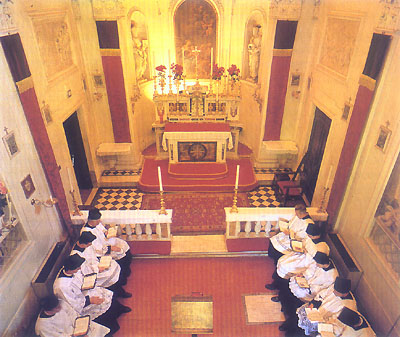
I had already been for a retreat at the house where the seminary was located in February 1986 when the place was still a contemplative monastery, and bitterly cold everywhere in the decrepit 18th century villa in the beautiful Tuscany countryside. There was a small baroque chapel, very plain on the outside, adjoining a small clearing between the trees and the way leading to the main building. The stucco on the walls was peeling away, showing many years of neglect.
The first person I met was called Arsène, an Oblate of the Benedictine community. He had studied law in France and seemed to know just about everything. He was recovering from having given up drinking and was still unable to enter the monastic life on account of being unable to stop smoking. A rough man in his late forties, he was indeed a friendly fellow, constantly helping with heavy work and welcoming guests. I spent about four days in a freezing guest room near the old chapel. The main community offices were in a large room of the main house, and the old eighteenth century chapel served only for the monks’ private Masses. Next to the room that served as the main community chapel, there was a hall with something like a minstrel’s gallery. The whole room, apparently some kind of private theatre, was painted in trompe l’oeil to imitate Renaissance niches and statues of pagan goddesses, but everything was covered in a coat of dust, and much of the paint had peeled away or was damaged by the crude installation of central heating.
After returning to Rome from Switzerland for the semester of 1986, I thought little more of the monastery high up in the Tuscany hills, having seen and visited so many Italian buildings. Little was I to know that only four years later, I would live there for two years. The application process for the new priestly institute took from May to October 1990. I finally received a telephone call during the October of that year to say that I was accepted into the seminary.
Arriving at the seminary in the November of 1990, I was pleasantly surprised to be greeted by the same Arsène and a young deacon who was completing his studies in Rome. We nicknamed the latter Don Vibraco della Traspontina on account of the time he spent in Rome doing his university studies with Msgr Piolanti. It was like a reunion of long-lost friends. Arsène had opted to stay at the monastery that had become a seminary, whilst all but two of the monks had returned to France. I found here another world of another time, somewhere between the era of Voltaire and Benedict XIV to the gilded rooms of the time of Leo XIII and Verdi’s La Traviata. I arrived on a sunny autumn day when the golden leaves on the olive trees could rival the candlesticks of this august House! I was shown my room and seminary life began.
It was curious to see so much more of a building of which I had seen very little when it was a monastery. The rooms are the ground floor were spacious and had high vaulted ceilings, all painted in white. There was the old theatre I had seen before, which had served as a refectory. There was an impressive main hall with a beamed ceiling, the walls painted with scenes of Italian cities and Tuscany villas. For most of the time I was there, it was used as a classroom. On occasions, it became a throne room for a visiting Cardinal or bishop who came to ordain deacons or priests. The large room used by the monks as a chapel was rapidly turned into the refectory as the old chapel was cleaned and appointed for daily use. Monsignor Wach had a very pleasant room for his office, protected from curious ears by soundproof doors. Adjoining this office was the secretariat where privileged seminarians could find out what was going on, or at least get some idea. Two fine stone staircases on opposite sides of the quadrangle led to the upstairs corridors, long and paved with red clay tiles. Most of the seminarians had their rooms on the upper floor. Across the front entrance with a fine wrought iron gate and a bridge going over the moat of what was a building on very ancient foundations was another building containing a baroque fountain. This was a front to the more utilitarian buildings used for producing wine and olive oil. The gardens were very pleasant, especially the fine grounds adjoining the orangery.
The chapel was small and plain on the outside. Inside, the baroque altar was singularly harmonious and beautiful, crowned by a curved apse with large statues of the holy Apostles Peter and Paul either side of a large painting in a gilt frame. The communion rail was in marble. The organ, on which I had worked and which I played each day, was up on a gallery. Various experiments were made with the pews in order that the community of seminarians could face each other like in the choir of a church. Two years of praying and singing the Office in this little baroque chapel left a lasting impression on me. Indeed, to some extent, it inspired the chapel in my present house.
This seminary was quite unlike anything I had known in the traditionalist world, indeed close to my earlier aspiration of joining the Oratory of St Philip Neri, in which I saw an informal “monasticism” without the sadness and rigorism. The founding ideal was to emphasise the spirituality of Saint Francis de Sales and the Italian spirit like in pre Vatican II Italian dioceses. There was something very human in those early days of this seminary. We prayed and we worked, combining the gentleness of St Francis de Sales, the intellectual rigour of St Thomas Aquinas and the devotion to the liturgical life of St Benedict. These were our three Patron Saints, who were to guide our spirit and new hope for traditional rite Catholicism.
Life was quite chaotic in those early days, as the monks had left the house in a mess. About thirty sickly chickens lethargically moved about in the run next to the orangery. None of them had laid an egg in years. They were later discreetly dispatched by Arsène and one of the seminarians, and thrown into the freezer after plucking and gutting. No amount of cooking would make their meat tender! The outbuildings were filled with junk and rusty woodwork tools, and the kitchen looked like something out of The Name of the Rose, with its blackened walls and antiquated equipment. Rotting vegetables were strewn on the floor. Even the old chapel was in a state of neglect, everything covered with a layer of dust. The organ was unplayable due to the pipes being choked with dirt. I wondered what kind of monastic community had lived in this place!
The seminary was a beehive of activity for those first months. Seminarians in their old work cassocks were dismantling and moving furniture, cleaning, clearing rubbish for the bonfire. The new kitchen with modern equipment was professionally installed, one of the highest priorities – hygiène oblige. I had the interesting task of dismantling and overhauling the organ. I removed the pipes and methodically stripped down the instrument. The mechanism, typical of Italian instruments of the mid eighteenth century, was very simple to repair. A name was visible inside the wind chest “Tronci di Pistoia 1766”. The pipes were quite unlike any I had seen in English organs: the metal was very thin and easily damaged from a light pressure of the fingers. Without the use of an air compressor, I had to wash the pipes in whatever I could scrounge from the kitchen, and then leave them in a row to dry on a table. I was able to clean the mechanism using a jury-rigged nozzle on the end of a vacuum cleaner tube. The organ was ready to fine-tune and play after about two weeks. The superior would have me go and play a piece on the organ whilst showing visitors around the chapel.
My peaceful and painstaking work on the organ did not isolate me from community life. We had a full day of breviary offices and the community Mass. Washing-up and refectory service teams were appointed for the meals. As in the monastic fashion, meals were eaten in silence with a reading from a book of piety. Unlike the way some seminarians thought, I found the seminary well organised, considering the amount of work needed to make the place fit for human habitation. Whilst I was cleaning organ pipes, others were painting walls, washing floors and polishing furniture. Several lorries arrived from France carrying furniture given by benefactors and retired priests. Boxes full of books also arrived, mostly junk but with some useful theological works.
The work continued through until December, when it was relegated to Saturday afternoons, the traditional time for having seminarians do useful and practical things. We were after all a missionary institute. What good would a mission priest be in Africa if he could not repair his house or mend his truck?
The superior outlined the essential philosophy of the Institute during his lectures spirituelles on Sunday evenings before Vespers. He spoke of Cardinal Siri, of Saint Francis de Sales, another approach from that of the rigorists of the Society of St Pius X. He spoke well, and certainly caught my attention. Gricigliano seemed to be almost paradise; though I knew full well that paradise does not exist on this earth. The academic life of the seminary was not as yet well organised. It was not particularly my problem as I had my own work continuing with the University of Fribourg. I had still to finish my written work on liturgical history and to prepare for my final examinations in dogmatic theology, moral theology and my chosen subject.
The first dissensions began to occur in mid December 1990 as some of the first-year seminarians (those in civil dress) began to leave mysteriously. One had refused to obey the rector and was dismissed. A subdeacon and a young seminarian got into their car during the night and were half-way back to France by the time it was noticed that they were gone. It would seem that the problem was partly caused by a prefect of discipline, a singularly immature young Frenchman. Most of us were relatively unconcerned, but tenseness reigned. It seemed that some of these men had not done a stroke of work in their lives, and could not understand why everything could not be done by paid servants! Such was their idea of the Catholic priesthood! There are many in the clergy who could not care less about anyone else, just like those who hang around religious houses, who waste no time in idle gossip! One priest wants a frilly pair of curtains. Others want antique furniture. This one complains that the sacristy door is squeaking, that the carpets are dusty. In any case, it’s always for someone else to do the job! In seminaries like in monasteries, one is judged by one’s capacities for work. You have it or you don’t! We seemed to be surrounded by swinging moods and whims of immature young boys!
Gricigliano was the subject of much gossip in those days. The essential is that it was a house of prayer. There was no denying that! It was truly a lovely place to live in, whichever the season. Perhaps, the “high camp” character in the more secular parts of the house was a little over the top! We should leave each man to choose his Louis XV armchair and Bertillon gilded mirrors in peace. Surprisingly, it was not all “high-camp”, since most of the seminarians made an honest effort in contributing to the work and devoting themselves to the service of God.
Towards Christmas, I was to be tonsured in Rome by Pietro Cardinal Palazzini together with another seminarian. The ceremony was supposed to have taken place at S. Girolamo della Carità, the Cardinal’s titular church where Saint Philip Neri has established the Oratory more than four hundred years before. Instead, the Cardinal didn’t turn up, because he had forgotten the appointment, and the ceremony took place in his apartment in a tawdry little private chapel. Our superior showed us the Eternal City with great pride, although I had already spent a year there. On returning to the seminary, it was announced that Cardinal Stickler was to come from Rome to ordain a priest and a subdeacon. This was to be the first of a series of highly complex Pontifical ceremonies in a chapel that had been designed for little more than Low Mass for an Italian aristocratic family. Within two weeks of the ordination, the newly ordained priest and subdeacon left Gricigliano to join a French “independent church”. The whole community, in January 1991, was in shock. The superior came to see each seminarian in private to ask us whether we had any idea that they were planning to leave. Only one knew something, the lay brother working in the kitchen. We were truly in a house of the blind. The “apostate” priest was replaced as prefect of discipline who was a former army officer, a fair and kind young man.
The deacons of the house were frequently called for secret meetings in Monsignor’s office, which caused no small perplexity among the seminarians. One problem in the house seemed to be caused by the hypersensitivity of the seminary rector. I never had any problem with him. A seminarian’s duty is to obey without question and to trust that his superior is fair in his decisions and requirements of his charges. Men who answered him back were sent to Santa Maria Novella, the in-house euphemism for the railway station of Florence, with a one-way ticket home. I saw others leave the seminary, many of whom were liars and dishonest men without the slightest inkling of a vocation. One sacristan, so it was alleged, was found out to have stolen albs and surplices from the sacristy to sell them to an antique dealer. The dealer in question knew the superior, and the sacristan was the next to take his train home. One first-year seminarian was discovered to be married, and was also quickly sent home!
I was still there after the “storms”, and was judged to be ready for all the minor orders in June 1991, which were conferred by Cardinal Stickler in the seminary chapel. After the ordination, I had to return quickly to the organ to accompany the rest of the Mass. Being the only organist in the house, I was more or less indispensable. I accompanied Vespers and Compline each day, and Solemn Mass on Sundays and Feast days. Though the old Tronci organ was playable and reasonably well tuned, it was difficult to play accurately on the narrow touches on the keyboard. The superior, appreciative of baroque music and good cigars, was very demanding of good organ playing, and I was able to remedy the difficulty to some extent by strengthening the springs of the organ’s mechanism. That year, a young lady, a semi-professional mezzo-soprano was invited to come to Italy from Paris. It was interesting to accompany something other than Gregorian chant, especially parts of Vivaldi’s Judith Triumphans and other baroque favourites of our superior. She came for the big occasions like the visit of the Cardinal Archbishop of the local Archdiocese and ordination days.
Gricigliano was a place of gossip and secrecy that would provoke idle curiosity that much more. Seminarians were leaving or asked to leave for unknown reasons. Each incident was followed by a secret meeting and more empty stalls in the chapel. Sometimes, the cook caught something, and would usually give me shreds of precious information during a visit to the Via Nicotina, an alley between two outbuildings where seminarians could go and smoke discreet cigarettes. I kept away from these intrigues. It was advisable not to seen to have an ear to the ground, and above all to keep one’s mouth shut! Loose lips sink ships!
I was still at the seminary the following year, and my turn came for the subdiaconate with five others. The seminary was joined by an American deacon and an English seminarian who had left the Fraternity of St Peter in Germany. The subdiaconal ordination was conferred by Cardinal Stickler in March 1992, and it felt a relief at last to be in Major Orders. It carried the obligation of reciting the breviary, but we could in theory be dismissed only for serious canonical reasons and no longer for “not having a vocation”. Life in the seminary had its ups and downs. Life was relatively calm in the spring and summer months of 1992.
It was on my return to seminary in the autumn of 1992 that the superior sent for me. I was behind time with my university work, partly because I was being asked to attend classes at the seminary instead of being allowed to study. I had finished my written work and sent it to Fribourg, but the final examinations still needed to be prepared, thesis-by-thesis. The superior seemed sympathetic to my explanation, and then proposed me a rapid ordination for a ministry that he was not prepared to divulge to me. It was a big secret. This would be done if I would agree to cease my work with Fribourg University. I later learned from a priest that he was going to send me to Africa as a prelude to eliminating me from the Institute. I was sent instead to serve at one of the Institute’s chapels at Marseilles run by a lay organisation.
I learned after my diaconate that my way to the diaconate was cleared by the influence of Fr François Crausaz, with whom I had been friends for a number of years.I returned to the seminary in March 1993 for the retreat and the ordination, which was conferred by Cardinal Palazzini. The day after, I had to return to Marseilles to continue assisting this priest in his more than limited ministry.
The day arrived for my diaconal ordination, a fresh and sunny spring day. There had been five of us at the retreat, the other four for the subdiaconate and myself for the diaconate. The vestments were neatly laid out in the sacristy with the folded dalmatics to be put over our left arms. The chapel was immaculately clean, and a strange stillness reigned in the little baroque chapel. The Cardinal’s vestments were laid out on the altar, as the strong smell of beeswax polish pervaded the scene of the ceremony. As the time approached for the ceremony, two future subdeacons and myself were vested and ready. The minutes ticked by, and the other two were not present. How can a man be late for his own ordination?
Finally, the seminarians arrived and everyone was vested. Still no sign of the missing ordinands. I ventured a question, but was told that there was no problem. We entered the chapel, and finally, Cardinal Palazzini arrived in cappa magna, accompanied by the ministers, servers and Monsignor wearing a cope. As the ceremony began, it was clear that the two missing ordinands were not going to be there. The feeling of confusion continued throughout the ceremony. I could feel the tenseness in my superior, and would notice the same thing afterwards when looking at photographs of the ceremony.
It was an almost unreal feeling as the sun shone in through the window high up to the side of the chapel, and I realised that I was actually going to be ordained a deacon. After the long Litany of the Saints, the two subdeacons were ordained, and I was finally called. The confusion filled my soul as I knelt before the Cardinal and he intoned the prayer of consecration. The right hand pressed firmly onto my head as the formula was recited: Accipe Spiritum Sactum ad robor… I received the stole and dalmatic, and had to lay my right hand on the book as I received the power to proclaim the Gospel in the name of the Church. The sun continued to shine through the smoke of the incense, as I read the Gospel and took the book to be kissed by His Eminence. There was a great joy within me, but an inability to forget the missing ordinands. Even after the ceremony, no information was forthcoming.
The missing ordinands had been expelled for some kind of intrigue, and one was eventually recycled through a stint in Africa and his ordination some two years later. The most shocking thing was to see him that very evening in Marseilles, where the confusion increased. The other ordinand simply disappeared, never to be seen again.
My main worry with this Institute was not so much the internal affairs of the seminary. A man is trained at the seminary for a few short years, and then the Way of the Cross begins after the Bishop has laid hands on him. I even dared to ask such questions. These priests must have been truly blindfolded to turn themselves into ostriches with their head in the sand! As time went on, everything began to decompose with the secret meetings in Monsignor’s office, mysterious departures of unhappy seminarians, intrigues, everything that has nothing to do with baroque elegance or Evangelical simplicity!
* * *
I have been unflattering about my experience in this seminary and indeed my time as a convert to Roman Catholicism. No one ever leaves the KGB! – a line from an old James Bond film. I survived and was unable to go the way of atheism. The Institute of Christ the King has apparently flourished since those days, and its continued existence is proof of a certain solidity. I have taken care to avoid saying anything for which I could be accused of libel or slander. It was not for me, and others have got on well there. A few from my time are still there, at the seminary or in any one of the outside ministries in many countries of the world.
I have decided to create a Substack for the purpose of uniting with other authors writing on a similar theme to my own, namely taking a more mystical and sophiological direction through a movement of thought, writing and friendship.
In this, I am particularly inspired by Dr Michael Martin, Rod Dreher and Paul Kingsnorth among others not yet on substack like Dr Timothy Graham.
I do not aspire to leading any new organisation. I am not a leader but an idea-giver, humbly contributing to a movement for the future. Novalis – “the one who clears new ground”. Traditionalism is a wonderful thing. It guides our faith and our lives, but it must be a tradition that looks ahead and lives.
This blog will continue to give postings in a lighter idiom, between sailing and spirituality, liturgy, culture, theology, etc.
This is a fascinating dialogue from a non-polemical point of view on Jansenism. At the same time, a historical examination of this sectarian movement in French Catholicism is very sobering in the light of contemporary experience.
Some aspects of Jansenism, characterised by sectarian fanaticism, were quite horrifying – like the Convulsionnaires of Saint-Médard. We might see some comparisons with the modern Pentecostalist and Charismatic movements. This Wikipedia article gives a number of very useful bibliographical references.
I have already touched this subject in this blog, notably in Jansenism and Jansenism Revisited. The links to articles from a “romancatholic.org” site have now been deleted. Frankly, Jansenism is interesting from a historical point of view, but something that is quite irrelevant today.
The video tends to gloss over the distinction between the Old Catholic movements of the eighteenth-century Netherlands and the nineteenth-century German and Swiss opposition to the Ultramontanist movement and Papal Infallibility largely inspired by Ignaz von Döllinger.
The entire period of the post-Tridentine Church and the history of the Jesuits need careful and extensive study. It is not merely a story of Popes and Jesuits, but also the secular powers of Europe, especially the Kingdom of France which was toppled in 1793 by yet again another fanatical and cruel movement.
Sometimes, a cyclical view of history enters the picture and the worst excesses of Jansenism are pinned onto modern rebel and traditionalist movements. I have come across some horrible attitudes in French, American and English traditionalist Roman Catholicism. Some of the crankier personalities go so far as to call themselves Jansenists. They sometimes associated themselves to the Feeneyites around the polemics surrounding the meaning of Extra Ecclesiam nulla salus. The problem is what is meant by the Church, whether it is a totalitarian pseudo-state led by the Pope or a mystical and sacramental Communion of the baptised. This problem was not solved in history, nor at this present time. There are some crazy cults around identifying with Catholicism, but more inspired by narcissistic personality disorder than by historical or theological considerations.
However, it is abusive to use this term, even as an analogy, in regard to most traditionalist Roman Catholics.
Studying this part of history will be harrowing to many of us, leaving us with the question of whether the creation of humanity was no more than a very bad joke! I have no real answer except each one of us being ourselves and living with the immanent spirit of God.
I am about to begin a real study of Sophiology as a foundation of much of the Christian idea to which I have aspired through Romanticism and Idealism. I will begin with the good Dr Michael Martin in America and the great Russian Orthodox priest Sergei Bulgakov. It won’t be easy, and many unhealthy tendencies rose out of this idea too. It is about time that at least a few Christians began to search for what God really is and does and what Christ taught!
I have had very little to say these last few days about Justin Welby, resigned Archbishop of Canterbury, as with the English Prime Minister Kier Starmer. I have watched videos on YouTube and seen articles on Google News, at least those that are not paywalled. None of the the various clashing collective opinions have totally convinced me, and I was surprised that Archbishop Welby resigned. There are plenty of videos about Mr Starmer having being obliterated by Nigel Farage and left with the only option of resigning. It has not happened.
As is my usual way, I am not convinced by any of the positions, for or against, but one side seems to have a little more probability than the other. It would seem that Mr Starmer is a liar, a corrupt person and applies the law differently to different segments of the population leaving many people with a sense of anger, disappointment and unfairness. The only thing that can really refute lies is time, waiting for facts to be known with certitude. I am a sceptic in the way John-Henry Newman reserved his judgement until the truth could be known with certitude. Many years of pain and suffering have brought me to this way of thinking and resisting the baying of the crowd.
I discovered the YouTube channel of someone called Piers Cross, who has attributed the problems of church bureaucracy, and politics by extension, to posh boarding schools. I watched this one about Archbishop Welby.
I also watched his introductory video which he did about ten years ago. I recognised some of the things he went through like gangs and bullying. I too went to boarding schools because my father desperately sought a solution for a son who was clearly suffering from family life. My late parents were caring and good, not a trace of abuse, and I still have the best of relations with my brother and two sisters. During my childhood, one sister was quite “overbearing”, the other sister more distant in her little corner, and my brother also in his world of collecting things and developing his numerous hobbies. I did very badly at school, whether it was being bullied at Castle Street Primary School in the parish of St George’s, Kendal, or other solutions my father tried. I could tell Piers Cross that my problem was not boarding schools but all schools.
The two boarding schools I attended were Wennington School near Wetherby in Yorkshire and St Peter’s School in York. I discussed some aspects of this experience in my blog article Tom Brown’s Schooldays. St Peter’s followed a decision by my father in a more conservative direction after the failure of various more “modern” ideas of education. Nevertheless, St Peter’s had had the privilege of Peter Gardiner who was a reformer in something like the spirit of Dr Arnold of Rugby. I have an extremely good impression of this school today in bringing the best of young human beings, though I detect a slight whiff of wokery! I say in complete candidness that I was a case of undetected high-functioning autism for which I underwent psychiatric diagnosis just a few years ago. Such a condition would be unimaginable in the 1960’s and 70’s except in the most severely handicapped. The human psychè is so complex that no single system of education can be perfect.
If we want to be completely honest, the issue of not education, in day or boarding schools, but humanity. In its natural state, humanity follows the instincts of most animals in competition for food and sex. The power of dominant males ensures a natural selective breeding and the survival of the fittest as Charles Darwin called it. In human society, these instincts are expressed as power, money and sexual dominance. The dominant male kills his competitors or expels them from the tribe. These are thoughts that inspired Friedrich Nietzsche as he contemplated the Übermensch and Zarathustra. Jung would have found a very powerful archetype here as he sought a balance between brute strength and empathy as emphasised by Christ in the Gospels and the contemplative Christian tradition. Would a psychopathic or narcissistic criminal be no more than an unsuccessful alpha male who was beaten by another stronger than he and one who holds political legitimacy?
It is a very dark and nihilistic view of humanity, deserving nothing less than a planet-killing meteorite. It is this reductio ad absurdam that relativises the question of boarding schools. There are many institutions in which young men are educated collectively, not least the day school, the Armed Forces, university colleges, seminaries. You name it. Prisons are designed to bring out the worst in bullies and dominant criminals to destroy the weaker men who fell the wrong side of the law.
We Christians seek a kinder world where human beings matter to each other in a relationship of love.
At the Nuremberg Trials of the leading war criminals in 1945-46, the American Army appointed a psychologist, Dr Gustav M. Gilbert, to study the minds and motivations of the Nazi defendants. Gilbert reported to the Chief Prosecutor Robert Jackson:
I told you once that I was searching for the nature of evil. I think I’ve come close to defining it: a lack of empathy. It’s the one characteristic that connects all the defendants: a genuine incapacity to feel with their fellow man. Evil, I think, is the absence of empathy.
Empathy is the capacity to recognise and venerate the experience, emotions and aspirations that one is aware of in oneself in other persons. This principle features in all religions and in the works of many philosophers and scientists. Thou shalt love thy neighbour as thyself – as Jesus said. Empathy implies recognition of human dignity and worth in others that one recognises in oneself. This is often what lacks in comments written, less so in this blog than certain others, by some people otherwise claiming to be Christians. Empathy is surely the yardstick by which we can judge all morality, goodness or evil.
However, we can be drawn to empathise with toxic and bad people, and that is our Achilles Heel of weakness. It can cause us to conform to mass ideologies contrary to science and reason. It is through empathy also that totalitarianism and ideology can poison humanity. We approach the very bottom of the rabbit hole of sin, that of humans and that of the powers of darkness. Errors of empathy and exploitation made by the evil “Führer” of that openness to the other bring us around full circle as we are forced to defend ourselves, even by killing in a just war or another situation of self defence.
Christ came to save us from ourselves, to give us the hope of being newly created as human beings in the created world. I don’t blame boarding school for my difficulties, but rather this reality of humanity that can soar high and fall to the darkest places. It is easier to discover the depths of the ocean or the furthest reaches of space and other worlds than to understand the other person just next to me. We can communicate by language, become friends, fall in love, but something always emerges from the nozzle of weirdness sooner or later. I spend most of my time alone, though I try to be good and kind with others. I try to be a gentleman as my parents and schoolmasters expected of me – but prudence, that Queen of Virtues, has to remain.
Some of you reading this will have suffered in life, others have breezed along in the corridors of institutional conformity. I have less and less trust in institutional churches and political ideologies. Evil in individuals can be rooted out and punished. That is less easy at the level of societies and nations. Consider the cost of defeating Hitler and other similar archetypal monsters. The worst was not the absurd methhead with the Charlie Chaplin moustache and the shaking hand, but the ideology that had possessed the souls and minds of millions of ordinary people.
What goes around comes around. Reading and hearing all the hype about the US Presidential Election, the lovely Easter carol comes into my mind and leaves me with a smile.
Till trump from east to west shall wake the dead in number
Of course, the carol refers to the trumpet of the Final Judgement that will announce the general Resurrection prefigured by the Resurrection of Christ. Will Trump from New York to San Francisco wake the spiritually dead in number? The joke seems irreverent, but it sticks in the mind.
I wrote a post on exactly this subject back in 2016 – End of the Season. I am wintering my boats as it is the end of the season and the clocks have gone back. The autumn colours are with us. The weather is dry but cloudy, and the days are shortening, and we still have nearly two months to go before the Winter Solstice. The other difference is that I am now divorced and living my re-found bachelor’s life in my village house in the Mayenne. Solitude has to be carefully distinguished from loneliness. Since April 2021, I have never had any doubt about having done the right thing to preserve my own mental health and perhaps even my very life.
My assessment of the American situation is enlightened by the UK with the Two-Tier Kier Starmer regime and the uncertainty in Europe. The UK had Brexit, and we on the Continent consider the green agenda with trepidation. It all seems to be the same as a force greater than our nation states and federations seems to be on the ascendancy, with the sole objective of increasing the power and financial wealth of the billionaire elite. It all looks like those old James Bond films featuring Blofeld and the diabolical organisation SPECTRE. The endgame seems simply to be organised crime and the abolition of law.
The anguish still revolves around the same subjects: the war between Zionism and Islam, Putin and Ukraine, uncontrolled illegal immigration, who is going to pay the enormous national debts. Does the western world still have a culture and values to preserve faced with the advent of the Caliphate or the New Soviet Union run by the billionaires? I cringe when I hear the positions of both Left and Right. It is fashionable to be Woke and left wing, but we have to be honest. It is a mental and spiritual cancer. Will Trump do better this time if he wins the election? I am sceptical. However, I cannot afford to be indifferent to the consequences of American domestic and foreign policy for those of us who live on the other side of the “pond”.
We dread the advent of totalitarianism, but we have to consider our own health of mind and ability to reason independently. I encourage you to listen to this following podcast which essentially gives us the same message as Dostoevsky, Thomas Mann, Wojtyla, Rob Riemen and many others who have experienced the collectivist “utopia” in gulags and concentration camps. We must not be parts of a mass but autonomous human beings.
I keep away from all political demonstrations and protests, where people chant slogans. I suppose it gives people energy to be part of a crowd or at a football match. I cannot think of anything more horrid. I try to analyse the various ideologies from a philosophical point of view, and to keep informed. I suppose I am slightly to the left of centre, because I believe in the welfare of the poor, the weak, the sick and the exploited at work. At the same time, I am utterly opposed to collectivist socialism. I also abhor the pigs of Animal Farm, and admire George Orwell for his prophetic vision.
May the tide turn in one way or another. May the Prophets of the Old Testament bring us hope, which is the central theme of Advent, hope for the Messiah and the Redeemer, who is Christ. As we are let down by the institutional churches, themselves following the same insane political ideologies and corrupt self-interest, we have to find God and the Holy Spirit within ourselves and in all things beautiful, true and good.
Miles Dent – The Water Rat, 14′ Whisstock gaff cutter
Patrick Hay – Salvo, 16’6” Tricorn
Mark Smith – sailed with Frédéric
Bob Pierce – sailed with Patrick, with Frédéric and with Miles
Michael Pierce – sailed with Frédéric and with Patrick
The original plan was for each boat to be provisioned for several days so that we could sail to the Île des Moutons, the Îles des Glénans, the Odet river, Beg Meil, and other harbours and anchorages with limited chances to re-stock. Strong winds forced some changes to the schedule, but with the exception of Île des Moutons all the objectives were achieved.
Bob and Michael decided to not bring Bob’s newly acquired Wayfarer (Whiskey) as originally intended because weather conditions seemed unsuitable for a maiden shakedown cruise. Instead they sailed on board the other boats.
Monday 09/09
by Anthony Chadwick
After a miserable windy and rainy Sunday in the port of Loctudy, Frédéric’s boat Marc’h Mor and Patrick’s Salvo were launched in their turn from the excellent but shallow-angled slipway. Miles would arrive later in the week to join us in time for our passage to the Glénans. A study of the forecast convinced us all we would have to adapt our sailing plan to the weather conditions. On this Monday, it was mostly dry, but there was a strong north-west wind. If we stayed near the coast, we would be largely sheltered from the Atlantic swell and chop.
We were joined by Frédéric’s charming American friends, Bob, already a DCA member, and his brother Mike whom we recruited to membership during the course of the rally. Bob joined Patrick on Salvo for the day while Michael sailed on Marc’h Mor. Mark, who had come over from England without his boat, sailed all week with Frédéric.
For the first time ever, I took in both reefs in my mainsail and mounted the smallest of my three jibs (I don’t have a furling jib). We were all cautious with this cool and sometimes severe north-west wind that would persist until Friday morning. Until then, the wind would moderate each evening only to return by morning and blow strongly in the afternoons.
We sailed to Sainte Marine at the mouth of the Odet River where we moored to the visitors’ pontoon and let ourselves be guided by Frédéric around the pretty village where his grandfather had taken him sailing and fishing as a boy. A prominent pink building in a 1920’s architectural style turned out to be the Abri du Marin seaman’s refuge charity hostel. It reminded me of the equivalent building in Douarnenez. Brittany is full of these testimonies to solidarity with those who needed a good rest after their labours as fishermen. Their working conditions were and still are dangerous and exhausting. We had a welcome drink in the “Café de la Cale” that had once been a fisherman’s house. This day would not be one of long distances sailed. We had a picnic lunch on the pontoon as we were all stocked with food for self-sufficiency.
We sailed back to Loctudy and went for a steak dinner at the restaurant “La Boucherie”. Our attitude to the sea this day had to be one of modesty and carefulness. The short trip brought a welcome change from being moored to the pontoon on Sunday with the boom tent up all the time to keep the rain off! As we found our places on the pontoon, my tent came out of its bag and went over the boom. I had adapted it from a plastic garden tarpaulin by sewing hems and attachment points. It has lasted well. The night was quiet in the calm water of the sheltered harbour, just right for a night’s sleep in my little cabin.
Tuesday 10/09/2024
by Mark Smith
Tuesday, our second day of sailing, was a longer trip. And without Bob and Mike who were exploring other parts of Brittany by car.
Setting out again from Loctudy the first part was a repeat of yesterday’s trip to the entrance to the Odet river. Our route went past long sandy beaches with the occasional rocky bits to avoid.
After a few hours Frédéric suddenly announced that it was “time to fish” and produced a large box containing his fishing tackle and a long line on a reel with several hooks. To my surprise we soon got our first big mackerel, after that there were a few that got away, but it didn’t take long to get the 4 we needed for lunch. Incidentally, although DCA rallies are not meant to be races, Salvo and Marc’h Mor don’t seem to know this! Salvo was usually first to reach our destination but I should point out that Marc’h Mor often had reduced sail, as Frédéric tells me that you can’t catch mackerel at more than 3 knots!
We then sailed further East along more sandy beaches towards the Baie de la Foret. Rounding the headland (Pointe de Beg Meil) Frédéric warned us not to take photos of what looked like a coastguard watchtower but apparently had a secret military role.
Once in the bay we sailed to the lovely seaside town of Beg Meil. We didn’t land (not all our boats were happy on sandy beaches) but all three boats rafted up on a buoy where we had a tasty fried fish lunch cooked by Frédéric on his little stove. This place had happy memories for Patrick as he had swum there as a boy 65 years ago! From our buoy we could see Concarneau on the other side of the bay and were entertained by an assortment of boats from the sailing schools of Beg Meil.
After lunch we sailed under jib further into the bay towards the harbour town of La Foret Fouesnant. This has a very large marina with a very interesting selection of boats – old and new, big and small – and is the base for several of the French yacht racing teams. We tied up to a pontoon at the far end of the marina next to several of the Imoca 60 boats (https://en.wikipedia.org/wiki/IMOCA_60). These were really impressive with a mainsail of 180 sq.m and a draft of 4m and dwarfed our little boats. Even more impressive was that these big boats were sailed single-handed across the Atlantic; and not all by men – Violette Derange is only 23 years old. We were lucky to be able to talk to some of the crews and to see one of the boats sailing next day.
Patrick and myself treated ourselves to a meal in one of the marina restaurants while the others cooked on board. I was lucky to find a grassy place to put up my tent right next to our boats.
Wednesday 11/09/2024
Part 1
by Patrick Hay
After a wet night in La Foret Fouesnant marina the occupants of Marc’h Mor, Novalis and Salvo emerged from their respective shelters to a grey morning with a wind of 12-15kn from the NW. Though our vessels are all compact, Frédéric’s and Anthony’s at least have cabins with windows and hatches. My living space on board Salvo offers little more than an access hole through a bulkhead leading to a tiny dark cave under the foredeck. Or at least, that’s how it feels when you have to creep out of it into a cockpit where everything is wet and there’s an inch of water on the floor. I even felt a little jealous of Mark who had spent the night in his micro-tent a few yards away on a grassy spot at the edge of a car park.
We all made efforts to spread stuff out to dry a little before stowing tarpaulins and other damp gear back on board. We were just three tiny boats among the dozens of ocean racing behemoths which brazenly flaunt their sponsors’ brands on hulls, sails – and even backup crew uniforms, each of which probably cost more than my boat is worth.
No such flagrant commercialism adorned our three little craft as we slipped out of the marina on our route southwards along the coast to the small fishing harbour of Trévignon – with a planned stop for exploration and lunch at Pouldohan on the way.
The following wind freshened as we headed southward. Salvo, with only her mainsail set, was able to comfortably outpace the other two boats. Sometimes her speed is a bit of an embarrassment when sailing in company but on this occasion I received my comeuppance for ‘showing off’ when one of the foil assisted swinging keel IMOCA racers swept past me at 4 times my speed.
Frédéric in Marc’h Mor led his flotilla into the bay of Pouldohan and then even further up its picturesque creeks which dry out at low water. Anthony was constrained by Novalis’ draft, but Salvo and Marc’h Mor ventured under motor through a dramatically narrow gap between spectacular rocks guarding a hidden reach of the Minahouet river. The ebb had already started, so we backtracked out to the bay where we picked up moorings for a lunch stop.
The wind had increased considerably and the moorings were exposed to the wind and swell from the NW so, though safe, it was not a comfortable place. After lunch Frédéric led the departure for Trévignon just as I heard from Miles, who was out at sea in The Water Rat, heading to meet us on the way from Loctudy. So instead of following Marc’hMor and Novalis I pointed Salvo’s bow in the direction of the little red sail I could see on the horizon. Not long later The Water Rat and Salvo were close enough for a couple of shouted greetings and both headed off to catch the others.
Wednesday 11/09/2024
Part 2
by Miles Dent
I was unable to join the rally on the Monday, as my wife and I had the funeral of a close friend to attend on the Tuesday. I was determined, however, to get there as soon as possible, so left home at about 2030 on the Tuesday evening for the 500km drive to Loctudy. I stopped just over half way and slept in the car for 4 or 5 hours, arriving at about 0930 on Wednesday. At the capitainerie I bought my pass for the slipway (15€ parking included) and launched and loaded The Water Rat for a 3/4 day cruise.
I had a trip of 14/16 NM to do, across La Baie de Fouesnant, to catch up with the rest of the fleet, mostly in an ESE direction. I was lucky to have a B3 NW wind – so motored out of the port and quickly hoisted full sail. I had the paper chart SHOM 7146L and a few waypoints entered in my GPS – the first being ‘La Voleuse’, a S cardinal about 6NM away bearing 106° which I reached at about 1300 – my old Garmin 72H handheld GPS delivering me to within 100m of it.
My next waypoint, and destination for the night, was the little port of Trévignon on a bearing of 100° about 8NM away. After about an hour I received a VHF call from Patrick to say they were just leaving Pouldohan, a little inlet just S of Concarneau. I altered course to 90° to try to intercept them on their way SE to Trévignon.
The wind started to really strengthen so I stopped to reef and continued much more comfortably but soon had to roll up the stay sail as well. Patrick had spotted me and came out to meet me so we could continue SE together towards Trévignon. The wind strengthened even more and we dropped mainsails to run down under single headsails only. Salvo is always so much faster than The Water Rat so I used some motor to keep up. There are several rocks to the N of the entrance to the port marked by the worryingly named W cardinal ‘Le Dragon’ ! We picked our way around them and aimed for the entrance to the port – now with motors running. Quite an alarming sight greeted us with waves breaking against a huge concrete mole – but once inside all was calm and we found places on the last row of buoys with our anchors run out up the beach.
I have to mention the highlight of the rally for me which was next morning sailing through a school of dolphins halfway between Trévignon and Île de Penfret (the largest of the Glénan islands). What appeared to be family groups of adults and juveniles were jumping and playing around my boat in the beautiful clear blue water.
There’s a lot of talk these days about ‘mindfulness’ as an antidote to stress, anxiety or pain. After a week of dealing with the death of a close friend I found dinghy cruising to be the perfect therapy.
Thursday 12/09/24
Day 4: Trévignon to the Îles Glénan
by Bob Pierce
Everyone had come on this cruise with the goal of getting to the Glénan Islands that sit almost 9 miles offshore of Trévignon. A few in the group had personal experiences here in their youth, which made the trip especially important. As for me, I was looking to simply survive the rally with body and spirit intact. I had brought along a non-sailor brother with whom I had not spent meaningful time in approximately 40 years; and this would be my first sail offshore in a small boat.
The islands are famous for sparkling white granite sand and turquoise water. They host a bio-preserve designed to protect the Glénan Narcissus (Daffodil) flower. Among sailors, talk about this place is filled with lore, especially about a famous international sailing school that has its expert training ground here.
During our passage, the last of the previous week’s foul weather hit us in squalls, the occasional strong gusts hitting us at our beam. On Water Rat, after his crew became paralyzed in the face of adversity, Captain Miles took matters into his own hands by single-handedly bringing the main under reef. Notably, his reefing system uses an efficient and tidy dual-line-and-bungee trick taught by Chris Waite, so he was done in a wink.
About half-way to our destination a radio call came from Anthony in Novalis. “We have dolphins! A pod of dolphins surrounded the boats and even swam with us. Sometimes jumping into the air at nearly arm’s length.
Once on shore, we took a walk to the far side of the island and heard about edible plants from Miles who taught science during his noble career. We chewed on sea cabbage (aka Sea Kale), a voluminous leafy affair on shore; err, yum. We also had wild spinach (aka Sea Beet), similar, but less yum. Then a few bites of “sea grapes,” a kind of kelp found in large quantity along the French west coast; much much less yum. I’m sure commando Frédéric eats it all for dessert every night.
Man does not live on salty vegetables alone, so we settled into the island’s quite well-visited bar, populated by a mix of ferry tourists and local sailing and scuba diving instructors. A few rounds of cider for everyone and sleep came easy.
Water Rat, Marc’h Mor, Salvo and Novalis moored off-shore. For me, a simple sleeping bag on the beach, staring at an intensely star, planet, and satellite-filled sky all night was profit enough.
Friday September 13 2024
Îles des Glénans to Benodet
by Frédéric Lopès & Patrick Hay
A cold night but the reward for spending it in the Glénan islands had been a spectacular show of stars in a dark clear sky. Our four boats lay moored to visitors buoys in the anchorage known as La Chambre, sheltered from the northerly wind by the islands of St Nicolas and Bananec. The tents of the shore-sleeping party could be spotted above the high water mark on the beach.
As Marc’hMor began a ferry operation to recover the three campers, the harbourmaster called to collect mooring fees. After hearing an explanation of the DCA and the cruising objectives of our little fleet, delivered by Anthony in fluent French, the kindly official decided to waive any harbour dues on the grounds that our boats were “too small”!
Today the marina at Benodet, an attractive holiday town at the mouth of the Odet river, was to be the destination. The wind was still in the north but much lighter than we had been used to all week, so reefs were shaken out. With the forecast for a moderate breeze from the NNW at first, veering to ENE but dropping further and ending the day with light airs from the SE, Frédéric, Anthony and Miles opted to depart the archipelago by way of the Chenal des Bluiniers taking a route to the west over the drying sands between St Nicolas and Ile de Drenec then threading their way through a channel flanked by many rocks, some visible, many others lurking just below the surface. Patrick, with Bob and Mike sailing Salvo, chose to exit the islands by way of a shorter channel known as La Pie which led northward towards the rocky reefs of Les Pourceaux and Les Moutons. His passage plan, to pass East of these, was stymied when the wind shifted to the ENE much earlier than expected so Salvo tacked onto starboard to go west of them instead. Happily this put Salvo on the same trajectory as the other three boats, although some distance ahead.
The breeze dropped as forecast so that motors were needed to negotiate the approach to the Odet. Benodet marina found enough space on the end of a visitors pontoon for all four DCA boats to moor close together.
Once again Frédéric had caught enough mackerel to feed the whole party. He prepared and cooked them and we ate a late lunch together sitting on the pontoon.
In the evening Mike treated us all to an excellent dinner at a waterfront restaurant. The Breton pastry dessert called “Kouign Amann” was discovered and enjoyed, and one or two limericks were recited by those who could recall the words. Back to the boats, except for Mark who pitched his tent in a park next to the marina, for another cold starry night.
Saturday September 14 2024
Benodet – Odet River – lunch at Anse de St Cadout – Loctudy
by Mike and Patrick
It had been another cold night, but the sun was shining and the day was warming as we prepared to explore the Odet river. Miles had had some outboard motor trouble and decided that the river trip might be pushing his luck a bit. He decided to go straight back to Loctudy to get an early start on his drive home. The rest of us waved him off and sorted ourselves out among the remaining 3 boats. Mike sailed on Salvo with Patrick, Bob joined Mark and Frédéric on Marc’hMor while Anthony singlehanded Novalis.
The Odet is a most attractive river running, mostly placidly, between thickly wooded banks. On its wider lower reaches some magnificent chateaux and grand houses stand on manicured lawns sloping down to the water. Moored yachts line both sides of the broad channel. A mile or two upstream it narrows, running faster in short zigzags with no room for moorings. The banks seem more densely wooded here, with big houses occasionally partly visible but mostly hidden discreetly among the trees.
There was not much river traffic, but in one of the narrowest stretches we moved aside to allow plenty of room for a large tourist trip boat to pass from astern. Many of the passengers gave us a jolly wave, and we returned their greetings. After a while the river broadened out, the city of Quimper became visible in the distance and the steep banks receded into a more meadowy landscape. We had spotted an interesting looking creek on the left bank so, it being lunchtime, we turned back half a mile to squeeze into its peaceful secluded anchorage (Anse de St Cadou) where our 3 boats rafted up and we shared provisions, bread, wine, cheese, pâté, cake, chocolate, for a relaxed meal.
After lunch we returned downriver, although the flood was still running against us a little. Marc’hMor tried sailing for a while but there wasn’t enough wind to make satisfactory progress until we had passed under the Pont de Cornouaille at Bénodet where sails could at last provide enough drive to tack through the moorings and out to sea. From the mouth of the river it was a close reach in a moderate breeze all the way back to Loctudy, though, as we were on port tack all the way we had to keep a good lookout for a fleet of windsurfing learners who were tacking and gybing unpredictability around us.
Arrival at Loctudy and recovery of all three boats to their trailers went without a hitch, leaving us with just enough time to enjoy a farewell drink together at the waterfront bar and to receive some topical limericks from Miles who had managed to compose one for each of us on his drive home.
Finally
Thanks to:
Frédéric for organising and for catching and cooking the fish
Bob and Mike for coming so far and Mike for buying us all dinner in Benodet
Miles for the map and the limericks
Anthony for gluing and screwing Salvo’s damaged rudder
Îles des Glénans for letting us off harbour dues because we were “too small”
This is my personal blog concerning my philosophy of life as a Christian following the Romantic world view. I am a priest in the Anglican Catholic Church – Original Province and live in France.