The Virtue of Hope

I have followed my Bishop’s tenth anniversary of Episcopal Consecration from afar. I would like to join my voice (or writing fingers) to Fr Jonathan Munn’s article Ad multos annos!

As I have mentioned elsewhere, I came to the conclusion in 1995 that my conversion to Roman Catholicism was mistaken and joined the Anglican Catholic Church in England, then under Bishop Hamlett. My experience brought me a clear view of the dangers of the extremes of cosmopolitan liberalism and parochialist conservatism. I went through all kinds of different journeys and dead-ends and ended up in the TAC under the “wooden-legged” Archbishop Hepworth. I stayed aboard until the deck sank from under my feet, and applied to Bishop Mead of the Anglican Catholic Church in England. I had already been in correspondence with Fr Jonathan Munn, and his most memorable saying was that this Church was like finding the contents of a jar corresponding exactly with the description on the label. What a surprise in this world of deceit, lies and the grandiose pretensions of narcissists and people with other disorders!

Even though Bishop Damien was friendly in my regard, he had me fill in the forms, express my motivations and vocation in writing and go before the Board of Ministry whose members were unused to dealing with someone of such an atypical profile who had lived such an extremely varied life. I was accepted, received and given conditional ordination to the priesthood.

No one would claim that the ACC is “the true Church”, but it is a true Church. The appeal to me of continuing Anglicanism was the liturgy and the effort to live with no preference over the Opus Dei – the work of God as St Benedict termed the Divine Office. Unlike with Roman Catholic traditionalists, I was not faced with political extremes and the “dialogue of the deaf”. In Bishop Damien Mead, I found a father in Christ, even though he is much younger than I am. We priests and laity are persons to him, not files of documents or quantities. This is an increasingly rare quality in a diocesan bishop!

My time in the ACC thus goes back to 2013. I never met Fr Tim Perkins who tragically died young. I was spared from knowing the drunken charlatan who was asked to leave our Diocese, who got himself consecrated by a “wooden leg” and continues to cause trouble in his town. A second priest left us for Atkinson-Wake’s group. No sooner than our Diocese had lost these two priests, others came and joined us, contributing their knowledge and learning to a cause beyond and higher than our immediate perimeters.

Like many Bishops, Bishop Damien has suffered from the weight of his pastoral charge – symbolised by the big Book of the Gospels placed on his shoulders at his consecration. We all suffer from the whims, iniquity and nihilism of humanity. Bishop Damien has taken all these sufferings with great courage, and thus edifies his charge. Ecce Sacerdos Magnus…

I am often asked what would happen if we had to have a new Bishop? I suppose that a suitable and worthy priest would be elected. However, I do think that we are in a time when Bishop Damien is the only one who has the depth of vision and understanding of profound issues that give us all a sense of direction and hope. It is indeed a part of the Virtue of Hope for us. I join in with Fr Jonathan’s prayers of –

asking the prayers of St Augustine of Canterbury, St Anselm, St Thomas Becket and St Damien of Molokai, that Bishop Damien may be given the strength to bear the maniple of tears and sorrow and that he may receive the true reward of his labours. I pray also for many more happy years as my bishop!

What a contrast from some Roman Catholic bishops I have been reading about who care more about their careers than their pastoral responsibilities!

I end with the reflection that a Bishop’s pastoral care is not unilateral. It is our responsibility as priests to look after and support our Bishop in his sufferings as a human being and his joy in doing God’s will and his job.

Posted in Uncategorized | Tagged | 5 Comments

The mask comes away…

I have come across a review of a book on the history of Vatican I (1870) in Vatican I, Pius IX, and the problem of ultramontanism. The article is published in a Roman Catholic site, and criticism from such a point of view is that much more germane. I was reading stuff like The Pope and the Council by Döllinger (Janus) and August Berhard Hasler’s How the Pope Became Infallible published in 1979 and translated into English in 1981 when I was yet a student at Fribourg and afterwards a seminarian at Gricigliano. The book in question is John W. O’Malley, Vatican I: The Council and the Making of the Ultramontane Church, Harvard University Press, 2018. I’ll read it.

This review approaches the subject with the eternal rule of the historian, that of avoiding anachronisms. You don’t judge the Inquisition by the standards of modern declarations of human rights! However, the historian is human and such temptations are impossible to avoid entirely when what we see today is a consequence of the past.

On the subject of Vatican I and its Pope who “felt infallible” like one of those clowns in the Palmar de Troya sect in Spain, we are reminded that a considerable amount of Roman Catholic apologetic cant ignores human imperfections. We are reminded of the way bishops had to live through a Roman July with its torrid heat and rain. The debates and speeches were nearly inaudible, in Latin, and horribly monotonous.

This review picks up on how Catholic reactionaries were hysterical about how the modern world, then like now, was threatening the existence of the institutional Church. Pius IX’s “solution” was to make himself an infallible monarch, the butt of jokes for decades. The theory according to which everything tightens up when there is a real or imagined threat is very compelling in this context. Conspiracy theorists in the latter part of the nineteenth century were quite shrill in their expression, and their writings are still used by groups like the sedevacantists or other traditionalists with similar views. Pius XI was a moderate and intelligent Pope who found a need to develop ideas of Christ the King (cf. Quas primas) in the 1920’s to dilute the influence of budding dictators like Mussolini and Hitler.

The nineteenth century in most of Europe was a time of great instability, and the spectre still influences the Brexit question. The paroxysm of authoritarianism was over in 1945 with the defeat of the dictators and a beginning of a new paradigm in which I discovered the world as a child. We have found out that such a guarantee of absolute certitude is an illusion. We have to work by our critical sense and understanding of our own times.

A historical study of the Council, such as I have read in Hasler’s book, and might discover in O’Malley’s book, is essential to deconstruct the myths and see the emerging image of hysterical reactionaries and a “hostage” situation as the clouds of war loomed in Europe.

We find the same terms applied to the Papacy since the French Revolution as to modern politics between the EU status quo and populist movements. In violation of the historian’s golden rule, our times give us a hermeneutic key to understanding the movements and goings-on of the nineteenth century. The history is the same, though over a longer time-scale.

Papal absolutism has brought us the Jesuit Pope from Argentina, who continues in a paradigm of unaccountability and bluff. The future will tell. To non Roman Catholic Christians, it hardly seems to matter. We are brought to the quip of Winston Churchill about the best argument against democracy being a conversation with a voter for five minutes!

We need seriously to change our paradigm and way of seeing the world. Certainly, there is hostility towards Christianity, but it is mostly indifference and ignorance. Most people don’t know and don’t want to know. Their freedom has to be respected. This forsaking of totalitarianism and authoritarianism has brought me to seek the essential of the Romantic movement and a realisation that truth is beyond our activism and illusions. It is transcendent.

Posted in Uncategorized | Tagged , , , , | 2 Comments

Tight or Loose?

I have reading a number of articles by sociologists and others who have an interesting theory about “tight” against “loose” cultures. The tightest would be strict Muslim countries or the remaining Communist and totalitarian countries. The loosest would be New Zealand or the Netherlands. It is the old dilemma between individualism and collectivism, liberalism against conservatism, between those who see positive aspects in today’s world and those who would go back to the 1950’s or 30’s and force everyone else to do so. Such a study would be Differences Between Tight and Loose Cultures: A 33-Nation Study.

My curiosity into this subject was aroused when I was voicing my concern a few days ago over Brexit. People want to leave or remain for different reasons, but I can say I have personal experience of northern England in the 1970’s and smallness of mind. A film that deeply resounded with me in those years was Kes. Here is the trailer:

This is essentially a young boy from a working class background seeking and finding his own world against the smothering norms of social conformity and bullying by schoolmates and teachers alike. I would almost wonder if there were a trace of autism in Billy Casper and the need for different world from working class Barnsley. In my own experience, I began an apprenticeship in organ building in Durham in 1976, and I only stayed for three months. My problem was cultural and my disgust with that narrow parochial mentality of the petty self-righteous. It was not my world, and I remember my father idealising those men whom he qualified at the time as the “salt of the earth”. It’s great to have a pint down t’ local with the lads, but living and working with them is another matter! It’s a point of view, because I am not interested in conversations about sexy women or football. The politicians in Westminster appealed to such people to get their Brexit vote.

All my life, I have contended with this issue of strict conformity and social cohesion against finding self-knowledge and the stuff of which creative people are made. I’m not picking on the workers, because the French bourgeoisie can be horrible too. Oscar Wilde picked out the point beautifully as he compared them with the Scribes and Pharisees, all law with a cold heart!

The world is made of many dialectical opposites: rich and poor, urban and rural, religious and spiritual or materialistic, nationalists and globalists, conservatives or traditionalists and liberals. Some of the sociologists I have been reading suggest that our differences are less political and ideological – but cultural. What is culture? Culture is not only art, music and literature, the creativeness of the few, but it is also a code – differing from country to country, from one social class to another – determining rules for correct behaviour and dress. Most of us follow these norms without a second thought, and others are more critical and find themselves living on the edge or in the margins. In some countries, social norms are enforced strictly – Saudi Arabia or North Korea for example – and we can do pretty well what we want in most western countries within the limits of the law.

One thing that alienated me in northern England was the pettiness and intolerance. On the other hand, people will talk to you. Try opening a conversation in London and the response is likely to be a very stuffy “I don’t think we’ve been introduced“. Those are two different levels of social conformity and intolerance. When things go too far, we tend to yearn for a nostalgic idealisation of the 1950’s when there was less litter, rudeness, selfishness and lack of respect for other people. Men wore hats. Ladies wore dresses. Men had short haircuts and women tied up their hair and wore hats. Punctuality was the politeness of kings! No one was entitled to anything – you had to earn it, in your place. The cycle turns again when individuals are stifled and yearn for the freedom, not to harm others, but to be truly themselves. Thesis, antithesis, synthesis – in the way Hegel put it. History is cyclic and what goes round comes round.

The theory according to which an existential threat brings about a coherent society is interesting. England during World War II was a model of national unity and people pulling together to look after the victims of war and the common effort of beating the Hun! My grandparents and parents mocked Hitler by drawing his face on rubbish bins and in other ways. On the other hand, occupied France was a minefield of collaborators and resistants. One could find oneself betrayed to the Gestapo by one’s own family! Collaborators would sell out a person just for a few food ration stamps or some petty privilege. I don’t think that tightness was always so correlative with existential threats, but it is often the case. The present-day threat as perceived by some is the spectre of mass Islamic immigration and the islamisation of Europe. How real is that threat? Certainly much more in Paris or Marseilles than in my little village among the apple trees and cows of Normandy! We also have to take into consideration the fact that we have voluntarily relinquished our Christian culture in favour of materialist consumerism.

With Brexit and tendencies towards nationalism and so-called “populism”, many favour authoritarianism and tightness. Who knows, in the 2020’s and 30’s, we might see a repeat or a caricature of a hundred years before with full-blown totalitarianism. It suffices to see the old footage to see how popular Hitler and Mussolini were in the 1930’s before the war and without folk knowing anything about slavery, concentration camps and euthanasia programmes. After all, the word Nazi was simply a contraction of Nationalsozialistische Deutsche Arbeiterpartei, a socialist notion made to appeal to the working class. Working class people could be counted on to obey the leader and repress original thinking. Without the workers, no one would have taken any notice of the ranting failed art student from Austria! That is the extreme. I felt the same “tightness” in Durham but at a more subtle and moderate level, but bullying and abuse are still serious matters.

The disciplined, clean and crime-free society is a temptation, as is a Church that serves as a “chaplain” to such a regime as in Spain under Franco. The loose society has its disadvantages and self-entitled “lazy bums”, but it also has tolerance and creativity. The totalitarian cult or sect works well for as long as the “guru” is reasonable in his demands and the adepts can be satisfied with life without criticising or asking questions. The “democratic” alternative community rarely lasts very long due to human nature. We are back to the old theme of Dostoyevsky’s Grand Inquisitor.

The only way out of this impossible situation is nobility of spirit, a subject I have written imperfectly about and which I am researching for my next Blue Flower. Few have it. Do I have it? It seems to be a quality like the State of Grace or humility! It is unredeemed against redeemed humanity. The dialectic is certainly to be found at the root of many problems in our world like terrorism, revolution or the road towards totalitarianism. The cycles of history turn and reaction follows action.

I see these things happening, and the truth is higher and more transcendent that any of this bloody mess. The aspiration to the wholeness of humanity in Romanticism happened in the wake of the French Revolution, as a reaction to Victorian hypocrisy and again shortly after World War II and the evaporation of European totalitarianism with the only exception of Communism in countries far away from us.

What about each one of us in all this? Be as harmless as doves and as cunning as wolves! We have to live in society and play the game, do the right things, but not believe in everything uncritically. That seems to be the difference. The Christian anarchist obeys the law and respects other people, but believes in a higher spiritual principle than authority, submission or law.

Posted in Uncategorized | Tagged , , , | 1 Comment

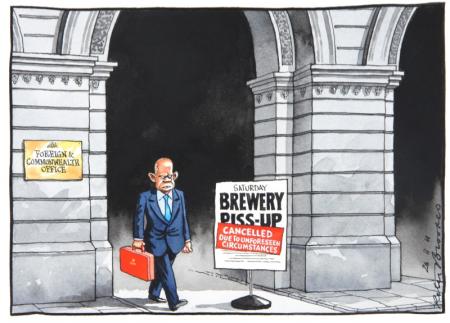
Piss-ups in Breweries

In two hundred days, the 29th March 2019, the UK will leave the European Union and go to the “good old days”. I won’t go into the details of everything I have been reading in the news. You can read it all for yourself, listen to videos of speeches in the Commons. I can only be grateful to have lived in France for so long – and I fulfil all the requirements for French citizenship. I have to go and sit an examination with the Alliance Française next month to produce a piece of paper saying that I come up to standard for the Froggie Lingo. It is one of the required conditions. Then I can submit my application to the Prefecture of Rouen in November. The UK will have nothing to say about that and the law allows me to keep my British nationality. I will then be both British and European, able to travel without restriction between the two worlds. I also have to get a French / EU driving licence, which I will be applying for next week. British driving licences will no longer be valid in Europe – and I will need to ask whether it is possible to keep my UK licence for when I go to England.

If Brexit is “no-deal”, then it is going to be chaos. Some journalists are likening the situation of this impotent government to France or Russia just before their revolutions, or Weimar shortly before Hitler took over. It is all very frightening as the British political establishment seems about as corrupt as the Vatican and any number of fly-blown banana republics, though more about money than “chicken leg”. Perhaps they are exaggerating and fear-mongering. Though there are many problems in the EU, I have not been hard to convince into the Remain camp – and I give my voice to the cause of a new Referendum before it is too late, offering three choices: soft Brexit according to the Chequers Agreement, hard Brexit or remain in the EU.

The British establishment seems blithely uninterested even in questions of business and trade, where the money is. The situation of EU nationals in England and UK nationals in Europe like myself is still vague and would become dire after a no-deal Brexit. I remember having to have a residence permit here in France, but then there was no problem in being able to work and be affiliated to the social security, health care and pension system. Without all that, I would be back in England and destitute, told that I can eat cake if I have no bread! Not so with French nationality as many British expats here in France have obtained.

From what I am reading in the mainstream news, Brexit seems to me absurd, an impossible situation. There are problems with the EU, over-regulation, lack of accountability and democracy, but the status quo is better than what might happen with a no-deal Brexit. As Voltaire said, Le mieux est l’ennemi du bien (the best is the enemy of the good).

A friend of mine wrote to his MP: “Current polling shows that a majority of UK voters, (and of your constituents), want to stay in the EU.  The best legal advice is that Article 50 can be rescinded unilaterally, even at the very last minute. Staying in the EU would protect this country’s commerce, manufacturing and agriculture, as well as its influence in the world“. My own work as a French to English translator is an epitome of the need for business in different countries to overcome the language barrier and to trade. I do business with translation agents in several European countries, and one in England run by a French director. He will also have difficulties once the fateful day arrives with all the restrictions and red tape.

I know zilch about economics and and international trade (except at my own infinitesimal level) but I can only strike my forehead with the palm of my hand – repeatedly – when I see the people running Westminster living in – – – Cloud Cuckoo Land. The EU was put together painstakingly over some forty years, and it is all about to be ruined. Perhaps the country of my birth is about to go back to the 1930’s!

This plea will have no effect other than ask British readers to reflect and voice their conviction that the Referendum first-time around was obtained by lies and populist jingoism. Our country lost what was left of its Empire from the end of World War II to the 1960’s. Next, it will be the unification of Ireland (an idea with which I sympathise) and the division of the Kingdom. Alarmism? Perhaps, but what I am reading about Theresa May and the Conservative half-wits hardly inspires confidence. I wonder whether all this is going to end up with a General Election over a vote of no-confidence and Labour getting in under the leadership of Jeremy Corbyn. We will have deserved it!

Some might ask me what I think about mass immigration and the vast sums of money being sucked out of the social security system. It is not a question I know much about. I live in the country, but I do know that some parts of Paris resemble slum dwellings in Africa, South America and the Middle-East. There is a problem when English people cannot afford to buy or rent homes and social housing is being given to people who have just arrived and are living on benefits. The question of survival is at the front of any populist and nationalist agenda. I cannot myself return to England because I don’t have the money and have not contributed to national insurance for years. I wouldn’t even get a measly state pension! The migration policies of the EU are catastrophic, even for the people themselves living in destitution and squalor. I don’t know what to say, but we can’t ruin everything just to stop the immigrants.

I have so little left of my origins: the English language in which I am writing, my red passport, my Church and my family. I go to Synod and Council of Advice meetings in England. I still have my memories from childhood and adolescence before I arrived in France in July 1982 looking for my vocation and life. The journey took me to Italy and Switzerland, an experience of cosmopolitanism – and I cringe when I read about the parochialism of Tory politicians in a completely bigoted and closed paradigm of mind. I was born in England, and I was given values and a world view I would have found nowhere else, except perhaps in Germany two hundred years ago. The present English political establishment is not the England that made me English!

I ask English readers to think these things over and write to their PM’s to show their support for a new Referendum. I am sure that Europe can and will reform the present institutions in Belgium and forge something that is not only money and material, but also lofty inspirations of the soul, the gift of Christianity, the intrinsic goodness and worth of the human person. There must be light at the end of the tunnel. Anyway, we can only do something about it by staying and working for that reform, not by leaving .

In every lawful and peaceful way, let us exorcise this demon of Brexit and avert incalculable harm to us innocent citizens, our families and friends, and all that matters to us.

Posted in Uncategorized | Tagged , | 10 Comments

Be careful about what you ask for!

The Pope’s Earthly empire is laid to rest – Italian anti-clerical drawing from 1870

It was in 2014 that I wrote in Aristocracy of the Spirit:

I had a long conversation with two friends in London a few days ago about the notion that the Church, in particular the Roman Catholic Church was, using computer language, in a state of complete system failure. No amount of work would repair the system other that a complete hard reboot. Roman Catholicism has painted itself into a corner with its notion of Papal infallibility that no amount of apologetics can save it from inevitable decline. Perhaps such a view is exaggerated, because it seems to be finished in most of Europe, but an evangelical and charismatic form seems to be growing in China, Africa and South America.

I found an entry in Facebook this morning that I cannot find, but the substance consists of saying that even devout and practising Catholic people would recommend the total collapse of institutional Catholicism as the only condition for the renewal of Catholicism and Christianity. The idea is going around, and it is tempting. I was listening to someone on YouTube who used to be a therapist, and the job certainly took its toll on his own spiritual and emotional life. He didn’t seem to be bitter, but he sees revolution in the air. I am brought to think of Wordsworth’s rapture on seeing the French Revolution – that is until they rolled out the guillotine! Indeed.

Only churchmen would be concerned to see the Church cleansed and reformed. The secular world would see it destroyed, taxed and fined out of existence. So would the more fundamentalist forms of Islam and Evangelical Christianity (though they have their own problems). A short while ago, I read about the Racketeer Influenced and Corrupt Organizations Act (RICO). It is a provision of American Federal law and there are equivalents of it in Europe (dealing with the Mafia in Italy, for example) and other parts of the world. The real issues are going on in the USA, but the Vatican is implied. Normally, the Vatican is a sovereign state and has diplomatic immunity. Would sending the troops in to invade the Vatican cause a war these days? A couple of thunder flashes (non-lethal hand grenades used for military training) and rifle shots in the air would do the job. Perhaps an idea or two could be left in the comments to this posting.

Then there is the question of whether this is an American problem or a world-wide one, or one that only concerns the American Church and the Vatican. We all need to watch the news, relevant blogs and the more credible entries in Facebook. There is a lot of hysteria and red herrings like homosexuality and clericalism being blamed for everything. I blame narcissistic and sociopath personalities, remembering that each person on this earth has a choice between good and evil. Psychopaths collaborating together in some kind of secret organisation is the very essence of a malaise in human nature described by the Polish psychiatrist Dr Andrzej Łobaczewski in Political Ponerology. I do believe that everything will click when someone reads this book (which is in English). If this has happened in the institutional Church, then all that can be done is for the UN and the USA to declare war on the Vatican and occupy the territory and positions of power after an unconditional surrender.

The future of it all would be most uncertain. Perhaps parishes that own their property as associations or rent a church that are not involved in crime or cover-up would find a way to continue. It may be like 1905 in France. The Church still exists in France but has no political power or immunity. The cathedrals belong to the State and parish churches older than 1905 belong to the municipal authority of each commune. The buildings are allocated rent-free to the diocesan and parochial associations that administer money and material tasks. The Law of 1905 has been used by traditionalists to their advantage, taking churches like Saint Nicolas du Chardonnet in Paris or Saint Louis du Port Marly near Versailles by force. The situation of the first church is tolerated by the Mairie of Paris and the second has been regularised with the Bishop of Versailles.

In America after massive bankruptcy and selling real-estate to pay the legal fees, fines, compensation, you name it? Perhaps some of the parishes could raise money to buy a few buildings for sale, just like traditionalist RC groups and continuing Anglican churches. Who knows? That’s America. What about the Vatican? That is a matter of international law and it will take time to pan out.

I don’t wish anyone any evil unless they are personally guilty of crimes against human persons or have covered-up for them from a position of authority. May the dirty secrets be blown open for the world to see, that sin may be overcome by repentance and a renewal brought about by divine grace and the innocent seeking a way forward in humility. Tremendous damage will be done, as happened at the end of World War II when Berlin was flattened and thousands of innocent German civilians were left homeless and starving.

I now begin work on my article in the next Blue Flower which will revolve around the antithesis of psychopathy and evil totalitarianism, the nobility of the human spirit at its highest and most beautiful. May we transcend the evil of this world as we yearn for the Βασιλεία τοῦ Θεοῦ (Kingdom of God).

Posted in Uncategorized | Tagged , , , , | Leave a comment

Blue Flower Feedback

Since publishing The Blue Flower in late June this year, my website statistics inform me that the file has been downloaded 317 times. It might have been read by that number of readers with varying degrees of interest.

Feedback is always useful for what modern business calls a strategy of continuous improvement. The review is intended to be quite high-brow for the sake of contributing to discussions that may no longer be fashionable in universities. When I was at Fribourg University, we had seminars that we could choose, and they involved dialogue with the professor in the old Greek tradition. This was very valuable in my experience as a student and opening my mind to possibilities of new paradigms.

The writer can feel quite discouraged if working “into a vacuum”. Feedback from readers would be appreciated so that progress can be made.

Posted in Uncategorized | Tagged , | 3 Comments

Solitude and Loneliness

When I was in my school choir, we sang the famous Mendelssohn anthem Hear my Prayer, the text of which is derived from Psalm 55.

Hör’ mein Bitten, Herr, neige dich zu mir,
auf deines Kindes Stimme habe Acht!
Ich bin allein; wer wird mein Tröster und Helfer sein?
Ich irre ohne Pfad in dunkler Nacht!

Die Feinde sie droh’n und heben ihr Haupt:
“Wo ist nun der Retter, an den ihr geglaubt?”
Sie lästern dich täglich, sie stellen uns nach
und halten die Frommen in Knechtschaft und Schmach.

Mich fasst des Todes Furcht bei ihrem Dräu’n.
Sie sind unzählige – ich bin allein;
mit meiner Kraft kann ich nicht widersteh’n;
Herr, kämpfe du für mich. Gott, hör’ mein Fleh’n!

O könnt’ ich fliegen wie Tauben dahin,
weit hinweg vor dem Feinde zu flieh’n!
in die Wüste eilt’ ich dann fort,
fände Ruhe am schattigen Ort.

In English, the last verse we sang was –

O for the wings, for the wings of a dove!
Far away, far away would I rove!
In the wilderness build me a nest,
and remain there for ever at rest.

It all seemed so solipsist, selfish and sentimental, but it struck very deeply in me. In fact, generations of monks and other special people took to the wilderness, which can be a physical place like mountains, the desert, a forest or the sea in a boat. St Aelred of Rievaux wrote at length on the Sabbath of the Soul in his Speculum Caritatis. The soul finds rest insofar as union with God is achieved and the sin of selfishness is purged away by divine grace and asceticism.

It seems like running away from reality, that reality being the noise and stress of modern urban life. I have mentioned before that my own experience of life is that of someone on the autism spectrum, especially sensitive to the negative emotions of other people. On the contrary, social media, city life and addictions are more like running away, whilst solitude is for the person who has the courage to face his strictest critic – himself.

In his play Huis clos, Jean-Paul Sartre wrote L’enfer c’est les autres (Hell is other people). The idea as intended by the French Existentialist philosopher is difficult to understand correctly. Are our relationships with others always toxic, infernal? All human beings contain what is important in ourselves for our self-knowledge. We all belong to the universal idea of the human being, but there is a vital distinction between persons. The scholastics thus distinguished between nature and person when discussing the theology of the Trinity. We are fallen and sinful, and dependence on other people will bring us to unhappiness in short order. We have to be resilient and self-reliant. We have not to compare ourselves with other people, but with ourselves the way we were yesterday. This is surely the condition of the authenticity of any intimate or social relationship. However populous the place where we live or work, we are always alone. Whether that is loneliness or solitude will depend on our awareness of our otherness as persons, the absolute impossibility of experiencing life as another person. The quality of empathy gives some insight into the emotions of another, but as “through a glass darkly” as St Paul put it. As someone with a degree of autism, I have often given thought to this impossible mystery of otherness and the lack of communication caused by weakness of perception. The autistic person or “aspie” (a term I don’t like very much) is alienated and often sickened. I am brought to think of the philosophical novel, also by Sartre, La Nausée. Nausea is a very powerful emotion by which someone would say “I am sick and tired of…”. It is a feeling that is often felt around the stomach and resembles the experience of a physical digestion malaise or a reaction from a disgusting smell like rotten meat. My own experience of anxiety will often make me feel like wanting to puke up. Sometimes, we have to take leave and go away.

The other side of the coin is that solitude can be lived positively, and we “recharge our batteries” through a week in a boat or camping in wild places. The line dividing beneficial solitude and toxic loneliness is brief. We do need some kind of relationship with those we trust like family and old friends. If we can’t be in their presence, at least we can write letters, e-mails and call them on the phone. It’s something. If our loneliness is to be converted into solitude, we need to experience God, the sacred, the spiritual.

For many years, I have worked alone to earn my living as a translator. A translation agent contacts me and ascertains my capacity to do the job. It then sends me an e-mail with the text to translate. I process the translation from French into English, using the proper technical terms, using various modern tools like Trados. I then send the file back and invoice the agent at the end of the month. No commuting! No bullying by narcissistic managers! But my day is spent in my own company with music and the jobs to do according to the deadlines given by the clients and to which I agree when I confirm the job order. Many people, including those who are not religious, have solitary jobs. Some look after a lighthouse or some area of land where people hardly ever go. I have a friend who is often alone on night shift at the port of Le Havre controlling ships entering and leaving for sea. We all need to earn a living – and offer what we have.

We are often brainwashed to confuse solitude and loneliness, to fear being alone, to perceive it as a punishment – a child being sent to his room or a prisoner being put in solitary confinement. Most people are addicted to social interaction to such an extent as any amount of solitude causes intense pain. A prisoner in the “hole” quickly goes mad, and loneliness can truly break the heart.

The glass is half-full or half-empty – or it is full of a quantity of liquid and a quantity of air. There is a difference between being alone against our will and finding ourselves alone because it is our way in life. Humans are social animals, but not always. I did have friends or playmates at school, but what I loved most was playing at camping in the garden or going fishing. It’s the way I was made and grew up. I enjoy being with friends, usually because a common interest brought us together and we empathised, but I can’t stand parties and small talk.

Solitude is a gift, and is reserved to those who have suffered and gained self-knowledge. The lonely person feels rejected and shunned, feels bitter towards the world. In solitude, a person has a relationship with himself, a kind of “two-in-one”. In my reading on psychology, I see this distinction in the comparison between borderline personality disorder (BPD) and autism spectrum disorder (ASD). The borderline personality is empty within and needs the psychic energy provided by other persons. They feel alone and abandoned. Loneliness for them is a punishment, a judgement of their attitude and behaviour. The autistic person (high-functioning) is also alienated from the “world” because of the “bullshit factor”, the lack of integrity and constancy. After a period of acquiring self-knowledge and coming to terms, solitude becomes something positive and a bringer of happiness and peace. We can use solitude to discover our true self and therefore the immanent divinity within us, the “icon” of God given to us through our being human and illuminated by Baptism. The greatest human achievements come from men and women who worked alone in spirituality, art and technology. The music of Bach, Beethoven and Mendelssohn did not come from Germany, but from those individual persons. Genius comes from solitude. Solitude allows us to create and reach out authentically to other people, caring for their needs and desires.

Posted in Uncategorized | Tagged , , | 2 Comments

Two Worlds

I have been neglecting this blog for some time, partly due to personal issues and partly due to having had a major computer crash. My data is backed up and some recent stuff is being saved from the hard disk of the stricken computer presently in the care of a technician. I have been able to put a Windows 7 computer into good use, installing the various applications from my external hard drive, and will be glad to have two parallel “rigs” for my translating work and my Blue Flower related work. I am hoping that my crashed computer can support Windows 7 after my bad experiences with Windows 10 – mainly a question of drivers. We’ll see…

There is also the need to be detached from some of the hysteria whirling around about the issues surrounding the Pope. I am not a member of the RC Church, but associations tend to be made between organised institutional religion and the old sins of unredeemed humanity.

Some time ago, I visited a kindly Englishman who owns a small château in northern France and aspires to building up a humanist vision of a change of consciousness. The theme reminded me of some of the ideas expressed in Romantic authors like Wordsworth, a kind of secular eschatology in an age when institutional Christianity was too tired to provide a convincing answer to materialist rationalism and the pent-up hatred against the old institutions of the Church and the Aristocracy. The reality is that the gentleman is alone in this comely dwelling in the woods. He has occasional visitors and friends, and sometimes some odd characters. He sometimes hosts groups of business people or educational concerns, which help to finance the estate. The central theme is New Age, a term that is eschewed by conservative Christians, both Protestant and Catholic. His ideas need rethinking – from financing his house through grandiose projects to building a community of alternative living at a human dimension. The contradictions are easy to understand but difficult to solve. I have enough problems of my own!

My approach to New Age has been philosophical and comparative (I have no experience with New Age groups), seeking an expression in modern times of phenomena like Gnosticism and Romanticism as it manifested itself in the wake of the French Revolution and the mid nineteenth century up to World War I. Unfortunately, it is not the only understanding of New Age. There is also a plethora of cheap commercial “spiritualities” and their charlatan gurus. The story of Theosophy and some of the “mystical” underpinnings of Hitler’s ideology are extremely confusing. Sometimes mental illness and psychosis enter the picture, and the end result is extreme confusion and a temptation to reject the wholesome and noble with the cheap dross and ravings of the feeble-minded.

With these thoughts in my mind as I contemplate an article for the next Blue Flower (Christmas 2018) on nobility of spirit, I am brought to the concept developed by Origen on the various levels of interpreting the Scriptures. These levels go from the literal / historical reading of the texts to analogy and allegory, a mystical and hidden meaning. In institutional Christianity, the Church has always had room both for ordinary parish life and the monastic life, covering both community life and the solitary contemplative life. Take away the “ordinary” way, and our “higher” way can only evaporate away from the lack of roots. Christianity that is purely Gnostic cannot subsist in history and human life. It cannot last, but it has to be there for those who can “take it”. Take away the “higher” way, and all you have left is materialism and the hubbub of modern politics.

I am reading April De Conick’s The Gnostic New Age. How A Countercultural Spirituality Revolutionized Religion from Antiquity to Today, published by Columbia University Press 2016. See a review. I am not yet very far through this book, but I am reading it to understand the issues and the need in people’s minds to wander beyond the bounds of Judeo-Christian monotheism to seek inner knowledge and self-consciousness. The challenge presented by Gnosticism is tracing the evolution of religion from obeying a tyrannical deity who sets the standards of the law too high and punishes transgressors without mercy, to entering into a Covenant, to the discovery of the loving and transcendent God the Father of Jesus Christ above the spirits of this world. The first view of the dictator god is that used by temporal rulers to obtain control over the masses, and this has always been the drama of the Church – to this very day. The theme runs all the way through history and both through religions and “secular” philosophies like anarchism à la Tolstoy. I find this book both challenging and enlightening.

My brother in the priesthood Fr Gregory Wassen has been writing in his blog after a period of relative silence, and I would like to draw your attention to his reflections on Plato and a theory of two worlds.

There are many agendas and ideas flying about in this world, and we can’t heed them all. We need to work things out using our rational faculties, but also our imagination and intuition. As a priest in the ACC, I am greatly indebted to the breadth of mind of our Bishop with the kind of priests he is attracting – including Fr Gregory Wassen, Fr Jonathan Munn and Fr Andrew Scurr. We are coming together to build a new way forward, on the basis of orthodox Catholicism but also through the soaring of our minds and imaginations to that transcendent world beyond, our Sehnsucht for the ultimate in truth and beauty.

I would certainly like to work towards a meet-up of all those who have expressed interest in my Blue Flower project. Summer is nearly over, and there will be fewer distractions as we get back into the mood for work and reflection.

Posted in Uncategorized | Tagged , , , , | 6 Comments

The Challenge

I was pointed towards this lovely article J. R. R. Tolkien’s Lost Prophetic Message on Abuse in the Church. It is for the reader to discern whether he should remain in the institutional RC Church or do something else. I am a cradle Anglican and was wrong in my choice and immature in my decision to become a Roman Catholic back in 1981. I returned to Anglicanism via the Continuum. Clergy of all churches can be tempted to seek partners for sex and even use manipulation to these ends. As a fresh young schoolboy, I came across a twisted Anglican vicar or two, and was able to avoid their clutches by simply telling them that I was not interested. Even in those days, they could go to prison and lose everything! I even heard the expression in the 1970’s “Mr X likes chicken leg” from a cathedral organist, not referring to food but young boys. There is an odd kind of complicity about this sordid subject, even among those who were in contact with the predatory clergy but did not themselves engage in such behaviour.

A lot of people are going to be seriously scandalised over the coming weeks and months, whatever happens with the Pope and his collaborators. I have already read sneering comments on Facebook about “superstitions” about “sky fairies” and how atheism and Islam would be triumphant on the final discrediting of Christianity.

Tolkien wrote this beautiful text:

You speak of ‘sagging faith’, however, that is quite another matter. In the last resort faith is an act of will, inspired by love. Our love may be chilled and our will eroded by the spectacle of the shortcomings, folly, and even sins of the Church and its ministers, but I do not think that one who has once had faith goes back over the line for these reasons (least of all anyone with any historical knowledge). ‘Scandal’ at most is an occasion of temptation – as indecency is to lust, which it does not make but arouses. It is convenient because it tends to turn our eyes away from ourselves and our own faults to find a scapegoat. But the act of will of faith is not a single moment of final decision: it is a permanent indefinitely repeated act > state which must go on – so we pray for ‘final perseverance’. The temptation to ‘unbelief’ (which really means rejection of Our Lord and His claims) is always there within us. Part of us longs to find an excuse for it outside us. The stronger the inner temptation the more readily and severely shall we be ‘scandalized’ by others. I think I am as sensitive as you (or any other Christian) to the scandals, both of clergy and laity. I have suffered grievously in my life from stupid, tired, dimmed, and even bad priests; but I now know enough about myself to be aware that I should not leave the church (which for me would mean leaving the allegiance of Our Lord) for any such reasons: I should leave because I did not believe, and should not believe anymore, even if I had never met anyone in orders who was not both wise and saintly. I should deny the Blessed Sacrament, that is: call our Lord a fraud to His face.

If He is a fraud and the Gospels fraudulent – that is: garbled accounts of a demented megalomaniac (which is the only alternative), then of course the spectacle exhibited by the Church (in the sense of clergy) in history and today is simply evidence of a gigantic fraud. If not, however, then this spectacle is alas! only what was to be expected: it began before the first Easter, and it does not affect faith at all – except that we may and should be deeply grieved. But we should grieve on our Lord’s behalf and for Him, associating ourselves with the scandalized heirs not with the saints, not crying out that we cannot ‘take’ Judas Iscariot, or even the absurd & cowardly Simon Peter, or the silly women like James’ mother, trying to push her sons.

It takes a fantastic will to unbelief to suppose that Jesus never really ‘happened’, and more to suppose that he did not say the things recorded all of him – so incapable of being ‘invented’ by anyone in the world at that time: such as ‘before Abraham came to be I am’ (John viii). ‘He that hath seen me hath seen the Father’ (John ix); or the promulgation of the Blessed Sacrament in John v: ‘He that he eateth my flesh and drinketh my blood hath eternal life.’ We must therefore either believe in Him and in what he said and take the consequences; or reject him and take the consequences. I find it for myself difficult to believe that anyone who has ever been to Communion, even once, with at least a right intention, can ever again reject Him without grave blame. (However, He alone knows each unique soul and its circumstances.)

This scandal will not affect only Roman Catholics but all Christians and all believers and non-materialists. It may be a challenge to many of us, even when we were hardened by seminary life, the culture of secrecy and human manipulation even when no physical sex was involved. This challenge has to be faced, by a mature faith and an authentic spirituality based on contemplation of the absolutely transcendent God and His presence within each and every one of us.

The kind of religion that seeks power, money and unconditional obedience may well die, and there is no need of a devil or evil spirit to prevail. What cannot die is what is within each of us and what even death cannot vanquish, and that doesn’t depend on institutional Churches. Even the sacramental Church only represents the stages though which the soul passes from childhood to maturity and the transition from this world to another.

Solutions for the priesthood? I have bitter experience of the kind of culture that favours that unhealthy kind of complicity. It is important for the priest to “get his life”, to discern and isolate what his vocation really means. The solutions usually proposed by conservatives leave me unconvinced. The kind of men they would want remain laymen, get married, have a family and remain in their jobs until retirement. I have discussed the “wooden leg” factor which only concerns a minority. As a seminarian, there was a kind of pleasure in wearing the cassock and belonging to an admired elite – it does something for self-esteem, but it is shallow. The affected piety is often little more than a justification for this rush of pleasure we receive at such a young age. Does this justify the liberal line of abolishing any kind of priestly identity (hunting out seminarians possessing a Latin breviary and a cassock) and doing so by the use of repression?

One thing I appreciate greatly in our Church (ACC) is that we do wear cassocks and liturgical vestments. We are also able to abstain from their use when in strictly secular life, being able to wear a suit and tie like my Bishop does in secular circumstances or my usually casual style. It is usually like this with Orthodox priests, and as things were in the middle ages and up to the eighteenth century in the west. We wear the cassock on duty, and live in the world as ordinary guys. This reality will come home even more as the world sees a symbol of shame and contempt in the dog collar and other items of clerical dress.

The catacomb Church will have other priorities, even when we opt for sacred and uplifting liturgies and a contemplative outlook. We should take heart in Tolkien’s thoughts and grow in ourselves the strength and character to live through the mocking and sneering to come.

Posted in Uncategorized | 2 Comments

Papal Bull

Some may wonder whether I would weigh in on the “big story” about Archbishop Viganò and his “whistle-blowing” on Pope Francis. It is far “above my pay grade” (I have no independent information) and I spent only fifteen years as a Roman Catholic. Father Zuhlsdorf (whatever you might think about him and his style) is writing a lot about this subject in his blog. If the subject interests you, go there. Personally, it sickens me to the core.

Posted in Uncategorized | Tagged , | Leave a comment