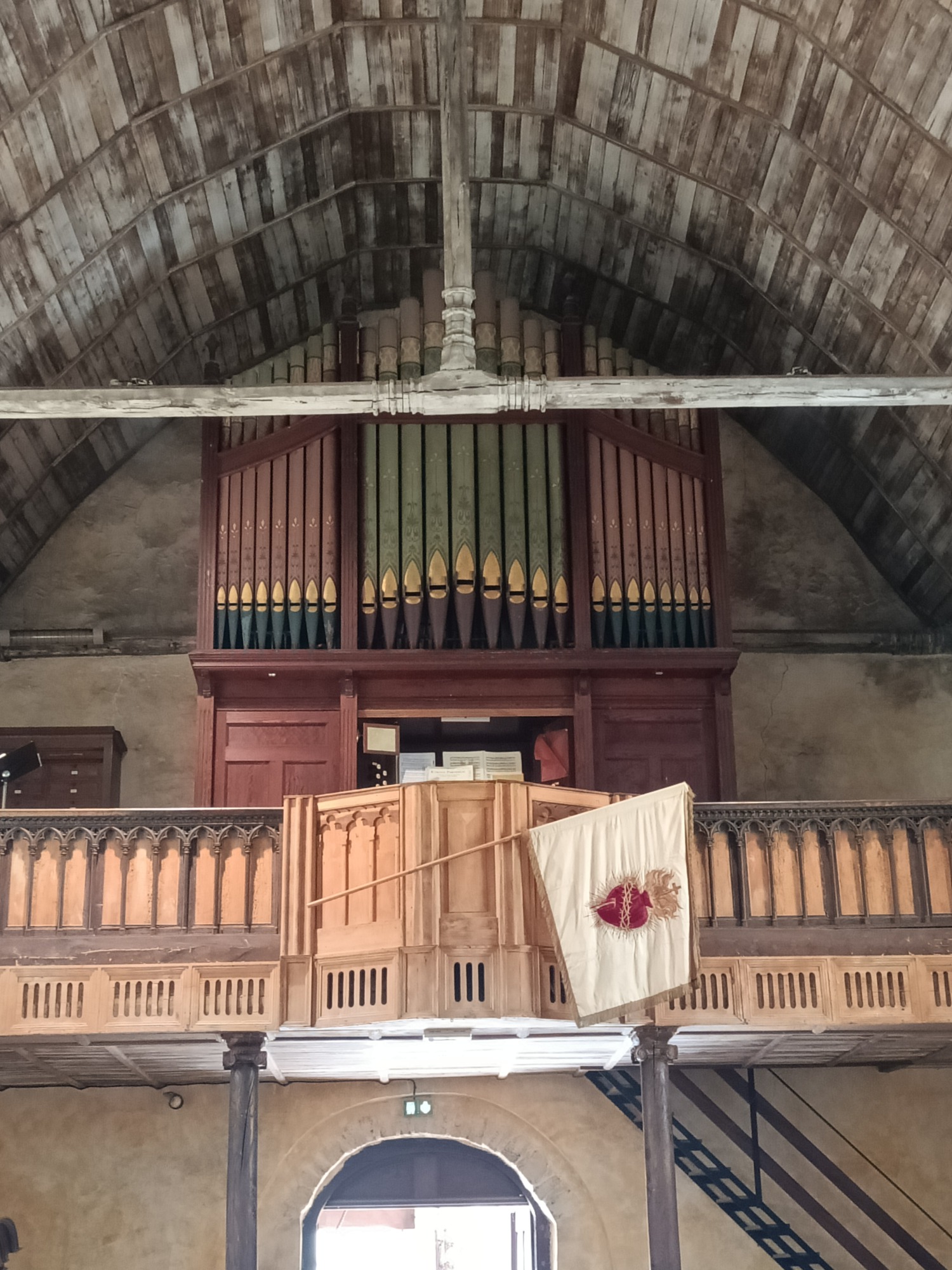
Woke!

I have had a very unpleasant experience with the “woke” leviathan these last few days, albeit on a very small scale, a true microcosm of something that is killing thousands, and millions in the past in its various manifestations. It is a particularly wicked and deceitful demon. I will keep the exact circumstances to myself. It concerned some of my posts on Facebook and my affirmation of belief in Christianity as a spiritual life. There was a number of postings that englobed the same ideology in the person in question. He would even deny that the “woke” ideology exists and that it was a creation of extreme-right fanatics and bigots against people suffering poverty, gay people, women, transgenders. He had obviously taken onboard the entire ideology, not merely particular points with which he sympathised. I have taken precautions to silence or even cancel these conflicts.

Since yesterday I have modified this posting because I had linked to a podcast on YouTube. I have been informed that the podcast in question is questionable, so I have removed it. It is not proven, as far as I can see, that there is a connection between Islamic Jihadism, mass immigration and Marxist critical theory and the ideology calling itself or being called “woke”.

Is the “woke” tide turning? I can only go by opinions and ideas I read, because I am out of touch with modern urban life. Perhaps we can be optimistic that people will truly awaken and reject this new form of what amounts to a repeat of twentieth century totalitarianism.

Such an idea brings me to a new idea – taking over the word Woke to mean something entirely different, the spiritual nature of humanity. I would like to research this idea more profoundly from a spiritual Christian point of view. We are called to wake up by Bach’s Cantata Wachet auf ruft uns die Stimme. As Dr Michael Martin has quoted in his most recent Substack article, The Sophianic Knighthood.

William Blake captures all of this in the opening lines to his illuminated book, Jerusalem: The Emanation of the Giant Albion:

Of the Sleep of Ulro! and of the passage through
Eternal Death! and of the awaking to Eternal Life.

This theme calls me in sleep night after night, & ev’ry morn
Awakes me at sun−rise, then I see the Saviour over me
Spreading his beams of love, & dictating the words of this mild song.

Awake! awake O sleeper of the land of shadows, wake! expand!
I am in you and you in me, mutual in love divine. Awake.

There are so many verses in the Scriptures on this theme of awakening, either using the word or implying it. Here are a few:

Wherefore he saith, Awake thou that sleepest, and arise from the dead, and Christ shall give thee light. Ephesians 5:14

And that, knowing the time, that now it is high time to awake out of sleep: for now is our salvation nearer than when we believed. Romans 13:11

These things said he: and after that he saith unto them, Our friend Lazarus sleepeth; but I go, that I may awake him out of sleep. Then said his disciples, Lord, if he sleep, he shall do well. Howbeit Jesus spake of his death: but they thought that he had spoken of taking of rest in sleep. Then said Jesus unto them plainly, Lazarus is dead. John 11:11-14

Awake, awake; put on thy strength, O Zion; put on thy beautiful garments, O Jerusalem, the holy city: for henceforth there shall no more come into thee the uncircumcised and the unclean. Isaiah 52:1

This awakening can mean different things, ceasing to be apathetic, coming to spiritual knowledge (γνώσεως), becoming more noble, rational and original in our thought and not following the mob, so many things. They are a universe away from the madness of post-modernity and the Enemy, the Father of Lies.

We should appropriate the word Woke in this spiritual and Christian meaning. We can make nonsense of the cultural Marxists pretending to uphold Islamic Jihad, LGBT (etc.), transsexualism, cancelling culture and history, promoting the Klaus Blofeld-Schwab world domination agenda and so forth. Who could sow the seed with force and credibility? I remember a film with a speech of Cardinal Innitzer of Vienna during World War II calling Christ the true Führer instead of Hitler, taking from the enemy the meaning of the words they were using to manipulate the people. The story of Cardinal Theodor Innitzer (1875 – 1955) is particularly poignant. After having been deceived by the strength of Hitler’s Anschluß, and having woken up to reality, he preached to the crowd assembled for the Feast of the Holy Rosary:

Meine liebe katholische Jugend Wiens, wir wollen gerade jetzt in dieser Zeit umso fester und standhafter unseren Glauben bekennen, uns zu Christus bekennen, unserem Führer, unserem König und zu seiner Kirche…

Einer ist euer Führer, euer Führer ist Christus, wenn ihr ihm die Treue haltet, werdet ihr niemals verloren gehen.

For that act of courage, his Archbishop’s house was ransacked by the Nazi fanatics, not without Innitzer having saved the Blessed Sacrament before escaping through a secret passage. The scene is portrayed in the film I mentioned which is delightfully available on YouTube, The Cardinal, made in 1963 that impressed me very deeply.

This is a spiritual war and we must have courage, even if we must lay down our lives as our forefathers did in other times.

For we wrestle not against flesh and blood, but against principalities, against powers, against the rulers of the darkness of this world, against spiritual wickedness in high places (Ephesians 6:12).

Posted in Uncategorized | Tagged , , | Leave a comment

Facebook

I have come to the decision to stop writing on Facebook except on groups that are not concerned with politics or religion. My account on FB will stay open and those wishing to correspond with me can do so by private message or e-mail. This is not simply a Lenten observance but my own brennender Sorge about the way the world is going and its effects in my own life. So it is back to blogs and books…

Several factors have combined to shake me to the core. One is finding myself confronted with what is more or less well named “woke” ideology. It is a disease that infects society all the way to certain persons more or less close to me. I smell its fetid breath all over me. It is truly a demon from hell. It has taken over our political and formerly spiritual institutions. It brings our world ever closer to total war.

It is better not to give any more details than that.

Perhaps it is my dribbling short texts on Facebook that has worn down my desire to write more serious blog articles or books, or even to read. Other writers have faced the same burn-out or writer’s block, the feeling of having nothing to write about.

For now, the best thing is to make a good Lent – eat more simply, get exercise, spend more time in prayer and serious reading. The sea sailing season is not yet with us, but there are rivers to explore by kayak in my area. Closeness to nature is essential.

I am thinking of returning to the Northern Catholicism theme on which I have already written but which I need to develop. The notion is usually severely criticised by Roman Catholic apologists for sinning in the same way as phyletism in Orthodoxy, meaning the desire to link the Church to the destiny of a specific nation. This notion could be seen as implicit in Gallicanism and Anglicanism, even though the former remained in communion with Rome and was absorbed into the Ultramontanist mainstream in the nineteenth century.

Another thing that motivates me is the political pressure we are suffering against Christian and western culture. Few people identify with that culture, having become atheists or “woke”. Perhaps my aspiration remains at the stage of Novalis’ fragment Die Christenheit oder Europa. Also read Kleingeld, Pauline (2008). “Romantic Cosmopolitanism: Novalis’s “Christianity or Europe”. Neither Novalis in his time or I in mine are deluded to think we can bring back the European middle ages. It is a parable of principles and ideas that we are called to live in our own time. Our own time is not modernity or modernism, but a pilgrimage to God’s kingdom, all the aspirations and inspirations than built northern Europe.

I believe in Europe, not the bureaucracy in Brussels that is bringing us to a dystopian Orwellian nightmare, but in what emerged from the ashes of the Roman Empire and the so-called Dark Ages. There was a world of harmony, beauty and spirituality – even if there was also human sin, sickness and death.

I am minded to follow Novalis’ example by writing. I am not a poet, but I write reasonable prose. Language is only an imperfect vehicle for conveying ideas, and it must not be poisoned by the ideologies of madness surrounding us like unchained demons. As I have said before, this is my priestly ministry. I must try to focus better as the years have passed from my marital separation and my soul and mind begin to heal.

I regret having been distracted by writing little ditties on Facebook and losing my energy to write more seriously. I am thankful never to have dabbled in Twitter, Instagram and the like. I have a YouTube channel, but my videos are rare and of poor quality, and mostly about sailing trips. I should be able to get back into shape after a short time. Lent provides a perfect opportunity.

Posted in Uncategorized | Tagged , , , | 7 Comments

C.S. Lewis and Sehnsucht

An Orthodox priest I know often writes on Facebook and quotes his favourite spiritual authors. One from Elder Saint Nectarios of Aegina:

The heart of the unbeliever is no longer full of infinity and is always groaning, seeking and longing, but never satisfied. This is because the pleasures of the world are powerless to fill the emptiness of his heart. The pleasures and amusements of the world, when they are extinguished, leave only bitterness in the heart, while vain glories have sorrows for companions.

We are led to perfection by the Lord, who comes and dwells in us when we do His commandments. And one of the first commandments is to do in our lives the will, not our own, but God’s. And to be done with the precision that is done in heaven by the angels.

I remember my parents trying to teach me not to want so much in life and to be content with little. Don’t yearn for the impossible, otherwise you will be disappointed. On one side, these are wise counsels. On the other side, if we have no desire, we surrender our humanity and fit into our predetermined slots. Christianity, like Judaism, is full of this theme of desire and longing. A few years ago, I wrote O for the Wings of a Dove. I referred to a choral piece by Mendelssohn who was both a Romantic and of Jewish origins. Longing and yearning are emotions that fill the psalms. Here are two examples:

By the waters of Babylon we sat down and wept, * when we remembered thee, O Sion.
As for our harps, we hanged them up * upon the trees that are therein.
For they that led us away captive, required of us then a song, and melody in our heaviness: * Sing us one of the songs of Sion.
How shall we sing the Lord’s song * in a strange land?

Like as the hart desireth the water-brooks, * so longeth my soul after thee, O God.
My soul is athirst for God, yea, even for the living God: * when shall I come to appear before the presence of God?
My tears have been my meat day and night, * while they daily say unto me, Where is now thy God?

This sense of alienation is one of my most profound and enduring emotions. I was electrified when I discovered the notion of Sehnsucht in Novalis, C.S. Lewis and a few others. Lewis spoke of an inconsolable longing within us for we know not what. That object of our desire is our own far off country . . . for something that has never actually appeared in our experience. This Sehnsucht is a German word translated as longing or yearning for something inexpressible. We Christians believe that this yearning is not a temptation but an experience given by God of eternity. Ecclesiastes 3:11 says that God hath set the world in their heart, so that no man can find out the work that God maketh from the beginning to the end.

For a child in a not-very-religious family, I too could not identify this mysterious world. Sometimes a film at the cinema might give me some inkling, especially a world of another time, or a fantasy world full of absolute beauty. Words and images would convey something other than their conventional meanings as understood by most people. If I spoke about these “impressions”, I would be told that it was all in my imagination, and that I should be working harder with my writing and arithmetic. All my life, including now, I have felt this alienation and longing for roots, that ideal world. As I grow older, I make the distinction between being happy with what I have in this world, and what I yearn for through the veil of death. I know that I am not alone, but most of us are careful what we say lest we be taken for mentally ill people with delusions. We should welcome these thoughts and feelings as a gift from God, something that pulls us from our worldly concerns to the ultimate reality.

This yearning is not an end in itself. It has what we call in moral theology the finis operis, the final purpose of a moral act or emotion. We can take a knife to cut food or to kill someone – taking a knife in itself has no moral significance. God reveals himself to us by means of what I analogically call an icon. Of course, this icon may take the form of an image of Christ or the saints, but our emotional and imaginative reaction to the transcendentals of truth, beauty and goodness are meant to lead us to the final end, which is God and our eternal union with him. As a small boy, I had no notion of this finality, so yearned to live in the worlds I saw in Walt Disney films, to sprout wings and fly like a bird, to sail the seas and explore new worlds. As an adult, I made the latter a reality by learning to sail and buying a boat.

I remember in philosophy that one of the “proofs” for the existence of God is that we desire him. St Paul wrote to the Hebrews: But now they desire a better country, that is, an heavenly: wherefore God is not ashamed to be called their God: for he hath prepared for them a city. Sehnsucht brought C.S. Lewis in Mere Christianity to conclude:

Creatures are not born with desires unless satisfaction for those desires exists. A baby feels hunger: well, there is such a thing as food. A duckling wants to swim: well, there is such a thing as water. Men feel sexual desire: well, there is such a thing as sex. If I find in myself a desire which no experience in this world can satisfy, the most probable explanation is that I was made for another world.

This is a thought I can bring into my mind when I am filled by anxiety because of my feeling of having little in the way of roots. Had I been un homme du torrent living in my home town of Kendal, doing a humdrum job, would I be happier? Remaking one’s life is absolutely futile. May this Advent be a longing for the Incarnate Word who made our desire for God possible in spite of the veils of our sinfulness. Children have Advent calendars to live each day towards the Light. We have the liturgy and the ancient Messianic Prophecies to guide us on our way.

The Lord is my strength and my shield; my heart hath trusted in him, and I am helped : therefore my heart danceth for joy, and in my song will I praise him (Psalm 28).

Posted in Uncategorized | Tagged , , , | Leave a comment

Stella

From 1964 until 1967, I went to the local primary school, Castle Street School in Kendal. It was a run-of-the-mill nominally Anglican primary school for children of 5 to 11 years old. Pupils were prepared for the Eleven-Plus, a test of intelligence which would determine whether boys would go to the Grammar School, girls to the High School or to Longlands Secondary Modern which would lead to apprenticeships in more manual occupations. It was a bit of a rough mix between different social classes. By 1967, my parents decided that it was not really the solution for my education and human development, but rather that I should attend a small private school for boys in Ambleside. That involved a return journey by bus each day from the stop opposite Kendal Post Office, via Staveley, Windermere, Troutbeck Bridge to Ambleside Bus Station. I was at Castle Street for three years.

Castle Street School was led by a kindly lady of near retirement age by the name of Miss Cliburn. One day, a black girl called Stella came to the school, and we were told to be kind to her. She looked different from all the other kids of the school because she or her ancestors came from Africa. We had been brought up on stories about British missionaries exploring Africa and other parts of the world to bring the “savages” to Christianity. This was an innovation for us white northerners that could provoke some serious bullying. As Miss Cliburn introduced this little girl, there were some nasty comments from children around me, and some would even do monkey imitations and pinch their lips together to mock the thick lips of African people. Personally, I was confused. Apart from the colour of the skin and slight facial differences, Stella was for me simply a human being, a child brought to learn to read and write, learn about other things and socialise with the other pupils. Two things were foreign to me, and it was not Stella. They were the racist behaviour of some of the children, but particularly the awkward and patronising way we were told not to be racist. The 1960’s were a long time ago!

I am not an expert in sociology or politics, but I have ideas about apparent things that I observe from my secluded distance. What I am targeting here is conventionally called identity politics or ideology. A few days ago, I discussed the gender issue, that of people rejecting their biologically assigned sex / gender and having recourse to medical and surgical means to identify as the opposite sex. Just yesterday, I saw a video sequence of a busload of male-to-female transsexuals meeting Pope Francis. It was frankly grotesque, especially the mincing and giggling – and profoundly anti-human! In today’s posting, I am considering people of different races and cultures, from different parts of the world. Returning to Stella and my first reaction on seeing a black child, my concern was not to put her into a category but simply to accept her as the human being she obviously was. She is probably a grandmother now living somewhere in England.

I have known nasty racism in the 1970’s. At school, boys got away with insults like You fucking Jew! They spoke of Pakis in Bradford, less about niggers than in America. Most of the immigration into the UK at that time was from Pakistan and India. Black people mostly came from the West Indies, so would be descendants from slaves who had been transported at some time to that part of the world. I have lived in the East End of London, and some of the nicest people I have known were from the ethnic communities. I ate many an Indian curry in Brick Lane in the late 1970’s. In the early 1990’s, I walked around the Algerian districts of Marseille in my cassock and bought things in their shops. They were charming and most respectful, as I was of them, also in their long baggy thobes. Muslims are far from being all terrorists or murderous! Some Algerians are risky, as Fr Charles de Foucault found to his cost, but generally the Moroccans and Tunisians were (are) polite and respectful of traditional Christians. What is in my mind is living with the humanity of people regardless of their culture, faith and ethnic origins. I simply have no problem with them, unless someone wants to do me some harm or steal from me. I am myself an immigrant into France – I was born in another country (England) and came here by choice – and went through the official process of acquiring dual-nationality. I speak the language and get on with people just fine.

The problem with the modern ideology is that, for our woke activists and politicians, multiculturalism asks us to concentrate on their differences. People are defined by identity: being of non-white races, women, gay, bisexual, transsexual and all other acronymes that have been added to the alphabet soup. In the 1970’s, homosexual people were under pressure to come out, and not to stay in the closet. The problem is that when a person thrusts his life and ideology in my face, I am not obliged to believe that it is right or normal for all, quite apart from the Church’s moral teachings. That person has created conflict rather than living his or her private life in a discreet and dignified way. Transgenderism has become almost a fashion as opposed to a small minority of people who have exceptional medical conditions or the recognised psychiatric condition of gender dysphoria. The busload of false women meeting Pope Francis deeply disgusted me – and many others! The problem is that each identity asserts itself and becomes opposed to all the others. Thus we now have pro-Palestinians who are saying the same horrible things about Jewish people as the Nazis did in their time.

Radicals like to emphasise the idea that rational universalism has failed and society has fragmented because it undermines the grip and control of the dominent elites. The problem with emphasising difference and fragmentation is the creation of a new form of racism and discrimination like I knew in the 1970’s. Racial thinking consists of believing that people are fundamentally different, and that some are perhaps sub-human. In past times, white people (Arians) were considered as being at the top of the ladder, and then other races were put on different rungs, going down to people who would be assimilated to apes or other non-human animals, or even trash to be disposed of. This ladder has simply been turned onto its side, and categories of people are still divided and opposed. If this is so, human beings cannot transform themselves and transcend their circumstances of life. We remain in the same dialectical and binary thinking.

This division is a most profoundly anti-human way of looking at humanity. We are now trapped forever in the identity that is projected on us – until individuals break out of the identity cells. In Iran, women are fighting with their lives to get rid of the hijab or veil. In Europe, the hijab has become an identity symbol, and the women concerned have no voice to protest. There are black men in the USA who vote for Donald Trump (we have the right to disagree with them) and believe in conservative and western values. Humanity is more important to them than being black, as it is for us whites, or Indians, Chinese, etc.! We are not caricatures but humans. This is true cosmopolitanism such as Novalis aspired to in the 1790’s. This does not mean the melting pot, or surrendering our local traditions and beliefs. What is does mean is that the value of the human person transcends our local and cultural characteristics and that we can find unity and put an end to war.

I believe I have come a step nearer to criticising the ongoing ideologies in the name of Christian humanism and our aspiration for a more just and peaceful world. At least, I try, given the difficulty we have in finding accurate information about what is going on in the world.

Posted in Uncategorized | Tagged , , , , , , , , , , , , | Leave a comment

The Night of Advent

We come around once again to this night of Advent as the gloom of winter encircles us who live in the northern hemisphere (it is now the turn of the Aussies to get their boats out and go sailing). For us people of the north, the liturgical year seems to match the moods of the seasons.

Back in December 2018, I wrote Cry to the Night in which I discussed the themes brought up by the more sensitive souls of recent history:

In these gloomy Advent days, I mediate on the words of Novalis in his Hymnen an die Nacht, which I read in English translation. I also find inspiration  in my favourite Russian philosopher Nikolai Berdyaev. Both he and Freidrich von Hardenberg were inspired by the great German cobbler and mystic Jakob Böhme. The theme of the night (the Ungrund) pervades Christian mysticism, especially the Carmelite saints like John of the Cross and Theresa of Avila. Holiness comes through suffering and long periods of desolation and spiritual hardship. Winter is a time when the days are at their shortest, but the true Sol Invictus, the incarnation of God in Christ, brings us light and inner deliverance within from whatever can befall us.

These themes remain with me, and shortly after writing Cry to the Night, I discovered Dr Michael Martin and his interest in Sophiology, the study of the Holy Wisdom. A few years ago, he wrote Post-Christianity: How Christianity Failed and Continues to Fail and You Are Here: Nikolai Berdyaev Calls the Eschaton. Michael too is a fan of Nikolai Berdyaev, whom I discovered during my student days at Fribourg. It was a time when I was tempted by Orthodoxy, but there was as much difference between Orthodoxy and Berdyaev as between the German Lutheran establishment and men like J.S. Bach and Jakob Böhme.

Either a new epoch in Christianity is in store for us and a Christian renaissance will take place, or Christianity is doomed to perish

Berdyaev wrote in The Fate of Man in the Modern World. He also wrote in the same work:

We are witnessing a judgement not on history alone, but upon Christian humanity…. The task of creating a more just and humane social order has fallen into the hands of anti-Christians, rather than Christians themselves. The divine has been torn apart from the human. This is the basis of all judgement in the moral sphere, now being passed upon Christianity.

When Christian humanism is gone, we finish up with the parable written by William Golding, The Lord of the Flies in 1954. It is a story of a group of apparently innocent pre-adolescent boys who were “plane-wrecked” on an uninhabited island. The dominent boys formed a gang, driven by superstition and obscurantism, and sank into barbarity. I don’t know if this work is still analysed and taught in schools, but this is how I knew of it. Films were made in 1963 and 1990, the latter being an American version. The plot is impressive and almost a theme of latter-day original sin. Calvin came up with his theory of double predestination and total depravity. This utter pessimism leads to one possible conclusion: the collective suicide or annihilation of humanity.

A few days ago, I saw one of those “fear-porn” videos on YouTube about the third secret of Fatima, which is as incoherent as they come. Pope Francis would be the Antichrist, and this is why all but the first page of the secret would have continued to be covered up by the Vatican. So we have something little different from the sweating and Bible-thumping of Ian Paisley! The point I bring up here is that evil would prevail, and God as a true psychopathic demiurge would proceed with the Great Chastisement. This, presumably, would take the form of nuclear Armageddon or an asteroid hitting the earth. If either of these did not annihilate the totality of mankind, few people would remain, presumably shut up in their homes with the two blessed candles (!). In the end, Our Lady’s Immaculate Heart would triumph… Over a charred earth made even more lifeless than Mercury or Mars? What triumph? Heaven, the Afterlife, whatever you want to call it? The end of the world is possible, but Christian eschatology has other layers of meaning than our individual deaths and human extinction.

I suppose that the quote of Samuel Johnson – Depend upon it, sir, when a man knows he is to be hanged in a fortnight, it concentrates his mind wonderfully takes on a new meaning. Humanity languishes in its condemned cell and hears the work of the carpenters at work assembling the gallows in the public place outside the prison. It is going to be wonderful feast for the townsfolk! Need I insist?

The traditionalist RC fear-porn wears thin, and it would not convert me if I were an atheist or of another religion. The history of the Church shows the presence of the Parousia in the minds of Christians. Jesus, having suffered death, risen miraculously and ascended into heaven, will come again to judge the quick and the dead. What does this mean? Many of us will already be dead and will have been through our judgement and our fate for eternity. Would this universal judgement affect only those still living at the time, or all of us? We need to develop our knowledge and understanding of eschatology, to arrive at a more mature way of seeing things. The Kingdom of Heaven is not a courtroom or a bank, but a much more profound and spiritual concept.

For Berdyaev, eschatology is more about regeneration, of the world and each one of us. We experience salvation whilst still in this life through θέωσις, deification , participation in the divine consciousness. The eschaton or full revelation announces itself through the prospect of our death, something we will not avoid whether we are good or evil, strong or weak. We have to experience transformation, to let go of our present comforts, passing through the darkness of night, chaos and Ungrund to enter a new world.

Our world is going through a crisis of ideologies, differently from the 1920’s and 30’s, but a certain analogy can be seen. As Berdyaev would have seen with the rise of Hitler and Stalin, we no longer trust our political institutions and we are confused by the lies and contradictions. Many talk of decivilisation and collapse. Mobs of young men in our cities burn cars, loot shops, attack the police with improvised weapons, and there seems to be no solution to it all. To quote Berdyaev:

The world is living in a period of agony which greatly resembles that of the end of antiquity. But the present situation is more hopeless, since at the close of antiquity Christianity entered the world as a new young force, while now Christianity, in its human age, is old and burdened with a long history in which Christians have often sinned and betrayed their ideal. And we shall see that the judgment upon history is also a judgment upon Christianity in history.

Something of great concern to us is artificial intelligence and technology. Mankind is becoming mechanised. Transsexualism by medical and surgical means is frightening, as is planting electronics into people’s brains. Berdyaev like Charlie Chaplin back in the 1940’s saw it coming.

No political system seems to have a solution. Their role is occupied by anti-Christians. As Michael Martin said: Christianity, furthermore, failed to save culture, because it failed to be Christian. The aspiration to unite churches through the ecumenical movement has failed. Policies like those of Pope Francis drive the traditionalists further away, aware that an existence outside the Papal communion removes from them all claim to coherence. There is still a multiplicity of Christian confessions and traditionalist dissidences.

This tendency began when Christians turned from eschatology to the institution. The first monasteries assimilated their life to the martyrdom suffered under the Roman Empire, but symbolically. Gradually, the institution formed after the Donation of Constantine (forged document) came into being, and the essence of Christianity was lost. I may seem to be writing like a Protestant, but they too have gone the same way.

Only Christianity can save the world from Christianity. That would seem to be an outrageous thing to say. Berdyaev exhorted us away from static traditionalism to the prophetic mission of Christianity. Does this mean a capitulation to “progressivism”, liberalism and Woke? No, the way lies elsewhere. It is difficult to judge whether we can find hope or just pessimism in Berdyaev. C.S. Lewis called his autobiography Surprised by Joy. Where is the wonder that beauty is meant to provoke in us, shocking us to seek something beyond every thing we know? This was the theme in my recent posting Beauty will save the world.

For as long as some of us have these aspirations in spite of our unworthiness, I think we can believe in a future Christianity built on beauty, truth, goodness, love and everything that inspires us who are critical of The Machine. I believe it is this movement of conversion, invisible to most, that would bring about the triumph of the Holy Wisdom and the Mother of God we invoke in our prayers. Let this light bring hope in this gloom as we prepare for the true Christian feast of the Nativity of Jesus.

I leave you with this poignant piece by Holst.

Posted in Uncategorized | Tagged , , , , | Leave a comment

Beauty will save the world

I have always been impressed by the Romanticism and idealism of Pope Benedict XVI, especially regarding the apology of Christian faith offered by beauty. The best-known quote is “I have often affirmed my conviction that the true apology of Christian faith, the most convincing demonstration of its truth…are the saints and the beauty that the faith has generated”. Conversely, the militant atheist Richard Dawkins bewailed the greatest challenge posed by the way art, music and literature can convey the reality of a spiritual and divine consciousness.

We are familiar with the old saying beauty lies in the eye of the beholder. People have their favourite composers and artists. I can like the music that others detest and find ugly. This seems to make the concept of beauty quite subjective and ephemeral. There are people who will say that 1970’s brutalism and atonal music are beautiful. I have always gone by the principle that beauty is objective and is based on eternal principles like, for example, harmony and melody in music. What is beauty. Someone like St Thomas Aquinas would recognise beauty by integrity, proportion and its ability to enlighten. Another way to recognise beauty is our experience of it, the effect it has on us. Beauty can lift us out of our selfish self-pity and nihilism and gives us “wings” to transcendence. It can shock us and cause suffering. For the Romantics, beauty brings us to long for the Universal Idea of beauty of which the beauty we experience is only an icon.

I remember my first impressions of entering York Minster, that great cathedral of the north of England, and hearing the choir and organ. Medieval cathedrals were built to draw souls to the infinite, away from the commonplace routine of our lives. The dominant dimension of a cathedral is the vertical, expressing the Sehnsucht of the human spirit for God in his truth, goodness and light. The human arts and nature convey the message of the Gospel through allegory and parable. As I recently mentioned during an interview with Dr Michael Martin, I have never been impressed by biblical literalism and “dogmatic” apologetics. I have been to the trouble of studying theology, because all the dimensions of God’s communication with man are important. Like many, I relate to art, music and nature.

As a musician, I was never keen on the “pop” music of the 1960’s and 70’s, but I would prefer to listen to what is generically named “classical” music. I began piano lessons at the age of 8 in response to having heard the organ in my parish church during the Christmas service. Unlike most people I knew, I actually noticed details of architecture and likened them to churches. Our family was respectful in regard to religion but never particularly devout. As popular music developed into things like “heavy rock”, I saw people who were stimulated by it. It repulsed and frightened me. The oof-oof-oof drumbeat and vocal screams of this a-musical monstrosity made me think of those old films about cannibal tribes with the missionary in the crock-pot being cooked alive. I had the same experience with musical modernism in the total chromatic atonal system devised by Schönberg in 1912. He had pushed romantic chromaticism to the limit and began to deconstruct the principles of harmony and melody, like Derrida in philosophy. These are the archetypes of the cancel culture of the woke ideology. As the twentieth century wore on, music and art would be utterly destroyed in displays of random splashes of paint and the effect of a dog striking notes on the piano with his paws and howling.

Another place of beauty is the natural world, especially the coasts of the land seen from the sea, mountains and forests. These are icons of God in Creation. Nothing has given me a new impetus of faith more than putting to sea in my little boat and exploring the cliffs, caves and islands of Brittany. We have to understand the role of the icon. It is not simply a picture, but conveys the presence of the person or spiritual truth portrayed. We are given windows to the transcendent.

Beauty is also to be found in persons who are close to God, especially through the innocence of children and the wisdom of many elderly folk. Benedict XVI once said “The beauty of Christian life is even more effective than art and imagery in the communication of the Gospel message. In the end, love alone is worthy of faith, and proves credible. The lives of the saints and martyrs demonstrate a singular beauty which fascinates and attracts, because a Christian life lived in fullness speaks without words. We need men and women whose lives are eloquent, and who know how to proclaim the Gospel with clarity and courage, with transparency of action, and with the joyful passion of charity”.

Beauty is also to be found in friendship, which is why I became endeared to St Aelred of Rievaulx and his famous book inspired by Cicero on friendship. Some claim St Aelred as patron of the alphabet soup of homosexual identities, which is a travesty. St Aelred was a Cistercian monk and Abbot of his community, and would have been very strict about sexual contacts between monks. However, he encouraged friendship, not something always found in monastic communities. Friendship with other human beings and God is a capital mark of spirituality. I would not bless a gay couple, but I would bless a friendship, even if I knew nothing about the private life of the persons concerned.

In my first contacts with the Church and awakening of a desire to know God and Jesus, I discovered church buildings and music. I sensed the sacred in all these expressions of beauty. Another landmark in my life was Anglo-Catholicism, already a big part of the services in York Minster thanks to the legacy of Dean Eric Milner-White. I went to London in 1978 and began to discover Anglo-Catholic parishes with the full liturgy. The combination of an eastward-facing altar, vestments, incense, music and ceremonies spoke another language. Does the liturgy lift us up, or drive us down to a parody of secular life? Anglo-Catholic worship can be quite affected and can itself become a caricature, making Evelyn Waugh write in his novel Brideshead Revisted about Charles’s cousin Jasper advising him to “Beware of the Anglo-Catholics—they’re all sodomites with unpleasant accents. In fact, steer clear of all the religious groups; they do nothing but harm”.  The implication here is the aestheticism of a certain breed of late Victorian men who were attracted to a superficial level of beauty and were active homosexuals on the “gay scene”. It is tempting to dismiss the beauty of the liturgy for this simple reason. Abusus non tollit usum.

One who wrote a lot about aesthetics and beauty was Oscar Wilde. I recommend an attentive reading of De Profundis, the letter he wrote to Lord Alfred Douglas in January to March 1897, close to the end of his imprisonment in Reading Gaol. I have mixing feelings about this cri de coeur. Wilde’s sufferings were caused by his decision to prosecute the Marquis of Queensberry for libel. The legal establishment fell on him like a ton of bricks. The tone often reeks of self-pity and narcissism. At least that is the impression one can get. Many of the ideas are profound, and the condemnation of Victorian self-righteousness, philistinism and hypocrisy arouses sympathy in the reader, even to us born more than a hundred years after Wilde. We also take comfort in what a nasty character the Marquis of Queensberry was. Wilde identified with Christ in his suffering, and I see something sincere and noble in this. It gave his own suffering meaning. Wilde portrayed Christ as a Romantic artist and his Passion as a Greek tragedy. Christ was utterly original as a person, not a product of social conformity. Wilde emphasised the ideas of love and beauty, attributing them to Christ. Perhaps we can read these ideas as allegory and analogy rather than literally. Wilde was received into the Roman Catholic Church by a priest in Paris shortly before his death in November 1900. Wilde was certainly fascinated by Catholic liturgical aesthetics and the role of suffering and sacrifice in ritualistic symbolism. This is an example of beauty to which Wilde could relate rather than apologetics and moralising homiletics, a religion of text and word.

We now come to a notion of true and false beauty. These would surely be distinguished by the effect they have on us. There are expressions of beauty displayed on TV, advertising and popular culture. Are these expressions a delusion, dazzling and superficial, inspiring a desire for power, pleasure and possession – instead of bringing us out of ourselves and opening us up to the true freedom above? Beauty alone does not necessarily make us good, for many of the Nazi leaders were musicians and Hitler himself was a talented artist (even if he was rejected by the art academy of Vienna). Perhaps the difference is in our response to this beauty, being “surprised” (as C.S. Lewis would have put it) into love, truth and virtue.

I have not been into the philosophy of beauty for this little posting, something that would require a tremendous amount of study and work. There are works on aesthetics by Plato, Aristotle, Philo of Alexandria, Cicero, Plotinus, Augustine, Dionysius the Areopagite, and others. From medieval times, we have Bonaventure, Albert the Great and Thomas Aquinas in particular. The whole idea is expressed by the Romantics and analogical tendencies to this day. Dostoevsky came out with this famous slogan Beauty will save the world in his book The Idiot. He could not separate beauty from goodness and truth. The three Platonic transcendentals are a “trinity” of forms of a single absolute Idea.

The subject of beauty is far from concluded, but I am sure that without it, I would never have related to Christianity and my life would have taken a different course.

Posted in Uncategorized | Tagged , , , | 1 Comment

Self Reliance Revisited

I first came across American Transcendentalism (a subject on which I have already written) through the poetry of Walt Whitman (1819-1892) in Leaves of Grass. Parts of these moving verses were adopted by Ralph Vaughan Williams in the Sea Symphony. Perhaps there is some convergence with the ideas of Nietzsche, man at his strongest by the force of will to overcome weakness and exterior obstacles. The essential theme is the transcendence of God and the way that man may participate in it.

O Thou transcendent,
Nameless, the fibre and the breath,
Light of the light, shedding forth universes, thou centre of them,
Thou mightier centre of the true, the good, the loving,
Thou moral, spiritual fountain—affection’s source—thou reservoir,
(O pensive soul of me—O thirst unsatisfied—waitest not there?
Waitest not haply for us somewhere there the Comrade perfect?)
Thou pulse—thou motive of the stars, suns, systems,
That, circling, move in order, safe, harmonious,
Athwart the shapeless vastnesses of space,
How should I think, how breathe a single breath, how speak, if, out of myself,
I could not launch, to those, superior universes?

Swiftly I shrivel at the thought of God,
At Nature and its wonders, Time and Space and Death,
But that I, turning, call to thee O soul, thou actual Me,

And lo, thou gently masterest the orbs,
Thou matest Time, smilest content at Death,
And fillest, swellest full the vastnesses of Space.

Greater than stars or suns,
Bounding O soul thou journeyest forth;
What love than thine and ours could wider amplify?
What aspirations, wishes, outvie thine and ours O soul?
What dreams of the ideal? what plans of purity, perfection, strength?
What cheerful willingness for others’ sake to give up all?
For others’ sake to suffer all?

Reckoning ahead O soul, when thou, the time achiev’d,
The seas all cross’d, weather’d the capes, the voyage done,
Surrounded, copest, frontest God, yieldest, the aim attain’d,
As fill’d with friendship, love complete, the Elder Brother found,
The Younger melts in fondness in his arms.

This is the very essence of Romanticism, that yearning for the transcendence that will never be fully realised in this life. Vaughan Williams understood this force that made man explore the world and discover ever more and more. Whitman ends the poem with this challenge to put to sea and dare to go further and further.

Sail forth—steer for the deep waters only,
Reckless O soul, exploring, I with thee, and thou with me,
For we are bound where mariner has not yet dared to go,
And we will risk the ship, ourselves and all.

O my brave soul!
O farther farther sail!
O daring joy, but safe! are they not all the seas of God?
O farther, farther, farther sail!

Shelley did so and perished in 1822 off the western Italian coast. Many daring souls met their deaths at sea! In my own experience of sailing, prudence and safety are of the essence to moderate our yearning for new pathways and courses over the sea. There are now few undiscovered places on the surface of this planet and the sea, but few of us have personal experience of them. Many people travel by air to their holidays in exotic places. I have no need, because much of Brittany remains unexplored for me. I will go a little further to remedying that next year. Dare we must, but within limits!

I feel the need to return to this subject and reproduce Emerson’s Self Reliance entirely. This texts appears to be in the public domain and not copyrighted. I will change my mind if convinced otherwise. Being self-reliant is not a matter of risking life and limb, or even being a person of exceptional strength. It comes not from the body but the spiritual soul. The essential theme is individualism, or personalism, in order to distinguish this aspiration from selfishness, egoism or refusal to take other people into consideration. Each person needs to avoid conformity, or what Orwell would have called groupthink. Each of us needs to follow our own instincts and ideas. We are called to person responsibility and originality. I recognise my own experience in the difference between myself and the other person who is a stranger. I have no idea of his thoughts, though I might find myself in an extreme degree of empathy with his or her emotions. This problem of groupthink and the limits of corporate management are not something from our own historical era, but are found also in other periods like that of Emerson. This does not justify nastiness to others, exploiting them, considering ourselves as better, refusing to help when someone is in need. Charity and kindness are at the heart of the Christian Gospel.

At the same time, our first duty of charity is in regard to ourselves. In the earlier article I wrote, I quoted Oscar Wilde’s letter to “Bosie” from prison, in which he encourages the individual person as source of art and beauty, the greatest sublimity – with the temptation to refusing all relationships with others. These seem to be contradictory notions, but which can be untied by careful distinctions, notably between the individual and the person. I recommend the book by the Orthodox theologian John D. Zizioulas, Being as Communion, London 1985. This work seeks to establish the basis of ecclesial communion on the human person as image of the Persons of the Holy Trinity. Individualism cannot be justified insofar as it destroys communion at a spiritual level. However, corporate humanity is not always spiritual, and there lies the distinction. Another inspiration on the subject of personalism is Karol Wojtyla who became Pope in 1978 under the name of John Paul II. This book explains Wojtyla’s system of thought: Andrew N. Woznicki, A Christian Humanism Karol – Wojtyla’s Existential Personalism, Mariel Publications 1980. John Paul II was often criticised by traditionalists for his emphasis on human dignity as opposed to the kingship of Christ, but they neglected the bitter experience of the Archbishop of Krakow under the boot of Communism.

Both Communism and Fascism suppress the person in favour of the State, the collective, the community. It is the same paradigm as that of the sectarian cult, following the leader in blind obedience and surrendering personality and originality. This is the basis of affirming the individual person, and where Romanticism and Transcendentalism come in as a just response. Nothing has authority over the individual. We have to obey juridical and moral laws or suffer the consequences, but observance is often exterior and formal. We don’t have to agree with all laws in an interior way, unless the country where we live has introduced sanctions against thought crime. At a spiritual level, we find enlightenment in our own souls – as Jesus himself taught:

And when he was demanded of the Pharisees, when the kingdom of God should come, he answered them and said, The kingdom of God cometh not with observation: neither shall they say, Lo here! or, lo there! for, behold, the kingdom of God is within you (Luke 17:20-21).

None of us is infallible, but we are more likely to find truth in self-searching than listening to other people’s ideologies in the name of authority. We need to have self-confidence without arrogance or narcissism – but the great man is he who in the midst of the crowd keeps with perfect sweetness the independence of solitude. We have to understand that institutional religion has its limits. We all need it to an extent, but we have to keep a critical spirit and denounce things like hypocrisy and double standards. We oscillate between originality and imitation. In Emerson’s words, Envy is ignorance, imitation is suicide. Later on, Insist on yourself; never imitate.

Even if we are exhorted to imitate Christ, Oscar Wilde had these words:

There is something so unique about Christ.  Of course just as there are false dawns before the dawn itself, and winter days so full of sudden sunlight that they will cheat the wise crocus into squandering its gold before its time, and make some foolish bird call to its mate to build on barren boughs, so there were Christians before Christ.  For that we should be grateful.  The unfortunate thing is that there have been none since.  I make one exception, St. Francis of Assisi.  But then God had given him at his birth the soul of a poet, as he himself when quite young had in mystical marriage taken poverty as his bride: and with the soul of a poet and the body of a beggar he found the way to perfection not difficult.  He understood Christ, and so he became like him.  We do not require the Liber Conformitatum to teach us that the life of St. Francis was the true Imitatio Christi, a poem compared to which the book of that name is merely prose.

We imitate Christ by being perfectly ourselves as he was!

How do we avoid the extreme of solipsism? No person, even if we aspire to self-reliance, can exist without connection to a higher power. That higher power is God and spirit, and forms the limit to this aspiration. What is the degree of nobility of the authority asking for our fealty, homage and obedience? Even the institutional Church admits the possibility of hermits – religious people who are neither married or in a community. Perhaps we can read Emerson’s essay with this idea in mind.

* * *

Ralph Waldo Emerson
Essays, First Series [1841]

Self-Reliance Continue reading

Posted in Uncategorized | Tagged , , , , | Leave a comment

Intellectual Masturbation

I came across an amazing article today – The illusions of abstract philosophy: Thought is never deep. I cast my mind back to university days and my times spent with a friend of Polish origins, English education and living in Germany. He is fluent in the three languages, and perhaps others too. He was in the German-speaking faculty of theology and I was in the French-speaking section. The two differed not only in the language used for teaching and working, but in the essential outlook. The French section essentially stuck to the Ressourcement ideas of men like Louis Bouyer, Danielou, De Lubac, Ratzinger and others, essentially formed by a scholastic basis with more interest in biblical theology and patristics. There was also a keen interest in Eastern Orthodox authors. On the other hand, the German section was largely based on ideas that were so intellectualised they they became incomprehensible – and I suspect irrational. My friend Roman would imagine a male penis on the forehead instead of its proper place, and would move his hand over the imaginary penis as if to stimulate it. It was his crude image of the widely used concept of intellectual masturbation, a way to find self-satisfaction but one that was totally sterile outside the subject.

Physical masturbation (onanism) is a solitary sexual act intended to bring satisfaction to the person in question but outside of a relationship. It is enhanced by a phantasm of a desired person, but without that person’s knowledge or consent – or by a fetish for some inanimate object (paraphilia). Classical Christian morality condemns it for its selfish finis operis and its sterility, sexuality being primarily for the purpose of procreation. I will refrain from any other moral judgement in this context so as not to get bogged down with academic moral ethics.

Applying this idea to thought and intellectual life, we consider the ideas of self-satisfaction and sterility, the thoughts in question having no purpose, sense or real meaning. We also have the notion of gobbledegook, talking for the sake of talking. Perhaps my own diatribes on Romanticism fall into the same category, and that my treasure is someone else’s trash! I would do better to go sailing, clean my house, do something in my workshop, spend a time in prayer, seek some social company and degree of friendship with others…

The thing that made my university friend and I question everything was the way students would argue with each other, for example about poverty, citing the things they had read, and would never reach a solution about the subject in hand. Poor people would continue to be poor. I find the same thing today with the Just Stop Oil activists blocking roads and destroying works of art, and they cannot answer the simple question of how we live without energy without the time and technology needed to find better solutions than fossil fuel. None of them will say that we need to go back to the Middle-Ages (without the faith, beauty and art), live in shitty hovels, forego nutritious food and medicine – and cull the majority of humanity without appearing to commit mass murder. The problem of much of modern politics is that it is a lot of talk (sometimes mendacious) without considering the means to bring about positive change and improvement.

The article to which I gave a link is quite long, and it needs to be read several times. I did wonder if its author was committing the same sin, but there are some ideas to show light between the words. However, the article needs to be read. Myself, I have spent my life divided between what I am now doing on my computer keyboard and going to do something practical. I did not do well at school because of social difficulties that I later found to be largely caused by my high-functioning autism. I was advised on account of my liking for woodwork and organ music to go in for organ building. My social difficulties closed that particular avenue. I was also attracted to learning to think and express myself, and regretted not doing well academically at school. I ended up accepted into the faculty of theology at Fribourg University on my way to the priesthood.

Someone came up with a theory of the dark satanic mills mentioned in Blake’s Jerusalem, that they were not the first cotton mills in the north of England in which former farm workers found slightly better-paid employment, but the universities. Does this idea hold water? Universities should be teaching people the skills they need to work as doctors, lawyers, bankers, architects and every other profession. Do they? My own experience is extreme, since autism makes the abstract completely inaccessible. I could never deal with pure mathematics, but I saw the use of geometry for things like marine navigation. I need to know where I am in relation to fixed landmarks and where I’m going. Differential calculus was a subject I encountered at school, and I was totally blind to it. It is a method for rationalising the notion of change in physics – but don’t ask me how. Perhaps someone will give me a good practical explanation. Angles and distances are self-evident for making things in the workshop, navigation, measuring objects or parts of our planet. Arithmetic is essential for managing money and other quantities in everyday life. I can handle that by doing sums the old way or using a calculator as we all do nowadays.

Is there a purpose to the way we are using our brains and minds? Usually metaphysical questions revolve around the meaning of life, whether our consciousness and awareness of existence go beyond our physical death. What or who is God? Where did we come from? We ask the same questions as we did as little children. What is reality? What is truth? What is love? These are things that differentiate humans from lower animal species. Are we worth no more than the pigs we kill and eat? We have to accept that many things are beyond us, that we yearn for them, but never get there. This is the essence of Romanticism, or the simple desire of sensitive souls to smash a hole through the abstract intellectualism and make progress by imagination and intuition.

Something we observe in modernity is that human beings working in groups lose common sense and become stupid. We have corporate management, meetings about meetings that cost a lot of money but achieve nothing. Education makes people stupid. In his De Profundis, Oscar Wilde expressed these prophetic words from his prison cell:

He knew that in the soul of one who is ignorant there is always room for a great idea.  But he could not stand stupid people, especially those who are made stupid by education: people who are full of opinions not one of which they even understand, a peculiarly modern type, summed up by Christ when he describes it as the type of one who has the key of knowledge, cannot use it himself, and does not allow other people to use it, though it may be made to open the gate of God’s Kingdom.

That said, crass ignorance is not a virtue. I meet many culture-less people, but who are no more virtuous than the bureaucrats.

When anything is made into a system, it dies. This is why I question my use of the word Romanticism. We have to use words to communicate, but words also destroy. Modern “woke” ideologies set various minority categories against the majority and even other minorities claiming inclusion. Nietzsche spoke of the death of God, not that God actually died, which is impossible, but that He was flogged to death in churches and theological faculties.

The point of the article is emphasising the priority given to the quality of the thinker’s life rather than his ability to bottle and package thought for the consumer. My own chaotic life goes beyond the comprehension of most people, who have conformed to the status quo, stuck to the mainstream, made a success of school and professional training, got into a stable marriage and so forth. In my daydreams, I have often tried to recreate my life, but with a warning. Another bit from Oscar Wilde :

The more mechanical people to whom life is a shrewd speculation depending on a careful calculation of ways and means, always know where they are going, and go there.  They start with the ideal desire of being the parish beadle, and in whatever sphere they are placed they succeed in being the parish beadle and no more.  A man whose desire is to be something separate from himself, to be a member of Parliament, or a successful grocer, or a prominent solicitor, or a judge, or something equally tedious, invariably succeeds in being what he wants to be.  That is his punishment.  Those who want a mask have to wear it.

We have to come to terms with what we are. Perhaps I am (or have been) unstable, whatever that word means – anything from being mentally ill to being morally deregulated, or just out of the box. The word unstable has been used by clergy to discourage me from seeking the priesthood. Would I be more stable in some other calling, or simply out of their way? We have above all to come to terms with the inadequacy of human language. This question of experience of life is capital. I still have not joined the two ends, but I no longer envy the “successful”.

It is not a question of my ego, something of which I am increasingly aware as I get older.

The individual, the selfless I, is irrelevant to matters of fact, and that, we are told, is what we are dealing with here. Except it isn’t, is it? Philosophy is not primarily about matters of fact, but about the ultimate “cause” and quality of those facts. Philosophy is supposed to address itself to pressing questions of existence, to the reality and nature of consciousness, love, art, beauty, god, self, sex, death, creativity, madness, addiction and freedom, none of which can be reduced to rational fact and logical argument any more than the taste of orange juice can be reduced to a description of the effect of water, sugar and citric acid on the relevant cells of the body.

This article taught me some elements to answer my own personal questions. I prefer my “unstable” life to the boring life of someone stuck in mainstream mediocrity, in the Machine, the Dark Satanic Mill. We begin to find the key to breaking out of our solipsism towards the light of gnosis.

I think that what I am trying to do through this blog is to give, to educate, to enlighten, and not to try to impress others through technical jargon. There is however a limit when trying to serve other people. My treasure is their trash. The person who is outside my dwindling circle of friends (their deaths) and my family is as unfathomable as the bottom of the ocean or some other part of the universe. Many people talk of the unity of mankind. I fail to find it outside a few persons I know, something that can make altruism and empathy difficult. I live these contradictions, even when I am alone and supposedly experiencing the greatest fulfilment. I find it very difficult to deal with intolerance, bigotry and ideology, which seem to be the final step before full-blown sociopathy and evil. To what extent am I guilty of the same frames of mind and refusal of grace?

I’m getting there slowly, through the right kind of reading and the experience of practical life. I find that people respect my ability to do work that others have to have done by professionals. I go more by intuition and reduction of entities (Occam’s Razor) than by official standards. I live in an old house. Short of demolishing it and building a new one (a little out of my financial budget) things like electrical systems and plumbing have to be adapted. Knowledge of principles more than codified standards enable solutions to be found whilst working for the safest installation possible. This is how my electrician and I worked to obtain something both affordable and safe. This is how I work and think, even when writing something like this posting.

Whatever we do in life, we need to see the whole picture and avoid being blinded by details, rules and obstacles. This is my main difference from French Cartesian hyper-rationalism, which is rife wherever I go. I have to dialogue with it, perform reality checks on myself, and usually find that my intuition was right. I know that it sounds arrogant, but we have to see the wood for the trees.

Posted in Uncategorized | Tagged , , , | 6 Comments

My Interview with Dr Michael Martin

I recently had the honour of being invited to dialogue with two Americans, Michael Sauter and Dr Michael Martin who runs a site The Center for Sophiological Studies which contains his old blog and The Druid Stares Back on Substack. Dr Martin is a philosopher, poet, musician, songwriter, editor, and biodynamic farmer. There is also the YouTube channel Regeneration: Mike Sauter and Michael Martin with more than a hundred videos that need to be seen. I noticed over time that Michael Martin was interested in the Christian Romantic (or Romantic Christian) theme in the same spirit in which Novalis wrote Christenheit oder Europain English (see the essay written by Pauline Kleingeld, Romantic Cosmopolitanism: Novalis’s “Christianity or Europe) in 1799, in that of C.S. Lewis and the other Inklings, and in a number of contemporary thinkers and authors. Michael Martin attracted my interest, and I began to correspond with him.

He has put up a posting on his Substack blog The Parallel Structure of Christian Romanticism. We are greeted by a photo of a group of people praying in the ruins of a bombed church. The implied symbolism is an institution devastated by man’s pride, and the essence of Christianity in the ordinary lay people imploring God in their distress in those dark days of World War II. From the ruins of institutional Christianity comes the inkling of a new Christian spirituality, a new Christian blaue Blume, a yearning for the truth of God through beauty, goodness and nobility of spirit.

I first discovered Novalis on reading a short quote in an article:

To romanticize the world is to make us aware of the magic, mystery and wonder of the world; it is to educate the senses to see the ordinary as extraordinary, the familiar as strange, the mundane as sacred, the finite as infinite.

Now compare this with the saying of Christ:

Verily I say unto you, Except ye be converted, and become as little children, ye shall not enter into the kingdom of heaven. Whosoever therefore shall humble himself as this little child, the same is greatest in the kingdom of heaven (Matthew 18).

Children have a sense of wonder that is most often forgotten in the homme du torrent (the modern person who has no time for anything) according to the expression of Louis-Claude de Saint Martin. A child takes nothing for granted, and this is the essence of the Romanticism of Novalis and other German Idealists before him. Since reading Christenheit (in English because my German isn’t up to much) and the Hymnen an die Nacht, along with other fragments, poems and his novel Henry von Ofterdingen, my attachment to this historical figure became very intense. He, like I, was gifted by a passion for music, language, thought – and technology and machines. He was a mining engineer, studied law and saw the world through the eyes of the Romantic, even though the term had not yet been invented. He had no need of an identity label to be what he was. I am not a mining engineer but have worked in organ building. Machines fascinate me, but yet I am drawn to beauty, music and the arts. What really interests me in being human with the culture that has formed us as a species and as individual persons.

I have said it many times: and it is reflected in Michael’s article

Like me, Fr. Anthony has embraced the notion of Christian Romanticism as an important—perhaps the only—opportunity for religious renewal in the Age of the Archons.

This places a great deal of responsibility on my shoulders. I have no parish duties. I am too confused by conflicting propaganda to contribute to Christian-inspired politics. Michael has expressed many ideas in common with the Distributists of the 1920’s following on from the earlier Arts & Crafts movement. These ideas represented a stream of Christianity that was decentralised and was more based on the person than the corporate entity or institution. I have discovered a world which is not merely my own private rabbit-hole but a movement or genus of thought that can be traced through the centuries. We can now write to each other, use modern means of audio-visual communication like Zoom, and we can write articles and books to teach and dispel ignorance. That would seem to be a most noble ministry for the priest I am, living a hermit’s life.

We can talk of Romanticism for the simple reason that we have to use words and language to communicate. Like all words and terms, it is imperfect and it is not understood to mean the same thing for everyone. I make a point in our interview that the conventional understanding of the term was the brief period from more or less the 1780’s to the 1820’s or 30’s. During my studies at Fribourg, in church history with Fr Guy Bedouelle OP, I noticed the convergence between the group of La Chesnaie (Lamennais, Montalembert, Chateaubriand, Guéranger and others) and the Oxford Movement in England mostly led by J.H. Newman and Pusey – and of course the architect A.W.N Pugin. Great minds think alike! In all modesty, I have found kindred spirits with whom I can dialogue with so little disagreement.

The vision Novalis laid out in Christendom or Europe is capable of being read at many levels or layers. It is like reading the Scriptures historically and literally, allegorically, morally, symbolically as described by Origen. Novalis’ fragment is a parable, like Christ conveying the meaning of the Kingdom of God (Βασιλεία τοῦ Θεοῦ). It is not a reactionary political manifesto, but an attempt to illustrate an idea, a Christianity for the future unlike the mind of the classical rationalist or the French revolutionary. Novalis had much in common with William Blake, Joachim of Fiore and the humble German cobbler Jakob Böhme. We are looking to the future, a regenerated Christianity, and not merely a caricature of some past period like the mid twentieth century. This is the true meaning of Modernism to which George Tyrrell aspired as opposed to the secularising and demythologising movement in the 1890’s that sought to suck everything spiritual or miraculous out of Christianity.

We need to broaden this vision and aspiration to include Sophiology and the Alexandrian school of Christian Gnosticism. We need to learn about Jakob Böhme and the beginnings of Theosophy before it took on some of the more grotesque trappings in the late nineteenth century. Yes, we should read Owen Barfield on the intuitions of Rudolph Steiner and Anthroposophy.

Novalis, born into a Protestant family, aspired to the fulness of Catholicism, but not as an adept of the Papal cult.

The old Papacy lies in its grave and Rome for the second time has become a ruin. Shall Protestantism not cease at last and make way for a new, enduring Church? The other continents await Europe’s reconciliation and resurrection in order to join with it and become fellow-citizens of the heavenly kingdom.

The future does not lie in a moribund Roman Catholicism or Protestantism. Eastern Orthodoxy is too imbued in nationalism to take the banner. Christianity is neither nationalist nor globalist, but its universality, its Catholicity, aspires to a higher dimension that transcends nationality and local cultures. At the time when the UK decided on Brexit, or separating from the European Union, I was opposed. At the same time, it is a parody, a caricature, a faceless bureaucracy. What needs to happen is not individual countries to leave the EU, but the countries of the EU to rid themselves of the shackles of the unelected Brussels machine, and unite in the sweetness of Christian faith and humanist culture. How could this happen? Certainly not in our days of such intellectual and cultural poverty!

We are little people. We have no power or influence. We dream of free and “wild” Christianity, something based on the union of humanity with divinity. We believe that something will come about, first and foremost in our spirits, minds and hearts. I wrote in an earlier blog article:

Berdyaev (in particular in Freedom and the Spirit, English translation London 1935) wrote about the relation between priesthood and prophecy, especially when priesthood carries the burden of clericalism. I suspect that the Church of the future might lose the priesthood or much of it. That does not need to mean the end of the world or the closing of channels of grace and salvation. With it would go the institutionalism, bureaucracy and clericalism. The liturgy may also disappear, except for prayer offices that can be recited or sung by lay people. In the place of priesthood would have to come mysticism and nobility of spirit of which Berdyaev and many others wrote, including Novalis.

It is easier for me as a priest. I can celebrate Mass and the Office in my little upstairs chapel. I have suffered doubts about my vocation. Sometimes, only the thought of nothing positive being gained from giving it all up would keep me in this gift I received from God and which is still confirmed by the Anglican Catholic Church, which is a legitimate episcopal and synodal institution. No one in this village where I live has ever asked me about the possibility of attending Mass in spite of the village church serving for very little other than funerals. My chapel does not conform to modern health and safety standards to be a public place of worship. I am more of a pastor in casual dress and not talking about religion than if I traipsed around the place in a cassock. Perhaps I converge with post World War II French Catholicism and the worker priest movement – in a way – but actually with totally different ideas. I became a solitary, a hermit, with an openness to other people and their well-being and happiness. My priesthood is underground. I had no choice about my vocation to be a hermit.

Indeed, Michael Martin and I have converged, but not through wanting to copy each other or plagiarise our work. We need to renew our religious and spiritual life, not by imitating secular values and ideologies, but by putting God first and looking after our souls, as Rob Riemen in his Nobility of Spirit, exhorted us. This is the only way to avoid the evil and fury of the mob, of mass humanity.

Here is the dialogue I had with Michael Sauter and Michael Martin.

Posted in Uncategorized | Tagged | 1 Comment

Romantia

This provocative title, Romantia, evokes an alternative world from the same kind of imagination as Novalis’ Christenheit oder Europa or indeed the ideas expressed in Chateaubriand’s Génie du Christianisme. Novalis is a pen name of Friedrich Leopold, Freiherr von Hardenberg, (1772-1801), an early German Romantic poet and theorist who greatly influenced later thought. The name Romantia suggests a utopian country, an imaginary world opposed to the “reality” of our world of human competition, hostility and dominance. I am not the first to think of this name, but those who did have forgotten it and had a very different idea from my own. However we understand the word and the idea it might conjure up within us, my notion is essentially philosophical, beyond cultural expressions of the past that might appeal to us aesthetically. Paradise is within our most transcendent selves to hope for and search. This is the essence of Romanticism and the imaginary nation and empire of Romantia. Though I have plagiarised the term Romantia, for me it goes much further than imitating externals of life in the 1900’s, 1930’s or 1950’s. I went a little further and coined the term Romantia Christiana to distinguish my own Weltanschauung from certain forms of paganism.

I have written a number of articles on this theme, but perhaps a little less philosophical.

Romantia is essentially a Platonic universal idea that transcends the types and shadows of so-called realism, which is little more than an illusion. The Romantic reverses the role of idea and reality! I have a feeling that Romantia could become an image for individual persons who seek something more profound in their thought and way of life. Christianity uses the images of the Kingdom of God (Βασιλεία τοῦ Θεοῦ), which is not a kingdom or a worldly state, but an elevated state of consciousness, a mystical experience of another world.

Like Christianity itself, Romanticism seeks to transcend meaningless “reality”, nothingness, nihilism, the void. Perhaps it is not even the Ungrund of Jakob Böhme which contains the potential of all there is, all creation, even God himself. The nihilism of Nietzsche and the “religionless Christianity of Bonhöffer reveal something very profound in the German spirit. The word Ungrund makes me think of the gigantic open pit diamond mine in Siberia. It is more than 525 metres deep, with a diameter of more than a kilometre. A nightmarish idea would be to dig into the sides of the pit and install concrete micro-apartments and have an automatic system for releasing the inhabitants for work in some kind of factory at the bottom of the pit. The imagery, like Dante’s Inferno, is quite striking and reminiscent of some of the most dystopian of the science fiction films of our times. Another example is the secret underground laboratory described in the novel The Andromeda Strain by the medical doctor and author Michael Crichton, a facility with increasing levels of sterility as one descended towards the bottom, where there was an atomic bomb for complete destruction should a biological weapon get out of control and escape. It can be perceived as a symbol of our existing spiritual nihilism in our cities and ideologies. I too am struck by the cult of ugliness, spiritual toxicity and refusal of the transcendent, the evils of modern politics, deceit and greed. Indeed some have called the modern world The Pit.

Like Christianity, Romantia is seen as a way of life, a sign of contradiction against the world. What St John calls the World (κόσμος): He was in the world, and the world was made by him, and the world knew him not. The Greek philosophers had various interpretations of the word κόσμος, but John seems to have an idea of an entity opposed to God and autonomous in its order and being. It is the world that occupies the mind of St Paul:

For we wrestle not against flesh and blood, but against principalities, against powers, against the rulers of the darkness of this world, against spiritual wickedness in high places.

In the 1980’s, I saw the film The Mission, and I remember two quotes in particular:

No, Señor Hontar. Thus have we made the world… thus have I made it. (…) If might is right, then love has no place in the world, it may be so. But I don’t have the strength to live in a world like that.

That was the world of the mid eighteenth century, the beginnings of modernity and imperialism of money and power over humanity. The philosophical meaning of the world goes much deeper. It is not merely the human order or the planet Earth, but the Cosmos, the conscious universe, both the Ungrund of Jakob Böhme and the order brought by the λόγος of God.

Unfortunately the way of dualism is not the right one. We are in the world but not of the world. A simplistic interpretation might be the image of a boat floating on the water, but there no water in the boat. There is a margin of reserve, where we accept our incarnate reality, but keep our measure of freedom and detachment. This notion of not being of this world is often described by the experiences of people with autism. The way an autistic person functions makes him incomprehensible to society at large and non-autistic persons. There is also a vast cultural difference. An autistic person lives in the world as an incarnate human being, but keeps his inner world, his “secret garden”, his soul. It is this “secret garden” that we might like to call Romantia.

Romantia is a figment of the imagination, an analogy of a utopian country. Novalis’ Christenheit oder Europa is a similar, yet more profound, vision of utopia without some of the less pleasant aspects of the period like religious fanaticism and a lack of what we call health and hygiene. It is a state of mind, one of spirits going through a material experience rather than the contrary which is our default materialist way of thinking.

Romanticism is a wide and recurring theme in history, often a human reaction to adversity and emergence into an era of turmoil and incomprehensible suffering. An important component in this world view is Nobility of Spirit which is a theme that has been discussed or implied by a number of “idealistic” thinkers, including the Russian émigré Nicholas Berdyaev who spent much of his life in France and the contemporary Dutch author Rob Riemen. My own thought and experience form the idea in a different mould, and this is where my own ideas, and those formed by the writings of others converge.

I cannot pretend to produce an idea or formula that would apply to others in their own search for the inner Kingdom, but I can relate some of my own thought and experience. Many of these ideas have been with me in fragmentary form all my life, some from childhood, and they were refined in adulthood.

We enter an extremely confusing time that I would be tempted to compare in some respects with the 1930’s. However, we live in a time of advanced technology and polarised ideologies. This little piece of work attempts to study human nature from a philosophical point of view with some references to specialists in the medical profession and anthropology. There are points in common with my previous book Romantic Christianity, but I am presently more concerned with humanity rather than with religious specifics.

Many of the Romantics reacted to the hopes raised and dashed by the French Revolution, whose effects went far beyond France, especially during the Napoleonic wars. This world view responded directly to the conditions of modernity, especially to the spiritual misery experienced by all classes under a socio-economic system based on money and competition. Of course, I am writing about the 1790’s about something that is still with us in the third decade of the twenty-first century. Their liberal system brought social fragmentation and the isolation of individuals. The Romantics expressed their feelings and thoughts by a sense of loss and nostalgia for an age when any hard-working and skilled person could succeed and live a decent life.

The Romantia of the Romantics could be real and historical, or it could be mythological or allegorical like Christenheit oder Europa. The essential characteristic is a highly idealized metaphysical expression of an aspiration. Nostalgia for a lost paradise brings us to a quest to recovery that lost world, usually in our own imaginations. For Novalis, it was a construction based on the middle ages. Others would aspire to something founded on Greek or Roman antiquity. The common aspiration is to recreate ideal values and conditions of life. Wordsworth sang the praises of the French Revolution before his dreams were shattered by the sight of cart-loads of headless corpses and dogs lapping up the dripping blood. It was a bourgeois revolution whose goal was nothing more than competition, power and money.

Karl Marx came from the same utopian aspirations, but also marked a transition from early Idealism to the “new orthodoxy” of the Soviet empire. Mary Shelley’s father, William Godwin (1756-1836), thought along similar lines by describing a utopia in relation to the state, private property, class hierarchy and marriage. He argued that if these institutions would be abolished, human beings would organise society by means of direct democracy ruled by reason. It did not seem to be a recipe for violent revolution but an evolution of mind. It is eye-opening to read these concerns from the 1790’s because they are exactly our own in 2020. Godwin was worried about a finite planet with finite resources sustaining an ever expanding earthly paradise. Of course I have expressed this in modern language. He predicted that humans would achieve immortality and cease to reproduce. Without doubt, we have the recipe of his daughter’s portrayal of Victor Frankenstein and his Modern Prometheus. Mary Shelley was showing her critical reflection on this kind of post-humanism – from her own father. At this point, enter Thomas Robert Malthus (1766-1834) who debated with Godwin on questions of “Malthusian” economics and demographics.

This early post-humanism helped to establish Romantic utopianism. After a time, Godwin moved to a more Romantic position, more critical of Malthusian capitalism and its disregard of humanity. Utopianism flip-flopped constantly between one vision of utopianism and another, and Karl Marx was never far behind, appropriating the methodology of the Malthusian system. Marxism remains a temptation in the wake of the 2008 financial crisis, and I dare say, that of the present coronavirus presently infecting the entire world. The French Revolution not only set out to destroy the aristocracy and the Church, but also an entire social order that was not always very just. I would characterise present-day utopianism as a kind of Romanticism in whatever form it takes.

The phenomenon of Luddism is interesting. What part would technology play in a utopia? We know what part it would take in a post-humanist paradigm. Science fiction is full of it. The Luddites broke machines as a part of their industrial action for better wages. Marx saw the potential of machines to replace human workers, evoking the soul-less monster of Frankenstein. It all depends on whom the machines are serving. Small businesses and self-employed people also use machines to enhance their own work and means of production. I am using a computer to write this book. Machines in themselves are not harmful.

The various theories characterised as Socialism, Marxism and Communism are interesting to study and compare. It is when we see the humanist or post-humanist roots that we see the origins of modern totalitarianism. It is important to learn something of the thought of Antonio Francesco Gramsci (1891-1937) and the critical theory of the School of Frankfurt. I see these ideas as offshoots from German Idealism and Romanticism. Critical theory started out as criticising capitalist, fascist and communist socio-economic systems in the 1930’s. They sought something new, but retained an essentially Freudian, Hegelian and Marxist basis. Could positivism, materialism, and determinism be surpassed by returning to the theories of Kant and Hegel? I find the language and concepts of Jürgen Habermas extremely difficult to understand and follow. We need all the same to make the effort.

The Frankfurt School was essentially left-wing in its social theories. As Nazism took over in Germany from 1933, these thinkers turned their attention to America and saw capitalism everywhere, especially in the media and the “culture industry”. One significant point is the power of culture and mass media as a political tool. What is culture? In this context, it may seem to be something extremely nebulous and distinct from art. The culture industry uses art to maintain the status quo, consumerism. It controls the masses like Fascism did in the 1930’s.

I can see this mass media age as one of propaganda. I have witnessed this myself by the way the Covid pandemic was reported and exploited by diametrically opposing political ideologies. Then came the woke ideology of “cancelling” western culture. Before that, there was the revolting lead-up to Brexit. If this smokescreen of lies and blustering gibberish can be criticised, I sympathise with the critics. There is no intellectual or rational content in modern politics! Ideologies, whether nationalist or consumerist, involve humanity operating as a crowd, a mass or a mob. I do appreciate something of the critical theorists: their ability to identify totalitarian tendencies on the left and the right. One characteristic in our time is the shutting down of debate and rational criticism. A post-rational world would fulfil George Orwell’s worst nightmares. The critical theorists are, in a way, Marxist-lite. I keep independent from any collective school of thought, but it does not mean that I will reject ideas simply by association.

We will see that the descendents of Romantic and Idealist thought have become very diverse and confusing. This is why I do not attempt to impose any view as the one and true, but rather relate things through the prism of my own experience.

Posted in Uncategorized | Leave a comment