Anglican Patrimony Revisited

After the Oxford Conference I would almost call this famous expression Anglican patrimony a kind of “self-consciousness”. I was intrigued to find it coined by Pope Paul VI according to the talk by Archbishop Augustine de Noia of the Roman Curia. De Noia wrote:

The recognition that there is a unique English tradition worthy of preservation was affirmed by Blessed Paul VI in 1970 when he canonized the forty English and Welsh martyrs. On that occasion he praised “the legitimate prestige and worthy patrimony of piety and usage proper to the Anglican Communion” (Homily 25 October 1970).

Diplomatic or sincere? It seems to have been a quid pro quo by Paul VI in exchange for the canonisations of a number of priests ministering to recusants and executed for “high treason” by some of the most twisted psychopaths of history on a par with Robespierre. Someone like Topcliffe the priest hunter would have been an Anglican, but we tend to think of the Anglican way as being more to do with the best and highest virtues of Christian humanity rather than man’s inhumanity to man.

In the context of Anglicanorum coetibus and the Ordinariates, it had to represent a way of providing Anglicans with a means of becoming Roman Catholics without the worst of neo-scholasticism, totalitarianism, sentimentalism and a generally Cartesian kind of philosophy imported from French Catholicism. Certain characteristics needed to be identified, and this would prove difficult with Anglo-Papalist clergy who had been using the modern Roman rite for years! And so, the Ordinariate liturgical books had to be based on the Book of Common Prayer and the English Missal. Is the liturgy everything?

Over a year ago, I wrote The Elusive Anglican Patrimony. One thing we have to observe is the extreme diversity of Anglicanism. Most English Anglicans do not call themselves by that title, but usually Church of England or C of E. Only a minority are Anglo-Catholics. For most, it is little more than a museum piece, civic religion, even a butt of jokes. There is every kind of churchmanship from near-Calvinism to happy-clappy Evangelicalism, modern Convulsionaries of Saint Médard to the stiff British middle-of-the-road. It is a world with which fewer and fewer people identify. It is essentially a clerical world. I may be conceding something in the direction of our friend John Bruce! Am I? I spent a day last week with an old friend of mine who is now Vicar of All Saints in Sutton. In a strange sort of way, those Forward in Faith parishes are the last remnants of Christian civilisation, something of the old order and harmony between civic life and religion. They lack the self-consciousness of continuing Anglicans or traditionalist Roman Catholics. They are still parishes in spite of their precarious canonical status in the Church of England. Perhaps Anglican Patrimony is simply English suburban life. Keep the Aspidistra Flying! There must be more to this particular philosopher’s stone.

I felt amazingly validated by Msgr Burnham’s talk, especially when he asked the rhetorical question of why he was “not content with the noble simplicity of mainline Anglicanism” and surmised that the answer was what was driving the Catholic movement from the nineteenth century was the romantic movement. He added “In that sense æsthetics led theology by the nose“, which shows a limited understanding of Romanticism, especially the German Idealist schools. The notion of Romanticism as a basis for a particular Anglican patrimony merited a passing reference in this talk, and it certainly struck me more that the other listeners. However, it is not the patrimony of Anglicanism as a whole, but only of a particular mindset or part of the clerical world.

The term Anglican Patrimony seems to refer to liturgical practices and justifying their not being abandoned by those becoming Roman Catholics. Certainly, there would be many attempts to extend the term to other aspects of Anglicanism: theology and other academic achievements, pastoral care of the laity, another notion of clericalism, willingness to discuss and debate rather than have the strongest impose the “truth”. It is of more relevance in relation to the Roman Catholic world than ours.

Certainly what I would see as the essence of our aspiration is too esoteric and elitist for most people to whom churches minister. The notion of a “spiritual nobility” can seem very proud and arrogant when humility is taught as a virtue. The concept I discovered in Berdyaev suggested a kind of “orthodox gnosticism”, the creative side of humanity which is the domain of the individual person rather than the group. All churches have treasures that have been contributed by individual creators, whether they be Michelangelo, Palestrina, Bach, Jakob Böhme the mystical cobbler, the many theologians and philosophers, each leaving their indelible mark. It is human to identify with what we feel to be ours rather than be told it was all worthless and that we have to conform in every detail to the “true church” micro-management. What we call “patrimony” is something that is bequeathed by individuals to their heirs, in this context, cultural values and monuments. We hope each one of us to leave something to the world, a few writings or pieces of music. It is a part of our hope for immortality beyond our inevitable bodily death.
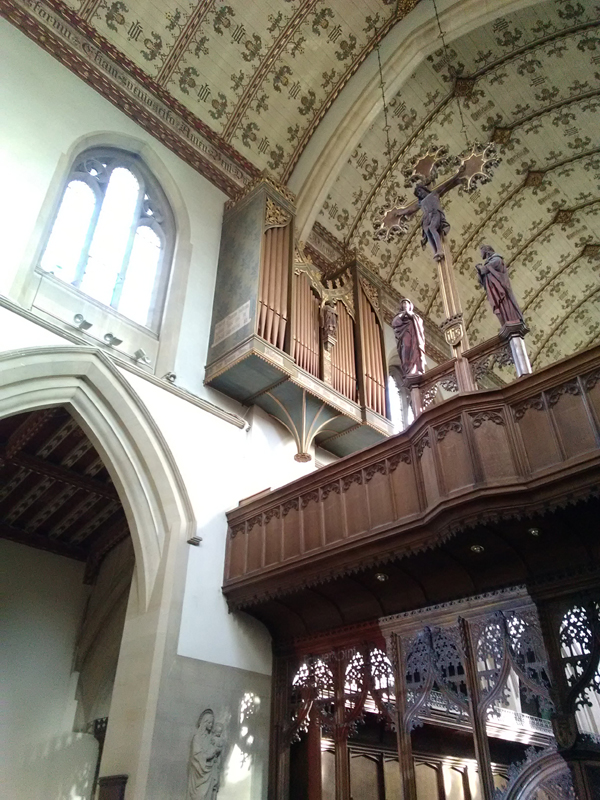
I sat for many hours in this church. It is the church of St John the Evangelist in Oxford, the Cowley Fathers church and joined by a cloister to St Stephen’s House, the high-church seminary of the Church of England. It is a Bodley church, built in 1896. To me, it is an expression of the Romantic medievalism of the broader Oxford Movement. The proportions are almost perfect, apart from the west tower being a little squat. The rood screen is exquisite. The altar is more Roman than English and the steps are too high in relation to medieval ones. The Gothic script on the wooden vault and the organ case suggests a German influence which goes down beautifully with my tastes. Northern Catholicism indeed! This building has much in common with some of the smaller cathedrals and collegiate churches in France like St Bertrand de Comminges, with the added advantage of sobriety. Architecture is another expression of the “patrimony” concept, but many churches on the European continent have choir screens, choir stalls and liturgical altars. Anglicanism has resisted the debasing of churches from the standards of the 1890’s more than Roman Catholicism, where emphasis was on devotions. However, I have been shocked to see some very radically “wreckovated” Anglican churches from a “modern” liturgical point of view.

What about the future? No one is certain about anything. The present arrangements for the Forward in Faith parishes are quite precarious, falling short of the hoped-for Third Province. The ecclesiology justifying such an arrangement is weak but enables those parishes to continue in their “natural state”. The Ordinariates do not seem to be threatened at present by the post-Benedict XVI era, but opportunities for many things have been passed over – not only liturgy-wise but an offer of a large building in greater London for a school. The Continuing Anglican Churches are still very small and self conscious like the traditionalist Roman Catholics. In England, we are a bishop, twelve priests and only about one hundred and fifty lay members and communicants. The Nordic Catholic Church under Bishop Roald Flemestad, part of the PNCC Union of Scranton, also has a small presence in England comparable with our own. Current dialogue between it and other Churches seems to indicate that priority should be given to solid theological principles rather than unity / intercommunion for its own sake. I do know that the Union of Scranton is interested in “doing business” with the G4 (union of the four main continuing Anglican Churches last October in America). This is encouraging but it will all need a lot of work. It is the notion of what we can bequeath to posterity. It strikes me that the same questions about patrimony are being asked by people in all churches, be they Orthodox, RC, Anglican, Lutheran or anything.

I also saw something very clear in the Oxford conference: an opposition between the current tendencies of “identity politics” and cultural Marxism, on one hand, and reactionary authoritarianism on the other. The latter is very American but is to be found in England. Romanticism has brought me to reject both this modern form of Jacobinism and the collectivist notion of humanity expressed by ideologies close to Fascism. Romanticism took up some of the earlier and higher aspirations of the Jacobins but kept the primacy of the human person over collectivism and all forms of tyranny. Romantic aspirations are wild! They go beyond the confines of any human institutions like Churches, though they aspire to the highest ideals of Christ and the many saints who were distinguished by their virtues and love of God and humanity. I think we all need to have this attitude in order to keep a critical mind and not be bogged down in a quagmire that inspired a friend of mine to write in a private e-mail to me:

I think that here can be a nasty feel about many religious and (sad to say) Catholic establishments in England. there can be an atmosphere of spying, lack of trust, outward conformity and externalism. The seminarians were treated like children (unhealthy) and there were stupid rules about where and when you would wear your hat out and where you could “take tea”. Bruno Scott James in his superb autobiography Asking for Trouble says that some of the really nastiest people he met were “religious”.

I return to John Bruce, not on any intrinsic importance he might represent, but a contradictory mind who presents a challenge, as did various heretical tendencies at the early Ecumenical Councils. One always needs an antithesis to make progress. He eschews any form of medievalism or romanticism. The only alternative he can propose is corporate collectivism, the abolition of the person to “feed” the “system”. At least this is the way he comes over. Eyeballs rolled upwards when I mentioned his name to those I met in Oxford and for whom the subject was relevant, including a few Americans and Canadians. That is his notion of the Church he embraced, and we can only imagine the spirit of Allen Hall seminary in the 1940’s and 50’s! Comparatively, Gricigliano was a more pleasant experience, even with some of the catty goings-on at times.

In the end, we need to turn our thoughts upwards and beyond. We will never find satisfaction in this world. Even in that beautiful church from 1896, there are nasty demons hiding behind the pillars to ruin the dream! I speak figuratively. We can attend Evensong in a great cathedral, but still the organist might play a bum note or the choir might be a little off key in a very difficult piece. Imperfection is human. We look for perfection but it doesn’t exist here. We look for beauty, but it is marred. There are people who believe that harmony and beauty should be abolished because of our collective sins. Whatever we have that is good is only of relative importance, relative to the life and world we yearn and hope for after our bodily demise.

Posted in Uncategorized | Tagged , , | 6 Comments

My first time at our new Pro-Cathedral

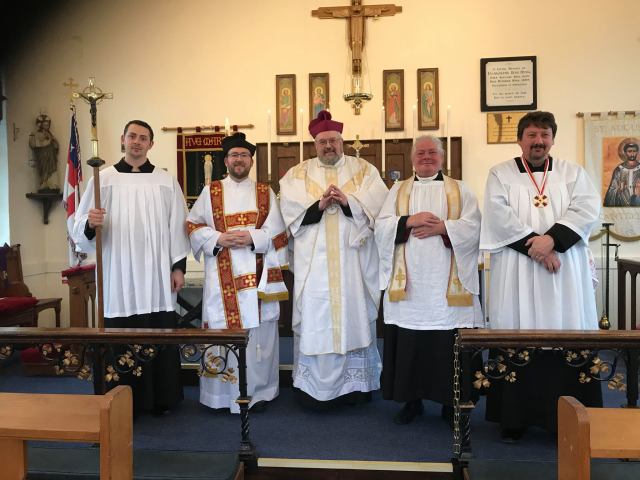
My Bishop invited me to preach at his Mass at our Pro-Cathedral in Painters Forstal near Faversham, Kent. It was Easter IV, Sunday 29th April 2018, and I expanded on the theme of the need of the Ascension of Christ for the coming of the Holy Spirit at Pentecost.

This was my very first time at the new church. I had seen many photos of the work and the finished church. I was truly impressed. Another “first” is Andy Hall (far left in the second photo) serving Sunday Mass for the first time. With Andy Hall, was Rev’d Rich Mulholland the parish deacon, Bishop Damien Mead, myself and Roy Hipkiss.

Posted in Uncategorized | Tagged | Leave a comment

Msgr Andrew Burnham and Romanticism

One of the loveliest talks I heard this week in Oxford was that of Msgr Andrew Burnham of the Ordinariate in England – Reply to Bishop Christopher Cocksworth’s ‘The Character and Gifts of Anglican Worship’. The following passage particularly impressed me:

For myself, looking back I sometimes struggle to understand how and why, for sixty years, I looked for and rejoiced in Roman and Latin liturgy and music in the Church of England. Why was I not content with the noble simplicity of mainline Anglicanism – the weekday surplice and stole Communions I served at in my youth, and the daily glories of choral Evensong? Why abandon The Shorter Prayer Book of 1946, only 314 pages long, and go back to the situation which Thomas Cranmer so acutely describes: ‘to turn the book only was so intricate a matter, that many times there was more business to find out what should be read, than to read it when it was found out’? The answer, I think, is that what drove High Churchmen, at least from the nineteenth century on, at least in part, was the romantic movement. In that sense æsthetics led theology by the nose. For me, it was growing up at Worksop Priory (founded in 1103), singing as a schoolboy at Southwell Minster (founded in 956), and then attending daily Evensong at New College (founded in 1379). Though the Sarum loyalists with their reconstructed liturgies disagreed with the Ritualists and their holiday imports of statuary and vestments from across the channel, all were driven by the longing to re-inhabit these and similar buildings with what Geoffrey Rowell described as the Vision Glorious.

Of all the prelates of the Ordinariate, Msgr Burnham seems to be the one who “gets it” the most. He distinguishes himself from the usual Anglo-Papalist line of following the reforms of Vatican II and Paul VI as I so often saw in London in the 1970’s. However, Romanticism was not mere feeling or aesthetics, but also a philosophical paradigm that changed Anglicanism and gave it something it did not have in its Reformed ethos. Is it dishonest then to speak of Anglican Patrimony? Some would say yes! Romanticism had far-reaching roots in Anglican history and spirituality.

Msgr Burnham might speak of longing for being a part of the Roman Catholic Church. For a Romantic, one would be yearning for very little! I remember those days well, and my correspondence with erstwhile Bishop Burnham before the Ordinariate was established. It was a feverish time for us all. I disagree with Msgr Burnham in that becoming a Roman Catholic is hardly a subject of Romantic Sehnsucht. I had my own experience of swimming the Tiber both ways!

The article needs to be read with great attention, and several other talks are available on the site. More will certainly be added in time.

Posted in Uncategorized | Tagged , , , | 2 Comments

Conference in Oxford

I am still in England after having been at my Diocesan Synod in Westminster, served our little mission in Bristol, spent a day with a dear friend who was recently inducted as a parish Vicar, enjoyed precious time with another dear friend who is a medical doctor, a modern-Romantic philosopher and father of five lovely children together with his Italian wife, attended the famous conference in Oxford, The Gospel and the Catholic Church, A conference discussing Anglican Patrimony today. After the Conference, I came up north to spend some precious time with my family. Tomorrow, I will have a long drive southwards to be with my Bishop near Faversham in Kent, and will see his new pro-Cathedral for the first time where I will have the privilege of preaching a brief and pastoral homily at Mass. Later on Sunday, I will have my ferry to catch at Dover to return to France.

The Conference itself was a very rich time, though some talks were slightly less relevant to the real theme, or were from quite diverse theological points of view. It was all held in the beautiful church of St John the Evangelist attached to St Stephen’s House in Oxford. This was the first time I had seen the buildings of “Staggers” as this seminary has been called. For this evening, still at my father’s house in Kendal, I will simply outline some of the things that most struck me, and may go into some details in the coming weeks. I am told there will be some texts of talks on the website, some of which I am eager to have.

One of the finest talks was by Msgr Andrew Burnham of the Ordinariate, in which he identified one of the roots of Catholic Anglican identity / patrimony. That was Romanticism and longing. In his perspective, the longing was for unity with the See of Rome. Such an aspiration is not wrong, because some form of primacy of the Church of Rome was always expressed in some way by the Fathers and early Councils of the Church. However, we may not always be agreed on the mode of this aspiration or the possibility of its realisation in our particular time in history.

Roman Catholic speakers including Msgr Mark Langham, who is undoubtedly a fine priest in his Church, but did not fail to express a strong notion of authority and obedience. He contrasted the continental influence in English Roman Catholicism and the neo-medieval ethos of Anglicanism. He even mentioned the Sarum Use! They all talk about it but stop at actually using it. The comparison is certainly simplistic, and he would be more nuanced in his other writings and ministry.

A priest of the Free Church of England was forthright in his criticism of liberalism and modern agendas, and struck me by his (what I would call) reactionary authoritarianism.

Dr Gavin Ashendon was present and also spoke on the roots of cultural Marxism and the Frankfurt School. He too was forthright with his authoritarian sympathies. As I listened to him, my thoughts became very strong about the need for a third way between this new form of Jacobinism (as I would characterise it) and the authoritarian reaction it begets.

There were other clerics who gave talks – Roman Catholics, Anglo-Catholics and a few Evangelicals. Was this some effort to unite the “remnant”? Certainly the Conference had the noble and holy purpose of healing the breaches between all Christians. I failed to detect any note of desperation but rather a message of trust in divine providence.

I noted the discreet presence of Bishop Roald Flemestad of the Nordic Catholic Church and his clergy in England. I was very encouraged to note the desire of the PNCC in America and the Union of Scranton to dialogue with the “G4” (intercommunion of the four main Continuing Anglican Churches achieved last October in America) rather than with the ACNA. These matters are in the hands of our Bishops and those they appoint to assist with the process of dialogue. On meeting Bishop Flemestad and his priests, I could only say what was on my mind, that we must be clear and transparent at all times, because this is the only way we can make progress.

I was apprehensive about meeting some of those men, but I am thankful to accomplish this task of giving a face to my name for those who read this blog and appreciate what I am trying to do. I was pleased to see Msgr John Broadhurst again after all these years since my TAC days, and I personally thank Msgr Andrew Burnham for his profound and sincere words. They are good men, and I have every respect and esteem for the Ordinariate and for everything it is trying to do in the face of indifference and frequent hostility caused by crass ignorance.

My own thoughts have been enriched and I find myself confirmed in my desire to work for a new way above materialist rationalism and religion based on bigotry and “appropriation of truth”.

Posted in Uncategorized | Tagged , , , , , , | 36 Comments

Hans Asperger – Nazi Collaborator

I was given a reference to a press article saying that an Austrian medical historian by the name of Herwig Czech has published Hans Asperger, National Socialism, and “race hygiene” in Nazi-era Vienna. This directly contradicts my earlier posting Hans Asperger mentioning articles suggesting he was almost a kind of “Scarlet Pimpernel”. Czech’s article seems to be based on documents previously believed to have been destroyed at the end of the war, but which were found. It looks like a highly credible piece of work, but destroys Asperger as a humanitarian medical practitioner.

This new study says that Asperger referred “profoundly disabled” children to the Am Spiegelgrund clinic in Vienna, despite knowing what took place there, namely euthanasia by starvation or lethal drugs. Asperger claimed to have been pursued by the Gestapo for refusing to hand over children for euthanasia, but it now turns out that there is no evidence for this claim. He knowingly and willingly served the Nazi machine which brought him advantages for his career.

What does this mean for those who have been diagnosed with “high-functioning autism”, as is my case? The term Asperger Syndrome disappeared from the American psychiatric manuals in 2013, and the same set of characteristics in a human person is diagnosed under Autism Spectrum Disorder (ASD). The spectrum goes from “high functioning” without any intellectual or developmental retard to children who need to be institutionalised for life or given special help and support in the community.

I was told by my own psychiatrist at the autism centre attached to the hospital of Rouen that I was hard to diagnose because I had learned to “play the game”, to apply the right kind of behaviour in social contexts of different kinds. For me, what lay at the base of it all was my profound feeling of alienation, the feelings that led me to philosophical Romanticism, something that plagued my childhood and prevented me from doing the “right thing”. It followed me everywhere I went, through the years and up to the present. It would seem that the real difference between Asperger Syndrome and high-functioning autism is in the diagnostic method of analysing the patients traits and behaviour. Some have complained that some who would have been diagnosed as being “aspies” would not fit the criteria applied in a diagnosis for autism anywhere on the spectrum. Those who are not diagnosed with autism get “Social Communication Disorder”, or are simply “unruly brats” on whom the top-quality rattan cane that built the British Empire should not be spared! By way of anecdote, flogging was abolished in the British forces by the Army Act of 1881, in response to strong public opinion. It was said that flogging “made a bad man worse, and broke a good man’s heart”. I am not one of those conservatives who advocate corporal punishment in schools or dismisses psychological or mental disorders as behavioural problems to be corrected by punishment. Human life is sacred, otherwise we should go right back to Nazism and apply the “survival of the fittest” and to hell with the weak.

It is indeed a tough job for the professionals who interview patients, run tests and make the most accurate diagnosis possible. Psychiatry is an inexact science, unlike physical medicine where the laws of physics, chemistry and biology apply. All a psychiatrist can do is to study and analyse a set of characteristics shown by the patient, his present behaviour and evidence of his past behaviour, and then apply a label. It may seem very approximate, but it allows the patient a level of self understanding and asks others to make allowances for the difficulties or annoying traits of that person.

Asperger’s work from 1944 is actually very dated and uses quaint language like “autistic psychopathy”, whilst psychopathy nowadays means a set of characteristics used by pioneers like Dr Hare. Clearly, the term psychopathy describes a completely different personality than one diagnosed with autism. I have heard lectures by the brilliant Canadian psychiatrist Dr Laurent Motron, in which he refuses the dividing line between is and is not, and concentrates on an examination of the traits and characteristics. The title of one of his books L’autisme: une autre intelligence (no translation needed) indicates a whole new attitude. Autists have a different experience of life and have no need to be compared with so-called “normal” people. I would hope to gain more scientific knowledge of autism so that I can begin to work on a comparative approach in philosophical terms. This was a part of my motivation behind The Blue Flower.

Diagnosis for autism at any place on the spectrum is a two-edged sword. It gives us a break from being called an “arsehole” or a “jerk”, but subjects us to being treated as people suffering from an abnormality. What is normality? In my studies of Romanticism, I find the notion of foundational truth, the “Imperial Science” as someone in a film coined it, to be losing its validity. Truth is above us, escapes our understanding and is transcendent. This is the case with the human soul and spirit as well as with God.

I am profoundly disappointed to learn that Asperger went along with that evil and inhuman system rather than emigrate to America and pursue his research in the free world. He became a cog in the machine. He knowingly sent children to a place where they were to be killed as “unworthy of life”. It seems that he was really into the ideology rather than just paying lip service to get by. For a doctor who seemed to care for his patients, how could he be a Nazi? We should read the paper, and we should be thankful for the efforts of scientists and philosophers in our human world in building up knowledge and better understanding.

Posted in Uncategorized | Tagged , , , , , | Leave a comment

Coming soon to a cinema near you…

Macron seems to be a guest star in all this. Boom!

Posted in Uncategorized | Tagged , | 2 Comments

Rapture?

The junk-religion merchants, especially on YouTube, are at it again. This time, they are proclaiming the end of the world and the “rapture” for 18th April, only five days from now. The Americans are rattling the sabre against the Syrians and the Russians acting as a kind of “anti-aggression” police. Who knows, World War III and we might hear some big bangs and see mushroom clouds. Most of us would die from radiation poisoning and starvation, not very pleasant. Nothing is impossible, but I’m not going to believe it from purveyors of “Armageddon pornography” as some cynics call it.

Those people, like flat-earthers (about an astounding 2% of the American population), portray the Rapture as what some witty cynics call “Got raptured, left clothes but took wallet“. What is this famous rapture, on which I have already written? A lot of the Bible is metaphor and poetry, not to be taken literally. I can add the philosophical notion I have been studying, that of having to have a foundational truth from which it is possible to abstract meaning. One thing I notice about fundamentalist Protestants is that they are materialists, in order to appropriate the truth for themselves. If life were anything but materialist, there would be more ways of “being saved” than in their particular lucrative business.

St Paul constantly referred to mysteries. There are cases in this world where persons other than Christ have experienced a kind of transfiguration and manifested an extremely bright light. St Seraphim of Zarov and the Curé d’Ars come to mind in the lives of the Saints. Paul’s words cannot be interpreted to mean what John Darby and the Dispensationalists concocted. The end of the world is a mystery, and our own death will be an end of a world – before we enter the next. I had nightmares in the 1960’s about a nuclear war with the Soviets, and it never happened. It is not impossible now, and man is free to sin, but on such a large scale? There are other “planet killers” like comets and meteorites, super volcanos and global warming. We could worry about all this – or go on with life and a healthy relationship with God and our fellow humans and the natural world. I prefer the latter, because I am more likely to die of some cause than be around when the end does happened, whether caused by man or God.

We don’t know the day or the hour. It is better like that. Yes, we do need to be ready and be aware of our mortality, even welcome it as our pilgrimage beyond this world when we are judged to be ready. Some of those “fundies” spend so much time with all these worries that they no longer function as human beings and do their ordinary duties of life.

I often pray, “Lord let me die, but not before having done thy will and my mission on this earth”. I am not satisfied that I have done God’s will, and there is so much more calling me… This is the way it is for us all.

Posted in Uncategorized | Tagged , , , , , , , , | 9 Comments

Possibility Consciousness

I have come into contact with a most interesting gentleman by the name of Peter Rhodes-Dimmer. Some years ago, he bought the Chateau de Bambecq in French Flanders, near St Omer, and began to build up an ambitious humanist and humanitarian programme involving the use of modern technology for helping the starving and homeless and working for environmental sustainability. Peter Rhodes-Dimmer also has a second Chateau de Bambecq site, on WordPress.

The extreme diversity of thought and projects will be quite difficult to unpack, but I have already had a long conversation with him via Skype, and I hope soon to be able to visit the chateau and the community that both pays for the upkeep of the chateau by hosting various corporate initiatives, and works towards this ambitious humanist project.

My previous posting mentioned subjects like theosophy and extraordinary philosophers and scientists in the Enlightenment era, and the term New Age comes out. Like many words and labels, it hits up against prejudice and rigid beliefs that many Christian folk hold. Also, the turn of the century passed eighteen years ago, and we see many more evils and dangers in this word than in the 1990’s. So, where is this famous Age of Aquarius? Optimism peels away, leaving the rusty metal panels of cynicism and foreboding. Like Romanticism two hundred years ago, the world was not changed one whit in terms of human sin and evil. The Industrial Revolution and the inhuman exploitation of workers ground on.

However, the difference was made at another level by profound and inspired souls. Most people, when they die, are forgotten within thirty years and no one bats an eyelid when their remains are put into the charnel house and space for new graved is freed up. The outstanding men and women remain in our consciousness, and their memory even in our world is eternal. Doubtlessly, a new age will enter human consciousness at a more subtle and humble level, as Christianity in the first century AD did. We need to keep an open mind. The Redemption itself made no visible difference in this world, but it does on another level of existence – a parallel universe, a state of consciousness, something mysterious made accessible through symbolism and by aspects of consciousness other than the sensorial / rationalistic faculties.

It occurs to me that the New Age movement, at its most honest and integral, is about education, helping people to understand what philosophy took centuries to cogitate and refine. I think of the transition of the theory of knowledge and the notion of foundational truth from the Enlightenment to early Romanticism. Certitude obtained by scientific deduction from first and intermediate principles becomes impossible in questions of what escapes our sensorial perception, so the alternative is belief or a new openness of mind to search and yearn for that Absolute that we cannot grasp in this life. The problem of belief is often one of naively accepting what someone else tells us is true, but things really need to be much more subtle. New Age isn’t, or shouldn’t be, the things fundamentalist Christians accuse it of being, but a frame of mind, a refusal to believe in a bleak, inanimate and deterministic universe where man and his world are alone. Perhaps we should relativise the term and rather seek understand the content rather than the packaging. The same goes for orthodox Christianity. We have to be fair.

Peter Rhodes-Dimmer wrote The Layman’s Guide to the New Age in 1992, which arrived in the post today. When I see the diversity of cultures to which he is addressing this message, I realise that my own level of existence is quite narrow. Indeed, we all have progress to make. Is Christianity a prison or a vision and mystery that set us free? If we are free, we can then admit of the possibility of every human aspiration, culture and philosophical vision. Nothing is immutable truth. Everything is possibility. Isn’t that an idea we also find in quantum theory? During our Skype conversation last week, Peter spoke of Possibility Consciousness, and immediately I thought of the anti-foundationalism of the German Romantics. We are just talking about the same subject using different words, comparing the culture of eighteenth-century Saxony with contemporary London! Everything converges. I have never experienced anything of the like in my whole life!

What is this Possibility Consciousness? He defines it in his book as

‘Possibility Consciousness’ allows you to hold together in your mind all the unproven spiritual and supernatural phenomena which you experience, or which interests you. in a way that accepts them as a possibility. Treat it as a separate storage area in the mind. In this area of your consciousness you can build up material you wish to work with, while not having to judge it. You simply hold it as being possible.

You will then find that a surprising number of spiritual and paranormal issues begin to link together to form strong patterns and synergies in your mind. You will also start to remember….

We don’t have to believe in anything new and hold it as a conviction and be afraid of betraying our past and present. We just accept the possibility and keep a sufficiently open mind to explore further. There are more things in heaven and earth, Horatio, Than are dreamt of in your philosophy. – Shakespeare, Hamlet (1.5.167-8). There are more frequencies of light than what our eyes can see. A radio set can only play one frequency of electro-magnetic waves at a time without unintelligible interference and  jamming. Our experience is narrower that what we could ever imagine.

Perhaps my own opening paradigm is an infinitesimal beginning of a change. Maybe some  change in the universe at a general level is predestined. Perhaps to an extent, it depends on us, our consciousness, our will to be positive and put aside our gloom and cynicism (knowing the price of everything but the value of nothing). These themes have always in my mind, but I have not always lived where it was safe to “come out” in public about them. Berdyaev has inspired me, as has René Guénon, Jean Faure who lived in Paris and wrote Le Cycle de l’Humanité Adamique on traditional cyclic notions of history as found in the Hindu scriptures. I have Paul le Cour’s book L’Ere du Verseau with a more astrological emphasis and a constant reference to French Romantics like Chateaubriand. Finally I see a new perspective on Berdyaev’s notion of a New Middle Age, not returning to the historical medieval period but the romanticised ideal like Hardenberg’s Die Christenheit oder Europa. I met Jean Phaure in Paris in 1992 and was invited to dinner at the Vietnamese restaurant where he almost lived.

New Age came into being over a very long period of time and used different words and descriptions. I see it as a part of human consciousness expressing itself in Christianity in the western world, the kind of Christianity that has always been offered to the Gentiles most of us are, but also in other religions in different parts of the world. One constant notion in Romanticism, often labelled as syncretism by some conservative Christians, is that of a primaeval revelation from which different religions and cultures evolved. The Mystery Schools are forgotten to all but scholars and avid readers, but they contained the same ideas that have filtered down to our own time. We ignore or deny this at our own peril and at the cost of our very freedom, freedom of perfection, freedom to seek the Absolute and the transcendent.

The term Possibility Consciousness is simple to grasp, perhaps a simplified way to understand what the philosophers worked so hard to find as a satisfying theory. It seems a wonderful way to break the spell of “realism” and materialism, to allow a relationship between philosophy and science whilst respecting the “otherness” of each. Giving humanity its freedom, not for gain or influence, but purely altruistically, is one of the greatest inspirations I will find in this world, already a sign of that change for which we all yearn with all our being.

Already, if our prayers and thoughts are pure, I believe we will avert World War III and all the things that terrify us like “Frankenstein science” and Big Brother, knowing that the enemy is among ourselves, under our own keel. I do follow the news, and I lament the constant “bullshit” and smokescreens of our elected politicians and the archons of the darkness of this world. We must do better by learning, thinking, praying and doing good around ourselves. Then that age, so desired, will arrive and console us in the heart of God.

Posted in Uncategorized | Tagged , , , , | 2 Comments

The TAC in England

Does anyone have any up-to-date information on the TAC in Britain? It seems to have vanished completely. It has no presence on the Internet and some of my brother priests in the ACC are wondering. I had heard that they had dialogue with the Free Church of England and the Nordic Catholic Church. Surely, if anything had been successful or conclusive, we would know about it.

My correspondent told me that they were no longer mentioned in Company House or the Charity Commission. The thought came into my mind that it all looked so good and healthy in October 2007. The Ordinariate creamed off some of the clergy and parishes. The clergy who joined the ACC are known on the website of our Diocese, but I am one of very few.

I welcome any information.

Posted in Uncategorized | Tagged , | 6 Comments

A Christian Mystery School

These few words are the reflection of a long process of thought in my mind from my university days. It has been brought home to me when I have seen the state of parish life here in France and elsewhere, the question of cultural Catholicism or belonging without believing. I am brought to the exhortation of Christ “Do not give what is holy to the dogs; nor cast your pearls before swine, lest they trample them under their feet, and turn and tear you in pieces“.

The passage needs interpretation and reading in the context like all scriptural quotes. What I see most of all is that animals like dogs and pigs (the former being good pets and the latter being sources of food) cannot appreciate the spiritual meaning of the Eucharist, and would eat it like any ordinary food. This would also be true of some humans, and their indifferent uncaring attitude can often be discerned by their behaviour in church. This is particularly the case where church services are assimilated to popular entertainment and a level of banality that repels the more cultured and contemplative souls. There may be a bearing on the question of Jews and Gentiles, but Christ seems to have wanted to extend his Kingdom to the Gentiles as well as people like the Samaritans.

Traditionally, the Church has operated through parishes to minister to ordinary people in the cities and the countryside. The monastery is something requiring a particular kind of commitment from its adepts, as are the various teaching and humanitarian orders like the Franciscans, Dominicans and Salesians. More recently, there is the Benedict Option which I will soon be reading thanks to a dear friend who has sent me a copy from America. It arrived in the post today. I need to learn much more about Rod Dreher’s ideas so that I can be more constructively critical. The inspiration seems to be idea of adapting monastic tenets and practices for lay people living in alternative and intentional communities. My biggest concern is whether the community in question is run democratically or by the authority of the strongest personality. The implications of the latter can very quickly degenerate into sectarianism, especially when the “guru” has a disordered personality (eg. psychopathy or malignant narcissism). This will be true of any community, including the family consisting of a man, a woman and their biological or adopted children. Nothing can escape the worst of human nature.

Another model of Christian living comes to mind, that of the mystery school. There were many such mystery schools in antiquity, and many of them showed characteristic extremely similar to Christianity, especially the theme of a God giving himself in sacrifice and rising from the dead. Christianity has often been accused of plagiarising these themes of deities like Horus. My interest in this world was awakened by reading Dom Odo Casel’s The Mystery of Christian Worship (Das Christliche Kultmysterium). Dom Casel fought for the notion of Christianity being the perfect fulfilment of a long history of types and shadows in both Judaism and ancient Paganism. We perceive our faith as a history of salvation, a notion that is particularly strong in the Old Testament and the very notion of Tradition. I have wondered about the possibility of a “church of the future” in the form of an esoteric lodge or school, a little like the Freemasons or other societies suspected because of their keeping secrets away from the general population.

My studies of Romanticism brought me to an acute understanding of the eighteenth century and the effects of the Englightenment. It was a world that was as bleak spiritually as our own. People went to church paying lip service to the old “superstitions” but had a materialistic view of life. Churches crumbled because no one cared, and the same is happening today. The Industrial Revolution is paralleled today by the vertiginous advance of digital technology and “post-humanism”. Mary Shelley wrote Frankenstein in 1816 and we now have scientists finding ways of transplanting the head from one person onto the body of another – or building digital technology into a human body to produce some kind of Ubermensch.

As institutional Christianity’s salt lost its savour, a powerful esoteric movement built up over the seventeenth century and into the eighteenth. We are brought to think of Jakob Böhme and German pietism all the way to the fashions of the late nineteenth century expressed in various versions of theosophy and occultism. Whilst reading about C.S. Lewis, I discovered the philosopher Owen Barfield and his interest in Rudolf Steiner. This is where many of the late Romantic themes were going up to World War I and well into the 1920’s.

To some extent, this movement became a backdrop to movements like Modernism in the Roman Catholic Church and Higher Criticism in Lutheranism and Anglicanism. A few seemed to have materialistic sympathies, but most wanted a more mystical and personal experience of Christianity. This was certainly true of Fr George Tyrrell. Along with this multi-layered movement came an interest in esoterism as back in the seventeenth and eighteenth centuries. According to this belief, not all of Christ’s teaching was addressed to the crowds of disciples and people in the synagogues and the Temple, but some were given behind closed doors. There are clues like the parables of the Kingdom and the explanations of what is given to ordinary people and what is taught to the initiated. On the other hand, Christ told the Pharisees that he taught nothing other than was publicly known. This apparent contradiction leads to some confusion.

One of the most important reasons for not rejecting Christianity, despite it having been “jammed” by power-hungry churchmen, is that it seeks to protect and strengthen the weak in the face of the strong and wealthy of this world, a kind of “socialism”. Who else is concerned for the ignorant, the poor and the sick without financial compensation in return? It marked moral limits of human competition and the elimination of the weakness to allow the strong to prosper without carrying the weight of “useless eaters”. It is the very antithesis of modern capitalism and the old Nazi ideology, the survival of the fittest of Darwin.

The other profound dimension of Christianity is the Mystery, the notion of keeping Christ incarnate in spite of his Resurrection and Ascension, outside of time and bringing the world of time into contact with eternity. This is made possible through the sacramental life of the Church and her life of prayer using forms of service similar in essentials to those of the Jews, the recitation of the Psalms in particular. This notion of Christianity inherits everything from the old Temple, but also from the mystery schools. Among these mystery schools were the Gnostics, from which some were reasonably orthodox Christians, and others had quite wild positions based on philosophical dualism (the opposition between matter and spirit). It is not all bad even though some elements lead to doubtful beliefs and practices.

I first heard of Jakob Böhme (1575 – 1624) through reading Berdyaev. He was a philosopher, mystic, and Lutheran theologian. Berdyaev wrote many things under Böhme’s influence, and there is this interesting piece on the internet, Etude I. The Teaching about the Ungrund and Freedom. It was also in reading German Romantic philosopher (or about them) that I would learn that Schelling, Schlegel and Novalis were inspired by Böhme, and Hegel called him the “first German philosopher”. We will be quite surprised when we discover Böhme’s fidelity to his Lutheran tradition, but yet a marked departure from some of the tenets of the Reformation. He had a marked view on Christian esotericism and some have called him a founder of Christian theosophy, though the term was only coined much later. All the word actually means etymologically is a contraction of the Greek derived words philosophy and theology. Modern Theosophy was promoted by Helena Blavatsky, and inspired the Liberal Catholic Church of James Ingall Wedgwood (1883 – 1951) and Charles Webster Leadbeater (1854 – 1934). The Liberal Catholic Church is still going, and I visited their parish in Paris in about 2006. The Theosophical Society was very popular in its early days, but the internet is parsimonious with recent information. That world has never really appealed to me even if my curiosity has been provoked on occasions.

Christian esotericism was also represented in Holland, England and France during the Renaissance period. There are some remarkable books written about esotericism and alchemy. I know little about alchemy, but I do know that the word is Arabic, reminding us of the ancient Islamic culture. The word alcohol also came from Arabic. There was a constant aspiration to find a spiritual world through symbols and earthly elements like fire and water. At the basis of all this lies the idea that matter can be transformed and spiritualised. In such a context, the transsubstantiation of bread into the body of Christ and wine into his blood at Mass takes on another meaning entirely.

Emanuel Swedenberg (1688 – 1772) is a fascinating figure in the reaction to the Enlightenment in the company of William Blake and the early Romantics of Jena. Like many inspired souls of that era, he was a scientist and a philosopher. He also travelled widely. Blake followed Swedenborg for a time until they disagreed. Swedenborg had mystical and psychic gifts. The American transcendentalist Ralph Waldo Emerson was influenced by him as was Charles Baudelaire. Like Novalis at the end of the century, he was an engineer and designed Sweden’s first salt mines. For his time, his scientific and technological knowledge was phenomenal. It is easy to dismiss Swedenborg for his unorthodoxy, but which of us would come anywhere near his achievements? He experienced states of altered consciousness including revelations from Christ about the understanding of Scripture. He is another historical character I need to learn more about. There are Swedenborgian churches to this day, sometimes called The New Church.

Another interesting development is the Martinist Order, founded by Papus in 1891. Superficially, it seems to have a lot in common with Freemasonry. However it is more specifically Christian. One distinguished initiate was René Guénon, who ultimately converted to Sufism, a contemplative form of Islam, and died in Egypt. The Order knew its heyday in the early twentieth century, especially in France. There is still an Ordre Martiniste in France to this day. I don’t have the impression that they are involved in any great conspiracies! They seem to be concerned for a mystical form of Christianity that is difficult to find in parishes. I might have been tempted at one time, but there seems to be a lot of quite elaborate and artificial secrets and ceremonies that are quite foreign to me. Orders are quite exacting about their filiation and legitimacy, when I think that they are not necessary for the essential of transmitting knowledge. Excesses are not unknown like the notorious Ordre du Temple Solaire, whose “guru” incited all the members to commit suicide! The sectarian temptation is never far away. However, I don’t believe that Martinism is a sect. 

Vladimir Solovyov (1853–1900) is reputed to have said:

“Although empiricism and rationalism rest on false principles, their respective objective contents, external experience, qua the foundation of natural science, and logical thought, qua the foundation of pure philosophy, are to be synthesized or encompassed along with mystical knowledge in ‘integral knowledge’.

I can’t seem to  find the source, and I am wary of the claims of theosophy, but this idea seems to converge to some extent with German Romantic philosophy. We can call it mystical knowledge, imagination or some other form of yearning. The quote needs a lot of thought, and above all the context that I am presently unable to find. The problem with Theosophy as far as I can see it is that it “multiplies” entities, becomes extremely complex and leaves me with a sense of “overload”. It is also a reflection of its era, the late nineteenth century rather than the more sober approach of the late eighteenth. I feel quite discouraged from going into it – and, of course, there are unsavoury and unscrupulous individuals who will gladly separate the gullible from their money!

Is anything possible outside parishes and traditional monasteries? My own instinct is to proceed from study and reflection, individually and in small groups. There is no need for secrets and rituals other than reciting or singing the Office together – one thing a group can do together without belonging to the same institutional Church. I do believe that a grounding in humanist culture is very important to maintain the balance of intuitive belief, imagination and reason. Early theosophy certainly reflected such a cultural background, as I can imagine with Madame Blavatsky and Swedenborg. Many aspects converge. I tend to be wary of modern movements.

Why secrecy in esotericism? Secrecy provokes curiosity and it is understandable how it can be so successful in building up an in-house identity and sense of belonging. Mystery doesn’t always mean something that is secret or withheld from the profane world. In theological terms, mystery is understood to mean a truth that is beyond human reason, not against reason but above it. I learned many things on reading Uberto Eco’s The Name of the Rose, the story of the medieval monastery and murder mystery, with the motive of guarding the big secret of the labyrinth library – the book by Aristotle that defends humour! I am a natural sceptic.

I refer readers to the book of Dom Casel that I mentioned above and its first chapter – The Mystery and Modern Man. Casel summarises the notion of mystery in these words:

The mystery means three things and one. First of all it is God considered in Himself as the infinitely distant, holy, unapproachable, to whom no man may draw near and live…. And this all-holy one reveals His mystery, comes down to His creatures and reveals Himself to them; yet once again in mysterio, that is to say, in a revelation by grace to those whom He has chosen, the humble, the pure of heart.

For St. Paul μυστήριον is the marvellous revelation of God in Christ…. Christ is the mystery in person, because He shows the invisible Godhead in the flesh

Since Christ is no longer visible among us, in St. Leo the Great’s words, ‘What was visible in the Lord has passed over into the mysteries.’ We meet His person, His saving deeds, the working of His grace in the mysteries of His worship. st. Ambrose writes: ‘I find you in your mysteries’.

The content of the mystery of Christ is, therefore, the person of the God-man and His redeeming act for the salvation of the Church; it is through this act that the Church is integrated into the mystery.

Dom Casel bathed in the Benedictine tradition of the monastic life, and we are drawn back to the notion of the Benedict Option (which I am now in a position to read). I think there needs to be some openness to studying phenomena like Swedenborg and theosophy, because there are important intuitions to sort out from what seems more difficult to digest. Much has been achieved by individual scholars who would meet in groups to compare notes, share friendship and pray together. Some of the more subtle expressions of theosophy rode on the cultural piggyback of the Renaissance and Romantic Sehnsucht and love of nature.

I see a tremendous amount of potential for such study groups in which friendship can draw people together and encourage a spirit of prayer and communion. I think that a Mystery School at this level would be ideal together with a careful opening to the outside world. I keep working on it – and I have so much to read, and progress is so slow.

Posted in Uncategorized | Tagged , , , , | 11 Comments