Flashback to 2010…

Things often swirl about in the mists of time and are forgotten. I was wondering about a passage written by Bishop Peter Elliott, a respected Australian Roman Catholic bishop who was once an Anglican. What is more, he lived at the Pontifical Nepomucene College in 1985 to 1986 when I was a first-year seminarian there. He was studying some speciality in moral theology with the Institute for Marriage and the Family and he was my confessor. He was also a chaplain for us seminarians and celebrated the Paul VI Roman rite Mass in Latin in a small chapel on the first floor of the College with a baroque style altar. His humour and humanity were a happy contrast to the dour ways of Msgr John F. McCarthy who was our superior. Something of his Anglicanism remained, though he had become far more Roman Catholic than I ever did! His article in The New Liturgical Movement, dated a few days before mine, is The Future Liturgy of an Anglican Ordinariate: Considerations by Bishop Peter Elliott. I am happy that the text has been preserved in spite of the events as they panned out over the next couple of years.

Shawn Tribe, who was in 2010 in charge of The New Liturgical Movement, asked me to write an article about the possibility of Sarum becoming the / an official rite of the Ordinariates. This was at a time when it was believed that the TAC and Archbishop Hepworth were to be the stars of the upcoming Ordinariates, whilst the Forward in Faith bishops in England and America lay low. My opinion seemed to be of some value at that point, the same time when I was being interviewed in France by Radio Courtoisie and various traditionalist RC organisations staging conferences.

At the time, until August 2010, I was on Christian Campbell’s The Anglo-Catholic (since taken down completely) and was stimulated by the prospect of a whole uniate church in communion with Rome, accepted en bloc. It seemed reasonable to believe that Benedict XVI would have the originality of mind to dare something hitherto unheard of, including massive dispensations from canon law in regard to former RC clergy (though Archbishop Hepworth was divorced and remarried, with or without a cause for nullity). It happened a different way, and I think it was a good thing. I never made any application to Rome, and I don’t believe my file was sent there by my Archbishop either. There was no way of knowing, given the lies, fabulations and exaggerations coming from those quarters. At any rate, I heard nothing from Rome or any Ordinariate, so it was safe to believe that I had never applied or been refused. I did not correspond with Bishop Elliott either, for precisely the reason that I was completely distanced from his Church – and I had no inclination to be told the only thing he in his position would have been able to tell me. By late 2012, I was effectively “orphaned” and I applied to the Anglican Catholic diocese in England under Bishop Damien Mead in early 2013 and was accepted via the Board of Ministry. It seems quite surreal to look back on all that, but quite salutary…

This highly revelatory article appeared on 15th May 2010 – The Future Liturgy of an Anglican Ordinariate: Why not Sarum? I was not the only one to be invited to give an opinion. Fr John Hunwicke was totally against reviving Sarum but rather adopting the English Missal reflecting an English “inculturation” of the Tridentine missal incorporating some features of the Prayer Book. You can search the blog under different keywords to find this period and theme.

Here is my piece as reproduced in that article. I use the Sarum liturgy to this day, though I conform to the Anglican Missal when celebrating for local communities in England, as I will do in Bristol next month the day after our Diocesan Synod. Frankly, I am likely to be dead before any Church generalises a revival of the pre-Reformation uses of England, Salisbury and York in particular. I have always had the same thought – throwing seeds onto the ground and putting messages into bottles and casting them into the sea.

* * *

The Future Liturgy of an Anglican Ordinariate: Why not Sarum?

by Rev. Fr. Anthony Chadwick, TAC – Patrimony of the Primate

In considering what could be liturgically possible in at least some of the future Anglican-Catholic Ordinariates, I was heartened by reading Bishop Peter Elliott’s ideas as he expressed them on this subject:

Considering its history and strong influence in the first editions of the Book of Common Prayer, the Sarum Rite might well be a major source. Queen Mary I published a national edition of the Sarum Missal to replace all those missals for the diocesan uses that went into the fire when the first Book of Common Prayer appeared in 1549. Therefore the Sarum Use was the last version of the Roman Rite in England before the universal Missale Romanum, Roman Missal, was authorised by St Pius V in 1570. At the end of the nineteenth century when Westminster cathedral was being built, it was proposed that the Sarum Rite be revived as the use proper to the cathedral. Nothing came of this project, lost I suspect in the cross-currents of liturgical controversies and an Ultramontane trend to standardise liturgy along Counter-Reformation lines, even down to the shape of chasubles.

Were this idea to be taken seriously by Rome and actually implemented, at least as an option, it would be the fulfilment of a dream that goes back many years. Though all Catholics are bound to assent to the doctrines, we do well to recover some of the products of organic development in the various dioceses and religious orders. I believe a reasonable diversity of traditional and legitimate liturgical rites could be most helpful. This diversity is intended to some extent in Anglicanorum Coetibus, in which it is said that the Roman rite (in both forms) should not be excluded even though Anglicans would be allowed a special liturgical usage. That leaves three rites, of which two may be in English following two different types of translation.

On the other hand, I see the prospect of there having to be what some have called a liturgical elephant, a fabricated liturgy based on the Prayer Book and the Anglican Missal, with a considerable amount of reworking to contain elements like a three-year lectionary and other features typical of the modern Roman rite. Either way, we seem to be looking at a liturgy that is not totally familiar to Anglicans because it is too obsolete or too new.

I will begin my discussion from a pastoral point of view, that of conservative Anglicans feeling that their spiritual life is built up on the basis of a single book, other than the Bible, the Book of Common Prayer. Historically, the Prayer Book provided a sense of unity and identity in Anglicanism at times when there was little agreement about anything else. On the other hand, as the Anglo-Catholic movement began to capture the popular imagination, the Prayer Book was no longer able to satisfy the changing lex credendi. Priests began to import material from other sources into the Prayer Book rite to flesh it out, to bring the law of prayer into line with a more Catholic structure of belief. Within the Anglican sense of identity is a conviction that a Catholic bedrock survived the Protestant vicissitudes of history. For some, this survival is owed to the Prayer Book, and to others, in spite of the Prayer Book. Paradoxically, many Anglicans are viscerally attached to the Prayer Book, but don’t use it! The Prayer Book has been a stumbling block for many Anglo-Catholics, who, as a result of the early ecumenical movement, cast it aside to adopt the Roman rite, and have since turned to modern Roman usage. I fear that reforming the reform of the Prayer Book would be far more problematic than doing the same thing with the modern Roman rite!

I am very afraid of the prospect of an eclectic and manufactured rite containing a number of options, alternative preparation prayers, penitential rites, offertories, communion rites. There is talk of a three-year lectionary, but it has to be made to work with the traditional temporal cycle. Otherwise we will have to miss another chance at restoring the temporal cycle, the Septuagesima season, the Ember Days and the Sundays after Trinity. Many are unaware that the Sarum lectionary contains proper feria readings for Wednesdays and Fridays, exactly like the Parisian Rite. What causes me particular anguish is that a hybrid missal will meet with as much opposition as the modern Roman rite in the 1970’s!

The other alternative would be to promulgate a Catholic edition of the 1928 American Prayer Book with a minimum of theological corrections. That might happen, but I know of very few high church Anglicans who use the Prayer Book without importing foreign material because the Prayer Book is too bare. I doubt Rome will go down that avenue.

Would reviving the Sarum Use be the right thing? Surely, celebrating according to a rite that has not been in regular use for about 450 years is not on? This might be so in the English Catholic context, since the 1570 Pian missal was introduced very early on by the Jesuits and was adopted by the Vicars Apostolic and the Hierarchy of 1850. The question is asked differently in the context of the Ordinariates, since Benedict XVI makes specific mention of a special rite alongside the Roman rite.

This notion of local and spiritual identity is what motivates my choice for the Use of Sarum. It is a pre-Tridentine rite that is characterised by a rare beauty and harmony, but which is quite “untidy” is other ways. The basic structure of the Mass is remarkably similar to the Dominican rite and some of the French diocesan uses of before their mutilation at the hands of Jansenist or Gallican bishops of the seventeenth and eighteenth centuries. The fact that Sarum became obsolete preserved it from tampering hands at that time. The full ceremonial is very ornate and reminiscent of Byzantine splendour, with the use of flabellae and scores of men and boys apparelled in copes and dalmatics. That kind of liturgical life, of which I witnessed some of the dying embers in Normandy in the early 1980’s, is quite a contrast from the Counter-Reformation sobriety of the Roman rite in its extraordinary form.

The Sarum Use in an Anglican context would provide the sense of unity people found in the Prayer Book, and would also form the lex orandi that would form and consolidate our profession of faith we have made in regard to the Catechism of the Catholic Church. It is a traditional rite that had centuries of use behind it, even though it is been out of general use for about three centuries. In time, it would form the same basis of local identity as the Ambrosian Rite for the Catholics of northern Italy and southern Switzerland. Translated into English (two excellent and complete translations exist), much of the desire for the Prayer Book on cultural grounds could be “transposed” back to the old rite. Sarum would be no more or less an innovation to Anglicans, but it would have the advantage of not having to be fabricated from the basis of liturgical scholarship that has always proved to be short of infallible. Like the Book of Divine Worship, reviving Sarum would be a “graft”.

Would it be necessary to make modifications to Sarum over and above the English translations that respectively date from 1868 (Pearson) and 1911 (Warren)? (The 1911 Warren translation of the Sarum Missal is available here: Part 1 and Part 2)

The more I study liturgical issues, the more I am convinced that liturgical use needs to depend less on legislation and codification than on use in the Church and organic development. If Sarum were brought in tomorrow, I would suggest using it exactly as in the days of Queen Mary for at least twenty of fifty years before deciding that a three-year lectionary of something of that kind might be useful.

There are practical difficulties to overcome, like for example learning the ceremonies and republishing the liturgical books. There are canonical difficulties on account of the Use having fallen out of continuous custom for several centuries. Rome can innovate canonically and re-promulgate it, or simply say that it is assimilated to the Extraordinary Form of the Roman rite.

From a pastoral point of view, a Sarum Use in English would be more suitable for Anglicans than the Extraordinary Form of the Roman rite which under present legislation is always in Latin. Though some Anglicans would be happy to adopt the Ordinary Form of the Roman rite, others aspire to a more traditional liturgical expression and experience. It would bring unity to a situation intrinsically divided by a fundamentally Protestant (or at best ambiguous) Prayer Book. It would reduce or even eliminate the gap between different “tendencies” within Anglo-Catholicism. I feel that it would, at a stroke, remove the angst of trying to tamper with rites (the jibes about there being as many Anglican liturgies as parishes is often too true) to make them both Anglican and Catholic.

Finally, Sarum would make it possible for priests to stop “doing their own thing” and “say the black and do the red”.

Posted in Uncategorized | Tagged , , , , | 7 Comments

Spy Wednesday

This is the day when Christians are mortified by thinking about the treachery of Judas. I have books and articles about old Gnostic ideas according to which Judas did this deed according to the wishes of Christ. I read these ideas again and again, and every time, it seems nonsense to me. There is a vast difference between Jesus accepting death because this is the Father’s will and committing suicide by some grandiose scheme involving getting himself crucified. Every time, I return to the Biblical and Christian narrative of what happened. Judas was a thief and a hypocrite, and sold Jesus to the Temple clergy for thirty pieces of silver, and committed suicide when his remorse became too much for him. It would have been better for him had he never been born.

I am familiar with the book of Elaine Pagels and Karen L. King, Reading Judas, the Gospel of Judas and the Shaping of Christianity. I haven’t read this book in sufficient detail to offer real criticism, but what I can already say is that the bits I have read leave me unsatisfied (if that is the word to use here). A so-called Gospel of Judas is contained in the edition I have of the Nag Hammadi Scriptures. It’s mind-bending stuff. Could we exonerate Judas without it being at the price of the traditional narrative of Christ’s Passion? The trouble is that if we nibble off a bit here and a bit there, we might be left with precious little other than a pile of ashes. I am glad the Romantics of Jena (not the men themselves who have been dead for two hundred years – but their writings) have helped me to relativise foundational “truths” that can mislead us more than intuition and poetry!

The Apostles were all messed up by the events. They fell asleep at Gethsemane, doubtlessly because they didn’t have the foggiest idea of what was going on, why Jesus was going off on his own to pray in an extreme state of anguish. Peter denies Jesus three times because he is at the very place where Jesus was on trial before the High Priest Caiaphas and then before Pilate. He remembers the prophecy of Jesus about the crowing of the cock, and goes out and “wept bitterly”. Thomas disbelieves the Resurrection until he is confronted with physical evidence. Nothing comes near to the treachery of Judas.

The way the Canonical Gospels portray this man is measured. He was a thief:

Why was not this ointment sold for three hundred pence, and given to the poor? This he said, not that he cared for the poor; but because he was a thief, and had the bag, and bare what was put therein. John xii, 5-6

Judas was both a thief and a hypocrite. What he did against Jesus was for money. He was overcome by remorse after the act and committed suicide. However, we have this verse from the Acts of the Apostles:

Now this man purchased a field with the reward of iniquity; and falling headlong, he burst asunder in the midst, and all his bowels gushed out.

This would seem to suggest that he did not commit suicide but died accidentally in a rather gruesome way. I am not really bothered about the apparent contradiction, or simply the event as misunderstood by one of the two narrators. In one version, Judas wanted to give the money back to have some hope of redeeming himself. In the other, he kept the money and bought the land with it. It is perplexing. Would that be enough to give serious consideration to a completely different narrative?

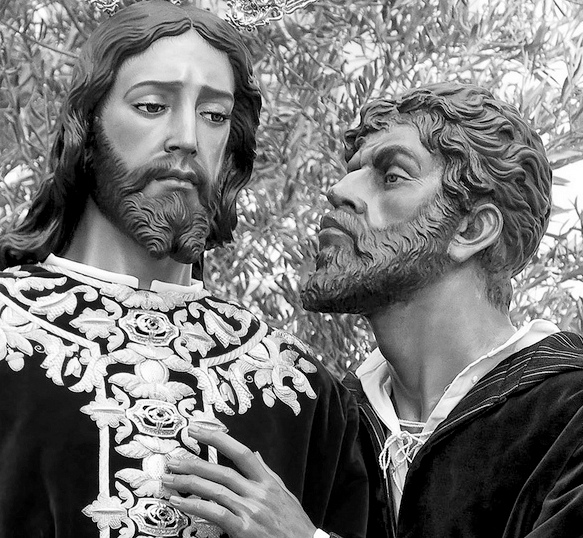
This representation of the kiss of Judas is quite chilling, and a remarkable tribute to the artist in reproducing facial expressions. The face of Judas is bestial and diabolical, whilst Jesus looks with sadness and a hint of surprise as he is betrayed with a kiss. The aquiline nose is associated with a low brow, pouting lips, a receding chin under the pointed beard and half-closed eyes.

Hypocrisy and theft are serious sins, but which come nowhere near to betraying one’s friend for money. Treachery is a form of murder, by getting the evil act done by someone else. It happens all the time in countries under some form of dictatorship like England under Henry VIII or Elizabeth I, Germany under Hitler or France under Robespierre. How far do we have to be pushed to betray a loved one to the enemy? This will be a good examination of conscience for us all. I hope and pray that I would prefer to die than betray another person. Judas didn’t need to be under such pressure. He just wanted money.

These are things not to forget as we get our churches and chapels ready for the Triduum. How someone can celebrate Easter without these intense moments of Christ’s Passion and the human weakness and evil around him is beyond me.

Posted in Uncategorized | Tagged , , | Leave a comment

Holy Week

We arrive at Tuesday of Holy Week. It seemed odd to celebrate the Annunciation yesterday as the Use of Sarum allows. I have already posted on this subject, and wondered whether I should defer the Annunciation to after the Octave of Easter. With the commemoration of the Feria, this feast took took on an extremely sober character in the midst of the Lenten Array and the absence of the Gloria, which in the Use of Sarum is possible only when the feast is transferred to after Easter.

Life has to be lived during these days, and life must go on. When I am on my own, which is usually the case, I recite the Office in my stall without ceremonies or hearse for Tenebrae. Maundy Thursday is a Passiontide Mass, and the “feast of priests” theme is absent. The two hosts left over from this Mass are reserved in the hanging pyx and the third host goes into the Easter Sepulchre after the Mass of the Presanctified of Good Friday. Unlike in the Roman rite (English / Anglican Missal), the church is not “secularised” or deprived of the presence of the Blessed Sacrament. What takes the most preparation is Holy Saturday. For once my sailing club doesn’t have its AGM on Holy Saturday, which leaves me free to do everything without any pressure or rush. I have a small private yard outside the chapel door, and this is where I have the New Fire in a small cast iron cauldron on a stand, using small pieces of wood from my workshop and lit with a gas blowlamp, jokingly called Blowlampus liturgicus.

I may feel a little dry this week in terms of creative writing, or I might be the opposite. Holy Week affects me differently from year to year. I have always noticed how tensions arise between persons, especially when I was in seminary. It is an odd time when the more pious of us try to follow the events like the catechumens of old, reliving the Transitus Domini, the exodus of the Jews from Egypt, the Resurrection of Christ, thoughts of our own death and the worrying events in the world. I used to wonder whether the Redemption had made much difference in this world, and I still wonder. However, there is more than this world, this universe, and the difference Christ’s Mystery made will be really known to us when we are no longer of this world. For the time being, with the bitter words of Christ (Let this cup pass from me, but not as I will…), I leave you with this poem (I wish I could read it in German) of Novalis:

Into the bosom of the earth,
Out of the Light’s dominion,
Death’s pains are but a bursting forth,
Sign of glad departure.
Swift in the narrow little boat,
Swift to the heavenly shore we float.

Blessed be the everlasting Night,
And blessed the endless slumber.
We are heated by the day too bright,
And withered up with care.
We’re weary of a life abroad,
And we now want our Father’s home.

What in this world should we all
Do with love and with faith?
That which is old is set aside,
And the new may perish also.
Alone he stands and sore downcast
Who loves with pious warmth the Past.

The Past where the light of the senses
In lofty flames did rise;
Where the Father’s face and hand
All men did recognize;
And, with high sense, in simplicity
Many still fit the original pattern.

The Past wherein, still rich in bloom,
Man’s strain did burgeon glorious,
And children, for the world to come,
Sought pain and death victorious,
And, through both life and pleasure spake,
Yet many a heart for love did break.

The Past, where to the flow of youth
God still showed himself,
And truly to an early death
Did commit his sweet life.
Fear and torture patiently he bore
So that he would be loved forever.

With anxious yearning now we see
That Past in darkness drenched,
With this world’s water never we
Shall find our hot thirst quenched.
To our old home we have to go
That blessed time again to know.

What yet doth hinder our return
To loved ones long reposed?
Their grave limits our lives.
We are all sad and afraid.
We can search for nothing more —
The heart is full, the world is void.

Infinite and mysterious,
Thrills through us a sweet trembling —
As if from far there echoed thus
A sigh, our grief resembling.
Our loved ones yearn as well as we,
And sent to us this longing breeze.

Down to the sweet bride, and away
To the beloved Jesus.
Have courage, evening shades grow gray
To those who love and grieve.
A dream will dash our chains apart,
And lay us in the Father’s lap.

Posted in Uncategorized | Tagged , , , | 4 Comments

Something of the Mind of Hell

I am presently battling with the notions of foundationalism and anti-foundationalism in epistemology and metaphysics from Kant’s Critique of Pure Reason to Fichte, Schlegel and Novalis, the latter of whom seemed, as a Christian believer, to be looking for a via media between absolute truth and the unthinkable. The crux of the problem seems to be the notion of idealism, consciousness before matter in modern terms and a truth preceding such consciousness. Chicken and egg? Fides et ratio? If any of you philosophers have studied German Idealism and can break this thing down into bite-size pieces, I will be grateful. I am presently reading Manfred Frank’s The Philosophical Foundations of Early German Romanticism, which expresses itself in quite plain and comprehensible language for my aching brain!

I went onto the Internet (imagine if I had had that as a student!!!) and wondered what our beloved German Pope thought about all that. There is a book by Emery de Gaál, The Theology of Pope Benedict XVI: The Christocentric Shift, published in 2010. Perhaps I’ll buy it next month because I have been spending quite a lot on books this month. Google Books allows you to read samples of books on the screen, but no copying or quoting. I copied out by hand a harrowing passage from pages 152-153. It was unrelated to my problem of understanding early German Romanticism in terms of epistemology and metaphysics, but Ratzinger was quoted as defending beauty as a manifestation of truth, a very Neo-Platonist idea. Its antithesis is absolutely chilling:

Ratzinger’s words must also be understood in the context of recent post-war German intellectual history. In a most pronounced way, the influential German philosopher Theodor Adorno (1903–1969) subscribed to anti-Platonism. The holocaust and the kitsch of National Socialist art discredited the appreciation of beauty. It likewise suggested the untenability of both German idealism and Platonism. The theory of a reality beyond an underlying palpable reality seemed obsolete. It is little wonder in 1948 Adorno postulated the provocative axiom that the inhumanity of art must excel that of the world, so that a remnant of humanity might survive. Three years later, in 1951, he declared that everything contains negativity. One cannot see the blossoming of a tree without anguish, because the tree lies. His Aesthetic Theory was published posthumously in 1970. In it, he argues art is merely “the memory of accumulated suffering.” To his mind, the only authentic form of music is that of Schönberg’s twelve-tone technique. The tonality of Beethoven and Mozart is fraud. Ratzinger responds to such negative dialectics with the rhetorical question of whether all joy must be suppressed in order to exercise solidarity with the suffering.

I had never heard of Theodor W. Adorno. Wikipedia describes him as a philosopher, sociologist, and composer known for his critical theory of society. He was a leading member of the Frankfurt School of critical theory.

Perhaps this kind of “post-modernism” will help us to distinguish this chilling indictment of the post-Nazi world from the real intuitions of Romanticism and Idealism. The causes of this particular kind of nihilism are obscure, and need careful study. I have often been quite distressed by the brutality of modern ugliness presented as “art”, a kind of punishment for man’s inhumanity to man. Perhaps we should have World War III and be done with it! The sheer negativity of it all speaks of pure evil, the very evil it set out to punish. On a critical note, Schönberg came up with his twelve-tone, atonal or serial system long before Nazism and two years before World War I, in 1912. Music was the first art form to be destroyed, long before painting, sculpture and architecture. Why?

Schönberg seemed to have devised this system, the destruction of harmony and melody, to solve the problem of the “collapse of tonality”. His late tonal music is often quite beautiful in its chromaticism, perhaps a little reminiscent of Richard Strauss or some of Wagner’s music. Something snapped. There was an idea of “progress”, something irreversible, deterministic and teleological. There seems to be a kind of foundationalism inherited from the Enlightenment and so-called realism. Does all this not sound familiar in terms of other domains like what happens in churches?

I don’t know how I am going to sort out the issue of foundationalism and the relationship between reason and imagination and all the other aspects of what it is to be human. C.S. Lewis has probably given one of the clearest accounts of a transition (his own) from Realism to Idealism to Romanticism to his conversion to Christianity. I have yet to read Lewis’ views on foundationalism, because Christian apologetics are built on the notion of a foundation of self-evident truths that are evident to our senses or otherwise beyond dispute. It would seem that Lewis returned somewhat from his Romanticism to a rational foundationalist position. I would like to be more sure about this.

My reading thus far is slowly revealing a kind of via media between this non-negotiable truth and “given” and the retreat from reason one finds in a lot of post-modernism. This is why I am so interested in German Idealism and the diversity of theories between philosophers of a same school. I seem to have deviated from the subject of Adorno and his anti-everything.

Posted in Uncategorized | Tagged , , , , , | 1 Comment

A Mark of Low Status?

I think my term Elite Christianity has been misunderstood in some comments, and I have come across an article that gives me some insight into this ambiguity. “Engaging the Culture” Doesn’t Work Because Christian Beliefs Are a Mark of Low Status. In this article, the word elite refers to social status, wealth, etc. In my use of the same word I meant “aristrocracy” or “nobility” of spirit in the same way as I have read in Berdyaev’s works. See Aristocracy of the Spirit. In my mind, it is not a question of birth, social status or wealth but of where our heart and mind are whether we are rich or poor, “ordinary” or bourgeois.

When thinking about cultural “relevance”, I was thinking about a priest of a community in England which is about as tiny as our own parishes in the ACC. Celebrate the modern Roman rite and that will do the trick. Will it? This article is American and refers to a world that is very different from our own in England or France. Evangelical and “mega” churches over there attract vast numbers of people, but interestingly from a “modest” background. They imitate TV entertainment shows with bright lights and celebrities, but often with less talent and technology. The values of the world are what we find in entertainment, politics and fashion – the sins of envy, vanity and hatred as one Facebook poster characterised it.

The USA still has a Christian civic undercurrent which is popular. It is eschewed by the intellectual elites (not the kind of elite to which I refer in positive terms). Such elites seem to be more or less the “realists” of English Universities throughout the nineteenth century and which ruled with an iron fist from about the 1920’s. Products of this intellectual elite are characters like the atheist Richard Dawkins. Christianity in America, like conservative options in Europe, appeal to popular resistance to secularism and bad morals. The current is still flowing in the direction of the socialist left and deconstructionism.

Christianity as a mark of low status? It always has been, because of the very teaching of Christianity in favour of the weak, poor and sick. There have been exceptions when there were saintly kings and men of high politics like St Thomas More. There were Christian philosophers in the universities and exceptions at every level. Here in Europe, so-called popular Christianity appeals to quite simple people concerned for their health and personal issues. Quack priests and independent bishops still do well out of a market for exorcisms and healing. Personally, I am not concerned with status but whether people “get it”, understand something most people don’t.

What particularly means something to me is this idea about trying to make other people Christians on the pretext of “saving them from hell”. We climb up waterfalls in Brazil to play baroque music on the oboe – and the modern equivalent. We come up with clever arguments to demonstrate that Christianity is true as opposed to materialism and “realism”.

The article mentions Rod Dreher. I have yet to read his book, but I have the impression that it would find it hard to impress me as a European. Some things fit, and other things are so American. Americans are much more corporate than we Europeans who are more individualist since the mid twentieth century. Christianity is marginal as in the beginning, and we have to come to terms with it. What are the alternatives if we abandon it? Most seem to be quite bleak. I can’t imagine myself going New Age or Hindu, or going into the Richard Dawkins mould. “Thou hast the words of eternal life, to whom else shall we go?

I belong to a small Church, which in fact seems better equipped to come to terms with the now marginal nature of Christianity. Some of our priests have built up real parishes, especially those who came from the “mainstream” and joined us, namely our two priests in Wales. I don’t have the resources or talents for that kind of ministry. It would also be pointless to address myself to social elites, because I am not one of them. I am not in their mould, nor do I conform to their fashions. I have simply been blogging for years, and have found a few like-minded souls to work with. There is my “elite” because we are brought together by potential friendship, unity of purpose and elevation of spirit. We go far beyond the world’s criteria of being “elite”.

Posted in Uncategorized | Tagged , , , , , | 1 Comment

Elite Christianity

I suppose this is yet another variation on the old theme. I am occasionally confronted with the view according to which I must relate to the “masses” and adapt my religion as a priest in order to minister to all these people. For this, it would no longer be possible to use something like the Anglican Missal or the archaic English translation of the Sarum Use, but rather use something like the Paul VI Roman rite with the 1970’s translation.

It is easy to criticise modern liturgies as some by-product of our machine and consumer age where everything can be bought, is used for as long as it operates, and is then thrown away to be replaced by a new one, or even the improved model. It is more difficult to reflect on one’s own position and reasons for a different way of seeing things. Should I be “out there”, preaching in the market square and making converts for Christ according to the Great Commission? It is not my vocation, because I don’t have the charisma or social skills for it. I think some priests and lay missionaries can and should in the way they do best, but it is not me. I do believe in the Pauline vision of the Church that proposes a single body in Christ but consisting of different talents and gifts like the different limbs and organs of the body.

I come across these arguments about the modern liturgy being able to draw the crowds and that the old liturgies are only good to be put in a museum or scrapped like old cars. The other argument is returning to the norms of a “pristine” period in the history of the Church. Such a “pristine” period never existed, and Christians were squabbling and fighting against each other in the time of St Paul. Sometimes, the argument for modern liturgy comes from the traditionalist criticism that it come from Protestant sources. Rather the other way round. I would conjecture that most Protestantism with anything resembling a Eucharist imitated what developed in the Roman Catholic Church from about the 1930’s in France and Germany. Roman Catholics were the first to experiment with Mass facing the people from the idea that it was the norm of the “primitive” Church. In fact, I would refer my readers to Monsignor Klaus Gamber’s Zum Herrn hin (turned to the Lord) in German or any available translation. The same German liturgical scholar also wrote the excellent book Die Reform des Römischen Liturgie. Then another monument came out, Dom Alcuin Reid’s The Organic Development of the Liturgy and the T&T Clark Companion to Liturgy which contains my modest chapter on the Tridentine missal. The election of Cardinal Ratzinger to the Papacy in 2005 was a double-edged sword in many ways, but encouraged scholarship and honesty about these liturgical questions. Thus, I approach the issue from a frankly elitist point of view. I leave pastoral considerations and claims to other priests. Both “sides” are too simplistic.

My own life and the way I am brought me to a highly critical position about the world I live in. I once had to answer the question of my own family – why I was so traditionalist and “conventional” in many ways whilst at the same time a rebel, an anti-authoritarian, a dreamer. Many of my Boomer generation took drugs and stopped washing, went to India and Mongolia in search of their particular holy grails. I retreated into a pre-modern world where I have remained ever since. I discovered that this is what some Aspergers people do, what the Romantics did in a time that was a close analogy of our own. My own brother said to me in quite a chilling way “You don’t relate to ordinary people”. I have discussed this many times when examining my own conscience and my calling as a priest.

If this appeal to modernity is an imperative, and if the Paul VI rite appeals to the masses, I am unmoved. I am not part of any mass, and my blog tends to accumulate persons who feel the same way. I would go further in the pastoral argument usque ad absurdam: most people, about 70% in England have absolutely no experience of churchgoing. For a smaller proportion, the world is as Richard Dawkins says -– brute matter and we are no more than biological machines. That kind of world has no time for anything other than money and what money can buy. Why would people relate to any liturgy? Liturgies don’t draw crowds – but Billy Graham did as do the money-and-bling mega-churches in America. That vision of things fills me with anxiety, until I take stock and have the courage to say that this is not an imperative for me.

I return to my Mystery School idea. In the 18th century, it was Freemasonry or the Rosicrucians. I see no need for funny handshakes or secrets, but I think the future of Christianity is behind closed doors where we know each other. I have thought of the possibility of “ordinary” people, if they feel attracted to Christianity, being something like the Quakers – until they are ready to be initiated into a liturgical life that is higher in ideal than any of us. I have the highest esteem for the Quakers. They go and quietly pray, and if someone is moved to say a word to edify his brethren, he gets up and does so. They are terrific and noble souls. The silence is as challenging as Gregorian chant to someone coming from the consumer world!

The Paul VI liturgy depresses me. I tried it a few times in about 2007, in Latin from the nice little brown books published in Rome in the early 1970’s. It was the time when I was in the TAC and believed that I was in some kind of uniate movement. Could I celebrate the rite of the Church my communion was desirous of embracing? It felt like a chore, a duty, and as bleak as setting out for a boring job on a Monday morning. I returned to the Pius V Roman rite in Latin, and went over to Sarum about a year later, which I now do mostly in English but sometimes in Latin. I use the Anglican Missal if I have any ministry with any of our local missions in England.

My Christianity is unashamedly elitist, but fortunately our Church follows St Paul in the diversity of gifts that make up the Church. Many of our priests are outgoing and pastoral, though they use the Anglican Missal. We are Anglicans and the old-style English is a part of our culture. I and a few other priests, together with weary lay intellectuals are preparing a new initiative for the elite. That is not to say we are any better than anyone else, but we just have different needs and gifts. I do think the Church (the universal sacramental communion) can exist at different levels. I also believe that modernity cannot be evangelised until persons begin to see through the leaden cloak, the cave of Plato, and seek the transcendent. Their thirst will then be unquenchable. I am unashamedly “un-pastoral” because I believe that people should be Christians because they yearned for it and not because some clever priest was able to sell his clockwork toys convincingly.

I am over-sensitive to criticism, because I really wonder if they could be right, and that my whole world view has to be overhauled and revised, but like a self-righting keel boat, I always seem to come back up the same way. I thank God for this sensitivity, because it protects me from thinking I am always right and committing the sin of Pride. I see no alternative to my way of seeing things unless I want to become someone else and annihilate everything I am and represent. I am thankful for being challenged because of the experience of being purified and made ever stronger.

At least I am not alone, and many readers of this blog have some sympathy with my thoughts and experience and form a part of this “Mystery School” and the Church as a universal communion in the Neo-Platonist understanding. Duc in altum was an expression I heard constantly at seminary. It can be given many meanings, but the one I understand most is leading to the heights of sublimity, leading those capable of seeking the transcendent and their own Ubermensch. Only a few have the self-knowledge to make this possible.

Posted in Uncategorized | Tagged , , , , , , | 16 Comments

Idealism, Realism and Churches

My intuition of going the philosophical way seems to be confirmed by my posting on the recent developments in the American Anglican world and the emerging Old Catholicism from the Nordic Catholic Church and the PNCC. I am confronted by the recurring issue of uniting Christian communities with a similar ethos but often with other ideas and practices that make such a union impossible.

Though I remain a priest in the ACC and warmly support all initiatives to resolve our conflicts and separation, I have always been sceptical about the theories behind ecumenism and the way things are attempted at various meetings and think tanks. I am very impressed about the success of the movement between four Continuing Anglican Churches (including the ACC) and am encouraged to know that the work is far from finished and will be continued at other synods and meetings. The Continuing Anglican world is united and compatible once the difficulties caused by personalities of some bishops in the past have been resolved. Being a bishop these days is more about ideals, service and hard work rather than bolstering the self-importance of cantankerous and bitter old men! There is no comparison between the ACC I now serve and the same Church as it suffered in 1997 from the “Bishops’ Brawl”.

I hope that our united Continuum will continue in its way of integrity and idealism, and from that high road engage dialogue with other apostolic churches sharing the same or similar ideals. For this to work, the ideals have to be understood without ambiguity of language and reflected upon in depth. The Catholic revival in England began with Romanticism and the idealism of a small number of Anglican clergy and intellectuals attached to the University of Oxford. The whole thing depended on Romanticism and Idealism like any attempt in Europe in the early nineteenth century to combat atheism and materialism and revive the ideals of transcendence and humanism. I see the points of comparison between the specifically religious movement in Oxford with similar movements in France that became known as Liberal (the desire for a separation of the Church from an atheistic, materialistic and hostile state). I then took a keen interest in German Idealism, whilst studying the differences between the diverse theories of metaphysics and knowledge as represented by men like Kant, Fichte, Schlegel, Schelling, Novalis, Schleiermacher and others. The thought was converging even if those groups never met or knew each other. Today, we have the Internet and the possibility of exchanging ideas and knowledge in spite of geographical distances – so that we don’t have to live in a single city or within walking or horse-riding distance.

I would like to promote this reflection on metaphysics and our possibilities of knowing something of transcendence. This contrasts with the pragmatic considerations of human institutions and making them sustainable by having human and financial resources. In my reckoning, the ideal must prevail over the “reality” of what is brought to our knowledge through the five senses. Pragmatism is necessary because we are incarnate and social beings, but this must be subordinated to the spiritual if we are a religious communion rather than a business or government / political agency.

Surely, it won’t be possible to reproduce the Oxford Movement or the little group of long-haired Germans. Such is not necessary, because we have no need to be concerned for appearances. Our context isn’t the same, and we lack the naivety and innocence of those eras. We have lived through modernity and are confronted by a paradigm that has no use for modernity or even the values of Idealism. We can draw from history, but we have to think and understand things for ourselves, and come up with something new. I am also convinced that history is not only linear but also circular, in cycles. I see parallels between 1790, 1890 and 1990 and the forty or so years that followed those symbolic dates. We belong to the third. Though things are analogies of each other, there is no metaphysical connection.

There is a lot of concern for setting achievable goals, and some have paid off. Some have followed ideals and not merely questions of buildings and money. There has to be a balance, because pure idealism will not necessarily achieve anything and will leave only disappointment and cynicism. Christianity itself is an ideal, and its adversaries and critics blow it away as an unrealistic system that penalises the strong and meritorious in favour of the weak. We have only to read Nietzsche! We dream of a single Communion with Rome, Constantinople and Moscow in mutual recognition and Vladimir Soloviev’s vision of the role of the Reformation churches in affirming human freedom. It hasn’t happened and I fail to see how it could happen in the future.

I will do my best with my little team (we are three committed members so far) to get the ideals out and have some influence on the movers and shakers of this world. There was an iconic slogan in France in the 1970’s – “Vous le voyez, en France, on n’a pas de pétrole mais on a des idées !” originally said by President Valéry Giscard d’Estaing. Referring to the energy crisis, France lacked oil but had ideas. In a certain way, The Blue Flower will work like that, as useless as a monastery of monks, but may be able to offer something more precious than oil or gold! I hope so and entrust this to God in my prayers.

As we read in Nicholas Berdyaev (Freedom of the Spirit), the Churches have to be concerned for the masses, and for this reason the liturgical life as we knew it is mostly gone. It is more concerned with getting a simple message over and working with human social instincts. There also have to be a kind of “aristocracy” involving very few persons of vision and with a calling to delve into the hidden things of God and the human spirit. Berdyaev, though he was Orthodox and Russian, was largely inspired by the German Idealists, a century apart from them, and so I am encouraged in going to the well-spring to drink from the same water.

The books are arriving, both in my library and my smartphone with its Kindle function. I still have so much to learn before I can begin to be creative in a new paradigm and way ahead for the treasure of Christ and a culture based on Jesus’ ideas and actions. Pray God I may come up with ideas that can inspire our bishops to bring about a union of churches based on spiritual integrity and all that is transcendent and sublime.

Posted in Uncategorized | Tagged , , , , , | 16 Comments

John Bruce’s “Discernment”

This is an interesting little post – Discernment. I am inclined to try to take it up in positive and helpful terms. John Bruce has been banging a drum about the Ordinariates for a long time and how the various weaknesses and scandals might suggest that the Anglican project be discontinued and brushed off as “Protestant”. My own intuition is that he is flogging the wrong horse because the Church he embraced is in a state comparable to the eve of the French Revolution! The mainstream Churches have made mistakes in selecting and “screening” (that fingernail on the wire netting of the sieve!!!) their clergy. I don’t think that Pope Alexander VI or Bishop Talleyrand (la merde dans un bas de soie – as Napoleon called him) were very edifying gentlemen. They should have been scrrrreeeened out of the selection process and prevented from being ordained.

I don’t know John well enough to give some much of an idea about the future of his blog. I know what it’s like to arrive at the end of a line and take off in a new direction as thoughts become deeper and diversify. This comes through reading and resisting the temptation to be obsessed about a single issue. That’s me. He must function in a totally different way depending on his cultural references and capacity for thinking “outside the box”. So far, his writing suggests a strongly rational and Cartesian notion of the Church, a perfectly functioning machine that processes and produces the desired thing. Theology is more mysterious than a subject of logical demonstration.

John seems to be most concerned with the formation of the clergy, which is a legitimate concern. Myself, I have my views on this subject, and perhaps my ideal standards of cultural, philosophical and theological education would be higher than his – not in terms of regurgitating at examinations what they have been taught, but their capacity to think, to criticise pure reason – and to feel as human beings. I approach these matters as an Idealist and a Romantic, and certainly not in terms of modern corporate conformity. The present system in the “mainstream” Churches, the C of E as well as Rome, perhaps more so, is designed to screen out originality and difference (and I’m not talking about autism) and produce standard clones. This is more so in the religious orders like the Legionaries of Christ or the Jesuits, but also in dioceses. Perhaps someone who shows his capacity for original thought will be easier to trust with the priesthood than the one who has ticked all the right boxes in the standard form and not been noticed during his time in seminary.

I agree that “instant ordinations” would be most imprudent. The question is knowing whether anyone has truly been instantly ordained without at least having been known and trusted from his (Anglican) days. When I was at seminary, I saw men ordained very quickly because they were judged to be ready for it and needed. Others went through the full cycles of spirituality, philosophy and theology because they were raw laymen and were not known quantities. The full shebang is no guarantee of priests of integrity. Psychopaths and narcissists hide their games extremely well. I have seen model seminarians who were as priests arrested and tried for sexual abuse of children! You can keep them in the box for years, and the reality will not be seen until it is too late. On the other hand, trusted men pushed more quickly through the system can be very good. There is no hard and fast rule, and I have for a very long time been quite hostile to the seminary system. Men should go to university, and then be trained in a parish. That would be more of a test than the kind of gilded baroque seminary I went to.

I now consider his opposition to “Anglican Patrimony” in the Roman Catholic Church. From my days in the TAC, I did not return to the RC Church, because no good would have come out of it, neither for myself nor for anyone else. I joined the ACC, which adopted a very firm position early on about trying to form a kind of “Anglican uniate” movement in the Roman Catholic Church. As for the Ordinariate, I will form a more informed opinion when I go to the conference in Oxford next month, where I will listen to and meet clergy from the Ordinariate, the Church of England and some smaller bodies like the Nordic Catholic Church and the Free Church of England. Anglican Patrimony is hard to identify and define, but my study of idealist philosophy and Romanticism is very revealing in questions or plurality and diversity. The Church of England was in a hell of a mess in the late eighteenth century! That situation brought the rise of John Wesley and the Oxford Movement. What it boils down to is not so much what is Anglican but what is truly human and transcendent, contemplative. What is bad in the RC Church is its bureaucratic and corporate structure, its worldliness. No institutional Church, large or small, my own included, is perfect.

For John to be taking so much interest in priests and the method of their training and selection, I suspect he might be a former seminarian himself. So were Dzerzhinsky and Emile Combes, one of the most virulent anti-clericals of early twentieth-century France. If I were a layman, I would take much less interest in les histoires des curés and more in studying philosophy, theology and church history. I would also read about art and science, poetry and the humanities. You are never too old to learn, as I find with my Blue Flower work at some distance from my own priestly calling. Does John want a job with the Congregation for the Clergy or the Doctrine of the Faith, so that he can go witch-hunting for potential bad priests? There are better ways of being a good Catholic layman.

For a long time, his blog has been all about the problems at St Mary’s Hollywood (no one thought of making a movie about all this!!!) and trashing the Ordinariates. This is not what would make me or anyone I know want to become a Roman Catholic! My advice to him would be unorthodox but honest – drop religion altogether and take an interest in something else – arts and culture, sciences, technology, hobbies, humanitarianism. Perhaps he could discreetly go to worship services in Orthodox and Protestant churches, mosques, synagogues, Buddhist and Hindu temples. Go and discover – just for a time! Travel… Read loads of books of philosophy and literature, find out something about Neo-Platonism, Biocentrism, rise to a challenge of tackling transcendent materialism (whatever that means). What makes you believe you won’t finish up like a broken-down computer on the rubbish heap as Stephen Hawking believed? Screening priests won’t bring you to eternal life or hope beyond everything that “sucks” in your present life.

There has to be something higher and more elevated than cleaning gutters!

I don’t think my present piece will make any difference, but I do try to keep from banging the same drums and to diversify life for the sake of my mental and spiritual health. I seem to have a little bit of a break from my translating work. The weather has faired up a little bit – so away from my desk and let’s get my hands dirty in the garden!

Posted in Uncategorized | Tagged , , , , , , , | 3 Comments

Completing the Reformation

I am not American and have no experience of the “second wave” of dissidence from the Canterbury Communion. All the same, I’m not surprised. My attention has been drawn to ACNA’s Anglo-Catholic Exodus. One of the ANCA dioceses is splitting away to join the PNCC. I wonder if all the parishes and people are following.

A bishop (which “side”?) is saying that the ACNA wants to “complete the Reformation” and have women’s ordination. If any didn’t agree with that, they could go over to Rome. Some clergy have contacted the Ordinariate and others the Russian Western Rite. The movement to join the PNCC doesn’t seem to be unanimous.

I don’t want to give simplistic opinions on this, but from the little I have read about the ACNA, it was only expected from a communion that is low-church, in favour of the ordination (and episcopal consecration) of women, and seemingly differing only on the issue of homosexuality. It seems that some of their bishops are Calvinists, understanding the 39 Articles in their “plain and literal sense”. What does “completing the Reformation” mean? It seems like a purge of Anglo-Catholicism.

Read the article from the above link if it interests you. We have to remember that the same words mean different things to different people, Catholic in particular. I have occasionally come across Spanish and Portuguese south American Anglicans, and ask myself what is Anglican about them. They are just independent churches more or less imitating modern Rome. In October 2004, I attended an attempt in Portugal to form a communion of Old Catholic Churches, opposed to the ordination of women and thus separate from Utrecht. It involved the bishops of the Igreja Católica Apostólica Brasileira founded by the dissident Roman Catholic bishop Carlos Duarte Costa. After a few days of this event, a bust-up happened between the Brazilian bishops, and I saw that the whole thing led by a certain Archbishop António José da Costa Raposo was in pieces and a totally pointless exercise. These men knew how to pull the crowds (and their money) in through mass hysteria more piously called Charismatic Renewal. This was not the ACNA, but shared a lot with several episcopi vagantes seeking to be legitimised and to belong to a Church that could afford to pay them and their families a living salary. That is about the top and bottom of it. It is an extremely extroverted kind of religion to which I absolutely don’t relate. Would Jesus relate to it either? I wonder…

About the Anglo-Catholics leaving the ACNA and joining the PNCC, I have met Bishop Flemestad of the Nordic Catholic Church who is a good pastoral bishop with a rich theological culture acquired through his having been a Lutheran. I am less sure about other PNCC bishops, some of whom are former modern Roman Catholics. That solution seems to be attracted because they have money and the possibility of giving priests full-time employment rather than their having to be “tent-makers” like us in the poor Continuing Churches.

When I see all that, I wouldn’t want to be an employee of such a church to be under threat of conforming to a new wave of convulsionaries of Saint-Médard or Bible-thumpers – or getting fired. The dream of sustainability is trickling away, even in the most mainstream Roman Catholic Church and the Church of England, both cutting back on expenses, closing parish churches and leaving cultural treasures to rot. Decidedly, the Christianity of the future cannot be about propping up the dinosaur of clericalism and empty buildings, however beautiful they are. We are going back to the Catacombs, whether we are Catholics, Orthodox or Protestants.

There needs to be a new spirit (or even the promised new Spirit) and a new philosophy to give substance without which exterior appearances of bishops and church worship are only tinsel and glitter on a Christmas tree.

Posted in Uncategorized | Tagged , , , , , , | 31 Comments

Silver Jubilee of my Diaconate

I was ordained a deacon twenty-five years ago (as of tomorrow 19th March) by Cardinal Pietro Palazzini in the seminary chapel of the Institute of Christ the King at Gricigliano. He was the same prelate who ordained the late Fr Frank Quoëx to the priesthood. Five years ago, I wrote all about it in Twenty Years of Diaconate. Fr Quoëx was the MC. Monsignor Gilles Wach acting as Archdeacon looked younger and fresher, as we all did. I was nearly thirty-four years old at the time.

It all drifts into the mists of time as does my original priestly ordination (somewhat less “regular”) almost twenty years ago. Why was I ordained? The Institute has developed a lot since 1990 and I only very occasionally look at their website. My time with them made a big impression on me in my life and I still have dreams about Gricigliano from time to time. We had a few “apostolates” in France and the USA, not yet in England and barely even in Germany. More priests were ordained than “benefices” could be found to support them. Some stayed at seminary, studied in Rome and had teaching functions. Others were hangers-on in our various chapels and parishes with a priest in charge of it all. I was no exception. The Institute was run on a shoestring in those days, and John Bruce would certainly have taken a dim view of ordaining priests without benefices!

Roman Catholicism took me from idealism to hopelessness and cynicism in a short time, and I was glad to have the courage to leave in 1995 even though the alternatives were so shaky. Should I have been ordained? With my Aspergers (which wasn’t known about then), I would have been wisely screened (I so hate that word) out and just told to go away. This word makes me think about running a fingernail over the fine wire netting of a kitchen sieve. In the end, a man has a vocation to the priesthood when he has the call of a Bishop, himself a member of a college of Bishops and a recognisable institutional Church. This is now the case for me, since Bishop Damien Mead had the kindness and pastoral concern to incardinate me into his Diocese which is a part of the Anglican Catholic Church, Original Province. I am grateful and do what I can like those priests who studied in Rome and taught seminarians. We now have the Internet and the possibility for many initiatives outside the traditional parochial / pastoral framework.

It took a long time to recover something of my earlier idealism, go through other harrowing experiences of life and begin to get things together in a single understanding. My notion of vocation has taken different turns, and has even taken a leaf from some of the post-war French ways of seeing things. The clerical image is so discredited in life that our best ministry is done without being recognisable as a priest! The reality is sad, but the institutional Church and clericalism only have themselves to blame.

Last Friday, I went to a little round table of people diagnosed with autism and parents of little children showing signs of it or having been diagnosed. The effect on a young mother is devastating, especially when sloppy psychiatrists take little care to see the right diagnosis is given. I was thanked for my testimony as someone who was able to learn to live in society, “play the game” and have a job (self-employed), a home and a sense of mission. It was not the time or place to talk about religion. Those people need more help from those who can express human empathy and concern than from professionals. There is a scientific approach but also a human and philosophical approach to “another experience of life”. Modern and post-modern society are truly absurd at times and show another’s weakness through its own human and moral turpitude. The relation between autism as a scientific discipline and philosophy is a new subject that we have to work on if those children and parents are to be helped. Perhaps this is my pastoral calling alongside my work to promote the kind of thought expressed by the Jena Circle (German Idealists and early Romantics) in the 1790’s against the “dark satanic mills” (whatever those were), the Terror in France and the road to 1984.

The priesthood is a service to the Church, a leaven and a light in the bleakness of this world, brought about by the Mystery of the Mass and a ministry of intercession through the Office. It is in the forefront when I am in chapel or with my brethren on my occasional visits to England – and always in the background as I go about life here in France. Far from rejecting my calling, it brings my life together in a single sense of purpose to serve my prophetic and humanist ministry.

Pray for me…

Posted in Uncategorized | Tagged , , , , , , | 2 Comments