Fr Jonathan Munn begins the year with a bang!

Sorry for the corny title! Fr Jonathan has reached the end of his tether with Facebook. That is something I fully understand, though I have learned to use Facebook with great care and understanding it as a place for special interests (like the old Yahoo e-mail group) and for light banter (something we aspies are not very good with, except it is by writing and not chattering). He has just written Currents and Raisons. I wrote the following comment which is longer than the posting!

I am a little puzzled by the title, though my knowledge of French points me to think in terms of courants (de pensée) and raisons – reasons or rational thought. Perhaps Fr Jonathan will enlighten us as to his choice of title…

* * *

I think you experience life differently in that lovely Yorkshire countryside, perhaps not unlike here in Normandy. Something that taught me a stern lesson was being in the TAC at the time when Archbishop Hepworth was telling us that the water was warm. In reaction to all those people getting on the “coeti-bus”, we were struggling to define what it is to be an Anglican and what is our justification for saying “Hold your horses” as the bus driver was telling us “Bitte, einsteig” (Please get onboard). We don’t have to justify not joining any herd of people all wanting to do the “done thing” (converting to a “true church”).

You and I have different experience. For example, you went to the ACC from the Church of England. My own way was more tortuous, going via the Roman “true church” and becoming very unhappy, perhaps largely due to my own difficulties. It is natural to want to appropriate our “identity” and monopolise it to validate ourselves and protect ourselves from having to go back to more justifying and negotiating with the bullies. I begin to analyse things in these terms, because I know the pain of having to go outside the box to find our own way and make sense of our experience.

I don’t think we have to justify ourselves vis à vis the Prayer Book. As far as I am concerned, I am simply an English Catholic, pre-Reformation, and sharing many things with the French of before the Revolution. The blog seems to be our place for such reflection and education of others, because it is written in greater depth and eventually becomes a self-publishing book. We let people have it for free instead of letting a publisher sell it for money and slap a copyright on it. We in the ACC don’t all have this Romantic pre-reformation perspective on our Anglicanism as a kind of “English Gallicanism”, but we have largely let go of the Reformation and have never been influenced by the Counter-Reformation (though there were good things like St Philip’s Oratory and some great diocesan bishops like Francis of Sales). We in England have the Anglican Missal – I have Sarum in Latin and English – and no one minds what we use for the Office, though most of us prefer the Coverdale Psalms to any other English translation.

The problem with many Americans is that they lose sight of the existence of cultures and people outside their country. Though it is a melting-pot of all cultures, they can be incredibly parochial like English people in their little northern neighbourhoods. My own experience of life has made me one in a thousand – and I can be perceived as quite threatening to the “herd”.

We certainly need to move on away from the polemics and self-justification to the study of history and philosophy. I am too aware that our treasure, our faith, is superstitious bunk to nearly everyone else. Our churches should be razed to the ground or given to other religions or to cultural or business concerns. We should all be like Richard Dawkins and realise once and for all that in the beginning there was brute matter and we cease to exist when we die, that life is totally pointless and futile. I am working on studying scientific views of the primacy of consciousness over matter, because I believe that the notion of God can thus be revived and re-discovered in a totally new light. It is the seed from which our treasure can re-grow and be loved once again – and influence our lives in the family and society. Along with science, there is art and culture, which can vehicle the faith and the essentials of the Tradition. This vision is becoming ever clearer in my mind.

We have now to go forwards, not looking back at our unhappy times in the past, but to build on the good a brighter future. I have no children. You do. I think you are well placed to develop the Benedict Option idea and refine it for our side of the Atlantic Ocean, to bring that something new and luminous to people who are deeply sceptical, cynical and nihilistic. We won’t get anywhere with the “herd”. We need to rebuild not only the contemplative life, but the arts and crafts of the medieval world, music, poetry, literature, architecture, working with our hands. I think you have talents in this great vision, with a logical mind capable of delving into science and philosophy and putting them into the service of Christ.

I have my blog and you have yours. We need to be as distinct as we are as two different persons, but I see the vision building up in you and the desire to forsake what is destroying Christianity and orthodoxy. I don’t care about Facebook. I have clear limits within which I use it, but I am not tempted to use it as a “blog” – because it just doesn’t work that way. If people think that culture and writing will disappear because of Facebook and the smartphone, they are wrong and push themselves into a nihilistic world where no one reads or writes! We may not be able to use the Internet for much longer for serious work, and we have had the Internet for such a short time. I hope that when we lose it, we will have the ability to write books and articles and print them on paper.

Keep your courage and discernment, and may God bless you in your new calling as a priest.

* * *

Please note Fr Jonathan’s new article Currants and Raisins: a response to Fr Chadwick. I’ll answer it when I complete the two translating orders that have to be in for tomorrow morning!

Posted in Uncategorized | Tagged , , , , , , , , , | 3 Comments

In these early days of 2018

I belatedly wish my readers a happy New Year. The Christmas Octave is over and we celebrate the octaves of St John, the Holy innocents, and then the Vigil of the Epiphany with the octave of St Thomas of Canterbury. The Feast returns in force with the proper Preface and Communicantes, this time with greater solemnity than Christmas. It is a very beautiful feast that brings me fond memories of processions in York Minster to the smoke of incense and the strains of O’er the hill and o’er the vale.

1. O’er the hill and o’er the vale,
Come three kings together,
Caring nought for snow and hail,
Cold and wind and weather;
Now on Persia’s sandy plains,
Now where Tigris swells with rains,
They their camels tether;
Now through Syrian lands they go,
Now through Moab, faint and slow,
Now o’er Edom’s heather.

2. O’er the hill and o’er the vale,
Each king bears a present;
Wise men go a Child to hail,
Monarchs seek a peasant:
And a star in front proceeds,
Over rocks and rivers leads,
Shines with beams incessant:
Therefore onward, onward still!
Ford the stream and climb the hill:
Love makes all things pleasant.

3. He is God ye go to meet:
Therefore incense proffer:
He is King ye go to greet;
Gold is in your coffer.
Also Man, He comes to share
Ev’ry woe that man can bear;
Tempter, railer, scoffer:
Therefore now, against the day
In the grave when Him they lay,
Myrrh ye also offer.

Unfortunately, I am unable to find a recording or even the tune we sang it to.

I have been quite discouraged over the past few days with the prevailing conversations about “one true churches” and why the Church we belong to is the wrong one. I have offered some comments on this blog about the question of Western Orthodoxy. Though sympathetic to the idea, many of the Facebook threads bring a feeling of nihilism when thinking about those to whom religion is some kind of addiction. I have also allowed myself to criticise some of the “converts” to Roman Catholicism whose religion is truly a burden to be laid on the backs of others.

As Americans freeze, Europe is being swept by gales and heavy rain. It is the dead of winter as we are still only days after the Solstice, a time of year when I almost wish that humans could hibernate! Pundits of all kinds offer predictions for 2018, and they are hit-and-miss as always. 2017 saw the deaths of several I have known, and 2018 will see the 90th birthday of my father and the 60th of one of my two sisters. A year can be short or very long, and everything can change in that span of time. I am apprehensive, but still seek the grace of Christian Hope.

I am not one for New Year Resolutions, but I feel that one must be made. Why are we Christians? What does it bring us? What can we answer to someone like Nietzsche who saw the unredeemed-ness of Christians?

I think that we can look around ourselves and see what we can do. I am fortunate to be a priest, and thus can offer Mass and continue with a ministry of dispelling both crass and invincible ignorance by education. All Christians can pray, can say the Divine Office in their own language and convey that originality of Christ in his essential mission and message. The gift is too precious to abandon or give up, even in this world of ignorance and hatred.

We live through many things like the dawn of the nineteenth century, the aftermath of the French Revolution, the dawn of the twentieth with the brief light of neo-Romanticism before the hecatomb of 1914. Again, a century later, and we still live under the shadow of the atomic bomb and the loss of all Christian and Enlightenment culture to both secular and religious barbarianism. A few of us try to emulate the example of those who lived, wrote and thought two hundred years ago and one hundred years ago. The same lesson needs to be taught each time – Beauty will save the world.

I ask your prayers, that this may be my true resolution and purpose of my ministry. I ask each and every one of you to be bearers of beauty and hope in this barren, frozen and windy desert.

Posted in Uncategorized | Tagged , | 13 Comments

Prognostics for Blogging

I was doing my daily rounds and found Fr Jonathan’s Blogday 2017: The beautiful feet of the Laity. I think he began his article with the tongue-in-cheek epitaph “Blogging, apparently, is a dying form which makes this, as usual, a thing of increasing archaism“. Is the blog on its way out? I typed out the question in Google, and I had little to relate to with the answers. It seems that since about 2012, the days of blogs run by professional journalists and those wanting to earn their living in this way were numbered. Apparently, fewer people were using computers and laptops to look at the internet, but rather turning to smartphones. That would exclude writing at length and turning to Facebook, Twitter, etc. until they in turn would be replaced with something more modern.

My personal experience is something a little different. I got my first smartphone last August with a deal including 20GB of internet. That is quite a lot if you don’t download too many YouTube videos. When away from home, it is great. I can get the internet without depending on Wi-Fi by using 4G. I can also “hotspot” my computer and use the smartphone as a modem on 4G if I have no wi-fi. If I need / want to use the smartphone as a standalone device, I have a keyboard with normal-sized keys connected to the phone by Bluetooth. Even then, the smartphone is a little like camping and using a Swiss knife. I find it too fiddly to use for my blog, even with the keyboard.

I can’t imagine what most of my readers use as hardware, but I imagine the situation is more conservative than what some imagine. Some are still using Windows and Macintosh office computers with older versions of their operating systems. If it works, why not? A trip to a computer shop is quite instructive. What do they offer compared with twenty years ago? There are plenty of office computers with flat screens, and above all, a rich choice of laptops for all budgets and needs, lots of accessories like external hard drives and USB keys with increasing capacities. I suspect that most of us still use a computer of some kind and a smartphone for when we are out of the house. Also, the computer is used for serious applications that would be too difficult on a smartphone, for example my translating work, writing books and articles for publication, storing information, design and technology, calculating and accounting, developing new software and all sorts of things. The computer with a keyboard and mouse / trackpad will be with us for a long time, even with the dazzling progress of new technologies.

If the blog and the computer are linked, then I have no fear. However, not all blogs are of the same quality or perseverance in time. In the late 2000’s, I devised a “blog” section on a static website, but there was no provision for comments. That paltry effort attracted the attention of Christian Campbell, a parishioner in one of the American TAC dioceses, who set up The Anglo-Catholic and invited me to be a guest writer on it. When the triumphalistic and smug RC apologists moved in and when Continuing Anglican bloggers over-reacted, it all became quite unpleasant. Christian Campbell moved to a pro-Roman Catholic position and eventually went to the SSPX and had a load of tattoos done on his arms. I was still loyal to Archbishop Hepworth and was waiting for the endgame to play out. I set up a blog by the name of the English Catholic, was was also victim to RC apologist and “classic” Anglican critics (to avoid unjustifiably called them trolls). This blog was set up in January 2012, nearly six years ago, and went off at a more cultural and liturgical tangent of less interest to the aggressive. Over that time, my statistics have been fairly steady: about three hundred views per day with peaks at four to five hundred.

My subject matter is specialised in comparison with the world at large, but quite diversified in the sacramental Christian churchy world. I have grafted on some unrelated topics like sailing and non-religious culture, and aspects of my life like my recent diagnosis of Aspergers / high-functioning autism. I remember a priest who is an artist advising me that culture is an important part of ministry, and especially being related to as a human being. Then I’m not afraid to talk about sailing and Aspergers. Those who are bored by such topics have the option of looking at something else without being rude to me. The blog allows candour without offending against the rules of living in society – and that has its advantages and disadvantages.

As far as I can see, the difference between the blog and social networking is the volume and content of what we want to write. Not everyone likes doing a lot of writing, but prefer some kind of virtual social life with a more light-hearted vein. I do use Facebook in that spirit and give a link to this blog when I want to get something more “serious” over to “friends” and groups. I have occasionally given a “selfie” of my flowing locks of hair – but that is not generally my “thing”. I participate in groups, which are the successor of the old e-mail Yahoo group or similar. Sometimes, the polemics lack courtesy and are too little reflected. It was an old criticism addressed against blogs as opposed to writing books and printed articles in recognised reviews. At least the way I see things, the blog is for something more serious and reflected, and the social network is for keeping in touch and getting quick information. People still write books and newspaper articles, and you can still buy a fountain pen and improve your handwriting!

The important thing is knowing what we want to share with the world in the way of education and contributing something positive. I like to express myself as a human being without “narcissism” and appeal to those who share my interests. I might be annoying when I get too “aspie” about details of the liturgy or my boat, but what I write is there to be looked at or disregarded. It is not rammed down anyone’s throat. We always say that e-mail doesn’t disturb anyone, but phone calls do – which is why I am so opposed to the abuse of the telephone by marketers and cold-callers. There is nothing in the way of constraint or persuasion about a blog, at least the way I do it.

Simply put, some blogs will die like The Anglo-Catholic, or the one I closed down in 2012. Others continue because there is still something to be said and the blogger is prepared to work at it, be original and offer ideas for sharing. I don’t do it for money, any more than most of the blogs I consult each day. Perhaps the blog in the late 1990’s was something of a “Facebook” of the time, but it ain’t now. If you write a blog in the fast-passing spirit of Facebook, it won’t go anywhere. A blog’s postings stay on the front page for longer and can be easily found with the search function. Two other trending sites have caught my attention: Pinterest and Quora. On the latter, we can ask questions like a little child and get a whole host of interesting answers. I have used it quite a lot on psychological issues. Pinterest will show you lots of nice images of what interests you. Its Arts & Crafts section is rather good. YouTube is for “vloggers”, those who prefer doing videos to written articles. I have a YouTube channel with some liturgical and boating footage, but I have neglected it for too long. I tend to stutter and stammer when talking to a camera and microphone. When writing, I put over my thought without having to worry about my appearance or media-savvy aspects.

There are threats against the internet, and the possibility it could be more tightly regulated and commercialised. That could happen, but would it be in the interest of “progress”? So far, those with the problems are committing anti-social offences like racism or anti-semitism, glorifying terrorism or “extreme right-wing” agendas, committing calumny, slander and libel, fake news, etc. There are always unsavoury people around. If we want the internet to continue, then we are responsible for the content we put on it. So far, so good, and we can use it for educating others or making contacts and friends through common interests.

It is possible that blogging is harder because of the diversification between blogs, Facebook, Twitter, YouTube, Quora and Pinterest. Each one has its speciality. When doing a blog, you need to have a clear idea of its central theme and to what extent it can diversify whilst keeping its essential identity. For mine, I began with the highly specialised subject of the Sarum liturgy, and then found that there was something more general underpinning everything about me. I think largely along the lines of an eccentric Victorian university don, fired by the values of Romanticism, the references to the Middle Ages, but seen through modern eyes. I also saw the rebellious 1960 Goliard by transposing at about five centuries of difference between maverick priests playing cat and mouse with the Inquisition and hippies smashed out on LSD in the 1960’s. I have never “done” drugs, but I was brought up in the 1960’s and my autism alienates me from the niceties of modern social life. The New Goliard would about cover my little Japanese lady’s fan of interests and topics to share. With all that, it needs work and single-mindedness, old-fashioned writing.

We need to have a good notion of relationship between the various platforms on the internet, when to promote a blog posting through a Facebook entry. That will depend on how many “friends” you have. I have about 400, and have made no effort to find more. Some are dead-wood spammers, scammers and those looking for a good time, but most are more worthwhile. A number of bloggers link to this blog in their sidebars, and I know it when someone clicks on those links. A good number are using search engines to find precise information that happens to be on my blog. Frankly, I’m not bothered about the promotional aspect, because my statistics are quite steady (as mentioned above), and I work in an educational perspective, definitely not for commercial marketing or for proselytising.

The trolls have left me alone since the election of Pope Francis, the one big spanner in the works of RC triumphalism. They have other cats to whip as we say here in France. My joining the ACC has to an extent endeared me to the classical Anglicans even if I am a little too pre-Reformation for their taste! I try to be kind with all and welcome new commenters who generally add something constructive even if they have reasons for showing me as wrong – and I can be in some of my more ambitious scientific / philosophical speculations.

The blog is a part of my life and teaching ministry as a priest and British eccentric! To an extent, it fulfils the role of the old-fashioned diary and personal letters as used to be written in the Victorian era and up to my own adolescence. But, the blog is public and the “letters” are written to all. Prudence is advised and some aspects of private life need to be kept to ourselves. Even so, I am quite daring and not always prudent!

There are millions of blogs out there. I only consult a few, less than ten on a regular basis. That could be so with most of us.

Posted in Uncategorized | Tagged | 6 Comments

Epistemology?

In my previous posting, I was concerned with “truth claims”. The truth one person believes in, alone or in consensus with a number of others, has to apply to all – by force if necessary.

I don’t have a scientific formation beyond school physics, chemistry and biology, but I often find myself confronted with a person who affirms a truth which for one reason or another I cannot accept. Evidence I might have in my possession might seem to refute what I perceive as lies or falsehood in good faith. What is truth? That is the question Pontius Pilate asked when deciding that the question of Christ at the Praetorium was going to cause him a lot of trouble. It is also the question asked by the tendency of Greek and Roman philosophy called scepticism.

Epistemology is the branch of philosophy concerned with the theory of knowledge. It studies the ground on which we justify faith and belief as rational. We are taught at seminary that truth is the conformity of our minds to objective reality. The big problem with the Platonic and Artistotelian paradigm of reality, a World of Ideas, is that the underpinning is quite fragile in the light of modern quantum physics and the idea of parallel universes, of parallel realities, and reality itself being nothing more than an infinity of possibilities. I have begun to read Robert Lanza’s Biocentrism, which introduces concepts that escape our sensual experience.

In such a perspective, a schizophrenic who hears voices is not mad or needing to be locked up, but is a person who lives in a parallel reality – just as real as that of those of us who perceive something else with our senses or functions of the brain. We are all used to trusting in our five senses to perceive reality. Quantum physics does away with such a view. The idea that consciousness precedes matter gives us God, but takes away the permanence of things that seem very real to us like the computer keyboard I am typing this on. My fingers seem to be hitting solid things, little plastic squares with letters printed on them. The new concepts leave me seriously confused, but the alternative is Newtonian materialism in which God have no place and life has no meaning.

It all flies in the face of common sense, and I still talk in the same terms, because that is what I am used to as a human being who sees, hears, touches, tastes and smells. Those who are to some degree austistic learn that we are supposed to communicate with other people by means other than language, and something which lies outside our experience. Already, different people experience life in different ways. The schizophrenic and the person who is smashed out on LSD have yet other experiences. Those of us who like to go to the cinema experience yet something else. The imagination alone can take us anywhere.

There are many things that science knows about, but which are outside our sensory experience. For example, we cannot see ultraviolet light. What we can sense depends on the quantum computers that are our brains. I remember writing The Brain of God a while ago because I noticed a similarity between an image taken through a very powerful telescope of things in space and a microscope image of brain neurones. As consciousness interfaces with human brains, could it be that systems of stars and galaxies are also interfaces of consciousness?

We just don’t seem to be able to escape the subjectivity of reality, and the possibility of a multiplicity of truths. Colour blind people don’t see the same colours as those who can pass the usual tests, and they have to accept the fact that their experience of colour is different. When considering the issue of autism, I ask myself what is “normal”. Surely everyone is on one kind of spectrum or another, since there are other identified mental and personality conditions that cause troubles in social relationships. We try to put things in little boxes, but something always comes along to prove to be the exception to the rule. Rules with exceptions are not science!

Science alone filters out many aspects of human experience of reality. Most of us would believe in the existence of love, yet it is has no physical reality and cannot be proven by physics, chemistry or biology – or even by mathematical calculation. We wander into the realm of philosophy and theology. Partial truths can only be different to different perceivers. What is real? How can a colour-blind person accept the reality of red and green or know what they are? How can any of us know what ultra-violet is? Going further, there is a reality that is totally beyond our experience. To some people, this may be threatening or frightening, but I am stimulated by the idea.

Our instinct of seeking meaning to life is quite fundamental, like the life preservation instinct itself. Quantum theory (which I find puzzling) proposes an idea of infinite random possibility. Over the past few days, I have been pondering the first words of St John’s Gospel – Ἐν ἀρχῇ ἦν ὁ Λόγος. Does this Logos represent consciousness? We could go on forever looking for the etymological meaning of the Greek word, which is translated in many ways. The Encyclopaedia Britannica gives this: “the divine reason implicit in the cosmos, ordering it and giving it form and meaning“. In Christian theology, the Logos is identified with the Son of the Father in the Trinity, and the principle by which God created everything. I find here a theological expression of the biocentric universe: there was consciousness before matter or even subatomic particles. Perhaps Heraclitus came closest to a definition by analogy of man’s reasoning power. Most philosophers positioned the Logos between God and creation. Logos gives order and meaning to all those subatomic particles (if they are particles and not pure energy and emanations of the Logos).

Another idea comes our way, that nothing exists without our observation of it and participation in it. Our consciousness could well be a part of that Logos. The Logos became man (in Christ) so that man could become the Logos, participate in the essence and energy of God. We participate in one universal consciousness. The world in which we seek meaning appears to be solid, but is only a “hologram” maintained by consciousness and energy. In this notion, the illusion of matter is pure energy. Nothing can be experienced without consciousness. Consciousness is the experience of self. As Descartes said famously: cogito ego sum – I think, therefore I am.

The oriental religions like Hinduism train their adepts to see beyond the illusion by seeking self-consciousness and awareness. We are an expression of consciousness and wholeness, the whole universe is in us and us in it.

The great message of Mary Shelley’s Frankenstein is the folly of attempting to create life from (what we perceive to be) matter. Life is consciousness. There is talk about artificial intelligence, which makes my mind boggle. Could robots and computers become a replacement for mankind? Perhaps consciousness might one day interface with man-made devices as it does with the human brain through incarnation. How would this happen? Would it happen any more than the attempt to bring a dead body back to life using electricity? Again we return to the idea of the illusion of matter and that everything is consciousness and energy.

Multiverses? I return to my mention of the theory of knowledge we call epistemology. Two persons each affirm a statement that contradicts the other. Aristotle gives us the principle of non-contradiction. They cannot both be true, though both can be false because the truth lies elsewhere. There are suggestions that there are parallel universes and that they are not always separate. One piece of information may be true in one universe but not in another. We think of the schizophrenic who hears voices that most of us do not hear. We conclude a diseased brain that needs to be made “normal” by medical treatment, but is it so easy? Some talk of UFO’s that they have seen or even photographed (if the photos are not optical illusions – and everything is illusion). I have never knowingly seen any, but some people say they have and relate it very sincerely. They have not necessarily travelled light years from another planet, but perhaps come from another “frequency” or parallel universe in the same “place” as ours. People see ghosts, or even the Blessed Virgin Mary in places like Lourdes and Fatima, and believers take these events for granted. The apparition, which might look “solid” or otherwise, would have come from another universe by some means of communication with this one.

Something else makes me wonder. According to conventional criteria of observation, Earth is the only planet with life on it. Some believe that Mars once had life – and even intelligent life – on it, going by visible objects with geometrical shapes. Many geometrical objects occur outside human intervention like snowflakes and crystals. Some see ruins of ancient buildings, perhaps destroyed by a cataclysm like a nuclear war or comet impact. I would have to study the matter further to be better informed. My idea would be that much more radical: perhaps in another universe, Mars is the living planet and Earth is dead and barren. What about the other planets, solar systems? Perhaps, in each parallel universe, only one planet has life, whether it be Saturn or Mercury or Venus.

If we give credence to quantum theory, there is nothingness, a vacuum, containing endless possibilities determined by consciousness. These “bits” of consciousness can produce quanta which are manifested as particles – making atoms and molecules. As a child, I pondered the infinity of space, but space is only given existence by what is in it – celestial bodies. Beyond these bodies, there is nothing, so it all ends there. But what if I drive my little rocket further than the furthest body. I would keep going, because my rocket and myself give existence to the direction where I am going, if I am going at all (if there is no destination to my voyage). That idea may seem to be a little less painful than infinity. My present investigation into consciousness before matter may be a continuation of the mind of the little boy lying on his back on the back lawn, near my mother’s washing line, gazing at the sky and imagining everything and anything.

It is flattering that we all have the same creative consciousness as God, because we all participate in the same Logos. We are all given potentials at conception and birth to function as humans, use language and special gifts we have in music, art, science, etc. Materialists attribute all this to our DNA, but matter is a consequence of consciousness. Our computers work because electricity is processed in a special way through the electronic components. Without electricity, the computer would not work. Electricity itself is only a subatomic consequence of consciousness.

Quantum theory is giving us an idea to which we can relate, and the possibility to escape the materialistic paradigm. Robert Lanza and others offer the idea that consciousness creates reality and makes it knowable. Thoughts are not matter, though they can be expressed by interfacing with the brain and the rest of our bodies and sensory organs. I do believe that when this notion of consciousness overcomes materialism, belief in God will no longer be a problem, and religions won’t have to justify themselves by force and fear. Our notion of truth will be transcended, as will our idea of Church and Sacrament, everything.

We need to study what others are thinking, and we need to think for ourselves, out of the box and with the “bullshit detector” turned on and fully operational. A contemplative life of study and prayer can bring us maturity and awareness. It occurs to me that much of the “true church” stuff flying about on the internet is pure materialism and unconsciousness. We need a higher notion of truth and knowledge, one that transcends human language and convention. We remain bonded to our reality because we are incarnated in it, but that will not always be the case – there remains the fact of death. Materialism gives us nothingness, and consciousness brings us hope.

I’m not a scientist, and many of my ideas are second-hand, but they seem to make sense and confirm our innermost instincts that transcend reason. Perhaps this is where our new meaning will be found…

Posted in Uncategorized | Tagged , , , | 4 Comments

Swimming Rivers

There has been a long thread on the Facebook Discussion Group for Anglicans Considering the Anglican Continuum (closed group). It concerns the relative merits of those Anglicans who become Roman Catholics through the Ordinariate or normal diocesan channels, or yet via the traditionalists, and some who become Orthodox via some western-rite channel or the various eastern Churches present in the western world.
I observe these discussions from afar, but my own experience of the Roman Catholic Church does not leave me indifferent. Perhaps with the self-knowledge I now have (Aspergers / autism), I would have stayed away from churches in my early 20’s or continued a loose relationship with the Church of England as a cynical organist, like so many others. However, I am glad I discovered Continuing Anglicanism and ended up with a good and trustworthy bishop in +Damien Mead. A part of my swimming the Tiber, or rather the Rhône, was due to the sales pitch and pressure of a young man still under instruction with the Jesuits at Farm Street, who has since then lapsed.

Of course, if someone wants to change churches, or even religion, I would be the last to stop him or exert pressure. Everyone is different, and especially someone like myself with a degree of autism just cannot imagine what it is like to be another person. Their thoughts and motivations are so different – and alien. I laboured for many years under the illusion that I had to be in the one true Church, outside of which there was said to be no salvation. One chance, miss it and you go to hell! I have read the extreme positions of Feeneyites (the most rigorist interpretation of extra ecclesiam nullus salus) to the absurd theories of sedevacantists – the most effective anti-apologia to the Papalist ideology I have come across.

Another thing I have discovered is that Orthodox Churches and the Roman Catholic Church are not designed for “converts” or “spiritual refugees”. The receiving institutional church is under no obligation to make any concessions for converts other than, perhaps, taking their money. Beyond a given critical mass, converts would do to a Church what a few million fanatical Muslims would do on entering a small country like England as refugees. The entire culture would be forced to change, and not necessarily for the good.

Some apologists in America are interested in proselytizing among Anglicans, profiting from the low morale and sense of identity. Those who are not deeply rooted in the Anglican tradition can easily be caught up in the movement. I have to remember that Archbishop Hepworth, formerly Primate of the TAC, is a former (cradle) Roman Catholic and presumably became an Anglican for personal reasons rather than on the basis of properly religious issues. That is something I can only surmise.

Anglican identity is not something that is easy to define, still less to agree upon between Anglicans. That is a frustrating fact that drives some to seek their happiness in Eastern Orthodoxy or Roman Catholicism. Coupled with that is the advanced state of decomposition in most of the Anglican Communion because of identity politics and theological liberalism.

Next to that, there are individuals who have studied theology, church history and culture, and others who are less cultured and more vulnerable to pressure from the “salesmen”.

Even after my painful experience of Roman Catholicism, I was a part of the movement of Archbishop Hepworth and elements of the TAC towards petitioning Rome to set up some kind of uniate solution on the basis of agreeing with the Catechism of John Paul II. Anglicanorum coetibus was interpreted by Archbishop Hepworth to be an answer to that petition, but in reality, it answered groups still within the Church of England and ECUSA like Forward in Faith. TAC clergy were later welcome to join as individuals on condition that they had never been Roman Catholics. A few discreet exceptions were made, but not for Archbishop Hepworth. I waited and bode my time, but never made any application to Rome or anyone else. I waited for the endgame to play out, for the lies and deceit to be refuted by fact, and made my decision to apply to the Anglican Catholic Church in spite of my squabbles with Fr Robert Hart shortly before that final year.

I don’t envy those who are still in the Anglican establishment, though I appreciate the point of view of some of the Forward in Faith clergy, who, like a few French parish priests in the 1980’s and 90’s, soldier on in the parishes and expose the weaker of the laity to as few painful decisions as possible. There is a risk to having a Church entirely made up of “enthusiasts”. Religion is also part of a popular culture – or used to be. I am impressed by the parish of St Luke in Kingston on Thames. It may not last, but good is being done while it is still under the same Vicar and assisting priests.

The main problem with the alternatives is that they are not substitutes for an “ideal” Anglicanism or an Anglicanism of a bygone era. We may seek a kind of “mere Catholicism” that is neither Reformation nor Counter-Reformation, but it is an illusion. Converting is really that: you forsake your familiar religious culture to assimilate another. That should not be an imperative to ordinary churchgoers, but only as the result of a long and mature reflection and spiritual growth. Where is home? The answer to that question is in ourselves. I mentioned that all Christians are in this world but not of it. We have no abiding home. The problem is that we have had familiar things and been at home where we once were.

I saw a comment asking whether the Continuing Churches could have more liturgical diversity outside the 1928 American Prayer Book. It is a two-edged sword. It can mean the Use of Sarum, but also the Novus Ordo! In practice, under the authority of our Bishops, we do have a certain scope of liturgical diversity, especially in England. Some Americans try to recreate an Anglicanism of, say the seventeenth century. My own religious references are not all from the 1520’s, since I am very fond of the cultural developments of the late nineteenth century and early twentieth, such as the Arts & Crafts movement and the by-products of neo-Romanticism. Rather than referring to a polemical standpoint, a cultural reference seems much healthier – and more peaceful.

I would not be opposed to some people needing a “time out” from the religious hothouse, to melt into secular life and study philosophy, culture and art. Why have people in lockstep across some imaginary bridge over a river, and then see them unhappy and regretful about precipitated choices because “their salvation depended on it”?

The American situation is completely different from other parts of the world, including the UK. People discuss religion and have strong opinions. Elsewhere, people care much less because they have been hurt by religious intolerance and bigotry. They often like “fire-breathing” preachers. We Europeans don’t, preferring our own reading and meditation for devotional inspiration and validation. We see such preachers as those who dominate and moralise, often with a measure of hypocrisy.

I was very interested in the idea of Western Rite Orthodoxy in the 1980’s when I was at Fribourg University. I read the usual authors like Vladimir Lossky, Bulgakov and the more acceptable names like Bobrinskoy of the Institut Saint Serge in Paris. I met Dr Ray Winch in Oxford who had founded the Gregorian Club and dreamed of reviving a highly archaic version of the Roman Rite for Orthodox use. Within ten years, he was worn out and disillusioned, half-returned to Roman Catholicism and was evidently a broken man, going by some of the letters he wrote me shortly before his death. The bait was to be there in ideal and theoretical terms, but nothing practical would ever materialise in England. What little that has appeared seems quite elitist and beyond the reach of the less informed and formed of ordinary churchgoers. I gave up the idea by 1990, the year when I went to seminary (Gricigliano) after my university days.

I can’t judge the Ordinariate. I read odd bits and pieces about it. I live in France and have no contact. I only slightly knew those priests who had been in the TAC, and whom I haven’t seen since about 2008, nearly ten years ago. Some of their churches seem to be good places to go, but I’m not keen on their liturgy, whether it is “English Missal” inspired or more or less compromised with the Novus Ordo lectionary. There is nothing wrong with that in terms of faith or morals, but it does destroy the inner coherence of the liturgy and the liturgical year. The Ordinariate has never appealed to me, perhaps partly because of my Aspergers-based social difficulties in relating to people I don’t know, and who would make little effort for me. Also, I just can’t see where it is all going.

Many of us Anglicans, even Continuing Church, try to be less obsessed with self-definition, especially through negation of the “others”. Religion must not be an unhealthy addiction.

As I mentioned a short while ago, division between Christians is tragic and it takes away our credibility. It should be seen that we reap what we sow. It is for us to convey a new and authentic meaning of Judeo-Christian monotheism and the mission of Christ. If most people refuse it now, there is a reason for it – however frustrating it is for us. Either we have to accept that it is all bunk – and act in consequence – or seek a new way. Proselytism is a part of the division and the movement of destruction. This tendency will not be reversed by movements of conversion to perceived “true churches”. The Roman Catholics and Orthodox have their own problems! The unity of the Church is not institutional but mysterious, sacramental, something that “works” in spite of human sin. That Church subsists in more institutional bodies than most would be prepared to admit because of vested interests and human bigotry. All that being said, I am more impressed by the quiet work of our Continuing Anglican bishops in getting us all to recognise each other as belonging to the same sacramental Church even if we have different human institutions and jurisdictions. That is a step in the right direction, and perhaps a tiny part of a reversal to the karma Christianity generally faces.

We also need to think of the Church not as international “mainstream” institutions, but as authentic little communities like I have seen in the ACC in England: a priest and a deacon with only six to ten lay people. We have next to no bureaucracy and the only church buildings we have are those we build with our bare hands or fit into an old building. We are free to do what the Church does. That seems to me to be the future, not the workings of distant and bureaucratic systems far away from where I live that produce talk and papers, not very much else. I really am more convinced by our little communities in Kent, Lancashire and elsewhere – they are what the “label on the jar” says.

Some of us have been burned by the temptations and the guffaws of the Tempter when we have fallen for the bait. We are faced with a choice of leaving Christianity to its fate on the scrap-heap of the weak and feeble, or to take our responsibilities in the areas where we can do something and are called by God and our consciences to do so. We can’t do anything about Rome, or the C of E or ECUSA – but we can do things like look after those who are near to us, work using modern media like the Internet, and above all pray and lead a Christian life.

There will always be predators and people with perverse personalities. They have their way, and we ours.

Posted in Uncategorized | Tagged , , , , , , , , , , , , , , | 2 Comments

Railways and Theology

The latest from John Bruce is quite a jaw-drop. I’m sure quite a few keep a watch on his blog without making any ado – as is usually the case for me. In A New Angle On The Oxford Movement, we read about the coincidence between railways in England and the Oxford Movement. After all, it all happened in the 1830’s!

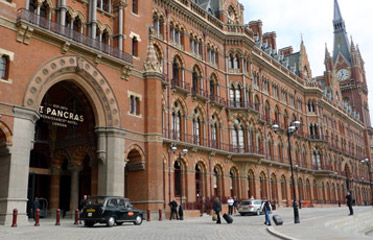
We read that some of the most fantastic buildings of the time were railway stations like St Pancras in London. Most of the other stations like Victoria, Paddington, Kings Cross and Waterloo are grandiose but more mundane. There had to be plenty of space and ventilation so that people wouldn’t be suffocated by the coal smoke and the steam from the mighty locomotives. I don’t know many gothic stations in England, to be truthful.

The Oxford Movement is a parallel tendency, a response to the industrial revolution, social upheaval, and the commercialization of society“. An aggiornamento? Really? I always thought that Romanticism was a reaction away from the Industrial Revolution rather than an adaptation to modern times!

I would mention that French Liberalism, also based on Romanticism and situated in the same time frame, had little to do with railways or The Machine. From that movement came Dom Guéranger, the monastic revival – and Ultramontanism. The Vatican has a private railway station, though I don’t think there are many trains running from it these days, even if Mussolini enforced the observance of Ferrovia dello Stato train times. However, a small railway still runs inside the Vatican to carry tourists. Most of the Parisian stations reflect the same Haussmann grandiosity as the church of Saint-Augustin next to the Gare Saint-Lazare. Perhaps John Bruce might consider visiting France and admiring the SNCF and the same institutional Church he spends his life defending.

This rather lovely building is from the end of the nineteenth century. It is (or was) a liquor factory making the famous Bénédictine of Fécamp. What a delicious drink to finish a meal! The grand hall of this place looks a bit like a church, and indeed my wife and I went to a concert there a few months ago. I wouldn’t be surprised to find out that the Direction of this distinguished firm gave generously to the Church.

There is also the High Court in London, which I always wished had been a church.

Would Anglo-Catholicism be a tad on the legalist side? Not just oof, oof, off, choo, choo!
Coming to the point, I see no connection between the Oxford Movement in England or Liberalism and Ultramontanism in France and the Industrial Revolution. Plenty with Romanticism and a new wave of philosophy and culture away from both the Ancien Régime and the Revolution.

I think that John Bruce is trying to convince us that our trashy Catholic Anglicanism is just a mix-and-match of the famous “private judgement” and therefore something to be shunned by “proper” Catholics. I won’t call the dear fellow names as I have done in the past, but will leave the reader to judge for himself…

Diese Zug ist für Bern, Zürich und Saint-Gallen. Bitte einsteig!

As for:

One feature of Protestantism, at least the Lutheran-Reformed version, is that it proved from the start amenable to state control. Anglo-Catholicism is, let’s face it, a version of state-controlled Protestantism that is not really compatible with Roman Catholicism. I don’t think Cardinal Law recognized this, and I don’t think Bp Lopes does, either.

I wonder what the poor man was smoking before he caught his train. Anglo-Catholicism, especially in the 1860’s and up to the twentieth century, tended to be something of a rebel in respect of Establishment control.

Posted in Uncategorized | Tagged , , , | 10 Comments

Happy Christmas!

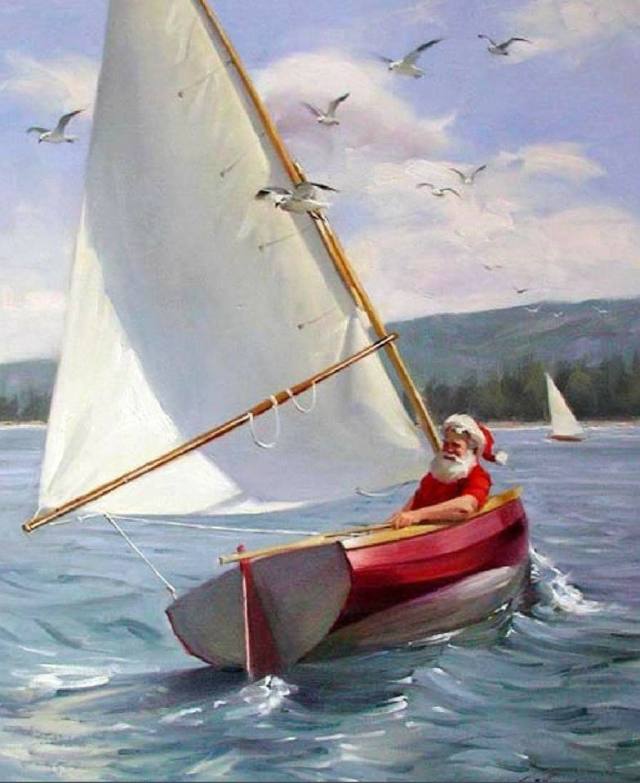
I’m sending out this somewhat secular e-Christmas card to all my readers, but depictions of the Nativity of Christ can be found in my greeting postings of previous years. So I have found this nice painting of Saint (Nic)Claus transposed to our own time having a good sail on his day off. The poor man might have been a tad cold with bare arms at this time of year. Don’t capsize!!!!

I wish you all a happy feast, keeping the essential in the midst of all the commercial and secular noise and hoop-la, the overeating, family squabbles and so forth. A way to put things into perspective is to look out of the window of your house and see the silent gloom of the drizzle-and-drip weather we are having at present in Europe. The only time I have ever had a white Christmas was in 1985 high up in the Swiss Alps with a seminary friend. That silence of the dead of winter reminds us of the events so long ago in Bethlehem and the indifference of the world.

Joseph and Mary were required to fulfil their administrative obligations by going to Bethlehem where all the guest houses were full, and she went into labour. There was nothing of the romance of our carols and cribs with artificial snow and christmassy decorations. Giving birth in a farm building, unless you are a cow, is not very hygienic! We need something of the real Christmas to go with our traditional enjoyment of rich food, gifts and excited children.

If you are alone and sad, perhaps ill or disabled, may this feast bring hope and love of God in your suffering. If you are with your family and doing things the typical way, make a good hypocrisy-check and keep things reasonable. If you are absorbed in the Offices and Mass, like monks, priests and devout churchgoers, may you be blessed by the Incarnation of the Λόγος of God and all that entails. Happy Christmas!

Posted in Uncategorized | Tagged | 4 Comments

The Machine Again

The story is buzzing on Facebook about the appointment of former chief nurse Sarah Mullally as next Bishop of London. One such posting contains a comment:

This woman’s appointment as the 3rd most senior bishop in the Church of England (without having been a bishop first) is, what may be called, the ‘management paradigm’. This is the mistaken notion that the terminal condition of the Church of England can somehow be ‘managed’. Justin Welby had a secular senior management background before he very speedily became an archbishop. A short time ago, he was unable to give a straight answer to a straight question about the Biblical teaching upon sexual morality. No other previous archbishop would have prevaricated in this way. The harsh fact is that the grave situation with the Church of England cannot be ‘managed’ unless by management is meant the management and sale of empty church buildings. Please note: The only apostle who was a ‘manager’ was Judas Iscariot.

I haven’t really gone into this lady’s profile or the details. I have just finished a translation order and still have today’s washing-up to do! I would hope that Mrs Mullally’s  experience as a nurse will give her a special devotion to the sick – but I suspect that being a chief nurse in the NHS has little to do with nursing these days. I cannot judge Mrs Mullally, but the spectre of corporate management in the Church chills me to the bone. I replied in the thread:

There are still a few small RC dioceses in southern Italy where there are less than 10 parishes and just someone at the diocesan curia to help the Bishop manage the registers and the finances. Paul VI merged many of them into larger dioceses but not all. Many priests who have influenced me have spent time in Italy, and I have spent 2 years in that country. This other paradigm brings over the diocesan Bishop as something like a dean or a parish priest, visiting people and spending time with families, schools, the poor and sick – just “mere” pastoral work. It is like the small family firm against the huge and inhuman modern corporation. Most of the RC Church and the Church of England are run like large corporations that stifle humanity and intimacy. They are breeding grounds for psychopaths and narcissists. I have found in the Anglican Catholic Church a spirit that is similar to some of the little Italian and French parishes I have known (whose priests are now dead). Our bishops are first and foremost parish priests, and Bishop Damien Mead is no exception. Oddly, we may well be the most modern and progressive using the Internet and modern communications, not the obfuscation and obscurantism of modern bureaucracy and corporate management.

The question of women’s ordination is a serious one. A part of the raison d’être of the ACC is this issue in “mainstream” Anglicanism. The underlying dystopian element is there and we really wonder what it is all about. I left the Church of England too long ago to really care about the latest developments – but it must be a lesson to us all.

Posted in Uncategorized | Tagged , , , | 23 Comments

O Sapientia

It all starts today in the Use of Sarum, because we have an extra O antiphon, O Virgo virginum. Here is an article on The Other Major Antiphons for the End of Advent which contains a link to another fine NLM article on the Magnificat antiphons for Vespers on these days. We Sarum-ites start today, and the Roman rite from tomorrow the 17th.

They are worthy of our meditation as we prepare for the real Christmas and the incarnation of the Λόγος of God. In the beginning was the Word…

Posted in Uncategorized | Tagged , | 1 Comment

Diagnosis!

It has taken a very long time (mostly being on the waiting list) to go through the process of being diagnosed for various questions in my life, about my relations with fellow human beings and my vocation as a priest. I have just returned home from my  third appointment with the Centre de Ressources Autisme de Haute-Normandie (CRAHN) attached to the main psychiatric hospital in Rouen. The first appointment was with the psychiatrist in charge of this centre, the second with two specialised psychologists and the third (today) with the whole team. They worked with professionalism and a high degree of finesse. It is much more difficult to deal with adults than with children. From the beginning, this was for me about self knowledge and not seeking excuses not to make reasonable efforts to live ordinary life with persons around me.

Like in the psychiatric profession in America, the category of Aspergers Syndrome has been discontinued in favour of a seamless spectrum, a continuum, of the condition known as autism from the most disabled to high-functioning persons with their intellectual abilities intact but with certain “eccentricities” like social awkwardness or things that look odd to the most observant. My diagnosis is that of high-functioning autism which is about equivalent to the old Aspergers Syndrome. Doubtlessly, psychiatrists and psychologists will continue to debate these matters from a scientific and phenomenological point of view. The reasoning is not difficult to understand: instead of putting people in little boxes, you seek to understand them as human souls – as they are – on a spectrum of various characteristics and traits. There are fewer lines to try to draw!

In the meantime, I have to live my life with my talents and difficulties.

Over the past year or so, I have stayed away from internet sites that tend to show “aspies” as being almost “fashionable” or even some kind of Nietzschean Ubermensch. That sort of thing is quite dangerous as with any other kind of label or pseudo-identity like being gay or transsexual or whatever buzzes around these days. Dr Tony Attwood, the most respected specialist in this matter, suggests tongue-in-cheek that this condition might be the next stage in man’s evolution. I’m not an evolutionist (at least in terms of determinism or something mechanical), and I believe that man can find his nobility of spirit from God and a high vision of life. Thus we have such elevated beings – and the low herd mentality of those who follow fashions and ideologies uncritically. Some autistic persons find it easier to elevate their spirit when they see the fallacies, “groupthink” and “bullshit” others take for granted. It can be a gift, a talent, and if we have talents, we are expected to take them to the bank and bring the interest of our investment back to our Creator and Sanctifier.

I will now return to reading Dr Attwood’s famous book The Complete Guide to Aspergers Syndrome, and see if I can participate in local groups. This condition plays havoc with self-esteem and a sense of identity, and I am sure that I could minister to people from a spiritual and philosophical point of view. My own diagnosis came as no surprise, but it made me feel quite shaken for the time it took to shake everyone’s hands and say goodbye and thank you – to the bus stop outside the establishment. I returned home by train and continued reading Dr Robert Lanza’s book on biocentrism, a theory that turns Aristotelian metaphysics upside-down and gives a new look to Idealism, or the idea that consciousness precedes matter. It’s hard going and a challenge, but it will bring a whole new paradigm of the notion of God and life beyond our death as we can observe it. I will certainly have to read this book several times!

I’m not Superman! I’m not the Village Idiot! I have some scientifically observed traits and a reference of self-knowledge (of a relative value) that will certainly help me on my way to a better sense of vocation and purpose in life as a Christian, a priest and philosopher (not someone with academic pretensions but a lover of wisdom). It gives me explanations about my my past so that I can learn for the future and adapt in a special way, unlike the way other people relate to society, their friends and families. This is a challenge, as it should be to anyone who identifies with a minority but has to get on in the world at large.

I’m not interested in Aspie Pride or anything like that – the herd mentality and ideology. We hear about transsexualism, but it is a matter that concerns very few individuals. The hot button issues fly out of the pages of Facebook and Twitter (and others), but we need to shut out the noise and be ourselves – and decent members of the groups of people we associate with in our daily lives.

I have my limits, and some will find my mannerisms difficult to understand. A part of our existence is to ask God in our prayer to docet nos terrena despicere et amare celestia, to be aware that we are alienated from the things of this world and called to God’s Kingdom. This is central to Christian martyrdom and the Romantic soul. Autism is a symptom of awareness of this exile from another world where we belong. At the same time, we live in this world – in it but not of it – and we have to come to terms with that.

I appreciate the prayers of my readers, and I hope this blog will continue to be a part of my ministry as a priest and a human being, because others out there labour with questions for which they have not yet found answers.

Posted in Uncategorized | Tagged , , , , , | 10 Comments