Pendalion

No, it isn’t about Eastern Orthodox canon law – but about a rudder all the same.

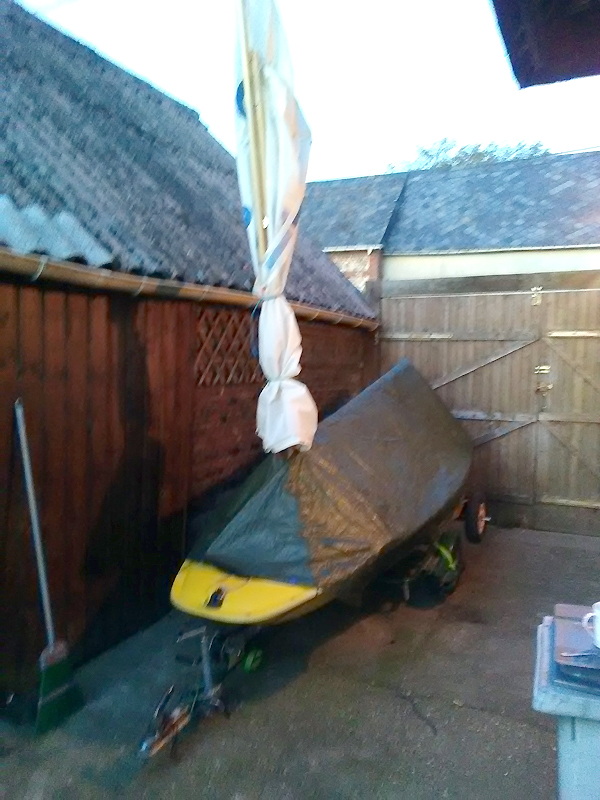
I decided to go for a fixed rudder for the sake of simplicity, and made one for my river boat “Sophia”. I had made a new blade for my aluminium stock that was made for the old spacing of the pintles. I made a new rudder and the transom board for the pintles in their new positions.

I found that the rudder blade I made did steer the boat but with a “sloppy” feel. This new rudder should work much better. I shaped the leading and trailing edges with a spokeshave. There is no restraining device so it can be lifted off easily and put on from being on board when the water is deep enough. In extremely shallow water, I should be able to steer with an oar and not use the rudder. The tiller is fashioned from an old garden tool handle I found in my garden shed!

When I posted this in my dinghy cruising group on Facebook, there were apposite comments. Dinghies usually have hinged rudders for dealing with shallow water, and some device to prevent them from floating off. In any case, the rudder needs a lanyard so that if it does come off the pintles, it won’t be lost. It will need to be tried and kept as simple as possible.

It was a busy afternoon yesterday, since the object behind the rudder leaning against the wall is an old electric cooking hob. It needed to be replaced and the new one arrived yesterday. Fortunately, the electrical connection schemas were clear to follow between what is needed for 400 v three-phase and 220v single-phase.

Boat repairer and electrician all in one afternoon. Whatever next?

Posted in Uncategorized | Tagged | Leave a comment

A Sublime Recapitulation

I was doing a little more research on links between thoughts and thinkers who have guided and inspired me over the years. One such is Nicholas Berdyaev (1872-1948), the Russian philosopher inspired to a great extent by German Idealism and the mysticism of Jakob Böhme, and not least by his belonging to the Russian Orthodox tradition. I discovered him through Vladimir Soloviev (1853-1900). When I was a student in Fribourg in the 1980’s, I had many personal and intellectual problems with traditionalist (or any other kind of) Roman Catholicism and consulted a Jungian-inspired therapist in Lausanne. He pointed me to Soloviev, since for him, my therapy would consist in a re-balancing of my intellectual perspective. Thus I tilted away from Thomism and Scholasticism towards Romanticism and German Idealism. My regret is that I did not learn the German language better and immerse myself in that culture.

I came across Nicolas Berdyaev And Modern Anti-Modernism, a very long article that left me with the exulting impression – “I knew it!” My many musings on Romaticism and some not always very Christian ideas combined with my being attracted to Berdyaev and his “orthodox Gnosticism” via German mysticism. This article is a criticism of the modern world as it developed since the Enlightenment era, the very centre of the Romantic movement as it emerged from the ruins of the eighteenth century and the shadow of the guillotine. We will find much in common between Berdyaev and Nietzsche in this agonised cri de coeur.

I always used to see Nietzsche as one of the inspiring lights of Hitler’s Nazi nightmare and a sort of blazing Götterdämmerung with the proclamation of God’s death. After all, he is the philosopher of Nihilism who died insane. My curiosity drove me to begin to read his works and learn some of the reality of this enigmatic man who inspired the music of Richard Strauss and Wagner to some extent. As far as I can see, he was the son of a Lutheran pastor and lost his faith when he studied theology. He emerged as someone obsessed with the question of the human soul and its transcendence. This is another theme I have found in American Romanticism and the likes of Walt Whitman. After all, is not the human soul an image of God? Nietzsche began, for me, to emerge as a heroic victim soul in the search for the true human spirit in its most divine and transcendent. He was no materialist, nor was he a “proto-Nazi”. The Ubermensch was not some goon from the Waffen SS, but the person who stood above the mediocrity and materialism of the masses. Nihilism was not something he wanted or believed in, but what he observed in the “herd mentality”. Tell me more….!

History seems to be repeating itself at more or less the same rate every century, between the end of the classical era and Romanticism, the same thing at the beginning of the following century, and perhaps now in 2017. What was going on in Europe, especially Germany, was to follow suit in Russia. Berdyaev would give a Christian answer and meaning to Nietzsche. Communism was the “herd mentality” about to enslave Russia and impose a kind of cultural levelling on the world. So were the Fascist ideologies of the 1920’s and 30’s.

Between Berdyaev with his Christian faith and Nietzsche who had lost his, the new quest for a “holy grail” was one of self-knowledge. Romanticism, for Berdyaev, meant transcendence and self-knowledge. It also meant the freedom of the spirit, which would take primacy even over ontology and metaphysics. Materialism and uber-rationalism have made the world such that it alienates the person. This feeling would become the basis of Existentialism, the estrangement from the fallen world, no foreign concept to anyone who has read St John’s Gospel!

Berdyaev left his native Russia and entered France as a refugee as the Bolshevik revolution took hold. He arrived in a Europe devastated by World War I, and the same thought was everywhere in minds like those of T. S. Eliot, Oswald Spengler and René Guénon. The 1920 were prophetic times, and Hitler was already agitating in the beer halls of Munich. The only hope for man was transcendent reality, of God and himself. With the numbing collectivism of Communism and other forms of socialism, the only answer was a new synthesis of Personalism, and Pope John Paul II would carry the same theme forward through the fall of the Berlin Wall to the end of the Benedict XVI pontificate. For many philosophers in this tendency, the person could only be constituted by relationship with others and The Other. The self-aware person is beckoned to solitude in no different way than for the mystic monk (without the coffee!).

Berdyaev came up with his notion of the “aristocracy of the soul”, a theme that has fascinated me throughout the long years. It colludes with the nobility of the spirit, the American transcendentalist’s self-reliance, Nietzsche’s Ubermensch and the Titans of Greek mythology revived by the Romantics. It reflects the Gnostic notion of the spirituals, the intellectuals and the base materialists. Even the Calvinist notion of sovereign election goes along these lines in its original inspiration. This is hardly surprising given the life experience of Saint Augustine.

Another thing about Berdyaev was his ability to see the disease of his beloved Russia as only one symptom of a greater malaise: the cultural and spiritual ruin in the western world in the wake of the Renaissance and the Reformation.

In The End of Our Time, Berdyaev writes: “The Renaissance came to nothing, the Reformation came to nothing, the Enlightenment came to nothing; so did the Revolution inspired by the Enlightenment. And thus too will Socialism come to nothing“.

Today, we might shrug this off since Perestroika and Glasnost nearly thirty years ago. I remember the university friend coming knocking on my door in December 1989, telling me that the Berlin Wall was down and Communism was over – and I thought he was joking. The ideologies remain and have become more virulent in different forms. Berdyaev described them as “an envious denial of the being of another“.

Why would there be an intellectual relationship between Berdyaev the believer and Nietzsche the atheist? It was exactly in this distinction between the lower and the higher, not depending on money or birth, but on nobility of spirit. Perhaps we can read Nietzsche through Berdyaev to understand where that suffering soul was really going. This article is really quite thrilling to read.

I will read into the mystery of Nietzsche, without being put off or limited by his loss of faith and his resulting atheism. It was his business to work out the idea of non-existence after death. He obviously wanted to replace faith in God by faith in the Ubermensch, or the spiritually noble man. I don’t see why we can’t have both as in the thought of Berdyaev. Christ is the true Ubermensch, and though him we can also participate in this high aspiration. We are called to self-knowledge through all means available to us, and through this knowledge, love and acceptance. Then we can love others as we love ourselves.

Posted in Uncategorized | Tagged , , | 8 Comments

Reality

I just came across an article about the downside of sailing by Robert Persig, the author of Zen and the Art of Motorcycle Maintenance. Cruising Blues and Their Cure. This is something I notice about many Youtube videos about young couples with piles of money able to buy a flashy boat and go looking for what is exotic and literally beyond the horizon. Dylan Winter with his down-to-earth manner often expresses the idea that the best is getting the boat we can afford and just go sailing – not to covet something that is beyond us or our means. He goes up rivers and “gunkholes” in his old 1960’s trailer-sailor or in a dinghy and films wildlife whilst extolling the beauties of simple things. I have tried his way in the two old dinghies I have, and which cost me almost nothing to run, and I have had some wonderful days and weeks out. He has his way, and I have mine.

Making abstraction from the mechanics of sailing, buying, preparing and maintaining a boat, repairs, mooring and all the rest – we come to the existential aspect. Reading this article brought me back to my old reflection on monastic life – Ausculta O Fili. The reality is not the beautiful buildings and the lofty chant of the Office. It is being faced with yourself as you are – and that is not always a pleasant experience. The same things over and over again every day can drive us crazy! I cannot recommend Pierre de Calan’s Cosmas or the Love of God strongly enough.

I haven’t had the experience of being at sea for more than a few hours at a time, but one thing is absolutely and painfully obvious.

(…) whether you are bored or excited, depressed or elated, successful or unsuccessful, even whether you are alive or dead, all this is of absolutely no consequence whatsoever. The sea keeps telling you this with every sweep of every wave. And when you accept this understanding of yourself and agree with it and continue on anyway, then a real fullness of virtue and self-understanding arrives. And sometimes the moment of arrival is accompanied by hilarious laughter.

What is reality? Is it the life and image of ourselves we construct in society or what we are with everything stripped away? I once wrote about a man who entered a round-the-world sailing race in the 1960’s and it drove him mad and killed him.

The orientals talk of karma, the reaction from our actions, cause and effect, what flies back in our face when we are less than honest and true to ourselves. The indifference of the sea is no different from the grinding monastic routine or even of the human world once all the glitz, glitter and illusions are gone.

Autumn is often the time when we get the “blues”. The warmth and pleasantness of summer are past. The boats are covered with their tarpaulins and life continues with people with different expectations from our own. The reality of society is complete indifference. No one owes us anything, not even wives or friends. We’re on our own – and the day we accept that is the moment of our illumination and joy.

Read the article and the wonderful site Metaphysics of Quality and its many articles in the tradition of Zen and fixing your motorcycle. Naturally, we don’t have to practice Zen or change our religion. It is an attitude of life that fills the teachings of Christ in the Gospel. Read Luke 12 as an example. It will help us get through the winter…

* * *

Update: Dylan Winter linked to this posting from his blog – thought for the day from Father Anthony. I quote the comments including my own:

Euan Mckenzie:
Now you’re becoming a sermon, the parable of the dinghy sailor, the modest yachty and the gin palace owner who all sail on the same sea….

RonG:
Well, you would be “extolling the beauties of simple things” if you didn’t keep rambling off onto diatribes about Presidents, hunters, two-strokes and lobster potters. Keep it up, I’d fall asleep if it was all just “going with the flow” existentialism.

Riley Morgan:
Interesting thinking. I always try to remember what we are. Simply a green smudge of lfe on a tiny speck of dust flying through a totally unimaginably huge universe. Puts me back in my place.

Anthony:
Many thanks for the link, Dylan. I hope we get to meet up one day. Like you, I am a product of the 1960’s and enjoy reading philosophical subjects. Like you, I have never had much money for boats, and therefore don’t have the notion of the “status symbol”. For each of us to discover life and its deepest values…

Stephen Mundane:
Thanks Dylan — thought provoking stuff. Fr Anthony is among good company…
Aristotle: “What doest it mean to be a good person?”
Descartes: “What does it mean to be?”
Nietzsche: “What does it mean?”
Bertrand Russell: “What does ‘it’ mean?”
C.S. Lewis: “What does it?”
Lil Jon: “What?” https://youtu.be/WhLLMXMFKTk
Douglas Adams: “42”

For me, philosopic thought is good exercise for the brain and lets you approach problems from a different viewpoint if you so choose but it will never uncover any empirical knowledge. There are many, many doctrines to contemplate but most of them are as much use as a chocolate tea-pot as far as answering the problems of living in my personal reality are concerned. But the Universe, like the sea, really doesn’t care.

Anthony:
I’m not sure where this is going, since certitude and easy answers are decreasingly a part of my life as I get older. We seem to have a choice between nihilism and meaninglessness or making a proverbial silk purse out of the proverbial sow’s ear. One way is not to think at all, drown yourself in noise and desire for money (I’m not saying that is your idea, because I don’t know you [Stephan Mundane]), or seek something higher, something spiritual – and that word can be understood many ways. I seem to know what works for me more or less well. What works for others…. even the bottom of the ocean is less mysterious than the person we are drinking a pint with at the local.

Hans Valk says:
You’re quite right about that, Stephen. The universe (why the capital ‘U’?) does not care. Actually, nature does anything within it’s power to cover things up.
In the Netherlands we have a writer, Armando, who is also a painter and a sculptor. He has invented the concept of the “guilty landscape”.
For example: you are walking in some wood, where there used to be a concentration camp. People were tortured and killed there.
But now, half a century later, there is little to remind us of these facts. What is left are ruins and these are almost fully overgrown. The wood itself is just what it always was. It saw what happened there fifty years earlier, did nothing and keeps silent about it. It actually covers it up and does not give a damn.. But in doing so, such a wood in Armando’s mind, is complicit to what happened
Well, there you have it..
In Art, of course, anything goes. The reality is: the universe does not give a shit. And it can’t.. There would be no end to it, would there?
Still, what do you think, when you’re taking a relaxed stroll in such a wood..? Food for thought.

I don’t know what readers will make of all this. Perhaps it is the thought of people who are completely outside our little “churchy” world. We are faced with complete “otherness” of other people and a world that doesn’t care for me or you. I seem to have entered the mystery of some of our post-modernist philosophers like Derrida and Nietzsche – dangerous venturing indeed. How justifiable is the notion of a God – in his infinity, transcendence and immanence – who cares about each one of us and has a plan? Perhaps this is the whole point, between what cares and what doesn’t care… Ideas?

Posted in Uncategorized | Tagged , , , | 1 Comment

Annihilationism and Pope Francis

Just under two years ago, I wrote A vision of hell in which I discussed. I also brought up the subject of Annihilationism in Christian Humanism in the summer of 2016. It would appear that Pope Francis is a partisan of this idea when we read Do Pope Francis and Archbishop Paglia Believe Hell Does Not Exist? I came across this latter article in the small hours of this night whilst undergoing a little insomnia when I looked up a couple of things on my smartphone. I noted it and find it easier to read through on my computer.

People are saying all sorts of things about Pope Francis. For the traditionalists and conservatives, he is heretical like John XXII in the fourteenth century, though the subject is not exactly the same. In some ways, his beliefs and teachings resemble Joachim of Flore and the various movements in the fourteenth and fifteenth centuries that fell victim to the rigours of the Inquisition. Recently, he has vindicated Luther, which does not seem to be entirely wrong. Luther was a very angry man in the face of corruption and superstition over things like indulgences. Churchmen wanted a monopoly of the same thing: salvation, a way out of the fear of death. Now, we read (from the above link):

Pope Francis, preceded in this [view] by John XXIII and Paul VI, but, with a more revolutionary force with respect to ecclesial theology, has abolished the places where, after death, souls must go: Hell, Purgatory, Paradise. Two thousand years of theology have been based on this kind of afterlife, which even the Gospels confirm. However, it is with some attention to the theme of Grace — that is in part due to the letters of Saint Paul (to the Corinthians and the Romans) and partly even more so to Augustine of Hippo. All souls are endowed with Grace, and so they are born perfectly innocent and they remain so unless they take the path of evil. If they are aware of it and do not repent even at the moment of death, they are condemned. Pope Francis, I repeat, has abolished the places of eternal dwelling in the afterlife of souls. The thesis held by him is that the souls dominated by evil and not repentant cease to exist while those who are redeemed from evil will be assumed into beatitude, contemplating God. This is the thesis of Francis and also of Paglia.

The Pope is also on record:

And in 2015, Pope Francis was again quoted by Scalfari: “What happens to that lost soul? Will it be punished? And how? The response of Francis is distinct and clear: there is no punishment, but the annihilation of that soul.”

Many atheists do not fear death, but are quite indifferent to the notion of ceasing to exist except in the memories of other people still living. Only the notion of being alive and being tortured would bring fear and susceptibility to being controlled. But, is this what it’s all about? One big problem is knowing where the borderline exists between this soul that will go down the cosmic plughole and never be heard from again, and that soul who was a mediocre person – not evil like Hitler or some serial killer – who goes to the same happiness as a saint. With this kind of tampering, the coherence of traditional Catholic teaching as a whole goes out of the window. What’s it all for if it isn’t a load of bunk? The majority of people in the western world believe exactly that, and churches are as useless as they are harmful. Is Pope Francis aware of this?

Is he a partisan of “cheap grace”? There are arguments for annihilationism, as seen in the above Wikipedia link on this word. I think I would see more light in reading Nietzsche and what he really means by nothingness or the antithesis of metaphysics and ontology. It is a dangerous undertaking, and we encounter the dark thoughts of Wagner’s rendering of German pagan mythology and the use the Nazis made of it. It is possible that some souls are so nihilistic and evil that they become what they are – nothing. If you think about it for any amount of time, the thought is terrifying, just as frightening as the idea of being roasted on a spit and tortured by demons for all eternity amidst the fires.

Francis not only disregards his own Catholic tradition but also the various apocryphal views of the afterlife. Most of those with knowledge of this affirm, like some of the great world religions, the existence of something that is multi-layered between our earthly existence to the highest degree of perfection and divine light. Francis minimises it like some of the “proto-protestants”, and standard Catholic teaching only knows heaven, purgatory and hell (and limbo for unbaptised infants). I tend to imagine a kind of “multiverse” with points of “communication” that can be imagined by comparing this whole with the range of radio frequencies, only one of which can be listened to at a time on a radio set. They all exist at the same time, but experience is confined to one at a time. This notion opens up the idea of a reality that is far beyond our understanding.

Is Francis some kind of medieval heresiarch or the rationalist for whom Christianity is no more than cheap moralism and the good order of society? A good Jesuit confuses everything and makes himself inscrutable! Perhaps he is a puppet in the hand of someone like George Soros, in it for the money, but that is a little conspiracy theorist and risky. Is he a cynic, an evil man, a fool is someone else’s hands or what?

Perhaps Francis wants to be rid of intellectual certitude given by studying and teaching from authority. Is there no certitude of anything? Is everything transcendent and beyond our rational understanding? Again I think of the Spirituals, the Dulcinites, the Fraticelli and the various other gangs of bandits in the hills and towns of Italy in the worst days of the Avignon schism. I have to admit that I am once again reading Umberto Eco’s The Name of the Rose. We all fear fundamentalism, whether it is Christian or Islamic, and we are all conscious that established religion has done incalculable harm to humanity in the name of monotheism. Christians would reply that atheists are worse, as with Nazism and Communism. To me, it is just the worst of human nature.

What Pope Francis is doing is very dangerous, reducing the Church to cheap grace and moral relativism. I have yet to discern whether he is going the same way as the Anglican Communion and most generic liberal protestants. Perhaps he won’t have time before the pendulum swings back to hard-line conservatism at the next Conclave. I don’t really care about the Roman establishment and the whole basket of crabs, but rather about the millions of ordinary people who are likely to turn to atheism once their balloon is burst!

* * *

An interesting addition to this posting is a link to the Vatican-watcher Sandro Magister’s The Showstopper For a Jesuit Pope: To Beatify Pascal, the Archenemy. Quite apart from the absurd possibility of his canonising Blaise Pascal, we see this:

“Sometimes in my interviewers I have noted – even in those who say they are very far from the faith – great intelligence and erudition. And even, in some cases, the capacity to let themselves be touched by the ‘touch’ of Pascal. This moves me, and I treasure it greatly.”

The first is in reality more a confirmation than a revelation. It is his affectionate esteem for Eugenio Scalfari, founder of the newspaper “la Repubblica.” He is, in fact, the interviewer “very far from the faith” to whom Francis is referring.

The two meet once or twice a year, at Santa Marta, and it is almost always the pope who invites his friend. The conversation takes place without Scalfari recording any of it. And in the following days he publishes an account, adhering to the following criteria as he explained once to the Foreign Press of Rome, reporting these words that he said to the pope at the end of the first conversation:

“I will reconstruct the account of the dialogue in such a way that it can be understood by all. Some things you have said to me I will not report. And some of the things I will attribute to you, you did not say them, but I will put them there so that the reader may understand who you are.”

The effect of this liberty of transcription is that Scalfari has confidently attributed to Francis not a few “revolutions,” the latest of which is the abolition of hell, purgatory, and heaven. Without the pope ever having felt it his duty to correct or deny anything.

Posted in Uncategorized | Tagged , , , , , | 28 Comments

A True River Cruiser

An inspiration came into my mind today, that of pursuing the role of my little plastic Tabur 320 (named Sophia) as a river cruiser, able to go under very low bridges and even be hauled out of the water for getting round obstacles like weirs and rapids. I found that the first boom tent I made for Sarum fitted perfectly. On Sarum, I made a new boom tent because I needed more headroom given that my sleeping arrangement went on two boards that served during the day as extra-width cockpit seats.

The boom tent is held by three elastic cords that go under the hull. For this, the boat needs to be out of the water and on a grassy or muddy bank. It is not like the tent on Sarum designed to be put up whilst the boat is at anchor or moored. Sophia becomes a land tent for the night. That is at least the theory which I don’t imagine trying out before next April or May.

The rowing thwart lifts out and my legs will easily go between the centreboard well and the buoyancy tanks, and I would be on a self-inflating mattress and in a sleeping bag. It is not exactly the Ritz, but a great way to spend a weekend or three days exploring a river before returning to the point where I left the van and trailer. I will no longer sail Sophia on the sea, now that I have Sarum.

Here is the old boom tent in its new application.

The sail and sprit are tied to the mast and the clew of the sail is detached from the boom. The boom is supported by the usual wooden cradle.

At the stern, the tent is left unattached to let the rain drain away freely over the outside of the transom.

Inside, the rowing thwart can be lifted out and placed at the opposite side of the boat from where I will sleep, likewise for the oars and other stuff. My galley box will have to be very small and compact and have a very simple camping gas burner. It has to be severely minimalist! The tent goes nicely over the fore of the boat and should keep the rain out, if necessary with the aid of a small plastic board, perhaps the boat’s centreboard.

Here is the simple arrangement of the boom with the wooden cradle.

Posted in Uncategorized | Tagged | Leave a comment

New Article by Dom Alcuin Reid

As an extension to my articles of the past few days, I was quite excited upon discovering Liturgy, Authority, and Postmodernity by Dom Alcuin Reid, an Australian Benedictine monk in a small monastery in the south of France. I have know Dom Alcuin for more than twenty years, and he published my work on the Tridentine Missal in the T&T Clark Companion to Liturgy (London 2016). He has done a true travail de bénédictin on what is central to his religious life and spirituality, the Opus Dei.

The article is as much philosophical as it is on liturgy and the Roman Catholic Church. By analogy, we could extend it to our reflections on the English Prayer Book and our culture. In one way, liturgy lives in human culture like a fish lives in water – but it is above culture, above the nihilism of post-modernism we all live in nowadays. There comes a point at which post-modern “culture” is insatiable and the liturgy has to go on in spite of its irrelevance. Quite simply, Christianity has nothing to say to about 95% of our white populations in England and western Europe. Christ is above popular culture and fashion as some of us are. I am certainly alienated from the world of “music”, tattoos, horrible clothing and hair fashions, even the ones that were around in the time of my own teens (the 1970’s). Those few of us who are alienated are more like to discover the joys and subtleties of “classical” music, art, literature, humanism and the aspects that can be evangelised by Christ’s message. I once read something by a pseudo-intellectual French bishop calling our time that of the homo technicus, as something distinct from humans in other times. Most of us use technology, and I am no exception, but it is a tool, not the definer of our identity. Some people play with their smartphones all day. To me, it is a tool like any other, a sort of “pocket computer” and “virtual Swiss knife”. That doesn’t prevent me from switching everything off and playing the organ or going sailing in one of mankind’s oldest inventions – the sailing boat. In moral and human terms, I hardly see any evolution in humanity: we are just as good and bad as hundreds of years ago.

Dom Alcuin comes out with a fairly standard understanding of liturgical tradition and more or less adopts the line of Dom Guéranger in regard to attempts to reform or improve the liturgy in the sixteenth and eighteenth centuries. Some of the ideas of the Synod of Pistoia were not so bad, but were set in a general context of “ultra-classicism” and rationalism. Take the mystery away and have stripped-down churches with large clear glass windows, so that everything can be seen by the people, and what is there left in the way of awe and wonder? On the other hand, we Anglican Catholics accept the adoption of an archaic vernacular in the place of Latin, like Church Slavonic instead of ancient Greek.

This article traces some of the realities of the Roman liturgical reform of the late 1960’s under Paul VI. The reminder is interesting, as are the anecdotes of Louis Bouyer. Archbishop Bugnini, the whipping boy of traditionalists, but a “scoundrel” according to Bouyer, seemed to be set on doing about the same thing as Cranmer and later editors of the Prayer Book, writing new eucharistic prayers, abolishing the Roman Canon as an “accretion”, Mass facing the people like in the preaching barns of after 1552 when “God’s Board” was set between the old choir stalls and put away after use. The notion of stability, except what is enforced by neo-conservatism, was destroyed, as was the motivation of increasing numbers of people to go to church on Sundays.

Radical Orthodoxy finds its way into Dom Alcuin’s essay, which is interesting. I find someone like Catherine Pickstock refreshing distinct from the conservative and traditionalist elements in both Roman Catholicism and Anglicanism. She does make the point that is liturgy has to be culturally relevant, it hasn’t nearly far enough. I am no fan of Pickstock, since she is quite “politically correct” and “stuck up” in matters like women’s ordination, but her work should not be ignored. The problem is understanding what defines “modern culture” and how homogeneous it is.

I love the quote from Louis Bouyer: Yesterday’s liturgy was hardly more than an embalmed cadaver. What people call liturgy today is little more than this same cadaver decomposed. It depends where and in which churches and communities, but there is an element of truth in this provocative statement. Both the Counter-Reformation and Reformation liturgies were victims of the same neo-scholastic reductionism and canonical positivism. I find this disease refreshingly absent in the Anglican Continuum, at least generally and taken as a whole. I really do think we have an opportunity to learn and take a different route!

Should the liturgy be unfamiliar? I have seen documentaries about the state of religion in England and people never going to church because that did was not a part of their upbringing. Pickstock’s position seems to contest this assumption: paraphrasing it, liturgy should be counter-cultural, another world. Therefore, the liturgy is absolved from having to be relevant, but humans of any age are invited to discover this new world outside their normal experience. It is like sailing up a river not knowing what is round the next bend, but on a higher plane.

My experience of the traditionalist Roman Catholic world was more than twenty years ago. The Institute of Christ the King is a lot more numerous than it was when I was with them, going by their website. It is impressive, though I would no longer be taken in by some of the sophistry, worldly wisdom and social graces it involves. Their being given the use of churches in England, America, France and other countries is impressive. It gives the impression of an artificial world, as perhaps we Continuing Anglicans do. They have the money and the support of some very wealthy benefactors – it’s quite frightening. Their origins were quite humble, as I remember from 1990 when I went to a place I had once visited when it was a Benedictine monastery. It was in a sad state, and we worked hard to do something with it. Since my departure, the buildings have been completely restored, and there is nowhere else you will find the glories of baroque liturgy! I don’t harbour any bitterness: I simply wasn’t made for their image of the Catholic priest.

Will the ministry such priestly institutes do the trick in the way of drawing the masses? No, they will attract people from certain conservative and aristocratic strata of society, the military and Catholic families of Versailles living in houses worth more than a million euros. The prevailing political ideology is highly characteristic. I once saw a seminarian rebuked for expressing neo-Nazi ideas, but the general idea is nationalist and conservative – Tradition, Family, Property. I am not a left-winger, but I find that kind of conservatism stifling. So, the traditionalist churches are well attended, but by the same kind of bourgeoisie as in the nineteenth-century post-revolutionary era. Has much progress been made?

Monasteries seem to give a gut-feeling of something more authentic, more concerned with spiritual life than social status. It is not without accident that someone came up with the notion of a Benedict Option. On the other hand, how can anyone other than monks in a community live it to the full? There is a notion here of making people relevant to the liturgy rather than the other way around. It may seem unorthodox of me, but I don’t think we are called to get masses of people into churches. The problem is that the clergy need their money to pay for magnificent churches and visibility. I don’t think that is a problem, because we just have to downscale to the reality. Christianity will disappear in the western world, at least in its Catholic and sacramental form. Will it survive in a fundamentalist Protestant form? Apparently the Bible-bashing and sweating Baptists in America’s Bible Belt are on the wane. Mega churches? Perhaps they are little more than a flash of magnesium. Liberal civic religion? For as long as they have money. Should we persist or give up? I think we should persist knowing that the odds are stacked against us, and that grace is costly (thinking of Bonhöffer). I’ll go on celebrating Mass and Office alone in my chapel, knowing that no one cares two hoots. My ministry is what I’m doing now – writing and offering ideas to advance the quest for knowledge and clarity of mind.

Dom Alcuin is a Roman Catholic and preaches to his own choir. That is to be expected, and we Anglicans can read analogies from his ideas. We Continuing Anglicans are much less affected by positivism in canon law and theology than the Roman Catholic world. We are more approximate and less concerned for precision. Our ambiguity around the subject of the Prayer Book can be exasperating, but I would prefer that to some of the paralysing teachings and beliefs in the Roman Catholic world. Imagine what I would have to go through as a Roman Catholic priest to celebrate in the Use of Sarum! I would be stonewalled at every turn as happened with Fr Sean Finnegan who was celebrating Sarum masses in Oxford in the 1990’s. Positivism and neo-conservatism created a situation analogous with that of Cranmer’s Prayer Book that canonised copyist’s and printer’s errors like in the Gloria and the Nicene Creed. It is all graven in stone, and Benedict XVI trod on a viper’s nest!

Given these reflections, Dom Alcuin’s article is of great interest in these hermeneutical guidelines – meaning in plain English our perspectives of interpretation as readers which are different from those of traditionalist or conservative Roman Catholics. For decades, polemicists have drawn analogies and comparisons between the Cranmer reforms of 1549 and 1552 and the Pius XII / John XXIII / Paul VI and Bugnini reforms of 1950 to 1969. The historical circumstances are totally different as are the theological views of the sixteenth-century Reformers and the “liberal” RC establishment as it formed in the wake of Vatican II. There was a certain amount of neo-Jansenist influence, but really that of deconstructionist and nihilistic philosophy. Such comparisons are more unhelpful than helpful in our understanding.

Read the article and look for its original points.


Posted in Uncategorized | Tagged , , | 4 Comments

The Trio

I am sure I will one day find another nickname for the little trio comprising Fr Gregory Wassen, Fr Jonathan Munn and your humble (or not humble enough!) servant. Perhaps we might one day organise a little seminar where people interested in it would do some preparatory research, give a little lecture and then have a question and answer session. It is a marvellous method of teaching in universities, and I really found them very useful.

I have just read Fr Jonathan’s newest posting Thank God for Continental Priests! It shows real progress being made in our reflection. I drew his attention to my old article on the Anglican Office and the way Fr Louis Bouyer compared it with the Quiñones Breviary of the 16th century. Quiñones and Cranmer. For my university work on the Roman Missal, I consulted Dom Suitbert Bäumer’s Geschichte des Breviers: Versuch einer quellenmässigen Darstellung der Entwicklung des altkirchlichen u. des römischen Officiums bis auf unsere Tage, Freiburg i. Breisgau, Herder 1895; French translation, R. Biron, Paris 1905. Unfortunately, no one seems to have translated this work into English. Bäumer’s work was particularly germane for questions of the calendar, since the same rules govern the calendar of the Breviary as for the Missal. This book was as important to me as Jungmann’s Missarum Sollemnia and the many secondary references, books and articles I found in Fribourg University Library (no internet in those days!).

I quoted extensively from Louis Bouyer (1913-2004) in my article mentioned above, because there was an aspect to Cranmer’s work that was not purely influenced by Protestant ideology, but constituted a movement parallel with that of the early Counter-Reformation, that of the Quiñones Breviary, rejected by Pope Pius IV in 1558. The Prayer Book Office was unique in the reformed world, in that it retained many of the essential elements of Matins and Lauds, and Vespers and Compline. It has points in common with the Monastic Office, but also with the Cathedral Office of Sarum. The versicles and responses (after the Benedictus or Nunc dimittis are much more prolix than the Kyrie and the Pater noster of the Benedictine offices. There is nothing wrong with that, and several centuries of these Offices have given the Church of England a choral tradition that is unique in the world.

For the frequency of saying the whole Psalter, St Benedict showed moderation in allowing monks a week to say the Psalms rather than a single day as in the former monastic tradition. Cranmer divided the Psalter into thirty days, morning and evening, and no Psalm was repeated during that time. In the monastic and Sarum breviaries, the Miserere is sung each day at Lauds as are the three Laudate psalms (148, 149 and 150). The Quiñones office had its own system of avoiding such repetitions, like at Compline or the Day Hours. Pius X in 1911 adopted a similar plan to lighten the load – since the 1568 Roman Breviary was really heavy going (I have a copy in my library from the Leo XIII era). The real problem was imposing an obligation of the entire Office on each cleric rather than on each cathedral, collegiate or parish church where clerics were expected to attend to their duties as corresponded with their prebendaries. Frankly, the breviary that appeals to me most is the monastic on account of its being light during the day and more intense in the very early morning. This sense of moderation in St Benedict and attempts to reform the office in line with Tradition and pastoral concern are a highly cogent point.

I make no pretence at intellectual eminence or scholarship sublime, but I enjoy reading and learning about things, going into them in depth. I do believe that our Church needs to work towards a certain academic standard, not for all clerics and priests, but for the sake of making progress in furthering our essential purpose of surviving the “bullshit” being hurled at us by “mainstream” churches. Fr Jonathan has read more than he will let on. He is also a talented musician and composer. His advanced education in mathematics gives him a logical rigour that is certainly less developed in my own mind.

Indeed, how do we maintain the standard given by the Prayer Book and not use it purely and simply? Is this not “cafeteria religion” taking out the bits we don’t like. What made the Prayer Book office is the English choral tradition that came down to us through Purcell, the many organists and composers of the Georgian era, and particularly from S.S. Wesley up to Stanford, Bairstow and our own time. Cathedral worship was always set apart from the parish religion of the preaching barns with an old chancel that was almost ashamed of its existence. Without that musical tradition, it is more difficult to make something of the Prayer Book Office. It can be said, or sung to simple plainsong. It is what the Prayer Book most has going for it. The additional material from the English Office Book and the English Hymnal bring something extraordinary to an Office which would fall flat on its face if taken only from the Prayer Book.

The Mass is something else. With his acid wit, Dom Gregory Dix (The Shape of the Litugy) remarked that Protestant Eucharistic rites tended to keep the medieval “accretions” and discard the parts that truly came from the early Church like the so-called Gregorian Canon. The translation of the Kyrie, Gloria, Nicene Creed and Sanctus is sublime. I can understand the Agnus Dei being chopped out, since the Holy Week rites reflect some of the most primitive forms of liturgy. The Gregorian Canon we have in the Anglican Missal is attributed to Miles Coverdale, the same who gave us our glorious Psalter. It is not a part of the Prayer Book, but comes from the same era and humanist culture. What has been done since the end of the nineteenth century is to reconstruct an Anglican Mass from these translations and new translations from the Latin missals in the same style of early modern English. Call it a pastiche if you will, but the Anglican Missal and the translation of the Sarum Missal by Canon Warren give us something that is both Anglican and Catholic.

I have often thought of sessions on the Sarum liturgy, but I have no idea about logistics and organisation, how to get establishment Anglicans, Continuing Anglicans and Roman Catholics under one roof without problems. Also, someone needs to come up with the money and sort out a venue. If it remains purely academic, it might not get people too excited, or even if only the Office is sung together – but Mass, communicatio in sacris, the priest not being recognised to be in valid orders by some? Oh dear! It is something I can live without… I am also realistic enough to know that such a rarefied subject will be of no interest to most Anglicans and Roman Catholics. I believe that the best way is research and writing, doing our own work and then sharing it with the world – as I do with my blog. I would like Sarum to attract more attention, since material is becoming available thanks to the Internet and copies of books we would only be able otherwise to borrow from a library. There is nothing wrong with using the Roman rite as is contained in the Anglican Missal and English Missal, like in the “neo-Gallican” missals of the eighteenth century in France, but Sarum would better express our own spiritual identity. It is no more difficult to learn, and Dr Renwick and I, among others, are working towards making all the books and music available.

Essentially, what the Prayer Book means is the language, a classical and archaic form of English that is our equivalent of Church Slavonic in the Russian Orthodox Church. We are very fortunate to have these texts and translations, a basis that has inspired centuries of sublime music, our literary heritage and English culture. The Germans have Luther’s vernacular, which is not what is now spoken on Zweites Deutsches Fernsehen. Mass in French nauseates me, since the oldest translations from the eighteenth century were only ever paraphrases, and they contrast with the the sober Latin by their flamboyance and exaggerated expressions. Actually, one of the better translations of the RC Novus Ordo is French, based on a lot of work done in the 1950’s and early 60’s. Mass in modern English has only been slightly improved by Benedict XVI’s version – which might be short-lived given the news about Pope Francis giving Cardinal Sarah a public dressing down! The kind of language we have leaves us stability and beauty, rivalled only by the Latin texts. Anglicanism has always had the wisdom to keep some Latin, especially for musical settings.

I think I have the essential of the issue of Anglican identity. It is in our language and culture, but also our share in the northern French heritage that goes back to the Conquest of 1066. We have progress to make in the Continuing Churches and the ACC. None of us three would point any fingers at anyone. It is simply our responsibility to do the reading and writing for the education of our brethren. That is our positive contribution.

Posted in Uncategorized | Tagged , , , , , , , | 5 Comments

Gallicanism, France’s “Anglicanism”

I have often expressed the idea of Anglicanism as an “English Gallicanism”. What was Gallicanism? The Wikipedia article is quite a good introduction from the historical point of view.

Gallicanism is a rejection of ultramontanism; it is akin to a form of Anglicanism but is nuanced, however, in that it plays down the authority of the Pope in Church without denying that there are some authoritative elements to the office associated with being primus inter pares (first among equals). Other terms for the same or similar doctrines include Erastianism, Febronianism and Josephinism.

The kind of Anglo-Catholicism that appeals to me is the kind that doesn’t roar anathemas against the Papacy (few Evangelicals do these days) but sees the Pope as an analogy with the Patriarchs and Metropolitans of the Orthodox Church, primus inter pares, Pope because he is a bishop. Unfortunately there were tendencies in European Catholicism in the eighteenth century that reduced religion to a civic force for good citizenship in accordance with the dictates of reason and decency. We have dealt with Erastianism in Anglicanism that had the characteristic of hollowing out the spiritual and mystical aspects of Christian worship and spirituality in favour of civil morality and social conformity.

What Gallicanism and Anglicanism have in common is to affirm the authority of the King of the land and limit that of the Pope in that place. Such a notion was relative under the Bourbons in France but absolute under Henry Tudor in 1534. The difference between Anglicanism and Gallicanism was a matter of degree. The four Gallican Articles of 1682 are striking:

  1. St. Peter and the popes, his successors, and the Church itself have dominion from God only over things spiritual and not over things temporal and civil. Therefore, kings and sovereigns are not beholden to the church in deciding temporal things. They cannot be deposed by the church and their subjects cannot be absolved by the church from their oaths of allegiance.
  2. The authority in things spiritual belongs to the Holy See and the successors of St. Peter, and does not affect the decrees of the Council of Constance contained in the fourth and fifth sessions of that council, which is observed by the Gallican Church. The Gallicans do not approve of casting slurs on those decrees.
  3. The exercise of this Apostolic authority (puissance) must be regulated in accordance with canons (rules) established by the Holy Spirit through the centuries of Church history.
  4. Although the pope has the chief part in questions of faith, and his decrees apply to all the Churches, and to each Church in particular, yet his judgment is not irreformable, at least pending the consent of the Church.

The Council of Constance is evoked as the principle of subjecting the primacy of the Pope to the college of Bishops. Ultramontanism in the nineteenth century was largely a direct reaction against what could be termed as ecclesiastical nationalism or any contesting of the two swords principle of the Papacy formulated since Bonface VIII’s Unum Sanctam of 1302. It should be remembered that the Council of Constance of 1414 to 1418 had the task of resolving a thoroughly rotten papacy and dealing with all the antipopes who had more influence that the present-day clown at Palmar de Troya! It formed the basis of the principle of “Northern Catholicism”. Gallicanism was far from perfect, but it formed something very solid and valuable in the effort to keep Catholicism credible faced with increasingly absurd claims from Rome! The seventeenth and eighteenth centuries represented the heyday of Gallicanism, and it persisted in a marginal form until shortly after Vatican I in 1870. It no longer had any place in communion with the Pope.

It formed the basis of Old Catholicism in the Netherlands and to some extent with Döllinger and the German / Swiss Old Catholics. There are a few small Churches in France claiming the Gallican identity. The longest established is the Eglise Gallicane – Tradition Apostolique de Gazinet based near Bordeaux. There is also the Eglise Catholique-Gallicane of Archbishop Dominique Philippe mostly present in Normandy. Another notable example is the Mission Gallicane d’Alsace and Bishop Raphael Steck. Their liturgy is frequently a little “approximate” and a contrast to what Anglicans are used to. There is a lot more popular religion than the “monastic spirit” involving a liberal use of faith healing and exorcisms. Such a concession to popular religiosity attracted ordinary people otherwise uninterested by profound theological reflection or monastic style liturgy. The Norman Gallicans still use the pre-Vatican II Roman missal in Latin. Occasionally, the label Gallican means an appeal to the French Church of pre-Roman influence, a little like some of the French western-rite Orthodox. It is a world that has never attracted me, but the baroque version of Gallicanism, now effectively dead, was something quite stimulating.

It is a slender basis for building an ecclesial idea for the early twenty-first century, as indeed is a vision of Anglicanism in the 1660’s Restoration era. The alternative is generic Liberal Protestantism which is increasingly an influence and a reference for the Franciscan Papacy. Even Bible-thumping Baptist fundamentalism in America is on the wane. Perhaps these are ideas to defining a form of episcopal and sacramental Catholicism that appeals to the Anglican sensitivity. I would certainly appreciate discussion about this topic.

Traditionalist Roman Catholics are sometimes labelled Jansenists because they are moral rigorists. Such appellation is abusive, because Jansenism had a much wider meaning. Pures comme des anges, orgueilleuses comme des démons, the nuns of Port Royal were described! There is always the same temptation in any high aspiration. Taken in its “pure” form, Jansenism could be as callous and dangerous as Calvinism, but it represented an aspiration to integrity. That is appealing. I have already written on Jansenism in this blog.

We Anglicans have been quite rigorist at times in history. The Prayer Book, partly under Calvinist influence, partly “proto-Jansenist”, was not very optimistic about human nature all in emphasising the forgiveness of sinners. I would find it hard to believe that there was no osmosis of Jansenism and Augustinian theology, however partial, between seventeenth-century France and England. Far from me to promote Jansenism, but I think there are aspects of it, its sobriety and moral integrity, that can form a part of our identity as Northern Catholics. This also provides a surviving link with Gallicanism and the Norman origins of the Sarum Use.

Posted in Uncategorized | Tagged , , , , | 1 Comment

Via Media

The title might seem provocative, since Newman’s reaction against that idea figured in his decision to become a Roman Catholic in early nineteenth-century England and Rome. He came up against the “brick wall” of what amounted in the Church of England to unifying in a single institution all opposing opinions and beliefs. In bygone days conformity meant conformity, belonging to the national Church and keeping one’s mouth shut. Continuing Anglicanism doesn’t have that crowned authority to keep it together on pain of being in trouble with the laws of England and the British Empire. Without an authority able to chop our heads off or throw us into prison, we have to forge some other principle of unity!

Just a few moments ago, I read something by Archbishop Peter Robinson on Facebook:

One of the problems one encounters as a Continuing Anglican is that if one actually takes the English Reformation at its word one gets slammed from both directions. The advanced (you could also refer to them as revisionist) sort of Anglo-Catholic generally wants nothing to do with the Articles of Religion or the 1662 Book of Common Prayer, which, by the way, is rather at odds with the “Prayer Book Catholic” tradition with which I grew up. On the other hand, the Anglo-Calvinists often try to hammer the 16th century English Reformation into a seventeenth century mould. Neither endeavour is particular successful.

I have always had a considerable amount of esteem for Archbishop Robinson and certain other Classic Anglicans who joined the fray during the days of the TAC trying to measure up to Anglicanorum coetibus. There was a time when I was trying to be loyal to Archbishop Hepworth at at costs and took quite a lot of stick from Fr Robert Hart. I now find that the latter and I are brother priests in the ACC. Perhaps, the peace we have made with each other is symbolic of a new comprehensiveness within an institutional Church. Things are very subtle. Anglicanorum coetibus took the wind out of the sails of what has become typified as Anglo-Papalism, something for which I never had much sympathy. Even as a Roman Catholic of fifteen-years, my sensitivities lay in the “English” style of gothic churches, riddel posts and the like.

I have to consider the possibility that Archbishop Robinson might have been provoked by the discussion between myself, Fr Jonathan Munn and Fr Gregory Wassen. For him, the Prayer Book, the Homilies and the 39 Articles are the very bedrock of Anglicanism. Depart from these and you are either a Calvinist or a Roman Catholic. Many nineteenth-century clergy in England strained at the leash, and the likes of Percy Dearmer sought to do with the Prayer Book in a Sarum mould as the Fathers of the London Oratory do with the Novus Ordo to take their faithful back to the glories of Counter-Reformation Rome!

It isn’t a question of aesthetics, like some of those stuffy Wren churches in London that escaped the Tractarians and the Ecclesiological Society against the “spikes” of the West End, the East End and the now gentrified slums of Holborn. There is a doctrinal foundation and a scholastic theological expression with its own language. When talking of the “Primitive Church”, claimed to be the model of seventeenth-century Anglicanism up to the Revolution and after the Restoration, how well does such a notion stand up to historical criticism?

When I was a child, my parents were not churchgoers, but my sisters went to Sunday School at St George’s in Kendal, a fairly “high-ish” Prayer Book parish at the time, and sung in the choir. My brother never had much time for religion, and nor did I apart from when I heard the organ at St George’s when our entire family went to church on Christmas Day. I was attracted to the organ, then to singing in the choir and then to learning more about Christianity when I was at St Peter’s in York. It was all very middle-of-the-road and quite “watered-down”. Our chaplain was the Rev’d Noel Kemp-Welch, a Kings College Cambridge graduate born in 1910, a kind and prayerful man, but utterly Liberal in his teaching in a curious old-fashioned way. I was confirmed in the school chapel by the Bishop of Selby at the age of sixteen. From my later teens, I found my sisters going in different directions, one in middle-of-the-road Anglicanism without bothering about it too much and my other sister became born-again Evangelical through the low-church parish in Kendal, St Thomas. For the time I was at a day school in sixth-form, I sang in the choir of Kendal Parish Church – old-fashioned Prayer Book and a solid choral tradition. We sang Evensong each Sunday and Mattins twice a month and Sung Eucharist (more or less English 1928) twice a month. There was no incense and our Vicar wore his surplice and tippet for the Eucharist. It was our English religion that made us upright patriots, hard working and honest as the day!

As always, the finer points of theology only concern the clergy, academics and particularly knowledgeable laymen. I was certainly not concerned by them. What did concern me was the culture of the Church through music and art making the Services an experience of holiness and transcendence. I remember the Epiphany Procession in York Minister in January 1973 when the Minster Choir and our school choir processed on opposite sides of the nave and met at the west end, under that glorious west window. Priests and canons processed in copes and servers wore dalmatics and incensed all the way. That was a discovery for a thirteen-year old boy! I had just encountered the tail-end of the Milner-White legacy under Dean Alan Richardson. All Saints, North Street was off my radar, but I remember visiting the church and being impressed by its character of a medieval parish church. My days in London took me to various forms of very high-church “spikery” and theatricals, and that contributed to my following the trans-Tiber train via the SSPX traditionalists in 1981. I am not left indifferent by my Roman Catholic experience, but have reverted to my love of the English medieval or Arts & Crafts expression.

The combination of my middle-of-the-road experience and Roman Catholicism brought me to know that a الجن‎‎ (genie) cannot be put back in the bottle. Someone who has lived in various parts of Europe can hardly fit back into northern English parochialism and small-mindedness. Beautiful as the Kendal Parish Church services were, I was forever brought to a more pre-Reformation perspective. We can’t pretend that history never happened, but we can refuse to be concerned by things that are foreign. I respect run-of-the-mill Roman Catholics and their Anglican counterparts in parishes up and down the land, but I cannot relate to them. Frankly, if that was all that was going, I think I would drift away as better men than myself have done.

The four Continuing Churches that have just united in doctrinal and human terms and begun work towards a more tangible unity in a single institution have given a terrific example. I have read Archbishop Haverland’s Charge to Synod (ACC) and I see his appeal to friendship, human empathy and a real desire for peace and harmony – even with those difficult matters yet to resolve. I think we can reach out to other Christians identifying with Anglicanism, and it is my prayer that we will overcome the “slamming” that Archbishop Robinson bewails. Our notion of the “true Church” is softened by our Christian humanism and sense of dialogue, making important distinctions in our use of language – and charity in all things.

I don’t know how we are going to reconcile the 39 Articles and traditional Northern European Catholicism of the pre-Tridentine era. Can our parishes exist side-by-side without clergy who dress differently feeling threatened? Some people on the Internet get quite excited and steamed-up about single issues, and that always clouds judgements and harms the cause of unity and Christian charity. Even in England, we have a certain amount of diversity between the underlying current represented by the upbringing and experiences of us all. We have all fought against the clutches of secularism and materialism, seeking to grow in our spiritual life, and sometimes that combat is very hard and embittering for us all.

I appeal to all my brethren to penetrate deeply into the depths of the Anglican and Northern Catholic spirit, and search for the highest aspirations – duc in altum

Posted in Uncategorized | Tagged , , , , , , , | 1 Comment

More Light from Archbishop Haverland

Mea culpa! I keep neglecting his splendid blog. Please read his Charge to Synod from earlier this month. I really do hope I will have the opportunity of meeting Archbishop Haverland one day.

Posted in Uncategorized | Tagged , , | Leave a comment