Straining at the Leash?

Archbishop Peter Robinson wrote in Facebook:

One of the things that is quite characteristic of modern Anglicanism, it seems, is its ability to ignore its own statements on doctrine, discipline, and worship. One area in which this is particularly evident is ceremonial, not that “Anglican Authority” makes it particular easy to obey the Church in this regard. The problem very largely lies with the fact that the one authoritative statement in the 1662 BCP is couched in legalese, and refers us to what was authorized by Parliament in the second year of the reign of King Edward VI – i.e. January 28th 1548 to January 27th 1549. I am using New Style dates for convenience.

Now this throws up an interesting problem because, although the Sarum Use was in use for the whole of the second year of King Edward VI, and into the third year of Edward VI, the first Act of Uniformity was passed 21st January 1549, that is, just before the end of 2 Edward VI, the Act itself being cited as 2 & 3 Edward VI c.1 – the first Act passed in that session of Parliament. This fact has given rise to two conflicting opinions as to how the Ornaments Rubric is to be interpreted. Dearmer, in common with many other late 19th century authorities, sees the Act of 1559/1662 as authorizing anything under the Sarum Use that was not forbidden in the second year of Edward VI, and proceed from that point to dress the BCP in the clothes of the Sarum Use, insofar as they will fit the Prayerbook.

The other point of view, which was maintained by the Royal Commission of 1906, and the Report to Convocation in 1909, is that the reference is to the BCP annexed to the 1549 Act of Uniformity, and therefore to the rubrics of the first Book of Common Prayer. Given the way Parliament usually cites legislation in the Tudor period, this makes a lot of sense, if not a lot of difference! Subsequent legislation in England, such as the draft Prayer Book of 1927/8, and the 1965 Canons have tended to take this line, whilst still leaving room for the more austere customs authorized by the Canons of 1604. Two things that neither the Ornaments Rubric, nor the 1604 Canons, allow are Genevan nudity, or Baroque Roman sentimentality, sadly, we see too much of both in Anglican Churches, though the latter tendency seems to be stronger in the USA.

Had the use provided for by the Ornaments Rubric prevailed, Anglican services would have somewhat resembled those of Lutheran orthodoxy. In addition to the choir habit, and choral services, Mass vestments, chant, and much of the old, modest, ceremonial would have survived, and the work of revival in the 19th century would have been so much easier, and so much less controversial. As it was, what so often came into use in the late 19th century was a mingle-mangle of private opinion and Baroque Romanism, neither of which is in accord with the spirit of the Book of Common Prayer. Even now it is not too late to put things right. All it would take is an honest attempt at obedience, and the use of reliable Anglican sources such as the old Alcuin Club “Directory of Ceremonial.”

Anglicanism does have a tradition of its own, and one that is rooted in the tradition of the Church before the forces of Reformation and Counter-Reformation distorted the traditions of the Western Church. There is nothing unprotestant or anti-reformed about the use of a dignified ceremonial in Church, and for many in this visual age, a modest ceremonial with colour and movement rooted in centuries of tradition might bring the eye-gate as well as the ear-gate to the human soul into the service of true religion.

Does anyone get the impression he would like to use Sarum, or do things Dearmer-fashion? One commenter asks the question – Perhaps you could explain this a bit further Archbishop. Are you referring to Sarum Rite? From what I have read that was a most complicated service.

Archbishop Robinson is certainly familiar with my Sarum page and what is available in classical English alongside the Latin. He is not a member of the Sarum group on Facebook, but he would of course be most welcome to join it. I refer readers to my previous discussion on the Prayer Book. It is indeed a stumbling block in the question of Anglican identity, and dialogue / reunion between continuing Churches.

Posted in Uncategorized | Tagged , , , , , | 19 Comments

Further Reflections on Independent Sacramental Churches

Dr William Tighe sent me an e-mail this morning with a reference to a book I bought some time ago – The Many Paths of the Independent Sacramental Movement (Independent Catholic Heritage) by John P. Plummer. I wrote Independent Sacramental Movement more than five years ago when I bought this book and emphasised with his perspective. I also wrote at various moments Further on the “indie” conversation, A Serious Look at Old Catholicism and The Desire for the Mitre.

With precious little experience of the American situation, I can only really go by what is found online. In October 2012, I collected a number of websites and blogs showing bishops and other clergy with a less self-important attitude, and who had simplified their “style” to suit reality. Nearly all these sites have disappeared, and some also provoke my Norton Anti-virus software to warn me about the dangers of being on such-and-such a page with nothing relevant to the subject of independent Catholicism. I tend to heed such warnings to keep my computer clean. What has happened. John Plummer’s Youtube videos have disappeared and his blog page has remained untouched since September 2012. On Facebook, he and some of his friends like John Treat appear like delightful gentlemen, committed to academia and good living, but with precious little in the way of ecclesiastical appearance or language. It is altogether understandable. Already, in the conclusion of his book, John Plummer described his disillusionment of people “playing church” and representing a whole kaleidoscope of conflicting ideas of what Christianity should be to certain minority groups.

The American situation is indeed fleeting and ephemeral. In France, some of the Gallican churches (some more Roman in expression, some using a “Gallican” rite) have become quite stable and endure over the years. Others have vanished. Roman Catholic traditionalist radicalism has motivated others, and some have survived, and others have gone or emigrated to the USA in the hope of finding some respectability. I had something of a brush with this world in the early 2000’s but became disillusioned and sought a more ecclesial dimension. That led me back to Continuing Anglicanism.

I don’t think there is much to say now. In England, some of the more spectacular prelates have shrunk into the underworld whether or not they maintain some internet and Facebook presence. There was one pretending to be a regular Roman Catholic whilst being in the Duarte Costa succession. Others show their honesty and originality like Archbishop Jerome Lloyd, who is a delightful person.

Let us be frank: it is an underworld full of good and bad, like any church, including the mainstream ones. What is the minimum for being in the Church of God or just some kind of false pretence? I don’t think the criteria are set in stone, but we all have decisions to make in life. Times have changed and Christianity is no longer something of the masses except in American mega churches and in past times. The priesthood has to mean something different, and that is the great insight of men like John Plummer and John Treat with his monastic experience.

The first thing is not appearing to be what we are not. My Bishop in England can do what he does because he has a real little diocese with priests, deacons and parishes – however small they are. I live in France and the people here, my wife included, haven’t the remotest interest in the kind of religion to which I aspire. Should I change, become an uber-extrovert mega-church pastor? No, I have to be what I believe in, so that means the intellectual life and education of those disposed to take an interest. With the rest of the world, you might as well photograph my 12-foot boat in the middle of the Atlantic Ocean (before it sinks!). We are swamped by indifference on every side, and none of us matters. Perhaps we matter at another level, and this is a part of our self-discovery and acceptance. Life is above the “low-born clods of brute earth”.

What has always encouraged me is the fact that monks can become priests, and often do. They will not (ordinarily) be parish priests, but contemplatives, intellectuals and craftsmen. It occurs to me that the Benedict Option will not be so much the construction of intentional communities (though that might happily happen in some places) but our own focus on finding God’s calling and living it where we are, the way we are. Some independent priests, like us in the continuing Anglican churches, will find their meaning and authenticity in this way. However, I fear that few will have the humility and spiritual maturity for it.

Some of us have been down this road, and remain modest and circumspect in our expression. We should express ourselves with compassion, giving souls credit for the good they try to do in the ways they alone know.

Posted in Uncategorized | Tagged , , , , | Leave a comment

Bishop Leslie Hamlett

My Bishop has just published a brief notice on our diocesan website Rest in Peace + Leslie Hamlett (Bishop Ordinary 1992 – 1997).

Given his being in extremis for some time (he was in a hospice), I can understand that his son and daughter were upset on seeing a caricature on him on this blog, drawn by a man who was helping in Bishop Hamlett’s pro-cathedral-parish in Madeley Heath and apparently living according to a Franciscan way of life. This person also drew caricatures that became increasingly grotesque, and though they seemed for a time to be amusing, they showed a process of radicalisation and bitterness. This grainy photo is all I have from about 1996 other than one of the Palm Sunday procession which I have already posted.

Il tempo fa passare l’amore e l’amore fa passare il tempo. Things lose relevance with the passage of time.

It is always a reminder of our own mortality to hear of the passing of someone we have known. When I first met Bishop Hamlett in 1995, I was in a difficult situation in the Roman Catholic Church as a deacon in a parish in rural France. He seemed to be a man of sympathy and vision with his having Fr Michael Wright in his diocese. Fr Wright had been an Army chaplain with a special interest in the dialogue between Anglicanism and Orthodoxy. There was a definite understanding of Orthodox theology in Bishop Hamlett’s discourse and an original approach to human iniquity. These themes, which have been uppermost in my mind over the past few days, formed a part of Bishop Hamlett’s thought. I remember the day when he told me all about his abortive attempt to found an Anglican-Use group in the Roman Catholic Church. When I wrote A Couple of Lovely Postings, I found material in my archives that reminded me of these early aspirations.

Bishop Hamlett had a certain intellectual ability to understand some of these issues, which brought him increasingly to reject Anglican expressions and to go along a “proto” Roman Catholic trajectory. He accepted the systematisation of doctrine and devotion coming from the Council of Trent, systematic and regular auricular confession, and an outward expression that was quite similar to the Roman Catholic traditionalists. The main difference is that the liturgy would continue to be celebrated in Prayer Book style English, from the Anglican Missal – and the separation from Rome would be clearly expressed. His big problem was his parochialism and lack of any real originality of thought, his small-mindedness and some quirk in his personality that gave him an inflated sense of self-importance. These characteristics had unpleasant consequences in about 1997. I left before this came to fruition, but I could already discern the tendencies leading towards the break. The big problem was that the Pastoral Provision failed in England, and continuing Anglican Churches in America were only a poor substitute for a cleric trying to keep his parish going outside the Church of England.

Over the years, he tried to realign and re-group as best he could. He acquired a church building in Stoke on Trent, and when the local town planning authorities decided it was in the way of their plans, they provided him with another and better church building. It was a pleasant Victorian building with a modern church hall. It was furnished in good taste with an English altar and the “big six”. I have no idea about how well attended this church was as the years wore on.

In spite of these questions, Bishop Hamlett was certainly sincere in his ministry and vision of the Church and acted according to his beliefs. It is the time for forgiveness and our prayers for him as he has passed from his pilgrimage on earth. He is now where no mortal can judge him, and all that remains is to pray and accept our limitations faced with this terrifying mystery of death.

We should also pray for his son and daughter. I don’t know whether his wife survives him. A page turns for him and for us in the Diocese of the United Kingdom of the ACC.

Posted in Uncategorized | Tagged , , | 2 Comments

Liturgical Arts Journal

The launch of the Liturgical Arts Journal is very good news indeed. It was set up by a young Roman Catholic layman, Shawn Tribe, who set up the New Liturgical Movement in 2005 and withdrew from active contribution. He explains everything here in his introduction. Unlike the NLM, this blog concentrates on the artistic and cultural dimensions of the liturgy and in particular an authentic understanding of the expression noble simplicity in the Vatican II Constitution on the liturgy.

LAJ will seek out noble beauty, being interested neither in pious clutter and overly-sentimentalist liturgical art on the one hand, nor modernist minimalism and brutalism on the other. Instead it will seek out manifestations that are characterized by beauty, nobility, Romanitas, gravitas and so on.

This theme is close to my own thoughts and feelings with my love of the Arts & Crafts movement and the English liturgical revival. I am quite interested in the “other modern” Shawn Tribe has promoted, meaning churches built in the 1920’s and 1950’s during those two post-war periods as mankind sought to soar above the devastation he had suffered, both to human life and cultural monuments. I remember being particularly impressed by the chapel of Charterhouse school, built by Gilbert-Scott in 1927 and the 1962 restoration of St Alban’s Holborn, and not least the Anglican Cathedral of Guildford from the same era. Modern does not always mean ugly.

Myself, I have followed the simplification of vestments and linen, both for the altar and the clergy. I quite went off lace, and took to preferring plain albs and surplices. An article recently appeared on this subject, showing the late Fr Frank Quoëx wearing a sober Roman surplice – A ‘Via Media’ for Lace as Liturgical Ornament. It left me with memories of Grigliano, where there best lace surplices and albs were limited to a couple of inches of the stuff at the bottoms and sleeves. I am no longer Roman or baroque in my tastes, even though I sympathise with monastic sobriety!

Noble Simplicity and Noble Beauty gives another perspective, which I find more germane, going from the particulars to general principles. There are objective standards of beauty, such as symmetry and harmony, aspects that are eschewed by deconstructionism and post-modernism.

All in all, I recommend this site and its being bookmarked for regular reference.

Posted in Uncategorized | Tagged , , | 2 Comments

Pendalion

No, it isn’t about Eastern Orthodox canon law – but about a rudder all the same.

I decided to go for a fixed rudder for the sake of simplicity, and made one for my river boat “Sophia”. I had made a new blade for my aluminium stock that was made for the old spacing of the pintles. I made a new rudder and the transom board for the pintles in their new positions.

I found that the rudder blade I made did steer the boat but with a “sloppy” feel. This new rudder should work much better. I shaped the leading and trailing edges with a spokeshave. There is no restraining device so it can be lifted off easily and put on from being on board when the water is deep enough. In extremely shallow water, I should be able to steer with an oar and not use the rudder. The tiller is fashioned from an old garden tool handle I found in my garden shed!

When I posted this in my dinghy cruising group on Facebook, there were apposite comments. Dinghies usually have hinged rudders for dealing with shallow water, and some device to prevent them from floating off. In any case, the rudder needs a lanyard so that if it does come off the pintles, it won’t be lost. It will need to be tried and kept as simple as possible.

It was a busy afternoon yesterday, since the object behind the rudder leaning against the wall is an old electric cooking hob. It needed to be replaced and the new one arrived yesterday. Fortunately, the electrical connection schemas were clear to follow between what is needed for 400 v three-phase and 220v single-phase.

Boat repairer and electrician all in one afternoon. Whatever next?

Posted in Uncategorized | Tagged | Leave a comment

A Sublime Recapitulation

I was doing a little more research on links between thoughts and thinkers who have guided and inspired me over the years. One such is Nicholas Berdyaev (1872-1948), the Russian philosopher inspired to a great extent by German Idealism and the mysticism of Jakob Böhme, and not least by his belonging to the Russian Orthodox tradition. I discovered him through Vladimir Soloviev (1853-1900). When I was a student in Fribourg in the 1980’s, I had many personal and intellectual problems with traditionalist (or any other kind of) Roman Catholicism and consulted a Jungian-inspired therapist in Lausanne. He pointed me to Soloviev, since for him, my therapy would consist in a re-balancing of my intellectual perspective. Thus I tilted away from Thomism and Scholasticism towards Romanticism and German Idealism. My regret is that I did not learn the German language better and immerse myself in that culture.

I came across Nicolas Berdyaev And Modern Anti-Modernism, a very long article that left me with the exulting impression – “I knew it!” My many musings on Romaticism and some not always very Christian ideas combined with my being attracted to Berdyaev and his “orthodox Gnosticism” via German mysticism. This article is a criticism of the modern world as it developed since the Enlightenment era, the very centre of the Romantic movement as it emerged from the ruins of the eighteenth century and the shadow of the guillotine. We will find much in common between Berdyaev and Nietzsche in this agonised cri de coeur.

I always used to see Nietzsche as one of the inspiring lights of Hitler’s Nazi nightmare and a sort of blazing Götterdämmerung with the proclamation of God’s death. After all, he is the philosopher of Nihilism who died insane. My curiosity drove me to begin to read his works and learn some of the reality of this enigmatic man who inspired the music of Richard Strauss and Wagner to some extent. As far as I can see, he was the son of a Lutheran pastor and lost his faith when he studied theology. He emerged as someone obsessed with the question of the human soul and its transcendence. This is another theme I have found in American Romanticism and the likes of Walt Whitman. After all, is not the human soul an image of God? Nietzsche began, for me, to emerge as a heroic victim soul in the search for the true human spirit in its most divine and transcendent. He was no materialist, nor was he a “proto-Nazi”. The Ubermensch was not some goon from the Waffen SS, but the person who stood above the mediocrity and materialism of the masses. Nihilism was not something he wanted or believed in, but what he observed in the “herd mentality”. Tell me more….!

History seems to be repeating itself at more or less the same rate every century, between the end of the classical era and Romanticism, the same thing at the beginning of the following century, and perhaps now in 2017. What was going on in Europe, especially Germany, was to follow suit in Russia. Berdyaev would give a Christian answer and meaning to Nietzsche. Communism was the “herd mentality” about to enslave Russia and impose a kind of cultural levelling on the world. So were the Fascist ideologies of the 1920’s and 30’s.

Between Berdyaev with his Christian faith and Nietzsche who had lost his, the new quest for a “holy grail” was one of self-knowledge. Romanticism, for Berdyaev, meant transcendence and self-knowledge. It also meant the freedom of the spirit, which would take primacy even over ontology and metaphysics. Materialism and uber-rationalism have made the world such that it alienates the person. This feeling would become the basis of Existentialism, the estrangement from the fallen world, no foreign concept to anyone who has read St John’s Gospel!

Berdyaev left his native Russia and entered France as a refugee as the Bolshevik revolution took hold. He arrived in a Europe devastated by World War I, and the same thought was everywhere in minds like those of T. S. Eliot, Oswald Spengler and René Guénon. The 1920 were prophetic times, and Hitler was already agitating in the beer halls of Munich. The only hope for man was transcendent reality, of God and himself. With the numbing collectivism of Communism and other forms of socialism, the only answer was a new synthesis of Personalism, and Pope John Paul II would carry the same theme forward through the fall of the Berlin Wall to the end of the Benedict XVI pontificate. For many philosophers in this tendency, the person could only be constituted by relationship with others and The Other. The self-aware person is beckoned to solitude in no different way than for the mystic monk (without the coffee!).

Berdyaev came up with his notion of the “aristocracy of the soul”, a theme that has fascinated me throughout the long years. It colludes with the nobility of the spirit, the American transcendentalist’s self-reliance, Nietzsche’s Ubermensch and the Titans of Greek mythology revived by the Romantics. It reflects the Gnostic notion of the spirituals, the intellectuals and the base materialists. Even the Calvinist notion of sovereign election goes along these lines in its original inspiration. This is hardly surprising given the life experience of Saint Augustine.

Another thing about Berdyaev was his ability to see the disease of his beloved Russia as only one symptom of a greater malaise: the cultural and spiritual ruin in the western world in the wake of the Renaissance and the Reformation.

In The End of Our Time, Berdyaev writes: “The Renaissance came to nothing, the Reformation came to nothing, the Enlightenment came to nothing; so did the Revolution inspired by the Enlightenment. And thus too will Socialism come to nothing“.

Today, we might shrug this off since Perestroika and Glasnost nearly thirty years ago. I remember the university friend coming knocking on my door in December 1989, telling me that the Berlin Wall was down and Communism was over – and I thought he was joking. The ideologies remain and have become more virulent in different forms. Berdyaev described them as “an envious denial of the being of another“.

Why would there be an intellectual relationship between Berdyaev the believer and Nietzsche the atheist? It was exactly in this distinction between the lower and the higher, not depending on money or birth, but on nobility of spirit. Perhaps we can read Nietzsche through Berdyaev to understand where that suffering soul was really going. This article is really quite thrilling to read.

I will read into the mystery of Nietzsche, without being put off or limited by his loss of faith and his resulting atheism. It was his business to work out the idea of non-existence after death. He obviously wanted to replace faith in God by faith in the Ubermensch, or the spiritually noble man. I don’t see why we can’t have both as in the thought of Berdyaev. Christ is the true Ubermensch, and though him we can also participate in this high aspiration. We are called to self-knowledge through all means available to us, and through this knowledge, love and acceptance. Then we can love others as we love ourselves.

Posted in Uncategorized | Tagged , , | 8 Comments

Reality

I just came across an article about the downside of sailing by Robert Persig, the author of Zen and the Art of Motorcycle Maintenance. Cruising Blues and Their Cure. This is something I notice about many Youtube videos about young couples with piles of money able to buy a flashy boat and go looking for what is exotic and literally beyond the horizon. Dylan Winter with his down-to-earth manner often expresses the idea that the best is getting the boat we can afford and just go sailing – not to covet something that is beyond us or our means. He goes up rivers and “gunkholes” in his old 1960’s trailer-sailor or in a dinghy and films wildlife whilst extolling the beauties of simple things. I have tried his way in the two old dinghies I have, and which cost me almost nothing to run, and I have had some wonderful days and weeks out. He has his way, and I have mine.

Making abstraction from the mechanics of sailing, buying, preparing and maintaining a boat, repairs, mooring and all the rest – we come to the existential aspect. Reading this article brought me back to my old reflection on monastic life – Ausculta O Fili. The reality is not the beautiful buildings and the lofty chant of the Office. It is being faced with yourself as you are – and that is not always a pleasant experience. The same things over and over again every day can drive us crazy! I cannot recommend Pierre de Calan’s Cosmas or the Love of God strongly enough.

I haven’t had the experience of being at sea for more than a few hours at a time, but one thing is absolutely and painfully obvious.

(…) whether you are bored or excited, depressed or elated, successful or unsuccessful, even whether you are alive or dead, all this is of absolutely no consequence whatsoever. The sea keeps telling you this with every sweep of every wave. And when you accept this understanding of yourself and agree with it and continue on anyway, then a real fullness of virtue and self-understanding arrives. And sometimes the moment of arrival is accompanied by hilarious laughter.

What is reality? Is it the life and image of ourselves we construct in society or what we are with everything stripped away? I once wrote about a man who entered a round-the-world sailing race in the 1960’s and it drove him mad and killed him.

The orientals talk of karma, the reaction from our actions, cause and effect, what flies back in our face when we are less than honest and true to ourselves. The indifference of the sea is no different from the grinding monastic routine or even of the human world once all the glitz, glitter and illusions are gone.

Autumn is often the time when we get the “blues”. The warmth and pleasantness of summer are past. The boats are covered with their tarpaulins and life continues with people with different expectations from our own. The reality of society is complete indifference. No one owes us anything, not even wives or friends. We’re on our own – and the day we accept that is the moment of our illumination and joy.

Read the article and the wonderful site Metaphysics of Quality and its many articles in the tradition of Zen and fixing your motorcycle. Naturally, we don’t have to practice Zen or change our religion. It is an attitude of life that fills the teachings of Christ in the Gospel. Read Luke 12 as an example. It will help us get through the winter…

* * *

Update: Dylan Winter linked to this posting from his blog – thought for the day from Father Anthony. I quote the comments including my own:

Euan Mckenzie:
Now you’re becoming a sermon, the parable of the dinghy sailor, the modest yachty and the gin palace owner who all sail on the same sea….

RonG:
Well, you would be “extolling the beauties of simple things” if you didn’t keep rambling off onto diatribes about Presidents, hunters, two-strokes and lobster potters. Keep it up, I’d fall asleep if it was all just “going with the flow” existentialism.

Riley Morgan:
Interesting thinking. I always try to remember what we are. Simply a green smudge of lfe on a tiny speck of dust flying through a totally unimaginably huge universe. Puts me back in my place.

Anthony:
Many thanks for the link, Dylan. I hope we get to meet up one day. Like you, I am a product of the 1960’s and enjoy reading philosophical subjects. Like you, I have never had much money for boats, and therefore don’t have the notion of the “status symbol”. For each of us to discover life and its deepest values…

Stephen Mundane:
Thanks Dylan — thought provoking stuff. Fr Anthony is among good company…
Aristotle: “What doest it mean to be a good person?”
Descartes: “What does it mean to be?”
Nietzsche: “What does it mean?”
Bertrand Russell: “What does ‘it’ mean?”
C.S. Lewis: “What does it?”
Lil Jon: “What?” https://youtu.be/WhLLMXMFKTk
Douglas Adams: “42”

For me, philosopic thought is good exercise for the brain and lets you approach problems from a different viewpoint if you so choose but it will never uncover any empirical knowledge. There are many, many doctrines to contemplate but most of them are as much use as a chocolate tea-pot as far as answering the problems of living in my personal reality are concerned. But the Universe, like the sea, really doesn’t care.

Anthony:
I’m not sure where this is going, since certitude and easy answers are decreasingly a part of my life as I get older. We seem to have a choice between nihilism and meaninglessness or making a proverbial silk purse out of the proverbial sow’s ear. One way is not to think at all, drown yourself in noise and desire for money (I’m not saying that is your idea, because I don’t know you [Stephan Mundane]), or seek something higher, something spiritual – and that word can be understood many ways. I seem to know what works for me more or less well. What works for others…. even the bottom of the ocean is less mysterious than the person we are drinking a pint with at the local.

Hans Valk says:
You’re quite right about that, Stephen. The universe (why the capital ‘U’?) does not care. Actually, nature does anything within it’s power to cover things up.
In the Netherlands we have a writer, Armando, who is also a painter and a sculptor. He has invented the concept of the “guilty landscape”.
For example: you are walking in some wood, where there used to be a concentration camp. People were tortured and killed there.
But now, half a century later, there is little to remind us of these facts. What is left are ruins and these are almost fully overgrown. The wood itself is just what it always was. It saw what happened there fifty years earlier, did nothing and keeps silent about it. It actually covers it up and does not give a damn.. But in doing so, such a wood in Armando’s mind, is complicit to what happened
Well, there you have it..
In Art, of course, anything goes. The reality is: the universe does not give a shit. And it can’t.. There would be no end to it, would there?
Still, what do you think, when you’re taking a relaxed stroll in such a wood..? Food for thought.

I don’t know what readers will make of all this. Perhaps it is the thought of people who are completely outside our little “churchy” world. We are faced with complete “otherness” of other people and a world that doesn’t care for me or you. I seem to have entered the mystery of some of our post-modernist philosophers like Derrida and Nietzsche – dangerous venturing indeed. How justifiable is the notion of a God – in his infinity, transcendence and immanence – who cares about each one of us and has a plan? Perhaps this is the whole point, between what cares and what doesn’t care… Ideas?

Posted in Uncategorized | Tagged , , , | 1 Comment

Annihilationism and Pope Francis

Just under two years ago, I wrote A vision of hell in which I discussed. I also brought up the subject of Annihilationism in Christian Humanism in the summer of 2016. It would appear that Pope Francis is a partisan of this idea when we read Do Pope Francis and Archbishop Paglia Believe Hell Does Not Exist? I came across this latter article in the small hours of this night whilst undergoing a little insomnia when I looked up a couple of things on my smartphone. I noted it and find it easier to read through on my computer.

People are saying all sorts of things about Pope Francis. For the traditionalists and conservatives, he is heretical like John XXII in the fourteenth century, though the subject is not exactly the same. In some ways, his beliefs and teachings resemble Joachim of Flore and the various movements in the fourteenth and fifteenth centuries that fell victim to the rigours of the Inquisition. Recently, he has vindicated Luther, which does not seem to be entirely wrong. Luther was a very angry man in the face of corruption and superstition over things like indulgences. Churchmen wanted a monopoly of the same thing: salvation, a way out of the fear of death. Now, we read (from the above link):

Pope Francis, preceded in this [view] by John XXIII and Paul VI, but, with a more revolutionary force with respect to ecclesial theology, has abolished the places where, after death, souls must go: Hell, Purgatory, Paradise. Two thousand years of theology have been based on this kind of afterlife, which even the Gospels confirm. However, it is with some attention to the theme of Grace — that is in part due to the letters of Saint Paul (to the Corinthians and the Romans) and partly even more so to Augustine of Hippo. All souls are endowed with Grace, and so they are born perfectly innocent and they remain so unless they take the path of evil. If they are aware of it and do not repent even at the moment of death, they are condemned. Pope Francis, I repeat, has abolished the places of eternal dwelling in the afterlife of souls. The thesis held by him is that the souls dominated by evil and not repentant cease to exist while those who are redeemed from evil will be assumed into beatitude, contemplating God. This is the thesis of Francis and also of Paglia.

The Pope is also on record:

And in 2015, Pope Francis was again quoted by Scalfari: “What happens to that lost soul? Will it be punished? And how? The response of Francis is distinct and clear: there is no punishment, but the annihilation of that soul.”

Many atheists do not fear death, but are quite indifferent to the notion of ceasing to exist except in the memories of other people still living. Only the notion of being alive and being tortured would bring fear and susceptibility to being controlled. But, is this what it’s all about? One big problem is knowing where the borderline exists between this soul that will go down the cosmic plughole and never be heard from again, and that soul who was a mediocre person – not evil like Hitler or some serial killer – who goes to the same happiness as a saint. With this kind of tampering, the coherence of traditional Catholic teaching as a whole goes out of the window. What’s it all for if it isn’t a load of bunk? The majority of people in the western world believe exactly that, and churches are as useless as they are harmful. Is Pope Francis aware of this?

Is he a partisan of “cheap grace”? There are arguments for annihilationism, as seen in the above Wikipedia link on this word. I think I would see more light in reading Nietzsche and what he really means by nothingness or the antithesis of metaphysics and ontology. It is a dangerous undertaking, and we encounter the dark thoughts of Wagner’s rendering of German pagan mythology and the use the Nazis made of it. It is possible that some souls are so nihilistic and evil that they become what they are – nothing. If you think about it for any amount of time, the thought is terrifying, just as frightening as the idea of being roasted on a spit and tortured by demons for all eternity amidst the fires.

Francis not only disregards his own Catholic tradition but also the various apocryphal views of the afterlife. Most of those with knowledge of this affirm, like some of the great world religions, the existence of something that is multi-layered between our earthly existence to the highest degree of perfection and divine light. Francis minimises it like some of the “proto-protestants”, and standard Catholic teaching only knows heaven, purgatory and hell (and limbo for unbaptised infants). I tend to imagine a kind of “multiverse” with points of “communication” that can be imagined by comparing this whole with the range of radio frequencies, only one of which can be listened to at a time on a radio set. They all exist at the same time, but experience is confined to one at a time. This notion opens up the idea of a reality that is far beyond our understanding.

Is Francis some kind of medieval heresiarch or the rationalist for whom Christianity is no more than cheap moralism and the good order of society? A good Jesuit confuses everything and makes himself inscrutable! Perhaps he is a puppet in the hand of someone like George Soros, in it for the money, but that is a little conspiracy theorist and risky. Is he a cynic, an evil man, a fool is someone else’s hands or what?

Perhaps Francis wants to be rid of intellectual certitude given by studying and teaching from authority. Is there no certitude of anything? Is everything transcendent and beyond our rational understanding? Again I think of the Spirituals, the Dulcinites, the Fraticelli and the various other gangs of bandits in the hills and towns of Italy in the worst days of the Avignon schism. I have to admit that I am once again reading Umberto Eco’s The Name of the Rose. We all fear fundamentalism, whether it is Christian or Islamic, and we are all conscious that established religion has done incalculable harm to humanity in the name of monotheism. Christians would reply that atheists are worse, as with Nazism and Communism. To me, it is just the worst of human nature.

What Pope Francis is doing is very dangerous, reducing the Church to cheap grace and moral relativism. I have yet to discern whether he is going the same way as the Anglican Communion and most generic liberal protestants. Perhaps he won’t have time before the pendulum swings back to hard-line conservatism at the next Conclave. I don’t really care about the Roman establishment and the whole basket of crabs, but rather about the millions of ordinary people who are likely to turn to atheism once their balloon is burst!

* * *

An interesting addition to this posting is a link to the Vatican-watcher Sandro Magister’s The Showstopper For a Jesuit Pope: To Beatify Pascal, the Archenemy. Quite apart from the absurd possibility of his canonising Blaise Pascal, we see this:

“Sometimes in my interviewers I have noted – even in those who say they are very far from the faith – great intelligence and erudition. And even, in some cases, the capacity to let themselves be touched by the ‘touch’ of Pascal. This moves me, and I treasure it greatly.”

The first is in reality more a confirmation than a revelation. It is his affectionate esteem for Eugenio Scalfari, founder of the newspaper “la Repubblica.” He is, in fact, the interviewer “very far from the faith” to whom Francis is referring.

The two meet once or twice a year, at Santa Marta, and it is almost always the pope who invites his friend. The conversation takes place without Scalfari recording any of it. And in the following days he publishes an account, adhering to the following criteria as he explained once to the Foreign Press of Rome, reporting these words that he said to the pope at the end of the first conversation:

“I will reconstruct the account of the dialogue in such a way that it can be understood by all. Some things you have said to me I will not report. And some of the things I will attribute to you, you did not say them, but I will put them there so that the reader may understand who you are.”

The effect of this liberty of transcription is that Scalfari has confidently attributed to Francis not a few “revolutions,” the latest of which is the abolition of hell, purgatory, and heaven. Without the pope ever having felt it his duty to correct or deny anything.

Posted in Uncategorized | Tagged , , , , , | 28 Comments

A True River Cruiser

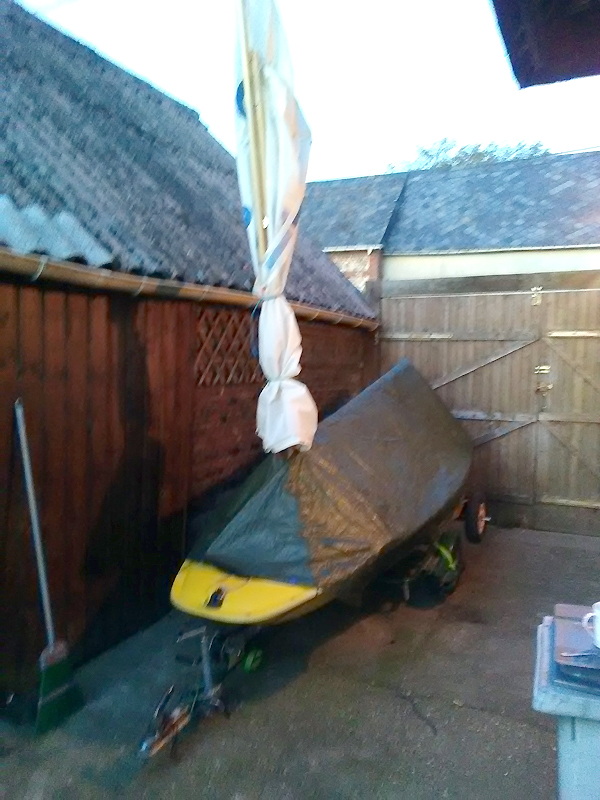
An inspiration came into my mind today, that of pursuing the role of my little plastic Tabur 320 (named Sophia) as a river cruiser, able to go under very low bridges and even be hauled out of the water for getting round obstacles like weirs and rapids. I found that the first boom tent I made for Sarum fitted perfectly. On Sarum, I made a new boom tent because I needed more headroom given that my sleeping arrangement went on two boards that served during the day as extra-width cockpit seats.

The boom tent is held by three elastic cords that go under the hull. For this, the boat needs to be out of the water and on a grassy or muddy bank. It is not like the tent on Sarum designed to be put up whilst the boat is at anchor or moored. Sophia becomes a land tent for the night. That is at least the theory which I don’t imagine trying out before next April or May.

The rowing thwart lifts out and my legs will easily go between the centreboard well and the buoyancy tanks, and I would be on a self-inflating mattress and in a sleeping bag. It is not exactly the Ritz, but a great way to spend a weekend or three days exploring a river before returning to the point where I left the van and trailer. I will no longer sail Sophia on the sea, now that I have Sarum.

Here is the old boom tent in its new application.

The sail and sprit are tied to the mast and the clew of the sail is detached from the boom. The boom is supported by the usual wooden cradle.

At the stern, the tent is left unattached to let the rain drain away freely over the outside of the transom.

Inside, the rowing thwart can be lifted out and placed at the opposite side of the boat from where I will sleep, likewise for the oars and other stuff. My galley box will have to be very small and compact and have a very simple camping gas burner. It has to be severely minimalist! The tent goes nicely over the fore of the boat and should keep the rain out, if necessary with the aid of a small plastic board, perhaps the boat’s centreboard.

Here is the simple arrangement of the boom with the wooden cradle.

Posted in Uncategorized | Tagged | Leave a comment

New Article by Dom Alcuin Reid

As an extension to my articles of the past few days, I was quite excited upon discovering Liturgy, Authority, and Postmodernity by Dom Alcuin Reid, an Australian Benedictine monk in a small monastery in the south of France. I have know Dom Alcuin for more than twenty years, and he published my work on the Tridentine Missal in the T&T Clark Companion to Liturgy (London 2016). He has done a true travail de bénédictin on what is central to his religious life and spirituality, the Opus Dei.

The article is as much philosophical as it is on liturgy and the Roman Catholic Church. By analogy, we could extend it to our reflections on the English Prayer Book and our culture. In one way, liturgy lives in human culture like a fish lives in water – but it is above culture, above the nihilism of post-modernism we all live in nowadays. There comes a point at which post-modern “culture” is insatiable and the liturgy has to go on in spite of its irrelevance. Quite simply, Christianity has nothing to say to about 95% of our white populations in England and western Europe. Christ is above popular culture and fashion as some of us are. I am certainly alienated from the world of “music”, tattoos, horrible clothing and hair fashions, even the ones that were around in the time of my own teens (the 1970’s). Those few of us who are alienated are more like to discover the joys and subtleties of “classical” music, art, literature, humanism and the aspects that can be evangelised by Christ’s message. I once read something by a pseudo-intellectual French bishop calling our time that of the homo technicus, as something distinct from humans in other times. Most of us use technology, and I am no exception, but it is a tool, not the definer of our identity. Some people play with their smartphones all day. To me, it is a tool like any other, a sort of “pocket computer” and “virtual Swiss knife”. That doesn’t prevent me from switching everything off and playing the organ or going sailing in one of mankind’s oldest inventions – the sailing boat. In moral and human terms, I hardly see any evolution in humanity: we are just as good and bad as hundreds of years ago.

Dom Alcuin comes out with a fairly standard understanding of liturgical tradition and more or less adopts the line of Dom Guéranger in regard to attempts to reform or improve the liturgy in the sixteenth and eighteenth centuries. Some of the ideas of the Synod of Pistoia were not so bad, but were set in a general context of “ultra-classicism” and rationalism. Take the mystery away and have stripped-down churches with large clear glass windows, so that everything can be seen by the people, and what is there left in the way of awe and wonder? On the other hand, we Anglican Catholics accept the adoption of an archaic vernacular in the place of Latin, like Church Slavonic instead of ancient Greek.

This article traces some of the realities of the Roman liturgical reform of the late 1960’s under Paul VI. The reminder is interesting, as are the anecdotes of Louis Bouyer. Archbishop Bugnini, the whipping boy of traditionalists, but a “scoundrel” according to Bouyer, seemed to be set on doing about the same thing as Cranmer and later editors of the Prayer Book, writing new eucharistic prayers, abolishing the Roman Canon as an “accretion”, Mass facing the people like in the preaching barns of after 1552 when “God’s Board” was set between the old choir stalls and put away after use. The notion of stability, except what is enforced by neo-conservatism, was destroyed, as was the motivation of increasing numbers of people to go to church on Sundays.

Radical Orthodoxy finds its way into Dom Alcuin’s essay, which is interesting. I find someone like Catherine Pickstock refreshing distinct from the conservative and traditionalist elements in both Roman Catholicism and Anglicanism. She does make the point that is liturgy has to be culturally relevant, it hasn’t nearly far enough. I am no fan of Pickstock, since she is quite “politically correct” and “stuck up” in matters like women’s ordination, but her work should not be ignored. The problem is understanding what defines “modern culture” and how homogeneous it is.

I love the quote from Louis Bouyer: Yesterday’s liturgy was hardly more than an embalmed cadaver. What people call liturgy today is little more than this same cadaver decomposed. It depends where and in which churches and communities, but there is an element of truth in this provocative statement. Both the Counter-Reformation and Reformation liturgies were victims of the same neo-scholastic reductionism and canonical positivism. I find this disease refreshingly absent in the Anglican Continuum, at least generally and taken as a whole. I really do think we have an opportunity to learn and take a different route!

Should the liturgy be unfamiliar? I have seen documentaries about the state of religion in England and people never going to church because that did was not a part of their upbringing. Pickstock’s position seems to contest this assumption: paraphrasing it, liturgy should be counter-cultural, another world. Therefore, the liturgy is absolved from having to be relevant, but humans of any age are invited to discover this new world outside their normal experience. It is like sailing up a river not knowing what is round the next bend, but on a higher plane.

My experience of the traditionalist Roman Catholic world was more than twenty years ago. The Institute of Christ the King is a lot more numerous than it was when I was with them, going by their website. It is impressive, though I would no longer be taken in by some of the sophistry, worldly wisdom and social graces it involves. Their being given the use of churches in England, America, France and other countries is impressive. It gives the impression of an artificial world, as perhaps we Continuing Anglicans do. They have the money and the support of some very wealthy benefactors – it’s quite frightening. Their origins were quite humble, as I remember from 1990 when I went to a place I had once visited when it was a Benedictine monastery. It was in a sad state, and we worked hard to do something with it. Since my departure, the buildings have been completely restored, and there is nowhere else you will find the glories of baroque liturgy! I don’t harbour any bitterness: I simply wasn’t made for their image of the Catholic priest.

Will the ministry such priestly institutes do the trick in the way of drawing the masses? No, they will attract people from certain conservative and aristocratic strata of society, the military and Catholic families of Versailles living in houses worth more than a million euros. The prevailing political ideology is highly characteristic. I once saw a seminarian rebuked for expressing neo-Nazi ideas, but the general idea is nationalist and conservative – Tradition, Family, Property. I am not a left-winger, but I find that kind of conservatism stifling. So, the traditionalist churches are well attended, but by the same kind of bourgeoisie as in the nineteenth-century post-revolutionary era. Has much progress been made?

Monasteries seem to give a gut-feeling of something more authentic, more concerned with spiritual life than social status. It is not without accident that someone came up with the notion of a Benedict Option. On the other hand, how can anyone other than monks in a community live it to the full? There is a notion here of making people relevant to the liturgy rather than the other way around. It may seem unorthodox of me, but I don’t think we are called to get masses of people into churches. The problem is that the clergy need their money to pay for magnificent churches and visibility. I don’t think that is a problem, because we just have to downscale to the reality. Christianity will disappear in the western world, at least in its Catholic and sacramental form. Will it survive in a fundamentalist Protestant form? Apparently the Bible-bashing and sweating Baptists in America’s Bible Belt are on the wane. Mega churches? Perhaps they are little more than a flash of magnesium. Liberal civic religion? For as long as they have money. Should we persist or give up? I think we should persist knowing that the odds are stacked against us, and that grace is costly (thinking of Bonhöffer). I’ll go on celebrating Mass and Office alone in my chapel, knowing that no one cares two hoots. My ministry is what I’m doing now – writing and offering ideas to advance the quest for knowledge and clarity of mind.

Dom Alcuin is a Roman Catholic and preaches to his own choir. That is to be expected, and we Anglicans can read analogies from his ideas. We Continuing Anglicans are much less affected by positivism in canon law and theology than the Roman Catholic world. We are more approximate and less concerned for precision. Our ambiguity around the subject of the Prayer Book can be exasperating, but I would prefer that to some of the paralysing teachings and beliefs in the Roman Catholic world. Imagine what I would have to go through as a Roman Catholic priest to celebrate in the Use of Sarum! I would be stonewalled at every turn as happened with Fr Sean Finnegan who was celebrating Sarum masses in Oxford in the 1990’s. Positivism and neo-conservatism created a situation analogous with that of Cranmer’s Prayer Book that canonised copyist’s and printer’s errors like in the Gloria and the Nicene Creed. It is all graven in stone, and Benedict XVI trod on a viper’s nest!

Given these reflections, Dom Alcuin’s article is of great interest in these hermeneutical guidelines – meaning in plain English our perspectives of interpretation as readers which are different from those of traditionalist or conservative Roman Catholics. For decades, polemicists have drawn analogies and comparisons between the Cranmer reforms of 1549 and 1552 and the Pius XII / John XXIII / Paul VI and Bugnini reforms of 1950 to 1969. The historical circumstances are totally different as are the theological views of the sixteenth-century Reformers and the “liberal” RC establishment as it formed in the wake of Vatican II. There was a certain amount of neo-Jansenist influence, but really that of deconstructionist and nihilistic philosophy. Such comparisons are more unhelpful than helpful in our understanding.

Read the article and look for its original points.


Posted in Uncategorized | Tagged , , | 4 Comments