More Light from Archbishop Haverland

Mea culpa! I keep neglecting his splendid blog. Please read his Charge to Synod from earlier this month. I really do hope I will have the opportunity of meeting Archbishop Haverland one day.

Posted in Uncategorized | Tagged , , | Leave a comment

Reflections on the Prayer Book

My brother in the priesthood Fr Jonathan Munn has written some reflections on the Prayer Book in Why I don’t use the Book of Common Prayer. That is certainly a provocative subject, especially with our American brethren identifying as Anglicans, Anglican Catholics, etc. We need to unpack things somewhat, since both of us are English, and have emerged from a particular tendency within Anglicanism that finds an insoluble problem with some aspects of the the Prayer Book (officially the 1662 in the Church of England) that are none other than aspects of the Reformation and the historical war against “popery”.

At the same time, we identify as Anglicans because this is our spiritual background as cradle Anglicans. We are not Swiss Calvinists, Lutherans, Roman Catholics with that Church’s polemical Counter-Reformation patrimony. We are not Old Catholics, since we have never been concerned with the problems between Jansenists and Jesuits in the early eighteenth century, or German-speaking university professors and historians protesting the aberration of papal infallibility in 1870. We grew up in a Church that evolved in history from the Reformed / Roman Catholic polemics, and this history involved Romanticism and its effect on religion in the nineteenth century. There was a movement in the wake of the Oxford Movement seeking the possibility of using pre-Reformation western rites like Sarum or revising the Prayer Book like the proposed book of 1928 that did not make it through the British government.

The English 1928 did get a certain amount of use, since Anglo-Catholic vicars were rarely in complete obedience to their Evangelical bishops, and did their own thing. The 1960’s and 70’s brought us Series I and II, and Series III was the first set of services in modern languages with the abandonment of the archaic Prayer Book style with thees and thous. After that came the Alternative Services Book in 1980 and now there is Common Worship which represents the kind of generic watered-down Christianity that fails to attract many of us.

The Continuing Anglican Churches tend to define their identity by fidelity to the Prayer Book, qualifying this idea with a reference to the Affirmation of St Louis and various authorised Eucharistic rites like the English Missal and the Anglican Missal, substantially the Roman rite of Pius V with the use of the Prayer Book cycle of Sunday collects, epistles and Gospels which came from the Norman / Sarum tradition. In a discussion with my Bishop, he expressed the notion that I could be justified in using Sarum because it is an Anglican rite, the official one during the time from the break from Rome of Henry VIII to the first Prayer Book of 1549. My using Sarum remains a tolerance and has had absolutely no influence in the Diocese to which I belong. I respect my Bishop and fellow priests, and let things be.

For the Office, my usual custom is one of three easily used books, especially when travelling. The Monastic Diurnal with the Prayer Book translation of the psalms, the collects and cycles of Sundays after Trinity (not after Pentecost), The Hours of Prayer (…) compiled from the Sarum breviary and other rites (Mowbray 1933) likewise containing the Coverdale Psalter, or the English Office Book, which is the official Prayer Book Office requiring the lectionary, usually the 1922 one in a separate book.

I usually say Mass in English using the Warren version of 1911, inspired by the Prayer Book style of translation from Latin, but sometimes I use the Latin Dickinson version which is a little more awkward to read from the facsimile book I have (even with my oculi de vitro cum capsula). However, the edition is carefully done and contains the biblical readings.

That is about all I ever do as a priest, since I have no stable congregation in the place where I live. So, in practice, I use parts of the Prayer Book like the Coverdale Psalter and parts of the Eucharist which are straight translations from the Sarum Missal like the Gloria, Credo, Sanctus, etc. There is a general and constant reference to the Prayer Book even though my liturgical practice is essentially pre-Reformation and pre-Counter-Reformation. As I mentioned in a comment in Fr Jonathan’s post, we cannot refuse the current of history and live in the past, but we can find our reference and inspiration and bring them to life in our own time.

I don’t like discussing these things very much on Facebook, since there are many emotional and aggressive reactions. The same can happen on a blog, but comments are more likely to be reflected and less polemical. This blog has arrived at this maturity given its age and constancy. Those who don’t agree with me have the option of not reading my articles or expressing themselves with kindness and courtesy.

Fr Jonathan is more “Roman” than I am, but he is inspired by the monastic patrimony as I am. It is safe to say that he and I are “northern” Catholics, less concerned with “devotions” than with the liturgy of the Mass and the Office. Spiritual reading and meditation are important, and the Rosary is a part of our western tradition without the more dire warnings and systematisation of nineteenth and twentieth century Roman Catholic piety.

Reformed liturgical rites always depend on imperfect scholarship and are sometimes influenced by ideology as happened in the Anglican Communion and the Roman Catholic Church alike. My use of the Sarum missal and office symbolise for me the idea that I have invented nothing and have nothing to invent. It represents a weight off my shoulders. For me, experimenting with the Novus Ordo and the Prayer Book, arranging things at my own initiative, represents an eternal dissatisfaction and instability. Is it our liturgy, or that of the Church?

Fr Jonathan and I are cradle Anglicans, but other influences made a staunch Prayer Book and nothing but the Prayer Book attitude impossible. I was a convert to Roman Catholicism for about fifteen years and had a “pre-conciliar” training at Gricigliano after being in some other places and university. To paraphrase Léon Bloy, we can transcend our experience but we cannot erase it. The Prayer Book essentially gives us our Psalter which is gradually committed to memory in the manner of the monastic way, and it gives us our musical tradition. As Fr Jonathan observes, I found it a book that pointed outside itself, as you would expect a book of prayer to do.

The Protestant polemics inherent in the 39 Articles and the mutilated Eucharistic rites represent a brick wall. Brick walls can be demolished, climbed over or gone round. The genius of the Prayer Book is its expression in early modern English with all the idiosyncrasies of a culture that is not our own, reflected in the deeper recesses of the legal profession and our Englishness. It is a cultural monument in that sense, and influences the translation of the Roman Canon in the Anglican Missal.

I read something a few days ago about the Continuing Churches lacking an academic tradition. Since the 1970’s, we have been more concerned with survival in the face of criticism and ideology from our adversaries. Priority has been rightfully given to the foundation of parishes. Less was given to the systematic training of priests by means of seminaries than in the traditionalist Roman Catholic world. Perhaps people like Fr Jonathan and I, not living in a situation where we would be occupied in pastoral ministry, would begin to emerge as researchers and writers. Neither of us depend in any way on a university and academia, but the internet has enormously facilitated our access to books without travelling to major cities to consult libraries. Academic work requires considerable self-discipline and asceticism, rather like the contemplative monk – and such a vocation is difficult to reconcile with family life especially when there are children. The priest-scholar is an important vocation in the Church, and those of us so called can bring a whole new dimension to the Church we serve as priests.

The work being done on reviving the Sarum Use is perhaps more active now than even the mid nineteenth century. I particularly salute Dr William Renwick, who is primarily a musicologist. I have a group on Facebook – Use of Sarum, which now has 689 members. Few are liturgical scholars, and most are curious lay Christians, but I get several new members each week. Something is happening, and the flame is being kept alight. Perhaps the time has not yet come for Sarum to be of pastoral relevance in parishes presently using the Prayer Book and the Anglican Missal. I am confident that it will become an option when there is a feeling of “something missing”, of dissatisfaction and instability. Already, our Continuing Church has shown enough tolerance and breadth to create this potential. In the meantime, we need to continue our studies, research and editing work to produce books in both Latin and English (Prayer Book influenced).

We also need to know more about the reality of the English Church in the early sixteenth century. Can we trust Eamon Duffy’s evaluation expressed in his The Stripping of the Altars, or was there more corruption and superstition eroding monotheistic orthodoxy? Popular religion in Latin countries continues to give English and other northern Europeans a lump in the throat – with things like the Santa Muerte in Mexico and the wild excesses of Palmar de Troya in Spain. Fatima also takes some swallowing, when people are seen walking on their knees in heroic penance. I would not want to stop people doing what they believe to be right, but would I do it?

We certainly need to work on this dilemma of the Prayer Book being a monument of Anglican identity, but that we need to recover the pre-Reformation rites. In the past I have written on retro-futurism and things like steam-punk. Is it legitimate to speculate what might have happened had Cranmer contented himself with translating the missal, the manual, the breviary and the pontifical into the English of his era? Can we imagine monastic-inspired parish religion without the excesses of dripping devotion? In terms of academic history, anachronism is a serious sin. On the other hand, if it is a way out of a dilemma often exploited by Roman Catholic polemicists and “true church” fanatics, what bad can come out of it in pastoral and missionary terms?

I will do my best to contribute what I can, knowing my own limitations in academic terms. I pray that the movement will continue and develop, and draw a new Romantic movement to Christ and worship in the beauty of holiness.

* * *

Following the publication of this article, another priest of our Diocese, or rather of our European Deanery, has posted his own input in To use or not to use …? It is very important to think of those of us who are not native British like Fr Jonathan, myself or our Bishop. Alongside Fr Gregory Wassen who is Dutch, we have in our Diocese Fr Jeen Thomas who is Indian. He had been a priest of the Syro-Malabar Catholic Church of India (Part of the Roman Catholic Church) and joined the ACC quite recently. He has learned to use the Anglican Missal rite for Mass and now serves our parish in Rochester. Like Fr Wassen, I have a chaplaincy outside England, but only very occasionally minister to French people. Fr Wassen, with his small congregation in the Netherlands, would presumably be celebrating in Dutch unless they are happy with worshipping in English. The liturgical language represents a huge cultural difference, and I have never been satisfied with any attempt at translating the liturgy into French. Is Anglicanism more than a thin veneer, as our Roman Catholic and Orthodox critics often suggest to render our position precarious. Fr Jeen came to us from Eastern Rite Roman Catholicism and Fr Wassen had been ordained in Western Rite Orthodoxy in the USA.

This fact suggests that the ACC is large enough to go beyond the limits of ethnical Englishness or Americaness! What makes the Anglican Catholic Church Anglican? When we are in English-speaking countries or ministering to English expatriates in another country, the kind of language we use is archaic and to some extent taken from the Prayer Book or formulated in the same early modern English idiom. In a way, it is our “church slavonic”, being closer to our modern vernacular than old Greek or Latin. What do we do when ministering to people of languages with no long tradition of vernacular liturgy? The Germans have Luther’s language and translations, and high-church Lutheranism is something quite special. The French and Italians have no vernacular tradition, and Roman Catholics in those countries have their liturgy in modern language translations. The only music that goes with those translations is of modern composition of good or poor quality. The culture is vastly different when only the language is considered.

How about using Latin? It is not exactly something you can do with people who are not used to it. Roman Catholic traditionalists usually come from a pre-conciliar background and have consciously refused the reforms of the 1960’s. Then, is Anglicanism outside the English-speaking world nothing more than Old Catholicism? What is Old Catholicism? This is an idea that could appeal to the Dutch. In that country, it isn’t a matter of German and Swiss Liberalism and university professors protesting against theological novelties. It is essentially Jansenism in the most positive meaning of that word. In the early eighteenth century, the See of Rome left the Archdiocese of Utrecht without an archbishop for many years as a punishment for harbouring French Jansenists fleeing persecution in France under Louis XIV. Jansenism was not merely a kind of “Catholic puritanism” interpreting Saint Augustine in a similar way to Calvinism, but sought to recapture the Church of the Fathers and the early medieval period. The Archbishop of Utrecht in 1725 was consecrated uncanonically by a French missionary bishop by the name of Dominique Varlet (1678-1742) and that little Church found itself in isolation until it united with the Swiss and German Liberals in 1889, thus forming the Union of Utrecht. Using a little “retro-futurism”, I don’t see why an Anglican mission in the Netherlands could not be inspired by the early ideas and practices of the exiled French Jansenists of Utrecht. The Dutch notion produced “Old Roman Catholicism” coined by Archbishop Arnold Harris Mathew from his consecration in Utrecht in 1908. Also see the less positive evaluation by Peter Anson in Bishops at Large for a balanced view. There was a certain collusion in England in the early twentieth century between some Anglo-Catholics and the Old (Roman) Catholic movement. Unfortunately the Old Roman Catholic movement proved to be extremely unstable like some moments in Continuing Anglican history and in more marginal traditionalist RC circles. In England, Archbishop Jerome Lloyd seems to be doing very good work in Brighton in a humanitarian context, undeterred from being daring and unusual. I am not opposed to there being some collusion between Anglican Catholicism and Old Roman Catholicism. Apart from the names, there is little more than a difference between early sixteenth-century England and eighteenth-century France. Culturally, in spite of the difference of language, the two are based on Northern French Catholicism rather than Latin Ultramontanism. That is a start.

There is the monastic dimension, but we should not forget that Henry VIII deep-sixed the monasteries in England and, after 1549, there were no monks involved in the formulation of the Prayer Book in its less radical and more radical versions of 1549 and 1552. Benedictine monasteries in France (Solesmes Congregation) use the Roman rite (1962, 1965 and / or Novus Ordo) and the Monastic Office. The order of psalms is much better than the buggered-up 1911 Roman Breviary of Pius X. Perhaps, the Prayer Book Office is a little “monastic” in that it has preserved the Office in cathedrals and parish churches whilst Roman Catholics only know Sunday Vespers and Benediction, which has been increasingly rare since the baroque era. That is little to go on to call the Prayer Book “monastic”. What it has going for it is the beautiful translation of the Psalms (Coverdale).

Our identity seems essentially to be Norman Catholicism that entered England via the Conquest of 1066, and that is a shared root between the Old Roman Catholic idea and Continuing Anglicanism. The alternatives are Counter-Reformation / Novus Ordo Roman Catholicism based on Jesuit influence, the Western Orthodox experiment that has known little success except in a few places (especially in the USA) and Protestantism. Perhaps high-church Lutheranism can find things in common with the Norman Rotomagus / Sarum based tradition living in small Old Roman Catholic and Continuing Anglican jurisdictions. I hope this tradition will be further studied and understood in affirming our identity in relation to the alternatives I have just mentioned. Fr Wassen has unknowingly guided my thought along these lines.

It is for this reason that I would love to see a gradual return to the French and Norman tradition rather than the Franciscan-Roman-Germanic tradition which is foreign to both Anglicanism and Old Roman Catholicism – even if many of us are using what is substantially the Pius V Roman liturgy. I respect what I find in my Church, and I am grateful to have a spiritual home in it – but my idea stands for any who would like to study it and develop its meaning for our Church and others with which we are very close.

There is also a question of pastoral relevance. We would be hard-pressed to find ordinary English people interested in Sarum or ordinary Dutch people interested in Dutch Old Catholicism of before the Union in Bonn of 1889 and the débâcle that repelled Archbishop Mathew. We need to develop these themes and help ordinary churchgoers to understand something about them, and thus to build their sense of identity on something as solid as the Byzantine tradition for Greeks and Russians. It is a long shot, and I believe that Christian tradition has evaporated. It is gone and our Churches and aspirations will dwindle and die. We are incredibly marginal, but an idea keeps us alive.

Why not bite the bullet and go Roman Catholic or modern Anglican? The reason is simple. There is more to Christianity than belonging to this or that mainstream church that is more or less emptied of its meaning. The only real alternative left is atheism or the quest for some kind of “spirituality” by which we dispense ourselves from any allegiance to an institutional Church of any kind. Does it have to be all-or-nothing?

This is something we have to decide for ourselves, as did the Romantics in their time when faced with the evils of the late eighteenth and early nineteenth centuries. Something was revived by the bookworms of Europe’s university libraries and priests living a quiet contemplative life away from the polemics of the ignorant. We can do the same thing today and plant the seeds for those who be on this earth long after we are gone. If we have done something, then we have hope

* * *

There is a precious dialogue on Facebook, which I would like to preserve, given the fleeting nature of anything written on Facebook. This is quite fascinating.

Gregory N Blevins: Interesting pieces all around. They do raise the question of the extent to which the products of the Reformation, especially classical Prayer-Book Anglicanism, are actually products of the Western Roman Catholicism as opposed to being rooted in the universal tradition from which the Western Church separated itself in the 11th Century.

Or is that a bridge too far?

Gregory Wassen: I do not think the case for the Prayer Book being rooted in Western Roman Catholicism is a strong one. A case could be made insofar as Cranmer smashed up the Old Liturgy and used the pieces to create his own liturgy. So the the building blocks of the BCP are “Catholic” but the edifice Cranmer constructed with it is not necessarily so. Though I would immediately want to add that the BCP can and is being forced into Catholic service by many Anglo Catholics.

Anthony Chadwick: For me it is clear that Protestantism has its roots in the Franciscan movement against the obscene wealth of the clergy in the 13th and 14th centuries, especially in the various groups like the Dolcinites and the Fraticelli. Then there were Wycliffe and Hus, perhaps some remote influence from the Cathars. Philosophically, we are looking at Nominalism that refuses the Universal Idea of Plato and sees only the reality of the particular. That carries a lot of consequences. It went very deep, and the reaction against the corruption of Rome and the bishops was understandable. Unfortunately, Catholicism has always been a balance between monotheistic orthodoxy and a kind of Paganism that “inculturates” the purity of the Judeo-Christian faith on the ground. Therefore the need for a liturgical, symbolic and sacramental life. There was good and bad in “unreformed” Catholicism, but I think it was preferable – in hindsight – to anything that was reformed either by the “Taliban / ISIS” of the time or the Jesuits! If left alone, things can “heal” themselves, but being under a corrupt bishop musn’t have been anything pleasant especially with his Inquisition littering things up with their torture chambers!

Gregory N Blevins: Much of classical, confessional Protestantism is, I think, a REACTION to the Western Catholic tradition. But as Khomiakov reminded us, both X and -X are still “X” in Algebra. I see this also with regard to Arminianism vs. Calvinism. (Or Abelard vs. Anselm on the question of how the death of Christ saves us.)

I think one fundamental issue, liturgy perhaps aside (as if that were possible), is that the question of the human will never became problematic in the East.

Gregory Wassen: Suppose X is the West and -X is the East? 😉

Gregory N Blevins: Gregory Wassen LOL. Is that demonstrable or is the West “X” and the East “Y”? I think the latter is more likely. Augustine seems to have been pretty cut off from the Fathers of the East that came before him, and, of course, for good or ill, Western theology since Augustine since is “a series of footnotes on Augustine”.

And where do you think Origen fits here?

Anthony Chadwick: Talking of Origin and St Clement of Alexandria, they were inspired by Gnosticism but did not go to the excess of Valentinian. Some have tried to find traces of Gnosticism in early forms of Protestantism, but I think it is something of a stretch. Protestantism was fundamentally anti-clericalism without atheism – get rid of bishops and priests, and you get back to the Acts of the Apostles. Yeah…

Gregory Wassen: I think Augustine is awesome. He and I disagree at times, but I think basically he is not at all as far removed from the Eastern Fathers as some have claimed. Quite the opposite. I would even want to suggest that the East is in dire need of some more Augustine ! Origen – whose homilies were read in the Octave of the Holy Name – and for some Marian Feasts in the west fits in well ! I also think that Origen ought to be read as combating heretical gnosticism and I think it can be demonstrated that Nicene Orthodoxy and Capapdocian Orthodoxy are dependent on him. Iow I think there are some basic agreement between Origen and Augstine. But Origen is the better exegete and theologian.

Gregory Wassen: I mean the Nicene “consubstantial” is found in Origen as well as the emphasis on the “Persons” of the Trinity.

Gregory N Blevins: Somebody has recently suggested that Augustine was “awesome” in his early years and later, not so much when his primary activity became the battle with Pelagianism.

It is not always easy to what problems come from where (was Nestorius really a Nestorian?).

Gregory Wassen: Well … Yes. About Nestorius that is 😀 I think Augustine needs to be read as a Neoplatonist. It puts different spin on things. But essentially the Augustine engaging Pelagius is the Augustine I find myself disagreeing with ….

* * *

To that last question about Nestorius, I remember my dogmatic theology professor, Fr Jean-Pierre Torrell OP, asking the same rhetorical question.I do know that many problems were resolved between the Coptic Church and Rome by giving a better analysis of some of the Greek theological terms used by the Council of Chalcedon. Many problems are caused by bad use of language!

This article has become very long, and perhaps I should carry some themes forward to future postings. St Augustine’s theology is indeed complex, but reflect a certain pessimism about human nature. Bitter experience of life and age do that to many of us! In spite of our desire to be optimistic and humanist, we find the old theme coming back about the three sorts of humans: spiritual, intellectual and materialist. No one is fixed in any “category”, because there is divine grace and the fruits of self-knowledge, but many people we come across in life leave us without much hope. There were excesses in Jansenism like the “pure” nuns of Port Royal, but I do think there was something very positive set in the context of the Counter-Reformation and the laxism of the Jesuits. A sin is a sin, and we have to face it square on, not beat about the bush. There is the element of integrity, but also the notion of having something cleaner and tidier than the busloads of Italians and Spaniards in Fatima and Lourdes among other places. We can debate these these things forever, but we need to reflect and read, get beyond the stereotypes and prejudice which I too suffer when I am ignorant about something.

To be continued in future postings.


Posted in Uncategorized | Tagged , , , , , | 11 Comments

Sarum Ordo on Android

I am fairly new to the art of using a smartphone, which I call my “pocket computer that happens also to be a telephone”. I am of a generation (born 1959) that knew the pocket calculator as the nec plus ultra of modern technology. Calculators are now sold for an amount that a child can afford from pocket money – and still have enough to buy sweets! I don’t play games, but I have quite a few applications like sea navigation, road navigation, tides, weather, detecting ships at sea through their AIS signals, internet, Kindle with various books I don’t have in paper form. The possibilities are endless, depending on what interests you.

I have discovered a way to consult the Sarum ordo on my smartphone:

Go to More Documents on Dr William Renwick’s site The Sarum Rite. Download the Ordo of the desired year. Kalendar 2017 is valid until 31st December 2017, by which time Dr Renwick will have produced the Ordo for 2018. Download it onto your computer.

Open a link between your computer and your smartphone, usually via the cable you got with the smartphone for recharging the battery and transferring data. Put the pdf file into a suitable directory on your phone’s SD disk. Go into the directory via “My files” and touch the filename. Touch “share” and choose Kindle, having already installed Kindle on your smartphone. After a few seconds, the ordo will be visible on your Kindle screen offering you the choice of books you have. You can then read and bookmark the ordo at the place you want, so that you don’t have to search for the date each time, just like any Kindle book.

It will appear very small on your phone’s screen, so you will need to view it in landscape rather than portrait. You then finger it around as you need to.

There are applications for the new and old Roman calendars, which you can download once they become available in November. But, this is a way to bring Sarum into the twenty-first century! The dates are given following the Gregorian Calendar, even though it was only introduced in England in 1752. This is an example of practical reality against a narrow view of authenticity.

I found this timeline also on Dr Renwick’s site. I reproduce the nineteenth and twentieth century up to our own time part, which is illuminating. With this much interest, I hardly see the Use as being dead!

1836: John Henry Newman, ‘The Roman Breviary as Embodying the Substance of the Devotional Services of the Catholic Church’ (Tracts for the Times)

1842-43: Portiforii Sarum (Seager).

1846: The Ancient Liturgy of the Church of England; Monumenta Ritualia Ecclesiae Anglicanae. (Maskell).

1849-54: The Church of our Fathers (Rock).

1850: The Psalter Noted (A Manual of Plainsong) Helmore.

1851: Hymnarium Sarisburiense; The Hymnal Noted (Neale).

1852: The Psalter (Chambers); Medieval Hymns and Sequences (Neale).

1861: Hymns Ancient and Modern.

1861-83: Missale Sarum (ed. Dickinson).

1862-1878: extensive restoration of the cathedral by G. G. Scott.

1874: Breviary Offices (Neale).

1877: New Willis organ; Divine Worship in England (Chambers).

1879-86: Breviarium Sarisburiense (Procter).

1881: Hymns Ancient and Modern

1882: Processionale Sarum (Henderson).

1884: The Sarum Missal in English (Pearson).

1894: Graduale Sarisburiensefacsimile.

1898-1091: The Use of Sarum (Frere).

ca. 1900-1930: Palmer editions of the Sarum Use in English.

1901: Ceremonies and Processions (Wordsworth).

1901-24: Antiphonale Sarisburiense facsimile.

1906: The English Hymnal.

1911: The Sarum Missal in English (Warren).

1912-13: Old Sarum Cathedral foundations excavated.

1916: The Sarum Missal (Legg).

1971: The Processions of Sarum (Bailey).

1984-99: The Use of Salisbury (Sandon).

2006-: The Sarum Rite (Renwick).

2008: New font installed in Salisbury Cathedral (located several bays to the east of the original font).

2011-13: The Sarum Customary Online (Harper).

Posted in Uncategorized | Tagged , | Leave a comment

Fine Sailing

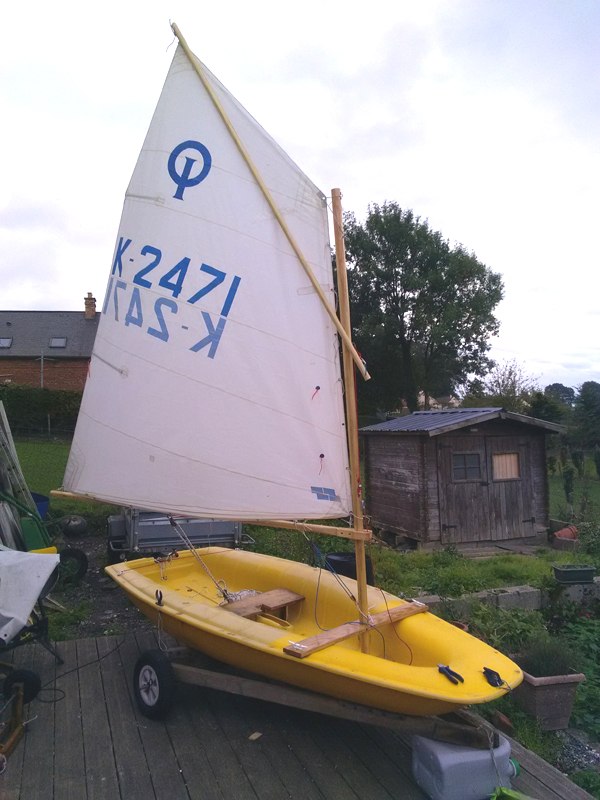
I took my smaller of the two boats out on the Seine, the one which has just undergone a re-rig. I launched from Poses, from the slipway that is closed with a padlock and a bar. Sophia , unlike Sarum my sea boat, is so light and made of plastic that she can be tipped off the launching trolley and down the grass bank and into the water. It then suffices to bring the boat to the bottom of the slipway the other side of the locked barrier, which seems to be there to penalise all boaters for the nuisance caused by a few jet skiers. I then loaded the rig, centreboard and oars on board, put on the rudder and I was off by rowing against the wind and the fluvial current. I was going to have to earn my downwind sail. With eight-foot oars, I made good progress towards the narrow parts of the Seine upstream. I stopped a couple of times for my little picnic, usually using people’s private slipways and pontoons – ready to move on if asked to do so. One riverbank house owner seems to be in admiration of someone rowing rather than using an engine, and offered me a drink. “Very kind, but I have what I need in the boat”. I rowed on to get as long as possible a sail in the limited time available.

The sail was enjoyable in the fresh wind coming from the outer reaches of Hurricane Ophelia. France was safe from what caused such havoc in Ireland, but the eerie clouds and high atmosphere fog of Sirocco dust rose gradually in the afternoon, making the sun go red. The new rig with the old Optimist sail came into its own. Inland wind is not constant like at sea. There is turbulence and sudden changes of direction as it is deflected by trees, buildings and surrounding land. A puff one way, and then another way like on the little lake where I did tests some days ago.

During my Laser course at the Glénans in August 2009, we were very well taught techniques of ghosting and what I might term as “micro” sailing. Doing tiny tacks and gybes, weaving in and out of moored boats, rather like people learning the fine art of motorcycling, the training made a big impression on me. The skill isn’t in speed and strength but finesse and accuracy. I applied many of these lessons yesterday.

The first thing was to remove the pulley from the boom and tie the mainsheet directly to the shackle attached to the boom. No force is needed, nor is pulley tackle needed like on a larger rig. You just hold the line in your hand and feel the wind in the sail. When tacking and gybing, you don’t wait for the boom to whack you over the head – you pull it across by hand at the right time just at the limit of sailing on the lee.

This kind of minimalist “micro” sailing appeals to me as I begin to explore the rivers and gunkholes near where I live. There are a few rivers either side of the Seine estuary, like segments of the Eure – even though there are weirs and fast-flowing water in places – more conducive to canoeing than in a sailing and rowing dinghy. Some rivers are tidal and can be navigated both ways on the tide with some astute organisation of time. Fresh water rivers have to be explored in segments unless there is a way round the weirs.

It isn’t just a way of “been there, seen that”, but a contemplative way of spending a day off alone. Nature is at its least disturbed near rivers that are inaccessible to motor boats because of hyper-low bridges that are no longer an obstacle to Sophia. It is an advantage to take a pair of binoculars to observe the wildlife and birds, seeing them without frightening them away. I have been greatly inspired by duck punting, which is sailing reduced to its most simple expression. It is also possible to extend the sailing season into the winter in this way and experience new waters. For example, in some places, large areas of land become flooded. When the rain and wind are over, the boat can sail in only inches of shallow water and a great time can be had. I have even seen duck punts sailing down flooded roads with cars of imprudent drivers bogged down and a cyclist with half his wheels under water!

Again, on landing, I had tremendous satisfaction at beating the locked slipway barrier. I took out the rig and oars and laid them on the ground. I hauled the hull up the grass bank and onto the launching trolley. It was a pleasant way to spend a day…

Posted in Uncategorized | Tagged | 6 Comments

The Numbers Game

I would appreciate  help in finding elements of an answer David Llewellyn Dodds’ question “Without giving undue weight to the matter, I would be interested in knowing the membership/average attendance numbers of the seven Continuing Churches being discussed, should they be available“.

The thought that usually lies behind such questions is “Everybody’s doing it, so it must be right” or that numbers give credibility. It is often an argument used by converts to Roman Catholicism seeking validation in their choice. Mr Llewellyn Dodd has always been rather more interested in things from an academic point of view and is discreet about his personal life and choices, so there is no finger pointing towards him. On the contrary, I appreciate and esteem his precious input.

Should we become Roman Catholics following the example of John Bruce and others, and put social conformity before everything, or knuckle up under the other mainstream denominations on pretext of their being more numerous and wealthy? The question might evoke self-justification or anger, but I put it rhetorically in this reflection. There are many justifications to any choice, but very few from more personal considerations such as belief or taste. If we English-speaking people seek the truth in the majority, then the “truth” is atheism and “post-modernity” (nihilism).

Various bits of information can be found about statistics in the Church of England, the American Episcopal Church and Roman Catholicism in the white Anglo-Saxon world and Europe. Figures are plummeting. Any kind of church-going is marginal and goes against acceptable social mores.

More evangelism? What is evangelism? – a sort of door-to-door marketing strategy (or by telephone) that invades people’s lives and make them ever more sick and tired? What about downsizing the church institutions, merge dioceses and parishes? The result is that no one knows where services can be found on any given Sunday, and they give up. More meetings? How boring!

The reality seems to be that decline is not due to liberalism per se, because the conservatives and traditionalists do little better. Roman Catholicism seems to do better because of ethnical groups like Latins, Asians and Africans. Those groups are less interested in endless meetings and wasting money – bureaucracy. Continuing Churches are not (yet) blighted by bureaucracy and idiotocracy! Like Anglicanism in the USA and the UK, French Roman Catholicism is overburdened with infrastructures for which no one is paying. I have had the impression for years that it’s all over, at least for the self-serving bureaucracy and the lovely parish churches which are locked and rotting. The real question is coming to the realisation that everything has to be let go, and then rebuild from scratch.

Another problem is internal conflict, which turns most of us away. This question is highly significant in the recent concordat of unity between the four Anglo-Catholic continuing Churches. Will that reverse the damage done by the conflicts since the Affirmation of St Louis through to the present day? The ACC’s diocese in England was nearly annihilated, and despite Bishop Mead’s professionalism and inspiring spiritual leadership, the rebuilding work is accepted only timidly.

Our Christian faith tells us that the Church is indefectible and cannot die, but that promise of Christ does not extend to the institutions we know. The Church is north Africa, where St Augustine had his diocese, is gone. Only ruins remain and those entire regions are Muslim. A few Christians live in those countries and survive, so this can be seen as evidence of that indefectibility in spite of the loss of the visible structures that one existed.

I don’t think we have got to the bottom of all the reasons why Christianity is in decline. There is also the diminishing rate in Causasian populations. There is doubtless the influence of feminist and homosexual movements, but their repression would do little for institutional Christianity.

Liberal = decline and conservative = growth seems somewhat simplistic and unrealistic. RC traditionalism and fundamentalist Protestatism in America also seem to be in decline.

We continuing Anglicans cannot afford to be smug, not that I have seen any such smugness. There are certain ideas of interest in Rod Dreher’s Benedict Option, though some are more appropriate for North America than Europe. I see the importance of creating situations in which Christian families can avoid being invaded and eroded by secularist “political correctness”. That would be difficult because of the children’s need for education and social interaction outside the family. It is important to create places of worship where Mass and Office are offered whether or not there are any people in the congregation. Is there a form of monasticism that can be adapted to lay people and secular priests who are not living in a clerical or religious community? There must be some way that the Church can live in “survival mode”.

I have always been against “marketing”, which means that we have to accept living in a secular world whose ethics and values are not ours. Our life will be like the persecuted Christians in the Roman Empire or the Soviet Union, purified by fire and kept alive by priorities being in the right places. I read elsewhere there that man is at his least creative when he is comfortable. Synthesis, as Hegel taught, comes from the interaction of thesis and antithesis, a certain amount of conflict and dialogue. This is also important – not the nastiness – but the interaction of opposing ideas to create new knowledge.

I believe this to be the role of our continuing Churches, regardless of how few we are.

Posted in Uncategorized | Tagged , | 7 Comments

Concordat Videos

Biretta tip to Fr Junathan Munn – Concordat!

I can only say – watch the videos and thank God for this historical step. Also see Fr Robert Hart’s Forty Years Long…

Posted in Uncategorized | Tagged , | 8 Comments

Σοφíα is re-rigged

The Oppie sail arrived in the post today, and I finalised the length of the spars and the position of the sprit tightening pulley. I reinforced the mast step in the bottom of the boat and it is nice and rigid. There was enough wind in my back yard to make the sail set using the boom vang and the sprit. There is no cunningham, because the tack is tied to the boom and the boom is down-hauled by the vang. That is the Optimist system, which I have followed. I have a small repair to do on the sail, which is not in bad condition, but was sold to me at a low price.

I like this arrangement without the plastic foredeck, because it allows me to put many of the functional things like my anchor and warps in the bow of the boat and avoid clutter elsewhere. It is all very accessible.

There is a small lake (Lac de Caniel) about 20 minutes away, and will go and put her through tests for weather helm and lee helm. I’ll need to choose a day when there will be some constant wind but not too gusty. When I was at sailing school, we used this lake when conditions were too rough at sea (Veulettes sur Mer), which meant that we had to be careful of violent gusts causing gybes and capsizes. The one uncertain thing is the balance of the boat which would be determined by the mast position. I have guessed it as slightly forward of the original mast position (the Tabur 320 is a catboat). I’ll have my tools in the van to make any adjustments necessary.

I have two church organs (which I moved from England and installed) to repair and tune next weekend in the Yonne (near Sens and Auxerre), so I might have some time to give the river Yonne a try. It is slow flowing between the locks, and wide enough to tack upwind if there are no barges – so that should be quite interesting.

Posted in Uncategorized | Tagged | 1 Comment

A right to health and life?

For as long as I can remember, my father (veterinary surgeon) and my brother (medical doctor) bewailed the state of the National Health Service (NHS) in England. This subject comes up a lot these days because of the American mess surrounding Obamacare and the astronomical cost of health insurance and medical treatment.

I had two hernia operations in 2011 and 2012, and they each cost a couple of thousand Euros to my caisse d’assurance maladie here in France. What we pay for our health care and pension schemes is quite a lot, but we get an excellent service here in France with very little waiting. How long will it last? Macron’s government is planning changes from 1st January 2018 for self-employed workers and the liberal professions, and we are all nervous about what will come out of it.

I have always been deterred from emigrating to the USA by this problem. Need hospital treatment over there and you find yourself in very big debt or left to die because you don’t have the means to pay the full whack. At one time, medical treatment was less expensive, but it was also quackery much of the time. The strain is felt by the NHS in the UK and the various organisations in other countries. Either the sheer weight breaks these state organisations or it has to be shared by taxpayers. The charges are high because we are paying for an increasingly ageing population. The alternative is some kind of Nazi-style extermination / euthanasia programme (!) – or returning to the life expectancy of former eras (which century?).

It is difficult to understand many of the issues hidden under layers of bureaucracy and politics, and we wonder if there is a Christian response. I often wonder where the limit of saving and prolonging life is situated. Would I like to linger on for years with Alzheimer’s or terminal cancer? Could I take the rigours of chemotherapy knowing that it would only give me another six months of life? What is life? What is death? If we believe in the survival of the spirit after death, does it matter? If we are atheistic nihilists, does it matter either? I’m thinking of these things as applied to myself, not to others! On the other hand, who would leave sick children to die if they can be saved and given real hope?

One big problem is that like housing and utilities like water and electricity, they are market commodities and are subject to speculation and the maximisation of profit. Health care is a part of the system. To what extent is it moral for drug companies to multiply the prices of their products for the sole reason of supply and demand? Can it be compared with the housing market in England, which is really unaffordable?

One big difference is the essentially Socialist notion of healthcare in Europe we take for granted against the Liberal notion of things in America where health care is not a right. Americans are expected to have their own savings for health care and retirement pensions. A good question would be one of decentralising health care schemes and regulating the pharmaceutical companies and the medical profession. Could it be done without making the contributions ever more expensive?

Ideas on a level of ethics and morality would be welcome if they don’t concern the American situation exclusively. What are the limits of human life?

* * *

I found two related themes as I begin to feel the autumn close in. The leaves are still on the trees, though starting to change colour, and the weather is still fair enough on the whole for some last outings of the season in the boat. November will be worse, and the world will seem pretty dead as Advent begins, leading to what is usually a feast of hypocrisy, and we Christians try to remember what Christmas is really about.

The first that struck me is Bernard Brandt’s More Notes from the First Circle of Hell. It strikes me that human life has become very cheap. I can’t imagine what Japanese society and culture are like, but I gather that they are cruel people with no notion of the person. The human being is only of value in relation to society and the corporate. Life can get lonely, especially as winter is just round the corner. This is one reason why I have decided to convert the smaller of my two boats into something suited for inland sailing and rowing, so that I can get out for a daysail without depending on the whims of the sea. It is important to get outside, even when we are professional writers fettered to an office stool and a computer. I also have a bicycle, but have to admit to my laziness in regard to physical effort. If I can row a boat, then I can make the effort on a bicycle and get daylight and fresh air.

Bernard Brandt writes quite a harrowing picture on the plight of the homeless in America, vagrancy being treated as a criminal offence rather than for a situation of people who need help. Like medicine and life itself, the poor Lazarus has no rights in America. In Europe, it isn’t perfect, but there is always a possibility of a place to sleep at night and some food, however unpleasant and demeaning that might be. My old friend Patrick Sheridan wrote something quite striking in his new blog The Lady in the Van…, admitting the possibility that he could become homeless and live this life of a living death.

I had a little experience in London in 1978-79, when I had a room at Toynbee Hall, with a soup kitchen in the crypt of St Botolph’s church in Aldgate. We gave them food and clothes, but each enclosed his secret within himself. Some were clearly mentally ill, many with physical problems. A few went to get free treatment at the London Hospital in Whitechapel. There is no less misery today than in the Victorian era. Is such misery a choice? I think that in most cases, it is the result of a sequences of events, a downward spiral – a consequence of bad decisions. My father used to say when I was a child, The world doesn’t owe you a living. You have to go out and earn it. It is reminiscent of the old Victorian work ethic, which is essentially at the bottom of the way things are done in America, but it is true. We either have to struggle and compete in society, or find some way of getting by.

Patrick makes mention of eccentricity, which can mean anything if one doesn’t have a taste for psychiatric labels like Aspergers or some personality disorder. “I may one day end up a vagrant”. I hope he doesn’t, but that he manages to set up a little self-employed business in doing something he does well. I wondered how I would make it once I was out of seminary and the RC system. Beyond one’s mid 30’s, one is not very employable – especially if you have “quirks” and don’t fit into the corporate mould. Orwell also wrote Keep the Aspidistra Flying, which is a portrait of the middle class keep-up-with-the-Joneses mentality of the 1930’s depression era. Patrick encouraged me to see films about Quentin Crisp, above all the Naked Civil Servant. The camp manner exasperates me, but he was being himself, and there was something Christlike in that soul. Crisp also knew when his time was up and flew to America despite his doctor’s orders not to take a plane. I am surprised that Patrick, now a Russian Orthodox, didn’t mention that poignant film The Island – or for that matter The Way of a Pilgrim, St Benedict Joseph Labre or St Seraphim of Zarov. He did mention the fictitious Sebastian Flyte created by Evelyn Waugh, whose particular demon was the bottle!

It helps enormously to keep ourselves free from addictions, including the computer and the smartphone. Some of us are not good with mainstream society, which is not good for a priest! We need to come to terms with ourselves and take life day by day. It is useless to worry about the future, especially when things seem pretty hopeless in many ways. Do not fear death! It will come and in the way we least expect. Most of us will leave this world and become totally forgotten, leaving nothing for others. It is important to engage in writing and art, not to be remembered, but to leave some good in the place of other people’s evil and sin. There is a chance we will be remembered for something good, but the importance of that is relative. How are we with God?

Posted in Uncategorized | Tagged | 1 Comment

Looking for Ships

I’m finding this Looking for a Ship blog quite fascinating in its own right. It is run by Fr C, but it is not clear who this priest is or which institutional Church he belongs to. Perhaps he or one of his readers might enlighten me. I understand his prudence. I only discovered this blog through a posting on Facebook and the postings on the combined Synod in America with the ACC as one of the partners of the new full communion concordat.

His reflections are profound and the result of thought, and this is greatly appreciated. I will be browsing through it for some time. I can’t fathom why I didn’t know about this blog before in the heady days of Anglicanorum coetibus and the various Western Orthodox attempts at getting something stable going. Fr C was certainly one of the more level-headed commentators in those days before the leaden cloak of Francis I (not the sixteenth-century French king) descended upon it all.

Now our Churches are getting together, I hope this will herald a revival of Anglican-Catholic blogging and a contribution to academia and thought in general.

Posted in Uncategorized | Tagged , , , | 2 Comments

Bliss it was in that dawn to be alive…

I quote Wordsworth as he saluted the French Revolution, that is until La Veuve began to drench the streets of Paris in blood! The sentiment can perfectly apply to the news coming from the combined Synod in America.

The much anticipated moment of the week arrived just after 9:00 a.m. on Friday.  The heads of the Diocese of the Holy Cross (Hewett), Anglican Church in America (March), Anglican Catholic Church (Haverland) and Anglican Province of America (Grundorf)(aka the “G-4”) ascended the platform before hundreds of rapt onlookers.  There was silence in the hall as each bishop read a portion of the Declaration of Communio In Sacris amongst the bodies.  The crowd of young seminarians, lay people of all ages, assorted clergy and many veterans of the long years of the continuing Anglican movement in the United States looked on as each prelate signed the documents.

At once the crowd was to its feet in prolonged applause with shouts of “Amen” and “Alleluia”.  There was hugging and no small amount of tears as the emotional dam of 40 years let go.  Then, all of the people burst into the Doxology which reverberated off the walls of the hall.  One bishop allowed that he made it through the first words, “Praise God….”, before the lump in his throat prevented anything further.  In the aftermath, people rushed to have their pictures taken with the bishops and to ask autographs.

The Pontifical Mass that followed, was no less joyful and emotional..  Each of the four bishops took a role in the liturgy, with ++Hewett celebrating and ++Grundorf as the homilist.  The lines of all of the years faded in the face of the Holy Eucharist, and many long-savored enmities seemed to disappear at the Real Presence.  This author was graced to receive the Host from Bp. Paul Hewett, who so many years ago chanted the Litany at my ordination, and the chalice at the hands of Abp. Mark Haverland who has been my Metropolitan for many years.  I could not help but add my own tears to those of many in the crowd as I returned to my place.

Are there more bumps in the road ahead?  Of course.  The Church is filled with human beings.  Indeed, there was great disappointment at the absence of the Anglican Province of Christ the King, which had declined to participate.  We can only pray that a body such as the APCK, which professes the same faith as the “G-4”, will move past its present reticence.  As well, there are a number of technical, ecclesial and canonical issues remaining.  However, this moment proves that, through prayer and perseverance, these obstacles will be overcome, for with God all things are possible.

As the crowd began to dissipate, there was a reluctance to leave such a graced occasion, but folks gradually bade their farewells with a renewed sense of purpose and a new sense of unity.

* * *

Indeed, Bliss it was in that dawn to be alive…

Posted in Uncategorized | Tagged , | Leave a comment