
Biretta tip to Fr Junathan Munn – Concordat!
I can only say – watch the videos and thank God for this historical step. Also see Fr Robert Hart’s Forty Years Long…
Biretta tip to Fr Junathan Munn – Concordat!
I can only say – watch the videos and thank God for this historical step. Also see Fr Robert Hart’s Forty Years Long…
The Oppie sail arrived in the post today, and I finalised the length of the spars and the position of the sprit tightening pulley. I reinforced the mast step in the bottom of the boat and it is nice and rigid. There was enough wind in my back yard to make the sail set using the boom vang and the sprit. There is no cunningham, because the tack is tied to the boom and the boom is down-hauled by the vang. That is the Optimist system, which I have followed. I have a small repair to do on the sail, which is not in bad condition, but was sold to me at a low price.
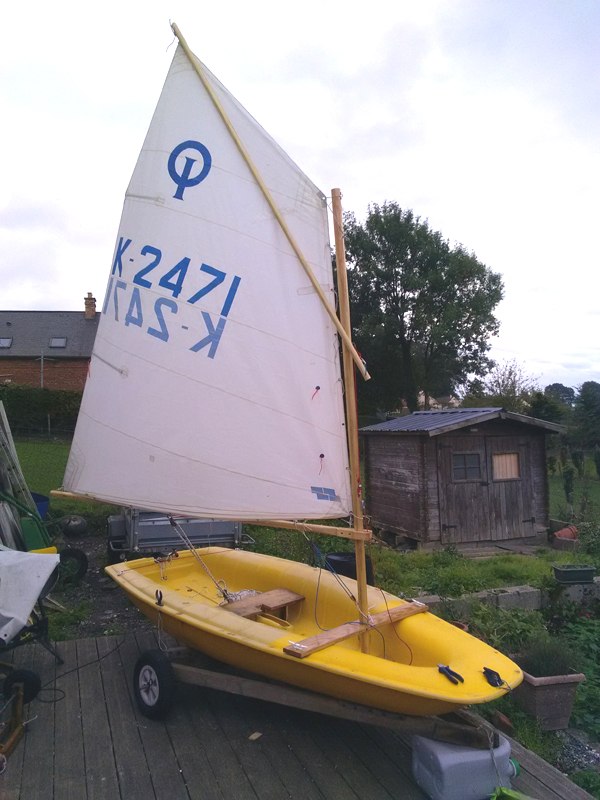
I like this arrangement without the plastic foredeck, because it allows me to put many of the functional things like my anchor and warps in the bow of the boat and avoid clutter elsewhere. It is all very accessible.
There is a small lake (Lac de Caniel) about 20 minutes away, and will go and put her through tests for weather helm and lee helm. I’ll need to choose a day when there will be some constant wind but not too gusty. When I was at sailing school, we used this lake when conditions were too rough at sea (Veulettes sur Mer), which meant that we had to be careful of violent gusts causing gybes and capsizes. The one uncertain thing is the balance of the boat which would be determined by the mast position. I have guessed it as slightly forward of the original mast position (the Tabur 320 is a catboat). I’ll have my tools in the van to make any adjustments necessary.
I have two church organs (which I moved from England and installed) to repair and tune next weekend in the Yonne (near Sens and Auxerre), so I might have some time to give the river Yonne a try. It is slow flowing between the locks, and wide enough to tack upwind if there are no barges – so that should be quite interesting.
For as long as I can remember, my father (veterinary surgeon) and my brother (medical doctor) bewailed the state of the National Health Service (NHS) in England. This subject comes up a lot these days because of the American mess surrounding Obamacare and the astronomical cost of health insurance and medical treatment.
I had two hernia operations in 2011 and 2012, and they each cost a couple of thousand Euros to my caisse d’assurance maladie here in France. What we pay for our health care and pension schemes is quite a lot, but we get an excellent service here in France with very little waiting. How long will it last? Macron’s government is planning changes from 1st January 2018 for self-employed workers and the liberal professions, and we are all nervous about what will come out of it.
I have always been deterred from emigrating to the USA by this problem. Need hospital treatment over there and you find yourself in very big debt or left to die because you don’t have the means to pay the full whack. At one time, medical treatment was less expensive, but it was also quackery much of the time. The strain is felt by the NHS in the UK and the various organisations in other countries. Either the sheer weight breaks these state organisations or it has to be shared by taxpayers. The charges are high because we are paying for an increasingly ageing population. The alternative is some kind of Nazi-style extermination / euthanasia programme (!) – or returning to the life expectancy of former eras (which century?).
It is difficult to understand many of the issues hidden under layers of bureaucracy and politics, and we wonder if there is a Christian response. I often wonder where the limit of saving and prolonging life is situated. Would I like to linger on for years with Alzheimer’s or terminal cancer? Could I take the rigours of chemotherapy knowing that it would only give me another six months of life? What is life? What is death? If we believe in the survival of the spirit after death, does it matter? If we are atheistic nihilists, does it matter either? I’m thinking of these things as applied to myself, not to others! On the other hand, who would leave sick children to die if they can be saved and given real hope?
One big problem is that like housing and utilities like water and electricity, they are market commodities and are subject to speculation and the maximisation of profit. Health care is a part of the system. To what extent is it moral for drug companies to multiply the prices of their products for the sole reason of supply and demand? Can it be compared with the housing market in England, which is really unaffordable?
One big difference is the essentially Socialist notion of healthcare in Europe we take for granted against the Liberal notion of things in America where health care is not a right. Americans are expected to have their own savings for health care and retirement pensions. A good question would be one of decentralising health care schemes and regulating the pharmaceutical companies and the medical profession. Could it be done without making the contributions ever more expensive?
Ideas on a level of ethics and morality would be welcome if they don’t concern the American situation exclusively. What are the limits of human life?
* * *
I found two related themes as I begin to feel the autumn close in. The leaves are still on the trees, though starting to change colour, and the weather is still fair enough on the whole for some last outings of the season in the boat. November will be worse, and the world will seem pretty dead as Advent begins, leading to what is usually a feast of hypocrisy, and we Christians try to remember what Christmas is really about.
The first that struck me is Bernard Brandt’s More Notes from the First Circle of Hell. It strikes me that human life has become very cheap. I can’t imagine what Japanese society and culture are like, but I gather that they are cruel people with no notion of the person. The human being is only of value in relation to society and the corporate. Life can get lonely, especially as winter is just round the corner. This is one reason why I have decided to convert the smaller of my two boats into something suited for inland sailing and rowing, so that I can get out for a daysail without depending on the whims of the sea. It is important to get outside, even when we are professional writers fettered to an office stool and a computer. I also have a bicycle, but have to admit to my laziness in regard to physical effort. If I can row a boat, then I can make the effort on a bicycle and get daylight and fresh air.
Bernard Brandt writes quite a harrowing picture on the plight of the homeless in America, vagrancy being treated as a criminal offence rather than for a situation of people who need help. Like medicine and life itself, the poor Lazarus has no rights in America. In Europe, it isn’t perfect, but there is always a possibility of a place to sleep at night and some food, however unpleasant and demeaning that might be. My old friend Patrick Sheridan wrote something quite striking in his new blog The Lady in the Van…, admitting the possibility that he could become homeless and live this life of a living death.
I had a little experience in London in 1978-79, when I had a room at Toynbee Hall, with a soup kitchen in the crypt of St Botolph’s church in Aldgate. We gave them food and clothes, but each enclosed his secret within himself. Some were clearly mentally ill, many with physical problems. A few went to get free treatment at the London Hospital in Whitechapel. There is no less misery today than in the Victorian era. Is such misery a choice? I think that in most cases, it is the result of a sequences of events, a downward spiral – a consequence of bad decisions. My father used to say when I was a child, The world doesn’t owe you a living. You have to go out and earn it. It is reminiscent of the old Victorian work ethic, which is essentially at the bottom of the way things are done in America, but it is true. We either have to struggle and compete in society, or find some way of getting by.
Patrick makes mention of eccentricity, which can mean anything if one doesn’t have a taste for psychiatric labels like Aspergers or some personality disorder. “I may one day end up a vagrant”. I hope he doesn’t, but that he manages to set up a little self-employed business in doing something he does well. I wondered how I would make it once I was out of seminary and the RC system. Beyond one’s mid 30’s, one is not very employable – especially if you have “quirks” and don’t fit into the corporate mould. Orwell also wrote Keep the Aspidistra Flying, which is a portrait of the middle class keep-up-with-the-Joneses mentality of the 1930’s depression era. Patrick encouraged me to see films about Quentin Crisp, above all the Naked Civil Servant. The camp manner exasperates me, but he was being himself, and there was something Christlike in that soul. Crisp also knew when his time was up and flew to America despite his doctor’s orders not to take a plane. I am surprised that Patrick, now a Russian Orthodox, didn’t mention that poignant film The Island – or for that matter The Way of a Pilgrim, St Benedict Joseph Labre or St Seraphim of Zarov. He did mention the fictitious Sebastian Flyte created by Evelyn Waugh, whose particular demon was the bottle!
It helps enormously to keep ourselves free from addictions, including the computer and the smartphone. Some of us are not good with mainstream society, which is not good for a priest! We need to come to terms with ourselves and take life day by day. It is useless to worry about the future, especially when things seem pretty hopeless in many ways. Do not fear death! It will come and in the way we least expect. Most of us will leave this world and become totally forgotten, leaving nothing for others. It is important to engage in writing and art, not to be remembered, but to leave some good in the place of other people’s evil and sin. There is a chance we will be remembered for something good, but the importance of that is relative. How are we with God?
 I’m finding this Looking for a Ship blog quite fascinating in its own right. It is run by Fr C, but it is not clear who this priest is or which institutional Church he belongs to. Perhaps he or one of his readers might enlighten me. I understand his prudence. I only discovered this blog through a posting on Facebook and the postings on the combined Synod in America with the ACC as one of the partners of the new full communion concordat.
His reflections are profound and the result of thought, and this is greatly appreciated. I will be browsing through it for some time. I can’t fathom why I didn’t know about this blog before in the heady days of Anglicanorum coetibus and the various Western Orthodox attempts at getting something stable going. Fr C was certainly one of the more level-headed commentators in those days before the leaden cloak of Francis I (not the sixteenth-century French king) descended upon it all.
Now our Churches are getting together, I hope this will herald a revival of Anglican-Catholic blogging and a contribution to academia and thought in general.
I quote Wordsworth as he saluted the French Revolution, that is until La Veuve began to drench the streets of Paris in blood! The sentiment can perfectly apply to the news coming from the combined Synod in America.
The much anticipated moment of the week arrived just after 9:00 a.m. on Friday. The heads of the Diocese of the Holy Cross (Hewett), Anglican Church in America (March), Anglican Catholic Church (Haverland) and Anglican Province of America (Grundorf)(aka the “G-4”) ascended the platform before hundreds of rapt onlookers. There was silence in the hall as each bishop read a portion of the Declaration of Communio In Sacris amongst the bodies. The crowd of young seminarians, lay people of all ages, assorted clergy and many veterans of the long years of the continuing Anglican movement in the United States looked on as each prelate signed the documents.
At once the crowd was to its feet in prolonged applause with shouts of “Amen” and “Alleluia”. There was hugging and no small amount of tears as the emotional dam of 40 years let go. Then, all of the people burst into the Doxology which reverberated off the walls of the hall. One bishop allowed that he made it through the first words, “Praise God….”, before the lump in his throat prevented anything further. In the aftermath, people rushed to have their pictures taken with the bishops and to ask autographs.
The Pontifical Mass that followed, was no less joyful and emotional.. Each of the four bishops took a role in the liturgy, with ++Hewett celebrating and ++Grundorf as the homilist. The lines of all of the years faded in the face of the Holy Eucharist, and many long-savored enmities seemed to disappear at the Real Presence. This author was graced to receive the Host from Bp. Paul Hewett, who so many years ago chanted the Litany at my ordination, and the chalice at the hands of Abp. Mark Haverland who has been my Metropolitan for many years. I could not help but add my own tears to those of many in the crowd as I returned to my place.
Are there more bumps in the road ahead? Of course. The Church is filled with human beings. Indeed, there was great disappointment at the absence of the Anglican Province of Christ the King, which had declined to participate. We can only pray that a body such as the APCK, which professes the same faith as the “G-4”, will move past its present reticence. As well, there are a number of technical, ecclesial and canonical issues remaining. However, this moment proves that, through prayer and perseverance, these obstacles will be overcome, for with God all things are possible.
As the crowd began to dissipate, there was a reluctance to leave such a graced occasion, but folks gradually bade their farewells with a renewed sense of purpose and a new sense of unity.
* * *
Indeed, Bliss it was in that dawn to be alive…
As mentioned two postings below, Σοφíα my first boat is getting a re-rig following her humiliation last August. Here she was in 2013.
 When I bought the Zef hull for Sarum, I transferred the rig to her and sorted out something temporary for Σοφíα. In accordance as its new vocation as an inland waterway boat, I have now decided to go for an Optimist rig without shrouds or forestay for the sake of easy rigging and unrigging. Here is the hull with the black foredeck taken off. I have bolted on a plank of pine with a hole of the right size. The mast will engage in a step plate, see below. The boat has a rowing thwart.
I moved the mast step position a couple of inches forward of the original mast position, because I found the weather helm to be hard, and the boat was easily caught in irons. This modification should make tacking much easier with a catboat rig (a single sail – no jib).
 This is the new rudder blade with the second coat of varnish.
 The spars are hanging on fine string whilst they get the successive coats of yacht varnish. In the foreground, the jaws of the boom. Behind it are the mast and the sprit.
 This funny thing is the mast step to go down into the bottom of the boat. The weight of the mast will hold it down, and four galvanised bolt heads will engage into four recesses in the bottom of the hull. It is designed not to move. It is also getting its “magic” varnish!
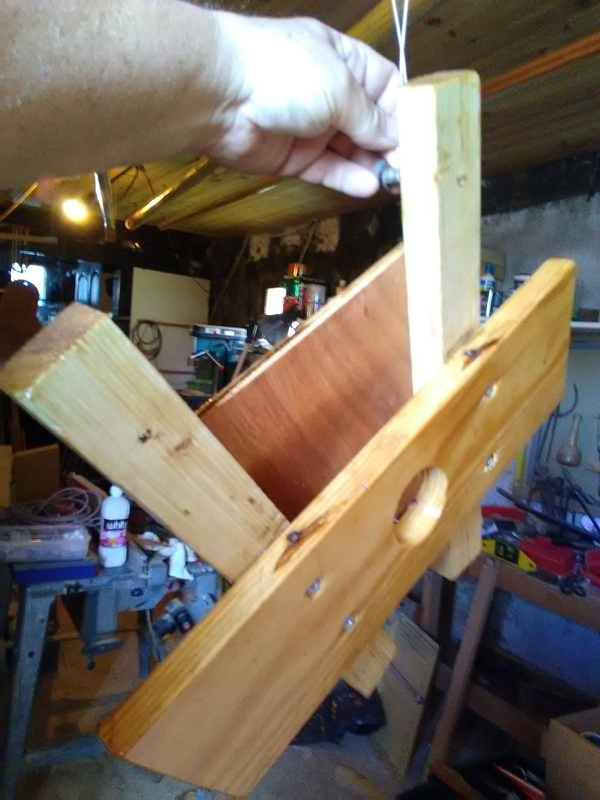 I should be getting my Oppie sail in a couple of days, so then I can finalise the length of the spars, round off the cut ends and varnish. Maybe I’ll be able to think about tests on the water in about a week’s time…
Update: A fair amount of talk is happening on Facebook. There is the neologism angrican, taken from Anglican and angry, but on the whole, the cantankerous elements are in a tiny minority. They are generally those who object to the Anglo-Catholic position of the four Churches now in full communion. There were no objections to the concordat of unity, and no voiced dissent. The vote was unanimous, which is something very important for us and the future of Continuing Anglicanism.
Obviously, it is only a first stage to work towards organic reorganisation and an opening to other Continuing Anglican jurisdictions, perhaps the Anglican Province of Christ the King and other smaller ones. I gather that this Synod was of great interest to larger Anglican groups including those who are less opposed to modern liturgics and women’s ordinations. We can’t chew off too much at a time, but if the movement goers slowly but surely, positive results will come out of this.
How do we go forward with people who are set in their ways? Two notions come to my mind that need a lot of work: synodal government of the united Church and a way to keep the bishops in agreement without any feeling snubbed or trodden on by more assertive men. Secondly, it would be better if the diocese would no longer be territorial but rather modelled on the personal ordinariate idea in which the local parish is personally affiliated (as a moral person) with its Bishop. I am sure that such an idea would alleviate any notion of competition between bishops. The territorial diocese has been the norm in the history of the Church, but is not always applicable or appropriate in given conditions like our own (vast territories and small numbers).
It is very encouraging that most of our bishops have a serious level of theological education and knowledge, and are accomplished men with clear leadership aptitudes. Archbishop Haverland has a doctorate in theology. Qualifications are not everything but what is important is culture and knowledge that fills the hole of ignorance. This seems to be the difference from the 1990’s. We are dogged by the lack of money to train priests and finance resources. Perhaps, organic union of the Churches in line with the full communion now achieved will help to raise funds, employ priests and other intellectuals to take charge of education and training, and thus to develop something solid and abiding.
There will always be naysayers who denigrate Continuing Anglicanism and prefer to compromise on questions of the sacramental integrity of the Church and the deposit of faith. The institution of the Church is only a means to an end, an “icon” of the Kingdom of God which is essentially immanent and spiritual. The objective of the Church is the salvation of souls – and this is the highest canon law. Salus animarum suprema lex. We cannot afford to be self-satisfied, smug or denigrate others. My examination of nobility of spirit comes into mind here.
We also have to be realistic. We live in a world where Catholic Christianity has all but evaporated to be replaced by Evangelical Protestantism, Islam or plain old-fashioned cynical atheism. We can’t behave as if we were state functionaries and members of the aristocracy! I once lived in a dream at Gricigliano with the swishing around in an eighteenth-century building, but the reality is the world we live in. People just don’t care, and our treasure is their trash. That brings us to a whole new way of living our faith and religion – something like the English Recusants in the sixteenth century or the underground Church in Soviet Russia under Stalin. The difference today is that people used to be hostile, and actually took a position. Now, they don’t care. We have to be self-sufficient and evaluate the truth of Christianity independently of our need to be validated by society. Are we up to this challenge, and can the Church adapt?
* * *
There has been a description of events at the combined Synods in Atlanta GA of the four main Continuing Anglican Churches. I am grateful for this news:
Some are confused by the term cleresy, a neologism combining the words clericalism and heresy presumably. I have mentioned several times that I am grateful for the present generation of bishops and their professionalism, sense of vocation and focus on the essential. It was right to bring up this theme to have a positive view on the future, distinguishing the “new” Continuing Anglicanism from the bitterness of the 1970’s to 90’s.

The agreement between the four Churches has been made public:
* * *
Agreement Establishing Full Communion (Communio in sacris)
Among
The Anglican Catholic Church
The Anglican Church in America
The Anglican Province of America
The Diocese of the Holy Cross
We the undersigned, belonging to and holding the faith of the One Holy Catholic and Apostolic Church, as received by the Church of England in the days of her orthodoxy, and as Continued by Anglicans in North America in response to the call of the Congress of Saint Louis in 1977, agree to the following:
Ø We acknowledge each other to be orthodox and catholic Anglicans in virtue of our common adherence to the authorities accepted by and summarized in The Affirmation of Saint Louis in the faith of the Holy Tradition of the Undivided Catholic Church and of the seven Ecumenical Councils.
Ø We recognize in each other in all essentials the same faith; the same sacraments; the same moral teaching; and the same worship; likewise we recognize in each other the same Holy Orders of bishops, priests, and deacons in the same Apostolic Succession, insofar as we all share the episcopate conveyed to the Continuing Churches in Denver in January 1978 in response to the call of the Congress of Saint Louis; therefore,
Ø We welcome members of all of our Churches to Holy Communion and parochial life in any and all of the congregations of our Churches; and,
Ø We pledge to pursue full, institutional, and organic union with each other, in a manner that respects tender consciences, builds consensus and harmony, and fulfils increasingly our Lord’s will that his Church be united; and,
Ø We pledge also to seek unity with other Christians, including those who understand themselves to be Anglican, insofar as such unity is consistent with the essentials of catholic faith, order, and moral teaching.
The Rt. Rev. Brian R. Marsh
The Most Rev. Mark Haverland
The Rt. Rev. Walter Grundorf
The Rt. Rev. Paul Hewett
* * *
This document is historic and shows the repair made to decades of bitterness and prejudice. It is essential for our bishops to have a professional attitude and rules to go by, which our book of canon law provides. They are well educated and well read, and the narcissistic self-importance is gone. We can be grateful for true pastors in the Episcopate. This document represents a will to face the future with confidence and a sense of purpose.
It’s obviously not the finality, but a beginning. Perhaps we might become so mainstream that this will bring other problems. We are all sinners before God. It is now the task of each one of us to work for this purpose and not leave everything to our bishops.
Gunkholing – “is a boating term referring to a type of cruising in shallow or shoal water, meandering from place to place, spending the nights in coves. The term refers to the gunk, or mud, typical of the creeks, coves, marshes, sloughs, and rivers that are referred to as gunkholes. While not necessary, gunkholers typically seek out the serenity of isolated anchorages over the crowds of marinas and popular bays, and a minimal draft is preferred, since gunkholers tend to go as far up and into the gunkholes as possible, seeking ever more inaccessible destinations”.
The Wikipedia article refers to yachts going up rivers and creeks, but dinghies can go even further. There is someone I esteem tremendously, Dylan Winter, an English journalist by trade and a keen amateur sailor in sea boats and improvised “duck punts“. Punts have flat bottoms and can go in only inches of water. The duck punt is so-called because it is an ideal boat for ornithologists to go bird-watching. Like me, he is opposed to hunting. He runs a blog called Keep Turning Left with lots of videos about sailing in yachts and small dinghies. Two recent videos have given me a lot of inspiration:
In the first video here, he is rowing in windless conditions in extremely shallow water, and in the second, he is using an Optimist sprit sail rig. He steers with an oar and with his weight in the boat. This is the finest sailing I have ever seen.
In August this year, I discovered the utmost limit of my Tabur 320, my first boat going by the name of Σοφíα. A Spanish internet acquaintance, Juan de la Fuente, also has this singularly ugly plastic ten-foot dinghy, and re-rigged it for sailing on inland lakes in Spain. I set out last August to participate in a regatta with my sailing club. The wind was blowing at about 23 knots and the waves breaking onto the shingle were quite forbidding. I was swamped on launching, and I was unable to bail fully before finding that the watertight buoyancy tanks were not watertight. After several successive capsizes, I noticed that the boat was slowly sinking. I held the boat on its side with the mast just under water, until I was washed up onto the beach. It was a discouraging experience…
I have two boats, the twelve-foot Zef, Sarum, with a Mirror rig which is my sea boat, and I brought the Tabur home a few days ago from the club – for repairs. The rudder was broken on the rough beaching, even though the rig survived. After having seen the Dylan Winter videos, I decided that this would be the future of the Tabur – on rivers and inland creeks. The Oppie sail is very well suited for this kind of sensitive fine sailing in very light winds, and I wanted to be able to take the rig and mast down easily for going under low bridges. This was possible in a recent gunkhole sail in my Zef, but with more difficulty. This was on the river Dives inland from Trouville-Deauville, and the bridge you see in the photo is so low that I had to duck my head! Needless to say, the rig was right down, and the mast was resting on my right thigh, being held off the helm! The ability to do this makes non-navigable waters navigable. All of a sudden, there are no other boats, and I can appreciate the silence except for the sounds of the wind and the birds chirping. But to each boat her job. Sophia is not suited for sea sailing, and Sarum is better on the sea and open water than going up or down rivers and canals.
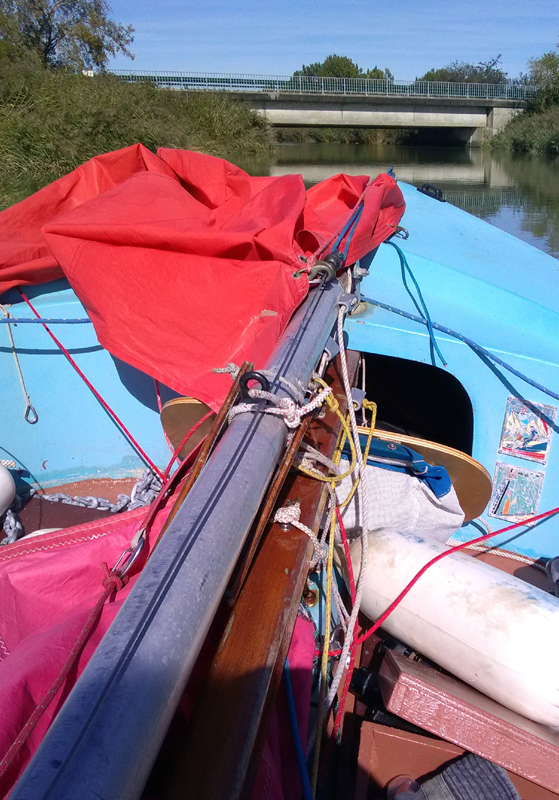 The other advantage of the Tabur is that it is very light. She can be hauled out of the water and dragged on the grass or wheeled on a hard surface to get round locks and weirs (on a special trolley I made some years ago). I think this is going to open a lot of new perspectives for inland sailing – a gift for sailing in the winter and when conditions are too rough at sea.
I will publish photos of the new rig when it is further advanced. I am waiting for my Oppie sail to arrive in the post, and have only put the first of six coats of yacht varnish on the spars, the mast step and the new rudder. I made the mast, boom and sprit from pine wood, planing to round by hand and sanding, and the inspiration is Dylan Winter’s home made rig that he can fit on just about any boat he wants.
After the Dives, I would like to sail and row on other rivers in Normandy, and perhaps the stretch on the Somme from Abbeville to Amiens, which is possible by going round the locks by hauling the boat out of the water and going without an engine. It was frustrating that my sail up the Somme canal in Sarum two years ago stopped at Abbeville because of the lock and the parsimonious opening hours. I look forward to discovering more rivers in France, and perhaps one day the mighty Loire and the Cher. The Seine is spectacular, but there are too many ships and barges – dangerous if you are not very careful. It is also, for this reason, highly regulated and policed. I would prefer the quiet little waterways.
I have just sent Dylan a little contribution for his films, and I encourage others to do likewise. They cost him money and time, so it is worth encouraging him to continue this work of bringing the Romantic soul to love nature and be in communion with this icon of God. I appreciate his gritty southern English humour and down-to-earth manner. As he would say: Bloodygoodonim!
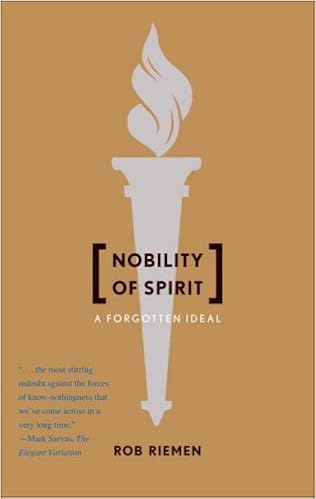 I read the Riemen’s book Nobility of Spirit, which, frankly is going to need another reading. I had expected the kind of thing Berdyaev would have written but from a more western and modern perspective, something to which we can easily relate. I was forced to accept the fact that the style of this book was different, one of anecdotes and imagined narratives. Examples given were the trial of Socrates and the torture by the Nazis of a Jewish philosopher in Rome by the use of a Catholic priest won over to the ideology. We are directly taken to the Grand Inquisitor and the interrogation of Christ by a cardinal whose main conviction was that Christ was wrong to restore freedom to man.
This theme has come up throughout history. What is freedom? Is it limitless and unconditional like in the insane yearnings of Nietzsche? Is it a liberty of indifference, arbitrary, or a freedom of perfection as expressed in the writings of St Thomas Aquinas? What about the idea of the limit of our freedom beginning where someone else’s begins – the very basis of the social contract?
Riemen’s examples of the philosopher – the lover of wisdom – all come from individual persons, never from the collectivity. The collective represents only the tyranny and ideology of the Grand Inquisitor or the Führer – who also were individuals but conditioned by the collective. We are taken from section to section, from Nietzsche to Socrates thousands of years before him, then to Spinoza in the seventeenth century to the German Romantics.
The narrative of 9/11 is quite interesting, because Riemen’s brings out the truth of fundamentalist Islam, being no different in essence from the Spanish Inquisition, the Gestapo or the KGB. Only yesterday, I was recommended to see a video about working conditions in a supermarket chain and its distribution system and an internet provider. The ideology of productivity and efficiency have crushed human dignity for obscene profits. We are brought to think of the satire in Charlie Chaplin’s Modern Times and The Dictator – and Blake’s Jerusalem. Poetry critics argue whether the dark satanic mills were the factories of the industrial revolution, or the churches that preached bourgeois morals but gave no spiritual consolation. That would be the context of John Wesley’s movement among the ordinary folk of England. It is debatable and we need to know more about Blake’s life and philosophy.
If ever we have a sense of vocation in this world, it is to join this movement of individual persons who live for for this ideal of freedom and transcendence in the image of God and the universal. In my own life, I have discovered that one thing matters in life – philosophy, the aspiration to wisdom, beauty, truth and everything that is good and brings true happiness, freedom from evil and barbarity. The next book I am going to try to find is Riemen’s main inspiration, Mann’s Nobility of Spirit: Sixteen Essays on the Problem of Humanity from 1945. I remember my grandfather whose memories of the war and his imprisonment in the Oflag were painful to him, and the privilege of reading his diary, now in the possession of my sister. They all had a tale to tell – and the barbarity and cruelty continue to this day, albeit in different and sometimes covert forms.
The essay on Leone Ginsberg, the Italian Jewish intellectual murdered by the Nazis,is poignant. The priest with the swastika is particularly painful to read, since he was Ginsberg’s fellow student at university and who had also studied philosophy. The final quotes are chilling.
Why, the, all this nonsense about a soul and divine truth! I know, I’ll burn in hell if it’s true. But the only hell there is, my friend, is here on earth – a hell from which I’ve managed to escape.
Do you understand what it would mean if Socrates is wrong? Do you understand that your entire life, everything you’ve accomplished, would rest on nothing but one huge, ghastly error? That you are letting them torture you, and will soon die, only thirty-five years young, because you believed in something false?
This from the mouth of a priest! Thoughts are taken to the Grand Inquisitor and the dense black fog of Nihilism. I once watched the end of Der Untergang, a film from which many young enthusiasts like to make what they will of Hitler raging in the Berlin bunker at his army’s inability to resist the Soviets. My attention was not taken by Hitler raging but the final Götterdämmerung of the Führer himself and his faithful committing suicide, Goebbels killing his own children before doing himself in, the scorched earth policy of the Nazi dystopia or nothing. That is the chilling indictment of human evil and the forces of the Archons of this world.
Unlike the ends of 1984 and Brave New World, Riemen’s book ends with the victory of love and the entry into heaven. We have to “be brave” faced with terror, hatred and ignorance. We are left with hope. For us priests wallowing in the morass of political ideas on Facebook and elsewhere on the Internet, there are things we need to guide our minds – a study of history and true philosophy in accordance with the etymological meaning of this word. It is in this freedom and light that we will find our transcendence and that of God, that union of love which constitutes the redeemed and divinised person.

Fr Jonathan Munn has now provoked me into a reflection about the Episcopate by writing Vaccinations for Purple Fever. In his turn, he found inspiration in my article about the less edifying aspects of our Church’s history. The Episcopate has been discussed throughout the history of the Church, and St Ignatius of Antioch is the first Church Father to have explicitly expressed the existence of the three-fold ministry of bishops, priests and deacons. In those days, churches were few and far between, and the “parish priest” was the Bishop. The Bishop was assisted by priests, deacons and those in the subdiaconate and minor orders. As the Gospel was preached and more communities came into being, the Bishop would send some of his clergy out to serve them. There, we have the origin of the diocese, cloned from the notion in Roman law of the local region like the county in England or the département in France. With the 1801 Concordat between Napoleon and Pius VII the diocese would henceforth correspond with the secular département. Thus in the Seine Maritime, there is the Archdiocese of Rouen and the suffragan Diocese of Le Havre. In the first century, these principles and the Episcopate itself were only implicit in the faith and order of the Church.
From a certain time, the Episcopate was assimilated to the aristocracy (dealt with in my previous article in a different way) and the Bishop became someone important like the local Lord or even a prince. Thus, anyone could become an aristocrat: you didn’t have to be born into the right family. However, in practice, most bishops were selected from among the aristocracy. Most monks were the youngest sons of noble families, and endowed with enough money to interest the Abbot. How this transformation occurred would have to be studied by historians from the available evidence in records and written narratives. The Bishop is someone imposing and important, and people of some traits of personality seek this aura of power and respect due to them by their “inferiors” or subjects.
For some time, I have studied personality disorders in psychological terms. Modern studies and psychiatric manuals attribute nine traits to someone who is diagnosed with a narcissistic personality disorder:
This description would perfectly match a number of ecclesiastics I have known, whether they were in a “mainstream” Church or a smaller entity. As Peter Anson and Henry Brandreth described in their well-known books, many bishops sought the Episcopate in marginal circumstances because they did not have this opportunity in Roman Catholicism or the Anglican Communion. There were some exceptions in the historical examples. Anson gave the example of the theologian Friedrich Heiler who was consecrated by the French adventurer René Vilatte (1854-1929). I also believe that Arnold Harris Mathew (1852-1919), though highly eccentric and fickle, did not fit the criteria of such a personality disorder. Much of the world of episcopi vagantes is quite grotesque, though there are some who genuinely minister to small communities and / or are involved in humanitarian work. It is a very mixed bag, and has evolved beyond Anson and Brandreth. Any of them can set up a website or a blog, and give an impressive appearance.
Since I joined the TAC in 2005 and the ACC in 2013, I have largely lost touch with this ecclesiastical underworld. There is everything between clones of the “liberal” mainstream to very extreme traditionalists, sedevacantists, embodiments of Anglicanism inculturated into Latin America, esoterism and neo-gnosticism, everything. Similarly, we see Churches where the Bishop is everything, and other Churches where the Bishops run everything as a college and have a healthier view of their service of ecclesial communion. I occasionally hear on the Internet or via private e-mail of someone being consecrated, or some old fraud selling up in France to get rich pickings in the USA.
Continuing Anglicanism has had its problems, but the notion of the Episcopate is healthier, especially over the past ten to fifteen years. They are not pompous aristocrats and they give more importance to their parishes and the priests running them. Nowadays, someone seeking to join the ACC in order to become a bishop doesn’t get anywhere. We also have a rule that no priest can become a bishop unless he has been a priest in our Church for a number of years. Thus, after the Hamlett débâcle in England and the Vicar General returning to the Churchof England, the Diocese was placed under the protection of Bishop Cahoon and run for several years by the new Vicar General Fr Damien Mead. Such a way of doing things protects us from the ambitious and unscrupulous, that we might find stability in slow growth and trust those who have authority over us priests, deacons and lay folk.
I occasionally get correspondence from marginal clerics in Europe looking for a label of legitimacy. They ask me for a certificate attesting that they are ACC. I always reply that I have no authority to do such a thing, but that they would be welcome to contact my Bishop and that their candidacy would be more convincing were they to visit England, have contact with one of our parishes and decide whether they think they would feel happy. I explain to them that we have a selection procedure and interviews – I was not exempt from them myself.
Like Fr Jonathan, I am totally unambitious. The lower I can be as a priest brings me closer to the spirit of Christ and the Gospel. I am not a good pastor since I suffer from too much social awkwardness to be a leader. I don’t have natural authority, so that is the reality. Don’t ask me to accept the Episcopate because I would be a walking disaster! My Bishop is a father in God and a friend. By friend, I don’t mean a “buddy” or an equal, but a friend as described in the famous treatise of St Aelred of Rievaulx. This is something precious in my life. Under a haughty and arrogant bishop, I don’t know how I would do. The most heroic thing would be to obey him because he is the Bishop, but I fear that my my attachment to the Church would die. This being said, the condition of being a legitimate priest is being under the jurisdiction of a Bishop – otherwise one may not celebrate the Eucharist or continue to minister in any way. Without the Bishop, the priesthood continues to subsist in the priest’s soul, but it becomes moot and dormant. In some circumstances, a vagus priest might be justified in coming to the aid of an abandoned community of faithful, but it is a subject of conscience and discernment case by case. A precedent for this in canon law is the possibility of a laicised priest to administer the Sacraments to a dying person if no regular priest is available. This is called the principle of epikeia (ἐπιείκεια) in canon law: a law can be broken for the sake of a higher good.
The Episcopate is essential to the Catholic Church, but it isn’t the preoccupation. The ACC has learned a lot from the Hamlett débâcle and the so-called Bishops’ Brawl when it was alleged that one American bishop drew his gun (I’m not sure that this was true). A bishop with a firearm seems a little surreal!
There have been many confessor and martyr bishops in the history of the Church. Their lives can be read for our edification, and this can be a great antidote for the indigestion we can sometimes feel brought on by the jerks and jokers of this world. One of my favourites is Saint Francis de Sales. We have had many fine servants of God in the Anglican Church over the centuries, from the great theologians of the seventeenth century to the time of the Oxford Movement and Anglo-Catholicism. Bishop Robert Mercer went to the Ordinariate, but I knew him as a saintly and gentle bishop, distinguished by his humility and piety.
A Church can actually manage very well with very few bishops. In the Anglican continuum, bishops run parishes and minister directly to their faithful. In most parishes, the real shire horses are the priests and parishioners who help with the administration and practical aspects to be looked after.
But it shall not be so among you: but whosoever will be great among you, let him be your minister (Matthew xx.26).

 | David LLewellyn Dodd… on Continuing Catholicism |
| David Llewellyn Dodd… on The Leaven of Romanticism |
| David Llewellyn Dodd… on Dr Winch’s Gregorian… |
 | Stephen K on Continuing Catholicism |
 | Fr Anthony Chadwick on Continuing Catholicism |
 | amphisbaenacoral9a61… on Dr Winch’s Gregorian… |
| David Llewellyn Dodd… on Continuing Catholicism |
 | Stephen K on Continuing Catholicism |
 | Caedmon on Continuing Catholicism |
| David Llewellyn Dodd… on Continuing Catholicism |
| David Llewellyn Dodd… on Archives from Static site |
| David Llewellyn Dodd… on Archives from Static site |
| Fr Anthony Chadwick on Priest and Sailor |
 | John Fitzgerald on Priest and Sailor |
| Fr Anthony Chadwick on Twenty Years of Diaconate |

