Benedict Option

I have seen this expression – Benedict Option – being bandied about on the internet. Here is an article by the American conservative Rod Dreher – Benedict Option FAQ. I am sceptical about anything coming from across the Atlantic, because an idea is taken, institutionalised and mechanised and made like the system from which it sought to escape. It becomes a new conformist paradigm. The same happened with Romanticism when the word and the inner ideas came to be banalised and made into sentimental slush about boys meeting girls and falling in “love”. Eventually, the Beast assimilates everything, and this Benedict Option will go the same way down the drain-hole of political correctness.

On first view, it seems attractive. The French monastic movement stemming from Solesmes and Dom Guéranger came straight out of the Romantic movement as did Anglo-Catholicism and Arts & Crafts and the various rebel movements away from the Establishment and the Machine. It is all coming together for me as a global vision – but there lay the seeds of its destruction and assimilation by political correctness and a new vice of conformity and intolerance of diversity. Anything can get too big for its own good.

John Senior and other American intellectuals dreamed of ways that the Christian ideal as a form of Romanticism could survive the collapse of society as happened with the end of the Roman Empire and the Civitas Dei of St Augustine. It was in the sixth century that St Benedict picked up elements of the old monastic traditions and the Fathers and produced a new vision of the balanced and moderate monastic life that could be realistically lived, whilst maintaining the essential of prayer, work, asceticism and community life.

Rod Dreher compares the Roman Empire with the current state of the American imperium. Indeed, the USA looks like becoming a new totalitarian empire (without comparing it with the Nazis) that continues to conquer territories to which it has no legal or moral right and thereby exposing s all to the spectre of a nuclear war. “Killary” or Trump, it seems to make no difference. The empire is still waging war everywhere and is trillions of dollars in debt. Sooner or later, it will crack, and many will die or be thrust out into destitution and exile.

New communities? So far I have heard of none other than traditional monasteries with celibate and professed monks and nuns living under the Abbatial crozier and the Rule. Is there a community life possible for ordinary people other than marriage and the nuclear family? I did some time ago write about intentional communities, which are not always religious or Christian. Those communities are not always easy to discern as to their intentions, or whether they consist of a few free souls or yet another form of political correctness and totalitarianism.

I suppose that the Benedict Option is an idea of individual persons and small communities, perhaps families in a few cases, consisting of breaking away from the system to build an alternative way of life. That is what the Hippies and some of the old Romantics did. Human nature being what it is, the community usually lacks stability and falls apart due to differences between persons and various forms of intolerance. Among strictly Christian communities, the monastery has abided because of its system of authority and obedience, therefore an imitation of the world and the Establishment. The only difference is that it is smaller. The only alternative is the kind of community with tolerance and encouragement of diversity built into its constitution so that people live between community life and life as free individual persons.

In Dreher’s article, we note the rejection of the Enlightenment and the yearning for tradition or some aspiration that lies beyond the limits of earthly life. That is the basis of Romanticism, also something that can go horribly wrong and dark. Dreher also notes that it is not simply a question of going to the “right” church on Sundays, when most people are living in consumerist conformity. I am also limited by the fetters of being married and paying for a house, and to a wife with personality issues.

I understand the aspiration towards a kind of “lay monastery”. Who is going to be the infallible leader to keep it all together? If there is no infallible leader, on what principle can such a thing be founded so that it will stay together and prosper. Dreher cites no example of something that has worked out, and this creates suspicion and scepticism. Perhaps individuals with such aspirations can join a community founded on vaguely Romantic foundations and not seek to convert everyone to Christianity or that person’s understanding of Christianity. In which case, as individuals, we live in the catacombs in the ordinary secular world and get on with other people with a strict self-discipline of discretion and respect for diversity. That is the beginning of the contemplative aspect of Christianity as opposed to the imperium.

Americans often winge and lament the disappearance of institutional Christianity from life. They should come to France, where “true” secularism is not tolerance of all, but a narrow form of atheism and anti-clericalism. Much of post-Communist Europe is sterile and devoid of Christianity. Is there any Romanticism left either? Difficult to say.

St Benedict founded monasteries, and that is a very special vocation to live in a small totalitarian society in which you accept having your personality crushed and made compliant as is not even found in military life. I was a working guest at Triors from December 1996 to July 1997 and installed two organs in their Abbey church. I esteemed the Abbot, Dom Hervé Courau, an austere but just man. He agreed with me that monastic life is the ultimate form of socialist totalitarianism, except that it is accepted voluntarily as a form of asceticism. If this is so, alternative living cannot be based on monasticism. I loved the Offices and the context of the buildings and their lands – but monastic life was not for me. I might have become an Oblate, but my future orientation of life was too uncertain.

In the nineteenth century, many attempts were made to inspire parish life from monastic spirituality. One example was Mesnil Saint Loup and Fr Emmanuel. There is still a monastery there to this day. I have known parish priests who were Benedictine secular Oblates and went to the Opus Sacerdotale retreat each year at Fontgombalt. These priests often has a Romantic outloook on life, loved the liturgy and would promote reverence and Gregorian chant. They would continue to wear the cassock and be assiduous with their daily Office and times of private prayer and reading. Another effect was the love of simple life and not being afraid to build things with one’s own hands.

Of course, there are the fundamental principles that can rule our lives even if we are lay people or secular priests. The first is our fundamental purpose of life and vocation, to devote ourselves to God in an utterly singular way, a notion especially but not exclusively familiar to people with Aspergers Syndrome! Connected with this vocation is a notion of self-discipline and being down-to-earth by means of prayer and work. Another is resisting our flights of instability and believing we will find paradise on earth. Paradise is elsewhere, and we can be on pilgrimage towards it just where we are, unless we are truly threatened by evil. Much of the “greener grass” on the other side of the fence is illusory, and we will regret it if we go that way. Another is community, communion, the life of the Trinity reflected in us all who bear the image of God. The community needs to be designed for the reality of totalitarianism or a form of democracy and participation. We have to choose. Another essential element is hospitality: welcoming visitors and people in need. There has to be balance between Christian hospitality and self-defence against evil people and enemies. We can forgive our enemies, but we have the duty of defending ourselves from them.

I am also sceptical about intentional communities, which are often cult-like with totalitarian leaders. Perhaps a more realistic possibility is the “eco-village” where people with compatible outlooks on life can buy a small plot of land, build something to live in and take on a commitment to an agreed amount of community work (farm work, gardening, crafts, etc.). Most people in such a setup would not be Christians but would also have a defined and identifiable vocational motivation. The Christian keeps it to himself, but is open to others enquiring about the Christian way. That I could see working, as long as the basis of the entire community is not political correctness but true love of diversity and freedom. Watch out for bureaucracy and the “managerial” style!

Dreher does mention some existing communities, and they need to be looked into. Some monasteries let or sell land around the outside of their buildings to oblates. Clear Creek in America does that. They would have to be extremely selective! The Brüderhof of German origin are intriguing. As with a monastery, it depends on your vocation and your ability to live according to their rules and criteria, and accept the upheaval in your life (selling one’s house, dispersing ones possessions, etc.).

The alternative is living the ideal where one is, with all the constraints of “feeding the Beast” and living at home with screaming kids and the television blaring. Can we impose our vocation on an unsympathetic wife and the needs of children in the modern world? I don’t think so. Yesterday, I mentioned Oscar Wilde who was imprisoned for his various turpitudes, and had to discover suffering as asceticism and a source of transformation. Most men who are punished in this way suffer the broken heart of a good man or become worse when they are bad. Suffering can be accepted as asceticism, but is not in itself asceticism. Asceticism is the ability to discipline oneself and limit the effects of fallen human nature and sin. A contemplative life is possible in the worst of distractions and noise, if the interior is silent and in peace. That is probably the most difficult thing in the world. We need breaks from “normal life” and go frequently on retreat. That can be a monastery or something like sailing or a hike in the forest or the mountains. The Romantic love of nature meets the inner contemplative life. If our life is true, it will be its own living witness and will be detected by those who have intuition and sensitivity. There is no need for marketing or preaching!

I am sceptical about using labels because they set trends. When this happens, the wrong sort of people are attracted, the so-called wannabe or super-ego that imitates and caricatures an idea, and reduces it to banality and a marketable consumer product. This goes as much for Romanticism as Benedict Option or Classical Anglican or anything else. This is the phenomenon of the market brand and the world of money, conformity and status. The Romantics did not call themselves by that term. The fact that Oscar Wilde did brought him down somewhat in my esteem. If they did not call themselves anything but gave priority to the idea rather than the super-ego, perhaps the idea had some hope.

I admire Dreher’s attempt at saving Christianity. I don’t think Christianity is something to be saved, but rather something that is just there and waiting for us to embrace it and our own souls. My big discovery in life is that genius resides in individual persons and not in collectivities. A church committee takes three hours to decide on changing the vestry light bulb: who is going to do the job with what safety precautions, who is going to pay for it, and all the rest. The individual buys a bulb, climbs up a stepladder and changes the bulb. The committee is still discussing it. Plurality of humans makes for inefficiency and stupidity. Individually, we have a strangely consistent and coherent system of ideas, and we all think in similar ways. Together, the intelligence and good sense go out of the window and stupidity enters the picture. It’s a hard judgement on my part, but an indicator of what makes communities fail, not so much because of a difference of personalities, but the collective bêtise. This is a fundamental intuition of the Romantic, before that word got assimilated by the collectivity.

If this alternative community idea gets assimilated by the institutional Church, it has already failed or become a part of the corporate world. From the beginning of my time as a Roman Catholic (1981-1997), I intuitively felt stifled and forced into a mould in which I did not belong. My vocation was made illusory and I became unstable. The roots are in my own experience of life together with a system that could not bring me anywhere near my aspiration that was in any case unattainable in this world. I can live in the ACC as an institutional Church because the process of mechanisation isn’t even begun, let alone completed! It is still a community of inspired persons. Conservatives complain about individualism because they believe that human life can only be lived under the domination of the wealthy and strong in a class system – as opposed to the creative genius of the individual person. I believe that assumption is wrong. Community comes from consensus of aspiration to the highest.

There is the notion of the apprenticeship, a different kind of relationship between the master and the disciple. This is the way Christ did everything with the small group and the larger group of disciples. We are not masters of crafts spontaneously. We need to be taught by someone we esteem and view as a father. This is something different from the infallible leader, but things can quickly degenerate. This notion has disappeared from the world, and relationships between younger and older people are now reduced by political correctness to occasions of sin, just like in the nineteenth century – or calls for “same sex marriage”. Note, the ancient Greek idea was person to person, and there lay creative genius and the basis of community.

Language gets distorted into ideology, just as is probably happening in my own writings. I feel what is wrong more than rationalising or understanding it completely and globally. I make slow progress, but feel I am getting there.

We are not going to see the fruits of our labours. There may be none if World War 3 breaks out and they push the red button. If there is not a single human left on the earth, then it won’t matter. Either we will be annihilated as the atheists believe, or we will experience a new world in another dimension (or whatever analogy we choose). We hope to bring hope and joy to those still in via as I still am (otherwise I wouldn’t be bashing away on a computer). I hope yet to give back something for what I received from God.

I am not bothered with big institutional Churches like Rome or Lambeth. They don’t matter. What does matter is the Mustard Seed and the Kingdom it conveys. Dreher seems to understand the Romantic message even if he does not use the word (because of the contemporary understanding of “romance” or the turpitudes of men like Byron, Shelley and Keats). We do not live up to our own ideals, but we must have the ideals and vocational aspiration.

I see people without this vocation or what makes them real. I see the super-ego, the possessing spirit, and it is very ugly. It makes the closest loved one unrecognisable in the ugliness of a satyr or a gargoyle. It is frightening, and I ask myself what protected me from that hollowness and death in life. There but for the grace of God go I…

Very few will ever be up to a “Benedict Option“, because they have to have something that is not bought with money or taken from other people. Many are called an few are chosen, which does not mean I believe that most people will go to hell when they die, in the manner of the Jansenists and Calvinists. The mystery is beyond heaven and hell. God is above God. I do believe that souls will be given the chance to receive illumination even after bodily death. We all need healing from the effects of our sins but also from our faulty creation.

Hold on through the dark night? We are already there, and we will only find the light within ourselves, from the spark of divinity that the Demiurge and the Archons are unable to destroy (I use Gnostic terminology as an analogy, which was intended in the first place). We face a future not unlike Europe in the 1930’s, but much, much, worse.

You who are reading this, if you feel called to a community or form a new one, go for it. Some people have the freedom of not being tied down by marriage, debts or jobs. Be prepared to give up a lot to buy the precious pearl.

Another thing is that to be Christians, we don’t have to look like the stereotypes. Under persecution, Christians retreat to the catacombs and look like ordinary folk when they go to work, buy food and participate in cultural activities. Our community life as contemplatives can be spent temporarily with those with whom we come into contact in ordinary life. Their capacity for community, as ours, is limited. Not too much can be expected. We can only give so much before getting it thrown back in our faces. My monastery is where I live, the work I do and my privileged moments of retreat in the chapel or out in nature, whether in the boat or on foot.

It all depends on ourselves, none other. Simple as that…

* * *

Erratum: I am not as informed about Clear Creek Abbey as I thought. I have just received this message in a private e-mail:

I have visited Clear Creek as a lay retreatant on three occasions and I am writing to correct one mistake that you (or some source of yours) made about the developments of community in that region:

The monks do not sell land to neighboring lay persons.  To the extent that lay persons have moved to the area to be near the monastery, they have purchased land from the Baptists or whoever were the native inhabitants of the place; they have not bought it from the monks.  Insofar as Dreher and others write about the “Clear Creek neighborhood,” it is a notional space that includes people who drive as far as 40 minutes to attend Mass.  It includes very few people who live close enough to walk to the monastery on any regular basis.

Posted in Uncategorized | Tagged , , , | 7 Comments

The Romantic Christ

Romanticism is very difficult to define and many attempts to define it resemble the cold rationalism from which it reacted some two hundred years ago. The subject fascinates me, not only as a historical state of mind in given circumstances but also something of my own experience of life. I was drawn to Christianity not by rational argument or moralism but through medieval churches, choral music and an inner yearning for a love that is unattainable on this earth. That being said, there are two Christianities, that which is based on the yearning for the beyond, and the other which is based on rationalism and the dominance of the strong.

Continue reading

Posted in Uncategorized | Tagged , , , | Leave a comment

Trip to the Fifteenth Century

My wife and I went to Rouen 1431 yesterday, an amazing 360° panorama of the city from the viewpoint of being on the top of the Cathedral façade. A son et lumière effect alternates fair and foul weather, day and night, the ringing of bells and the noises of people and animals. It is amazing in its detail and studied perspective, best from the second floor of the structure in the centre of the cylindrical building. We intend to go a second time, but with my binoculars to see the details of St Joan of Arc before her judges and the many markets, religious processions and people farming in their back yards.

If any of you go to Rouen, I recommend this show which will continue until next year. This video gives a vague idea, but the reality is far better:

Posted in Uncategorized | Tagged , | Leave a comment

Third Liturgical Movement

My head has got so big it is about to explode!!! The Third Liturgical Movement has just been published. Far from me to claim such a grandiose title for my work of collecting the work of others, living and deceased, much more erudite than myself! I am a rebel, an eccentric, outside the box, and sometimes I throw out mostly useless ideas, but occasionally ones that make sense to other people. If it can do some good somewhere…

It’s there for anyone to pick up and improve on. I have never sought to make money out of it, and I am no leader of anything. I’m not interested in creating yet another group. What I do on the internet leaves each reader in the privacy of his own home surrounded by his own free air, with full liberty of expression. Even if someone picks it all up and removes me from the picture, I don’t mind. Only the ideas are important and they might abide for another hundred years or so.

My website As the Sun in its Orb is there and can be consulted at any time. I welcome links and suggestions for improvement. I don’t think this “third liturgical movement” will go very far, but that it for you and others to decide.

* * *

Sometimes, the The New Liturgical Movement is blamed for problems brought up by the traditionalist world. Many of the contributors on this fine site are in reality higher in mind and spirit than many of the traditionalist caricatures. I have corresponded with Shawn Tribe who has done excellent work over the years. The NLM site has published many articles on pre-Tridentine liturgical rites like Sarum, Ambrosian, Dominican, Lyons and others. These contributors are as willing to promote the idea of pre-Tridentine rites, but they are Roman Catholics and are limited by their bishops, religious superiors and parish priests. They can only do what their Church allows them to do, and they can only conclude that the 1962 Roman rite is better than nothing! It is not my perspective, but it is theirs.

Some bloggers might want to denigrate the NLM, but I cannot avoid seeing the best of intentions in it. We outside the RC Church have more freedom, but maybe less in the way of credentials and credibility based on being “in the mainstream”. As I have mentioned in my Facebook group on the Use of Sarum, there is room for those who want to use it and those who merely want to study it for the purposes of a comparative method in their liturgical studies. There is room for both. I would certainly have been one of the NLM contributors had I stayed at Gricigliano and become a good Roman Catholic priest. That was not to be so, and my “take” on the base of experience is different, but the difference is extremely subtle.

Another Roman Catholic blogger produces some very interesting work in The Rad Trad, and he is of a mind to resist complete conformity to the post Pius X and Pius XII norms. Is Liturgy Worth Keeping? is most germane to our discussion.

The objective is multi-disciplinary as university people say. If any of us has insight, it can only be part of a whole.

Posted in Uncategorized | Tagged , , | Leave a comment

Post-Modern Goliards

The theme has fascinated me for a long time. I feel profoundly dissatisfied with the development of conservative mores. I notice the fascination many of my contemporaries have for the generation born in the 1920’s and 30’s who lived their youth in the 1950’s. The post-war period in America and Europe were marked by the beginning of consumerism, buying a house, a car, a fridge and a stereo player. The old Soviet bloc lived through the same discovery in the 1990’s onwards. Materialism and consumerism are the panem et circenses of the political and social mainstream. As technology develops, this return to authority and order would seem – if unchecked – to be on the way to the archetypical totalitarian dystopia or Orwell or Huxley, hard or soft. Both Orwell and Huxley were writing in the post-war period when it was feared that the dead Hitler would be replaced by much worse. That is how it was developing in the Soviet Union with Stalin and Beria, in the USA with the “anti-commie” inquisition of Senator McCarthy and conservative England.

The effect of World War II, the Cold War and the Vietnamese war were extremely profound both sides of the Atlantic. I have been reading about the so-called Beatniks (contraction of the Beat reaction and Sputnik, suggesting that anti-conservatives were covert Communist agents), and I find much of the underlying philosophy fascinating. Out of the Beat set came the Hippies, Woodstock, the drugs and “music”, sexual deviancies that went far beyond the idea of replacing marriage and the nuclear family with some kind of tribe or commune. In the end, many of these subcultures became new conformity fashions and something extrinsic to personality or philosophy of life.

I am not a sociologist, but I recognise many of these themes in my own growth as a child and teenager in a sheltered family and schools in the north of England. My brother was more influenced by the “with-it” stuff than I, but my school reports from when I was 11 and 12 years of age mention my not finding the Prophets and the Gospels as being sufficiently “with-it” – modern, anti-authoritarian and in fashion. My two terms at Wennington in 1971-72 brought me into contact with tie-dye clothes and long hair on men and boys. I have noticed observations made about me at seminary that my attitude was too “bohemian” and not urban and conservative. I began to listen to the criticisms and ask myself where it was all coming from.

In my own life, I have been divided between the radical philosophy to which I was exposed as a boy and my love for church music, churches and medieval culture – which led me to a Christian commitment. The trouble is that most radically-minded people are not interested in formal liturgy and conservatives are not interested in other people’s freedom. That’s enough about me, because it’s my problem, nobody else’s.

As I looked into this generic category of counter-culture, I noticed a whole series of historical movements: Romanticism from the 1790’s to about 1840, the Beatniks of the end of World War II to the first hits of the Beatles, the Hippies of the 60’s and 70’s and finally the flotsam and jetsam of alienated urban youth of our own days.

Counter-culture seems to be a notion of opposition against mainstream politics, business, social status determined by money and warmongering. The Romantics had fairly clear philosophical ideas of opposing excesses of rationalism and organisation, laying the ground for modern ecology (the intrinsic rights of nature independently of its usefulness to mankind), pacifism and opposition to capitalism. The Beat Generation still had fairly clear ideas in what they wrote in books and articles. After then, it began to be all about sexual promiscuity, drugs and “music” that would imitate tribal rhythms and manipulate crowds. Eventually, the mainstream would identify the key ideas and assimilate them in order to maintain a predictable and docile population.

A counter-culture would typically aspire to a new society or a better life, the idealised utopia, and would eschew party politics and authoritarianism. Other manifestations would occur from the 1970’s like radical feminism and “come-out” homosexuality, two themes particularly opposed by “conservatives”. Orwell seemed to have a good handle on things when writing Animal Farm: the oppressed become the oppressors. Sociologists have found sub-cultures defining themselves in “counter” or negative terms, peaking, going into decline with some influence on mainstream norms and then absorption as young people got married, found employment and settled. The Romantics, Pre-Raphaelites, Bohemians, Beats and Hippies left a lasting impression in mainstream culture. Many marginal cultures remain, much to the distaste of those who are not part of them: Punk Rockers, Goths and those named for their “musical” preferences.

Many themes have been commercialised like clothing, “music”, ecology, the outlawing of discrimination against minorities, the LGBT scene and radical feminism. This hardly seems a victory of the “movement” but rather its assimilation by the authoritarian mainstream to put it all to some other use.

I have noticed in some studies how the internet has been found to be a place of free expression and protest against the “Machine”. In the early days, some people were hacking and doing damage to what they perceived as “the enemy” (government, business, banks, politics, etc.). Less anti-social elements would use e-mail, build up a web site and more recently move on to blogs and social media like Facebook. More and more of us appreciate the freedom of the internet and being able to transcend geographical limits and the cost of travel to socialise along the lines of common interests. We also find the theme of anarchism which is more or less nihilistic and perverse in terms of respecting other human beings and their freedom.

Though I am a product of the 1960’s and reaction against post-war conservatism, and sympathise with many aspects of the underlying Romantic-based philosophy, I have no time for psychedelic drugs, crowd hysteria, noise blaring out of loudspeakers and instruments like electric guitars, drums and screaming voices. I don’t think I would have liked Woodstock, but I do enjoy the big sailing gatherings in France like the Semaine du Golfe, which is centred on traditional Brittany seafaring culture, not the same thing.

I am quite fascinated by the theme of alternatives to marriage and the “nuclear” family. As a priest of a Continuing Anglican Church, heavily marked by American conservatism, I have to be careful what I say. I have not seen an alternative involving children that has lasted or worked out for the best. I am told that many children of same-sex couples (adopted or conceived by artificial insemination) have become very balanced persons, free of many of the extreme oppositions between traditional masculine and feminine roles in society. Perhaps some but not all. When families are dysfunctional, marriage and the family become a living hell for the couple and the children. There were no children from my own marriage, and my own experience does not leave me inclined to beat the conservative drum. I know too little about children born into Hippie and other alternative communities, but I intend to do some more reading and watching documentaries. Is the nuclear family essential for a child’s identity and stability as a person? I am not completely sure. As for simple homosexuality without children, it may be against the traditional notion of natural law, but it doesn’t do any harm to others if it is the choice of two persons in a private context. After that, it is a matter of personal conscience in accordance with the persons’ beliefs and faith. Christian conservatives cannot legislate over non-Christians or non-religious people! I have already expressed a highly suspicious attitude in regard to “gender” issues and identifying with the opposite sex. There are scientific articles on “gender dysphoria”, but I am suspicious also about psychiatry. There are many things in heaven and earth… I prefer not to get into arguments with conservative moralists!

There are other themes more or less assimilated by mainstream culture and authority. One is protesting against wars of aggression waged principally by the United States in the name of imperial domination (if we can believe alternative news sources). The threat of nuclear war is now returning for the first time since the collapse of the Soviet Union in 1989. Who can win a nuclear war? Apparently, there are men of politics who really believe that they can win a nuclear war or want to “suicide” the world!

Other themes include opposition to racial hatred, often manifested by conservatives and police forces. I agree that racial hatred is unacceptable in our society, and a study of history will reveal that there have always been ethnic minorities at the margins of every society. I have lived in Marseilles in the 1990’s wearing the cassock and walking around Moroccan and Algerian neighbourhoods without feeling threatened. I have lived in London’s East End (35 years ago) and didn’t feel threatened by black people, Jewish people and Muslims. Radicalisation is the real threat, but the problem is defining radicalisation. Christianity as expressed in the Gospels and the life of St Francis of Assisi is radical – but is doesn’t commit terrorist acts or kill people. Our world is becoming an ever-more dangerous place, and conservative warfare and policing are not solving the problems.

Christianity has become counter-cultural because its conservative tendency is rejected by the mainstream that assimilated and recycled aspects of the counter-cultural movement. If you like, it’s a reaction against a reaction against a reaction. Perhaps a good reading of Antonio Gramsci (cultural Marxism) and the Frankfurt critical theory school would shed light on what is going on. Being counter-cutural will do Christianity a lot of good after centuries of being in bed with repressive and authoritarian regimes. At last, Christianity becomes a manifestation of freedom and love instead of population control and hatred. This notion is central to my New Goliard theme.

Why does counter-culture has to be so tightly associated with “music” like rock, techno or rave? What is needed is another movement associated with the music of Bach, Mozart, Schumann and some of the twentieth century and nineteenth century composers. There was a little group of composers in Paris between the wars called Les Six, probably quite closely associated with Bohemians and Existentialist philosophers. I am very fond of Francis Poulenc who was one of the six. Much has been done to remove good music from the monopoly of the Establishment!

A good expression of Romantic Christianity would do much more good than a lot of the New Age and neo-pagan stuff that has been going around and making pots of money for charlatans. It needs to be separated from establishment conservatism, rigid moralism and brought to appeal to spiritual aspirations and sensuality.

Many of the excesses of the movement have died, leading to triumphalistic assumptions by conservatives. Historical parallels teach us a considerable amount from the Goliards to the Franciscans, Wycliffe and Hus who heralded the Reformation against excesses of clericalism and popular superstition. Many heresies were born of repression and corruption in the ranks of the ecclesiastical and political Establishment. As the Reformation became repressive and taken over by those with power and money, movements arose to oppose them. Christianity is called to find out what it really stands for and then it might attract the interest of the sorts of people Christ came to heal. I would say that Christianity now has a chance before it gets assimilated again by the “Beast”.

An opportunity, a challenge? Whatever. It seems to be a blank sheet of paper waiting for us to write on it – and enjoy the freedom whilst it lasts.

Posted in Uncategorized | Tagged , , , , , | Leave a comment

Weird Symbolism

I don’t know if we have any medieval experts looking at this blog. Have a look at this:

goliards-perhapsI am rather intrigued by this group of dissolute-looking folk gathered around a book of music. I am brought to think of the famous Goliards, the monks and priests who floated around and didn’t take the Church very seriously. We should note that before about the seventeenth century, secular music was written in something very similar to Gregorian notation on a four-line stave. Modern editions of Renaissance music are transcribed into modern notation to make it easier for musicians used to reading G and F clefs.

The whole group appears to be sitting on what looks like a giant egg with a hole broken in its shell. At the bottom-left, a demon playing the lute and a man holding out a bag of coins. The man wearing a funnel on his head would a dunce or a fool. The owl represents wisdom in contrast to foolishness. We have a dead snake hanging from a dead tree and a couple of bats flying around. The magpie would represent good luck and the stork, perhaps the coming of a baby if such symbolism existed then. Two crows are feeding on a dead and plucked bird, perhaps a chicken, in the iron pot. A person at the back of the group is wearing some kind of building on his head, a lighthouse or a semaphore for guiding ships on the sea.

I haven’t been able to find the source of the image except for this blog posting on medieval music. This posting features a Youtube video with recordings of medieval music that might be of interest to you.

A penny for your thoughts…

Posted in Uncategorized | Tagged , , | 18 Comments

The Meaning of Life

Yes, indeed, the title of a somewhat dumb Monty Python film from 1983 featuring the exploding Mr Creosote. My subject is that eternal question of our times and the whole of human history for as long as meaning has been an issue. Is it an issue in “primitive” tribes and cultures? I wonder.

This has come in from an Orthodox priest: You Don’t Mean a Thing. I greatly appreciate this look at our existential question: Are we just animals that live and die without any purpose or meaning, or is there a meaning of our existence, a notion of vocation? I suppose that the question itself is one of modernity and man’s attempt to dominate and own everything.

I thought about this while running some errands in my van. It’s not what we try to project onto ourselves but finding out who we are, where we come from and what we are called to be in our inmost depths. Some seem to have an easy answer: they became a doctor or a teacher or a lorry driver – or married and had children – or entered a monastery or became a priest. For others, it might not be so easy, and the questions continue throughout life.

Yes, we need to see what we have been given, the Parable of the Talents. It is not what we do or have, but what we are. I recommend reading Charles Dickens’ Tale of Two Cities and the final speech of Sydney Carton, the dissolute lawyer who sacrifices his own life to save the man who married the woman he loved. In that final moment before going to the guillotine, he redeems his life with the words:

It is a far, far better thing that I do, than I have ever done; it is a far, far better rest that I go to than I have ever known.

Posted in Uncategorized | Tagged , , | Leave a comment

Pre-Tridentine Catholicism

Searching for the Long Lonely Road to Pre-Tridentine Catholicism

I heartily recommend this highly lucid article.

Posted in Uncategorized | Tagged , , , , | Leave a comment

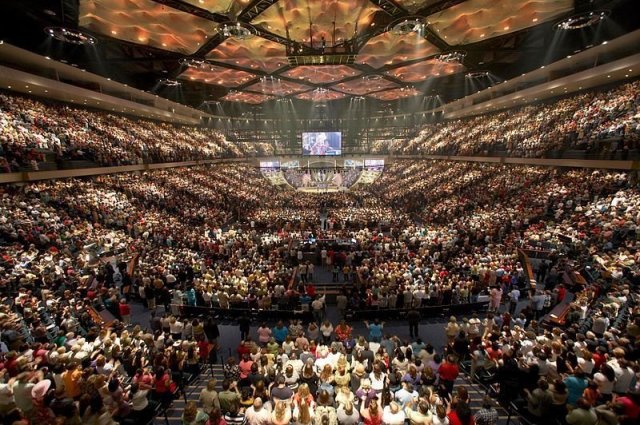
Mega Churches

mega-churchIt is an American phenomenon above all. It’s rather frightening. The mega church (or these two words joined together) is a term used to describe a Protestant, Evangelical or Pentecostalist church of more than a couple of thousand worshippers at regular Sunday services. Recent research lists about fifty churches in the USA with more than ten thousand each Sunday, up to forty seven thousand in one case. It is a developing phenomenon in the US and South Korea, where one church has more than 830,000 members. The Roman Catholic Church as a whole, or in the USA, is not considered a mega church because it is not Protestant.

Some mega churches have been known for “cultish” practices, and they generate enormous amounts of money.

Here is a short video about a mega church imported into the US from Australia, led by a thirty-five year old pastor:

Does this bring people to God? Perhaps, but I find it too distasteful. It is as alien to me as its secular archetype – the rock concert. A fix for addicts? I really wonder.

I know what brings me into the presence of the Transcendent:

Perhaps there is room for both, and we should be tolerant about the cultural “vehicles” Christianity uses to win people’s hearts. I have no experience of mega churches, but I have of York Minster!

Posted in Uncategorized | Tagged , , | 10 Comments

Website Up and Running

My website As the Sun in its Orb is up and running after its recent ruthless haircut (be assured, I still have my hair!). The links are restored, updated or deleted because the subject matter is no longer in existence.

The site consists of four main pages: the title, an introduction, a page on the Use of Sarum and a page on the liturgy in general. There are html files accessed from the Sarum and general liturgical pages. Each of those files have a link back to their referring page. Only the four main pages link to each other.

If there are still problems with links not working, missing photos or other inconsistencies, please post a comment and let me know. I would also welcome suggestions and links to update the site and improve it as a reference resource.

Posted in Uncategorized | Tagged , | 3 Comments