The Empress of America

george-thirdI found the satire below on Facebook. It is priceless and had me laughing! Bring back the stuffy throat-clearing noises, monocles, moustaches, colonial hats and those wonderful staff cars the Imperial Army had in the 1900’s in the streets of New Delhi! A new gentlemen’s club will be established in St James Square – the West American Club, furnished with the customary leather armchairs. Long live the Empress of America!

In accordance with Romantian norms, serious consideration must be given to cars and where pedestrians walk when in town. The raised part at the side of the road is called the pavement. Motor cars, with or without running boards, have a bonnet covering the engine and the compartment at the rear for luggage is the boot. The recolonisation of North America should include the reinstatement of pounds, shillings and pence together with Imperial weights and measures.

It can go on… Comments with suggestions are welcome.

* * *

A MESSAGE FROM THE QUEEN

To the citizens of the United States of America from Her Sovereign Majesty Queen Elizabeth II

In light of your failure in recent years to nominate competent candidates for President of the USA and thus to govern yourselves, we hereby give notice of the revocation of your independence, effective immediately. (You should look up ‘revocation’ in the Oxford English Dictionary.)

Her Sovereign Majesty Queen Elizabeth II will resume monarchical duties over all states, commonwealths, and territories (except North Dakota, which she does not fancy).

Your new Prime Minister, David Cameron, will appoint a Governor for America without the need for further elections.

Congress and the Senate will be disbanded. A questionnaire may be circulated next year to determine whether any of you noticed.

To aid in the transition to a British Crown dependency, the following rules are introduced with immediate effect:

———————–

1. The letter ‘U’ will be reinstated in words such as ‘colour,’ ‘favour,’ ‘labour’ and ‘neighbour.’ Likewise, you will learn to spell ‘doughnut’ without skipping half the letters, and the suffix ‘-ize’ will be replaced by the suffix ‘-ise.’ Generally, you will be expected to raise your vocabulary to acceptable levels. (look up ‘vocabulary’).

————————

2. Using the same twenty-seven words interspersed with filler noises such as ”like’ and ‘you know’ is an unacceptable and inefficient form of communication. There is no such thing as U.S. English. We will let Microsoft know on your behalf. The Microsoft spell-checker will be adjusted to take into account the reinstated letter ‘u” and the elimination of ‘-ize.’

——————-

3. July 4th will no longer be celebrated as a holiday.

—————–

4. You will learn to resolve personal issues without using guns, lawyers, or therapists. The fact that you need so many lawyers and therapists shows that you’re not quite ready to be independent. Guns should only be used for shooting grouse. If you can’t sort things out without suing someone or speaking to a therapist, then you’re not ready to shoot grouse.

———————-

5. Therefore, you will no longer be allowed to own or carry anything more dangerous than a vegetable peeler. Although a permit will be required if you wish to carry a vegetable peeler in public.

———————-

6. All intersections will be replaced with roundabouts, and you will start driving on the left side with immediate effect. At the same time, you will go metric with immediate effect and without the benefit of conversion tables. Both roundabouts and metrication will help you understand the British sense of humour.

——————–

7. The former USA will adopt UK prices on petrol (which you have been calling gasoline) of roughly $10/US gallon. Get used to it.

——————-

8. You will learn to make real chips. Those things you call French fries are not real chips, and those things you insist on calling potato chips are properly called crisps. Real chips are thick cut, fried in animal fat, and dressed not with catsup but with vinegar.

——————-

9. The cold, tasteless stuff you insist on calling beer is not actually beer at all. Henceforth, only proper British Bitter will be referred to as beer, and European brews of known and accepted provenance will be referred to as Lager. South African beer is also acceptable, as they are pound for pound the greatest sporting nation on earth and it can only be due to the beer. They are also part of the British Commonwealth – see what it did for them. American brands will be referred to as Near-Frozen Gnat’s Urine, so that all can be sold without risk of further confusion.

———————

10. Hollywood will be required occasionally to cast English actors as good guys. Hollywood will also be required to cast English actors to play English characters. Watching Andie Macdowell attempt English dialect in Four Weddings and a Funeral was an experience akin to having one’s ears removed with a cheese grater.

———————

11. You will cease playing American football. There is only one kind of proper football; you call it soccer. Those of you brave enough will, in time, be allowed to play rugby (which has some similarities to American football, but does not involve stopping for a rest every twenty seconds or wearing full kevlar body armour like a bunch of nancies).

———————

12. Further, you will stop playing baseball. It is not reasonable to host an event called the World Series for a game which is not played outside of America. Since only 2.1% of you are aware there is a world beyond your borders, your error is understandable. You will learn cricket, and we will let you face the South Africans first to take the sting out of their deliveries.

——————–

13.. You must tell us who killed JFK. It’s been driving us mad.

—————–

14. An internal revenue agent (i.e. tax collector) from Her Majesty’s Government will be with you shortly to ensure the acquisition of all monies due (backdated to 1776).

—————

15. Daily Tea Time begins promptly at 4 p.m. with proper cups, with saucers, and never mugs, with high quality biscuits (cookies) and cakes; plus strawberries (with cream) when in season.

God Save the Queen!

PS: Only share this with friends who have a good sense of humour (NOT humor)!

Posted in Uncategorized | Tagged | 12 Comments

Brick by Brick

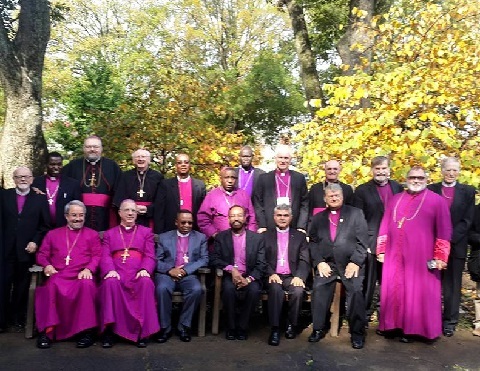
bishops_at_synod2015We Anglicans too can use this expression, especially when there is yet more progress towards unity and the healing of old differences in the Anglican Continuum. This will be an occasion to give us more confidence and credibility with our people. This seems to be the time of reconstruction and positive building. This is great news.

I reproduce this article from Fr Robert Hart – Formal Accord:

Continuing Anglican jurisdictions Announce Formal Accord

The following is an interjurisdictional letter of support issued by the four heads of the Continuing Anglican Churches.

We the undersigned bishops of the Continuing Anglican churches, as indicated below, pledge to work cooperatively, in a spirit of brotherly love and affection, to create a sacramental union and commonality of purpose that is pleasing to God and in accord with godly service to our respective jurisdictions.

Additionally, we will endeavor to hold in concert our national and provincial synods in 2017. Our goal for this meeting will be to formalize a relationship of communio in sacris.

During the intervening period, we will work in full accord toward that end. We will seek ways to cooperate with each other, supporting each others’ jurisdictions and communicating on a variety of ecclesiastical matters. We will maintain regular monthly communication by teleconference.

The Most Reverend Walter Grundorf, The Anglican Province of America
The Most Reverend Mark Haverland, The Anglican Catholic Church
The Right Reverend Paul C. Hewett, The Diocese of the Holy Cross
The Most Reverend Brian R. Marsh, The Anglican Church in America

Update:

Virtue Online has published Continuing Anglican Churches Announce Formal Accord. At the end of the same quote as above, this is added:

The photo omits Bishop Hewitt and includes Presiding Bishop Peter Robinson of the UECNA. We regret the omission. To date rthe UECNA has not signed on to this accord. We will let you know when they do.

There are comments in both articles which may be of some help for understanding the positions of Archbishop Peter Robinson and the Anglican Province of Christ the King.

I also add that the photo on this article is of the ACC bishops at our Provincial Synod of 2015 with bishops of other Churches present as observers. It has no other intended meaning.

Posted in Uncategorized | Tagged , | 6 Comments

Fourth Anniversary

This blog is approaching its fourth anniversary (17th January). Subject matter has changed considerably from a somewhat romanticised view of “Northern Catholicism” through the Use of Sarum and finally to a study of some Gnostic themes which can enhance and enrich the Christian way.

I have had to learn many things over that time. The beginning of this blog overlapped with the excroissance and demise of the English Catholic. Some rescued material – The TAC Archive. I have occasionally given in to temptations to discuss polemical topics and that has always caused trouble. It is essential to be personal on a blog. It might seem to be introspective, navel-gazing and narcissistic, but is really a way one person (me) relates to certain things – whether or not they interest other people. It is vital to be oneself, and not to try to please others or do what attracts more views in the statistics page or comments.

I often go through this in the winter. January in the northern hemisphere is particularly gruelling, and I am reminded of six months I spent as a working guest in a Benedictine abbey from just after Christmas 1996 until mid July of 1997. It was there when I encountered the exorcism situation and kept my distance from it. I don’t have a very strong character! The experience of doing a blog is also something that makes its mark.

Each year, I have to make the resolution to work on the quality of this blog, making it a service for others as well as a sounding board for myself. If I try to educate, it is in the manner of a university, not a seminary or a guru’s cult. I don’t mind different opinions or being disagreed with. I have never sanctioned a commenter for that reason.

There are things remaining to be studied and thought out. I am still concerned for working out something of the Gnostic mythology of God and creation, and homing in from the “wilder” versions of Gnosticism to the Alexandrian school and some of the leading lights in Eastern Orthodoxy and how they relate to spiritual currents in Anglicanism. It’s a big undertaking…

Posted in Uncategorized | Tagged | Leave a comment

David Icke

I wrote an article about the Archons in Gnostic mythology, something more or less parallel to demons in ours as Christians. I thought it appropriate to mention David Icke as a controversial figure who has recently become interested in Gnosticism of account of a collusion between its mythology and his own theories.

He is a conspiracy theorist through and through, like some other characters I have met in England including the late John Gaster, a former Nazi sympathiser and a really odd character who went on and on about Arthur Guirdham. Long after I lost touch with him, he was murdered in mysterious circumstances. I originally met him at at the Society of St Pius X Mass centre in London, and he was an example of how we should be careful about getting mixed up with unsavoury people! Heavy duty conspiracy theorists include the American Alex Jones who runs the site Prison Planet. It’s weird and cloying world that requires critical thinking and questioning at every turn. G.K. Chesterton once made the observation that those who don’t believe in God would believe in just about anything.

The psychology of conspiracy theorists is of itself a fascinating study. Again, we have to wade through a morass of psychiatric hyperbole. An article in Scientific American attempts to put conspiracy theories to bed with a hot water bottle and a kiss. I too find the one about 9/11 far-fetched, but Hitler mounted a false flag operation in 1933 to destroy the Reichstag to produce justification for persecuting the Communists. The historical precedent is there. It is not always irrational. For example, I find it difficult to believe that a jet plane crashing into a building would cause more than a huge fire and localised structural damage, perhaps enough to make the top of the building fall off the bottom part. Those two buildings fell vertically, exactly like in a precisely engineered demolition job – yet the planes didn’t touch the foundations. OK, I’m not an engineer, but common sense seems to cast reasonable doubt on the official story. My mind is open, but highly suspicious. Many of these theories resonate with our profound desires, fears and archetypes. One of my worst childhood nightmares was being taken to a secret laboratory many floors underground and tortured by being experimented on. I doubtlessly “got the idea” from reading about Auschwitz and Dr Mengele. I can think of no other explanation. My wife annoys me when she blames bad weather on the weather forecaster on the radio. She knows that isn’t true – but she talks in that way all the same! We have to watch ourselves…

The problem with conspiracies is that they are sometimes true – like Nazism and probably the many criminal bankers, businessmen, politicians and others in this world. Toppled political leaders are still tried for war crimes and crimes against humanity, and some are found guilty and punished. To some extent or another, we all have the same suspicious instincts, especially when things are withheld from us and kept secret. We assume the worst. It’s natural.

hollow-earthSome things just seem to be over the top. The two big examples are reptile-human hybrids and the hollow earth theory. However, before we roll on the floor laughing, we do need to think about things. Surely, if someone is a reptile-human, it would be possible for a biologist specialised in genetics to analyse his DNA. I don’t know much about genetic science, but I read that humans have only 46 chromosomes as opposed to 48 in most primates. Our genome has similarities with that of reptiles. So, the idea doesn’t seem as far-fetched as we might think.

Also, possession by evil spirits is something very real and strange things do happen. Some humans are more susceptible than others to “channel” evil spirits as well as the souls of deceased humans who may be stuck in some kind of half-way house between one universe and another. Rationalists and psychiatrists scoff at this kind of thing, but I have heard the cries and ravings of a possessed man. There is something of a basis together with some of the stuff you find in Biblical, Greek and Nordic mythology about what were believed to be gods and humans.

David Icke claims that the world is run by such hybrids, but that most humans are not reptile-human hybrids (I keep looking for scales on my arm but don’t find any!). He claims to have identified all the reptilian families on earth, including the British Royal Family. At this stage, it gets a little hard to swallow!

What are my impressions as an Englishman? Well, for someone born in Leicester, he has the wrong accent. He talks Estuary English with glottal stops. I don’t know how appealing that is to ordinary middle-class people from London and the Home Counties. Plenty of people go to his lectures and shows. I must be something of a snob, because I’m more for Received Pronunciation without too much of an affectation. In the end, I don’t mind if someone speaks broad Scouse or Geordie as long as I can understand them! But, all the same, speech and accent are a dead give-away. As I have said, he is no wild-eyed loony: he reasons, speaks logically and acknowledges that many people take the mickey out of him. His sense of humour shows a “normal” mind, at least one that isn’t the manifestation of a diseased brain. My own opinion of mental illness is one that is extremely distrustful of psychiatry, but rather one that understands different people perceiving reality differently.

Facts and events in the world have not refuted his claims that world political elites want to lock us into an Orwellian prison, and remove all our freedom. That was obvious in the 1930’s in Germany, as it has become now. The storm clouds of war are gathering in the Middle East, and more so in the last few days – and the warring factions including the jihadists are proxies of these evil western powers. It can’t be denied. We don’t yet get killed for saying so, but that might happen one day…

The hollow earth theory is one I really find difficult to fathom. There, I am not convinced. When I was a little boy I used to lie on my back on the lawn and look up to the sky. I wondered if I was inside the earth and if the clouds were continents in the midst of the azure blue seas. A simple explanation from my father sufficed to convince me that the sky is outside the earth and that clouds are made of steam and condensed water droplets. The hollow earth theory suggests a huge hole (its location being a closely guarded secret) and some very strange creatures down there, perhaps including a resurrected Hitler and a Napoleon or two. Sorry, please excuse the cynicism. Perhaps there is a portal to another universe, a sort of Stargate like in the film, but I remain to be convinced.

On the other hand, I can accept the idea that all our existence is “holographic” and that matter is an illusion made by pure energy and consciousness. That might also sound like gobbledegook, but quantum science is mind blowing and some physical experiments have produced absolutely unpredictable results defying Newtonian physics.

What about the conspiracies to enslave us all? It’s perfectly plausible, since it happened in Germany in the 1930’s and caused World War II and in Soviet Russia under Stalin. Life is made to have us sleep and be in denial. I am not concerned about David Icke being crazy, which I don’t believe he is, but he is a highly extroverted demagogue. He knows how to get a crowd going. When I preach a sermon, I like it to resemble a fireside chat, intimate and unthreatening. Icke really gets those people going.

His scientific arguments about genetics and DNA seem to be researched and plausible. I discussed the idea of “junk DNA” which in reality seems to be useful DNA but with other purposes than simply defining the physical organism. The task of refuting Icke would have to fall to a scientist specialised in this field. The serpent is the symbol of man’s fall, and the allegory would take on a whole new meaning. What would it mean to be reptilian, since we humans are mammals? Our females do not lay eggs and we are warm blooded, and we have some characteristics in common with apes. Biologists calls us primates like chimpanzees and gorillas. Are reptiles evil, whether they are snakes, lizards or crocodiles? No more than black cats or any other animal living in this earth. What is the big deal about humans having reptilian DNA? It is symbolic of the being with no properly human feelings or empathy. Tortoises are not human at all.

Icke’s thesis depends on there being some communication between the universe of the archons and our world on similar frequencies, close enough to cause radio-like interference. That makes it possible for him to be talking sense.

With the coming Big Brother and Room 101 – with the worst torture in the world tailored for each individual, does Icke leave us with any hope? That is the story with the happy ending. Blofeld is killed and Bond gets his pretty girl. Will it happen like that in the life we know? It would depend on each of us to wake up and smell the coffee, take stock of the reality. We may be powerless, a roaring mouse against the New World Order, but we would keep our own soul whatever the cost of that may become.

I am not inclined to dismiss David Icke as insane or his theories being nonsense, but my attitude is one of prudence and being sceptical and critical. VIP people being influenced or possessed by evil spirits, perhaps – but a hollow earth seems ludicrous. I find no evidence for it. I suggest doing research and find out who believes in this sort of thing and what religious or cultural traditions they follow. He invites us to become informed, so let’s do the reading with a mind as independent from him as from the Establishment.

His greatest intuition, which is also a Christian one, is that the war cannot be won by hatred and fear, but by love and consciousness.

Posted in Uncategorized | Tagged , | Leave a comment

The Fool’s Quest for Secret Knowledge

In my present haphazard studies of Gnosticm, mainly through books by Elaine Pagels, Stephan Hoeller and Jean-Yves Leloup, I discover that there is a whole discrepancy of understanding between “true gnosticism” and the various caricatures thrown about by polemicists.

My own intuition tells me not to look for labels and categories, not even to try to work out what is “true Gnosticism” or not. I have had that experience in Christianity between all the various conflicting ideas. Gnosticism is not my war. I am not a Gnostic (though I do not hide my sympathies), and I don’t think many people in our world are, nor for that matter ever were in the ancient world. It seems to me more of a state of mind, a world-view, sometimes based on an allegorical and analogical interpretation of some ancient mythologies given to us as an alternative to the Genesis mythology more familiar to Christians.

Only this morning, I read someone who defined it as salvation by knowledge. The very words betray the person’s prejudice. Outside a strict Christian setting, what is salvation and what is knowledge? Words are awkward things. Leaving the Greek word aside, there are two French words for knowing: savoir and connaître. The word for knowledge is connaissance. It conveys the idea of knowing a person or a town with which one is familiar. Je sais means that I have a certain understanding. For example, I know that 2 and 2 make 4. We are in a certain degree of confusion as to what knowledge means.

It can of course mean possession of the object of knowledge: information, facts, the true nature of people, sciences, etc. If I withhold information from others, the information  becomes secret. When those who do not know become jealous, the knowers become an elite. You’ll have to join us in order to be let into our secrets, but on this or that condition. Perhaps some Masonic lodges operate on that basis, but it seems to be something too banal for words, a mere device some people use to manipulate and control others.

This seems to be one of the most misunderstood aspects of Gnosticism, one which causes some polemicists to believe that Gnosticism was some kind of conspiracy that would evolve into totalitarian political ideologies. Reading a few books by Umberto Eco, especially the Name of the Rose and Foucault’s Pendulum, is something very salutary. We find all sorts of people chasing after secret knowledge, and when they find out, it all turns out to be banal or meaningless. That being said, not all secrets are so banal – like for example what Mr John Doe said to me in Confession last Saturday. All right, he killed his wife four times! Does that make you feel any better? Perhaps the biggest secret is about ourselves. What many people find appealing about Gnosticism is the idea of a spiritual life without “revealed truth” being rammed down their neck in the name of an “infallible” Bible, Pope or magisterium. And here we go again…

We moderns tend to be model consumers, going to the supermarket with its bewildering choice of products, and trying to do our shopping wisely, trying to get the best value for money. We are used to choice, and – frankly – we have too much of it. Our expectations go up, and our empathy for those who have no choice evaporates. We tend to see gnosis as liberation and new-found freedom. The idea seems great, but becomes our downfall if we are not mature persons with a sufficiently deep understanding. Imagine a fundamentalist “converting” to Gnosticism and preaching his new biblical mythology in a literalist way like he did with his Bible! There has to be something to know…

The knowledge in question is not book learning. It isn’t information. It is to know ourselves and therefore the image (“spark”) of God in ourselves. You get a lot of nonsense in the world of many alternative religions. Watching a Youtube video of a Wicca ceremony made me want or weep or laugh – I’m not sure which. It was literally a load of mumbo-jumbo, people just being silly and playing games. The same thing happens when people start using “esoteric” words, often in other languages than plain English, to sow confusion and make people believe that they had secrets. Have you ever read advertisements for products for re-growing hair on bald heads? We get secrets expressed in riddles and cryptic words. This is why I try to relate things to the discoveries of modern science and terms that appeal to our minds today. Yes I am a Modernist and proud to be one! That doesn’t mean going along with fashionable agendas. It just means being credible.

It is interesting to see Elaine Pagels labelled as a feminist, with the idea of giving her a vested interest in promoting Gnosticism. I haven’t yet read enough of her to discern such an undercurrent. Would a world of hyper-macho men and their wives chained to their kitchen sinks pumping out babies be more conducive to mankind and our spiritual health than an idea of just getting on together in a complementary way with empathy and feeling for each other? Sometimes it is good for a man to become aware of the “feminine” traits he has within himself without ceasing to be what he is. What’s all the fuss about the idea of a “feminine god”? Divinity is androgynous, the archetype of ourselves. That can be one aspect of our self discovery and healing.

I did consider the idea of contacting a group with “gnostic” in its name, in order to learn and study. Wouldn’t be be nice to have the warmth of human company, which one finds increasingly rare in a church? There are some study groups, but one that calls itself a mystery school looks too much like a money-making sect for my liking. The Rosicrucians come in various versions, some with the typical “initiation into secrets” image, and others with disproportionate signs of wealth and “powerful” people in charge. That’s not for me, either as a private person or an Anglican Catholic priest. There is a little Martinist order founded by a man they called “Papus” in France. The website gives the impression of something modest and honest, but it does seem to me that ideas are strongly filtered through a particular interpretation. It really does seem best to stick with reading and getting on with life – without frills!

The biggest mistake for anyone is to believe himself to be better than οἱ πολλοί, the ordinary folk. There is the notion of the “spiritual aristocracy”, the “pneumatics”, the “psychics” and the general run of materialist and spiritually dead folk. This notion is extremely dangerous in the wrong mind. I do believe the “spiritual aristocracy” exists: the philosophers, composers, artists, creative people. True nobility is not whether you live in a palace, have lots of money, talk with a posh accent – but whether you are a gentleman, a person with social and empathic virtues. If one does stand out in some way, it is for the service of all. To me that is how I see the gift of the priesthood I received from a bishop. Those who climb higher have further to fall. Most religious people are attached to routines and doctrines, to authorities and rules. That can be a source of pride – or of holiness through perseverance and fidelity throughout life. I can’t say I am any exception, but I feel called to creativeness in different ways – and then go and dry up. We tend to look at the “masses of the unwashed” – but if you take them individually, great beauty can be found – and they are not as crass and materialistic as we believed. We can be elite through our talents and gifts – but not elit-ist. This is the reason why we still need churches and “ordinary” religion, and identify with the “psychics” – and let God do the rest.

I have been writing a few quite “provocative” articles, because some people need to be helped to think and get out of the box for once. Very often, only a serious challenge will do that. We are constantly faced with challenges to faith, the possibility that what we believe in might not be true. What is truth? – the sceptics asked, as did Pontius Pilate. Truth is not mere information. Many baulk at gnosis, whilst they spend their lives defending truth. In the deeper meaning of those two words, there is little or no difference. They do not designate mere information, but life at a depth and height that is greater than ordinary sensual experience.

I mentioned Umberto Eco a little earlier in this article. We do tend to hype things up in this life, and the imagination runs riot. Like foodstuffs at the supermarket, there are hundreds of New Age books, videos and trinkets, just like the bondieuserie shops in Lourdes selling rosaries, statues and John Paul II screwdrivers. Eco’s novel, Foucault’s Pendulum is a great send-up of the Illuminati conspiracies and all the other dead ends. Some called this book the “thinking man’s Da Vinci Code“, except that it all ends with a banal anticlimax. Life grinds on, seemingly without meaning, because that avenue of excitement is exhausted. There was no substance to it. This is what we have to watch out for with anything.

There seems to be no concern that Fr Chadwick might be becoming a Gnostic heretic! I am intellectually curious about it, where the mythology came from, which bits find a collusion with modern science and things to which we can relate. “Ordinary” Christianity can seem very poor at times, because it is drained of its spiritual content like in the eighteenth century. Some people go on and on about homosexuality, transsexualism, feminism and threats to the nuclear family. They get steamed up, so worried that the world might end if the message doesn’t get out. Such moralising cant revolts me and pushes me to seek for a deeper underpinning of the Christian message, something that makes of Jesus Christ something other than a tyrannical archon or a simpering idiot.

I’m not interested in secrecy or the kind of hype that is used to manipulate people in religion, politics and business. I’m not interested in being better than anyone else or having a right to consider them as unworthy. What interests me is to discover, set my sails and go forth on the journey of life. We have to be sober and vigilant lest we get gobbled up!

Being brought back to earth is a sobering and sometimes disappointing experience. We are faced with the fact that we cannot experience what is outside our “frequency”. Most of us are deprived of knowledge in the meaning of personal experience, and have to rely on faith and hope. Our world is one of nihilism, materialism and New Age irrationalism. Rationality and science have offered themselves to us to confer meaning, and is often safer – but duller.

Perhaps, quantum physics and other more recent disciplines are our consolation, bringing aspects unknown to Newtonian materialism. The mythology modern science brings fires the imagination and brings excitement, as much as the Nag Hammadi scriptures. Hope springs eternal, and it is for us to go fishing and delve into the mysteries – one step at a time.

Posted in Uncategorized | Tagged | 2 Comments

Archons

Modern cinema, especially in science fiction epics like Star Trek and Star Wars, is a dramatic reflection of human psychology and mythology. We find images of the conflict of good and evil often grossly simplified but often based on ideas and beliefs that go back centuries and millennia. Such has happened to the mythology of various versions of Gnosticism, especially since the discovery of the Nag Hammadi texts in 1945. Archons have starred in Star Trek, and the theme arises with any evil empire such as that which was led by Darth Vader in Star Wars. Much of the imagery is also based on the old SS symbolism in the Nazi era, down to the shape of the battle helmet.

Based as they are on real human instincts and fears, films are made for our entertainment. I enjoy watching them just like anyone else. I too enjoy the latest James Bond films and went with a nephew a couple of days ago to see the new Star Wars blockbuster that goes on for two and a quarter hours. In the James Bond mythology, the nemesis is a dark criminal conspiracy, the earliest and most recent being known as SPECTRE with Blofeld in command. The Star Wars theme is that of The Force which has a good side, represented by the Jedi Knights and the Dark Side represented by Darth Vader and the Empire. Indeed, such dualistic themes appeal to modern humanity just like in other forms in the past.

Knowledge of evil forces goes right back in history, and there are traces in the Book of Genesis as in the Nag Hammadi texts. The mythology differs, but the main lines are striking in their similarity, as with all religions in the world. We are all familiar with I am become death, the destroyer of worlds, quoted from the Bhagavad Gita by Oppenheimer.

I will go into greater detail of Valentinian mythology and its contrast and similarities with Genesis in another posting, so the idea of this little phalanx of beauties is going to seem a little out of context – so be it. In Gnostic mythology, archons are seven in number, and roughly correspond with the demons or fallen angels in the Judeo-Christian tradition. The word ἄρχων is a Greek title for lord or ruler. It is the present participle of the verb stem ἀρχ-, meaning “to rule”. The is where the words hierarchy and monarch come from.

Many words are derived from this Greek etymology. In Hierarchy, ἱεράρχης is the high priest, therefore rule by the priesthood – even though the word now describes any ordered human authority structure. In the Church, we have archbishop, archdeacon, arch-pillock, all sorts to describe the top brass! The monarch is a single ruler, the king or queen of a country. Anarchy is the absence of a ruler. There is also the archive which these days means a collection of documents that need to be kept and occasionally consulted, but the name is properly associated with the official building and facility in which the documents are kept, for example an establishment like Somerset House in London which holds a copy of my birth certificate and that of millions of others.

There are reflections of this mythology in Greek, Roman and Nordic mythology and in the names of the planets in our solar system (remember that Saturn was believed until recently to be the outermost planet). In some polytheistic religions, the names correspond with their gods. We are going to discover that the greatest deception by an evil spirit is to have us believe that he is our god! And that goes a very long way…

Who are these Archons? Good question. This is why I divide this posting into two parts, one to outline the ancient mythologies that conveyed the idea from ancient times up to now, and then a more modern assessment.

In Gnostic mythology, we are going to come up against something we Christians are not going to like, a total and complete change to the meaning of Christ because the “orthodox” basis of redemption and salvation are totally blown away. The spirit who created the world and us was not God. The fracture (original sin) is not the doing of man, but was a part of a botched and faulty creation. Nevertheless, man was left with a “spark” of divinity of which under certain conditions he could become conscious, or gain knowledge. This for Christian gnostics would have been the mission of Christ rather than paying a debt on behalf of humanity.

It goes something like this. God did not create anything, but various beings emanated for that one Godhead. One was Sophia. Something went wrong and the result was a grotesque parody of God called Yaldabaoth or Yahweh, alias the Demiurge. This usurper would then have created the seven Archons, earth and the life we know. Strangely the names given to these seven spirits (Christ once mentions seven spirits) are attributed to the Old Testament God: Athoth with the face of a lion, Eloaios with the face of an ass, Astaphaios with the face of a hyena, Yao with the face of a seven-headed snake, Sabaoth with the face of a dragon, Adonin with the face of an ape and Sabbataios with a face of shining flames of fire.

We use the name Sabaoth in the Sanctus at Mass, and Adonai is often used by the Old Testament Jews as a title for God. The seventh name resembles the day of rest, the Sabbath. We find the seven days of creation, and these seven beings who govern the world. We need to be careful about numerical symbolism because it doesn’t always go as we expect it to go!

Mythology personalises many things as we find in all religious traditions, whether they are monotheistic or pagan. On the other hand, are gods and demons entirely spiritual? To ask the question differently, does matter exist? What about mulitiverses and different frequencies like on the radio? Our modern myth of aliens and flying saucers shows our perception of things that appear and disappear, perhaps because they come into our “frequency” as “interference” for a very short time. I have never seen a UFO, but those who have truly experienced something and were not lying. Are archons aliens from another planet? That is another good question, because we don’t know. We are talking about things outside our limited experience, just liken the limited frequency band of light that we can see with our eyes.

There is something else that has been exploited by modern cinema: mythological beasts and half-humans, chimeras and biblical beings that perished in the Flood. Our modern knowledge of dinosaurs and fossils confirms that the mere Earth goes far beyond our knowledge and understanding. There are hieroglyphics in Egypt and South America that suggest ancient civilisations, machines like modern aeroplanes and helicopters, absolutely straight lines and buildings that could not be constructed with our technology. The Chariots of the Gods (link to a whole load of fascinating documentaries in Youtube) has done much to arouse our imaginations. We tend to get saturated with information and reject the lot if we’re not careful! The upshot of this is the striking parallel between Gnostic “demonology” and modern “Ufology”

It would seem that, in Gnostic mythology, the Archons came into being because of an anomaly in the cosmic order. They cannot create and their “world” is barren and lifeless. The creative movement of what we perceive as matter would have originated with Sophia via the Demiurge, and life with the spark of divinity by Sophia’s life and awareness. This would be in accord with modern astronomy in that most of the solar system consists of inorganic chemistry, but organic chemistry reigns on Earth. The earliest historical records in Mesopotamian cuneiform writing in the form of mythology, predating the Old Testament, would go back about three thousand years. The stories relate the arrival of a non-human species called Annunaki. There may be a connection with the Nephilim in the Book of Enoch, the giants I mentioned in my earlier article on Original Sin. There are also Prometheus and the Titans of Greek mythology who attracted the attention of some of the Romantic poets. Prometheus has also won the attention of modern film producers.

Perhaps, what Christianity calls original sin is not something of the moral order, but bad DNA, something that causes the genetic degradation of our species. Humans or some humans would be the chimera progeny of the archons and human women. But, let’s not forget we are talking of symbolic mythology rather than historical literalism! There is now a twist in the plot. There is a description of an ape-like hybrid race of slaves, which might have been Neanderthal man. It would seem that the Nazis did not invent eugenics! Again, the cuneiform record is a myth. Neanderthal man is extinct.

It is perhaps at this point that Adam and Eve enter the picture. Eve would have refused to be inseminated by an Archon, and gave rise to a genetically unaffected humanity – but there are things that don’t match… Some modern mythologies are almost more fantastic than the Gnostic or Biblical narratives! One is the “reptilian agenda” according to which the secret leaders of the world are “shape-shifting” reptiles. One exponent of this theory is, or has been, David Icke. This extraordinary character merits an article to himself, and we tend to think of him as a complete nutcase. He doesn’t look very mentally ill when we listen to him speak and reason. What’s up? I spent several hours last night listening to a fascinating interview, and I found him quite plausible on beginning to understand where he was getting it all from. He went from an intuitive stance to one supported by his newly-discovered knowledge of Archons in Gnostic mythology. Could it be that some beings that appear to be human in our own time are not? David Icke needs to be heeded and critically examined by informed minds rather than dismissed as insane.

One thing Icke seems to do is to modernise Gnostic mythology and present it in a form to which we can relate. Try this from quantum physics – the idea that the universe is a kind of hologram in waveform information. Matter is only an illusion created by conscious energy. I first saw a hologram in a science class when I was at school, one of the most fascinating things I have ever seen. You break the plate and you don’t get so many pieces of the picture but smaller complete pictures. You do the reading to find out how they work! Our universe as a hologram would be an analogy, because it involves wave frequency rather than laser light.

I find Icke’s theories about the British Royal Family and other surviving royal lines tedious, and to be faced later on in a different frame of mind. I won’t go into his conspiracy theories, though I find the one about the Rothschilds and the big world bankers plausible. What would characterise modern Archons would be the traits of psychopathy, not only those of serial killers but also of any person devoid of shame, remorse or empathy – something we see all the time in political leaders, ruthless businessmen, army and police, banking and even the Church. “Death” symbolism abounds in official structures and covens of devil worshippers. We are made aware of this through many films like End of Days with Arnold Schwarzenegger. Many actors who play evil characters often feel “strange” on returning to their own personalities. Evil is almost like a kind of “virus”.

I remain deeply sceptical about the reptilian idea, unless the reptilian quality is entirely in the personality and nothing physical or visible. Many studies I have read about psychopathy describe those individuals as intrinsically evil. My own mind is divided, because I wonder where the free will to sin goes. Is there a dark side to us in such wise as we would become Nazis or serial killers in the right/wrong circumstances? In comes the idea of predestination, and so many things can follow… Then there are the organisations like governments, banks, the Vatican and many more aspects of The Establishment. Paedophilia is a scourge in many institutions, and in some cases reveals the existence of conspiracies and cover-ups. We are rightly disgusted by Jimmy Savile, Ted Heath and more than a few Roman Catholic and Anglican bishops and priests. These are characters we trusted and thought were good men. We no longer have confidence in our own judgement, and feel defiled and “raped” as much as the innocent victims. Paedophiles are vampires, feeding on the energy, vitality and innocence of their victims.

We are faced with a dystopian future in this perspective. Transhumanism is another nightmare: the idea of our being enhanced with mechanical body parts and electronics or something that will work by light or quantum energy or whatever. We would eventually became robots and slaves through the misuse of technology. The theme goes right back to Mary Shelley’s vision of Frankenstein on the basis of knowing an Italian doctor called Galvani who experimented with electricity. This name gave rise to the word galvanise – making dead or living muscle contract and move, or plating zinc onto mild steel with electricity to stop it from rusting.

We have to be very careful with conspiracy theories, because some people can become obsessed in a very unhealthy way. But, in history, many conspiracies were real, as were for example the Nazis. Their evil is overshadowed by some people in the world today. Now we see things going so wrong in the world, much more so than in 1914 or the 1930’s. What strikes our minds is that everything seems so coordinated between what should be mortal enemies. Currently, going outwards, we have Syria and Daesh, then Turkey and Iran, then Russia and the United States. I keep reading articles in the alternative media about the US government and big business having interests in protecting the jihadist terrorists whilst pretending to fight them. Open one eye and it is all coherent and unified in evil. Open the other and we are in a morass of confusion and cognitive dissonance. Red pill or blue pill? Just as we are about to dismiss something as the ravings of a lunatic, it leaps out of the mainstream press in black and white. What the hell is happening? Are humans intelligent enough to bring about such a “perfect” dystopia?

The key really seems to be our understanding of reality. A schizophrenic doesn’t have anything wrong with his brain. He hears and perceives things we don’t. Why? Tune your radio onto a station, then tune increasingly away, and then you will get faint and increasing interference from other frequencies. Your schizophrenic is able to tune in onto frequencies we “normal” people can’t. When we call physical reality or matter seems to be an illusion, a hologram. Our “frequency” is one of billions or an infinite number. This principle works for radio waves, but also light. We can see only a very narrow band of light frequencies. We can enhance this handicap with electronic devices and machines – but only to an extent. That’s mainstream science. Frequencies or reality and consciousness must work in the same way. Heaven isn’t up in the sky, but on a different “frequency”. If we could tune in, we would be able to see or hear it or whatever. Like on the radio, frequencies can be so close together that you get interference – therefore the voices heard by schizophrenics, visions and mystical experiences like the children of Fatima. The evil entities behind the evil people of this world also operate in a frequency that is very close to our own. I mentioned UFO’s above that appear and disappear for some people. If the frequency approaches our own, we can “decode” or sense it. It becomes a part of our experience. I have to admit that I find this theory convincing.

With our scientific culture, our eyes are opened when we discover that people from the time of Christ understood by analogy what we understand by other analogies. We find a different version of the Christian narrative and the reason why Jesus came among us, and it wasn’t about negotiating with a cantankerous guy with a beard in the sky about paying an infinite debt of everybody’s sin with his life. The Archons occupied an important part of this “alternative” message. For the ancients, the Archons were manipulative forces that could not be seen or heard.  We would talk about energy and holographic projections as an analogy.

One amazing thing about Archons, like demons in traditional Christian mythology, is that they cannot create. They have no original thought. They are only capable of imitation or plagiarism. They ride on the backs of others and are parasites. We all come across humans who “feed” off other people’s emotions and creative energy. They are “psychic energy vampires“. In a small way, a person can drain another person of his or her energy. The macrocosmic version is manifested in things like taxation, the pressure to work in boring jobs for just enough salary to prevent strikes. The big boys feed off the ordinary folk whether they are liberals in private business or the Socialist state. David Icke compares these entities to computers. It would seem that Big Brother in Orwell’s mind is a computer, not a human being like Stalin. The archons would need human help for their agenda, because they cannot remain for long in our “frequency”. Another characteristic is that they have “Asperger’s Syndrome”, bound as they are to rigid routines and automatisms. (I have known a few people suffering from this neurological condition on the autism spectrum, and they are good and morally upright people – I use some of the symptoms of AS as an analogy.) When we see something in our world that isn’t human, but operates like a machine, a faceless bureaucracy, we begin to be able to put a name to it. They are structured and predictable, like German soldiers in a war film.

We tend to “turn off”, because this thing is so much bigger than we are, and we feel so impotent, even if we “wake up”.

There’s another idea of David Icke that I find interesting, the notion of genetic manipulation. This would not be merely a product of our own science and technology, but another part of the Gnostic narrative. In the Book of Genesis, there is the notion of incest and its effect of genetic quality. The Flood would have been sent to destroy what was irreparable, but the problem was not completely solved. The fault is not only physical but also spiritual. Another notion is one of junk DNA (this article giving something of an update). It is a kind of language conveying information by means other than speech, at the basis of speech and our ability to understand language. Among animals, we have all seen swarms of insects, starlings and fish in the sea. Everything is based on vibrational wave forms. If genetic engineering (by archons or modern scientific humans) can alter this “junk DNA” by programming it according to their own agendas, then they manipulate us at our various physical and intellectual levels.

One thing that really resonates with me, with my interest in Romanticism, is Icke’s theory that people other than us were more guided by the heart than the intellect, and that we have “gut reactions” in the part of the body where we feel anxiety. The orientals talk of chakras in the body, of which the highest are the heart and the head. The lowest are where the lowest emotional vibrations are communicated, like fear, frustration, anxiety, guilt and depression. Energy vampires feed off these negative emotions, spirits as well as low humans. We have to admit that most humans, glued as they are to TV and their smartphones, go through their lives without an original and creative thought. Without the heart, which is much more than a pump for circulating blood, we no longer have intuition or innate understanding. The Romantics reacted against the excesses of the intellect. In our mindless and soulless time, we deal with morons too. Reactions to situations are no longer intuitive or rational, but emotional. That is dangerous and what leads us into the hands of our manipulators. Icke sees this as a cause of our response to provocation. For example, in response to a jihadist atrocity, the reaction says “Let’s deport and kill all Muslims” – Holocaust 2.0. Great! Isn’t that exactly what the bastards want of us, so that they can kill more of us and start World War III between Russia and the USA?

The reasoning goes on. The more we respond with this negative energy, the more the archons will feed. St Paul knew who they were: “For we wrestle not against flesh and blood, but against principalities, against powers, against the rulers of the darkness of this world, against spiritual wickedness in high places“. They feed on our negative emotions. I have had the experience of getting angry with something, and the person I am with reacts disproportionately and irrationally. Their reaction has fed on mine. That is how it works. We also experience the same thing on the Internet with trolls. We don’t see the person. We don’t know who it is, because the identity is concealed. But, the bad energy comes through. Exorcists will tell you that if you lose your temper during an exorcism, you’re in very serious trouble!

What can we do? What can one man do against an army? We can try to fight them, but we will continue feeding the “beast”. It is like dealing with a nagging wife. There are ways of disarming the situation by not feeding the emotions. How that works with governments and faceless bureaucracies, I couldn’t imagine. Perhaps get out while the going’s good like the Syrians tried. Where do you go? All we can really do is work on ourselves from within – and that is within our control and possibilities.

Another thing that guides my thinking is the way we see the world, through all the bad news from the mainstream media or through the higher creative faculties within us. We need to have a spiritual life involving different kinds of prayer and meditation, art, playing a musical instrument, thinking upwards and following inspiration. Like the hologram, each of us is like a little piece that shows the whole of humanity. The conflicts of Russia and the USA are our own conflicts of duty or belief. We all seem to work together like the school of fish or the swarm of starlings all synchronised and ordered in their flight. We humans laugh together, are sad together, worry about the same things. Yet at another level, one would think we had absolutely nothing in common. Telepathy becomes that much more credible when we see ourselves following the hologram analogy.

Can our changing ourselves really change the world? Prayer is sometimes called positive energy and putting out high-frequency positive vibrations. We should try it. Sodom would have been spared for the sake of ten good men or even one. We seem to find the old Chinese proverb attributed to Confucius:

If there is righteousness in the heart, there will be beauty in the character. If there is beauty in the character, there will be harmony in the home. If there is harmony in the home, there will be order in the nations. When there is order in the nations, there will peace in the world.

We often fail to recognise the enemy because of our loyalties to our country and our Church, our desire for self-identity. Living in France for many years, I see the way my native England has gone. I finally discover that I am nostalgic, not for England, but for something of another world. I discover that my Patria is nowhere else than within me. The England I knew is gone like my own childhood.

In do believe that Christ chose his words carefully. He addressed God as Father, referred to the God above gods as Father, not by the names given by the Old Testament. I surmise that he may have made a distinction between God the Father and that twisted parody mistaken by some for God (and who claimed to be God) who advocated cruelty and killing. It is my hope that a Christianity of the future will shake off these fetters and discover the God of love, beauty and consciousness. For my part, I am resolved to read the once-missing Scriptures (Nag Hammadi) with an open mind, and discover a new world of freedom, light and truth. A part of this work is knowing our enemy and answering with the high road of the heart, not with the bitterness on which archons and sick humans feed.

We may have to suffer from a dystopian world for a long time yet, but we can shorten these times by refusing to feed it. We have first to wake up as St Paul exhorts us at the beginning of Advent. We need to be conscious and disconnect from the programme that is set out for us to obey. We have to find ourselves and be ourselves.

Posted in Uncategorized | Tagged , | 7 Comments

Clearing the way

As I was discussing gnosticism on Boxing Day, I mentioned the usual criticisms coming from conservative Christianity. I will certainly make a distinction between problems caused by theological incompatibilities and objections from a more political point of view.

As I saw an attempted political definition of gnosticism, I came across the name of the philosopher Eric Vögelin. Erich Hermann Wilhelm Vögelin was German and born in the first year of the twentieth century. He spent his childhood in Austria and studied law and political science. He fled Austria shortly after the Anschluß of 1938 and ended up like so many others in the USA. His experience of Nazism would bring him to seek the root causes of the problems in western civilisation. He removed the o mit Umlaut from his name and replaced it with o and e, making Voegelin. Without becoming an expert on this fellow’s philosophy, one might imagine that he found America’s conservative Christianity to be less unpleasant than what he had left in Europe. From 1951, he was writing books on a notion of “classic and Christian tradition” which he opposed to gnosticism.

For Vögelin, according to a brief introductory article by Dr Stephan Hoeller, a Hungarian expatriate living in Los Angeles, gnosticism would have been the background philosophy behind Nazism and other forms of totalitarian tyranny. All the bad guys had to be gnostics as opposed to the good guys who were conservative American Christians. In that way, Marxism would also be roped into the same category as Hitler. In his view, gnostics were involved with making society into a kind of revolutionary “heaven on earth” for the simple reason that the historical gnostics refused the conventional Christian heaven and hell. The problem with this view is that gnostics saw this earthly life as “hopeless and unredeemable”. How could such be made into a utopia? Hitler and Stalin were interested in all kinds of crank philosophies, but neither made any reference to historical Gnosticism.

Other thinkers like the Catholic traditionalist and admirer of Charles Maurras, Thomas Molnar, went along with this view that the modern great conspiracy all boiled down to Gnosticism. The deviations of science, industry and technology would be blamed on Gnosticism, as would the Industrial Revolution that treated human beings as machines. Gnosticism would from now on be represented as Satanism, Freemasonry and the Reds under the bed, in short, a bogeyman for adults.

Frankly, I am not very interested in pursuing this point of view further. I have read points of view in some French sedevacantist sources affirming that the divines of the Oxford Movement like Newman and Pusey were gnostics! Therefore they were part of the great conspiracy of Cardinal Rampolla (allegedly a Freemason who narrowly missed being elected Pope instead of Pius X in 1903) to destroy the Catholic priesthood by making ordinations invalid. Associations are at best fanciful and actually quite entertaining to read if we like that sort of thing.

Likewise, I will not associate Vögelin with the later and more extreme developments of this theory. All I can say at present is that gnosticism is not this kind of thing, but is rather an attitude in the minds of individual persons.

The real problem is our use of words. Words can simply mean what we want them to mean. In my knowledge of church history and personal experience, division and discord are always caused by differences in understanding the meanings of words, labels and categories. This is another difficulty that has to be clarified before we can go any further.

Posted in Uncategorized | Tagged | 3 Comments

The seeds are planted

That might seem an odd title for St Stephen’s Day. My feeling of “dryness” has probably been beneficial. Of course, over the past week, it has been the run-up to Christmas (mostly the preparation of the “secular” part), and many people will still be away from home and their computers. There is still the general Angst in the world, our empathy for the victims of fanatical religious people. The most demoralising is the complete incoherence in what we read from our various news sources – people in very high and low places are lying through their teeth. The notion of the common good is gone and all that matters is money! In such a climate, why would anyone try to be a light in the darkness? Let the darkness come and let us bring everything to a close.

I have noticed that some more reflective souls than myself have just come to a stop or even announced their intentions to stop blogging. Before now, I have deleted a blog, which is something like burning a library. I vowed never to do that again. These moments of “writer’s block” are beneficial and act as a regulating mechanism, to stop us writing rubbish and polemical content for the sake of bumping up the stats.

What has really interested people who read this blog? Mostly, it has been anything that offered continuity from the defunct English Catholic, namely the fate of the Traditional Anglican Communion and Pope Benedict’s XVI’s Anglicanorum coetibus. The so-called Orthodox Blow-Out Department has been very “successful”, but is harrowing in that it shows evidence of hatred and disagreements between members of the Orthodox Churches in regard to the assimilation of western “spiritual refugees”.

My sailing articles have been well read. I last launched a boat at the beginning of October this year. I have some maintenance work and a jib to repair. The weather is incredibly mild in Europe, and once the present spate of north Atlantic gales is over, work permitting, I may have a sail on the Seine or a sheltered bit of sea away from the Atlantic swell that ventures into the English Channel (or La Manche).

I don’t seem to have anything to add on the Use of Sarum other, than just getting on with it in the general sea of indifference. I am happy to see Dr William Renwick in Canada continuing his work of editing the noted breviary in Latin and English, and the noted Missal is on its way. I admire him for the fact that he is not doing this for money, but as a service to us all. We have just to get on with it and live with it.

One blogger wrote in his post, announcing that he was stopping, mentioned that a friend had suggested that for the effort needed to research and write something of real interest, he would be better writing books. I have often thought the same thing. I have a published chapter in a serious book on liturgical studies. That brought me a free copy of the book and fascinating reading of what I did not write. Getting work published is long and tedious, and it takes someone’s sympathetic influence to get into the “closed shop” as happened to me, someone who had used my work on the Tridentine missal in passing for his doctoral thesis which earned a preface by Cardinal Ratzinger. The advantage of blogging is that it is self-publishing and does not require the expense or enormous effort of going through book publishers. It can be too easy, and we end up publishing crap. “Writer’s block” is a censoring mechanism. I am going through one of those times.

There is another way of doing a blog, limiting postings to one per week or month. A good example is The Old Anglican Churchman by Archbishop Peter Robinson. I have a tremendous amount of sympathy for this quiet way of writing and intelligent discussion of Anglican issues. I am not quite on the same wavelength or subject, but he is a good example of a thoughtful blogger.

Some days ago, I mentioned some subjects that interest me and that I would like to develop. There is Romanticism, but which branches out into poetry, literature, music and visual art. Look at a blog from someone who really knows something about these aspects – Catherine Redford’s Romanticism Blog – and you will see that I have no desire to make a fool of myself. Mrs Redford has studied Romantic literature at university and gives a whole list of blogs and sites to explore, which also point us to real books. My interest in Romanticism is as one aspect of a greater human aspiration that manifests itself as a golden thread throughout history and crossing a number of different cultures. Its name is Gnosticism and Christian Gnosticism.

The crunch is that several of the Church Fathers wrote against Gnosticism, especially Irenaeus of Lyons and the official Church stamped out this tendency in various forms. Churches have been more or less tolerant with various mitigated forms of Gnosticism like Origen, Clement of Alexandria, the Alexandrian School in general and modern figures like C.G. Jung, Nicholas Berdyaev and other Russian philosophers influenced by German Romanticism. Gnostic themes are strongly present in the thought of William Blake and most of the Romantic poets.

Gnosticism isn’t a denomination, even though some have tried to make churches out of it. It isn’t something you become, but something you are. It concerned only a few souls living among crass materialists and those who are dependent on churches and book learning. Like orthodox Christianity and Judaism, historical Gnosticism explains the origins of everything in terms of myth, allegory and metaphor. It has its own version of the Genesis of everything we know and another explanation of the mystery of evil. It is confusing to the novice but no less credible than the classical Monotheist narrative of Paradise and original sin. To add to the discovery, we have English translations of documents that go back as far or further than what was accepted for the canonical New Testament by the Church. These are the scriptures of Nag Hammadi. These texts are added to those known by Jung such as Pistis Sophia and a whole tradition of alchemy and hermeticism throughout the Renaissance period. Some of these oral ad written traditions found their way into Freemasonry, Rosicrucianism and various wealthy cults run by snake oil salesmen in glitzy “power” suits. What is this “love that dare not speak its name“? In time, I will write articles on what I read and how it relates to my own thoughts and “feelings”.

Nicholas Berdyaev already warned us about the growth of a whole industry round so-called theosophy that developed into the New Age movement in the 1960’s give or take a decade or two in different places. These currents have about as much in common with Gnosticism as shops selling bondieuseries in Lourdes with Catholicism. What interests me is something that is deeply within us, the immanent Kingdom of the Modernists, a heavenly world we remember and for which we are nostalgic in our present exile.

I discovered Berdyaev through reading a book by Soloviev when I was at university. It was about the time when I was thinking about Orthodoxy, but found that this kind of philosophy had as little to do with Orthodoxy as the music of J.S. Bach with Lutheranism. You can’t expect too much from a Church. The “interesting stuff” is found with individual persons, not with churches, governments, police forces, schools and everything else that governs the practical aspect of our life in society. Berdyaev was a Christian, not because someone sold it to him or bludgeoned him into conformity, but because he discovered Christ through his own spiritual freedom.

This is where the seeds are planted together with all the metaphorical images about which Christ is quoted in the canonical Gospels and the newly-found Nag Hammadi texts like the Gospel of St Thomas and so many others. I progressed beyond Berdyaev and waded through some of the confusing language of Jung, but perhaps I would understand him better with more knowledge of modern psychology. Fr Sergei Bulgakov was more daring than Berdyaev even as he remained a Russian Orthodox priest and seminary professor. We will find Louis Bouyer picking up many of the same themes in Gnosis, published in Paris in 1988. He also wrote Sophia ou le Monde en Dieu, Paris 1994. These two books would bring a Gnostic contribution to modern Catholic theology as Berdyaev and Bulgakov imported into Russian Orthodoxy. Another modern witness is René Guénon (1886-1951), who was quite extreme, to the point of leaving Christianity to embrace Sufism (mystical version of Islam). I find the site of Bishop Stepan Hoeller very interesting like his introductory book Gnosticism: New Light on the Ancient Tradition of Inner Knowing. I later discovered Elaine Pagels, who is sometimes demonised as a “feminist”. She has written a number of extremely interesting books on the Nag Hammadi texts and historical Gnosticism.

Anti-Gnosticism as a tendency in church Christianity, both Catholic and Evangelical, is extremely revealing. A blog by this name defines its position thus:

A civilization can, indeed, advance and decline at the same time—but not forever. There is a limit toward which this ambiguous process moves; the limit is reached when an activist sect which represents the Gnostic truth organizes the civilization into an empire under its rule. Totalitarianism, defined as the existential rule of Gnostic activists, is the end form of progressive civilization. — Eric Voegelin

I see no relationship between the Gnosis I have described summarily and some idea of a totalitarian regime. It seems to be a matter more of individuals and small secret groups (secret to avoid persecution) than a conspiracy to take over the world, something attributed both to Freemasonry and Nazism as to other ideologies in the past and present. Gnosticism is often blamed for the great conspiracies of real and imaginary groups like the so-called Illuminati or American financial oligarchs. There are many myths and conspiracy theories. What interests me is a spiritual knowledge that can bring good to persons and small groups giving no more than lip service to larger human entities – far from them to want to set up a secret police, an elite army and dominate the world!

We will find the fiercest opposition to Gnosticism in Christianity: conservative Catholicism, fundamentalist Protestantism and Christians of these two categories who convert to Orthodoxy. The precise point of contention is the notion of salvation, what that means and the conditions governing it. Gnosis emancipates the person from the absolute nature of the Church, relegating the exoteric Church to something that is useful in society for those who need it most. I have always known that there were more things in heaven and earth than were dreamt of in the Bible or seminary theology! Sorry, Mr Shakespeare! The Gnostic Christ is a balanced and measured criticism of Gnosticism by an Evangelical minister, but the alternative is what you would find in his Evangelical church – which repels many. The word Gnosticism is often used to describe all the “liberal” aspects of modern Christianity opposed by conservatism, and I have noted its (improper) use by Pope Francis:

(…) a purely subjective faith whose only interest is a certain experience or a set of ideas and bits of information which are meant to console and enlighten, but which ultimately keep one imprisoned in his or her own thoughts and feelings.

Most churches would prefer tithe-paying materialists to those who show any sign of an aspiration to independence and elevation above the hum-drum. This might seem to be a hard saying, but is it really wrong?

Using the metaphor of Alice in Wonderland, it really depends on how far you go down the rabbit hole, or how strong a red pill you take if you are a Matrix fan. Gnosticism in its less “Christian” forms has a highly complex mythological base that would indeed be dangerous in the mind of someone disposed to literalism and fundamentalism, looking for demiurges and archons under his bed. The parallels with biblical mythology are striking as are the differences. Who were Adam and Eve, names of something other than human beings? Gnostic genesis mythology seems no more far-fetched than what we hear each year at the Christmas Carol Service.

As I have already expressed, I am not interested in changing other people’s minds or converting them. My purpose will be to describe my own discoveries as I explore this subject in books and living life. Like Berdyaev, Bouyer and the Russian philosophers, I am concerned for the discovery of a way for man to find the divinity within, offer a counterweight against materialist “churchianity” and yet for the “spiritual” or the “pneumatic” to have compassion for the less talented or fortunate around him. There needs to be this balance, and this is a drama Christianity shares with Islam – the tension between the observance of laws and obedience to institutions – the purification of the world from sinners and “sub-humans” on one hand – and the flight of the spiritual life on the other.

Many people feel strangers in this world and even to a Church that seems only to be an extension of that world in its Johannine meaning. They are drawn to the way of the solitary traveller and explorer. The trappings of New Age mean no more to them than trinkets from Lourdes to a Carthusian monk. Waking to a new and inner world brings them to freedom. Such freedom is a challenge to the materialist and the psychic whose spirituality can only be framed by the material and conventional. The man of this world is severely challenged by those who take to heart the terrena despicere et amare coelestia in so many of our liturgical prayers. Berdyaev opens his book Freedom and the Spirit with a discussion on alienation and suffering and the famous quote from Léon Bloy:

Souffrir passe, avoir souffert ne passe jamais.

There is a certain basis for going on to a new and different level, with renewed strength and sincerity. Like the Romantics, we need to turn our minds from the harsh light of rationality and extroversion to the mysterious light of the moon-lit night. It is in a new frame of mind that we can safely approach the hitherto dangerous mythologies and mysteries of ancient times lodged in the depths of our own being. I think my writings will be less frequent and more sparing, because I need time for reading. I have come across the idea that we look in vain for a teacher or a master. We have ourselves to become teachers and guide others, but only so far.

Posted in Uncategorized | Tagged , , , | 3 Comments

Christmas 2015

nativityI would like to wish all my readers a happy Christmas by whatever way they choose to celebrate it.

Another year passes:

Hic praesens testatur dies,
currens per anni circulum,
quod a solus sede Patris
mundi salus adveneris.

Here in Normandy, we will be praying for peace in the world and for consolation of those whose have fled for their lives and lost everything. May our Christmas be true of heart and an expression of our love for God and neighbour.

I bid you all peace.

* * *

Preparing the chalice at Midnight Mass.

midnight-massI have to admit that the queue looks odd with vestments! I had a congregation of four.

Posted in Uncategorized | Tagged | 2 Comments

Inclusivism and Exclusivism

mission-oboeThis is just to follow on from my earlier posting, because I am a priest belonging to an orthodox (little “o”) Christian Church, and have responsibility in regard to my Bishop and the faithful in our Diocese who read my blog. It may seem tempting to let everything go and repudiate Christianity entirely on account of those who misinterpret it and abuse it. Many do.

I invite the reader to consult two pages on Wikipedia, which can point our way to some more serious theological reading. The first is the notion of anonymous Christianity and Karl Rahner, one of the leading influences at Vatican II. The second is the more general notion of Inclusivism. The word is highly controversial, so I will qualify it for the purpose of this posting. It is often used to promote feminism, transsexualism and homosexuality. This is not my purpose. I quote the article on two types of inclusivism:

  • Traditional Inclusivism, which asserts that the believer’s own views are absolutely true, and believers of other religions are correct insofar as they agree with that believer.

  • Relativistic Inclusivism, which asserts that an unknown set of assertions are Absolutely True, that no human being currently living has yet ascertained Absolute Truth, but that all human beings have partially ascertained Absolute Truth.

I think that we Christians cannot escape the notion that Christ’s Gospel message and the Mystery of his divine incarnation, passion, resurrection, ascension and the Parousia are absolute truths. Otherwise, what’s the point? I would go along with the notion that people who are not Christians (or who have left Christianity under the influence of bad experience) or who belong to other religious traditions participate to some extent in the one truth of Christ in spite of being Hindus, Muslims or whatever.

The consequence of such a view would be to continue our Christian witness through the virtue and holiness to which we aspire and make sincere efforts to attain with the help of divine grace. We would allow non-Christians to see and sense what we believe and do, and respect them if they do not convert to the Christian way. We would no longer consider their faith as bogus or evil, nor would we feel we have the right to treat them as sub-human or subject them to constraint.

We need to think a lot about these matters and refine and develop the theories of men like Rahner and others, integrating them into a traditional notion of liturgical and sacramental Christianity. I certainly intend to do more reading on this subject.

Posted in Uncategorized | Tagged , , | 5 Comments