Hello, Ducky!

quentin-crispMy colleague in the blogosphere Patrick has been writing about Quentin Crisp (not for the first time) in relationship to some of his own experiences of being given the cold shoulder by some of those “among his own kind” as he quoted from the Naked Civil Servant (in eight parts – go to the sidebar on Youtube for parts 2 to 8). The film is touching, though I haven’t yet seen it all. I’ll watch the whole of it this evening.

Quentin Crisp lived to the ripe old age of 90 and made a name for himself as an entertainer but also a person who was himself his entire life. He makes me think of Oscar Wilde. The camp affectation makes me squirm somewhat. But, why not? He and other “old queens” did and do less harm than the bullies and liars of this world who are considered as so “normal” and masculine. There is a sign of contradiction with some of those men mincing around and flapping their wrists. I wondered what there was at the basis of it. My enquiring mind would just not let it go.

I was quite flabbergasted that some psychological studies had revealed a relation between high-functioning autism and Asperger Syndrome with effeminate personalities and physical characteristics. Here is one study. Of course, not all men “on the spectrum” are effeminate or androgynous. The article is interesting even if it might not convince us conclusively. The idea is interesting, and I would like to read further into the subject as I research my own life.

I do believe that whatever may be our quirks and feelings, we do have to make some effort to live in society. Someone who is effeminate might have an easier time of it nowadays than in the 1930’s or until very recently. I have read quite a few criticisms written or said by “conservatives” about effeminate men and their attraction for liturgical forms. I saw the connection with high-functioning autism with regard to set liturgical forms. The usual accusation is that liturgical “tat” can be the object of a perverted sexual fetish. Perhaps that is so in some cases, but I hope not in all. In any case, no one should be excluded from churches, and we all have to work our salvation and our peace with God and ourselves.

I met a number of “queens” when I lived in London as a student between 1978 and 1982. I never found their dress or manner appealing. There were a few men like this at a city church where I was assistant organist there when I was about 20. I kept my distance but sympathised. I remember the Curate of the parish announcing before the sermon “My dears, next Sunday, we will not have one – but two – bishops and an orchestra“. Are we assimilating liturgy and worship to cheap entertainment? I am tempted to be hostile, but are not these men loved by God as anyone else?

In my own life, I have found it very helpful to live in the country and I took up sailing shortly before my fiftieth birthday. It is a sport, but not a competitive one – and I have always loved boats and the sea. I am good with my hands and enjoy practical work around the house, garden – and of course maintaining and improving my boat.  My experience at Gricigliano, full of preciousness and lace (no arsenic), was instructive. It was not nearly as blatant as in the London Anglo-Catholic “spikes”. Anyone found involved in homosexuality was very quickly told to leave the seminary, but there was a side to Italianate liturgical flamboyance that would give me cause for reflection. I just don’t have that kind of thing in my way of life, but at the same time I am extremely sensitive to the violence and unpleasantness of the ultra-masculine.

We have to live in society. I tie up my hair when “on duty” as a priest or when in town (apart from practical / safety reasons such as using power tools). I am not effeminate or even “foppish”, but I do like people to be themselves. I have learned many things from reading about the autism spectrum (which may concern me given the many coincidences I have found) and many things fit. A priest has to have some social skills, and the “aspie’s” tactlessness can prove a setback. We have to learn to compensate and think about what we are tempted to say for that bit longer before going and offending someone. The same goes with anyone who wants a friend or two in life and some sympathetic company.

Quentin Crisp had a long life. I find knowing about his having been a “rent boy” quite repugnant. I can only begin to imagine what life would have been like for someone like that in the 1920’s and 30’s, being harassed by the police and bullied by local yobs. The little film brings home the ugliness of bullying for any reason – and the need for prudence when we live in such a hostile world. There is no need to provoke or tempt the Devil! I hope he found peace with God at the time when he died alone of a heart attack. Understanding such people is costly, because we have to get over our own egos and social masks in order not to judge them as degenerate, immoral of whatever. To what degree is affectation part of that personality or a mask to conceal something really rather ugly and deformed. I don’t think we will ever know in this life.

See his obituary in The Telegraph. Evidently, he was a complex personality who refused to give any support for the modern LGBT movement, and was quite a misanthropist in many ways. He did not practice any kind of religion but did not seem to be a complete atheist. I certainly wouldn’t have known what to make of him had I met him. He seemed quite contradictory and bitter on the surface.

People are not always to our “taste” and are often beyond our understanding. Perhaps this can bring those of us who do care about other people and our effect on them us to greater humility.

* * *

What was his attitude about God and religion? He himself gave us a few notions in Do you believe in God? I quote the main consideration which resonate perfectly with many of us. 

I am unable to believe in a God susceptible to prayer as petition. It does not seem to me to be sufficiently humble to imagine that whatever force keeps the planets turning in the heavens is going to stop what it’s doing to give me a bicycle with three speeds.

But if God is the universe that encloses the universe, or if God is the cell within the cell, or if God is the cause behind the cause, then this I accept absolutely. And if prayer is a way of aligning your body with the forces that flow through the universe, then prayer I accept. But there is a worrying aspect about the idea of God. Like witchcraft or the science of the zodiac or any of these other things, the burden is placed elsewhere. This is what I don’t like.

Posted in Uncategorized | Tagged , , | 9 Comments

Dysphoria

Our good friend Dr Tighe has sent out a link to an interesting page in his e-mail list – Gender identity and the plastic nature of self-definition. It is about English schools trying to make life easier for pupils who don’t fit into one stereotype or another. At the head of this article is a somewhat frightening multiple choice of self-identifying types according to various words used nowadays to describe what I have called the androgyny continuum. The article itself is presented from a conservative Christian point of view suggesting that all this is merely an aspect of modern hedonism and that the remedy would presumably be a return to the old methods of the 1950’s and early 60’s.

My own introspections over the past few days and review of my school reports, full of gentle talk and euphemisms, have brought me to remember older notions of education and parenting. Masculinity was generally associated with the competitive type and the refusal of sensitivity and emotion normally associated with girls and women. The genders have been stereotyped for quite a long time, and this makes it much less difficult to understand what they are doing in English schools. There has certainly been a big problem with bullying as soon as a child or adolescent steps out of a very narrow orthodoxy. Children can be incredibly cruel, even with insignificant differences like wearing eye glasses, being a bit overweight, “nerdy” (austism spectrum), etc. I am not involved in education, and fortunately. My mother was a teacher and definitely told me that teaching would be a no-no for me. That doesn’t mean that I would be unqualified to give some opinions on the basis of having been a pupil in the 1960’s and 70’s.

I am rather glad that things are being done to solve the root cause of bullying: the refusal of diversity of temperament as well as race, culture and religion. I might be accused of going along with modern gender theories, whereas my thought is much more original. In the “trans-gender” culture, freedom is supposed to be found by a boy becoming a caricature of a girl. The old binary thinking has not changed: it has simply flipped over to the opposite extreme. I have always contended that we are human beings, male and female according to our gender-defining chromosomes and whether we have a penis and testicles or a vagina and breasts. The older gender-defining criteria would define the genders with characteristics that have nothing to do with the question of gender. Either gender has an infinite continuum of temperaments and quirks of persons.

I have been through the English school system, and I am old enough to remember corporal punishment. Some teachers would be extremely careful to make sure the pupil understood why he was being punished, and others were little more than sadists. The school uniform was designed to abolish differences due to background and social class. There are other indicators like the accent and the way a kid talks. It’s obvious that such and such a boy is the baker’s son and not from the family of the doctor or the bank manager. One problem with clothes is the association with social status through the brands of the firms that made and marketed the garments, thus increasing children’s expectations and sense of entitlement. You can’t put boys into traditional girls’ clothes, but you can allow choices where the differences are not so distinctive. The real problem is the school itself and its leadership, whether you have a character the pupils respect and follow or whether the community is broken down by ideologies and conflicts. You need a head teacher of the calibre of Dr Arnold or Kenneth Barnes.

With the right kind of person in charge, distinctions can be made for the good of the school and each pupil. The notion of dysphoria is a scary one, because it involves both psychology and political ideology. There is often a “copycat” phenomenon that makes some impressionable kids think along these lines simply because another person has done so. I do believe that many of the issues involves with “transgenderism” could be resolved by ceasing to make children conform to the older stereotypes of what it is to be a male or a female. When I was in prep school, my teacher saw that I was useless at football and unmotivated, and asked the rhetorical question in my school report – What does it matter? My talents and abilities would lie elsewhere.

Just a paragraph or two above, I mentioned Kenneth Barnes. He was headmaster of Wennington School in Yorkshire, which was one of the most fascinating experiments in modern education. I was a pupil there from September 1971 until Easter of 1972 under Barnes’ successor, Brian Hill, who had been the Latin and English literature teacher. Hill didn’t have the charisma or the personality for the job, and morale plummeted. The experiment failed, but the ideas from the Barnes era were inspiring. My short experience there brought me to appreciate the co-educational ideal and the integration of boys and girls, thus reducing the smutty talk and discrimination, and increasing mutual respect. The theory becomes fact under good leadership, and it flops when it is a dead-letter ideology.

We should know that even in modern secular society, people don’t get “sex-change” operations on a whim. They go through extensive psychological and psychiatric evaluation and only then are they brought to understand everything before anyone goes ahead. I personally find the idea revolting, but I am not in the skin of someone in this situation. I believe there are more constructive ways to live one’s life without becoming a caricature of the opposite sex and something completely bogus. Some men can live like women whilst not having their bodies modified. They might seem to be odd, but who isn’t odd in some way? We are free in living our own lives if we don’t hurt anyone else.

An educator has to have vision and charisma, and he or she has to discern what the kids are going to be like without supervision. The real bane of a school is a culture of bullying, and you’re going to get that everywhere. There was quite a lot of it at Wennington. It only takes one or two perverse narcissistic personalities, and they manipulate the entire system to their advantage. Schools can be awful places for some kids. If you’re going to create complex rules for all sorts of “types”, that might aggravate the culture of bullying and corruption.

Another problem with some of those schools is that they’re so damned big. My own alma mater, St Peter’s School in York, had 400 boys in the 1970’s. Since then, they have taken over the neighbouring Queen Anne’s School for girls and become completely co-educational. I find the web site impressive, and the smiles on their faces shows something much more open, constructive and positive than what I knew in the 1970’s. Institutions need constant reform, and I have the impression that St Peter’s is vastly improved. New ideas and methods might sometimes be scoffed at, but the proof of the pudding is in the eating. Are the pupils happier and more successful in their achievements?

For too long, school was a nerve-racking experience of conformity and competition. I suffered greatly under it. I never had the idea of wanting to be a girl, but I did want to be less “masculine”. I could do so through preferring activities like the choir and music, rowing and sculling rather than team games like rugby, soccer or cricket. Things were going the right way under Peter Gardiner, a generous and liberal-minded headmaster. To the contrary of the conservative Christian article, self-identity is paramount in the pursuit of happiness and a successful achievement. How does that fit in with religion? That is another question, and one which will depend on a good chaplain who gets on well with the headmaster.

There need not be any opposition between identity and personality on one hand and the honest service of God on the other. One big problem in churches that is probably a leading cause of atheism is the assumption that grace and virtue have to be contra naturam. There has to be constant conflict instead of peace and harmony allowing self-discovery! School RE is pretty gruelling, and is but thin gruel most of the time. It is mostly about the refusal of personality and individualism in the mechanics of grey conformity. If we want young people to be spiritual seekers and believers, we have to do better than in the bad old days! With a more “gnostic” outlook, self-identity – as I still find – is a part of discovering the immanent divinity or “image of God” in all of us.

The end of the article rants on and on about the evils of allowing a child or adolescent self-discovery, identity and happiness instead of the worship of an oppressive Demiurge and being guilt-ridden. It is such an attitude that caused the shifts in the 1960’s and 70’s that I myself experienced in spite of teachers making every effort to understand and accommodate the changes. Whatever, the conservatives will not get the genie back into the bottle. It is true that we all have to learn the role of disinterested love that involves self-sacrifice and the quest for truth. That is a part of all of us, if only it can be allowed to grow in the person together with the rest. I remember the rhetoric of Remembrance Day and how hollow and hypocritical it all sounded. If you want to see what I mean, I recommend seeing Lindsey Anderson’s satire, If… When I was at St Peter’s, our film club showed the film in about 1973, and it made a big impression. Our school was sufficiently modern to resist the criticism, but the satire is sufficiently close to the reality of the English public school for us to relate to it. I still have my tuck box! It is now used as a travelling chapel.

Are we going to go back to that, to bullying, abuse and sadism? I welcome the vision of modern educators. The trick is not to swing to the opposite extreme. We need to ask ourselves honest questions about what school did for us before preaching about returning to the floggings and the fagging.

As for trans-sexualism, I can only hope that the medical profession will continue to keep a close eye on copycat phenomena and other illusions. I would prefer reassignment surgery to be made illegal except in the case of birth deformities because of genetic errors. At the same time, gender roles need to be more blurred. When I was at Wennington, the boys had cooking and sewing lessons as well as woodwork, and we had girls doing woodwork. It was wonderful, and I have seen wonderful work done by those little hands. Thanks to “domestic science”, I was able to cook meals as a bachelor and make vestments for the chapel. We had nude swimming, boys and girls, and I did notice that the lewd conversation between boys at other schools was almost absent here. I was sent to Wennington because I had difficulties with the “traditional” system, and the failure of the Wennington experiment had me sent to a more Establishment school. I still live with it all as I have written in my last couple of postings.

As for some of the comments after that conservative Christian article, they are really quite lewd and infra dignitatem, almost encouraging the culture or bullying, beatings and rape. We have our choices to make. I don’t have any children, but if I had, I would give great attention to the way they would be educated.

* * *

Currently, there is a story on Facebook about a young woman in Norway who believes that she should have been a cat. It brings me to wonder how far the notion of dysphoria can be taken. Species dysphoria is a known concept. I am not a psychiatrist, and so could only idly speculate about hysteria or autosuggestion. The other extreme would be to conclude that mental illness is nothing more than what the person in question can control under self-discipline or external discipline. The subject is related to the notion of gender identity. I remember reading Jung and finding that he saw as much sickness in the world as in his patients. What is normal? What are the limits of normality? Do we all have to be identical to what is perceived to be the majority? If so, religion would have to go out of the window because most people are not churchgoers, whether they are atheists or just simply not interested in church. What is reality? What is sanity?

A girl who wants to be a cat seems so outlandish that we wonder if other people want to be elephants or ants! It just seems to be too ludicrous for words. If the girl is sincere, there is also the way the story has been reported. We are all used to jokes about insane people who think they are [whatever], card games played by four Napoleons in a lunatic asylum. The possibilities are endless.

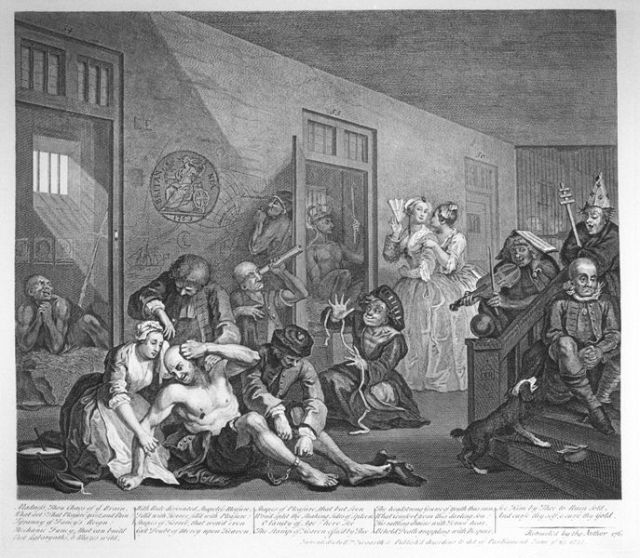
bedlamBut what is this problem of self-identity? Who are we? Perhaps it is when we have learned to let go that we will find everything in Christ.

The association between female humans and cats is known. It is usually limited to woman having one or several cats as pets and being extremely attached to them like children, especially if the woman in question has been unable to have children for medical reasons. It is the case with my own wife. Perhaps this bonding between a woman and a cat can lead to identity issues in a few rare cases. The girl in Norway is either drawing attention to herself through an elaborate joke, or she might be suffering some kind of psychosis (which involves a distorted understanding of what most people agree on as “reality”).  I will at this stage cease looking for a psychiatric explanation because I simply don’t have more than a few notions of that scientific discipline.

The alternative explanation is what psychiatrists call dissociative identity disorder, formerly known as multiple personality disorder. Exorcists call it demonic possession by one or several entities. If you go back to works like the Malleus Mallificarum, one will see associations made between black cats and evil spirits. These unfortunate animals were often the victims of this belief by being thrown alive into fires. Black cats are very much part of folklore in many cultures, because of their alleged association with witches. Cats were not massacred to the same extent in England as in some other European countries. In the instance of the girl in Norway, the black colour seems to have nothing to do with it, and I have seen no sign of her being involved in occult or satanic worship. Also, I don’t know whether she believes that she is a cat or both human and feline.

It is easy for most of us to lose patience. First it is homosexuality, then transsexualism and now people taking on non-human identities! Is this some kind of joke? Should these people be killed or locked up? Some would seem to think so. Fortunately, there are laws stipulating under which circumstances a person should be sent to jail or a psychiatric hospital.

I appended to a comment in Facebook an old Yorkshire saying: There’s now’t so queer as folk. How true.

Posted in Uncategorized | Tagged , | 14 Comments

Introspection and Exploration

I continue doing my homework, and I have found a wealth of valuable information on the Internet. Life on the Spectrum is an English-based site, and avoids some of the psycho-hype one might find across the Atlantic. It is above all turned around the human experience, things that can go wrong and managing in the wider world of family, work, etc. How life has changed! We used to have to go to the library, and know in advance what we were looking for. There are tons of sites on Aspergers Syndrome, high-functioning autism and other information on psychology from a more or less scientific point of view.

It seems to be a “light bulb” moment for me as many life-long questions find resolution and elements of an answer. No two persons are the same, and I find the total absence of two typical symptoms: poor physical co-ordination and sensory hyper-sensitivity. I have excellent space-time-distance-speed perception which enables me to navigate at sea with a minimum use of instruments like the bearing compass, and above all to drive a car on the road safely. Very loud rock, etc “music” drives me mad, as it does to many “neuro-typical” people too, and I am sensitive to people crowding me in or “invading”. On the other hand, I have good night vision, good hearing and notice little sounds and noises – and I know what kinds of things I like to touch. I distinctly have my favourite clothes on the basis of the “feel”. One has to beware of auto-suggestion and the “placebo” effect, so my mind has to be disciplined to be able to make distinctions.

I spent a few hours yesterday between two translating orders on a “manifestation of conscience” in a Word document on my hard disk. That won’t be for publication, but it is helping me get my childhood and adulthood experience into some kind of order from historical and comparative points of view. I fortunately have all my school reports from 1967 up to 1976, and that has proved to be a valuable resource to me. The various “check-lists” on Aspergers sites and online tests have enabled me to shine my “laser” onto old memories of criticisms from parents and teachers. The picture becomes clearer, and I become inclined to seek a professional diagnosis both for the sake of my priestly vocation and my marriage – also to eliminate autosuggestion, because they use scientific controls in their testing methods. I don’t anticipate any changes, but I am convinced that self-knowledge will be the basis of my relations with other people and love of the world around me.

* * *

In the meantime, a Google search uncovered an old article by John Beeler in his blog. He has written to a certain extent on Aspergers Syndrome. I don’t know whether he has had a professional diagnosis, or whether he has made his own conclusions from the typology available in libraries and on the internet and his own personal experience. He has a healthy approach to it, as has Patrick Sheridan who has been diagnosed.

Here is the article from 2005, which compares my two “types” of human beings with “aspies” and “neuro-typicals”, the latter being 99% of humanity who are unimpaired socially if they suffer from no other mental or psychological problem. Quote between the triplets of stars:

* * *

Type As and those of us who aren’t

I’ve noticed this divide, which recent online friends from Fr Anthony Chadwick, an English priest in France, to Mia in Sweden have described.

Fr Chadwick writes (see his entry dated the 26th July for all of it):

Over the years, I have seen two fundamental temperaments of people:

– Those given to beauty and art. People of this group don’t always dislike sports, but prefer the non-competitive activities like cycling, swimming and fishing. They spurn the “pop culture” and prefer classical music and realistic art. Don’t ask me to be successful in business, because I hate to profit at the expense of others! This sort of person likes the Faith to be his entire life. Often this kind of temperament is more sensitive to friendship. Also, this temperament is kind to animals and cannot bear cruelty or indifference in regard to animals, and sometimes it goes to the extent of refusing to eat meat! Most of us are more moderate, eating farm animals killed by other people, but loving our dogs and cats.

– What I would call the “fundamentalist rugby-player type”. We often find liberals and conservatives in this group. They are often the kind of people who are great organisers, they like modern “pop” music, are often interested in sports and a competitive mentality, extending from the soccer field into their working and family lives. Such men are often successful in business, for business is played pretty much by the rules of football, that is when it is fair and honest. Religion, for this temperament, is all about the cut-and-thrust of apologetics, using the same techniques as for marketing. This temperament has no need for beautiful churches, but for assymetry and functionality. There is little or no aesthetic taste. A lot of church women are like this, when you see them destroy a priest who dares to counter their aggressivity!

It fairly describes the difference between many of us ‘differently brained’ people (like those of us with Asperger syndrome or what Mia describes as ‘social phobia’, likewise a real disorder) and what some of us call ‘neurotypical’ people, the type the larger world favours: the Type As as Mia calls them, the second type described by Fr C.

When you don’t understand your own condition, whatever it may be, it’s easy to react in anger by demonising the Type As by being self-righteous, thinking you’re better and more spiritual, etc. (Which understandably/justifiably only gets the Type As more pissed off at you!) Now that I understand AS I try not to do that anymore… but at the same time know ‘where I don’t belong’, and why (which makes a big difference), and that’s fine.

If anything I better understand why people like Fr C and Mia and I are friends and am thankful for that, and them.

* * *

I find that my comments of that time lack maturity, and it was in the context of singing the praises of the recently elected Pope Benedict XVI. I found the original text on my hard disk, since the website John was linking to no longer exists. My comments reveal a certain dialectic between one “type” and the other. We find this in all walks of life, between rich and poor, different races and cultures, religions and religious opinions, men and women, “gay” and “straight” and all the other binaries in life. Self-knowledge always carries this risk of thinking that “I” am better than the other. This was always the bane of Gnosticism in relation to the tradition of the Christian Church, and why it was persecuted by the orthodox.

Interestingly, many “aspies” are atheists since a frequent characteristic is not being able to relate to the abstract but only to the concrete. This brings me to the reflection of how we understand God or anything that is not material as we know it through the five senses and natural science. I mentioned my two fellow bloggers who are up front with their Aspergers. Patrick in England intended his blog to be about the liturgy, and he writes brilliantly. Because of his uncompromising position on the liturgy (unwillingness to go along the logic of the “pastoral” liturgical movement) he became increasingly burned out by comments made by traditionalist Roman Catholics and lack of interest in his other main theme, that of the great author Tolkien. John in America, on the other hand occupies a more classical traditionalist position with the ideas he has constantly expressed of “Office and Mass” and various other distinctions from neo-conservatism and “integralism”. I recognise many of the thought patterns in my own personal history, which I have had to learn to nuance by the use of my rational faculties over faulty intuitive judgements.

Science isn’t certain about the physical aspects like genetics and neurons. What makes for synchronisation between individuals of a species might be mirror neurons. These are very difficult things to prove in the laboratory – like quantum mechanics. This function would be impaired to some extent in individuals with the Asperger Syndrome and deeper degrees of autism. It is difficult to imagine a total loss of empathy and intuition and complete reliance on language to convey concepts. We have to reason out what we find difficult to “feel”. It is often said that blind people make the best piano tuners, because the acuity of their hearing compensates for their loss of sight. This notion is the source of a positive aspiration for those who have this condition. If this theory is anywhere near the truth, the intellect is privileged over the affective life. There are positive aspects, a different human experience and shift of consciousness. At the same time, “aspies” do have empathy, often too much, but feel it differently from other people.

One lovely thing about a blog is it isn’t Facebook or the local pub, where we can only remain at a social and superficial level. We can rabbit on and on about the subjects that interest us. I go on about boats and John goes on about classic American cars, those magnificent machines from the 30’s, 40’s and 50’s. I get into something, and I like to go into the technical details. Now, someone reading blogs is usually interested or shares the interest to some extent, otherwise he would shut it off and move elsewhere. When talking with people, we have to restrict the flow, otherwise they shut off and get bored, because they do not relate to the topic. I find it very difficult to answer the question “How does it work?” in three words flat! That is so frustrating. When we are teenagers or children, we can’t judge the limits, but as adults, we have to assume the person is not interested and make the effort to do some small talk on pain of becoming a party bore. It sucks or we suck! – to express it like the Americans.

I found this with my mother and my wife – no technical details. No talk about the things I really know about, so I have to learn more things to come up with something new and original. The worst is being asked what something is, for example a part of my boat. What do you say? A reefing line? What the hell is that? If I say, it’s a bit of string to tighten up the mainsail at the reefing line once the halyard is lowered, ouch!, that is too long winded and technical. It’s a bit of my boat – don’t chuck it out, please. That is probably just about the limit. Perhaps this is where friendships are made and broken. With friends, one can go a little further, especially when interests are shared. The inhibitions are removed and one can go quite a bit further and learn more from the other person.

Hans Asperger, the psychologist specialised in helping autistic children and who discovered this condition in 1944, was the origin of many fine quotes. Perhaps the most memorable is “It seems that for success in science or art, a dash of autism is essential“. It is thought that Mozart might have been “on the spectrum” due to his brilliance as a composer and his quirky behaviour like getting up onto a table and meowing like a cat. Asperger summed everything up so simply “Social adaptation has to proceed via the intellect“. We have to compensate, like the blind man hearing and feeling his way around.

In everyday life, “aspies” are odd eccentrics, often the butt of jokes. What about the spiritual aspect, given that some or even many are atheists? Of course, we might find that some are “religion geeks”. We know about all the minutiae of the liturgy like the parts of an engine or a sailing boat’s rig. Information vegetable, animal and mineral as the Gilbert and Sullivan song goes as the modern Major General describes himself. Some study theology and open themselves to new areas of knowledge. What about a life of prayer? The very notion of God? Being religious isn’t just a matter of following rules and looking right. I do believe in the notion of altered states of consciousness and knowledge of what escapes our materialist experience. Of course, many things can happen under mind-bending drugs or conditions like schizophrenia or various types of psychosis.

The Red Indian shaman comes from a tradition of men who are conscious differently from the rest of us. Many religious and spiritual traditions have this element of the wise man, the wizard, the oracle or healer of the community who knows things differently. One would have thought that “aspies” would be suited to monastic life, but that is excluded in some of the totalitarian and personicide <neologism> communities I have come across with a philosophy more akin to the Army than anything else! That is a crying shame, because it is difficult for an “aspie” to assume the role of a parish priest as this vocation is currently conceived – for extroverts and the most socially adapted. Is any other model of the priesthood possible if monastic life is not an option? For centuries, priests have been used by their bishops for all kinds of ministries, from teaching to research and all kinds of chaplaincies and niche ministries. There is always somewhere in a paradigm of diversity.

An idea I can advance outside conventional religious categories is that someone “on the spectrum” has been on the front lines for years, knowing that something was wrong and not knowing what, being blamed for moral deficiencies and lack of virtue. Many are only diagnosed as adults after a considerable amount of suffering and soul searching, almost a quest for the Philosopher’s Stone. It would seem to me to be the first step towards Gnosis, that of the person who is completely naked before God and his own soul where a spark of divinity resides in spite of our being broken vessels. This is the beginning of knowledge and experience. I am brought to remember the words of Walt Whitman:

Away O Soul! hoist instantly the anchor!
Cut the hawsers – haul out – shake out every sail!
Sail forth – steer for the deep waters only.
Reckless O Soul, exploring, I with thee, and thou with me,
For we are bound where mariner has not yet dared to go,
And we will risk the ship, ourselves and all.
O my brave Soul!
O farther, farther sail!
O daring joy, but safe! are they not all the seas of God?
O farther, farther, farther sail!

That is our vocation, to go where others would not dare (trying very hard to avoid the Star Trek cliché). But, this is only a first stage of the “fool for Christ”, the “sign of contradiction”, you name it. At the same time, it cannot be an occasion for pride, thinking of oneself as better. We are just different, like men from women or different species of animals.

Patrick in Kent has probably passed through the gate, though he is still suffering from a kind of “purgation”. One who feels and experiences alienation from the ways of this world is on the way towards Gnosis, knowledge and not mere faith. To such persons, ordinary religious teaching can sound horribly hollow. Bible stories we once took for granted can only be interpreted allegorically, as metaphors to describe events outside human experience.

I won’t go into the Gnostic mythology, but I can affirm that what atheists say does not exist is not God! I’ll let you work that out for yourself. To give you a clue, what some people worship is not God but a projection of messed-up man and buggered-up creation.

Our alienation from blind acceptance of the way society works can make us very lonely, but it is something that protects us from lies and false egos. When we are in a social context in which we do not belong, it is best to be away from it. The “aspie” will feel this extremely acutely. I certainly do. It annoys my wife to see me not “playing the game”, but what is life about? I have asked myself many questions about empathy. Surely we become evil without empathy for others and an ensuing moral sense dictated by natural law. Empathy makes life hell, because we soak up from others what is bad as well as good. Compassion would seem to be better. Christ resisted all the lies and devices of the evil, but he was always compassionate to those he described as blessed in the Sermon on the Mount.

I have stopped worrying about fitting into society. People who are true of heart can deal with eccentricity and diversity. I do make efforts to relate to some extent but it is tiring. The old How do you do or more modern equivalents are quite obnoxious, since the person would run a mile if I were to say anything about my health or feelings! Why should they care? In old English etiquette, we had formal introductions – so that people don’t have to break the ice of their own with hypocritical banter. Perhaps there are compromises, opening up a true subject whilst keeping things brief and verbosity to the minimum. But, many would still run a mile if the surface is breached. Then why bother at all?

We will certainly find what we are seeking away from the false egos and the hypocrites. We can be sorry for them and pray for them, have good and positive thoughts, but by knowing that we have nothing to do in that world. The sea is indifferent, but at least honest! I’m not sure that I am an “aspie”, but I certainly think and feel like one. The housework is done and the rubbish cleared away, and we can seek what is true, beautiful and noble.

I’m not better than anyone else, just a broken vessel of clay that God can repair if he wishes. As St Theresa of the Infant Jesus once said: Je veux faire mon ciel à faire du bien sur le terre. This good is not simple philanthropy or charity to the poor, but the sharing of a higher light, good and truth.

Posted in Uncategorized | Tagged , , , , | 10 Comments

Dark Days

I should imagine that many of us in the northern hemisphere are going through the late January blues since the end of the Christmas season (though some argue that it continues up to the eve of Candlemas). We arrive at the gates of Septuagesima, which is particularly early this year. I remember a seminary pilgrimage to Lourdes in February 1991 when we stopped off at the Abbey of Le Barroux for Ash Wednesday before continuing on towards Lourdes for the feast day of 11th February. It was all ice and snow and I was driving three other seminarians in a 2CV – yes that legendary French car – and once skidded on black ice. Fortunately, I was driving slowly, so there were no injuries or damage to the car.

I haven’t written anything here for nearly a week, and I still have my reading into the old Gnostic world view in mind. I am concerned to write articles of my own and not plagiarise anyone else! I am fortunate this January to have a reasonable amount of translating work to keep money coming in to pay the bills. I have also been going through an introspective phase and some research into the Asperger Syndrome, which might explain many things I have found difficult to understand about my own life. Various articles I read tell us that this autism-related condition manifests itself in different ways. For example, not all people affected by this condition are clumsy physically, they have good space perception and they do not all collect locomotive numbers or other bits of useless information. On the other hand, one can get quite passionate about things like sailing boats, classic cars, pipe organs and the liturgy. I often find myself noticing details of architecture on buildings, like for example what kind of windows they have – and then I realise that I need to concentrate on what I’m doing like driving – or walking without bumping into other people. I don’t know whether I have this condition or not, since I am disinclined to jump through the hoops of the “system” for a formal diagnosis in the hands of a psychologist. Online tests can be unreliable unless you answer the questions one by one and with absolute honesty and naivety, otherwise we know what is implicit in the questions and the result we are “looking for” determines our answers. I have no need of an “identity label” other than just being myself. Aspergers is about how your brain is made from our genetic code, and is not some problem caused by chemicals in the brain or bad psychological experience. I leave all that to the experts! I could find many explanations for many aspects of my own childhood and difficulties in relating to schoolmates, teachers and even my own family, and which extended into adulthood. Some things match, but others don’t. There are variations. Over the years, I have learned how to “compensate” for many of the more difficult aspects, make an effort to “read” people’s emotions and implicit communication, look at eyes, etc. I am a priest, and it is important to relate to others even if it is difficult. Like Gnosticism, this will have to be something ongoing, open-ended and without any final conclusion.

I have kept my eyes open on the blogs and news sites. The world continues to go very badly due to the criminal elements in high places, the lies of politicians and the barbarism of people claiming to follow a certain religious tradition. The players of the Anglican establishment continue to hedge their bets and try to please everybody. One blog article hung the bait in front of my face, calling continuing Anglican bishops frauds – to give you a clue – but I did not react. What’s the point?

Most blogs concerned with religion and liturgy are filling in the gaps with the current saints’ feasts and the upcoming Septuagesima period preceding Lent. Some are commenting on Pope Francis making changes to Maundy Thursday. I am totally unconcerned, as I am by just about everything else I read and hear about this pontificate of a Church to which I belonged for only some fifteen years. Now, I must not sound too melancholic, since I feel rather calm about things.

I mentioned being passionate about the boat. At last, the registration for the Route du Sable is open and I have sent off my registration for the event that will take place in June. I intend to precede this gathering with three days alone on the Rade de Brest. The Rade is protected from the really big Atlantic swell, but can be a challenge to a sailor. This week, I made some modifications to my boat trailer to incorporate a separate launching trolley, so that the road trailer never has to go anywhere near seawater. Mild steel goes rusty very quickly, even when painted and regularly maintained. All said and done, my two boats Sarum (12 foot Zef) and Sophia (10 foot Tabur 320), both with the standard Mirror rig, are still wintered and waiting for the new season, which is still likely to be a month and a half away at least. Enough rambling for now! The idea gives something to look forward to.

Even though it is winter and the mornings and evenings are long and dark, there are landmarks. My wife and I will participate in a choral weekend from tomorrow and meet up with all sorts of amateur singers. Mixing with crowds takes effort, but can be done! They are good people and there will be jokes, good food and flowing wine. We have booked a little weekend in early February to visit Amiens and its magnificent cathedral (which I didn’t do on my canal trip on the boat last September). There is also the house of Jules Verne, my great childhood hero, and that promises to be fascinating.

I have tended to close off to “churchy” news apart from the healthy developments with our ACC bishops and those of other Churches. They are working towards reconciliation and unity, a way to overcome the sins of the past and provide for a bright and hopeful future. There is so much darkness and evil in the world that we need to find beauty and goodness in the simple things of life. Let’s keep the faith!

As when I was with the monks all those years ago, I am heartened to see the first snowdrops and even a sprouting daffodil with a tinge of yellow in the flower bud. These are reminders that more joyful days are ahead, and this should bring us courage and hope.

Posted in Uncategorized | Tagged , , | 1 Comment

Other Enquiring Minds

I once spent a couple of days with Fr Michael Wood at an Orthodox monastery in France. He is a Russian Orthodox priest of Australian and Anglican origins, and runs a western rite mission in England. He spends time on Facebook bringing us lovely images of medieval English churches. He has also set up a new blog Notes on Life, which I happily make known here.

I have been particularly struck by his article God, the Cosmos and Everything.

I see a certain collusion with the Gnostic vision, a brave attempt of conciliating credal orthodoxy with the mystical and apophatic tradition of understanding the notion of God.

He also introduces the “new” view of the world as expressed by scientists specialised in quantum mechanics. He muses on the way most of us were taught physics at school: the atoms comprising matter in the form of little “solar systems”. What were believed to be solid particles are pieces of information.He also sets out to try to understand something of the “virtual reality” theory. The world exists only by the information on which it depends. No autonomous existence is possible as in the materialist hypothesis. The creation narrative, or the Gnostic equivalent, would have to depend on an analogical understanding. He goes on to describe the need for there to be dimensions outside the universe we experience. The usual analogy is the radio and the wide range of frequencies one can tune in onto – but only one at a time, or the very narrow band of light frequencies we can see with our eyes.

We are brought to awareness of how little we experience or know. Perhaps that is part of our own “evangelisation” and eye-opening from the various prisons in which we languish. Well done, Father.

Posted in Uncategorized | Tagged , , , | 7 Comments

Post-post-everything

Since my writing up Monsignor Pope’s article in my posting a few days ago, The Challenge of Downsizing, our good friend JV has posted “Tridentine” stagnation in a post-Summorum Pontificum world. It makes things even clearer. What is a Church without the crowds? Simply it is one that cannot afford big buildings, prestige and status, all things that did not matter to Christ or which were thought of as obstacles to the spiritual life. I think I have said it clearly enough.

I remember the brash assumptions of traditionalists, both Roman Catholic and Anglican, that beauty and “other-worldly” liturgy would draw in the crowds. They haven’t. Most people do not appreciate “classical” music neither, nor to they visit museums or art galleries. Most people watch television and listen to the rhythms and melodies to which they can relate. According to the principle of inculturation, methods of evangelism have to involve modern television entertainment. Count me out!

If “evangelization” is the way, what does that word mean? Etymologically, it means bringing groups of people to believe in or live according to the Gospel. There is also the question of the contradictory aspect of using the old liturgy in defiance of authority, thus creating a dialectic that causes reflection and commitment. If this element is gone by the old liturgy being assimilated into the ordinary diocesan system, the salt loses its savour. In my other article, I compared most “evangelization” with methods of marketing products and services in the secular world. The evangelical Protestants are the ones who do that best, especially the American “mega-churches”. If number matter, they have them – so shouldn’t we bite the bullet and go and get “born again” in a shower of emotion?

The bottom line is asking ourselves whether all people are “called” to be Christians. It comes back to the old exclusivism and the role of the “true church” in salvation. It is circular and a never-ending loop. I am not going to go into this again, and it is the main reason why I am breaking that loop by appealing to some of the Gnostic ideas. I don’t believe it is a matter of what happens when we die, but rather what knowledge we can gain of the immanent “kingdom” or divinity within ourselves, what the Orthodox call θέωσις. In reality, the notion is similar to Gnosticism with the difference of vocabulary and reference to mythology. People will not be encouraged to find this degree of “deification” by filling the pews of a mega-church, waving their hands in the air and getting emotional like at a rock concert.

Those people who become Christians are open, seeking of their own accord and “waiting”. They have enough knowledge to know that something higher than “ordinary life” exists and is desirable. I too have to abandon the illusion according to which liturgy and beauty would attract people to any church, be it a great cathedral or a converted garden shed.

The real issue is not whether we like churches or not. I have spent all my adolescent and adult life in churches – as a choirboy, choir man, organist and going through the minor and major orders at seminary. As a priest, my church life is what I make of it. The real issue is our fundamental priorities in life – whether we are interested in seeking our full spiritual potential (which goes to a different degree for each of us) or whether we are dead or nearly dead in this life.

When the spiritual soul begins to live, we have other needs and priorities than what goes on in churches. Those of us who remain “asleep” remain in the prison house from which Christ offers us liberation. The reality is not liturgy or joining the hot-gospel hard-selling teams, but working on ourselves and having compassion for all. The Gnostic notion of the three kinds of humanity (spiritually aware, tied to religious routines and laws, and materialists) is both salutary and dangerous. It can cause the “elite” to see everyone else as “sub-human” in the manner of the Nazis, or it can help us to recognise those who are nearest the “kingdom”. How do we know if we are “spiritual”? That is probably the most difficult thing in the world, but there are indicators. One is being free in a world that does its best to be our prison and motivated by love.

If the word “evangelization” has any meaning, it is the work we do on ourselves to become aware and alive, free and motivated by love. This can only be shared with others who have also “got it”, for whom no explanation or propaganda is necessary. Its finality is not putting bums on church pews, but something much higher. Perhaps some progress is possible via churches and sharing something with the literalists of routine and law, so that a light bulb may light up. Many things can make lives change, usually suffering of some kind. I remember the long Mattins services at Triors Abbey where I “suffered from suffering from the liturgy“. These were inner conflicts that would be interpreted in one way by my Abbot, and in another way as I began to discover.

We are coming to a stage where not only those who have “got it” are in a tiny minority, but also those who seek truth, routine, law and security. The vast majority seem to be materialists, dead as far as we can see, and who may well be annihilated when they physically die. That is something very hard and bitter to contemplate, but a horse can be brought to water but not forced to drink. That is essentially why I see most “evangelization” as futile. This saying from the Gospel of Philip will leave us with more than raised eyebrows:

Those who say they will die first and then rise are in error. If they do not first receive the resurrection while they live, when they die they will receive nothing.

As a priest, I can be human and compassionate with all, try to bring consolation in suffering – but only open to the call from an imprisoned soul. With most people I know, this is so rare. Here on the internet, there is a wider interaction, but I never get to meet any of you reading my words.

All that being said, beware of appearances. Holiness is found in the most unexpected people and situations. Often it is the lowest that are the highest and vice versa.

Posted in Uncategorized | Tagged , , , | 2 Comments

Conformity

I have just been pointed to a couple of articles that merit examination: Pervasive Conformity and Its Influence on Earth Culture and Exit from the Matrix. I mention these ideas without going into the “prepper” culture (people making an unhealthy hobby of collecting materials believed to be useful or necessary for surviving little short of the end of the world), which is another issue and can itself become a “mechanical” mode that challenges our humanity.

I don’t think that any of us can claim to be completely independent from any man-made system or the culture to which we belong. We have all been in families, schools and other institutions where we had to obey rules and follow a code of conduct. At school or in the armed forces, we would wear a uniform. As a priest, my official dress is the cassock or a clerical suit (or another combination with black trousers and a shirt with a clerical collar). Any kind of life with other people, however informal, imposes a limit on our individual freedom. Indeed, the greatest freedom is found in relationship and love, which constitutes true personhood. There is a degree of conformity in that relationship.

On the other hand, we do need to reflect on another kind of conformity, one which makes human beings prisoners of a system or mechanism. We can see the point of Jesus in regard to the Pharisees. The spirit gives life and the letter kills. A living tradition is life and love, and dead tradition enslaves. We live in a world in which Christian tradition means very little, but other forms of dead convention take over. How does dead letter kill? Obviously, it does not do so physically but it takes away our personality and difference between persons.

The combat of the Romantics, including those who lived in the eighteenth century like William Blake, was against the machine, not against useful technology but against dehumanisation and the death of the imagination. This notion has marked me deeply. I use machines and technology as much as any other, but I consciously declare my independence as a human being. The machine is a tool, not a substitute for us.

Humans acting like machines is a characteristic of totalitarianism. The armed forces have drills and marching in lockstep. Even monks in a monastery make a big point on precise timekeeping for the Offices and other community functions. In this latter case, I would hope that the obedience is given with love and as human beings with personality and imagination. “Political correctness”, once a notion confined to Orwell’s dystopian novel, is now a kind of invisible machine. You obey it for your own self-preservation and for fear of getting into trouble with the law. I have never served in the armed forces, but I have spoken with people who have, and who have killed in the line of duty. The training is designed to kill our usual conscious and unconscious reflexes. You learn to become a machine that obeys orders and kills on command. That is a soldier’s job. The police are finding that they have to adopt the same methods.

We are living in days of hyper-rationalism and the same conditions by analogy as at the time of the French Revolution. Can we escape the machine? Not completely, but we can resist in many ways.

The first way is to take to heart the saying that the Sabbath is made for man, not the other way round. Machines are tools to help us to work. They obey our commands because they are inanimate objects. They shut down when we switch them off and they have no minds of their own, not even the sophisticated machines with “artificial intelligence”. They exist to serve us because we made them.

We have an imagination, and we need to stimulate it especially through creative writing, art and music. We must not let the internet get us out of the habit of reading books.

We should avoid doing things automatically as much as possible. That’s easier said than done, because we humans are creatures of habit and routine. It is good to take a step back and take a critical attitude. Are all habits and routines the right thing?

In our religious life, we should try to connect with the mystical and spiritual tradition. Getting out into the natural world is a great help, in a boat at sea or on top of a high mountain for example, and we can more easily find the solitude we need for prayer and meditation.

In our beliefs about the world, we should try to understand new scientific theories and discoveries – and relativise the old materialism and “realistic” metaphysics. We need to see that our experience is only a very narrow “band width” of what exists. Such ideas can bring us awe and wonder.

It is in this optic that I seek to conciliate Christianity with some of the old Gnostic ideas of consciousness and immanent divinity, the “kingdom” within.

We may have to live in an extremely hostile world, and we are ordinary people, not heroes. Some things may help our resilience and inner strength as humans and vessels of divinity. In many ways, we are forced to conform outwardly – but yet be free within. The time to begin learning is now while we are still physically free.

Posted in Uncategorized | Tagged , , , , | 2 Comments

A Careful Clarification

My Bishop has posted the following on Facebook:

The ‘alphabet soup’ of acronyms that exist the whole world over and which can be found in almost every area of life, and increasingly in Church life, can be confusing.

I have had some messages and emails concerning the events in Canterbury this week, namely the meeting at the Cathedral of the Primates of the Anglican Communion. There has been some confusion because some press coverage and commentators have been mentioning the ‘ACC’. In this context the ‘ACC’ referred to in the reports is the “Anglican Church of Canada” and not the Church to which I belong the “Anglican Catholic Church”. My ACC is not part of the “Anglican Communion” – nor part of what appears to be the more traditionalist “Alternative” Anglican Communion that has been emerging slowly over the past 10 – 15 years (our origins are much earlier). In addition to this I am in no way, shape or form involved in the events at Canterbury Cathedral this week – except to say I have been praying earnestly for a return to orthodoxy in faith and practice of the whole Anglican family. Not to mention praying for the many friends I have within the Church of England and other parts of the Anglican Communion who are finding their Church life very tough.

It is important to be clear at this stage lest confusion set in and bring blame to ourselves.  We will certainly read all about it in a few days as journalists and bloggers go to their keyboards. I don’t really know much about what goes on in the Canterbury Communion apart from a lot of money being spent for hype, hot air and equivocation. Fewer and fewer people are convinced. We in the ACC make no “true church” claims but simply affirm our fidelity to the English tradition and the Catholic Church through our independence and persevering in our little way.

Our position is clearly stated so that no one may be confused. That’s all we can do other than pray…

Posted in Uncategorized | Tagged , , | Leave a comment

Ungodly Alliances

In the light of recent events, many of us are noticing that politicians who promote left-wing “politically correct” agendas are also favouring the growth of tendencies that one would imagine to be diametrically opposed to their own interests and any notion of human rights. The case in point is the rape of European women by young immigrant men from northern Africa and the Middle-East. The response of the Mayor of Cologne is that the victims asked for it by being dressed provocatively. An article I read this morning, The Left’s Embrace of Islamic Rape, wonders if German women would be advised to dress in the burqa or the niqab. Was there any expression of a resolve to bring the men in question to justice and impose the usually heavy prison sentences provided for by the law?

What is at the basis of all this? There are conspiracy theories that are more or less fantastic, but I would tend to look for an underlying philosophy and psychological underpinning in the collective consciousness. We do need to unpack things a little, because young women in towns often represent a degenerate culture in their dress, manner and choice of “music”. Women’s fashions have changed a lot since Edwardian days through the two world wars and the 1960’s. Girls are generally allowed a good amount of tolerance within the limits of public decency. Should there be laws about how we should dress over and above covering our intimate parts? What is considered as provocative?

To what extent should indigenous populations in Europe adapt to immigrant Muslim populations? To Muslims of fundamentalist tendencies, we should dismantle our own culture and adopt theirs, purely and simply, finish with democracy and our system of law and submit to their system of Sharia law. Life in France, Germany and England, everywhere, would be like in Saudi Arabia: no religions other than Islam, torture and capital punishment for any opposition to Islam, etc., etc. It was in the early eighteenth century that public opinion turned against the barbarity of hanging, drawing and quartering, and in the late nineteenth against all public hangings. This humanist movement would be reversed in a heartbeat! What has this to do with modern socialism? Why the glaring paradox?

Perhaps there is a belief that Muslims coming to live in Europe would learn to appreciate democracy and consumerism. With some luck, they would become atheists and contribute to building the new Orwellian order – one way of looking at it. There is the idea of action and reaction: get Europeans radicalised into extreme right-wing ideologies by multiplying the outrages, thus starting a civil war and revolutions like that of Hitler and the Nazis, and then an unknown stage involving some other ungodly alliance. The agenda would seem to go much further than getting nationalist parties into power in Europe.

What is most characteristic of the Left’s agenda? How is it possible to believe it is possible to conciliate hard-line feminism with Islamic “head choppers” who rape women and would make slaves of them? The answer would seem to be Nihilism. Large numbers of disenchanted young Europeans have been going to Syria to join Daesh. Some were “cradle” Muslims, others were “converts”. Did they really believe in the tenets of a monotheist religion invented in the sixth century on the basis of bits and pieces of Judaism, Christianity and older bits and pieces from Zoroastrianism and Manichaeism? Or did they believe that the world should be “suicided” by their own death wish?

One possible analysis is one of the most powerful yearnings of the human psyché, that of submitting oneself to a totalitarian entity. It can be religion, a cult, a political ideology, anything. The individual, having failed to identify with his own context and life, finds power and purpose in the authoritarian collectivity. Yes, I can hear you say it – the Church too! Yes, indeed. I have done so myself when I went to be “received” by the Society of St Pius X and sought to go to their seminary. Gradually, I discovered that there were still aspects of my identity and personality that attached me to the humanist values in which I was brought up. I sought to find another way with the old liturgy, and those were the days before the Indult, Ecclesia Dei and Summorum Pontificium. Those who truly submit, as I could not, reach the stage of being a true adept of a cult. They are ready to give their life, to become a “martyr”. It is hard to find one’s own identity, and few have the tools for discovering the “key of knowledge” – γνῶσις. Jung helped many, but most of us do not have access to such a person or the money to pay him for his time as a professional. Most of us are on our own to discover our own “archetypes”, and most of us find the work so hard that we give up and submit to whatever it is.

I quote Umberto Eco in his Name of the Rose novel:

Jorge, I mean. In that face, deformed by hatred of philosophy, I saw for the first time the portrait of the Antichrist, who does not come from the tribe of Judas, as his heralds have it, or from a far country. The Antichrist can be born from piety itself, from excessive love of God or of the truth, as the heretic is born from the saint and the possessed from the seer. Fear prophets, Adso, and those prepared to die for the truth, for as a rule they make many others die with them, often before them, at times instead of them. Jorge did a diabolical thing because he loved his truth so lewdly that he dared anything in order to destroy falsehood.

It is not only Islam or some weird cult where the adepts are persuaded to take cyanide. There were men like Anthony Blunt and Kim Philby who kicked the British establishment in the teeth to convert to Soviet Communism. I think that those two men died from natural causes, but they were certainly used by their new masters. I mentioned an elderly man a few days ago on this blog who more than dabbled with Nazism in the 1930’s and during the war. He died in dark circumstances, perhaps killed for money by a rent boy, who knows…

Nihilism has produced many paradoxes and alliances, notably between the Nazis and the Grand Mufti of Jerusalem. The Hezbollah is known for its ambition to rid the world of Jews as well as its opposition to Daesh. The Shi’ites are just as bad as the Sunnis with their torture chambers and terror. Nihilism is hard to define in any universal way. The word is easy enough, from the Latin nihil meaning nothing.

It might collude with severe depression by which someone sees life as meaningless and all negative. There are extreme alleged psychiatric conditions like the Cotard delusion. I am dubious about modern psychiatry as something that lacks scientific rigour. However, some of these “conditions” remind us of philosophical nihilism. There are also depersonalistion disorders and reactions to trauma (soldiers returning home after a war) in PTSS. The human being is a spiritual animal, and thus is susceptible to being damaged by his environment, both physically and spiritually. As an extreme condition, the description of the Cotard delusion illustrates nihilism rather well. The subject believes he is dead or does not exist. Common characteristics are despair, self-loathing, delusions of negation and clinical depression. Some patients would deny the existence of parts of their bodies, the need to eat. Many would commit suicide. Psychiatrists love to attach names to anything, and many things are confused and misdiagnosed, because undiagnosable, but the bottom line is this dark melancholy into we we can all descend into it for a short time or chronically. Without medical or psychiatric qualifications, I can only offer an approximate opinion, and then prefer a philosophical approach.

Nihilism is most often associated with Friedrich Nietzsche (1844-1900), an incredibly complex character and the subject of many research doctorates. There are many tragic Greek themes in this view of life, some aspects of Romanticism, but notably the destruction of morality and metaphysics. I posted Byron’s Darkness last All Souls’ Day. Nietzsche is the one who most comes to mind in this reflection on nihilism, but he did not invent it. We find it particularly in nineteenth century Russia. Dostoevsky described it very well in his book Demons (Бесы). This novel is probably one of the most profound analyses of Russian nihilism of that time. Nihilism very quickly became associated with the revolutionary movement against the Empire of the Czars and the Church. When anarchism and nihilism are combined, it is one of the most destructive forces of modern history. When man’s spiritual being is denied and all that is left is materialism and rationalism, the exaltation of freedom becomes wanton evil and destruction, murder and terrorism. I have often written in favour of anarchism, but Christian anarchism, on the basis of spiritual gnosis and a higher principle than human authority. There is a difference!

Does nihilism have roots in Greek philosophy? Perhaps the Skeptics who denied knowledge and truth. They were epistemological nihilists to coin an expression. The three main areas affected by nihilism are political, moral and existential. A university friend once described existentialism as driving into a brick wall at high speed! Life is meaningless and absurd as often satirised by entertainers like the Monty Python group in the 1960’s and 70’s.

Nietzsche is a really difficult one to understand. He was a tortured man and was unhealthy spiritually and psychologically. It seems that any idea of truth or value was baseless and deserved only to be destroyed. Many of his ideas like the Ubermensch (the “master race”) and the role of the will, would help to form the basis of the Nazi ideology. Nietzsche’s analysis influenced Oswald Spengler in The Decline of the West (1926). It is amazing how ideas from the 1920’s collude with our own concerns today! Russians like Berdyaev saw the rot creeping in, as did Julius Evola, René Guénon and others looking for a ticket out of the hell of the modern world under the banner of Integral Traditionalism. From these analyses came Existentialism. Martin Heidegger found nihilism to be man’s “normal state”. We can only begin to imagine the effect of the World War I hecatomb in Europe with so many dead and maimed. Life loses all purpose and morality except strength and will. This would be the earth from which Nazism grew in that era, to Hitler’s election in 1933 and his downfall to even darker forces in 1945.

Historically, nihilism is related to the old Skeptics in their denial of truth and knowledge, but in the twentieth century, it described the idea according to which life is meaningless. You just exist until the day you die. This depressing idea formed the basis of writings by Camus and Sartre in Paris. Gaie Paris can indeed be a depressing place! Jean-Paul Sartre’s (1905-1980) defined Existentialism as l’existence précède l’essence, which seems not to require any translation. Existence without being – the idea seems impossible as it indeed is. If we are alienated beings in exile, I would prefer to believe that we are based on an image of God, and that are purpose of life is to seek spiritual knowledge of that image, spark or whatever. For Sartre, when you “man up”, you have to strip away the illusions and cope with the boredom of it all. All the same, I see something parallel with the old Gnostic mythology in that an individual is thrown into an alien world and barred from knowing. The Gnostic would seek knowledge. The Existentialist denies that knowledge or meaning exists! Camus was able to see where it would all go: nihilism is followed by destruction, hatred and war.

I have sometimes tried to grapple with the notion of post-modernism. Is there much difference in this idea from nihilism. The stereotype is some suburban lout who isn’t interested in anything, gets drunk, gets into trouble with the police and hasn’t the slightest ounce of culture, reading or thought about him. They’re not interested in politics, religion or spirituality, being or doing anything intelligible. One feels that the only thing such a person deserves is a bullet through his head or at least a stint in an Army boot camp! I have sometimes looked for desires for knowledge, understanding and beauty beyond the categories of rationalism, a new kind of Romanticism. Perhaps I live in illusions, yet I am one of humanity. There is another aspect: the refusal of institutional hypocrisy and pretending to be a caricature of the conformist. We can only question hyper-rationalism and the mechanical world of machines and bureaucracy, and we sink into irrationality and despair. Post-modernism is indeed a nebulous idea that leaves us deeply unsatisfied.

The association between Nietzsche and Hitler’s crackpot stuff has served to warn us away from many of those ideas. Nihilism has mutated in its outward forms since the days in the spring of 1945 when people in Berlin were blowing their brains out to the strains of Wagner’s Götterdammerung and ordering Germany to be completely destroyed because the war was lost. It is the one human instinct that will enable us to begin to understand why individuals become inconsolably depressed and why people in high positions of political power are prepared to go to war, even with nuclear weapons. The apocalyptic overtone spreads anxiety, gloom, terror, anger and hatred from which evil feeds. Even in the Church, we wonder if it would be better if we let the old worn-out “mainstream” die its death in order to bring about something new. I am tempted to think along those lines – but there is a difference between bringing it about and the acceptance of its demise. I would not commit suicide, but I have to accept that I will die one day. The idea that something good would come out of destroying everything is an illusion, a very dangerous one. There is something of the nihilist in us all. This is our spiritual combat with darkness and the shadow. Berdyaev resumes this theme of the night following the end of the Renaissance. It is almost reminiscent of St John the Cross’s Dark Night of the Soul. This darkness is necessary so that we can come to the light. The night is close to the mystery of all beginning. Berdyaev wrote The End of Our Time in 1933, doubtlessly aware that there was no further obstacle to the evil and darkness descending over Germany and the rest of Europe. His words remain alive to us today. But, there seem to be two kinds of darkness and night, one in which we find hope and a glimmering of the light.

Berdyaev likens the Middle Ages (or the “new” Middle Ages) to the night, not in the meaning of rationalists referring to irrationality and obscurantism, but a transition from rationalism to a new beginning. The previous “day” could not go on for ever, and it is tarrying in coming to its end. Perhaps this is the deepest intuition of nihilism – except that something has to follow the nothingness. The Romantics were but a shadow of that role in the wilderness left by the French Revolution, but their vision was but limited. Did Berdyaev think he would see the New Middle Ages in his lifetime? Perhaps, but only within himself. In a way, Islamic barbarity has proved too much of a challenge for western humanism that is aware of its own fragility and illusions. In the absence of God, there is only hell and the antichrist. We cannot go on with the present western status quo. Berdyaev wrote about capitalism in the 1930’s, and we recognise the same blight and diabolical hold today. Nothing has changed, except that the cracks are there. It is no longer about real money but debt!

Like in the 1930’s, the downfall of the old system is being challenged both by nationalism and Islamic jihadism and the oppositions and individualistic reactions are the same. For Berdyaev, the new Middle Age will not be the old one, unless it is the version Deash would like to impose with the horrors for which they are renowned and serfdom. Out of the barbarianism came the notions of fair maids, knights, chivalry and a whole new civilisation from the ashes of the “dark ages”. How might that happen with the collapse of liberal capitalism and the twin demons of nationalism and jihadism? We have to see that our concerns go back back in history.

There is a prophetic role to be seen in post-Communist Russia and Vladimir Putin, not as a new nationalist movement and an authoritarian regime, but a precursor of Christ and the eternal Church. I have great hope there, and pray I am not mistaken or deluded. It is ironic that hope comes from the east, not from the rotten corpses of America and western Europe. Berdyaev’s reflections on women – in 1933 – are amazing, as if he could foretell the excesses of modern feminism in its negation of masculinity. There is not only the thought of Berdyaev, but also of other Russians, especially Dostoevsky, Tolstoy and Soloviev. There is something great coming our way from that country. I believe it very strongly. We can’t become Russians, but we can learn from their most noble spirits.

Perhaps nihilism is our painful passage from the old dying world to something new and radiant. Our only way through and out will be our human capacity for self-reflection and the quest for γνῶσις. There is no guarantee of our salvation, redemption, call it what you will, but it is in our hands. Nothing is automatic. Berdyaev wrote in 1933, and the old dying world is still ours to suffer from, almost a century later. Will God help us? We cannot presume it before we have done something for ourselves.

Posted in Uncategorized | Tagged , , , | Leave a comment

New Hope

A few days ago, I quoted an article from Fr Robert Hart, and then discovered that it was all on Virtue Online. It was about continuing Anglican bishops getting together and working towards unity. I have now come across Continuing Church IV: A New Hope by Fr J. Gordon Anderson of the Anglican Province of America on his blog.

Most of us can remember some of the bad times over the last twenty to thirty years, things like bishop’s brawls, disputes between cantankerous and parochially-minded men who had at some time been elevated to the Episcopate because they happened to be in the right place at the right time. I had almost the same discussion with my Bishop and with Fr David Chislett serving in the Church of England via Forward in Faith. We have seen it all before, but something brought us back from the brink of cynicism (modern meaning). Now, we can be extremely encouraged about this turn of the tide.

In the past, every time there was a development, there were men trashing continuing Anglicanism saying that we should have stayed with the Establishment or made our choice between the Patriarchate of Antioch or the Roman Catholic Church. This time, the armchair apologists and bellicose clergy seem to be silent. Pope Francis seems to have flattened a good few things out… In his paragraph about a priest trashing everything in sight, I would not like to guess the identity of that person. Frankly, it isn’t my problem. This time, we seem to be left in peace. Perhaps our former adversaries have problems of their own rather than worry about us.

It is good to get on with the things that really matter, just getting on with being ordinary priests doing what ordinary priests do. I find it a great encouragement to see these movements towards peace and unity for the sake of the Church doing its job: bringing people to the light of Christ. The upshot of all that: we can be thankful for the good news. Many of us have lost the “extremist” discourse born of reaction to embrace a more irenic view of things as we continue to worship with classical rites and seek a theological synthesis of everything.

Churches reach their limit of “usefulness” when they are over-institutionalised and “mechanical” in their bureaucracy. We Continuing Anglicans will certainly reach that point one day with sanctimonious cant and empty verbosity. But, that hasn’t happened yet, and I for one will do my best to put off that moment for as long as possible. Far from being a danger to the credibility of Christianity, the vicissitudes of Continuing Anglicanism through splits and learned lessons have helped to bring in something new, fresh and spiritually attractive.

A couple of days with one’s Bishop and fellow clergy do wonders for the morale in these dark melancholic days of January!

Posted in Uncategorized | Tagged , , | Leave a comment