Ordinariate Market Research

He’s written another one What Is The Market For Anglicanorum coetibus? Before I set up as a translator at the beginning of this century, I did a brief course of business studies: the idea we want to sell, what we can do and are qualified to do, the market share, and then all the accounting and financial aspects as relevant in the French taxation system. It is the issue for anyone who sets up a business, like wanting to establish a grocery shop in the same street as a supermarket. It can be done, but you have to have convincing selling points for your more expensive products: the human aspect, high quality, products like in the old days, that sort of thing. But, supermarkets are also trying to seduce their customers with the same sales patter. The boundaries of competition move all the time, and so the businessman has to adapt to the market. Perhaps I am not made for selling groceries… Personally, I have exploited a by-product of my life experience, my ability to speak, understand, read and write French and English. I stumbled into the world of industrial and technical translation, and now know quite a lot about how companies develop, manufacture and market their products. I can also understand my garage mechanic when he explains something about my van, like my recently broken gearbox! Nowadays, we have very good resources on the internet for technical terms. The linguistic style of technical work is neutral and there is little to criticise (and run the risk of the work not being accepted by the client). I do much less well with the world of advertising and marketing – a world I actually despise and detest. We have to adapt to get our narrow slice and eke out a living.

Comparing what Churches have to offer their customers is one analogy by which we can see things. It is uppermost in Mr Bruce’s mind. The Ordinariates have a very narrow market share. Is that enough to justify their existence? Mr Bruce would probably apply a whole business plan and wind up the lame ducks, making sure that resources are used to serve the maximum number of paying customers. It would seem to make sense. He is also an American, and mega churches are obviously the way, the corporate Church and the same kind of culture in large industries or service providers. I have had my own occasions to criticise this kind of parallel between religion and business. The elephant in the room is that the purpose of the Church is not making money, even though the corporate structures have to be financed. The final purpose is not that of a business.

In “business” terms, my own life as a priest is a failure. I have not found a way to create a “market” in this country, nor have I found one. The priesthood is above success or failure at this level, because it finds its expression in any number of contexts outside parish ministry.

Anglicanorum coetibus came about in a way that I followed from the October 2007 meeting of TAC bishops in Portsmouth. There were three movements, Archbishop Hepworth, the Americans who had obtained the Pastoral Provision from Cardinal Law of Boston, and the English bishops following in the wake of the former Bishop of London, Graham Leonard. It is my belief that Benedict XVI and his advisers issued something neutral that would form a basis for future adaptation. Thus, Archbishop Hepworth thought it was a response from his request to the Holy See in late 2007, but it was a coincidence. Events from late 2009 until the final settling in about 2012 show a comprehensible picture. The TAC had nothing to do with it. Anglicanorum coetibus opened the way for the English “Anglo-Papalists”, and for the Americans it would be a firmer canonical basis for the Pastoral Provision and a handful of Episcopalian clergy in a parallel movement with that of the English Anglo-Papalists. As Rome became aware of the TAC, it was decided that individuals could apply to join the new existing ordinariates, but in no way would serve as a clearing house for the canonically irregular (divorce and remarriage, use of the Roman Catholic priesthood in “schismatic” communities, etc.). The Canadians were tacked onto the American Ordinariate and Australia was set up as an afterthought.

Thus, the basis was a little wider than English Anglo-Papalism, but narrower than what we in the TAC hoped for at the time. It is clear that no provision was ever envisaged for low-church groups. How are the various Ordinariates doing? I can’t answer that question, but information is available on the internet and the media they publish. The English Ordinariate has a website and a magazine and is up-front with what it does. The Americans seem a little less organised with their news, and Australia has very little to relate to the rest of us. I’m not providing the links. They can be found by searching or though other sites.

Should it all be shut down because they don’t get the same numbers in their parishes as the average RC parish in Los Angeles? What defined viability? Money and business considerations? Is that what the Church is about. Mr Bruce ends with a notion that the movement was only ever clerical and never had much lay following, at least not the large-scale clientèle like places of popular pilgrimages.

It is a sad indictment if the Church has to follow market trends, and dangerous if the logic is followed. Most ordinary folk I know, practising or non-practising Christians, would seem to want modernisation. Yet numbers are dribbling away in both Anglicanism and Roman Catholicism in their most mainstream expressions. Are the pilgrimage places like Lourdes and Fatima doing as well today as in the past? They may well be, suggesting that what people really want is a solution to their personal health and other problems. A wholesale reversion to paganism might be the answer. I don’t want to extrapolate too much.

I have just tried typing “What kind of religion do people want” in Google, and this is what we will find. The fundamental human need is belief in God to provide emotional security and an answer to the mystery of death. Atheists attack belief at this level. Many superstitious people are attracted to a form of faith and religion. We all seek meaning of life and death. We seek justice for the downtrodden and punishment for evil doers, and a belief that everything will come right in the end. A lot of religious behaviour involves our animal instinct of following a dominant male and a large group is more affirming than a small one. Churches are counted on to bring people together into communities and encourage them to stop fighting and killing each other. Many people at the “bottom end” of spiritual development are inclined to seek out a “mega-church” where they can be carried on the wave of a crowd. Should the Church cater for only this level?

Has it been any different in the past when “traditional” liturgy was the norm? Perhaps not except for a certain number of individuals attracted to monasticism or cathedral liturgy.

There should be room in churches for a diversity of temperaments and levels of spiritual growth from Billy Graham rallies to the Trappists and Carthusians – and everything in between. The men of the establishment talk a lot about inculturation and use popular entertainment models for those whose cultural references are TV shows, shopping centres and football. Many people are “exculturated” because sensitivity to art and beauty is marginal and not very cost-effective. Many people find church an experience that fails to address them, and which talks past them.

Why does it matter if the Ordinariate only has a small market?
Posted in Uncategorized | Tagged , , | 5 Comments

More liturgical matters

Again, I go into a subject from which there is little to conclude definitively. I do so because there have been a few exchanges between one blog and another. The real issue I read in these various posts is one of rubricism. The articles in question are The Traditional Roman Liturgy Question and Eastern Liturgics and the heads-up I got from a surprising reaction from my old friend in Kent, Fred Phelps… The latter article gives a link to the former, which contains a considerable amount of finesse and a more theological view of the liturgy.

On this subject, I have always been fascinated by the work on the Christliche Kultmysterium notions of Dom Odo Casel, Louis Bouyer, Joseph Ratzinger, Klaus Gamber and a German priest I knew well as a student at Fribourg, Fr Martin Reinecke. There is a whole school, mostly Germans, that has influenced my way of thinking and make me sympathetic to an approach that compared the spirit of the liturgy in the post-Tridentine Roman Catholic Church and the Eastern Orthodox Churches, not forgetting the Non-Chalcedonians. It is also a view of the liturgy formed by the spirit of Benedictine monasticism, of which I acquired a taste during my six months at Triors Abbey in 1997.

Gabriel Sanchez writes in a very interesting way. If I recall, I had occasional exchanges of e-mails with him in the early 2000’s, and then we lost contact. In his blog, he mentions being Greek Catholic, but there is no mention of his being a priest or not. In his first paragraphs, he comments on the issue of the process of liturgical reform from about 1950, which affected the Holy Week ceremonies in the Roman rite. I remember my days at Gricigliano and our MC, the late Fr Frank Quöex. Many of my fellow seminarians had been in the Society of St Pius X and sought a more liturgical than political view of Catholicism. Though we officially followed 1962, we did a lot of tweaking like the use of folded chasubles and the old Mass of the Presanctified on Good Friday. I would agree, from the experience of more than two years in that seminary with lots of lace, pom-poms, buckled shoes and all the tat you could imagine, that most of the time, 1962 is hardly different from previous editions of the Roman missal since 1570. Many commemorations were dropped. We still had the “third Confiteor” after the priest’s Communion at Gricigliano. Nobody minded, whether in our community or in Rome. There is also the French spirit in contrast with Anglo-Saxon rubricism – a small amount of sloppiness isn’t such a bad thing!

I can understand a Roman Catholic point of view wanting to put aside unessential differences in order to make progress with a traditional liturgy rather than the Novus Ordo. One would have the impression that everyone following 1962 would bring about strength in unity, and then go about some careful twisting, just like our Anglo-Catholic clergy in London in the first years of the twentieth century. With the experience I have had, I understand the issue – but I am no longer a part of it. I am deeply alienated spiritually and emotionally, profoundly marked and this has had its effect on my priestly calling. The Anglicanism I now embody as a priest in the ACC is not quite the same as when I was a church organist in the 1970’s and a chorister before then. Nothing is quite right, but I have to live with imperfections and discrepancies, first of all within myself.

I joined the TAC directly under Archbishop Hepworth (Patrimony of the Primate was my canonical title) in 2005 and continued to use the Roman rite to which I had been fully accustomed for many years. I still have the small format altar missal I was given to me by the German priest I mentioned above, a missal dating from the early 1940’s. As the years went by, I was aware of an enormous discrepancy between using the post-Counter-Reformation Roman missal and being an Anglican of sorts. Yes, we officially used the English Missal and the Anglican Missal, two translations of the Tridentine missal adapted to absorb the content of the Prayer Book Communion Service and thus justify its existence. In the ACC, we have the Anglican Missal, and most of our praxis in England is very similar to the Roman Catholics in the Society of St Pius X and the Latin Mass Society. To this day, I still use my late baroque French chalice and the Latin vestments I made when I was a student on my old Bernina sewing machine. As we moved into 2008, I became quite restless and considered Sarum. I knew the arguments against it: that it was totally obsolete, no longer a part of “living tradition”, eccentric, you name it. I felt I had to break with the Roman rite to finish off the chapter in my life from about 1981 until the time when I left the Institute of Christ the King in the 1990’s. The chapter could have closed in one of many ways, but I continued to pursue the priesthood. I began by using the Warren translation of the Sarum Use, which I still do occasionally, but I usually use the nineteenth-century Latin edition by Dickinson. It makes no difference to my wife or anyone else, but it has made the difference for me.

I mention this because it colours my way of seeing the problems with the Roman rite. I turned my back to it, both in its pre-Pius XII form and 1962 and 1965. I had exposure to the 1965 liturgy at Triors, a daughter house of Fontgombault Abbey, itself a daughter of Solesmes. The looseness of the 1965 liturgy would suit the sobriety and asceticism of the monastic liturgy. The processions in the cloister and Salve Sancte Dies on Easter morning made me think of Sarum. Something now only done by monks used to be done also by cathedral canons and secular clergy. We were close at Gricigliano, but we were a seminary and had to curtail the liturgical routine to some extent for the sake of academic work and other aspects of our community life. We had Lauds, Sext, Vespers and Compline each day, of which the latter two were sung in full. I was the regular organist from 1990 until 1992.

During the dark months of early 1997 when I was at Triors, I went through a period of near-depression. I had long talks with the Abbot about acedia (a subject on which I have written). I experienced suffering from suffering from the liturgy! Matins went on and on and on… I knew I did not have a monastic vocation, for that reason and others. One thing that struck in particular me was the notion in Dom Delatte’s commentary on the Rule of St Benedict about the way of forming novices à vase clos, à l’étouffée, like food in a pressure cooker. The layers of the soul are peeled away as the novice relinquishes his own being to give himself entirely to God. The monastic commitment is total. You own nothing, not even your own mind. It is that radical! Is it wrong? I don’t think so, but the idea and the suffering from their liturgical asceticism pierced me to the core. I would never be a monk!

Is it possible to have liturgy without that level of asceticism? Parish liturgy for ordinary folk has always been “Catholicism Lite“. It had to be. The diocesan cathedral would have given a much fuller liturgy, but still, offices like Matins would be said in private except for major occasions like Holy Week and Christmas. This is the compromise we have all had to learn to make, some of us very painfully.

I have very little experience of the Byzantine tradition. I once went to Liturgy at the Greek cathedral in London, but I remember very little of the experience. The Russian cathedral at Ennismore Gardens made more of an impression. I heard Metropolitan Anthony preach a couple of times, and I discerned his profound monastic spirituality. I once attended a Coptic Liturgy, which I found thoroughly confusing.

What would have been done in medieval England? The late Dr Ray Winch conjectured a comparison between a fifteenth century country parish with Cyprus and Crete in our own day. Is this still so, or do those people also have television and smartphones? The emerging ideal would be what some trendy Anglicans would call “messy church”, being sloppy and making concessions to the “old religion” (pre-Christian paganism). I think old Fr Montgomery-Wright reproduced it fairly well in his parish in Normandy until his death in 1996. He had been an Anglo-Catholic priest in London, became a Roman Catholic and preferred French sloppiness to English priggishness and rubricism. My own life had its parallels with his, but we lived at different times and I had to be myself. Normandy was once quite “Sarum”, which is hardly surprising since Sarum is essentially the Use of Rouen with a few bits from the Mozarabic tradition. My priestly life is now one of a “Goliard”, essentially the secular life of an “ordinary guy” with the gift of the priesthood.

What do I make of “Pray as you can, not as you wish you could”, the question from an old Russian priest quoted in the article? We have no choice. I can only ever celebrate Low Mass – for the simple reason that I am alone. It is that or nothing. On feasts, I will make the effort to sing and incense the Oblata at the Offertory. It can be done with the thurible stand near the altar. Already, doing things like that would be taking big liberties in the Roman rite. Sarum is much less codified, though the canons of Salisbury were the most exacting and rigorous of England. I believe in following rules wherever possible. Today, I celebrated St Michael of Mount Tumba. The proper specifies that the Creed is said. I was tempted to omit it, but dutifully obeyed the rubric. At the same time, I was celebrating alone and playing fast and loose in many ways. The Sabbath is made for man and not man for the Sabbath. The French sloppiness has rubbed off on me, but not completely.

Finally, the problems in the RC Church are not mine. My Bishop lets me do what I do, something he and I have always understood. The different groups of Roman Catholics can do what they want, and I am unconcerned. At the same time, I relate something of my own experience. I do think it is unfair to be hard on boys in their twenties writing intemperately on their blogs. I didn’t even have a computer at his age, let alone internet or a blog, but I think I might have been worse. Thank heaven for small mercies… Lay people got “into” liturgy because they felt betrayed by their clergy. It is easy for clergy to be – – – clerical, and look down their noses at the “ignorant” laity. Many liturgical problems come from there.

We continuing Anglicans and the RC traditionalists have dreamt for many years about unity and strength coming from unity. I don’t think we are meant to be strong and bring about model and ideal parishes and cathedrals. It is another point I have discussed, the idea of “weak” Christianity that gives strength at a different and spiritual level. It is a point of view the right-wing reactionaries despise.

I see little point in liturgical discussions on the internet. In an anecdotal vein, I am subscribed to a couple of e-mail lists on dinghy sailing, also a couple of groups on Facebook. For me, sailing is something you do in your boat when it is floating on the water. Of course, we can learn from each other about navigation, safety, ways of dealing with different conditions at sea, also about the boat itself and the technical stuff – but there too, people get pedantic and out of proportion with their self-expression. I found the same thing with musicians – and indeed with all groupings based on interests in common. We can only share so much with other people.

In the end of the day, if we are priests, we can say Mass. If we are on our own, we can do pretty well what we want or believe to be best. If we are in a parish, we have to take notice of what the Bishop says and what the people are used to. That is simply pastoral common sense. When you’re at the ball, you are expected to dance. Whether or not we are priests, we can say the Office. It is good to sing the Office together – that’s what it is designed for – but we just do it alone when a common celebration isn’t possible. We need to be more interior, more detached, and more humble in the knowledge that our treasures are other people’s trash. The world is like that, and indeed what we have made it into.

Young people are keen and passionate. When we get older, our priorities change. I used to dream about the possibility of getting people together for celebrations of the Sarum liturgy. It has been done in Oxford and Toronto in Canada. There are young fellows in England who have staged liturgical reconstructions, and may have others planned for the future. We English have more contagious hobbies than in other countries where such eccentricities would fall flat on their faces. No attempt to found a stable community on the basis of a particular rite has ever been successful, only when some other theological or political ideology was the focal point. No attempt to set up a “Sarum parish” will ever succeed, nor even one based on the pre-1962 Roman liturgy. There are of course the sedevacantists who are something of a western equivalent of the Поповцы and Безпоповцы Old Believers in seventeenth-century Russia.

It is human nature to fix onto “things” because they give us security. Christian asceticism has always preached detachment from things that console and give security, like the Benedictine novice in the “cooking pot”. We will always live in this dilemma, since our religious practices, like the Jewish Sabbath, were made to help us on our way. One real problem is that the Churches talk of “inculturation”, but we are “exculturated”, a sacrificed generation. We have now to re-discover Christianity, but in a different way. The dream is broken, but we still try to salvage a few bits and pieces.

Have a look at the sites I mentioned. Try to get behind the façades and the kind of expression that can remind us of our own brash and youthful passion. I had to find my own way out of the morass, a little corner of Christianity to which I could hope to relate full-heartedly and with both faith and humanity. Our young friend has dabbled quite a lot in London Anglicanism, but it was not for him. Foxes have holes… but the Son of Man? Do we still have anywhere we can call home spiritually?

Our treasure is other people’s trash. That is just something we have to accept, and then we get on with life. I would like to recommend a wonderful book I read many years ago by the French author Pierre de Calan, Cosmas or the Love of God. Brief review. It is an excellent parable for us all.

Posted in Uncategorized | Tagged , , , | 18 Comments

A tough sell…

This is something to think about. Darkness comes over the world like in the Hitler or Stalin regimes or something like Orwell’s dystopia. The Party has the ultimate means of turning believers into atheists and correcting anyone with politically incorrect views. They take you to a torture chamber where there are no racks, pinions, thumbscrews or vials of scopolamine. All there is is a bed on which the victim is strapped and a machine that looks something like a scanner in a hospital. Simple magnetism is applied in the right way and instant compliance is obtained.

For once it isn’t some kind of conspiracy theory coming from people with tin foil on their heads, obsessed about shape-shifting reptiles and the Illuminati, but respectable scientists in English universities. Try this one – Psychologists Claim To Reduce Belief In God And Distrust Of Immigrants Using Magnetism. The two big problems or diseases to cure are religion and the belief that uncontrolled immigration is orthodoxy. It sounds like something out of a Richard Dawkins book!

I’ll try to look at this thing soberly. Briefly, the use of magnetic energy can close down parts of the brain associated with our response to external stimuli. The people being experimented on were invited to think about death, religious beliefs and their feelings about immigrants. With the magnetic energy temporarily shutting down selected parts of the brain, a proportion of the subjects ceased to have any supernatural belief of adverse feelings about immigrants.

According to the scientists, people turn to ideology as a response to adversity. I suppose that ideology is defined here as an irrational belief rather than a set of ideal values. It might well be that some people react to their own mortality and the constant barrage of bad news from the media by irrational ideology. Perhaps some people are unwell and require professional help.

I wrote an article on Stages of Spiritual Life quite some time ago, in the light of which belief cannot be dismissed as irregularities of functioning in the brain, neurones misfiring or whatever. It seems obvious to me that for those scientists, the brain is all and consciousness cannot exist apart from it. That is an ideology, when you consider that other scientific opinions and discoveries indicate that consciousness is above the physical brain. Religious belief goes beyond credence in narratives and sacred writings. As someone progresses spiritually, faith and belief give way to knowledge and experience.

As for feelings in regard to immigrants, I cannot let that one go without some qualification. Through some of the things I read, I am led to believe that there are indeed many Syrian, Irakian and Afghan people who have lost their homes and possessions by the action of the jihadist barbarians in their countries, causing them to migrate to refugee camps and any country willing to give them a temporary or permanent place in safety. It is a true crisis, and those people have to be helped. Unfortunately, there are also economic migrants wanting to go to countries where they will receive social benefits paid for by those who live and work in that country. Housing is unaffordable for natives, but given out to all comers from abroad. At least that is what we can be brought to fear unless we get credible explanations from our political leaders. Finally, there are war criminals and terrorists who want to come to Europe with the idea of conquest, regardless of how unsuccessful they will be through lack of numbers or military force. We simply can’t afford to take them all, and decisions are made by our political authorities undemocratically. Are the proper distinctions being made between true refugees and criminals or delinquents riding piggy-back?

That doesn’t seem to be the result of a malfunctioning brain, but simply common sense. We have less and less trust in our political authorities, because they have have often been caught out betraying that trust. I am not afraid of foreigners per se. I am myself a foreigner living in a country where I was not born, but I earn my own living and pay my way. I speak their language and have integrated. At the same time, I am careful to keep my own cultural identity as something important for my spiritual and emotional health. What will frighten us is knowing that hordes of “refugees” in Germany and other northern European countries are raping women and shouting Allahu akbar (اَللّٰهُ أَكْبَر) as a jihadist equivalent of Heil Hitler or Seig Heil. Who are the people with irrational ideologies? There are things that don’t add up. Our reactions can therefore be understandable and not be considered as a mental problem!

Science can often be so unscientific. I say this as someone coming from a scientific and rationalist family in which we were critical about faith or any conviction not backed up by empirical evidence. Science is certain knowledge derived from reasoning, demonstration and evidence, and the results have to repeatable. Otherwise it becomes the very ideology it claims to dispel.

Posted in Uncategorized | Tagged , , , , | 2 Comments

Gentrified Catholicism

Last Saturday, I attended a Confirmation ceremony of my wife’s thirteen-year old niece in a school chapel in Vesinet. This is quite a chic area near Versailles and in the Diocese by that name. The nineteenth-century houses are in leafy avenues and sport large windows for plenty of light. It is difficult to imagine who has that kind of income. In reality, you come by such property by inheriting it from your parents.

The Diocese of Versailles is exceptional in France. People in that area are loaded financially and there is a high proportion of conservative Catholics, conservative politically too. The Bishop is a conservative, as is the Vicar General, Vicars Episcopal and most of the parish priests and school chaplains. They dress in strict black clerical suits with slip-in collars and have the same kind of manner as we can discern when meeting lawyers, doctors and engineers. Just over the road from my brother-in-law’s house (he is an engineer working for Total), there is a large nineteenth-century house owned by the Diocese and used as a seminary for the first two years.

I briefly met the Vicar Episcopal who conferred the confirmations. When you meet these people, you turn your tongue ten times round your mouth before saying anything! The immediate impression is someone you wouldn’t trust further than you can throw him. Introductions are restrained and brief, as unthreatening as possible. I simply mentioned that I was an Anglican priest living in Normandy. My time over 2009 to about 2012 taught me extreme circumspection. Behind the smooth ecumenical talk, there is the harsh conviction that there is a “true Church” and the “heretics and schismatics”. You just don’t let the conversation go into that direction. He wondered why I was there. The reason was as banal as any – on invitation from the Boutin family for the Confirmation of their daughter.

The Mass was standard Novus Ordo, celebrated on a 1970’s stone altar facing the nave of the chapel from that era. The movements and gestures were formal and “conservative”. Both the celebrant and concelebrant were wearing chasubles (modern “gothic”) and had the manner of conservative priests. The music was the new French tendency of Gregorian, Byzantine or Anglican inspired melodies, accompanied by an electronic piano and two violins. The singing was led by two young girls at a microphone, with raucous Lebanese style voices. It was quite excruciating on the ear! Well, there were no clowns or dancing as is still often the rule in America, but it was straight-down middle-of-the-road Versailles.

I was not angry about anything, just detached and quiet like someone from outside the religious world. My wife and mother-in-law went and received Communion. I didn’t even bother looking. I observed the manner of the large congregation (there were some 20 candidates for Confirmation), the generally respectful attitude but obviously “in the box”. There was a “happy-clappy” song at the end of Mass, and then the cacophony of human voices like in any public place. I was glad when it was all over, and then we went to my brother-in-law’s house where there was plenty to eat, but I had to be careful about my wine-consumption since I was driving.

I live in the country and remain indifferent to the many gadgets that are essential in people’s lives like smart-phones and video cameras. They are less vulgar than people attending family ceremonies in the provinces, but one can tell that television is a big part of their lives. These church services are clearly made for them.

The traditionalist view tends to blame everything on the lack of asceticism and recollection. I am naturally influenced by my childhood when we were expected to be quiet and respectful in a church like in a public library. I have spent time in the monastic milieu. I suppose my liturgical observance as a priest is more monastic than anything else, with the only concession of using English when someone is present. Again, I am brought to think of extroversion and introversion, as well as the “classical” and “romantic” temperaments. Over the last ten years, we see the difference between Benedict XVI and Francis, Ratzinger and Bergoglio. I don’t think the Versailles priests have changed between the two.

I met some of the Versailles seminarians in 2011 at the Naviclerus regatta (eight Dufour 34 yachts with crews of six or eight). They were young and bright faced, extroverts the lot of them. It’s obviously the expected profile, otherwise they would be joining monastic communities rather than aiming to be diocesan priests. Gone are the days of country curés with lives like the nineteenth-century Anglican vicar with his eccentricities. The eccentricities are ironed out, frowned upon and relegated to the past. The Diocese of Versailles, so it seems to me, is as corporate as any large company producing oil, making cars, managing money or whatever. Gone are the days also of the working priests or guys like Guy Gilbert and his work among recovering drug addicts. Versailles and the outlying towns have no poor people. The gentrification is complete.

I don’t really seem to have any point to go to with this, except to express feelings and impressions faced with this reality in the world. It is a Church that doesn’t attract me. My past experience (through Gricigliano and a brief stay in the Archdiocese of Paris) of it has largely faded and the passing years take their toll. It is essential not to brood over the past or be like a dog that returns to its vomit. We have to look ahead, relate to what we can relate to. My own future as a priest is fragile. The Church I belong to is fragile. The whole Gospel message of Jesus Christ is fragile and always has been. Perhaps I prefer this fragility to the “too big to fail” corporate structures of the mainstream churches to which people relate less and less.

Both my wife and I are now living in fear of the storm clouds of war on the horizon. It is all happening today in Syria and Irak like in Bosnia in 1914. Some of those big corporate men would kill millions for their financial ambitions! I am reading both the alternative news and mainstream sources, and discover that conspiracy theories often get verified by later events and mainstream news sources. We live in fear, but we should not – Fear not! as Pope John Paul II often repeated. War not only destroys lives, but also love and creativeness. Create for what? The first two world wars caused millions to lose faith, and others found solace only in God when they had nothing else. My heart goes out to the refugees, both those who are killing themselves to get to Europe where they will not be allowed to live normally until they have been through the immigration bureaucracy (the terrorists have to be kept out). I also pain to read about those still in the camps in Turkey, completely destitute and faced with the only option of returning to Syria – even if it means getting blown up or decapitated by psychopathic Daesh terrorists. This war will spread everywhere if there is ever a direct confrontation between Russia and NATO. It does put “churchy” things into perspective somewhat. Of course, if it goes nuclear, perhaps the mutant cockroaches will learn to spread the message to their posterity!

We just have to carry on doing “our thing” and being confident we are serving God and humanity in some good way. Je veux passer mon ciel à faire du bien sur la terre – I want to make of my life in heaven a way to do good on earth, said Saint Thérèse de l’Enfant Jésus in her correspondence. It is the only attitude we can have.

Posted in Uncategorized | Tagged | 27 Comments

Mass of the Five Wounds

I had a comment asking for the English text of the Votive Mass of the Five Wounds, featuring in the Sarum missal and the fine translation by Canon Warren. It is a very beautiful devotion, paralleling devotion to the Sacred Heart in the seventeenth-century as a reaction against Jansenism and already implicit in the devotional writings of St Bernard of Clairvaux. Devotion to the humanity of Jesus and the Passion is a part of our western spirituality, though it is important to see the wholeness of the Mystery of Christ. Please see my earlier posting The Mass of the Five Wounds.

* * *

Here beginneth the Office of the Mass of the Five Wounds of our Lord Jesus Christ.

Office.
Our Lord Jesus Christ humbled himself, and became obedient unto death, even the death of the cross. Wherefore, God also hath highly exalted him, and given him a name which is above every name. Ps. My song shall be alway of the loving kindness of the Lord.

Glory be to God on high etc. is said, except throughout Advent and from Septuagesima to Easter.

Collect.
O Lord Jesus Christ, Son of the living God, who didst come down from heaven to earth from the bosom of the Father, and didst bear five wounds on the wood of the cross, and didst shed thy precious blood for the forgiveness of our sins, we humbly beseech thee that on the day of judgment we may be set at thy right hand, and be found worthy to hear from thee that most sweet word. Come, ye blessed, into the kingdom of my Father. Who livest etc.

One additional Collect shall also be used at pleasure, according to the number and exigency of the season, on behalf of some living or deceased person, for whom these five masses are celebrated.

The Lesson. Zech. xii. 10, 11; xiii. 6, 7
Thus saith the Lord God, I will pour upon the house of David, and upon the inhabitants of Jerusalem, the spirit of grace and of supplications: and they shall look upon me whom they have pierced, and they shall mourn for him, as one mourneth for his only son, and shall be in bitterness for him, as one that is in bitterness for his firstborn. In that day shall there be a great mourning in Jerusalem, as the mourning of Hadadrimmon in the valley of Megiddon. And one shall say unto him, What are these wounds in thine hands? Then he shall answer, Those with which I was wounded in the house of my friends. Awake, O sword, against my shepherd, and against the man that is my fellow, saith the Lord of hosts.

Gradual.
Thy rebuke hath broken my heart; I am full of heaviness: I looked for some to have pity on me, but there was no man, neither found I any to comfort me. V. They gave me gall to eat : and when I was thirsty they gave me vinegar to drink.
Alleluya. V. Hail, our king, Jesu Christ ; thou alone in pity hast borne our sins and wickednesses : obeying thy Father thou wast led to the cross, as a gentle lamb to the slaughter ; glory be to thee, osanna to thee, most high in the quire of praise and honour.

Tract.
Give sentence with me, O God, and defend my cause against the ungodly people : O deliver me from the deceitful and wicked man.
V. For thou art the God of my strength : why hast thou put me from thee, and why go I so heavily, while the enemy oppresseth me.
V. For there are false witnesses risen up against me, and such as speak wrong.
V. The plowers plowed upon my back, and made long furrows.
V. They stand staring and looking upon me. They part my garments among them, and cast lots upon my vesture.
V. They pierced my hands and my feet : I may tell all my bones : and they added sorrow upon sorrow to my wounds.

Sequence.
Thou, Christ, with thy disciples, the feast didst celebrate.
Thy death to the apostles didst openly relate ;
And Judas, the arch-traitor, all-knowing didst foreshow,
And forthwith thence departing didst to the garden go.
Upon the earth then falling the Lord did prostrate lie,
And prayed that cup might from him, if possible, pass by.
Unto the Father’s judgment he yet commended all,
And lo ! his sweat as blood-drops upon the ground did fall.
To kiss that face so sacred then Judas did presume,
Whereat the Lord said gently, “Friend, wherefore art thou come?
Him thou hast sold already with a kiss dost thou betray ?”
Forthwith the soldiers seized him, and led the Lord away.
Jesus through those night hours in sleepless watch remained.
Nor sympathy nor respite on any side obtained.
By magistrates ungodly reviled and mocked he stands ;
And innocent is buffeted and smitten by men’s hands.
While Jesus to deliver Pilate himself essayed.
The madness of the people more fiercely is arrayed ;
And crowds a mighty uproar stirred up on every side,
In wrath their voices thundered, and ” Crucify him !” cried.
Captive and bound the Saviour away the soldiers bore,
With cruel blows his body they mangled then full sore ;
Upon the king of glory they set a thorny crown ;
Then all, to do him despite, with bended knees bowed down.
The pitiful Redeemer, who in tender flesh is found,
With thongs is to the pillar iniquitously bound.
The torturer’s vile scourging he then doth undergo,
His precious blood in rivers on every side doth flow.
Next Jesus through the city in slow procession came.
Bearing upon his shoulder the cross of bitter shame.
Unto the gates of outlet streamed forth the populace.
To all men was revealed his manifold disgrace.
Indignity most crowning, of clothing all bereft.
To winds and cold, O Jesu, exposed thou wast left ;
The curse of sin, all sinless, thou on the cross didst bear ;
And ‘midst the malefactors chief ignominy share.
With outstretched arms his hands, lo ! are nailed to the tree ;
Flesh, nerves, and veins, with iron are tortured piteously;
His feet and soles transfixed in like wise torn we see.
Then, after these things speaking, “I thirst !” the Saviour said.
Forthwith one ran and vinegar with gall commingled.
And on a sponge he put it unto his mouth with haste.
And yet he would not drink it, but scarce thereof would taste.
O Jesu, wonder-worker, how dost thou this explain?
Thou of the cross art silent, yet dost of thirst complain.
Didst thou feel thirst more keenly than all that bitter pain .
Or rather, our salvation didst thou so thirst to gain.
Then, on the Father calling, of words thou mad’st an end.
And to his holy keeping thy spirit didst commend ;
At length, with loud voice crying, thou gavest up the ghost,
And so thy work didst finish — the saving of the lost.
Now I, alas ! deal proudly ; thou dost full lowly lie :
Mine are the foul transgressions ; thine is the penalty :
I eat the fruit forbidden; thou drink’st the cup of gall:
I seek mine ease and pleasure ; dread sorrows on thee fall.
What mind or tongue, moreover, of living men can tell
The bitter pain and grief which the virgin’s heart befell,
When she beheld them pierce his already lifeless side,
And her Son’s holy body by a lance riven wide .
That lifeless body, truly, no more the pang could feel ;
But her sad heart was pierced by the soldier’s spear of steel,
When standing by she saw it in her Son’s side infixed,
And forthwith thereout flowing came blood and water mixed.
Rivers of blood most precious the Saviour’s fountains give;
With speedy steps run hither, O sinner’s soul, and live.
Let all with thirsty longing that sacred draught drink in.
That each may oft gain healing of all the wounds of sin.
Unto that Saviour’s fountain betake thee then with speed,
That on the sweets thence flowing thy inmost soul may feed ;
Purchased by that blood’s shedding, the fount of life we see ;
May healing for thy sickness thence flow eternally !

The Gospel. John xix. 28-35
At that time, Jesus knowing that all things were now accomplished, that the scripture might be fulfilled, saith, I thirst. Now there was set a vessel full of vinegar: and they filled a spunge with vinegar, and put it upon hyssop, and put it to his mouth. When Jesus therefore had received the vinegar, he said, It is finished: and he bowed his head, and gave up the ghost. The Jews therefore, because it was the preparation, that the bodies should not remain upon the cross on the sabbath day, (for that sabbath day was an high day,) besought Pilate that their legs might be broken, and that they might be taken away. Then came the soldiers, and brake the legs of the first, and of the other which was crucified with him. But when they came to Jesus, and saw that he was dead already, they brake not his legs: But one of the soldiers with a spear pierced his side, and forthwith came there out blood and water. And he that saw it bare record, and his record is true.

Offertory.
False witnesses did rise up against me : without mercy they sought to slay me, and they spared not to spit upon my face ; and with their spears they wounded me, and all my bones were out of joint.

Secret.
O Lord Jesu Christ, who for the redemption of the world didst mount upon the wood of the cross, that all the world which was in darkness might be enlightened, pour forth, we beseech thee, that light upon our souls and bodies through which we may be found worthy to attain unto light everlasting. Who livest etc.

Preface.
Who hast established the salvation etc

Communion.
They pierced my hands and my feet : I may tell all my bones.

Postcommunion.
O Lord Jesu Christ, who at the sixth hour of the day didst ascend upon the cross for the redemption of the world, and didst shed thy precious blood for the forgiveness of our sins, grant, we humbly beseech thee, that through the merits of thy passion and thy wounds we may, after our death, be found worthy to enter with joy the gate of paradise. Who livest etc.

Posted in Uncategorized | Tagged , , | 10 Comments

Book published

The T&T Clark Companion to Liturgy is now published. It contains a condensed version of my university work on the Roman rite of Mass from the Council of Trent and Pope Pius V.

Chapter 6:

The Roman Missal of the Council of Trent – Anthony Chadwick, Priest of the Traditional Anglican Communion, France.

My ecclesial affiliation as of the time when my chapter was submitted has not been corrected. I have been licensed as a priest in the Diocese of the United Kingdom in the Anglican Catholic Church (Original Province) since the spring of 2013.

The price of this book is steep at a RRP of £100, and I have no influence over that. I should be getting a free copy of the book, and look forward to reading the other chapters. It promises to be extremely interesting and a true contribution to liturgical scholarship and reflection on this question in the Church.

Posted in Uncategorized | Tagged | 1 Comment

Anglo-Catholic conspiracies?

The author of More On Anglican Papalism seems to have bitten off a little more than he can chew when attempting a criticism of English Anglo-Papalism. It just doesn’t seem to match what I have experienced in my native country. Admittedly, my first contact with that tendency in London only happened around 1979 and not in the time scale he mentions (1900 to 1960).

The motivating premiss is the same: those who don’t convert to “ordinary” novus ordo Roman Catholicism, like he has done, are at best insincere and trash at worst. There should be no traditionalist groups or ordinariates – just the flat boring fare of “viable” American parishes. Indeed, “If you want a picture of the future, imagine a boot stamping on a human face— forever.” I digress by comparing “corporate” Catholicism with Orwell’s dystopia! My world view is Romantic and Mr Bruce’s is Classical (or what has evolved from classicism).

The criticism revolves around several points:

  • Anglo-Papalism was a clerical movement, not a lay movement,
  • Latin was used instead of English,
  • It was a refuge for gay priests,
  • Anglo-Papalists were involved in the occult,
  • These problems were at the root of the “disappointing outcome of Anglicanorum coetibus“.

I have the book by Michael Yelton and read it quite some time ago, so will not go into that now. I will merely rely on first-hand knowledge and memories of what I have read about the period whose last year coincided with the first of my own life.

The Church of England in all its “churchmanships” (snake-belly low to sky high) is as much of a clerical and bureaucratic organisation as the Roman Catholic Church. The ecclesiastical structures correspond more or less with the pre-Reformation Church. The laity have tended to be consulted more through parish vestries and councils. Anglo-Catholicism of all colours was more an effect of cosmopolitan city life and cultural Romanticism, not in the country where ordinary folk were (and still are) conservative. Most country churches were restored in the nineteenth century to Tractarian standards, but remained “middle of the road” in terms of liturgical services and doctrine. Anglo-Papalism is mostly confined to London, Brighton and one or two other south coast towns. In London, the main parishes involved were St Alban’s Holborn, St Magnus the Martyr near London (not Tower) Bridge and St Mary’s Bourne Street. All Saints Margaret Street was more English and less pseudo Roman Catholic. To my knowledge, only Bourne Street and St Magnus had Mass in Latin. The others were using the English Missal before adopting the Novus Ordo or the Alternative Services Book in the 1970’s.

The claim that Latin in the liturgy was widespread (other than choral music) is exaggerated. I never came across it personally in the Church of England.

Homosexuality is widespread in the Anglo-Catholic movement, and some parishes fit the caricatures. Perhaps in recent years it has calmed down somewhat as efforts are made to preserve the credibility of the parishes concerned as incumbents come and go. The celibate priesthood in the Roman Catholic Church too has traditionally been a “refuge” for homosexually inclined men, whether they were “active” or refrained from having relations with other persons for the integrity of their priestly vocation. I have known some pretty disgusting priests in the Church of England, but also in the Roman Catholic Church. It is a matter for bishops to deal with, and I am just not interested in the lives of other people if they are not causing harm or molesting children and adolescents. In the end, it seems to be a non sequitur.

As for involvement in the occult, spiritualism, communication with the dead, etc., I have never come across it in England (or anywhere else). I don’t know where Mr Bruce got this idea. Perhaps it needs to be studied. Occultism, theosophy and other related themes were in fashion in the late nineteenth century, a by-product of the darker instincts of Romanticism. I know of no formal link between such groups and Anglo-Catholic parishes. I have read conspiracy theories involving the Oxford Movement and the Catholic movement in the Church of England, something not far removed from the idea of Newman and Pusey belonging to some dastardly secret society – clearly nonsense.

These “problems” are far from being established even with Church of England Anglo-Catholicism (Papalism), and so it would be difficult to blame difficulties in the ordinariates on them. The problems came as much from the ambiguous approaches of Rome, the TAC and the former Anglican Communion clergy. For example, I have not heard of any problems due to homosexuality, since most of the clergy involved are in stable marriages with wives and families. The real problems are to be identified with the difficulties Pope Benedict XVI had with the more “conservative” elements of the Roman Curia, not to mention certain associations of “liberal” clergy now coming to light.

Mr Bruce rightly makes a distinction between Anglo-Papalists and Anglo-Catholics, the latter using vestments and other Catholic trappings but conforming to the Prayer Book. The use of the Anglican Missal and the English Missal was more blurred and across the board than Mr Bruce thinks. This is the case in continuing Anglican jurisdictions like the ACC and the TAC.

It is interesting to note that Anglo-Papalism saw itself as a pro-uniate movement, a “turnkey” movement that had only to be recognised and regularised by Rome when the time was right. This aspiration certainly motivated the English ordinariate, since most of the clergy were of this tendency. In the Continuing Anglican world, Archbishop Hepworth, believed to be a major player until about 2011, was of this tendency – but is also a former Roman Catholic priest and not a “cradle” Anglican. Looking at it all from the outside, it seems irrelevant to all outside Anglo-Papalist circles. None of the other Continuing Churches were remotely interested. See A response from the ACC to Rome’s Offer to Former Anglicans by Archbishop Mark Haverland dating from 9th November 2009.

One thing Mr Bruce seems to have forgotten is a by-product of the more marginal tendencies of Anglo-Catholicism / Papalism – irregular bishops (episcopi vagantes) deemed to be validly consecrated according to Augustinian criteria and using their “lines of succession” to confer orders on Anglican clergy that Rome would have to recognise. These activities were going on in the 1890’s and 1900’s on account of the bull of Leo XIII Apostolicae Curae proclaiming that Anglican orders were invalid, thereby halting the uniate movement in its tracks. The ephemeral Order of Corporate Reunion still has a more or less virtual existence. Present-day independent bishops and churches come in all shapes and sizes, and I will go into this subject no further.

Certainly, these points merit research and nothing can be over-simplified.

Posted in Uncategorized | Tagged , , , , , , | 7 Comments

Fr Stephen Smuts is back

On 20th September this year, Fr Stephen Smuts of the TAC in South Africa revived his blog: It’s Been a While… There are also some other articles on the blog since then.

Fr Smuts is particularly interested in biblical archaeology. He has also written on the question of Islam in the west.

This is a good development, and I wish him the best after his long hiatus for doing his ordinary parish work and taking stock. He also tells us that priests are needed in South Africa, and I happily relate that fact here. Welcome back, Father!

Posted in Uncategorized | Tagged , | 1 Comment

When the King goes crazy

It happened in England in the late eighteenth century:

It would seem that the same thing is happening in Saudi Arabia – Power Grab in Riyadh Likely After Saudi King ‘Hospitalized for Dementia’.

I have the impression that historic events are taking place these days. I cannot forget the Feast of our Lady of the Rosary and the Battle of Lepanto. Then I consider how Russia is getting on with the job of flushing the terrorists and jihadists out of Syria, Irak and Afghanistan. Let us be careful of the temptation of hero-worshipping, but from what I read, I can only admire Putin and his courage in the face of the liberal west.

Now it is Saudi Arabia, that country that pretends to be modern, yet tortures and executes people like we Europeans stopped doing in the eighteenth century in the name of humanity and decency.

Now it seems that the governments of Afghanistan and Irak are asking help from Russia.

May divine grace illuminate and console us, bringing us to hope in a better future.

Posted in Uncategorized | Tagged , , | 4 Comments

Moderate Terrorists

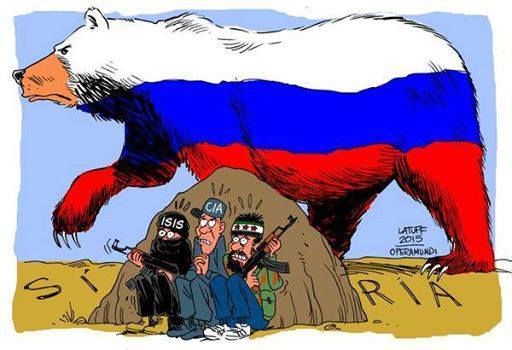
putin-vs-daeshI jot this down with some trepidation having read the news about Russia doing more harm to ISIS / Daesh in one day than the Americans and British in a year. The latest whingeing and whining from Washington is that Putin is attacking “moderate” terrorists (supposedly the “good guys” trained by the CIA to fight against the Assad government) as well as Daesh.

Following these historical events, I am inclined to give more credence to the view that considers that the US have been fighting proxy wars in the Middle East, Afghanistan and elsewhere using terrorists and mercenaries trained and financed by the American taxpayer. If this is so, the mask is falling away and we face an entirely different world than what we have known since World War II. Europe will need to look to new leadership, and perhaps work to rediscover its Christian roots.

At any rate, Syria is something like much of Europe in 1945, and Daesh terrorists will soon be bits of pink flesh spattered against devastated walls, swinging from the gallows, or having French fits on scopolamine or sodium pentathol (or whatever they use these days) as they eagerly tell all they know about their mates. I hope and pray the refugees of Syria will be able to return home, rebuild the desolation of many generations – and obtain humanitarian help from as many of us who can give it.

In the meantime, the hype about CIA trained and financed “moderate terrorists” reminded me of this old story. Perhaps they go down to their underground bunkers to drink tea and have parish council meetings and cucumber sandwiches with the Vicar. The mind boggles. Here it is:

Anglican Extremists Attack Shopping Centre

A group of Anglican extremists have attacked Cackwater shopping centre in Gutborough. There are no casualties, although several people are reported to be “quite confused”.

The attack took place at midday outside the local branch of TK Maxx. A bomb, made from cake mixture and “hundreds and thousands” was left in front of the store and exploded, leaving two men splattered and one man needing counselling. Shoppers ran for cover, fearing that the cake-bomb was the first of many, but were disappointed.

Shortly after the attack, a video appeared on the Anglican fundamentalist website extremistvicars.co.uk claiming that “all those who do not worship the Lord shall lead a rather average life” and that “if you do not follow the path of Jesus Christ, then I shall wag my finger at you”.

The alleged leader of the Anglican Fundamentalist group, Valerie Bin-Liner, said that the campaign was aimed at “all those who don’t attend church, i.e. everyone”. Police have been tracking Bin-Liner for the last two years, and have as yet been unsuccessful. Sightings have been frequent; latest reports say that she is hiding out in a box room in Cheltenham.

Anglican fundamentalism is growing in the UK. A group of women were arrested two months ago after putting excessive amounts of sugar in the tea of supposed “disbelievers”, while another woman was arrested after trying to ram her bicycle into the side of a nightclub.

An elderly man escaped the clutches of police officers after an attempt to hijack the number 51 bus to Gropple town centre. The driver, who has undergone counselling to recover from the harrowing experience, said “he approached me and said that he had a cake-bomb strapped to his waist and that I should divert the bus to Scrimpton. Naturally, I did as he asked – it was only the next village, and he appeared quite determined. The passengers were almost frightened – both of them. I kept my calm and drove the bus to Scrimpton, where he said ‘thank you’ in a menacing manner, and got off the bus. That’s when I called the police.”

Locals in Gutborough, however, are fearing another wave of Anglican attacks, and have been advised not to eat any cakes until the situation has eased.

Posted in Uncategorized | Tagged , , , , | 11 Comments