Sarum and Authority

There is an interesting discussion going on at Facebook on the old question of whether Sarum belongs in a museum or whether it still exists as a Catholic rite. It all started off by the question:

I once read that there was a debate among English Catholics at the time of the re-establishment of the Catholic hierarchy in 1850 that the Sarum rite should be restored as well. This was violently opposed by Manning and other ultramontane converts who wanted uniformity with the Roman Use. Anyone know the details where the debate came from and where it was argued (England or Rome?)

I have no pretence of having an answer to this historical question. During the discussion, I did link to Fr Finnigan’s article Aspicientes in Jesum: The Legal Status of the Sarum Mass. It is of interest from a Roman Catholic point of view, and it offers insight into the relationship between positive law and immemorial custom, the basis on which traditionalists base their claim for the Pius V liturgy. The question is asked and answered differently in Anglican and Eastern Orthodox churches.

I won’t go into all the arguments now. The prevailing opinion is that it is a “museum piece”, from the evidence that so few of us have any inclination to celebrate it. At the same time, a discussion group such as this one has attracted 196 members. The uses of Hereford and York, for example, attract much less interest at a “popular” level. It would certainly seem that a diversity of rites and uses within the Latin Rite is generally understood as symbolic of a difference of ecclesiology. Thus, the French Church which kept its distance from Roman authority attached greater importance to local uses than those for whom adhesion to Papal authority was a bulwark against Protestantism and for whom religious life was primarily a question of authority and obedience. At the same time, let us harbour no illusion about eighteenth-century Gallican bishops. A part of the motivation for Ultramontanism in the nineteenth century was that a tyrant hundreds of miles away was better than a dictator on one’s own doorstep!

In our own time, we need to get things into perspective. The greatest problem is not Sarum in a museum but the entire liturgical Christian patrimony in the dustbin with the McDonalds burger wrappers.

The adoption of Sarum by western rite Orthodox priests is a mystery to me. Before the 1054 symbolic date of the schism between Rome and Constantinople, there was no Sarum Use in England. There were certainly many variants of Celtic, Roman and French usages in England. I have nothing against the western Orthodox, but their use of creative anachronism certainly raises an eyebrow. The northern French tradition that became the Sarum Use was essentially imported by the Norman Conquest and some “native” elements continued to subsist.

I am somewhat burned out by arguments on canon law and the relationship between positive law and custom. The argument of authority is a strong one, present in the thought of the Italian Perennialist Julius Evola for whom Christianity was no longer fit to form the framework of human society. Fr Hunwicke once wrote on auctoritas, and the subject is highly relevant to this reflection. Perhaps Christianity can be cold-shouldered out of the picture due to the dwindling number of believers and its lack of authority in modern western society. Conservative Christians desperately hanker after temporal authority by riding piggyback on some vaguely conservative Christian political loud-mouth. Alternatively, Christianity does not depend on authority but a higher principle that transcends politics and people squabbling over interpretations of law.

There are arguments for and against using Sarum. My own reasoning was as follows. I was a Tiber-swimmer who swallowed all the stuff served up to new converts, and sided with the traditionalists. Very early on, I noticed the cognitive dissonance between Papal authority and the authority the traditionalists themselves wanted to wield instead of looking more critically at the whole thing. Then came the traditionalists in union with Rome from 1988 and that temple of youth of life in the seminary at Gricigliano. Knowledge of history brought home what was represented by Romantic medievalism on one hand and Italianate baroque on the other. After leaving the Institute of Christ the King and my years of marginal pseudo Roman Catholic life, I returned to the Romantic medievalist outlook. It didn’t happen immediately. As late as 2008 as a priest in the TAC, I was using the Roman rite in Latin. The English Missal and the Anglican Missal are substantially the Roman rite of 1570 in one Roman edition or another. I suppose I could have sided with the Prayer Book Catholics – but whatever you do to the Prayer Book, one can never be satisfied.

I cannot allow myself to judge the policies of a Church to which I belong, so I will only speak for myself.

One becomes stuck in a morass of emotional and liturgical instability. It is better to have a rite and stick to it. For me, the solution was Sarum, an “iconic” liturgical usage that would represent pre-Prayer Book Anglicanism. Nothing is perfect in this world, but I am still using Sarum seven years later. I occasionally do it in English, but nearly always in Latin following a reproduction of the Dickinson edition I found on the Internet and which was not cheap!

Pastoral considerations? I did promise to my Bishop that if I were ever to serve a community of lay faithful in our Diocese, I would conform to the Anglican Missal. The occasion has never occurred. I have nothing against it, since pastoral service would outweigh personal memories of my Roman Catholic years. I am nearly always alone at Mass, so the pastoral consideration is non-existent. I could celebrate the Tridentine rite, but it would not interest RC traditionalists – because I’m not the right kind of priest for them. I could celebrate the Novus Ordo, but then I would be masquerading as a Roman Catholic priest of the local archdiocese here. Who would be interested? Besides, the ACC does not use the Novus Ordo.

I think Sarum will continue to be of academic interest to liturgical historians and musicians. It will occasionally be dusted off for one-off use at some cultural manifestation in an English provincial town church. It will continue to fascinate seminarians and young priests. I had the idea seven years ago of setting up a Yahoo group list to discuss it, and more recently something more appealing to modern computer users on Facebook. It works well and subjects keep coming in even if my own inertia prevents me from writing very much on it.

Many of us priests have little to offer the future, but the future is not ours. We can be optimistic or pessimistic, hope that what we do will leave some trace for the good of others in the future. We have to have the humility that our work and lives will leave very little, and that we are called to live in a better world.

The thought always returns. If liturgy and Christianity itself depend on authority (living persons saying what we may or may not do, or standing customs accepted by all or a majority), then there is little to hope for – and some other principle should be sought. Sometimes too much thought will lead us into more trouble than we bargained for! …

Posted in Uncategorized | Tagged , , | 7 Comments

What a damp place to spend the night!

semaine-golfe21This photo was taken by the owner of the black boat with the blue sail. This is the only photo of my boat with the tent – which needs improvement to keep out the eternal dampness. I spent the first night at the Port du Logéo in the Golfe du Morbihan afloat for some of the time at anchor and dried out when the tide ebbed. The following day (Ascension Thursday), with the weather being too foul for sailing, I moved to the beach with the others, and had no further need of my inflatable tender to get ashore.

The week was unforgettable!

Posted in Uncategorized | Tagged , , | Leave a comment

Fr Robert Hart on Transgenderism

Not the author of confusion is a very sensible article by Fr Robert Hart. I have had occasion to comment on this frightening tendency in society. Some hospitals are now ceasing to perform the “sex-change” operation for valid psychological reasons, and also because a “transgender” does not change sex in spite of appearances and the inner feelings of the person concerned. Perhaps there are signs that the insanity is coming to an end.

I have said it before. There is nothing wrong with men doing some feminine things like sewing and looking after children, or living for the fine things of this world. We don’t all have to be competitive or hyper-masculine or cut our hair short. We remain men in our diversity of personalities, talents, etc. – just as God and nature made us.

Posted in Uncategorized | Tagged | 8 Comments

Dave Allen on the Creation

Posted in Uncategorized | Tagged | Leave a comment

Espèce d’âne rouge!

These are the words of the dying Doctor Spiletti to the Communist Mayor Peppone in one of the Dom Camillo films – You red ass! Since the downfall of Soviet Communism in 1989, Communism has made as much of a caricature of itself as Peppone in the old Don Camillo films. He spouts out ideology about the workers being oppressed by the owners of capital and the means of production – without really understanding the deepest meaning of the works of Hegel, Engels, Marx and Lenin.

As most revolutions, like the French one of the end of the eighteenth century, the oppressed became the oppressors. Intolerance against difference and the “enemies of the people” led in France to the guillotine, and in Russia to the gulags and the deaths of millions in various parts of the Soviet empire. I remember the sadness of the Nepomucene College in Rome in 1985. Some of those seminarians were ready to walk out of their country with nothing but their papers and a bit of money in their shoes for freedom to become Catholic priests. We read about Ostpolitik and the vacillating attitude of men of the Church in regard to the Soviet empire – and now the empire of corporate capitalism.

One thing strikes me very deeply as a Christian and a priest – the increasing inequalities between rich and poor. In England, an ordinary family cannot find an affordable house to buy. Unsaleable food from supermarkets is being wasted on an unprecedented scale, and stealing it from dustbins in England is against the law (France has at last outlawed this wastage). Less than one hundred people own the same amount of money as billions of the rest of us. From what I read, the USA is on the slippery slope to totalitarianism and the Police State, and it becomes very frightening.

Should we bring back Communism? What a question to come from a priest! Perhaps if the Communism were of a voluntary nature, tolerant of difference and open to the spiritual, there might be something with which I could sympathise – like the village in Spain and the Mayor who looks like Castro. Everyone can find work, though on a modest salary. On the other hand, food and housing are at an affordable price. Education and medical care are free and assumed by the Cooperative.

We read about the “end of history” represented by corporate capitalism and economic liberalism, the free-for-all for the bankers and speculators. The crisis of the 2000’s has put all that into question. I am tempted by the Communist idea with the reservations I expressed above, but I know that human nature can be just as vile with socialism as with the kind of capitalism that is now destroying the world by sucking it dry.

Capitalism is unmasked in its grossest cynicism, and its tyranny rivals that of Stalin and Beria. I am concerned about the way the European Union is going, the plight of Greece, Spain, Ireland and many other places – as we all languish under the bureaucracy of Brussels. Should we go back to the pre-1989 situation? That would be impossible. The dinosaur died under its own unsupportable weight. Socialism in France is nothing more than “state capitalism” as it would have been in England had Labour won the election.

Actually, I think that any political system at a state level is doomed to failure and internal corruption. It can only work at a much smaller scale and when there is some way it can be prevented from being infected by men with evil intent from seeking power and money. It may seem a hopeless dream.

What could be hoped and worked for? Some of the people working to transform institutions in Gramsci’s cultural Marxism are not the kind of people we would invite to dinner. We find ourselves close to the Frankfurt School and Critical Theory – destroy the DNA of everything and create something different. There are many different types of anarchists as in Russia before the Revolution of 1917, some identified as “demons” by Dostoevsky, the nihilist who does the logical thing – suicide. On the other hand, we find extremely noble ideas in the thought of Tolstoy. It is a labyrinth and as diverse as the individual hotheads who worked to topple everything.

I can understand the way many French priests sided with Communism in the 1950’s, almost in expiation from the way their bishops had collaborated with the Nazi Occupation during the war. Sooner or later, the bomb will go off, and I would hope that the visionaries and prophets of this world will be heeded before blood flows. Communism as we have known it has been as irretrievably tainted as the Nazi regime. Is the evil intrinsic or a deviation from the noble ideal?

Something will arise to restore justice and peace in this world, and I mean justice and peace in a different way from the Vatican bureaucrats. The last straw will break the camel’s back. Perhaps it is now the vocation of Christianity to influence and help what is to come, above all to keep noble ideals out of the hands of evil exploiters. It all sounds naive, but we should dream of that day when we may drink the wine of youth!

Posted in Uncategorized | Tagged , | 6 Comments

The Rite of Braga

The Report on the Bragan Rite for the Congregation for Divine Worship – Review is quite harrowing but entirely predictable. I know little about the Rite of Braga, a diocese in Portugal, but it is one of the many diocesan rites that continued to exist alongside the “codified” Roman rite of Pius V. There are some similarities with the Sarum and French traditions, but I will let the reader go into the details – if he wishes – from other sources and the article.

It is the old question. Why indeed should we not scrap everything that is old and eccentric and just have something streamlined and modern and which “does the job”? We can only imagine the consequences of such reasoning in other fields of life. For example, every town and city in Europe is to be bulldozed and replaced with modern functional buildings. It is often the same principle in history: come up with something new and destroy the old with a spirit of disdain and intolerance, as I discussed previously about the French Revolution. Strangely, it is only in the twentieth century that we become self-conscious about history and began to want to preserve the old heritage. In the nineteenth century, they had no scruple about demolishing medieval buildings to replace them with something new, or heavily “restore” them.

In the wider context, with the passing of the old century, we leave behind the era of ideologies, of left and right, and all the engineered plans for the future of mankind. I am concerned about the notion of the “end of history” meaning that man will go no further now than liberal capitalism. The writing on the wall indicates that the minority that owns just about all the wealth there is will rapidly fall as money itself no longer represents what made those people rich. I believe the capitalist system will fall and will be replaced, but not by the old dinosaur of Marxist Communism. The future is the great unknown.

Similarly in the Church, the triumphalist thinking behind the Novus Ordo is as dated as liberal democracy and the era of totalitarianism. The presumption behind this mentality is the Counter Reformation, the Industrial Revolution and the “Age of Reason”.

I encounter this mentality when discussing the Use of Sarum with those who are attached to the rite of Pius V. Indeed, the use of any particular rite will not in itself bring people to church, and people would have to get used to anything that differs from what they have known elsewhere like the Prayer Book, the Alternative Services Book (or what they use now in the C of E), the Novus Ordo or the so-called Tridentine rite. Those wanting pre-1965 rites in the RC Church come up against the same criticism. Why not settle for something that “does the job” (is “valid”) and satisfies the person’s Sunday obligation?

I feel “done” with discussing details of liturgies, unless it is at an academic level. However, I am brought to see our period of history as a gateway towards the globalist dystopia with its “aristocracy” of billionaires and corporations, or a breakdown leading to the death of millions of human beings and the dawn of an era in which small groups of survivors would redefine their “social contract” and the community at a tribal level. The question is huge and the answers depend on our awareness and expectations in life.

Many articles predict the breakdown of the hegemonies of this world, including the Roman Catholic Church as a unified institution and all other historical churches. Each time, the individual person is facing a towering and impersonal bureaucracy, and we can either go to sleep in the cave of shadows or contribute in some way to a future uprising as we reclaim our humanity and our souls. This kind of talk is dangerous as people died for less under the regimes of Stalin or Hitler.

What has all this to do with liturgy? More often than not, we consider the liturgy to be a part of man’s artistic and spiritual culture, a heritage from tradition and a sense of being a part of history rather than those who preside over the burial of history, tradition and identity. In terms of religious and sacramental “function”, very little is actually necessary, but form is essential for our human psychology and state of being connected with the world the liturgy is supposed to represent – the “interface” between the life we know and the Kingdom Christ preached and lived.

The question of local and particular rites is moot in an age when the majority of our contemporaries know less about liturgical Christianity than about Zoroastrianism or quantum mechanics. Any liturgical symbolism means nothing to a person who can only relate to electronic technology and the status that money can buy. The Novus Ordo would be no more “relevant” to them than the Syro-Malabar rite or the traditions of the Mandaeans!

Far beyond liturgy, we need to examine whether the Church means authority and clericalism or the community of “children of the Father”, whether it means the offspring of freedom and love – or slavery to a jealous and spiteful deity. The notion of strict and hyper-rational uniformity seems to have more in common with the latter.

I am realistic enough to know that Sarum, Braga and all other local rites are things of the past, as is all liturgical Christianity insofar as it competes against the new globalism and its aristocracy of billionaires. We face our own deaths and a history of humanity that goes beyond our own limits as those of our forebears.

I wonder if I will ever express the thought: “Bliss was it in that dawn to be alive, but to be young was very heaven!” Each one of us can only hope so.

Addendum: The Praxis of Christianity is very germane to this discussion. I bristled when I read the link Why Bible Study Isn’t Enough. I immediately recognised the common Augustinian roots between the Roman Catholic monolith and the Protestant take – authority. We have to move away from the authority of the jealous and spiteful God and its correlative obedience to a relationship based on intimate knowledge and love. It’s too deeply anchored in biblical mythology.

Posted in Uncategorized | Tagged , | 9 Comments

Bliss was it in that dawn to be alive

quantum_gamesWilliam Wordsworth wrote these words at the beginning of the French Revolution:

Bliss was it in that dawn to be alive
But to be young was very heaven!

As the heads fell during the Terror, he wrote:

Domestic carnage, now filled the whole year
With feast-days, old men from the chimney-nook,
The maiden from the busom of her love,
The mother from the cradle of her babe,
The warrior from the field – all perished, all –
Friends, enemies, of all parties, ages, ranks,
Head after head, and never heads enough
For those that bade them fall.

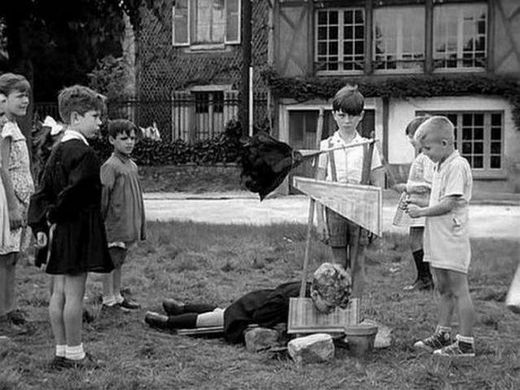
The French Revolution was truly the end of western civilisation. It was the end of monarchy and aristocratic privilege and the beginning of democracy, but it was also the beginning of totalitarianism and the killing of large numbers of human beings by bureaucracy and fanaticism. Only the Nazis and Communists would rival Robespierre in the blood lust and crimes against humanity.

All too often, we think we can impose freedom by force as institutional religion has imposed “truth”. France still lives by the ideology in its weight of bureaucracy and langue de bois, reflected by the speech of men of the Church.

I fail to understand those who worship Napoleon under the pretext that he created modern Europe and a rational code of law. He was little other than the first modern dictator who conquered and bullied until he lost fairly on the battlefield of Waterloo. Power corrupts and no one can rule without guilt.

Certainly, the old French monarchy was exhausted and the Aristocracy was corrupt and self-serving. The Church was in a mess like everywhere else in the so-called Age of Reason. I live in France and Europe, and I fear for the future. They are no longer killing people. Thank goodness! But the soul of this continent has died. May we learn from history!

Posted in Uncategorized | Tagged , , | 19 Comments

Let Nothing You Dismay

Fr Michael Gollop runs the blog Let Nothing You Dismay. This poignant title is quoted from the popular Christmas carol God rest ye merry gentlemen. He heads the blog with this message:

This, then is our desert: to live facing despair, but not to consent. To trample it down under hope in the Cross. To wage war against despair unceasingly. That war is our wilderness. If we wage it courageously, we will find Christ at our side. If we cannot face it, we will never find him.

I ask your prayers as I go through inner conflicts and difficulties. It isn’t a question of having fun in a boat and then going back to the humdrum of work and “normal” life! It often happens to me at this time of year – probably a dose of acedia, like a boat on a mirror-like sea and no wind.

The message makes so much sense. Life is so empty when it is a matter of material concerns and the cynicism of our contemporaries. Indeed, we have to combat our discouragement and face the constant conflicts. I have feelings of forebodings about so many things going on in the world, or not going on… I just don’t see things as I saw them thirty years ago.

Enough of self-pity! I only write this reflection for the benefit of anyone else going through the “doldrums” when the sails just flap helplessly from their yards and the ship goes nowhere. We just seem to have to hang on and wait for better days.

Two Jehovah’s Witness women came to the door this morning. Our little increasingly senile dog Seraphine ventured out of the gate to sniff at their feet. I picked her up and directed her back towards the house. They began the show me their publications and came out with the standard line about the Bible. The penny dropped, and I asked them the direct question – Are you Jehovah’s Witnesses? “Yes”, they answered. I simply said “Thank you” and closed my gate. I wasn’t in the mood for arguing with them. They were such pleasant ladies, and I felt shocked about expressing such a rude rejection, but the deed was done. Discussing things with those programmed people is like dealing with some people you come across in the forums and blog comment boxes. You are swimming against the current against ideologies and things people have just learned to repeat without understanding them. If I resist being “converted” by them, what should I “convert” them to? I have become so accustomed to the priestly life in the desert in a world that wants to know nothing of Christianity for its own sake.

The two ladies went their way, apparently used to repeated rejections or worse. Cold calling has become ever more frequent, most for commercial purposes, and it makes us hard of heart. The JWs have been doing it for a long time, like the men who used to peddle clockwork toys or vacuum cleaners. They were probably nice and decent people, but recruited in the cause of such a strange and screwed-up revelation and creed.

Modern life makes us hard-hearted and sceptical, isolated and cynical, as materialistic as our contemporaries. I would never dream of “evangelising” by cold calling. It cheapens what we believe in and invades privacy like the company that wants to do a thermal analysis on our home or sell us insurance. Again, this is one of my recurring subjects!

Posted in Uncategorized | Tagged , | 10 Comments

The Pit

We are used to catalogues about the woes of modern society. The party’s over is no exception and a breeding ground for simplistic right-wing jingoistic solutions: Spare the rod…

Of course, it is all cogent. We have just as much if not more in France. In the years following World War II, there was a boom in scouting, the Glénans sailing school, the Sea Scouts and many more youth movements. Myself, I lived through the 1960’s and went along with some of the reaction against the old conservative order. My parents were convinced that I needed an education especially suited to building up the character and the ability to get on in life, to overcome the difficulties I had to live with. We all have our problems, and none can pretend not to have suffered from our own sense of disorientation.

Much of psychiatry is pure bunk and many of the medicines used for mental conditions do more harm than good. At the same time, mental illness can be very real and distressing. All too often, the cure is a change in life, in attitude and in one’s fundamental philosophy of life.

About a month ago, I had a long conversation with my father about the tendency of people to high expectations of life and a sense of entitlement. I do believe in essential human rights to life, freedom and happiness – but with corresponding duties.

Technocratic or bureaucratic solutions to the problems of mankind… Don’t I know it! I had a car break down in England. One solution was to have me wait several days for spare parts and spend a fortune for a car that was at the end of its road. Some great guys in Yorkshire did some improvised repairs, and the car got back to France under its own power, giving up the ghost as it arrived home. I seem to have come from a background that considers things to have been built to last, only needing repairs within the capabilities of someone who has skills in woodwork and metalwork. Bureaucracy refuses the humanity of those who have to address themselves to it, for the simple reason that it is not human. Increasingly, our relations with banks are with computers, not with a human who can give sound financial advice.

I don’t know about drugs. I stopped smoking nearly nine years ago. I had occasionally taken a puff or two of cannabis in my student days. I did well to listen to the warnings of my father – never even try heroin, cocaine, LSD, etc. Nicotine was a nasty one to beat, but I know it is almost entirely psychological rather than physical addiction. Addiction as a concept of dependence against which the will is impotent is something that needs a lot of study. The solutions aren’t simplistic, but they are hardly rocket science either!

It is particularly important to do everything we can to preserve high culture. Classic FM in England is a tedious station to listen to, but it has got many people to appreciate classical, baroque and romantic music. I admire such initiatives. I don’t know about schools these days, but we learned about music, art and poetry. They were often insensitively taught by masters who seemed to lack personal interest in their subject. The problem goes back a long way.

The welfare state is a part of technocracy and bureaucracy. Vast amounts of money are squandered and we all have to pay this money for the privilege to work! Health and social security (stealth and total obscurity) have become a lumbering and inefficient monster. One thing that causes resentment with mass immigration is that immigrants seem to be getting more entitlement to state handouts than us natives. Many of us who are working have to give to richer people than ourselves!

Civil behaviour gets rarer. There are exceptions and there are still good, civil and polite people everywhere. I don’t buy the idea that we are less civil than in the 1970’s or earlier. Some people are really horrible and aggressive, and many others are as virtuous as in any “good old days”.

The ideology of political correctness, paired with technocracy and bureaucracy, will be a tough one to crack. We have to be cunning and detached, and above all critical and capable of challenging it with satire. You never challenge a problem by head-on confrontation, but by eroding it by the edges. That is the way of France, Italy and other Latin countries: everything is regulated and forbidden, but there is always a way round the problem – la combinazione! You just have to get used to it.

There are real problems in society and we all feel concerned. It is a part of our human condition to want to improve life and society. I read many different articles. Would four dozen with the lash do more to correct a delinquent than ten years in prison? I would be tempted to advocate a sharp way of dealing with delinquency and crime, but it has to be just. Prisons do more harm than good, and they are more vindictive than medicinal. Again, the bureaucratic spirit rather than freedom of judges to judge…

It is indeed tempting to want to remake the world, but we will not succeed in doing so. We do well to work on ourselves lest we be the worst hypocrites in our conservative rhetoric. We can either live with it or go and live somewhere else – but beware lest the grass be found not to be greener on the other side!

Posted in Uncategorized | Tagged , , | 6 Comments

Perceptio

Perceptio is of a rare subtlety in understanding many of the issues that dog us. Churches concerned with political correctness are described in Make of it what you will.

I have given a lot of thought to the issue of gender identity and the tendency some of us might entertain to want to caricature our own sex or the opposite sex. In earlier articles, I have speculated on things like androgyny: a man remains identified with his gender but enjoys assimilating feminine characteristics, whether physical or psychological or both. I intensely dislike labels and names which we are all wont to use in the way doctors typify diseases and other pathological disorders in their efforts to help the sick. We can be humans without worrying whether our image is sufficiently stereotypical of our gender or the opposite. Ideally, a human being integrates the two genders in his or her personality in that delicate balance between art, intuition, empathy and the things usually attributed to “real men”. I fail to understand the person who decides to have a surgeon alter his or her body to appear like the opposite sex, the so-called transgender or transsexual. A person thus becomes a caricature of the desired gender identity. The person remains human and enjoys the same rights to life, freedom and happiness as the rest of us. But, why single that person (with mutilated body) out for special treatment in the name of political correctness?

The more recent article Frithjof Schoun, Perennialism, and Christology is of particular interest. I have come across people of the Perennialist tendency in France and read some their works. Schoun and René Guénon felt compelled to forsake Christianity as something not viable or able to reach the deepest aspiration of the human spirit. They embraced Sufism, a mystical version of Islam, which if studied would reveal something beautiful and profound. The only thing is that I see no reason to abandon Christianity but rather the shallow and parasitical caricatures that have emerged over the centuries. Schoun and Guénon saw Christianity as emptied of its metaphysical content and replaced by shallow moralism. I agree, but would differ in believing that there is an almost unknown Christianity that has survived alongside institutional orthodox Church religion. It has never left us, but we have to seek it within ourselves, in the immanent Kingdom. This was one of the most shining intuitions of the Modernist George Tyrrell. Many eyes have been opened by the discovery shortly before our own lifetimes of the Nag Hammadi Scriptures.

A serious counter-force against modernity? By modernity, it is not so much the invention and use of technology by man but the tendency to allow his humanity to be replaced by the Machine and hyper-rationalism. It is the theme of the Romantics when they re-claimed the imagination and sensuality. Julius Evola too evoked the theme of Christianity’s impotence. There are some very unhealthy tendencies who take their inspiration from such forms of Perennialism. We find Nietzsche at the root of some of this philosophy with its determined criticism of Christianity. Evola eschewed the totalitarianisms of the twentieth century, but shared many of the themes used by Nazism to persecute those who were deemed to be of “inferior races”. We have to be careful how far down this road we go!

Our friend seems to have a clear appreciations of the excesses of Perennialism. Like Gnosticism, I could never completely assimilate a way that is fraught with many dangers to one’s spirituality and our very mental health. There are better ways to relate with modernity (hyper rationalism and anti-humanism) and keep it at arm’s length through a critical spirit. Christianity is both esoteric and exoteric. Exoterism is to Christianity what the skeleton is to the human body. We need a way to follow…

Perennialism shows a critical attitude to shallowness and the moralism of pious cant. It is the aspiration of a restless souls. Without this aspiration, we would be left only with the steamroller of modern rationalist bureaucracy. Many of us will spend our whole lives in conflict or find the way to the coniunctio oppositorum as Jung coined the notion. Perhaps this will give a clue to the reason why many of us live through a crisis of gender identity.

Posted in Uncategorized | Tagged , , , , , , , | 5 Comments