I would like to wish all my readers a happy New Year 2022 with my prayers that this world might become a better place for us all. After some thought, I have adopted a new name for my YouTube channel: Romantia Christiana.
As I explain in the video, the word Romantia has been used for some quite absurd things, but the people concerned adopted another name for their “thing” and since have disappeared from view. With its adjective Christiana, I very much imply the allegorical use of the name Jerusalem used in the Old and New Testaments.
These verses of Psalm 137, Super flumina, summarise the spirit of Romanticism like the idealisation of England in Blake’s Jerusalem.
By the waters of Babylon we sat down and wept: when we remembered thee, O Sion.
As for our harps, we hanged them up: upon the trees that are therein.
For they that led us away captive required of us then a song, and melody in our heaviness: Sing us one of the songs of Sion.
How shall we sing the Lord’s song: in a strange land?
If I forget thee, O Jerusalem: let my right hand forget her cunning.
If I do not remember thee, let my tongue cleave to the roof of my mouth: yea, if I prefer not Jerusalem in my mirth.
In this way, Romantia seems to represent a kind of world of ideas, an unattainable paradise at a spiritual and ideal level, Cockaigne and dreamland. It might seem futile to the realist of our day. Christianity is both a yearning for the Kingdom that is both beyond and within ourselves. A part of our mission is to bring heaven onto earth in the ways that are within our ability. Thus, Christian Romanticism as an “ideology” and as an alternative name for the biblical Kingdom of God.
I am particularly concerned for a more refined ministry through beauty and music. I am not in a situation to be able to build a mission or a parish in an increasingly church-weary population. I am not interested in political activism. Many have expressed the notion that Beauty will save the world or that the only read apologia for Christianity is the lives of the Saints and the beauty of sacred art. That is very much my calling as a priest.
I will be building up and improving my “vlogging” skills this year with the use of editing software. I also have some sailing projects this year on the Golfe du Morbihan and the Rade de Brest, perhaps also the gathering in late July in the bay of Douarnenez. My friend Roger Barnes has given me a lot of advice about doing sailing videos with short sections and voice-over rather than subjecting the viewer to wind noise in the microphone.
I have a video camera on order with a protected microphone. It isn’t the best or most expensive, but it should serve me well.
The more I read about the present rififi between the Pope and the traditionalists, the more I am taken back to that story from 1973 about a monastery in a remote place on Ireland’s Atlantic coast on which I wrote in Catholics, the Paradox. The film is remarkably faithful to the book by Brian Moore, which I bought and read. I was particularly concerned about the account of the Abbot’s loss of faith and his fairly easy capitulation to the priest sent from Rome to ensure the community’s compliance to the “new ways”. The book brings the story to a tidy end, but the film leaves a little more suspense and non-resolution. I noticed in the early 1980’s that there was no resolution and that it was fruitless for me to keep searching for something that probably never existed.
I am troubled by the renewal of Paul VI’s hostility to Archbishop Lefebvre in 1976 in the present decision of Pope Francis to curtail the ministry and work of the traditionalists (not the SSPX and sedevacantists which are at least in material schism) but the Fraternity of St Peter, Gricigliano and various other clerical societies and religious communities. At the same time, I am worried about many of the things I read and especially at the level of Facebook comments.
I am Catholic and Roman, I attend only the real Holy Mass, I reject Vatican II (you accept it) and I am very happy. Soft traditonalists in communion with modernist Rome would think about taking a more clear position towards modernism.
On one side, I would sympathise with the coherence of leaving the Roman Catholic Church and joining something closer to one’s convictions. Soft traditionalists and hard ones? I looked at the old video footage from 1987 of traditionalist militants breaking into a church from which they had been evicted by the police with a battering ram, and bawling Christus vincit, Christus regnat, Christus imperat! Perhaps those men did the only thing possible, otherwise the church would now be a carpet warehouse or – something else. However, the scene of such mob rage does not bear witness of the love of Christ, unless we think of Jesus chasing the money-changers out of the Temple. Even then, the reaction was measured and proportionate.
Likewise, the Irish monks had a peculiar way of talking about the liturgy, showing a very rudimentary knowledge of the catechism and popular religion. I notice this kind of anti-rational obscurantism in talking about the dirty word modernism. I baited my correspondent on Facebook. What was his understanding of modernism (with or without the capital M)?
He wrote this:
Modernism is the suppression of transcendence in favour of immanence, what means that holy doctrine or holy rites are variable or depend on the trends of every time. According to modernists sacrality is everywhere, not upon you and conferred to you but intrinsically within you whence the offices turned towards the “assembly” etc.
Of course, the words transcendence and immanence. For me, they describe the relationship man has with God, who is both absolutely beyond our grasp, but at the same time is the consciousness within us. My correspondent uses the words to describe how the institutional Church would attempt to make doctrines and rites more relevant by things like Mass facing the people. Perhaps a certain analogy is possible, but not in this kind of mind. I suspect the problem of modernity having different layers of meaning between its dialectic opposition to tradition and its being used to describe the humanism of the Renaissance after the fall of the medieval Christian imperium.
Modernism is an an extremely elastic word which can be made to mean just about anything.
The architects of Vatican II were modernist but their work opened the way to the postmodernism. If truth is variable, so one day we shall attack also the natural order and will consider it as something plastic or unjust or imperfect. Deconstructionism is an offshoot of modernism.
We are unclear whether this is about general human culture or metaphysics and epistemology. Surely, believing that the Truth is our property is a denial of the very transcendence the traditionalists claim. Another aspect offered here is immobility contrasted with variability or evolution. He has seized on the hermeneutic of development as in Newman’s mind and the scholastic immobilism of Bossuet. See Owen Chadwick, From Bossuet to Newman, Cambridge 1987.
Our friend then blamed Modernism on German idealism. He directs his attack against critical-historical methods in biblical studies and anti-foundationalism in epistemology. There are hazards in both. The first can lead to the secularisation of the biblical message, the denial of transcendence and miracles, finally to materialism. The second can lead to the denial of all language and knowledge, the cancelling of culture. It can also remove the basis of political tyranny and totalitarianism, enable us to think for ourselves, enquire and progress in our knowledge, in short have a purpose to life as we all seek. He advocates Christian integralism, perhaps something on the lines of Salazar’s Estado nuovo. Perhaps this kind of right-wing regime was more benevolent than Fascism or Nazism, and it does require study. I have already written on theocracy in Christian Integralism and Humanism and Flogging made a bad man worse, and broke a good man’s heart. If this person pulled off a coup d’état, we can only imagine what his political regime would look like.
I have already quoted Bernard R.G. Reardon on Modernism:
The use of the word Modernism in restricted reference (hence the capitalization of its initial letter) to a movement of a theologically “modernizing” or liberalizing character in the Roman Catholic Church at the turn of the twentieth century has already been alluded to. But it should at once be said that to describe Roman Catholic Modernism as a movement at all is somewhat misleading, as it had little cohesion, and those to whom the designation “Modernist” has usually been applied do not in any sense constitute a school. As the most famous of them, Alfred Loisy (1857–1940), expressly stated, they were only “a quite limited number of persons” who individually shared “the desire to adapt the Catholic religion to the intellectual, moral and social needs of the present time.” But the exact determination of their overall aim differed from one writer to another, according to his particular interest. Thus the only satisfactory way of studying Modernism is not to attempt to impose upon it a schematization like that of Pius X, by whose encyclical Pascendi dominici gregis it was condemned in 1907, but to examine and assess each author’s contribution to the cause as a whole. The countries where Modernist tendencies were most in evidence were France, Italy, and England. Germany, rather surprisingly, was less affected, and in the United States it had no real following at all”.
There was no conspiracy. On the other hand, a lot of ink has flowed about L’Intégisme and the policies and actions of Pius X to combat Modernism. They turned the Church into a “spiritual police state” until the world had more serious concerns in 1914. Here are some articles of mine to avoid repeating myself here.
From the integralist point of view, postulating a Modernist conspiracy (Freemasonry, Bill Gates and the Moofia?) – no, seriously, here are books from a couple of French authors:
François Ducaud-Bourget, La Maçonnerie Noire ou La Vérité sur l’Intégrisme, Niort 1974.
Jean Madiran, L’Intégrisme, Histoire d’une Histoire, Paris (NEL) 1964.
Tit-for-Tat
The traditionalist world as I knew it was very mixed. Most clergy and laity would deny being in the stereotyped category of being rigid or politically fanatical. There is as much diversity of human personalities as in any other religious context. There are theories about why Pope Francis decided to “cancel” the traditionalist world, at least the part of it that was partially reintegrated into the official Church under the pontificates of John Paul II and Benedict XVI. What seems to be the most probable is that Roman Catholicism was going the same way as the Anglican Communion under Paul VI. Whoever was responsible for getting Bergoglio elected in 2013 wanted a return to the 1970’s and Paul VI. The period between 1978 and 2013 has to be airbrushed out of existence. That represents thirty-five years of a conciliatory approach to the more moderate and “soft” elements of the traditionalist reaction.
What does the neo-Montinian papacy want? It seems to essentially political, in the same way as the traditionalists would revive El Caudillo and His Most Catholic Majesty. The antithesis is essentially Chinese Communism, since Russian Communism collapsed under Gorbachev in 1989. To the extreme extent, the Pope would be something like Xi Jinping’s “chaplain” like the Deutsche Christen in 1920’s Germany. For the time being, the money and the power are in Beijing. It is yet another Peace of Constantine. In the end, there is little difference between one kind of political Catholicism and another. The pendulum swings one way and the other.
* * *
My own experience of life shapes what we perceive in the Church. I write as an anti-foundationalist and a sceptic. Truth is transcendent and above human understanding or desire for possession. From one person to another, there is no real communication, and language is disguised by so many layers of meaning that there is more confusion than understanding. You, reading this, will be unable to imagine remotely what might be in my mind. Perhaps I should stop writing and close down this blog. I don’t because some people show signs of appreciating it and finding something positive in it. One thing that is important is that I was a Roman Catholic only from 1981 (received by the SSPX) to 1997 after a failed reconciliation with my former superior after a miserable year with the Anglican Catholic Church under Bishop Leslie Hamlett. That was a total of about fifteen years. In all honesty, I spent the entire time in a state of nostalgia for Anglicanism and the pre-Reformation Church. I detested the We possess the truth attitude. I discovered Idealism, Romanticism and Ressourcement when I was up at Fribourg from 1986 to 1990. Even though I was accepted by Msgr Wach in 1990 to be a seminarian at Gricigliano, the “softest” traditionalists around, there was always an inner tension between my outward orthodoxy and my secret search and yearning.
In a way, the traditionalists “met their Waterloo”, their Karma, as the very principle of their authority decided to shut them down. The choice is between denying one’s very principles and reason for being – and becoming schismatic. That dirty word defines a fate worse than anything. It is the keystone that keeps the building standing. This is the Achilles Heel of Roman Catholicism. Modernism was actually an attempt to propose a new apologia for a Christianity that had become absurd. Mysteries are above human reason, not against it. The Päpstprinzip (a neologism based on Führerprinzip, absolute and unquestioning obedience to Hitler) gives a version of Christianity that has been morally rotten and intellectually absurd for the better part of a millennium.
In my Romantic view of life, I could not reject it all for the grimness of materialism and nihilism. Fortunately, I have a reasonable knowledge of Church history. There were elements to sought to separate Christianity as a way of life and a sacramental Mystery from man’s lust for power, money and sexual domination. The transcendentals of beauty, truth and goodness were always upmost in my thought and experience, even if only implicit. The World of Ideas sometimes expresses itself in the Cave in which we live with our shadows. As a student in Switzerland, I sought my own soul through the writings of Jung and those who were inspired by his work. I had to reconcile opposites and become the unique person I am, on pain of going the way of death of most of our contemporaries. Such a view of life is not compatible with either kind of Roman Catholicism, Marxist or theocratic along the lines of Tradição, Família, Propriedade. We are not human beings, but collective units to be bought and sold by the wealthy and powerful.
For as long as it was about beauty and oneness with God, I believed I would find my way in Roman Catholicism. I was warned by my own family and friends that it was little better than a cult. It is better to be an Anglican and not take it seriously! A prelate in Rome (Msgr Camille Perl) even advanced the idea that I was “unstable” because I made the change from Anglicanism to Roman Catholicism, “swam the Tiber” as many Anglo-Catholics call it. Yes, it completes the absurdity and nihilism of the entire paradigm. However, the message of Christ and his continued existence are too good to be thrown away with the trash.
* * *
Why now? The usual reason offered is that it was an error of Benedict XVI to remove the restrictions on the old liturgy. Summorum Pontificium would have backfired because of the radicals. Mainstream conservative intellectuals were expressing themselves like Archbishop Lefebvre. His biggest problem was religious freedom. We have only to read the Parable of the Great Inquisitor from Dostoyevsky. So, shut it all down. Either way, the traditionalists lose their keystone of legitimacy. They either have to admit they were wrong or go into formal schism. How many laity would follow in either case? My own feelings are mixed, because I abhor the political right (just like the left) in its collectivism and corporatism. It all comes to politics. Another problem is that men like Archbishop Carlo Maria Vigano and Bishop Schneider are onboard, and their discourse is very radical and conspiracy theorist. The problem for our Peronist Pope is that trying to rein in the traditionalists will cause increased radicalisation and a larger schismatic movement in parallel with the SSPX. We see the example of the Old Believers in Russian Orthodoxy or the Recusants in sixteenth-century England. Come rack and rope… Perhaps some traditionalists could distinguish themselves by a different style of writing and expressing themselves.
Is Church unity that important. Should we all go along with the Pope whatever? The history of the Church is such that there were splits because of human corruption, and then the dissidents also succumbed to corruption, sectarianism and radicalisation. Unfortunately, Christianity hasn’t much of a leg to stand on if it depends on these considerations. Ecumenism has softened many of the old polemics, but has also highlighted the impossibility of “diversity in unity”. The weak have to conform to the powerful. How should the Church be? There seems to be no answer.
Who is going to win or lose? Bergoglio and “Padlock” Roche? The traditionalists? Either way, the old Constantianian arrangement is closing in on itself. Which is it to be? Peppone or Salazar? Is the state going to accept theocracy or is the Church going to knuckle under in a new form of Erastianism like the good old Church of England? Beijing and Rome are very close together by plane and electronic communications! Has China asked for the elimination of the traditionalists? I doubt they would be interested as long as they are not in China.
One big problem is the role of the liturgy in all this,something which means a lot more than many people think. How does the Church in its dimension of a Christian “world of ideas (εἶδος) relate to human beings in this world? It is through the liturgy. The idea of liturgy is extended beyond the prayer of the Church to any kind of ritual unifying people and an idea. The Nazis had their pagan rites at Nuremberg, Berlin and elsewhere. We have all seen the films of processions of nuclear missiles in Red Square in Moscow with all the red flags. Capitalism has advertising and marketing. The keystone of Vatican II was not about the Church or the Word of God, but the liturgy. Without the liturgy, the Church is meaningless, even if some elevated souls in the Quaker Society of Friends achieve this meaning by silent prayer.
What will Bergoglio achieve by having only the many variations of the Paul VI rites whilst recalcitrant traditionalists are pushed into schism? For one, religious freedom is gone, one of the tenets of Vatican II that was most contested by Archbishop Lefebvre. It is ironic, almost as if two opposing versions of intégrisme were trying to cancel each other out. Surely, the Pope would have been advised that the traditionalists would form a number of entities like the Society of St Pius X and that more people calling themselves Catholics would be outside than under his jurisdiction. Would there be a small and faithful Novus Ordo remnant, the “one true church”? Would Xi Jinping be interested in something so winnowed down? What about the Pauline rite itself? It is 73 years old. Perhaps he should just shut everything down in one big lockdown until Padlock Roche comes up with a new and pristine liturgy.
Like in other times in history, Catholicism is becoming quite hateful like the secular world and its politics. The Oozelum Bird flies in ever-decreasing circles until it disappears up its own arsehole. In this somewhat safe but insanitary situation, it showers shit and sarcasm over its pursuer. Another version, less vulgar, suggests that it flies around in ever-decreasing circles until it manages to fly up itself, disappearing completely, which adds to its rarity. Whichever you prefer…
Many of my readers express their confusion and heartbreak. Perhaps this is an opportunity for traditionalism to reform itself, become more contemplative and mystical, closer to Orthodoxy and Anglicanism, less concerned about being the “true church” or controlling other people. Also I remember a time in the late 1980’s and 90’s when the traditionalist question was hardly discussed. It was just normality, and I was being informed as a seminarian by men like Msgr John F. McCarthy and Msgr Wach about what was happening in Rome. It is almost as if we were waiting for some controversy to give us all a new shot of energy. Traditionalists now have an extraordinary new burst of energy in the face of a situation like the stand-off between Archbishop Lefebvre and Paul VI in 1976. The next thing to expect would be Archbishop Vigano and Bishop Schneider getting conditional consecration (see the traditionalists’ very own “Apostolicae Curae”) from the SSPX bishops and consecrating a whole load more! I gratefully display a photo of Pierre Martin Ngô Đình Thục on my wall, since my priesthood came from his episcopal succession.
* * *
An expression often used in our days is the rad-trad, the radical traditionalist. It is something I left behind when I returned to Anglicanism by way of the Continuum and the Traditional Anglican Communion and then the Anglican Catholic Church. Everything had changed since the conflict in the ACC episcopate in late 1997 and the departure of Bishop Hamlett to the foundation of a new ecclesial body. The ACC recovered and some more serious men were raised to the Episcopate. I am grateful for the stability I now find and the serious level of theological knowledge in the clergy.
We have a certain amount of liturgical diversity in the ACC including the 1570 Roman rite which with the 1928 American Book of Common Prayer forms the basis of the Anglican Missal and the English Missal. My Archbishop allows me to use the Sarum liturgy which is not currently on the official list of approved liturgical rites. We tend to be conservative in terms of politics and moral influence, and this is more pronounced in America than the UK. One thing that is thankfully absent is the problem of the “all-or-nothing” communion with the Pope. It is a little like the Liberals in 1830’s France (Lamennais in particular) campaigning for the separation of Church and State. How can the clergy live and minister under hostile civil authorities. I see separation from Rome in the same light, not as act of damaging the Church’s unity, but simple survival.
Ironically, Pope Francis has laid emphasis on synodality. Probably what he means by this word is anonymous bureaucracy led by men like Roche (“Terrible news that the horrible Arthur Roche will be prefect of the Congregation for Divine Worship. One of the most ambitious, pompous and ruthless operators in the Catholic Church. Yuk.” – Damien Thompson) and Cupich (Archbishop of Chicago). In many of the Orthodox Churches and in the ACC, we have provincial and diocesan synods. Typically, they begin with Mass and a time of socialising. The meeting proceeds according to an agenda including reports and motions which are proposed, seconded and voted upon. It is partly about accounts and other practical matters, but more spiritual matters are brought up as needed. The Bishop gives his own report and anything else of note. We usually go home with a feeling that it has been an expression of our unity but also the dignity and existence of each of us as persons. I cannot imagine that traditionalist organisation don’t also have meetings and discuss important matters to be decided collegially or by consultation. Perhaps Pope Francis would like it all done by artificial intelligence while he goes off to play golf with Roche and Cupich!
The traditionalists need to earn our respect by taking responsibility for their own mistakes. I think they can learn from the example of Archbishop Lefebvre and continue to run seminaries and ordain priests, take steps to ensure the ministry of bishops. They need to be more collegial and synodal, ideas coming from persons and offered as inspiration for corporate decisions. They should accept the principle of separation of Church and State and live in secular society with the Faith as a sign of contradiction and witness.
I have no simple answers for such a complex world as the traditionalists and the radicalism that can enter and possess any religious or political idea. At the same time, we have as Christians to take responsibility for our world. Archbishop Desmond Tutu said “If you are neutral in situation of injustice, you have chosen the side of the oppressor“.
First they came for the Communists
And I did not speak out
Because I was not a Communist
Then they came for the Socialists
And I did not speak out
Because I was not a Socialist
Then they came for the trade unionists
And I did not speak out
Because I was not a trade unionist
Then they came for the Jews
And I did not speak out
Because I was not a Jew
Then they came for me
And there was no one left
To speak out for me
This was written by Martin Niemöller, a German Lutheran pastor and theologian who initially supported Hitler’s Nazi ideology. He became disillusioned and joined a group of clergy opposed to Hitler. He nearly ended up like Bonhöffer but was liberated by the Allies. I hope and pray that the traditionalists will come to such nobility of spirit. And this is why I speak out for the traditionalists even though I know they would despise me for my instability and Modernism!
* * *
Just after publishing this post, I read the article of my brother priest Fr Jonathan Munn Blogday 2021: Seen and not heard in which he describes the situation he lived through (more recently than myself) in the Church of England. This situation is just where the Roman Catholic Church is going. Such is the need for Continuing Churches. It is a beautiful testimony.
My reflection on Christmas is fairly unusual in that I spent this great feast of the Incarnation of the λόγος alone. I was about to say for the first time, but it was also the case when I was living in a very difficult situation. I was then also in a state of loneliness. I would celebrate the Vigil Mass and the three Christmas Masses even though there was no congregation. Would such solitude “ruin” Christmas?
I was not alone. This array of cards shows loving care from my family, friends and from Bishop Damien Mead. I had many more e-mails and greetings on media like Facebook.
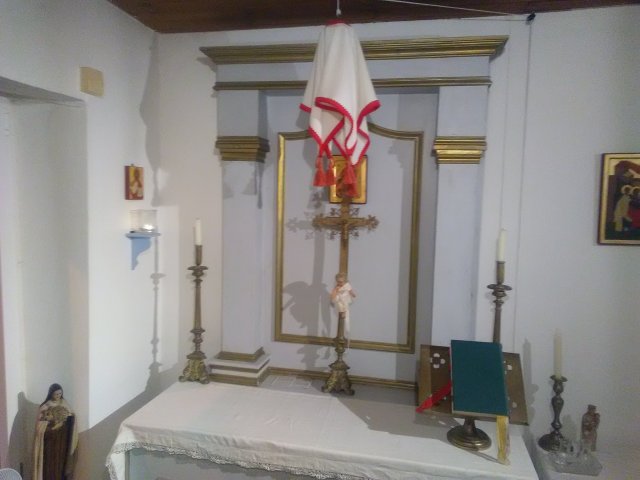
Many themes in the liturgy of Christmas filled me with gratitude and thanks to my caring sisters who helped me move to my new home. Christmas is not only physical presence with one’s family, especially when such is impossible because of the present pandemic restrictions on travel. Also, a choice is imposed between a secular Christmas and the liturgical Mystery which requires my little chapel. I am grateful for this solitude all in caring for those I love, and also praying for those who are alone because of age, illness, being in quarantine, at sea, exiled, destitute. I am thinking about millions of people who live in worse conditions than the Stable of Bethlehem! I have a home and my translating work enables me to earn an honest living. Gratitude is everything, along with humility, just being little and in God’s hands.
It is too easy to virtue-signal about secular Christmas – parties on Christmas Eve, the Réveillon as we call it in France, pieces of foie gras on toast and champagne, laughter and gaity around the Christmas tree. When the family is united (not ideologically divided), it can be a very fulfilling time. Some families make it their business to go to church and begin Christmas by what it really means, before the baubles, tinsel and things that pass like a puff of smoke.
It is very revealing that political authorities talk of “saving” Christmas, as if Christmas was reduced to that big family get-together, eating and drinking (perhaps to excess) and the ritual of presents, many of which are not appreciated by the recipients and have to be returned to the shops that sold them. The Incarnation of the λόγος is buried.
How many of us follow Advent and those illuminating Prophecies of Isaiah? There shalt came forth a Rod out of the Stem of Jesse… These words are symbols, and will be unintelligible to those who are ignorant of Old Testament Judaism and the Messianic tradition. Institutional churches reduce liturgical services to the level of entertainment instead of bringing back the disciplina arcani and initiating the faithful through catechesis in the knowledge that most do not have the interest, motivation or spiritual readiness.
The entire Christmas message is arcane and esoteric. Do we imagine that a star moved to lead the Magi to Bethlehem any more than Eve being tempted by a talking snake? These are symbols that express a mystical reality than cannot be expressed in words. One or all of the Magi or Wise Men were astrologers, and were guided by the constellations and positions of the stars in the signs of the Zodiac, or whatever system they were using. The gifts of gold, frankincense and myrrh were also symbolic. Jesus was not only the Messiah of Israel, but also the hope of all nations and peoples on this earth who received the primitive revelation and moral law. Spending Advent and Christmas in study and meditation are infinitely more precious than family get-togethers that often rankle of hypocrisy and ideological tensions.
Christ first revealed himself to the humble, to shepherds and farming folk, to wise astrologers who sought the Light that promised to re-create the world and humanity. The Virgin Mary is also a sign, not only that gentle and loving mother protecting her new-born baby, but also the Wisdom of God, the new Eve, who would care for the Church. Here I don’t mean the institutional Church and the Pope, but the communion of all the faithful and the Communion of Saints. These signs open our minds and lift the veil (II Corinthians iii. 16). See the expression in its context:
And not as Moses, which put a vail over his face, that the children of Israel could not stedfastly look to the end of that which is abolished: But their minds were blinded: for until this day remaineth the same vail untaken away in the reading of the old testament; which vail is done away in Christ. But even unto this day, when Moses is read, the vail is upon their heart. Nevertheless when it shall turn to the Lord, the vail shall be taken away. Now the Lord is that Spirit: and where the Spirit of the Lord is, there is liberty. But we all, with open face beholding as in a glass the glory of the Lord, are changed into the same image from glory to glory, even as by the Spirit of the Lord.
This veil remains in the hearts and minds of all those who refuse the World of Ideas outside our materialistic view. This is also the case with many who call themselves Christians, seeking to reduce everything to worldly concerns. Existence without God or having “cancelled culture” lead the nihilist into the ultimate loneliness of life without purpose or self-understanding. This is something that the Covid lockdowns brought out and drove many into despair and depression. Social life needs to be about what we can bring to others, and not the construction of ourselves from the consciousness of others. The whole difference is there. Living alone in this village of northern France, I am not lonely even though I live in solitude. That solitude is a precious gift that cannot be obtained by most people.
I wish all my readers a blessed Christmas Octave and the unfolding of these great mysteries through the Epiphany and the events leading to the Holy Triduum.
O Emmanuel, our King and Lawgiver, the One whom the Gentiles expect, and their Salvation: Come and save us, O Lord our God.
Maurice Greene (1696-1755), Voluntary XI in B minor
O Virgo Virginum
O Virgin of virgins, how shall this be? for neither was there any like thee before thee, nor shall there be after: Daughters of Jerusalem, why marvel at me? the thing which ye behold is a divine mystery.
Healey Willan (1880–1968), Chorale Prelude on O wie Selig
I found the following text on Facebook in a group aligned with the Ordinariate. I reproduce it without any comment or opinion from myself:
* * *
Mgr John Broadhurst has sent this to the Portal. We post it here as it will be of interest.
Father John Hepworth
I have known John for many years. My original encounter with him was when the very small continuing church in England elected a priest and petitioned for his consecration to the Episcopate. Archbishop Louis Falk of the Traditional Anglican Communion phoned me as he was very concerned about the election and asked my opinion. He sent Fr. Hepworth to England to investigate and report. He came to see me as chairman of Forward in Faith to ask my opinion. As a consequence, the TAC never ordained a bishop for England but rather used overseas bishops to manage here. John himself was soon to be consecrated as a bishop for Australia and eventually followed Archbishop Falk as the Primate of the TAC. What is not known publicly is that the TAC always collaborated with Forward in Faith and our own Fr. Brian Gill, who became vicar general for the TAC in England, was co-opted to FIF’s governing Council.
John Hepworth was a regular visitor to the FIF National Assembly and frequently spoke on the first day at the international synod. He was a very talented and intelligent man but not without his faults and flaws. When Australia had a referendum on becoming a republic John was very high profile campaigner for the monarchy and regularly appeared on Australian television. As a priest he was a visionary, though as an administrator he certainly got into several financial and structural problems. He has been to my home on several occasions and I certainly enjoyed chatting to him. I’ve also been to his house in Adelaide on one occasion when Judi and I had a very pleasant afternoon in his garden. Recently he has phoned me on several occasions to see how things were developing.
Continuing Anglicanism has always been very fractious and there are a large number of jurisdictions mainly in the United States. Louis Falk tried to bring together some of these and this led to the creation of the Traditional Anglican Communion. In North America many of the TAC priests were ex-Anglican Communion clergy. I have led summer schools for two continuing groups in the USA and on both occasions have thought that rather like our clergy they are a mixed lot. Many are of real ability and impressive formation and quite capable of holding their own. John’s great contribution was that he realised that factionalism was the opposite of Catholicism. The divisions amongst continuers were a denial of Catholicism. As a consequence he realised that it was only united with the Holy See that Anglicans of any kind could make sense of their present situation.
The bishops of the TAC met together at St Agatha Portsmouth in 2007 to discuss unity with Rome. As chairman of FIF I was invited and so were two of our regional deans. All the active TAC bishops were present. They accepted the catechism of the Catholic Church as “the most complete and authentic expression and application of the catholic faith at this moment”. In spite of later claims to the contrary there was a serious discussion, and every delegate voted in favour. All the bishops signed a copy of the catechism. Bishop Hepworth, Bishop Robert Mercer (now Mgr.), and Bishop Peter Wilkinson (now Mgr.) then went to Rome to deliver the petition to the CDF.
In March 2010 John invited me to come to a conference with the American bishops which was being held at the Cathedral of the Incarnation in Orlando Florida. That significant church and parish are now members of the Ordinariate. All the American bishops were present but foolishly the American church had consecrated two new bishops who didn’t want to surrender their newfound power or hats! One of them was a Freemason and the situation with others was compounded by personal marital complications. There were also two representatives of the 1980 pastoral provision (Anglican use) parishes of the Catholic Church present at this conference. It became obvious that it would not be possible to deliver all of the TAC parishes in the USA.
It was also obvious that some of those who most loudly proclaimed their Catholicism would be the last to become Catholics. We have seen this in England where it’s been apparent that many of those who call themselves Anglican Papalists are the least likely to be reconciled with the Holy See! They are also the most likely to attack those who do become Catholics!
Continuing Anglicanism has never been very large in England and I think I’m right that only five of our clergy (including Msgr Mercer) have come from the TAC. That is not so in America or Australia. I am personally aware of at least 13 continuing congregations and many priests that joined the Ordinariate in the USA, and in Canada there are a number of significant ex-TAC Ordinariate churches. In England we have struggled without our own buildings so is interesting that in North America most communities have managed to establish their own. There are also interesting individuals. For example a Japanese ex Anglican Communion Bishop who had joined the TAC. In Australia the first ordinary, Harry Entwistle had been an Anglican Archdeacon who then became a TAC Bishop. Several of their clergy are ex-TAC as are a considerable number in the USA and Canada.
There is an interesting article on the Anglicanorum Coetibus society website. John was an ex-RC priest. Though I have no means of ascertaining the details it looks as if Fr. John was reconciled to the Catholic Church as a priest on his deathbed. If so, I am very grateful and happy for him. May he rest in peace.
* * *
A comment says this, to be verified:
I understand that the Archdiocese has clarified that he was reconciled as a layman rather than as a Priest.
O Thomas Didymus, through Christ whom thou didst merit to touch, we beseech thee with sublime prayers assist us that we may not be condemned with the wicked at the coming of the Judge.
O King of the Nations, and their Desire; the Cornerstone who dost unite the divided into one: Come and save mankind, whom thou didst create out of clay.
Eugène Gigout (1844-1925), Antienne dans le mode phrygien ecclésiastique
December 20th – O Oriens
O Day-Spring, radiant everlasting Light, and Sun of Righteousness: Come and enlighten those who sit in darkness and the shadow of death.
Sigfrid Karg-Elert (1877-1933), Mit Ernst, O Menschenkinder, Op. 65
O Key of David, and Sceptre of the house of Israel; who openest and no one shutteth, who shuttest and no one openeth: come and bring the prisoners out of the dungeon, from the prison those who sit in darkness and the shadow of death.
Charles Hubert Hastings Parry (1848-1918), Chorale prelude on St Mary
“O Lord turn not thy face from me
Who lie in woeful state.”
We have the “Rejoice in the Lord alway” Epistle on this Sunday in the Use of Sarum, which might be a surprise to those who are used to the Roman rite. Which is right, Sarum or Rome? It needs a little study. St John the Baptist is the Vox clamantis in deserto – The voice of one crying in the wilderness. An English idiom for someone who expresses an idea or opinion that is not popular or that the individual is the sole person expressing that particular opinion with the suggestion that the opinion is then ignored. We need to be ourselves and not go with the crowd. Be bold, be original. Persevere with what you believe to be right.
Johannes Brahms (1833-1897), Mein Jesu, der du mich.
This is my personal blog concerning my philosophy of life as a Christian following the Romantic world view. I am a priest in the Anglican Catholic Church – Original Province and live in France.



 The Blue Flower