The Pipe of Peace

I have had some careful defusing to do over the past day, regarding the article Europeans are frightened in The Anti-Gnostic blog. The person running this blog is spiritually of Episcopalian origins. He is now an Orthodox Christian and tells me that he is interested in western rites including Sarum. Some extremely offensive comments crept onto this article, and Anti-Gnostic had the kindness to remove them. I corresponded with him, explaining certain things that are not appropriately written in public, and we seem to have arrived at an understanding. It goes to show that nearly all conflicts are solved by dialogue and communication. It suffices to explain things and be aware of each other as human beings.

I also wrote to the commenter who wrote so offensively, someone who has been writing on this blog, but I have received no reply, and I withhold the expression in question. There are still many comments from this person in this blog, using the same e-mail address but under two different pseudonyms. According to information he himself gives in his comments, he converted to Orthodoxy from his Roman Catholic origins and became very disappointed. He was ordained a priest, but it is unclear whether he was ordained in a canonical Orthodox jurisdiction or by an independent bishop. The change of pseudonym seems to suggest that he no longer exercises the priesthood. We all live with our ghosts and we all have work to do on ourselves. In closing my e-mail to him, I wrote “I truly pray for God’s peace to descend on you that your heart may be changed“.

My statistics page tells me that those who read my blog are very diverse and numerous, living in many different countries and continents. Most of my commenters are concerned, as I am, to understand things rationally or at least in a spiritual way faced with reality that is beyond human reason. It is too easy to become aggressive and to want to put on a hyper-masculine shell – Go get ’em, boys – as if this world were some kind of wooded land in the south or west of the United States in the nineteenth century. The forces of the modern world cannot be confronted with a blunderbuss and a pistol!

I was quite shaken by the aggressive comments on the postings I deleted and then resumed in my posting of yesterday. We are living in a world of confusion and fear. We are all afraid as my grandparents were back in the summer of 1939. Our lives are about to be changed by one threat or another. It is obvious that nothing can continue as it is. The present financial and political establishment may collapse in a very short time, as did Chamberlain in 1939. Appeasement was over. Darkness was poised to come over the world, and it was stopped. I often marvel at the way we were threatened by annihilation during the Cold War, but the worst never happened. I had nightmares as a child about the nuclear holocaust. Again we are threatened by technological totalitarianism like Orwell predicted in his novel of 1948, and now by radicalised Islam and terror. Nationalist politics may seem to be the solution, but we can ask whether they are equipped in terms of statecraft, diplomacy and an understanding of the big picture. I see no solution, except that we were spared the darkness of the Gestapo and the SS, and we were spared from being vaporised in a mushroom cloud or a lingering death from radiation poisoning. I see God’s hand in all that.

The Gospel exhorts us not to worry about the future, but to live day by day. Perhaps Islam will prevail, and stimulate us Christians to be more authentic in our faith, more so than in the present soul-destroying consumer-capitalist-democratic world. We should be careful about what we think we want, because we might just get it and in a way we least expected. This is the root of my apparently glass-licking attitude. I have been in France since the Mitterrand days, and have observed the political climate here, with the rise of the Front National. I would cringe each time Jean-Marie Le Pen would express things the political establishment and media would interpret as apologiae for crimes against humanity or holocaust denying. This kind of thing has put a lot of people off the nationalist path. We are just little people. We may have our opinions and convictions, but we just can’t express ourselves just in any way. We have to weigh things up, organise our minds and priorities, and assume the consequences.

As Christians, we do well to see things sub specie aeternitatis, in the same way as we look at history. We are called upon as Christians to another level of life through prayer and doing to others as we would have done to ourselves. Many political polemicists have forgotten this. We have the message of The Mission: one priest faces the enemy with the Blessed Sacrament, the other with weapons of war. They both get killed. To the resigned attitude saying “We must work in the world; the world is thus”, Cardinal Altamirando gives his epitaph – “No, thus have we made the world. Thus have I made it”.

Is this a call to do nothing and give up? No, because there are many things that can be done, notably missionary work among Muslims as some priests are doing now in the cities right here. Many of those people, who already fled their countries, may well convert to Christianity as the pressure of violence increases. Are we ready to welcome such people, or are we going to continue to call them “rag-heads” or whatever? We can also increase our knowledge of Islam. We must know the enemy and understand why the fundamentalist and violent elements emerged at different points of history. These are things we can do, and no law or authority forbids them. There is no limit to the imagination, or even of human and Christian kindness.

Posted in Uncategorized | Tagged , , | 5 Comments

Charlie Hebdo, Terrorism, etc.

terroristsI wrote several articles following the atrocity committed by three gunmen in Paris last 7th January. They claimed to belong to Al Qaeda, and later, that organisation confirmed that this was the case. They killed journalists and cartoon artists of a satirical French weekly magazine called Charlie Hebdo because they depicted Mohammed in satirical cartoons as they also did with Christian churches and secular political institutions and personalities. They also killed two police officers, and have themselves been killed by the police.

The subject burned me out somewhat, because I failed to anticipate reactions in the comments, some of which implied that Christians should “do something” about the large numbers of Muslim immigrants in Europe and North America. Other comments have been more constructive, reflecting the essentially cynical (in the ancient meaning of this word), anarchist and pacifist message of the Christian Gospel. Unfortunately, with the removal of the postings in question, the comments are also deleted, but not before my having saved them all to my hard disk.

I will resume my thought a little, with some hindsight into the issues of Je suis Charlie and the media coverage of all the events. Our first reaction is one of revolt on learning that unarmed men at a meeting, about their normal business, were massacred by three men in what looked to be a highly organised operation made to look sloppy (having difficulty finding their way to the right office, leaving an ID card in the car, etc.). The murdered men were working for a satirical weekly inspired by the old French revolutionary tendency against the Church and the aristocracy. We find anarchists and free thinkers in many countries, sometimes influenced by Trotsky and others. Quite frankly, when we trace the history of dissidence against the Establishment, often on account of some travesty of justice committed by the latter, we find some measure of sympathy. It happened again during the Russian Revolution, the reaction against the Church and bourgeoisie of the nineteenth century, and finally in the aftermath of World War II and the Occupation in France.

I am not Charlie, if you want to use this hackneyed expression, but I do have sympathy with the currents that flowed through society at about the time when I was a small boy and my brother was already a teenager – the late 1960’s. Apart from their hard-line atheism, I think I would have found points in common to discuss with these men who were shot to death the day after the Feast of the Epiphany.

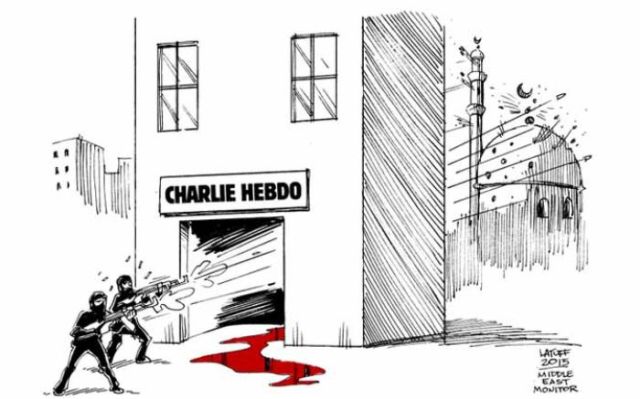
I have read quite a few articles in this country between those who see this atrocity as an attack against freedom of expression, a restoration of the old blasphemy laws – or whether this killing was an “understandable” (though disapproved) reaction by Muslims against a terrible crime committed against their revered prophet. Some conservative Christians have expressed points of view with some similarities to the latter understanding. My own “feeling” (the degree of credence I give to some of the things I read) is to surmise that this attack may have had the intent of galvanising ordinary Muslim folk into terrorist and fanatical positions to justify an overt programme of persecution and warfare by certain western political tendencies. This would explain the cartoon at the head of this page depicting two terrorists killing the staff of Charlie Hebdo, and destroying a mosque with their gunfire as a consequence.

The question of freedom of expression is a difficult one, and is a matter of a great deal of controversy. French constitutional law upholds freedom of expression as a fundamental and absolute human right. At the same time, the exercise of this freedom is subject to the law in terms of its limits and public order. The main limits of this freedom are libel and insult, words and writings calling for hatred, suggestive of apologiae of crimes against humanity, anti-semitism, racism and homophobia (hatred or fear of homosexual people above and apart from a simple moral judgement of homosexual acts). All published writings – on the internet (including comments on a blog), in newspapers and in books – fall under these laws regulating the freedom of expression. Facebook and Twitter are also governed by these laws. We have to be careful of what we say, or better still purify our minds of hatred and prejudice. Laws limiting the freedom of the press go back a long way, and most refer to the Law of 29th July 1881. Social networks like Facebook and Twitter have been more difficult to govern, because they are American services, and American law is more flexible in matters of the freedom of expression than France. Many things condemned in France are legal in the USA. The social networks are tending to comply with the more restrictive codes of laws such as that of France.

Humour and satire are dealt with entirely differently. Freedom of expression does not allow racism or anti-semitism, but it does not forbid satire and humour. Satire of the absurd and parody are allowed by the law. If the representation is an exaggeration or an alteration of the personality in question, satire, parody and jokes are allowed. There is a right to insolence and lack of respect. Cases do come up before judges, who often have to make fine distinctions.

In 2007, Charlie Hebdo had to answer for caricatures of Mohammed before a court of law. The court decided that this weekly could legally publish these drawings. Even though caricatures provoke, they form part of legitimate freedom of expression. Even though the drawings were found to be shocking to Muslims, the context would indicate that there was no deliberate intention to offend all Muslims and that the limits had not been exceeded. The law does not forbid us from mocking a religion, since France is a secular country and there are no laws against blasphemy. However, it does forbid calling for hatred against the believers of a religion or to defend crimes against humanity (the Holocaust for example).

That is for the position of French law. For the question of morality, would it have been better for Charlie Hebdo to self-censure? These were atheists, freethinkers and anarchists. Their consciences are not bound in the way we Christians are, but the attitude was clearly – my job is to draw a satirical cartoon about a personality or institution that is already absurd. It seems to be the very definition of humour as illustrated in the famous book by Umberto Eco, The Name of the Rose, in which the monks of the abbey sought to suppress a justification of humour and laughter in a book by Aristotle. The quote is resumed in these few words – We shall now discuss the way comedy stimulates our delight in the ridiculous by using vulgar persons and taking pleasure from their defects. I do not know whether this is indeed a quote of Aristotle, as I have not checked. It seems a most apposite definition. I have even read the notion saying that were humour and satire to be outlawed, we would truly be in a totalitarian society – and that is even when we see caricatures of Christ, the Pope, priests and the Church in general.

There is also a question of perspective. Before the atrocity, this was a fairly marginal weekly read by people of a similar philosophical outlook to that of the journalists and artists who produced it. Until 7th January last, I had hardly heard of the existence of Charlie Hebdo, let alone bought a copy and read it. Now I am waiting for my copy of the “survivors’ edition” which is selling at something like five million copies.

After the atrocity, there was a deeply moving phenomenon of popular solidarity between millions of French people in peaceful demonstrations in Paris and other cities. The slogan Je suis Charlie was coined, and the movement was supported by the French government and most mainstream politicians. The incredible thing was this support by mainstream politics for a group of anarchists who were not afraid to mock anything or anyone they found to be absurd, including President Hollande himself. I give credence to the idea that this large number of people were defending something they believe to be precious, namely the freedom not to be subjected to Shariah law or any other kind of totalitarianism – and that the means to this end was to be non-violent.

An issue has emerged in the comment boxes, and it may well indicate what will happen despite the wishes of any of us – the idea according to which terrorism and violence are intrinsic to the Islamic religion and that all Muslims are complicit. If this is so, it would justify outlawing Islam as a dangerous cult and deporting all those who profess Islam as their religion. This seems to express the idea of many people of right-wing opinions, especially European nationalists and American neo-conservatives. This may be exactly what the radicals of ISIS, Al Qaeda and other groups want: war against them so that they can wage war against us – and conquer the western world. Are we deluded if we deny this thesis, preferring to believe that most Muslims living in the western world are to some extent influenced by secularism and Enlightenment values?

Do we Christians want to be ruled by American neo-conservatives and European nationalists? Would those groups and parties, if elected into power, repeat the history of the early twentieth century (without committing the error of Godwin’s Law)? Is Christianity able, simply by moral influence, to stem the danger of a major change of culture in the western world to that of strict Islam? None of these questions can be clearly answered. Is the present democratic (materialist, corrupt, indebted, you name it) system, with its own serious problems, something to defend with our lives? I too abhor nearly all of what passes for politics in Europe and North America, the hypocrisy of the “caviar lefties” whose ideology is not true socialism but state capitalism which is just as cynical (modern meaning) as private capitalism. I dread the turn to the “extreme right”, and it may well happen – UKIP in England, Le Pen in France and more sinister in some other countries. Are we on the brink of war?

I have been struck by those comments coming from a type of person one might associate with stereotypes of “red-necks”, southern Confederates and the Klu Klux Klan. I have seen men with a fascination for firearms and the idea of being prepared for being attacked by forces in America opposed to the principles of the Constitution and its various Amendments. I am not an American. I have fired rifles and pistols with live ammunition – to make holes in paper targets. Many boys like that idea. When I was in the CCF at school, our Lee Enflield .303 rifles were kept in a strongly locked room, chained to their racks and the bolts were kept in a safe. The ammunition was stored in another strong safe. We Europeans are not used to having our own arms, at least for anything other than target practice or hunting. Even the Swiss only ever use their arms in a strictly military context. I will not enter into this uniquely American controversy, but I will say I find it quite unhealthy. Those who live by the sword will die by the sword. The saying of Christ applies also to any weapon used for killing another human being. My intuition is that pacifism is the way, though the possibility of having to kill may one day be something we cannot avoid. May I never have to kill for as long as I live!

How long would many of those men last in a real war? I ask myself the question.

One very legitimate question is how far ordinary Muslims who are not themselves terrorists would go to oppose the extremist organisations in the name of respecting the native values of the country into which they have immigrated. It is also legitimate to debate about the continuation of mass immigration of people who will never integrate into the host country or become financially independent. Many of us, outside extreme political tendencies, are concerned about these points. Immigration is incredibly expensive to the taxpayer, and security is a real issue. If nothing is done about these problems by the proper authorities, then we really do have something to worry about. Maybe the only thing to do is to hole up in some remote hamlet in the west of Brittany! What makes all this agonising is knowing that Christianity is impotent and mainstream European political and economic life is going through a crisis that suggests very hard times ahead for us all. I really have the impression that mass immigration of Muslims will have dire results.

On the specific subject of Islam, we need to do some learning about religious traditions that are not our own. I understand Islam to be essentially a mixture of Judaism, Nestorian Christianity and a few bits and bobs borrowed from the ancient Arabian mystery religions. There are different strands of Islam like there are in Christianity, from the mystical Sufism to the Sunnites and Shites. There have been priests who have consecrated themselves to a ministry of understanding Islam and seeking to bring about enlightenment and humanism. Benedict XVI himself worked in this perspective with the Regensburg speech.
I resolve this year to acquire a foundation of knowledge of Islam. There was a Muslim student at Fribourg University where I was, and he had very interesting insights into our belief in the Trinity and the divinity of Christ. There I could discern the distant Nestorian roots of Islam and the contacts Muhammed had with Christians. I think this is an urgent task for us all to be free of prejudice and stereotypes. There is also a suggestion that the more terrorists kill and outrage decent humanity, the more ordinary Muslims will take the courageous step of converting to Christianity. Many have done just that.

I think we need to discern very carefully whether Europe is about to be taken over and made into a Muslim caliphate or whether this is the apocalyptic thinking and irrationality of the prejudiced and the bigoted. The big problem is processing the information, because we don’t know who to believe. Is there a collusion between mainstream left-wing politics and ISIS / Al Qaeda? Why would there be? Is it not simply a tidy conspiracy theory with no basis in fact? Our minds are polluted by conspiracy theories and the search for simplistic solutions. That is how famines and very cold winters in the seventeenth century were blamed on old women practising herbal medicine and alchemy! Many were burned at the stake as witches.

These are just a few reflections provoked by the news and controversies on this blog. It is not a question of being right or wrong, but of seeking to understand. Finally, I will accept comments if they are written in a constructive and Christian spirit. I will reject comments especially if they offend against the law or call for hatred or warfare, etc.

Posted in Uncategorized | Tagged | 21 Comments

Communion in the Hand

Responding to The Red Herring of Communion in the Hand, Fr Robert Hart has written something interesting on Facebook:

Normally I avoid these specifically Roman Catholic problems, inasmuch as my own position is perfectly clear for all to read. But, when bad scholarship attacks perfectly valid Anglican practice, and (as I witnessed yesterday on Facebook) wrongly impresses my friends, I am only too happy to set the facts in order.
_______________
‘So according to St. Justin Martyr, Tertullian, St. Cyprian of Carthage, St. Cyril of Jerusalem, St. Ambrose of Milan, St. Basil the Great, the Synod of Trullo, St. John Damascus, and the Catholic Encyclopedia, communion by hand was not at all uncommon in the early Church. In fact, it was a recommended manner of reception in many places. Unless these Fathers and Doctors (and all but Tertullian are saints) were thus “sacrilegious” or promoting a “lessening of respect for the Eucharist”, the self-styled ‘traditionalist’ who denigrates this practice in and of itself has some serious explaining to do. Communion by hand was accepted in the first millennium. Nor for the most part was it considered irregular. However, it was not a uniform practice or universal so the liberals who claim it was are lying about this. However the ‘traditionalist’ who tries to make communion by mouth into an Apostolic Tradition is just as guilty of blatant lying as the liberal who revises history to suit their personal agendas. This is the problem that ‘traditionalists’ put themselves in when they make these kinds of ill-informed arguments.’

There is an interesting comment by Archbishop Haverland:

Surely the problem isn’t ‘touching’ the host, but particles of the host being dropped or left on the hand. Consciousness of the full import of the Real Presence developed slowly, and as it did, there were practical and liturgical effects. One, I think, was the decline or disappearance in the West of infant communion (because babies throw up so much). Reception on the tongue is a similar and logical development. Necessary, no. Sensible, yes.

An important distinction has to be made. When I was confirmed as an Anglican schoolboy, we received Communion by placing the right hand on the left, receiving the host, and then bringing both hands up to the mouth to take the host with the tongue. We would also do the same with any crumbs (which were rare). We then received the chalice as is the usual Anglican practice. The modern Roman Catholic way is to receive the host on the left hand and to take the host with the right thumb and index finger and consume the host, often whilst walking away from the communion rail with an apparently casual attitude. On those rare occasions when I have someone at Mass, invariably Roman Catholics, I give them Communion on the tongue in both kinds by intinction. They easily understand why I do not give them Communion in the hand when I have just “dunked” the host into the chalice.

Like our Archbishop, I find that Communion on the tongue is prudent and sensible. It is the practice of our Diocese, though the chalice is administered separately.

Indeed, traditionalists have often made a storm in a teacup, and sometimes a single issue. It is good to be calm and reasoned about these matters.

Posted in Uncategorized | Tagged | 7 Comments

When the boats are laid up…

What do we sailors talk about when our boats are laid up for the winter?

Good use of Facebook can make it so different. I put out a New Year greeting showing the photo of John Wesley and I side by side, wearing Anglican choir dress (bands, surplice and tippet) and our long hair. You can find it in Nowhere near his holiness…

Of all people, one of my “friends” (I have every reason to believe he could become a true friend), Roger Barnes, has been commenting. He and I have agreed to meet up at the Semaine du Golfe (in which both our boats are registered in flotille no. 2) and probably also at the Route du Sable. He is an architect and a remarkable writer. I warmed immediately to the spirit of freedom and personhood he conveys in anything to do with the Dinghy Cruising Association, his books, articles and the Internet.

I have tended to go softly on religion on the sailing forums and so forth, but some sailors have a view on life that stands out from the crass materialism and sheep-like mentality of our times. Perhaps it is the solitude of the sea, the fact of doing something for ourselves, interacting with nature and the elements.

Roger noticed that unlike Wesley, I was wearing a Roman collar. This led to a conversation:

Roger Barnes – Wrong collar Anthony…!

Anthony Chadwick – There are the bands under the Roman collar, but not easily visible on the photo. Also, I don’t have the same curls in my hair as Wesley (who didn’t wear a wig even though he lived in the 18th century), just what I get naturally! Actually, I find the Roman collar very uncomfortable, made of hard plastic as they are. Some kind of white scarf would be better with either the jabot or the bands. That being said, you won’t find me dressed like that in my boat!!!

Roger Barnes – I see the bands, but Wesley’s emerge from the top. He also used curling tongs, presumably.

Anthony Chadwick – Like the French rabat. Curling tongs and anything hot are bad for the hair. I leave mine natural except tying it up in something like a ponytail for practical reasons (like sailing…).

Roger Barnes – My client Michael Eavis believes that his Glastonbury Festival is an example of applied Methodism. I wonder what Wesley would think?

Anthony Chadwick – I find the comparison difficult. Methodism seemed to be about getting back to spiritual roots and bringing Christianity to the working classes, being more radical than the Establishment. I am not a Methodist myself and come from an Anglican background, but I have a lot of esteem for them. Some people make their mark by being good to others, and I need to read more about Michael Eavis to discover the mark he makes on his world.

Roger Barnes – One of the central planks of the Methodist critique of mainstream Anglicanism was the idea that ordinary people were intrinsically good and capable of taking control of their own lives. So Michael believes that if you put 175,000 people in a muddy field for a week with only minor policing and very minimal plumbing they will be very happy and very good to each other….

Anthony Chadwick – You don’t have to be an open boat sailor to understand such ideas, but it helps!

What really interests me is this reflection that “ordinary people were intrinsically good and capable of taking control of their own lives“. This resonates within me as the antithesis of the Inquisitor of Dostoyevsky as the symbol of those who believe that humanity can only be evil without the tight reins of authority and oppression. This is true anarchy, not being anti-social or making other people’s lives miserable, but being truly ourselves – even in society. I have had this experience with boating people, preferably in boats propelled by sail and oar, no engine.

Methodism was the perfect response in the eighteenth century to the Establishment as was William Blake to the Industrial Revolution and Capitalism. It represented men and women moving on and taking their own lives in hand. In the same way, we are called to bring out the best in human nature which is based on empathy, care for others and an intrinsic sense of right and wrong. Many of us in churches and with religious concerns miss these points that are so obvious to many people who do not share these concerns. It is my hope that Continuing Anglicanism, after its tumultuous beginnings, will fulfil this role in our own time like Methodism did (and still does) in previous eras. We need to give our lives to prayer and the life of the spirit, do things in simplicity and love and bring God’s gifts to the little ones of this world. I see every sign of this in our Archbishop and my Diocesan Bishop, and in many of my fellow clergy. May this be so, and this is my wish and hope for 2015.

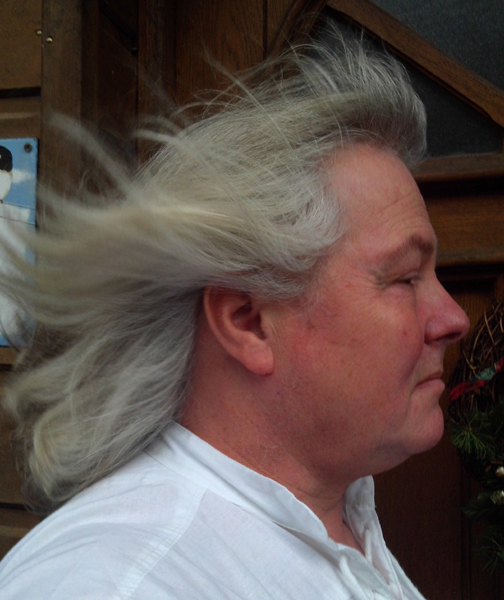
20141218hair-windOh, and by the way, I think I will replace that awful plastic collar with some kind of fine white scarf in cotton and wear bands as Wesley did when in choir dress. These are only details of dress and personal taste (even in matters of our clerical “uniform”), but which are so full of meaning.

Please be indulgent for my “selfie”, but this is my blog after all!

Posted in Uncategorized | Tagged , , , , , | Leave a comment

Desiderata

I found this on my longhair forum, so full of wisdom:

Desiderata
Max Ehrmann, writer and lawyer (1872-1945)

Go placidly amid the noise and the haste and rememeber what peace there may be in silence. As far as possible, without surrender, be on good terms with all persons. Speak your truth quietly and clearly. And listen to others, even to the dull and the ignorant, for they too have their story.

Avoid loud and aggresive persons, for they are vexatious to the spirit. Never compare yourself with others. You may become vain or bitter, for there will be always greater and lesser persons than yourself. Enjoy your achievements, as well as your plans.

Keep interested in your career, however humble. It is a real possesion in the changing fortunes of life. Exercise caution in your business affairs, for the world is full of trickery. But let this not blind you to what virtue there is. Many people strive for high ideals and everywhere life is full of heroism.

Be yourself. Especially, do not feign affection. Neither be cynical about love. For in the face of all aridity and disenchantment, it is as perennial as the grass. Take kindly the counsel of years, gracefully surrendering the things of youth. Nurture strength of spirit to shield you in sudden misfortune. But do not distress yourself with dark imaginings, for many fears are born of fatigue and loneliness.

Beyond a wholesome discipline, be gentle with yourself. You are a child of the universe, no less than the trees and the stars. You have a right to be there. And whether or not it is clear to you, the universe is unfolding as it should.

Therefore, be at peace with God, whatever you conceive him to be. And whatever your labours and aspirations in the noisy confusion of life, keep peace in your soul. With all its sham, drudgery and broken dreams, it is still a beautiful world. Be cheerful. Strive to be happy.

Posted in Uncategorized | Tagged | Leave a comment

Leavened Bread and the Blessed Sacrament

Patricius has written Elevations… which is interesting when you get to know its author a little. He loves making conservative readers bristle by his rhetoric! I have always used standard unleavened wafers that you buy ready made and keep in an airtight container. They are practical and break cleanly, if you do the Fraction carefully and along the scored line on the back of the host. The western Church has used unleavened bread for a long time unlike the πρόσφορα of the Byzantine and other oriental Churches.

I see no reason why a πρόσφορον could not be used in the Latin rite. The usual type used in the Byzantine Liturgy is quite large and thick. A piece is ceremonially cut out of the centre to be consecrated during the Liturgy, and the remainder is given to the faithful at the end as the Ἀντίδωρον. I could imagine the same kind of leavened bread being pressed flatter and baked to resemble a disk of about half an inch thick. The bread can be quite similar to Turkish pita bread used for making döner kebabs. It can be handled in the same way as an unleavened wafer and broken at the Fraction, care being taken to avoid crumbs getting everywhere. But, a point I will make is that I don’t, both for practical reasons and some measure of conformity to the ways of the Diocese to which I belong as a priest. I use unleavened hosts.

I am not sure what kind of host would have been used in fifteenth-century England in an average country church, but they would not have been very different from the wafers you buy in church supplier’s shops nowadays. Leavened bread in the Latin Church goes back a very long way. Host pressing irons in convents and museums are the usual evidence of this method of making them, and some of these irons go back a long time. I order my hosts from our own church shop which is presently moving from Canterbury to Lydd in Kent where it will be open for mail and internet orders.

As for devotion to the Blessed Sacrament, there is also a long history. Essentially it is an extension of devotion at the Easter Sepulcre from the Mass of the Presanctified on Good Friday until Easter Sunday morning – the way it is in the Use of Sarum. In the Roman rite, things shifted to the altar of repose on Maundy Thursday to the Mass of the Presanctified. Thursday began to be the day associated with Corpus Christi as for the Ascension. The proper we have of the Maundy Thursday Mass with a few bits and pieces for the Roman Maundy Thursday procession were written by St Thomas Aquinas. From that time, Corpus Christi spread from Orvieto to the north of Rome to the entire Latin Church. The Sarum missals of the early sixteenth century contain the Mass of Corpus Christi with the same proper. Eucharistic processions and devotion to the Blessed Sacrament were as characteristic of pre-Reformation England as nineteenth-century France.

Corpus Christi certainly marks a spirit of joy and the quote from Hilaire Belloc:

Where’er the Catholic sun doth shine,
There’s music and laughter and good red wine.
At least I’ve always found it so.
Benedicamus Domino!

Things have changed a lot in Italy and France now, but I have personally seen some lovely displays of popular piety in Catholic Germany and Switzerland. I am inclined not to sneeze at popular piety, because sometimes we discover how little spirituality we have ourselves. I have been to Lourdes and Fatima, and have been able to observe the faith and hope of those who are hopelessly ill or dying, but yet pray for a miracle. Who would I be to smash those shrines and tell those people to get back to work and that they are worth their money? In all the tackiness and sentimentalism, there is faith and hope, a real love for God and the whole supernatural order. Personally, I prefer quiet days in monasteries to noisy pilgrimages and busloads of vulgar Italians and Spaniards – but they have also come to seek God.

Devotion to the Blessed Sacrament is important, but it is important to catechise the faithful. The primary purpose of the Blessed Sacrament is Holy Communion at Mass, but the Sacrament can convey grace in other ways too. There is the concept of the Spiritual Communion from the days when most lay folk rarely communicated.

I have little experience of the more “purist” forms of Western Orthodoxy or Old Catholicism, but I see the link with the Jansenist movement and some of the movements in seventeenth-century Anglicanism. Everything can be made so dry and sterile that ordinary folk can no longer relate. Swiss and German Old Catholicism was never a popular movement as Soloviev acidly criticised them. Any kind of Western Orthodoxy that has had any pastoral success has tended to imitate post-Tridentine Roman Catholicism like the Anglo-Catholic movement in England. This is the big difference between Patricius and myself. I am a priest with long experience of seminaries, parishes and community life. We are bodies and souls and need both ἔρως and ἀγάπη in our relationship with the sacred. My concern is as pastoral as it is academic. My experience is not his.

My experience of the Use of Sarum and doing it as authentically as possible has shown that there is less “bobbing” (genuflecting) that in the classical Roman rite. There are profound bows at certain moments, but fewer of them. I do things as at the eve of the Reformation. It wasn’t perfect. Nothing ever is, but it is well documented and relies very little on “reconstruction” or conjecture. It is rather similar to the Dominican rite and many of the monastic usages, characterised by sobriety and “noble simplicity”.

From there to destroying lock, stock and barrel… There is a lot of Patrician rhetoric and many pinches of salt to be taken. I do appreciate sobriety in the liturgy. This is perhaps to some extent my reaction from the baroque extravagance of Gricigliano! Popular piety needs to be fostered but the faithful also need to learn about the liturgy. In France, the most positive influence come from the newly restored Benedictine monasteries following the Revolution and Romanticism. One of the most well-known examples of this movement was Père Emmanuel and his parish at Mesnil-Saint-Loup. It all constituted the early Liturgical Movement.

Patricius’ suggestions remind me of the Synod of Pistoia and the Jansenists, Father Jacques Jubé of Asnières and what actually inspired the movement towards the Novus Ordo of Archbishop Annabile Bugnini accepted by Pope Paul VI. The inspiration is the idea of pristine purity from the Church of something like the third century (if such was not an illusion) and a highly cerebral notion of the liturgy and theology. It is a thicker iconostasis of elitism than the jubé or the rood screen ever was! Perhaps I took on some influence from Dom Guéranger as I read the Institutions Liturgiques written in the 1840’s. In medio stat virtus, and right or wrong is not on one side only. Jansenist purism is a tendency, as had Pharisaism been in Judaism in the time of Christ since the return from the Second Exile. In the end, it is the fine balance between our northern paganism, Greek philosophy and Jewish monotheism. Christianity became something extremely complex, and it has become lost in time over the centuries. Tradition has bequeathed us a few remnants, so not everything is entirely gone.

The Elevation is an established custom at Mass in the various western rites. In my Sarum Mass, I elevate the Host as in the Roman rite and elevate the chalice to a height of about my face. I rarely celebrate Benediction, as I rarely have lay faithful at Mass. I reserve the Sacrament in the hanging pyx and I keep an oil lamp lit (it consumes a lot of olive oil). I have never celebrated Mass coram Sanctissimo, and have never seen it done, not even at Gricigliano! The Holy Week usages of Sarum have been quite an eye-opener. The Easter Selpulcre isn’t merely an “altar of repose a day late”, but the emphasis is different. It remains throughout the Paschal Vigil ceremonies, and until a short ceremony of removing the cross and putting the third host of Maundy Thursday into the pyx just before the Mass of Easter Sunday.

I am an Anglican and distribute Holy Communion under both kinds. I usually do so by intinction, a great way to avoid people wanting Communion in the hand (at least the way it usually happens in Roman Catholic parishes). We do need to be careful where we keep the Blessed Sacrament. My hanging pyx isn’t very “secure” but I live in the countryside. In cities, the usual way is (or used to be) to open the tabernacle on the altar each evening and transfer the Blessed Sacrament to a safe behind the high altar. Satanists still find ways to steal the Blessed Sacrament and use it for evil rites. Profanations still happen and for reasons of hatred of Christianity.

What would I do if I were the Pope? It is the sixty-four thousand dollar question. Patricius will never be the Pope and nor will I. I would never want that degree of authority or influence over such large numbers of innocent people. The Protestants tried stamping out “superstition” (the remnants of northern paganism tolerated to make monotheism assimilable) and they failed. People either returned to Catholic ways or gave up religion altogether. The neo-Jansenists of the 1960’s and 70’s tried it and emptied their churches. Those who left will never return. That is the terrifying responsibility of authority!

What would be the solution? It isn’t changing the world or remaking the Church. It is looking at ourselves and seeing what we can bring the world in terms of prophecy, spirituality, love and beauty. I have been edified by simple pilgrims walking on their knees to the shrine of Fatima. I have seen very sick people dragging their hands round the grotto of Lourdes. The hope is there, however primary their faith or knowledge may be. There is a spark that we have no right to quench. We are not the Pope, but even a lowly priest has responsibility, and this is why I have written this article.

Posted in Uncategorized | Tagged , , | 47 Comments

Food for thought

Hat tip to John Beeler in his latest round-up. In particular, he quotes a blog posting – Post rationalism. I have often lain awake thinking about these things, and there is nothing we can do about the society in which we live. The conservatives would revive the political climate of the early twentieth century and especially the period following World War I. The so-called “liberal” movements seek to impose ideologies and stereotypes, missing the essential intuitions that were at the origin of their claims.

The comments (at least most of them) are as fascinating as the article. Christianity seems to be dead because it’s no use to anyone. We have the Welfare State, hospitals and state schools. Very few have any notion of the inner spiritual content of Christianity. The future of the west seems to be divided between “medieval” and “fundamentalist” Islam and Orwellian technology and totalitarianism.

My own intuition is that collective humanity is brainless, the perfect expression of the Valentinian hylics (from the Greek ύλη – matter). The world has always been materialist and hostile to the life of the spirit. Prophets, saints and artists have always been individual persons. No one could ever do anything about the world other than bring it into deeper evil and materialism. My point is that we waste our breath trying to do something about the world by competing at the level of authority.

We can only compromise as best we can with the world, the only alternative being our death. We have to make money to live, feed the Welfare State and pay taxes, pay back debts for our houses, cars and education. Some of us will be forced out by the sheer pressure, to begin anew elsewhere. Mankind can be extremely resourceful. We will always live in a hostile world in which man eats man.

Christianity will always survive where it remains true to itself, and will founder when it tries to compete with the world instead of answering with love and self-sacrifice. It will seem most triumphant when it forms an alliance with world powers in a seeming coincidence of interests, but that kind of Christianity is hollow, hypocritical and to be rejected by anyone of a spiritual vision. What will remain are prophets and saints purified in the crucible.

Posted in Uncategorized | Tagged , , , , | 2 Comments

Answer with love…

I found this on Facebook from our Metropolitan Archbishop Mark Haverland. He quoted it from Fyodor Dostoyevsky’s Karamazov Brothers. It was not long ago that this theme of responding to everything with love came up in a conversation with my Bishop in England. If we answer hatred with hatred, it can only escalate and the malice doubles with each exchange or act of revenge. Instead, we respond with love and our humility:

At some thoughts one stands perplexed, especially at the sight of men’s sin, and wonders whether one should use force or humble love. Always decide to use humble love. If you resolve on that once for all, you may subdue the whole world. Loving humility is marvellously strong – the strongest of all things and there is nothing else like it….If the evil doing of men brings you to indignation and overwhelming distress, even to a desire for vengeance on the evil-doers, shun above all that feeling. Go at once and seek suffering for yourself, as though you were yourself guilty of that wrong. Accept that suffering and bear it and your heart will find comfort.

Could this be our New Year resolution? This is the way of Christ and the Gospel.

Posted in Uncategorized | Tagged , , | 3 Comments

More on pronunciation…

Is received pronunciation such a good idea? It is a while since I wrote Speech and Pronunciation and the subject also appeals to John Beeler. That tends to be the way I talk, and I brought many a smile to a supermarket assistant when I visited the US. Our posh talk really tickles them!

On the other hand, I descended from a solid Yorkshire family (I was actually born in Westmorland – don’t talk to me about Cumbria!) and spent many years living in York and being interested in the way we pronounce words. Our little country is one of many accents and different ways of pronouncing words. All that has been influenced by travel and television, and much has been lost.

There is also a question of history. See Original Pronunciation and the Prayer Book which brings in another dimension, that of Shakespeare specialists studying how English was pronounced in the early seventeenth century. The demonstrations they give sound something like a mixture of West Country, Midlands and a smattering of Yorkshire. The West Country extended “R” has continued more in American English than anywhere in modern England. We found it in the Irish brogue. Was English really pronounced like that in those days? How do they know? The justifications they give are quite convincing and plausible. Puns and rhymes “work” in the reconstructed original pronunciation, and not in our Queen’s English.

We English have made close associations between accent and social standing, and that has caused a considerable amount of damage. There are extremes and caricatures of received pronunciation that are quite grotesque! Most of us speak as we were taught by our parents, schoolteachers and friends. The best we can do is to talk naturally and without affectation.

Apply the Shakespeare English work to the language of the Prayer Book. That would be interesting. I have heard those texts read with many regional accents that are spoken in England. I still hear the broad Yorkshire accents of lay readers and non-stipendiary priests to this day in association with certain texts, in contrast with the Vicar or the cathedral canons and their Oxford and Cambridge accents.

It would also be interesting to see how Latin would have been pronounced in the late fifteenth century. I suspect it would be like the way it has been pronounced in France and Germany, but I have never studied the question. We just have to wait and see what linguists come up with…

Posted in Uncategorized | Tagged , , | 6 Comments

Use of Sarum on Facebook

sarum2002Facebook is an incredibly complex and popular piece of internet, and I have always found most of it to be complete drivel. I suppose many of its users spend their lives making “friends” and “liking” this or that. My Bishop has been using Facebook in a light-hearted way as a part of his ministry, and this has brought me to reconsider some of my former prejudices. Like anything, Facebook can be used in different ways.

One thing I do like about Facebook is the possibility of finding old contacts. I have recently “befriended” two old boys from my school in York, whom I met at about the time when a computer looked like an office block and a cathode ray oscilloscope!

Over the years, I got overtaken by the number of “friends”, and one has always to be on the lookout for spam, scams and computer viruses. There are some nasty people out there, and one needs to be discerning about whose “friendship” one accepts by clicking of the “accept” button. All that friends do is to give an increasingly complex and comprehensive “timeline” page, most of it trivia and drivel.

I find that some of the Facebook groups can be good and more “modern” than the Yahoo e-mail group. I have recently set up two of these groups, the dinghy cruising group I mentioned yesterday to mount a project of a gathering in Lower Normandy. Today, I bring up the group I set up on the Use of Sarum. It is based on my old Yahoo Use of Sarum group, which still exists for the sake of its archives and those who might feel motivated to revive the volume of traffic. The blog, the Yahoo group and Facebook are three different things. The blogger writes his pieces, and gets comments if the material is of interest. The Yahoo group is largely e-mail based and can involve quite profound discussions. The Facebook group, more graphic, involves short messages and the “turnover” is much faster. It helps to get people together, or can do.

My Use of Sarum group is open to all comers and people can “join” it if they wish. We are currently 49 members, a third of my old Yahoo group membership. The essential thing is that we have good discussions and share resources, especially any and all attempts to revive the practical use of this liturgical tradition within the Latin Rite.

Posted in Uncategorized | Tagged | Leave a comment