Original Sin

I have just been reading this article on original sin from a “liberal” point of view. The author’s thesis is that this doctrine needs to be “reviewed, reformulated, or even discarded”. The ideas he expressed fit in entirely with my article of a few days ago on Romanticism and Modernism. The general tone seems to be that all the “old hat” isn’t “with it” and unsuitable for modern man who knows everything and has evolved to be superior to anything else. All that sounds great, except that we all have to die, as I was rudely reminded yesterday, and everything comes to nothing or there is something beyond our modern competitive and power-hungry jungle.

So, what is original sin? What scholasticism calls actual sin is usually an act of alienation from God caused by a transgression of moral laws, as defined by what is usually taught. Sin takes many forms, whether from the individual to human collectivities and structures. It is part of the study of evil. The news is full of it, from heinous crimes and murder to the police state and warfare for money.

The big problem is that if humanity was created in the image and likeness of a perfect God – therefore perfect, how did everything go wrong? The explanation would be the Devil and the fallen angels. The Devil made me do it, Your Honour… Isn’t that the oldest excuse in the book? Were not the Angels also created perfect by God? We’re back at square one. So it’s a mystery beyond human understanding. It is. All we have are a few myths from different ancient traditions to explain truths in allegorical and analogical terms. We are too used to literalism, something which takes away credibility and casts Christianity into a kind of storybook for children to be discarded by modernity and adulthood.

The doctrine of original sin is an analogy, as in the creation narrative and all the events of the Book of Genesis. Something happened in distant history, but all we read are the myths that convey it in terms we cannot understand but accept in some way. We seem to be in trouble if we deny original sin, because that was surely the whole point of Christ, the Incarnation, the Paschal Mystery and Sacrifice of the New Testament. Or was it?

I’m certainly not going to take the step of denying it, because that creates more problems than it solves. The problem is more in literalism than anything else, because it places requirements on the mind to find reasons and consequences, theological constructs for which Scholasticism is famed. You then need to find out how this sin is transmitted, like a biological disease, how Baptism deals with it, the question of the Immaculate Conception and what happens to unbaptised babies who die without having ever committed a moral act of any kind.

The Roman Catholic dogmas of the Immaculate Conception and the Assumption come from this particular theological formulation of original sin. The way this doctrine developed in Roman Catholicism was assumed untouched by Anglicanism, Lutheranism and all the Reformed churches, all of which followed the position of St Augustine. The current catechism defined it quite well in an attempt to recover credibility:

The account of the fall in Genesis 3 uses figurative language, but affirms a primeval event, a deed that took place at the beginning of the history of man. Revelation gives us the certainty of faith that the whole of the human history is marked by the original fault freely committed by our first parents. [n.390]

Something did happen at the beginning of our history. What is significant is that the Oriental and Byzantine Churches have not accepted Augustine’s explanation about the exact nature of this sin and how it passes from generation to generation in all human beings. The prevailing view in Orthodoxy is that humans inherit mortality which would be restored by a process of deification made possible through the redemptive work of Christ. This notion is less “legalistic” and more ontological. The “liberal” article tries to adopt a more empirical approach through psychology and anthropology, claiming that a new-born baby is morally neutral, neither holy nor evil. Such an approach will necessarily be inadequate and as literalistic as that of Christian fundamentalism, but should be taken into consideration.

It appears to me that we are all mortal and suffer from the effects of genetic degeneration. See The Degeneration of Man, The Human Race Is Dying and others – disclaimer: I do not endorse all the practical conclusions of these articles. Scientific evidence seems rather to refute the idea of evolution. The Nazis thought they could do something about it through eugenics and killing people of “inferior races”, but in reality, no human solution is possible. Each one of us must die one day after growing old, succumbing to a disease or being killed by accident or human evil. I find it believable that the human race shares the same destiny – and this was not changed (at least physically) by the event of Christ. What is more, non-human life shares the same fate of degeneration and death. The planet itself is finite and ageing.

Can we talk of original sin, rather than an original fault? An analogy in genetics is that if you make a photocopy of a photocopy of an original document or image, and continue the process for several “generations”, you will end up with a real mess. In technology, this is the difference between analogical and digital. Computers make identical copies of files that are no better or worse than the originals, but digital technology is also fraught with faults and errors – or “bugs”.

The “liberal” article attempts to “save” Christianity in spite of denying Augustine’s notion of original “sin”. Baptism would be more geared to initiation into the Christian community rather than regeneration. Is Baptism necessary for salvation? What is the Church? What happens to the “non-saved”? Is hell eternal, and if so, how can this be reconciled with a loving God? These are the question asked by all those who don’t say they don’t care, who feel concerned about the future of Christianity or another spiritual world view to replace it.

The Augustinian notion of original sin is found embarrassing by the Church authorities themselves, and Popes and bishops are in two minds. We remember how Benedict XVI “did away” with limbo as an explanation of what happens to unbaptised babies dying in infancy. The controversy continues between Universalists and those at the other extreme who believe that most of humanity is predestined to roast in eternal hell.

What do other spiritual and religious traditions convey to us? All the world religions recognise that there is something wrong and that humans commit evil. Divine light is obscured and sin alienates humans from our happiness and from God. But that is personal sin through our words, deeds and omissions. Sin is usually described in mythological terms, because they would reach a greater depth than using the analogies of law and notions of financial credit and debt. We need to examine the Eastern Orthodox view to seek balance in our understanding. The keyword is θέωσις – transliterated as theosis. It is the counterpart of the western notion of salvation – but something beginning in this life and not exclusively after our bodily death and particular judgement. Behind the words, connections can be made in our attempt to achieve some understanding. The concept of deification through grace has found its way into modern western theology, and this is something positive.

Modernists (those who believe in the linear evolution of man and that we are the nec plus ultra with our smartphones, laptops and air travel transporting Ebola all over the world) think that terms like original sin and baptismal regeneration will just drop away. Perhaps they might, and then the other skins of the onion have to be peeled away until nothing remains. Alternatively, we can try to understand them more deeply and enter into dialogue with our literalist contemporaries of “left” and “right” alike.

I will not enter the fray, since I have studied the question only generally in a context of university level dogmatic theology. There is the myth of Adam and Eve (when I say myth, it is not a “fairy story for children” but an allegorical narrative) that points to a reason behind the faults and defects that spoiled God’s creation. The Creation is also another myth. The Book of Genesis is full of them. One example I have been reading about is the Nephilim, derived from a Hebrew word meaning the giant or powerful beings that existed before the Flood. This myth stretches the imagination, and we find the ancient Egyptian, Greek and Roman gods, the cult of the superman, the Übermensch of Nietzsche and the parody adopted by the Nazis in their murderous plan. Mythical animals are a powerful part of our imagination – unicorns, mermaids, kraken and others from the mysterious depths of the sea, minotaurs and other creatures from Greek mythology. They are allegories of something. We are not sure what. In science, there are skeletons of dinosaurs, other extinct animals and giant humans (when the photos are not fakes). In Christian art and imagination, there are portrayals of Satan and the demons as human / animal hybrids. The question of hybrids has come up in modern science and genetic engineering.

When I was a boy of about 10, I knew that there was a kind of “safety lock”or reproductive barrier preventing different species from reproducing. However, some exceptions are possible in nature like between a horse and a donkey, producing the mule. Some basic scientific information can be found on Hybrid (biology). A vital distinction is made between breed or race and species. There are hundreds of breeds of dogs, cats, cattle and many others, caused by selective cross-breeding. Humans of different races can produce offspring, and I have seen some very beautiful people of mixed race. In this Wikipedia article, there is a short section on mythical hybrids and chimera. Can science and genetic manipulation produce offspring from, say, a bird and a frog, or a pig and a cat? Nature is tough. For example, a mule is sterile and cannot reproduce. Did creatures like griffins, centaurs, minotaurs, unicorns and mermaids ever exist, for example before the Flood? If so, were they artificially made by “Frankenstein” science?  Today’s science is not making hybrids, properly speaking, but it has been possible to graft cells from one species onto another, like the notorious image of a human ear on a mouse. Here is some more scientific information from Hybrids, Chimeras and Haldane’s Rule. Let’s not get carried away!

However, there are some who claim that some creatures other than Noah, his family and the animals he was carrying survived the flood. According to the Book of Enoch the Nephilim were wicked sons of fallen angels (? I thought angels were spiritual beings with no bodies, but the Angel Gabriel was responsible for Mary’s pregnancy with Christ) inseminated women and produced humans who presumably had genetic defects. If there was some antediluvian survival, then the cycle began over again, and this would explain man’s diminishing genetic quality and viability. Seen in this context, bodily death and extinctions are necessary. As a Christian, I cannot condone abortion or euthanasia for reasons of poor genetic quality, but there are cases where such a conservative judgement would be very difficult (eg. trisomy)… There are individual abnormalities and then there is the constant and general decrease in humanity as a whole. Eventually, we will become sterile and the species will become extinct.

There is also the mythology of Gnosticism which I find fascinating. Mythology and allegory are crucial notions, as we find in Jung’s psychology and his attempt to understand how the human mind and soul work. The Gnostic understanding of our beginning, as it has been understood from the Nag Hammadi scriptures, Pistis Sophia and other ancient sources, is quite different. The problem is not man but God. If the creator created a flawed world in his image, it would logically follow that the creator was flawed. Was the creator God or some other being?

Gnosticism saw that there was a problem in the origins, right back at the very beginning. The difference from traditional Christianity is that the flaw was not the fault of humans but of the creator. That leads to another problem. Are there two Gods, one good and the other bad (Manichaeism) or is God just as sinful as we are? If we say that, we come up against the accusation of blasphemy – attributing evil to a good God.

Greeks like Plato encouraged us to look at the good side, at the beauty and harmony of the universe. How well did they address the flaws and the alienation? The question is God himself. In the Gnostic view, God, the true and transcendent God, never created anything, but “emanated” from his own essence other beings who contained the divine spark. These beings were called Aeons. These beings would probably correspond with our Angels of the Old and New Testaments. One of those Aeons was Sophia, identified by Jung as a feminine principle, and incorporated into Christian Mariology to an extent. From Sophia emanated a flawed consciousness who would come to be called the Demiurge or “half-maker”. Again, according to Gnostic mythology, this Demiurge would have begun to claim to be the ultimate God and surround himself by so-called Archons or “rulers”. It sounds like our own myth of Satan or Lucifer and the fallen Angels. If this is so, the original fault was somewhere between Sophia and the Demiurge before any “material” was ever created.

Humans, created by the Demiurge (as the Old Testament God would seem to be in his cruelty and anger), would be composites of the original divine spark imprisoned in perishable bodies and souls. Contrary to those who know, the describing word of Gnostics (γνῶσις), most humans are ignorant of their divine spark. This ignorance is maintained by the Archons whose intention is to keep us enslaved and attached to the material world. Death releases the spark from the lowly body, but there must have been a long effort of achieving gnosis lest the soul be hurled back into the same world through something like reincarnation.

The Gnostics divided humans into three categories: spirituals, psychics and materialists. This is a particularly fascinating theme, even though it is potentially dangerous and elitist, giving the Gnostics their reputation of excluding the majority of mankind from spiritual life. All the same, it rings true when we look around us and read the news!

Much of the mythology of Gnosticism is implicit in Genesis, if you search through the layers of allegory and symbolic language. Our task is not made easy when reading translations or being unable to read Hebrew. There is a parallel between the Greek concept of θέωσις (theosis – divinisation) and γνῶσις (gnosis – spiritual knowledge). It makes a refreshing change from materialism and legalism in the concept of salvation.

Some Gnostics were Christians, and a diluted variation of Gnosticism found its way into the Alexandrian school of Origen and Clement of Alexandria. Salvific figures in their mythology include Seth (the third Son of Adam) and Jesus Christ. Thus, Gnosticism filtered its way into orthodox Christianity and human culture down the centuries. We find it in the first reactions against the Constantinian official Church, the off-flow from the Franciscan movement, the progenitors of Protestantism, Renaissance alchemists, Freemasonry, Romanticism and various influences in contemporary theology. We find it in the psychology of Jung. Some attempts have been made to establish neo-Gnostic churches, particularly in Europe at the beginning of the twentieth century (cf. Theosophy) and the USA. One of the most known promoters of modern Gnosticsm is Bishop Stefan Höller, who would certainly not go down well with conservative Anglicans and Roman Catholics!

Since my student days, I have been fascinated by this influence in the more “spiritual” visions of Christianity (as opposed to materialistic, legalistic or conventional). It often appeals to the Baby Boomer generation and people who like to place spirituality over conventional religion (not necessarily by excluding the latter totally). I read a couple of works by Carl Gustav Jung, who ideas have helped me in my own self-understanding and mental balance. Jung makes for hard reading, but the labour is worth it. He was concerned with helping and healing people with emotional and personal problems to find their true selves. If you have seen people in mental hospitals, the first thing we notice is that they are prisoners of themselves. In a way, they live in the ultimate hell. Jung’s work helps to heal and cure many of those souls without debilitating drugs. Many of the ancient myths help us to identify our own inner conflicts and find peace as human persons.

I am not tempted by Gnosticism as presented by those who break entirely with conventional Christianity, but I have seen a vital distinction between the kind of stuff that can really lead us astray (when understanding things in a literal and materialistic way) and a certain influence that has been admitted and tolerated more or less in the history of the Church. It provides a leaven against the materialistic characteristics of religion that Jesus attributed to the Scribes and Pharisees of his time.

The subject of this article is original sin. With a Christian viewpoint leavened with “orthodox” Gnosticism, the notion of sin is removed from its legalistic and materialist understanding and brought to mean all the things that make us suffer: the certainty of death, sickness, human evil, catastrophes and accidents, the cruelty of the sea and the weather, so many things that challenge our Promethean ambitions. Sin and evil are evident in persons (ourselves included) and structures. The ruin of our planet and the increasing tyranny and self-interest in our politics are no worse or better than people challenging conventional marriage and sexual morality. We live in a world of beauty, nobility and greatness, ugliness, evil and tragedy. The flaw is still there.

What difference did Jesus make? This is a mystery to us. The difference is not at the material level. The death, sickness and evil remain just as before the birth of Christ. It is at a level that is becoming increasingly recognised by scientists specialising in quantum physics. There is no matter. Matter is an illusion. Everything is energy and consciousness, which can change and take different “forms”. Everything is related and nothing is separate. This concept is baffling, since matter seems so real to us, because we live in that dimension. The difference Christ and his redemptive work made through the Incarnation and the Paschal Mystery are situated at another level which is both transcendent and immanent. We begin to understand in a different way and know as we had never known before. Maybe some of us can begin to transcend some of the old materialistic and legalistic categories, not to conform to some cheap modern materialism of another kind, but the reality above reality. As I was saying about Romanticism and Modernism the other day…

Perhaps, with such ideas, we will reach out towards another understanding of Christ and the sacramental Church that would draw all of us who have the slightest spiritual insight and aspiration. Just one last word. I have already approached these notions in Aristocracy of the Spirit and I share Berdyaev’s judgement on Gnosticism, “had the Gnostics won the day, Christianity would never have been victorious. It would have been turned into an aristocratic sect“. You cannot drink pure alcohol! Christianity had to appeal to souls who might have been at a “lower” level but sought to soar to the heights. Gnosticism’s greatest failure is the refusal of the possibility that the lower can be transfigured into the higher. That was the originality of Christianity.

The job is far from finished….
Posted in Uncategorized | Tagged , , , | 1 Comment

In the Midst of Life…

Something quite scary happened to me this morning. I woke up at about 5am needing to go to the bathroom. About two steps from the bed, my head reeled and my legs gave way under me – I had collapsed. However, I did not lose consciousness and was aware that I had all my cognitive functions and there was no pain anywhere. After a couple of minutes sitting on the floor, I managed to complete my “business” in the bathroom, and returned to bed. I was in a sweat for quite a long time.

I have had fainting spells before in my life: standing for too long or just after a big meal in a hot and stuffy room, but nothing like this. I went to see my doctor and he checked my blood pressure – normal – and listened to my heart – perfectly regular and no anomalies. My real concern was the possibility of having had a TIA (transient ischemic attack or “mini stroke”), but I had none of the symptoms as the doctor described to me. Phew!

I need to go and have a blood test to eliminate the possibility of diabetes (which I didn’t have the last time I have a blood test a year or so ago). So, it’s off to “Dracula” again as my wife and I nickname our local medical analysis laboratory. All that being said, it was a case of hypotension, low blood pressure, because the regulating system didn’t kick in quick enough. In cases like that, you get up slowly out of bed, not forgetting to sit still for a few seconds before standing up and walking. You give your body a chance to react, especially when we start getting older.

I have always been blessed with a robust health, except (apart from the usual winter viral diseases) for small things like occasional gout attacks and psoriasis (which has behaved itself for several years, due in part to contact with seawater). I had to have a couple of operations for hernias, and that is all sorted out.  Apart from that, I thrive in cold weather and love to be out and about in the boat, walking the dogs (yes, in the plural, because we have a new Jack Russell puppy) and doing the garden. When things do happen, we can only empathise with the suffering of those whose lives are dogged with poor health, and I think particularly of my Bishop and my father.

What is the point of talking about my health? Well, when I went down this morning, I thought I was about to die. How fragile we humans are –

Man, that is born of a woman, hath but a short time to live, and is full of misery. He cometh up, and is cut down, like a flower; he fleeth as it were a shadow, and never continueth in one stay.

Less than two years ago, my mother had a heart attack and died at home. My father collapsed in a shopping centre some years ago, and his life was saved by two paramedics who happened to have a defibrillator within reach. He received a pacemaker and has special medication. One moment we are here – and gone the next.

A subitanea et improvisa morte, libera nos, Domine.

As I collapsed, I turned my thoughts to God, but there was little to say. If this was to be my moment, no amount of prayers or last-minute fix-its will change anything. God is not mocked. He knows the secrets of our hearts. But, I recovered once I got back to bed. I’ll probably go and get a good siesta on finishing this posting, since I still feel quite wobbly and weak.

These are warnings to bring us to apply ourselves unto wisdom, to see what is most essential in life and what furthers our relationship of both filial respect and love with Christ. I ask you to pray for me, as I pray for all those who read this blog who suffer from poor health and pain.

Posted in Uncategorized | Tagged , , | 14 Comments

A Boat named Sarum

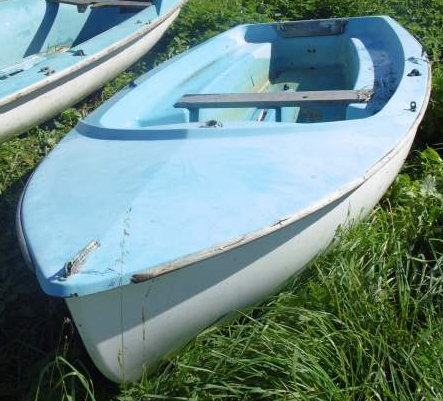
sarum-boatI had the most amazing stroke of luck today, that of finding a dinghy hull for only fifty euros – and close to my home. It and several others are being sold by an association specialising in helping young people through sports, activities and constructive work. There were some six boats in this pitiful state, left out in a field and deprived of their rigs through a fire in the club house where the masts, booms, sails, rudders, ropes, etc. were kept. Only the hulls survived because they were outside.

I went to fetch the hull this morning. The boat is a Zef dinghy, a popular make in France that democratised sailing in the same way as the Mirror did in England. Some French enthusiasts have a site on Dériveur Zef. Designed by Michel Nivelt and made of fibreglass, it has a hinged centreboard, which is much better for if I touch bottom. The centreboard hinges back instead of breaking off as can happen with a daggerboard. On Sophia, my old boat, I have had a few near misses and low-speed scrapes – but no damage. The length is twelve feet and the beam is generous at five feet, making for a very stable boat. There is lots of room for stowing gear, making this a better cruising boat than my Tabur 320. The freeboard is generous and the bow rides high in the chop. Some fifteen thousand of these boats were built from 1960 until the 1980’s. There were three versions of which mine is the most recent, numbered 17903 and built in 1976.

All I have is the hull and the centreboard. The hull is in good condition, with two professional repairs. The original rudder perished in the fire, so I will have to find a replacement. I intend to rig Sarum, as I have decided to name her, with the Mirror rig of Sophia, and I have a spare set of rigging for the old boat. I will be keeping both boats, since Sophia is much lighter and more appropriate for certain conditions. She will be kept as a light weather boat, whereas Sarum will be more seaworthy in a swell and chop and will have less sail than what she was originally designed for. It suits me, as a cruising boat needs to be capable of being safely handled in a stiff breeze and reefed as necessary.

There is plenty of work for the rest of autumn and this winter. The mast step needs to be adapted, the attaching points for the standing rigging need a good look. The transom needs rebuilding with marine plywood plate and the pintles put in the right places for the future rudder. This boat is designed to take a very small outboard engine (2hp). The Seagull is said to be very reliable even though the design is old. I don’t expect her to be a fast or sporty boat? The Zef is a plodder, a cruising boat. I intend to give Sarum a good lick of paint next spring. The obvious colour is Sarum blue (hull above the waterline, white for below the waterline the decks and inside the cockpit. I hope to find a flag of Our Lady of Salisbury Cathedral to run up to the masthead with the French flag and the Red Ensign of my own country.

I will take Sarum to the Semaine du Golfe instead of Sophia, though I might take both boats if a friend would like to come and sail with us. Sarum needs a lot of work, and I am sure she will be a proud little vessel when I bless her just before launching at the beginning of next season.

Posted in Uncategorized | Tagged , | 7 Comments

Romanticism and Modernism

Someone sent me a link to this most illuminating article.

Owen Barfield’s Critical Semantics: Diagnosing Modernity in History in English Words

I make my living by translating texts, substituting concepts in French by equivalent English ones, using the most appropriate words possible. Translating is not easy. Technical stuff needs ultra-precise translation with the right technical terms. Literary prose needs a much more supple approach, and is much more dependant on the translator being culturally “connected”. I have tried journalistic and advertising translations, and I have always done badly. I am not culturally connected with that milieu, and so I stick to technical stuff. It is safe, dull, but safe. I don’t make money out of the writing I like to do. That’s the way it is.

Words are important, but even more so are the concepts and ideas behind them. I have been speculating about the subject of Modernism, and what that word conventionally means and what it should mean. In the world of theology and churchmanship, we find a considerable amount of confusion between the various strands of late nineteenth century theology and world views and the authorities in Rome lumping them all together to create a nemesis to emphasise their orthodoxy, a heresy by the name of Modernism.

In reality, it is not possible to get any understanding of this question until one has looked at the history of philosophy and ideas since the Renaissance and the Enlightenment, not only in theology but also in culture generally. This article is a review of a book that I have not read (but it needs to be read) about what I might be tempted to call a philosophy of language. There are sciences of linguistics and philosophy of language, so I make no original claim here. It is a question of world view and mentality, the way words change their meanings. Without such notions of linguistics, philosophy of analogy and knowledge of culture, we bash each other’s brains out for the use of words – reading the same word but understanding different concepts.

We need to take a step back from the words and look at the concepts. Is Modernism a “modern” mentality based on the Enlightenment idea of progress and rationalism? Is Modernism a new form of Romanticism reacting against mechanisation, dehumanisation, excessive rationalism and the erosion of the spiritual? That is the question we have to ask when we read papal documents from the 1900’s, whose intellectual honesty is questionable. I see just about nothing in common between Loisy and Tyrrell, though they were lumped together for the sake of opposing them against official Thomist orthodoxy. In reality, Tyrrell was a (neo) Romantic and not a modernist. As an Anglican, I’m not really bothered about what Rome says to judge its critics and adversaries, but the term is used in general culture and other religious contexts. Roman Catholic polemics have spilled over the walls of the citadel. Therefore, it has to be addressed in the present polemical climate opposing conservatism and liberalism / modernism. Very often, the extremes meet and traditionalists become modernists and those who were accused of modernism are in fact traditional(ists).

The Enlightenment undoubtedly brought many positive things like scientific discovery and a greater emphasis on reason to combat prejudice and obscurantism. There was undoubtedly a lot of abuse and inhumanity on account of “irrational” beliefs, like for example attributing disease and crop failure to witchcraft and other forms of scapegoating. The Enlightenment also brought large numbers of people to live in cities and be put to work in the new factories. For the first time, men began to be alienated from his roots. The “superstitious” ways of country dwellers gave way to the arts, philosophy and culture. Science led to scepticism. Man set himself above nature, and the result now is atomic energy and fracking! We are destroying our world – and ourselves. Going by the evidence, humanity is suffering from genetic degeneration (there are different scientific and pseudo-religious theories to explain it), and our species will eventually die like each one of us suffering from old age and disease. We just have to accept this truth and put ourselves in the hands of God.

What I find interesting about this article is how a precise point is identified. It opens our eyes. We humans are separated and alienated (alien meaning other) from everything else. We place ourselves above everything and believe that everything is for our use. Of course, the idea of that is read in Genesis. This manipulation of our world places man in a position in which he does not participate. Finally, the same process happens to our culture. We no longer participate in it. We look at paintings, listen to music, visit churches – but their meaning is gone. So-called “culture” is something that is controlled and paid for by mechanised bureaucracies, and are simply there for the consumer. Being called a “consumer” is also something that gets up my nose!

Historical study in ineffective at conveying any ability to understand the ancient and medieval world view. We have to make abstraction of all the influence we have suffered from modernity, ideas of progress and evolution of man’s right to everything and sense of entitlement. Ideas of humility, regeneration and amendment are foreign to our culture. It is of no wonder that no one understands the notion of sin. Our modern assumption is that our ancestors lived in darkness, and only we have light and objectiveness. This old and hackneyed assumption continues to be rehashed by well-known atheist career writers.

Self-consciousness… seems to have first dawned faintly on Europe at about the time of the Reformation, [but] it was not until the seventeenth century that the new light really began to spread and lighten.

We have discussed the self-consciousness of our aspiration to recover the old mentality and the notion of tradition. We are self-conscious about ourselves, all adoring our reflection like Narcissus. In the medieval world view, man was devoted to the other. Modern man is concerned for himself. Hyper-rationalism, leading ultimately to modern bureaucracy, was based on a kind of utopianism. A few words to describe it:

arrange, category, classify, method, organize, organization, regular, regulate, regularity, system, systematic

There are hundreds of other words too. We immediately recognise the culture of modern corporations and the way of having people work and think. I have done many translations on project management in industry and things like quality control. Factories mass-produce components for machines, and one can only imagine the boredom of men working on the assembly line. I have done it myself and stuck it out for a couple of months before finding a more “human” job in retailing. Humans themselves become machines, that is until such a time as a machine can be invented to take their place. Quality is ensured by “mechanical” means like the FMEA method (Failure Mode Effects Analysis) which is implemented mainly in the automotive industry. One cannot imagine anything less human! The less human it is, the more the product is rational and constant in quantity and quality.

It is a world that revolts me, but I make money out of it as so many others do. As a bureaucrat shuffles paper and vacuous concepts, I am brought to do the same thing. The more voluminous, the more words I can ratchet up on my monthly invoice! The Machine came in with the Industrial Revolution, and is not merely mechanisation in industry and manufacturing but the electronic high technology we are using in our computers and smart phones. There have been protests, but everything continues to go the same way.

The life of the spirit is gone together with our humanity. It seems that we have everything to fear in the future. We read about transhumanism, the stuff of science fiction and dystopia, the idea of mixtures of machines and human beings until you get machines mimicking humans like the Terminator. Is it a good thing to think – oh well, I just have another twenty to thirty years to go, perhaps less. What about our children and grandchildren? I suppose the early twentieth-century generation thought the same thing as they lived through the Nazi era and worried about their “silent era” and “baby boom” children.

What about restoring the spiritual life of man? Most strategies of evangelisation look to me to be moulded in the same mentality that runs factories producing car parts. The modern “mega-church” is exactly that. Its goal is political and ideological, a sort of right-wing version of what Marxism is to liberation theology. Roman Catholicism has also become a machine. It opposes “the absolute value and infinite potentiality of each human soul“.

As we read the article, we come to the notion of Romanticism, which is characterised by the notion of imagination, a rediscovery of the reality of the external world and begins to grasp that world as living rather than dead, as vital and spontaneous rather than as mechanistic and determinate. Romanticism looks to the notion of transcendence and regeneration. The Romantics, as all of us, were victims of the world that formed them. They were not perfect, but were on the right way, which is why we need to select the good points and separate the wheat from the chaff. Percy Shelley, like Lord Byron, must seem to have been very selfish and morally degenerate men – but that does not invalidate their deepest intuitions.

Our communion with the world is not only Christian but also Pagan. Nature is not soulless matter, but something living and full of meaning. The Romantics explored the world, navigated, climbed mountains and soared above the mechanistic determinism society tries to impose on all. This is why Romanticism seeks to see behind the construct of mechanisation and rationalism to rediscover the wealth of the forgotten medieval world. Medievalism sought another way of living and experiencing, of participating in creation. Romanticism is an attempt to open consciousness and to evolve spiritually.

I do not expect Romanticism ever to be more than a minority leaven. Otherwise, it too would be mechanised, rationalised and given its price tag. It would, like most “diseased” Christianity, cease to have any intrinsic meaning. We need to read authors like René Guénon, Nicolas Berdyaev, T. S. Eliot and Tolkien – not to become “fans” but to understand what they were looking for. We cannot escape the Machine entirely, but there are things we can reasonably do like live in the country, in intentional communities (which are limited from the modern influence to which they have to conform to survive), spend time in nature – whether sailing, cycling, hiking, mountaineering, etc. We necessarily become marginal and self-conscious, another part of the modern curse.

I think these considerations will clarify our use of the word modern and modernist. If it means the process of dehumanisation and rationalism I have described, there is not way it can be compatible with any kind of spiritual life, whether monotheistic or pagan. If it means an attempt to reinvigorate our parched desert of modernity with spirituality presented in a way that we can assimilate and accept it, that is another matter.

Posted in Uncategorized | Tagged , , , , , | 4 Comments

Sarum Chant

This recording has been around for a number of years and is now on Youtube. With a Canterbury cap tip to Rad Trad, I reproduce this link. See Sarum Christmas Mass.

I made the observation over there:

I was in charge of music at Gricigliano from late 1990 to summer 1992. I tried to bring in a more robust style of singing like in English choral music. Fr Mora, the seminary rector, wanted the “old” Solesmes style and replaced me when I got sent for my pastoral stint in France. The Ensemble Organum and Marcel Pérès have done some interesting recordings of medieval chant using the influence of Corsican harmonised chant for faux-bourdon.

That being said, I find unaccompanied Gregorian chant rather dry and arid. I always accompanied the chant at seminary using a soft 8ft stop and simple harmony, and it added something to the dry cake. The relationship between Gregorian chant and polyphony has always been tumultuous, as the Council of Trent came within an inch of abolishing all music other than plain chant. Most of my readers will know about Palestrina, Pope Marcel II and the Missa Papa Marcelli – and the saving of Renaissance choral music.

Also, I find plain chant outside a liturgical context deadly boring. There aren’t the sounds you hear – bells, the thurible, noises from the congregation. Above all, with a recording, one isn’t there to see the ceremonies. It is a document that helps to preserve a patrimony that seems to interest many, but motivate few to do it.

With the resources we usually have in churches, Gregorian chant and Anglican hymns is about all we can do, preferably with organ accompaniment. We need to form quartets and double quartets of competent singers, and wonders can be done with less cost than full choirs. Preferably, the only female singers would be the sopranos, and many women these days learn to sing with a pure non-vibrato voice.

Autumn is here and the nights draw in. I go out in the boat less frequently as the weather begins to close in for the winter – time to do some more compositions. My own quartet will be performing (in a secular concert) two of my works in December, a setting of In pace in idipsum and a verse from John Keats, What but thee, Sleep. I should do a Mass and a lovely Sarum text to Our Lady which is not found in the Roman rite:

Felix namque es, sacra virgo Maria, et omni laude dignissima : quia ex te ortus est sol justitiae Christus Deus noster, alleluya.

Posted in Uncategorized | Tagged , | 10 Comments

Le Cri de Coeur

My blog is constantly accessed from Liturgiae Causa, and I have read the two most recent postings. I met Patricius last spring in London, a young man of good urban appearance and intelligence. Not being a medical professional, I wouldn’t venture an opinion on the causes of such a conflicted soul. At a human level, it may be lack of maturity or an inner conflict that reveals serious spiritual difficulties.

The episode on the bus in the suburban London sprawl was quite amusing, and Patrick has a gift with writing and a sense of satire. He then wrote Are you happy? as a result of an interview with his boss at the bank where he works. Frankly, I cannot imagine anyone less suited to working in such a corporate structure as a major bank than Patrick – other than myself! Me, I prefer my long hair, hoodie and bermuda shorts with lots of pockets, my cassock when I’m on duty as a priest… All the same, the comments of his superiors are germane. If you’re happy working with us, stay. If not, go and find another job. That seems to make sense. When you go to a ball, the thing to do is dance – Quand on est au bal, il faut danser.

Then he wrote In answer…  It might seem disturbing, but he writes about it and expresses himself in this cri de coeur. I am amazed about his objectivity and lucidity, but yet his lack of resolve to make his way in life in some unconventional way. Wrong line of work for someone who so violently opposes corporate conformity, the only world-view possible for working in a large retail company or an international bank (my own current and business accounts are with them). I feel just the same about corporations, but I keep away from them. We don’t have to like “power” suits and short cropped hair! We don’t have to live or work in a city. There are other ways to live. All that we do has its consequences.

It isn’t my responsibility to analyse anyone. I don’t have the qualifications and it isn’t my business. At his age, I too went through conflicts as I went to the wrong seminaries and pursued the wrong illusory vocation. My own present is the consequence of my errors of youth. It is simply the law of karma – the state of man awaiting the freedom that the grace of the Redemption confers.

It is tempting to blame everyone other than oneself. Patrick reminds me very much of Sebastian Flyte in Brideshead Revisited, someone torturing himself from the inside out, Sebastian contra mundum. His greatest friend, Charles Ryder, could not continue with the way things went, and had to leave this piece of suffering humanity in his elected domicile in northern Africa. Charles himself had to face the consequences of his own broken vocation as an artist and husband, to find himself in the Army at the beginning of a grotty war at a grotty time of history. We all carry our own crosses, but different ones – with more or less dignity and stoicism. Sebastian’s future was so beautifully described by his younger sister Cordelia. You can see the videos in Libenter suffertis insipientens : cum sitis ipsi sapientes. Sebastian is a man totally devoid of will power, stripped of all dignity and who paradoxically finds holiness as a fool for Christ.

Hatred is my chief problem; absolute hatred. Ever have I had the uttermost scorn for authority, especially that wielded by the young, and scarce can I conceal it.

Perhaps it is by reading the cantankerous Evelyn Waugh that we begin to understand the Augustinian pessimism about human nature (which is not entirely mistaken). Hatred was an emotion keenly felt by Oscar Wilde as his purged his term in prison –

You may realise it when I say that had I been released last May, as I tried to be, I would have left this place loathing it and every official in it with a bitterness of hatred that would have poisoned my life. I have had a year longer of imprisonment, but humanity has been in the prison along with us all, and now when I go out I shall always remember great kindnesses that I have received here from almost everybody, and on the day of my release I shall give many thanks to many people, and ask to be remembered by them in turn.

I never tire of reading De Profundis, as I understand it anew each time. Unlike Dorian Gray, I grow older and my understanding matures at the same time. At the same time, I cannot bring myself to take the role of a raging Hitler is some re-enactment of Götterdämmerung wowing to kill everyone he deemed to be unworthy of life. At least he had the grace to take a cyanide pill and blow his brains out, and thus made the rest of the world a more pleasant place for the rest of us. Patrick has never been “in power” and has never been responsible for anyone’s death. But, the feeling can be equivalent to the act as Christ teaches when he condemns anger as being just as bad as actually killing someone. We all have to master our tempers.

I recognise the Wilde and Waugh in his writings, and these two authors will be remembered long after the rest of us are forgotten.

Suicide? I don’t think he would ever do it. It is perhaps a question that many of us would ask, but the act of killing ourselves is anathema. It opposes our most fundamental instinct of self-preservation. It would lead to a most uncertain afterlife to put it mildly. We will be gone quickly enough, but Patrick is still at an age when time seems to go slowly. Perhaps he could go to Africa, look after the sick and catch Ebola – at least that would be a death for a purpose! Not that I would wish that on anyone, and certainly not on myself. We are called to live and accept the challenge which is harder than copping out…

Like all of us, he has the solution to his predicament in his own hands. He needs to discover a sense of vocation (not necessarily religious) and put his will and heart into it. Many of us “miss the bus” when we are young and it is harder later in life. I read his gifts as a writer, yet he has written no books. I have encouraged him to consider journalism, but I fear that most modern news agencies would be too corporate. Theatrical and drama training would be another possibility. Those places are hard to get into, but he is still young enough.

Some of you may wonder why I give publicity to this person, who writes to the world on his blog. We all need to develop our empathy and care for those who suffer in body and mind. Prayer is everything, and compassion – not the nihilist pressing the button to nuke the world – makes us human.

Posted in Uncategorized | Tagged , | 9 Comments

Anglican Missals

corpuschristiI was answering a comment today about the so-called Cowley missal and what I thought of it. Its design seems to form a compromise between the various national Prayer Books, the Roman missal of the early twentieth century and Sarum. I have a copy of this missal, which I bought at Thornton’s in London more than twenty years ago, and is unfortunately heavily mutilated with crossings-out and sheets of paper glued in (with glue that won’t come undone with steam). Fr Hunwicke has written most stimulatingly about the Cowley missal and about Anglican liturgical patrimony in general in Four Liturgical Forms. Unlike he, I was never a clerk in Holy Orders in the Church of England.

I did a Google search and found this fascinating article on Anglican missals in the plural, including the 1921 Anglican Missal properly speaking, but also the English missal, Dearmer’s Altar Book and various editions of the Sarum Missal in Latin and English. The article is Collecting Anglican Missals. Many of us enjoy collecting things. If I had enough space at home, I would love to collect three or four sailing dinghies. A neighbour in my village has a collection of some twenty farm tractors, which he restores and gets into working order. My brother has always been a collector – stamps, fossils, all sorts, and now he has a small collection of vintage cars. I have quite a few books, and I have at least referred to most of those I have not read entirely. My late mother collected Goss china and kept the pieces in a glass case in the hall of our home. I have quite a few missals and breviaries in my library. I had to spend quite a lot of money on my Warren and Dickinson Sarum missals after having found that the Pearson version is a disappointing and cheap paperback that wouldn’t last two weeks in liturgical use.

It is encouraging to see information on the various editions of the Sarum missal that were produced from the late nineteenth century to the period of the twentieth before the Great War. It showed not only an interest in studying England’s pre-Reformation liturgical patrimony (there were other uses too like Hereford and York), but in actually celebrating Mass following them if the priest in question could get away with it. Priests could go to prison for Ritualism and using unauthorised rites in those days! Sarum was the last local use to remain under the reign of Henry VIII when the other Uses were abolished.

A few old Sarum missals can still be seen in libraries, and I remember once seeing one at the SPCK bookshop in Marylebone Road in the early 1980’s. It was going for a couple of hundred quid. Nowadays, I would make sacrifices for such an opportunity, but then, the price was prohibitive. I have a Roman missal from 1640, which was given to me and which had been in Recusant hands in the seventeenth century. Who knows who would have bought the Sarum missal with the money I didn’t have?

I don’t need to give any introduction to the Sarum Missal here. You can always find what I have already written here. Many fine distinctions need to be made when comparing rites. It is not merely a variation of the Roman rite, but draws upon sources that are quite different from the Use of the Roman Curia that became the official codified standard Roman Missal of 1570 with its editions and revisions up to 1965. Sarum draws on French sources, notably the uses of Rouen and Bayeux and has many similarities with the Dominican and Parisian rites in more recent use. There are not only differences in the order of Mass but also in the Proper. The system of Scripture readings is quite different, and the Book of Common Prayer resumed much of the Sarum schema for the Sundays and major feasts.

Fortunately, for those who don’t have the money for antiquarian books, there are more recent and accessible editions. Also it is not easy to read sixteenth-century printing with its symbols now known only to experts in palaeography. Hand-copying and printing, still in its infancy, were incredibly laborious and expensive endeavours. Paper had to be economised and the missal would be full of shorthand and cross references. Such a book would be very difficult to use. That was until Rev. G.H. Forbes/Dickinson came along in 1861 and published the Missale ad Usum Insignis Ecclesiae Sarum generally known as the “Burntisland Missal”. It was based on the printed edition of 1526 and filled with footnotes referring to other available specimens. It comes half-way between an academic book and something that can be used at the altar. I have done so myself from late 2009. The cross-references are clear and the spelling is that of modern Roman Latin usage. It is a bit annoying to read a sequence filled with little letters referring to sources and other versions. Attempts have been made to produce more practical editions, but none has been published in hardback. Before buying my Gregg reprint at the best part of a hundred quid, I had home-printed booklets from a version available on the internet in “dirty” facsimile pdf format. I could easily celebrate Mass using the temporal proper, the sanctoral and the common of saints – and of course the Ordo Missae done on MS Publisher. The Ordo Missae in the Dickinson edition is a tangled mass of rubrics and text. I simply use my edition of the Ordo Missae and the Dickinson missal for the propers, a little like the way a bishop celebrates the Roman rite with a missal and pontifical canon. When you get to the preface, you close the missal and lay it down on the altar and use the booklet, and then open the Missal again for the Communion and Postcommunion.

Dickinson’s edition was translated into English by A. Harford Pearson in 1868, under the title of The Sarum Missal in English. Apart from the unusable modern reprint book, I detest the over-use use of capital initial letters for every pronoun referring to God. It is most unlike the sober style of the Prayer Book, where only proper names are capitalised. A habit I have acquired from French is to be sparing with the use of capital initial letters. However, it is good to have this book for reference.

We then have the Canon Warren edition from 1911. I find the translation much better, more finely polished “Prayer Book” and without all those ghastly capital letters. Unlike Dickinson in Latin, neither of the English versions have a lectionary, so either you have to use a Bible, or I have done a lectionary which you can have for free. With Warren and this lectionary, you can quite easily celebrate a Sarum Mass. Of course, for High Mass, you need the chant in a version adapted for English. I think the nuns of Wantage did a gradual, but there may be tweaks from the “pure” Sarum use. Apparently, the Warren missal has been reprinted and is available, but I haven’t seen hide nor hair of it.There are various mix-and-match versions around like the one that was done into English and Abridged. I don’t bother with them. I found an ordo missae from this version in the 1980’s and I still have it. The Canon is modified and has most of the saints of the diptychs chopped out. What a waste of a book!

The distinguished liturgical scholar J.W. Wickham Legg did an academic and critical edition in 1916, but it has never pretended to be usable at the altar. It represents earlier usage than the 1526 edition which was the source of Dickinson’s work. It is hard to find, but I have photocopies of the ordo missae.

If you are patient, and ready to spend more than you would usually do for second-hand books, you can find these books. It is even easier with the Internet and online ordering. It’s like finding classic movies on Youtube! Keep persevering…

Something not mentioned in this article: the gradual from the temporal cycle done by Nick Sandon. I snapped up those volumes when they were in print. Last but not least, there is the phenomenal work of Dr William Renwick. He has been working on Latin and English versions of the Sarum Breviary for years, a true travail de Bénédictin, a true labour of a monk. His work on the Missal to complete Sandon’s work is still in the project phase. Dr Renwick’s site includes a calendar for each year following the Gregorian calendar. There was an Orthodox priest who did a Sarum ordo following the Julian calendar (as was the usage in anti-papal England until 1752).

This is probably the best one-stop place to find Sarum liturgical material – Internet Archive Search: Sarum. You also need the Pie (Pica) which gives ceremonial information.

Sarum is remarkably well-organised, but differently from Burchard and the men who organised the Roman missal of Pius V (1570). It can be “got used to”.

I am concerned with the Use of Sarum, and this is what interested me in this article about someone’s collection of books. There are Sarum-inspired books that incorporate the Prayer Book rite. Dearmer was a strict conservative and insisted on conforming to the 1662 Prayer Book, as was his obligation as a cleric in the Church of England. So his work was something of the Anglican equivalent of the “Tridentine” Novus Ordo at the London Oratory! What goes around comes around. I too have a copy of the Altar Book. Nevertheless, I have always admired Dearmer’s work of research in medieval liturgical tradition. Many books were published in those days to guide priests who wished to “sarumise” the official rites of the Church of England and who were Ritualists. The Anglican liturgical movement is unique, and many of the results have brought confusion and disarray, but the will and intellect behind it were admirable and a true inspiration.

Much of that work from the 1860’s up to around 1914 tends to be the butt of despising jokes by churchmen who feel they know better, but have done little more than jump onto a bandwagon of ideology and ignorance. I have a great debt of gratitude to those men who dreamed and studied, and make it possible for me to celebrate a reasonably authentic Sarum liturgy in 2014. Between the English Use men and those who favoured contemporary Roman Catholic usage, they created the basis for our usages in the Continuing Anglican Churches, including those parishes using the Prayer Book.

It is more than academic study and antiquarianism. It is our quest for our spiritual roots and identity, and though those our living Christian existence. That’s what they felt then as the way I feel today.

Posted in Uncategorized | Tagged , , , | 7 Comments

Theologically Modernist, Liturgically Traditionalist

The blog by this name, until now a newly-opened blog with no articles, is now in business. The sub-title I know nothing. There is nothing that I know. But the heart senses certain things might seem an anti-intellectual point of view, but joins the Romantic message I have conveyed in some of my articles as well as the Franciscan tendency in the middle ages to give primacy of the heart over the faculty of reason. We also see a reflection of the via negativa in eastern Christian theology and spirituality.

I thank Xryztofer for his article Liturgical Sun-Tzu, in which he refers to a previous article of mine. His main question is what to do in the present situation of the Roman Catholic Church. The situation is unenviable, but it seems rather simple:

  • Go along with everything as it is,
  • Join a traditionalist group,
  • Get out and join another Church,
  • Give up religion.

There’s not a lot else I can say. The choice is limited if you are bound by the “true church” stuff, which obviously does not concern me. I was only an unwelcome guest in their Church for about fifteen years. I find the subject tedious and tiring.

Xryztofer has been to visit an Anglo-Catholic parish (A visit to the Anglo-Catholics). I looked at the church website, and found a church building in somewhat garish taste. I would encourage him to continue his exploration outside the ECUSA institution and look around some of the continuing Churches. Here are the official sites of most of the major jurisdictions with links to their parishes in the USA and elsewhere:

It is entirely up to him. We Continuing Anglicans have other problems of our own, and we are all human. At least we have no major issues causing problems of conscience. We are there but exert no pressure on anyone to join us.

I was quite amazed at the time when the Ordinariates were emerging that those involved felt that some new liturgy had to be invented. In the end, it was an improved version of the Book of Divine Worship with some bit and pieces of the old Roman rite via the Anglican Missal being reinstated. Some suggested Sarum, and I wrote some articles in the now-defunct blog The Anglo-Catholic when the question was being discussed:

It was not to be, but I made the point that there was no need to invent something new. The Use of Sarum has already been translated into Cranmer style English and can be used as it is. If anything, it is simpler and more sober than the Tridentine Roman rite and no more complicated than the Dominican rite. But, it is taboo and “smacks” of archaeologism and irrelevance. So be it. I do it with the blessing of my Bishop and I really don’t care if no one else is interested.

I used to get very demoralised about all this stuff, but I have developed a thick skin. I beat my own drum on this blog, and it does good for some but not for others. You can’t please everybody. The Orthodox have their own problems with their reading of history and anachronisms. That’s their problem. We all have our own problems. I only conclude that most religion in the world is a front for a sick and deluded mind, of disordered personalities and various forms of evil. It is for each of us to distinguish between the gold and the dross, the baby and the bathwater, the spiritual and the narcissistic cult of power and domination. I do think the world would be much worse without faith and spirituality.

I think that the disarray of all church institutions makes us all ask questions and seek the essential, the very things that no one can take away from us. We see the parallels between our own time, that of Tyrrell and that of William Blake. Perhaps Modernist is not a very good term to use. I prefer Romantic.

Posted in Uncategorized | Tagged , , , , , , | 37 Comments

Dieppe and Varengeville

The cliff of Varengeville forms a point on the Côte d’Albâtre between Quiberville and Dieppe. Varengeville-sur-Mer is one of those coastal villages that developed in the late nineteenth and early twentieth centuries as well-to-do families would have their houses built to face the sea. Some of those properties reflect not only the wealth of their owners but a spirit of beauty and adventure. One such house is the Arts & Crafts manor designed by Edward Lutyns, the Bois des Moutiers which has one of the loveliest English gardens I have ever known. I invite you to see the video on this site that shows Varengeville, the house and the garden. The explanations are in French.

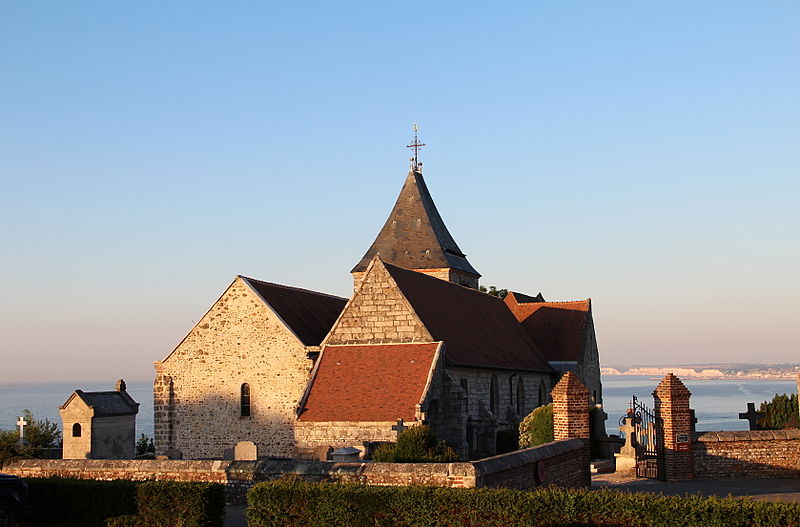
Another aspect of this lovely village is the church perched atop the cliffs, its cemetery filled with graves of celebrities who had spent their twilight years in Varengeville.

varengeville-egliseThis church is built in the austere Romanesque style, to which a gothic aisle was added.

dieppe-varengevilleTo see Varengeville from the sea, there are two beaches to launch a boat, Pourville at the centre of this satellite photo to the west of the port of Dieppe or from Quiberville or Saint-Marguerite-sur-Mer to the west of the Varengeville headland. Yesterday, on account of the rising tide, I launched from Pourville and sailed to the west upwind. The conditions were gentle and the wind was a south-westerly veering to the west.

20141001dieppe01This is the beach of Pourville at low tide looking towards the cliffs of Varengeville. The colour is not the usual chalk and flint, but some brownish stone, possibly coloured by the erosion of the soil. Atop the cliffs, one can see one of those fine country houses and its garden extending to the cliff edge. We will see more of this cliff as I launch the boat and begin sailing westwards.

20141001dieppe02Here I leave Pourville behind and get out of the shallow water.

20141001dieppe03Looking eastwards, Dieppe is obscured by the haze, but the starboard seawall of the port can be seen quite clearly.

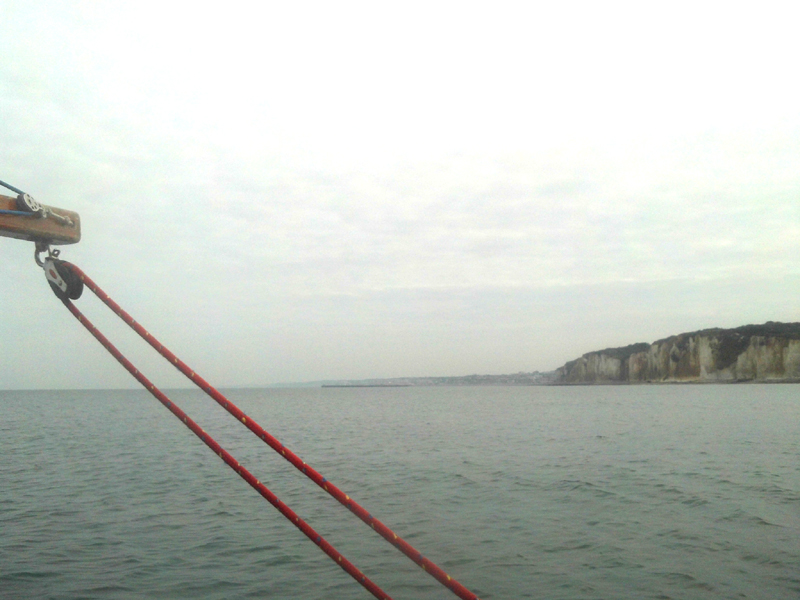
20141001dieppe04Looking at Varengeville, I am too far away for the camera to get much in the way of detail.

20141001dieppe05As I lashed the helm and carefully set the sails, I turned more to the west. We can see past the headland of Varengeville to Quiverville, Saint-Aubin and the headland that hides Veules-les-Roses. The coast leading to Saint-Valéry-en Caux is in the extreme background.

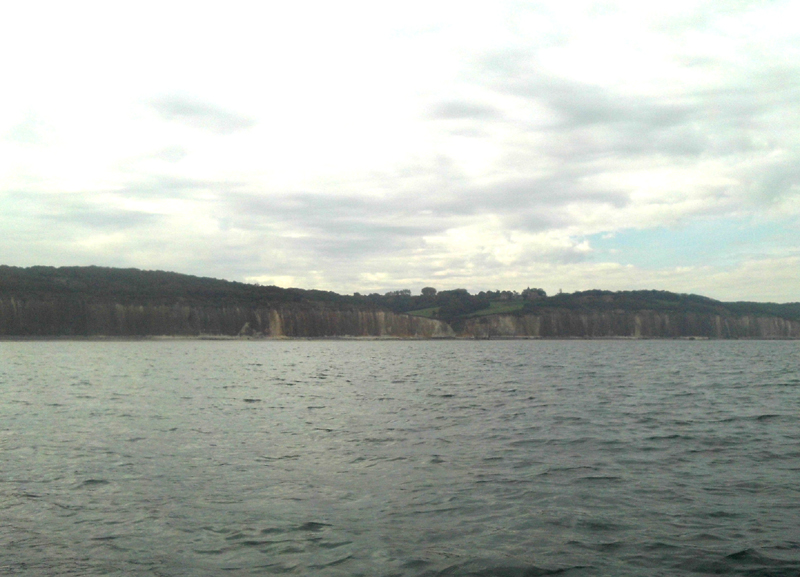
20141001dieppe06Here is another one of the same coast as I was almost opposite the Varengeville headland. To most people, I imagine these photos all look alike.Someone who is used to coastal navigation observes everything from church spires, water towers, lighthouses and particular shapes of cliffs.

20141001dieppe07Time was getting on and the tide was in full current, and there was only a light wind. I turned back off the Varengeville headland and took this one from my starboard beam. The tower of Varengeville church can be clearly seen on the cliff top. Churches still guide ships and boats even if they find it that much more difficult to guide souls to God!

20141001dieppe08Here is Pourville again as I approach it in a run and then a full reach as the wind turned to the north-west.

20141001dieppe09One last look at the Varengeville cliff. There’s a couple those tight coves that allow access to the sea. I don’t know if you can get a boat down there. I would be surprised in spite of the presence of a dilapidated launching slipway. They must have been great for smugglers in the old days!

20141001dieppe10Here is a clearer shot of Dieppe as the weather improved a little. Most of these towns and villages suffered during World War II, less so in 1944 as the D-Day landing was more to the south. There were many heroic attempts to get Allied servicemen out of France in 1940 and in some places as late as 1942. The Dieppe Raid in August 1942 was a largely failed attempt to seize and hold a major port in occupied territory and get intelligence. Most of the servicemen were Canadian and many died or were taken prisoners. There is a memorial to them in Pourville.

I have explored most of this coast from Dieppe to Fécamp to the west and have crossed the Seine Estuary. Further to the north, there is the Baie de Somme which is wonderful for its natural wildlife (I must not forget my binoculars!). The tidal currents are complex and treacherous, so I will need to do a lot of research and planning. Perhaps for next year… There are also the organised events of the Semaine du Golfe and my second time at the Route du Sable. There are many more trips in perspective for my little ten-footer…

Posted in Uncategorized | Tagged , | Leave a comment

Knuckle up or else!

I have the impression of such a challenge in Odd One Out which comments on articles to which I have added thoughts in this blog.

Should we just put aside all we love, snap into lockstep, “convert to the true church” and grin and bear it. Surely if we don’t, we are insincere about our profession of the truth. Yes, if the Church has to be be the spiritual equivalent of the Waffen SS or the KGB. If that is to be so, then, truly, love has no place in this world and I would want nothing to do with it.

Perhaps a bigger challenge would be, however much we are concerned for faith and living some kind of relationship with God, relating to the world. Do we do anything other than engage in obsessive-compulsive behaviour, feeding our addictions? That can cut both ways. Perhaps “wreckovation” and the new liturgies bring pleasure and joy to some people, but they alienate others. The Church cannot be pensée unique or totalitarian, especially when it professes to uphold the freedom of conscience in step with most national constitutions in Europe and America.

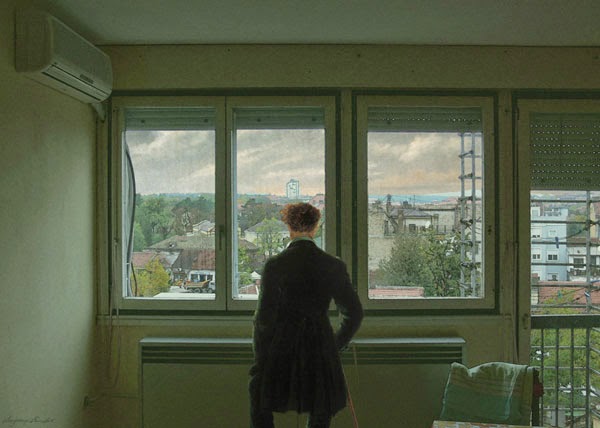
At the same time, any practical effort to continue with old liturgies meets with unresolvable dilemmas and lack of interest. The article ends with a picture of a man in a nineteenth-century frock coat looking out of the window of a modern apartment.

Is that the condition I live in as I celebrate Sarum masses? I have often given thought to this question, being a member of an institutional church (the TAC and now the ACC) as a priest. Is it possible to be a priest alone for the simple reason that I’m in the wrong place to interest anyone in my “boutique”? If so, would it be better to use 1962, an older version of the Roman rite, the English Missal, the Novus Ordo, the 1928 or 1549 Prayer Book? Does it make any difference? Would it be better to shut the whole damned thing down, turn the chapel into a workshop or a music room cum library? What good would that do? Usually, when one makes a decision, one has to think whether positive good would come out of it. I honestly don’t think I am the wistful gentlemen in his flat. In my everyday life, I am very modern with casual clothes and long hair. Nearly all the people I know are agnostics and atheists, at least people to whom religious culture is as foreign as Zen Buddhism or Hinduism to us.

The two extremes seem to converge in the nagging thought “You know in your heart of hearts that it’s all bosh!” What I believe in in not bosh, but what most church people dress it up in is bosh. It is all very alienating. The one thought that keeps body and soul together is not making any change unless a positive good would come out of it. Otherwise, it’s Keep calm and carry on

Posted in Uncategorized | Tagged | Leave a comment