Sailing without Snottiness

20141031sail_02Something that always amazes me in life is the sheer amount of money people need, or think they need. The maximum becomes the minimum. A big and powerful car becomes a status symbol. We have lost our love of simplicity and simple things.

I have shared a few reflections about my way of thinking about sailing, the aquatic equivalent of back packing and giving the modern world a kick in the face for a few days. Sailing used to be the sport of kings or the occupation of humble fishermen in our coastal ports. Something happened in the 1950’s and 60’s: fishing was increasingly done from large vessels that only an established business could afford, and pleasure boating was increasingly geared to competition and racing. Finally, the yacht became as much of a status symbol as a Mercedes or BMW on the road.

I have discovered a whole new world through trial and error, and then through such great associations as the Dinghy Cruising Association and the Fédération Voile-Aviron in France. I have been on a few adventures and participated in the Route du Sable. One comes to meet wonderful people who bring their boats and show how simple and happy humanity can become. Dinghy cruising restores our faith in humanity and the noblest aspect of our soul. Our little boats can be hauled onto a trailer by hand and transported anywhere we like. There are no mooring charges in an expensive marina berth. There’s no risk of getting the compass or pulleys stolen, because we keep the boat in our back yard. You just hitch up, find the place that takes our fancy, set the GPS or have a map on the passenger seat – and drive there.

Dinghy cruisers are thought of as crazy folk in some way, sleeping in inhuman conditions rather than in a comfortable cabin or a hotel on land when we’re away from home. Throw a tarpaulin over the boom, secure the sides with a bit of elastic around the gunwale, set up the bed over the lazarette and the thwart – and Bob’s your uncle. We live the dreams we had as little boys, certainly as I had each time I saw a red or white sail on Windermere as I passed on the bus each day to return home from school. I am now committed to going to the Semaine du Golfe next year and setting up the boat for sleeping aboard. As when I bivouac in my van on certain occasions when I’m alone, this kind of boating is spartan and a world apart from the glamorous world of what someone once called “floating gin palaces” when referring to modern luxury yachts! I go to London, and I don’t pay £100 a night for “cheap” hotel accommodation. I’m proud of it!

I am slow on the uptake with technology. I was about 35 before I used a computer for the first time. I use a sighting compass, chart and portland plotter for my navigation together with a book of tides and currents. That is when I want to be scientific. If I’m not too far from land and visibility is good, I can do it all by eye and “feel” the vast space and changes of visual perspective. Messing about in a ten or twelve foot boat goes entirely against the grain, in a world where you need to have big money and “status” for everything. Dinghy cruising can be compared with people who go fell walking with just what they can carry on their backs, where it would be more comfortable in a 4×4 vehicle.

The sea is the last place of freedom on this earth, at least for the time being. We experience the sea the most directly in our small open boats. Dinghy cruising is like bivouacking or “wild” camping, unlike the spirit of caravanning, camping in an official camp site – or even worse, being on an organised holiday in a coach sleeping in motels and doing what you’re told from beginning to end. It all seems to depend what kind of person we are. As a priest, I am a kind of “modern Goliard”! At the same time, we dinghy cruisers are an “elite” – not because we have a lot of money, but because we have certain skills and a spirit of individuality and independence. Many of us have had to teach ourselves, with the basis a sailing school gave us in racing round the cans in boats that capsize when you sneeze!

It is another kind of cloister for the contemplative. One might think of taking a Mass kit if the hosts can be kept dry. Nothing is worse than soggy hosts. Alternatively, one can forego Mass, which is not a bad thing sometimes – and be more attentive with the Office. Books can be kept in the dry bag or other sealed containers. It is salutary to think of things in such terms, since nothing is ever taken for granted. Even the clothes on our backs and bedding have to be kept in dry bags. Washing and hygiene become a challenge, but nothing is impossible. Obviously, it will be possible to live like this only for a few days – and in the more clement seasons. These are times of retreat and recreation in contrast with our lives the rest of the year when the boat is laid up and we are back to the old leviathan of the modern world.

* * *

I was very reassured today about the legal status of boats in France. As far as I have heard, a boat needs registration papers like a car, except for very small vessels called engins de plage, beach devices. An example of such a vessel would be a boat of under 2.5 metres propelled by rowing or foot-powered paddles. This category is limited to 300 metres from the beach. It is widely believed that any boat without papers is reduced to the status of an engin de plage.

Now, when someone tries to register a boat, often bought second-hand and without papers (because they were at some stage lost), the Affaires Maritimes requires not only the receipt of sale from the one who sold him the boat, but also the complete technical documentation from the manufacturer. In short, the boat has to be registered to be registered, a kind of circular no-win situation. It is the same for caravans over a very low weight limit that are sold and bought second-hand. Typically, France is a country where “everything is forbidden but everything is tolerated”. Southern European countries are even worse, and bureaucracies in some instances have been known to be corrupt.

Someone with whom I am acquainted knows a lot about the law in these matters, and admits having sailed a dinghy for many years without registration papers. The only time he was stopped for a check was to make sure he was wearing a life jacket, which he was. He was unable to find any sanction provided for in French law for a boat without registration. All the registration card does is attest who owns the boat.

More significantly, this person affirms that a boat without papers does not become an engin de plage assimilated to a child’s toy rubber dinghy with paddles. Dinghies are limited to 2 nautical miles from a place a shelter (beach, port, cove, anything) and are bound to be carrying a certain amount of safety equipment (life jacket, anchor, oars or paddles, VHF, flares, etc.). Yachts may go up to 6 nautical miles with the regulation safety equipment, and further if they have an inflatable raft.

Thus the law is very untidy about this point and needs to be amended like for second-hand but otherwise roadworthy caravans and other trailers over 500 kg. In the meantime, the vast majority of small open boats have no papers and are technically irregular. At the same time, the Affaires Maritimes and Gendarmerie with sea patrolling duties only trouble boats that are manifestly unsafe or sailing in forbidden waters (for example within the security perimeter of a nuclear power station). I once got a warning for this reason, but was not asked for boat’s papers or why I quite a long way out to sea.

I will not be losing sleep at night over this…

Posted in Uncategorized | Tagged , | 2 Comments

Swallows and Amazons

swallows-amazonsI have already written about my favourite hobby dinghy cruising. I suppose I become wistful about it at this time of the year when possibilities of taking the boat out become increasingly rare due to cold and bad weather. December and January do occasionally give nice little weather windows, and an opportunity is not to be missed even if it means more clothing and waterproofs.

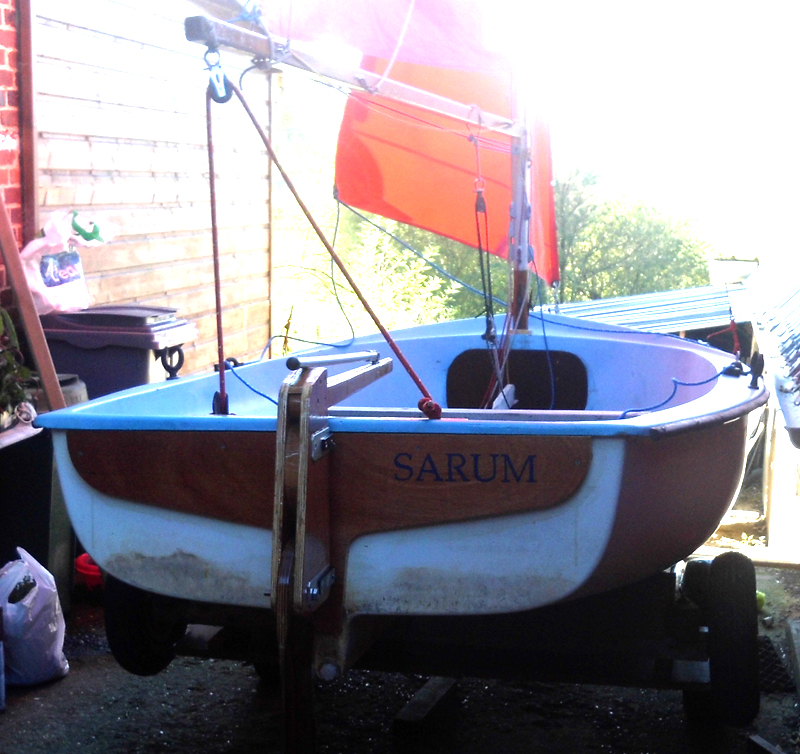
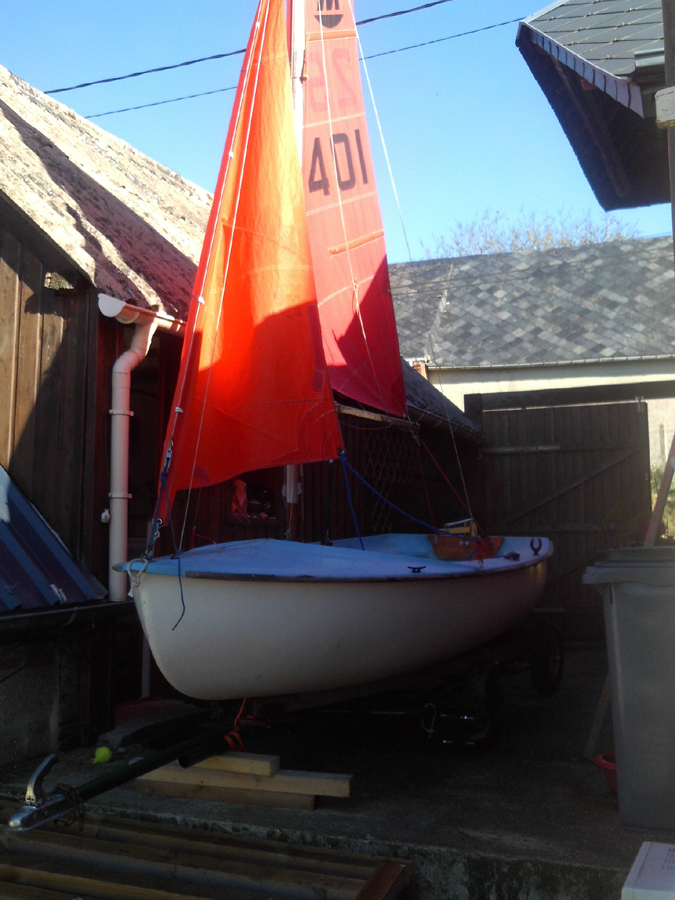
Since last year, I have acquired the twelve-foot Zef hull and rigged it with my Mirror rig, and took it out for a sail as I described in Sarum’s Sea Trials. Sarum is now blessed and registered for next year’s Semaine du Golfe, the great gathering in southern Brittany where there will be more than a thousand boats from the size of mine to three-masted tall ships.

The trailer I bought last year is now improved and I have discontinued the use a separate launching trolley. My next project is to create the possibility of going for a cruise of several days and sleeping on board. This is done by setting up a tent over the boom and some boards to make a bed (pneumatic mattress and what one would use in a tent).

This is what we will be doing in Brittany next year. The alternative is being vehicle and campsite based and keeping a close eye on the time to avoiding missing the bus provided by the event’s organisers. I was reassured a few days ago by the veteran dinghy cruiser Roger Barnes that all the ports where we stop over for the night will be serviced by fresh water taps, catering (for a reasonable price or even free) – so that we don’t have to carry too much food.

You sit there sipping your coffee and munching your croissant, watching the other harassed crews arriving in buses from their distant campsites.

Some of the ports have showers, and make it possible for us to be more civilised. Our boats will have to be very well prepared for all likely weather conditions in May, including reefing, anchors, fenders and warps and enough in the way of tools and spares to do at least temporary repairs to what is most likely to go wrong. I am looking at different ideas for arranging the tent and the bed.

I remember that when I was learning to sail, it was all about high-tech boats and racing. The training was good, and prepared me for harsh conditions and performing at the limit of our physical fitness, which in my case… (!). I became confident at handling a small boat in reasonable conditions.

As I mentioned in my last posting, dinghy cruising has quietly taken off. I have never owned a yacht, but I discovered that yacht sailing is expensive as are the docking and club facilities, and the boat is limited to a small area of sailing (unless you have several days or weeks to go further afield). A dinghy can be towed on a trailer anywhere and sailed very close to land in shallow waters, easily beached and free of structures. That is something that is very appealing. It is true that I would love to do an epic voyage like crossing the Atlantic in a forty-foot yacht. But, at what price? The dinghy is affordable and does a lot within its limits.

Some have made epic voyages in dinghies, and men have been known to cross entire seas in bad weather in a small open boat. They also risked their lives! When Captain Bligh lost the Bounty to the famous mutiny, he sailed more than two thousand miles in the ship’s longboat to safety and a passage back to England. Every sport has its extreme versions. Most of us are a little bit more reasonable, preferring a gentle sail for a few hours in a familiar bit of sea, along the coast and never far from safety. In between, we have cruises of three or four days, alone or in the company of other sailors and their boats. There are so many possibilities: islands, along coasts, up estuaries and rivers, long canal trips inland. There are also lakes like Geneva, Annecy, the Great Lakes in the USA and Canada. Canada must be wonderful for inland sailing. Near my home, there is the Baie de Somme, which has a very complex tidal system. It is something I should try, but after getting advice to avoid being dried out miles from the sea because the tide has gone out! One is close to nature, non-polluting and non-consuming (except for the occasional use of an engine when sailing is impossible).

The Semaine du Golfe has a distinctive “democratic” spirit by showing sailing as something within the reach of ordinary people, away from the stuffy spirit of British yacht clubs. We don’t need to have expensive shiny new boats, but what we can find in the classified ads going for a song, an old hull to do up in one’s spare time and a rig that will go with it. With the adult version of Swallows and Amazons, many of us are eager to go beyond day sailing or the potter around the bay for a couple of hours. There comes a day when we feel urged to sail to a distant island and give ourselves a challenge. A dinghy can be kitted out for camping on-board no less comfortably than the little tents of hikers in the mountains. The boat can be beached and anchored or left afloat in a really safe and secluded bay.

We dinghy cruisers tend to be independent like the old sea dogs who circumnavigate alone in the yachts on which they live. At the same time, it is good to follow the progress of clubs and associations that organise rallies, as others do for vintage car and motorcycle rallies. France is more advanced with the Semaine du Golfe and the Route du Sable in which I participated last year. One can meet a different kind of humanity than in our cities! It is as much a human experience as improving our seamanship. I would love to see sailing schools diversify into dinghy cruising and “adventure sailing”, especially for youngsters. It would be a wonderful discipline to add to Scouting programmes and school sports. Precisely, it is something that brings health of mind and body without the spirit of competition and aggression found in many sports.

If any of my readers are thinking of taking up sailing, they would do well to get The Dinghy Cruising Companion by Roger Barnes and enjoy the refreshing change from expensive boats and stuffy commodores…

Posted in Uncategorized | Tagged , | 4 Comments

Ite Missa Est

In the Roman rite and most related local uses, there are three forms of dismissal to be sung or said by the deacon after the postcommunion and final Dominus vobiscum. They are Ite missa est, Benedicamus Domino like in the Office or Requiescant in pace. The third would always be said at Mass of the Dead and the first at Mass when the Gloria is said.

The Sarum rubrics tend to express the rule for the dismissal formula as governed by the number of lessons at Matins and whether the Te Deum is sung. The Roman rite (pre 1962) follows the same principle, since the Gloria is sung at Mass when the Te Deum is sung at Matins. The only vigils at which the Ite missa est is sung are Easter and Pentecost. Benedicamus Domino is said on all weekday ferias, all other vigils, when the Mass Salus Populi is said, Masses of the Cross and all feasts of three lessons, when the Te Deum is not sung at Matins. Our (those of us who use Sarum) main difference from the Roman rite is that minor feasts of saints are celebrated without Gloria, and Benedicamus Domino is said. The ferial weekdays of Paschaltide are just as at any other time of the liturgical year. In the pre-1962 rite, the Benedicamus Domino would be said when violet vestments are worn or green on weekdays. This more sparing use of the Gloria reflects a time when the Gloria was reserved for the Bishop’s mass, as on Maundy Thursday.

Since beginning to use Sarum from about 2008, I see many things as more logical and more in keeping with the rationale than the 1570 Roman rite.

Another question is how to translate Ite missa est for when we say Mass in English. There is no problem for Benedicamus Domino (Let us bless the Lord) and Requiescant in pace (May they rest in peace). No translation seems to be entirely adequate. Ite means the imperative Go. That bit is easy enough. Missa can mean mass or dismissal, sending away. Est is the third person singular in the present tense of the infinitive esse, to be.

Go, dismissal (sending on mission) is – Go, it is the dismissal. It doesn’t seem much. The key to this problem would seem to be in interpreting the word missa as related to missio as collecta for collectio or ascensa for ascensio. It refers to the sending away of the faithful to take to the world what they have have given at Mass. The sending is implicit in Go. For a freer translation, a reason for this sending away could be given, on account of the fact that the Mass is over and people may go home or stay in church for private prayer.

The usual translations given are:

  • Go, you are dismissed.
  • Depart, the mass is ended.
  • Depart, the mass is finished.
  • Depart, the congregation is dismissed.

It is on account of this awkwardness that I say Ite missa est in Latin at Mass in English. After all, we say the Κύριε ελέησον in Greek and הַלְּלוּיָהּ (alleluia) in Hebrew. On Good Friday, we have the whole Trisagion in Greek as in the Byzantine Liturgy. So, what cannot be translated is best left untranslated. Indeed, unless saying Mass in the vernacular for pastoral needs, I say Mass entirely in Latin.

The reason why the Benedicamus Domino is used on non-solemn days is that the congregation was not sent away, but encouraged to stay in church for further prayers and devotions. However, the three Roman Ordines of before the tenth century know only Ite missa est, presumably why the Benedicamus Domino was removed from the Roman rite in 1962 and the reformed rites under Paul VI. Evidence of this is the singing of Benedicamus Domino at the end of the Christmas midnight Mass because Lauds follows.

From 1964 in the Roman rite, the Ite missa est was moved to its present position after the blessing, so that they would be the last words the congregation would hear before leaving the church. The Novus Ordo removed the Placeat tibi sancta Trinitas prayer before the final kissing of the altar and placed the blessing immediately after the Postcommunion. The priest would kiss the altar just after the Ite missa est. The reasoning would seem to be logical, except that the blessing is not part of the Mass, but an add-on as was the Placeat. Perhaps old Bugnini could have been more logical and abolished the blessing. There is no blessing at the end of the Sarum Mass. After the Placeat and the final kissing of the altar, the priest crosses himself In nomine Patris, etc. and says the Prologue of St John quietly on his way to the sacristy.

Posted in Uncategorized | Tagged | 2 Comments

First Sailing Lessons

I have just dug out a few photos my wife took as she relished seeing me capsize!

My first lessons with a patient young Breton were on the Lac du Caniel, the place where the local sailing school teaches beginners and children. I then graduated to sailing catamarans on the sea at Veules les Roses. This was on 12th August 2008. I have no photos of my first outing on a two-hander (14-foot Topaz Magno). The first impression of sailing upwind is being on a razor edge or learning to ride a bicycle. You have to have the balance between the wind in the sail, the contrary pressure of the person sailing the boat on the weather gunwale and the helm.

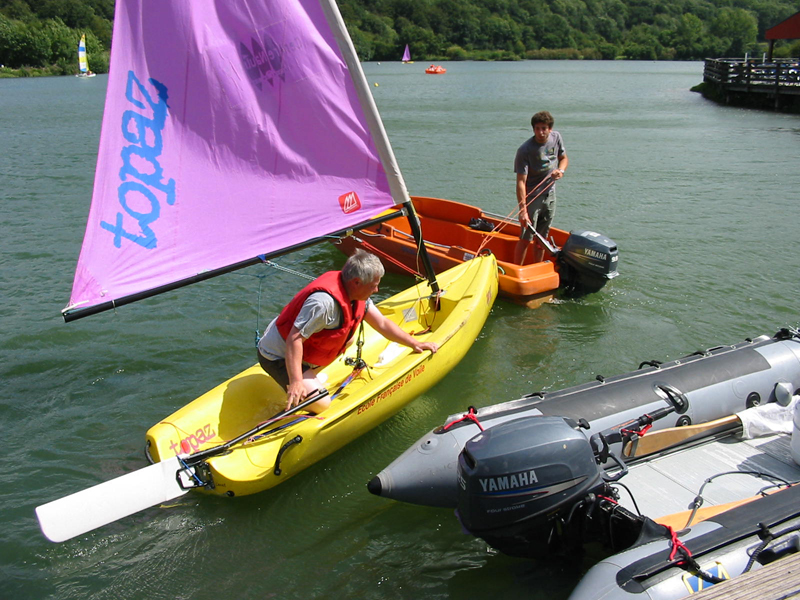
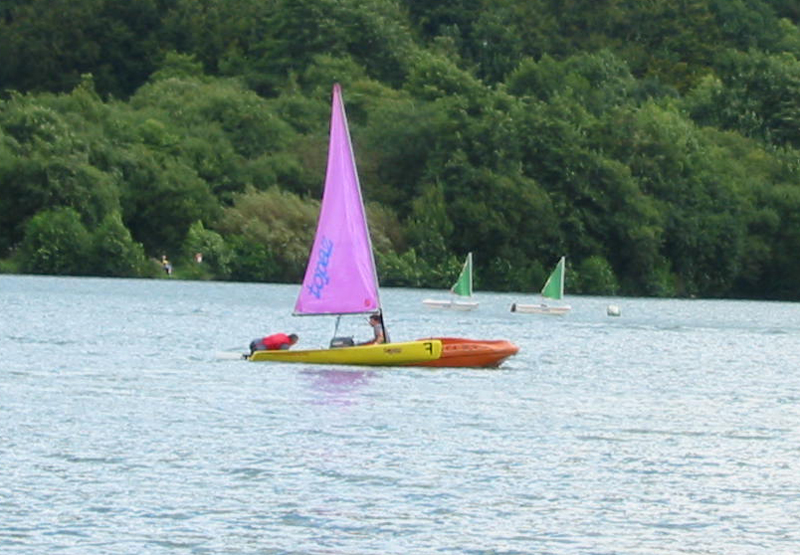
These photos were on my second day of one-to-one lessons, when there was too much wind at sea, so we used this little artificial lake. The first thing is to push off from the dock against the wind, without so much as a paddle. The boat was a Topaz Uno, a heavy plastic job that is ideal for schools. It is roughly like a Laser, but much heavier. Its weather helm is like hell! My problem with this boat is that there is nowhere to sit unless you have a strong and constant wind, and you don’t get that on a lake. A puff here or there, a gust to take you unawares.

20080812learnsail01The poor fellow had to tow me away from the dock. Imbecile! That rudder is still up and I had no way to steer the boat. No wonder I was in trouble! First thing when you’re in the water is to get the rudder down, the very first thing even before grabbing the mainsheet.

20080812learnsail02In this next one, I’m doing reasonably well in a full reach, carefully watched by my instructor in his motor boat.

20080812learnsail03That’s me climbing back in after a capsize! My wife really enjoyed this one. You swim round to the centreboard and push down on it. That rights the boat (make sure the boat is facing the wind or she’ll go over again). Then you get back in over the gunwale or over the stern (no transom on this boat). My first capsize was quite frightening, so you have to understand why a boat capsizes and be able to right it.

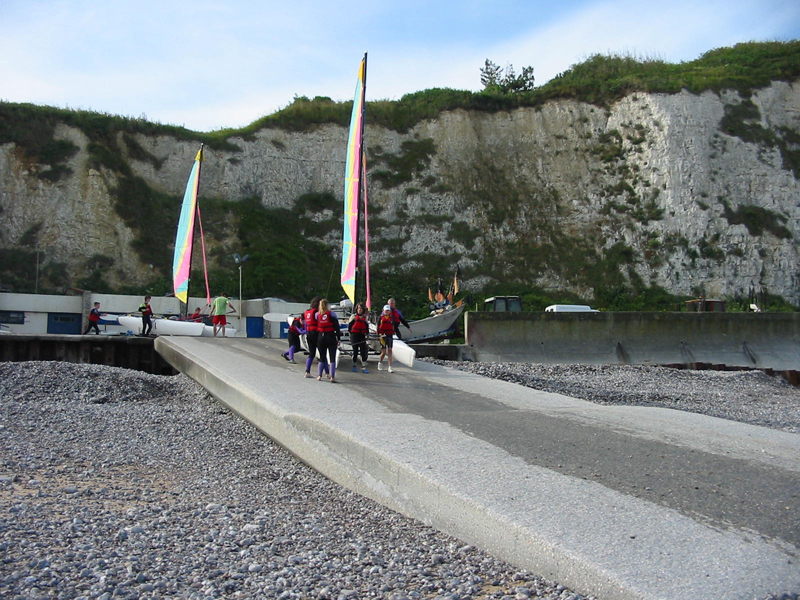
20080812learnsail04Here I am as part of a team of youngsters taking catamarans down the slipway to the beach. This was a week’s class. I don’t like catamarans, but prefer dinghies. But they are good training. Keep on the weather side and they don’t capsize – unless you’re really daft!

20080812learnsail05Indeed, sailing is not improvised. There’s a certain amount of theory, how flowing air makes a boat move forward, etc. The boat is subject to forces from the air and the sea. You then have to relate the theory to the practice, and you begin to get somewhere. You also have to develop an intuitive sense and become able to react without panicking.

As with anything in life, it’s a learning curve, and I’m not afraid at my stage in life to learn something new.

Posted in Uncategorized | Tagged , | Leave a comment

Is it all about sexual ethics?

I get a little annoyed when the Christian philosophy of life is all brought down to family and sexual ethics. That is at least the impression when I read The Synod and the Ordinariates, which I found via Deborah Gyapong’s piece, The Anglican Ordinariates and the synod. The subject is dealt with sensitively, and we can sometimes wonder what reactions were over the recent Synod in Rome presided over by Pope Francis.

A few days ago, I commented on some of the underlying issues in Benedictine and Ignatian Views of the Liturgy. I see good in both sides, with the “Benedictine” neo-Platonic approach to the liturgy and the Church’s sacramental life and the more personal, individual and moral approach of the school of thought broadly based on Nominalist metaphysics. I mentioned the possibility that Anglo-Catholicism had some success in reconciling these two “tendencies”.

What I find disconcerting is the strident and shrill discussion on the moral questions of our day, sexual ethics in particular – sexual relations in or out of marriage, contraception, homosexuality. Then there are the questions of human life, such as abortion, euthanasia and capital punishment. The indissolubility of marriage is yet another question, since it is a Sacrament which brings the natural contract shared by almost all humanity to a spiritual level. We are brought to a conflict of ideologies between those who wish to legitimize sex outside marriage, contraception, homosexuality, the “right to choose” and the possibility of remarriage after divorce, on one hand, and those who uphold traditional moral teachings on the other hand. In all the shrill dialectics between conservatism and so-called liberalism, there is a missing element – pastoral care.

The question of human sexuality is one of society and social pressure. It cannot be treated simply as an individual moral issue. The social questions are not addressed by anyone. Without the wider social context, marriage is under immense pressure. Most cases of women having abortions are horribly tragic. Who offers financial and human help to these women? Those most against abortion would be the most judgemental about the women in question being a single mother! Similarly with euthanasia, the human tragedies are swept under the carpet, and there are cases where we cannot but “understand”. At the same time, we cannot approve of something that could lead straight to the kind of things that happened under Nazism! Capital punishment is increasingly coming under the judgement of abolitionism. The way it is done in the USA is completely hypocritical. If that country wants to carry on punishing heinous crime with death, then let them use the guillotine and in public. The public outcry would put an end to capital punishment in five minutes flat! But, what do you do with an unrepentant evil and dangerous person against which society has to be protected? These are all questions with answers that are often tormenting. I find that may of the conservative polemicists lack empathy and pastoral concern. All they care about is order and authority. Should we conclude that Hitler was right, taking the logic to the extreme?

Conservatism frightens me, and so do the feminist and gay lobbies that would persecute and silence their adversaries in the debate. Both camps seem to think in the same ideological terms.

I noticed this kind of clash of ideologies during the Ordinariate era during the final year of Benedict XVI’s pontificate. At that time, the apologetic artillery was firing salvos full blast. I remember the difficulties I has at the time of the now-defunct English Catholic blog. On one side, I favoured moving into communion with Rome but according to a corporate trajectory that Archbishop Hepworth was pushing – and in which we believed at the time that he was enjoying success. Anglicanorum Coetibus was a carefully studied essay in ambiguity for reasons we had yet to learn in November 2009. It was a compromise, and the solution was available to former members of the Anglican Communion (and a few TAC priests) on condition that they had never been Roman Catholics, cradle or converts. That much was clear in 2009, but we were misinformed that there would be “pastoral” exceptions. Finally, the provision was tailored for Anglo-Papalists. Anglo-Papalism was a movement in Anglicanism that advocated the uncritical aping of Tridentine and Vatican II Roman Catholicism with the exception of compulsory clerical celibacy. Anglo-Papalism was a term that would often be confused with Anglo-Catholicism, a kind of “English Gallicanism” or a compromise of this tendency with the Arminian tradition in the English Reformation. Many of these questions are debated in Continuing Anglican circles, and there has been pressure to demonise non Anglo-Papalist forms of Anglo-Catholicism. In the end, what’s in a name, in a label that does not adequately describe anything?

I opened this article with moral questions that have, in recent years, eclipsed even the question of ordaining women to the priesthood and episcopate. Many Anglicans were alienated from the American Episcopal Church and the Church of England over questions of sexual ethics and the question of whether a same sex couple could contract a relationship that would be legally and morally assimilated to marriage. In general, we can say that Forward in Faith and Continuing Anglicanism came into being over the ordination of women, and bodies like the Anglican Church of North America, supported by the Southern Cone, split with ECUSA over questions of sexual ethics. The latter tendency is clear in sites like Virtue Online.

Hard-line conservatism seems to be more of a target for Pope Francis than the use of liturgical rites other than the Novus Ordo. This seems to be apparent in much of the polemics over the Synod on the family and its projected follow-up in a year’s time. It is very easy to make an ideology of the Christian family, and very difficult to live it out, especially in today’s society and the “consumer” culture. Perhaps my viewpoint is not unbiased, since my wife is infertile – but I am not sure that the family is the only or best basic unit of society for the procreation and raising of children. It can be, but so much can go wrong – as “masculine” and “muscular” husbands can be as physically abusive as wives and mothers can be psychologically and spiritually abusive. There is no infallible way for all, any more than Christians of different traditions and communities being told they have to be Roman Catholics or go to hell. There were other forms of communities in the 1960’s that perhaps did a better job of bringing up and educating children than the nuclear family. That is something for a priest to say!

A serious discussion of the family should not be centred on currently polemical issues like remarriage after divorce or the related same-sex marriage. Instead, the social context of the nuclear family needs to be studied. For example, families need to get together to explore ways of creating better larger village-scale communities as I have discussed about intentional communities in The Epitaph and The Pit. Alternatively, alternatives need to be found to the family. That idea could be very frightening and suggestive of a dystopian society where babies are bred in “farms”!

Another problem is the distinction between the pulpit and the confessional – the distinction between what we say to all as a general principle, and what we say to an individual person whose special issues we have come to understand. Abortion is something truly sordid and dreadful, but understanding and empathy would go a long way. Torching an abortion clinic will do no good, but true pastoral care of a women who is suffering might result in a decision to have her baby and find a supportive community to help the single parent. I disapprove of the gay lobby, but that doesn’t mean that I think that the persons concerned should be persecuted. There is something positive about same-sex love – it is called friendship and the lives of those people are their business, not ours. We have a lot of progress to make in our pastoral care of people. The institutional Church has failed too many, alienated the working class bedrock and intellectual people who can no longer switch off their brains and accept any old bunk and bosh. The institutional Church no longer has the support of Mussolini, Pinochet and so many other authoritarian dictators by which the “social kingship of Christ” could be imposed by force! Unless the Church is spiritual and pastoral, then it really is a load of bunk.

And so I have kept out of the hubbub, constantly seeing e-mail with links sent to scores of e-mail addresses including my own. Finally, I see the way through it all – by empathy and pastoral care – both of which are increasingly rare in our world.

I reread this old posting – Election address of Pope Celestine VI – which I wrote during the sede vacante of 2013. There are elements of comparison with Pope Francis.

Posted in Uncategorized | Tagged , | 2 Comments

Sarum’s Sea Trials

At last, my “new” 12-foot boat sailed the sea today, at the very moment when my Bishop is on the Atlantic on the Queen Mary II. I don’t know what things are like for him but there is quite a fresh south-westerly following the traditional direction of the Gulf Stream and taking heavy clouds to the British Isles. It is the season, and we can expect the cold to be coming in the next few days. That wind gave me a weather shore and some 12 knots with gusts of about 18 to 20 knots. With the wind coming from the land, there was very little swell on the sea.

Here she is, ready to go.

20141031sail_01

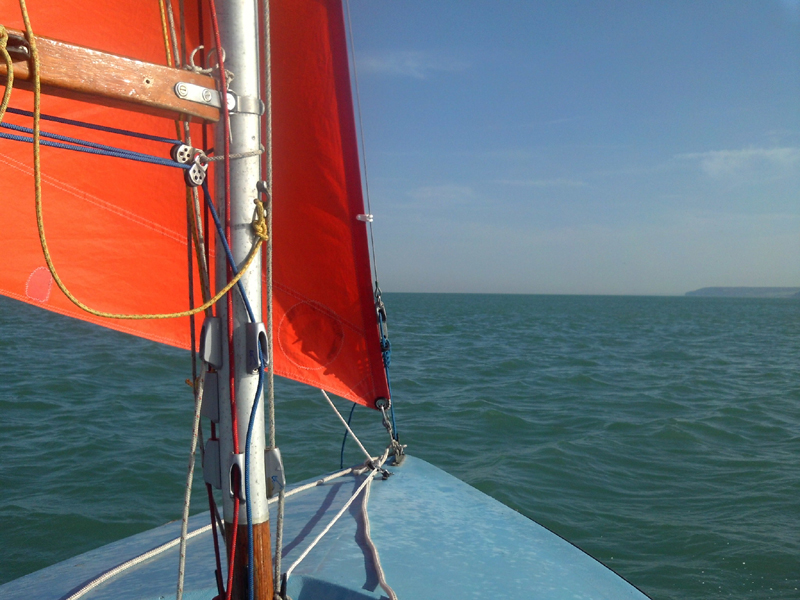
I was warned that the Zef was a slow boat and would not sail upwind with anything less than the original rig. She went like a dream in the fresh breeze. The sharp bow sliced through the wavelets and the sail filled beautifully as on Sophia, my old Tabur 320 boat. Here are three photos of her sea trial.

20141031sail_0220141031sail_0320141031sail_04

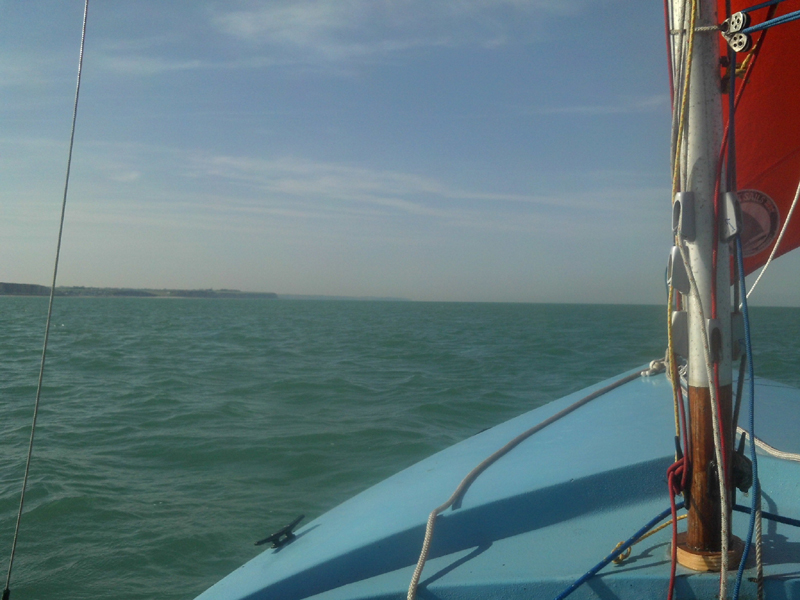
I found that the jib sheet cleats were a tad out of reach, and have since screwed them to each side of the thwart. I sailed about six nautical miles to the east, almost to Varengeville from Veules les Roses, and then back to the beach in time to land on sand. This is a fibreglass boat, not rotomoulded polypropelene like Sophia. Fibreglass is light and strong, but brittle and will break on impact with rocks! One has to be careful.

Stability is as people say about the Zef. It isn’t a regatta boat. She is designed for cruising and fishing, just right for me. Sarum is much faster than Sophia and sails better upwind with the Mirror rig. She was buffeted by the gusts coming from the land, and I reacted as I was taught, putting my weight on the gunwale, steering to the wind and keeping a “dynamic” mainsheet. There was always time to react before the boat would come anywhere near capsizing. The skeg helps to avoid broaching, and I’m used to compensating waves with a jerk on the rudder. My new rudder worked just fine, and the helm impeder came in useful a couple of times to sort out a line on the mast or a fouled jibsheet.

I will proceed with the blessing of Sarum and her “official” naming. I think a bottle of champagne would knock a hole in the hull, so I’ll just use holy water! I still need to sort out a few things with the trailer. New sailing days are beginning, even with the oncoming winter. In all seasons, there are days when you can take a boat out, even if you have to dress warmly. That is the advantage of trailer-sailing. You just up and go when you want (when I don’t have work to do and the weather is good).

Well, my dear Bishop, I will be thinking of you enjoying your Atlantic crossing on that great liner. I very doubt that you are in peril on the sea, but may the Angels look after you all the same…

Posted in Uncategorized | Tagged , | 6 Comments

Benedictine and Ignatian Views of the Liturgy

I have just received some links to two interesting articles on fundamental attitudes regarding the liturgy – The Ironic Outcome of the Benedictine-Jesuit Controversy and Sacramental or devotional. . . The latter article was written by a Lutheran.

This was one aspect with which I found it extremely difficult to come to terms as a young Roman Catholic convert in 1981. How important is the liturgy? To a monastic or someone in the Eastern Orthodox tradition, as to many of us Anglican Catholics, it is the icon of Christ in which the whole Mystery of our Redemption is made truly and really present. To someone of the tradition going back to Saint Francis, Nominalism and the first strains of the Reformation and Counter-Reformation, what was important was individual devotional life for which liturgy is only one of several means or “tools”.

After my arrival in France in July 1982, I began to discover the traditionalist world. Several religious communities were more or less associated with the Society of St Pius X, including the Benedictines of Le Barroux. The Society itself was strongly modelled on the Jesuit ideal, perhaps with the gentleness and broadness of spirit en moins. It was through them that I first experienced an Ignatian retreat. I later made another one with the late Father Hugh Thwaites in 1990. One is supposed to find God’s will through meditating by experiencing a “film” of Christ’s life and teaching. By following rules for the discernment of spirits, we would make what would most likely be the right decision in accordance with God’s will. I found a great amount of sympathy with that holy priest in London. The Jesuits essentially followed the Franciscan tradition of the heart as opposed to the pure intellect. St Francis was what would later be termed as a Romantic, placing the imagination and a person’s humanity before the rational and intellectual rigour. Oscar Wilde places St Francis of Assisi as a kind of Romantic before its time.

Something I found with Benedictines and Dominicans was a great clarity of thought and a Platonic philosophy of life and reality, but a shocking lack of heart. The Jansenists embodied this spirit in the seventeenth and eighteenth centuries, in the Age of Reason. In my many reflections about Romanticism, I recognised this struggle within myself, and found myself unable to know where I was. As an Anglican, I loved the liturgy and churches, but I yearned for a human and humane Church, one that had the same generosity as Christ himself who forgave sinners and healed the sick. Succeeding and having were not among Christ’s priorities – no “prosperity gospel” for him!

The tension is between individual and corporate, to be sure, but it is far more than this.

It is no accident that Cardinal Ratzinger took the Papal name of Benedict and Cardinal Bergoglio took the name of Francis. Pope Benedict brought us images of the great and noble Benedect XIV of the eighteenth century, the vast amount of learning of that time together with cultural wealth. Pope Francis is bringing another message, when we have sifted through all the polemics about “de-ratzingerisation”. This opposition of two tides has created a great deal of confusion and distance in my mind. Both tendencies strike chords in me, and is perhaps the very distinguishing mark of Anglo-Catholicism. The Oxford Movement and Ritualism brought beauty and nobility to the lives of the poor and unfortunate. Pastoral gentleness was married to love of beauty, harmony and order.

Individualism and collectivism? These are two ideas that strike me very profoundly. I often read different views about life after death and the ways they parallel and diverge from traditional Christian teaching. Individualism (personalism too if you like – Eastern Orthodoxy makes a vital distinction between the two in the light of their Trinitarian theology) is a sign of our imperfection and alienation. Corporate man tends to miss the spiritual purpose of life in his effort to keep up with society. According to things I read, the soul falls into a “deep sleep”, goes through a tunnel towards a brilliant light or finds himself in something like the existence of an earthworm. The soul is then helped towards a level of life that corresponded with his life on earth. Then would follow several ascents, and individual personality would have decreasing importance until the soul would become a part of The One or whatever image a particular tradition uses to describe God and “everythingness”. The oriental mentality attaches much less importance to being an individual person than we westerners. Liturgy in the Benedictine perspective would reflect this surrendering of the ego to be a living component of the Church.

There is truth on both “sides”. We cling to our lives as persons at the same time as accepting our inevitable dissolution and our progressive “de-personalisation” and assimilation into the Divine. Many of us are alienated from Churches by bad experiences, or can only relate to a tiny part of institutional Christianity, as is my case. We have to live much of our spiritual life on our own in the vast spiritual desert of western Europe. I am a priest and my access to Mass is no more difficult than going to my chapel, putting on vestments and doing it. Many of my readers don’t have that “luxury”. I have often related my experience of being a working guest with the Benedictines at Triors. The smell of boot polish and unwashed sweat in the corridors made me think of the army or the sports changing rooms at school. My once weekly talks and spiritual direction with the Abbot left me with a lasting impression of the “heartlessness” of monastic life. It cannot and does not cater for individual persons, any more than the modern mechanised society of money and industry.

Perhaps we Anglicans are not always successful at living this via media between the head and the heart, but it is something I have found in our little Diocese in the Anglican Catholic Church. We are English, often of the Romantic spirit, and deeply attached to beauty, order, harmony and the worship of the Church. We have our soul as the Slavs have theirs, each culture living its own balance between what is apparently irreconcilable.

I hope these ideas will provoke discussion, even in these darkening days (in the northern hemisphere).

Posted in Uncategorized | Tagged , , | 4 Comments

Sarum Makes Progress

There’s a chance that Sarum will sail this year. I have adapted the hull fittings to the rig and have rebuilt the rudder head. I am still waiting for a couple of V jam-cleats for the tiller, for the line that holds the rudder blade down in the water and for the helm impeder.

Here she is in my back-yard “private shipyard”. By the time the varnish is dry and hard, we expect some bad weather later this week. Perhaps in early November, it might be possible to try her out on the sea.

sarum-boat01

sarum-boat02

Posted in Uncategorized | Tagged , | 2 Comments

Sailing Analogies

I quite often look at the French traditionalist Forum Catholique which had a posting that caught my attention:

Celui qui ne tire pas les bords dans un archipel, va passer droit sur un rocher…

Quand le vent est stable, quand la mer est sans courants, quand rien ne dépasse des eaux sans vagues, pas besoin de virer de bord.

Mais ce n’est ni le cas de notre vie sur terre, ni de la vie dans l’Eglise remuée de l’intérieur !

Pas moyen d’aller droit, ni d’aboutir sans tirer des bords !

A translation into English would be “Whoever does not bring his boat about in an archipelago will go straight onto a rock. But this is not the case of our earthly life or the life of the Church stirred up from within! No way to go straight ahead or get where you’re going without tacking!

Yeah, I understand that many people use sailing analogies and know nothing about sailing. The concepts the person is trying to get over are quite surprising to a person who sails. Tacking is the way to sail a boat upwind. The no-go angle varies according to the rig of the boat, the amount of sail carried and the efficiency of the centreboard or keel. A modern yacht can go close-hauled at about 30° from the direction of the wind. Older lug or square rigs are that much less efficient, and may not be able to may way against both current and wind without an engine. Another reason to tack a boat is the same reason a driver of a car would perform an emergency stop – to avoid a rock or a collision with another boat. Another possibility is heaving-to, releasing the sails and pushing the tiller over to lee, and a small boat stops very quickly even on the same tack. I usually use this technique to avoid getting run down by a ship, and if I could see that I was too close, I would tack and enjoy a surf on the vessel’s bow waves!

When the wind is stable, when the sea has no current, when nothing protrudes from water without waves, no need to tack. It depends where you are going, even on a lake where there are no tidal currents. If you go upwind, you have to tack, whether the wind is stable or fickle as from a weather shore. Another expression often used in everyday language is “You’re sailing too close to the wind“, meaning you are running close to getting into trouble or danger. A boat that goes into the no-go angle (about 35° each side of the wind) will simply stop and be caught “in irons”. The boat is stopped and therefore has no steerage and remains hove-to. You simply take in the jib sheet to give the boat lee helm, and then you haul in your mainsheet whilst pulling the helm towards you. Sometimes, depending on the boat, you need to “pump” the mainsheet to get the boat “rebooted” and moving. Once you are moving, you have steerage and can fall off the wind to get back under way. The analogy of sailing too close to the wind is not a bad one. I do it all the time when close-hauling, but you have to feel the balance between luffing up (luffing – steering towards the wind and falling off – steering away from the wind and setting your sail accordingly) with the helm and hauling in the mainsail, and hiking out, and losing your power by being too luffed up. The more you are to luff, the more distance you travel upwind, but at the cost of power. You may have to make less progress but with more power and distance. That is the art of sailing upwind. The rules are different for reaching and running.

Running before the wind is often an image that means having things good in life. Actually, running is much less efficient than being in a full reach, having the wind in your aft quarter and feeling the power. Like sailing upwind, you have to gybe and change tack, but at a closer angle. Gybing takes more courage as the boom swings over violently and much further. The best is to sheet in, make the gybe and let the sail out in increments. You are less likely to go into a broach and capsize the boat. It is also gentler on the rigging and the sail. Look after your boat, and you boat will look after you.

Tacking in the Church? In our figurative boat, I can imagine the rocks everywhere waiting to rip our hull open and destroy our centreboard. The wind can be very unstable and fickle as with a weather shore or a lake. You have to be very quick at reacting with the helm, mainsheet, jibsheet and your position on the boat. I capsized more on lakes than on the sea as a beginner. Certainly, in the Church, we go against the grain (woodworking analogy – which way you plane a piece of wood) or against the prevailing mentality, representing the wind direction. You need to go one side or the other to make your way in the political quagmire of modern Catholicism. Interesting…

The Church is often compared with a ship, Noah’s Ark or the Barque of Peter. Mighty ships can sail big seas, but small boats can get inshore and see the details of the coast, to navigate in shallower waters than the big ship. There’s something to think about.

Posted in Uncategorized | Tagged , | Leave a comment

Man’s Inhumanity to Man

I occasionally look at David Virtue’s site and found an article on his visit to Prague and his reflections about missionary work in eastern Europe in the Communist era and the evaporation of Christianity in our time. He also visited Auschwitz in neighbouring Poland, and his reflection was the following:

I was given a conducted tour of Auschwitz and saw man’s inhumanity to man, confirming in me, forever, the Doctrine of Original Sin and man’s total depravity. Many of my Polish friends could not finish the tour as it was too painful for them.

I have visited Oradour sur Glâne here in France, and Dachau concentration camp during a visit to Munich, east Bavaria and Austria. I have to admit I had the same reaction. Why don’t we have an earth-splitting meteorite or an Ebola pandemic? Why not an all-out nuclear war? Why don’t we all commit suicide? This is often the reflection when we are faced with pure evil and when we go to places where massive atrocities happened. The atmosphere in these places is tense and anguishing. Those of us with an ounce of empathy feel the full horror of what once happened.

At the same time, man is flawed and has always been flawed. There is still the divine image within us all, the “spark”, which must be allowed to shine through our prayer, conversion to God, virtue and good works. Man is also capable of sublimity through the divine image within us. This is something we must not forget. There are just people, as there were during World War II. There were times when German soldiers risked their lives by helping Jewish people to escape the SS, and many people earned the title of Righteous Among the Nations (חסידי אומות העולם) during those dark days, and some sacrificed their lives.

There is evil in the world, but there is also good. Many things can restore our faith in the good part of human nature, and not only when people help others in distress and danger. We also have a great capacity for solidarity and friendship. This is something I find with people who are enthusiastic about boats as I am, perhaps more than with people going to car rallies or other gatherings of common hobbies. In the Church, there are the Saints who showed the way through the Light they had within them and Christ’s Transfiguration.

Would you hurl that cold black meteorite or “death star” at earth, seeing great beauty in nature and human imagination alongside the death and ugliness. Would you nuke a whole country rather than sort the good harvest from the weeds? This is the issue I have with capital punishment in the case of a single human being, even one who has committed a heinous crime. Who is to judge that this person is beyond redemption?

The attitudes of some religious people frighten me, and further illustrate some of the matters I discussed yesterday in my article on original sin.

Posted in Uncategorized | Tagged , | 5 Comments