This is often one of those “obsession” subjects, but I might as well draw your attention to some reflections by Fr John Hunwicke in his blog.
A blog article can’t be expected to go into any real theological depth, but the argument is against the sedevacantists who use similar arguments for the invalidity of orders conferred according to the Roman rite of Paul VI as have been used from the late nineteenth century in regard to Anglican orders. I am fundamentally inclined to accept the validity of Roman Catholic orders, including those conferred according to the Bugnini / Paul VI rite – for the simple reason that there is an ecclesial context in an Episcopal structure and the fundamental intention to ordain priests who will do what priests do. A number of theologians have argued more for this essential ecclesial context than for the exact words of a rite.
I also find the sedevacantists generally quite execrable and deeply Donatist in their apologetics and attitudes. The best thing is that they paint themselves into the corner by finding “official Church” ordinations invalid because they use a new rite, and “vagante” ordinations invalid because they are outside any ecclesial context – therefore no valid orders anywhere except in the “forbidden” Orthodox Churches. Perhaps they don’t have valid orders because they are not in communion with Rome. What a wonderful apologia for – atheism!
I have read many arguments for and against this or that particular rite. If there is some church structure (a community consisting of at least a bishop, a few priests and laity united by profession of the Catholic faith), the imposition of hands and a formula to the effect of “receive the Holy Spirit and the priesthood of Christ”, that ordination is valid as far as I am concerned. I recognise Anglican ordinations if there are no women “bishops” in the line of succession (not because I don’t like women, but because the Apostolic Churches of the West and East are agreed that women cannot be ordained in sacramental and ontological terms).
There are other arguments for retaining the old traditional liturgies from before the Church’s “industrial revolution” (Council of Trent to Vatican II). I won’t go into it all here other than recommend the writings of men like Bouyer, Ratzinger and Gamber.
What is validity? In simple terms, it would seem to be the difference between something that is real and genuine from an empty imitation or simulation, like an actor in a film. This is an accusation thrown by any institutional church against anything less “official”, “recognised” or numerous than they seem to be. There are clearly cases of men “playing religion” like overgrown children, and we might be permitted some doubts in their case. If there is some ecclesial community with one or more bishops, a number of priests, deacons and lay faithful, however few – and that community celebrates the liturgy, believes and teaches the Catholic faith and extends a pastoral ministry of sorts , I see no reason why that Church should not have “valid orders” in the same way as Canterbury, Rome, Constantinople, Antioch, Moscow, etc.
The “cut-off” points are difficult, perhaps impossible, to define with any accuracy. Who is in and who is out? Who are the real ones and who are the impostors against whom we might feel a duty to protect the naïve and unwary? We have made it so complicated and we often deserve to be sitting on the branch we are sawing off! Like discerning who is in the Church and who is outside, there are no limits to God’s grace and ability to reach the most remote souls. I have always firmly believed that I should be under the jurisdiction of a Bishop, so that my priesthood be a fruit of being sent, having the mission of the Universal Church. A branch cut off from a tree withers and dies, but sometimes the most amazing miracles of grace can happen to repair and restore what human sin has divided. Whilst submitting to proper canonical discipline ourselves, we should have compassion on those labourers who have not yet found employment in the Lord’s vineyard. Surely, the Church is big enough for all and for all vocations between parish work, teaching, the ministry of writing, music and art and the contemplative life. How mean some people are, who take delight in the misfortunes of others! As I write this, I am listening to Perosi’s L’Entrata di Christo in Gerusalemme, and hear the baritone singing those majestic words of Christ as Saint Jerome translated them:
Hierusalem Hierusalem quae occidis prophetas et lapidas eos qui mittuntur ad te quotiens volui congregare filios tuos quemadmodum avis nidum suum sub pinnis et noluisti.
Jerusalem, Jerusalem, that killest the prophets; and stonest them that are sent to thee, how often would I have gathered thy children as the bird doth her brood under her wings, and thou wouldest not? Is not our vocation to gather and seek the positive and good – wherever they may be found? It may be weak as a theological argument, but there are not many theological arguments left. At least, that is how I see it.




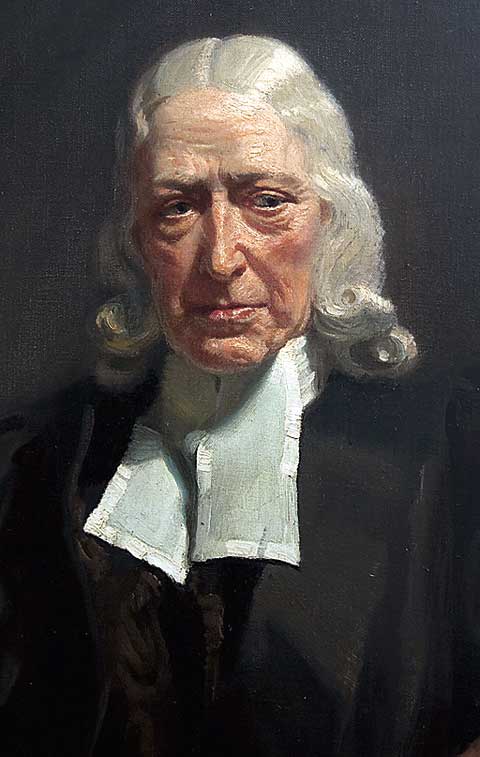
![[John Wesley]](https://i0.wp.com/freemasonry.bcy.ca/biography/images/wesley_j.jpg)