Happy New Year!

I wish my readers a happy and safe New Year.

I think most of my readers are reasonable folk and won’t be drunken driving or whatever! My wife and I will have a friend with us, and we will eat sea food and stay at home. There’s no sense in over-doing it…

May the coming year bring consolation and light at the end of the tunnel, may it bring the joy of living and an outstretched hand to all in need. May 2014 bring peace and new hope as 1914 brought war, death, destruction and the end of a world.

Posted in Uncategorized | Tagged , | Leave a comment

Nostalgia

An excellent article has just been published on The New Liturgical Movement“What Is Most Deeply Human”: Two Contrasting Approaches to Nostalgia.

I have heard the discussions and read the literature for and against the traditional Roman liturgy from the point of view of the reformers, the conservatives and traditionalists. We still have discussions about “classical” Anglicanism, the Prayer Book and the Missals. The Roman Catholic Church almost seems to be replaying the sixteenth century, as we find alternating trends between the conservatives and the iconoclasts of our days.

This article addresses a fundamental human frame of mind, nostalgia, a word that conjures up images of elderly folk talking about the “good old days”. I remember a TV commercial in the 1970’s for a brand of bread in England, with a man in his 80’s reminiscing about going to the baker’s shop on his bicycle as a young boy some time before World War I and saying that the bread was as good today as it had always been. The background music was Dvořák‘s New World Symphony and the scenery of some village in industrial Yorkshire. The commercial appeals to nostalgia to convey its message. Everything has changed except the bread!

We tend to be derogatory and demeaning when we consider nostalgia. N’est ce pas, old people only ruminate the past and hardly represent the future of the brave new world! If we were to read the worlds of certain high priests of the novus ordo, growing old is something really to worry about. We shouldn’t forget that we’re all going to get old – unless we die first…

There is a different kind of nostalgia, not for a particular period in time, but for a more human world, something less mechanised than our own time. Technology has brought immense benefits to mankind from medicine, labour saving, culture to communications. At the same time, it has taken away innocence and beauty. I have read about children themselves lamenting that they were using mobile phones and computers before they were ready for them. I grew up with things my parents didn’t have at that age, and I see exactly the same things now with two new generations. The tape recorder is now as obsolete as the wind-up gramophone, and electronic calculators can be bought with a child’s pocket money. My generation saw Captain Kirk and Spock using communicators in Star Trek movies, and did not imagine that we would see everyone using mobile phones and i-pods in our lifetime. We all have our reference points, but we mix them with the technology we are now using together with our knowledge.

Nostalgia has a deeper meaning, as this NLM article brings about. Yes, we find the idea of reacting against modernity and what Oscar Wilde would have called the soul of man under socialism. Many ask whether the abdication of Benedict XVI took us back to the brutalism of the 1970’s! There is a strange sense of back to the future. Young people have been discovering traditional Catholicism for a long time, but is there much difference between some kid born in 1990 and myself at the same age back in 1982? Thirty years divide the two, yet there is essentially no difference between then and now – except the technology.

Nostalgia is something profound and powerful when it underlies spiritual things. We read in the Psalms:

By the waters of Babylon we sat down and wept: when we remembered thee, O Sion.
As for our harps, we hanged them up: upon the trees that are therein.
For they that led us away captive required of us then a song, and melody in our heaviness: Sing us one of the songs of Sion.
How shall we sing the Lord’s song: in a strange land?

This is the nostalgia of exile, not only of someone from his native country but also from the tabernacle of God. It is not difficult to imagine the sadness of an exile and a slave in a far country. This is something that happens in churches when you take everything away even under the pretext of replacing it with something new and “better”. Indeed, those who will not learn from history are doomed to repeat it.

Many of us are nostalgic for a more spiritual and human world, or simply a place in our modern world of technology and money for that sabbath of the soul for which we all yearn. We have a deep hunger and thirst for beauty and transcendence. We reach out from our mortality for what is eternal and perfect. The words of the great American poet Walt Whitman come to mind:

O Thou transcendent,
Nameless, the fibre and the breath,
Light of the light, shedding forth universes, thou centre of them.

Swiftly I shrivel at the thought of God,
At Nature and its wonders, Time and Space and Death,
But that I, turning, call to thee O soul, thou actual Me,
And lo, thou gently masterest the orbs,
Thou matest Time, smilest content at Death,
And fillest, swellest full the vastnesses of Space.

Greater than stars or suns,
Bounding O soul thou journeyest forth.

The TLM article seems to strive for a distinction between profound existential nostalgia and elderly persons obsessively regurgitating an idealised version of the past. We find a contrast between ecstasy of the soul turned away from mortality to transcendence and the self-absorption of which the angels of the “brave new world” accuse traditionalists. Is the distinction so absolute?

Traditionalists tend to be self-defensive about justifying the use of the old liturgy, trying to take away the subjective elements for which they can be criticised by their adversaries. I don’t think we need to justify anything, for the superficial elements are a part of the wholeness of humanity and the transcendence for which we long.

We all face an uncertain future as fragile persons and minority communities. Our condition as exiles seems to be just about definitive as the churches close down, and we continue to hear and read the mindless patter from the “liturgical” bureaucrats. We are told that the future, in the words of George Orwell is like a boot stamping on a human face – forever. But, we have the liberty not to believe those who would reduce our existence to ever-expanding cities, electronic gadgets, the rhythmic noise some call “music” and aggression. There is another dimension of humanity, and it will survive and endure all things like the darkness of the Soviet hell, the old Nazi totalitarianism and the things the modern elites have in store for us if they get their way. Man’s soul will endure and find its rest in the Eternal.

Posted in Uncategorized | Tagged , | 1 Comment

Sadness at Christmas

I don’t know about you who are reading this posting, but I often find a great sadness in Christmas in the midst of merry-making, rich food, presents and our efforts to celebrate the real Christmas in our liturgies, devotions and prayers. Myself, my mother is particularly present in my thoughts. There is not only my own loss, but thoughts going out to my brother who lost his son a little over six years ago. Christmas almost becomes a caricature and a cruel mockery. We often mock the Dickensian character Scrooge as he sneered at Christmas and carried on with his business as on any ordinary day. Someone like that must have been marked by some terrible event. I have the consolation of knowing that my father will be with my sister for much of tomorrow, and will not be alone.

Perhaps the saddest thing is spending Christmas alone. It has happened to me one year back in the 1990’s. For some, every Christmas is lonely, because they are homeless and loveless. Even for those of us eating rich food and having someone with us, we find that it was really all about the Logos of God born not only into humanity but also into extreme humility. There are of course the usual sentimental representations of the Gospel narrative of Jesus being born in a place where a farmer kept his animals through the winter. What is humanity? Is it the condition of hatred, power, money and corruption, or a condition that can be redeemed and sanctified? Faith tells me one thing and experience often tells me another.

Christmas is here also to bring consolation through its most profound meaning. As Christmas was Christ’s first coming of the three, it was also his first death through incarnation into corrupt humanity.

Verily, verily, I say unto you, Except a corn of wheat fall into the ground and die, it abideth alone: but if it die, it bringeth forth much fruit.

There is a custom in Italy which I have continued since my seminary days. Make up the Crib in the usual way, but take a second and larger representation of the infant Jesus and tie it to the altar cross just below the crucified. At St Mary Major’s in Rome, there are relics of the crib believed to have been brought from the Holy Land in the seventh century.They consist of five pieces of sycamore wood. The significance is the wood, the material linking the Crib and the Cross. This symbolism is strong, associating Christmas and the suffering of the Passion. Each time Christmas comes round, we are that little bit older and further away from the world.

This death of our loved ones and our own slow descent reminds us that we should be looking beyond the transient joys towards eternity. In the words of Jesus in the Beatitudes: They will be consoled. May this Christmas bring consolation to all who suffer, who are alone and who have no one to love.

Blessed are the poor in spirit: for theirs is the kingdom of heaven.

Blessed are they that mourn: for they shall be comforted.

Blessed are the meek: for they shall inherit the earth.

Blessed are they which do hunger and thirst after righteousness: for they shall be filled.

Blessed are the merciful: for they shall obtain mercy.

Blessed are the pure in heart: for they shall see God.

Blessed are the peacemakers: for they shall be called the children of God.

Blessed are they which are persecuted for righteousness’ sake: for theirs is the kingdom of heaven.

Blessed are ye, when men shall revile you, and persecute you, and shall say all manner of evil against you falsely, for my sake.

Rejoice, and be exceeding glad: for great is your reward in heaven: for so persecuted they the prophets which were before you.

Posted in Uncategorized | Tagged | 2 Comments

A Year Passes

I note that some readers have been looking at posts I wrote a year ago on Christmas Eve, Christmas Day and St Stephen’s Day. You can look in the archives of this blog. Re-reading the posts, we were all in turmoil and in the thick of polemics surrounding the TAC and the zeal of the new Ordinariate converts. So much has happened in this one year, notably the abdication of Pope Benedict XVI and the election of Pope Francis, bringing in another way of seeing things.

As 2013 progressed, I joined the ACC’s diocese in England and found a new ecclesial calling as a priest. It took me out of the polemics. Archbishop Prakash and Bishop Michael Gill in South Africa had both been very kind to me after the déchéance of Archbishop Hepworth, as had Canon (now Bishop) Ian Gray in England. I needed all the same to move on and find my own way spiritually. I will not say any ill of those I have left behind, but will rather commend the TAC to God’s care. I continue to live in the same way as a “solitary” in my home, and now with my spiritual family in the ACC.

Reading the old posts, I remember the agony I went through with the loyalty I felt towards Archbishop Hepworth and with my own vocation. This year, the old ghosts are all in the past and Christmas is celebrated that much more peacefully with my wife and mother-in-law. They are presently cooking in the kitchen and chatting, and we will soon be singing carols around the organ, and then it will be the somewhat anticipated Missa in Gallicantu of the holy night of Christmas. Afterwards, we will be eating some very tasty things.

Christmas is not all joy and heavy eating and drinking. It is a sad time for us all who are bereaved (I think of my father and my family, as my mother passed away this year). Many people are homeless, as the Holy Family was when Joseph and Mary had to go to Bethlehem for their civil duties. I can think of few more depressing things than Christmas spent alone! Those people need our prayers. And that is without talking of people who have been turned out of their homes because the money ran out and their creditors claimed their money back. Life in our day is no more merciful than it ever was in the past.

2013 has been an annus horribilis for me, but there have been grace-filled moments like being welcomed into the ACC and having the moral support of a great Bishop. Whatever any of us has been through this year, there have been good things. Not least for the kind of people who read this blog, we can be thankful for the calm and peace that now reign after all the polemics and squabbling.

Let us go onwards in faith into the new year 2014…

Posted in Uncategorized | Tagged | 3 Comments

Merrie Christmass

nativity14cI convey my Christmas greeting to all those to whom I have not been able to write individually. May this feast of the Nativity renew the joy and hope of Christ in us all.

All hosts, above, beneath,

Sing the incarnate Lord,
With instruments and pious breath

Attune each measured word.
This is the hallow’d morn

When on our fallen race
In full effulgence rose the dawn

Of new-born joy and grace.
Glory to God on high,

On this renowned night
Was thundered forth in harmony

By angel legions bright.
Amazing splendours shone

A strange unwonted sight
Upon the shepherds biding lone

Under the veil of night.
Sudden, while peacefully

They watch’d their sheep-folds still.
Good tidings wafted from on high

Their ears attentive fill.
Who was before all time

Is born of purest Maid;
Glory to God in heights sublime,

Peace comes the world to aid.
E’en thus the choir on high

Sings praises jubilant,
From pole to pole their voices fly,

Heaven echoes to their chant.
Let all with thrilling voice

Give back the glorious lay,
Let the wide universe rejoice,

That God is born this day.
Burst are the iron chains

Which held the world in thrall;
The cruel foe no longer reigns,

Peace is restored to all.
For lo ! an order new

Doth the glad world adorn ;
Let all things render praises due

Unto the Virgin-born.
He all upholds alone,

He all alone did frame ;
May he who hath such pity shown

Blot out our sin and shame.

Sequence of the Mass in gallicantu, translation by Canon Warren.

Posted in Uncategorized | Tagged | Leave a comment

Beautiful Article on the O Antiphons

I am very heartened to see Patricius’ blog re-activating. May the flower continue to open!

Today in the Use of Sarum is the last one (since we sing O Sapientia on 16th December instead of the 17th in the Roman rite). We also celebrate the Rorate Mass of Our Lady on this day before Christmas Eve.

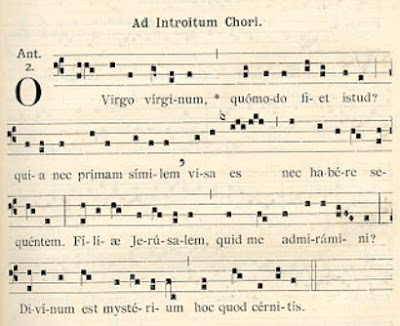
OVirgoVirginumO Virgo virginum, quomodo fiet istud? quia noc primam similem visa es, nec habere sequentem. Filæ Jerusalem, quid me admiramini? Divinum est mysterium hoc quod cernitis.

O Virgin of virgins! how shall this be? for never was there one like thee, nor will there ever be. Ye daughters of Jerusalem, why look ye wondering at me? What ye behold, is a divine mystery.

Posted in Uncategorized | Tagged , | 1 Comment

And a parish came back in from the cold…

A link was given by a kind soul in a comment on the Orthodox Blow-Out Department. It is worthy of note here.

In brief, a continuing Anglican parish that joined the Russian Orthodox Church outside Russia has returned to continuing Anglicanism. They seem to be retaining the Byzantine style terminology, but that seems to be of little importance. What is of interest is the different theological slant and the idea of liturgical pluralism that might influence its Anglican host Church in a positive way. This influence may be far reaching in time.

This western rite vicariate appears to be a kind of uniatism within continuing Anglicanism, almost the idea of the TAC as a kind of pro-uniate structure at the door of Roman Catholicism. It’s interesting, a kind of “waiting solution” and prototype of ecumenism in the face of conservatism and opposition from “canonical” Orthodox Churches. The idea is intriguing and is a sign of a positive attitude of cultural diversity in ecclesial bodies formed around the historical circumstances of their foundations.

Please note. Comments are disabled on this page. Please use the Blowout Department.

* * *

Just an afterthought of mine in the light of my answer made to a comment by Dr Tighe.

The notion of Western Orthodoxy seems to be precisely defined as being a group of western Catholic or Anglican origin under the jurisdiction of an Eastern Orthodox diocesan bishop or provincial synod or whatever. The use of Byzantine terminology and ecclesiological references would only make sense in that context. Logic would usually dictate that if they are under a generic Anglican jurisdiction, then they are simply Anglican Catholics (high-church Anglicans, Anglo-Catholics, whatever name seems most appropriate).

It occurred to me that they wanted to make a kind of model, a laboratory or a prototype for something new – western Catholicism with an eastern Orthodox ecclesiology. I can understand how this this must seem absurd to Dr Tighe, being a member of an eastern rite Roman Catholic parish. Is this a “waiting solution” until they can find a place in another eastern Orthodox jurisdiction, with the APA serving as a temporary platform? Would Archbishop Grundorf not feel he was being “used”?

There is another possibility, using the analogy of a homeless person or a refugee from his original country. That displaced person needs to find at least a temporary home in order to find a job and enrol in the social security system, and then he has hope of finding a more permanent home. This group found itself victim of its host Church’s decision to “pull the plug”, which has its parallel with the TAC and the Ordinariate movement. It didn’t work for everybody. Did this group merely “need a break” as they say over in America?

What would bring this matter out of the realm of pure pragmatism would be a generalised idea within the American continuing Anglican Churches of seeking corporate reunion with the eastern Orthodox Churches as whole ecclesial units, like what Archbishop Hepworth hoped for with Rome.

They also seem to place emphasis on liturgical pluralism outside the usual fare of the 1928 American Prayer Book and the Anglican Missal. I am dubious about Byzantine-flavoured Sarum liturgies and the kind of Gallican liturgy that originated in France in a former Liberal Catholic church that made approaches towards Moscow, the Russian Church in Exile and finally the Romanian Patriarchate – now the ECOF. However, in the context of this issue, the liturgy is only a matter of secondary importance.

Western rite eastern Orthodox under Anglican jurisdiction. This kind of “double turn” does seem surrealistic (unlike a notion of eastern rite Anglicanism or Roman Catholicism), and such an idea wouldn’t interest me. Western Catholicism inculturated into an Eastern Orthodox mould and then putting itself under (generic) Anglican jurisdiction. What reason would they give for not simply returning to Anglicanism? There seems either to be brilliant intuition at play or skulduggery. I fail to see clearly which.

* * *

WESTERN RITE VICARIATE RESTORED

Although corporate reunion between Eastern and Orthodox Anglican Christians is no longer possible at this time due to the unilateral action taken by the Russian Orthodox Church Outside of Russia at their Extraordinary Session of the Synod Synod of Bishops on July 9, 2013 and their Decree of July 12th, there still remains great interest in unity among the thousands of self-identified Orthodox Christians in the Anglican tradition who had expressed interest in corporate reunion between Eastern and Western Christendom. In mid-October the House of Bishops of the Anglican Province of America met and after extensive discussions voted unanimously to offer to serve as a center of unity for self-identified Orthodox Christians in the West. The Anglican Province of America‘s House of Bishops offered to enter into unity with congregations and religious communities of the former Western Rite Vicariate of the Russian Orthodox Church Outside of Russia, and to restore the Western Rite Vicariate as it existed on July 8, 2013. The new Western Rite Vicariate would remain under its own leadership and function as a non-geographic stavropegial organization, directly under Archbishop Walter Grundorf, primate of the Anglican Province of America. The Western Rite Vicariate would be a further witness to the catholicity of the Anglican Province of America by making it possible for the traditional Roman, Sarum and Gallican Rites to exist side by side with the Anglican Rite in one ecclesiastical body. On October 29, 2013 Fr. Anthony Bondi, former Pastoral Vicar of the ROCOR Western Rite Vicariate wrote to Fr. Victor Novak, rector of Holy Cross parish saying, “I ask that you keep your Orthodox identity and, as archpriest, serve as Dean of the Vicariate.” Fr. Novak has agreed to do this, the Anglican Province of America has given him their recognition, and on November 1, 2013 the Western Rite Vicariate was restored under the Omophorian of Archbishop Walter Grundorf. The Anglican Church in America (ACA) is also in the process of uniting with the Anglican Province of America, and the two jurisdictions will hold their provincial synods at a common location in 2014. A new realignment is taking place that will unite not only Orthodox Anglicans, but Orthodox Christians of other Western Christian traditions in one body. As Blessed James DeKoven, a 19th century Anglican saint said, “I do not know what reason our Church has to exist, except it be, on the one hand, that she is the American branch of the Catholic Church, and on the other that, because she is so, she can do what no other Christian body can accomplish.”

Posted in Uncategorized | Tagged , | Comments Off on And a parish came back in from the cold…

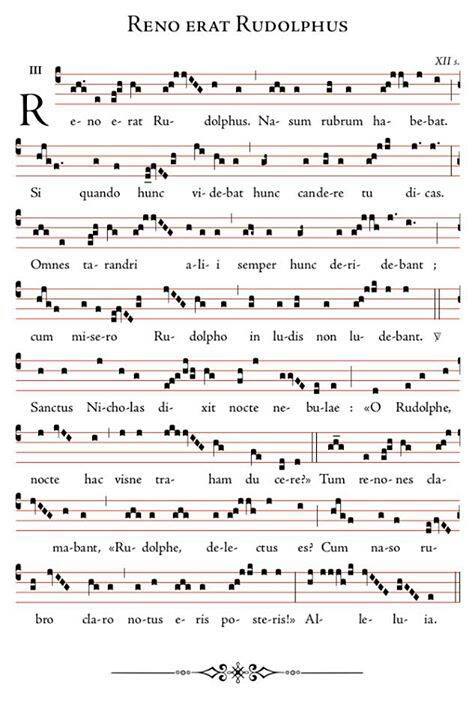
Reno Erat Rudolphus, Nasum Rubrum Habebat

Rudolph the red-nosed reindeer was written in the twelfth century by a monk of the Abbey of Melk. Or was it? Your guess is as good as mine. I found it on Facebook.

rudolph

Posted in Uncategorized | Tagged , | 2 Comments

Does the Liturgy ever Exist in a Natural State?

On reading Dale’s comment in my previous posting asking me whether I would develop my response to Rubricarius as a full posting, I gave the matter thought. The question is really how the liturgy “lives” in the life of the Church in history, and what are its fundamental principles:

  • whether it grows “accretions” and has to be pruned back by acts of authority,
  • whether it is a mere “decoration” to help people assimilate doctrines and in their devotional practices,
  • whether there is a “natural” life of the liturgy which is “self-regulating” if left alone.

I gave these matters a considerable amount of thought when I was at university in the late 1980’s doing my Licentiate mémoire with Fr Jakob Baumgartner. At the time, my intellectual life was still considerably influenced by the ambient ideology of Roman Catholic traditionalism, and I felt I had a cause to defend. This still may be the case now, but I have to admit I find the alternatives to be bleak.

My university work (The Tridentine Mass and Liturgical Reform: A Study of the History of the Codification of the the Roman Mass Liturgy by Saint Pius V and the Principles of its Development in the Tradition of the Church) attracted the attention of Dom Alcuin Reid in his book The Organic Development of the Liturgy (Farnborough 2004). Dom Alcuin’s book in its turn attracted the attention of Cardinal Ratzinger who was promoting his notion of a hermeneutic of continuity. I suppose it was like Newman as an Anglican trying to draw an orthodox Catholic interpretation out of the Thirty-Nine Articles.

My mind is not to defend the Roman Catholic system put in place by the Council of Trent, the Congregation of Rites, the Popes and, finally, Vatican II and the reforms that followed under the aegis of Bugnini and Paul VI. To try to get somewhere in these questions, we have to try to clear our minds of institutional loyalties and “orthodoxies” to uphold. That is probably the most difficult thing, unless you are simply an academic with no ecclesial loyalties. I have no duty to defend the Magisterium or prerogatives of canon law or authority over tradition and custom. Belonging to a marginal Anglican Catholic community, I just don’t have these axes to grind.

Perhaps I can start by the negatives, the Scylla and Charybdis of arbitrary pastorally-motivated liturgical re-invention and the back-to-the-sources movement. There is a third point of view of considering everything – doctrine and liturgy – to be frozen in amber and to be preserved, but it is really a part of the back-to-the-sources movement characteristic of Protestantism and Jansenism in the seventeenth and eighteenth centuries. Very often, the serpent ate its own tail as the opposing mythical sea monsters converged in a conjunctio oppositorum. Distinctions really can only be made for the purpose of our trying to figure things out or explain them to other people. Analogies can only be imperfect as we labour to rationalise something that even the great brains of our time like Ratzinger find difficult to explain convincingly.

Another mind in our little Internet circle is Fr John Hunwicke. He is one of the more traditionalist divines of the English Ordinariate and has sometimes sailed too close to the wind, something which delayed his re-ordination as a Roman Catholic priest. He obviously feels a lot freer now with the frankness of his writing. ‘Organic Development’ yet again shows his critical attitude of the conservative attitude which consists of considering acts of Papal authority as milestones of tradition and organic development. This criticism is refreshing. Fr Hunwicke emphasises the slow and gradual characteristic of a liturgy in the life of the Church. It didn’t come down ready-made from the Pope, but grew in the local community.

In the centuries before printing, the authority in Liturgy was very generally a combination of Tradition, Sensus Fidelium, and Subsidiarity – with the emphasis very strongly upon the first of this troika.

Putting it in his down-to-earth way, he puts it in this way:

If you can continue to use your old Altar Book, while from time to time gumming a new Mass or preface in here or making a marginal alteration there or crossing out this bit or remembering to do that bit differently, then evolution is probably happening organically. If, on the other hand, you have no choice but to abandon that book to gather dust lying useless on the top shelf in your sacristy … while you go out to the shop and pay big money for a new book … then the changes are certainly not organic. You’ve got on your hands, not evolution, but revolution.

I have to admit that in my use of the Sarum liturgy that has only been in marginal use since the mid sixteenth century, I have added the additional prefaces of the Rouen and Parisian missals together with some modern feasts of particular significance and celebrated by the rest of my Diocese in England. I avoid eclecticism but have allowed these conservative developments in for the sake of coherence. I also use the fiddleback vestments I had when using the Roman rite, and I also use the Gregorian calendar and electric lighting in the chapel. So there is some kind of development there, but in a concern to preserve the essential integrity of the rite I use.

Back to our “negatives”, since I digressed for the sake of Fr Hunwicke. I quote from my university work:

Any period in the history of the Church in which a tendency arises to simplify and logically re-order the eucharistic liturgy is shown by this very fact to be a period of decay, preparing only for future corruption.

I have a feeling that I paraphrased this quote, probably from Bouyer, without footnoting a source – bad of me. The book of Bouyer I most used was Life and Liturgy, so you will probably find it there. Louis Bouyer (1913-2004) was a French Lutheran convert to Roman Catholicism, joined the Oratory of Cardinal de Bérulle and made his mark as a major theologian specialising in biblical studies, ecclesiology and liturgy. He had an ironic and satirical touch to his writing, and was highly critical of the ideological trend that entered the scene after Vatican II. This is clearly seen in his Decomposition of Catholicism, a polemical work he wrote in 1968. Indeed, during my university days, I sought to avoid relying on material from traditionalist authors like Michael Davies or Fr Didier Bonneterre of the Socety of St Puis X, but rather to find opinions among the ressourcement theologians.

Fundamental theology and theories of tradition and development are a young science, essentially developed in the nineteenth century in the midst of theories of evolution. This gave rise to a desire to develop theology and equip it for dialogue with the new theories of history and natural science, and this moved towards the so-called “modernism” that clashed with neo-scholasticism in the period between the very end of the nineteenth century up to World War I. This movement brought a refreshing change from stick-in-the-mud conservatism and the reaction it engendered – revolution.

Reading Bouyer and others, we become more critical of the Protestant liturgies as well as the Roman Catholic novus ordo. They were artificially fabricated rites without any real basis in history. We discover that the Protestants actually discarded the most ancient parts of the liturgy and kept the apocryphal medieval accretions under the pretext of getting rid of accretions and restoring something pure. In our own age, the ideology consists of making the liturgy culturally relevant for a post World War II civilisation that has largely rejected its classical culture. The new forms of worship would be arbitrary but justified by the superficial notion of returning to sources. We find these two notions represented by the words archaeologism and “pastoralism”.

Pastoralism usually describes a method of farming, which is clearly inappropriate for this subject, but used by some French liturgical scholars. In our context, pastoralism would mean the modification of the liturgy for the sake of pastoral needs. Pastoralism isn’t “all bad“. The use of languages that ordinary people can understand for the liturgy and the Bible is something clearly desirable, and has made it possible for people to take an interest in the liturgy rather than “switch off” and fill the vacuum with lay devotions like the rosary. Making it possible to see through the choir screen is another positive concession to pastoral needs. However, it can go to extremes when the liturgy loses its integrity and is re-invented according to whims and fancies.

Archaeologism is the ideology consisting of wanting to restore a form of the liturgy deemed to be purer and “free from accretions”. As Bouyer observed that some of the Protestant reformers either lacked intellectual integrity or historical information, Dom Gregory Dix made similar observations in his The Shape of the Liturgy written just after World War II. It is also possible to exaggerate their limits of scholarship, since some of the Reformers were dragging up old oriental liturgies. Restoring rites in relatively recent use are one thing, if the documentation has been perfectly preserved and there is still a comparative tradition (for example in the case of Sarum, the existence of Norman customs until the 1980’s in a few places and the Dominican rite). It is another to want to restore an ancient rite of which only a few fragments are extant, and thus requiring reconstruction on the basis of conjecture.

Coming back to nineteenth-century theology of those who tried to present something new and refreshing, like Newman and his theory of development, we also have Dom Prosper Guéranger and his anti-liturgical heresy theory. This theory features in his monumental work Institutions Liturgiques from the 1840’s, and introduces an element of anti-Protestant polemics. Guéranger’s real target was Jansenism, which he opposed by his increasing adhesion to the Liberal-inspired Ultramontanist movement. The main Jansenist tendency was really that of baroque culture, the emphasis on reason and “enlightenment” together with a pessimistic view of humanity. This would entail the loss of “unction” and “mystery” in the liturgy. Newman was working on the  equivalent in the field of theology, how Protestant novelty was wrong and how some developments could be right. Such matters had to be determined, however imperfectly, by the use of lists of criteria.

After this discussion of pastoralism and archaeologism, we ask ourselves whether it is possible for liturgy to exist in a “natural state” for any length of time. I see the question in relation to the simple question of humanity. Can we humans aspire to holiness, or do we need to be policed and coerced, tortured into compliance and orthodoxy? Are we naturally corrupt or do we seek the good, true and beautiful in spite of sin and weakness? Liturgy didn’t drop out of heaven, but was a part of tradition as you will find in other spiritual and religious traditions in the world like Hinduism, various types of Confucianism and Buddhism and Gnosticism in the Middle-East. Civilisations have been destroyed by the use of Christian evangelisation for purposes of imperial conquest. These seem to be the real questions to think about.

We need an anthropological and sociological approach. Most studies show the present state of western civilisation to be unfavourable for Christian tradition and the notion of “liturgy in the wild”. Through having been mutilated for the sake of ideology and other reasons, the liturgy is rendered impotent as a binding force of humanity and the Church. Without the liturgy, the Church has to rely on authority and political power to coerce and force compliance.

If that is so, then the liturgy can only be a political banner, a symbol of some other reality. French Roman Catholic traditionalism in reality often symbolises conservative right-wing politics, and the priest wearing a cassock and celebrating Mass in Latin becomes a banner of the National Front! This is no longer a spiritual or even a cultural tradition. Conversely, many of the manifestations of modern liturgy symbolise socialist and left-wing politics.

Can liturgy exist in a “natural state”? It certainly doesn’t nowadays, except perhaps in monasteries. As a bedrock of our civilisation, it is totally destroyed. Either a new form of Christianity without it has to be invented, a notion of Christianity without religion as suggested in Dietrich Bonhöffer’s thought, secular Christianity which can be used for little more than “internal forum policing” – or the liturgical basis has to be recovered on a limited basis in monasteries and communities of those who take an interest in the question.

We are up against a heresy of formlessness, which is an idea we need to study. Does Christianity need any kind of liturgy? This is a question that was getting serious attention in the Roman Catholic Church under Benedict XVI, but those thinking about it now seem to have missed the bus under the Franciscan pontificate. Doubtless, those of the New Liturgical Movement tendency will continue along this theme and keep it alive into the future and more favourable circumstances in their Church.

The idea that the liturgy has no form and can be reinvented according to perceived pastoral needs has grown over most of the twentieth century, and colluded with older Protestant reforms, is still current. My own feeling is that if this is true, like the question of ordaining women, why not do away with everything altogether? Just tell people that Christianity is just getting on with life and being kind to people! No need for churches, prayers, priests or anything. It is only logical. It is partly to do with our ideological culture and our having been influenced by dialectic philosophy, of the kind that gave rise to Marxism and the “critical theory“. It would seem that Christianity cannot be culturally relevant, but counter cultural – by retreating in some analogical way to the Catacombs.

Perhaps the most positive thing I can suggest is small communities like the ACC and some of the less political traditionalist groups assuming the role of laboratories and conservatories of parallel culture and notions of tradition. For the rest, it only blends with themes I have already amply discussed on this blog.

Posted in Uncategorized | Tagged , , , , | 3 Comments

The Golden Mass

Ember Wednesday of Advent comes up tomorrow. In the middle-ages, it was usually the custom to transfer feasts away from Rorate Wednesday. John XXIII happily restored the predominance of the Advent Ember Days in 1961, but they were done away with altogether in the less fortunate reform of Paul VI in 1969.

The Missa aurea or Golden Mass is stationed at Saint Mary Major in the Roman missal. We find the texts chosen on account of the Gospel. The Rorate introit (or Office as we call it), unlike the Roman missal, is not used in the fourth Sunday of Advent. This Mass is that of the Annunciation of Our Lady. This reflects the Ambrosian rite keeping the last Sunday of Advent as the feast of the Incarnation. The Mozarabic rite fixes the Annunciation on 18th December. In some places, white vestments were used instead of the penitential violet or blue, and the deacon and subdeacon wear dalmatic and tunicle instead of folded chasubles. In Bayeux, the Gospel was sung by a priest in a white cope, not by the deacon. He held a palm branch in his hand. This Wednesday became a second feast of the Annunciation in Paris, where it remained until the Archdiocese of Paris adopted the Roman missal in 1873.

The Rorate Wednesday Mass is also a focus of devotion in Poland and much of northern Europe. Here it is from the Sarum missal in the Warren translation.

Wednesday in Ember Week of Advent in the Use of Sarum.

At Mass. Office.
Drop down ye heavens from above, and let the skies pour down righteousness ; let the earth open, and bring forth a Saviour.
Ps. And let righteousness spring up together ; I the Lord have created it.

The Collect shall follow without The Lord be with you, and only with Let us pray.

Collect.
Grant, we beseech thee. Almighty God, that the approaching solemnity of our redemption may both afford us succour in this present life, and bestow on us abundantly the rewards of eternal happiness. Through the same etc.

The Lesson. Isaiah. ii. 2-5
In those days the Prophet Isaias said, in the last days, that the mountain of the Lord’s house shall be established in the top of the mountains, and shall be exalted above the hills; and all nations shall flow unto it. And many people shall go and say, Come ye, and let us go up to the mountain of the Lord, to the house of the God of Jacob; and he will teach us of his ways, and we will walk in his paths: for out of Zion shall go forth the law, and the word of the Lord from Jerusalem. And he shall judge among the nations, and shall rebuke many people: and they shall beat their swords into plowshares, and their spears into pruninghooks: nation shall not lift up sword against nation, neither shall they learn war any more. O house of Jacob, come ye, and let us walk in the light of the Lord our God.

Gradual.
Lift up your heads, O ye gates, and be ye lift up, ye everlasting doors ; and the King of Glory shall come in. V. Who shall ascend into the hill of the Lord ? or who shall rise up in his holy place ? Even he that hath clean hands and a pure heart.
The gradual shall not be repeated, but there shall immediately follow The Lord be with you and Let us pray.

Collect.
Hasten we beseech thee, O Lord, and tarry not ; and grant us the assistance of thy strength from above ; that they who trust in thy goodness may be sustained by the consolations of thy coming. Who livest etc.

The accustomed memories are said here.

The Lesson. Isaiah vii. 10-15
In those days, the Lord spake again unto Ahaz, saying, Ask thee a sign of the Lord thy God; ask it either in the depth, or in the height above. But Ahaz said, I will not ask, neither will I tempt the Lord. And he said, Hear ye now, O house of David; Is it a small thing for you to weary men, but will ye weary my God also? Therefore the Lord himself shall give you a sign; Behold, a virgin shall conceive, and bear a son, and shall call his name Immanuel. Butter and honey shall he eat, that he may know to refuse the evil, and choose the good.

Gradual.
The Lord is nigh unto all them that call upon him : yea, all such as call upon him faithfully.
V. My mouth shall speak the praise of the Lord : and let all flesh give thanks unto his holy name.
The gradual is to be repeated.

The Gospel. Luke i. 26-38
At that time, the angel Gabriel was sent from God unto a city of Galilee, named Nazareth, To a virgin espoused to a man whose name was Joseph, of the house of David; and the virgin’s name was Mary. And the angel came in unto her, and said, Hail, thou that art highly favoured, the Lord is with thee: blessed art thou among women. And when she saw him, she was troubled at his saying, and cast in her mind what manner of salutation this should be. And the angel said unto her, Fear not, Mary: for thou hast found favour with God. And, behold, thou shalt conceive in thy womb, and bring forth a son, and shalt call his name Jesus. He shall be great, and shall be called the Son of the Highest: and the Lord God shall give unto him the throne of his father David: And he shall reign over the house of Jacob for ever; and of his kingdom there shall be no end. Then said Mary unto the angel, How shall this be, seeing I know not a man? And the angel answered and said unto her, The Holy Ghost shall come upon thee, and the power of the Highest shall overshadow thee: therefore also that holy thing which shall be born of thee shall be called the Son of God. And, behold, thy cousin Elisabeth, she hath also conceived a son in her old age: and this is the sixth month with her, who was called barren. For with God nothing shall be impossible. And Mary said, Behold the handmaid of the Lord; be it unto me according to thy word.

Offertory.
Hail, Mary, full of grace ; the Lord is with thee : blessed art thou among women, and blessed is the fruit of thy womb.
V. Therefore also that holy thing which shall be born of thee shall be called the Son of God.

Secret.
We present offerings, O Lord, befitting this health-giving fast : grant that by these offices we may be prepared for the nativity of the eternal Bread. Through etc.

Ferial [Advent] Preface.

Communion.
Behold, a virgin shall conceive, and bear a son, and shall call his name Emmanuel.”

Postcommunion.
Being filled, O Lord, with the gift of thy salvation, we humbly pray thee, that rejoicing in the taste thereof we may by it be effectually renewed. Through etc.

Posted in Uncategorized | Tagged , , , | 7 Comments