Comprehensiveness, on whose terms?

I should stress that this article is of my own initiative and not the official position of the ACC. At the same time, I am loyal to the way of my diocese in the UK (and now with a European chaplaincy) and my Archbishop in appealing to the whole tradition of the Church, not only the early Church but also the middle-ages.

I have found two articles of interest, expressing the idea that Anglican comprehensiveness can only “work” if it is contained within Reformed or Evangelical standards, viz. the Thirty-Nine Articles. This is an old and tired subject, but one that needs to be studied.

* * *

Addition on 4th December 2013:

I have already written on this subject, in Nice Little Article on Anglican Identity in particular. This article contains the link to the famous piece by Dr William Tighe – Can the Thirty-Nine Articles Function As a Confessional Standard for Anglicans Today? He has just written to me to remind me about it. There is also page 2 of this, in which former Bishop Peter Wilkinson (now a priest in the Ordinariate) expresses himself very well on this subject. If a few clergy in the TAC and the ACC privately uphold the Articles, they are not binding on anyone. I have never been asked to promise to uphold them. And I don’t.

* * *

We are faced with the old spectre, that of comprehensiveness being possible but only on “our” terms. Both Anglo-Catholics and Evangelicals say the same of the other party. We in the ACC have just about scrapped the Thirty-Nine Articles, even though some of our clergy uphold them as standards of doctrine. I seem to belong to the majority in the ACC that has dropped the Articles as anything other than of historical and academic interest. Other continuing Anglican Churches don’t like that, but my conversations with our bishops and brother clergy show me a greater attraction for the tradition of the Church Fathers and the life of the Church through the centuries preceding the Reformation.

If the Articles are a normative aspect of Anglican identity, those Anglicans who do not uphold them are considered by the “upholders” as not being true Anglicans but rather “impostors”. We are then invited to go away and make our choice between Roman Catholicism or Orthodoxy instead of restoring a form of western Catholicism that eschews the “military” spirit of the Counter-Reformation and its polemical and polarised atmosphere. We would like to live a vision that overrides both the Reformation and the Counter-Reformation, noting various moderate steps taken in the early days against clerical corruption and superstition in popular religious practices. We eschew both Protestantism and “infallibilist” or Ultramontanist Roman Catholicism, situating the notion of via media elsewhere than with the “upholders” of the Articles.

I simply note that for these postings, to which I have given the links, Anglicanism is Reformed. Therefore it is not comprehensive because it excludes Catholics. Of course, they would say the same about us. The idea is comprehensiveness, but on condition of the exclusion of both Catholics and Anabaptists. In terms of worship, at least in England and in the old days, it was the Book of Common Prayer and the status quo of before the Oxford Movement. Nowadays, it’s alternative services, female clergy and à la carte doctrine. Thus, nothing seems to matter anymore in the Church by Law Established – only for the Continuing Churches which for the mainstream Anglicans are no more than schismatic sects. We can’t use the argument of authority. If Her Gracious Majesty knows about us, she doesn’t acknowledge us as Anglicans. If you are really strict about who the Anglicans are, then you might as well say – people of English or British nationality who are baptised members of the Church of England and in good canonical standing.

We in the ACC are not all English (though I am and now living in another country) and are not all using the Prayer Book (or at least exclusively and in the version that was official in the Church of England) or upholding the Articles. So, if we are not Anglican, we are not Roman Catholics, Orthodox or Non-Conformist Protestants either. We use the term Anglican as meaning the English tradition of Catholicism, like Gallicanism being the French tradition of Catholicism. In that way, we are Anglicans.

I am not going to criticise Protestantism, but I will say it is founded on a philosophical basis that was based on post-Thomist scholasticism and Nominalism. We have better theological tools based on knowledge of history and comparative methods. Who wants to go back to eating with a hunting knife and his fingers when we have cutlery? There is a crudeness and “shrill dogmatism” that jar in the educated mind. Those who have known something of Reality cannot return to Plato’s cave of images and figures. History can only go forwards in a “hermeneutic of continuity” in our notion of Tradition.

To be fettered by the Articles means that a Catholic revival is only possible in cultural and aesthetic terms and not touching the substance of the Faith or the spiritual life or the sacramental reality of the Church. If something is “only” cultural and aesthetic, it can and should be sacrificed for the sake of the truth (which the Reformed claim as much as anyone else) and church unity on that basis.

Comprehensiveness, if it is not based on the Articles or the Prayer Book – or being pukka English under the Crown – is then based on fashion and taste. This has also happened in Roman Catholicism. Forget the religion and look to the political and social dimension – the use of religion for purposes of regulating society. It’s nothing new, but it quickly becomes something very boring and irrelevant.

In my mind, there can only be two claims to Anglicanism: something born in the sixteenth century and masquerading as a restoration of the early Church of before the third century or a pastiche revival of pre-Reformation Catholicism with the “sappy” stuff cut out like eating an apple with the core and the bad part removed for the rest to be edible. It’s a tricky choice. The alternative is to establish a similar pastiche in Orthodoxy with the support of benevolent bishops and synods or join the Roman Catholic traditionalists, who are often as shrill as the Protestants in their intolerance and dogmatism. Perhaps religion does not make people ignorant and violent, but ideology certainly does!

The second posting is very clear about some aspects of Catholicism condemned by the Articles:

  • the canonical status of the Apocrypha (deuterocanonical books)
  • transubstantiation
  • the seven sacraments
  • clerical celibacy
  • Latin in the liturgy
  • the ex opere operato view of the efficacy of the sacraments and the real presence
  • purgatory
  • indulgences
  • the “worship” of images and relics
  • the cult of the saints
  • the notion of good works as contributing to salvation
  • the “immaculate” conception
  • and so forth.

A more enlightened view would be a comparative approach with the Orthodox and other very ancient Churches of the East. All of these “Catholic” characteristics are present in the other Churches under different names and exact explanations. For example, the “immaculate” conception of our Lady was before 1854 (in the Roman Catholic Church) a pious opinion held by the Franciscans and rejected by the Dominicans and many of the older monastic orders. All ancient Churches use non-living languages or archaic forms of the vernacular.

As for defending orthodox Christianity against the ancient heresies, there is no need for the Articles, since we have the documents of the Ecumenical Councils. To follow the Articles would be to outlaw Catholicism, whether pre or post Tridentine. That is hardly comprehensive. Those who are really convinced by the Articles can only be brought to come into our churches and start breaking things up and committing acts of violence – to the “glory of God”. Catholics have done the same thing with the Inquisition and the autos da fé and fundamentalist Muslims are still doing that kind of thing today! This is the one thing that discredits Christianity and betrays the Gospel.

It is true that Ritualism was an innovation in the nineteenth century in relation to the status quo of the Church of England. It was foreign, yet represented a profound aspiration as part of the Romantic movement and reaction against eighteenth-century Georgian rationalism and privileges of the Aristocracy and nineteenth-century moralism. It was a new branch that grafted itself to the old tree, and found its de facto existence, even if it was in violation of laws. This sort of thing happened before and has happened since. Persevere for long enough and what you are doing will find its place, as if by the legal principle of prescription. Custom takes precedence over law – that is a constant principle of canon law.

As a priest in the Anglican Catholic Church, I am grateful that this title of our particular Church, consisting of two archepiscopal provinces, is Anglican Catholic and not Anglican. This is important, given our notion of Anglicanism as something analogous to Gallicanism or other forms of national Catholicism in Europe, especially in the German-speaking countries. We are Anglicans because we attach more importance to local tradition and ecclesial life than to the “universal” aspect of Ultramontanist ecclesiology. However, other Anglicans define themselves by the position they took in the Reformation era and up to the late seventeenth century.

I can only recommend that we abandon reunion schemes between Anglicans and Anglican Catholics, focusing on the coherence of our own ecclesial life in our parishes and dioceses, and then entering into dialogue at a level of Christian charity and openness. Attempts to conciliate Catholicism and Protestantism are futile, but there is nothing to prevent us from praying together, studying common ground and esteeming each other as devout religious human beings. There need to be two Anglican traditions, tolerating each other and not trying to persuade the “other side” to change.

These two traditions can perfectly well coexist like Protestants and Catholics have done over the past four centuries, in separate churches and keeping a respectful distance. With a modern notion of religious freedom and human rights, we can learn to respect each other and do away with intolerance, violence and bigotry. That would be the greatest step forward, and it doesn’t have to be done by ideological Liberalism or indifferentism / relativism. We can be faithful Christians according to our consciences and in our notions of what we believe to be right.

Perhaps Christ’s desire that all might be one would be better brought about in such a way.
Posted in Uncategorized | Tagged , , | 16 Comments

Wachet auf, ruft uns die Stimme

Advent arrives once again, and we lose the Gloria and the Ite missa est, at least those of us who follow the Sarum rules. Like the Alleluia silenced in Septuagesima and Lent blooming forth at the Paschal Vigil, the Gloria will return in all its joy on the blessed night of Christmas.

To welcome this new liturgical year, I invite you to listen to Bach’s cantata, Wachet auf, ruft uns die Stimme, BWV 140 in a fine performance by the Amsterdam Baroque Orchestra & Choir conducted by Ton Koopman. I like this light and crisp interpretation.

Posted in Uncategorized | Tagged , , | 3 Comments

Diocesan Cycle of Prayer

Our Diocesan Cycle of Prayer is available as a pdf file or plain text for printing in any format. We appreciate your prayers for each and all of us in the Diocese of the United Kingdom, and especially our Ordinary, Bishop Damien Mead.

Posted in Uncategorized | Tagged | Leave a comment

Anglican Catholic Gentleness

I would like to salute Fr Jonathan Munn in his sensitive and gentle comments to a posting by Cappellane, the posting in question being Tea With Fr. Munn.

Gentleness and kindness, an irenic approach, are a fundamental part of Anglican culture and our way. This is most praiseworthy and, with the contribution from Archbishop Haverland, shows a happy new direction and example for Continuing Anglicanism.

Experience has taught us to avoid being shrill and intolerant, but rather to adopt a kind attitude that dialogues with the other and feels empathy for the other person’s human qualities. Indeed, we English start by putting the kettle on and making a cup of tea. I encourage readers to read about the life of Saint Philip Neri, who was Florentine, not English, but who left us an amazing spiritual legacy alongside Richard Rolle and our own English way.

I select this quote of Fr Jonathan Munn, which should take its place in history:

I will admit to being “anti-Reformation” on the grounds that it stopped acceptance of theologoumena in favour of shrill dogma which proclaimed absolute certainty rather than that truly Anglican of virtues of being fairly certain, and also because of the concomitant loss of life of good men on both sides. It is this reason that I have sought to undo the Reformation and find that Faith which England possessed before it was pulled astray first by medieval accretion and then the subsequent fractures and partisan behaviour.

* * * * *

Continue reading

Posted in Uncategorized | Tagged , , | Leave a comment

The Bishop in the Anglican Catholic Church

Following on from my posting Church Bureaucracy, I wrote to our Metropolitan, Archbishop Mark Haverland and asked him to write something about being a bishop in the Anglican Catholic Church in the light of his experience. In his e-mail, he wrote me a text which I could post in this blog.

The first two paragraphs are by way of an introduction before the text itself, but I reproduce them since they show his mature and measured insight. I thank him for this contribution.

* * *

By the way, while I was a parish priest for my first decade as a bishop, I have been a full-time bishop since 2007. I live in the procathedral parish and have an active involvement in its parochial life – as I have since 1982. But I am free to do visitations on weekends and to travel as needed for the ACC as well as the diocese. One or two other of our bishops also are no longer parish priests.

About a piece by me, I think you have yourself done a good job already of making the point. Your notes about bureaucracy in the Church and the old, small Italian dioceses are directly relevant. But some ideas follow, if you’d like to make use of them, perhaps in combination with my earlier note about ACC dioceses.

I am inclined to think that the ideal parish size is around 300 communicants. At that size the parish has enough members to have a very full liturgical life, including music, but is small enough that the parish priest can know personally everyone in the parish and can provide pastoral care without being overwhelmed. Particularly if the priest has an assistant (perhaps a retired priest or deacon) and a good secretary or office manager, he can take care of sick calls, catechesis, counselling, and sacramental ministry while maintaining his own prayer life and study. If a parish becomes larger, the parish priest becomes a manager of staff or an exhausted sacrament machine and something of value is lost.

Likewise, I think the ideal size for a diocese is around 25 full parishes and perhaps another 15 or 20 missions. That is large enough to provide for a full time bishop and a small support system (a secretary or two and a priest or two to help) and to provide means for works of mercy and mission. But it is small enough to keep the bishop accessible and ‘close to the ground’ and to permit him to visit every parish annually and in person. The bishop can be a pastor to the pastors, visit all the parishes in his diocese, and still have time for prayer, study, and family.

The ‘micro-church’ idea has much appeal. Still, I think most Continuing Church congregations are too small. The house church, the remnant church, and the mission that is basically an extended family or two with another few individuals or couples, are all fine. But such small groups cannot provide the fuller liturgical life, pastoral care, and mission outreach that we should seek. Also, in very small groups an eccentric or disruptive individual can do disproportionately large damage, which a larger group can weather or ignore.

Protestant mega-churches are now in decline, I think. But even at their peak they tended actually to be collections of ‘small groups’ – Bible studies, prayer groups, age or interest groups – that formed the real communities to which the more serious members gave their time and loyalty. Roman Catholic parishes in the United States also are ‘mega’, with thousands of members. The problems there are well-known, and the clergy in such large communities are necessarily detached from most daily pastoral needs. Two or three priests cannot care for such large groups in any deep sense, so abnormalities grow – hospitalized or home-bound parishioners never see a priest, the pastor does not know the names of most of his regular attendees and contributors, confession is extremely rare, and catechesis is handled often in a vague and slipshod manner. So, again, a smaller parish seems better.

* * *

From an earlier e-mail from our Archbishop to which he alluded as an “earlier note about ACC dioceses”.

* * *

I liked your most recent blog piece.  The ACC deliberately keeps the dioceses small (no larger than 30 fully self-supporting parishes) so that bishops do not become prince-bishops or bureaucrats.  We are forced to stick close to the grassroots.  That does seem healthy.  People seem to feel free to pick up the phone (or sit at the keyboard) to contact their bishop, or even me.  I suspect that all is healthy.  Our successful bishops have usually been successful parish priests – good parish-builders. The biggest blowups in the ACC have almost always been the work of bishops who were not ever successful parish priests.  It’s true that we’ve bishops who were good or even brilliant parish priests, but not particularly successful as bishops:  managing Synods and being a pastor to the clergy is a little different from caring for the laity of a parish.  But if you can’t be a good pastor, you won’t be a good bishop in this day.

Posted in Uncategorized | Tagged , , | 4 Comments

Roman Uniformity

Fr John Hunwicke is active again in his blog Fr Hunwicke’s Mutual Enrichment. He is one of the highest profile Anglo-Catholic priests from the Church of England to have become a pillar of the English Ordinariate. I esteem and respect him as a scholar, someone who has quietly achieved in life and done a good job as a parish priest. The theme of his blog seems to be that of a convergence of the 1962 Roman rite and the Novus Ordo to produce a single rite that, theoretically, all priests and laity would accept. His latest article is Mix and Match.

He looks forward to the Ordinariate rite that is to be officially rolled out this coming Sunday in all its parishes. This new rite contains elements from the Roman missal of 1570 according to familiar translations such as the English Missal and the Anglican Missal. Fr Hunwicke sees this as a stage of Pope Benedict XI’s vision of “re-unifying” the Roman rite and producing something every priest and lay Catholic would accept. The idea is laudable, that of settling decades of dissidences and polemics, such as the Society of St Pius X and the sedevacantist minority who believe that there has been no true Pope since Pius XII died (yet it was Pius XII who first introduced the hermeneutic of rupture in the liturgy through the new Holy Week and the Bea version of the psalter in the Breviary).

A theme seem to be appearing in the thought of Pope Francis, that of returning to the standards of the Council of Trent in matters of general reform in the Church. That might delight many a traditionalist’s heart, but a notion of change and “organic development” would have to be accepted – such as the vernacular and the three-year lectionary.

Another assumption that might prove to be a fallacy or an illusion is the idea of the Ordinariate liturgy having influence over “ordinary” Roman Catholics. That might happen to some extent in England and the United States, but that leaves the rest of the world, non English-speaking. I don’t imagine French traditionalists asking Rome for a translation into French of the Ordinariate rite for the sake of uniformity with those using the Novus Ordo. Same thing in Germany or the Latin countries.

I am highly dubious about any ideal of returning to rigid uniformity as prevailed from the late sixteenth century until the 1950’s and the Pauline reforms. As in my article a couple of days ago about Sarum, the basis of liturgy seems to be folk religion. Nowadays, the only ones attracted to Christianity are “thinking” folk, with a certain level of education and culture and a clear idea of their philosophy of life. I am one of those myself! Perhaps there are still “popular religion” people in Italy and Spain. Lourdes and Lisieux are still popular, but mostly for pilgrims from outside France. There is something I find profoundly distasteful about bus-loads of Spaniards making a lot of noise and bustling in piety shops looking for John Paul II screwdrivers and luminous plastic statues! Generally, apart from traditionalists and liturgical “experts”, Roman Catholics are totally indifferent to the liturgy. They don’t care.

Fr Hunwicke has never hidden his sympathies for the traditionalist Roman Catholics and sees links between their movement and the Ordinariate push by the Forward in Faith bishops and the TAC. He sees the issue from an “old” Anglican Papalist point of view which converges with the New Liturgical Movement perspective. As Pope Francis shows himself not to be a liberal but playing a very subtle game as only Jesuits can do, he entertains hope of a reprise of the “Benedict bounce”. Benedict XVI was finer in his theological, cultural and liturgical approach. Francis is more pastoral and political, a convergence indeed.

But, are convergence and uniformity necessary? It might be so for the urban intelligentsia and liturgical enthusiasts, and popular Catholicism is just about gone except perhaps in the Latin countries where liturgy just isn’t an issue. There is another category, those influenced by monastic ideas on which I have already commented. The Ordinariate Anglican influx is something important, as it originated in a movement that was very rich culturally and appeals to Tradition more than authority – something very healthy.

There are different kinds of Roman Catholic traditionalists. The general tendency is to have made of traditional (pre Vatican II) Catholicism a political ideology to reinforce the old anti-semitic and pre World War I Europe conservative values in general and a sense of national or social identity. Ideology tends to get the upper hand over the more contemplative and mystical dimension of Catholic Christianity. The divide is less felt in England than in France or the USA.

Benedict XVI’s idea was to improve usages in the Novus Ordo by the moderating influence of the old (“extraordinary”) rite and bring traditionalists to accept some of the reforms like the vernacular in a good quality translation and things like the three-year lectionary and an increased number of prefaces and eucharistic prayers. Will the experiment work? I have my doubts, but keep an open mind and an eye on the internet.

Liturgical diversity or “anarchy”, as I advocate, can’t be something institutionalised and normalised. We just need an absence of coercive uniformity and a sense of being “policed”. Ironically, most of the policing is done not by Church authorities but by enthusiasts of the urban and intellectual “category”.

In reality, I have the impression that the Ordinariate clergy feel that they have found a strong sense of identity and security, having become Roman Catholic priests. They certainly believe in this “hinge” role for re-unifying traditionalists and “ordinary” Roman Catholics. Time alone will tell, since such a role alone would pull them out of obscurity and a marginal position. It is the quest of a foundational myth, something that fires the imagination, an almost “messianic” role. If they can do good, I would be happy for them and wish them the best.

What lessons can be drawn for those of us who are not going that way, and who are more sceptical of the existence or effectiveness of a “new Tridentine movement” and a further “militarisation” of the Church? My gut feeling is that the future of Christianity is in the hands of God, and neither we or our imaginations can do anything significant. Liturgical uniformity would achieve no purpose outside itself or the identity self-affirmation of a minority of urban Catholics. The lesson of St Benedict in his Rule is just getting on with our own lives with no fuss or letting our imaginations get the better of us – and in a total lack of ambition. I’m certainly far from the mark myself, but this kind of interior Christian idea remains my ideal.

I personally, if I were in communion with Rome (which I’m not), would not be interested in a hybrid liturgy – however clever and “well-designed” it is. I don’t identify with the traditionalists and am drawn to older liturgical traditions such as Sarum, even though it is the subject of such love-hatred. Whatever floats one’s boat, so it would be said in a world where Christianity is discussed with a tired and bored yawn. The traditionalists themselves are quite incoherent through their defence of the new Holy Holy Week ceremonies and all the stuff done by the same bête noire Bugnini since his installation in the Congregation of Rites from 1948. Even Pius X did a complete overhaul of the Breviary that would have been rejected by someone like Paul IV who rejected the Breviary of Quinõnes on the basis of its having broken with tradition. In the end, every single modification made to the liturgy by Rome could be called into question, even when it was something justified such as a correction of misprints or faults in the calculation of the calendar.

Are we preserving something out of a fear of change, or are we throwing babies out with bathwater in a rush to defer more to authority than to Tradition? Thinking about it too much can lead us into confusion and anger. It seems best to be in a Church in which there is liturgical discipline but a sensible level of flexibility in the application. I only use the liturgy of the rest of my diocese (Anglican Missal) when called upon to serve an existing community accustomed to it. Out here on a limb and alone, no one cares what I do as long as I don’t commit sacrilege! (I think my Bishop would mind if I were doing the Novus Ordo. No danger of that!) Sorry to sound cynical…

We need diversity and for the screws to be loosened so that we can grow spiritually and in human terms. We have our human needs such as control over our own lives and a sense of identity. We also need a healthy sense of asceticism and self-denial to find God and hack through the undergrowth of ideologies and worries to find spiritual peace.

Perhaps they are right in their quest for identity. The danger is setting themselves up on a pedestal of status and exclusivity, with something they can have and nobody else can have – something so urban English and “club class”! I hope that isn’t the case. Anyway, it’s their mess, not ours. We keep an eye open all the same…

Posted in Uncategorized | Tagged , , , | Leave a comment

New Testament Seamanship

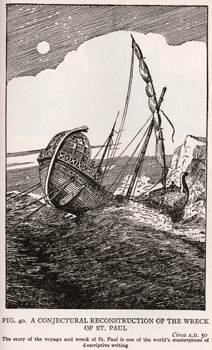
shipwreck-st-paulA letter was written to a newspaper many years ago:

Sir, – The story is told of an Exmouth pilot listening in church for the first time to the story of the shipwreck of St. Paul. The Reader ended dramatically at the verse ‘And fearing lest we should have fallen upon rocks, they cast four anchors out of the stern and wished for the day.’

In utter amazement at such seamanship the pilot was heard to mutter: ‘The damn vools, they’ll ev the backside of ‘er out.’

Yours faithfully,

T. G. SHELMERDINE

Chaplain’s House, Livery Dole, Exeter, April 3

This shipwreck is described in Acts 27 to 28, and the detail given by the ever-meticulous St Luke is quite amazing.

First of all, what do we know about Roman ships? I have found this article. Prisoners were certainly transported in cargo ships. They, and the Empire’s warships, were sturdy vessels. The basis of all ships until the mid nineteenth century was already established: the forecastle or fo’c’sle, the main midships deck and the poop reserved to the officers and the helmsman. Steering was by a large oar coming out of one side of the stern. They were rowed when sailing was impossible due to an unfavourable wind.

The article says:

Anchors and a ship’s boat formed part of the normal equipment, and the whole ship appears to have been well furnished. A single square sail was generally used for propulsion, although in the merchantmen an additional square sail was used on a forwardly projecting fore mast something like a bowsprit, and occasionally a triangular, or “raffee,” topsail hoisted above the main sail.

We also have a fine website – Apostle Paul’s Shipwreck, an Historical Examination of Acts 27 and 28.

Sailing from what is now the western coast of Israel and Lebanon, the ship was bound for Italy. Clearly, Paul was not even a member of the crew but a prisoner. The course was to be a coastal one, since in those days, navigation by the sun and stars was far from being an exact science. Under Cyprus? This I would interpret as being to the lee of the island. Ships in the days of the Roman Empire were square rigged and could not sail upwind. They took down the sails and rowed. They changed ships at Myra in present-day Turkey. They found a passage which would take them to Italy. Paul foretold that they would have a rough time.

They were off Crete when the wind called the Euroclydon hit them. The Mediterranean is a nasty sea, and winds can come from anywhere without warning. In any other sea, there are always signs of bad weather, even if you don’t have scientific forecasts. In that sea, the winds come from everywhere and whip up maelstroms that go in every direction. It is so unpredictable.

Since the ship could not sail upwind, we let her drive – what we would call a run or a full reach. They feared running aground. They strake sail, and so were driven – they dropped the sails and certainly lost steerage. The anchors could have only been for this purpose – see below.

And the third day we cast out with our own hands the tackling of the ship. This seems a little obscure. Perhaps it means that the passengers and prisoners joined the crew to help, probably by rowing since the sails were down.  They sounded their depth with weighted ropes and found the water getting shallow.

Then we get the astounding verse – Then fearing lest we should have fallen upon rocks, they cast four anchors out of the stern, and wished for the day. The Roman ship had a sharp stern and this would have helped to absorb the shock of the waves. This is also the design basis of the Hillyard classic yacht. The sharp stern has its advantages and disadvantages. The anchors must have been used in such a way as to drag along the sea bed and not stop the vessel completely. The waves would cause the square stern of a modern boat to be ripped away, which caused the reaction of the pilot mentioned in the letter to the newspaper. This effect, when using a sea anchor (which they wouldn’t have had) is absorbed by the use of heavy-duty elastic or springs. An anchor (or sea anchor) can be used from the bow or one side of the bow to keep the vessel hove-to and slightly off the waves. Many yachts in bad conditions use this technique and avoid being knocked down and capsized. The drogue prevents broaching. It is the only way to heave-to and keep steerage when all the sails are down and you have no engine. Stern anchoring is risky as this video explains. The boat can get “pooped” by a cresting wave. However, stern anchoring is often used by fishing boats with some kind of absorbing device.

Here is a lecture on the use of the sea anchor and surviving storms.

The crew were about to abandon ship, but Paul told them to stay. Rule number one is to stay with your boat unless it’s going to sink. It must have been quite big, as the number of those on board is given as two hundred and seventy-six. Rudder bands – they knew the technique of lashing the helm. At last, they found a lee shore and hoisted the sail. The ship ran aground and broke up, and was abandoned.

After their time of survival on land, they found another ship, this time from Alexandria and stayed in Syracuse for three days. The passage speaks of fetching a compass. Now this is interesting, because the magnetic compass was first invented as a device for divination as early as the Chinese Han Dynasty (since about 206 BC). Its use in Europe was first recorded in around 1187 to 1202. Were the Romans using this magnetic compass, or did they have some other device by this name? It appears to have been unknown outside China at this time.

This New Testament account gives us quite a lot of information about sailing in those days, but many aspects are obscure. We find that the techniques of handling a ship were not very much different from anything up to the mid nineteenth century.

Posted in Uncategorized | Tagged , , | Leave a comment

New Reefing System

This is something I have wanted to do for some time. I began to comment on reefing a Mirror dinghy sail and saw the ideas of Mr David Sumner who lives in southern England and is very serious about his Mirror cruising. When taking a boat out for more than a couple of hours, there are precautions to take, especially having a proper anchor, oars and, above all, the possibility of shortening sail. That is of course on top of the usual safety equipment like VHF, mobile phone, life jacket and suitable clothing like a wet or dry suit, flares, signalling mirror, bailer or bilge pump, fog horn, etc. Thus, if we are hit by bad weather, we have a much better chance of surviving and keeping the boat intact for the next outing.

My first reefing system was something like that of the young Australian in the other article. He uses a single line. I thought this would be great, because of the principle of Occam’s Razor – the simpler it is, the more reliable it will be. The problem is that tightening both the tack and the clew of the reefing line together will cause friction and wear to the sail. His system is fine for him, because his boat has a bermudian rig. A gunter rig, such as the Mirror has, needs a device to keep the yard (gaff) close to the mast. I devised a sliding strap, but it made it difficult to hoist the yard because of friction. There was another difficulty – the impossibility of dropping the mainsail altogether in a big blow and getting the boat to the shore by rowing or waiting out the storm at anchor (or sea anchor).

Some time ago, I discovered this video of David Sumner’s boat, already in my previous article on reefing.

I then contacted him, and he has sent me drawings, which I will not reproduce here. He is a member of the Dinghy Cruising Association in England and frequently posts to Openboat. If you join this e-mail list, Mr Sumner’s drawings can be found in the files section.

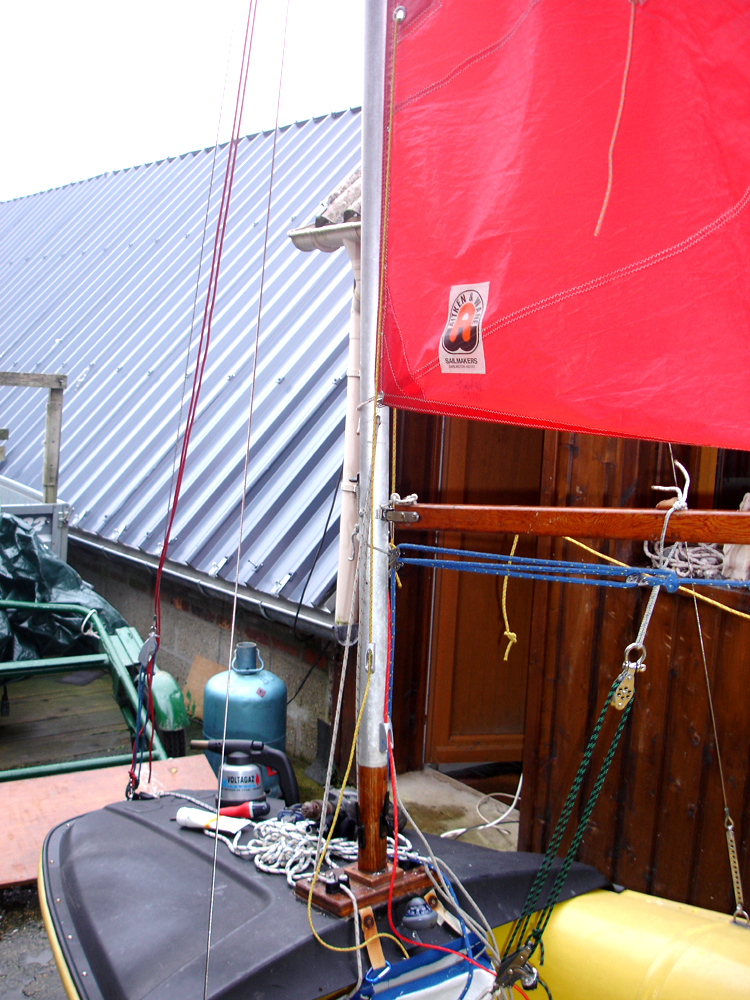
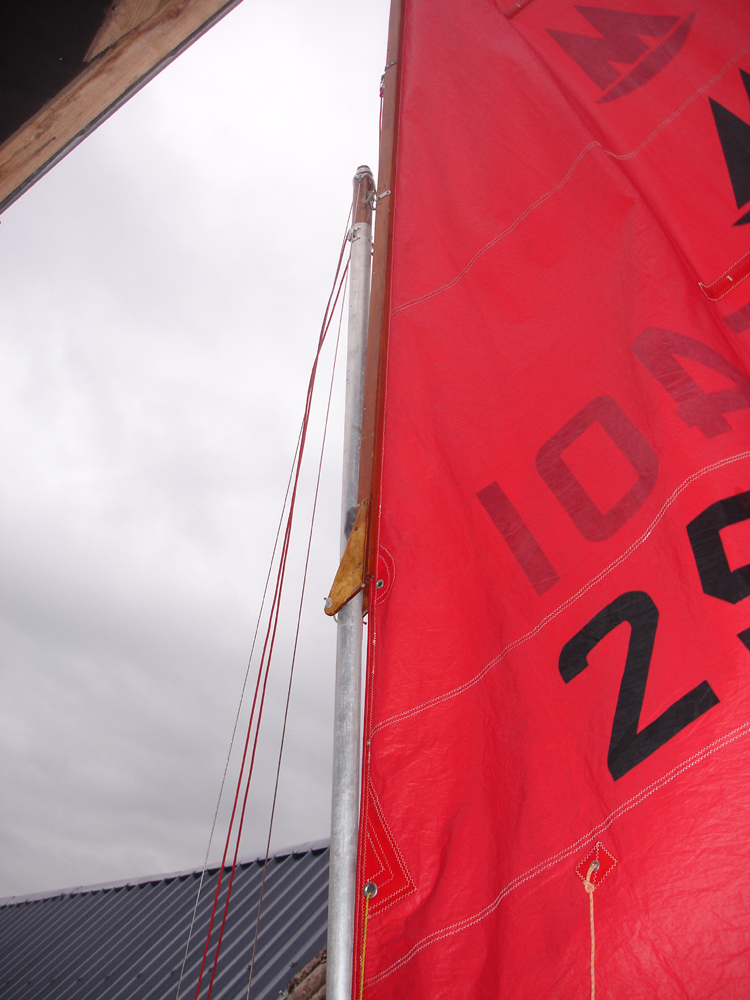
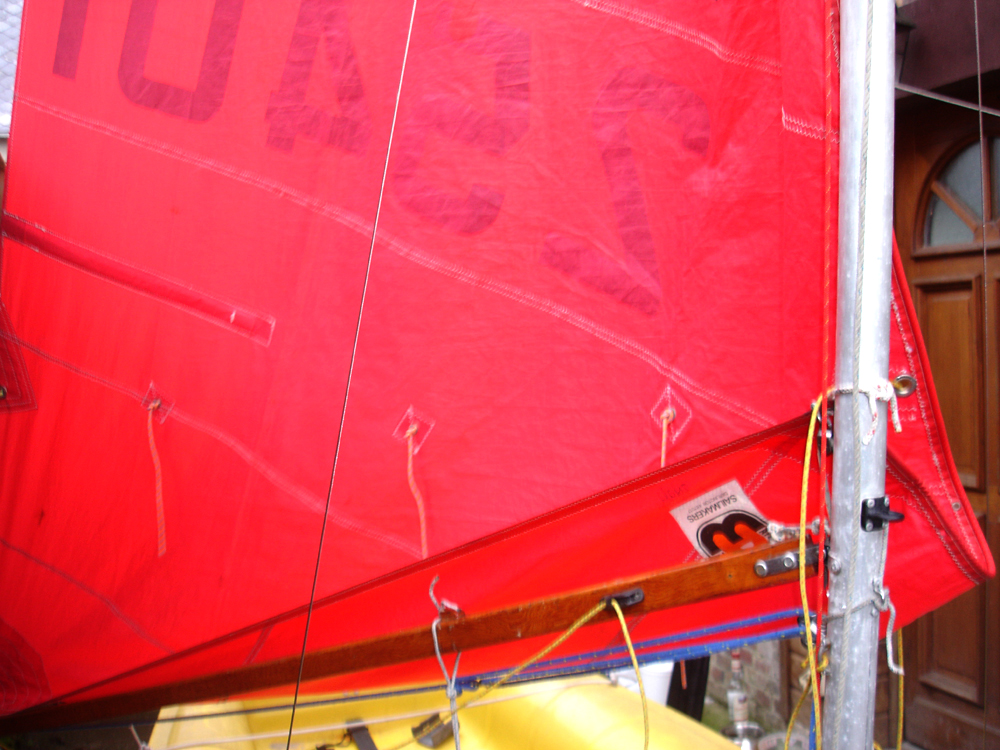
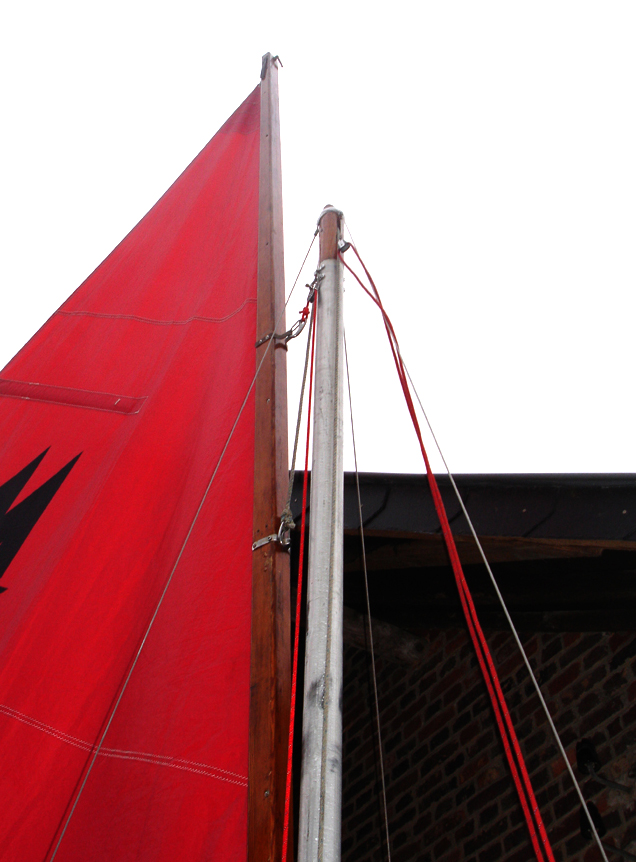
I did the job today with my boat rigged up in the back yard. My new system is based very closely on Mr Sumner’s. The second halyard is identical and runs from a pulley shackled to the top of the mast. The clew reefing line is the same, and the tack reefing line runs from the mast and not the boom, reflecting the cunningham line for the normal rig.

Now for photos. To avoid confusion, the explanations of all the photos are above the photos they describe.

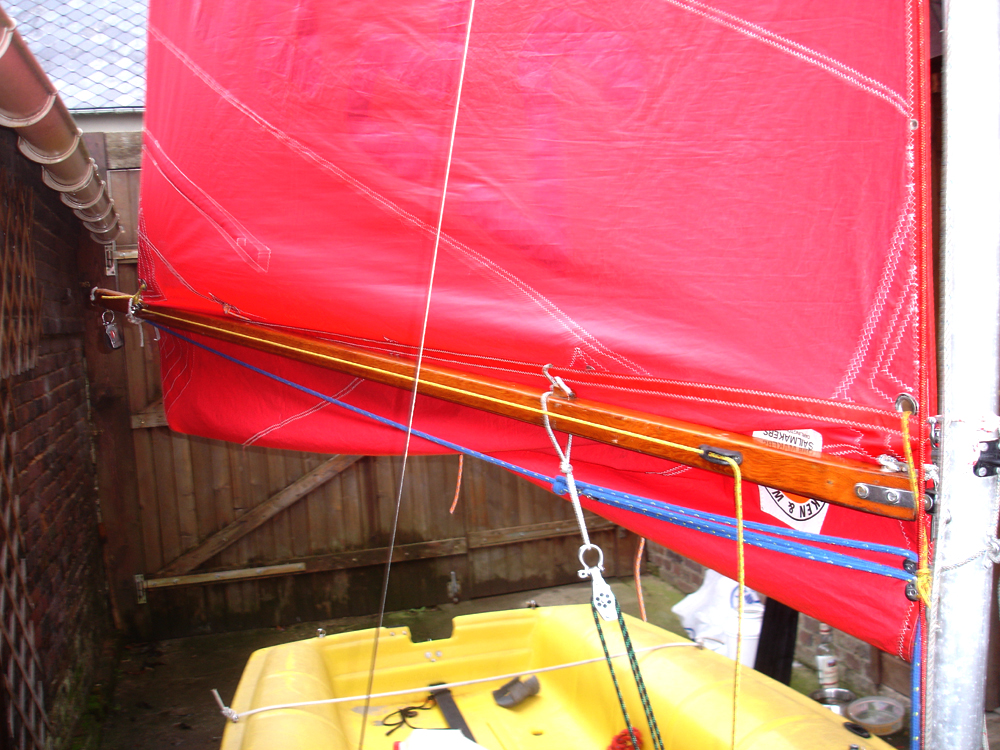
In the first photo, I have followed Mr Sumner’s advice and dispensed with the standard Mirror whipping of the luff to the mast. It is not necessary. However, I have included a tack strap to keep the tack close to the mast. My outhaul is the blue rope using a pulley system and running to a the starboard cleat at the foot of the mast. The yellow rope is the tack reefing line. The cunningham runs to the port cleat at the bottom of the mast. I have distanced the jib halyard from everything to avoid confusion. The reefing halyard is red and runs to a clam cleat in the centre of the mast (main halyard on the starboard mast cleat and the jib halyard to the port mast cleat).

normal-port1This is the normal rig from the port side. The reefing halyard  runs up to its point on the yard. The yard is hauled up as far as it will go on the normal main halyard.

normal-port2Going round to the starboard side, the clew reefing line is seen in a clamcleat on the boom. The tack reefing line (yellow) runs from its point of attachment on the mast, through the tack and back down to the cleat which you cannot see on this photo.

normal-sbd1At the top of the mast, starboard side, the reef halyard pulley is clearly seen, as are the two fixing points on the yard. The other pulley forward of the mast is for the jib halyard. I wanted the reef halyard in blue rope, but the ship chandler didn’t have enough, so I had to buy my 5 mm rope in red. There’s no confusion, because the two halyards are in different places.

normal-sbd2You then release the main halyard and the boom drops, unless you use topping lifts that hold the boom up when there is no tension on the leech of the sail. You then haul up the yard by the reef halyard as far as it will go, then cleat the halyard.

boom-droppedHere is the yard on the reef halyard.

reefed-sbdYou then pull in the clew and tack reefing lines, and you get this. The mainsheet isn’t on. This is my back yard and not the beach! You can still see my blue outhaul line inspired by the Laser system, so the foot of the sail can be adjusted at sea as can the cunningham. But neither are in use when the sail is reefed.

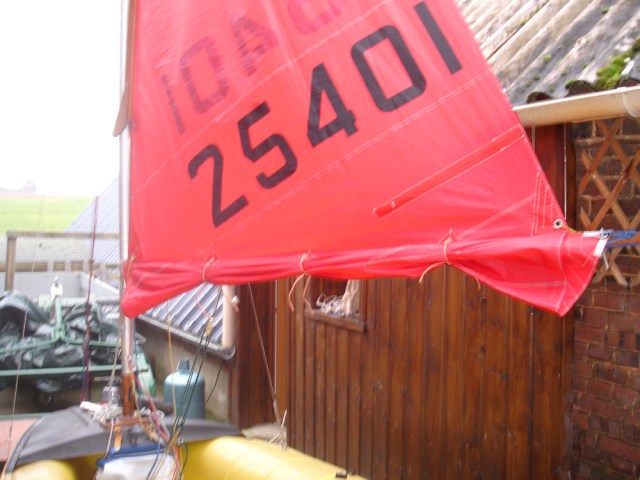
sail-reefedIt now suffices to tie up the sail using reef knots. This is where the name of this knot came from – left over right and right over left. The sail is reefed, and this operation is possible at sea. It is advisable to anticipate bad weather. To quote Shakespeare: Better three hours too soon than a minute too late. Well, perhaps not three hours, but at least in plenty of time before it really starts to blow.

reefed-portI have also adopted Mr Sumner’s jib dropping system. You release the halyard and pull the top of the jib down using a fine rope that passes through a pulley fixed to the foredeck. When the jib is down, you just tie it into a bundle with the “down-haul” cord. You then sail with the reefed mainsail alone – just get the tacks right so as not to get “in irons”. If that does happen, you push on the boom and push the tiller the other way. You then get a beam wind and then you “re-boot” the boat by pumping the mainsail to get beyond the initial inertia.

Then you get the hell out of it!

Posted in Uncategorized | Tagged , | 4 Comments

How the Use of Sarum Shaped a Village Church

roodscreen-devonshireI have just found this on the New Liturgical Movement, a blog that is quite rich in articles on medieval liturgies – How the Sarum Rite Shaped the Art and Architecture of a Country Church in Devon. The village in question is in Devonshire, and there are some fine photos of the church with explanations.

Some of the comments brings up a very apposite point – the difference between cathedral and parish church liturgy, and also the difference between modern Anglo-Catholicism and country folk Catholicism. In parishes in the fifteenth century, there were still the means to “do quite a lot” in the way of a sung procession and high Mass, and at least Vespers on Sundays and holy days.

I appreciate the reflection:

My point was really to avoid the errors of the “British Museum” school of liturgists, who seemed to think that every Sunday mass was a complicated choreography with armies of “clerkes” in apparelled “albes” (or even “aubes”!) popping in and out of side chapels to do picturesque things with the elements. One cannot quite see the parson of a vil, tired out after six days tilling his glebe, coming over all Dearmer-like on Sunday!

My sentiments exactly, celebrating Mass each day according to this use without the “high camp”. For example, I had Roman vestments before I started using Sarum – and I still use them except for a couple of simple gothic vestments I have. When the Dominicans use their old rite, they do it unselfconsciously, with the vestments they have. Unlike some of our friends in London and the English Universities, I have lived in country parishes and seen some of the last dregs of folk religion.

I never have the means to do any more than a low Mass, except with some singing when I have someone present, and incense for the big feasts. Sarum being very similar to the Dominican Rite, it’s actually a lot simpler and more sober than the pre-Vatican II Roman Rite I was trained in at seminary.

Sarum is just different culturally from the Counter-Reformation Roman style, but is really no different from the diocesan usages of anywhere in northern Europe in the fifteenth and early sixteenth centuries. France was one of the last countries to go along entirely with the Council of Trent and centralised Roman norms of liturgy and religious culture. One thing one learns about history is that there are long “transition” periods between, for example, the late medieval and the Renaissance, and many aspects of medieval life and culture survived into as late as the twentieth century. There are still faith healers and specialists in herbal medicine who would have been burned at the stake in the old days. One has to make a subtle separation between the trappings and the fundamental culture of a person or a micro-society. Someone living in the second half of the eighteenth century wouldn’t have woken up one morning and said “we are no longer in the baroque era and today is the beginning of the classical era“! To make an example of that period, baroque styles continued well into the nineteenth century (and even now in pastiche), and romanticism was latent already in the eighteenth century, for example in the works of some artist-painters and in literature and poetry.

However, I don’t spit on the “Dearmerite” movement in late nineteenth-century and belle époque England. With the Arts & Crafts movement, it was a new cultural inspiration. It was short-lived, cut off by the “realities” of World War I just a hundred years ago, but it was a brave attempt at Catholicism for intellectuals and the artistic temperament. We live in days when traditional folk Catholicism is just about gone, the last remnant being the armies of old ladies with rosaries. All that remains is the damp and dusty building and the silent witness of the old furnishings. A body without a soul is a corpse.

If I promote something of the “Dearmerite” spirit, it is to keep the memory of “local” Catholicism alive as something representing freedom as contrasted with the centralism, firstly of Tridentine and baroque norms, and then of the present “cult of ugliness”. As I grow older, I see how fragile it all is, and am fearful about it all being totally forgotten.

The subject of Sarum shows an uncanny interest and nostalgia that persists and captures the imagination – and some of the deepest longing of us English and northern Europeans. There’s something there, just waiting for good soil and water to germinate the long-dormant seed.

Posted in Uncategorized | Tagged , | Leave a comment

Happy Thanksgiving

What goes round comes round. Whatever Thanksgiving means to you, I wish my American readers a happy day.

Posted in Uncategorized | Tagged , | 1 Comment