How the Use of Sarum Shaped a Village Church

roodscreen-devonshireI have just found this on the New Liturgical Movement, a blog that is quite rich in articles on medieval liturgies – How the Sarum Rite Shaped the Art and Architecture of a Country Church in Devon. The village in question is in Devonshire, and there are some fine photos of the church with explanations.

Some of the comments brings up a very apposite point – the difference between cathedral and parish church liturgy, and also the difference between modern Anglo-Catholicism and country folk Catholicism. In parishes in the fifteenth century, there were still the means to “do quite a lot” in the way of a sung procession and high Mass, and at least Vespers on Sundays and holy days.

I appreciate the reflection:

My point was really to avoid the errors of the “British Museum” school of liturgists, who seemed to think that every Sunday mass was a complicated choreography with armies of “clerkes” in apparelled “albes” (or even “aubes”!) popping in and out of side chapels to do picturesque things with the elements. One cannot quite see the parson of a vil, tired out after six days tilling his glebe, coming over all Dearmer-like on Sunday!

My sentiments exactly, celebrating Mass each day according to this use without the “high camp”. For example, I had Roman vestments before I started using Sarum – and I still use them except for a couple of simple gothic vestments I have. When the Dominicans use their old rite, they do it unselfconsciously, with the vestments they have. Unlike some of our friends in London and the English Universities, I have lived in country parishes and seen some of the last dregs of folk religion.

I never have the means to do any more than a low Mass, except with some singing when I have someone present, and incense for the big feasts. Sarum being very similar to the Dominican Rite, it’s actually a lot simpler and more sober than the pre-Vatican II Roman Rite I was trained in at seminary.

Sarum is just different culturally from the Counter-Reformation Roman style, but is really no different from the diocesan usages of anywhere in northern Europe in the fifteenth and early sixteenth centuries. France was one of the last countries to go along entirely with the Council of Trent and centralised Roman norms of liturgy and religious culture. One thing one learns about history is that there are long “transition” periods between, for example, the late medieval and the Renaissance, and many aspects of medieval life and culture survived into as late as the twentieth century. There are still faith healers and specialists in herbal medicine who would have been burned at the stake in the old days. One has to make a subtle separation between the trappings and the fundamental culture of a person or a micro-society. Someone living in the second half of the eighteenth century wouldn’t have woken up one morning and said “we are no longer in the baroque era and today is the beginning of the classical era“! To make an example of that period, baroque styles continued well into the nineteenth century (and even now in pastiche), and romanticism was latent already in the eighteenth century, for example in the works of some artist-painters and in literature and poetry.

However, I don’t spit on the “Dearmerite” movement in late nineteenth-century and belle époque England. With the Arts & Crafts movement, it was a new cultural inspiration. It was short-lived, cut off by the “realities” of World War I just a hundred years ago, but it was a brave attempt at Catholicism for intellectuals and the artistic temperament. We live in days when traditional folk Catholicism is just about gone, the last remnant being the armies of old ladies with rosaries. All that remains is the damp and dusty building and the silent witness of the old furnishings. A body without a soul is a corpse.

If I promote something of the “Dearmerite” spirit, it is to keep the memory of “local” Catholicism alive as something representing freedom as contrasted with the centralism, firstly of Tridentine and baroque norms, and then of the present “cult of ugliness”. As I grow older, I see how fragile it all is, and am fearful about it all being totally forgotten.

The subject of Sarum shows an uncanny interest and nostalgia that persists and captures the imagination – and some of the deepest longing of us English and northern Europeans. There’s something there, just waiting for good soil and water to germinate the long-dormant seed.

Posted in Uncategorized | Tagged , | Leave a comment

Happy Thanksgiving

What goes round comes round. Whatever Thanksgiving means to you, I wish my American readers a happy day.

Posted in Uncategorized | Tagged , | 1 Comment

The “Petite Eglise” of the Deux-Sèvres

This is a story of another time in history, which is little known in the English-speaking world. It is one I am posting today for the sake of historical knowledge and our general culture. This phenomenon is obscure because of its extremely local nature. The largest of the communities that refused the deal between Pope Pius VII and Napoleon Bonaparte in 1801 is that of the Deux-Sèvres. There were other dissidences, particularly in the Lyons area and the Walloon, the French-speaking part of what is now Belgium.

When I lived in the Vendée, I visited the village of Courlay and went to the Petite Eglise church. It was locked, but I could see quite a lot through the keyhole. The most striking thing about it is that there was no structure in front of the high altar for Mass facing the people. Otherwise it looked like any rural French village church. On the other hand, Mass has not been celebrated in this church since the early nineteenth century!

The Petite Eglise of the Deux-Sèvres is now mainly concentrated in the north-west of the Deux-Sèvres, essentially in Courlay, Cirières and Montigny. Those people describe themselves as “dissidents” or “those who share our ideas”. They are country folk, honest and hard-working, and remind me a little of the Amish in Pennsylvania.

doc-105The origin of this schism in readily available in history books. For those who read French, I recommend the following links:

A small bibliography can be found in the second of these two links.

Napoleon wanted a kind of settlement (idea familiar to us Anglicans thinking back to Elizabeth I) to settle the difference between the constitutional priests who signed the Civil Constitution of the Clergy and the non-juring or refractory clergy. It resembles something like the Russian Orthodox Church under Communism. There was the Patriarchate of Moscow and then the Russian Church in Exile, now known as the Russian Orthodox Church outside Russia and now back in communion with Moscow. Like the Greek Old Calendarists and the Old Believers, there remain a number of “non-juring” communities. Napoleon obtained a concordat with Pius VII, who was Bonaparte’s prisoner, to reorganise the dioceses of the French Church and have the clergy accept the authority of constitutional and refractory bishops alike.

It is the kind of problem that is found in almost all periods of church history, especially after the persecutions under the Roman Empire. The Donatists refused to have anything to do with Christians who had betrayed the Church or given secret liturgical texts to the persecutor. This was the essence of the controversy against which Saint Augustine fought. There is a point at which the moral conscience is excessively rigorist, across which the sin of betrayal or sacrilege is committed – and a point when some flexibility is required to obtain a greater good, across which too much complicity with the world destroys the whole point of Christianity. Those dividing lines are easy enough to understand in hindsight, but someone faced with such a moral dilemma has a hard time of it. This is also a part of our lot of being clergy and lay members of dissident Anglican Churches and broken-away Roman Catholic communities.

There is a close modern equivalent of the Petite Eglise, but one that is more urban and fragmented than those robust folk of the Vendée. “Home-alone” sedevacantists. These modern dissidents, whose ideology goes far beyond simple fidelity to the old Roman rite, orthodox doctrine or Christian political ideas, tend to be individuals. Here is a somewhat partial article on this subject by a sedevacantist priest – Home Alone?. This is an article by a home-aloner for objectivity. Home-aloners reject all clergy ordained since 1958 (death of Pius XII) and who have never been “compromised” by accepting the teaching of Vatican II. As most such priests are no longer alive, home-aloners do not go to church but rather practice their religion privately through lay devotions and other forms of prayer and worship not requiring a priest.

Back to our subject, Pius VII agreed to recognise the French Republic and the government of France in its turn recognised Catholicism as the religion of most of the French people. The Holy See let Napoleon name bishops to the various dioceses and require an oath of loyalty to the established government. The diocesan borders were changed to coincide with the Département. Thus the Archdiocese of Rouen covers the Seine Maritime, though there is now a suffragan Diocese of Le Havre for the western part of the Département. The part where I live is under Rouen. That arrangement was not changed by the Separation of Church and State in 1905.

The Concordat of 1801 was refused by a number of bishops like Bishop De Coucy who was at La Rochelle from 1789 until then and who was exiled in Spain to escape the guillotine. The grievances included the integration of constitutional clergy, the reduction of holy days of obligation, the obligation of contracting a civil marriage before the Mayor before being married in church, the oath of loyalty to the Republic and the retention of property seized at the Revolution (monasteries for example).

Many local communities split away and gathered in very localised areas. In 1820, the Petite Eglise numbered around 20,000 souls. That number quickly declined as the clergy died out and the bishops were not prepared to consecrate schismatic bishops. [It was probably this consideration that weighed most in Archbishop Lefebvre’s mind in 1988 as he consecrated four bishops against the will of Pope John Paul II.] Indeed, the last bishop died in 1830, and only the worst quality of priests could be found: immoral priests, alcoholics, adventurers, charlatans, false priests, etc. After a time, they gave up on priests and entrusted the responsibility of their communities to laymen. Worship was definitively lay-led from 1847. Thus, in Courlay, the leader is chosen from the same Texier family, descended from the parents of Fr Pierre Texier (1758-1826). The women have their responsibilities in the schools and looking after the churches. Here is the church at Courlay.

petite-eglise-courlayThe particularity of the Petite Eglise, like the Amish in America, is not to proselytise or recruit converts. They kept themselves to themselves, and to this day, it is difficult for newspaper reporters of academic researchers to find what they are looking for or to visit a church. By 1958, they were down to about 3,150 souls.

There have been concessions by the Roman Catholic Church in regard to the dissidents, Archbishop Gerlier of Lyons in particular, in the 1950’s. The dissidents were acknowledged as Roman Catholics despite their separation for political and historical reasons. They could receive Roman Catholic sacraments like any Roman Catholic, but it seems that none have availed of this provision. Likewise, a dialogue with the Dutch Old Catholic Church in the nineteenth century came to nothing.

Worship is in the church, but many devotional practices are at home in families. It consists of parts of the Mass without the offertory to the communion, a spiritual “communion of desire”, the Office and traditional lay devotions. A Sunday service takes about two hours. Their fasting practices are very rigorous, and they also abstain from cheese and eggs. Women must wear the veil, and modest dress is a must, as in many traditionalist RC chapels in our own times. Men sit on one side of the church and the women on the other.

The Petite Eglise has two true Sacraments: Baptism and Marriage. The French government dispenses these people from a prior civil wedding before being married in church. One would suppose that the lay leader has delegated powers from Monsieur le Maire. They make confession directly to God and choose their own penance (people can be very hard on themselves).

They use an old catechism from before 1789, so it would be more or less based on the Catechism of the Council of Trent. The children are taught intensively for a month preceding their solemn “communion”, and are dispensed from school. They have their own cemeteries, and are not buried in the regular Roman Catholic cemetery. The graves are oriented to the west.

Their social mores are very similar to the Amish, though young people often leave the community, marry a Roman Catholic and enter secular life. Modern secular life is taking its toll on the Petite Eglise as on all religion in France. I have no accurate information on current statistics or numbers of faithful.

A word of warning to the unwary. Some of the episcopi vagantes of our own times have attempted to claim legitimacy through some kind of connection with the Petite Eglise. At no time has the Petite Eglise accepted ministrations from “wandering” clergy or even from the Dutch Old Catholic Church. They have been totally without clergy from the first half of the nineteenth century.

Posted in Uncategorized | Tagged , , | 12 Comments

Around the World in an Open Boat

I have just discovered another amazing feat from the annals of seafaring. It is the incredible voyage of Anthony Steward, a South African, who circumnavigated in a nineteen-foot open boat, modified from a coastal trailer-sailer dayboat.

No one has done it since! That’s man’s ability to survive was incredible. We could judge him as mad or selfish for putting his family to so much anxiety. On the other hand, he did it! Just imagine the wealth of his personality after the feat…

Posted in Uncategorized | Tagged , | Leave a comment

A Better Sarum Calendar

I forgot about this very important source of Sarum material, especially the Office.

It includes the Calendar2013 for Advent and up to 31st December 2013 and 2014 from 1st January 2014 to 31st December 2014. The pdf files can be downloaded and printed, and then tidied up in ring binders. This calendar is in English and has had more work and research put into it than my humble effort. There are also details from the Pie (priestly directory).

This calendar is also relevant for those using the Book of Common Prayer.

Posted in Uncategorized | Tagged , | Leave a comment

Another Plea for a Church of Human Dimensions

My brother priest Fr Jonathan Munn has written another cri de coeurUnashamed Idealism. I added a brief comment, suggesting that my old article Rigorism,Tutiorism and Probabilism had some relevance by analysing the roots of the legalistic and judgemental attitude some Christians have in regard to the weaker members of their Church and society in general.

It is difficult to be idealistic when everything we stand for is being challenged, extinguished and stamped out by our contemporaries. Is humanity reduced to the level of internet trolls and those who carve you up on the road in their cars? The cynic, according to Oscar Wilde, is one who knows the price of everything but the value of nothing.

Like Fr Jonathan, I write this blog because I think there is an alternative to the dystopian dread we all have of some kind of “fourth Reich” or Orwell’s Nineteen Eighty-Four. That alternative is the sweetness and freshness of Christ. Our agony is not being able to anticipate for the future beyond our own deaths. We are threatened either by global warming or freezing (depending on which scientists you find more credible), political and economic collapse and the breakdown of civilisation. At the same time, the tired out old monsters refuse to die and leave their place to youth and freshness.

This article on the Hitchins brothers and atheism is interesting:

Whereas Christopher has a rather baroque literary style, his brother writes soberly and directly. His fundamental theme is this: though the atheists claim just the contrary, the collapse of Christianity carries in its wake dire consequences for civilization itself. Peter Hitchens was a foreign correspondent in Moscow during the waning years of the Soviet Union, and he experienced a culture in deep crisis. There was political corruption of every type on every level of the system; there was widespread drunkenness; abortions far outnumbered live births; and a suspension of common courtesies—exchanging common signs, holding doors, etc.—was everywhere in evidence. How does one begin to explain this almost total ethical collapse?

The late Christopher Hitchins was an atheist, but his brother Peter saw the consequences of the suppression of Christianity in society. Suppress Christianity and you also suppress kindness, love and altruism. The world becomes money and money becomes the world!

Some day, there will inevitably be a reaction and a rediscovery of Christianity through hunger and thirst for everything Christ represents in terms of human values as well as transcendence. Churches would follow a similar path, eschewing legalism and bureaucracy to bring the Church back to the Sabbath being for man and not man for the Sabbath. Our little continuing Churches are a first step in this prophetic way of announcing the Gospel and living the sacramental presence of Christ among us – without facing uncaring ivory towers and whited sepulchres of inhuman bureaucracy.

I think most of us – individually – have a vision of a Church of human dimensions, in the same way as we are nostalgic for humanity and honesty in trade and business. We prefer our souls to some deterministic and mechanistic relentless “system” that processes us and dehumanises us. Man was never meant to live in such vast social and political “units” (nation, European Union, world government, etc.). We were intended to live in tribes and families. Our Continuing Churches, whilst they remain small, are spiritual “tribes”.

Nicholas Berdyaev had a profound vision of the end of the Renaissance and the revolt against God, a long period of darkness like St John of the Cross’ Dark Night of the Soul, and finally a new Middle-Ages of luminous churches, learning, culture, kindness and love and everything in our dreams to which the human soul aspires. It will come in this life or the next, rather the next for folk of my generation. All we can do is plant and sow, for others will reap after us.

Posted in Uncategorized | Tagged , , , , | 2 Comments

Abolish the Priesthood?

In view of the weight of claims for the episcopal consecration of women and the “empowerment” of the laity one keeps hearing in French dioceses, I did a search on Google to see if anyone had seriously considered abolishing the priesthood completely. I came across Abolish the Priesthood! and read the article on the Association of Catholic Priests website. I can’t help thinking of the absurd scenario of Hitler issuing an order to sink the Bismarck!

In so many of these calls for “reform” along Protestant lines but going much further, my question is – Why not go all the way? Abolish religion? The would-be church reformer meets the atheist on common ground. All the same, we are brought to ask whether Christ instituted the Priesthood through the Last Supper and allowing himself to be sacrificed as the “proto” priest and the victim in order to bring about the Redemption. Or is this all rubbish, and was Christ’s mission merely a moral one, or even a political one?

I have made many criticisms of clericalism and ecclesiastical bureaucracy, but I clearly separate them from the sacramental Priesthood. I am not enough of a historian to go into the question of the point at which early Christians expressed an explicit notion of the priesthood and episcopate. For the episcopate, it looks like the Epistles of Saint Ignatius of Antioch, but the notion of a Priesthood would seem much older. I would appreciate help from readers.

In the meantime, this is interesting – Were there priests in the early church? Garry Wills says no. He’s wrong, and here’s why.

On the other hand, the thirst some (not always women) have for the ordination of women and therefore their admission into the clerical caste seems to contradict their desire to see the priesthood disappear. It does occur to me that the priesthood would go, but clericalism would remain. Don’t count on me to have anything to do with such a church!

The confusion of priesthood with clericalism seems to be the hub of the whole question. The priesthood is blamed for the sins of clericalism, and then a priestly clericalism is then replaced by a lay clericalism with the same spirit of bureaucracy, tyranny and un-Christian spirit. It isn’t because a priest is able to bring about the sacramental bodily presence of Christ at Mass that is a problem. The problem is when he considers himself to be there to be served and not to serve. That is clericalism, not priesthood.

Is there any historical basis to the assertion that the early Church was priestless and that the Eucharist was a later invention? This article comes up with an amazing notion, certainly unintended but of significance to us Anglicans.

… criticises those who argue for the ordination of women or men in married or gay relationships, suggesting that the most honest position would be one that seeks the abolition of priesthood entirely.

The problem for the reformer is that abolishing the priesthood would mean abolishing the clerical state. But that ain’t going to happen. The reformer will replace the priest with the cleric who is not a priest. Those who guillotined the king in 1793 would be tyrants such as Louis XVI never was. This is the nature of revolution. The claim is made that the Church without the priesthood would be egalitarian and just for all, but this is an illusion. The new clericalism would be much worse than the old. The “lay clerical” church exists here in France and elsewhere – and it isn’t making converts!

What is needed is for priests to put aside clericalism and bureaucracy to bring out the sublimity of our vocation in spiritual and pastoral terms. We need to develop the doctrine and spirituality of the priesthood, and be able to live this vocation even when we are in the catacombs, wearing lay dress because the cassock has taken on a political meaning to replace its spiritual symbolism, celebrating Mass alone because the world is indifferent to it and what it means. Being a priest is like a tiny boat on the immense sea – the Lord must increase as we decrease.

Posted in Uncategorized | Tagged , , , | Leave a comment

Mobile Chapels

I’m in the mind to continue this theme. I remember reading a book by Fr Werenfried van Straaten about his work in eastern Germany just after World War II in the flattened and devastated cities. This is one of the most remarkable priests of the twentieth century, a Norbertine Canon, who bred pigs on his monastery farm to get salt meat over to Germany to feed the people he was ministering to. For this reason, he got nicknamed the “Bacon Priest”. I have always appreciated the work of Aid to the Church in Need, and it was my great privilege to sail for this charity two years ago in the Naviclerus regatta.

L'aigleAid to the Church in Need still does wonderful work in the world, especially where Christians are persecuted by intolerant Muslims. I discuss this wonderful priest and ACN because they had an original way of bringing Mass and the Sacraments to those suffering people. Fr Werenfried launched a Rucksack Priest campaign with priests going out in cars and on motorcycles to those who were still displaced. He used decommissioned army trucks to make mobile chapels. In the truck, there would be some basic living accommodation for the priest and a sacristy. The central section would open up to reveal the sanctuary of the chapel. The congregation would attend Mass from where they were standing in the street.

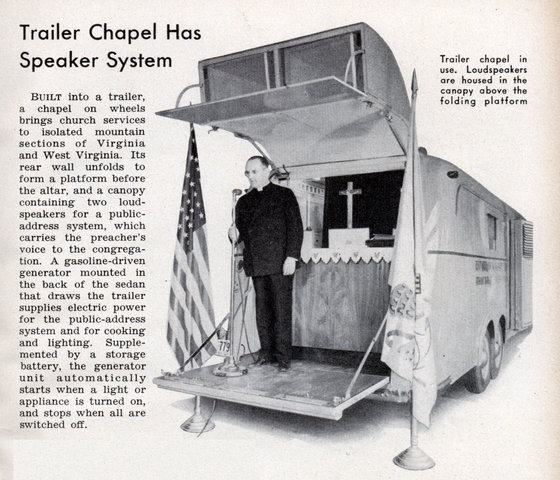
ACN-chapelMobile chapels are used in the USA. The early ones were quite sweet like this one.

mobile-church-tiny-house-of-godIn later times, they became quite tacky and vulgar in their style. This one appears to be from the 1950’s, operating according to similar idea to that of the ACN vehicles:

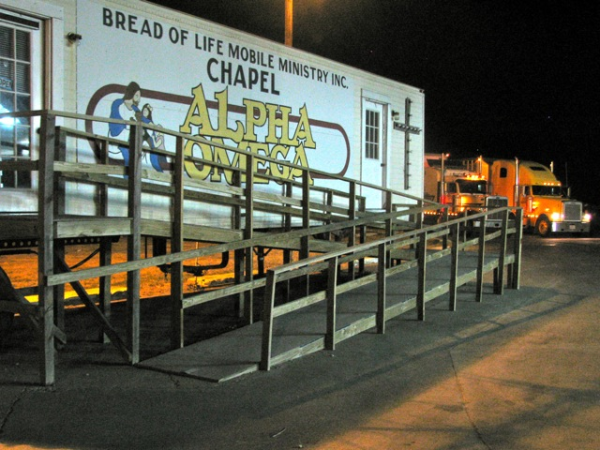
med_trailer_chapelSome of the Evangelical churches are using full-sized semi trailers like this one:

evang-truck-chapelThis is a Russian Orthodox mobile chapel:

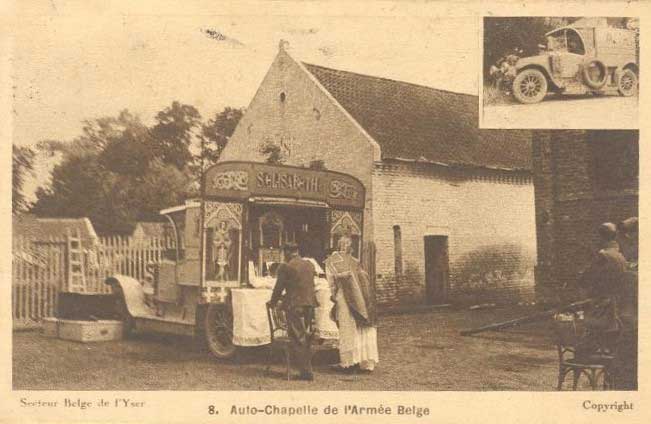
orthodox-chapelHere’s one from the World War I era, featuring the Belgian Army:

belgian-armyThere is no end to human ingenuity and inventiveness, and this is something I admire about those who are able to think “out of the box” – quite the opposite of bureaucracy. When we begin to find solutions to needs, then we will be looking at the true renewal of the Church.

Posted in Uncategorized | Tagged , | 1 Comment

Tuck Box Chapel

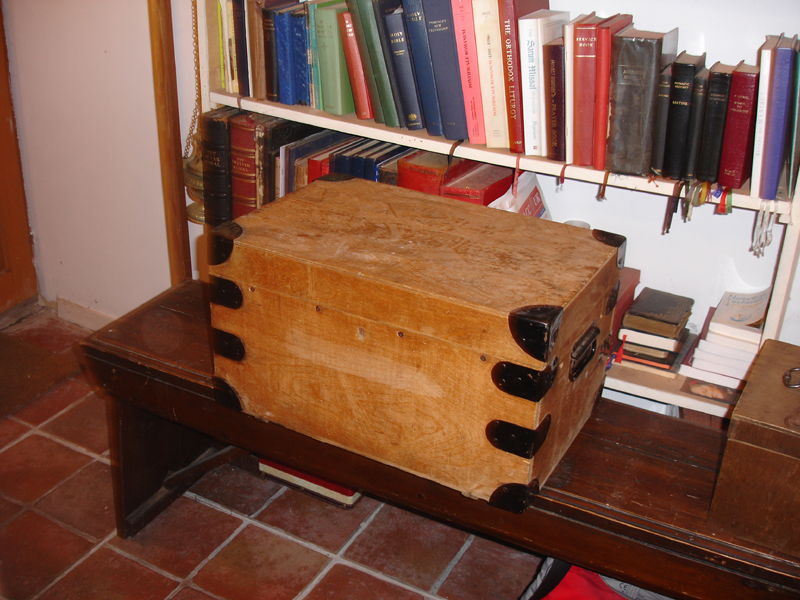
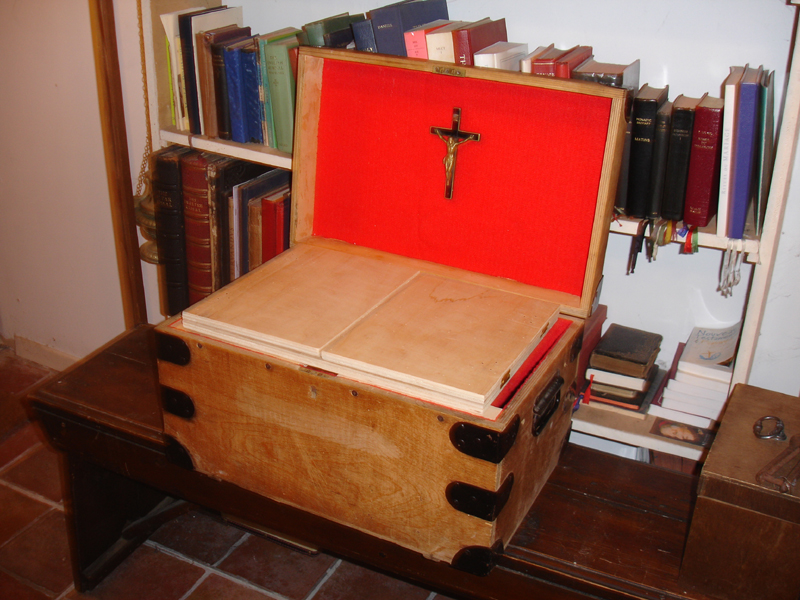
Following on from my previous article, it occurs to me that I have never shown my tuck box chapel. A schoolboy’s tuck box is perhaps his most important piece of standard equipment at an English boarding school. It goes with the schoolboy’s trunk which contains his clothing. My parents bought it for me in 1972 when I went to St Peter’s in York.

Every boy in an English public school (private boarding school like Eton, Harrow, Charterhouse, St Peters in York, Cheltenham College, etc.) has his own tuck box, a robust wooden container that can be locked. They were originally used for storing supplies of food and sweets, but they are actually used for personal belonging like books and games, letters from home and photos. Nowadays, a boy has a laptop and a mobile phone, and they lock more securely than the ones we had!

By way of a brief digression, going to boarding school was a wise decision of my parents. It was emotionally hard, but it gave us independence and brought us to make more efforts to socialise. It even brought us to appreciate home and family life much more. I am grateful to have had such an education. The tuck box was the only privacy we had, a symbol of our secret loves and longings. After I left school, I used my tuck box for woodworking tools and it lay disused for some years in the attic at home. When I was ordained a priest, I considered the possibilities of making a portable chapel. My old tuck box was the obvious solution.

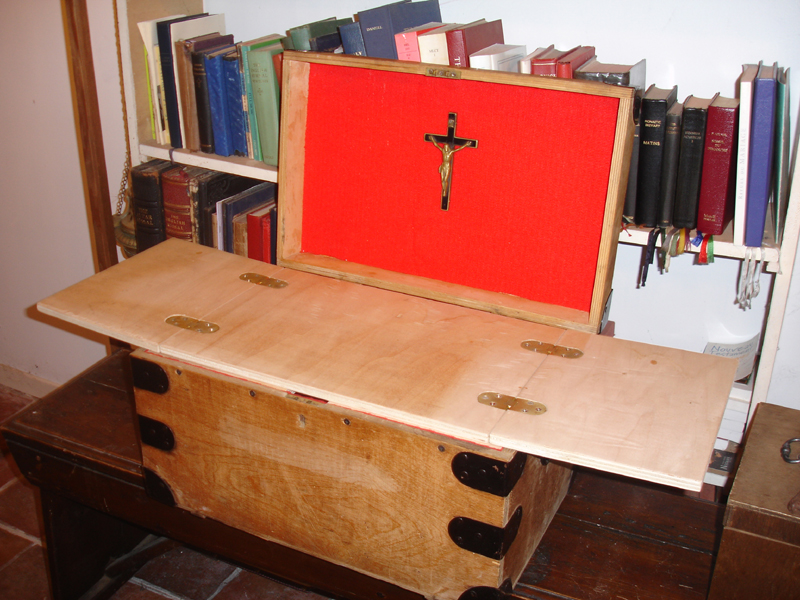
The folding table just under the lid is attached by two hinges. It lifts up for access to all the things needed for Mass like the altar cloths, vestments, chalice, candlesticks, etc. This is one possibility for saying Mass in a private home or even on the tailgate of my van. When it is placed on an ordinary domestic table, it is just the right height for saying Mass.

tuckbox-chapel1Tuck box with everything packed in it

tuckbox-chapel2Tuck box with the lid lifted showing the crucifix fixed to the inside of the lid, table folded.

tuckbox-chapel3Tuck box with the table extended

tuckbox-chapel4Tuck box chapel ready for use

Posted in Uncategorized | Tagged , | 1 Comment

Temporary Altars

I am overjoyed that the Anglican Catholic Fellowship (our diocese in England)  is ministering to house groups and isolated folk. One such group is being established in Whitby, the north-eastern port that represents my own roots and means a great deal to my own family. Our diocese had a church and parish in Whitby, but the priest has chosen another path and our Bishop had had no choice other than to part company with him for disciplinary reasons.

This may be the beginning of a new group that could develop into a parish, worshipping in private homes for the foreseeable future. Perhaps one day, they would get the use of a cemetery chapel or build their own.

See Churches of the Future.

Our diocesan site shows the home altar used for Mass in Whitby:

home-altarIt all comes from a good sentiment, and this round table might be the only one in the house. It isn’t always easy to find altar cloths, and when we’re “in the field”, we just have to make do with what we find. The corporal would have served as an altar cloth.

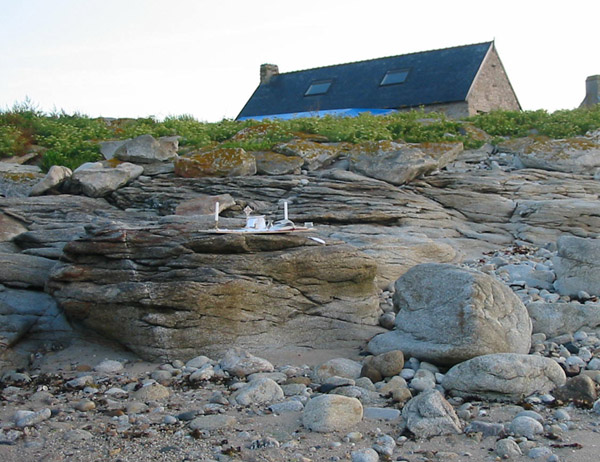
I have a certain amount of experience with this, including celebrating Mass on a rock on the beach on the Glénans islands.

glenans_rock_altarI had to carry everything in two bags on foot, since I travelled by sea from the mainland to the islands, so it had to be the absolute minimum.

An alternative is for the priest to use a travelling chapel, like the old school tuck box I still have with a folding table inside the lid. When the box is placed on an ordinary table, the altar table is just at the right height. That is one solution.

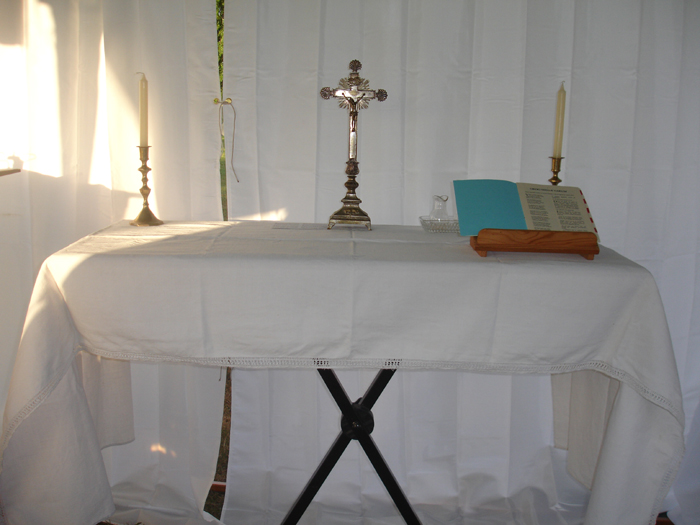
Another is carrying a piece of 20 mm plywood in the car with a trestle foot, such as I used for my sailing holiday in Brittany this past summer:

terre&mer06It’s functional and the right height and size. I recommend a height of about 90 cm and the piece of plywood being 1m30 by something like 70 cm. If you can find space for the board and the folding foot (which you can buy in a DIY shop) in your car, everything else packs into a small box.

An alternative is using a chest of drawers rather than a table. I would also advise keeping it simple. There is no need for flowers or statues on the altar. A Byzantine antemension can be used instead of an altar stone.

Posted in Uncategorized | Tagged , , | Leave a comment