More on Proselytism

New addition. See towards the end of this posting for a dialogue between a Lutheran pastor and a conservative Roman Catholic priest.

* * *

This is not the first time I have written on this subject, but it is one that crops up from time to time, and is particularly toxic and nauseous. It is more relevant in America than in Europe. Here in France, I meet very few people who regularly attend churches, though some are open to a spiritual view of life involving self-acceptance and unity with a universal consciousness of some kind. Most of the conservative priests for whom I have installed an organ in their church understand why my time in the Roman Catholic Church had to come to an end. I had nothing to relate to, and it was quite honestly a nightmare for me. One might attribute it to my autistic “condition” and my not being able to identify the reality with the apologetic claims proffered to have me take the bait. I fight to make the distinctions needed to keep both my faith and my vocation as a priest.

I was particularly impressed on reading a message to a small e-mail list by Rev. Larry Peters, a Lutheran pastor.

With respect to David Mills piece on Peter Scaer, it should be noted that there is no Lutheran worth his salt who does not regularly address the question of whether Lutheranism still offers the best choice for evangelical catholicity or not.  I would say that every Lutheran serious about his Lutheran-ness struggles with the great divide between Rome and Wittenberg, that every Lutheran longs to find an ally in the pursuit of orthodoxy in doctrine and witness before the world within Rome, and that most Lutherans hope for a Pope who will aid in these causes.  Lutherans deal not with ideas per se but with the Word of God, the catholic witness of the Church, and our life flowing from the means of grace.  One of the primary differences between good Lutherans and Roman Catholics is this – every good Lutheran must wrestle with why they are Lutheran and not Roman or Orthodox while it seems most Roman Catholics do not even raise the question of why they remain Roman Catholic.  I suggest that if Roman Catholics considered this challenge more, it just might be harder for a Lutheran to justify remaining a Lutheran.

I have no personal experience of Lutheranism, but I see it as one of the early expressions of the Reformation like Wycliffe, Hus and the Moravians. I am very intrigued by the story of John Wesley who led the pietist Methodist movement in England against the backdrop of Enlightenment rationalism and the fading away of a spiritual vision in Christianity. I have written on John Wesley, and not merely on account of the flowing locks of his hair! My great-great grandfather was a Methodist minister in Yorkshire in Victorian times, serving working people and businessmen who gave them work. As a schoolboy in York and singing in a parish choir, I quite often went to Methodist services with the choir to give support to their hearty worship. We would joke, “We’re on the meths tonight”, but that altered nothing of their welcome and their taking their faith seriously. The Methodists are less strict these days about drinking alcohol, but they never drank methylated spirit, a nasty smelling liquid we use for alcohol stoves and which is poisonous if drunk.

The religion of a country forms its culture, and this was certainly true of Germany from the Renaissance era and through the centuries to our own time. Lutheranism was high-church up to about the time of Bach, who composed several Latin masses to be sung in Lutheran churches. Lutheranism largely kept the mystical tradition of medieval Catholicism which is reflected in pietism and the beautiful texts of Bach’s cantatas. The theology of these texts is so rich in spirituality and beauty as would also be found in the writings of Roman Catholic and Orthodox saints. Pietism is a response to the teaching of Scripture and a dialogue with God’s word, often highly poetic and mystical. Our souls engage and do not merely acquiesce to the word. It is a paraliturgical experience, enriched by inspired musical composition. Lutheranism also produced Jakob Böhme, who did not always meet with the favour of his local parish pastor on account of his unconventional writing. I have visited a few Lutheran churches in Germany. They still have their medieval stone altars which are used facing the east. The statues and icons were not destroyed, and even the Sakramentshaus remains intact in many of these churches.

The same thing happened in eighteenth-century Germany as in England during the same period, a movement of rationalism and secularisation that emphasised moral and social teaching over prayer and mysticism. Such secularisation is what has occurred again in our own time, this time in the Roman Catholic Church as well as in Lutheranism, Anglicanism and all expressions of western Christianity. In turn, like John Wesley, bishops, priests and lay people reacted by asking for the old liturgy and spiritual life rather than simple considerations of helping the poor, redistributing wealth and bringing about a solution to ecological issues.

This is what we need to remain focused on, rather than abstract considerations on which church is the most true or authentic, setting out the others as fakes or illusions. I know that the Lutheran Church-Missouri Synod is the biggest of several American split-offs from mainstream Lutheranism. In all churches, there are conservative and traditionalist movements, like Continuing Anglicanism to which I belong as a priest. We tend to project our certitudes on our brand names and entertain hopes that more people will convert to what we believe to be true. Since my early days in 1981 as a “convert”, I have become much more sceptical and Idealistic in my epistemology. Truth is not something we possess but a transcendent reality to which we aspire in our entire human experience and imagination. A one true church making an exclusive claim in institutional terms is complete nonsense to me.

No institutional church can make the claim to be the one true church, but rather should seek the truth of God. Roman Catholics can no longer make that claim on account of its being based on their Pope’s teaching. That teaching now brings Catholicism to the level of eighteenth-century rationalism and secularism in Lutheranism and Anglicanism during the same period, and in its own ranks. We can only shudder to think how they ended up during the French Revolution. Lutherans will often come up with tit-for-tat arguments. I have seen the same apologetics in evangelical communities, where zealots “thump” their Bible as a sign of “possessing truth”. In my reckoning, Christianity that becomes a fanatical ideology loses its very claim to truth.

The Roman Catholics profess to want unity with all Christians and to engage dialogue. It has been like that since the 1950’s and the run-up to Vatican II. We have all seen the scandal of sectarian conflict and violence, its effect of discrediting the very Christian Gospel. We all want peace and mutual respect, mutual recognition of at least our sincerity and purpose of being Christ’s disciples in our own time.

Presently, in the Roman Catholic Church, the Pope has brought out the conflict between the apologists and zealots one one hand, the liturgical traditionalists and the more or less secularised synodality of the mainstream. I respect them all for their sincerity, but I have nothing in common with them. I do not relate to them. I feel no duty or obligation to join them.

Again, I bring out the point of not converting to an idea of an institution, but to a concrete community. It might be a parish, a “Benedict option” community, perhaps a monastery where ordinary people can attend Mass and Office. Where two of three are gathered in my Name… Christian faith is expressed inwardly by each of us and by our communities, our families, circles of friends, anything imaginable. That community might be a part of a larger communion, perhaps “approved” by a Roman Catholic bishop, perhaps independent and trying to hang onto the essential ideal. Many Roman Catholics want to demolish this belonging in order to “save” someone’s soul by having them go through reception – and then years and decades of agony and alienation. I have known people who could only disassociate themselves from all institutional religion in order not to lose the faith and personal attachment to Christ. Yes, it is possible, and such people need to be respected.

I have wondered whether I should move to a place where people are more actively Christian and in need of priests. In the end, northern France is where I live and where people secretly live their beliefs and ideals, perhaps Christian, perhaps “pre” or “post” Christian. Europe has lived through centuries of conflict and persecution, and the seeds of human sin remain. We needed secular states and neutrality, perhaps with more conviction than America’s Constitution. If we are spiritual and sincere, then we will not only be tolerated but asked what gave us this way of life. The essential is to teach, not by word, but by example, by love, by beauty, truth and goodness.

* * *

Dialogue between the Lutheran pastor and a conservative Roman Catholic priest. The Lutheran pastor is Rev. Larry Peters, already mentioned above. I will hide the identity of the RC priest, because I am not attacking his or any person but rather a mindset shared by many. His comments are preceded by “Father”.

Rev. Larry Peters With respect to David Mills piece on Peter Scaer, it should be noted that there is no Lutheran worth his salt who does not regularly address the question of whether Lutheranism still offers the best choice for evangelical catholicity or not. I would say that every Lutheran serious about his Lutheran-ness struggles with the great divide between Rome and Wittenberg, that every Lutheran longs to find an ally in the pursuit of orthodoxy in doctrine and witness before the world within Rome, and that most Lutherans hope for a Pope who will aid in these causes. Lutherans deal not with ideas per se but with the Word of God, the catholic witness of the Church, and our life flowing from the means of grace. One of the primary differences between good Lutherans and Roman Catholics is this – every good Lutheran must wrestle with why they are Lutheran and not Roman or Orthodox while it seems most Roman Catholics do not even raise the question of why they remain Roman Catholic. I suggest that if Roman Catholics considered this challenge more, it just might be harder for a Lutheran to justify remaining a Lutheran.

Father “I suggest that if Roman Catholics considered this challenge more, it just might be harder for a Lutheran to justify remaining a Lutheran.”

Your idea needs more explanation. Can you detail the argument that moves from Roman Catholics considering why they remain Roman Catholic to your conclusion that it might just be harder for Lutherans to remain Lutheran. I don’t quite follow

Rev. Larry Peters My point is that many in Rome make little effort to actually develop an apologetic beyond the complaint that I as a Lutheran am a Biblicist, do not believe in THE Church, do not have a valid ministry and therefore no valid sacraments. In essence, many in Rome find it impossible to conceive why anybody would not simply recognize and join the Roman Church – no matter how good or bad the local incarnation of that might be. Quite frankly, the local examples of Roman worship, preaching, and teaching are rather pathetic – hardly more than a Roman version of Protestant Contemporary Christian Music loosely within a liturgical framework, hurriedly executed as if the building were on fire, with sermons that barely make mention of the Scriptures. I am sure that there are many places where this is not the case but I can say with some confidence that within an hour’s drive of my own parish, there is nothing better. In fact, the most catholic expression of the Church’s liturgy and preaching happens where I am at every week. The typical Roman cannot distinguish a Baptist from a Lutheran and does not care. But even the worst Roman Catholic, who never attends mass, is sure of one thing – that to join another church is to exit the realm of God’s grace. What am I to make of such a church?

Father I think you are comparing two quite different categories of persons. You cannot compare yourself, one who is a highly intelligent man with an inquisitive mind, a highly educated Lutheran pastor, and one who is open to considering issues beyond just those of concern within his own Confession, with ordinary average Catholics or, indeed, ordinary average Lutherans. Moreover, anyone who thinks that you “as a Lutheran am a Biblicist, do not believe in THE Church” has clearly never read the Book Of Concord”.

One of my closest friends, the late Lutheran Pastor Dr Daniel Overduin, was able to have with me the very open theological discussions to which you refer. And I am grateful to him for that as I began to understand more and more about the Lutheran Confessions, the intrusion into Lutheranism of Calvinism, and the openness of orthodox Lutherans to a reconsideration of their relationship with Rome.

There are Catholics who rarely attend Mass still but still have the Faith no matter that their practice may be appallingly weak. Such Catholics know and believe that the Catholic Church is not just a church among other churches but is The One Holy Catholic, and Apostolic Church. And that is why they would not consider going to one of the protestant ecclesial communities for the sacraments. And as the Church teaches, protestants are baptised Christians who are in a state of imperfect Communion with the Catholic Church.

Rev. Larry Peters I would suggest that the Roman Catholics I reference are not “ordinary or average” except that they are typical. Several monsignors, a cathedral dean, priests with pontifical college degrees, a former seminary professor, and a few Lutherans who have swum the Tiber. In my experience from rural parish to urban setting, from cathedral principal mass to university setting, the quality of the worship is abysmal. The homilies sad and pathetic. The liturgy rushed and irreverent. Our cantor was on the staff at St. John Cantius in Chicago for several years. He and some others were let go when Cupich reduced their budget. But that is one experience against many other attempts on my part to see and hear.

What I was saying is that there is little attempt on the part of Roman Catholics to see and hear – I think they would be shocked and surprised. My local priest told one Roman Catholic family looking for more reverence to go over to that Lutheran Church where they still chant and take their time. They did. They are. I suspect that they are not alone in longing for this in Rome but they have been driven away by trivialities parading as liturgy and jokes and stories acting as homilies. Rome has done a little to encourage me to look (Benedict XVI is one thing) but the papered over differences over justification and the current Pope are not helping at all. I confess that Lutheranism may not offer any more consistent confessional and liturgical integrity than what I see in Rome but Rome does not offer any compelling reason for me to keep looking except the stock and trade of Christ only established one Church and not many churches, that communion with the Bishop of Rome is contiguous with the boundaries of heaven, and that the papacy was the plan of Jesus from the beginning. With the sad state of bishops in Rome, why would I trade one broken communion for another? I thought it was the Gospel that saved, grace that justified, faith formed by its hearing, and my baptismal new life fed by the Eucharist. When did communion with the Pope become the saving Gospel? Yet, sadly, none of my Roman friends have much of a justification for leaving where I am as a priest and pastor to become a laymen sitting in the pew behind the praise band while I receive only the Body of Christ from a female extraordinary minister of the Eucharist except the papal office and its guarantee that Rome is the only right and real church. The Lutherans I know who left were not so much running to something as running away from something. They knew they were trading one kind of brokenness for another. I am not ready to do the same.

I am not sure that those who neither attend mass or go to confession could testify that the Roman Catholic Church is the true and only Holy, Catholic, and Apostolic Church. I wonder if they do not write off everyone as being as shallow and irreverent as their and my local experience of Rome has proven. Just a little over a year ago, the local priest in my community took the stage during mass to announce he was gay. Apparently that was more important than Christ crucified and risen. And people wonder why churches are in decline! In any case, what shocks me is that these folk who have not darkened the door to a Roman Catholic Church for ages are considered by that communion to be “better” than me a Lutheran who has heeded the Augsburg Confession’s call to be the Catholic Church in doctrine and practice. Is it mere formal association that Rome seeks? If so, how it that any different than any Protestant Church? Could it be that we are all competing to be the true, visible sect on earth?

I am not trying to be argumentative or smug but to be real from someone who laments the broken state of most churches and wishes that there was one that was not.

Father You say: “I am not trying to be argumentative or smug but to be real from someone who laments the broken state of most churches and wishes that there was one that was not.” No one could fairly say that of you. But, here’s the thing. You are caricaturing Catholic beliefs. Your criticisms of Catholic liturgy are fair, and I lament the trivial nonsense served up as a Homily and the folksy over casual way in which the Mass is too often celebrated.

But I do not hear Catholics saying they are necessarily “better” Christians.

There are many churches which are in Full Communion with the Church. Those churches share the same faith, are in communion with Peter, and have valid orders of bishop, priest, and deacon. Lutherans simply refuse to deal with Christ’s conferring on St Peter the prime ministership of the Church. I could lament the various brands of Lutheranism which include all kinds heterodox moral views and liturgical aberrations such as women Pastors. As my late friend used to say, only half jokingly, that he didn’t think Luther was a Lutheran.

Of course you should remain where you are if that is what your conscience tells you. But you need better justifications than the ones you have chosen because in the end, and pace the behaviour of many Catholics, it is the truth that matters, the truth that sets us free. I abandoned the Protestantism of my upbringing for many reasons, the most important of which was my recognising where the Church is really, truly, and substantially to be found. As Chesterton once put it, I do not want a Church which is right when I am right, but a Church which is right where I am wrong.

Another Lutheran pastor – recognising where the Church is really, truly, and substantially to be found

That’s the trick, isn’t it? If one doesn’t already know where the Church is to be found, how exactly does one go about “recognising” it?

Of course there are several plausible answers to the question of how to recognise it (e.g. look at the history, look at the Bible, look at the Tradition, etc). But surely, to recognise something is to ask the question “what does it look like.” Fr Peters is asking, does the Roman Catholic Church that I actually see look like the Catholic and Apostolic Church as it has always been through the ages? It’s hardly surprising that his answer is No. (That is my answer as well.)

It seems to me that what you are saying is that even though the RC Church looks like the most vapid of Protestant sects, despite all appearances it is the Apostolic Church — because it is in communion with the Pope. That is simply not enough.

Father You have changed the way I used the word “recognising” in such a way that it has no meaning in the context. The Church physically “looks” different in different places in the world as has always been the case. The problems in the Church in countries like the US are in no way the same as in many parts of Africa, Eastern Europe, Latin America, and Australia. Moreover, what do you mean by “look(s) like the Catholic and Apostolic Church as it has always been through the ages”. What are the criteria? Such a comparison is impossible to sensibly make.

The question only makes sense if it applies as you remark earlier by “look(ing) at the history, look(ing) at the Bible, look(ing) at the Tradition”. Luther’s Reformation represented a break from what went before it.

* * *

I find plenty of things to criticise about Lutheranism, but we need to place it in its historical context. Ironically, it finds itself confronted with the kind of Roman Catholicism as it faced in the early sixteenth century. Much of Father‘s apologetic approach projects the Counter-Reformation onto our own time. Essentially, however corrupt and absurd the Roman Catholic institution has become, it has to be recognised as the one true Church simply because it is in communion with the Pope.

There may indeed be good and holiness in the RC Church in places other than Europe and the USA, but it is found also in other churches, and indeed other religions. The Papacy has recognised this fact, and the teaching of Vatican II on ecumenism pointed the way to the notion of truth lying beyond human reach, possessed by none, and inviting mankind to converge and seek together. Father‘s apologetics are left on the beach as absurd verbiage. Triumphalism has driven away the noblest souls and those who bought the advertised product regretted it bitterly. To such apologists, it would almost seem that it would be better to be a materialist and an atheist than to find God and grace in a different institutional church.

Traditionalists often caricature the current state of the liturgy, speaking of “clown masses” and other uses of modern entertainment. Most churches positively lack spectacle and imagination, and most parish masses are pious and prayerful – but uninspiring. The same applies to many Tridentine or Prayer Book services, probably also to the Sarum masses I celebrate on my own – if someone turned up to attend. I find no need to caricature what goes on in most or almost all churches. There is simply no need to go through the intellectual and spiritual torture, the cognitive dissonance, of “converting” from one imperfect Christian institution to another.

In the end, there are probably more contradictions between members of the RC Church (or any other) than between Lutheranism and Roman Catholicism. The apologetics don’t work, as the Modernists found more than a hundred years ago!

Posted in Uncategorized | Tagged , , , , | 2 Comments

Spiritual Death and Life

I am constantly coming across texts that tell us that belief in God (adherence to a religion?) is decreasing in France and other European countries. Americans refer to such people as nones, those who would tick the box in a form saying none (belonging to no religious tradition). At the same time, we live in a time when apocalypticism is back in vogue. I read an opinion (scientific?) that Covid would mutate into ever more deadly strains until we all die from it. The “climate emergency” would give us less than fifty years before the earth becomes totally hostile to human habitation – unless we stop eating beef and driving cars. I express a common caricature of the ecologist narrative à la Extinction Rebellion.

According to a recent survey (I never trust them completely, since I have never been surveyed) only 49% declared themselves to be believers compared with 66% in 1947. According to a priest I know in the Archdiocese of Sens-Auxerre, one of the most spiritually barren parts of France, only 1% of nominal Catholics attend Mass. Would this be regular Sunday attendance or main feasts like Christmas and Easter together with baptisms, weddings and funerals? Are the 51% all hard-core materialistic atheists or “spiritual but not religious”?

If anything, the Covid pandemic and the chain of lockdowns have not improved the situation. 91% of those polled believe that the global pandemic has not brought them closer to religious practice. My own experience with most people I meet is that they are not atheists Richard Dawkins fashion according to the exalted science of the nineteenth century. Most believe in the existence of some kind of universal consciousness and life after death. What they do with such an idea differs from person to person. What is the prevailing idea about the meaning of life when it is not social status and money?

The institutional Church is used to blaming ordinary people for their pleasures and the things money can buy. Take them back fifty years and they will learn! Not so. Churches have been most inadequate in the quest for bringing man a credible and spiritual message. This is not only the “modernist” time since the 1960’s and 70’s, but right the way back to our reaction against the notion of religion being a simple and mechanical system of rewards and punishments. We witness in all Churches the growth of a kind of neo-clericalism or bureaucracy that excludes the little people and the poor. Gentrification seems to be the word. We live in an era of nihilism and deconstructionism, as happened in eighteenth-century France and nineteenth-century Russia.

Socrates once said that “wisdom begins in wonder”, what the Old Testament calls the fear of the Lord. Conversely, madness begins in denial and the narcissistic sense of self-entitlement. A large segment of society adhering to the Woke ideology wishes to deny and cancel everything. God is not found in barrages of words or marketing, but by truth, beauty and goodness, the famous transcendentals of Plato.

I was deeply impressed with this interview with Patrick Moore, the founder of Greenpeace.

We are now on the subject of what people believe in when they cease to believe in God and Christ. As G.K. Chesterton once said “When men choose not to believe in God, they do not thereafter believe in nothing, they then become capable of believing in anything“. Whether what this guy says stands up to objective scientific evidence, I have no way of telling. All I can say is that I open my door and look and feel the weather and temperature – and find no difference with what I experienced of this world in my childhood. There are terrifying weather events which can happen anywhere, and the pollution of this earth mainly by industry is horrific. In reality, the apocalypse to which we need to be attentive is our own death, and many of these shrieking sayings only show our fear of death and desire to project it on the whole of humanity and nature. I think that Patrick Moore has many sensible things to say, though some may not stand up to informed criticism. I have no way of knowing.

As always, and I say more or less the same things.

– Declare our independence from peer pressure and social status,
– Appreciate the time we spend alone to face truths,
– Love nature and be a part of it, not its lord and master,
– Become aware of those moments of wonder faced with natural or human beauty,
– Come to terms with our true selves and our relationship with the Transcendental,
– Teach by example, not by word.

I could add many others like “out-of-the-box” thinking and being as eccentric as we may be. That is the door by which Christ may enter our souls and bring us to that Heaven which is already within us.

Posted in Uncategorized | Tagged , , | Leave a comment

Free Sacramental Christianity

I spent a moment today listening to Damian Thompson being interviewed on the subject of Pope Francis’ ideas of synodality, the same talk-shop and hot air as in most Churches.

Who, apart from professional bureaucrats, would have the least interest in such a Church or its message? Institutions, all institutions, are acting for their own sakes and no other objective. They become sterile and godless, as do political institutions and the mediocre and insincere claptrap. When the salt loses its savour… Why are those people still getting money from somewhere?

Today, this depressing interview was put into question in my mind as I read Rewilding the Church by Michael Martin. Wildness is a part of the Romantic mind, as expressed by this remarkable author. What I was doing last week was part of my childhood dream of sailing on the sea. Only this time, the gathering was planned and we kept ourselves safe in the very open waters in which we found ourselves. Love of nature, the great outdoors, the countryside, mountains and the sea are also a part of the Romantic mind. Nature is not the property of man, but we are a part of this world that is totally indifferent to our ideologies and sophistries.

I seem to have touched upon this theme as I contributed my share to the discussion of clericalism. La mer nous apprend la modestie, as an old priest and skipper said to his crew (I was a member of it) back in 2011. The sea teaches us modesty, humility, as all of nature does. You don’t climb a mountain unless you first of all respect it.

I don’t think humanity will ever be rewilded, but will continue to live in cities and consume. I too had to go into town today and do some food shopping. We cannot deceive ourselves, but we should be aware and tend towards another way of life. Survivalists go to remote places and build their citadels like in the many apocalyptic films over the past few decades. I have not gone so far. I live in a remote village in the Mayenne. Like the survivalists, life is fragile and vulnerable if push should come to shove. We have lived through the Covid pandemic – but imagine a pandemic that was as contagious as the common cold but as deadly as Ebola! Imagine a third world war or a meteorite hitting the earth! We have to be sober enough to know that we are all going to die of something one day in the near future. That is inescapable. What matters is the quality of what we do in life. Now what about our relationship with the Church? Can we go on with popes and bishops who are no more virtuous than our prime ministers, cabinet ministers, presidents and bureaucrats?

Michael Martin sees the issues in terms that strike me as similar to those of Rod Dreher in his Benedict Option thinking. Not that the Church is exclusively composed of monasteries, but with lay people and families sharing spiritual characteristics with contemplative monks. Jesus and his disciples were country folk and fishermen. Christianity became urban as it began to be used for political purposes.

Continuing Anglicanism, like many independent expressions of Catholicism and Orthodoxy, goes a part of the way away from big political and bureaucratic institutions. I have already written about the so-called independent sacramental movement. I have mentioned its most noble aspirations and also the shenanigans of charlatans and frauds in their pretensions to imitating institutional hierarchs. I have corresponded with two American bishops. One was John P. Plummer who wrote The Many Paths of the Independent Sacramental Movement, Berkeley (Apocryphile Press) 2006. The originality of John Plummer, even if his teaching might be somewhat at variance from conservative churches, involves a different approach from the narcissism of many men in that world. The more discreet and modest of them truly form an underground Church.

The author of the article mentions his predilection for Celtic Christianity as something far removed from the influences of those wielding power in some distant urban empire. I know of a Celtic Orthodox Church in Brittany that I would love to visit. It is essentially a monastery in the Morbihan countryside with a ministry to people attending the Liturgy.

The bureaucratic and political models are destroying Christianity and corrupting it at the core. Of course, as I have said elsewhere, we do have to manage finances and be organised as a body of clergy and laity. My Church has a notion of management, but for a precise purpose, not of inflating egos of those thirsting for power. The dividing line is very fine. The problem comes when powerful people hide their unethical acts and attitudes behind the jargon of corporate management, and escape all responsibility or accountability.

Institutional Christianity is dying. Christianity as a faith and contemplative way of life, the Mystery and Sacrament of Christ, cannot die. This is the Church of Christ. Et portae inferi non praevalebunt adversus eam. There is the distinction and a different notion of what the Church is.

Posted in Uncategorized | Tagged , , , , | Leave a comment

Cruise to the Islands off La Rochelle

This video in two parts show a few aspects of an adventure with a few members of the Dinghy Cruising Association, mostly living in France, and two of whom being Frenchmen and former military men. One had been seriously wounded in a military operation and took many years of surgery and psychological therapy to recover. It was a privilege to spend time with him and even enter into spiritual subjects.

We arrived at the Port of Les Minimes at La Rochelle on Sunday 5th September, and we recovered our boats yesterday (Friday 10th). Given the strong spring tide currents and the pessimistic weather forecasts, the plan was simple. We would sail as best as possible on Monday and Tuesday, two very hot days with little wind. Thunderstorms were forecast on Wednesday, but they remained on the mainland. The only rainfall we actually got was early on Friday morning, and my home-made boat tent performed much better than I feared.

Monday 6th. We put to sea in the early morning to take advantage of the ebb tide, and the destination was Le Douhet on the north coast of the Ile d’Oléran. We found a big harbourmaster’s office in a large 1930’s building. There were a few buildings including a place to get a beer and something to eat.

Tuesday 7th. It was a very hot day, but I had my trusty Australian style hat. We sailed north under the bridge between La Rochelle and the Ile de Ré towards La Flotte. This is a beautiful town in the Charentais style. Again, we ate together and the company was enjoyable. None of us could sufficiently stress the importance of drinking at least two litres of water per day. Dehydration and heat stroke are pernicious!

Wednesday 8th. We were spared the threatened rain and thunderstorms. We sailed to Ars en Ré where we arrived when there was enough depth over the sandbars where we beached and waited. We were guided into the lagoon by a north cardinal buoy and a series of three starboard channel buoys and one port channel marker. We had a head wind, so had to take the sails down and motor in. One of the French had problems with his engine when he reached the channel to the port. He called us on the VHF and I went and towed him in.

Thursday 9th. The plane was to cross to the mainland and visit Tranche sur Mer in the Vendée. However, the wind started to freshen and threatened to be vicious – which it was even when we changed our plan and visited Saint Martin de Ré. This was one of the places from where prisoners condemned to the penal colony of French Guyana were shipped. It would seem that the famous Papillon (the real-life person) was among them. Most of the barrack buildings where the guards lived have been converted into hotels, shops and restaurants. It was an interesting visit as we left our boats in the port. The passage back to Ars was very hard. I had to reef my sail lest my mast would break, already bending under the strain. The following sea made hard work on the rudder. After the cardinal buoy, we had to close-haul and tacking was impossible without getting into irons. I motored in. A man has to know his limits as Clint Eastwood said in his films. The meal at the restaurant was most welcome!

On Friday we returned to La Rochelle and our cars and trailers. We sailed on a following wind but against the current. The chop was vicious and made the helm very hard. We sailed and surfed, and we just had to stick it out and persevere, just go on like Columbus to the West Indes. It was a little calmer after the bridge, as the wind was quite vicious as we approached the port. I finally got there behind the others with bigger boats than mine, and doused the sails so that I could motor to the slipway. I recovered the boat on the slipway and said goodbye to the others. I decided to drive all the way home just for the softness of my bed. Even today, I still have the sensation of my “sea legs”. Yes, I think I was taken to the limit by sailing such a small boat on the Atlantic Ocean. It was all within the limit, but just. I wouldn’t exchange the experience for very much!

Posted in Uncategorized | Tagged , | 1 Comment

Clericalism

My attention has been drawn to an article about clericalism. Bringing priests into balance by Leila Marie Lawler.

The subject seems to have come up because the Pope seems to put all the blame in this respect on the traditionalists. In reality, clericalism is not the preserve of clerics as tonsured seminarians, deacons and priests are clerics. People who work in offices and administration are called clerks. In the Church, clerics are defined as those having received the Tonsure, Minor Orders and Major Orders. The term we often find in the Anglican tradition is clerk in holy orders. Cleric and clerk are interchangeable as words. In the civil world, the legal profession and administration, clerks are defined by their professional function and having taken over from ordained “scribes” who once fulfilled their functions. We also have the notion of functionary (fonctionnaire in French), the civil servant. In the Middle Ages, reading and writing were almost exclusively the domain of the priestly class. You have to be literate in order to push papers in an office, however boring the job might be.

Roman Catholic canon law (207 in the 1983 Code) says that “by divine institution, there are among the Christian faithful in the Church sacred ministers who in law are also called clerics; the other members of the Christian faithful are called lay persons“. It is almost a caste system like in Hinduism, but the distinction is by ordination, being “put in order”, not by birth. That said, there were times when high offices in the Church were reserved to the Aristocracy. The Latin word is clericus, from the Greek κληρικός. We use the words clerk and cleric, and collectively, we belong to the clergy. Anglican clerics are often known as clergymen.

Usually, the priesthood (except in those who are laicised or “unfrocked”) is indissociable from the clerical state as a class apart from the laity. It involves a measure of authority like that of a judge in a court of law. The de-Christianisation of civil life has largely made this class distinction irrelevant. The priesthood has had to be re-thought in the light of the end of Christendom, the French Revolution, Anti-Clericalism in the late nineteenth and early twentieth centuries and the two world wars.

Clericalism, the cause of anti-clericalism involves some kind of oppression by one class of human beings over another. At the French Revolution, during Robespierre’s Terror of 1793, many of the nobles and clergy found their situation of those whose head on some pretext condemned to be mown off. Even without the frivolous quote from The Mikado, those from the old first and second Estates (nobility and clergy) were hated by the people who had to pay for them by their hard work and received little gratitude. Their were exceptions, and those nobles who had been exceptionally kind to the ordinary people were spared. I have heard many stories of the curé jupitérien who suffered as much from the temptations to power, money and sexual dominance as anyone else.

Unfortunately, for Pope Francis, the temptation to clericalism is not caused by the Latin liturgy or the cassock. In this post-conciliar era, the clericalism has changed appearance but is aggravated. Priests and bishops believe themselves to be owed absolute obedience and the right to gaslight the faithful into the ground.

The article insists on the penitential or apologetic character of the old liturgy, which is valid to a point. What is sure is that the priest as a human person is effaced by the position at the altar, wearing vestments and doing what the liturgy tells him to do rather than his own fancies. We could conclude that the new Roman Catholic and Anglican liturgies of the 1960’s and 70’s are more clerical than what they replaced, namely the traditional Roman rite and the Prayer Book. A frequent accusation against Mass facing the people is that is encourages narcissism in the priest. This is probably the case in many places and men who are priests. As a schoolboy, I intensely disliked this innovation in my school chapel and parish churches in the early 1970’s.

Clericalism is not only an expression of narcissism in some individual priests but an inappropriate way of identifying the priest with Christ. Christ himself is inappropriately identified with the notion of a king and the First Estate, so that he and the priests and bishops identifying with him can assume temporal power. Christ came to serve, and so must the priest. The beginning of all spiritual life is compunction, which corrects our relationship with God. Priesthood has to be built on humility, which often involves a much more discreet approach to the world.

I have personal experience of the traditionalist attempt to recreate the seminary of the nineteenth century or the 1930’s or 1950’s. It is a paradox to imagine cassocks and Latin as causes of clericalism, at a time when clericalism is worse than priests dressing and behaving as business executives and politicians. I have always been critical of the seminary as a method for training priests. How else should it be done? In my own Church, the Anglican Catholic Church, we don’t have seminaries because we don’t have the resources for them. Perhaps the best remaining way to train priests is to have them do university studies in theology – with exceptions for some – and then have them apprenticed to a talented priest who is recognised for his qualities. That is more easily said than done.

The ACC Diocese of the UK has developed guidelines for clerical training. This has been published on Facebook:

During the past two years the Board of Ministry has expanded its remit, at the Bishop’s request, to include the academic training and examining of candidates for Holy Orders, and for the Office of Reader.

Our partnerships with the Theology department of the Victoria College of Music and Drama, London, and with the Johann Heinrich Pestalozzi Christian University, Miami, have enabled us to provide in-house training and studies within the framework of excellence regulated by these institutions. Further educational training where required after ordination or licensing will also be a part of the Board’s responsibilities, and there are opportunities for candidates and clergy to undertake degree courses with the University.

Our Board Secretary, Fr Munn, has also been industrious in his production of catechetical material both in written form with a number of new published works, and through on-line video presentations. The Bishop has therefore decided that to reflect this change of function the Board will now be renamed the Board of Ministry and Education.

In seminary, we live a semi-monastic life and learn to apply ourselves to a serious routine and a relationship of subordination to our superiors. Former military men often make excellent priests and monks because they have that gravitas and discipline of life. Those aspects are not the kind of clericalism that is reprehensible. My own “post-matrimonial” life is a mess that needs to be retrained, something I am working on in my intimate life. As I slept under my boat tent last Monday night, I had a frightening and vivid dream in which I was losing all sense of value and spiritually dying. It is necessary in order again to find the fervour in my vocation I had when I first went to seminary after university. I have to rebuild my self-reliance and manliness, not by being a macho stereotype, but by being truly myself. However, tout est grâce. We have to rely on Christ and his love for the man who is in need, who doesn’t suffice unto himself.

In traditional theology and spirituality, one is not ordained a priest for oneself, but typically for a parish ministry. One is both a cleric in terms of having authority (often in competition with the local Mayor) and a priest in terms of sacramental intercession for the faithful who participate through the common priesthood from their Baptism. There is thus an official dimension and a sacramental dimension. However, in the practice of the Church, choir monks in a monastery are ordained. Some monasteries have parish ministries and others are strictly contemplative. A priestly ministry can also involve teaching in a school or university, or simply being an academic. Yet another model of ministry is the Worker Priest. Priests living like working class men was a noble aspiration, but it was open to abuse, political activism in particular. It is understandable.

Some of us in the more “marginal” institutional Churches have wandered into “niche ministry”, the idea of living among people identifying with a given idea, activity, characteristic, etc. Parish ministry here in France is really the property of Roman Catholicism and a new form of clericalism – collectivist and bureaucratic. The Worker Priest movement was an attempt to relate to working people by sharing their condition that involved hard work and mediocre pay. Man does not only work, but also has other interests shared with others. The rural parish worked when there was an extremely homogenous population and the majority of people went to church. Today in France, the level of regular religious practice is about 1%. Some of the 99% are of other religions like Islam or are atheists. I believe that most are open to some kind of spiritual world view, but do not relate to institutional religion.

Some priests and active laity have thought of the idea of relating to “lifestyles” or other “identities”. Some are political, others involve different kinds of human relationships, and others involve shared hobbies like sports, culture, music, anything. Ethnic groups living in a country other than the one of their origins find a common identity which might coincide with Christian faith and a desire to worship together. If a priest is involved, it might not be a good idea to push people towards religious activities like services, Bible reading, etc. Ministry can only be built on trust, and that has been broken too many times in history.

I have got back from some hard days’ sailing with some members of the Dinghy Cruising Association. There were some English people now living in France and a couple of Frenchmen who are former Army officers, one of whom was nearly killed in a military operation and more or less recovered. We didn’t talk about religion very much but I didn’t hide it completely. One of the Frenchmen compared me with Fr Guy Gilbert, le Prêtre des Loubards, with my most unclerical presentation and long hair. I have a great amount of esteem for this priest who has a genuine spiritual and human foundation, which is rare among priests whether they are in cassocks or in civil dress for the sake of this discretion and self-effacement. There was a certain fad in France at one time to have priests working in factories and supporting Socialist politics. Fr Gilbert went to the motorcycling boys and those tempted by drugs. He set up centres where those people could be helped, and his leather-man image seemed to help. I don’t see my life with sailing people as a ministry but simply as sharing their life and being ready to share spiritual concerns as they come up. With most people, I see how inadequate standard clerical religion is and how it has gaslit and twisted our idea of reality and relationship with the Absolute. Perhaps the Underground Church will bring back that sacred leaven into those solitary souls in their boats silently sailing over the waves. Priests do need to have a truly human experience and grow spiritually. That, perhaps, is the cure for clericalism.

Essentially, the words are humility, humanity and simplicity. These are qualities that come from within. Humility is often thought to be a matter of beating ourselves up and sinking into depression and worthlessness. That is wrong. Humility is really being true to ourselves, appreciating everything that is positive and relating with others on those terms.

Posted in Uncategorized | Tagged , , , | Leave a comment

Parallel Realities

I often meet people who speak with absolute conviction of a “truth” that makes no sense to me. They seem to live in another universe, or perhaps I live in the other universe. It isn’t just a question of telling lies or believing them. We arrive at the limit of the famous Principle of Non-Contradiction of Aristotle, the means by which courts of law catch witnesses out for perjury. The witness says that X went into the building at midnight, and then the opposing lawyer asks the same question after using a distracting strategy, and gets a different answer. Am I being cynical? Am I losing my mind?

There are theories about parallel universes and states of consciousness, all related to quantum mechanics. Perhaps they offer an explanation to what happens to our consciousness after bodily death, ideas corresponding to what Christian tradition calls heaven, purgatory and hell. These may be three discrete categories of a spectrum of parallel states. Already some traditions talk of degrees of beatitude and degrees of agony in hell. These are notions that we cannot clarify with materialistic science or reasoning. Church teaching is only vague compared with the more “gnostic” ways of thinking and believing. So, in this earthly life, we meet another person who lives in another reality. We usually call this madness, psychosis, schizophrenia, a diseased brain or mind.

When society reaches a degree of malaise, what we now call madness becomes the new normal, the new rational, the “buzz” term of the new reset, or whatever. These ideas twist our minds, and there comes a time when we have to become self-sufficient, vaccinate ourselves from the virus of terror, fear and manipulation. I have read a lot about this when examining the conventionally-named mental condition of the narcissistic personality and gaslighting. Another person begins to twist and distort our sense of reality. We either react or let ourselves die spiritually. This is the power of the darkness of this world, that Ungrund of darkness within each of us like the origins of God, Creation and the infinite universe – and the universes outside the possibilities of our observation.

Another thing came to my attention, the descent of our society into darkness and madness. Today I read How France fell for QAnon, The land of Descartes now fizzes with conspiracy theories by John Lichfield in UnHerd. At the head of the article, we see a man in his early to mid thirties, carrying a French flag and sporting a yellow star of David, like the ones Jewish people had to wear under the Nazi persecution, with the words Sans vaccin – vaccine-free. Everything is said, as if that man would survive a day at Buchenwald or Auschwitz in the early 1940’s!

We read the article and ask whether conspiracies only exist because the mainstream says so. Can we trust anyone? Was not Nazism a conspiracy to take over the whole world and kill everyone the ideology thought to be inferior to their “master race”? Yet, Nazism captured the support of a whole country and nearly a whole continent through conspiracy theories, usually involving Jews or Freemasons. Hitler’s ideology was a conspiracy that fed from conspiracies, a monster eating its own tail.

On one side, it is alarming to see masses of people abandon materialistic rationalism to embrace some form of idealism that produces its new reality. On the other side, like the Romantics, some of us see the value of rationalism if it is tempered by the imagination and allows the spiritual dimension of man. We still have things to learn to understand, more realities to yearn for as we go through life.

Conspiracy theories and those who seek to understand our world by that means are the products of literalism. Some will call the Queen of England or Bill Gates shape-shifting alien reptiles. They are not reptiles but humans. Perhaps they are acquired by the Dark Side (Star Wars language) of the Archons of Gnosticism or demons of Christianity. Perhaps not. Perhaps we are. The enemy is never far away and often within ourselves. It is called sin. The ideas may be analogies or metaphors, situated at a level different from our sensation of matter. The we can become more subtle in our criticism.

The other absurdity about most conspiracy theories is that they are secret, yet I know about them from reading widely available books, articles and the internet! If we know about them, then the people who matter would know about them from the same sources. Yet conspiracies can exist. Think of Guy Fawkes and his buddies, who all ended up on the rack and the quartering block! The article goes on about France, almost as fragmented as the USA, but the same tendencies are found everywhere.

There is a delicate balance between this mass psychosis and what most of us (individually) call conventional wisdom, the so-called mainstream position. One thing about the conspiracy theory is that it is not based on either empirical evidence-based proof or demonstrative reasoning. A real conspiracy might be exposed or remain hidden. It is amazing to read in this article that such a high proportion of people believe in irrational conspiracy theories.

My concern is that we are abdicating both reason and spiritual life, and we will go back to the 1920’s albeit with a different appearance. One aspect of Nazi misinformation was the conspiracy theory. Many historians argue that conspiratorial thinking was central to bringing the Hitler regime into power, consolidated the third Reich and radicalised ordinary people and men in the German armed forces. Certainly I would prefer to have an imperfect democratic regime in a country, because our vote does have some effect.

One effect of post-modernism and post-everything else, the new nihilism like in nineteenth-century Russia, is the rejection of all institutions from the State, the Church, the police and armed forces, the government and republic, everything. Yes, we gripe when the buying power of our money is diminished, when we are pushed to the limit in spite of doing an honest day’s work. I supported the Gilets Jaunes at the beginning by displaying my regulation yellow vest on my dashboard. After all, it was about fuel prices and taxes. Why take it all from the ordinary people rather than from the billionaires? Then the Gilets Jaunes started to get radical and violent. Then I saw what was happening: they were exploited and re-educated by the extreme Right. My yellow vest went back into my car toolbox! I am not sure about the health pass policy. However, it is nearly impossible to get objective and scientific information about the pandemic. What I do know if that vaccines are helping (I have had my two jabs and they haven’t killed me – yet) to reduce severe symptoms, hospitalisation and death from acute pneumonia. Tell a French person to do something and they will do the opposite. It is a result of the Occupation of 1940 to 1944. The problem with the vaccines is that not enough people are getting vaccinated. In the end, the State will have to lift all restrictions and hope that enough people have been vaccinated so as not to swamp the hospitals by a “let rip” policy. Protect the vulnerable as much as possible and let the unvaccinated take their chances with the virus. I see no other way. But – – – I’m not a scientist and have a hard time getting my mind around herd immunity and the likelihood that this virus is going to go on for years. Lockdowns are over, because we can’t afford them. I have played the game with the masks, social distancing and vaccines, but I can easily give credence in the bungling policies of governments everywhere in managing the crisis and the clashes of interests with scientific experts – with their own self-interest.

The stuff about Bill Gates and Big Pharma seems to be nonsense. At the same time, I was scandalised when I read that Pfizer and Moderna had hiked their prices! Things like that hardly inspire trust. There are some very evil and greedy people around who have all the money!

QAnon seems to have made its way in France. I have never met anyone believing in that stuff, but I am sure they exist. Some of the more extreme elements of the Rassemblement National of Marine Le Pen are stirring up white working class people and Muslim immigrants and enticing them into Anti-Semitism. Will the QAnon people here or in America have any more influence than neo-Nazis in Germany? George Orwell simply said about his horrifying vision of a totalitarian future – Don’t let it happen. It depends on us as human persons.

The article suggests that conspiracy theories fill up the anti-institution and nihilist vacuum of people who for the most part never had a religious or Christian culture. As “meta-narratives” fall be the wayside with “post-modernism”, conspiracy theory takes their place as something people believe in. It sounds plausible. America has fundamentalism and conservative Christianity, but French traditionalist Catholicism is much more marginal.

I have known a pre-internet era where information came to us much more slowly. Was that a good thing? Are we worse off with the internet with its shouting voices? How do we balance our scepticism, self-doubt and the courage of our convictions? Whistle-blowing on institutional corruption makes us increasingly informed and vulnerable to radical thinking. I my own mind, I am deliberately sceptical and say that anything might be as someone has said, yet there might be a stronger argument to the contrary. Perhaps there are truly opposing truths in different “dimensions”. I do question everything, even my own certitudes, because for me truth is above our understanding. Truth is God, the Absolute, the Mystery.

One big stumbling block is our culture of technocracy and bureaucracy, the very things that erode our faith in institutions – including the Church. The archetype of the Orwellian dystopia is very powerful in our minds and anxiety. The institutions and radicals almost seem to be in league like the old Fascists and Communists. I find Macron here in France more credible and respectable than the Tory bunch in England or the new Biden regime in America. At the same time, Macron is sometimes difficult to follow.

I don’t have quick and easy solutions. I can’t do anything about other people, but I can work on myself. I can work on my own sense of self-reliance and mapping out my life with the Christian Gospel and the old philosophies. To what good is our world and culture are doomed, as they may be. We look to the Night, our death and the Parousia. At the same time, we love what is beautiful and innocent in this world. Is my parallel universe the right one? I just don’t know, and I am left confused and vulnerable. This is why we have to have faith in the Mystery of Christ, lived sacramentally and liturgically in the Church. Tu es Petrus et supra hanc petram aedificabo ecclesiam meam. Christ said this to Peter, but not to Peter alone, but to all of us. The Church is built on what is solid in us all, and this brings about our communion and desire for the absolute truth above all universes and truths.

Many Christians will try to reach out to the secular world and embrace its fleeting values, but they will be disappointed. They will try to use materialistic politics to promote their values, but those values will not be those of Christ. We do need to look more deeply into the notion of the Benedict Option, but with new ideas. Some are called to monastic life, but some monasteries have embraced the world and its temptations. Some have the idea of intentional communities, but what of the reality? Many of us have to rely on ourselves and set the boundaries of our relationship with the world and other people. That is only possible when we have come to terms with ourselves and God.

Posted in Uncategorized | Tagged , , , , , | Leave a comment

Orwellian Religion

I am astounded by this article Still Lost in Blunderland (PART ONE): Refuting Peter Kwasniewski’s Latest Attack on Ultramontanism and Still Lost in Blunderland (PART TWO): Refuting Peter Kwasniewski’s Latest Attack on Ultramontanism from the sedevacantist site Novus Ordo Watch. They have castigated an author who participates in the New Liturgical Movement and Rorate Coeli by the name of Dr. Peter Kwasniewski. I have read a number of his articles and I find them impressive by their critical and “out of the box” thinking.

I advise readers to go straight to these two parts of the article and then come back to my terse reflections. (…) That was quite a dense reading and an eye-opener into the drama of sedevacantism, essentially that a Pope is not Pope when he is not infallible. Otherwise said, how do we maintain the infallibilist notion of the Papacy when it is evident that it has made Catholicism complete nonsense? Sedevacantism “saves” infallibility by demonstrating that the fallible Pope is in fact a false pope. Of course, there is a notion, largely thanks to Cardinal Newman who was an “inopportunist” at Vatican I, according to which the Pope is only infallible when he “engages” his infallibility by solemnly defining a dogma of faith or moral teaching. However, the implication is to present the precedent of the notorious ideological slogans of the twentieth century – Der Führer hat immer Recht and Il Duce ha sempre raggione. Likewise, the main characteristic of Big Brother in Orwell’s Nineteen Eighty-Four is always right and it is a thought crime to deny it. The anachronistic extension of the idea is to postulate an Orwellian Church, a hypocritical dystopia.

Dr Kwasniewski needs to be read attentively, and I haven’t yet had the time to go through all his work on this subject. I am likely to find his ideas more credible than those of the sedevacantists.

As far as I see it, with my own experience of right-wing conservatives and sedevacantist totalitarians, taking a retroactive position with the Old Catholics and Bishop Strossmayer of 1870 is an attempt to “save” the Church against the papalist ideology. Strossmayer was alleged to have made a highly polemical speech to the first Vatican Council, but one that is considered by serious historians to be spurious. It was promoted for a long time by anti-Catholic Protestant polemicists.  Hans August Hasler wrote How the pope became infallible in 1981 and mentions this text. It is a text of which we must be wary. Who really did write it? Ian Paisley’s grandfather? The Catholic Encyclopedia mentions the speech, said to have been forged by a former Augustinian Mexican, Dr José Agustin Escudero. At the same time, some had highly cogent reasons for such nonsense to be defined as Church dogma. Strossmeyer was indeed an opponent of Papal infallibility and did make a speech to that effect at the Vatican Council. The text should be available in the Acta of the Council should someone have the heart to find it in a library. Strossmayer and Newman played the card of diplomacy whilst the German opponent of infallibility Ignaz Döllinger got himself excommunicated bell, book and candle.

In a certain way, the sedes are more coherent than many of the “mainstream” traditionalists and conservatives. The result is exactly the same as the Old Catholics: they set up separate organisations and run them with the same authority as the Vatican and diocesan bishops in the grand old Piuspäpst days. In their minds, they are the Church, unless the Church can exist as a Platonic Universal Idea. However, that would seem to deny the Orwellian ideology they uphold. War is peace, black is white, something like Covid politics!

I have the impression that we Anglicans come out of all this smelling of roses!

Posted in Uncategorized | Tagged , , , , | 4 Comments

Academy of Ideas

I have been enjoying many videos from the Academy of Ideas. In the description, we find:

We create videos explaining the ideas of history’s great thinkers. We do this to help supply the world with more knowledge, to empower the individual, and to promote freedom.

I have found many videos on solitude and the question of relationships. Solitude is a double-edged sword: it builds us or kills us. We find our vocation in life or we succumb to addictions and self-harm. If we seek a relationship with another without first tending our own soul, the dissolution of the relationship begins there.

I was also impressed by this video on conformity.

The person who runs this site has obviously spent a lot of time thinking and reading about me and you (or you and I), the otherness of other people and what makes a relationship. He leans heavily on the psychoanalysis of C.G. Jung. My own reclusive life is bringing me to understand many more things about vocation, meaning of life found in one’s own work, thought and values.

We have been conditioned in our lives to give first priority to relationships, marriage and social life – on pain of being labelled as selfish. Man is a social animal as said by all philosophers of history. However, relationships are only a part of our existence and vocation in life. The greatest books, works of art and technological achievements are the fruit of the individual person.

If we live alone, we should see this positive dimension of solitude as opposed to loneliness and dependency on others for our “addictive fix”. I wish for you all a fascinating time watching these videos and developing your own critical minds.

The summer has given time to work through many of these things, because the coming autumn and winter will bring another way of living – less time outdoors and more intimate work reading and writing.

Posted in Uncategorized | Tagged , , , , | 1 Comment

Straf! Straf! Straf alles!

A comment from Patrick Sheridan (who is open about his identity) brought me to look at his blog where he writes only rarely. I quoted the Naval officer on the subject of excessive punishment of sailors and its negative effect on morale onboard His Majesty’s ships. I also thought of the caricature of Hitler from 1940 by Charlie Chaplin ranting in gibberish that superficially sounds a little like German. Indeed, I have mentioned this film when describing what looks like a purge in the Roman Catholic Church of traditionalist milieux and diocesan bishops who have accepted them into the mainstream.

Patrick became Orthodox and has often expressed his frustration with some of the less coherent aspects of the traditionalist scene. I too left it to return to my native Anglicanism via the Continuum. As a priest, I do not use the Roman rite but rather the Use of Sarum from a version based on several sources from the 1520’s. My position in regard to the RC traditionalist scene is less severe even though I suffered from it. I have tried to see things a little more positively and in terms that transcend human vengeance and Schadenfreude.

I am still quite perplexed to see traditionalists attempt once again to reconcile the discredited doctrine of Papal infallibility with the way Pope Francis is conducting his ministry. Some traditionalists are criticising the motu proprio from a canonical point of view or one of auctorias. I studied the Roman missal of 1570 at university, and a pared-down version is published in Dom Alcuin Reid’s Companion to Liturgy.

I understand what has happened to Patrick: information overload. Many years ago, I met a student at Durham University by the name of Stephen Bicknell. He was just as passionate about the organ as I, working as I was at the time as an apprentice with Harrison & Harrison. He went on to the organ building world but down south, in London and with Manders. Rather than the usual way of doing a lot of woodwork and passing tools to the organ tuner on his round, he went in for organ design. His career was remarkable and his many creations include St John’s College Cambridge. He expressed a very positive opinion about the London Oratory organ designed by Ralph Downes and built by Walkers. After a time, something went very wrong with him, in his soul, and he left the organ world. I understand, because professional musicians and instrument makers can be a bloody-minded lot! He worked in some other line of technical work. I will not comment on his personal life. It sufficed to say that he contracted HIV and suffered from it for the rest of his short life. He was found dead at home at the age of 49 years.

The Church Fathers speak of the spiritual sickness of acedia, and the mental health profession speaks of depression. Perhaps. I have lived through seminary at Gricigliano where I didn’t do too badly, and then on pastoral experience in a parish in la France profonde, I became very discouraged. I could easily empathise with the story in the Journal d’un Curé de Campagne by Georges Bernanos – My parish is devoured by boredom... After the failure of my marriage which also had its effect on my priestly vocation, I have had to learn to keep the right distance in order to avoid acedia on one hand and bitterness on the other. These are things we have to sort out ourselves and have the will to overcome them.

For Patrick’s fixation on the question of the 1962 version incorporating the Pius XII Holy Week among other things, I observed even in my own time at seminary that there was a tendency to resuming some of the older rites of before Pius XII. Our protagonist for this question was the late Fr Frank Quoëx who was a seminarian at Ecône, went through a sedevacantist phase and ended up at Gricigliano before transferring to the Archdiocese of Vaduz in Leichtenstein. Perhaps had he lived longer than his 38 years, he might also have become saturated and molten down. Someone like Evelyn Waugh was particularly sensitive to these very human issues as is evident in Brideshead Revisited. I really do wonder what is traditional. Does everything in Christian life have to be traditional? I ask this question whilst I use a rite that is extremely archaic. At least Sarum gets me out of all these fixations centred on the Roman rite and its various versions since 1570.

What I have seen of the French traditionalist scene, after the various cranks and nutcases at St Joseph & St Padarn in Holloway Road, was mainly characterised by hard-line right-wing politics. Either Dieu et le Roi! C’est tout! – or a second best being some modernised half-baked form of Fascism. At Gricigliano, it was less political and less influenced by extremely twisted forms of popular religion. Was it narcissism or a Roman Catholic version of the Biretta Circle in southern English Anglo-Catholicism, the sodomites with unpleasant accents, quoting Evelyn Waugh again? There was still a heavy dose of caudillo-style politics, such as organising a meeting of the Front National in a village where the Gestapo had tortured and shot a number of young men fighting in the Résistance. There are some things you just don’t do! Please, a bit of tact…

If anyone had a reason for being bitter about the tradis, I would. The years have gone by and I have let go. L’amore fa passare il tempo, et il tempo fa passare l’amore, as the Italians put it. It is an illusion to think that Francis’ reason for getting his own back on the tradis was a question of the 1962 version, the Pius XII Holy Week or the 1911 Breviary of Pius X. It was ideology that had nothing to do with the liturgy. There are plenty of Novus Ordo communities that are just as caudillo as the tradis!

I see Benedict XVI’s Summorum Pontificum as an attempt to settle differences that were not really liturgical. Thus we have ordinary use and extraordinary use, which have no analogy with the uses of Sarum, York, Paris or Rouen. C’est du bricolage! It was a pragmatic step by someone who is an intellectual and would know better in terms of church history. This was an attempt to defuse and soften the polemics, and it was successful to a great extent. Traditiones custodi reignited the old polemics from the 1970’s and 1980’s.

Patrick goes into an argument of Pope Francis making a distinction between the “unreformed” Roman rite and the 1962 version which would have been abrogated on the basis of it not being the traditional Roman rite. Maybe there is merit to this argument, but it is certainly not the reasoning of Pope Francis.

I too think that Roman Catholic traditionalism is untenable. Is Orthodoxy or Continuing Anglicanism any more tenable and viable in time? I know that each one of us is mortal and no one will care a toss when we are gone. With what is going on in the world, I really wonder. We still have the Covid epidemic. The Taliban has taken over Afghanistan and we can be expecting more export-a-terrorist to kill people where they feel like it. There is also climate change, which is up for discussion in the scientific world. People all around us are soaking up the Woke ideology and are speaking and thinking in terms that were unthinkable in the 1960’s and 70’s. Some speak of the collapse of western civilisation. Surely, the living would envy the dead! As an Idealist and a Romantic, I go along with the idea that reality comes from our consciousness, and that the quality of our spiritual life can change everything. If the tradis would take more notice of the ideas of Rod Dreher in the Benedict Option, there might be more to hope for. Everything has to be based on a high quality of Christian living and worship, and not on politics, ideologies or aggressive slogans.

As a convert to Orthodoxy, Patrick emphasises the need to abandon Papalism. I as an Anglican would agree. Our consciousness can only associate Papal infallibility with Orwell’s Insoc and Big Brother in his prophetic novel 1984. The Vatican is now at a level of corruption unrivalled since the time of Alexander VI and Lucretia Borgia. The credibility is gone. That much I agree. Perhaps Patrick would say “You now know that your Church has no credibility. Therefore, convert to Orthodoxy“, perhaps not. I have expressed my own forebodings many times. If I didn’t actually believe in the truth of Christianity, I too would have given up, as many have done so. Yet, atheism goes nowhere and satisfies no one.

If anyone can give an example of a future for Christianity, it is the monasteries. This is one reason why Dom Alcuin Reid has a powerful voice, not as a polemicist or a politician, but as a contemplative monk. Rod Dreher wrote his Benedict Option, but in an American cultural perspective. I myself wrestle with my own life and vocation and circumstances leading me to the hermit’s life. If being a hermit is being a recluse shut in somewhere, I see no point in it. Covid and separation have made me too much of a recluse, and I need to make the effort to have outside activities and some social life – for my mental health! Some do live such a life between their intense life of prayer, yet a contact with the world without imposing any kind of ideology. I think of Fr Charles de Foucauld who was a “traditional” hermit, but yet the “little brothers” inspired by him who were heavily involved in the Worker Priest movement in the 1950’s. We have to be a leaven in the desert. I see no other future for Catholic and Orthodox Christianity.

I don’t like the Society of St Pius X any more than Patrick does. I found them very sectarian and invasive, rather like the notorious archetypical narcissistic personality manipulating and gaslighting their adepts. I have also observed even more extreme caricatures like Palmar de Troya, Opus Dei and the Legionaries of Christ – the latter two being in the mainstream Church and using the new rite. Palmar de Troya is still going and has not been forcibly dispersed by the Spanish police as would happen in Jacobin France. Laïcisme or its American counterpart Secularism are not such bad inventions, even when there are laws that violate or contradict Natural Law and Christian moral teachings. Even with the risk of dérives sectaires, I would not take repressive action against the Society of St Pius X whether as a high political figure or the Pope. Perhaps by calming the polemics, it would be possible to recognise the good in other Christians mutually.

Ironically, Jorge Bergoglio is open to question about collaboration or involvement with the Junta in Argentina until 1982. Pope Francis: questions remain over his role during Argentina’s dictatorship – article from 2013. It is something quite easy to understand: Cuius regno ejus religio. The Jesuits were always good at this kind of thing. The book Mission by Robert Bolt or the excellent film provide us with a parable of this kind of duplicity with anti-Christian powers. Bergoglio’s motives are not pure, any more than those of any other political leader. If that is all the Church is, then it is no longer a question of rites and liturgies!

Perhaps we could invite the newly-victorious Taliban in Afghanistan to come and sort it all out for us! I think we would regret it….

Posted in Uncategorized | Tagged , , , , , , , , | 10 Comments

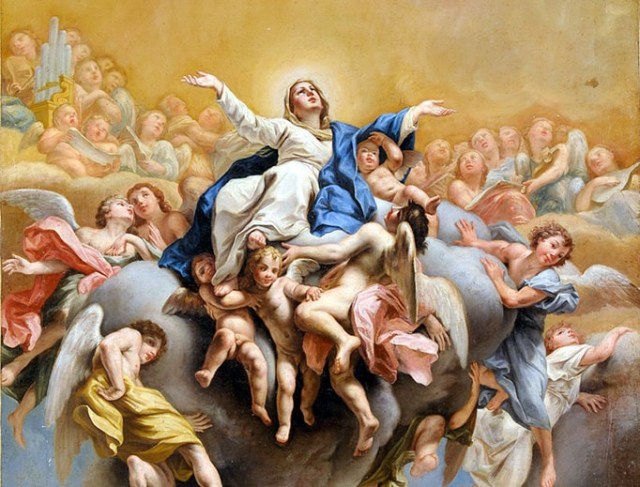
Assumption 2021

I wish you all a joyful feast of the Assumption this day. Many of us are praying in union with Roman Catholics who are challenged by the recent motu proprio from their Pope. We pray that serenity may reign together with the will to survive and continue in our many diverse liturgical traditions.

I prayed today for a new Enlightenment and Age of Reason, not like in the 18th century but one sanctified by grace and the gifts of the Holy Spirit.

I entrusted our suffering world to the holy Mother of God, whether through human wickedness, fanaticism, obscurantism, sickness, extreme weather, earthquakes and all other adversities. All we can do is muster the will to survive and come through this adversity and consecrate ourselves and our loved ones to Mary.

Posted in Uncategorized | Tagged , , | Leave a comment