Catholicism as a Mystery Religion

Many atheists accuse Christians of having plagiarised the ancient Egyptian mystery religions. They gleefully affirm that the legendary Horus was born of a virgin and rose from the dead. They infer from this that Jesus was a fraud, make-believe, never existed, and so the entire Christian message loses its credibility. It seems very easy.

The Church Fathers were very keen on showing the Old Testament as a prefiguring and symbolic prophecy of the coming of the Messiah. Like Judaism, since Christianity was also addressed to the Gentiles – people who were not born Jewish – the old pre-Christian religions of the Roman Empire, Greece, Egypt, Arabia and Persia were perceived also as prophecies of the one who would bring salvation and reconciliation between man and God or the various deities those people worshipped.

A mystery religion is so called because it contained secret rites known only to the initiated. This was certainly true of early Christianity with the disciplina arcani. The Sacraments of Baptism, Confirmation (Chrismation) and the Eucharist are called the Sacraments of Christian Initiation.

The ancient mystery religions were found all over the eastern Roman Empire and beyond. There were also public religions without secret initiations. Among the secret esoteric religions, there were the Eleusinian and Orphic cults, Demeter and Dionysus, Cybele and her beloved Attis. Isis and Osiris (which become Serapis) come from Egypt. Adonis originated in Syria and Palestine and the better known Mithra came from Persia and was immensely popular in the Roman army. I have myself visited the temple of Mithra under the Basilica of St Clement in Rome. It is very impressive. As for meals, the worshippers lay prone each side of the altar on which a bull (or meat from the already dead bull) was sacrificed. Those soldiers sought manliness and strength.

There were hundreds of these mystery cults as there were many more public religions, usually polytheistic. There was no single or common religion in the ancient world. The various religions tended to mingle and become eclectic from about the beginning of the fourth century of our era. Many mystery religions had some ‘characteristics in common. Considerable significance was found in the rites of spring and autumn, respectively new life and death. Nature became symbolic of spiritual processes. Worshippers joined the mystery religions by initiation into secrets about the life of the deity and how humans may find union with that spiritual principle. Emphasis, as in Gnosticism, was placed on personal experience and esoteric knowledge. The mystery religions were based on a myth of the return to life after death of the deity, together with the notion of redemption or the transfiguration of the lower to the higher. These myths were expressed in “sacramental dramas”, which made the ineffable accessible to ordinary human beings.

Though Christianity is essentially based on the Judaism in which Christ was born and was brought up, there are theories about Christ’s youth as with figures like John the Baptist. They came into contact with other spiritual and mystical traditions and disciplines. There were the Essenes, a mystical version of the Jewish faith, as there was also a Gnostic undertow in both Judaism and early Christianity. The tendency of modern Christians to believe in an absolutely united and uniform early Church seems quite ludicrous. As Christianity spread to the non-Jewish world, it adapted and expressed itself in as many ways as the mystery religions. Read St Paul in this light, and a light bulb might suddenly light up in your mind!

I have written to some extent on this subject in Odo Casel and Liturgical Theology, Reflections on Ressourcement Theology and Another Kind of Traditionalism in particular. Over the past hundred years, there have been many advances in historical and theological scholarship. We owe a great debt of gratitude to some of the Modernists at the beginning of the twentieth century who got such a raw deal from Pope Pius X.

Christian evangelism was not an affair of glitzy advertising or psychological manipulation tactics. It involved searching for man’s deepest aspirations and showing how Christ completely fulfils what was known only partially before. The liturgy touches the whole person and not only the intellect.

Dom Odo Casel devoted much of his life to studying the mystery religions. There is a very important work by Dr Theodore Filthaut, Die Kontroverse über die Mysterienlehr, published in 1948 – his doctorate thesis defended at Munich University. I have a translation of this book in French, but I know of no English translation. If a reader can find one, please give us the link. This book describes the controversy in German theological circles between those who followed Dom Casel’s thought and those who stuck to the more classical scholastic theology which give much less importance to the liturgy.

Casel presented the ancient mystery religions as a preparation for the coming of Christ, whilst the liturgy of the Church is the ideal and divine accomplishment of these mysteries. Casel’s main adversary was the Jesuit Father J.B. Umberg. According to the Jesuit, explaining the re-actualisation of past events by the omnipresence of the Logos is an unacceptable hypothesis. There can be no essential resemblance between Pagan and Christian mysteries.

Casel departed from scholasticism and sought a new way of presenting the Christian Sacraments, not by transposing the pagan spirit into Christianity, but to see the essential unity of all religions through the notion of mystery. Casel saw a doctrine of mysteries through the Tradition of the Church. I won’t go into the details of this controversy, because it would take ages – but it would suffice to say that Casel’s vision could not be contained in the old bottle of scholasticism the good Jesuit was upholding. Clearly the limits of scholasticism were becoming evident, as I myself found when I started reading Fr George Tyrrell and the great “new” theologians of the post World War II period. By the time of Vatican II, the Rhine needed to flow into the Tiber, to quote the title of a book widely read by Roman Catholic traditionalists.

Casel sought to see a complete and whole view of the mystery of Christ and the re-actualisation of all the events of salvation history, and not merely the Passion. This was a more Platonic view rather than the Nominalist view that began to prevail in later scholasticism and the Reformation. It is a view expounded by the divines of Radical Orthodoxy. On this subject, there is an article on a new book by Catherine Pickstock on the liturgy – The Contribution of Catherine Pickstock to Liturgical Renewal. I read this illuminating article a few days ago, and meant to mention it on this blog. I was sidetracked by my trip to England and the call of the sea!

I was discussing this kind of thing with my Bishop. The Anglican Catholic Church is ideally placed to work on recovering the spirit, theology and liturgical experience of the Catholic Church of before the Reformation and the Counter Reformation, of before the era when God’s word was frozen in amber by both Catholics and Protestants. This is the starting point of a true renewal, away from clericalism and institutionalism, away from claims of particular institutions to be the true church rather than seek fidelity to the one Church that has always been there and in which we all participate through the Mysteries.

It is a mammoth work, which was clearly the intention of Vatican II in the Roman Catholic Church, but which came up against the opposition of conservatism and the spirit of inertia. The movement was to come through the Liturgical Movement and Ressourcement theology. This movement did not intend to the Church to come to terms with the modern world, but to find ways of communicating with the modern world to get over transcendent truths and mysteries.

It is in this spirit that I have always worked hard to promote a kind of Catholicism that gets behind clericalism and conservatism to be radically orthodox or whatever any of us might want to call it. For this we need young blood, men and women capable of serious study and openness to what is new or different from our previous experience.

As I have had the occasion to explain, this blog is the essential of my teaching ministry. An insignificant and humble contribution, for which I thank modern technology.

Posted in Uncategorized | Tagged , , | 1 Comment

Been Away

I was a little slow in approving a couple of new comments, because I have been away since Friday night until this morning.

I have been to England to attend a meeting with some of the ACC clergy. It was a quick in-and-out using the Calais to Dover ferry service.

Yesterday afternoon, I visited Bishop Damien Mead at his home in Lydd on the south coast of Kent. We spent a couple of illuminating hours discussing ideas for the future and other realities. We truly understand each other. His foot is making slow progress, though he is still quite disabled due to the accident he suffered at the beginning of June. He needs our prayers and our moral support.

The Anglican Catholic Church is very small, but we have the opportunity to come up with new ideas and initiatives. We have no heavy bureaucracy to fight against. Isn’t that a blessing! I have a lot of hope and optimism.

Posted in Uncategorized | Tagged | Leave a comment

Housekeeping and New Page

There is now an Orthodox Blow-Out Department permanent page on this blog (on the black bar below the dancing Goliards) for the discussion of intra and inter Orthodox questions. Comments can be added to those pages just like any posting. I have had to remove some off-topic comments from my recent posting on the Sarum liturgy which contains only a passing and non-polemical mention of Orthodoxy.

The comments from the recent Sarum posting are reproduced on that page and removing from their original place. Those interested in these questions should post only in the “blow-out department” and nowhere else.

I may also institute Anglican and Roman Catholic “blow-out departments” for comments of a polemical and sectarian nature if called for.

Please respect my clear wishes. I don’t like moderating people other than those who are truly spiteful trolls (usual criteria), especially when they are otherwise pleasant and intelligent people.

So, gentlemen, please – in the right place – “at the other side of the quadrangle where you can all go and do it together“.

Posted in Uncategorized | Tagged , | Leave a comment

Independence Day

Another year passes!

Once again, I wish my American readers a happy Independence Day.

In the midst of many threats to the liberty and fundamental human rights your Constitution is designed to guarantee, may God preserve your faith and foundations of democracy.

Posted in Uncategorized | Tagged | 2 Comments

Using the Sarum Liturgy

Here is just about everything I have written on this subject. As you reach the bottom of the page, you will find the link to “older posts”.

I am quite intrigued to read about people who “love the Sarum liturgy” and lament that no one uses it. Cynics tell the world that no one is interested. At the same time, look up Sarum on Google and there are hundreds of postings, though some are about an educational institution in Salisbury and others about Old Sarum, the predecessor of modern Salisbury.

Msgr Burnham has mentioned the magic word a couple of times in a paper he recently wrote and which was given in a speech by Msgr Keith Newton in Rome (see here for my source), but I hardly see the UK Ordinariate doing more than perhaps bringing a couple of oddities into the standard Anglican Use or Novus Ordo celebration.

Anglicanæ traditiones, the Holy See’s inter-dicasterial working group, looked at this modern English practice, and at the feasibility of introducing the pre-Reformation Sarum Use in translation, before deciding to base its work on the 1983 Book of Divine Worship, authorised for the Pastoral Provision 1980. This rite has now been revised and enriched by material from the Anglican Missal and English Missal, pre-conciliar resources used extensively by Anglo-catholics.

My Bishop doesn’t mind me doing it in my own chapel, but the official rite of our ACC Diocese is the Anglican Missal. I don’t see it “catching on”. Some of the TAC parishes in Canada used Sarum occasionally before they went to the American Ordinariate, and there have been some initiatives in Orthodox circles. The rest is known history.

I would welcome comments. Are people really interested when they say they are? Are there any priest readers of this blog interested? Is there anyone thinking about it, but afraid they wouldn’t find all the materials and rubrics?

I would especially like to hear from priests interested in learning the Sarum liturgy and sharing their experience. If they do not wish to comment (even under a pseudonym), they can write to me at anthony.chadwick AT wanadoo.fr.

Over to you…

Posted in Uncategorized | Tagged , | 17 Comments

Fourteenth Century Catholicism in a Dead Language?

Yes, I look at the “progressive” point of view as well as everyone else’s. The so-called Enlightened Catholicism blog has done a trashing job on the traditionalists by contrasting the way Benedict XVI hoped to deal with the Society of St Pius X and the “Sorry you feel that way,  see ya’ bye” of Pope Francis. See Pope Francis Talks About The Church Of Living Stones; SSPX Throws Stones.

Before going any further, I am not casting any innuendos against the Roman Catholic church or its Pope, or even giving credit for a blogger who would see her Church go the way of the Anglican Communion and secular society. I have no interest in the Society of St Pius X one way or the other.

What is of significance to me is the reason why the traditionalists are being trashed in this way. Is it because of their anti-democratic politics and nostalgia for twentieth-century totalitarianism? No. It is about the liturgy

I wish them well and hope if they ever figure out how to be living stones by espousing a 14th century Catholicism in a dead language they come back and let us know how they accomplished it.  In the meantime, Francis has one less problem to deal with.

If you take the trouble to read the article, this blogger tars Pope Benedict XVI with the same brush as the SSPX. That the SSPX espouses nationalist and authoritarian politics is of no consequence to this blogger, since she would certainly advocate the imposition of absolute authority and “re-education” for dissidents if she ever found herself with the levers of power in her hands. I would only expect this kind of talk from this blogger, just as I would expect to see leaves on the trees in spring.

So the problem is the liturgy! Evidently not for the vast majority of western humanity to which the Church is no longer a known or trusted entity. In a way, this person is right – the old Latin liturgy will not bring the crowds back. Rather, it is the contrary: large numbers of people are drawn to “mega-church” liturgies. I have nothing against that for those who are drawn to God that way, but some of us are aliens to this type of religion. The common-sense answer would be diversity of “churchmanship” as in twentieth-century Anglicanism. But would it work? Perhaps the other common-sense answer is to get away from institutions and see the Church another way.

It will just bring us to reflect on the real reasons that keep most people away from church. They only ever went because they were forced to by civil authorities under the control of ecclesiastical authorities. How long ago did the Church die? Or rather, how is the Church still surviving far away from the rubble and waste?

As an afterthought, I keep an eye on Patricius‘ blog Liturgiae Causa, in which this young man from the greater London sprawl has written most insightfully. I find myself unable to comment on this blog for reasons of not having the right kind of connection to Google. The conclusion he has come to is sad but is understandable, as we see the dialectics between two totalitarian visions of Catholicism, one “nationalist” and one “socialist” and everything being blamed on styles of worship. Patricius and I sympathise probably more than he or I would care to think. At the same time, I have been around for long enough to know that intemperate writing alienates even one’s friends. I hope Patricius will have the courage to get out of his south-east English existence in a place as dull as Sidcup, to find new surroundings in which he can mature as a person and find fulfilment.

I am determined not to apostatise, but rather to hang on and remain faithful to those little pockets and remnants of Catholicism where they still exist and where they are still Christian as opposed to political. I have written at length on anarchism. Anarchism has always failed in political terms, because it is a-political. It concerns persons and the spiritual life, not yet another way to re-model society, in exactly the way Oscar Wilde claimed to have found freedom in prison. This is the freedom of the spirit – and it is there for each of us to discover.

Posted in Uncategorized | Tagged , , , , | 39 Comments

Peter the Fisherman

Tomorrow, we celebrate the feast of the Holy Apostles Peter and Paul. I look at Peter the Fisherman who was made a “fisher of men”. In particular, one may wonder what kind of boat he had to earn his living. In this article, I concentrate on the Galilean fishing boat.

We often see representations of the kind of boats used by fishermen on the Sea of Galilee in New Testament times. There are many mentions of boats and nets as used by some of the Apostles who were fishermen. Jesus preached from a boat at least on one occasion. There was a storm on the Sea of Galilee and Jesus was seen walking on the water and calmed the storm. The Synoptic gospels of Mark (i.14–20), Matthew (iv.18–22), and Luke (v.1–11) narrate Jesus recruiting four of his Apostles from the Galilean shores. The fishermen among the twelve were Simon Peter and his brother Andrew, and there are James and John. We remember the episode of the miraculous catch and the feeding of five thousand people. The Sea of Galilee is constantly present.

The mosaic representation below shows a boat with a short mast stepped nearer the stern than the bow, fitted with a yard and apparently a square sail. I have the impression that there are three oars on each side of the boat.

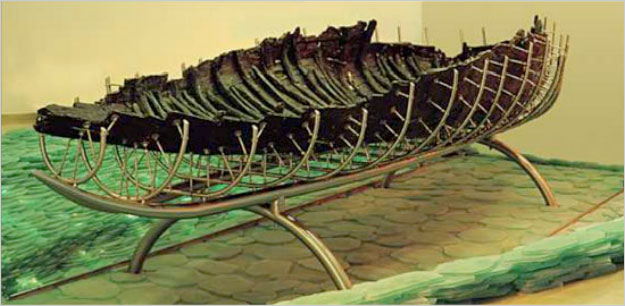
jesusboat01A boat dating from New Testament times was discovered in 1986 on the north-west shore of the Sea of Galilee. What is seen here would be the part of the hull that would have been under the waterline and which was preserved by the mud.

jesusboat02The boat is described in the illustration below of a reconstruction. The draft was very shallow to allow the boat to be beached. There is no evidence connecting the boat to Jesus or his disciples, but fishing boats were (are are) generally built to follow a local tradition.

jesusboat03We see a simple square rig with a “fancy” stern post and stem post jointed onto the keel. The boat is steered by an oar fixed to the port aft quarter and a deck is seen to the fore. The mast appears to have no shrouds or forestay, and would have been fixed in place by the mast step. There are two halyards to haul up the yard and the sail, two braces and two sheets for the bottom yard. Such a rig would allow broad reaching and running. The boat would have to be rowed closer to the wind.

jesusboat04Here is a romantic representation of a storm on the Sea of Galilee. The boat is of about the right size with apparently fourteen persons on board. The man just besides the helmsman appears to be Jesus. One person is heaving his guts over the side (weather beam!). A crewman desperately  works to get the jib down. The mainsail is torn and a rope with a pulley has broken, perhaps the main halyard or one of the port shrouds. The representation is indeed dramatic! I doubt that a boat of that time would have been rigged with a jib.

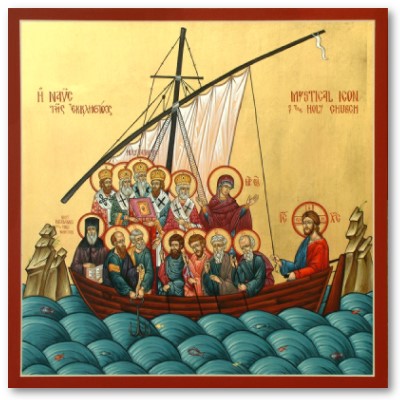
jesusboat05This Byzantine icon represents a very “modern” rig with a spreader on the mast like modern yachts. The rig is lug or Lateen. This rig points better into the wind, especially if there is some kind of device to reduce drift, like the keel on a modern yacht or the centreboard on a dinghy. However, the historical discovery gives no indication of such a device.

jesusboat06This is a popular style of representing the boats of the Sea of Galilee, again with a lug or Lateen rig and a fairly “modern” hull. The stern is a “canoe” stern, but no rudder or tiller can be seen in this drawing.

The Sea of Galilee is a very large inland lake, which can be treacherous in bad weather, even without the tidal currents we get at sea. Waves up to ten feet have been known and many boats have foundered.

After this article about Peter’s boat, I give a link to an interesting Wikipedia article on the man himself Saint Peter.

Posted in Uncategorized | Tagged , , , | Leave a comment

Fifteenth Ordination Anniversary

I refer you to my posting of last year, Nativity of Saint John the Baptist and Anniversary of Priestly Ordination for photos and other information. Fifteen years seem to have some significance. I ask your prayers on this feast of Saint John the Baptist 2013, and also for my late mother.

See this excellent article – Liturgical Notes on the Nativity of St. John the Baptist by Gregory Di Pippo.

Posted in Uncategorized | Tagged | 7 Comments

Another Nibble at Christian Anarchism

It’s not the first time I have brought this subject up (Christian Anarchism and a very recent one, The Mustard Seed), and this is a hotly debated subject. The word anarchism has a very negative ring, implying the mindless ideology of a nihilist who is hell-bent on destruction and is not above terrorist acts, killing or harming other people and violating other people’s property. The word is not a very nice one, but the underlying idea is very much me from my childhood and at various times in my adult life. I am extremely wary of authority, especially when it used by those in power to get more power and wealth with an obvious ambition to enslave his subjects. Clearly, I respect those with the role of fathers and benevolent leaders, unlike the man who has the biggest and most expensive car and the swarthiness of an alpha male.

We generally find that if we break laws, the police and legal authorities will do something about it. However, outside George Orwell’s Nineteen Eighty Four and the thought police and telescreens, we are free to conform outwardly to laws and dissent interiorly and within. Many laws reflect moral principles, like our dealing with other people as we would have them deal with us. Therefore, we believe that killing and stealing are wrong, and we obey the law, not because it is the will of authority, but because it forbids us from doing something that is also morally wrong. Some laws violate the Christian conscience, and that is more delicate. To what extent are we prepared to suffer being arrested by the police, tried and imprisoned. These things usually only happen those those who get involved in illegal demonstrations and provoke the police. I won’t even go into the issue of people who oppose the recent law in France allowing same-sex marriage (civil) and get into trouble as many have done.

If I am ever going to try to make head or tail of something that has gnawed away within me since my tender years as a schoolboy at the end of the 1960’s, the books will have to be read, especially by Tolstoy, Jacques Ellul and Berdiaev (the last of whom I have read quite a lot). We also need to be careful of labels like any “ism”, because they often involve bandwagons of other people’s ideologies and not thought in the light of one’s own intuition and experience. I haven’t yet had the courage to attack some very difficult writing, even in its original French or translated into English in the case of books originally written in Russian. It took a long time to become aware that when I would read books of Russian origin, it was not Orthodoxy that was attracting me but what Berdiaev called “the aristocracy of the spirit”, a kind of refined Gnosticism in the terms of the modern mind.

This kind of thinking is diametrically opposed to the years I spent in traditionalist and conservative circles for the sole reason that I was attracted to traditional liturgy and the finer aspects of culture like music and architecture, notions of love and beauty outweighing the usual masculine concerns for power, sex and wealth.

I am more attracted to a notion of salvation that does not imply its being conditioned by compliance to a particular human institution and authority, but rather by how we have lived, loved and served, by how we have stood up for what seemed right and true in itself rather than what bolstered up the authority of the rich and powerful. Maybe, I have a tendency towards universalism, but one that does not absolve individuals and groups from moral responsibility. Christianity calls us to conversion, not to submission to an authority that is known to have committed evil acts in history, but to love of God and embracing the values of the Gospel clearly set out by Christ. We should not proselytise but rather offer something beautiful and good that others may have for the taking if they are attracted to it.

We have each to work out for ourselves how we relate to the State where we live. I have always been attracted to the idea of living simply and needing as little money as possible. I comply with the State’s laws, but I do everything possible to avoid being made into a sheep-like consumer and money-addict. Total independence isn’t possible. We have to be realistic, but something can be done to resist to some extent. It also extends to our use of the medical and social security systems – avoid using either as much as possible. It’s the same with our food, even if we have not made a decision to become vegetarians. There is a difference between killing and eating an animal that lived a happy life on a farm, and keeping animals in concentration camp like conditions for maximum productivity. But then, there is the question of money. Junk is less expensive – at least for now until it gets the monopoly. I have to be very careful about the temptation towards “conspiracy” thinking, because many things that look like conspiracies are not.

Education of children is another theme. I went through the old system and had an “old square schoolmaster” who taught me to write English. He also used corporal punishment that might seem to an adult to be an effective way of not “sparing the rod and spoiling the child”. My first anarchist thoughts were during this phase of my life. My father saw the warning signs and took them very seriously. He took me fishing, had me go on “outward-bound” courses and had me go to a school that was run on very modern principles – in 1971. I have oscillated between that and outward conservatism for most of my life.

The thing an anarchist can do, if he outwardly abides by the law and accepted moral principles, is to be as independent as possible from the “system” or “The Pit” as others have called it. In America, parents can homeschool their kids. I went to school, so I have no idea what homeschooling does to a kid. I would imagine that children have to have some social life through culture and sport, and, of course, churches. We can’t change society or The Pit, but we can try to “do our own thing” to some extent, be a sign of contradiction whilst respecting other people’s rights. I belong to a marginal Church, which ironically is quite conservative. Not as conservative as the French traditionalist right-wingers or American “neo-cons”, but still quite “Estabishment” is some areas of thought. We have to live with what we’ve got, all in weaving in and out of the laws, norms and conventions we find in place. Not easy.

Should we actively resist the system? Two things come to mind, our respect of other people’s rights and the consequences of our acts. We break the law, and we’ll get into trouble with the police. We have to know what we want. I am more for a passive approach and creating micro societies like those who sought a new life in the New World centuries ago. The ideals become corrupt in any society, however purely it began, the Church being no exception, and one has to move on when this happens.

Evil men prosper because good men do nothing. I’m not sure if I got my quote right. Bonhöffer went to the gallows for his resistance against Hitler and the Nazis. If our countries got taken over by something similar to Nazism, would we resist? It’s easier said than done!

Central to my thought is that no human being should have power over another, but rather that society should be based on the idea of community and family. What do we do about sin and anti-social or criminal behaviour? Kill them? Put them in prison? That is the problem, but surely the good should not suffer for the deeds of wicked people, like making it illegal to drive a car because one person drove whilst drunk and killed someone. It would seem that Utopia is like the Perpetual Motion Machine. Does the existence of sin invalidate Christianity as a whole?

The marginal community is always at great risk of becoming totalitarian like the sects, or even most legitimate Catholic monasteries I have visited. Totalitarianism is rational and seems to make sense. Many people in Europe supported Hitler in the 1930’s, not knowing about the concentration camps and the Holocaust! When the light was seen in 1944-45, we had to start thinking differently over here in Europe. The thing I find frightening is that the first signs are there to indicate that it is all starting again!

I have personally grappled with these matters for decades. Is “radical individualism” the way, as anything good and of genius has always come from individuals? It can be very lonely, though some of us live a solitary life more easily that others. Some kind of relationship with other people is essential to our sanity and our very human nature.

I don’t know is there is a practical solution to all this other than the time we spend alone doing things like camping in the mountains or sailing on the sea – or for that matter undertaking the life of a hermit with the appropriate degree of spiritual discipline. Some ways of life come close to it without becoming just another ideology or way of getting power over other people as the circle of hypocrisy closes.

It’s easy to dream about all this stuff whilst living in a house and getting our shopping from the supermarket with the little money we are allowed to keep from what we earn. It’s not for dilettantes, but for those prepared to get “dirty”. I have no interest in doing things that will get me in trouble with the law, and which in any case make Christians look like fanatics and discredit themselves. I still live with the shame of being a part of the consumer culture and compromising with The Pit. Sooner or later, decisions have to be made.

Posted in Uncategorized | Tagged , , , | 9 Comments

Hooked like a Fish!

internet-addiction

I remember as a child reading a comic in which a cartoon cat used fishing tackle to catch a mouse. The cat threatens the mouse with great delight – “I’m going to hook you. When I get you, I’ll reel you in and fillet you“! Sometimes we’re slaves or victims of other people, often of ourselves.

My subject today is that of addiction. This seems to be a pluridisciplinary subject somewhere between medicine and psychology. I am not qualified in either subject, but I may have noticed patterns of behaviour in some fields of life which have not yet drawn the attention of the medical profession.

Addiction or dependence is a form of behaviour that is based on a repeated and irresistible craving for something in spite of efforts of the subject to control his own life and find independence from the thing that enslaves his life. Generally, it is a chemical substance like tobacco, alcohol or soft / hard drugs. In the case of some chemical substances, dependency becomes physical and severance is made possible with medical help.

I smoked cigarettes for many years and became addicted. Whilst it was a simple moral matter of willpower and courage, I found it impossible to break the addiction. Many people do. I stopped once for about a month, and the second time I held out for six months, and I was quite depressed. Depression is not merely the result of an all-or-nothing worldview. It is also a physical problem of the brain and central nervous system. The human organism is extremely complex, and the more doctors discover it, the more remains hidden from their scientific knowledge. I finally broke it when I married and my wife got me thinking about addiction not merely as a “moral” problem but a medical problem. There are now medicines that take away the physical craving and nervous depression. The nicotine patch also does wonders and is reduced progressively. Acupuncture, whether the traditional way or using special laser beams (done by a medical professional), is also helpful. It has now been seven years, and I haven’t touched one since – not one puff!

To get off cigarettes, the medical help is great, but there needs to be a very personal motivation in the first place. The usual anti-smoking propaganda is actually quite harmful, and anti-authoritarian people hate being threatened by the law. I found the best motivation, apart from the usual health and financial reasons, was that I was being taken over by an “authority” and was enslaved. Emancipation and freedom were within my reach if I went about it the right way for me. When I was a lad, smoking was a part of the “independence” and anti-authority movement – and that was a way of thinking I had to reason away. I am being more of a “rebel” not smoking than when I smoked. It is also better for other people, and there are only advantages to having kicked it.

There are many other forms of addiction, and I won’t go into alcoholism and drug addiction here. I will reflect on forms of addiction not involving chemical substances and modifications to the organism’s chemical-physical functions. The professionals often talk of being “hooked” of chemicals as a dependence rather than an addiction.

The most known non-chemical addictions are gambling, internet and computer games and television. We are now purely in the field of psychology, and several pathologies are known like obsessive-compulsive disorders. I am not an expert on psychology, and can only refer the reader to books and internet articles written by professionals. Sexual addiction is devastating, as a person often needs more and more of it, and with ever more “kinky” methods of stimulation. This is a developing science as contemporary society grapples to understand what drives paedophiles and rapists. One other thing I see as a possible source of obsessive-compulsive dependency is religion. This is something often picked up by atheists, and there need to be ministries in Churches to help people caught in these behaviours. Such persons are quite easy to spot in churches with stereotyped gestures and habits, and in the way they relate to other people. People hooked on cults and sects – or cult-like communities in the mainstream Churches – display the same pathology.

As a person lives with an addiction, it becomes a downward slope as that person’s relationships progressively deteriorate. Return to normal behaviour and relationships becomes increasingly difficult.

Doctors have discovered that some people are more prone to addictions, including chemical ones like alcoholism, than others. Not all heavy drinkers become alcoholics. It is something in the human psychological mechanism. Certain sports can also become addictive, bringing on a dependency independent from the will.

The word addiction comes from the Latin ad-dicere, say to… In the old Roman world, slaves didn’t have their own names and were “said to” their paterfamilias. Addiction is thus the condition of a slave, someone without independence or freedom. Debt is also a form of slavery and addiction. Sigmund Freud used the term to show a primitive need of all human beings. Children are addicted to our mothers for our very survival, and this is a kind of archetype of all addictions. A most credible definition of non-chemical or behavioural addiction is given by the psychoanalyst Aviel Goodman:

a disorder in which a behaviour that can function both to produce pleasure and to provide escape from internal discomfort is employed in a pattern characterized by:

  1. recurrent failure to control the behaviour;
  2. continuation of the behaviour despite significant harmful consequences.

There is also the notion of increasing the “dose” to obtain the same degree of satisfaction of the craving. Whether we are talking of chemical dependency, perverted sex or other behaviours, we find common characteristics like an increasing tolerance and greater difficulty in breaking the habit. The subject can no longer control the degree of consumption by the use of reason and willpower. As the addiction becomes more intense, other social, cultural and leisure activities are neglected.

There is also the term workaholism, the person who devotes himself inordinately and unreasonably to his job. We can become addicted to anything, to things that are usually good for us, like physical and intellectual activity, sport and reading / study.

Addiction is something that has become something much better understood than in the days when it was considered as a lack of character or willpower. There are many theories, and here again, I can only refer the reader to the experts. It seems to be closely related to the mechanism of reward and sensation of pleasure. We remember how we train dogs and small children using rewards and punishments: good = a sweet or a toy, bad = a slap, a smacked bottom or half an hour in “time out”. Where is the dividing line between normal and addictive behaviours?

Can addictions be “cured”? Chemical dependencies are cured medically, like my old cigarette smoking. The doctor gives his patient something to take away the craving and withdrawal symptoms. Then comes the psychological aspect, which will differ from person to person. I still get occasional cravings for a cigarette, but I stopped smoking so long ago and have very little contact with “second-hand” smoke, and can only conclude each time that it is a psychological illusion. Deep breathing and a good stretch usually do the trick – and life goes on.

How does a doctor treat someone who is addicted to the internet or gambling? There is no chemical dependency, so it is more simple and complicated at the same time. Different professionals have their methods and theories. One example is internet addiction, and games in particular. Blogging can also be addictive, as can be going on forums and commenting. I often wonder whether the behaviour of “trolls” is not also a form of addiction or compulsive behaviour.

From some of the articles I read, one goes “cold turkey” – shutting down the computer – and going to residential behaviour-modification programmes. Like establishments for alcoholics, restrictions are placed so that the addiction becomes impossible. So, no alcoholic drinks for alcoholics and no computers or internet for internet addicts. That seems to make sense. These centres also forbid electronic gadgets. They find life as it was thirty years ago – opportunities for reading books, listening to or playing music and good old-fashioned board games. One re-learns practical things in life: making and repairing things, cooking, looking after animals and physical exercise. Walking outside does wonders.

Those involved in this kind of work have noticed the effects of Facebook and Twitter, which seem to be designed to hook you like a fish. There is the old drawing of the Facebook player who had several thousand “friends”, and when he died, there were only two or three people at his funeral. That alone is sobering. Addictive use of the internet can become something like “electronic cocaine” and “mind-rot” like excessive amounts of time spent watching television.

Internet can make us information-saturated, and this is very unsettling. We need to spend more of our leisure time with sports, outdoor exercise, music (playing an instrument) and reading old-fashioned books. Some may need to stop using the computer entirely. For others, it suffices to ask ourselves whether we have a good reason to use it: for work or getting information. A good exercise is to keep our daily “survey of the blogs” to a minimum time. I would say that ten minutes a day is enough, plus not more than half an hour for reading articles and writing well-reflected comments. Personally, I don’t think my use of the internet is compulsive, and I recognise the signs of “overdoing it”.

We all need to examine ourselves and see if we tend to be addicted to things. We need to begin to understand the mechanism of addiction so that we see the warning signs in ourselves. It is simply a question of our own health, our freedom and independence in relation to slavery imposed by other people and our own compulsive behaviour.

Posted in Uncategorized | Tagged , , , , , | 5 Comments