Another Nibble at Christian Anarchism

It’s not the first time I have brought this subject up (Christian Anarchism and a very recent one, The Mustard Seed), and this is a hotly debated subject. The word anarchism has a very negative ring, implying the mindless ideology of a nihilist who is hell-bent on destruction and is not above terrorist acts, killing or harming other people and violating other people’s property. The word is not a very nice one, but the underlying idea is very much me from my childhood and at various times in my adult life. I am extremely wary of authority, especially when it used by those in power to get more power and wealth with an obvious ambition to enslave his subjects. Clearly, I respect those with the role of fathers and benevolent leaders, unlike the man who has the biggest and most expensive car and the swarthiness of an alpha male.

We generally find that if we break laws, the police and legal authorities will do something about it. However, outside George Orwell’s Nineteen Eighty Four and the thought police and telescreens, we are free to conform outwardly to laws and dissent interiorly and within. Many laws reflect moral principles, like our dealing with other people as we would have them deal with us. Therefore, we believe that killing and stealing are wrong, and we obey the law, not because it is the will of authority, but because it forbids us from doing something that is also morally wrong. Some laws violate the Christian conscience, and that is more delicate. To what extent are we prepared to suffer being arrested by the police, tried and imprisoned. These things usually only happen those those who get involved in illegal demonstrations and provoke the police. I won’t even go into the issue of people who oppose the recent law in France allowing same-sex marriage (civil) and get into trouble as many have done.

If I am ever going to try to make head or tail of something that has gnawed away within me since my tender years as a schoolboy at the end of the 1960’s, the books will have to be read, especially by Tolstoy, Jacques Ellul and Berdiaev (the last of whom I have read quite a lot). We also need to be careful of labels like any “ism”, because they often involve bandwagons of other people’s ideologies and not thought in the light of one’s own intuition and experience. I haven’t yet had the courage to attack some very difficult writing, even in its original French or translated into English in the case of books originally written in Russian. It took a long time to become aware that when I would read books of Russian origin, it was not Orthodoxy that was attracting me but what Berdiaev called “the aristocracy of the spirit”, a kind of refined Gnosticism in the terms of the modern mind.

This kind of thinking is diametrically opposed to the years I spent in traditionalist and conservative circles for the sole reason that I was attracted to traditional liturgy and the finer aspects of culture like music and architecture, notions of love and beauty outweighing the usual masculine concerns for power, sex and wealth.

I am more attracted to a notion of salvation that does not imply its being conditioned by compliance to a particular human institution and authority, but rather by how we have lived, loved and served, by how we have stood up for what seemed right and true in itself rather than what bolstered up the authority of the rich and powerful. Maybe, I have a tendency towards universalism, but one that does not absolve individuals and groups from moral responsibility. Christianity calls us to conversion, not to submission to an authority that is known to have committed evil acts in history, but to love of God and embracing the values of the Gospel clearly set out by Christ. We should not proselytise but rather offer something beautiful and good that others may have for the taking if they are attracted to it.

We have each to work out for ourselves how we relate to the State where we live. I have always been attracted to the idea of living simply and needing as little money as possible. I comply with the State’s laws, but I do everything possible to avoid being made into a sheep-like consumer and money-addict. Total independence isn’t possible. We have to be realistic, but something can be done to resist to some extent. It also extends to our use of the medical and social security systems – avoid using either as much as possible. It’s the same with our food, even if we have not made a decision to become vegetarians. There is a difference between killing and eating an animal that lived a happy life on a farm, and keeping animals in concentration camp like conditions for maximum productivity. But then, there is the question of money. Junk is less expensive – at least for now until it gets the monopoly. I have to be very careful about the temptation towards “conspiracy” thinking, because many things that look like conspiracies are not.

Education of children is another theme. I went through the old system and had an “old square schoolmaster” who taught me to write English. He also used corporal punishment that might seem to an adult to be an effective way of not “sparing the rod and spoiling the child”. My first anarchist thoughts were during this phase of my life. My father saw the warning signs and took them very seriously. He took me fishing, had me go on “outward-bound” courses and had me go to a school that was run on very modern principles – in 1971. I have oscillated between that and outward conservatism for most of my life.

The thing an anarchist can do, if he outwardly abides by the law and accepted moral principles, is to be as independent as possible from the “system” or “The Pit” as others have called it. In America, parents can homeschool their kids. I went to school, so I have no idea what homeschooling does to a kid. I would imagine that children have to have some social life through culture and sport, and, of course, churches. We can’t change society or The Pit, but we can try to “do our own thing” to some extent, be a sign of contradiction whilst respecting other people’s rights. I belong to a marginal Church, which ironically is quite conservative. Not as conservative as the French traditionalist right-wingers or American “neo-cons”, but still quite “Estabishment” is some areas of thought. We have to live with what we’ve got, all in weaving in and out of the laws, norms and conventions we find in place. Not easy.

Should we actively resist the system? Two things come to mind, our respect of other people’s rights and the consequences of our acts. We break the law, and we’ll get into trouble with the police. We have to know what we want. I am more for a passive approach and creating micro societies like those who sought a new life in the New World centuries ago. The ideals become corrupt in any society, however purely it began, the Church being no exception, and one has to move on when this happens.

Evil men prosper because good men do nothing. I’m not sure if I got my quote right. Bonhöffer went to the gallows for his resistance against Hitler and the Nazis. If our countries got taken over by something similar to Nazism, would we resist? It’s easier said than done!

Central to my thought is that no human being should have power over another, but rather that society should be based on the idea of community and family. What do we do about sin and anti-social or criminal behaviour? Kill them? Put them in prison? That is the problem, but surely the good should not suffer for the deeds of wicked people, like making it illegal to drive a car because one person drove whilst drunk and killed someone. It would seem that Utopia is like the Perpetual Motion Machine. Does the existence of sin invalidate Christianity as a whole?

The marginal community is always at great risk of becoming totalitarian like the sects, or even most legitimate Catholic monasteries I have visited. Totalitarianism is rational and seems to make sense. Many people in Europe supported Hitler in the 1930’s, not knowing about the concentration camps and the Holocaust! When the light was seen in 1944-45, we had to start thinking differently over here in Europe. The thing I find frightening is that the first signs are there to indicate that it is all starting again!

I have personally grappled with these matters for decades. Is “radical individualism” the way, as anything good and of genius has always come from individuals? It can be very lonely, though some of us live a solitary life more easily that others. Some kind of relationship with other people is essential to our sanity and our very human nature.

I don’t know is there is a practical solution to all this other than the time we spend alone doing things like camping in the mountains or sailing on the sea – or for that matter undertaking the life of a hermit with the appropriate degree of spiritual discipline. Some ways of life come close to it without becoming just another ideology or way of getting power over other people as the circle of hypocrisy closes.

It’s easy to dream about all this stuff whilst living in a house and getting our shopping from the supermarket with the little money we are allowed to keep from what we earn. It’s not for dilettantes, but for those prepared to get “dirty”. I have no interest in doing things that will get me in trouble with the law, and which in any case make Christians look like fanatics and discredit themselves. I still live with the shame of being a part of the consumer culture and compromising with The Pit. Sooner or later, decisions have to be made.


Posted in Uncategorized | Tagged , , , | 9 Comments

Hooked like a Fish!

internet-addiction

I remember as a child reading a comic in which a cartoon cat used fishing tackle to catch a mouse. The cat threatens the mouse with great delight – “I’m going to hook you. When I get you, I’ll reel you in and fillet you“! Sometimes we’re slaves or victims of other people, often of ourselves.

My subject today is that of addiction. This seems to be a pluridisciplinary subject somewhere between medicine and psychology. I am not qualified in either subject, but I may have noticed patterns of behaviour in some fields of life which have not yet drawn the attention of the medical profession.

Addiction or dependence is a form of behaviour that is based on a repeated and irresistible craving for something in spite of efforts of the subject to control his own life and find independence from the thing that enslaves his life. Generally, it is a chemical substance like tobacco, alcohol or soft / hard drugs. In the case of some chemical substances, dependency becomes physical and severance is made possible with medical help.

I smoked cigarettes for many years and became addicted. Whilst it was a simple moral matter of willpower and courage, I found it impossible to break the addiction. Many people do. I stopped once for about a month, and the second time I held out for six months, and I was quite depressed. Depression is not merely the result of an all-or-nothing worldview. It is also a physical problem of the brain and central nervous system. The human organism is extremely complex, and the more doctors discover it, the more remains hidden from their scientific knowledge. I finally broke it when I married and my wife got me thinking about addiction not merely as a “moral” problem but a medical problem. There are now medicines that take away the physical craving and nervous depression. The nicotine patch also does wonders and is reduced progressively. Acupuncture, whether the traditional way or using special laser beams (done by a medical professional), is also helpful. It has now been seven years, and I haven’t touched one since – not one puff!

To get off cigarettes, the medical help is great, but there needs to be a very personal motivation in the first place. The usual anti-smoking propaganda is actually quite harmful, and anti-authoritarian people hate being threatened by the law. I found the best motivation, apart from the usual health and financial reasons, was that I was being taken over by an “authority” and was enslaved. Emancipation and freedom were within my reach if I went about it the right way for me. When I was a lad, smoking was a part of the “independence” and anti-authority movement – and that was a way of thinking I had to reason away. I am being more of a “rebel” not smoking than when I smoked. It is also better for other people, and there are only advantages to having kicked it.

There are many other forms of addiction, and I won’t go into alcoholism and drug addiction here. I will reflect on forms of addiction not involving chemical substances and modifications to the organism’s chemical-physical functions. The professionals often talk of being “hooked” of chemicals as a dependence rather than an addiction.

The most known non-chemical addictions are gambling, internet and computer games and television. We are now purely in the field of psychology, and several pathologies are known like obsessive-compulsive disorders. I am not an expert on psychology, and can only refer the reader to books and internet articles written by professionals. Sexual addiction is devastating, as a person often needs more and more of it, and with ever more “kinky” methods of stimulation. This is a developing science as contemporary society grapples to understand what drives paedophiles and rapists. One other thing I see as a possible source of obsessive-compulsive dependency is religion. This is something often picked up by atheists, and there need to be ministries in Churches to help people caught in these behaviours. Such persons are quite easy to spot in churches with stereotyped gestures and habits, and in the way they relate to other people. People hooked on cults and sects – or cult-like communities in the mainstream Churches – display the same pathology.

As a person lives with an addiction, it becomes a downward slope as that person’s relationships progressively deteriorate. Return to normal behaviour and relationships becomes increasingly difficult.

Doctors have discovered that some people are more prone to addictions, including chemical ones like alcoholism, than others. Not all heavy drinkers become alcoholics. It is something in the human psychological mechanism. Certain sports can also become addictive, bringing on a dependency independent from the will.

The word addiction comes from the Latin ad-dicere, say to… In the old Roman world, slaves didn’t have their own names and were “said to” their paterfamilias. Addiction is thus the condition of a slave, someone without independence or freedom. Debt is also a form of slavery and addiction. Sigmund Freud used the term to show a primitive need of all human beings. Children are addicted to our mothers for our very survival, and this is a kind of archetype of all addictions. A most credible definition of non-chemical or behavioural addiction is given by the psychoanalyst Aviel Goodman:

a disorder in which a behaviour that can function both to produce pleasure and to provide escape from internal discomfort is employed in a pattern characterized by:

  1. recurrent failure to control the behaviour;
  2. continuation of the behaviour despite significant harmful consequences.

There is also the notion of increasing the “dose” to obtain the same degree of satisfaction of the craving. Whether we are talking of chemical dependency, perverted sex or other behaviours, we find common characteristics like an increasing tolerance and greater difficulty in breaking the habit. The subject can no longer control the degree of consumption by the use of reason and willpower. As the addiction becomes more intense, other social, cultural and leisure activities are neglected.

There is also the term workaholism, the person who devotes himself inordinately and unreasonably to his job. We can become addicted to anything, to things that are usually good for us, like physical and intellectual activity, sport and reading / study.

Addiction is something that has become something much better understood than in the days when it was considered as a lack of character or willpower. There are many theories, and here again, I can only refer the reader to the experts. It seems to be closely related to the mechanism of reward and sensation of pleasure. We remember how we train dogs and small children using rewards and punishments: good = a sweet or a toy, bad = a slap, a smacked bottom or half an hour in “time out”. Where is the dividing line between normal and addictive behaviours?

Can addictions be “cured”? Chemical dependencies are cured medically, like my old cigarette smoking. The doctor gives his patient something to take away the craving and withdrawal symptoms. Then comes the psychological aspect, which will differ from person to person. I still get occasional cravings for a cigarette, but I stopped smoking so long ago and have very little contact with “second-hand” smoke, and can only conclude each time that it is a psychological illusion. Deep breathing and a good stretch usually do the trick – and life goes on.

How does a doctor treat someone who is addicted to the internet or gambling? There is no chemical dependency, so it is more simple and complicated at the same time. Different professionals have their methods and theories. One example is internet addiction, and games in particular. Blogging can also be addictive, as can be going on forums and commenting. I often wonder whether the behaviour of “trolls” is not also a form of addiction or compulsive behaviour.

From some of the articles I read, one goes “cold turkey” – shutting down the computer – and going to residential behaviour-modification programmes. Like establishments for alcoholics, restrictions are placed so that the addiction becomes impossible. So, no alcoholic drinks for alcoholics and no computers or internet for internet addicts. That seems to make sense. These centres also forbid electronic gadgets. They find life as it was thirty years ago – opportunities for reading books, listening to or playing music and good old-fashioned board games. One re-learns practical things in life: making and repairing things, cooking, looking after animals and physical exercise. Walking outside does wonders.

Those involved in this kind of work have noticed the effects of Facebook and Twitter, which seem to be designed to hook you like a fish. There is the old drawing of the Facebook player who had several thousand “friends”, and when he died, there were only two or three people at his funeral. That alone is sobering. Addictive use of the internet can become something like “electronic cocaine” and “mind-rot” like excessive amounts of time spent watching television.

Internet can make us information-saturated, and this is very unsettling. We need to spend more of our leisure time with sports, outdoor exercise, music (playing an instrument) and reading old-fashioned books. Some may need to stop using the computer entirely. For others, it suffices to ask ourselves whether we have a good reason to use it: for work or getting information. A good exercise is to keep our daily “survey of the blogs” to a minimum time. I would say that ten minutes a day is enough, plus not more than half an hour for reading articles and writing well-reflected comments. Personally, I don’t think my use of the internet is compulsive, and I recognise the signs of “overdoing it”.

We all need to examine ourselves and see if we tend to be addicted to things. We need to begin to understand the mechanism of addiction so that we see the warning signs in ourselves. It is simply a question of our own health, our freedom and independence in relation to slavery imposed by other people and our own compulsive behaviour.

Posted in Uncategorized | Tagged , , , , , | 5 Comments

Valid but Irregular?

Square Peg in a Round HoleI have been getting some new responses to an earlier article, Vagante Bishops and Aping Rome, about a small number of individuals who get themselves ordained and consecrated bishops by prelates on whom they count for getting themselves recognised as valid by Rome in the hypothesis of their taking steps to find a back door into the official Roman Catholic clergy.

The men in Rome who occupy positions of responsibility in the Curia know about this trick. Many have tried it, and there is no reliably proven example of it “working”. Two examples in recent history are cited.

The first is that of Bishop Barbosa Ferraz, who was one of those who were consecrated by Bishop Carlos Duarte Costa in the 1940’s. He was received into the Roman Catholic Church in 1963 in his Orders as a bishop. Some allege that he had been a Roman Catholic, and that Rome made an exception from the normal rule, namely that anyone who has been a Roman Catholic and has committed heresy, apostasy or schism, or has received orders from schismatic bishops is definitely grilled, as we termed it in seminary. The evidence points to Ferraz having come from a Protestant background and never having been a Roman Catholic. He was treated in the same way as any Old Catholic or an Orthodox bishop swimming the Tiber. Once the orders are ascertained to be valid, the man goes over like any other convert.

The second case is that of bishops and priests ordained and consecrated by Archbishop Marcel Lefebvre and who are all Roman Catholics. In the early 1980’s, deacons and priests leaving the Society of St Pius X were treated as if they were in the usual inextricable canonical situation. As Cardinal Ratzinger took over at the CDF from Cardinal Seper in 1983, the padlocks began to fall away. Clerics were regularised and traditionalist priests doing their doctorates in Rome began to mount “ratlines” to get the former SSPX clerics incardinated into Italian, Polish, Lithuanian, etc. dioceses. Eventually, after the SSPX consecrations in 1988, Rome allowed communities like the Fraternity of Saint Peter and the Institute of Christ the King to be set up.

There have been other maverick Roman Catholic bishops ordaining and consecrating outside canonical norms, three to my knowledge:  Archbishop Pierre Martin Ngô Đình Thục, Bishop Alfredo Méndez-Gonzalez and Archbishop Emmanuel Milingo. In the cases of the first and third of these prelates, the Congregation for the Doctrine of the Faith pronounced: “does not recognize and does not intend to recognize in the future such ordinations or any ordinations derived from them, and therefore the canonical state of the alleged bishops remains the one they were in before the ordination conferred by the aforementioned N.“. This standard formula means that whether or not the orders in question are valid, they are canonically irregular and will never be regularised, except by the person in question returning to his Church as a layman. Bishop Mendez-Gonzalez seems to have slipped under the net, as he avoided provoking the media, and there were no blogs in those days (1983). The bishop he consecrated, Clarence Kelly, is a sedevacantist and would be unlikely to be looking to Rome to be regularised!

I have followed all this kind of thing for many years, and hoped an exception was going to be made for Archbishop Hepworth on the basis of his leading a significant ecclesial body. It was not to be so, and the way he has been dealt with by the CDF is nothing exceptional. Go wrong in this way and there is no way back except as a layman! The question remains as to whether one believes that the Roman Catholic Church is the “true Church”. If that is so, rather than “trying it” for pragmatic reasons, belonging to it without any condition outweighs any kind of sense of vocation or attachment to one’s priestly orders. This is really what it comes down to.

I find this world of men looking for orders and trying to justify themselves more than a little sickening, and I relate to it less and less well. Some independent Catholic clerics take a humble attitude and don’t try to justify themselves, and are realistic about not being able to be a cleric of a “mainstream” Church. Some of them have a few souls to minister to and others lead more contemplative lives of differing degrees of authenticity. Those are people I can relate to.

But, when it comes to men like Bishop Bell in England, mentioned in the older article, and a certain prelate, consecrated by ex-Archbishop (Rome laicised him) Milingo, looking for regularisation with Rome, then my reaction is that they can bloody well go through the front door on their knees and go to the crappiest Novus Ordo they can find! These poor men tie themselves up in knots with something with which they will never get anywhere. I do not mock them or take any pleasure in their lot. Mine would be just the same if I pursued the wait-wait-never-never game with Rome – or the local Bishop or parish priest – all the same thing as such cases are always referred to Rome – it’s the law. We just have to know what we want in life.

I have nothing against Rome or Roman Catholicism. It’s a fact and that institution has its rules, which it always applies. Just try committing a traffic offence and try negotiating with the policeman who catches you! The pessimist complains about the wind. The optimist expects it to change. The realist trims his sails!

The more realistic of us know that we can settle into a Church who will accept us and find use for our gifts, or we can do as most do – retire into secular life and seek to live another form of spiritual life. We all have our choices to make, and no one is beyond the pale of God’s mercy even if he is beyond that of the institutional Church. Most of us mature and grow up over the years, and see through the charade of clericalism. We cannot go back in life, but forwards. None of us can afford to be triumphalistic, and I have nothing to be triumphalist about.

For me, it comes to the notion of Christian anarchy, separating priesthood from clericalism. The distinction may seem fine, but it is vital – otherwise the priesthood is thrown out with clericalism and tacky nineteenth-century churches which finally get their appointment with the demolition company and their bulldozer.

The message is simple, all the wannabe Romans have to do is become rank-and-file lay Joe Catholics and go and find out what’s going on at the local parish. Alternatively, they can take a deep breath and think things over, and then make a realistic decision.

* * *

I will end this reflection with a few theological notions. The first is the absurdity of considering the ordinations of men like David Bell as valid whilst denying that of the bishops of Anglican communities, who, they, have souls to minister to and accountability. Usually, men like Bell are of interest only to themselves and what I might be tempted to term as “episcopi vagantes spotters” searching on Google. He has managed to attract a lot of attention to himself by claiming to be a regular Roman Catholic and sneaks in to get himself photographed with the Pope.

The notion of being valid but irregular / illicit leads to an absurd notion of the Sacrament of Order and the Catholic priesthood. The Orthodox deny that such a state of things could be possible – if you’re illicit, you’re also invalid. That is the Cyprianic notion – Sacraments being possible only within the Church. What has to defined is the notion of regularity and licitness. For whom? Is the Roman Catholic Church or the canonical Orthodox Churches the only judges, therefore the only true Churches outside of which the taps of grace are turned off and sealed?

I have often attempted to write on notions of ecclesiology, to demonstrate the possibility of the unique Church subsisting in several ecclesial bodies that are divided from each other in human terms. Call this the “branch theory”! I don’t care. What I do care about is that ecclesial bodies that are much smaller than the Roman Catholic Church or the Patriarchate of Moscow can also participate in the mystery of the Church. If this is so, licitness and regularity are simply the ecclesial context of an ordination. It’s not an easy one to judge, and the big Churches have every right to deny the ordinations of anyone coming to them or to ignore the marginal church bodies that keep away and to themselves.

I find it absurd that someone like Bell should be seeking to get Rome to say he is valid, yet not go to the CDF, lay aside his orders, do a penance and go back to London or wherever and find a job. He is not the only one. Other guys have been to get “kosher” orders in the hope the CDF will accept them as an episcopal package. The situation of individuals outside any ecclesial context other than imaginary or fictitious, is quite clear. They are simply charlatans. All such men applying to Rome will be turned down unless they agree to be reconciled as laymen with a perpetual irregularity against exercising orders.

In recent times, the Roman Catholic authorities, like the Orthodox, are very careful about commenting on the orders of those who are outside their communion and canonical chain of command. They just say “whatever might be the question of validity – quidquid ad validitatem” and say that those men have nothing to do with them.

A part of being an independent Catholic, or being in a Church where Catholicism subsists in sacramental and theological terms, is not to misrepresent oneself as what one is not. We in the Anglican Catholic Church are clear about not being in communion with Canterbury or being part of the “official” Anglican Communion. We are tiny and marginal, but we have the characteristics of a Church, at least for our own. We don’t need Rome or Constantinople to “recognise” us. We should be prepared to enter into dialogues and common efforts to unite churches in accordance with the explicit will of Christ. But, if we are shrugged off, it won’t be our fault.

We are much more likely to have an ecclesial life and valid Sacraments by belonging to Churches that “are what it says on the jar” than chasing around with fantastic pretensions and seeking to get recognition from Rome (unless we have never been one of theirs).

In any case, we’re fiddling as Rome burns… What’s the use?

* * *

As a post scriptum, I received an e-mail from “Edson” who complains that I said that the CDF Thuc and Milingo in the same boat.He said it was not true that the CDF only made a statment about Thuc, and the statement was unsigned and merely issued by the Vatican Press Office not legal authority. He tells me the first bishops Milingo ordained were already valid though the Old Catholic line but that the offical spokesman for the Vatican declared the Milingo ordinations as valid, unlike Thuc. See: http://www.nbcnews.com/id/34466444/ns/us_news-faith/t/vatican-defrocks-african-archbishop/.

And later in the message:

And later they were compared to the illicit Chinese ordinations. Perhaps you can correct the statement on your site about comparing Thuc to Milingo in this regard.

OK, the man has a right to a response, but it is not very coherent. In his comments to the other posting, he advances theories that are off the mark, like a laicised bishop ordaining invalidly or that validity is compromised by there being several “links of a chain” between the original Roman Catholic ordaining prelate and the ordinand in question. Almost as if ordinations were like photocopies of photocopies, each generation being less perfect than the previous one. That’s a new one on me! Fortunately, when digital files are copied, the copy is just as good as the original.

We’ll see when “Edson” gets his own situation sorted out and finds his name in the Annuario Pontificio. The proof of the pudding is in the eating. I waited long enough to find out the truth with Archbishop Hepworth! Again, we’ll see…

Another one has just come in giving a link about the Chinese Patriotic bishops. The article cites Archbishops Milingo and Thuc, but in a very imprecise way, and this article is what it is, a news article. Whether Thuc is called a schismatic and Milingo not – by a journalist – is of no consequence. I see no substantial difference between the way Milingo and his bishops and Thuc and his bishops in Palmar de Troya and Toulon as far as Rome is concerned.

I can see what “Edson” is getting at, a loophole by which he can get through the net and become an official Roman Catholic bishop. It is not for me to decide. We’ll see what Rome decides.

Posted in Uncategorized | Tagged , , , , | Leave a comment

The Mustard Seed

Most of us reading this kind of blog are familiar with the various Kingdom Parables in the Gospel. Some are easier to interpret than others. In the Parable of the Sower, Jesus gives the meaning. The mustard seed is the smallest of seeds and grows into a big plant. That can be be seen to support a tiny ecclesial group like the Anglican Catholic Church in England and give hope that we can truly do something towards bringing about the Kingdom of God on earth.

I have read the poignant article of Deacon Jonathan Munn of our Diocese, who has written Missing the Mission, and who is going to be priested this summer. Our Bishop has been the victim of ill luck as his foot was seriously injured in a furniture moving accident. He wrote to tell me that progress is happening and nature does her marvellous healing work. It just takes time and patience. Is the shepherd being smitten and the flock scattered? To what end? I have offered my own musings on the fate of Christianity in the contemporary world in which the limits between good and evil are pushed back further and further.

I live in a country where Christianity seems to fare even worse than in England. Over here, Christians were getting their heads chopped off on Madame la Veuve Noire in the 1790’s. A spate of persecution arose again in the late nineteenth century with the political differences between the growing Masonic – Socialist men of politics and the hardening response of the Church through Papal infallibility and anti-Modernism. The Church in France was disestablished in 1905. They chopped down the doors of monasteries with axes and chased the monks from their homes. They ridiculed priests and devout lay people. They did a great favour to the Church by taking away its money and political clout. England seems to be having its first taste of opposition to religion, not from Christians with opposing theological convictions, but like in France from atheists. Persecution has been honed to a fine art, and no longer commits the fatal error of making martyrs. Those who are persecuted are made into pariahs without any honour or dignity, discredited. The churches are decaying and seem to be of interest only to those who might be able to make money from them.

I understand the concern for Bishop Damien Mead who has been the only one able to make something of the ACC since Fr Patrick, the old Vicar General, was unable to go on. The Anglican Catholic Church suffered from conflicts and instability in the 1990’s – I saw the early stages in 1996, too close to Bishop Hamlett for comfort. Continuing Anglicanism has always had a very hard time in England. We English have no sense of innocence and wonder, but we are hard and heartless cynics, knowing the cost of everything but the value of nothing, as Oscar Wilde said. What is it with us English? Do we really want a world where money is everything, perhaps even a totalitarian society on the lines of Orwell’s 1984!

We need to think what there is about the ACC that other churches do not offer. We have an older form of liturgy, but we are poor and only have small rented buildings or makeshift secular premises. That takes away much of the beauty. I was once attracted to churches by beautiful buildings and fine choral music. We have neither in the ACC. We have more of a public profile than we might have had, due to our Bishop’s ability to work like a businessman and make us visible. In the end of the day, we are something like some of the independent traditional Catholic groups who try to continue with the traditions their mainstream Churches of origin trashed in the 1960’s. We are of appeal only to those with some memory of the “old ways” and who don’t mind being marginal and “non-conformist”. Maybe a few without a specific Catholic culture might be attracted to our little marginal community, because we don’t have the weight of big ecclesiastical bureaucracies and impersonality. Perhaps we would be like small shops attracting customers by old-fashioned quality rather than low prices and abundance at the supermarket. But, behind that, what does the seeker believe in?

Our smallness and insignificance could be ways of “atoning” for the things about the mainstream churches that alienated people, the stereotypes and hypocrisy. They will find much worse in business and politics, though it can be argued that only religious people are bound to be moral and people of integrity. Sleazy businessmen don’t have this constraint, and they are just expected to do their stuff! The Church is expected to be true to itself and pay for its honesty in a world where rip-off artists thrive! It’s a point of view. We don’t have money or big financial / material commitments, so we can be seen as more coherent, something like the Franciscan movement in the thirteenth and fourteenth centuries.

Deacon Jonathan’s thoughts ring true in his honesty. He lives a relatively sheltered life, living outside London and teaching in a good school. All the same, he finds the attitudes of our times through his pupils struggling with differential calculus and algebra. He, like I, are against trying to convert people through the use of pressure. All we can do is find those who are seeking and who may find happiness with our way. Something I don’t like about the Evangelicals, like salesmen, is that it is difficult to have a normal human relationship with them without having to rebuff their trying to make a conquest.

Again, I come to the idea of the leaven in the desert. Our existence is likely to become a very lonely one in human terms, but doing good for the world in terms of prayer and being more compassionate and full of empathy in our ordinary lives. It was the vocation of the monks and hermits, and I see no other way in the world as it presently is with a philosophy of life that has nothing in common with Christianity. There is the great impenetrable barrier.

This is something Deacon Munn, as a Benedictine oblate, seems to have understood. It is true that Mark Twain said “The reports of my death have been greatly exaggerated” and that Christianity is not dead, nor will it die. But it can lose lose its churches, respectability and privileges it had in public life in exchange for becoming a kind of “thought police” for secular authorities. Christianity is an inner Kingdom, something within each of us and when two or three come together in Christ’s name. Christianity is essentially anarchism – going along with secular authority and the law out of necessity but without believing in it, with one’s heart set on something higher and more abiding – terrena despicere et amare caelestia, as so many of of our liturgical prayers say. The Kingdom is our secret garden of the soul, in each one of us and when we come into communion.

We are tiny, like so many Christian communities that walked away from money and respectability and embraced Christian anarchy. Naturally, I define anarchy as eschewing authority and power except on a practical level, and not as a movement of nihilistic people who commit violent criminal and terrorist acts. Read the Gospels and the Sermon on the Mount.

An anarchist is someone who doesn’t need a cop to make him behave. Anarchism is voluntary cooperation with the right of secession. The individual or the family or the small group as a unit instead of the State.

Far from committing violent acts, the anarchist ideal is expressed in this little quote

There is little doubt that the earliest followers of Jesus, and all those who continued the monastic tradition into modern times, have adopted the anarchist principle of leading a simple, industrious, mutually self-supporting life.

Those who seem to give the example are the Amish in America, monasteries (though many monasteries are totalitarian in practice), the old groups of Goliards, the fools for Christ, the little independent Catholic churches, good Christian families and people doing an honest day’s work. We read about the necessity of authority. We cannot escape it in civil life and we accept being under the orders of our bishops. Absolute anarchy would be a principle of selfishness and nihilism. Absolute authoritarianism is something like the hell Hitler and Stalin created in their respective countries and usurped empires. The “absolute” being taken here to mean some metaphysical reality rather than a simple principle of organising society. Christian anarchism seems to lie somewhere between pragmatic realism and keeping the ideal going within.

We seem to be touching the nerve, and finding a basis on which we can begin to believe that not all is lost. The buildings are decaying, people just don’t care, but the leaven remains.

Posted in Uncategorized | Tagged , | 1 Comment

Achtung Minen!

They are still finding World War II mines in the English Channel. The tides come and go, each day at a different coefficient. The currents combine with the weather in an infinite number of permutations of forces working together or against each other. Most of the German mines (to defend occupied France against the Allies) were found and destroyed after the war. Now and again, a mine gets uncovered and reported to the coastal authorities who call in the Navy.

sea-mineI was sailing this afternoon, and got a lesson in the usefulness of a VHF radio on board. It isn’t just for calling for help if something catastrophic happens to me. You leave Channel 16 open, and you get bulletins or calls for help from other boats. There’s not much I can do in a ten-foot dinghy with no engine, but I have helped de-masted boats or very small motor boats with broken-down engines. Within my kind of range of sailing, I see the other boats and can tell if they’re in trouble. Channel 16 is used by the seafaring community to call for help, to answer distress calls and give safety information like bad weather warnings and hazardous events in general. Using Channel 16 requires a strict protocol, and if there is any other kind of communication, the two vessels agree to go onto another channel to free up Channel 16.

Today, the VHF crackled into life and we learned that in half an hour, at an exact given position, the French Navy was going to explode a mine, and all ships should stay at least 1,500 metres away. The only thing was that I don’t have a GPS, as I never go more than about a nautical mile from the shore, so all my navigation is by eye and the occasional use of a sighting compass. I thought the event would take place far away, or there was another possibility. I saw a ship far away on the horizon which seemed to have the profile of a small Naval vessel. A minesweeper, similar to this one?

minesweeperBetween my dinghy and the ship on the horizon was a yacht, itself seemingly not very concerned, so I seemed to have nothing to worry about as my safety distance was many times more than what was stipulated. Another announcement on the VHF, ten minutes to explosion. Then another one – five minutes to explosion. Then the last ten seconds like the countdown for the old moon rockets in America. I looked towards the ship, and sure enough, the sea near it exploded. It looked something like this, except that I saw it from about a couple of miles away:

sea-mine-explodingI heard the muffled bang a few seconds later. That was it. It seemed disappointing. I wondered if there would be a shock wave, but I never felt one, unless it was indistinguishable from the normal swell of the sea.

Seventy years later, they still find unexploded shells on the beaches, mines at sea, bombs in the cities. Just imagine what gets left behind by more recent wars in the world! As we often sing in England to that lovely tune by Parry on Remembrance Sunday:

Dear Lord and Father of mankind,
forgive our foolish ways;
reclothe us in our rightful mind,
in purer lives thy service find,
in deeper reverence, praise.

Drop thy still dews of quietness,
till all our strivings cease;
take from our souls the strain and stress,
and let our ordered lives confess
the beauty of thy peace.

Remember in your prayers the brave Naval men whose job it is to find these murderous weapons built seventy-five years ago and whose detonators are still frequently in amazingly good working condition. This is dangerous work done by divers who are experts in defusing mines, and then the thing is set off by remote control from the ship.

Had I not had my VHF, I would have seen the explosion and not understood what it was. They don’t blow up mines at sea often these days, and very rarely in the English Channel, the sea with the highest volume of maritime traffic in the world.

Posted in Uncategorized | Tagged , | Leave a comment

Western Rite Russian Orthodoxy in England

I received a private e-mail to give me information about how Western Orthodoxy under the Russian Orthodox Church outside Russia is developing in England. Some might want to trash it, but my own attitude is to encourage them in their own work in God’s Vineyard. I am a lowly priest in the Anglican Catholic Church, but I have an open mind to any other little community that is doing practically the same work as we try to do.

We should be cultivating friendly relationships. Indeed, when I observed that there was no Western Orthodox presence in England, I should have been clearer about there being no Antiochian WR liturgies in England. They are under ROCOR and the community’s priest Fr Thomas Cook. In his correspondence, he cracked a little jibe about if we thought the ACC is small, we should take a look at the little WR Orthodox vicariate in the UK under Bishop Jerome of Manhattan!

They have a presence on the internet in two forms:

They have the liturgical usages they have. They are as small as us in the ACC or even smaller. No human community, even a religious one, is perfect. We all have something worthy of criticism and needing improvement. Whatever, I think they should be encouraged and make a permanent part of the English world of traditional Catholicism in the widest meaning of this term.

Posted in Uncategorized | Tagged | Leave a comment

Is Christianity Dying?

It’s an old question, and someone kindly send me a link by e-mail to Fr Guy Winfrey’s blog and its article under this very same title – Is Christianity Dying?. Fr Winfrey is an Orthodox priest, but speaks of Christianity in general without regard to denomination or particular tradition. I link to his article because I find a ring of truth.

We get all kinds of answers to this question, depending what people believe in or don’t believe in. Very often, conservative American Christians denounce the very culture and “money is everything” by which they live – have to live in order to stay where they are. Then they advocate what they call “masculine” and “muscular” Christianity, a kind of religion that operates like an extreme right-wing political ideology. Yet, Americans have only known un-established (as opposed to dis-established) religion and freedom of religion, and therefore without the temporal authority they need to enforce their “orthodoxy” in the manner of the Papacy in the fourteenth and fifteenth centuries. As a European (or rather an English expatriate), I see through this piece of cant immediately. However, I won’t go into an anti-American diatribe, since I know that only a proportion of Americans think that way, and most are decent honest folk like over this side of the pond.

In Europe, the problem of dying Christianity is much more acute, and we know that Fascism and other “integralist” ideologies have done more harm than good to the standing of the Church in most people’s minds.

We who are Christians search for the first signs of a new spring, the continuing of old traditions like Christmas and Easter, greetings like Grüss Gott in Catholic parts of Germany, Austria and Switzerland and so forth.

It is sure that the institutional Church is partly to blame for its “irrelevance”, but we live in a culture where money is everything and we exist to consume and become ever more addicted to money. The system is made that way. Whether it is a plan of a great conspiracy or just the end result of modernity, and perhaps the end of history, it is the paroxysm of the industrial revolution and the alienation of man from his roots, culture and traditional values. From this come the radical change of moral values, the denaturing of marriage and the family – itself subjected to the requirements of the consumer society and the money mill (the more you have the more you need), and then perversions in human sexuality and the “culture of death” as Pope John Paul II coined it. The Church institutions have not been above the “sleaze”, but those who criticise the Church for paedophilia and love of money often have worse skeletons in their closets themselves!

The longer I live in our consumer and throw-away world, the more I can feel that Christianity is suffocated and unliveable. It is not by accident that there are still vocations to monasteries and various forms of religious communities for clerics and lay people. But, how do we reject the very world that sustains us, giving us comfort, a feeling of security, doctors when we get sick, money to buy the attractive things shown to us through advertising and marketing? How do we go about it? How can churches become “relevant” to that kind of “culture”? They can’t without renouncing Christianity in some way.

Most of us will not escape “The Pit”, because the wrench would be too painful. It might be possible for some to make some kind of compromise by “simple living”, but that is much more difficult in deed than in word. What kind of churches encourage this kind of lifestyle, when they are addicted to money for their crumbling buildings? There was something very hopeful in nineteenth-century Anglo Catholicism – eschewing the rich bourgeois classes of the Establishment and the idea of bringing beauty and holiness to the poor. The message of the slum priests was a Christian understanding of simplicity and poverty like St Francis of Assisi. Nowadays, the working classes and marginal people are alienated from churches and their “smug orthodoxies” – and many former working and country people are part of the “money is everything” and consumer world.

Total radicalism is an illusion, and some measure of compromise is the only way. We have to have money, but we can work damned hard at reducing our need and addiction for it and other people’s need for ours. I see a need for us to become marginal people to be Christians, at least the prophetic type. How far are we prepared to go?

Many of us in an “establishment” kind of life may baulk at the sight of hippies, or the current equivalent, groups of men and women on motorcycles, “bums” and all sorts – but they seem to be the modern equivalent of the kinds of people to whom Christ stretched out his hand to draw them higher. The so-called “dregs” of society may be immoral and unworthy for most of us, but perhaps less impervious to grace than company directors, bankers and politicians.

I see Christianity living on at the edges, as motorcycle people study the Summa Theologica and dropouts are the philosophers of life. In the USA, there is a higher proportion, better defined, of marginal people – and it is easier to discern their spiritual aspirations. As for churches and institutions, they will last the longest in the cities as they support the “successful”. But for how long? This is the way my reflections are going. Fr Winfrey’s article is very interesting and may enable many of us to be more “honest to God” in our own lives and understanding of what Christianity is really all about.

Posted in Uncategorized | Tagged , , | 2 Comments

A Comment on Commenting

I have more or less followed the long thread of comments on the recent posting I did on Western Orthodoxy. My feelings are mixed. On one side I am grateful for exchanges of information and opinions, which gives a blog life and “democracy”. On the other side, especially when emotion shows through, as much as it can with the internet, it is quite depressing. My reaction on some mornings, when I have my usual “internet breakfast”, is that what some are really saying is that no one should become Orthodox, as mired as it is in the same kind of logic and dialectics as contemporary Roman Catholicism: showing intolerance for certain forms of liturgical attachment in the name of unity, integrity of one’s evangelical approach or authenticity of conversion.

Personally, I don’t buy it and I have become immune. It is all the same sad that those who are alienated from their Churches of origin have nowhere else to go without a massive break in their religious experience and a “reboot”. Perhaps a reboot is necessary in some cases, but putting it into perspective, if immigrants into a country were asked the same thing, there would be an outcry from human rights protesters! It has to be said that no Church is obliged to receive “immigrants”, but they should at least say so.

As I see it, it doesn’t matter that the Antiochian Church doesn’t allow the Western Rite in England. Then alienated Anglicans and Roman Catholics won’t become Orthodox (unless they’re prepared for a “reboot” and the Byzantine package). It’s as simple as that. They can either question their commitment to Christianity or find a Church body that will welcome them “as they are” in a “hermeneutic of continuity”. If no such ecclesial community exists, they could hardly be blamed for staying away from church! I am sure God has other ways of looking after his wandering children!

I just ask my good commenters to be careful what they say, lest they should convey the message that they are fiddling while Rome burns or that they do not themselves believe in what they profess, or that Christianity itself is a “mental disease” as the atheists would say. My feeling, as I have my “internet breakfast” is often that this kind of thing should not exist in this day and age.

As I explained to one enquirer, I don’t want to moderate more than necessary. I do so in clear cases when “troll” behaviour is manifest: extreme rudeness, anonymity, predatory behaviour and emotional provocation. In other cases, I consider them as “moderating influences” on the opposing points of view and those tempted to use this blog for proselytising. I therefore don’t moderate them, but I do ask for prudence in not allowing anger and other emotions to get through.

I suggest writing difficult or intellectually / emotionally challenging comments off-line, on your word processor for example, and then copy and paste the text into the comment box.

Posted in Uncategorized | Tagged , | Leave a comment

Two Sailing Days

I have had a real treat over the past two days, as my big translating order has made such good progress – yes still the massive great machine for making aircraft parts.

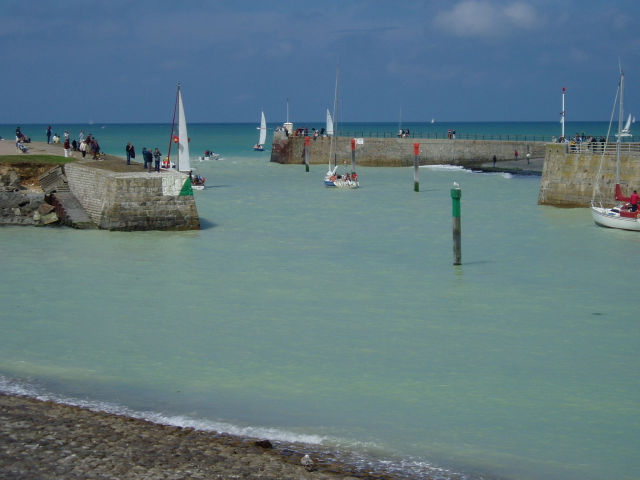
saint-valery-en-cauxI took the boat to the port of Saint Valéry en Caux and launched from the slipway you can see on the right of the photo (port side from the sea). The yachts and fishing boats are moored in the inner part of the port where there is a dam which keeps the water in the basin when the tide is out. Using a port for launching a dinghy is of interest at high tide. The high walls create eddies with the wind, so you have to be very reactive, using puffs of wind in the sails and good strong strokes with the paddle. Once the boat has cleared the narrow entrance – the problem with this port for any boat without an engine, it is literally – plain sailing.

Yesterday, the wind was the end of the long week of a north-east wind that blew quite strongly over the weekend. It was down to 7 to 10 knots and would afford a peaceful outing. It is also pleasant to have just an hour of the rising tide before it begins to ebb – no tidal currents, so I could go far out to sea with the yachts. I took the north-east wind in a broad reach and sailed north-west against the remains of the rising tide and enjoyed the ride. After about half an hour, I could see as much of the Côte d’Albâtre coastline as could be seen, from Fécamp to Dieppe, which is quite a lot. The visibility was perfect and the weather was pleasant.

When I felt I was far enough out to sea, a couple of leagues probably, I tacked and turned south-east in a close reach and sailed towards Veules les Roses, where my sailing club is. After about an hour and a half at sea, I turned back towards Saint Valéry en Caux and ran before the wind, with my mainsail and jib in “scissors” formation. This is a configuration which is quite tricky, with the wind almost directly astern. The danger is unexpected gybing, with the effect of waves on the helm, and the usual broach and capsize. I prefer to run with the wind a little to one side, and the boat becomes a lot more stable, then you just gybe a few times to keep a steady course.

Today, the wind had changed to an unstable and “grumpy” south-westerly, bringing light rain in patches, but the sea was flat due to its being to lee. I always carry an anchor when the wind is coming from the land, just in case. In these conditions, and with fewer fishing boats and yachts at sea, I stayed reasonably inshore and did a return journey to Veules les Roses. This is a trip I have often made the other way round. I was in a broad reach to get there and a close reach back, but I could simply watch the boat and enjoy the scenery. The scene of the coastline was misted in fine rain here and there, and the weather was not too bad elsewhere. That kind of weather also has its charm. It inspired plenty of impressionist artists in the 1900’s!

Returning to port the wind /drift configuration was unfavourable, so I had to compensate by close-hauling and aiming at the beach before the port. As I approached, I saw I was “overshooting”, so I tacked a couple of times to compensate for my drift. I saw the possibility of entering the port on a port tack, but in retrospect I would have been better off “overshooting” and returning on a starboard tack. As I passed the harbour entrance, the wind was taken out of my sails and I took my paddle. A yacht motoring back into port offered me a tow, so I threw its skipper my tow rope and thanked him. Once in harbour, he let go of my rope a little early, so I had to tack to get back to the slipway. It was amusing to see a man on the harbour wall explaining to a woman standing next to him that a sailing boat has to tack to go upwind! I only had to tack about three times to get in far enough.

All in all, these were a nice couple of days on my familiar bit of the English Channel (wrong side!). For the rest of this week, the wind will be whipping up, and the weather might not be very clement over the next couple of days.

armada2013gotebergNext Sunday, Sophie and I will be going to the Seine at Caudebec to see the Tall Ships Armada parade. These great ships are shown in the photos above moored at Rouen, where we went to visit them last Saturday. As we visited the Götheborg, a Swedish replica of an eighteenth-century warship, an elderly man was demonstrating the art of traditional sail-making. Sails were made of flax, a very strong material from before our days of Dacron and other synthetics. Hand sewing is hard work! He turned out to be English, and looked every inch a man of the sea – I could see it in his eyes. We seemed to understand each other.

The most impressive vessel is the Russian Kruzenshtern:

КрузенштернAs can be seen, she is a four masted barque and is no less than 375 feet in length, more than a hundred times my dinghy, and she has a crew of 257 men. See more about this amazing ship.

Posted in Uncategorized | Tagged , | Leave a comment

Authority and Tradition

For many years, I have heard it said again and again that the crisis of western Christianity is one of authority. This constitutes the entire question of religious freedom and the liberty of the conscience – also why some authoritarian religions appeal to authoritarian political structures to support their agendas. For Roman Catholics, the authority is (at least nominally) the Pope, and for conservative Protestants, it is the Bible. The ideal for any religious authority is to have control over the secular authorities in order to enforce their own authority.

I found this quotation in an article dealing with questions of authority and the rise of democracy.

Authority is only meaningful as long as it can be enforced. Sentiment for tradition is only effective as long as it continues to persuade.

I have never come across a more succinct way of saying it. If religion depends on authority, and that authority cannot be enforced, then that religion becomes meaningless – and from thence comes secularism.

We have two elements, authority that constrains, binds and punishes for non-compliance, and we have Tradition that needs to persuade through a notion of intrinsic truth. If it is true, it is because it is the way it is and not because someone we’re afraid of says so. Unfortunately, much of what purports to be traditional is based on another form of authoritarianism.

What kind of “traditionalism” is possible without constraint and punishment, and rather the fatherly role of bishops rather than their clericalism and careerism.

See this wonderful article by Sandro Magister on a question that has preoccupied me since my seminary days – Vatican Diary / The scourge of divorce between bishop and diocese. Pope Francis seems to understand the Episcopate better than anyone else – for years or decades.

Perhaps a real turnaround is happening, something that traditional liturgical trappings alone cannot do.

Posted in Uncategorized | Tagged , , , | 36 Comments