A Missing Link

No, it’s not a Barbie doll’s head dug up in the garden and submitted to the palaeontology faculty of the local university, but an earlier article of Archbishop Haverland about the doctrinal basis of the Anglican Catholic Church.

I have reproduced the article in full for the sake of convenience, with a link to the source.

I intend to dig for more light on the so-called Henrician Settlement and will be writing further.

* * *

Archbishop Haverland on the Formularies of the ACC – original article with its 8 comments

The following is an article by the Most Reverend Mark Haverland, Ph.D., Archbishop and Metropolitan of the Anglican Catholic Church.

What are the Formularies of the Anglican Catholic Church?

What are the Formularies of the Anglican Catholic Church? What documents and authorities have the greatest weight for the ACC in determining debated issues of doctrine and morals? The question should be of interest, of course, to members of the ACC in particular. The question also may be of some interest to some others.

In such matters one often has to distinguish intrinsic and formal authority from practical and material authority. For instance, most Christians would agree that Scripture is intrinsically more important than a Conciliar formula, say the Tome of Saint Leo. However, often as a practical matter a less intrinsically important authority may provide the practical lens which brings the more fundamental, greater text into focus. Roman Catholics, for instance, certainly would acknowledge that Saint John’s gospel is more fundamental and important than a papal encyclical. However, as a practical matter Roman Catholics view, for instance, S. Matthew 16 or Saint John 21 in the light of developed assumptions and teachings about papal authority which have a kind of practical, interpretive priority. The lesser authority as a practical matter determines the meaning of texts which can be and are interpreted in widely different senses by different sincere, intelligent, and learned readers.

So while no sane or sensible person would assert that the Constitution and Canons (C&C) of the Anglican Catholic Church have any profound intrinsic authority, they have a kind of priority in any attempt to identify the authoritative formularies of the ACC.

One approach to the question before us is to apply to the ACC a line of argument following from the term ‘Continuing Church’. On this theory the ACC is a Continuing Church; what the ACC continues is classical Anglicanism; and the formularies of classical Anglicanism are, in the reckoning of the late Father Peter Toon, the 1662 Book of Common Prayer (with its Ordinal), the Thirty-nine Articles of Religion, and the Homilies.

As an approach concerning the formularies of the ACC the obvious problem for this theory is the fact that none of the documents mentioned in the previous paragraph is established in the ACC’s Constitution and Canons. The Articles are not given any authority at all, for the C&C do not mention them. The Homilies are not given any particular authority. And the Prayer Books explicitly authorized for use in the ACC do not include 1662 but rather are the ones in use in the U.S. (1928) and Canada (1962) at the time of the ACC’s formation, along with the first book (England 1549) and the traditional books in use in places to which the ACC has later spread, namely the South African book of 1954 and the Indian book of 1963 with its official Supplement. The C&C also explicitly authorizes the use of the American, Anglican, and English Missals.

Whatever one makes of the difference between the Toon list of authorities and the C&C’s list, any correct answer to the question posed in this article has to begin with the actual formularies mentioned in the C&C rather than with various other possible lists of documents which have been given some authority by various commentators in various places and various times in the many centuries of Anglican history.

The actual authorities recognized in the C&C, in addition to the Prayer Books and missals already listed, include:

1. The Affirmation of Saint Louis. In the light of the collapse of Christian orthodoxy and Catholic Order in the Churches of the official Anglican or Canterbury Communion (in 1975 in Canada, 1976 in the Episcopal Church, and in the early 1990s in England), the ACC correctly asserts the need to fix and establish definitely our teaching concerning many matters that long were debated in the Anglican world. Some of these matters were the precipitating issues at question in the late-20th century collapse: the male character of Holy Orders, the sanctity of unborn life, and the inadequacy (or worse) of the modernist liturgies. But other issues which the Affirmation settles were long debated in Anglican circles. The Affirmation does not debate, but affirms and asserts, for example: that there are seven sacraments, not two; that there are seven Ecumenical Councils, not four; and that valid sacramental marriages are simply indissoluble. The Affirmation also asserts that all Anglican formularies and authorities are to be interpreted in accordance with the clarified, definite teaching of the Affirmation and its basic principles. In short, within the ACC many long-standing Anglican debates are definitely and clearly settled by the Affirmation.

2. The ‘Henrician Settlement’. On a number of basic matters of doctrine, polity, and Church law the C&C fix as authoritative the state of English Catholicism in the reign of Henry VIII after the break with Rome but without the Royal Supremacy. The teachings of the Fathers and of the Councils are accepted ‘as received in the Church of England through the year 1543′ (Canon 2.1). So too canonical matters not determined by the ACC otherwise are to be governed by the state of affairs in the Church of England ‘in its estates in convocation assembled as specified by the Acts of Parliament of 1534 and 1543’. (Canon 2.2) This is not quaint antiquarianism. Rather the ACC establishes as its default assumptions the Henrician rather than the Elizabethan Settlement. However, the liturgical fruits of the Elizabethan Settlement, as improved by later Prayer Book revision and as viewed through the lens of the Affirmation, are also established. The ‘Henrician Settlement’ would include: the rejection of the papal office in its late medieval form; episcopal and synodal Church government; three-fold Holy Orders; the doctrinal and credal orthodoxy found in the large number of patristic authorities named in the C&C; the sacramental system which the Henrician Church retained; and large chunks of the Corpus Juris Canonici and the custom and common law of the Church. This starting point looks much more like the Church consensus of the first millennium than it does Protestantism in the common meaning of the word.

3. Subsequent, positive Anglican legislation insofar as it is consistent with the Affirmation and the ACC’s C&C. The Henrician Church included mandatory clerical celibacy, legally-enforceable tithing, mandatory Latin liturgy, and many other things which the ACC does not retain. The Henrician Church also did not include many things which the ACC establishes, such as a house of laity in all Synods. Desuetude and explicit or positive canonical legislation explain the differences in question. I am not asserting that the ACC is governed in detail by Henrician norms. I am asserting that Henrician Catholicism is a more authoritative starting point in many, particularly non-liturgical, matters than is the state of the Elizabethan Church. But desuetude and subsequent legislation affect almost all matters since the 16th century. For the ACC the most significant locus of such normative legislation is the C&C.A quick review of the official footnotes of the C&C is instructive. Scripture, the Prayer Book, the Ecumenical Councils, and the Fathers are the authorities most often cited. John Cosin is the only individual Anglican theologian or Churchman cited by name. The C&C are not some odd invention of canon-mad Continuers, but a fairly workable set of rules which limit lawless bishops and help regulate most of our affairs. These rules are explicitly drawn from Scripture, the Prayer Book, the Councils, and our own past.

So, given this information about the ACC’s formularies and authorities, what are we to make of some of the other authorities sometimes cited?

A. The Articles. The Articles of Religion, as I have said, are not an ACC formulary, though they are undoubtedly an historical Anglican formulary. From this I conclude that when the Articles are useful they may usefully be quoted. When they are understood so as to harmonize with the actual formularies of the ACC they may be very useful. There is great apologetical and historical value in careful reading of the Articles in the manner familiar to readers of The Continuum in the writings of E.J. Bicknell or Father Robert Hart. But the Articles themselves have no independent authority within the ACC: like it or not, there it is.

B. The Tudor and Stuart theologians. C&C quotation of individuals after the Patristic era is very rare. John Cosin is quoted. Saint Thomas Aquinas is quoted. That’s about it. As a general matter I would suggest that particular theologians of the 16th and 17th century have to be read and judged as individuals. I would agree with A.M. Allchin who once wrote:

…The position of the seventeenth-century Anglican theologians is,…and must remain, of real importance for all Anglican theological thinking. But this emphatically does not mean that we have to follow them in every particular, nor that we are limited by their positions and conclusions. What it does mean is that we may find in them certain attitudes, certain approaches to theological problems, which are still valid for Anglican thinking to-day and, we would dare to say, still of value for Christian thinking as a whole. By their constant appeal to “the Scriptures interpreted by the perpetual practice of God’s Church”, to use the words of Herbert Thorndike, they provide us with a method and a starting point for our own researches. But they do not give us a complete and finished system. (Our Lady in Seventeenth-century Anglican Devotion and Theology, 1963)

I wrote a master’s thesis on Richard Hooker and a doctrinal dissertation on Henry Hammond. Obviously I see a very great value in understanding the great writers of our own Church and tradition. Modern Roman Catholic scholars have argued that in moral theology the Caroline divines better preserved the great medieval synthesis than did any of their Roman contemporaries. Nicholas Lossky has argued something similar in the case of Lancelot Andrewes, whom Lossky sees as a better synthesizer of the Fathers than his 17th century Eastern contemporaries. But in any case what we gain now from these classical Anglican writers builds on firm foundations established by our own formularies.

C. The Anglo-Catholic movement. If the main impetus for early lay membership in the ACC was Prayer Book loyalty, the main impetus for early clerical membership in the ACC was partisan Anglo-Catholicism. These two obvious facts of our history are such that any wise ACC leader will incline towards American rather than English Anglo-Catholicism. At the risk of oversimplifying, I think it is true that American Anglo-Catholics were more loyal to the Prayer Book than English Anglo-Catholics. We also were less inclined to be Anglo-Papalists. In both cases our greater confidence in our own Anglicanism may have come from the fact that our disestablishment limited the power of our bishops to persecute and to suppress the positive developments of the Tractarian and Ritualist revivals. It also comes from the fact that the 1928 American book is much more adequate than the 1662 English book. Americans did not feel as great a need to fiddle with what was in place. In any case, in matters liturgical I know of no ACC bishop who would attempt to foist a missal or any addition therefrom on a parish that is happy with an unadorned Prayer Book rite. It also is clear that no ACC bishop could get away with an attempt to stop a united priest and parish from doing anything liturgically which can be clearly supported by any authorized missal. There is a spectrum of accepted liturgical usage, and I think we have achieved a broad agreement on that spectrum.

In brief, then the Affirmation of Saint Louis is the lens through which we view all Anglican authorities. This place for the Affirmation is established by material provisions of our Constitution and Canons. The particular Anglican authorities actually received in the ACC are not what they were in the Churches from which we came. Nor are specifically Anglican authorities a razor for trimming the basic affirmations of the ACC as found in our actual formularies. We are not a Church in which Catholic opinions (e.g., that there are seven sacraments and Councils) are tolerated. We are a Catholic Church in which all opinions are subject to correction on the clear basis of our formularies.
Posted in Uncategorized | Tagged , | 1 Comment

The ACC as a Henrician Church

I have just found these fascinating articles dating from 2010 in Retro Church, a blog which is full of resources.

* * *

More From Archbishop Haverland on ACC Formularies

[I won’t reproduce the comments, which can be read by clicking on the above link, other than noting that some commenters challenge the ACC to use the Sarum liturgy and colour sequence if it is truly Henrician.]

Archbishop Haverland kindly sends an occasional note, which I gratefully use (with his permission, of course) as blog material while I am mired in the busyness which keeps me from blogging regularly.

I mentioned in a previous post on Retro-Church some examples of things clearly present in the Henrician Church but not found in the Anglican Catholic Church now due to authoritative ACC formularies to the contrary or due to desuetude. In that category I mentioned ‘mandatory clerical celibacy, legally-enforceable tithing, mandatory Latin liturgy, and many other things which the ACC does not retain’.

Likewise I mention positively a number of things from the Henrician Church that the ACC does keep. These include ‘rejection of the papal office in its late medieval form; episcopal and synodal Church government; three-fold Holy Orders; the doctrinal and credal orthodoxy found in the large number of patristic authorities named in the C&C; the sacramental system which the Henrician Church retained; and large chunks of the Corpus Juris Canonici and the custom and common law of the Church’.

Some have wondered about the significance of the ACC’s canonical starting point in the Henrician, rather than Elizabethan, settlement of religion. To explain that significance it might help to expand the list of positive elements in the ACC flowing from Henrician Catholicism. An expanded list might include the permissibility of the invocation of the saints; the objective (though not magical) efficacy of the seven sacraments; baptismal regeneration; and a high doctrine of the Real Presence. These beliefs are all features of the faith of the Universal Church which were preserved in the Henrician Church and are believed in the ACC. Such beliefs are not authoritatively contradicted by anything that binds us in the ACC, whatever contrary views one might cite from some in the Elizabethan Church of England. If the Articles seem to teach something to the contrary, either the Article in question has been misunderstood or is not authoritative, since it contradicts the more central and authoritative tradition of Christendom to which it is the purpose of the Articles to bear witness. Tract 90 and Bicknell and Father Robert Hart generally would say that the Article would in such a case have been misunderstood.

I try to be an ecclesial thinker. I joined the ACC as soon as it formed and have never looked back. I begin with the actual faith and actual formularies of the actual Church in which I actually find myself. I think the faith that I hold is Anglican in a variety of ways which are very important to me. However it is much more important to me to maintain the faith of my Church and to be squarely within the consensus of the central tradition of Christendom on controversial matters. If that approach is insufficiently ‘Anglican’ in the minds of some, I am not too worried. I am more interested in being a faithful Anglican Catholic and in standing within the central tradition of Christendom than in meeting some criterion of Anglicanism that is not itself firmly rooted in the ACC’s actual formularies.

For the most part the central tradition of Christendom can be identified simply by looking for the consensus of East and West even today. I see nothing in the actual faith of the ACC which contradicts anything actually held by both the East and West. The only exception might be the marriage of bishops, but on that matter everybody admits that our position is in fact consistent with Scripture and the earliest Church, while the contrary position is a disciplinary matter rooted in no doctrinal necessity. The supposed agreement of East and West against Anglican Orders is clearly contradicted by actual Orthodox positions in the 20th century. Is there anything else held by Rome and the Orthodox but rejected by the ACC? Perhaps that there is One True Church. But as the Two One True Churches disagree about which is True and which Not, I am content with our charitable position that both are True, as are we.

Another advantage to a doctrinal starting point in Henrician Catholicism is that it historically antedates the most revolutionary claims of Roman Catholics and Protestants. Everyone now agrees, I think, that the late medieval Western Church had many serious problems, practical and doctrinal. For instance, the late medieval Church had a powerful Pelagian strand which Trent, a reforming synod in many ways, rejected as did Luther, Calvin, and the Articles. Everyone also agrees that all early modern monarchs sought to control their national Churches and to limit papal authority therein. But both the continental Reformers and Trent responded to the problems of the late medieval Church and the challenge of the monarchs by a radical abandonment of the Conciliar movement. Both radically abandoned Erasmian and Conciliarist reason, one for fideism and the other for the authoritarianism of an absolute ecclesiastical monarchy. The Henrician reformation at its best may be seen as an attempt to reform rather than revolutionize. Henry’s bishops only abandoned the effort when forced to choose between the Romanism of Mary and the new-model revolution of Edward’s later reign. But already with the Elizabethan anti-Puritans and Hooker the moderate, reasonable spirit began to revive. We in the ACC combine unambiguous doctrinal Catholicism (looking back to the Henricians and reasserted in the Affirmation of Saint Louis) with the riches of the later Anglican patrimony (literary, musical, architectural, spiritual), and the liturgical glories of the Prayer Book tradition. We have the best of all theological worlds.

* * *

Some notes by Archbishop Haverland from 10th June 2010

The Anglican Catholic Church does not ordain subdeacons, though the liturgical function exists in parishes that celebrate Solemn High Mass. The function may be performed by layreaders or deacons or priests. Ordination of subdeacons, like the mandatory vow of celibacy taken before that ordination (as in the Roman Church between Trent and the post-Vatican II reform), is a matter firmly covered by the principle of desuetude, to which I made reference in the posted articles. I am unaware of any ACC bishop purporting to ‘ordain’ subdeacons. If one did so, it would be little more than licensing a layreader or an acolyte.

Trent occurred after the reign of Henry VIII.

Trent rejected medieval Pelagianism also, of the sort exemplified by Gabriel Biel, and asserted the unelicited character of prevenient grace. As I believe Ronald Knox once observed of his Anglo-Catholic days, the one element of the Roman system which no Anglican that one has ever heard of, no matter how spiky, ever felt the least attraction to is indulgences. The notion that any lingering elements of the indulgence system in the Henrician Church require explanation by any modern Anglican Catholic is not serious. This matter too is covered by desuetude. Indulgences have not existed in any Anglican Church for centuries, and the formularies of the ACC do not revive them. This issue strikes me as a red herring.

As for the idea that a reconstruction of late medieval vestment color schemes is important, much less central, to the identity of any Church: well, that too does not seem to me to be very serious. As Percy Dearmer and many others demonstrate, late medieval English usage in the matter was various and flexible. Many parishes did not have full sets of vestments, and the rule was that one used the best that he had for important occasions, whatever the color. Dearmer also notes that as best one can now reconstruct a color sequence in strict accordance with the Ornaments Rubric, the result ‘would differ but very slighty from the Roman sequence which is so well known at the present day.’ Which suggests that the ACC’s critic in this case need not be so worried.

Anglicanrose is mistaken in thinking that my seeking a consensus of East and West even today assumes that ‘one of the two (likely the East) have [sic] no innovation.’ On the contrary, the obvious purpose in seeking consensus (a good, Hookerian exercise) is precisely that matters of agreement are much more likely than either the East or the West alone to avoid erroneous or dubious innovations. This implies no Anglican self-negation but rather an Anglican refusal to confuse a part for the whole.

Anglicanrose’s liturgical questions simply ignore what I actually wrote about the relevance of Henrician Catholicism for the ACC. I explicitly said that in many matters, including liturgical, desuetude and positive legislation have altered matters since Henry’s reign.

+MDH

* * *

This is Fr Anthony writing – I joined the ACC on the understanding that I would conform to its usual liturgical customs when celebrating in a parish. One has to be pastoral and not rise to the dilemmas of those who say we can’t be Henrician without doing everything exactly as it was done in the 1530’s and 40’s. I believe the notion of Henricianism refers to ecclesiology rather than “the way things were done” – a kind of English Gallicanism. Many things about Henry VIII were not very nice. Look at him the wrong way and you would have got yourself strung up or your head chopped off! They were bloody times, and he sacked the monasteries no less than the French revolutionaries in the 1790’s! As far as I can see from my own time, Henry VIII was little better than a tyrant and a fat pig like Hermann Göring!

What Archbishop Haverland is getting at is the idea of the ACC being an English form of Gallicanism. One problem with Gallicanism is not having the king’s authority any more than that of the Pope, so authority in the Church is invested in the College of Bishops – conciliar ecclesiology. This ecclesiology, as any other, is imperfect – but it seems about the best tried and tested vision of the Catholic Church. The other major idea is that of an independent Catholic Church without Protestantism as was the French Church in the eighteenth century. Much was wrong, as witnessed by the fury of the revolutionaries against the Church as well as the Aristocracy and the Monarchy. From the decadence of the Gallican Church came Ultramontanism!

We need to work on these ideas and refine them. I would, in the light of my own thought and experience, and these writings of Archbishop Haverland, encourage future possibilities of reviving the Use of Sarum on an appreciable scale, reviving the Subdiaconate, the Minor Orders and the Tonsure and many other things that would bring greater depth to the ACC’s positioning as a Catholic Church.

I understand what we are trying to get at by calling the Anglican Church of between Henry’s break with Rome and the first Cramerian Prayer Book Henrician. The Anglican Church was free from Papal authority but not yet Protestant – it could be compared with the Gallican Church of Louis XIV, at a distance from Rome but without having fully broken away from Rome. We need to reflect a lot by this “reference” in our position.

Positive comments here would be most welcome.

Posted in Uncategorized | Tagged , , , , , | 4 Comments

The Hard Sell

It was last March when I wrote Evangelical Catholicism and New Evangelism. I had my little rant about the modern culture of advertising, hard selling and getting around the fact that a given person doesn’t want or need your product.

When was the last time I met someone in France who is remotely interested in religion or Christianity? My mother-in-law, a Roman Catholic, goes to church most Sundays – and the Mass was absolutely wonderful as soon as there was a little singing and a reasonable number of people in the pews. French Catholicism has been down for a long time, ever since it was no longer the “respectable” thing for thinking people. The Irish Church is really going down. Two factors: sudden prosperity and the paedophile priest scandals.

My wife and I visited a Trappist abbey with a particularly ugly church. The monks were of their usual discretion. There were a few ordinary people there to pray and find a moment’s peace. Yes, Christ is still to be found in the hidden places.

I don’t know about America, but at least we don’t get phone calls about Christianity as we get about having our homes diagnosed for better heat efficiency or yet another insurance salesman. I am glad about that. Telephone sales people are doing their job, so I try not to be rude, simply to say that I protest the invasion of my privacy and inform them that on principle I will not buy anything because of telephone advertising.

Coming to the point, has Christianity had its day or is there a way we can evangelise – ie: market God and Jesus and our particular brand? I have often heard the question asked, whether churches should employ professional sales people and marketers. Marketing is a highly skilled job involving knowledge of psychology and the sort of thing that began to be developed in Germany by Josef Göbbels – propaganda. The mere mention of the Nazi minister of propaganda is certainly enough to show complete cynicism about the whole world of marketing and propaganda. It involves taking people’s freedom away through psychological manipulation and using them for our own advantage. The very idea is anti-Christian.

Marketing is all about selling people something they don’t want or need.

We are all influenced to some extent by marketing and advertising. I try to resist it as much as possible, but we have to be honest. We look at our shopping basket, and find we have some brands of things and remember a particular witty TV commercial. It worked and I kick myself for allowing myself to be a part of the “pit”! My wife and I carefully study the price per kilo of just about everything and have a good look to see there isn’t too much fat on the meat and the vegetables aren’t rotten before they’re ripe. We really do try to restrict ourselves to what we need – and see through the lies. The “special offers” on the ends of the shelves are often more expensive than the regular products in their usual places!

The urban world is a noisy place. I am nearly always out of it, and sometimes completely out of it when out in my boat. The world is selling products and services, and is also offering stimulation and entertainment to satisfy our lower instincts, cravings and addictions. Can we bring religion and spirituality down to this level? This prayer will make you rich and powerful – like – buy this big and powerful car and you might get the pretty girl with it!

Religion and spirituality, not only Christian but other faiths too, are the opposite of the illusion commercial marketing tries to create. The typical religious way involves hardship and priority given to principles and transcendent desires over comfort and emotional stimulation. It is true of Buddhism, Hinduism, Islam, Judaism and just about every serious spirituality or philosophy of life. Many atheists have a philosophy of life that involves authenticity, generosity and self-sacrifice. How do you sell suffering and the dark night of the soul?

If I were a car salesman and said to my customer that he can have this beautiful car if he works hard for ten years and saves up to buy it, I would be bankrupt in five minutes! Toil and hardship would have to be rewarded by something more abiding and worthwhile! People think carefully when they are asked to spend real money.

People turn to God when they see that nothing else will relieve their spiritual agony and poverty. What I find interesting is the way people quietly flock to the monasteries and are found in silent prayer, because only God will do – and nothing else. I am glad to live in a country where “evangelism” is not a way of life or a credible way of filling the pews of empty churches.

Most people don’t want or need God because they have something that fulfils them at least for the time being, that is until they are confronted with death, the bottom falling out of their lives or whatever. I read articles about “sustainable growth” and the way this planet can be increasingly populated and people made comfortable and dependent on the right people. I get the feeling that things can only go so far until some big collapse as has happened before in history. We often look to the “end of the world” for self-justification, and that is another blind alley. Our suffering is to see a world that doesn’t care a damn about what we care about most.

Efforts at religious marketing seem to be tied up with the present culture that simply doesn’t want or need God. The big problem is that churches are run like businesses – they need paying customers to keep the buildings and bureaucratic structures going. A business with no market has no future – supply and demand. If there is no demand, you close down your business before it closes you down.They can try marketing and advertising, but what if they have nothing to sell, nothing that corresponds with any real or manufactured need?

Institutional churches are desperate because the churches are having to be closed down and sold. Irreplaceable treasures are going to the highest bidder. The cultural heritage of centuries is being trashed. The institutional Church is going the same way as every single empire this world has known, from the Roman Empire to the Italian, German, British and French versions. It is going the way of the trajectory of history. Our little churches will go the same way in as far as we have the same attitudes and needs to “keep the business going”.

I have no clear answer, but I see light in some of the monasteries I visit. They earn their living making good quality food and home products. Some communities have turned to technical expertise, and often work for industry. Their authenticity as men of prayer is something apparent for all to see, and this seems to be a chink of light at the end of the tunnel. I believe there will be monasteries even when there are no diocese or parishes, no bureaucracy, and at a time when bishops and priests will be working in ordinary jobs and struggling like everyone else.

This being said, there is a “new monastic” movement that involves monks living and working in the modern world and meeting for prayer. But, gone is the splendour of the liturgy and soaring chant in buildings whose only future is being gawked at by Japanese tourists chewing gum and taking photos!

Everyone knows they are there, and can go when they find they want and need God.

Posted in Uncategorized | Tagged | 1 Comment

The Anglican Catholic Church on Unity

I realise I am getting tied up in knots responding to people I don’t know and whose “positions” could mean anything. Eventually, one becomes emotionally worn out and demoralised by the conflicts, and no progress is made. The restoration of pre-Tractarian “old high church” Anglicanism isn’t an issue in England, but in the USA. I am English. The ACC has a major presence in America, and also in England. We have our ways in England, and what I have recently found in England is stable and credible.

I suggest we should all read Defining Anglicanism Today, On Anglican Ecumenism and Toward Anglican Unity from the ACC’s official web site.

Serious steps are being taken, and the fruits are becoming apparent. The first steps are the obvious ones to make – reducing the number of institutional ecclesial bodies and keeping the number of bishops to the minimum. Also, raising standards of the clergy in terms of education and stability is doing a lot of good. Many of the divisive personalities and sources of instability of the 1990’s and earlier are now gone. The Ordinariate has received those who were inclined that way, and Orthodoxy in the USA has generally shown itself welcoming to Anglicans who are ready to comply with the tenets of that Church.

The “cat herding” is understood in different ways by different people. Some aim for a “more reasonable” basis of Anglo-Catholicism. Others would like comprehensiveness based on the Reformation formularies. Others would demonise Anglo-Catholicism and fight against it in a new Reformation, purging away “popery” as much as even the use of pagan Greek philosophy.

The ACC approach is solidly in the hands of its Bishops, and I am proud to belong to a Church that has recovered from a very serious state of conflict some fifteen years ago. Souffrir passe, avoir souffert ne passe jamais. Experience brings wisdom and prudence in a new era of peace, serenity and stability.

If we can in the next few years reduce the number of groups from six to two or three, we will have made excellent progress.

There are meetings between Churches, and progress is made. The quality of the clergy is improved by responsible behaviour on the part of bishops and keeping the “rats” out.

If we limit new causes of division and work on eliminating existing divisions, time will become our friend.

One of these causes of division is reigniting the old polemics, and we have to be careful on the blogs. I have been allowing some comments that really I should have censored and deleted. Perhaps the ACC is “narrow” in its policies and positions, but that’s the way it is. That is the ACC I voluntarily joined as an Anglo-Catholic priest coming from the TAC with fifteen years of my life as a Roman Catholic. We are what we are and the baggage we carry will help to enrich the Church and make the edifice ever more diverse and beautiful. I trust my Metropolitan Archbishop and my Diocesan Bishop. They are not infallible, but I consider that their judgement of things is likely to be better than mine. I have not yet been asked to do anything against my conscience!

This work of unity will take longer than the years we have yet to live. We must look beyond our own limits and selves, for the good of those who will follow us in the future. Bequeathing what we think precious is indeed an old-fashioned idea – perhaps futile – but what I believe in until someone comes up with something better.

Posted in Uncategorized | Tagged | 7 Comments

Herding Cats Revisited

kitties

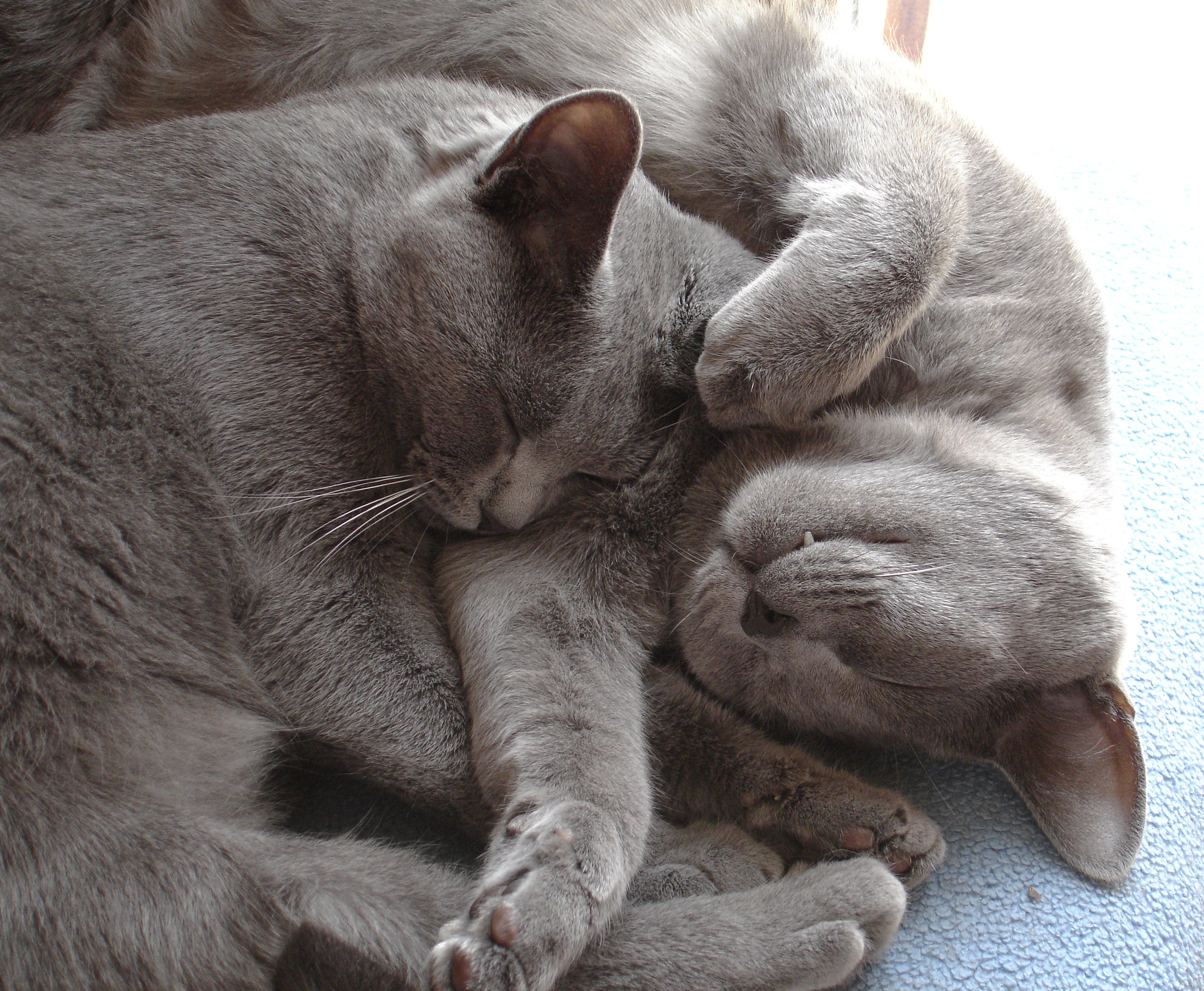
My wife and I have two adorable Chartreux cats who luxuriate in their thick and soft grey fur, named Celestine and her biological offspring is called Doucelin. We are woken each morning by incessant head-rubbing and purring as these two half-starved creatures crave their morning food! We bought Celestine from a breeder, and found the kitten was not well socialised, as the breeder had several nursing cats and litters of kittens in the house, each confined to a bedroom suitably stinking of cat piss!

Cats are brought round to our way of life by giving them their needs and our affection. We also have to take away their natural sexual instinct by having them neutered by the vet, after Celestine had had her litter of three kittens (we kept one and sold the other two, which paid our veterinary and other expenses). Otherwise, they would revert to the wild state. That is how cats are, more so than dogs. Then the denatured cat adapts to life with humans, and the relationship is reinforced by means of maintaining them in a state of kittenhood by stroking them – imitating the mother cat licking them – and giving them more than what they need in terms of food. It’s a two-way contract, the human gets affection from the cat in exchange for a soft and care-free life.

So, I am really dubious when humans, religious or not, are likened to cats being herded and brought together in some form of unity. I need also to say that the advertising sketch I reproduced on Continuing Anglican Ministry – Herding Cats is very funny. Simply, cats are not cattle or sheep, or even dogs – they are not social animals.

Getting onto the point of this article, I have been looking at the latest posts on the Anglican Diaspora, which is a fine forum with some good people on it and a good friend running it. In particular, we have the continuation of the “old problem” of establishing the basis of a “comprehensive” Anglicanism that everybody could accept. It is a concept that seems to approach that of inventing and designing a time machine or a perpetual motion machine that needs no continuing energy input to keep working.

I won’t quote the postings, but they can be found in this thread (you can look at the previous pages to trace it all from the beginning). I find this thread stimulating and thought-provoking, and it has inspired a few posts on this blog. At the same time, it is frustrating because the stated goal to be attained in as impossible as time travel or perpetual motion – that is: time travel and perpetual motion are possible in a universe other than ours.

I have already said it: we either have to discard Protestantism and base ourselves on a form of pre-Reformation Catholicism, or on post-Tridentine or post-Vatican II Roman Catholicism. We can do this by knocking on Rome’s door to join the Ordinariates, go to our local Roman Catholic parishes, or by becoming something assimilable to Old Catholicism. Alternatively, we can base ourselves on the Reformation formularies and allow ourselves a little indulgence in our taste for “bells and smells” and reject both pre-Reformation and post-Tridentine Roman Catholicism as erroneous, and reject Old Catholicism as alien to the Reformed Anglican position. A third way would be to get together on the basis on rejecting any doctrinal foundation and just getting on together for the sake of improving humanity in some kind of Enlightenment perspective.

The obvious solution would seem to be an agreement to separate two groups: one loosely based on a kind of “pre-Reformation Old (Conciliar) Catholic ideal” and the other bound to the English and Continental Reformation and the old high-church movement from the late sixteenth to the late eighteenth century. I note that in the Continuing Anglican world, the latter prevails in the USA and the former in the somewhat marginal TAC and ACC communities in England. There is little need to state that my own sympathies lie with the former position, and that the Reformation is irrelevant to my own Christian life and intellectual convictions.

To insist all the same on pushing the two fundamental perspectives into one body necessarily implies that one have to give way to the other – and under an authority that can enforce compliance. This authority can be something like the Pope and the Vatican or a secular authority in somewhere like England where the Church is still established, but where anything goes. Without the authority of the Pope (RC apologists will be delighting in my “seeing the light”) or that of the confessional State, church unity can only depend on voluntary agreement.

We English have been used to clerical obfuscation and ambiguous language – saying something that can be interpreted in two or more different ways and according to different meanings attached to common words. This creates an illusion of unity, where none in fact exists, and it breeds hypocrisy and the idea that all churchman do is spend other people’s money on playing games. I would not say such an idea is wrong, and I have no time for the Church of England as it is now or since I left it more than thirty years ago.

So, we have several types of Anglicans:

  • post-modern “liberals” who have taken the Enlightenment to the ultimate extreme,
  • those who think of themselves as Protestants,
  • those who think of themselves as Catholic (non Papal, non Roman) and reject Protestantism
  • those who think of themselves as Catholic and have become Roman Catholics or Eastern Orthodox with or without concessions to their cultural attachments.

One cogent point of view on this forum defends the idea of having two Continuing Anglican Churches to avoid Anglo-Catholics being forced out or put in the defensive.

Is it such a bad thing to have more than one Anglican church?

The other school of thought, represented by a good friend who comments here on this blog, would refuse any possibility of such a settlement based on separation along the theological fault lines. To admit such a possibility would be admitting the illegitimacy of Anglicanism as a whole. Here it could be replied that this imperative should extend to negotiating with the Roman Catholic, Eastern Orthodox, Old Catholic, Lutheran and other Confessions, with the liberals as well as the conservatives. It could be argued also that failure to produce results should result in forfeiture of the credibility of Christians to the atheists and secularists. How far do we go? If this imperative of organic unity is absolute, it looks as though we have to choose between being Protestants or Roman Catholics – or abandoning Christianity as something intrinsically founded on error and illusion.

Realistically we have to admit that, yes, there are divisions, not only within Anglicanism, but between Christians of various persuasions. Differences exist and, as a result, divisions exist. Is this acceptable? Are we brethren or are we not?

The argumentation is attractive. We either bury our differences or admit that we are not sincere Christians. Perhaps this is what has really caused the demise of Christianity in the modern world. It is founded on illusion and fallacy to such an extent that it has to be put aside and scrapped like a car that has become too unreliable and expensive to maintain. On the other end of the spectrum, the RC and Orthodox apologists are right, and we should be converting to those “true churches” – which themselves are revealing their irrelevance to the modern western world.

As far as I see it, organic unity is only possible under constraint and compulsion, on pain of excommunication which in the Middle Ages involved total social shunning. Only two ways lie open to such a pariah of society, repentance and reconciliation or death. Perhaps our friend should be campaigning for election to the Presidency of his country with the possibility of abolishing the Constitution and bringing about some kind of theocratic dictatorship to punish all kinds on non-conformity. I’m not saying that this is what he would like to do. It’s not in his nature, but it is the only way, with a Secret Police Inquisition to root out dissidence.

The big problem with this is that Christ willed that his disciples should be free, and that Redemption involved freeing the children of the new Israel from the chains of the Law – by fulfilling it. St Paul is full of this theme, as are the Gospels. We will again find this theme of freedom in twentieth century Russian philosophy and in European currents of thought as humanity groaned under the weight of the Ideologies.

Perhaps we can belong to a single body, but in which doctrinal formularies are mere formalities or which simply don’t matter. This is post-modern religion in which anything goes, at choice at the cafeteria of ideas. A little of this and a little of that would be so nice! OK, fair enough, and it would seem that liberalism and relativism are the only way to deal with the violence and conflict – either physical or intellectual or both – that pushes our tired-out world to the brink. Then women clergy and gay families should be a part of our daily life, together with coffee-table eucharists and smug chattiness. We are then wrong with being conservatives or holding onto stuff that should have been carried away by the dustbin men a long time ago! A word of warning. One won’t find much tolerance with the liberals and politically-correct crowd. So, we are back to square one.

I think we are all opposed to Christianity being discredited and made into a foolish illusion by division and intestine intolerance. We all find denominationalism to be poisonous. Come and live in a country like France where the only respectable Christians are Roman Catholics and Reformed, and a few ethnic Churches for ethnic people – and anything else is a dangerous cult to be repressed by any possible financial and legal means! This is why my wife has always encouraged me to keep an ethnic character to my ministry – be English and make the most of it – and not be something like a “French Old Catholic” – which is disreputable in the eyes of most people. Over here, the Gallicans are usually associated with uneducated errant clergy who live from the credulity of simple people through doing exorcisms and parallel “medicine” for money. It is a question of image and local sensitivity. In the USA and a lesser extent in England, we have had non-conformity and religious pluralism for centuries, and this is considered as normal. There is a middle ground between Anglo-Saxon denominationalism and the Church-State alliance which is still implicit in Europe. But that is just about impossible to define, let alone bring about in reality!

Could there be some new form of Anglican settlement in the conservative Continuing Churches? Perhaps coherence would demand that the Continuing Churches should dissolve their organisations and tell their people to go back to their owners – the parishes that have their names inscribed in the Baptismal Registers. How dare Continuing Anglicans want to be free not only of Protestantism but also of all the modern liberal developments which are surely the will of God, since they have been adopted by the bishops of the Church and synodal organs of government? Not happy with that? Tough! Become Roman Catholics or Orthodox or stew in your juices. This is what we are up against.

Something realistic has to be possible. What has happened? We get different types of Anglicanism as you have different types of Catholicism, Orthodoxy and Protestantism. It’s just a fact, whether we like it or not.

Our friend tells us that we “have” to incorporate Protestantism into our existence as Christians and Churches. After all, Rome itself has taken certain Reformed things into account – the Bible and the liturgy in the language of the people. Emphasis on the community rather than individual piety, monotheism to regulate the more questionable aspects of devotion to Our Lady and the Saints. It is true that things needed to be tidied up in the 1950’s as in the 1530’s, but often things went from one extreme to the other, the Puritans in the sixteenth and seventeenth centuries as the Novus Ordo iconoclasts of the 1970’s. If this is carried too far, what right have Continuing Anglican and traditionalist groups to exist and dare affirm their independence from the “official institution”? Does not schism breed schism? This is our agony.

georgian-church-1814

Who is going to distinguish between “moderate” Protestantism and full-blown Puritanism (or other phenomena along similar lines) and opposition to any form of Sacramental Mystery or Hellenic philosophy? Are we going to reach agreement? I would be all for trying, but no significant progress has yet been made. It seems for the time being more realistic to consolidate the stability of Anglo-Catholic churches on one side and Evangelical churches on the other, either that or giving up. We are often presented with dilemmas, the most usual of which is that we have to identify and define our Anglican identity in something like a coherent and agreed way – or admit to Rome’s classical position according to which Anglicans are bogus Catholics playing games and deceiving the faithful!

We all have our history, and we do not have the right to discard it. Can we form a new Anglican identity based on the historical models and inspirations? This seems to be the the approach of the Anglican Church in North America, which still seems to be attached to ordaining women even though it refuses the homosexual agenda. Some of the more “comprehensive” continuing Churches are pushing for a relationship with the ACNA, if only they can ditch women priests! There seems to lie the rub. The devil is always in the details. That’s what the Anglican Diaspora thread was all about to begin with.

We need to talk to each other, listen to each other, and respect each other. We need to recognize that, within broad limits, there will be differences of opinion, and even to be thankful for that. Openly discussing our differences in a respectful and gentlemanly manner, with the recognition that none of us are 100% right all the time will go a long way toward bringing unity. Infighting, rigidity and combativeness will only produce division and weaken our common witness.

In the absolute, I can’t agree more. However, it only works when we remain at an unofficial level. On this blog, I have readers from all sorts of places, religious convictions and affiliations to this or that Church. When abstraction is made of those three aspects, we can indeed pray together and find harmony between ourselves. It is when efforts are made towards disturbing that harmony and forcing people to choose when organisations “horse-trade” and negotiate one thing against another, that everything falls down. I read something about this in Soloviev. The Antichrist is born not when Christians pray together but when their Churches attempt to abolish their differences and conform to some alien mould of conformity.

He says it himself. The goal should not be producing a “pure” and monochromatic organization. This would only be possible by means of inquisitions and police states.

The reality seems to be just about the present status quo. I joined the Anglican Catholic Church, not because I believe it to be any “truer” than any other community identifying with Anglicanism, but because I find it to have attained a credible level of stability after all the shenanigans of the 1990’s involving men like Bishop Leslie Hamlett and a long period of recovery. I myself needed an ecclesial mission and continuity in my vocation as a priest. Perhaps had I been living in the north-east United States, I would have remained in my parish throughout the period of turmoil in the TAC, and would have made no change. I live in Europe and I “lost” my Archbishop and the recovery of the TAC in England seems less obvious or generally known – so I had to make a decision. The ACC may seem “sectarian” to some, but I am highly impressed about how Archbishop Haverland has made sense of the mess that prevailed fifteen years ago and how Bishop Damien Mead has taken the reins in England. We are small and marginal, but we are also stable and credible through our integrity. That is a remarkable achievement!

When there is more stability and integrity in all our little communities, I do believe that we will be able to begin cooperating in things like sharing material resources – seminaries, libraries, information – and then churches and services rendered by Bishops without clerical pretensions and ambitions to power. We can begin by getting rid of the negative stuff, the bad memories of the 1980’s and 90’s, the so-called “Phalanx” and having services together – Mattins and Evensong to avoid differences over the rite used for the Eucharist.

I fail to see how it could all become like the Church of England in the 1950’s, because the genie is out of the bottle and the cat has experienced the joy of catching a mouse for the first time. The ideal should be there, but also there should be the ideal of letting Churches get their acts together and reflect on their own identity and common convictions. There seems no crime in that!

* * *

pre-tractarian4

Lest I be seen to be “reinventing the wheel”, I draw your attention to the posting and thread of comments on ACC Makeover. There is no solution to this dispute, and I won’t even try.

Posted in Uncategorized | Tagged , , , , , , , , , | 29 Comments

Ignorance and Prejudice

Bishop Damien Mead has just written up his experience in As it happened …. The Bishop’s Diary during CRE 2013, as the Anglican Catholic Church in England had a stand on the recent International Christian Resources Exhibition.

People come in all kinds, just as they use their computers to do the same thing here on the blogs. Most people are open-minded and want to learn, because their fundamental philosophy of life is tolerant and modern, and their religion motivated by love and generosity. Some are fearful, ignorant, looking for a fight, stingy, you name it.

It’s still an especial shock to the system when facing people in the flesh and seeing the flaring of nostrils and reddening of faces! But far more shocking is actually being in the physical presence of those who display such ignorance!

But, it should be stressed, there as here in the blogosphere, that most people are open-minded and positive:

We have had a lot of positive and encouraging comments from our fellow Christians.

It is exactly my experience as a blogger. We are never going to solve the issues of human nature, sin, negativity, ignorance, prejudice and so forth. Each of us also has shadows to clean out from our souls, so that we might be as welcoming as we would like other people to be.

I have found a lovely page of quotes from wise people in history about ignorance and prejudice – just to quote a couple:

“Prejudices, it is well known, are most difficult to eradicate from the heart whose soil has never been loosened or fertilised by education: they grow there, firm as weeds among stones.”― Charlotte Brontë, Jane Eyre

“It’s an universal law– intolerance is the first sign of an inadequate education. An ill-educated person behaves with arrogant impatience, whereas truly profound education breeds humility.” ― Aleksandr Solzhenitsyn

Here is also one of my favourites from Oscar Wilde:

Like all poetical natures he [Christ] loved ignorant people. He knew that in the soul of one who is ignorant there is always room for a great idea. But he could not stand stupid people, especially those who are made stupid by education: people who are full of opinions not one of which they even understand, a peculiarly modern type, summed up by Christ when he describes it as the type of one who has the key of knowledge, cannot use it himself, and does not allow other people to use it, though it may be made to open the gate of God’s Kingdom. His chief war was against the Philistines. That is the war every child of light has to wage. Philistinism was the note of the age and community in which he lived. In their heavy inaccessibility to ideas, their dull respectability, their tedious orthodoxy, their worship of vulgar success, their entire preoccupation with the gross materialistic side of life, and their ridiculous estimate of themselves and their importance, the Jews of Jerusalem in Christ’s day were the exact counterpart of the British Philistine of our own. Christ mocked at the ‘whited sepulchre’ of respectability, and fixed that phrase for ever. He treated worldly success as a thing absolutely to be despised. He saw nothing in it at all. He looked on wealth as an encumbrance to a man. He would not hear of life being sacrificed to any system of thought or morals. He pointed out that forms and ceremonies were made for man, not man for forms and ceremonies. He took sabbatarianism as a type of the things that should be set at nought. The cold philanthropies, the ostentatious public charities, the tedious formalisms so dear to the middle-class mind, he exposed with utter and relentless scorn. To us, what is termed orthodoxy is merely a facile unintelligent acquiescence; but to them, and in their hands, it was a terrible and paralysing tyranny. Christ swept it aside. He showed that the spirit alone was of value. He took a keen pleasure in pointing out to them that though they were always reading the law and the prophets, they had not really the smallest idea of what either of them meant. In opposition to their tithing of each separate day into the fixed routine of prescribed duties, as they tithe mint and rue, he preached the enormous importance of living completely for the moment.

We’re not going to solve it here, but a gentle reminder is good for us all.

Posted in Uncategorized | Tagged , , , | Leave a comment

Soteriology

I have felt a little “low” these past few days, but I know that we all have to make progress in both our service to our Churches and our own intimate spiritual lives in whatever way we live them.

The other day, I quoted Israel’s No: Jews and Jesus in an Unredeemed World by Jurgen Moltmann and remembered what Pope Benedict XVI said on visiting Auschwitz in May 2006:

How many questions arise in this place!  Constantly the question comes up: Where was God in those days?  Why was he silent?  How could he permit this endless slaughter, this triumph of evil?  The words of Psalm 44 come to mind, Israel’s lament for its woes: “You have broken us in the haunt of jackals, and covered us with deep darkness … because of you we are being killed all day long, and accounted as sheep for the slaughter.   Rouse yourself!  Why do you sleep, O Lord?  Awake, do not cast us off forever!  Why do you hide your face?  Why do you forget our affliction and oppression?  For we sink down to the dust; our bodies cling to the ground.  Rise up, come to our help!  Redeem us for the sake of your steadfast love!” (Ps 44:19, 22-26).  This cry of anguish, which Israel raised to God in its suffering, at moments of deep distress, is also the cry for help raised by all those who in every age – yesterday, today and tomorrow – suffer for the love of God, for the love of truth and goodness.  How many they are, even in our own day!

The tears well up as I find myself tempted to doubt the Redemption or at least ask serious questions about the meaning of that word. I did not begin my life until fourteen years after the end of the war, but I have seen the films of the Nuremberg Trials and the concentration camps. I have visited Oradour-sur-Glane and Dachau. I have seen the film Schindler’s List and others. Seeing these horrors of man’s inhumanity to man is like being strapped to a table, skinned alive and the raw flesh being slowly cooked by a jet of steam!

Is this the humanity that God came to save?

The main source of conflict between groups of Christians is the question of “who will be saved” – all, many, a few or even none. What does “not being saved” mean. The usual answer is – You go to eternal hell. Some time ago, I wrote Hell and Salvation in which I expressed a fairly “universalist” kind of position.

No one is going to get off scot free for living an evil life or being a crass materialist or whatever. I do believe there are conditions in which souls will suffer atrociously for aeons, reaping what they sowed by cruelty, selfishness, hypocrisy or whatever. But, I do believe that the notion of eternal hell, as eternal as God and goodness, is nonsense.

The notion of salvation is necessarily in relation to the notion of what happens to “unsaved” souls. These are the thoughts going through my mind as I was confronted with the double predestination theories of Calvin and others, albeit based on St Augustine. In many ways, I share Augustine’s pessimism and see daily examples of man’s evil and moral weakness in the newspapers, television and the internet. I am then uplifted by the poetry of William Blake, the music of Bach and our crowning artistic achievements in the gothic cathedrals of Europe.

What Jesus changed is above all interior. He gave us hope against ourselves and the kind of evil that overwhelms us. It is above all that, that spark of divinity within us all that brings each one of us genius, inspiration and knowledge from experience.

Our hope is that evil men are powerless in their ambition to spread their nefarious seed beyond this world.

Posted in Uncategorized | Tagged , , , , | 13 Comments

EmbryoParson

Update: I have apologised to Caedmon (see comment below) for having identified him with EmbryoParson. I therefore modify this article in consequence.

* * *

He really does seem to be be passionately interested in my writings despite having protested too much in his latest update to The Conciliar Anglican (Fr. Jonathan) on The Rise of Parties.

Here is his article of today – Fr. Anthony Chadwick on Participation by Grace in the Life of God. I haven’t bothered to read it.

I post this article lest I should be in some way “admitting defeat” in the face of a supposedly stronger and more credible theological position. I am unwilling to discuss theology or anything with this man because he lacks the most elementary courtesy and I do not know his identity. Also, I have to admit that I have never taken any significant interest in Reformed theology except in a general context of church history. My knowledge of Calvin and others is only notional. But, it is above all on principle that this man is not admitted into my “household”.

He started it all. Secondly, he does not represent any significant proportion of the Continuing Anglican movement, but only his bigoted opinion. The only complement I will grant him is having set up his own blog instead of trolling in other people’s comment boxes. I always find anonymity suspicious.

I will simply end by noting some advice from a person of confidence who has known his contributions to a forum under another pseudonym. Since then, he has changed to EmbryoParson. His real identity is elusive, “but indications are that he has moved around quite a bit and earned for himself a reputation for being loudly dissatisfied and combative“.  He seems to have done quite a lot of church-hopping in his time, but that is not something I care about. He lives in a free world and so do I, but I will not have him dictating to me or anyone I esteem.

My own readers are welcome to read EmbryoParson‘s blog if they wish and evaluate it as they see fit. He can now say what he wants – I couldn’t care less.

Posted in Uncategorized | Tagged | 7 Comments

I’m Spiritual but not Religious

I’m Spiritual but not Religious. This is one of the most hackneyed self-descriptions we hear from many of our contemporaries. Most of us who are attached to churches as clergy or laity would say that it is impossible to be spiritual without any attachment to a spiritual tradition like Christianity or one of the other religions, or such a claim is at least hypocritical self-deceit. This may well be so for people who are worldly and secular but shrink from identifying with atheism and materialism.

It may do some people good to take a break from their involvement in religious practices, especially when they become distorted or if the person finds his emotional health being affected. An immediate disclaimer – I have no qualifications as a therapist and do not presume to offer a “solution” for every individual person seeking his or her way, often with great difficulty.

There is so much conflict in and between the churches that some are profoundly alienated and can fall prey to those who do claim to have a cut-and-dried solution. Cult gurus prey on such “seekers” and the process of alienation becomes that much more profound.

One thing I notice with some with whom I correspond is that they have suffered from ecclesial shenanigans to the point of falling victim to the old spiritual malaises known by the Desert Fathers, such as ἀκηδία. This example, in the minds of the monks of old, calls for asceticism and self-unpleasantness. It can also call for a change of life, travel and a new quest for being capable of a sense of wonder and freshness. At the same time, most of us have commitments in life and we just have to knuckle down to our lot in life. It is within those limits that we have to look for what is good and wonderful.

Some people just think too much about the wrong things, and those who are monks are brought back to the most fundamental things – observing the Rule, getting back into place and rediscovering the relationship with God. Most of us don’t have the framework of a monastery, and are left to our own devices. The choice most of us have is between materialism and a life that means something in a universal consciousness that transcends our desire for money, sex and power. Those of us who have a spiritual discipline through the religion we are attached to are fortunate, if the religious and spiritual aspects are in harmony.

Our universal consciousness – our participation in the essence of God by means we will never understand – is our first step. Our values are a part of this consciousness, and this will explain the fact that the morality of just about about every person who cares for others is constant and identical. It is wrong to kill, steal and tell lies, and it is right to help others in distress and make them happy. There are values other than morality like truth, beauty, love, compassion, empathy. Without this consciousness, in whatever way it manifests itself to each of us, we lose our desire to continue living.

Religious tradition is something that has become very difficult to relate to. Many of us have been born and brought up in a religious tradition or a Church. We went to school, sung in the choir, learnt to serve the liturgy and bring up the cruets at the right time. We read the Bible or parts of it, and read books by spiritual writers. Many of us have had none of that, born into godless families, unknown by people at the local church, synagogue or whatever, totally ignorant of the notion of being part of a religious community. Then it gets complicated. We also have formerly religious people who became alienated, and not always through their own fault.

Perhaps we church people can be smug and tell them to forget about spirituality and eat crow until they’re ready to submit and become tithe-paying church people! That was exactly the leaven of the Pharisees that Jesus condemned with such vigour in the Gospels. We lay unbearable burdens on their shoulders, and their death is our life. We become demons and cannibals! How can we wonder why people search elsewhere?

Finding balance between religious commitment and personal spirituality is difficult. It can be done by those who have suffered, reflected and experienced. We do what our Churches say we should do, and then we have our secret gardens where anything is possible and no one else can follow us. One example of the secret garden of some of us is γνώσις, secret knowledge that cannot form the structure of an exoteric religion, any more than anarchism can be a principle of politics and society. We learn about Gnosis through the Alexandrian Fathers and modern men like Carl Gustav Jung, the psychologist who sought further than Freud, the spirit of man beyond the functions of the organic brain and nervous system. But, in our Churches, the emphasis is on the social dimension and our concern for other people and their good.

Another thing that puts people off religions, all religions, is that we kill and demolish each other. The beliefs of others, their conception of truth, threatens our own. We believe we are right and they are wrong and have to be corrected, by force if necessary. We compensate for our own doubts by becoming arrogant in our attempt to possess truth. Are any of us right? The question haunts us all. We can take our part in the killing, give it all up – and find we do the same thing in another philosophy of life or political ideology, or we try to find a new basis and foundation.

Jesus taught us to seek the Kingdom that is within, and then build the community on that basis, on the basis of the genius that only individual persons can possess. We grow our crops in the secret garden, and then offer the produce to the world with which a community can be based. Churches and communities come and go, but something remains, even among our friends and family members who stay away from churches because they have been hurt.

In the absolute, it is better for the world to be populated by spiritual seekers who are alienated from religious traditions than in a world of religious zealots who have not one shred of spirituality. There should be no dilemma, and I believe one should be both religious and spiritual, but we live in a very badly wounded world in which the Redemption by Christ seems harder and harder to discern.

Many religious people live through alienation to find God and their inner selves. That is why some of us are attracted to the mountains, the desert and the sea. We don’t find churches at sea, but the emptiness we need to scour out our souls and see what really matters. Some people need psychological help to make these distinctions. A few priests and monks have these abilities too, but being a good judge of character is not given to everyone. Psychological help is usually very expensive and as often ineffective because of being based on the wrong things. We need to know about our secret gardens and spend time in them. For me, there is nothing better than having a tiller in one hand, the other hand on the mainsheet and surfing in a full reach or running before the wind on a moderate sea swell – and with everything well with the boat and its rigging, we can be still and know that God is God. Those who don’t sail will have their thing that enables them to do their “gardening”. It might actually be gardening in a real garden, pulling out the nettles and putting in the broad beans in a nice neat row.

I don’t think we need be afraid that bad religion will discredit spiritual life, as the latter is so much a part of our being. There are good people in churches as there are bad. We all have a foot in each camp through sin and shortcoming. We have clergy who fall short monstrously, yet there are others who do their duty with heroism and courage. Certainly, invariably, someone is a good member of one’s Church through tending the garden and partaking of its beauty.

That’s where the difference lies. I’m much less concerned about people who say they are spiritual but not religious than about church people who manifestly have no spirituality, let alone the qualities of love, empathy, beauty and self-sacrifice.

I invite you to read Israel’s No: Jews and Jesus in an Unredeemed World and offer comments. I have for years been dogged by the idea of an unredeemed world and unredeemed Christians, and find this article to be profound, yet Christian tradition teaches us that the Mystery of Christ changed everything. I haven’t yet had the time to read this essay fully, but it promises to be a good reflection to provoke us. Is the world unredeemed? Was there some limit to the Redemption? Is the Redemption (Atonement) begun but not complete?

Posted in Uncategorized | Tagged , , | 6 Comments

The Contradictions of Comprehensiveness

The question bothers me since reading the aggressive points of view of some Continuing Anglican divines who propose a pogrom against Anglo-Catholics. In a way, we can wonder if they are merely reacting in a self-defence reflex against aggression from Anglo-Catholicism who would see the back of the Reformation and its “variations” as Bossuet would have put it. The question is both highly complex and very simple. If one claims to be both Protestant and Catholic, or “reformed Catholic”, then one is founding oneself on a basic premise. Perhaps one may be Protestant but concede some “high church” trappings to please those who are unsatisfied with plainness and austerity. Is that what Catholicism is about, or does it have some more substantial doctrinal and spiritual foundation? Surely, if it is just “dressing up”, then one should become a “real Catholic” by swimming the Tiber or biting the bullet and accepting someone else’s austerity. It is surely God’s will that all pleasure is sin and all art and beauty to be reproved unless it is secular!

I have always had the idea that comprehensiveness would be easier from a Catholic basis (conciliar ecclesiology, not Papal) rather than the Protestant basis that destroys the Platonic metaphysics forming the basis of the possibility of redeemed man to participate by grace in the life of God. In the Reformed type of thinking, God reveals himself to man only through the written Word of the Bible, nothing else.

If Anglicanism can be a continuation of the pre-Reformation and pre-Tridentine Catholic Church, a great deal of comprehensiveness is possible. It suffices to visit the church of a Trappist (reformed Cistercians) community and find that there are no images other than a statue of Our Lady. The rest of the church is whitewashed, plain, bereft of beauty or decoration. It would be easier and saner to have the possibility of low church liturgy on the basis of Catholic theology than high church liturgy on the basis of Reformed doctrine.

As with any movement, the Reformation began by reacting against abuses and superstitious practices. Hitler and Mussolini began by promising good things for the people such as a reliable train service, affordable cars, good fast roads and modern living conditions. The nasty things only came later, like Calvin burning someone at the stake with green wood to prolong the suffering! But, it has to be said that the early stages were needed.

In many things, there was a question of emphasis and things that were needed, like the liturgy and the Bible in the language of the people. Basing all Anglicanism on the Reformation – supposing the Anglican Catholic Church were taken over by Evangelical “classical” Anglicans, there would have to be a purge of Anglo-Catholics. If everything were to be founded on the Reformers, there would be no point in high-church ceremonies, which would become at best irrelevant and impious at worst. You get rid of the statues and icons, put the communion table in the middle of the choir with its ends in the same direction as the east and west ends of the church. Vestments become a matter of effeminate men wanting to “play dressing up”. Just go back to England of before the Tractarians, the triple-decker pulpits and box pews. It takes little imagination – just see the engravings of Hogarth depicting fire-breathing preachers and swooning ladies!

I see little evidence that many of today’s Continuing Anglicans would go so far in their outward observances. Evangelicals are more likely to emulate the “mega church” style with modern language services.

The problem would seem to be in one side wanting to impose the 39 Articles as a doctrinal standard for all, albeit interpreted à la Bicknell – and the other side doing away with the Articles and imposing the Affirmation of Saint Louis containing a commitment to seven Sacraments (instead of two) and the seven Ecumenical Councils including Nicea II (against iconoclasm).

I am personally all for having the Affirmation as a basis (with the ancient traditional doctrines it contains), and joined the Anglican Catholic Church knowing that I would not have to assent to Reformation formularies. At the same time, there are different ways of observing the liturgical life from the “spiky” style of the Tridentine liturgy in English to the simpler English “Sarum” style and the simpler “monastic” tastes. I tend to be somewhere between the “extremes” whilst refraining from criticising those who are more “Tridentine” than I am. In these matters, there can be diversity according to the customs of the people in their parishes and pastoral necessity.

If conciliar Catholicism were better known, conciliar as in the reforming Council of Constance placing the Episcopate over the Pope acting alone, this would be far more healthy than being hidebound to Reformation formularies. With a conciliar Catholic approach, we can have the Bible and the liturgy in the vernacular, keep popular religion and the taste for miracles and wonders in check, keep the clergy from becoming corrupt, get the laity to learn their catechism and develop an interest for more advanced doctrinal, historical, spiritual and liturgical study, and so forth. The problem with Protestant Augustinianism is that is is too narrow, like asking a great French chef to cook a fabulous meal with only one saucepan, a pound of potatoes and water. I prefer people like the Methodists with their high church theology and low church services to having to be narrow in one’s theological vision and then “playing at religion” by doing high services without any underlying justification. Did not some of the Reformers lament abominations of popish masses?

Another objection to Protestantism is that it was a reaction against a very specific situation in history. Since the sixteenth century and up to our own times, there have been changes. In Roman Catholicism, the issues involving corruption and superstition were addressed by the Council of Trent and the Counter Reformation. There was the dispute between Jesuits and Jansenists which cleared many of the difficulties surrounding Augustinian theology. Then, from the nineteenth century, there is a whole movement in theology, ecclesiology, church history and historical criticism leading to the Ressourcement, the appeal to the Fathers of the Church. With exposure to that kind of theology, who wants to return to sixteenth-century pseudo-scholastic polemics which were as narrow and asinine from the Roman point of view as from the Reformers? One who has seen sunlight will not return to live in the cave and see only shadows and imaginations. What we would like to continue is colour, beauty, diversity and joy.

Is the Affirmation of Saint Louis a perfect document? Certainly not, and it too will prove to be tied to its time and will be found to be too narrow. It has already been modified to reflect the definitive nature of the separation of Continuing Anglicanism from the Canterbury Communion. It is a good guide which helped to define Continuing Anglican identity in a time of crisis. The Articles also emerged from a situation of crisis. Defining an exact number of Sacraments at seven is a fruit of the Roman Catholic Council of Trent. Are we going to be Roman Catholics without being members of the Roman Catholic Church? That is another contradiction that is a danger among so-called Anglican Papalists. The Affirmation is exactly that, an affirmation of identity, and not a definitive definition of dogma.

If we “trash” the Reformation, do we not deny any continuation of Catholicism in Anglicanism? Probably we do, as traditionalist Roman Catholics see very little in the way of orthodox Catholicism in the pontificate of Paul VI and the 1970’s. Is continuation absolutely vital as opposed to restoration? There was a liturgical movement in Roman Catholicism because the meaning of the liturgy had become obscure by the end of the eighteenth century. Dom Guéranger began the movement of bringing the people to the liturgy and the liturgy to the people. The Oxford Movement began a parallel movement of restoration in the Church of England, to breathe life back into dead bones.

To what extent was there any continuation of Catholicism through the Reformation era? If there was none, then Rome could be justified in saying that our Orders are absolutely null and utterly void. So could Orthodoxy when looking at late eighteenth-century French Catholicism and Talleyrand, whom Napoleon had dubbed a turd in a silk stocking. Continuity is relative in all churches, but there is always something. Rome can trace the apostolic lineage of most of its bishops to Scipione Rebiba (1504-1577). There is no reliable documentation beyond him. There is probability of continuation further back, but no documentary proof. Every Church has its skeletons in the cupboard and things the apologists overlook. We Anglicans as no exception.

I have always liked Soloviev’s approach to ecumenism. Roman Catholicism, Orthodoxy and Protestantism are all too one-sided and only a part of the whole. Roman Catholicism represents the human organisation of the Church for the purpose of the Mission. Orthodoxy represents the mystical and contemplative approach, and Protestantism represents the freedom of man in his response to God’s Word and invitation to salvation and sanctification (justification). If all contributed to something higher, then there is hope for the restoration of Catholicism. I fear that few in the Continuum are up to such a sublime vision, one that would transfigure the serious deficiencies of Protestantism, Roman Catholicism and Orthodoxy.

In the current dialectics between “classical” Anglicans and Anglo-Catholics, what is of greatest concern is that the former can only affirm itself at the expense of the latter. Let the Anglo-Catholics go to the Ordinariate, and leave us (Evangelicals) alone! It can also be argued that Anglo-Catholics would like the “classical” Anglicans to leave and become non-conformists or whatever, so that there can be a unified Anglo-Catholic Church. Can the two co-exist? With current attitudes and theological visions, probably not. I see very little possibility for cohabitation in a single institutional Church. I notice how the term “Classical Anglicanism” is increasingly becoming a euphemism for the Protestant position with the intention of expelling Anglo-Catholics or making them so uncomfortable that they will leave.

There is also the possibility of uniting all Anglicans on the basis of some kind of “mere Christianity”, the term being coined by a book written by C.S. Lewis. The notion of the “classical Anglicans” is tied up with Anglican apologetics, because if this category is uncatholic, then the apologetic basis of Anglo-Catholicism is gone – unless the quality of being a Church is something that can be restored as I have suggested.

I lived through the entire time of the TAC’s approach to Rome from the bishops’ meeting in Portsmouth to Anglicanorum coetibus two years later, probably the result of other Anglican groups and events. One of the greatest problems was the definition of Anglican Patrimony or identity. Is Anglicanism a kind of English “Old Catholicism” or a half-way house moderate Protestantism conserving some Catholic characteristics like bishops and chapters of canons? Was it all in the liturgy or the tradition of pastorally-minded clergy as opposed to being a “country squire parson”? Was it all in the scholarship? I think we are ourselves struggling with such a definition without knocking at Rome’s door to say we want to be Roman Catholics with something akin to uniate status like the Byzantine rite folk.

I am unable to finish this article with anything like a definitive conclusion. I think we don’t stand much of a chance, any more than any other form of Christianity that is humanist in its inspiration and respects man’s intrinsic dignity. I see the totalitarian caricature, whether it is in the successors of Calvin, Topcliffe, Torquemada or Ivan the Terrible, winning out. Critically-minded people will be less and less drawn to Christianity, a religion to be written off as a failure.

There is something to be said for the idea that we would have been better off to have remained in the Egyptian fleshpots of our Churches of origin, and made our pilgrimages as individuals. We chose instead to found or join dissident churches and launch out into the deep, for which we needed a common identity rather than individual identities as persons with our talents and sins. In guise of a provisional conclusion, I can only suggest we make the best of our little churches and communities, and make our pilgrimages. Someone above us will want to try cat herding. Let them try, and perhaps succeed.

The more time that goes past, the less I am worried by it all. Let the Americans play baseball, the English play football, the Protestants in their books and the Catholics in theirs. I see nothing wrong with separate church institutions according to the different ways of reading the Gospel and the Tradition. Perhaps, we will discover a common basis – or perhaps we won’t.

Posted in Uncategorized | Tagged | 50 Comments