We live at a time when nearly all the churches around us are closing down and are being left to rot. The less historical of these buildings, mostly left to us from the Victorian era, are occasionally given or sold to other Christian denominations or other religions. Usually, they are redeveloped as residential accommodation or business premises. With our dwindling congregations, who can afford the upkeep of most churches? It is a headache of most of the mainstream denominations and the Roman Catholic Church.
At the same time, only the more wealthy traditionalist organisations have been able to buy and restore old churches, or to build new ones to suit their numbers of faithful. Most of the Continuing Anglican Churches, at least elsewhere than in the USA, have had great difficulties in the matter of buildings and material resources.
One might ask oneself why we need churches at all. The answer is in one word – liturgy. Without the liturgy, a room in an ordinary house is enough to share the reading of the Scriptures and a time of prayer. The need for a church is both symbolic and practical. To celebrate Mass, you need an altar of the right height and a credence table. A rudimentary sacristy is useful unless the kitchen of the house and the bedroom wardrobe will be pressed into service to serve a dual-purpose.
Many Continuing Anglican missions are established in houses, and men and women can show extraordinary ingenuity when setting up a temporary chapel in a brightly lit room like the living room, and then the altar and other things can be stowed away when not in use, for example in the garden shed or the garage. The furniture is rearranged, and the altar put up against a window with the curtains closed. Another point of a church is to overcome the feeling of reserve we all have when we go into someone else’s home – respect of privacy, and particularly of that person’s or family’s bad taste in furnishings and decorations! A church is open to all, and it is the home of God, domus Dei et aula sanctificationis. The real meaning of the church is seen in the common for the dedication of a church in the missal. The church houses the altar and the liturgy – the sacramental presence of God – but also gives the worshipping community a place to go and identify with their faith.
Many local congregations are very small compared to the Victorian era or even forty years ago. Congregations in the medieval and Victorian parish churches, at least outside the big cities where parish leaders and clergy are particularly charismatic, are pitifully small. Continuing Anglican congregations may number only ten or twenty in a given place in the provinces, usually less than ten.
The cheapest way to have something like a church or a chapel is to convert an existing building. Some buildings are more suitable than others. Garages tend to be poky and squalid, built for a car, perhaps two cars and a domestic workshop for the handyman about the house. The thing that really kills a chapel is a low ceiling in proportion to the floor area and shape. Most garden sheds are too shoddy and are designed for keeping tools and machines like the lawnmower, perhaps with a shelf or two for keeping the geraniums out of the frost during the winter. Older houses sometimes have outbuildings with a greater degree of potential.
For up to ten people, I suggest a floor area of some twenty feet in length and twelve feet width. Everything will have to be very carefully designed, and there are usually constraints caused by positions of doors and windows, and sometimes by different floor levels. Here is a link to my own chapel. The building had all the potential, but there was no level floor, the walls were shoddily built and there is an ugly fibro-cement roof. I can’t remember what I spent, but it would be in the order of a few thousand Euros, mostly for preparing and adapting the building – doing all the work myself.
The alternative, assuming the availability of land and planning permission, is to build. The cost of building is usually prohibitive, and planning permission can be hard to get. There are also health and safety regulations governing public buildings, such that if they were implemented, it would be so much simpler to give up and abandon the project! The answer can be a “temporary” wooden building, assimilated to a garden shed.
Forget most commercially available garden sheds in kits. Often the kiln-seasoned wood is split and warped before you even start. The roof is often shallow-pitched and very low, and the whole is flimsy. I have one in my garden, which my wife insisted I should buy a few years ago – for garden stuff. I have had to do quite a few modifications to it just to keep it standing! The answer is designing and building in wood.
Some Western Orthodox in England have looked at this question in their site on Building a Chapel / Church. Making abstraction of the precise style of furnishing, the ideas given are very good. Find more ideas here [I’m not saying anything for or against this particular manufacturer and dealer – just drawing attention to the basic designs]. Here’s the famous Orthodox priest who did a wonderful job!
The first problem is land. The expensive way is to buy a plot of building land and obtain planning permission to build. If the building is public, it must conform to health and safety regulations, and the money will have to be available. The alternative is the use of private land with permission from the owner and the building being officially for private use. I defined my chapel, when I declared the change of use of the building, as a private cultural space. If the building can be assimilated to a garden shed, then nothing need be said to the official authorities. Keep it simple.
I won’t go into all the technical details, but watch for the dimensions beyond which planning permission is required. If that is the case, perhaps the project can go ahead but for private use. Then you don’t need ramps for handicapped access and toilets all over the place!
For the design of the building, there are two possibilities: the timbers of the walls being strong enough to constitute the structure of the building or the need for a frame. I favour the latter. I also favour a pitched roof to give the impression of height even if the side walls are no higher than seven or eight feet. If you don’t want to freeze to death in winter or swelter in the summer, you will need insulation and interior plasterboard. The outside would be cladding with some kind of insulation against damp. The electricity needs only to be simple: lights in the right places and a couple of 13A sockets. Running water is useful but not essential.
For the furnishing, two terms apply – simplicity and good taste. Simplicity will also be less expensive, and the chapel should not give the impression of masquerading as a cathedral. If the project is built on owned and private land, it can cost as little a just a couple of thousand quid. Maintenance costs will be negligible. If the insulation is properly done, heating will also be economical.
This arrangement may only be temporary, but it gives a new mission the time to get established and grow before making more material commitments. How temporary? Human nature being what it is, what is temporary tends to become permanent, so the building needs to be good enough for, say, five to ten years. That being said, there are plenty of little wooden chapels in Russia and the Ukraine that have been there for centuries and withstood almost a century of Communism and neglect.
As mentioned, rather than buying a wooden shed kit, read up on designing and building wooden structures, acquire woodworking and joinery skills (evening classes at your local technology school) and build your own. Get the base right – either an insulated concrete base or a space under the wooden floor (which also needs both insulation and ventilation). The best thing is to have an experienced joiner (who might be prepared to negotiate his rates or work on a voluntary basis) and practically inclined men helping him.
Design the chapel carefully. There needs to be a sanctuary with the altar, and enough space for a dignified ceremony, and somewhere for the lay faithful to go. Simple wooden benches take less space than cumbersome pews and chairs. The Orthodox site gives some very good ideas.
For the furnishing, which is simple and in good taste, it can be bought second-hand or made. Avoid cumbersome Victorian styles! A sacristy isn’t essential and a simple wardrobe to one side would suffice: one side for vestments and albs, the other side with shelves. Don’t put fiddleback vestments on hangers! For this reason, gothic vestments would be more practical. There’s no need for a confessional – all you need is a cushion for the penitent to kneel on and the priest sits on any convenient bench. Think of it like a boat – space needs to be used, so you have units that double for two or more uses.
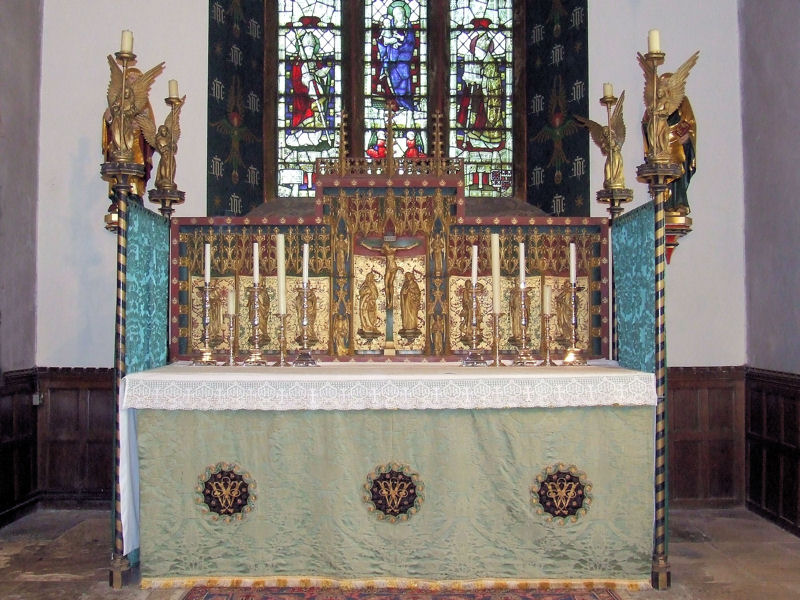
The altar can be made of wood, even plywood with varnish or paint. There are all kinds of tricks to give the right appearance. Get the dimensions right. Six feet long is a convenient size and enough depth for a corporal and the foot of the altar cross. If you use a hanging pyx, you don’t need gradines or the space for a tabernacle. The exact height is 95 cm, no more or less. Keep it simple. Use dossals and riddels, or a wooden reredos so as not to have an empty wall behind the altar. A window above the reredos is a plus, especially if the chapel is truly eastward-facing. For the consecrated part of the altar, you can put in an altar stone or use a Greek antemension. The altar should have a frontal. The credence can be a simple shelf attached to the wall to the right of the altar.

 I don’t usually discuss politics here, but I do honour this great lady who served our country by conviction and altruism. I am old enough to remember the years between the administration of Edward Heath, his resignation, the Labour fiasco of Jim Callaghan and the vote of no-confidence – and the election of Mrs Thatcher in 1979. Our country was an utter mess and the strikes were never-ending.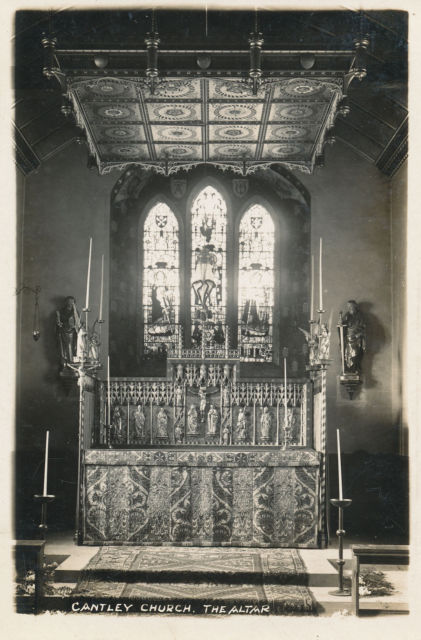






 The Blue Flower