The Easter Sepulcre

This valuable page needs to be seen. The Easter Sepulcre in the Sarum Use and other medieval rites is not the same thing as the Altar of Repose in the Roman rite.

It is unclear in the Use of Sarum what is done with the Blessed Sacrament after the Maundy Thursday Mass and the stripping / washing of the altar, after which there is the Maundy – the washing of the feet in the chapter house. Possibly the two hosts are simply put back into the hanging pyx. On Good Friday, just before the Mass of the Presanctified, all the rubric says is that the sacrifice is placed on the altar in the accustomed way and censed. There is no evidence of a procession like in the Roman rite. The Pie also seems to be parsimonious. If anyone has information from other sources, I would be grateful.

Fr Aidan Keller, an Orthodox priest, is of this opinion:

Since the question is a Sarum use one, I have a Sarum use answer. The Easter sepulchre is not “inhabited” by any reserved sacrament until after the Presanctified Mass on Good Friday. At the end of that service, as Communion-time Vespers ends, there is the procession to the sepulchre with the cross, then the placing of the reserved sacrament in the Easter sepulchre. On Maundy Thursday, the sacrament is reserved in the usual way which is most often the hanging dove (a reservation aumbrey set into the wall is also known). A tabernacle on the altar is not used. The vestments colour is red. The altar is stripped and washed in water and wine, with special twig brooms, on Maundy Thursday, and is not re-vested until daytime on Holy Saturday, so it is not vested at the time of the Presanctified Mass.

Fr Sean Finegan says the following in Sarum Maundy Thursday:

As to what happened to the Blessed Sacrament, whether it was placed in an altar of repose, or in the sepulchre, or simply returned to its usual place of reservation, the books I have are silent.

After I wrote this post, I discovered a reference to the third Host being brought from the ‘Altare Authentica’ to bury in the sepulchre on Good Friday. This altare authentica is probably to be identified with the high altar, and therefore we assume that there is no altar of repose, but that the Blessed Sacrament is simply reserved at, or over, the high altar as usual. The ceremonies that we associate with the altar of repose are observed the following night, then, at the sepulchre.

I put them into a wooden urn on a simple credence table on the Gospel side of the sanctuary like the Roman altar of repose. This will become the Easter Sepulcre, but as yet is merely a place to reserve the Blessed Sacrament without ceremony. The only alternative seems to me to reserve in the hanging pyx, which doesn’t seem quite right.

On Good Friday, this arrangement with the remaining (third from Maundy Thursday) host is veiled as the Easter Sepulcre. Now the rubrics are clear!

easter-sepulcre11

The cross that is “buried” with the Blessed Sacrament is that used on Good Friday for the creeping to the cross. It is a large and austere wooden cross with a corpus. I cover it over with a veil.

The medieval sepulcre was a permanent structure in the wall of the church or some kind of wooden box. After the Good Friday Mass of the Presanctified, the “burial” is accompanied by the singing of the responsory I am counted as one of them that go down into the pit. Thus, in the Use of Sarum, the church is not totally bereft of the Presence on Holy Saturday. The symbolism is different from the Roman usage of having the church “die” on that day.

The Easter Sepulcre is watched like the Roman altar of repose, except a day later. On Easter Sunday morning, before Mass and the ringing of the bells, the Blessed Sacrament is taken to the altar with ceremony and chant, and put back into the hanging pyx. The cross is also removed with a procession. Then the Mass of Easter Sunday is celebrated.

Posted in Uncategorized | Tagged , | Leave a comment

Washing of the Altar on Maundy Thursday

In the Use of Sarum, after the stripping of the altar on Maundy Thursday, we wash the altars with wine and water. There is an old article on this subject by Shawn Tribe in The New Liturgical Movement, which I reproduce below.

Often, in the liturgy, ceremonies remain in Papal and Pontifical ceremonies that have disappeared elsewhere in the Roman rite. This is an example of a Papal rite that was practised in masses of ordinary priests in the medieval uses. Also in the Use of Sarum, the priest washes his hands at the piscina a second time, after the ablutions, which in the Roman rite is reserved to a bishop.

* * *

The Tradition of the Washing of the Altar by Shawn Tribe

While going through The Ceremonies of Holy Week in the Papal Chapel at the Vatican by Francesco Cancellieri, I noticed an interesting liturgical ceremony at the high altar of St. Peter’s Basilica, which pertains to the ceremonies of Holy Thursday and the canons of that basilica.

But the most remarkable ceremony is the washing of the altar.

While Matins and Lauds are singing in the Choir, a table is prepared near the high altar on which are placed seven crystal vases, and one of gilt copper containing wine. In one are seven towels, in another seven sponges: when the choir sings the Benedictus of Lauds, small brushes of box or yew but generally of bloodwort, arranged in the form of a diadem, are distributed to the canons.

The sacristan of the choir prepares a cope and seven black stoles for the seven senior canons, who repair to the high altar, preceded by two acolytes bearing the Cross which is veiled in black, with the candles extinguished, in sign of mourning.

The Cross bearer and Acolytes are placed on the eastern side of the Altar, the whole chapter is disposed in a circle, when all kneel and pray. The antiphon Diversunt sibi, they divided my garments, is followed by the psalm, Deus, Deus meus.

The Altar is uncovered, and washed with wine and then with water by the six first Canons who are followed by the rest of the chapter. This ceremony being finished, the seven sponges are brought to wipe, and the seven towels to dry the Altar. The clergy repeat the antiphon, Diviserunt sibi, the Christus factus est; the Pater noster is said in a low tone, the prayer Respice quaesumus Domine is recited. All then kneeling venerate the three principle relics, the Cross, the Holy face, and the Lance, preserved in the gallery over the status of St. Veronica.

Interestingly, this same type of ceremony is also performed within the context of the Dominican rite. Fr. Augustine Thompson posted upon this (in its Dominican context) last year when he wrote upon Lent and Holy Week in the Dominican rite:

“Priests then went, each accompanied by two acolytes carrying cruets of water and wine, for the stripping of all the altars in the monastery. The priests then washed of the altars (or altar stones) with water and wine. Symbolically, this recalled Christ’s stripping and the preparation of his body for burial.”

Posted in Uncategorized | Tagged , | Leave a comment

Debunking Myths about Pope Francis

I have obviously been as dupe as anyone else. Debunking three ‘urban legends’ about Pope Francis seems credible.

It seemed unbelievable that he would be so cruel to his predecessor as to say “the carnival is over” when he declined to wear the red shoulder cape or mozzetta. The second myth to debunk would be about Cardinal Law being exiled from St Mary Major to live in a monastery. Monasteries are not dustbins for delinquent clerics but communities of contemplatives who are there because they had a vocation to that life. The third myth was about the type of vehicle used to transport the Pope. If that is of interest to readers, then they can see the article.

This is reassuring, as one does not expect crude humour or dismissiveness from a Pope, any more than nastiness and vindictiveness. I can understand that a lot of falsehood is being constructed around Pope Francis.

Damian Thompson ran an account of Cardinal Bergoglio saying some outrageous things about politics, socialism and the USA in Did Pope Francis really say that socialism causes misery, and that America is heading towards a form of communism?. A critical reading would reveal this purported interview to be a hoax, and Damian Thompson is manifestly not prepared to stake his credibility on it. Indeed he plainly says that the interview is a hoax. Had it been true, some journalist would have become a rich man for the “scoop”!

The comment about the carnival being over seemed particularly cruel and is hurtful to anyone who has appreciated the papacy of Benedict XVI and his attempt to restore beauty in the liturgy “brick by brick” without hurting or offending anyone. The sincere and visibly moving meeting between Pope Francis and Benedict XVI last Saturday seems incompatible with the idea that Pope Francis would be a latter-day Boniface VIII about to consign Celestine V to a dank dungeon to die of starvation and disease!

All this shows that we should be more prudent about what we read in the media. The signs I have seen are of a deeply saintly, pastoral and prayerful Pope. We might not be happy with his not being as “high-church” as Benedict XVI, but Pope Francis is doing nothing other than what he has done since the day he was ordained a priest. He never used the old rite.

I speak highly of this Pope even though I will never again be a Roman Catholic, as least not as a cleric. I remain an Anglican in a “pre-Reformation” perspective, but I look to Rome as a symbol of the Church’s unity that will not be realised in material or human terms. It isn’t about me, as others have said. What it is about is for this Pope to be able to do God’s work in spite of all the calumnies and falsehoods hurled about by the media to discredit him both with liberals and traditionalists.

Posted in Uncategorized | Tagged | Leave a comment

Noble Simplicity and Beauty

I feel inclined to offer a few reflections on the beauty of the liturgy. I’m far from being the first, as I do little more than resume a theme of Benedict XVI:

The only really effective apologia for Christianity comes down to two arguments, namely, the saints the Church has produced and the art which has grown in her womb.

It is the second idea with which I am concerned – the role of art and beauty, which both have their role in the liturgy. At the same time, beauty does not have to be elaborate or difficult, but there are certain objective rules for beauty, as for language and musical harmony. Many people perceive beauty to be subjective. What is extremely ugly for some is held to be beautiful by others. I think particularly of brutalist sculpture or atonal music.

I battled for a long time in my teens to learn to appreciate the atonal music of composers like Arnold Schönberg and more recent modernists. One young composer told me that I needed new ears for new music! The ears I have are quite good enough… Schönberg invented a system called the twelve-tone row – total chromaticism, which he saw as a development from the extreme chromaticism of post-Romantic composers and the Wagnerian school. This kind of music is also called atonal: without tonal reference, without harmony or rhythm, without any objective communication. The effect is random noise made with musical instruments or other objects that produce sounds, like a child who has never had a music lesson bashing away on a piano keyboard. The assumption is made that each listener will “compose” his own music or hear things in it that others do not hear. The same principle goes for the kind of modern “art” that involves throwing paint onto a canvas! Modernist artists and composers will deny that their work is random and unskilled, but I doubt their sincerity. I remain convinced that beauty and ugliness are governed by immutable and eternal rules, harmony, melody and rhythm in music – and form and colour in art.

I have met a number of composers who have broken with the tyranny of atonalism. One I have known is Nicholas Wilton, a music graduate of London University, who has done some beautiful church music. Recordings and scores can be ordered from his site. Most importantly, this music is not a pastiche of older styles, even if some pieces are reminiscent of Bruckner or the Renaissance English tradition. Some of his music has a melancholic Germanic feeling about it, and the sense of harmony is there. I remember long discussions with Nicholas in which he told me about composers he knew who were returning to the objective laws of music and harmony. Harmony was studied by the ancient Greeks, and both Plato and Aristotle expounded at great length on the laws of aesthetics – objective beauty.

I very much believe in objective beauty, based on harmony, form, symmetry and many other aspects we all notice and to which we are sensitive. As is evidenced by the monastic tradition of liturgy, beauty can be sober and simple, but it follows laws of objective beauty. This is the genius of the Roman rite, following the Curial / Franciscan tradition as well as the northern European and French variants. Compared with the Byzantine tradition, the Roman tradition in all its local uses is sober. Its simplicity is noble and leads us to contemplation.

Simplicity is perfectly compatible with beauty. I have never hidden my love for the Arts and Crafts movement of a hundred years ago. Here are some previous posts of mine tagged with the term. See my Arts and Crafts: an influence in Anglican aesthetics in particular. It is an aesthetic reaction from the over-decorated and tedious style of Victorian industrialism, aspiring to a humanisation of work and a renewal of craftsmanship. We find simplicity and a feeling of the medieval. Was this the noble simplicity that some of the Vatican II Fathers thought of through the so-called other modern? I rather like some of the churches built in Europe in the 1930’s and 40’s and the monastic vestments inspired by the Liturgical Movement. The spirit of Arts & Crafts pervades as mankind once again reacted from the industrialised inhumanity that produced Nazism and World War II! Again, man sought his soul and God through the madness.

There is a distinction to be made between noble simplicity, on one hand, and banality and aesthetic dissolution on the other. It is not simply a question of plainness and lack of decoration. It is above all clarity and harmony – objectivity and communion.

Posted in Uncategorized | Tagged , , | 7 Comments

Saturation of Suffering

It is Holy Week and we celebrate the Transitus Domini, the Paschal Mystery of our Redemption. This awesome Mystery is seen both from a “high” and theological / liturgical point of view and from the human angle.

The other point of view is the extreme level of abuse and torture Jesus suffered. If it does anything for your spiritual life and you can bear it, Mel Gibson’s The Passion of the Christ can be seen on YouTube:

Seeing such horror and sadistic cruelty may provoke us to pity and compassion, like Spanish crucifixes and Ignatian meditations on the Passion. In others, these scenes may provoke anger or simply an utter incomprehension of man’s inhumanity to man. Many who lived through World War II and other more recent conflicts were so saturated with suffering that they could no longer accept the idea of a loving and merciful God. Some of us might react the same way on seeing this film that gives the most realistic rendering of Christ’s suffering. I suggest the film be seen with this reserve and consideration in view.

For others of us, we cling to the idea of God’s incarnation through Christ, his participating in our nature so that we might by grace participate in his. The Mystery is rendered present for us through the liturgy as the Church is brought together to pass through death into new life. My vision is close to that of Dom Casel and his thoughts about how the Church Fathers understood the Mystery. The ideal is that contemplation should transcend images of Christ’s physical sufferings, uniting all the biblical and allegorical images of the old Jewish Passover and man’s deification. We above all celebrate the mystery of our Baptism, our own participation in this passage from servitude to freedom, from death to life.

In his sacred humanity, Christ cried out My God, my God, why hast thou forsaken me? The cup was full, and yet there already lay the hope of the Resurrection.

Posted in Uncategorized | Tagged | 10 Comments

Patriarchy and Patrimony

There is an interesting thread on the Anglican Diaspora forum – Patriarchy and Patrimony. Join the forum if you want to add anything.

The subject is about episcopal oversight of clergy and Christian communities in extraordinary situations. The Roman Catholic Church invented the concept of the personal ordinariate to cater for Anglicans becoming Roman Catholics whilst keeping some aspects of their cultural patrimony. I am glad this question is being discussed. I quote my own contribution to that discussion:

This is an interesting thread. Properly, patrimony is all about money – the cleric’s benefice, what he’s going to live on. The Roman code of canon law says that no cleric is to be ordained or incardinated unless there is provision for his upkeep. Normally these days, it’s the diocese that pays from a central fund, so the title for ordination is the diocese. In the Anglican and pre-reformation tradition, the cleric is ordained or licensed for his benefice – a parish, a canon’s stall, ad patrimoniis suis. Some clerics can be ordained or licensed on the strength of their having a private income.

If that were applied in the Continuing Anglican Churches, it would be no money no priests. So, patrimony becomes spiritualised to mean a form of personal jurisdiction, whilst the cleric lives by his secular work or a pension. It’s a “personal” and extra-diocesan mode of episcopal oversight.

I believe Archbishop Haverland has a similar device with his Patrimony of the Metropolitan, to care for pastoral situations that cannot be catered for in the normal dioceses. In modern Roman terms, it might be more appropriate to call such a disposition an extraordinary personal episcopal jurisdiction / oversight, like the concept of the personal ordinariate. In the TAC as before 2011-12 and the ACC, Archbishop Hepworth then, as Archbishop Haverland now, have personal jurisdiction as well as their diocesan jurisdiction in their own geographical areas.

There can be many reasons for putting some clergy under personal jurisdictions instead of geographical diocesan jurisdiction. One is as in my own case – there not being a geographical diocese in the place where I live. There can be other special reasons such as the rite (oriental rite for example) or ethnical considerations like Polish people in the USA. Military ordinariates are also part of this category. Normally, the diocesan bishops accept the existence of these ordinariates or extraordinary means of providing oversight if the reasons are bona fide and sincere.

I would not apply the word patriarchy, as I have not come across it in canon law applied otherwise than to patriarchs – archbishops with primacy of honour. That is something else.

The Church has always had ways of taking pastoral care of clergy and faithful in all situations and adapting to needs. Such canonical innovations fulfil the old saying salus animarum suprema lex.

In the context of the ACA, things began to be more difficult as Archbishop Hepworth extended his patrimony to include members of the ACA who wanted to go to the ordinariate in spite of the opposition of the ACA bishops to the Anglicanorum coetibus plan. After the US Ordinariate was instituted by Rome, the bishops of the ACA wanted there to be no “half-way house”, but that clergy and laity should choose between the normal diocesan jurisdiction in the ACA or go to the Ordinariate, leaving some clergy in difficult situations. This subject has been hacked as clergy like Bishop Moyer have effectively disappeared. Not being American, I decline from expressing any position in this dispute.

What would seem to be best is that diocesan bishops agree on a policy for handling extraordinary pastoral needs and respond to them with an Apostolic spirit and Christian charity. For example, a national synod of bishops can nominate one of their number to take care of those with special needs and exercise personal jurisdiction, even if it overlaps with the territory of a bishop’s jurisdiction.

After all, a bishop is consecrated to serve and not to claim prerogatives at the expense of souls. We all have a lot to learn whether we are bishops or simple priests and Christian folk.

Posted in Uncategorized | Tagged , , , | Leave a comment

Very Moving

There are some photos of the meeting between Pope Francis and Pope Emeritus Benedict XVI on The two popes. The video is particularly moving. Benedict XVI has become so frail! When I see this kind of humanity and warmth, then I see hope for the Church.

See some more photos here.

What more need be said?

Posted in Uncategorized | Tagged | Leave a comment

Holy Week 2013

I would be extremely surprised if any of you readers would be coming to my chapel hundreds or thousands of miles from your homes. My services will be of an extreme simplicity, and you are welcome to be with us in spirit.

The liturgical colour is bull’s blood red with black orphreys. Black with red orphreys is possible too. Bright red for Maundy Thursday, not white like in the Roman rite. Cloth of gold or white for the Masses of the Paschal Vigil and Easter Sunday and the Octave.

24th March – Palm Sunday: Blessing of Palms and Mass in the morning

25th, 26th and 27th March – Monday and Tuesday of Holy Week, Spy Wednesday: Mass at some point during the day.

28th March – Maundy Thursday: Mass of the Lord’s Supper in the evening

29th March – Good Friday: Mass of the Presanctified in the afternoon

30th March – Holy Saturday: Paschal Vigil in the evening

31st March – Easter Sunday: Mass in the morning after having put the Blessed Sacrament into the hanging pyx from the Easter Sepulchre.

All ceremonies from the Sarum Missal. I will be singing or saying Tenebrae in the evenings of Spy Wednesday, Maundy Thursday and Good Friday according to possibility.

Posted in Uncategorized | Tagged , | 1 Comment

Francis not breaking away from Benedict

This is interesting: Letter #56: Holding to Benedict by Robert Moynihan.

But there is another form of poverty! It is the spiritual poverty of our time, which afflicts the so-called richer countries particularly seriously. It is what my much-loved predecessor, the dear and venerated Benedict XVI, called the ‘tyranny of relativism’…

It isn’t just those who don’t have enough money to live on – which will the increasing case for many of us middle class folk! Thank you, Dr Tighe, for the heads-up.

Also see “Francis is the future indicated by Benedict XVI”, which gives another slant and a truly prophetic vision that resonates with me.

If you read French, have a look at Fr Claude Barthe’s Une analyse de l’élection du pape François. Fr Barthe is a French priest I esteem and respect greatly for his nuanced analysis of questions concerning the Church. He seems to be afraid that Pope Francis also would be unable to bring about any significant change.

Posted in Uncategorized | Tagged | Leave a comment

Gooseneck

Another search term that came up was model ship mast and boom connection.

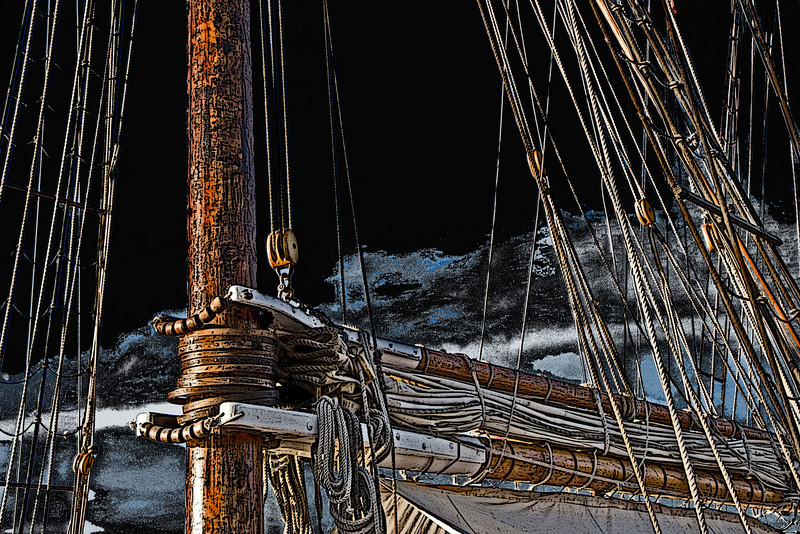
I know little about making model ships, but on a yacht or a dinghy, the boom is connected to the mast by means of a gooseneck that allows sideways and vertical swivelling. The concept is similar to that of a universal joint in mechanical engineering, except the two movements oscillate instead of being in rotation. On modern boats, this device comes in extremely varied forms. See these images.

Most model ships with any degree of authenticity would follow old rigging methods on ships. The simplest example, usually for the boom of the mizzen mast carrying the spanker (for balancing the ship and helping it to sail close to the wind) is a fork at the end of the boom allowing both movements. The boom is held close to the mast by the outhaul of the sail and parrel beads.

old-rig-boom

Here, the boom is seen with the mainsail down and the gaff resting on the folded sail. The “fork” on the gaff is called the parrel. The boom remains in the same place and is stopped from rising on the mast by some kind of vang or downhaul device, the sail being regulated by upward tension on the gaff. See gaff rig to know how it works.

Posted in Uncategorized | Tagged , | Leave a comment