Interesting Blog

Someone with the initials JV recently commented on one of my posts and said:

You certainly have a keen sense of what is at issue, for the the future of the Roman Church. Sadly, most RCs are blinded to such a view.

Why should I be able to perceive things other people who are more “in touch” are not “getting”? I followed the link to JV’s blog and found A Real Live One. Going by the links he gives, he is obviously a Roman Catholic and probably a layman. He describes himself:

I am a theologian by degree, a linguist by professional interest. I currently teach at area undergraduate programs in addition to other professional ventures outside of Theology. What’s the purpose of this blog? Well, have you ever glanced at the typical Theology blog? Purpose number one: I want to take this material that I find incredibly interesting and convince you that it is indeed interesting. That means dropping the pretension and dropping the often tortuous academic jargon. I won’t, however, insult your intelligence. I’m going to give you some meat to sink your teeth into. Purpose number two: there are topics best left out of an academic environment, be it the classroom or in potential research papers. This is a place to discuss those topics and see where the discussion takes us. Sit back, click, and enjoy! Your Friend, V.

It’s rather interesting to think that I was giving an English lesson last Wednesday to some engineers working for a company in a town near my home. We entered into the discussion of what they write to explain physical forces in view to reducing the risks of failure of a new machine. As a translator, I sometimes come up against obtuse and pompous language which is very difficult to translate into English and get it right. What has higher priority, doing a good job or showing off for the sake of one’s own conceited sense of self-importance? I do a better job of translating if the French engineer writes plainly and simply, without ambiguity or exaggerations in style. My translation will then be highly accurate, and the concepts will be faithfully conveyed to English-speaking readers as the French author intended. JV makes a very good point about theology – getting away from jargon and pseudo-intellectualism to clarity and concern for the reader.

This is a great difference between an encyclical by John Paul II and the simpler and more straightforward style of Benedict XVI. He needs no pompous style of writing to show his ability as a theologian! This was something very refreshing about Ratzinger as opposed to Rahner or some of the other theologians of the Vatican II era.

JV expressed his admiration of Benedict XVI’s style in Last thoughts on Benedict XVI, Papa emeritus and his flattering evaluation of my own writing in A Healthy Perspective on the Roman Church.

In the first of these postings, I quote:

Benedict’s papacy may well prove to be the consummation of many things in the Roman Church. It was a last ditch attempt to save the Second Vatican Council from the road to irrelevance which so-called progressives had unwittingly set it upon. I maintain that, gradually, Vatican II will become ever more distant as there is no one left to evoke their memory of the Council. This papacy was an attempt to sure up priestly identity and the significance of the sacramental ministry as well as restore the traditional aesthetic of the Roman liturgy. It was, as his choice of name suggested, an attempt to re-evangelize and restore the faith in Europe, the historical home of the Roman Church. Benedict’s supporters know well that all of these things were works in progress, nowhere near completion. There is the distinct sense that one era of the Roman Church is coming to an end and a new one is upon us.

Benedict himself has alluded to the storms battering the bark of Peter and his inability to successfully guide the Church amid them. Now is a time for decision in the Roman Church. I personally do not think the cardinals can afford to vote for the status quo. I also do not think the cardinals should be such intellectual derelicts to vote for every liberal whim – statistics can tell you how well the Episcopalian and Anglican churches have done by following that line.

Something is coming with the next conclave. God only knows what.

It’s an interesting idea, which would vindicate the SSPX, a return to the nineteenth century and the final combat against the world and the Devil. I would dread such a course being steered. It would be the way of the Third Secret of Fatima and the vision of Saint John Bosco and heaven’s endorsement of extreme Ultramontanism. I frankly doubt things would go that way, but I can see a vision similar to that of the continuing Anglican Churches and the traditionalist communities – that the Church is lived in the local Eucharistic community. Giving more to local bishops will be double-edged, leading to evils in some dioceses and freedom for good in other dioceses. Likewise, the episcopal conferences need to be dismantled so that each bishop is truly the bishop of his diocese, and each parish priest truly has responsibility for his local flock. Much of the bureaucracy and reinforced Papal authority was actually a result of Vatican II! How many times have I read ideas like this in Ratzinger’s books?

Do away with Vatican II? I don’t see it, but it would be a way of solving the problem of hermeneutics of continuity, cognitive dissonance and pushing square pegs into round holes. Reiterate the Counter-Reformation and the Council of Trent? The only thing the Renaissance and our time have in common is that they are both times of crisis, but the difference is as between black and white! I don’t think Rome run by the SSPX would appeal to me!

Then we have the kind write-up of my own ideas, I am thankful that my extremely limited perspective is coming in useful for those really concerned by these questions. He picks me up on the issue of making Catholicism local rather than a global bureaucracy. Reduce ecclesial units to human dimensions and you don’t need paperwork beyond registers for the Sacraments and a few files of documentation for contentious canonical trials such as marriage nullities. Make the Bishop the father of his people, driving himself around in a modest car or even cycling or walking, going to the market, visiting homes and farms, and keeping an eye on factories and having good influences there too with workers and executive staff. That’s what Jesus did – walking around with his disciples doing what needed to be done at the right time. It used to be like that in some of the Italian dioceses like Montefiascone, Bagnoregio, Orvieto or Gaëta among so many others. Some of those dioceses had no more that twenty or so parishes and measured little more than twenty or thirty kilometres between the most distant points of their territories. Then Paul VI in the 1970’s grouped them into bigger dioceses and brought in the bureaucracy.

No system of Church government is perfect or sheltered from abuses by bad men, but decentralisation would prevent the bad from becoming uniform and incontestable like a totalitarian dictatorship. Untie the hands of diocesan bishops and parish priests. Get rid of 99% of the bureaucracy – and we will find that at least some bishops and local priests are good and holy men, and will have the freedom to impregnate the wider Church with their godly leaven.

One lesson that Benedict XVI has taught us is that bishops and patriarchs with primacy of honour are useful for the Church but not essential. What is essential is the Episcopate, the communion of all the Bishops in the sacramental Mystery and the profession of the Apostolic and Patristic faith of all ages. On that basis, A Church of Churches can be built. This is what we are trying to do as continuing Anglicans and independent sacramental Christians.

A change of paradigm will be incredibly difficult and dangerous. I think this is what the old Cardinal Ratzinger meant about the little “pure” Church. An attempt to change things will cause most of the faithful to walk away in search of emotional security. Faced with the terrifying task of putting words into practice, Benedict XVI tried it brick by brick. That is the wisdom of a parish priest reintroducing good liturgy and the eastward position. Do it too quickly and the people will revolt! Few would have a finesse of understanding as some of us have in the light of intellectual study, synthesis and bitter experience. As JV asks, what is left to lose? As things are, there’s not much left where we Europeans live, precious little other than the empty buildings and increasing cynicism from the media.
Posted in Uncategorized | Tagged , | Leave a comment

Sede Vacante 2013

sede-vacanteA few days ago, I reminisced about the vacancy of the papal see in Sede Vacante 2005. How does it seem this time?

After the death of John Paul II, when I was already far from being in that Church as when I was with the Institute of Christ the King, I felt a sense of despondency and cynicism. It was almost a climax of a de facto sede vacante as Pope John Paul II slowly declined into death.

This time, we can have the impression that Benedict XVI, like Benedict XIV in the eighteenth century, was a brief ray of light and left his desk tidy. I have no way of knowing other than by what I read on the internet – and that is often very unreliable. All I can give is a couple of impressions like last time. For news and predictions about the next Pope, there are plenty of other sites and blogs from Novus Ordo Watch to Catholica Forum, representing every point of view from resurrecting Pius IX or making Ms Jefferts Schori pope with her army of lawyers.

I too am in my own way in sede vacante, being, as one blogger put it, Fr Anthony Chadwick, a non-parochial priest living in France, who runs a blog, and whose ecclesiastical status has been unclear since Hepworth retired. In fact, I am discreetly discerning the future, with a trip to England on the horizon, and I am quite confident that things will turn out in a quiet way. Hmm, enough of that for the moment.

Naturally, the sede vacante in Rome and the election of the new Pope will have no bearing on my own pilgrimage. As I have said before, I am concerned for a large but dwindling number of Christians who rightly or wrongly look to Rome for example and leadership.

Late last night, I caught up with the videos and goodbye speeches as I got home from an evening with some musical friends. The question of many retired men is what they will do with their time. I don’t think Benedict XVI will have any difficulty for as long as he is reasonably healthy. I hope he will write new books and continue his profound reflections on the liturgy as when he was a Cardinal and at the CDF. I would imagine that the eye of the media will be off him when they start reporting on black smoke and white smoke over the Sistine Chapel roof and making their guesses about the winning horses.

Sede vacante is a time of anti-climax and emptiness. The various Roman Catholic blogs and forums exchange ideas. Our Anglican blogs are very quiet. Fr Smuts is keeping very quiet – it is Lent and he is certainly occupied with his parish ministry and the good work he does with the fire brigade. Deborah Gyapong has the occasional article to post from the Ordinariate point of view. All the other Ordinariate watering holes are quiet. The Anglo-Catholic had a rumbling about Bishop Williamson (former SSPX) being about to start consecrating bishops, and then nothing. Virtue Online goes on as ever with its articles, some informative and others of local American interest. My own blog can hardly do more than repeat someone else’s new reports – I hardly see the sense of that – or give reflections from the point of view of a canonical “outlaw”.

Many are grateful for the little Benedict XVI has been able to achieve in the face of the “old guard” from the days of Paul VI and John Paul II. Others are downright mean, both traditionalists and “liberals” (I could call them left-wing anti-conservative conservatives) and say that they chanted Santo subito! when John Paul II died, but not this time. Normally, we would be mourning and praying for the soul of a deceased Pope, but the outgoing Pontiff is still alive and behind closed doors out of sight.

The conclave horse fair will go on as planned in something like a couple of weeks, and I feel very cynical about that. I prayed uno cum famulo tuo papa nostro Benedicto in the Mass, as recognising the Papacy as an ideal symbol of Church unity in the west. Now, that little phrase is omitted. Will I say uno cum famulo tuo papa nostro Pio or Leone or whatever? I am uncertain. I am an “outlaw” and will certainly continue as some kind of Anglican in a continuing Church living out my days doing what I can do with the gift of the priesthood I received. I often think I should not have received it, and I would certainly have done something else in life has I known about the trajectory I would follow. But, I have received it, and it is my duty to put it to the service of the Church in some way. I suspect I will limit myself to praying in union with my diocesan Bishop and the Queen of my country.

With the conservative / liberal dialectics as they are, I see little light at the end of the tunnel. If the Roman Catholic Church were to collapse, really collapse, I wonder how well the rest of us would do out of it. I think such a collapse would discredit Christianity almost entirely except the most rabid anti-Catholic Evangelical Protestantism in its modern American form. What will give the Church its credibility? If that question can be answered, there is hope.

During the last sede vacante, we felt that something had to move in the stagnant stillness. Now, we look for signs of stability and light, that the baby not be thrown out with the foetid bathwater. Cardinal Ratzinger seemed the obvious hope back in 2005, but most of us believed he would not be elected. Who is the obvious hope now?

There will be a new Pope, but what I am really interested in is the availability of the Church at a local level through small dioceses of human dimensions with very little paperwork like in some parts of Europe up to the 1970’s with equally small and welcoming parishes. When Cardinal Ratzinger talked about little communities of faith, I think this is what he meant and not some kind of “spiritual genocide” against the weak and mediocre. This is something we can do whether we are Roman Catholics or belonging to “ragtag” churches like the continuing Anglicans or other independent sacramental communities trying to live the way of the Gospel.

So, instead of lamenting about the sede vacante as I did back in 2005, there is something to do about it, because Christ still occupies his place.

Posted in Uncategorized | Tagged , | Leave a comment

A Couple of Articles

I got the heads-up this morning in my mailbox.

I find this article of little interest, as I have found many analogies of little help. I think of the Ordinariate Christmas gifts for impatient children, warm Tiber water and all that sort of thing. Now the Church is compared to a person suffering from depression and having to be treated in the old-fashioned way – electric shock treatment. Indeed, Frankenstein science (Luigi Galvani) from the late eighteenth and early nineteenth centuries left its legacy in this method of “rebooting” the human brain with electricity and saving lives by restarting hearts with a defibrillator. It seems just to be another red herring analogy.

The first assumption is that the Pope would have abdicated as a “shock tactic”. The announcement came suddenly, but many of us saw it coming. We will see if future Popes have to resign at a set age or after so many years in office, and perhaps this is something I don’t care about.

The Catholic identity being something less of interest as time goes on. I can’t speak for others, but there are so many Catholic identities as to become something as nebulous as the touted Anglican patrimony. As far as I am concerned, if it is being one of the Pope’s fans or parishioners, forget it. If it is a way to live the incarnational mystery of Christ through the Sacraments and the liturgy, like the Orthodox in their parts of the world, then there’s something interesting all of a sudden. Catholicism is said to be growing in Africa, but what kind of Catholicism is that? If it is the phenomenon of personality cults and mass hysteria, that is of less interest.

I would agree that Rome and the Papacy have been made into a personality cult. It is a part of our modern culture and part of human nature. The Church always offered examples to imitate by canonising saints. Some people like mass religion and large numbers of bustling people. I don’t. I would prefer to go and spend a few days in a monastery than go on pilgrimage to Lourdes. I like the Church in its intimate and family-like dimension.

Perhaps a lesson to be learned is that the Church suffers from the top-heaviness of its bureaucracy and institutional inertia, but those are hardly the fault of Benedict XVI. He tried to improve it, not make it worse. I would like to see the Papacy itself fade into a lower profile and for church life to be based in parishes, monasteries and alternative communities. Orthodoxy cannot be enforced. It has to be embraced lovingly and through enchantment. That is a theme on which Benedict XVI has always insisted, and he is right.

It’s interesting that this author refers to Pope Novus, because many of us would spontaneously add Bogus. Why is it so important for priests, bishops and popes to retire? Some people become infirm and incapable whilst they are yet young, and some people grow very old and keep their physical and mental strength. The priesthood is a vocation, and if I were a parish priest somewhere in a parish as they used to be in this country, without bureaucrats wearing me down, I don’t think I would want to retire, but rather to stay on as long as possible. I have lived in presbyteries with priests who went on and on. One priest I knew had a stroke at 82 and died, but until then he did his duties very well. I bristled when I saw him precariously wobbling his way up a stepladder to change the sanctuary lamp – a good lesson to do it before he noticed it hadn’t been done! I am against forced retirement. The essential thing is for an elderly priest to have the help he needs rather than being left by his own devices by people who don’t care but who still want their “consumer religion”.

If they reform the Papacy, they will only make the Church less human and less family-like. They would increase the bureaucracy and number of rules. Then even fewer people would be interested in the new Daughter of Zion as they pass by shaking their heads – is this what men called the perfection of beauty? Indeed – Quomodo sedet sola civitas

This journalist seems to have it all worked out, but he is laying a red herring. Rome’s not the problem. It’s the local dioceses and parishes. They don’t need rules and bureaucracy. They need the freedom to do good as well as do evil, put on beautiful liturgies as well as jamborees with rock bands and projection screens.

Pope Novus sounds so boring, so predictable and so mundane. I don’t need him (especially as I’m an Anglican – of sorts), and he would be an irrelevance to others, even more than the traditionalist and neo-intransigent Pius XIII. The church does not live by popes alone.That is one of the few truthful things this journalist has said, reflected the narrative of the Three Temptations.

This is an interesting historical reflection by Dr John Rao. The comparison is made between the early sixteenth century and the present situation. It is something of a paean of hope and faith, the idea that the Church can transcend the limitations human beings place on it. If this Church is a “pre-reformation” church as in the Renaissance era, then where are the reformers and counter reformers? Is such a comparison possible? Are the elements in place?

I suppose Africa and South America could be taken over by American Evangelical churches and the Pentecostalists, and maybe the “reformers” of Europe are the Muslims. But, are they not just stepping into a vacuum rather than having a mind to reform and restore Biblical values? Where’s Luther? Calvin? Ignatius Loyola? Philip Neri? Antonio Michele Ghislieri? – or their modern equivalents? Can we imagine the circumstances that would lead to the Second Council of Trent or equivalent counter-reforming Council in Rome? With most of today’s bishops?

How can the situation of today compare with a religious world where there was ignorance and corruption but also a deep tradition of piety and liturgy? In my own studies of the liturgy in the Renaissance era, I found that the corruption was not evenly distributed, and that some parts of the Catholic world were healthy and popular – England for example. The Reformation had to be enforced by foreign mercenaries killing people. The people wanted the Mass as before and not the “Christmas game”!

We can believe in the grace of God, providence, his ability to bring the greatest good and beauty from the least likely places. The Redemption was brought about by Jesus being tortured to death by wicked men! Thus Ciaphas and Pilate were instruments of grace…

O felix culpa, quæ talem ac tantum meruit habere Redemptorem! O vere beata nox, quæ sola meruit scire tempus et horam, in qua Christus ab inferis resurrexit!

On the other hand, like in the Renaissance era, our time is one of transition to the unknown, to the darkness of Jakob Böhm’s Ungrund from which light and grace will bloom forth at the appointed time. Studying the history of that era would certainly do us a lot of good and get us out of out temporal insularity.

Popes Pius IV and Pius V dealt with homosexuals by torturing and killing them with red hot pokers, castration and burning at the stake. Is that what we want, when God wills not the death of a sinner, but rather that he should turn to God and live? That is an aspect of the Counter Reformation that horrifies me. If that kind of thing takes over, and they get their hands on the levers of political power, it is simple for me – I will buy a forty-foot boat, cast off and sail away!

They not only murdered the gays, but also sent wandering monks into slavery and all the card sharps, bushwhackers and whiskey pedlars to the hanging judge like in the old West. We live in a time when crime and punishment are the subjects of ethical reflections. What do you do with psychopathic serial killers? Our natural inclination is to kill them, and then we kill people for stealing a loaf of bread and spitting on the road. The prisons are full and there seems only the option of Botany Bay and Devil’s Island, but in more humane versions. What caused those guys to go bad in the first place? Did we “good guys” have some responsibility? Execution is the easy option, but it is still killing and taking human life. If human life is cheap, then the Nazis were right – and I wouldn’t want to spend a minute longer on this earth!

If love has no place in this world and only force will do what it takes to reform the Church, then it is not the way of Christ. The Counter-Reformation cost lives and plunged Europe into bloody wars, as did the Protestants.

Like Benedict XVI, I believe the way out is contemplative and by rational persuasion on the marketplace of ideas. It might not work in human terms, but it respects freedom and human dignity. Fewer people will belong to the Church, but those who do will be attracted by beauty and holiness.

Dr Rao is right in that we now run the risk of seeing all Benedict XVI’s work undone, a return to the 1970’s and “dogmatic” liberalism. I notice how Brian Coyne on the Catholica Forum claims freedom and goodness, but yet would be inquisitorial on liturgical traditionalists. The French revolutionaries cried death to the enemies of freedom. Was not opposition to a certain concept of freedom itself a form of freedom? Will we find ourselves with a southern cone pope who will write off Europe and leave us to our fate? Will we be returning to polyester vestments, wooden tables and clown masses?

As I’ve said, there is no point in speculating about the conclave. It will be over in a day, a few days, or the people who feed their Eminences will have to say No Pope no food! It all looks surreal in our secular, scientific, technological, informed – and above all cynical world. Perhaps they have stocked up on provisions for months like on a ship.

The terrifying thing is to have no idea about what the solution would be. I do believe that a world without the leaven of Christian faith and culture would be something like Germany in the 1930’s but much worse. The Church has not always been exemplary about the respect of human life, but godless man is even more of a psychopathic murderer. Now is the time to look for God, not the whims of sinful man, for universal consciousness and beauty.

Dr Rao constantly quotes Louis Veuillot, that most ultramontanist of French journalists and Pius IX fans. I have often criticised that kind of Catholicism of the nineteenth century that provoked its nemesis in the form of anti-clerical Socialism and Grand Orient Freemasonry. Had the Church been kinder, following the example of a Saint Philip Neri or a François de Sales, surely fewer people would have turned against Christianity with such pent-up hatred. I would not like to see the Church return to that point – but to come up with something new to transcend both conservatism and “dogmatic” liberalism.

Perhaps the absence of a clear way forward is God’s way of telling us not to make such mistakes. I am confident that we will see the light one day, whether we are Roman clergy or rag-tag priests and folk in “micro churches” like the Anglican continuers and the traditionalist communities. I see no other way.

Posted in Uncategorized | Tagged , | 3 Comments

Mainsheet length

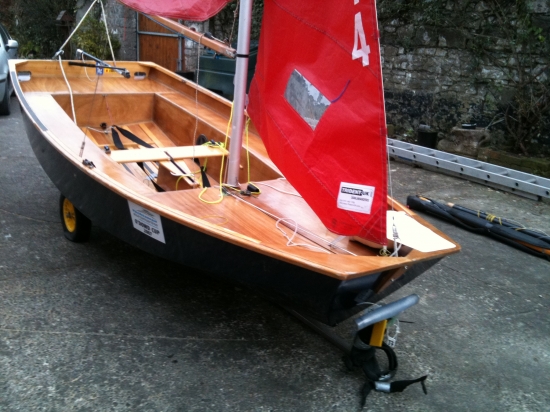
Another search term came in – mainsheet length, mirror dinghy centre main.

There are two ways of setting up a main sheet in a dinghy. Most modern boats have a central mainsheet:

mainsheet-centre

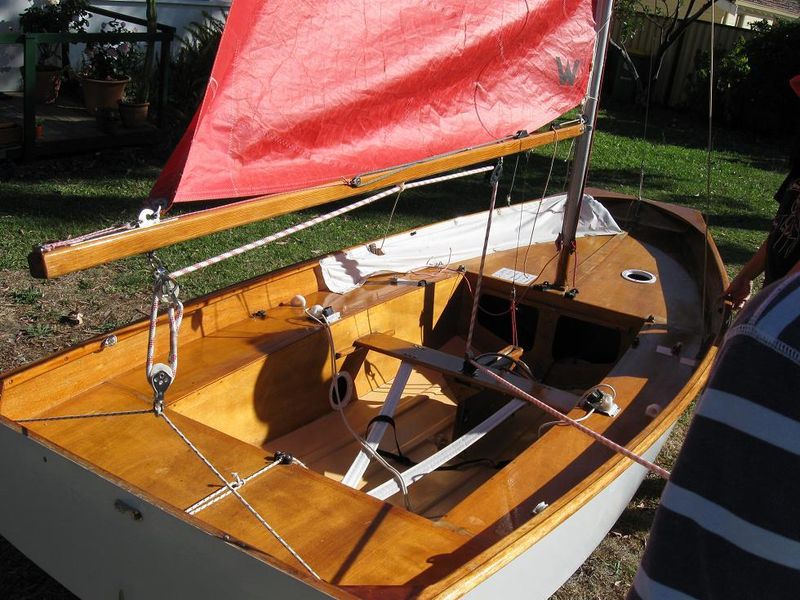
This arrangement requires four pulleys because one loses the leverage of a boom-end mainsheet. The Mirror mainsheet is very simple. It is tied to one side of the boat’s transom, runs through a single pulley at the end of the boom and through a pulley on the other side of the transom. It is simple and sensitive, and I much prefer boom-end mainsheets. I developed this preference sailing the Laser dinghy and compared the leverage and control I had with the rope-burn and heaving you have with centre sheeting.

In my boat, after the pulley on the transom, I then run the sheet through a centre pulley just aft of the centreboard. This avoids the mainsheet interfering with the tiller when tacking and gybing. The other advantage of pulling the mainsheet upwards is that when I am hiking for close hauling, I have both the tiller stick and the mainsheet to hold on to, so as not to put all the effort into my tummy muscles. The disadvantage is that the rope running from the transom to the centre block can cause rope burn to the feet and shins, and they take a long time to heal. I have to get my legs over the rope so as not to touch it as it runs.

The length of my mainsheet is 7 metres or 23 feet.

Here are two boom-end mainsheet rigs. Both are sensitive and comfortable. The first is the traditional Mirror rig.

mainsheet-end1

This one is inspired by that of the Laser. It has an independent traveller rope. Using the traveller enables you to get the mainsail into interesting shapes for better efficiency. On bigger boats, the traveller pulley can be locked in any position. In this photo, the Laser influence goes much further, in the possibility of tightening the traveller rope with a pulley system and a cleat. It is a neat setup.

mainsheet-end2

Posted in Uncategorized | Tagged , | 4 Comments

Papal Speeches

This is becoming a new fad with:

It was Brian Coyne’s “papal” speech in the anti-conservative Catholica Forum that gave me the idea of Celestine VI. I was originally against doing a papal speech for fear of committing plagiarism, but my ideas are too different from My Coyne’s to do such a thing. I found some things, especially the sex abuse issue, in Mr Coyne’s Pope with which I would agree, but I do find his judgements about those who want traditional liturgies to be harsh, especially in other threads. His words have been very strong about the Ordinariates and those who dared to leave their original Anglican community! Otherwise, his plan proved of some use, but I quickly parted company from it. This is often a fault of those who are in the “liberal camp”. I also detest the political spin that accompanies the question of women priests and the LGBT agenda. The extremes leave me with a feeling of loathing.

I’ll keep a look out for more papal speeches (other than real ones) and will link to them.

Posted in Uncategorized | Tagged | 2 Comments

The Old Soviet Empire and the Fax Machine

Another reflection comes into my mind as I find with Damien Thompson’s thinking. It is modern communication that is making all the difference. There is an old story that does the rounds according to which the real factor in the collapse of the Soviet empire was not Pope John Paul II or President Reagan, or all the prayers of the people for the conversion of Russia, but the invention of the fax machine. All of a sudden, the state no longer had a monopoly over publishing and communication of information.

The story may be a subject for discussion, as other empires and regimes have fallen without necessarily the transmission of information to the masses. Vatican secrecy has a number of enemies, particularly the Internet, mobile phones and surveillance technology. I would almost bet that someone with advanced technology will find a way to listen in onto what will be said in the Sistine Chapel during the conclave – in spite of all the precautions against bugs. The media would pay top dollar!

We all have access to information, and sometimes it overloads us and our critical capacities. Either the Church will be a crutch for the insecure, or it will have to be understood in a different and more spiritual way. The second way would be the most difficult. Perhaps something will come of all this.

I have been criticised for reading too much in the way of cataclysms and endgames into this current situation. Maybe it really will be business as usual for the next twenty years, but the numbers of faithful in the churches seem to continue to dwindle. Mass communication becomes that much more sophisticated and secrets harder to keep.

That seems to be as far as anyone can go with speculation, but nothing stays still for long. There would be movement in one direction or another with consequences. We’ll see.

Posted in Uncategorized | Tagged | Leave a comment

De quoi devenir chèvre…

goatThe French have a wonderful expression – devenir chèvre, become a goat – for the way a human being reacts to an impossibly complicated or illogical situation that causes frustration and anger. It is often what we are confronted with when dealing with obstructive bureaucracy designed to make us give up in our request for a derogation from the rules or the supplier of a service that has failed and will do everything to avoid giving us our money back. The image of a goat is quite telling through its lack of human intelligence and its amusing appearance.

I came across two highly significant texts this morning. One is a document by Pius IX dating from 1865 under the title Ad Quosdam Puseistas Anglicos – To Certain Puseyite Anglicans. My source points us to a pdf file. The language in this document is as if all the internet trolls, apologists and armchair inquisitors were rolled up into one person and made Pope! Usual stuff: we’re bogus Catholics and we have to convert to the true Church or else… Of course in those days, you could still find magnificent liturgies at least in the major parishes, abbeys and cathedrals. You had nasty totalitarian bishops and you also had kind saintly ones. There wasn’t the uniformity of thought and bureaucratic rule you have now. There must have been consolations to go with the bad stuff, but I suppose that most of those guys were at least truthful and honest. It’s said that Pius IX could be a kindly fellow and not that hard to get an audience with. Newman managed it, and long before Anglicans were called “Puseyites”.

Pius IX was also the Pope who “felt infallible” and said the same of Tradition as Louis XIV said about his kingdom of France – L’état c’est moi. His words would have been in Italian La Tradizione son’io. He promulgated Quanta Cura and the Syllabus of 1864 in which religious liberty was definitively condemned. It all seemed logical, and so the Church became totalitarian enough to be an inspiration for evil regimes in the twentieth century wanting to imitate it for their own ends. We can only imagine the Church of the nineteenth century from the old relics of popular devotion in parish churches, films, photos and descriptions in novels and non-fiction. As in the middle ages, there was a notion of a truth to be preserved at all costs and propagated in a rebellious and unfaithful world.

Now, those who promote this kind of ecclesiology are now on the receiving end. As I mentioned in my previous article, the Roman Catholic Church is in such a state that only the sedevacantists can express Pius IX’s ecclesiology with any real intellectual honesty – the true Church is reduced to a few communities in the USA and France. Most have a valid priesthood from illicitly consecrated bishops.

I have just discovered an article Cardinal Koch and the SSPX in the Angelus Press blog, written by a non-SSPX traditionalist. If there is anything liable to cause us to lose our tempers in the irrational and asinine way of goats on the farm, it is the way ecclesiastics try to tailor words to fit together. It reminds me of the way things go on in the Anglican Communion – formulating everything in such a way as it means different things to different people.

Fundamentally, the Society of St Pius X, like all Thomist thinkers, goes by the Aristotelian Principle of Non-Contradiction: two contradicting statements cannot both be true. One is true and the other false, or they are both false. There may be some middle ground depending on the propositions and forms of logic. The SSPX opposes Vatican II on grounds of its teaching contradicting some very solemn or even “infallible” pronouncements on ecumenism and religious freedom by popes like Pius IX, Boniface VIII and Pius IV.

Cardinal Koch, who was put into the place of Cardinal Kasper when he retired, maintains that in order to be Catholic, one has to go along with ecumenism and recognise the current teaching on the Jewish people and their faith. Being a Catholic is conditioned by following Vatican II.

Benedict XVI has been trying to put forward a hermeneutic of continuity, something like Newman’s theory of doctrinal development. The problem is that Newman set out a number of criteria to prevent the theory from becoming a device for dispensing oneself from coherence and logical thought, putting it crudely. It is interesting to read Cardinal Koch being so vague and unclear, presumably to make some sense to secular journalists. Conservative theologians like Fr Umberto Betti try to attribute infallibility to the Vatican II constitutions. Virtual infallibility is another term we find. Oh my! My head hurts!

The sloppiness of the Church these days is found in the way formal heretics remain in good standing even if they are criticised and sometimes silenced. Sister Elizabeth Johnson and Hans Küng are given as examples. The latter has formally denied papal infallibility and not simply having suggested ordaining women! Indeed the reasons for not regularising the SSPX are not dogmatic, though that would be the only reason for saying they are not Catholic. This subject has now been flogged for several decades.

What is most puzzling is the idea of a hermeneutic of continuity as Benedict XVI has tried to propose, but with ideas that are simply contradictory. It would be something like my “Celestine VI” saying that he is not infallible and remains Pope. Why pretend to be in continuity rather than say that the old teaching was wrong or that it only applied to its historical context? In an infallible Church, one contradiction or admission of error discredits the whole. This is the great Achilles Heel of Catholicism. If it can never be wrong, when it is found to be wrong, nothing is right! The sedevacantists have only taken the logic to its conclusion – the Church has to exist is a state of sede vacante, waiting for its infallible pope and not say that the pope is unnecessary except for the good of the Church. Admitting a hermeneutic of rupture puts one into an impossible position because that plays into the hands of the traditionalists – the teaching of Pius IX is of a higher authority than the conciliar texts. Rome would be shooting itself in the foot.

Reading this article, we can understand why Benedict XVI has seen such importance in reconciling the SSPX with Rome, but the contradictions remain for as long as the teachings of Vatican II relativising extra ecclesiam nulla salus remain in force, namely ecumenism and religious freedom, recognising any element of truth outside the institutional Roman Catholic Church. The choice is clearly between Vatican II and the SSPX, relating to the modern world or returning to the Counter Reformation fortress and bankruptcy.

This has clearly been the heaviest cross for Benedict XVI to bear, as the Church divides into the diametrically opposing extreme political positions of two contradictory infallible conservative and liberal certitudes.

If you really want to become a goat, consider this. You have to submit to the “true Church” because of what popes like Pius IX said and accept the teaching of Vatican II that contradicts that teaching without contradicting it, by virtue of truths that aren’t true but which are infallible. In an episode of Star Trek an android is defeated through the famous liar’s paradox known to the ancient Greeks. The android works on the logical clashes, overloads its processors and short-circuits itself.

There is no via media.

Posted in Uncategorized | Tagged , | 11 Comments

Election address of Pope Celestine VI

It is, of course, a pipe dream – but something we can indulge in from time to time.

* * *

Dear Brothers and Sisters in Christ,

Humbled by the decision of the Conclave to have elected me as Pope, I face the daunting responsibility for our Church. This Church has gone through a serious crisis of faith, spirituality and of its very credibility, which led to my predecessor, Pope Benedict XVI, having to abdicate from his charge.

Jesus commanded us to bring the Word to the whole world and to all peoples, but we have failed in this responsibility for too long. It will be a priority in my pontificate to examine what is most essential in terms of Christian commitment and the authenticity of our liturgical and personal prayer. We have to return to the foundations of our beliefs and the reasons why the Church exists. This is not the time to go into details, but rather for a few thoughts to guide our work over the coming years.

The mission of the Church is to seek the truth that belongs to God alone. We seek enlightenment about the purpose of our lives and the grace to convey these truths to the world. Absolute truth is only communicated to humanity progressively and through both faith and scientific research in nature and spiritual realities. We will never possess the wholeness of truth before the end of time for each of us and all God’s creation. In our pursuit of happiness, freedom and truth, we need to educate and stimulate the Christian conscience of persons in every stage of life.

If the Church is ever again to be a respected and credible institution in the midst of human society, we need to be seen to be pushing back ignorance, bigotry and obscurantism and filling the darkness with the light of Christ and all forms of human creativeness, discovery and learning. This progress in life and virtue must be manifest in art, science, sociology, economics, history, politics, ethics, law, medicine, psychology, genetics and biology, sports and leisure. As a Church, we seek to become open to the marvels of man’s co-creativity and participation in the love of God.

The Church must again become truly universal and welcoming to all conditions and social classes, from the poorest and those labouring under handicap and illness, to those in hard, underpaid and dangerous labour and to artists and the talented, the ruling classes, professional people and the aristocracy. We are called to encourage everyone in their search for truth and meaning in their own life pilgrimages. Christ rebuked the Scribes and the Pharisees to render freedom to God’s people. The Church must venerate the gift of this God-given freedom and never seek to annihilate it under pretext of “correcting” the work of Christ. The Pope and the Bishops are to be seen to be guiding, not punishing, encouraging instead of oppressing.

There are specific issues to be addressed, and we need to develop ways to respond in complete honesty and transparency. We may be seriously challenged by some issues in the same way that Christ took on the self-serving attitudes and hypocrisy of much of the Jewish establishment of his day. He challenged excessive certitude and the dangers of institutionalisation.

The first issue is that of the primacy of the spiritual and the quality of our liturgical prayer. My predecessor, Benedict XVI, issued a document to remove restrictions from the use of older forms of liturgy for the Mass, the Divine Office and the Sacraments, attempting to fit everything into a single Roman rite by the terms “extraordinary form” and “ordinary form”. I would like to go much further in a multiplicity of traditions, uses and forms, without any pretence of fostering a single rite. The Church is too diverse culturally to impose excessive uniformity. Therefore, parishes and religious communities will be free to use any traditional liturgy of their choice or they may adopt more modern forms. This freedom is a condition for the development of a healthy liturgical and sacramental life in cultural and spiritual diversity. Any abuses involving sacrilegious treatment of the Sacraments or scandals to the faithful would be dealt with by diocesan bishops as and when they occur.

Next, we need to address the issue of infallibility. I do not claim to be infallible or above any other bishop, priest or lay person. We all struggle in our uncertainties, temptations and sins. None of us is infallible, and we need to re-examine the extravagant formulations of the late nineteenth century. The mystery of God or universal consciousness is beyond the understanding of us all, and Wisdom speaks through all mankind, including those of all the great religious traditions of the world and those who struggle with belief itself. We are here both to discover and guide through love and respect of freedom. Thus, the Roman Curia will be reformed and adapted to present-day needs; its finances will be entrusted to mainstream merchant bankers reputed for their integrity and conformity to international banking standards and accountability.

The next essential item is that of human sexuality in the light of modern medicine, psychology and anthropology. Sexuality is an aspect of the whole person and human relationships. Modern western society has accepted equality between the sexes and respect between men and women. The subject of relationship and love expressed in friendship needs to be developed and explored so that it may be separated from political manipulation. Human sexuality and the notion of the family are more complex than Church teaching has often portrayed, and progress has to be made.

Alongside these burning issues, the Church needs to work its way out of political agendas defined by notions of conservatism, liberalism, progressivism and traditionalism. It is manifest that these political agendas based on dialectic either / or thinking are as intolerant and disrespectful of freedom as each other. I am determined, like my predecessor, to revive the philosophy of the ancient Greeks, Plato in particular, and a paradigm of life based on reality, universality, harmony, goodness, truth and beauty. Our agenda is not limited to promoting general councils, be they Vatican II, Vatican I, Trent or any other since the second Council of Nicea.

I intend to create commissions of scholars, contemplative souls and pastors to study these questions and explore possibilities for pastoral guidelines in parishes and alternative Christian communities of all kinds.

A word needs to be said about the Ordinariates founded by my predecessor, Benedict XVI, for communities of Anglicans leaving the Anglican Communion and the Continuing Churches. Whilst we shall maintain relations of dialogue with all Christian communities, these alternative non-geographical dioceses will be fostered and should become examples for other communities defined by their cultural sensitivities and charismas. In the implementation of Anglicanorum coetibus, goalposts were moved as Pope Benedict XVI was manipulated by elements in the Roman Curia and this left many Anglicans confused and disappointed. Whilst I call on the Anglican bishops to do everything to avoid alienating their own faithful, I also set out to correct and expand certain aspects of this pastoral provision for Anglicans to include certain priests and bishops excluded by an unpastoral and rigorist interpretation of canon law.

Most importantly, the question of sexual abuse of children and vulnerable adults by priests and bishops needs to be addressed once and for all. I first, as Pope, extend my humblest apologies to the whole of humanity for the way we bishops have placed the reputation of the clergy and the institutional Church before the care of victims and the punishment of offenders. Individual persons and families have been as devastated both by perverted priests and cover-ups by means of institutional secrecy. I apologise for the cover ups and accept the lessons taught us by secular society, and by civil and police authorities implementing law and justice. A number of practical steps will be taken to eliminate this cancerous scourge of corruption from the Church.

After the permanent removal of offending clergy, solutions are to be explored, ranging from the abolition of compulsory clerical celibacy to the empowerment of lay men and women in the Church at every level of its pastoral and teaching ministry. Methods of training the clergy will have to be radically revised, through the abolition of seminaries and their replacement by a combination of apprenticeship in a parish and a university education. These will be radical measures that many will find hard to accept, but which are essential for the future of the Christian ideal.

In God’s name, I bless you all.

Celestine pp VI, 28th March 2013, Maundy Thursday

Posted in Uncategorized | Tagged | 10 Comments

Sailing Question

The sailing season is nearly upon us, though it’s still rather cold here in Normandy. Under 10°C with probably no more than 7 to 8°C in the water, there is a real risk of hypothermia even with a good wetsuit such as I have. I have no intention of putting rescuers’ lives at risk as well as my own! Also, sailing is meant to be a pleasure, not some kind of penance at St Patrick’s Purgatory!

Since publishing a posting on rigging a Mirror dinghy, there has been this query in my search box: what knot for attaching halyard to gaff shackle.

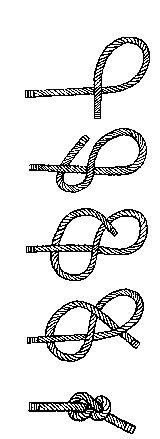
I had said in the other posting: Tie the main halyard to the gaff with a figure-of-eight knot. Here is how to tie a figure-of-eight knot:

figure-eight-knot

If you want to revise your frequently used knots whilst your boat is still laid up for the rest of the winter, here is a good link with animations – Some Useful Sailing Knots. I rarely use anything other than the bowline, the figure-of-eight and the reef knot on a dinghy, sometimes a round turn and two half hitches and a trucker’s hitch for  things like an improvised rope pulley tackle in a jury rig when pulleys aren’t available.

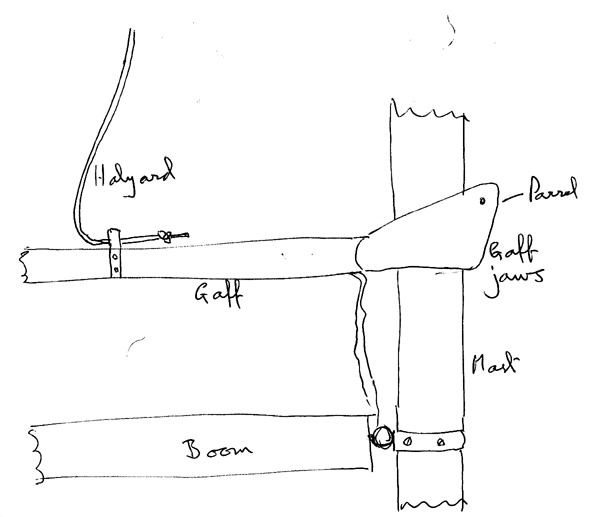
halyard-gaff

Before tying this knot, with the gaff horizontal and within reach, the gaff jaws on the mast and the parrel tied (figure-of-eight each side of the gaff jaws), thread the halyard through the shackle from the side farthest away from the mast towards the mast. Then tie the figure-of-eight knot. In this way, when the gaff (with the main sail attached) is fully hoisted and vertical, the halyard will run straight downwards through the shackle and be stopped by the knot.

Maybe in a couple of weeks or so… Last year, I sailed at the end of February, but that is most unusual in Normandy. On the sailing forum we have here in France, there are plenty of sailors chafing at the bit and looking for the first opportunity. Some have already been out on the water – – – brrrrr!

Posted in Uncategorized | Tagged , | Leave a comment

Why do I care?

A comment came in, attached to the Panier de Crabes posting, asking me why I care about the Roman Catholic Church. Surely, one Pope goes out and another comes in, business as usual for another 2,000 years.

Why do I care? I care simply because I care about other people and their spiritual good. I live in a country where those who care about religion are Roman Catholics or Muslims, and the condition of the Church here will not be improved whether the next Pope is a conservative or a liberal, or just a cynical bureaucrat. I care because I am a priest and am often called upon to answer questions asked by people whose faith may depend on the fortunes of ecclesiastical institutions.

I think the day I cease to care would be the day I will have lost faith and the will to go on living. Much of what is wrong with the world today is that people don’t care. Je n’ai rien à foutre has become one of the most common expressions said in French these days.

However, I agree that Vatican speculation is unhealthy and we run up against brick walls wherever we go. We might as well play billiards with a cloth untrue, a twisted cue and elliptical billiard balls! There are limits and times for letting go. That is a point on which I agree.

Perhaps we might care if it is Cardinal Kasper taking the name Boniface X, depending on how you look at it! The railway service might indeed become very unreliable, if you get my meaning…

Posted in Uncategorized | Tagged | 3 Comments