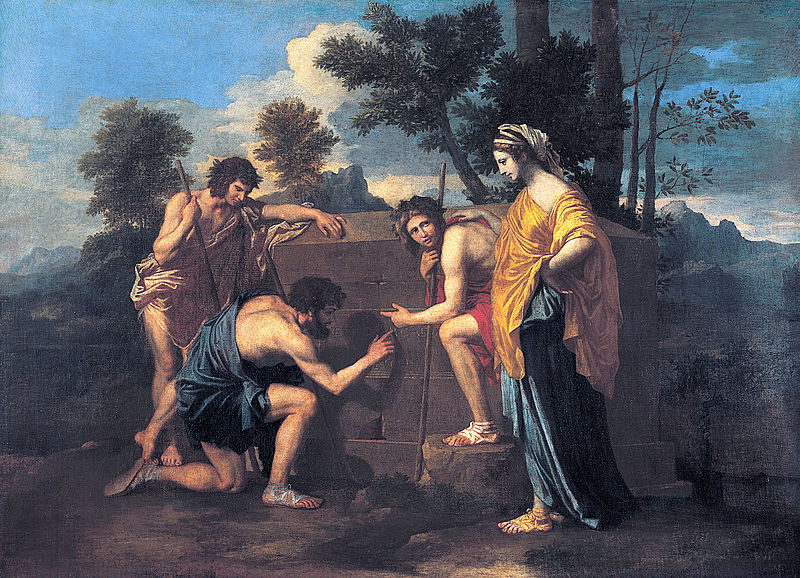
Et in Arcadia Ego

This is the title of the opening section of Evelyn’s Waugh’s Brideshead Revisited, a description of the life of an undergraduate at Oxford University in the 1920’s and his friendship with an aristocratic family with no financial worries. I see the parallel with the title Paradise Regained, and perhaps this might have been in Waugh’s mind as a man of literature. I follow on from my articles The Invisible Empire of Romantia and The Dream of Non-Papal Catholicism. Naturally, I pass off Romantia as a big overgrown schoolboy’s joke, but underneath, there is a strong element of nostalgia. It is no less than the Paradise Lost of John Milton or Thomas More’s Utopia. The longing for Utopia is part of our human soul.

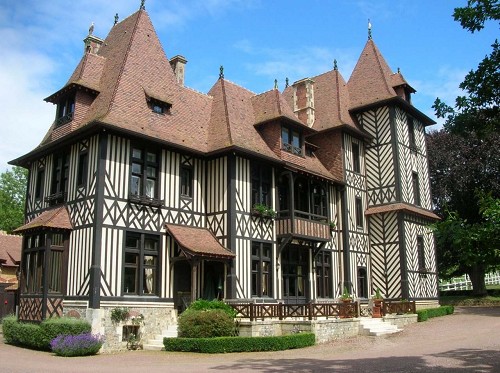
The Romantic Ladies are not the only ones to have come up with a perfect romanticised world of the past, which in their case in situated in one of my own favourite periods between something like 1890 up to World War I. If you had money and came from a good home, those were the days of imagination and the heyday of Arts & Crafts. All around me here in Normandy, especially at the coastal resorts, the houses of the wealthy (or at least reasonably well-to-do) from that period are all in a fantasist Anglo-Normand style. They are head-turners as you drive past.
It is interesting to find various articles on this theme. One of the most impressive archetypes is Arcadia (Ἀρκαδία), a vision of man living in harmony with nature. It is a theme found in Romanticism, in its art and poetry in the early nineteenth century. Unlike the utopianism of the murderous twentieth-century ideologies, Arcadia remained for most a dream, a lost paradise. Inherent is the notion of the lost golden age corrupted by modernity.

One of my readers rightly drew my attention to a novel called Islandia by Austin Tappan Wright. This is a fantasy that can strike at the hearts of all of us. Unlike Tolkein’s The Lord of the Rings, Islandia is not magical, but simply a traditional civilisation. We could think of Tibet of before the moment the Chinese Communists got their hands on it. Our childhood is filled with the notion of good magic, fairy tales and impossible wonders. Jules Verne was the one who did it for me. Today’s kids go for Harry Potter, condemned as dangerous by conservative Christians, but a character able to fire imaginations. We need it – and this is why we have cinema and fictional novels. Imagine a part of the world yet undisturbed by modernity where the people live entirely according to traditional principles. When I first came to France, I imagined finding a diocese that would have been untouched by the Vatican II reforms, yet without the ideology of the traditionalist groups. See Fr Bryan Houghton’s Mitre and Crook, the story about a diocesan bishop who resisted and kept everything traditional. Fr Houghton was an Englishman who expatriated to France, as was Fr Quintin Montgomery-Wright. To an extent, I found it, but in a few parishes with an old priest who had stuck up for himself against a reforming bishop. Those brave priests have now all passed away, and some of the parishes are now in the hands of traditionalist priestly societies, and other churches have shining new padlocks on their doors, left to fall into ruin.

And so, Romantia – or the “Platonic Church” – is a deep instinct in many of us, certainly in me. My whole life has been dedicated to finding the best compromise possible between the inescapable “reality” of modernity and the inner quest for innocence and blessedness. I opted for country living and discovered the joy of being at sea in a sailing boat. I don’t think utopianism is unhealthy if we have a fair grasp of our relationship and willingness to compromise with the “real” world. It is modernity that gives us our technology, feeds us, cures us of our sicknesses, educates us and gives us skills to get by and socialise with other human beings in society. We can’t live entirely in isolation, seeing the experience of shipwrecked people on remote islands and how well or badly they do. Our relationship with the utopian archetype will determine our spiritual and emotional balance.

Jung‘s books explain the psychological dimension far better than I ever could, and those writings are abiding. We all need to be vigilant in keeping the balance between our inner γνῶσις and our place in human society. Even if we live in the country and have many things on our own terms, there is still money to earn to keep it all going, bills to pay, boring work to do, conflicts to resolve and the general condition of us all. The garden has to be done, and the house needs constant maintenance. A motor vehicle is a complex piece of machinery and represents our fragile and fickle link with the outside world. That too takes our attention and makes us need money. Perhaps living in the country helps with this sense of realism, knowing that the utopia cannot be an absolute – as in the nostalgia of city-dwellers.

This is something I notice in those who dedicate themselves to hard-selling an idea or proselytising. They invariably live in cities and their projected nostalgia is that much harder to reconcile with their actual condition. Our desire for another life beyond bodily death is also a very strong instinct, marred by the thoughts coming from our contemporaries. What if life were merely material and all over with death? It is the antipode, the negativity that leads to dystopia as in the visions of George Orwell and Aldous Huxley, brought to grim reality by Hitler and Stalin and to some extent and degree in the countries where we live, from North Korea to Sweden! Our life contains elements of both utopia and dystopia, happiness whilst sailing on the sea or taking the dog for a walk in a forest – and the next day queuing at the till of a supermarket surrounded by blaring loudspeakers and screaming toddlers wanting this or that.

I leave these thoughts to those who project their deep desires on the Church and are “more Catholic than the Pope”. The idea of building the Empire of Romantia in our homes may seem absurd and be the butt of endless jokes, but there is a foundation that is necessary for our spiritual health. We can go so far in making ourselves citizens of God’s Kingdom, and even adapting our lives around us to some extent, but only to some extent. We can’t change the world, but we can do something about a tiny bit of it. That was the idea behind setting up little “rump churches” like the Continuing Anglicans or some of the more grandiose-minded independent sacramental movement bishops. Have you ever heard of micro-states (tiny countries recognised by the international community like Liechtenstein, Monaco, Andorra or the Vatican) and micro-nations (attempts at making a dream like Romantia into a reality)?. The micro-nation may seem absurd like a comic opera, but the foundation is always the same when the intention is pure (for example not a way of tax dodging, etc.). The Chinese had a proverb about there being peace in the heart, and that peace spreading to the family, the village, the county, the nation and finally to the whole world. It has to begin with ourselves, otherwise we can do nothing about other people.

I think that just about sums it up. We have to compromise and negotiate all the time – that’s life.

Posted in Uncategorized | Tagged , | Leave a comment

The Invisible Empire of Romantia

Further from my posting of yesterday, I used to have such a good laugh over the Romantic, the Reactionary Review, the Imperial Angel and the New Century written by those dotty ladies in England who are certainly less innocent than they would like us to believe. But, no smutty stuff here!

It’s all rather funny, completely batty, but it doesn’t leave us indifferent. Here is a description of the Great Invisible Empire from the 1980’s.

* * *

The Invisible Empire of Romantia is like an archipelago of islands, spread out upon a sea of darkness. Each one of those islands is a Romanian home, its warm light glowing and its strong walls firm against the rising tide of madness.

Some of these islands are very small: a single room at a University college, a tiny flat, even a mere bedroom. Yet however small it may be, it is home, and it can be a part of the Empire of Romantia.

One of our most charming Romantian writers tells me in a letter how her first Romantian home was her bedroom. “My parents watched television. It made me so sad. It was quite unendurable to see them sitting placidly before a deluge of filth and evil which was pumped into the home each day. Their home, not mine. My home was my bedroom. Every night, between half-past six and seven I retired there. I undressed and got into bed: there I did my homework on my knees, read, wrote, listened to classical music and the latest dance-band singers, all on my darling wind-up gramphone Al Bowlly, Hutch, Bing Crosby, Vera Lynne, Ruth Etting. They were my friends: they and the masters of English letters, great and small —C. S. Lewis, E. Nesbit, Jane Austen and a hundred others. It was a strange life, I suppose. When people came to call they had to say I was in bed! I was always in bed. And there, instead of being poisoned by the cathode-ray, I gained a solid grounding in English literature and began to be a writer. I did not know about secession then, but in my own funny way I had seceded. The whole room was part of Romantia, even though I did not know the word. I would never have anything Babylonian in it. Not a packet, not a carrier bag. Most of my books I bought from a second-hand shop but when I had paperbacks or library books I hid them in a box under the bed. No one coming into my room should see anything to make them think they were in the late 20th century.”

Such are the simple beginnings of secession: the rudiments of making one’s home a Romantian sanctuary: and if a child living in a largely unsympathetic parental home can do it, what excuse has any one else?

Of course, there are more Romantian homes now, and while a world of garish barbarity may exist outside the door, there are now places to go: other homes that are not part of Babylon.—And within those homes, often more places again: cinemas, night clubs, shops, taverns. For many Romantians delight in transforming their homes, just as they transform their own personalities: playing the game of building a world—for what is any world, Babylon included, but a game? Is not the success of the modern disease simply a question of the number of people it has persuaded to take its game seriously and call a monstrous, vulgar, unintelligent farce “the real world”? We have thrown its persuaders out of our houses. We no longer take the game seriously: thus our homes are not part of its world. They are part of our world.

Another friend writes to me of her first Romantian home: “As soon as I went to University, I decided to break with Babylon and make my room a sanctuary from all the ghastliness. It was a bit of a business, because the rooms were all furnished with identical ‘fittings’ or ‘units’ or whatever dreadful name they call them in the most horrible light wood. However I bought lots of charming, Victorian-looking drapes at a charity shop and covered everything—the awful bedside-thing, the dreadful desk, the nasty institutional bed which did not even have the decency to be cast-iron. I put my few treasures there—glass candlesticks, framed prints of Miss Katherine Hepburn and Miss Carole Lombard, a picture or two, my Victorian tea set with only three cups, and of course, my books, which transformed the plank-bookshelves. People used to say that it was like stepping into another world.”

Of course there are certain advantages to just beginning in life. Another friend, who has only recently become a Romantic faces a different problem: “There is nothing hateful in my house, but really I have never been vigilant until now. All sorts of not-really-very-nice things which one gets because one is half-thinking one ought to collaborate. Gradually I am replacing one thing after another. I started by getting everything remotely exceptionable out of the drawing-room and making that a wholly Romantian room where I could invite any one. Slowly I am licking the rest of the house into shape.”

It is not merely a physical, but also a psychological process whereby one transforms one’s home into a Romantian sanctuary. Another correspondent writes: “As my Romantian house takes shape and my taste is refined by photoplays and racination, more things jar with me. In my bedroom in the morning I can always hear the roar of traffic, which began to grate with me as a hateful intrusion of Babylon. Recently I had an inspiration. I lay in bed and listened to the cars and pictured them— not Babylonian cars, but beautiful, black shining real cars, like the ones our friends drive and the ones you see in the photoplays. I see busy streets bustling with real cars and real people. It has added a new dimension to my sanctuary, and I feel I am colonising some of the ‘ether’ about my house: widening and strengthening my ‘bubble’.”

This mention of “ether” and of the” bubble” brings us on to the ritual side of building a sanctuary. Not every one is drawn to ritual, and if, for whatever reason, you do not wish to use such means, please feel free to ignore this passage. If, however, you have no aversion to ritual, be assured that it can help greatly in creating a true Romantian sanctuary, even if you see it as nothing more than an aid to building its reality in your unconscious mind.

This ritual is very simple. All that is needed is a stick of incense, preferably of a scent corresponding to the sun (frankincense, myrrh, saffron, amber). Choose which room is to be the heart of your sanctuary. It may be the drawing room, your study, even a bedroom. Facing East, trace upon the air with your lighted incense stick the sign of the Fora (the circle-cross on the Romantian flag and shield), saying “In the name of Themis, protect this sanctaury”. Envision the Fora standing before you, golden, glowing and as tall as yourself. Trace it again, with the same words. in the North, the West and the South. Now, Facing East again, and with eyes closed, imagine the four Foras growing and moving outwards, and about them, with you as its centre, a great golden bubble, so fine and so pure that all things of Babylon must wither and die at its touch. All within the bubble is golden light, and if any of the area about your house is enclosed within it, it too is transformed. The motor cars into real motor cars, the people into real people wearing real clothes and walking like racinated human beings. Hold this vision in your mind (it does not matter if you only think it rather than see it), and then see a golden shaft descending from heaven through the centre of your bubble, forming the roof-tree of your sanctuary and also the thread or pillar which connects you with Romantia. See, high above, the towers of the celestial Empire shining in the sky.

Finally, raising your right arm, say “Hail Themis, Hail Romantia, Hail Themis.”

You can repeat this ritual whenever you feel your sanctuary needs to be renewed, or purified, or more closely linked to the rest of Romantia. We have known psychically sensitive people actually see this bubble even when they know nothing of Romantia, and certainly it will protect and help you.

But whether or not you use ritual means, you can make your home, however large or small, a true part of the real world: the sane, civilised, charming world which should have been your birthright—and still can be.

Posted in Uncategorized | Tagged , | 7 Comments

The Merton Institute for Contemplative Living

This initiative is named after Fr Thomas Merton, the famous American Trappist monk. It isn’t a monastery, though this site is connected with Merton’s old abbey. It seems to be a virtual meeting point for all who aspire to a contemplative life. Here are some useful guiding points.

We intentionally engage in activities intended to deepen our relationships with ourselves, God, others and nature.

We are conscious that our decisions, actions and use of time affect each of our relationships.

We see how our relationships are all interrelated and integrated and see God in each of them.

We take personal responsibility for each of our relationships.

We understand that ourrelationships our integral to reaching our life’s goals.

We are not as easily distracted by meaningless activity; our active life flows from our contemplative nature.

We see through “the illusion of separateness;” acknowledge whatever we do that alienates us from our true self, each other, nature and God; and live with the recognition that “we are already one.”

Our spiritual/contemplative life is our active daily life.

We regularly spend time in silent reflection, solitude, and other contemplative practices.

We are more concerned with the issues confronting humanity and less with the mundane concerns of daily life.

We experience the freedom, joy and love that can only come from grounding ourselves in our relationships.

This initiative organises retreats and other activities in the United States and at Gethsemane Abbey in particular. If that appeals to you and you live nearby, why not? On the other hand, these ideas are loose enough for us to “plug” into and discover a wonderful and traditional wisdom. The site addresses itself to ordinary people – priests and laity – who are not monks. We can do so much to find our way through the rubble such as I described in my previous posting and rediscover what Christianity really is. I want to see a Christianity with a future!

Read through the material, and it would be nice to have comments about how this blog could help foster the contemplative life, and through it, a vision of Christian unity beyond and above denominational conflict and “true church” claims.

Posted in Uncategorized | Leave a comment

The Dream of Non-Papal Catholicism

Young Fogey is writing on a favourite theme, trying to prove that only Roman Catholicism is viable enough to foster and continue the Catholic way into the future. One by one, he proceeds to trash the alternatives.

The disillusionment of Anglicans is held up as an example – ‘I really do think the dream of a non-papal Catholicism is just that: a dream’, quoted from Anglican Bishop John Hind. The Eastern Orthodox are no good because they don’t have a firm line on contraception. One by one, the branches are lopped off with a summary wave of the hand at Old Catholicism, including the PNCC. I can’t say I exactly disagree when viewing the Continuum as “a little gaggle of squabbling sects”. The simplistic conclusion: the Pope’s the only one who makes sense, and he has a world presence, teaching all nations.

Falsus in uno, falsus in omnibus – great, and nothing will survive. Perhaps it shouldn’t.

Triumphalism indeed. The apologists project their notion of the “true church” onto what seems to be a Platonic idea. The Church they try to convert us to is not my local parish, or even the local RC diocese, but a romanticised idea of the Church from the 1870’s which no longer exists, or perhaps never did exist. How can one “convert” to an idea? Certainly, it is an idea to which we all aspire, but it is the Communion of Saints, not some institution here on earth whose image of the Eternal Church is tarnished. The reality here in Europe is sobering. The Roman Catholic Church looks like being another candidate for Young Fogey’s trash list! It’s a bit bigger than all the other non-viable entities, but the logic is the same.

In my student days, a friend of mine in London came across a couple of very original ladies who produced a little printed magazine called The Romantic. Google has found me their website. They also produced cassette tapes of amusing “news” from the Great Invisible Empire of Romantia. The cassette was to be put into a tape recorder hidden inside the shell of an old 1930’s wireless set. Imagine listening to the hissing cassette and hearing a precious female voice imitating something like the Queen but pronouncing the “r” as a “w” like children in the 1920’s in aristocratic families (as in Be vewwy quiet: I’m hunting wabbits), saying: “This is the News of the Imperial Home Service, coming to you from somewhere in the Great Invisible Empire“!

The implication is that you imagine that you are back in the days of the British Empire, namely the Victorian and Edwardian eras. I found it all very funny and amusing – until. It turned out, according to something I heard, that these two ladies set up a “school” variously in Ireland or north London, where teenage girls could go and get an “old-fashioned” education with corporal punishment – which seemed to have sado-masochistic overtones. They have a site at Aristasia and it all still seems to be in the wrist! Obviously, those two ladies are outrageous eccentrics, and my friends and I took it all as one big joke.

It is tempting to apply the same kind of psychology to the Church, living as if Pius IX was the Pope and adopting the kind of rhetoric characteristic of Cardinal Pie of Poitiers or Manning of Westminster. It is simple stupidity, yet people get taken in. I too like 1950’s cars, hats and cut-throat razors – but times have changed, and their modern equivalents are so much more practical. I’m not so sure that people were more virtuous in the 1950’s. I remember most of the 1960’s and that was in the 40-50 years ago, long enough ago to be the good old days. But, were those days so good? The fantasy of living in a Platonic idea is little more than the delirium of the Klu Klux Klan!

Reality in 1962 – fifty years ago – was bleak, and we faced the possibility of a nuclear holocaust. We are now in 2012 and the threats to our life are different. We were as bad then as we are now. There have been prophets of doom and nostalgics throughout history.

The churches in Europe are closing down, now at a rate that rival Anglican and non-conformist church redundancies in England. The buildings are sold for business premises or conversion into prestige homes. The buildings of greater artistic merit are reused as banks, museums, concert rooms and libraries. What all those churches have in common is – Ite missa est. So the problem is secularisation and the inexorable ebb of faith and belief. The closing down of churches in Europe is nothing new. In the days of the French Revolution and anti-clericalism in the nineteenth century, churches were turned into farm buildings and military barracks. Nothing new.

Church buildings are expensive to maintain, and there are too many of them. One thing that is painful for the few Christians left is that very few people care about those buildings. Their disappearance would make no difference to them.

I was discussing the question of relevance of the Church in our society. That relevance is the existence of parishes and the dioceses doing what is necessary to ordain priests and provide a full sacramental life for all the faithful. The clergy blame the laity on secularisation because of materialism, the “good life”, material security, well-being, health and so forth. Perhaps a good war would bring everyone scuttling back to church! But, to what? The problem is one of the clergy, clerical culture and increasing elitism. They alienated the working class in the nineteenth century, the bourgeoisie in the 1950’s and now the rest of us. Why go to church? What will we find if we go there? A locked door?

Until the question of priests is solved, Papal Catholicism – just like any other kind of Catholicism – is going the same way, nowhere. Just one more bit of trash… I could go further: Europe’s present is America’s future.

We are faced with bleakness, uncertainty, our own agony in trying to reconcile our fixed beliefs with a reality outside ourselves. Does the world fall into chaos without Christianity? Of course not. Every prophecy of the end of the world has failed, as will that of the 21st of next month. The world existed before Christianity or the present Papacy on which the conservatives are pinning all their dying hopes. The world will continue without it. It looks as though Christianity was a worthless illusion from the first.

In human terms, there is no sense in any of this. Thinking men have agonised about all this for decades. What is said now is little different from what was said a hundred years ago. Evola recommended that Christianity should be abandoned, but for what? Guénon converted to Sufism, but does that spiritual way do any better to reverse the trend of western civilisation’s terminal decline? We continue to seek a philosopher’s stone.

I could end this reflection in complete nihilism, but there are signs. In one of the most secular countries in the world, monasticism is thriving and young people seek further than materialism. Some resort to various forms of conservative politics and project their ideology onto their belief. Others seek a way that no longer contains the seeds of its own destruction. One thing is for sure – that we are at the end of history or the beginning of a new era. And this will continue to be our Advent…

* * *

Update: One of my readers has been sending out e-mails to several persons including myself and Bishop Roald Flemestad concerning alleged weaknesses in the Polish National Catholic Church and reflecting the latest postings of Young Fogey. Convert to Roman Catholicism or die!, as seems to be implied.

From a friend: I asked a prelate of the Polish National Catholic Church how they continued to resist women’s ordination and the other assaults of the modern world, and he said that this is how their people voted.   I asked then, if their people had voted like Episcopalians, or if they did so next year,  would the truth be changed?   He didn’t like my question.

The good Bishop replies:

As you have included me among the recipients of this email and refer to the PNCC in the text, I suppose you are soliciting a reaction.

Firstly, your anonymous friend’s comment appears condescending to me. Is he of of those blinded RC triumphalists one meets every now and then?

In that case, tell him you need a looking glass to find Roman Catholics who do not accept the ordination of women. The hierarch himself stated in his first interview after his appointment that he was in favour of women priests. As it caused a stir, he later came out saying that he was misquoted. Fortunately, there are more traditionalist currents among the clergy.

As to the PNCC, the ordination of women is explicitly rejected in the Declaration of Scranton of 2008. It was prepared by the doctrinal commission, accepted by the clergy conference and promulgated with the signature of all the bishops as expression of their teaching authority.

Somehow it seems doubtful that the Roman Catholic Church nowadays could muster that kind of broad consensus. Time will show but it is perhaps not so convincing to present the RC as societas perfecta et communio hierachica – as least not at the expense of other churches.

Posted in Uncategorized | Tagged , , , | 43 Comments

The Great Meltdown

Update from Sunday 17.55 GMT:

Father Stephen Smuts has completed the maintenance work on his blog, and there are new articles.

* * *

I begin to be quite “alone” as this blog somehow continues to be of some interest and good to others in circumstances unknown to me.

Since The Anglo-Catholic went into hiatus, we have had to look all around to continue to have news about the TAC and its attempt to regroup and reconstruct its strengths after the advent of the Ordinariates. Father Stephen Smuts in South Africa took up the flag and has been most assiduous in providing us with news and views about the Ordinariates and the continuation of the TAC, often at the expense of the former Primate. This blog has been “under maintenance” for a little over a week, and most of us know that blogs need no maintenance. Comments continue to appear from time to time. It looks like hiatus to me, but we are all free to do what we want. I have had my own meltdowns through over-sensitivity to trolls.

Foolishness to the World is still going, and Deborah Gyapong keeps us informed about developments in Canada and other places where Anglicans have become Roman Catholics and / or joined the Ordinariates. I have always enjoyed collaborating with her, a professional journalist and talented writer, and a devout Christian.

St Mary’s Hollywood: The Cold Case File has appeared, run by a journalist called John Bruce, and he – from the point of view of a convert to the Roman Catholic Church – is writing about the remains of the TAC. I assume he engages his own liability before the law and is careful about what he writes. The main issue is the débâcle (déconfiture is another nice French word) of that nice neo-baroque church in Hollywood presently claimed by the TAC.

The Ordinariate Portal hasn’t moved for a long time. I think it has just been discontinued. Anglican Patrimony is still producing Ordinariate news and sympathetic articles. Fr. Hunwicke’s Liturgical Notes has a bit of a comeback with the good Father’s scholarly articles, but he probably no longer has much time for blogging. Father Ed Bakker’s Blog produces spiritual articles and the occasional nostalgic sigh.

The Continuum of Fr Robert Hart is now quiet, as he and other priests have been afflicted with illness and exhaustion. They need our prayers. The archives of this blog show highly polemical articles from the heady days of the TAC in its Hepworth era. Posterity will judge. Also from the Anglican Catholic Church – Original Province is Deacon Jonathan Munns blog O cuniculi! Ubi lexicon Latinum posui? which shows intellectual ability and resourcefulness.

Virtue Online is an old classic, and is not sympathetic to extra-mural Anglicanism or Anglo-Catholicism. It is worth looking at frequently, with a mind to check out facts against other sources of known reliability.

In the Roman Catholic world, we have the Australian Catholica Forum from an ultra-liberal and anti-Pell perspective. On the traditionalist side, there is Rorate Caeli. Fr Z  battles on with great constancy, and you either love him or hate him! There are the Vatican-watcher old favourites www.chiesa and Whispers in the Loggia if you like that kind of thing. Damian Thompson used to be a real battleaxe with the English liberal RC bishops, but he is more concerned with English politics these days. If you have a taste for the exotic, there are Traditio and Novus Ordo Watch – it helps to share their particular convictions, as objectivity flies out of the window.

For those of us contemplating the rotting leaves of the TAC, there isn’t an awful lot left.

Posted in Uncategorized | Tagged , , | 8 Comments

Another View on Erastianism

Excellent article by Deacon Jonathan Munn.

Posted in Uncategorized | Tagged | 1 Comment

Quid est Veritas?

We have read it in the Gospel, heard it in church during Holy Week, and some of us have seen the Mel Gibson film. What is truth?

In Thomist philosophy, the truth is something outside ourselves, and seizing the truth is conforming our intelligence to the information our senses receive from outside reality. In the tradition of Plato’s realism, absolute truth exists, but truth on earth is but a mere shadow of the Universal Idea of truth. Thomas Aquinas went for Aristotle’s moderate realism that gave some reality to the individual manifestations of the Universal Idea. All that is very mind-boggling, even for those of us who have sat through hours of muddled Italian philosophy lectures at the Angelicum!

Is anything absolutely true? To be sure, saying that there is no absolute truth is an “absolute truth” in itself. That is the dilemma of the “dogmatic truth” put out by atheists to say there is no God. After all, science sets out to discover truth and certitude of knowledge. So do theology and philosophy. There are some things on which we all agree as absolute truth, but our agreement depends on an agreement of definition. How is an idea or a term expressed in a language understood by you and I? That is where subjectivity lies and where our understanding or apprehension of truth is made imperfect. Even if we have a great deal of evidence and proof about something, there is a percentage of error by which our judgement of truth might be wrong.

We Christians tend to believe things as true because they were revealed by God – through the Scriptures, the Tradition, the consensus of the Church Fathers and so forth. In a Platonic perspective, the truth lies outside our grasp, and our apprehension of this truth is the work of our lives. The truth is not ours but of God. The difficulty is when we begin to impose our “absolute truth” on others to exclude them and say that they do not have this absolute truth or are in error. Those who do not assent to the “absolute truth” of the dominant person or group is attacked and denigrated, persecuted, tortured in an Inquisition torture chamber, burned at the stake, trolled on blogs, you name it…

There has to be a notion of truth, something we all have in common and a transcendent reality outside ourselves to which we all aspire. Otherwise, there can only be chaos. It is a little like the issue of authority and anarchy, but there is the difference between the Universal Idea and the particular manifestation which can only be imperfect.

The notion of truth will continue to be debated as we all have such an imperfect understanding of what is mysterious and above the limits of our reason. Pontius Pilate was a Sceptic, one who denies the existence of truth or doubts our ability to understand anything about it. What is truth? That is the question in all our minds if there is an ounce of honesty within us.

I remember a scene from the famous film of Boris Karloff, Bedlam, made in 1946, about the notorious lunatic asylum in London in the eighteenth century. There is a scene where two young insane people are sitting on the floor squabbling over a book – That’s not true! No, that’s not true. A visitor to the hospital asks why they are fighting over truth, to which the answer is – Wiser men have fought over truth for centuries. Reading some peoples’ ideas about religion and truth, I wonder if we are not all in Bedlam!

Posted in Uncategorized | Tagged , | Leave a comment

A Relevance of Christianity

Since writing my last post and receiving a very interesting comment, I wonder if I have allowed myself to get onto someone’s conservative bandwagon. After all, the argument of some of the protagonists for women bishops in the Church of England is that such a change would bring the Church into modern times, in line with secular thought, and therefore relevant to ordinary people.

What is this relevance? It seems to be common ground on the basis of which it becomes possible to build a relationship. For example, an American or someone living in another distant country tells me I have to become Roman Catholic or Orthodox. What of that recommendation can I relate to? If someone says – Come to our church, and I go there one Sunday and find a Christian witness that appeals to me, and with which I can relate as a human person, then it might go a little further. If I am approached with love and a spirit of prayer, I am uplifted. If I am told to make applications to bureaucracy and committees and have to wait a very long time for a response, if one will ever arrive, then I am crushed and alienated. That for me is relevance.

A possible analogy of relevance is what is called in industry a man-machine interface. On a computer, the MMI normally consists of a video screen, a keyboard and a mouse. The human controls the computer by keystrokes and mouse clicks and the computer gives information on the screen and various types of multimedia devices via words and images to the human user. In this way, the machine and the human person have a relationship – of sorts. Between two humans, the interface is a common language, an ability of both persons to write, read, speak, hear and see signs of body language – and not least, a degree of emotional empathy or friendship. The relationship goes much further. Then we consider a community, which also implies its purpose. In all cases, there has to be common ground, a single purpose that all share.

If there is no interface, there is no relationship. There seems to be a lot of confusion about what Christianity is for. Are Christians the only ones who are selfless, generous and self-sacrificing? What would happen to the world if Christianity disappeared? This is something we really need to think about? Perhaps the question should be asking ourselves what would happen if the world went under an atheist dictatorship (something like Orwell’s 1984) and all religion was abolished by whatever means necessary. Or simply that man was brought to forget all sense of the transcendental through panem et circenses.

Perhaps if I were the “Stalin” of the twenty-first century, I would put a human face on everything rather than be known as a monster who arrested people, tortured them and put them in concentration camps. I would try to show the world how much better we would be without God or religion. How I would do that, I have no idea, but I’m just putting forth the idea. If civil life is perfectly able to deal with poverty, disease and death, what is there left for Christianity or any religion? When we come up with an answer to that, we might be talking about relevance.

We Christians often say that without Christianity, the world would become the first circle of hell, maybe hell itself. We often cite the Nazi or Stalin regimes as what the world would be like without Christianity: mass murder, perpetual war, humanity descending to the level of beasts, depravity, death and the stuff of nightmares. On the other hand, some nominally Christian countries have also done their share of the killing and persecuting! I won’t say which ones… There seems to a constant that an entirely Christian world would be no more one of peace and goodness than a non-Christian or atheistic world would be one of cruelty and depravity.

One big problem with “official” Christianity is its being modelled on the State and used as a kind of “morality police”. The Kingdom of God is made into a kind of earthly state with its police force and law courts. As nothing can be hidden from God, it goes much further than a secular legal system “clever” people can always get round. God becomes the perfect Thought Police! This is an abuse of religion, for the vested interest of dominant human beings, and what alienates people – and makes it irrelevant. There is also a point that some atheist thinkers make, that religious faith takes away the use of reason and brings mankind into conflict. Of course, men like Dawkins have their own “dogmatic truth” and commit the same errors as they believe religions do. We have not to forget that many atrocities committed today by some Muslims are no different from what some Christians did hundreds of years ago and in our own times.

Religion, re-ligare, contains the idea of the interface. It is what enables man to have a relationship with God, whatever God is made to mean to us. This is the central idea of the philosophia perennis, the idea that a single transcendent being is approached through all systems of religion and philosophy in one degree or another. None has the monopoly on truth. The usual interface is tradition and the multiplicity of human cultures. Making Christianity relevant would be integrating it into the religious landscape of our world and the acquisitions of science, notably the discoveries involving pure energy being turned into matter. That would be possible through the esoteric and contemplative vision and life.

What does seem to attract sometimes the most unlikely people is contemplative life and the kind of liturgy and culture that go with contemplative life and a reaction against political Christianity. That seems to be a start.

Posted in Uncategorized | Tagged , | Leave a comment

They Played Cards and Lost

The agenda for women bishops in England really thought they had it made, and not a whit did they care about those opposed even for theological and ecumenical reasons. The opposition had only to be crushed as the Church of England became a clone of Dr Schori’s ECUSA, driving on to some kind of religious vision that no one can relate to. It was to be winner take all!

There is a sense of karma in all this. The crushers were crushed by a mere handful of votes. That being said, I wouldn’t bring the will of God into all this, because God has very little to do with it.

Voting for women bishops was such a foregone conclusion that there would have no discussion afterwards. Those against had only to join the Ordinariate, retire or jump off Beachy Head!

They played cards and lost. Now there will be discussion, and determination to bring the whole agenda back by whatever means it takes. The PC Brigade in the Government will try by legal means to overturn the Synod failure to get two-thirds of the laity. I read that Forward in Faith and others who are against women bishops are not rejoicing, because they will not be allowed to taste victory or enjoy it. Some speak of civil war in the Church of England. We will see.

The elephant in the room is that the average Englishman couldn’t care less about the Church of England or any kind of religion for that matter. Religion has shot itself in the foot and made itself irrelevant through trying self-consciously to be relevant. Those of us who are not Anglicans or no longer Anglicans often blame Erastianism – the Church as a “department of State”. We used to call the Church the Conservative Party at Prayer, and now its more like the Guardian readership at trying to out-relevant everyone else!

What seems to be the situation is that the Church of England is bankrupt and is only waiting for the bailiffs to come and collect. It has nothing to say to the millions of its own baptised members and so many others. Who is remotely interested? What is a pity is thinking about what will happen to all the church buildings.

Even if they bring it all up again in five years time, things will be a lot different. So many more churches will have been sold off and so much more capital spent as running expenses. It’s all running out. It is certainly time for disestablishment, like the Church in France back in 1905. There will be no money, no status for the clergy, no respectability. The clergy will sing the Lamentations of Jeremiah or turn to God in their distress!

I could see a wave of anti-clericalism arrive in England in the minority that is still interested in the question. But, most people in England don’t even have a clue about what it’s all about.

Posted in Uncategorized | Tagged | 22 Comments

Monsignor Léon Gromier and Liturgical Reform

When I was in seminary in Italy, our liturgical expert Fr Franck Quoex handed some of us a photocopied sheet of an essay by a distinguished French prelate and MC of Pope Pius XII. About ten years ago, I published this paper on the internet and translated it into English. Here are the links:

Perhaps better versions are now available elsewhere, as this paper has not gone unnoticed in the traditionalist Roman Catholic world.

Another article has been published about this remarkable man – Léon Gromier: Liturgical Reform Between Rupture and Continuity on the Chant Café blog. I also make a HT to The New Liturgical Movement which has linked to this article. It somewhat “mainstreams” criticisms of the 1950’s reforms of certain aspects of the Roman Missal like the Holy Week ceremonies and gives a theological and scholarly tilt to the discussion. This is something we can be very grateful for.

I’m sure Fr Smith, who wrote this article, would be grateful for comments over on Chant Café. The idea of liturgy coming from centuries of tradition and gradual change rather than being “manufactured” has always been a theme close to my heart.

Posted in Uncategorized | Tagged | 17 Comments