Le Mieux est l’Ennemi du Bien

This famous French proverb means something like “the perfect is the enemy of the good”. The theme of a smaller and purer Church is essentially one found in the writings of the present Pope from the time before his election.

What is happening now is a violent reaction against so-called liberalism and relativism that the idea of a smaller and purer church is quite frightening. If the mission of the Church is closed and no longer open to all, the Church is no longer Catholic. We often think the Vatican is out of touch, but it is said they know absolutely everything. They have their computer and internet specialists, and I am sure that every scrap of information is carefully recorded and archived. The Vatican is probably the finest intelligence service in the world.

The fundamental problem is the divide between “faithful to the magisterium” conservatives and zealots, on one hand, and the bureaucrats and “company men” on the other. How much credibility does either group have with naive spiritual seekers in the world? The reflections of John Milbank about the Anglican Church float in my mind when considering the Roman Catholic Church itself – the European and non-English version of “Whig” political correctness.

Would it be good to have a Church where only committed faithful are allowed into the churches to attend liturgies and prayer groups? We are brought to think about the Church under the persecutions of the early centuries, when security had to be tight and motivations of persons carefully examined. The sheep are separated from the goats in this world, and not as an eschatological sign! The idea is as attractive as it is repulsive.

Some bishops have been challenging the “weak” Catholics to leave the Church and embrace secularism, supposedly as a kind of goad to make them “good” Catholics. That might seem attractive to zealots, but is it pastoral in terms of pearls hanging on slender threads, as Newman put it? If you’re not for us you’re against us. Is that Christian or the mentality of gangs?

Seeking a “smaller, purer Church” carries with it an inherent risk, one of making the Church into a sect. I read this description of exclusion:

Those who are comfortable pursuing a “smaller, purer” Church don’t realize the dangers inherent in their quest. Exclusion, by its very nature, is all-consuming. It is an engine that keeps on chugging, a mill perpetually demanding new grist. If the reactionary fringe ever banished all liberal dissent, it would not suddenly dwell in the peace of Christ. It would, in the absence of other scapegoats, cannibalize itself.

It is human nature, like under the totalitarian regimes, whether Nazi, Fascist or Communist, to shave away the forms of dissidence from the party line from either side until you have no more than the edge of a razor blade. Orthodoxy becomes narrower and narrower. Such a regime indeed can only consume itself and implode.

Eventually, the result can only be a complete volte-face, a reaction akin to the French Revolution on the death of Benedict XVI or a gentle movement of glasnost and perestroika, a loosening of the screws and allowing the Church at parish and local community level to readjust itself. It might mean some really wild things, but it would also allow the cultivation of more traditional ways.

This is one reason why I consider the ordinariates to be a positive thing, but yet too short-sighted in their implementation, too dependent on a top-heavy authoritarian structure.

I see things going in the sense of the perfect being the enemy of the good. For example, a rule comes out saying that a parish has to pay its priest a living salary. So a small parish of, say, twenty people, cannot have a priest – not even a non-stipendiary volunteer. Of course there are two sides to everything, but it is an example of the saying.

I will leave this subject with an updating of Jesus’ analogy of the good wheat and the weeds. If you dig up the weeds too early, you will ravage the good crop. Nowadays, we seem to be getting genetically engineered crops in order for the weeds to be better eliminated – but will the crop do us any good?

I was once very excited about the election of Benedict XVI as in the misty days of John XXIII who wanted to open the windows and doors to let fresh air into the stuffy rooms. All we can do now is wait and in the meantime continue our own little ways as best we can. Unity with the Pope remains a fine ideal for the sake of the unity of the Church, but not under the present conditions for some of us as many others.

Posted in Uncategorized | Tagged , | 17 Comments

Retro Church

My attention has been drawn to the Retro-Church blog. It appears to be from the point of view of the Anglican Catholic Church. The tone is theological and from a conservative point of view, as would be expected. I find this blog very interesting.

Give the micro-church theme a look in, very insightful. It reflects many of my own reflections about institutional bureaucracy and small churches like the continuing Anglicans and independent Catholics. The advantage of small marginal communities is that people know each other, their priests and even their bishops – – – and if the universal Church subsists in the local eucharistic community, however small…

Posted in Uncategorized | Tagged | Leave a comment

Congratulations for a Diaconal Ordination

Jonathan Munn of the Anglican Catholic Church in England, with whom I often correspond, was ordained a deacon yesterday by Bishop Damian Mead. The prelate in Latin choir dress and a Spanish biretta is Archbishop Jerome Lloyd of the Old Roman Catholic Church Latin Rite, a friend of Deacon Munn.

I send him my warmest congratulations on this day and my wishes for a fruitful ministry in the south of England.

Posted in Uncategorized | Tagged | 1 Comment

After Rowan: Priorities for the Anglican Communion

I really recommend this article. I see no need to reproduce it here. I am impressed by Dr Milbank’s analysis of “Whig” latitudinarianism and Erastianism, and how modern “liberalism” is modelled on it. He rightly complains about the predominantly “liberal” and managerialist ecclesial culture that encourages bureaucratisation and over-specialisation.

The clergy need better and more thorough education, at least equivalent to the Roman Catholic seminary system, preferably coupled with a theology course in a university. That is fine by me, but I think Milbank might be neglecting the dimension of hands-on experience, though he happily does not forget the spiritual aspect which is primordial. I am quite flabbergasted to find The Church of England needs some sort of equivalent of the Catholic cardinalate. But Milbank qualifies this idea by having global primates fulfilling this role and not a “super-elite” as in the Roman Catholic Church. He also comes out with the idea that the Anglican Church needs to have a teaching voice, not an infallible authority, but simply a return from the current tendency of leaving the faithful with no guidance at all.

These three notions would not be intended to create a kind of parallel or rival Roman Catholic Church, but to be seen as only steps towards an eventual reunification under Roman primacy.

Milbank’s strongest wish is for there to be new blood to warm the frigidity of the “Whig” Church – what matters for Anglicans in the near future is finally to expunge from its midst the more heterodox and worldly-compromising notions of surviving whiggery, in order that Anglicanism can at last stand forth in its hidden coherence: radically biblical yet hyper-Catholic; sturdily incarnated in land, parish and work, yet sublimely aspiring in its verbal, musical and visual performances. If that seems a little wordy, read it phrase by phrase, and you’ll get it!

He also impresses me by correctly identifying the hallmark and scourge of any established and institutional Church – bureaucracy and inertia. The organisation exists for its own sake and not for the Christian mission. Of course, I would not point a finger only at the Church of England – – – but also Ultra Montes!

Go and read the article, and I would like to know what you think.

Posted in Uncategorized | Tagged | 3 Comments

Straight Talk

I promised to stop saying anything about the “old problem”, but have been following the threads of comments on Fr Smuts’ blog. When a step or two is taken back from the insult-hurling and black-and-white thinking, you get from time to time something that strikes home.

I have myself been hurt by Rome (or priests of that Church) to such an extent that I would never return to that communion. Perhaps that makes me an apostate, a schismatic, whatever. Most people in such a position would give up the Faith and cease to believe or pray. I cannot go that far, and can only seek to follow my little way as best I can as a “redundant” priest.

Now this is the last I will say on the subject: on one hand I cannot blame everything on Archbishop Hepworth and uphold the total innocence of the TAC bishops, and on the other hand I cannot avoid being aware of the ruthless manipulation from the part of some clerics in Rome. The KGB or Machiavelli couldn’t have done it better! I may be able to see that reasonably clearly, but am unable to take either side. I am exhausted by it all.

Out of the Frying Pan says:

As you suggest yourself, taken to its extreme, your [Mourad’s] argument would be that any bishop signing the CCC could not in conscience wait for a reply, let alone for an ordinariate to be set up. Whatever the bishops thought they were doing–and I venture to suggest that even bishops can be carried along on the wave of the moment by a persuasive orator and a herd mentality–some of them I am sure did it without much thought for (or perhaps even knowledge of) what they were signing as a symbol of the hope of corporate reunion, no matter how vain that hope now seems to be. Corporate reunion wasn’t offered, and when the TAC bishops declined the invitation, they in fact declined an invitation that was not issued to the TAC as a body. And Hepworth himself hasn’t returned. Some folk out there blame Hepworth for daring to approach Rome at all. I certainly don’t. Others blame him for using the TAC for the purpose of legitimising his return to Rome–that’s another matter, and not without a few cigarette cards discarded and trampled underfoot on the way. For myself, I might yet wind up in the Ordinariate, and was headed that way until I stood at the edge and looked into the heart of the Roman bureaucratic machine and saw the corruption and cover-up ‘appearances are everything’ mentality and the flagrant disregard for the truth. Perhaps one day I’ll recognise that all communions have their sinners as well as their saints, but right at the moment I’m reeling from the horror I’ve experienced. We might’ve had our Hepworth, but what I see in Rome seems all the more hideous for being institutionalised. A lot of it is cultural, of course. I expect I’ll get over it, but persistent attacks on TAC bishops who appear to have done one misguided thing without really thinking and are now held to it by those who seek to defend the man who put them up to it and hasn’t himself submitted to what has been offered in his case don’t help me to warm to it.

Posted in Uncategorized | Tagged , | 7 Comments

Anglican Clerical Attire

In a fascinating posting by Deborah Gyapong, From a comment threat over at Fr. Smuts’ blog, a suggestion is made:

And I wonder, too, if the TAC bishops will stop wearing Roman Catholic ecclesial attire? Maybe Fr. Anthony can do a post on his blog about what Anglican priestly and episcopal attire should look like.

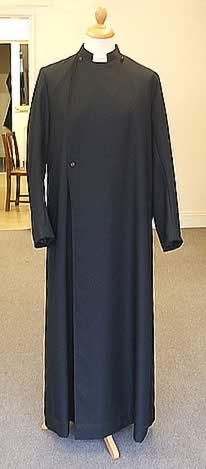
Nothing is simpler, since the clergy of the Church of England for the most part continue to wear traditional English attire for Mattins, Evensong and assisting in choir at services of other Churches. I have occasionally been invited to assist in choir at baptism and wedding services of my family-in-law here in France, so I dress in this fashion.

And here is the bishop’s choir habit:

Here is the so-called Sarum cassock:

Of course, for Mass, a priest would wear an amice, alb, girdle, maniple, stole and chasuble. I prefer plain albs with no lace and a sober gothic or fiddleback chasuble depending on what the church has in its vestry.

Update: This posting and the posting by Deborah Gyapong that inspired it have been commented upon by Fr Smuts, Will ‘the TAC bishops will stop wearing Roman Catholic ecclesial attire?’. Is the real issue knowing whether I “support” Deborah Gyapong or the TAC bishops in their intent to inculpate Archbishop Hepworth and exonerate themselves? It may be a surprise to some, but I am not interested in the way TAC bishops dress.

In the end of the day, I don’t care what bishops and priests of any church wear. Someone is always copying someone, whatever you do. Each to his own…

Another form of clerical dress, to crew in a regatta for Aid to the Church in Need (I’m standing on the weather beam of the boat holding a shroud). By the way, I’m not in a woman’s skirt but in a pair of bermuda shorts! 🙂

Posted in Uncategorized | Tagged | 11 Comments

New TTAC Website

The Traditional Anglican Church in Britain (TAC) has a new website. This is a happy development, and I look forward to seeing this site completed and refined, as it surely will be. My congratulations to the web designer and to Canon Ian Gray, our Vicar General.

Just a raised eyebrow when reading the “contact” page. Other pages of the site are lifted verbatim from the old site.

The Presiding Bishop was until Easter Archbishop John Hepworth of the Anglican Catholic Church in Australia. There is now no Presiding Bishop; opinions vary on whether there is an Acting Presiding Bishop.

These are the words from Fr Michael Gray (not Canon Ian Gray the present Vicar General) who ran the old web site (I have a copy of it on my hard disk) and who has now left the TTAC. According to a letter I received from Archbishop Prakash informing me of my own canonical situation, the TTAC is under the jurisdiction of Bishop Craig Botterill of Canada, so the TTAC would recognise Archbishop Prakash to be the Acting Primate.

It seems that the former TAC site, the “Messenger” is not being updated. Opinions vary as to the authority of a new site.

Fr Owen Buckton was running the Messenger and was until a few days ago the Vicar General in Australia. He is believed still to be a priest in the ACCA. There is no word of a new Australian web site.

In Great Britain (Ireland has a separate church), the Episcopal Visitor was Bishop David Moyer. He has ceased to act. Opinions vary as to whether he has been replaced.

This is very definitely from the old site, and no mention is made of Bishop Botterill. I have documentary evidence (pdf’s of letters from Archbishop Prakash and e-mails from Bishop Botterill and Canon Gray) that the TTAC recognises itself as being under Bishop Botterill’s jurisdiction as Episcopal Visitor.

As I said, the site needs to be completed and refined, and not merely be a cosmetic remake of the old site. There is still work to be done, supposedly after a good meeting of the Vicar General, the new area Deans and the person doing the web site. Over to them…

* * *

There is, however, another possible conjecture, that the TTAC does not recognise itself as part of the TAC as led by Archbishop Prakash, and would be waiting for the possibility of membership in another Church body. In that case, the new web site might seem to be the prelude to such a move. That is only a guess on my part and I may be completely wrong even to think of such a possibility.

Posted in Uncategorized | Tagged | 5 Comments

Teilhard du Chardin

Here is a fine article from The Rose in the Cross – Teilhard and me.I’ll just pick out a couple of points, because I don’t want disputes about evolution and creationism. I also don’t want any discussions about politics. I do not promote Marxism any more than anything else. My emphasis.

I remember as a seminarian of the Society of St. Pius X reading a polemical article against Teilhard’s theology in a reactionary Catholic magazine. Like the proverbial boy who learns how to sin from the vademecum manual of confessors, I came away thinking that, even if Teilhard’s thought was wrong, at least it was pretty. In my days of a more mystical bent, I suppose I was tempted often by pantheism, which is perhaps the reason I became enamored with Eastern Christian spirituality. Nevertheless, at least then, I was always of the opinion that Teilhard was wrong, that it was safer to stick with “official Church teaching”, and that one must keep an absolute wall between science and religion, and so on.

(…)

In the 1950 papal encyclical, Humani Generis, which condemned the “New Theology”, and the writings of Henri de Lubac in particular (though not by name), the long suffering Teilhard proved to be a secondary target, and it is thought that this official document definitively put him on the papal “persona non grata” list. What was seen as being at stake in the absolute division of nature and grace? Theologically, the answer is everything. Christian orthodox theology is predicated on the idea of the absolute gratuity of God’s working in the world. That is, God must be completely separate from the world, and if he does anything for it, even the act of creation, it is posited that he very well could not have done it. If this is not the case, then pantheism is sort of a logical conclusion: the world and God are one, our actions and very selves are deified, and lofty divine ideals mean nothing as they are the same as cosmic laws such as gravity and the speed of light. In other words, there is no freedom in the universe, and our actions don’t mean anything.

(…)

Just from reading about Teilhard, I find that the major issue at stake is the reality and relevance of truth. If something is true, it must be incarnate in everyday life and inform every corner of human knowledge. Many Catholic conservatives will assert that Teilhard’s crime, like Galileo’s, was that of not respecting the absolute wall between science and theology. That is basically the same problem as that of nature and grace as explained above.

The issue is dualism, and I found that one characteristic of the Celtic tradition and Pelagianism is the refusal of dualism. Like the author of this article, I have not read any Teilhard, but I have to admit I’m curious, especially since finding that Tyrrell’s books had no smell of sulphur! To the contrary!

Posted in Uncategorized | Tagged , | 2 Comments

Modern Medievalism

I have just discovered a medievalist blog – Modern Medievalism – that needs to be encouraged and better known. The most recent posts are about Pugin, and show images of the Great Exhibition of 1851.

Posted in Uncategorized | Tagged | 1 Comment

Channel Buoys and a Compass

My Christian life over the past few years, perhaps longer, has resembled a cracked record. Before the days of CDs, we had gramophone records consisting of a precisely carved spiral groove that made a stylus or needle vibrate and reproduce music or other forms of sound. If the record was damaged or the groove blocked, the needle would not continue into the next revolution but would return to the previous one. The result would be a tiny fragment of the music played over and over again, punctuated by a violent click about every two seconds in the case of a 33 rpm LP.

I may be an extraordinarily stubborn person, since my experience of churches and claims to the one true Catholic Christian is little different from that of so many other people. I have searched to find what was wrong in my own personality and vocation? Just why is it I cannot fit in? I must surely be diabolical or evil, to be hated and chased away from the “paradise” of the “true” Christians. Let us face it, most people just reject what they find to be nonsense, what defies reason and common sense. Churches are going the same way as the Soviet Empire in 1989. There was no violence or bloodshed. People just wanted a change.

As one who has identified with traditionalist Catholicism, because it upheld traditional liturgical rites and culture, I have come to see the limits of the kind of mentality and political ideology that led to the tragedy of the twentieth century through two world wars. It is the ideology of the world belonging to the strong and there being no compassion for the weak.

Yesterday, I brought out the theme of Celtic Christianity, and the temptation is to try to found some fantasy of an independent church. Many people have an idea, get themselves ordained in some presumably valid episcopal lineage and “go into business”. The problem is that unless you are exceptionally charismatic and have the kind of influence over people a cult guru has, there is little or no market for independent churches – even in the USA! What is the alternative to knuckling down with the mainstream Church, living with disappointment, rejection and manipulation by the strong and powerful, setting up a sect or giving up and dying spiritually? Historically, it is the monastic or solitary life.

Most of us, myself included, have commitments to a spouse, family, paying for our material goods and sharing the condition of most of humanity. All the same, we spend time alone as well as in company. As I write this article, I am alone. My wife is at work and I spend my days alone. I work, write, go sailing when my work load is light and the weather is right, I say Mass and at least some of the Benedictine Office. My deepest contemplative moments are invariably at sea on those days when it is safe to take more distance from the coast.

In ecclesial terms, I arrive at a watershed. I am still a member of the TAC, being in possession of a pdf file of a letter of Archbishop Prakash and a few private e-mails. Like other priests in the TAC diaspora, this ecclesial affiliation is very little else than something on paper. We are far from the heady days of the Portsmouth bishops’ meeting of October 2007 or even the last English synod I attended in the same church, St Agatha’s, Portsmouth. I celebrated the Sarum Mass on the Lady altar of that beautiful church with gracious permission from its priest. That wouldn’t be possible now. Everything has changed. We have all to live with loss and bereavement, and life must go on.

The last poisonous taste in my mouth owed itself to a posting and thread of comments about Archbishop Hepworth. The hatred is overwhelming, and if the TAC is in the state it is in, it is because it has to bear and assume the responsibility of having allowed itself to be led by Archbishop Hepworth for nearly nine years. This point has been made. Those who have joined ordinariates have moved on, and so must those who whom the prospect of returning to Roman Catholicism would be something like having all one’s teeth pulled out without an anaesthetic. If that is true religion, then for some, it is better to live without it as the new atheists would encourage us to do, in order to embrace materialism. Or find a new way to God and inner peace.

One thing I notice is that there isn’t a single marginal church I would want to join for one reason or another, but Celtic spirituality is something very attractive as long as it doesn’t become littered with patriarchs, metropolitans and all kinds of more or less fictitious ecclesiastical offices and institutions. What is really important is the one-to-one with God and intimacy with a few other human beings of like mind. Many people of my generation (baby boomer) have sought light in the eastern non-Christian traditions, but we are of another culture. Then we find that Christianity itself is historically a middle-eastern splinter from Judaism with themes seemingly plagiarised from the Greek and Egyptian mystery religions of antiquity. Yet, Christianity is its spiritual form has done so much good and largely formed our own culture and experience.

The first thing we notice about modern attempts to revive Celtic spirituality is the absence of dominance and submission. There is instead a notion of gentleness, love, freedom and beauty, but yet the challenge of self-denial and penance. Rather than forsake Christianity, we need to seek to renew it, rediscover out relationship with God, creation, other humans, animals and everything we know. Celtic spirituality is ideal for those of us who saw through abuse of authority and the ways of the powerful. There are “new age” themes that can be illusory when accepted uncritically, but which can open our minds to things of heaven and earth that are not dreamt of in our philosophies, to paraphrase Shakespeare.

Even though I have been a conservative Christian in many respects, I am fascinated with the idea of stewardship not only in respect of human beings suffering adversity, but also the earth and creation for which we are responsible. As a sailor, I am a convinced adept of ecology and the cause for stopping this world being more polluted than it is. I am also a supporter of moderate and sensible feminism. I find women difficult to understand, as all men do, but I see no reason to tread them down and make them objects or slaves! To the contrary, marriage is all about complementarily!

One thing I have been concerned about is the concentration of Christianity in cities. The country parishes are dying and only city parishes thrive. The Celtic and monastic ways took Christianity into the remote places and built new civilisations. One of my deepest experiences was spending a week on an island of the Glénans archipelago off Brittany, where I had my sailing course in 2009. I would rise before the others and go and say Mass on a granite rock. The cross of my travelling Mass kit is Coptic, given to me many years ago in England.

Church life has become bureaucratised and is characterised by activism. For the clergy and leading laity, it is all meetings, discussions and reorganising the world. My own time as a TAC priest blogger has repeatedly burned me out, and I certainly need a deeper way. This is why I resolutely cast off from any discussion of my former Archbishop.

I’m married and could not become a monk, but being a monk with a habit and tonsure is really only a form so that the institutional Church can keep control. Anyone can be a contemplative, which is what enlightened spiritual masters over the centuries have tried to teach us.

As the Arts and Crafts movement reacted from the triumphalism of the industrial nineteenth century, many of us react away from the triumphalist and “industrial” Church. The Modernist Movement was its parallel in theology and biblical interpretation. The monuments and dinosaurs in Rome have nothing to offer the modern world, because they are part of that “world” that hated and rejected Christ. They are just consuming money and resources – and that alone is a scandal. We are reacting against styles of church that abuse, manipulate and hurt people. As in the eighteenth century, people turn to spirituality, which is often expressed in New Age and the charismatic movement. We need to be God-centred and community-centred, and we need to be post-modern like our contemporaries. The Modernists were right by emphasising the immanence of God. Sure, God is transcendent and unknowable – and we can only say what he is not. But, the divine presence has an effect as in St Paul’s dark looking glass, and the Kingdom is within.

The Church needs to be above all small communities and families, so that it can flourish in the remote places and not be forced into the cities. I am convinced that it is by friendships and human connectedness that the Church can have any relevance for us. If we want to rediscover the secret of medieval Christianity, we need to bring God into our work and homes – not by provoking the secular world, but by being an invisible leaven. People might ask us why we are good to people without expecting a packet of money in return! That would be a start.

For too long, I have believed in stability – immobilism and stillness being the signs of God’s presence unlike the dialectics and movement of Heraclitus. Life is a pilgrimage and growth is movement and change. Churches say of those who move that they are “unstable”. In the Celtic way, as in the medieval mendicant orders like the Franciscans, holiness is found in movement, change and availability to the changing world, the very reason for holy poverty. The pilgrimage is the heart of Christian mission, and wandering makes us creative, vulnerable and available. Pilgrimage is not merely visiting holy places, but above all seeking the will of God by being ready to be in the right place. St Brendan went to sea!

If we are not to be frustrated and defeated in our relating to the modern, secular and atheistic world, we have to engage with the modern world and live in it. The visibility of the Church through buildings, political influence and clerical dress will have to be things of the past, and we go to the Catacombs to be a living and contemplative leaven.

In practical terms, many of those with whom I dialogue belong to the Church of England or the Roman Catholic Church, and pursue their spirituality independently and with initiative and wisdom. I commend them for sticking it out, but I am sufficiently aware not to think where they are is a paradise where all problems cease! Others are disconnected from the institutions, and we need to offer the hand of friendship and respect – without expecting their money or “humiliating” conversion and defeat.

I intend by this blog and my New Goliards to map my way to a new vision of Christianity and spirituality to attain that complete availability to the workings of grace and the needs of the most alienated from the Church.

Posted in Uncategorized | Tagged | 4 Comments