A new face to blogging

I have brought what is likely to be a full stop to the English Catholic blog which has become too intrinsically involved with the almighty mess caused by the recent vicissitudes of the TAC, the way the RC ordinariates have been implemented and the effects of conservative Anglicanism and conservative Roman Catholicism.

By my theological formation and life experience, I am not a conservative, and each time I dialogue with this “occupying army” in Christian churches and blogs, I come a cropper. Simply, it is just about impossible to avoid taking sides or jumping onto someone’s bandwagon. There were two ways to deal with the English Catholic blog – remove the “occupying army” or abandon the blog. I removed some of the most aggressive, including a comment from someone mocking the “novus ordo” in a “traditionalist” rhetoric, and I have effectively abandoned the blog.

On this blog, on which I want to keep discussion to serious matters, I will take preventive measures as necessary so that this blog does not go down the same path. Some people believe blogs and comments are to be used for contradictory debating. Such debates boil down to one subject: My church is the true church and you have to join it and accept whatever conditions you find in your way. You must join our church, but we’ll make it impossible for you.  I don’t want that here, and I will just put the offending e-mail addresses on the banned list. The comments concerned go into the spam bin, and once I am sure they are not there in error, I press the delete button. They never appear on the blog. Simple as that. If I seem to be having an ego trip, don’t worry. There are millions of blogs over which I have no control, and our “aggressive drivers” can comment on those without any opposition from me. Similarly, if my style of blogging doesn’t interest you, no one is forcing you to read it – just go away.

I have enough of a critical way of thinking to see through the virtual world of the Internet. It doesn’t have the reality of people living in Yvetot, Saint Valéry en Caux or Rouen, or the good people I recently met at Costock in Nottinghamshire. I still have my family and friends in England. My wife is a believer, and occasionally feels the need to recharge her batteries in our chapel, but she is revolted by the clerical and elitist Church. The unfortunate thing about ordaining women is that nothing would change. The same clericalism would be back with a vengeance. That is the reality! As soon as I finish this posting, I’m going sailing, as I have no translating orders to do today. The weather is beautiful and there is a light wind.

It will also be better if this blog does not concern my own vocation or the churches I have belonged to. I am a banged-up mess, and I doubt I will ever be called to serve a normal flock of lay faithful as their priest and pastor. That sort of decision should be in the hands of a bishop. I am under the jurisdiction of an archbishop about to resign, apart from remaining as bishop of his flock in Australia, and perhaps gather a small group of those not going to the Ordinariates and not attracted to the kind of Anglicanism promoted by most of the conservative Continuing Churches. There is to be a meeting, and we will see who will be at it. If that goes belly-up, then I will be once again an unchurched cleric, as I was back in 2005. What goes around comes around!

This is now my main blog and I will try to make of it something worthwhile. It will be something I can do as a priest in a Church as a kind of “teaching ministry” to an invisible or remote flock – or as a layman more or less alienated from churches and living a spiritual life through prayer, reading and the love of nature. That decision is for later this year, as I am still too emotionally upset to make a wise decision.

I may occasionally put on postings about sailing, because it is a part of my life. For others, it is a sport or a recreational activity. For me it is a part of my life of prayer. The sea is a sanctuary with its own silence and spirit. I won’t bore you with the technical aspects of handling a boat, but rather about the experience of God through creation and beauty.

If I have to be cut away from churches, my expression will be necessarily less orthodox, as I am naturally drawn to esoteric Christianity and some of the themes found in the Church Fathers and Saints, especially those of the Alexandrian school.

May this blog represent the seeds of a new beginning. I ask you readers to help me keep it clean.
Posted in Uncategorized | Tagged | 4 Comments

Liturgical Garden re-post

Here is another posting from a little more than a year ago from the English Catholic. I try to get as much reflection as possible going about the Use of Sarum. The pre-Reformation Church was a bit of a mess, but it was human – and traditional.

The Liturgical Garden

A new [2nd January 2011] article has come up in a blog – On The Sarum Rite: Beginnings, which is noteworthy in the quality of its reflections. Derek Olsen, the author, describes himself as a “Benedictine Anglican Medievalist within the Episcopal Church with a PhD in New Testament and an interest in most things medieval, monastic, and liturgical”. He also describes his domestic situation, which may cause an eyebrow to be raised, but that does not concern me. I keep an occasional eye on his writings.

These reflections do help to reflect on the question What is Sarum?. There are some differences between Sarum and the Norman uses of the eleventh century that were imported into England with the Norman Conquest. Mr Olsen reminds us that a Use is not a rigidly organised structure of liturgical observances like the Roman rite since 1570 and a century or two before as the various codes of rubrics were increasingly well organised. The colours of vestments and ceremonies were far from uniform, even within a single diocese. I read somewhere that the parish of Telford in Shropshire was using the Ambrosian missal in the fifteenth century because that is what they had, as simply as that.

The reality of medieval England was probably like the loose cohesion between parishes in an Orthodox country like Greece or Cyprus where there has been no movement of reform and standardisation. We tend to consider the “set of customs and characteristics” of Sarum in the light of the Tridentine reform of Paul IV, Pius IV and Pius V. Sarum was not a thirteenth century “codification” like the Roman rite in the sixteenth. We observe the interplay of different Norman diocesan, monastic and other northern European usages.

The one reflection that all this brings into mind is that a situation in which the liturgy is simply a traditional part of our spiritual and ecclesial life is a thing of the past. It now comes pre-packaged, as a finished product from its makers and imposed by authority, a product of rubricism and codification. This was globalism centuries before the outlawing of the export of French cheese made from unpasteurised milk! The ‘freedom’ movements of the 1960’s were largely in reaction to this trend, and dissolution was largely the result. The notion of tradition and cohesiveness of “something that is” was forever lost. Ironically, we Anglicans with our lack of liturgical uniformity, other than Anglo-Catholics conforming to every jot and tittle of Tridentine norms, seem to have most kept the pre-Reformation notion of liturgical tradition. And, that is in spite of having to live with a Prayer Book rite that was stripped sown much further than the modern Roman rite of 1969.

I think there is a lesson to be learned, as I do so much eschew abstract study without any practical application. Catholics are torn between a choice of Tridentine rubricism (or a transposition of that spirit onto the modern rites) and 1970’s style “liturgical creativity” and abuse. I do believe liturgical stability comes not from compulsion and codification, but from learning to love the liturgy, singing Mass and Office day after day, year after year, living in the school of the Lord’s service and preferring nothing to God’s work. We may wonder if it is possible to live the liturgy outside the monastic life. It isn’t easy, but it is possible. I would love to see the establishing of collegiate churches and canonical foundations, because those communities of priests make the regular solemn celebration of the liturgy possible – and above all a sense of stability, peace and being a ‘leaven’ in the world.

It will not be possible to roll back the reforms of Trent and Vatican II, but I do see the possibility and need for a new process of settling down and healing for the liturgy by the mutual influence of the classical and modern Roman rites, and by the influx of local and ethnical traditions like ours in the Anglican world. Local communities should be free to create the nurseries in which the liturgy can be re-grown, if we want to use the analogy of gardening and agriculture. I am convinced that this is the way for the future, and not that of ‘manufactured traditions’ presented and imposed by authority.

Posted in Uncategorized | Tagged , | Leave a comment

A fine Norwegian church

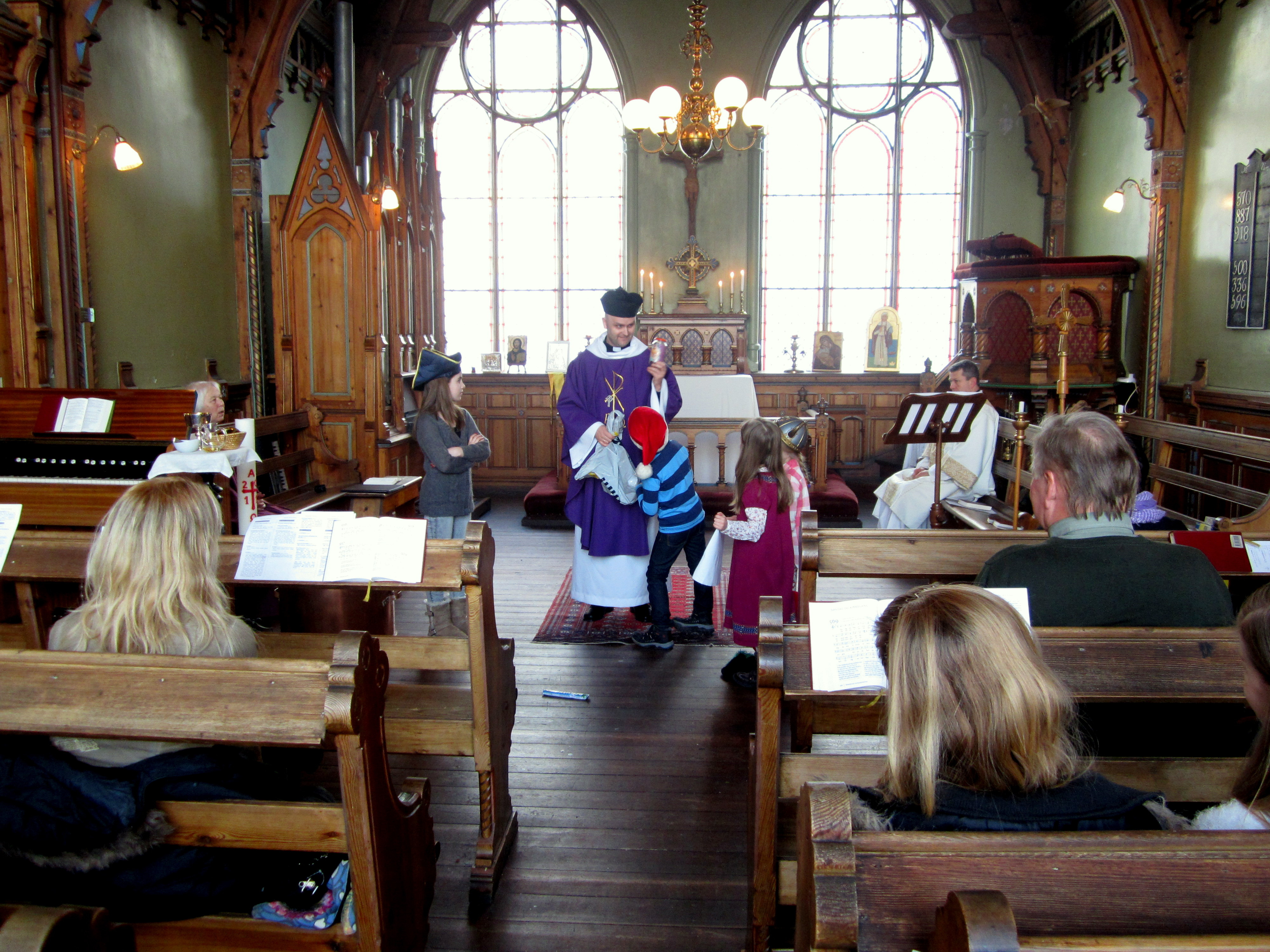
This is the Nordic Catholic Church’s parish in Bergen, dedicated to St Sunniva. I have found the photo in their blog post Fastelavn og karneval.

The priest here, Fr Roy Olav, is giving a lesson to the children about Carneval, literally “goodbye to meat” as we go into Lent. The object on the floor is a bar of chocolate lying there as a temptation. Indeed, Lent is about fasting and prayer, the only way to expel demons and sin.

The western Churches have indeed grown very slack about fasting, which doesn’t mean doing without a few luxuries – but abstaining from all food for a given time. This should not be attempted by people in poor health, but I think most of us can decide to fast completely on Wednesdays and Fridays from everything except water until 3pm, the traditional hour at which Christ expired on the Cross. If this is done prayerfully and without ostentation, I think we can be surprised at the spiritual power of fasting.

This church is quite surprising. The first thing that strikes us is the size of the windows. Coming from the north of England, I remember the short January days when I went to school on the bus, how the daylight hours were so short. The winter days in Norway are much shorter than that, and above the Arctic Circle, the sun is not seen at all for six long months! If a place is a little to the south of the Arctic Circle, the solar day may only last a few minutes or an hour! Those big windows are really needed.

The building appears to be from the late nineteenth century with a fairly “low-church” altar similar to pre-Tractarian English ones. The altar rail wraps around tightly, and certainly makes high ceremonies difficult. Perhaps it lifts away for those occasions. The pulpit is imposing and the little pipe organ on the left in its neo-gothic case looks interesting. I would guess the organ needs work, since a harmonium is seen at the left of the photo.

This building is obviously a former Lutheran church, which means that the Nordic Catholic Church was able to keep or acquire some of the old churches. That is something tremendous.

Posted in Uncategorized | Tagged , , , | 4 Comments

A few ideas for Lent

In two days it will be Quinquagesima, and Ash Wednesday arrives all too brutally after Mardi Gras as we call it here in France, or Shrove Tuesday in English folk tradition. Shrove comes from the old English word shrift or to shrive, meaning going to confession. The expression to get short shrift hearkens back to the time when a condemned criminal got precious little time for his confession before his execution.

Lent is a time for reliving the preparation of catechumens for Baptism in the ancient Church. They underwent exorcisms, learned the Creed and the Lord’s Prayer – the Tradition and the Reddition. There were the Scrutinies, and finally the catechumen was ready to be baptised during the great Paschal Vigil of Holy Saturday. We are called to relive this renewal, this transitus from death to life, from the bondage of sin, through prayer and conversion.

Conversion comes through asceticism, which is usually expressed as fasting – eating poorer and simpler food than usual, and perhaps going without the tastier and more satisfying aliments like meat and fried food. Traditional monks and pious Orthodox folk not only abstain from meat but also from eggs, fish, milk, cheese and any other animal product down to fat using for roasting and frying. Boiled vegetables are the traditional Lenten fare. We are not obliged to go this far. The western Churches ask for very little, and asceticism is not something to be imposed on other people – but it might be what it takes in our “inner chamber”. Remember the Gospel of Ash Wednesday – make our penances in secret so that no one else may see them, lest we become hypocrites!

Naturally, those who are in poor health should not fast. In case of doubt, ask your doctor’s advice. A good compromise is one meal a day except Sundays and two collations, and eat vegetarian on Wednesdays, Fridays and Saturdays. That is quite a lot for most people. Besides, many of us are overweight and could do well to tighten the belt a little. Healthy souls and healthy bodies go together!

Penance is one thing, and there is a positive aspect to Lent – improving our spiritual life through our regularity at prayer and Mass, and above all doing something about reducing the sins we commit, notably the evil we say and write about other people. We all have efforts to make, and I to begin with!

Frequent attendance at Mass is very important when it is possible. Priests do well to celebrate daily, even when no one is in attendance – because the whole Church is present at each Mass. Another important thing to get into our lives, especially if it has “slipped” as little, is the Divine Office. If you do not have a breviary and would like to have something more than the Prayer Book offices, I can recommend the Benedictine Breviary in English which can be ordered here. It comes in two books: the Diurnal and the Matins book. It is not essential to pray all the Hours, but rather simply say Lauds, Vespers and Compline. The essential is to form a habit of doing it, a routine, something of the monastic rule which can be applied in anyone’s life if you put your mind to it.

Another important part of Lent, which we can keep up outside Lent, is lectio divina, the slow and prayerful reading of the Bible, the Fathers of the Church and other spiritual writings. This gives four things to our spiritual life:  lectio (reading the text of Scripture, etc.), meditatio (meditating it in the way cows chew the cud), oratio (prayer to God) and contemplatio (the final stage of adoring and contemplating the presence of God). It isn’t easy, and it takes practice like learning a musical instrument.

We can also revise our knowledge of Christian doctrine through the Catechism of the Catholic Church or books of theology adapted to our intellectual capacities and acquired knowledge. Learn about the liturgy through reading explanations by men like Dom Guéranger, Cardinal Schuster and many others.

Above all, may this Lent bring you all illumination and faith, and the grace of God.

Posted in Uncategorized | Tagged | 5 Comments

Sarum revival and pastoral considerations

Sometimes we read things like this here and there. This one is from an Orthodox priest arguing his scepticism about the western rite:

I guess I am ambivalent about the place of the Western-rite.  I think the liturgical nuances of the western-rite, especially the Sarum revival being attempted by some has little socio-cultural connection to Western people.  The approach of the Antiochian Western-rite Vicariate in drawing on post-Reformation Latin Catholic tradition – Tridentine as lived by the Western Latin Church into the 1960’s offers a much closer cultural connection.

If we look at Australia, there has been a complete failure to connect culturally and spiritually with seekers, …

My own feelings about this is whether the Tridentine rite / English Missal is any more relevant to the average seeker than other rites that are superficially very similar and distinguishable only by those with inside knowledge of the liturgy. I am relatively unfamiliar with the converts-to-Orthodoxy scene, and I have little idea about what kind of western spiritual seeker is attracted to the Byzantine Liturgy, or which would prefer the Antiochian “Tridentine” rite over Sarum. Perhaps Fr Dale or other Orthodox readers of this blog would care to comment and enlighten us.

I could perhaps make a guess that the Antiochian parishes in America using the Liturgy of St Gregory do so quite soberly. Some priests using Sarum perhaps are quite “precious” in their style, which might not be helpful to some people. For the layman (I don’t mean as opposed to clerics, but as opposed to those with specialist knowledge) the language of the liturgy is important. Latin is hardly likely to be appropriate in such missionary or pastoral situations, and perhaps modern language is more in keeping. On the other hand, some seekers look for an experience of the sacred rather than going to hear a sermon from a priest with “fire in his belly”.

Does the pre-Vatican II liturgy offer a close cultural connection. My guess is that it would attract the aesthetically-minded, those looking for spirituality and contemplation rather than being challenged by words, the kind of persons who would prefer to worship with monks in a monastery rather than in a parish setting. Are the traditionalist Roman Catholic communities (in communion with Rome or not) attracting large numbers of people or connecting with modern culture? I doubt it. Of course I live in Europe and not America. If people are attracted to a Tridentine liturgy, in Latin or English, why would they not be attracted to another western rite celebrated in the same degree of solemnity or simplicity?

The real issue of the author of the quote above seems to be the western rite in general from an eastern Orthodox point of view, which fairly well colludes with the viewpoint of conservative Roman Catholics telling their converts to knuckle up to the modern Roman rite. In one case or the other, it seems to be the assumption that people or our era and living in the places where we live are of a homogenous culture. For the youth in a hoodie whose life is geared to TV celebrities, Facebook, pop music and football, is it likely to make a difference whether the liturgy on offer is Tridentine, Byzantine or Sarum? The question is totally surreal.

In the history of the Church, the liturgy is something for the initiated and following a regular Christian life as a cleric, monk, nun or lay person. The uninitiated are invited to hear the Word of God in some way and share in informal prayers or quiet moments in a suitable place. A few might wander into a church and be so impressed by the liturgy that it converts them on the spot, but this is fairly rare. To most unchurched people, any kind of liturgy is gobbledegook, however modern and “relevant” it is claimed to be.

The claim that Sarum, or the Dominican, Ambrosian, Lyonese, etc. rites are out, whilst at the same time saying that other superficially similar rites are in is absurd from a pastoral point of view. I would find an argument for secularised modern liturgy, facing the people, in modern language and using pop music more convincing, though that is obviously not the kind of liturgy I would go for. But one hieratic liturgy against another seems to make no sense.

Connecting with culture and people of our time is a question of the priest’s personality and empathy for other people, the friendliness of the faithful, and above all anything that brings the seeker to believe that he is dealing with people who are coherent with their professed principles and give an impression of being redeemed. This is much more challenging than the sterile exercise of inventing “seeker-friendly” services!

If people – or some people, or even a few – are interested in Sarum or similar ways to celebrate the Eucharist and the Office, that seems a good enough reason to do it. It’s as simple as that. No one is imposing anything on anyone!

Posted in Uncategorized | Tagged , , | 3 Comments

Sarum at St Cyprian Clarence Gate, 2002 version

A series of photos were taken in 2002 by John Salmon replicating the original Alcuin Club volume of the 1920s Ceremonial Pictured in Photographs. These images were commissioned by the Gild of Clerks and taken at the Comper church of St Cyprian’s Clarence Gate. The photo reproduced here is from this collection and intended to attract attention to the originals.

Go to the link and click on each of the small photos. Below, you will find the old black-and-white 1920s photo.

As in the original black-and-white photos, this is a “sarumised” Prayer Book service and not the real Use of Sarum. Nevertheless, the photos are impressive.

Posted in Uncategorized | Tagged , , | 3 Comments

Ordinations in the Nordic Catholic Church

Two new deacons were ordained last Sunday in the Nordic Catholic Church by Bishop Roald Flemestad. The newly ordained are Michael Catenacci and Bjørn Nicolaisen. Magnus Sterner was ordained an acolyte. Deacon Catenacci and Acolyte Sterner will serve in Stockholm, Sweden, and Deacon Nicolaisen will serve in Trondheim.

Going by the photo, there was less snow up there in frozen Norway than here in France!

See here for more photos and an article in Swedish.

I send the newly ordained my prayers and congratulations.

Posted in Uncategorized | Tagged , , , | 2 Comments

Sarum in contemporary Roman Catholicism

This article by Fr Sean Finnegan is illuminating – The Legal Status of the Sarum Mass. It is quite amazing to see the interest in Sarum but yet blind hatred from some quarters. In particular a young man of questionable stability denounced Fr Finnegan for the Sarum Mass in Oxford and the local Archbishop prevailed upon him to stop doing it.

The story of St George’s Sudbury and Fr Clement Russell to some extent reflects the priest I knew here in Normandy, Fr Quintin Montgomery-Wright. Fr Russell “sarumised” the Roman rite in his fine Arts & Crafts style church built in 1924 and did as much as he dared as a Roman Catholic priest of the Archdiocese of Westminster. I visited this church in the early 1990’s before the wreckovation, when there was a simple table in front of the altar. It was truly a beautiful church.

Clearly, given the trouble Fr Finnegan had in the 1990’s for celebrating the Use of Sarum in Oxford, it has no future in the Roman Catholic Church. This is truly sad. The comments to this post are most revealing. Most indicate a desire to see Sarum back and evidence that the desire for such a revival is a sign that the custom or auctoritas remains unbroken. One comment even informs us that the question of the Use of Sarum would have been put to the Congregation of Divine Worship in 2008 and that the answer would have been that the Use of Sarum enjoys the privilege of custom like the Ambrosian, Dominican and other rites.

Benedict XVI has evidently done his best to reverse the liturgical steamroller in his Church, but progress will not be through adding more laws and constraints but through openness and empathy. But, now and again, there are visionary priests like Fr Finnegan, and for this we can only be grateful.

Posted in Uncategorized | Tagged , , | 1 Comment

Dearmer Revisited

This is not the first time I write on Percy Dearmer (1867-1936), and when I did in the past, I discovered that this man was highly controversial. Some of the comments in Dearmer and Modernism really shot me down. It was truly a case of falsus in uno falsus in omnibus! The man was probably a little too interested in “esoteric Christianity” and sympathised with the feminism of the Suffragette movement.

Typing the right words into Google bring up some very “interesting” ideas. For example, some of the more cranky characters in the blogosphere would attribute to Dearmer the idea of ordaining women as priests or being a secret bishop in the Order of Corporate Reunion. A Ship of Fools thread gives us a profile that would portray Dearmer as a total modernist. The crankiness and hatred of those whose pet hates are Sarumism and Vagantes seem to have no limit, and seems to me self-discrediting. The OCR story also discredits itself through claiming that Henry Arthur Stanton (1839-1913), the saintly and humble Curate of St Alban’s Holborn, was another one of them. I wonder what the authors of such allegations were smoking in their pipe! I would be very surprised if anyone in those days had the remotest idea of ordaining women, but I am open to documentary evidence.

One interesting posting is by a TAC priest by the name of Fr Bartus – Sarum what?. His major argument against Sarum seems to be that it is Dearmerite and leads to Affirming Catholicism. Incidentally, I was the one of them running amok on the Anglo-Catholic blog, who ironically enough is an expat English priest running a small Anglican mission in France!  He and three other parishes in the world use the Sarum liturgy. Quite flattering. I wish Fr Bartus and his parish well in the Ordinariate. Of course the point I would make is that if Sarum died, nobody would be talking about it or saying they wished it would come back!

Quite frankly, I don’t care about the tittle-tattle, and the man has been dead for a very long time. To me, what is important is what he wrote about the liturgy and the appointment of churches.

Alternatively, go to the English Catholic or the Anglo-Catholic and type the word “Dearmer” into the search box to find articles I or others have written.

No one ever said that Dearmer was the Church’s greatest saint or even perfect. He only went so far with the Sarum revival, dressing up the 1662 Communion Service. As a priest of the Church of England in the late nineteenth century, that was all he could do, and he felt the need to combat the rapidly-growing Papalist tendency in southern England. This seems understandable.

His life can be found in the Wikipedia article. Mention is made of his left-wing politics, as was the case of many other ritualist clergy in those days serving poor parishes in the cities. Our young blogger friend living in Kent, Patrick Sheridan, wrote Percy Dearmer…, which I find a very interesting and well-written article. Some of Dearmer’s work can be found reproduced here, all downloadable for free!

Perhaps, Percy Dearmer’s greatest contribution to Anglican worship was good taste, an exceedingly rare virtue these days. When he took up his living as Vicar of St Mary’s Primrose Hill, he was known to have invented this dictum: “You must give people what is good and they will come to like it“. He looked out the “ornaments rubric” to justify introducing beauty in worship. He introduced sanctuary lamps, riddle curtains and full and ample vestments. He quickly attracted large numbers of faithful to his services.

Is good taste something too much to ask for in 2012? It is a question of communicating holiness through care, concern and diligence. Dearmer once wrote,

…whether the ceremonial used is little or much, the services of our Church should at least be conducted on the legitimate lines, if only that they may be freed from what is anomalous, tawdry or grotesque.

Many things were tawdry and grotesque in those days, going by some of the monstrous creations of the nineteenth century, but they fade into insignificance at some of the brutish horrors inflicted on our churches since the 1960’s, and even earlier.

Surely, good taste and care for beauty are not everything, but they are a beginning to a revival of western Catholicism in the widest meaning of this word.

Posted in Uncategorized | Tagged , , , , , | Leave a comment

Archaeologism or Tradition?

This is a question frequently asked about whether old and discontinued liturgical traditions can be restored. Actually, this question is one at the very base of the Paul VI liturgical reform in the Roman Catholic Church that claimed be be restoring ancient traditions whilst fabricating a new liturgy on the basis of pastoral expedience and accommodating “post-modern” culture.

One instinct, that of Tridentine and Novus Ordo Roman Catholics, as well as Byzantine Orthodox, argues that when a tradition is broken or discontinued, it cannot be restored. To do so would be archaeologism and a negation of liturgical tradition. We are brought to consider the words of Pope Pius XII in Mediator Dei (1947):

62. Assuredly it is a wise and most laudable thing to return in spirit and affection to the sources of the sacred liturgy. For research in this field of study, by tracing it back to its origins, contributes valuable assistance towards a more thorough and careful investigation of the significance of feast-days, and of the meaning of the texts and sacred ceremonies employed on their occasion. But it is neither wise nor laudable to reduce everything to antiquity by every possible device. Thus, to cite some instances, one would be straying from the straight path were he to wish the altar restored to its primitive table form; were he to want black excluded as a colour for the liturgical vestments; were he to forbid the use of sacred images and statues in Churches; were he to order the crucifix so designed that the divine Redeemer’s body shows no trace of His cruel sufferings; and lastly were he to disdain and reject polyphonic music or singing in parts, even where it conforms to regulations issued by the Holy See.

63. Clearly no sincere Catholic can refuse to accept the formulation of Christian doctrine more recently elaborated and proclaimed as dogmas by the Church, under the inspiration and guidance of the Holy Spirit with abundant fruit for souls, because it pleases him to hark back to the old formulas. No more can any Catholic in his right senses repudiate existing legislation of the Church to revert to prescriptions based on the earliest sources of canon law. Just as obviously unwise and mistaken is the zeal of one who in matters liturgical would go back to the rites and usage of antiquity, discarding the new patterns introduced by disposition of divine Providence to meet the changes of circumstances and situation.

64. This way of acting bids fair to revive the exaggerated and senseless antiquarianism to which the illegal Council of Pistoia gave rise. It likewise attempts to reinstate a series of errors which were responsible for the calling of that meeting as well as for those resulting from it, with grievous harm to souls, and which the Church, the ever watchful guardian of the “deposit of faith” committed to her charge by her divine Founder, had every right and reason to condemn. For perverse designs and ventures of this sort tend to paralyse and weaken that process of sanctification by which the sacred liturgy directs the sons of adoption to their Heavenly Father of their souls’ salvation.

Naturally, the late Holy Father argued from the point of view of what is permitted by Rome, but he does appeal to Tradition. The practice of scouring university libraries in the search of documents from some “golden age” of the Church’s history, which are almost invariably fragments, and conjecturing a “primitive” liturgy around them is more than questionable. We see examples of this kind of liturgical work in some of the more or less canonical Orthodox Churches when it comes to restoring the Gallican and Celtic liturgies. I have attended Gallican liturgies celebrated by the French Orthodox Church (ECOF) and find something not very dissimilar from the Byzantine Liturgy, just some differences of texts. It just doesn’t hit home for me!

Liturgical scholars in the 1950’s and 60’s feverishly sought to re-order the Roman Canon. See From One Eucharistic Prayer to Many: How it Happened and Why by Father Cassian Folsom, O.S.B. The character whose work he most described was that of Cipriano Vagaggini who worked closely with Bugnini. His arguments for abolishing or reordering the Roman Canon were – “The defects are undeniable and of no small importance. The present Roman canon sins in a number of ways against those requirements of good liturgical composition and sound liturgical sense that were emphasized by the Second Vatican Council“. Much of this kind of work from that era found its way into various Western Orthodox attempts to restore an “old Roman” liturgy.

Another school of thought that does not involve forbidding absolutely everything that cannot prove proven continuity is the moderate approach of reviving late medieval and well-documented liturgical traditions that were partially preserved in the Anglican and Lutheran churches. The work of men like Dearmer was left incomplete (it only went as far as “dressing up” the Prayer Book rite), but it was abiding and captured the English imagination. We find that the spirit and culture of the Use of Sarum (and by extension the other English and northern French diocesan uses) never completely died like the old Gallican world. Revival and restoration to a more complete extent is possible. We have only to build on an existing basis.

Ecclesial context is vital, but the most difficult. Churchmen are often selfish in this respect and find it difficult to look beyond their own horizons. When the original ecclesial context is lost or distorted to such an extent that it becomes impossible to stay, that is when the drama begins. Most Roman Catholic and Orthodox hierarchs cannot understand such an aspiration – You can come into our Church but without your baggage. Churches for the most part do not want immigrants from other Churches, shipwrecked sailors even less!

So, what is needed is education. We need to understand what we are doing so that we can teach others to understand our aspiration to our medieval northern European patrimony – not just English or from a single diocese. It may seem unimportant compared with the task of evangelism and humanitarian work, but it is the interface by which people relate to the Church and God. Liturgical and spiritual culture go deep into the human psyché. Fiddle with it and millions are alienated from the Church, and they lose God or any spiritual markers. It is a pastoral question, but also one of justice and empathy with cultures closer to our own than of those living in parts of the world further away.

The opportunity has again been missed in the Roman Catholic Church, unless there is some hidden movement in the Ordinariates to take on this work of liturgical revival. There has been much talk of a more or less secret committee to produce and Ordinariate liturgy, but I see no real evidence of one. Apparently, Monsignor Burnham in England came up with ideas, and I heard they were rejected. Bishop Elliott once said how he was interested in Sarum, and Bishop Wilkinson of the Canadian TAC submitted a revised English Missal. Might Rome surprise us by saying – No more fabricated liturgies. Here is the Sarum missal – use that? But, we are dreaming and speculating on something with no substance. In addition, the more secret it is, the more afraid I would be of what might be in the process of being cooked up – yet another primitive liturgy with pastoral adaptations? Ugh!

The Russian Orthodox Church Outside Russia has a very interesting Western Rite ministry allowing several traditional rites and a St Colman Prayer Book. All these can be found at www.theorthodoxchurch.org/westernrite.htm. Orthodoxy has a mentality many western people find it difficult to relate to, but I respect and esteem this option.

In a Church that has the pastoral openness to understand this aspiration, ideas need to be clearly expressed and conveyed without confronting emotions and prejudice. There are late medieval rites that are extremely well documented – complete missals with rubrics, chant books, customaries, processionals, books of rules for the calendar and other ceremonial aspects. They are just as complete as the Roman rite, though perhaps a little less precise in places. This is the case of the Use of Sarum as for the Lyons Rite or the Dominican liturgical books. Everything is there, and different uses of a same family mutually clarify any ambiguities or difficulties in understanding a particular rule. This is the kind of liturgical revival that is no less legitimate than that of the Dominican rite or the Roman rite in its editions from 1570 to 1962. All rites have been discontinued and revived to one extent or another. As evidenced by what is said and done by some Anglicans, the Use of Sarum remains in the collective memory, and as such was never discontinued. This seems something entirely other than fiddling about with documents of Hippolytus and eighth-century fragments.

The issue now is a “Church-vehicle” now that Rome is still not open enough to this aspiration and the Anglican Church is closing to all who are unwilling to accommodate to female clergy. The possibilities are narrow, but this blog is being read and found interesting. We have only to continue the good work…

Posted in Uncategorized | Tagged , , | 9 Comments