J’accuse

J’Accuse…!” was an open letter published on 13th January 1898 in the newspaper L’Aurore by the writer Émile Zola. His issue was what came to be known in France as L’Affaire Dreyfus. Dreyfus was a Jewish artillery captain in the French army who was falsely convicted of passing military secrets to the Germans. He was degraded and sent to Devil’s Island, and his public humiliation was an expression of the ambient anti-Semitism of the time. This issue deeply divided France. It was not simply a matter of injustice to a man but also touched national identity, politics and religion in the anti-clerical era.

Two events are now widely known in the news surrounding the Brexit issue: the Supreme Court ruling that the PM didn’t have the right to prorogue Parliament in these circumstances (again, read the news) and the sickening rant of Geoffrey Cox (Attorney General) in today’s reassembly of the House of Commons. I have no idea what Mr Johnson is going to do, though I have been reading and watching commentaries by those who know a lot more about politics than I do.

The whole thing is a diabolical web with no way out. I will refrain from comparing it to Hitler’s Enabling Act of 1933 in Germany, even though I see a lot of parallels. There is no effective opposition by Corbyn’s party. It seems to be that the majority of English people still want Brexit and the hardest one possible, believing that there will be no adverse consequences. England now seems to be as divided as France was in the 1890’s.

The Dreyfus Affair still has its effects here and there, even though anti-Semitism is no longer acceptable. The issues are similar, just what made the twentieth century and its political instability. England was the country of my birth, and now I mourn as for a deceased loved one. The coffin lid has to be closed and life must go on. My time of anxiety is over and yields place to grief.

I must think more about my life in France and turn the page as the UK either crashes out at the end of October (whether the PM is Johnson or someone else) or remains in the EU as a toxic and divisive thorn. The time is past, as far as I am concerned, for political activism or protest. I see nothing good or noble, only the beginnings of a revolution in the UK (or two opposing revolutions), the end of the Monarchy and very dark times.

We have to raise ourselves to God, what is good in humanity and the wisdom we seek and to which we aspire. Today we mourn, and tomorrow we will see destruction, and maybe a true sunlit upland will come in ways we cannot expect.

Teach us the strength that cannot seek,
By deed, or thought, to hurt the weak;
That, under thee, we may possess
Man’s strength to comfort man’s distress.
Teach us delight in simple things,
The mirth that has no bitter springs;
Forgiveness free of evil done,
And love to all men ‘neath the sun.
Land of our birth, our faith, our pride,
For whose dear sake our fathers died;
O Motherland, we pledge to thee,
Head, heart and hand through the years to be.
The Lord shall be thine everlasting light,
And the days of thy mourning shall be ended.

Rudyard Kipling

Posted in Uncategorized | Tagged , , | 12 Comments

Science and Faith, a Warning

I have been haunted all day by the article Darwinism Is Dead, Now What? Towards A Rational Spirituality. We seem to have a compare-and-contrast exercise between materialistic atheism – Dawkins style – and the kinds of Christianity we sometimes encounter that are reduced to the levels of ideology. Popes John Paul II and Benedict XVI wrote considerable volumes on faith and reason, both in their books and official teachings as bishops. It is time for these questions to be tackled, and I am myself fascinated by them. They are one of the dimensions of human thought and experience that brought me to the same Romanticism that pops up again and again as the challenges come in its way.

The author of this article, Luke Baier, knocks materialism (everything is dead matter and at best some magically-produced kind of consciousness from biological machines) for six. This is very encouraging in light of my presently reading Dr Rupert Sheldrake. Science hasn’t to be built on ideology or unproven assumptions, but rather on repeatable evidence. You can’t have “science” built on belief-based assumptions and then attack belief!

Darwinism, one of the foundations of atheistic materialism, is crumbling.

If Darwinism is wrong, which it is without a shred of a doubt, should we all go back to the bible? Should we ‘accept the Lord Jesus’?

If materialism falls, do we have to return to irrational faith and doctrine? Baier goes much further than I would ever go (which is a good thing since I am a priest!), by dismissing that vital distinction I learned at university – between what is above reason and what is against reason. What can materialist science say about love or loyalty, which are metaphysical categories, not “material things”? Many Christians feel challenged by atheism to answer the criticism on its own terms. This is the art of apologetics and the approach of the “modernist” Fr George Tyrrell. Scholastic theology has little to say in response to Darwin and Dawkins. The modern apologist has to have knowledge, an unconventional knowledge, of disciplines like quantum mechanics and the theories of knowledge and truth that began to emerge from Idealist Germany in the 1790’s.

I will not enter into any polemics concerning the credibility of mysteries of faith. They come under the category of mystical experience and imagination rather than pure reason in the Kantian understanding of that word. Christianity remains fair game for atheists until it shifts to a higher ground than seemingly irrational beliefs both in terms of rationality and spirituality. The interesting thing about this article is that it hammers atheism and materialism, like Sheldrake is doing – but leaves the challenge to Christian teaching and belief. Atheism can only be attacked on account of its irrational and unscientific basis, its hypocrisy. But, beware, Christians can be hypocrites too!

Perhaps we will overcome “bad” (relying on ideology more than free enquiry and prayer) Christianity in the same way as giving the coup de grâce to atheism. “There are more things in heaven and Earth, Horatio, than are dreamt of in your philosophy” – as Shakespeare famously wrote in Hamlet. There are more things in existence that what meets the eyes of the materialist or the Christian. Many things, presently hypotheses and possibilities, surpass the canonical Scriptures or the teachings of churches. One is the multiverse, the alternative reality that might contain an exact duplicate of each of us living a life according to different combinations of possibilities. There might be an infinity of such universes existing like radio wavelengths to which a radio can tune one at a time. Something suggests this possibility, dismissed by materialist scientists – the existence of para-psychological phenomena like guardian angels, demons, near-death experiences, communication with the dead through mediums, telepathy, prophecy, visions and so much more. Quantum physics studies sub-atomic particles that seem to be made of pure energy. Some experiments have shown such quanta of energy to be conscious – not simply subject to some outside deterministic law from an unknown source.

The science of the future is one that postulates a big likelihood of conscious life beyond bodily death. I often wonder if I might be “absorbed” by my “other me” in another universe – a prisoner languishing in a dungeon, a monk in a community of prayer, a sailor circumnavigating the globe, a doctor healing the sick, a country priest, doing and being what I would never do here. Perhaps… We are our own heaven, hell and purgatory. Would I go at light speed down a “wormhole” as portrayed in films like Stargate? That film was certainly based on some of these ideas of parallel universes and the possibility of existence outside time and space – thus the possibility of going “places” too far away for our present NASA technology. The imagination runs wild and the reason follows, trying to understand and distinguish true possibility from nonsense.

Our author seems to reject orthodox Christianity. I don’t, but I see it as only a skeleton to which so much more is added as it is discovered. The Roman Catholic Church in the person of Pope Pius X made so much ado about Revelation being frozen by the death of the last Apostle, presumably replaced by the authority of those who set out to “correct” the work of Christ in that wonderful pact with the Roman Empire. If believing in the possibility of this Revelation continuing to evolve in our consciousness makes me a Modernist – so be it. Times have moved. The Modernism that was so shocking in the 1900’s has taken on a whole new meaning to those who see the dissolution of Christianity in the minds of those who need more than milk-sops in their journey of faith and spirit. We are called to discover for ourselves and to take risks.

One way to make our journey is to become “open” as opposed to “closed”, cosmopolitan rather than nationalist or parochial. These ideas obsessed me as a child, even though I did not understand all the philosophical implications. I do think we need to seek wisdom wherever it is found. We can find many things in the Jewish Kabbala, esoteric Christianity – Gnosticism in particular, Sufi Islam, the gurus of India, the light from the Buddhist east. I don’t mean that all that has to be mixed up to produce a new religion but rather that we should be enriched by so many colours, traditions, ways of life and thinking.

We need to learn about freedom and how it will enrich us, rather than destroy those who are not ready for it. Our author gives practical advice about how we can evolve into better human beings on something along the lines of Jesus’s teachings in the Gospel and a fuller understanding of the old law and commandments. Above all, we need to cultivate our freedom to think and feel. No knowledge must be forbidden.

Our author seems to advocate an approach to religion like in the seventeenth and eighteenth centuries, making reason trump everything. That seems to be his limit. Mysteries cannot be denied simply because we don’t understand them completely. However, they can be questioned when they become tools of the rich, powerful and authoritarian.

I find this idea fascinating:

Our material world is constructed in a certain way. We can’t just teleport somewhere if we wish, and we can’t walk through walls. Similarly, maybe there is a higher world, in which our material world is embedded, that is also constructed in a certain way, although we usually can’t see it. Part of its fabric is of an ethical nature. If you transgress its laws, you may not physically feel it, but the effects – subtle as they are – are very real and can accumulate rapidly. This leads to a spiritual abyss from which it is hard to recover. Just think about all those people you know, or have heard of, who have sunk into a sorry state of self-pity, resentment and constant blaming of others; those poor souls who seem forever unable to lift themselves out of their self-created misery. As Jordan Peterson would say: hell can be very real here on earth. Navigating this elusive, yet very real world of objective morality, while constantly learning more about it, seems to be a major goal of, or meaning for, our existence.

This is the moral order, Karma, the law of cause and effect. We are responsible beings in our freedom to think and ask questions. No, not anything goes! We will find it more morally and spiritually challenging to make our own way of discovery than to obey an authority or an ideology. As we read in Berdyaev, the way of the Spirit is harder, but more real and true.

Indeed we are called to move ahead, to evolve

Posted in Uncategorized | Tagged , , , , , , , , | 1 Comment

“The old Anglican, patristic, literary, Oxford tone transplanted into the Church”

My attention was drawn to Fr Hunwicke’s article The Anglican Patrimony. I find most of what this priest writes as irrelevant to my life as mine would be to him, but there is something here that provokes me to comment. He is an Ordinariate priest. I am not, and as a result, my perspective is totally different.

Fr Hunwicke refers to a whole movement of scholars from the late nineteenth to early twentieth centuries. It is such a long time since I was at university (and a Swiss one) that I have no pretence at “scholarship sublime”, but rather the quest for a new paradigm in which Christianity might survive in the future. Some of the scholars Fr Hunwicke mentions were influenced by the Romantic movement, and therefore the need to uphold the heritage of the Enlightenment whilst promoting the whole human experience, including the spiritual life. He highlights the critical sense, including criticism of criticism. I am not surprised to find the expression Hermeneutic of Continuity, which is neither Anglican nor English, but from the pen of Benedict XVI with a thought for Newman’s theory of organic development.

It is significant that the ultra-ultramontanist Cardinal Manning criticised Newman in these terms:

“I see much danger of an English Catholicism of which Newman is the highest type. It is the old Anglican, patristic, literary, Oxford tone transplanted into the Church”.

Isn’ t that the so-called Anglican Patrimony of Ordinariate clergy? I couldn’t answer this question other than remembering that conference I attended at Pusey House in April 2018. I came away inspired by the talk given by Monsignor Burnham, but with the interior knowledge that I had very little Englishness left in me, but rather a feeling of utter rootlessness.

Fr Hunwicke and I are working from different angles, he from having been a teacher and an Anglican parish priest and now in the Ordinariate as a Roman Catholic, myself from having been virtually broken by my experiences and still limping to contribute a flickering light to Christianity in general, regardless of which institutional church it belongs to. My own thought is known by those who read this blog.

I was a cradle Anglican, but more involved with music than academia. I didn’t go to university until long after I left England. The Fathers need to be read through the eyes of a historical critic, in the knowledge that the harsh condemnations render their otherwise valuable work irrelevant for people of this age used to liberal humanism.

The ever-elusive Anglican Patrimony is also an issue in the Continuum, between the kind of Anglo-Catholicism that almost imitates post-Tridentine Roman Catholicism and those who refer to “Classical Anglicanism” or something like a romanticised version of the pre-Reformation status quo. Christianity itself is in question, and with it the basis of humanism and compassion for the weak and the poor.

I share Fr Hunwicke’s concern for the current situation under the pontificate of Pope Francis. Since 2013, I have largely banished Roman Catholicism from my mind and allowed bits and pieces of information to reach me. I have become more critical of right-wing and conservative populism as I am of the Tweedledee in the combat – identity politics and nihilism. Francis seems to be almost a “Jeremy Corbyn” of his Church and encouraging a return to an obsolete form of socialism and collectivism, but there is a spiritual foundation that doesn’t leave me indifferent.

Whether we become Roman Catholics or remain in the various Anglican churches that give us a canonical mission for our priesthood, an important antidote to sentimentalism, populism and being swept along by fashions and the masses is our study, reading and crystallising our thought into something both original and solid, the product of both mind and heart.

Posted in Uncategorized | Tagged , , , , , , , | Leave a comment

“Catholicism made me Protestant”

I would like to draw your attention to an article that has appeared in First Things. I had better not reproduce it for copyright reasons, but there is no paywall. Catholicism made me Protestant. Read it there.

I should attempt a few comments. First of all, there is an American view of Catholicism and Protestantism, the authority of the Church being embodied in the secular authorities “to the punishment of wickedness and vice and the maintenance of thy true religion and virtue“. This English form of unity of Church and State has lapsed somewhat in England, but it has remained more meaningful in the USA, whether through the Episcopal Church, Roman Catholicism or various forms of Baptist and Presbyterian denominations. Protestantism is more or less dead in the UK and Europe, except where it has put on the gloves of populist religion like in the mega-churches. I have no contact with Protestants and barely any with Roman Catholics. None of the people with whom I socialise go to any form of church. Churchgoing is more motivated by cultural and social considerations than by belief and faith.

In America, there is more discussion about doctrine, moral teaching, the role of authority, secondarily about prayer and spirituality, than over here in Europe. This is the first thing that strikes me about American conservative Christian writing. French Roman Catholics, other than the traditionalists, do not discuss questions of interest to conservative converts like Papal infallibility, questions of tradition and private judgement. They are indifferent to such considerations, at least over the past hundred years or so. Less than 5% of the baptised population ever go to church. American methods of “evangelisation” will be of no avail. Only some other way will do, usually by giving the person some kind of experience beyond the rational faculties.

My own experience with Roman Catholicism was consciously embraced through the traditionalists, firstly the “dissidents” of Archbishop Lefebvre and then the various groups admitted back into the fold by John Paul II in the 1980’s. Like many cradle Anglicans, I read Newman and spent many sleepless nights worrying about tradition and authority. Like many Europeans and rationalists disposed to scepticism, I saw the historical abuse of authority both in the Church and modern secular states. Where did the dictators of the 1920’s to 40’s get their infallibility? It is rather obvious, don’t you think? Protestants too have their authority – a book and the preachers with “fire in their belly”. It is all about base humanity and the “first past the post”.

At this stage in my life, I belong to a small church claiming the Anglican and Catholic tradition in the broadest meaning of the latter word. I am a priest and do what I can to keep going in my “exile”, self-imposed and very soon out of necessity. I can understand the person who has become alienated from the Church but yet has not become a materialist or an atheist. They often try to express slogans like spiritual but not religious – something that is anathema to American conservatives but understandable if one seeks to get behind the words and clichés. My contact with my Church is quite minimal, synod and bishop’s council meetings, made increasingly difficult by ever-toughening traffic regulations in London. Apart from that, little more remains other than Facebook.

What is the attraction of Protestantism for some people who find themselves in a state of cognitive dissonance as Roman Catholics? Protestantism comes in different shades, fundamentalist and liberal, Calvinist and Arminian, Methodists, Presbyterians, Quakers, Unitarians, literally hundreds of denominations. The Reformation was a highly complex movement based on a reaction against corrupt Roman Catholic clericalism, an appeal to the early Church and especially St Augustine of Hippo and a desire for political freedom from local two-bit princes. It tended to revert to some extent to an imitation of Judaism through emphasis on the Scriptures as the sole source of tradition and worship centred on the word rather than sacramental symbolism. Personally I am more attracted to the Christianity of the Gentiles, the way Christ was introduced to pagans and animists!

Christianity is at the same watershed as in the seventeenth and eighteenth centuries. What is the relationship between scientific reason and philosophical faith, the intellect and the heart? Listening to the average American preacher is about as boring as a lecture at the Angelicum on various Atonement theories in the thirteenth century or the treatise on merit and grace!

How do we live as Christians in a world where Christianity or even the teachings of Christ as recorded in the Gospels is totally irrelevant and lost in the noise of materialism, consumerism and political populism? Many have tried to give an answer, including myself through this blog. I have come to believe that the kind of Christianity taught in nearly all churches is inadequate and its apologetics have no credibility. I find myself quite close to the “Modernist” theologian George Tyrrell in the 1900’s. There needs to be an esoteric and mystical dimension by which a person acquires experience of the sacred and the profound truth of Christ. The Protestant world has the Pentecostal movement, like the old Convulsionnaires de Saint Médard in seventeenth-century Jansenist France,  and various phenomena which might not all be of God. Catholicism and Orthodoxy have monasticism and a deep contemplative tradition. The Lutheran and Pietist world has J.S. Bach, Jakob Böhme and Novalis to show in the mystical tradition from which German Romanticism grew. Rod Dreyer dreams of some form of lay monasticism called the Benedict Option, and shares many intuitions with mainly Americans in mind. I would add the need for mystery schools like in the ancient world where people can meet kindred spirits and learn about sacred symbolism and depth psychology.

Many of us have been scandalised by the failing of the clergy to set a moral example. I am a priest myself, and am far from impeccable. That said, I have stayed on the right side of the law and public decency all my life. Most priests have. I have always made a distinction between mortal humans and the high moral ideal of the Church. I studied theology mostly at Fribourg University, which gave me a neo-patristic approach with some measure of German Idealism rather than strict Thomism and Scholasticism. I was largely spared the nit-picking and pinpoint-splitting distinctions of traditionalist seminaries. Reading the Fathers of the Church can be quite shocking, since error would be attributed to wickedness rather than ignorance in good faith or human prejudice. A psychological view of a person only came in from the nineteenth century. Reformation and Counter-Reformation polemics leave the same impression of hardness and lack of compassion for persons. In Umberto Eco’s Name of the Rose, Salvatore is referred to as the heretical hunchback rather than someone who is mentally retarded. The study of history does not admit anachronism. Human rights are something very recent and a fruit of the Enlightenment and the Age of Reason. This is why I advocate Romanticism: a union of the Enlightenment and the modern understanding of the human person with a revival of the emotions and the creative imagination. Such would change our way of expressing Christian teachings to a world that thirsts for the transcendent in a way of which it is unaware.

Newman wrote as an Anglican but also as one who cultivated an immense knowledge of the Fathers of the Church, both Greek and Latin. As we read his books, even when we see through the nineteenth-century cultural mask, we become aware of his obsession in trying to reconcile the irreconcilable. The theory of doctrinal development was a stroke of genius in describing the living consciousness, but its purpose is disappointing – an attempt to justify Papal infallibility even if it is limited. What must the nineteenth century Church have been like? It was certainly more diverse than after World War II and since Vatican II when the Piuspäpst tradition reached its paroxysm. There was a movement of revival and Romanticism, but also a progressive tightening leading to the purges of liberals and modernists by Pius X in the years leading up to World War I. Newman needs to be placed in his historical context. I like his thought, but he is not the be-all-and-end-all.

Since reverting to Anglican Catholicism from my fifteen-odd years with the Roman Catholics, I have been relieved of that problem of infallible authority, either religious or civil. We are all endowed with “private” judgement, though most of us are sceptical enough to recognise our fallibility and possibility of being mistaken. That is a part of our human condition and the learning curve. The problem with Newman is his opposition of authority and the use of reason. Perhaps he would have been enlightened by the reign of terror in the 1930’s and 40’s in Europe with a mind for comparison with some historical popes and bishops. There have always been evil men in positions of authority and there always will be. Infallibility is simply not possible. There must be a harmony of reason, faith / spiritual life and freedom of inquiry. Of course there is the element of sin, but you can’t stop sin by legislating against it. The way must be interior. Since World War II, mere authority has no credibility, and post-modernity rejects all institutions.

I don’t claim to have a universal answer. If I did not belong to a Church, I would not be attracted to Protestantism or any other institutional form, at least in the state in which I now find myself in late middle age. The Catholic Church (in its meaning as a Platonic universal idea) needs another kind of definition, one that is not institutional or political. It needs to consider modern discoveries of conscious energy and its relationship with matter. Science is beginning to vindicate the intuitions of Romanticism, even if Mary Shelley perverted it somewhat. We arrive at a new form of Tyrrell’s so-called “modernism” and perhaps a key to bringing our Christian life into our times without imitating mass culture and demagogy.

As a student at Fribourg, I was very impressed by the thought of Vladimir Soloviev and Nikolai Berdyaev. Firstly there was the idea of trying to pick out the positive intuitions of Orthodoxy, Catholicism and the Reformation and bringing about a convergence. The idea is sublime but naïve. I discovered orthodox Gnosticism through Berdyaev and some of the other Russian theologians of the time, many of whom were exiled to France by the 1917 revolution in Russia. These strands set me thinking, and I could only go on reading and discovering new insights, even if they brought me close to heresy and doubt about things that should be absolutely certain. I had to work through many of these things myself, in the same way as I worked to understand my own personality.

I end with a quote from Berdyaev in Freedom and the Spirit:

“As Leon Bloy has well said in Le Pelerin de l’Absolu, “Souffrir passe, avoir souffert ne passe jamais”. This is a remarkable aphorism demanding the broadest possible interpretation. Victory may indeed be achieved over what has been experienced, and yet that experience is still in our possession as a permanent enhancement and extension of the reality of our spiritual life. What has once been lived through cannot possibly be effaced. That which has been continues to exist in a transfigured form. Man is by no means a completely finished product. Rather he moulds and creates himself in and through his experience of life, through spiritual conflict, and through those various trials which his destiny imposes him. Man is only what God is planning, a projected design”.

Posted in Uncategorized | Tagged , , , , , , | 4 Comments

Hiraeth

I don’t speak Welsh, but I came across the word Hiraeth as I was doing my daily scan of Facebook. The posting gave a definition of this word:

Homesickness for a home to which you cannot return, a home which maybe never was. The nostalgia, the yearning, the grief for the lost places of your past.

I have often dwelt on this theme through the German word Sehnsucht, and this is one of my most significant pieces – Nostalgia and Hope. I am intrigued to find the concept expressed in Welsh. Homesickness is one idea that comes through, nostalgia for childhood, the past, the misty memories of the big Victorian house in Kendal and the leafy garden so beautifully tended by my father. Grief from losing my mother six years ago not only represented the passing of a person but also a part of my own life – since I came from her. Sehnsucht refers to more than our past and what is familiar, a world beyond our own that is of God.

The feeling of grief has hit me quite hard over the past few days. I see what is happening to my country. I won’t go back into the old polemics – but the parallels between what the Prime Minister is doing and Hitler’s Enabling Act of 1933 are striking and terrifying. The behaviour of a number of MP’s as Parliament was prorogued this week was also truly shocking. I am being deprived of my country, my origins, the origin of my own life and culture. I see my Patrie descending into the darkness. Something might yet happen to restore my faith in my country as a nation of law and justice. Whatever, I will spend the rest of my life in France, since I weighed anchor from England many years ago and long before the word Brexit was ever uttered.

A Welsh poet by the name of Tim Davis wrote a fine poem on Hiraeth. I quote the poem from this source. If you go to the link, you will find a recording of the poem set to music and sung by a male voice choir. The tone is melancholic but very beautiful.

Hiraeth beckons with wordless call,
Hear, my soul, with heart enthrall’d.
Hiraeth whispers while earth I roam;
Here I wait the call “come home.”

Like seagull cry, like sea borne wind,
That speak with words beyond my ken,
A heartfelt cry with words unsaid,
Calls a wanderer home instead.

I heed your call, Hiraeth, I come
On westward path to hearth and home.
My path leads on to western shore,
My heart tells me there is yet more.

Within my ears the sea air sighs;
The sunset glow, it fills my eyes.
I stand at edge of sea and earth,
My bare feet washed in gentle surf.

Hiraeth’s longing to call me on,
Here, on shore, in setting sun.
Hiraeth calls past sunset fire,
“Look beyond, come far higher!”

Posted in Uncategorized | Tagged , | 1 Comment

Combat de la Mort et de la Vie

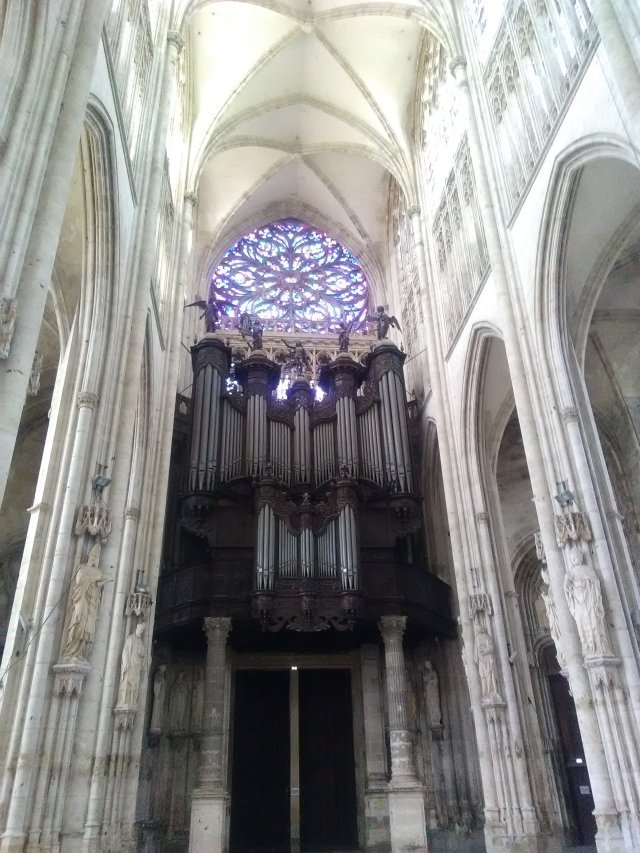
I went today to an organ recital at St Ouen in Rouen, where there is just about the finest Cavaillé-Coll organ ever built. The recital was played by Thomas Lacôte, titular organist of the Holy Trinity church in Paris where he succeeds Olivier Messiaen. He played music by Bach and Messiaen on the themes of life and death. The piece I found most moving was Messiaen’s Combat de la Mort et de la Vie from the organ cycle Les Corps Glorieux composed in 1939.

Though this piece describes the Paschal Mystery, the death and Resurrection of Christ, the year 1939 is significant. The aggressive toccata over a bass motive represents an extreme degree of anguish. The composer must have known about the looming war in the newspapers and on the wireless, and indeed I heard this emotion and my extreme empathy kicked in. The life part is quiet and meditative. Here is a recording of Messiaen himself playing the Combat de la Mort et de la Vie.

After a few chorale preludes of Bach, M. Lacôte played Les Ténèbres and La Résurrection du Christ from his last organ work (1984), Le Livre du Saint-Sacrement. Like the earlier piece Les Corps Glorieux, we find an extreme contrast between the darkness and the light of the Resurrection, a towering upward movement ending in a massive resolution into a major chord.

Messiaen is sometimes difficult to listen to, but his music is not atonal, but follows a system of harmony that is proper to this composer. He was a profoundly devout and even mystical Christian, as was Bach. Quite an experience!

Posted in Uncategorized | Tagged , | 1 Comment

Dystopia

I have to admit that I often write from a worried point of view – about our future in the post-everything western world. I was particularly marked by studying Orwell’s 1984 for English literature at school – like most kids of my generation. In the film, Richard Burton exquisitely played the role of the inquisitor in Room 101 with the chair and the cage of rats. Since the end of World War II, the defeat of Nazism and the fall of the Soviet Communist empire in 1989, science fiction has continued to portray the dystopia as an archetype of the man-made hell of earth. There always have been tyrannical regimes and there will be in the future. In the ancient world, the best-known of such regimes were the Aztecs in what is now South America and Mexico and the Pharaohs in Egypt. Typically, society was formed of the ruler and his court, the priesthood of the society’s religion and a sub-class of slaves and serfs. Then came the Roman Empire and the succession of emperors who oscillated between the most sadistic and brutal to something like Plato’s vision of the Philosopher King. So it was when the Church became the priestly caste under Constantine and proved useful for controlling the population, so it was throughout the middle ages with the Two Swords.

With the Renaissance came the notion of the intrinsic value of the human person, at least to a point, the ideology of humanism and a notion of progress in freedom. The Industrial Revolution brought a new notion of progress and growth, eventually leading to a contestation of the class or “caste” structure of society and dependence on technology. From then, things would oscillate between the interests of the State and oligarchy or plutocracy. Eventually all these opposing ideas and tendencies would be increasingly radicalised in various types of socialism and nationalism. The extremes of all these ideologies would emerge in the wake of World War I in the regimes of Hitler, Mussolini, Stalin and Franco.

History seems to be marked by these oscillations between progressive liberalism and nationalist authoritarianism. For seventy-five years, the old photos of the concentration camps and the piles of emaciated corpses put us off the nationalist “reaction”. There are still a few old-style totalitarian states in the world, like North Korea and its “charming” leader Kim Jong Un who invents new and ever more sadistic ways to get rid of his opponents. What is terrifying now is that such ideologies are returning via democratic electoral processes – people voting according to how well they have been influenced by television and other forms of mass media.

I am now ready to believe that the majority of British people want Brexit, the triumph of men like Boris Johnson and the dismantling of Parliament and other regulating obstacles. “Get on with it!” they clamour without a thought to what, according to the evidence, is coming. Light the blue touch paper and stand well back!

I have tried to understand things for which I have never been trained. I know too little of political philosophy and sociology, so I can only read books and articles written by others and decide whether the message seems plausible. I am inclined to seek an evidence-based and rational approach to avoid the wildest of the conspiracy theories. It is not easy. We tend to think of history (modern) as a natural oscillation between action, reaction and synthesis, as Hegel expressed. We generally label authoritarian tendencies as “reactionary”, essentially conservative and wanting to turn back the clock on inevitable progress and growth. They mark the equally inevitable death of liberal democracy and its advocacy for causes like feminism, other races and cultures, homosexuality and “gender fluidity”. Those of us who find such liberalism to be exaggerated or morally wrong will find solace in the new authoritarianism.

For one “camp”, the game is over. It has gone to its limit, and now – back to the 1930’s we go! Conventional wisdom would see the “new right” as just a temporary inconvenience in the way of progress towards liberal utopia. It doesn’t seem to explain things well enough, and seems to be too comforting to be realistic. What I will say now is not an apologia for fascism or the “new right”, but what seems to be happening. Nationalism, authoritarianism and a modern form of “fascism” are becoming the new “normal”.

Like in the 1930’s, something more basic will model our world view – our material condition, wealth, affordable housing, availability of food and other fundamental resources. There isn’t enough to go round! The “wogs” are getting free “hand-outs” and we have to work our backsides off for a pittance of a wage! The thing is that immigrants don’t get “free hand-outs” but have to go through the same application process and stand in the same queue as everyone else fulfilling the required criteria. In the 1930’s in Germany, a wheelbarrow full of money wasn’t enough for a loaf of bread – it was “all the fault of the Jews”, as people heard from Hitler. Is it surprising? Yesterday’s “Jews” are today’s Muslim immigrants.

According to a longer view of history, this “not enough to go round” crisis is a slow creeping one. Wealth is concentrated in the hands of fewer and fewer billionaires, whilst ordinary people work longer hours for less, get themselves into debt, live in cities. The Trente Glorieuses are over, and have been for a very long time, something like the mid 1970’s.

Something most of us are noticing is an increase of security and surveillance in public life, and as much comes in with “socialist” governments like those of François Hollande, Tony Blair and Obama in America. The police in most western countries is being given powers it usually only gets in an authoritarian regime. What we seem to be getting is not a regression from progress, but rather progress itself to a new period of history. The general movement is the curtailing of freedom and increased control. It also describes the concentration of wealth for the rich and increased debt and poverty for increasing numbers of disadvantaged people.

The real issue seems to be climate change due to human industry and cosmic cycles. There are fewer resources for increasing numbers of people. Such is the basis of an ideology of Nazism. What do you do to reduce the number of people in this world who compete against our way of life? You kill them. It is the solution that no one dares to express since the Nuremberg Trials. The totalitarianism of the future is a response to an emergency. In emergencies, people have to be managed and controlled. Whether the label is right-wing or left-wing the direction everything is going is the same. That is why the UK run by Labour and Corbyn would leave the average person no better off than under the Tories and their billionaires.

The real issue is our dependence on technology and industry, myself just as much as anyone else. With the exploitation of coal and oil came massive deforestation and desertification. Up went the exponential increase in carbon dioxide emitted into the atmosphere. One lot of scientific data seems to contradict another! Follow the money and the ulterior motives… There is a lot of hype, but we seem still be be in big environmental trouble with the potential of leading to Byron’s Darkness.

The coming repression goes hand in hand with our environmental crisis. Alternatives to fossil fuels lack efficiency and all that is in the interest of the richest billionaires. The alternative to solving the environment crisis, unfortunately, is genocide! Many methods are possible to avoid humans being blamed: war, famine, drought, flooding, disease, anything. For the time being, total control is enough. In China, there is the “social credit” system. If you conform, you get the perks of being allowed to travel and having somewhere nice to live. Otherwise, you get banned from just about everything. This system manages the availability of resources. I could see it easily coming to the UK, America and Europe.

Macron here in France was responding to the same crisis through trying to introduce a fuel tax to discourage us from driving, even if there is no alternative way to commute to work. Fuel shortages and prices determined by offer and demand are only the tip of the tentacle. Had the Gilet Jaune protest continued, it would have ended up with people being shot dead by the police. The same mechanism of control becomes necessary for any political government. I imagine that Trump’s wall isn’t for the small groups of South Americans trying to get into the USA illegally – but the millions in the future when the nasty stuff really hits the fan. What happens in a “post-apocalyptic” scenario when we live somewhere with a garden where we can grow a little food. When the starving people from the nearby city see what I’ve got and they haven’t, what do they do? They’ll shoot me and steal my food, or I can defend myself. I know this is the very argument of the gun lobby in America, but there is some truth in it – even though I have have never owned a gun (though I have learned to handle a Lee Enfield .303 rifle and a Browning 9mm).

Please remember that I am not promoting fascism or analogical ideologies. I am rather seeking to analyse reality and try to understand something. We need to read authors like Thomas Mann and all those who lived through fascism and Nazism in the 1930’s and 40’s. There is the issue of nobility or otherwise of the soul, morals, ethics, principles, values – but also the realisation that something has to be done about the environmental crisis. As things are, totalitarianism is viewed as the inevitable future, progress towards “making America (or name another country) great”. Bring in enough jingoism and visions of the Allied victory in 1945, and people will follow anything.

As things appear presently, nationalist authoritarianism seems to be the inevitable future, the way to utopia and what cynics in England call the “Uplands of Blue Unicorns”, a fairy-tale scenario where everyone will live happily for evermore. Fascism is the inevitable future of civilisation built on capitalist exploitation of people and the earth, the “end of history” and the final point of “progress” for industrial society.

The solution is what most of us cannot contemplate. We will give up technology and return to the early to mid eighteenth century. We will die of small infections (and big ones like TB) and will not have the medicine we now take for granted. We will get used to high proportions of child mortality. We will go off grid. Some people have managed it and are very happy. The only way you would read anything written by me would be by buying a book printed on an old-fashioned letterset press. There would be better authors to me by far to merit the attention of a publisher and printer. We can dig our toilets into the earth and dig our own wells. We can hunt and gather, or run a small farm to feed ourselves and our families. No more holidays away from home! No more boat unless I am living near a fishing port and am going fishing! Could we make such sacrifices?

Even if we did that, we would be victims of official regulation and being ravaged by the “have-nots” still depending on social security and the vanishing welfare state. Perhaps such a scenario might come about like in the post-apocalyptic and science fiction films like Mad Max, Matrix and others featuring glass dome cities with the outcasts living in a desolate blackened world. There are other futures possible, because our forefathers lived without oil and coal, without industrial destruction of the forests and the environment. Mankind once lived without international finance and debt. Such a future would only be possible for the most resilient and adaptable, those who can learn new skills and going back to the old ways. Perhaps this would be the true Benedict Option!

Maybe it’s possible… Otherwise, it’s Goodnight as the world moves once again into darkness and evil.

Posted in Uncategorized | Tagged , , , , , | 1 Comment

Muscular Christianity

This is one of my favourite Don Camillo films. In this except, Peppone goes to confession, for the first time since 1918. He has little to confess, and Don Camillo gives him Absolution. Afterwards, he says to himself “I’m going to pulverise him!” Jesus answers, “No question of it. Your hands are made to bless”. Don Camillo replies, “My hands are made to bless. But my feet?” Jesus remains silent and Don Camillo gives Peppone a good kick up the backside. Peppone reacts as if to start a fight, but calms down and says “Now we’re even”.

I doubt this kind of clerical manliness was considered in the article The case for muscular Christianity written in The Portal, which is the periodical of the British Ordinariate. The succinct definition is given: “Muscular Christianity can be characterised as seeking to promote beliefs in patriotic duty, self-sacrifice, manliness, and the moral and physical beauty of athleticism.” In other words – little short of fascism. These qualities, when exaggerated, become the “virtues” of our new political establishment in the UK. No names mentioned… I do believe in my country, for as long as its cause is noble and just. I have already in my life taken risks to rescue persons from danger of death. However, I am not interested in cultivating the image of the Alpha male in myself, nor am I interested in team sports.

The so-called muscular Christian movement might seem to have been influenced by Rudyard Kipling’s If… and British imperialism.

If you can keep your head when all about you
Are losing theirs and blaming it on you;
If you can trust yourself when all men doubt you,
But make allowance for their doubting too:
If you can wait and not be tired by waiting,
Or, being lied about, don’t deal in lies,
Or being hated don’t give way to hating,
And yet don’t look too good, nor talk too wise;

If you can dream – and not make dreams your master;
If you can think – and not make thoughts your aim,
If you can meet with Triumph and Disaster
And treat those two impostors just the same:.
If you can bear to hear the truth you’ve spoken
Twisted by knaves to make a trap for fools,
Or watch the things you gave your life to, broken,
And stoop and build’em up with worn-out tools;

If you can make one heap of all your winnings
And risk it on one turn of pitch-and-toss,
And lose, and start again at your beginnings,
And never breathe a word about your loss:
If you can force your heart and nerve and sinew
To serve your turn long after they are gone,
And so hold on when there is nothing in you
Except the Will which says to them: “Hold on!”

If you can talk with crowds and keep your virtue,
Or walk with Kings – nor lose the common touch,
If neither foes nor loving friends can hurt you,
If all men count with you, but none too much:
If you can fill the unforgiving minute
With sixty seconds’ worth of distance run,
Yours is the Earth and everything that’s in it,
And – which is more – you’ll be a Man, my son!

It particularly developed in the USA. I personally experienced the mentality at my alma mater, St Peter’s School in York, which has become an educational miracle in recent years with enlightened ideas and headmasters. Dr Arnold’s reforming work at Rugby in the nineteenth century was a milestone in humanism and Christian education.

This muscular Christianity was a “belief, which first appeared in British private schools, that competition in games helps instil desirable traits of character and thus qualifies as a legitimate educational activity”.

In its extreme form, the ideology encourages competition, social Darwinism and eugenics. I imagine nothing more opposed to the teachings of the Christian Gospel than this.

This is not the first time I have reflected on this theme. Should all parish priests be as tough and pugnacious as Don Camillo? Perhaps in some parishes. Everyone is called at the most unexpected time to defend himself against an enemy or stand up for what he believes to be right. Anyone can be violent if provoked enough. South America is notorious for priests being killed by Communist partisans or drug cartels. In some parts of the world, nowadays, Don Camillo wouldn’t last two minutes! We now celebrate the third anniversary of the martyrdom of Fr Jacques Hamel at the hands of Jihadist thugs in France.

I have known some very courageous priests who stood up to their bishops over the liturgical changes and the abolition of the old missal in the 1970’s. I knew one, Fr Jacques Pecha, parish priest of Bouloire in the Diocese of Le Mans. Determined as he was, he was not the stereotype of the English public school rugby player calling for his fag to warm his toilet seat! He was human, humane and sensitive to things like beauty and love. Perhaps those qualities make more of a man than competition, aggressiveness and domination.

My circumstances in life have precluded my being involved in pastoral ministry. My life is identical to that of any layman, except for what I do in my chapel and at this computer keyboard – and when I am with my Bishop and brother priests in England. I do so hate masculine stereotypes like my wife hates feminine ones in some other women. We are men and women according to the way our bodies are made – with tits and a vagina, or a cock and a pair of balls! I have no sympathy for transsexualism and people who get operations and hormone treatment to look like the opposite sex. However, I have nothing against a man who desires to experience something of a woman’s life, the gentle and intuitive approach instead of materialist rationalism. Some men are not made to be dominant, have less body hair, have smooth skin, do not become bald – yet recognise themselves as men with responsibilities to themselves and their loved ones. Is such a man less worthy in the sight of God? As St Paul taught, there are many vocations and many talents in the Lord’s Vineyard. Perhaps if we were less concerned with these gender stereotypes, there would be less of a problem of some people being unable to come to terms with themselves the way they are.

By all means, let us love our countries, be courageous, be prepared to be hurt for what is right, give the best of ourselves. But we are also called to empathy and compassion for the weak and the poor. If that part of the Christian Gospel is airbrushed out, then I see no point in Christianity except as a political aid to control of the population. Bonhöffer gave his life against the assimilation of Christianity by Nazism and “cheap grace” – nothing more manly than to face the gallows!

I am convinced that we are gradually moving towards a new type of fascism with nothing of the trappings of Mussolini or Hitler. The accidents change but the substance remains the same. I have written enough about this sickening subject, but one we face in the coming years. I am just as sickened by the left-wing equivalent and opposite extreme formed by “mass-thinking” and bandwagons.

This kind of labelling and worship of the stereotype male does nothing to foster the nobility of spirit that comes from the teachings of Christ and the most profound philosophers, scientists and artists.

Posted in Uncategorized | Tagged , , , , , | 2 Comments

A l’identique…

I have just found this excellent news for those of us who feared that the roof of Notre Dame Cathedral in Paris was to be rebuilt in a modern style. It’s official: the new Notre Dame will look like the old Notre Dame.

Many problems remain like the effect of the present hot weather on the vaults and who they will get to do the job to what budget. It won’t be simple. But the principle is announced – à l’identique.

Posted in Uncategorized | Tagged | Leave a comment

The Science Delusion

I have always been fascinated by the sciences, coming as I do from a scientific and rational family background. My scientific education at school was entirely based on Newton’s laws and the mechanistic notion of the universe and life as we know it. Atheism and materialism have been around since about the seventeenth century (Descartes and Newton, for example), and we are all brainwashed in its “dogmatic” belief system as it developed under the influence of ideologies. The current controversy over climate change (the hypothesis of its having been caused by humans filling the atmosphere with carbon dioxide and methane, as opposed to cosmic and solar cycles) is based on what we learn from the media, said to be scientific, but which shows itself as an irrational ideology with many of the characteristics of a cult. Though I believe that we should be ecological and respect nature, I find that the notion bandied around by groups like Extinction Rebellion that the planet will become uninhabitable by 2050 resembles the apocalyptic rantings of Jehovah’s Witnesses and other cults.

It is very difficult for us to break out of this system of thought except by accepting the teaching of a religious belief system or the rantings of a cult. When that belief system loses credibility through its internal incoherence, we fall back onto materialism and the mechanistic view of everything. Dr Richard Dawkins is one of the chief “evangelists” of atheism, and he refers to God as a delusion and consciousness in terms of bio-chemistry and unconscious matter in the brain.

Dr Rupert Sheldrake advances the idea that science cannot be based on a belief system, but on hypotheses which prove themselves or not through experiments and other methods for obtaining certain knowledge. He has written The Science Delusion. Dr Sheldrake has given a talk to introduce his book:

I have bought the book, and it is also on my reading list. I have already mentioned Idealist and Romantic notions of truth and Foundationalism. Minds like Novalis were struggling with the triumphalistic materialism of the Enlightenment for the sake of human consciousness beyond pure intellectualism. We need to study a whole notion of knowledge and truth to discover the primacy of consciousness and energy over matter. If this is acquired, we find a whole new idea of God as the universal consciousness which subsists in each human being, other species of animals and everything around us like the sea and the land of this planet.

If anything, we need a whole new Enlightenment and a new approach to science. Since the seventeenth century, we have had to deal with a dualism between disembodied consciousness and unconscious matter. This world view has found its way into Christian theology with the distinction between naturalism and supernaturalism. We need a new basis on which consciousness in everything becomes a possibility to be discovered.

What people will do with such knowledge is up to them. Some will seek out some formal or ritualistic form of religion. Others will seek an approach of “religionless Christianity” like that proposed by Bonhöffer to make a vital distinction between the Christian way and the corrupt institutional churches that became tools of political ideologies like under the Hitler regime – and which could happen again, and which has happened in differing degrees. Others will learn to experience consciousness and enter into communion with the All. Those of us who belong to churches need a new openness of mind to take on a new approach to science and philosophy. It will give us a whole new approach to symbolism, liturgy, prayer and meditation.

I see a lot of hope in this progress of science and philosophy in our own time, a more rational approach to what we are discovering, a new sense of wonder.

Posted in Uncategorized | Tagged , , , , | 2 Comments