Be careful about what you ask for!

The Pope’s Earthly empire is laid to rest – Italian anti-clerical drawing from 1870

It was in 2014 that I wrote in Aristocracy of the Spirit:

I had a long conversation with two friends in London a few days ago about the notion that the Church, in particular the Roman Catholic Church was, using computer language, in a state of complete system failure. No amount of work would repair the system other that a complete hard reboot. Roman Catholicism has painted itself into a corner with its notion of Papal infallibility that no amount of apologetics can save it from inevitable decline. Perhaps such a view is exaggerated, because it seems to be finished in most of Europe, but an evangelical and charismatic form seems to be growing in China, Africa and South America.

I found an entry in Facebook this morning that I cannot find, but the substance consists of saying that even devout and practising Catholic people would recommend the total collapse of institutional Catholicism as the only condition for the renewal of Catholicism and Christianity. The idea is going around, and it is tempting. I was listening to someone on YouTube who used to be a therapist, and the job certainly took its toll on his own spiritual and emotional life. He didn’t seem to be bitter, but he sees revolution in the air. I am brought to think of Wordsworth’s rapture on seeing the French Revolution – that is until they rolled out the guillotine! Indeed.

Only churchmen would be concerned to see the Church cleansed and reformed. The secular world would see it destroyed, taxed and fined out of existence. So would the more fundamentalist forms of Islam and Evangelical Christianity (though they have their own problems). A short while ago, I read about the Racketeer Influenced and Corrupt Organizations Act (RICO). It is a provision of American Federal law and there are equivalents of it in Europe (dealing with the Mafia in Italy, for example) and other parts of the world. The real issues are going on in the USA, but the Vatican is implied. Normally, the Vatican is a sovereign state and has diplomatic immunity. Would sending the troops in to invade the Vatican cause a war these days? A couple of thunder flashes (non-lethal hand grenades used for military training) and rifle shots in the air would do the job. Perhaps an idea or two could be left in the comments to this posting.

Then there is the question of whether this is an American problem or a world-wide one, or one that only concerns the American Church and the Vatican. We all need to watch the news, relevant blogs and the more credible entries in Facebook. There is a lot of hysteria and red herrings like homosexuality and clericalism being blamed for everything. I blame narcissistic and sociopath personalities, remembering that each person on this earth has a choice between good and evil. Psychopaths collaborating together in some kind of secret organisation is the very essence of a malaise in human nature described by the Polish psychiatrist Dr Andrzej Łobaczewski in Political Ponerology. I do believe that everything will click when someone reads this book (which is in English). If this has happened in the institutional Church, then all that can be done is for the UN and the USA to declare war on the Vatican and occupy the territory and positions of power after an unconditional surrender.

The future of it all would be most uncertain. Perhaps parishes that own their property as associations or rent a church that are not involved in crime or cover-up would find a way to continue. It may be like 1905 in France. The Church still exists in France but has no political power or immunity. The cathedrals belong to the State and parish churches older than 1905 belong to the municipal authority of each commune. The buildings are allocated rent-free to the diocesan and parochial associations that administer money and material tasks. The Law of 1905 has been used by traditionalists to their advantage, taking churches like Saint Nicolas du Chardonnet in Paris or Saint Louis du Port Marly near Versailles by force. The situation of the first church is tolerated by the Mairie of Paris and the second has been regularised with the Bishop of Versailles.

In America after massive bankruptcy and selling real-estate to pay the legal fees, fines, compensation, you name it? Perhaps some of the parishes could raise money to buy a few buildings for sale, just like traditionalist RC groups and continuing Anglican churches. Who knows? That’s America. What about the Vatican? That is a matter of international law and it will take time to pan out.

I don’t wish anyone any evil unless they are personally guilty of crimes against human persons or have covered-up for them from a position of authority. May the dirty secrets be blown open for the world to see, that sin may be overcome by repentance and a renewal brought about by divine grace and the innocent seeking a way forward in humility. Tremendous damage will be done, as happened at the end of World War II when Berlin was flattened and thousands of innocent German civilians were left homeless and starving.

I now begin work on my article in the next Blue Flower which will revolve around the antithesis of psychopathy and evil totalitarianism, the nobility of the human spirit at its highest and most beautiful. May we transcend the evil of this world as we yearn for the Βασιλεία τοῦ Θεοῦ (Kingdom of God).

Posted in Uncategorized | Tagged , , , , | Leave a comment

Blue Flower Feedback

Since publishing The Blue Flower in late June this year, my website statistics inform me that the file has been downloaded 317 times. It might have been read by that number of readers with varying degrees of interest.

Feedback is always useful for what modern business calls a strategy of continuous improvement. The review is intended to be quite high-brow for the sake of contributing to discussions that may no longer be fashionable in universities. When I was at Fribourg University, we had seminars that we could choose, and they involved dialogue with the professor in the old Greek tradition. This was very valuable in my experience as a student and opening my mind to possibilities of new paradigms.

The writer can feel quite discouraged if working “into a vacuum”. Feedback from readers would be appreciated so that progress can be made.

Posted in Uncategorized | Tagged , | 3 Comments

Solitude and Loneliness

When I was in my school choir, we sang the famous Mendelssohn anthem Hear my Prayer, the text of which is derived from Psalm 55.

Hör’ mein Bitten, Herr, neige dich zu mir,
auf deines Kindes Stimme habe Acht!
Ich bin allein; wer wird mein Tröster und Helfer sein?
Ich irre ohne Pfad in dunkler Nacht!

Die Feinde sie droh’n und heben ihr Haupt:
“Wo ist nun der Retter, an den ihr geglaubt?”
Sie lästern dich täglich, sie stellen uns nach
und halten die Frommen in Knechtschaft und Schmach.

Mich fasst des Todes Furcht bei ihrem Dräu’n.
Sie sind unzählige – ich bin allein;
mit meiner Kraft kann ich nicht widersteh’n;
Herr, kämpfe du für mich. Gott, hör’ mein Fleh’n!

O könnt’ ich fliegen wie Tauben dahin,
weit hinweg vor dem Feinde zu flieh’n!
in die Wüste eilt’ ich dann fort,
fände Ruhe am schattigen Ort.

In English, the last verse we sang was –

O for the wings, for the wings of a dove!
Far away, far away would I rove!
In the wilderness build me a nest,
and remain there for ever at rest.

It all seemed so solipsist, selfish and sentimental, but it struck very deeply in me. In fact, generations of monks and other special people took to the wilderness, which can be a physical place like mountains, the desert, a forest or the sea in a boat. St Aelred of Rievaux wrote at length on the Sabbath of the Soul in his Speculum Caritatis. The soul finds rest insofar as union with God is achieved and the sin of selfishness is purged away by divine grace and asceticism.

It seems like running away from reality, that reality being the noise and stress of modern urban life. I have mentioned before that my own experience of life is that of someone on the autism spectrum, especially sensitive to the negative emotions of other people. On the contrary, social media, city life and addictions are more like running away, whilst solitude is for the person who has the courage to face his strictest critic – himself.

In his play Huis clos, Jean-Paul Sartre wrote L’enfer c’est les autres (Hell is other people). The idea as intended by the French Existentialist philosopher is difficult to understand correctly. Are our relationships with others always toxic, infernal? All human beings contain what is important in ourselves for our self-knowledge. We all belong to the universal idea of the human being, but there is a vital distinction between persons. The scholastics thus distinguished between nature and person when discussing the theology of the Trinity. We are fallen and sinful, and dependence on other people will bring us to unhappiness in short order. We have to be resilient and self-reliant. We have not to compare ourselves with other people, but with ourselves the way we were yesterday. This is surely the condition of the authenticity of any intimate or social relationship. However populous the place where we live or work, we are always alone. Whether that is loneliness or solitude will depend on our awareness of our otherness as persons, the absolute impossibility of experiencing life as another person. The quality of empathy gives some insight into the emotions of another, but as “through a glass darkly” as St Paul put it. As someone with a degree of autism, I have often given thought to this impossible mystery of otherness and the lack of communication caused by weakness of perception. The autistic person or “aspie” (a term I don’t like very much) is alienated and often sickened. I am brought to think of the philosophical novel, also by Sartre, La Nausée. Nausea is a very powerful emotion by which someone would say “I am sick and tired of…”. It is a feeling that is often felt around the stomach and resembles the experience of a physical digestion malaise or a reaction from a disgusting smell like rotten meat. My own experience of anxiety will often make me feel like wanting to puke up. Sometimes, we have to take leave and go away.

The other side of the coin is that solitude can be lived positively, and we “recharge our batteries” through a week in a boat or camping in wild places. The line dividing beneficial solitude and toxic loneliness is brief. We do need some kind of relationship with those we trust like family and old friends. If we can’t be in their presence, at least we can write letters, e-mails and call them on the phone. It’s something. If our loneliness is to be converted into solitude, we need to experience God, the sacred, the spiritual.

For many years, I have worked alone to earn my living as a translator. A translation agent contacts me and ascertains my capacity to do the job. It then sends me an e-mail with the text to translate. I process the translation from French into English, using the proper technical terms, using various modern tools like Trados. I then send the file back and invoice the agent at the end of the month. No commuting! No bullying by narcissistic managers! But my day is spent in my own company with music and the jobs to do according to the deadlines given by the clients and to which I agree when I confirm the job order. Many people, including those who are not religious, have solitary jobs. Some look after a lighthouse or some area of land where people hardly ever go. I have a friend who is often alone on night shift at the port of Le Havre controlling ships entering and leaving for sea. We all need to earn a living – and offer what we have.

We are often brainwashed to confuse solitude and loneliness, to fear being alone, to perceive it as a punishment – a child being sent to his room or a prisoner being put in solitary confinement. Most people are addicted to social interaction to such an extent as any amount of solitude causes intense pain. A prisoner in the “hole” quickly goes mad, and loneliness can truly break the heart.

The glass is half-full or half-empty – or it is full of a quantity of liquid and a quantity of air. There is a difference between being alone against our will and finding ourselves alone because it is our way in life. Humans are social animals, but not always. I did have friends or playmates at school, but what I loved most was playing at camping in the garden or going fishing. It’s the way I was made and grew up. I enjoy being with friends, usually because a common interest brought us together and we empathised, but I can’t stand parties and small talk.

Solitude is a gift, and is reserved to those who have suffered and gained self-knowledge. The lonely person feels rejected and shunned, feels bitter towards the world. In solitude, a person has a relationship with himself, a kind of “two-in-one”. In my reading on psychology, I see this distinction in the comparison between borderline personality disorder (BPD) and autism spectrum disorder (ASD). The borderline personality is empty within and needs the psychic energy provided by other persons. They feel alone and abandoned. Loneliness for them is a punishment, a judgement of their attitude and behaviour. The autistic person (high-functioning) is also alienated from the “world” because of the “bullshit factor”, the lack of integrity and constancy. After a period of acquiring self-knowledge and coming to terms, solitude becomes something positive and a bringer of happiness and peace. We can use solitude to discover our true self and therefore the immanent divinity within us, the “icon” of God given to us through our being human and illuminated by Baptism. The greatest human achievements come from men and women who worked alone in spirituality, art and technology. The music of Bach, Beethoven and Mendelssohn did not come from Germany, but from those individual persons. Genius comes from solitude. Solitude allows us to create and reach out authentically to other people, caring for their needs and desires.

Posted in Uncategorized | Tagged , , | 2 Comments

Two Worlds

I have been neglecting this blog for some time, partly due to personal issues and partly due to having had a major computer crash. My data is backed up and some recent stuff is being saved from the hard disk of the stricken computer presently in the care of a technician. I have been able to put a Windows 7 computer into good use, installing the various applications from my external hard drive, and will be glad to have two parallel “rigs” for my translating work and my Blue Flower related work. I am hoping that my crashed computer can support Windows 7 after my bad experiences with Windows 10 – mainly a question of drivers. We’ll see…

There is also the need to be detached from some of the hysteria whirling around about the issues surrounding the Pope. I am not a member of the RC Church, but associations tend to be made between organised institutional religion and the old sins of unredeemed humanity.

Some time ago, I visited a kindly Englishman who owns a small château in northern France and aspires to building up a humanist vision of a change of consciousness. The theme reminded me of some of the ideas expressed in Romantic authors like Wordsworth, a kind of secular eschatology in an age when institutional Christianity was too tired to provide a convincing answer to materialist rationalism and the pent-up hatred against the old institutions of the Church and the Aristocracy. The reality is that the gentleman is alone in this comely dwelling in the woods. He has occasional visitors and friends, and sometimes some odd characters. He sometimes hosts groups of business people or educational concerns, which help to finance the estate. The central theme is New Age, a term that is eschewed by conservative Christians, both Protestant and Catholic. His ideas need rethinking – from financing his house through grandiose projects to building a community of alternative living at a human dimension. The contradictions are easy to understand but difficult to solve. I have enough problems of my own!

My approach to New Age has been philosophical and comparative (I have no experience with New Age groups), seeking an expression in modern times of phenomena like Gnosticism and Romanticism as it manifested itself in the wake of the French Revolution and the mid nineteenth century up to World War I. Unfortunately, it is not the only understanding of New Age. There is also a plethora of cheap commercial “spiritualities” and their charlatan gurus. The story of Theosophy and some of the “mystical” underpinnings of Hitler’s ideology are extremely confusing. Sometimes mental illness and psychosis enter the picture, and the end result is extreme confusion and a temptation to reject the wholesome and noble with the cheap dross and ravings of the feeble-minded.

With these thoughts in my mind as I contemplate an article for the next Blue Flower (Christmas 2018) on nobility of spirit, I am brought to the concept developed by Origen on the various levels of interpreting the Scriptures. These levels go from the literal / historical reading of the texts to analogy and allegory, a mystical and hidden meaning. In institutional Christianity, the Church has always had room both for ordinary parish life and the monastic life, covering both community life and the solitary contemplative life. Take away the “ordinary” way, and our “higher” way can only evaporate away from the lack of roots. Christianity that is purely Gnostic cannot subsist in history and human life. It cannot last, but it has to be there for those who can “take it”. Take away the “higher” way, and all you have left is materialism and the hubbub of modern politics.

I am reading April De Conick’s The Gnostic New Age. How A Countercultural Spirituality Revolutionized Religion from Antiquity to Today, published by Columbia University Press 2016. See a review. I am not yet very far through this book, but I am reading it to understand the issues and the need in people’s minds to wander beyond the bounds of Judeo-Christian monotheism to seek inner knowledge and self-consciousness. The challenge presented by Gnosticism is tracing the evolution of religion from obeying a tyrannical deity who sets the standards of the law too high and punishes transgressors without mercy, to entering into a Covenant, to the discovery of the loving and transcendent God the Father of Jesus Christ above the spirits of this world. The first view of the dictator god is that used by temporal rulers to obtain control over the masses, and this has always been the drama of the Church – to this very day. The theme runs all the way through history and both through religions and “secular” philosophies like anarchism à la Tolstoy. I find this book both challenging and enlightening.

My brother in the priesthood Fr Gregory Wassen has been writing in his blog after a period of relative silence, and I would like to draw your attention to his reflections on Plato and a theory of two worlds.

There are many agendas and ideas flying about in this world, and we can’t heed them all. We need to work things out using our rational faculties, but also our imagination and intuition. As a priest in the ACC, I am greatly indebted to the breadth of mind of our Bishop with the kind of priests he is attracting – including Fr Gregory Wassen, Fr Jonathan Munn and Fr Andrew Scurr. We are coming together to build a new way forward, on the basis of orthodox Catholicism but also through the soaring of our minds and imaginations to that transcendent world beyond, our Sehnsucht for the ultimate in truth and beauty.

I would certainly like to work towards a meet-up of all those who have expressed interest in my Blue Flower project. Summer is nearly over, and there will be fewer distractions as we get back into the mood for work and reflection.

Posted in Uncategorized | Tagged , , , , | 6 Comments

The Challenge

I was pointed towards this lovely article J. R. R. Tolkien’s Lost Prophetic Message on Abuse in the Church. It is for the reader to discern whether he should remain in the institutional RC Church or do something else. I am a cradle Anglican and was wrong in my choice and immature in my decision to become a Roman Catholic back in 1981. I returned to Anglicanism via the Continuum. Clergy of all churches can be tempted to seek partners for sex and even use manipulation to these ends. As a fresh young schoolboy, I came across a twisted Anglican vicar or two, and was able to avoid their clutches by simply telling them that I was not interested. Even in those days, they could go to prison and lose everything! I even heard the expression in the 1970’s “Mr X likes chicken leg” from a cathedral organist, not referring to food but young boys. There is an odd kind of complicity about this sordid subject, even among those who were in contact with the predatory clergy but did not themselves engage in such behaviour.

A lot of people are going to be seriously scandalised over the coming weeks and months, whatever happens with the Pope and his collaborators. I have already read sneering comments on Facebook about “superstitions” about “sky fairies” and how atheism and Islam would be triumphant on the final discrediting of Christianity.

Tolkien wrote this beautiful text:

You speak of ‘sagging faith’, however, that is quite another matter. In the last resort faith is an act of will, inspired by love. Our love may be chilled and our will eroded by the spectacle of the shortcomings, folly, and even sins of the Church and its ministers, but I do not think that one who has once had faith goes back over the line for these reasons (least of all anyone with any historical knowledge). ‘Scandal’ at most is an occasion of temptation – as indecency is to lust, which it does not make but arouses. It is convenient because it tends to turn our eyes away from ourselves and our own faults to find a scapegoat. But the act of will of faith is not a single moment of final decision: it is a permanent indefinitely repeated act > state which must go on – so we pray for ‘final perseverance’. The temptation to ‘unbelief’ (which really means rejection of Our Lord and His claims) is always there within us. Part of us longs to find an excuse for it outside us. The stronger the inner temptation the more readily and severely shall we be ‘scandalized’ by others. I think I am as sensitive as you (or any other Christian) to the scandals, both of clergy and laity. I have suffered grievously in my life from stupid, tired, dimmed, and even bad priests; but I now know enough about myself to be aware that I should not leave the church (which for me would mean leaving the allegiance of Our Lord) for any such reasons: I should leave because I did not believe, and should not believe anymore, even if I had never met anyone in orders who was not both wise and saintly. I should deny the Blessed Sacrament, that is: call our Lord a fraud to His face.

If He is a fraud and the Gospels fraudulent – that is: garbled accounts of a demented megalomaniac (which is the only alternative), then of course the spectacle exhibited by the Church (in the sense of clergy) in history and today is simply evidence of a gigantic fraud. If not, however, then this spectacle is alas! only what was to be expected: it began before the first Easter, and it does not affect faith at all – except that we may and should be deeply grieved. But we should grieve on our Lord’s behalf and for Him, associating ourselves with the scandalized heirs not with the saints, not crying out that we cannot ‘take’ Judas Iscariot, or even the absurd & cowardly Simon Peter, or the silly women like James’ mother, trying to push her sons.

It takes a fantastic will to unbelief to suppose that Jesus never really ‘happened’, and more to suppose that he did not say the things recorded all of him – so incapable of being ‘invented’ by anyone in the world at that time: such as ‘before Abraham came to be I am’ (John viii). ‘He that hath seen me hath seen the Father’ (John ix); or the promulgation of the Blessed Sacrament in John v: ‘He that he eateth my flesh and drinketh my blood hath eternal life.’ We must therefore either believe in Him and in what he said and take the consequences; or reject him and take the consequences. I find it for myself difficult to believe that anyone who has ever been to Communion, even once, with at least a right intention, can ever again reject Him without grave blame. (However, He alone knows each unique soul and its circumstances.)

This scandal will not affect only Roman Catholics but all Christians and all believers and non-materialists. It may be a challenge to many of us, even when we were hardened by seminary life, the culture of secrecy and human manipulation even when no physical sex was involved. This challenge has to be faced, by a mature faith and an authentic spirituality based on contemplation of the absolutely transcendent God and His presence within each and every one of us.

The kind of religion that seeks power, money and unconditional obedience may well die, and there is no need of a devil or evil spirit to prevail. What cannot die is what is within each of us and what even death cannot vanquish, and that doesn’t depend on institutional Churches. Even the sacramental Church only represents the stages though which the soul passes from childhood to maturity and the transition from this world to another.

Solutions for the priesthood? I have bitter experience of the kind of culture that favours that unhealthy kind of complicity. It is important for the priest to “get his life”, to discern and isolate what his vocation really means. The solutions usually proposed by conservatives leave me unconvinced. The kind of men they would want remain laymen, get married, have a family and remain in their jobs until retirement. I have discussed the “wooden leg” factor which only concerns a minority. As a seminarian, there was a kind of pleasure in wearing the cassock and belonging to an admired elite – it does something for self-esteem, but it is shallow. The affected piety is often little more than a justification for this rush of pleasure we receive at such a young age. Does this justify the liberal line of abolishing any kind of priestly identity (hunting out seminarians possessing a Latin breviary and a cassock) and doing so by the use of repression?

One thing I appreciate greatly in our Church (ACC) is that we do wear cassocks and liturgical vestments. We are also able to abstain from their use when in strictly secular life, being able to wear a suit and tie like my Bishop does in secular circumstances or my usually casual style. It is usually like this with Orthodox priests, and as things were in the middle ages and up to the eighteenth century in the west. We wear the cassock on duty, and live in the world as ordinary guys. This reality will come home even more as the world sees a symbol of shame and contempt in the dog collar and other items of clerical dress.

The catacomb Church will have other priorities, even when we opt for sacred and uplifting liturgies and a contemplative outlook. We should take heart in Tolkien’s thoughts and grow in ourselves the strength and character to live through the mocking and sneering to come.

Posted in Uncategorized | 2 Comments

Papal Bull

Some may wonder whether I would weigh in on the “big story” about Archbishop Viganò and his “whistle-blowing” on Pope Francis. It is far “above my pay grade” (I have no independent information) and I spent only fifteen years as a Roman Catholic. Father Zuhlsdorf (whatever you might think about him and his style) is writing a lot about this subject in his blog. If the subject interests you, go there. Personally, it sickens me to the core.

Posted in Uncategorized | Tagged , | Leave a comment

New Brother in the Priesthood

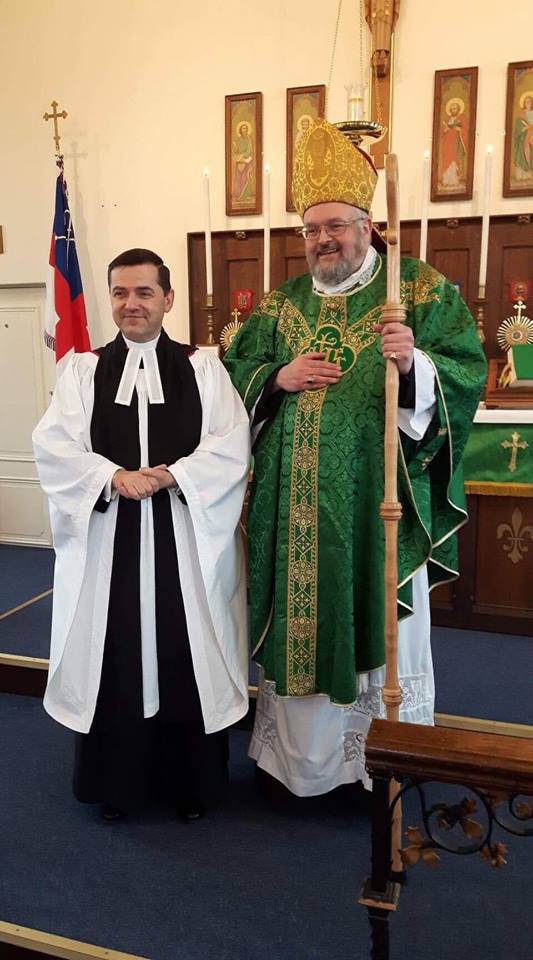
I would like to congratulate my brother in the priesthood Fr Andrew Scurr on his reception today into our Diocese of the Anglican Catholic Church. Fr Andrew and I share an interest in the Use of Sarum and the English style, as will be seen in his choir dress. We will without doubt see the official news of this event on our Diocesan website.

Update: the official news is here.

Posted in Uncategorized | Tagged , | 5 Comments

Destroy this Temple…


Strasbourg Cathedral as a Temple of Reason in 1793-94

I have read some opinions on this blog responding to my postings concerning the unhappier aspects of human nature and the downside of clericalism. Clericalism is not merely a problem in the Church but in every public organisation where an elite is created by education and complicity. You will find this in every institution of politics or business, education, law and even charitable organisations. How do you deal with it when it becomes corrupt and complicity extends to protecting the guilty? The natural reaction is to destroy the institution and then pick off the escaping rats one by one, like when the Nazis were defeated in 1945 at the end of World War II.

What do you replace the destroyed institution with? It turned out rather well for Germany. The smaller fry of the old Nazi regime were allowed to stay in the police, civil service, etc. and they died out as they got older. The present-day bands of neo-Nazis are marginal and present little in the way of a threat to stability in Germany and the European Union. Things were allowed to resolve themselves through compromise and picking off the worst rats through the various war crimes trials in 1945-46.

To what extent ridding the Church of paedophiles will restore the credibility of the whole is a matter of individual judgement. If Falsus in uno, falsus in omnibus is to be the rule, then the priesthood and sacramental nature of the Church must be done away with to prevent any possibility of corruption and complicity arising in the future. We have only to look to the Reformation and the more radical reformers like Calvin and Zwingli. We can go further and seek to abolish all religion and make atheism the norm like in revolutionary France or the Soviet regime. Will this solve the problem of human nature? Richard Dawkins would say “Just the ticket”, whilst most of us know that nature abhors a vacuum.

We have the vision of all churches and monasteries being emptied of all “churchy” things. It happened during the French Revolution, with classical rationalism being turned into an ersatz religion through the Goddess Reason. The monasteries were sold off as stone quarries. We could now imagine the UN deciding to send troops and police units into the Vatican to evict all the bishops and monsignori, and then turn the buildings over to the Italian State, the EU or the highest private bidder. Is this what we would like to see? Perhaps we are so little different from the people who voted for Hitler in the 1930’s!

Whatever is done, if anything is done from the outside, it is sinful human nature combatting sinful human nature. Corruption in the Church is something that disgusts us all, but the solution can only come from within the Church, and to some extent by its being deprived of paying customers and their money.

If Christianity goes, so does all our culture, as T.S. Eliot once said (more or less). The motivation for humanism in the Renaissance time came from Christianity. No other philosophy or religious system promotes the intrinsic value and rights of the human person. All other systems advocate competition and the elimination of the weakest, which is the natural principle held by all species of animals.

I don’t know what others will propose to replace the priesthood and sacramental / liturgical life of the Church. Suppose that all that is gone, repressed, made illegal. Is all that we have left is DIY spirituality? What form would that take? Do we adapt eastern religions like Buddhism and Hinduism for western consumption, as was doubtlessly tried in the 1960’s by people returning to the west from India, Nepal and Tibet? That said, we do have things to learn from peaceful and humanist spiritual traditions, and I am myself curious to learn more about Dom Bede Griffiths who incorporated elements of Hinduism in his Benedictine monastic way of life.

I still haven’t read Dreyer’s Benedict Option, so I am still prevented from offering an informed opinion. There are Christian communities around, Protestant and Catholic, incorporating lay people with families, not only monks and nuns. To what extent are those communities hierarchical or democratic? Are those communities the only way?

I am attracted to the idea of the alternative community based on a democratic government and a reaction against modern consumer capitalism, ecology, a philosophy of life with much in common with Romanticism. Perhaps some culture of this kind can partially assimilate a notion of Christianity that is open to democracy and anarchism, small numbers in the community and, if there is a priesthood for the sake of a sacramental / liturgical life, they have to be “ordinary guys” in everyday life and not tin-god clerics. Perhaps this is suggestive of the “basic community” of Latino Americano Marxist communists. I think that Distributism would be more in order, and allowing people their own philosophies of life. We have to learn to live with diversity, just as long as it comes from nobility of spirit.

Any church of the future has to be a marginal community without political privileges or masses of real-estate and money. This is already a reality with Continuing Anglicans and independent Catholics like the Nordic Catholic Church, whose priests have to earn their own living through work or their old-age pension. In the light of everything that has been tried and found successful or a failure, we need to re-think the priesthood and not discard the precious things the donkey is carrying (referring to my older article with the Aesop fable).

Remember, if churches have to be suppressed by secular authorities, there would be bloodshed as in the past. The transition has to be slower and without constraint. If our little Churches can excel in virtue, beauty and nobility, then we will be lights in the darkness, a powerful and quiet witness in a world that already knows that money isn’t the end of history.

Posted in Uncategorized | Tagged , | Leave a comment

The Wooden Leg

There is a film from 1935 about the infamous mutiny on the Bounty of 1789, the earliest which depicts Captain Bligh as a sadist who loved whipping and keel-hauling his crew. Historical evidence now tends to set William Bligh (1754 – 1817) in a more sympathetic light as a master seaman and is a little more critical of Fletcher Christian (1764 – 1793) and the mutineers who settled on the Island of Pitcairn. In the earliest film, there is the delightful but pathetic image of the alcoholic and crippled ship’s surgeon who had a different story for each person he conversed with about how he lost his leg. The character, at least the one in the film, is a fabulator, a chameleon, a false construction of a hollow personality.

Research on pathological lying has been around for a long time. The word mythomania is more commonly used in its French version, but it exists in English. Modern psychiatry doesn’t seem to isolate it as a distinct condition but rather characterises it as a symptom of conditions like borderline personality disorder. We are targeting the person who constantly tells lies, not always with a clear objective in view. Lying is often a part of the manipulative personality, which is close to those with BPD and NPD. It is not usually an isolated symptom but a part of a wider pattern of behaviours.

Sometimes, pathological liars can believe their lies and construct a delusional world. They lose control of their lies and awareness of their effect or lack of credibility to others. They become addicted to the false construction of their minds and it sometimes ends up in criminal behaviour like fraud. As many priests are caught with their fingers in the till as with their trousers down in the wrong place! For further study of this question, I recommend:

You can also do a Google search to find other articles and book references.

Why have I brought up this subject? I have already discussed various characters in the ecclesiastical underworld. The worst I encountered was Gérard Roux who constantly lied about who ordained him, who consecrated him, and has been in trouble with the law several times for fraud and abus de faiblesse (using his fabulated ecclesiastical status to get lonely elderly people to give him their savings). I have never known cruder and more transparent false documents! I have known more harmless cases who simply constructed grandiose self-styled titles and expensive garb. I last wrote about this subject in Purple Fever. The real issue is the pathological personality. With the amusing image of the drunken ship’s surgeon on the Bounty, I have come up with the neologism of the Wooden Leg.

I have already commented on James Atkinson-Wake. No one minds his being an independent priest or bishop running a chapel for a few alienated Anglicans or Roman Catholics. What is objectionable is his lying about being a legitimate member of the Roman Catholic hierarchy. He is a chameleon who even changes his name between David Bell and James Atkinson-Wake. Two priests, probably sharing the same pathology, left our diocese in the ACC to join the chameleon: Philip James French and Michael Clothier. The former is now a bishop “gloriously reigning”. I will not go into all the gruesome details related to me by my Bishop!

The ghost of Archbishop Hepworth again emerges in Peter Slipper- Bishop of Australia? The history of Peter Slipper is particularly sordid. To what extent Archbishop Hepworth was in good faith when he ordained Slipper is anyone’s guess, but the ordination was done in secret. The whole history of Archbishop Hepworth’s dealing with the Ordinariate question has revealed his own pathological lying probably due to some personality issue. Slipper is now a bishop, styled Bishop of Australia. It would appear that he is pontificating over a community formerly belonging to the Church of the Torres Strait (CTS), a member body of the Traditional Anglican Communion. He appears to be connected with the  Igreja Católica Apostólica Brasileira (ICAB) founded by Bishop Carlos Duarte-Costa and led for many years by Bishop Castillo-Mendez.

These issues, like the re-surfacing of the paedophile priest scandal in the Roman Catholic Church, are so many indicators of that curse of personality disorders, a true mark of Original Sin and man’s propensity to actual sin. These disorders come in forms of a spectrum, just like autism on the opposite side of the human condition. Other conditions like depression and bi-polar disorder range from the highly-functioning to those who have to be institutionalised in a psychiatric hospital. The problem with the Church is its dependence on sinful human nature. We don’t all suffer from the same condition, and “normality” seems to be a very narrow category on the knife edge between the scales of acidity and alkalinity on the pH spectrum in chemistry. Identifying and choosing perfectly “neurotypical” men for the priesthood seems to be an illusion – and even those of the knife edge of “normality” can also be tempted to sin.

I have been reading Shawn Tribe’s reaction on Facebook to Fr Jay Scott Newman’s article The End of the Imperial Episcopate.

Fr. Jay Scott Newman’s (JSN) ideas here about vestural reforms strike me as highly odd, highly problematic, and I couldn’t disagree with them more. That said, I am not surprised to see this sort of thing coming up. I’ve been told by some priests that some others have attempted, in the light of the current situation, to try to argue that traditional vestments and ceremonial should all be abandoned as “effete” as well (ignoring the fact that they have been for the most part abandoned to this point, and are only now slowly seeing a revival).

Back to the article in question, a few excerpts:

JSN: “We should encourage bishops to abandon colored sashes, buttons, piping, and capes and stick to simple black. ”

His rationale? :

JSN: “Exalted titles and elaborate uniforms… tend to distance bishops from their priests and people, and also subtly nudge them toward self-important and self-referential ways of thinking and acting. As the recent catastrophic scandals demonstrate, too many bishops have proven unable to act as pastors and evangelists and have instead behaved as managers and bureaucrats. ”

To call this attempted linkage a ‘stretch’ seems overly generous.

Incidentally, what is “elaborate” and “exalted” exactly? Who defines that and from what perspective or principles? This is a priest’s perspective but a layman might well argue that clerical dress at all is the very same and that the title “Father” (which JSN proposes bishops should be referred to) is itself too “exalted.” The reality is, however the Church is a hierarchy; it has an order, and the titles and uniforms — as in all levels and facets of society (sic) — reflect that order and hierarchy; they speak to the offices. This is very much embedded into our human nature — and it is something most naturally appreciate and are drawn to, even need, unless they are pulled away from it by some ideology.

As for episcopal dress today, JSN speaks as though prelates today dress for the most part like they did a century ago. Never mind the curious reference to capes (a virtually extinct animal on a prelate), the reality is that the bishops have already effectively abandoned their traditional dress for over half a century now. Bishops today are virtually indistinguishable from a priest or a deacon (far less so than the Eastern Church in fact, which JSN vaunts as an exemplar) seen usually in the same black clerical suit as priests or deacons with only the hint of a silver chain showing — and the cross hidden inside a shirt pocket. It’s how most of them show up at the parishes, their own cathedrals, diocesan events, etc. It’s rare to see them otherwise, so this is a pretty weak premise for that reason alone; their cassock likely gets pulled out of the episcopal closet as often a pair of blue jeans do — and possibly less.

What’s more, it hardly seems to follow that the way to make bishops act more like bishops and less like managers and bureaucrats is by stripping them of those very things which should remind them of their pastoral duties and office. We have seen the adverse effects of the loss of clerical and religious identity that have come with the loss of clerical and religious dress at those levels, so why in the world should one think it is going to work out just fine at the episcopal level is beyond me — especially when, as I say above, it’s what is already being de facto done. Clearly it’s not a solution; internal conversion and reform is (and arguably also the episcopal selection process itself).

JSN continues:

“…what has that spectacle [the church’s extra-liturgical ceremonial] wrought among the men themselves? How does that pageantry serve the gospel now, if it ever did? For the purification of the priesthood and the authentic reform of the Church, everything that is of Imperium rather than Evangelium needs to go.”

If you think you’ve heard this sort of thinking before it’s because you have; it was the very same set of principles that were used against the liturgical tradition of the Church, seen as corrupted by the Carolinigan court. (And, for the record, it would make very little sense to apply this sort of principle only to the one aspect of the Church’s life and not the other — ie. the sacred liturgy. Of course, that was already done in both theory and practice by the progressives and it’s not clear to anyone that the results have been exactly fruitful and without trouble.)

The liturgical and ceremonial life of the Church, while different and on different levels it needs to be said, are indeed interconnected, similar to how orthopraxis and orthodoxy are. When you start trying to cut the strings that intertwine them, the ball has a way of unravelling on you. Moreover, aside from being reminders, these things also have a teaching component for they speak to the dignity and duties of that office, just as the cassock and black worn by a priest does of the priesthood itself, or the habit of the monk. Here again, selectively picking out just the prelates but exempting the rest in this regard makes little sense from any perspective.

JSN: “The titles Your Eminence, Your Excellency, My Lord, Your Grace, or Monsignor do not come from the gospel,… They are echoes of the Imperial Court, now the Papal Court, and they obscure the scriptural and familial nature of the episcopate—both from the bishop himself and from those he serves. … his priests and people should greet him as Father.”

The main thing alarming in this suggestion, like the one before it, is the rationale behind it. — and lest it be forgotten, the term “Father” itself for a cleric is itself not “from the gospel” in the way JSN is applying it here. (Neither is it against it of course.) So here again, it makes very little sense to apply this to prelates but not further down the chain — but JSN does so.

Newman’s arguments against the ‘Imperium’ simply don’t follow and what’s more they are extraordinarily problematic in principle. While I appreciate and agree with his point that bishops need to act like bishops rather than managers, his attempt to tie this to the (all but now absent) ceremonial life of the Church is ludicrous. Bishops have lost their identity in great part, just as many clerics have, and it’s in the tradition (both interior and exterior) that they can be helped to find it again — not by dispensing of it. It seems like JSN himself hasn’t followed his own arguments through to their logical conclusions either — and where we end up is a very messy and all too familiar place. Either that or his arguments on this specific front are a case one who simply has a pre-existing axe to grind and he is trying to find ways to grind it.

Shawn Tribe has a point in the opposition between ceremonial and the ministry of the Gospel, which was central to the Reformation in the sixteenth century. Do we want a new Reformation? Perhaps with Islamic Jihadist puritans doing the statue and altar smashing? I tend to advocate a simplification of clerical dress after my time at Gricigliano: plain black cassocks or tunics with some specific Christian symbol like a cross. I have lived in a country (France) where clerics started wearing civil dress from the 1960’s with a small cross on the lapel, usually looking like executive staff from some large company. In my present state of life, I spend most of my life in casual dress because any external manifestation of my priesthood would lack credibility and would attract ridicule. Perhaps that might change in the future, but the hard lesson would have been learned.

I am very touched by two stories I heard at seminary. One was the fable by Aesop, An ass carrying an image. The French version by La Fontaine calls the fable L’Âne portant des reliques, a donkey carrying relics.

Un Baudet, chargé de Reliques,
S’imagina qu’on l’adorait.
Dans ce penser il se carrait,
Recevant comme siens l’Encens et les Cantiques.
Quelqu’un vit l’erreur, et lui dit :
Maître Baudet, ôtez-vous de l’esprit
Une vanité si folle.
Ce n’est pas vous, c’est l’Idole
À qui cet honneur se rend,
Et que la gloire en est due.
D’un Magistrat ignorant
C’est la Robe qu’on salue.

When people made reverences towards the donkey, the animal thought the honours were being made to him rather than the holy relics and images he was carrying. This message comes home to seminarians who love to wear buckled shoes and fringed cinctures from Gamarelli’s. The vestments a priest wears at Mass confer no honour on the man who is ordained a priest, but hide the person behind the sacerdotal character, the sacramental mystery of the Incarnation continuing throughout history from Pentecost to the Parousia.

The other story used to give seminarians a sense of perspective and sobriety is the Curé d’Ars dressed in a scruffy old cassock, but who wore the best vestments in church. So it was also with the slum priests in London in the 1860’s. That seems to be the priority and yardstick – distinguishing the man from the precious gift he bears. Abolishing the precious gift would be to cut off our own noses to spite our faces.

One thing that attracted me back to the ACC was the notion that the lesson was learned by our bishops and that what is in the jar is what it says on the label. We are not without sin, and have no stones to cast, but I am grateful to know that we are vigilant to keep the “bullshit factor” out and devote ourselves prayerfully to truth and the quest for humility. The real solution to this crisis is each of us seeking holiness through humility, prayer, service to others, self-denial and utter devotion to truth. It begins with each of us.


Posted in Uncategorized | Tagged , , , | 3 Comments

The Enemy Below


The title of this posting is suggestive of a classic film about submarine hunting during World War II. It makes me think also of the mystery of good and evil in human personalities. The more I encounter or read about evil in all its forms, the more I oscillate between my desire to believe in human goodness and intrinsic value, and my temptation to give consideration to the extreme Augustinian ideas of men like Calvin and Jansen.

I have said nothing here and very little of Facebook in response to the scale of child sex abuse by Roman Catholic priests that has just been revealed by legal authorities in countries like the USA, Australia and the UK. The tendency is to blame the Church, clericalism, celibacy, men of homosexual tendencies.

I have been watching a documentary about Jimmy Savile:

This is just a short one. There are others on YouTube that discuss this energumen in greater detail, but already the ten minutes this video lasts sickened me. He was knighted by the Queen, congratulated by Lady Thatcher, admired for his humanitarianism and work for handicapped children – when he wasn’t buggering them. Finally the lid came off, and now he is dead. He was not a priest or a part of the clerical structure.

However, it is true that the culture of clericalism and secrecy in the Church can become the preserve of men without conscience or empathy, whose intention in life is evil. What happens now will depend to a great extent on the media and the way it is all politicised. There have been anti-clerical purges before, the nearest to home being the French Revolution and the Separation of Church and State in 1905. There was also intense anti-clericalism in Italy in the late nineteenth century, and the Kulturkampf in Germany. It is easy to sympathise with this destructive current that seeks to root out evil, but all too often replaces one evil with one that is far worse.

Paedophilia is but one manifestation of the harm evil priests and others have done from positions of status, power and influence. To understand this phenomenon, we need to have more insight into human sexuality when it deviates from mutual love (typically in marriage) and the family. It is something that is cleverly dissimulated behind a façade of charm. I have personally known two clerics who ended up in trouble with the law for sexual abuse. One was the self-styled canon Serge Clivaz, a Swiss priest ordained in a Spanish diocese through a kind of “ratline” in Rome finding diocesan bishops willing to fill in papers for some favour. (I know who was involved, but I won’t mention any names other than Fr Gregor Hess and Bishop Pavol Hnilica who are now both dead.) Clivaz was eventually employed as a priest at a traditionalist chapel in Lausanne, Switzerland and came across as someone very sure of himself, slick and worldly wise. I thought nothing of it. The local bishop (Geneva, Lausanne and Fribourg) wanted that priest out, and the patrons of the chapel then came to me to ask me to be a paid caretaker of the chapel. I did this job between March 1990 and November of the same year when I went to Gricigliano to pursue the priesthood. I wasn’t yet ordained, so one of my jobs was to find priests willing to come and celebrate Mass for us. What happened to Clivaz? No one would say anything clear. Finally, he was heard of from France, and it was about his being caught abusing young boys and committing suicide. This gentleman had heard about my “taking his place” in Lausanne and tried to stop my diaconate in 1993 by accusing me of looking for sexual partners in a public park. Monsignor Wach disbelieved the calumnies and had me ordained. I was not surprised to find out that he was the promiscuous abuser!

Another one I knew was an American, Fr Timothy Svea, whom I had known with the Oblates of Wisdom in Rome (1985) and at Gricigliano. The Institute of Christ the King’s lawyer was quoted: “the institute became aware of the accusations in March 2001 and had known nothing of them before that“. He seemed a model of piety with his rosary and breviary, and none of us suspected anything. How can such men be screened out? Scopolamine? Systematic psychoanalysis? Torture? Sorry to be facetious.

The clerical system obviously doesn’t cause sexual perversions and paraphilias. It will protect perverts if they are “discreet” and show talent in some other way. Those with charm and a thirst for power can go far as in politics and business, any human organisation where bureaucracy hides human defects.

To many people, the solution would be the suppression of the Roman Catholic Church by an international organisation like the UN, a repeat of the Kulturkampf and the French anti-clerical laws of the 1900’s. The winners would be big business getting the buildings and even worse psychopaths getting into control. Even Hitler didn’t dare invade the Vatican!

We can’t legislate against evil. Our police and law courts can catch as many bad people as possible, put them in prison or execute them. The demon whose name is Legion will send many more, and more after that. The sin and the evil are hidden and under our feet. Is it in all of us? We all sin in one way or another. There is a difference between losing our temper or saying something nasty about someone – and premeditated murder and rape. Most of us would be incapable of such heinous crimes, because we have consciences, care for other people, and would feel intense guilt and remorse if we so much as hurt someone by accident.

The evil psychopath, sociopath and narcissist are types of personality. They are born with it and are made so by an abusive upbringing. Perhaps that fact seems to confirm Calvin’s TULIP:

Total Depravity (also known as Total Inability and Original Sin)
Unconditional Election
Limited Atonement (also known as Particular Atonement)
Irresistible Grace
Perseverance of the Saints (also known as Once Saved Always Saved)

– at least for the question of total depravity. Are certain human beings born to be damned? Are they human? Are they demons disguised as humans? A story was told about the Curé d’Ars in nineteenth century France. A lady went to confession to the Curé of Ars. After she knelt, he began to tell her events from her past life. The story would have been told by her, since priests are bound by the seal of confession.

– Do you remember that you went to a ball on such-and-such occasion?
– Yes, I remember.
– Do you remember that at a certain moment a handsome young man entered the ballroom. He was quite elegant, appeared very upright and danced with several young ladies?
– Yes, I do.
– Do you recall that you had a great desire to dance with him?
– I recall that.
– Do you recollect that you became sad because he didn’t ask you to dance?
– Yes, I do.
– Do you remember that by chance you looked down at his feet and saw a strange blue light coming from them?
– Yes. I remember.

The priest added:

– That young man was none other than the devil who had taken that shape to tempt several of the young women there. He was unable to approach you because you are a Daughter of Mary protected by her, and you were wearing the Miraculous Medal.

The Curé d’Ars fought against traditional folk dancing in the villages. Imagine it if he were around today and saw the night clubs and the sexual revolution of today! As an Anglican, I am a little sickened by a lot of the gooey stuff about miraculous medals and various devotional practices that easily become fetishes in the older meaning of this word. On the other hand, if someone has the Faith and is devoted to the Mother of God, this might clarify things a little… The point is that some beings that appear to be human are not human but incarnated evil spirits. Is this something to which we can give any credence?

Was someone like Ted Bundy a human being or a demon? One of the founding principles of evil – something we learned from the Nuremburg trials – is that refusing the quality of humanity to certain persons banalises the act of killing them and absolves the killer from guilt. This is one big question I have about capital punishment as well as the crimes of such evil people.

Psychologists call this kind of evil by the three types of personality mentioned above: psychopathy, sociopathy and narcissism. All of these come in the form of a spectrum between the subtle manifestations to unscrupulous businessmen and politicians to electric chair fodder like Ted Bundy. Psychopathy concerns a very small minority of human beings or appearances of human beings.

It is all a big mystery, and we will never get to the bottom of it. Most of us know that we are not sexually attracted to children, and that we put the child’s integrity and innocence before anything else. I am personally repelled by the very status and power those personalities seek. Indeed people on the autistic spectrum are at the opposite extreme, like east from west, from those who want power and are devoid of empathy or indeed any kind of spiritual life. I remember the conversation at the retreat house in March 1993 with Monsignor Wach about Fr Clivaz’s accusations intended to stop my diaconate. I asked him how people could be like that. Was the Redemption by Christ limited as the Calvinists and Jansenists claimed? I am often overwhelmed by such thoughts, and I look to Nietzsche and his reflections on nihilism. There, we approach the heart of the mystery. The Russians seem to express it better in the Devils of Dostoyevsky and the philosophical studies of men like Berdyaev. Evil is nihilism, non-existence, nothing. Goodness is creation, the Word made flesh.

These are the thoughts of the Christian Holy Week and especially the Triduum with the iniquity of those who sent Jesus to die, from Judas to the High Priest and Pilate. Pilate sinned through weakness and the banality of his functions like a Nazi Obergruppenführer. The High Priest sinned through religious fanaticism and his good relations with the occupying Roman power (and Herod), and Judas would have been a common criminal interested in money and power. The Gnostics had a less comfortable notion about Judas against which we should not shut our minds. St Peter also sinned through weakness and fear of the evil around him, but he repented and “wept bitterly”.

Those who comment on the bureaucratic dimension of large “mainstream” churches and their clerical power structures have a point. There is much less likelihood of something like this happening in a little Church like the one I belong to. I say this, not in a spirit of self-righteousness but an observation of the fact we know each other. Perhaps, tomorrow, we will be shaken to the core on learning that one of our priests has been arrested by the police for child abuse! God forbid! The evil of the evil is hidden and disguised under a thick aura of charm. The real difference is that we would not cover up such evil under a shroud of secrecy and bureaucracy. We would not be complicit with the evil-doer, but rather with the side of law and decency, the good of the victims.

Posted in Uncategorized | Tagged , , | 15 Comments