Hasta La Vista, Baby

I find myself in the Spanish-speaking blogosphere.

I have never learned Spanish, but my knowledge of Italian gives me an idea of some of it – and I ran the text through Google translation to get something very vague. It was a help. I don’t know who runs Sursum Corda or what his “position” is. Perhaps he is Orthodox with a soft spot for western rites. They do exist in Spain and Latin America.

He mentions The Blue Flower without seemingly really understanding what it is about. I do have an interest in Radical Orthodoxy as one expression of neo-Platonism and at a distance from scholastic literalism, but it is just one current of thought among many others. We need to be open-minded so as not to be victims of fixed ideas that hold us prisoners rather than freeing us to seek the truth.

It’s not a bad or unkind article. I am grateful for that. I doubt that Latins would be inclined to leave comments, but we’ll see. Perhaps an old confrere at Gricigliano we called La Gran’ España. Olé!

The author of Sursum Corda is planning an article about Archbishop Pierre Martin Ngô Đình Thục. I wrote this one three years ago, and the subject matter has been flogged to death by the Archbishop’s defenders and adversaries, mostly in the USA. The sedevacantist world has settled down quite well now, but has been very similar to continuing Anglicanism in the 1990’s with the same problem of mitre-fever and immature men in the Episcopate. I see the variations on the same constant theme of human foolishness. I am grateful to see things settling down and becoming more stable, both in my own Anglican camp and with those identifying as Roman Catholics in spite of their canonical rupture from Rome.

I attach more importance to ecclesial coherence than the exact form of the rites of ordination in the Pontifical and our Anglican Ordinal. I have no problem with the validity of Anglican Orders in spite of the Reformation and the radical changing of rites. The same thing happened in the Roman Catholic Church with the novus ordo ordination rites, and they still have a valid priesthood. We do well not be obsessed with these issues of validity, but rather to live as Christians and adjusted human beings.

Posted in Uncategorized | 7 Comments

Sailing Dinghies

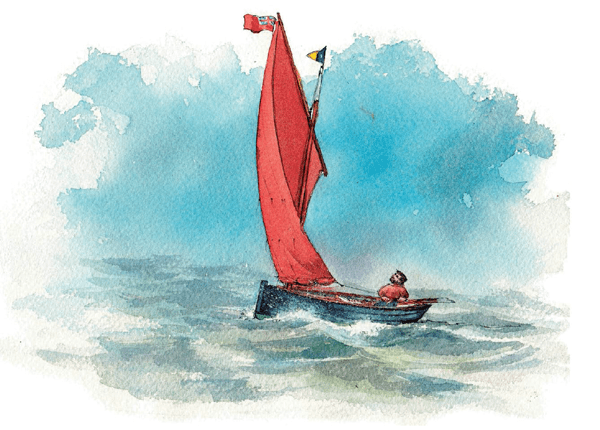
Painting by Claudia Myatt

There has been another lovely article from my old friend Roger Barnes on his preference for an open sailing boat over cabin yachts. A personal view: Why I sail dinghies. He once had a yacht and sold it before converting to a dinghy, first a twelve footer similar to my Sarum, but traditionally built in wood. Then he acquired his present Ilur designed and built by François Vivier and very similar to the fishing boats of old. I have sailed on a big modern yacht with five others, and it is another experience, but I enjoy my autonomy on a dinghy. I have never owned a yacht.

I sometimes look at boats for sale, particularly the transportable ones with bilge keels and cabins. Perhaps I could one day have one of those and keep my dinghy. I keep an open mind, but many practical things have to be thought about. I like the old gunter, gaff, lug and sprit rigs rather than the more impersonal bermudan rig with the high mast.

Roger contrasts life on board a yacht and spending a week or so on a dinghy. The latter is very much camping in a minimalist spirit. Yachts are more like caravans with dry and comfortable sleeping accommodation and galley facilities. They are the sort of boats that will appeal more to the wife, who might crew but would be more likely to prefer trailing a fishing line!

Roger has a somewhat poetic style of writing, which is very appealing. I tend to be very prosaic and get frustrated in trying to manage so much the small space limited by the length and beam of a twelve-foot dinghy. Another couple of feet might not seem to make much difference, but it does. The beam increases proportionately, and storage is made so much easier. Every year, I try to make improvements to where I put the safety stuff – accessible when the boat is capsized and mast-down (God forbid!). Most of the stuff in the forward compartment is connected with tent, bed and dry clothes in two dry bags. I have compartments for the galley, personal items and tools. I still get my feet encumbered by water and petrol cans. Roger by principle doesn’t use an engine. I do when I really need my old British Seagull, where an opposing wind and tide make rowing too hard going.

In the end, it all depends on how long you want to be out and where you want to go. Dinghies are limited to sheltered waters or the open sea in fair weather. A dinghy can be moored or dried out just about anywhere, as can a bilge keel yacht. I too notice the number of yachts occupying all the places in a marina, and hardly ever put to sea. People find they run out of money and time. Dinghies are much more DIY, and they go on a trailer in your own property, thus saving on mooring fees. I would be less quick to say like Roger that one is better than the other. It depends on what you want and what you can afford.

I would certainly like a larger boat that what I have. Perhaps one day, and that will give time to decide what I want to look for. The Ilur is a lovely boat, as is the Drascombe Lugger. We’ll see. Perhaps the next boat will be called Eboracum or one of the names of Gregorian neumes like Porrectus or Scandicus like monks call their livestock! Perhaps it will be the name of one of the lakes of my native Lake District like Grasmere, Rydal or Windermere. For the time being, it is Sarum.

Posted in Uncategorized | Tagged | 1 Comment

The Patrimony and Romanticism

I received a very kind e-mail about my last posting on what we continuing Anglicans are continuing. The correspondent in question is a priest in the Church of England but in the Forward in Faith jurisdiction. I think two paragraphs of that e-mail can be reproduced here without breaking any confidences:

I have just read your latest post. Full of good sense. The best of the Ordinariate are now, in the quest for “the patrimony”, pretty well all on the same page and exploring the same themes – the power of romanticism, its place in our history, and its potential for renewal etc. (Some are even a bit less snooty toward those who have not joined the Ordinariate, and renewing older friendships!) The Francis papacy is not all bad, but it is ensuring a rediscovery of the authentic theology and history of the primacy, and the question of what it’s all for. (Fr Tillard may well now be read by a new generation!) Some (not all!) who went to the Ordinariate were attracted in part by the most unfortunate aspects of triumphalist counter reformation Rome. They tended not to be well enough versed in the actual writings of Joseph Ratzinger/ Pope Benedict to know that he himself was never a “maximalist” with regard to the Primacy. I cannot believe he didn’t know that his “retirement” would help “demythologise” the primacy as part of the excruciatingly difficult process of its renewal.

(…)

Keep up the ministry with the blog. There was a time not so long ago when I thought that only Tracey Rowland (who wrote and lectured so movingly about romanticism and the nouvelle theologians – even including the impact of John Henry Newman’s writings on the young Joseph Ratzinger!-) and I were the only people left who could see the moving of the Spirit in the great romantic movement.

It was the impression I had of the Ordinariate clergy I met in Oxford, including Monsignori John Broadhurst and Andrew Burnham. I personally congratulated the latter for his comments on Romanticism in his talk, in which I wrote Msgr Andrew Burnham and Romanticism.

(….) what drove High Churchmen, at least from the nineteenth century on, at least in part, was the romantic movement. In that sense æsthetics led theology by the nose.

He was kind enough to talk with me for a few minutes in the north quire aisle of the church over a cup of coffee. It was the story of my own conversion. My love for church buildings, organs and choirs preceded my interest in theology and spirituality. The “icon” of God brought me to God. This is of paramount importance in an age when many clergy believe that beauty should be abolished as an act of penance of the western white race. This theme is (he is still alive) uppermost in the thought of Pope Benedict XVI, a German cradle Roman Catholic and a Romantic.

My correspondent mentions Fr Tillard, whose lectures on the Trinity (mostly from the Eastern Orthodox point of view) I attended as a student at Fribourg University. His real subject was ecclesiology, and I have his book Eglise d’Eglises, L’écclésiologie de communion (Paris 1987). I had every admiration for him, and he always had a kind word at oral examinations in the way of a spiritual counsel. We need the ressourcement school of theology also with authors like Louis Bouyer, Josef Ratzinger and Dom Odo Casel. I have a feeling that the leadership of the English Ordinariate may well go down this path with some original studies and scholarship.

Tracey Rowland needs reading. So far I have only read her Ratzinger’s Faith, The Theology of Pope Benedict XVI, Oxford 2008. In this book, she makes several references to Romanticism. For example, on page 6: 

Perhaps because so many of the questions raised by the Existentialists and the so-called Modernists were products of the nineteenth-century Romantic movement in Germany, Ratzinger, Karl Rahner and Hans Urs von Balthasar, and other German-speaking theologians of their generation were able to see that something more than Neo-Scholasticism was needed to address what were fundamentally Romantic movement issues in a period of European history when Christianity appeared to have run its course. To put this point another way, if the central interests of the Romantics were history, tradition, beauty, individuality, and self-development, a Catholic response to this tradition needed to address these themes. Many Thomists who taught in seminaries in the first half of the twentieth century did not go near these topics, either out of a lack of interest or because of a fear of being suspected of Modernism. For seminarians like Alfred Lapple and Ratzinger, the writings of Newman and the Fathers of the Church provided a refuge and a treasury wherein one could safely reflect upon these topics.

I am thankful for my alma mater, Fribourg University, that for the most part taught this kind of neo-patristic and ressourcement theology. The Romantic element dawned on me as I found a common source, not only of a renewed philosophical and theological movement, but also art and beauty. I now do this work as a priest in the Anglican Catholic Church – Original Province. Not being a charismatic personality, I am no leader – but I seem to be able to convey ideas that others will make into a dynamic movement. Each to his own gifts…

* * *

Update – a few articles by Tracey Rowland on Newman’s influence on Pope Benedict XVI

It all reminds me of that enormously optimistic period in the late 2000’s and up to about 2011 when we were all discussing the meaning and interpretation of Anglicanorum coetibus. Tracey Rowland seemed to whittle everything down to Newman, who was without doubt a character in the Romantic movement, and the theological mind of Josef Ratzinger. The latter was always extremely careful about what he said and wrote given his position as a senior cleric in the Vatican. Rowland draws from the greater Romantic tradition when analysing what seemed to matter most in the era of Benedict XVI.

My own impression of Newman was that of someone who was extremely talented but naïve when he left the Oxford Movement to become a Roman Catholic. Keble and Pusey were also pillars of the Oxford Movement, and remained Anglicans. Newman is hailed as an example of the model convert to inspire hundreds of Anglican intellectuals who became Roman Catholics. It is easy to become swept into a movement that isn’t ours!

The idea of seeing Romantic influence is nothing new to me. I was particular influenced by Fr Guy Bedouelle’s church history seminar at Fribourg on Liberalism, for which I prepared a topic on Félicité de Lamennais. I would only discover the influence of Romanticism when I bought Bernard Reardon’s Religion in the Age of Romanticism (Cambridge 1985). This book and a number of other works by Russian philosophers like Berdyaev and Catholic Modernists like George Tyrrell shattered my last links with Thomism, driving me to neo-Platonism and all that implies. That turning point marked me ever since, with Newman a little more in the background as I became increasing alienated from Roman Catholicism in the John Paul II era.

Posted in Uncategorized | Tagged , , , , , , | Leave a comment

What are we trying to continue?

Some time ago, I resolved to step down from the sterile polemics with our friend in California – yes, you know who. I won’t give the link this time. He has noticed that the American Episcopal Church has decided to eliminate all gender language from its Prayer Book. Shocked? We can only conclude their final capitulation to modern secularism and identity politics, the leveller of institutional stupidity.

The “regular correspondent” chained continuing Anglicanism to its progenitor, the Anglican Communion. Continuing Anglicanism could only follow the same decline and fate. Perhaps so, as we observe in all institutional churches including the Roman Catholics – at least under the present Pontificate.

I keep a certain sympathy with the Ordinariate, at least the one in England. I had my only contact with them at the Oxford conference last April, and found them to be serious and purposeful. They have ordained ten priests this year, whom I assume to have been properly trained and examined. As things went in about 2011 and up to the abdication of Benedict XVI, I didn’t go that way. I waited for Archbishop Hepworth’s endgame to play out, and waited a little longer, knowing that I didn’t matter to anyone. I was quietly received into the ACC by Bishop Damien Mead in April 2013 and continued my ministry of the word through blogging and The Blue Flower. I have expressed my view about conversion to Roman Catholicism on several occasions. If I did so again, what good to it do to myself or others, considering that I would have to give up the priesthood and revert to being a layman? Being a priest isn’t a sine qua non to salvation, if that is what it’s all about, but Christian life is all about doing better things, making wiser decisions – and not slumping into a nihilistic attitude in life.

The Ordinariate people have been quite concerned at defining Anglican Patrimony, as I heard in Oxford. Benedict XVI, a German cradle Roman Catholic, was also interested in this notion in the plan of regenerating European Catholicism. After all, he had to try. Now, Christianity has to be a part of secular humanism, something like in the eighteenth century without the baroque culture, and surrender to the latest trends of modernity. Perhaps it might turn to the way of Evangelical and Reformed mega-churches and work through celebrity worship and techniques of marketing. Ugh! Monsignor Andrew Burnham nailed it on the head by identifying Romanticism as the power source of the Oxford Movement, medievalism and a new convergence between “northern” Catholicism and a ressourcement and renewal movement amidst the ruins of popular Catholicism and attempts to imitate the Evangelicals.

Hopeless! – our “friend” would triumphantly proclaim. American Catholicism seems to have a stronger infrastructure of suburban lacklustre parishes than England or most of Europe. This side of the Atlantic, the only thriving parishes are in Paris or run by the “new” communities. I visited a church a few days ago and saw the green mould on the floor and the rotting furniture. The building was only exceptionally open!

I cannot speak for the Ordinariates, because I am not one of them, nor have I ever been. I am less pessimistic than our “friend”. I willingly give the link to the Anglicanorum Coetibus Society blog which gives news about all three of the Ordinariates. After all, I say, if something is doing the Lord’s work, who am I to judge? I wouldn’t seek to join them even if by some miracle my priestly vocation could be “saved”, but they exist and minister.

We in the Continuing Churches also do what we can without the supposedly well-oiled structures in America and of course the money that says everything. I am not sure we will survive for very long. In England we are very fragile and very much depend on the Bishop we have. We are slowly building, and we might make it beyond our own lifetimes – but perhaps not. Does it matter in view to the dangers human civilisation and the natural environment face? My optimism is also mitigated there. However, I know that we have moved beyond “infighting and factionalism” and refer more to Catholicism without any other adjective or the post-Tridentine ideology rather than our past parochialism. I turned to Romanticism for the same reason as men like Novalis, a yearning for the cosmopolitan, the light and broad-mindedness. We made mistakes in the past through our petty ambitions, and now we need to build on the foundations we have been able to establish.

I see our identity in what we are called to do rather than the simple conservation of our nostalgic past in this or that parish. I have not been allowed by circumstances of life to be a pastor. I have experience of French parish life, with the few old priests I have known – but that was not to be my ministry. I do what I can do. I have always been aware that I have given ideas to others who then reaped the benefits. So that seems to be my vocation, to give ideas to others and live my little life in less than ideal circumstances, but which could be much worse.

What would I like to see happen in our Church, Rome and elsewhere? I will express it in positive terms rather than what we need to be rid of. We need Catholicism, not Roman, Anglo, or whatever. Just Catholicism. The way I see things is how the Oxford Movement had ideas in common with the Old Catholic movement in Germany and Switzerland deriving from the Council of Constance. It is a notion of a “medieval” Church without the corruption and the domination of secular power. Gallicanism survived the Revolution but only continued in fragmentary form until the mid nineteenth century, Vatican II and the deaths of the last old parish priests. It is a Romantic idea, not realist, because it can’t be implemented by means of laws and reforms. Such a vision would be snuffed out under modern Rome. We have to be independent, yet in coherent Churches.

So far, some of us are still writing and the conversation continues. My chapel will die when I do, and I intend to leave all my “stuff”  to my Diocese, assuming it outlives me. I hope it will! I hope to be able to leave my writings and a few books to gather dust somewhere or be read for what they are worth. I am not a celebrity.

Again, it is the grain of wheat in the earth and the conditions for bearing fruit.

Posted in Uncategorized | Tagged , , , , , , | 50 Comments

Medievalism and Ritualism

This is the kind of article I would have appreciated in the first issue of The Blue FlowerMedievalism and Ritualism – Part 1: Percy Dearmer and the scholarly context of the Parson’s Handbook has been written by Fr Allan Barton who is a priest in the Church of England. “Part 1” implies that there will be at least a Part 2 to look forward to. I found the link up on my Use of Sarum group on Facebook, which now has more than eight hundred members.

Perhaps we can call this the “other” Anglican Patrimony as opposed to the more Roman and post-Tridentine style preferred by many Anglican churches. Enough of the old feuds like in English Roman Catholic seminaries in the 1940’s! But we need to dialogue and rejoice in our diversity which is also part of the Anglican way.

Posted in Uncategorized | Tagged , , , | 2 Comments

That Which Remaineth

My Blue Flower contributor Dr Timothy Graham has been running his own blog That Which Remaineth for some time, in fact for five years. For some reason, I have neglected to bring attention to it on this blog apart from a sidebar link. Dr Graham has always set out to discuss the ideals of Anglo Catholicism (he is a layman in the Ordinariate), his love of books and reading, and above all his passion for philosophy and the Romantic world view. I also warmly recommend his article The First Signs of Freedom in the current issue of The Blue Flower centred on William Morris’s Art and Labour.

We spent time together last April and went to the famous conference in Oxford in that lovely Bodley church of St John the Evangelist. There was so much to talk about in too little time! Apart from philosophy, I was astounded to discover such a beautiful and unspoiled part of Surrey – so near London! My mother was a native of that county.

How refreshing it is to discover a world of quiet and reflective people, and surely with others who will also write articles for The Blue Flower! This journal is a modest beginning, and I hope in time that we will have get-togethers where we can sing or recite the Office together and share our deepest aspirations.

Posted in Uncategorized | Tagged , , | 3 Comments

The Blue Flower is here!

I have just finalised the first issue of The Blue Flower.

It can be obtained in pdf format through the The Blue Flower page or

Directly

You can then print it out as you wish.

After a general editorial giving the tone of the journal and this issue, there are three articles, two on medievalism as an expression of Sehnsucht, and an excellent article by Fr Jonathan Munn showing the thought and work of Novalis (Friedrich von Hardenberg) as a mathematician. I was never much good at mathematics myself at school, but it is an essential science with its own symbolism and mystical meaning. Music is a form of mathematics as are the calculations we need for our everyday lives, our occupations and things like designing complex objects and finding our way around at sea. The basis of our mathematical knowledge goes back to the ancient Greeks like Pythagoras and Euclid. I welcome this perspective to complement medievalism, the Oxford Movement and cultural expression in art and poetry.

These are small beginnings and everything has to be built up from scratch. I am thankful for the technology that allows any kind of publishing without the expense of a gamble. My site statistics page will inform me about the number of times it has been downloaded, and will provide information for a paper version in the fulness of time.

Feedback is going to be essential as will be finding new contributors for the next issue for the Winter Solstice and Christmas 2018. Please contact me by e-mail or by comment to this posting.

* * *

According to my site statistics page, this file has been downloaded 77 times in the space of less than 24 hours. I am encouraged!

Posted in Uncategorized | Tagged , | 7 Comments

Romantic Sarum

My attention was drawn today to Fr Hunwicke’s posting Pugin and Sarum. Dr Timothy Graham sent in a comment to my blog:

On Fr Hunwicke’s blog today (Pugin and Sarum), “more recently than that, a complete rendering of the Sarum Ordo Missae in Cranmerian pastiche was put together for use in the Ordinariates … but the plan failed since the Americans and the Australians were unkeen.” I wonder where this text could be obtained. What a shame!

to which I replied:

I remember from about 2011 or thereabouts that Monsignor Andrew Burnham wrote favourably about Sarum, at least as an “extraordinary use”. Bishop Peter Eliott also warmed to the idea. I was invited to write The Future Liturgy of an Anglican Ordinariate: Why not Sarum? for The New Liturgical Movement. Fr Hunwicke also wrote for NLM and expressed his position for the English Missal as being close to the post-Tridentine Roman Missal.

The can was kicked here, there and everywhere. Everyone is talking about Sarum but no one wants to do anything about it. I get lots of “hits” for my static website as well as this blog, because of the Sarum element. I think the text is simply the Warren translation for which you will find a link on As the Sun in its Orb – The Use of Sarum under “Major Resources”. Warren did the whole thing in Cranmerian / early modern English.

Every single attempt to revive Sarum has met with opposition or indifference in the Roman Catholic Church. It is a lost cause. I think I have understood something from my recent visit to the old Allen Hall at St Edmund’s College, Ware in Hertfordshire. I was shown around by Alan Robinson, a schoolmaster there, and I was able to “feel” that pettiness that reigned between “English” and “Roman” in the early 1940’s when the young convert Fr Quintin Montgomery-Wright was a seminarian there before asking for a transfer to France. Few of us can have any idea of English Roman Catholicism of the period before Vatican II, the sheer stuffiness and small-mindedness of it all. Compared with that, Gricigliano was no more than the froth on the glass of champagne! The chapel at Ware is a fine Pugin building, but there is no evidence that Sarum masses were ever celebrated there.

Fr Sean Finnigan was the priest who celebrated the Sarum Use in Merton College Chapel in the 1990’s until some little twerp ratted on him to Rome and it was all stopped. The Legal Status of the Sarum Mass is revealing as are the comments. The Ordinariate project might have been an opportunity, another “might-have-been” passed by.

Should we give up and leave it as a lost cause? Why do people still discuss Sarum and show an interest? After all, less interest is shown in the Ambrosian Rite of Milan and the Altspanische rites. Only Sarum is associated with something other than simple academic studies of defunct liturgical uses. It seems to be symbolic of a kind of “English Gallicanism” to offset the prevailing Ultramontanism of the nineteenth century onwards.

I just go on with it day after day, knowing that everyone but no one is interested. I am dead to the world and to that church of the world, the flesh and the Devil. Switching to the English Missal or the Missale Romanum of 1570 and all the decrees of the Congregation  of Rites would make no difference in that regard. In the end, it is not liturgy that will make the Church relevant to the world or even sincere and searching souls, but philosophy and a new paradigm that I believe Romanticism can bring. The original Gospel message is lost in the obscurity of added ecclesial meanings given to some very radical ideas. No liturgy will be of any relevance without some philosophical and cultural foundation. St Paul only made progress through Greek philosophy!

The ideal environment for the Use of Sarum is continuing Anglicanism – in which my eccentric quirks are tolerated. I doubt that anything will continue after my death, but I will leave all I can in terms of writings and various pleas. I can do nothing more.

Posted in Uncategorized | Tagged , , , | 17 Comments

Finis Terrae

Rather than providing a simple “family slide show”, my purpose here is to emphase a more human and spiritual dimension of my little outing in a small sailing boat. Perhaps I still suffer from Swallows and Amazons Syndrome and my childhood dreams of sailing boats and adventures. I also live out my moments of the 1960’s reaction from post-war conservative authoritarianism as many of my fellow greying “boomers” at the Route du Sable. There was even a boatload of kids in their forties and younger with the pirate theme and truly letting off steam. They gave me a tow up the river as the current turned unfavourably to join an unfavourable east wind. We couldn’t be late for the lock at Guilly-Glaz!
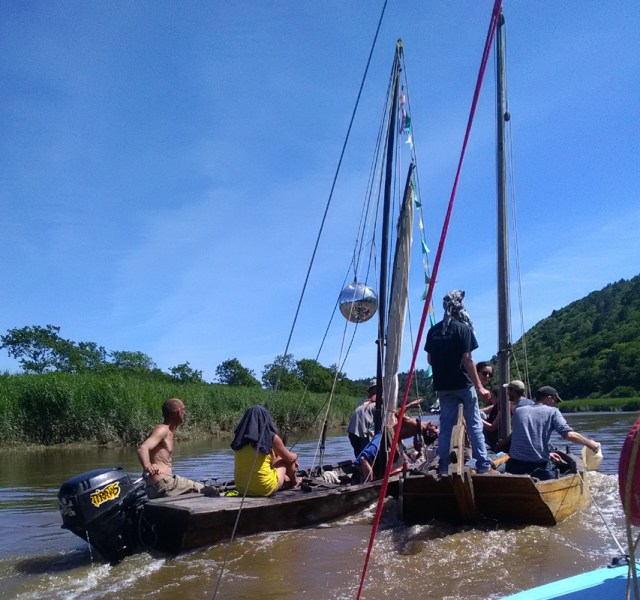
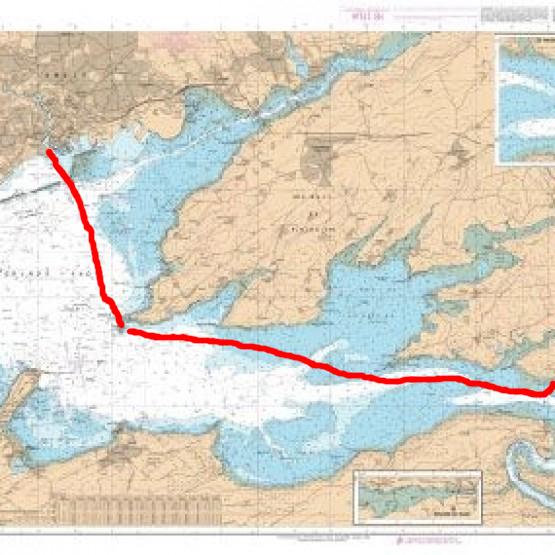
My week began in the Rance to the south of St Malo, launching at the electricity-generating dam to the north and all the way down to the lock north of Dinan in the south. I spent a total of two half-days, and decided that my real week would be spent in the Rade de Brest in the Finistère, the French corruption of the Latin term Finis Terrae, Land’s End like in Cornwall. There is an odd feeling to looking out to sea and knowing that the next land mass is America! Suddenly, our humanity is humbled before this immensity of the sea, both inviting and forbidding at the same time. My little dinghy is not up to the might of the Atlantic Ocean, and even sheltered waters like the Rade de Brest can be challenging.

Above all, I have to obey the eternal cycles of the tides and the fickle Brittany weather, where people say that the Brittany weather is fair every day, several times a day! I imagine the Irish have something similar to say in their Emerald Island. The tides leave a boat dried out for hours and give a night’s sleep undisturbed by any movement. They also provide favourable currents if we organise a trip well and have the right “app” on the mobile phone. My phone also provided constant weather information and a detailed GPS chart plotter to avoid nasty things like rocks. Long hours at the helm empty the mind of anxious thoughts and irrelevance. On returning to the place where I left my van and trailer (Trégarvan on the Aulne river), I fired up my computer (left in the van) and hotspot-connected it to my mobile phone to get the internet. The various blogs and sites of religious polemics left me totally cold and indifferent. I only read the postings concerned after my return home and similarly brushed them off.

Another lesson to be learned is minimalism, making do with very little. My mobile phone battery needed to be charged, and my two little charging batteries could only do so much. One gave off a very unpleasant smell and smoke when I tried charging it with my solar panel. I reacted quickly, and it still seems to work, though its battery is depleted. With good organisation, I kept an operational mobile phone for nearly a week. Another thing is food. I wanted some fresh things and cooked breakfasts – bacon and eggs.

The gas canisters I was using don’t last for long, and I went several days without a spare, eventually finding two of them in a shop. Pasta is a good fall-back and quite decent pre-cooked rice is worth getting for the galley. Here, the boat was moored to a very slippery launching ramp where I spent the whole day of Tuesday in Daoulas when there was no wind. I also had to economise the petrol for my outboard engine, and the dammed “sewing machine on the back” makes so much noise that any contemplative life is made impossible. Eventually, the water cooling impeller gave out and I had to stop using the engine except for short bursts whilst it was still cold. Everything has to be economised and thought out carefully. It is a good lesson.

For the night’s sleep, I have my two cockpit seats that move together in the centre of the boat, and then I use a light self-inflating mattress and a sleeping bag. With some careful use of a towel over the centreboard well, I had a full-length bed, which was a little hard on the hips towards the end of the night. After the first night, I generally slept from about 11pm to 6.30 in the morning. A tent made from garden tarpaulin material goes over the boom. In the boating fraternity, guys who sleep like this are called hard bastards!

It is important to be able to forego comfort, at least for me. I perhaps reflects the life of monks and hermits in the early Church, except that this was a week’s retreat for me and not my usual way of life. It is after all difficult to get showers and keep clean and groomed! Reading was possible as was saying Offices from the Breviary like during my day up the creek at Daoulas. I also had some shopping to do and some visiting.

Abbaye Notre-Dame de Daoulas

I then sailed to Brest last Thursday in disappointing winds. I had to fire up the engine several times. I stayed the night at the Marina du Chateau in a part of the old naval establishment sold to private enterprise. The marina was not unpleasant and I felt some need for urban life.

My mooring fee included use of the shower block, which was beautifully clean and modern, like in a good camp site. The cafés and restaurants along the front of the marina were full of fashionable young people, and it was all very noisy. I had supper in the boat and slept for the night. Before going to Brest, I neglected to check the weather for the next day – a big mistake. The wind was freshening to about 12 knots in the morning, and would go up to 15 and gust in the twenties. The Route du Sable was in question if I stayed marooned in Brest. Stiff upper lip and some careful sailing got me there. I left port by about 8 in the morning whilst the wind was still reasonable for the exposed crossing from Brest to the Ile Ronde.

I sailed on a broad reach and surfed on the waves. No capsize! I was on my own for this one. On sailing along the north coast of the Rade, I found the wind almost in my face, so had to close-haul. The wind freshened as promised and the gusts were quite unpleasant as was the chop. I had to shorten sail and take in a reef. I left the jib up to keep some control over the boat’s trim. I just had to keep going. By evening, I sailed the entire length of the Rade non-stop, mind emptied of junk, determined and concentrated on keeping the boat from capsizing. I was successful.
My rest on that calm beach on the weather shore was most welcome. I was where I needed to be on Friday night, in the river Aulne at Trevargan. My van battery was flat because a light had been left on inside the vehicle. Fortunately, a kind retired man gave me the juice via my jump leads I needed to start the engine and go and get some shopping in Châteaulin. That also recharged the van battery. If I “recharged my batteries”, it was as literal as figurative!

On Saturday morning, the other boats arrived for the Route du Sable. Usually the west wind would push the boats up the river and respect the closing time of the Guilly-Glaz lock determined by the tide. It was an east wind. We could tack on a wide part of the river, with the current in our favour. Actually the current will push the boat into the wind and give more virtual wind speed – an old regatta trick. I left my engine in the van and managed with sail and oar alone like most of the other boats. Rowing into the wind is quite unpleasant!

 The best we could hope for was that the wind would drop to allow us to row at a decent speed! My boat is on the right in this photo. The current turned, and it was time to be towed by a boat with an engine – the “pirates” and their roll-your-own cigarettes. After we were safely through the first lock, it was easier to make progress by rowing. I had my red jib up to catch the occasional breaths of winds from behind, saving two or three oar strokes. Here we set off from Port Launay to Châteaulin.

In the afternoon, we went back to Port Launay after a little reception at the camp site (where I was able to get another one of those heavenly showers and hair washes). Back to the grind with oars against the little puffs of unfavourable wind. The wind was in the wrong direction, but we enjoyed perfect sunny weather.

Then came the time to get the trailer and recover the boat from the water, get everything packed up for the long journey home to Normandy. As always, it was a tough week, and I am grateful still to be able to do it and keep something of the spirit one learns with the Boy Scouts and our Combined Cadet Force we had at school. Self-reliance is something that is vital for the Romantic and transcendentalist mind, as it was for the monks and aesthetes, as it was for Fr Charles de Foucauld in the Algerian desert. He had been a soldier and a true “hard bastard”. I come nowhere near that discipline of body and soul, but something like a twelve-foot boat and knowing what I want is a good second-best.

Posted in Uncategorized | Tagged , , | 6 Comments

Twentieth Anniversary of my Priestly Ordination


Time goes by so quickly. St John the Baptist’s Day is approaching, and I will be afloat somewhere on the River Aulne. Some recent discussions brought my ordination to mind, which is found on my blog at:

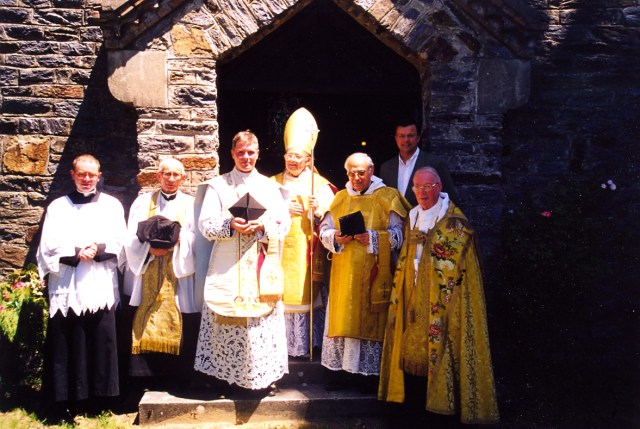
I made no secret of the fact that I was ordained a priest on the 24th June 1998 by Bishop Raymond Terrasson, an independent bishop consecrated in the Ngô-Dinh-Thuc succession. He was consecrated in 1976 by the self-exalted guru Clemente Dominguez y Gomez of the flamboyant Spanish cult at Palmar de Troya. The sect in question might be despicable and heretical, but there remains the fact that they received the episcopate from a Roman Catholic archbishop who apparently was not joking or in some state of mental malaise when he did it. Donatism is still a current heresy among some faithful of the Roman Catholic Church. Bishop Terrasson no longer belonged to the cult when he ordained me, having left when the guru proclaimed himself “pope”.

One solution is to deny the indelible character of the sacrament of order (defined by the Council of Trent) and you do away with uncanonical clergy at a stroke, but you saw off the branch of your own clericalism! Alternatively, there is the “Cyprianic” view that ties validity to the – wait for it – “true church”. The problem is which “true church”. The Augustinian view allows some “economia”, but has to make a distinction between “valid” and “licit”. It is a jungle of speculation, which only adds to the ridicule of spiritually bankrupt institutional churches. Can one blame the Protestants of the sixteenth century?

For the sake of prudence, I received conditional re-ordination to the priesthood from Bishop Damien Mead in 2013. The faithful of our Church have the right to be morally certain of the sacramental validity of all our priests.

The place where my ordination took place is symbolic, a chapel built near the village of Coussac-Bonneval near Limoges in 1946 in thanksgiving for the village having spared Nazi atrocities in 1944 like the massacre of nearby Oradour-sur-Glâne. It is a simple stone and concrete building, dedicated to Our Lady of Biaugias. It stands as a memorial to the men and women who resisted the Nazis in France, and who often gave their lives very painfully in the hands of the Gestapo.

Two Roman Catholic parish priests were present and participated in the ordination: Fr Jacques Pecha (1920-2002) of the parish of Bouloire (Diocese of Le Mans) and Fr Noël Tibur (1918-2010) of the parish of Clermont (Diocese of Dax). Another priest was present, previously ordained by Bishop Terrasson. Fr Pecha, a priest who had a tremendous influence in my life, had the role of Archdeacon and Assistant Priest.

The ordination was uncanonical in the eyes of anyone’s Church, I readily admit it. However, there was nothing grubby or shameful about it, the doors of the chapel being left open throughout the ceremony. Experience brought me in time to a much more sober view of independent bishops and the shenanigans of some. Sometimes, it is hard to find the fine line between a legitimate Church – as I believe the continuing Anglicans to be – and flagrant irregularity. In the end, we need to see what it is all about, as I have alluded to in my previous article on the vocation.

* * *

Some make allusion to an episcopate I received in 2000. Since I have not exercised it in any way since 2004 (I ordained a priest who since then became Orthodox – and would have been re-ordained), it is of no relevance in my life as a simple priest.

Posted in Uncategorized | Tagged , , , , | 7 Comments