I am a member of Churchcrawling – A Passion for Churches on Facebook, run by Fr Allan Barton. An article came up about a church in Manchester with a kind of architecture I have never really liked. It is the “preaching barn” built in about 1830 with “gothick” windows and a bell tower, usually well built in stone, but with a large space enclosed by the outside walls and a two-pitched roof. The design excludes side aisle or pillars, and especially eliminates the quire, leaving only a small stubby sanctuary for the altar.
The east window is ghastly and the style is manifestly very low church, though there are icons and candles on the altar.
Coming from the north myself, this is the typical church from about 1830, the answer to the Industrial Revolution. They are not only low-church Anglican buildings, but the RC Church also sometimes built in this style rather than copying the native pre-Reformation style of most Anglican buildings. An example is Holy Trinity & St George in Kendal (my home town). This design did away with the choir of the church, as did the Counter-Reformation.
The sanctuary is very Strawberry Hill gothick. The church was built between 1835 and 1837 for the growing Roman Catholic community in Kendal. Until the 1980’s, there were two side altars with nice German-style retables. The old altar is still in situ, but it might only be the front without any depth to give room for versus populum celebration. Note the arrangement of the pews with two side passages and no central aisle. St Thomas’ has the same arrangement.
The church has no tower, doubtlessly for financial reasons and because Roman Catholic churches were not allowed to ring bells until the early nineteenth century. The façade is quite French.
The low church Anglican parish in the same town, St Thomas. I was baptised in this church in October 1959.
The architecture is stark, and the scissor beam arrangement for the sanctuary roof is interesting. The structure had to be reinforced with tie rods pulling the end walls together. For its time, it would have been quite a feat of engineering.
St George’s (more high church) near Stramongate Bridge was built in the same style without pillars or side aisles, but had an Edwardian sanctuary in the early 20th century. This was my childhood parish and where hearing the organ started me off on a whole quest in life.
This is the church from the outside. There were twin spires which had to come down because of weaknesses in the foundations. The architecture of the nave is remarkably similar to St Thomas’ and the RC parish church.
From when I was a small boy, I vividly remember my father coming into my bedroom asking me whether I had been reading after lights-out time. I lied and said “no”. My father proceeded to touch the bulb of my bedside light and found it to be hot – proof that I had lied. I was not so much punished for breaking my lights-out rule but for lying. My father’s principle was that lying and stealing had to be dealt with severely, and I believe he was right.
I was thus taught to love the truth and honesty, even if it would be to our disadvantage. It was the same at school, and this sense has been powerful in me with what has turned out to be Aspergers syndrome, a totally different view of the world and society. What has really offended me has been to hear easily refutable lies from those who should be the most honest: businessmen, politicians and priests.
Recently, I have been reading about terms like post-truth and fake news. They “become viral” and spread. Most people I discuss this with tell me that they know we are being lied to and treated like dirt. I have never liked President Trump, but I thought his electoral patter was more convincing than that of Hillary Clinton. I have been reading articles in the alternative media as well as the mainstream. Nothing seems to add up. Trump ordered his military to launch sophisticated high-tech missiles costing millions of dollars in reprisal for what he called a chemical attack with sarin gas on a village. Why on earth would Assad do such a thing when he was winning against ISIS / Daesh and willing to step aside once the civil war is over in Syria? It didn’t add up. For some pundits, Trump was flip-flopping and betraying his voters in America. For others, this was a part of a Machiavellian scheme that none of us understands.
Here in France, we are being subjected to the same bullshit from the “empty suit” Macron, and I am quite shocked with some of the things said by Mme Le Pen in the debate this week between the two finalist candidates for the Presidency. In such a duel, both persons would have been under considerable stress, which makes objective reasoning difficult. They were shouting each other down rather than obeying a moderator and taking turns in expressing their theses and antitheses – following the civilised rules of debate. It was the law of the jungle! I tend to think that we would be better off with Le Pen so that the system can be routed out and “rebooted”. It could be bloody and very unpleasant as we descend into civil war – but civil war now might be less unpleasant than when the “religion of peace” arms itself better and has more fighters and terrorists. On the other hand, as with Brexit, leaving the European Union with the European Union still intact is dangerous, as we Brits are finding out in our own run-up to a general election.
How have we come to this. The term post-truth has been in my mind for a while, so I looked it up in Google. There’s a fellow called Ralph Keyes who seems to have studied the question and has written an accessible introduction – The Post-Truth Era: Dishonesty and Deception in Contemporary Life
The way I am, I have always been out of my depth with euphemisms and means of “bending” the notion of truth and honesty. We are manipulated all the time by other people in society, especially when they want our money without equivalent value in exchange. One sign of this scourge is the use of langue de bois, a special kind of language that does not inform the intellect but excites emotions. I sometimes have to translate it, and do not always find it easy to satisfy the client!
Usually, people don’t lie overtly, because lying removes a person’s general credibility. Falsus in uno falsus in omnibus – Something is wrong in one small matter and the whole is rotten to the core. Isn’t it amazing how Latin is such an economical language and doesn’t waste one’s breath! Usually, it is a matter of blurring the borders, introducing ambiguity and removing the exact meaning from language and words. The intention of deceiving by mental reservation or ambiguity becomes a habit. This brings us to a very uncomfortable situation where we can no longer trust someone giving us a job, selling us something or whatever.
I have sometimes been tempted to “doctor up” a curriculum vitae, but I am always afraid of selling out my own soul – and being discovered as a liar, like when my father touched the light bulb and went by empirical evidence. Like the boy who cried “Wolf!” three times as a false alarm, no one would believe him when the wolf came and ate the sheep he was looking after. That is my simple Yorkshire morality, but all that is going out of the window, and we face Orwell’s dystopian Ministry of Truth, truth which changes with the tyrant’s pragmatic needs.
In the ecclesiastical world, I have come across independent bishops who for the most part had their own snake oil to sell. One such whom I met in France produced forged false documents as evidence that he had been consecrated by a Roman Catholic bishop, and therefore that he had the “most valid” episcopate. Episcopate of what? The more I saw of this man, the falser he proved himself until such time as I could not believe him at all. There are others who will tell you that they have secret relations with Rome and that it is only a matter of time before they would be formally recognised and be given complete credibility. I won’t mention any names.
It is becoming fashionable to fabulate one’s own legend, falsely claiming qualifications or awards one doesn’t have, a bogus life history. How does this come about? We hear that disdain for “truth” is a part of post-modernism, the thing of the future. We are taught to be non-judgemental and not to condemn something that is clearly wrong. There is also the question of pathological personality issues like narcissism, perhaps itself a euphemism for evil or moral weakness. Psychiatry is a very inexact science with little to go on.
If truth is out of the window, then what happens to trust, being favourable to a person until that person betrays that trust? We now have to assume someone to be “guilty until proven innocent” or bad until proven to be good. What is reality? What is truth? These were also big questions in ancient times between Platonists and Sceptics. Quantum theory has eroded the materialistic notion of reality, and we have to see things in terms of consciousness and energy, which are perhaps more stringent about truth than materialism. We are humans, and the notion of truth and trust is the only basis of society and a social contract.
On the eve of the French election, we are living in great danger as with nearly all other self-interested politicians since General De Gaulle. All this stuff exhausts me, but writing about it does some good in these hours of anxiety.
I mentioned the issue of punishment in the Royal Navy at the end of the eighteenth century in connection with Captain Bligh and the mutiny of the Bounty. I have of course, like many others, been influenced by the films made on this subject in the 1930’s and in 1962. Bligh was portrayed as a cynical sadist without any empathy for the men under his command. The 1984 film Bounty, is more moderate on this subject, but shows Bligh as foul-mouthed and rude to his officers, even in front of the crew.
This morning, I received an e-mail from a correspondent:
I take your point about the religiosity of fear and punishment and it will be undoubtedly be so that the Royal Navy saw it fit – eventually, after some considerable time – to discontinue flogging of its sailors, but I think your phrasing “the court-martial of Captain Bligh” implies he was found guilty. We know in fact that he was honorably acquitted, went on to become a vice-admiral of the blue after a stint as Governor of NSW during which he time he sought to break the corrupt NSW “Rum” Corps and the privateers like John McArthur. His record, and the indisputable achievement of bringing all of his Bounty co-expellees across 3 and a half thousand miles to safety in Timor show he was a man of skill, courage, strength and integrity, of a character far-removed from the popular misrepresentations, (including of his alleged brutality).
The Wikipedia articles William Bligh and Mutiny on the Bounty are of interest in our general historical education in the matter. All commanding officers were harsh in those days and most sailors were pressed into service from taverns and prisons. These days, we prefer to think that a commanding officer who inspires respect and conveys a fatherly role would obtain better performance and team work in the demanding task of sailing a ship. The Navy recognised that fact, not only because of Lieutenant Bligh who was acquitted by the court-martial, but also because times were changing in the way of the Enlightenment.
The story of Bligh’s voyage to Timor, 3,618 nautical miles from where he and his loyal officers and men were set adrift in the Bounty’s shallop by the mutineers is a legend in the annals of seamanship. Regarding discipline, the evidence of the ship’s log shows that Bligh scolded when other captains used the cat o’ nine tails, had a man flogged when others would have him hanged from the yardarm. He was interested in science, and cared about the crew’s welfare, particularly seeing that they got food of good quality, hygiene and physical exercise.
I end with his final quote from the Wikipedia article:
The modern historian John Beaglehole has described the major flaw in this otherwise enlightened naval officer: “[Bligh made] dogmatic judgements which he felt himself entitled to make; he saw fools about him too easily … thin-skinned vanity was his curse through life … [Bligh] never learnt that you do not make friends of men by insulting them.”
I sometime say things lightly, or go along with the conventional view, which is not good. I sinned from weakness, but wanted to illustrate the point that human beings do better by being guided than punished. Punishment is sometimes necessary, as with training animals like dogs. The balance between reward and punishment, and especially respect for those you have under your command, is delicate and requires qualities I would certainly not have in such a situation. When I sail, I sail alone and have only myself to command, and the consequences of my own errors of navigation to assume!
On my morning rounds, I found “Good, or ancient, or Catholic” quoted from J. Wickham Legg. The exact source is not given, but a search on Google reveals his paper read before St Paul’s Ecclesiological Society on 27th October 1887, as published in Essays on Ceremonial in 1904.
Now the earlier ecclesiologists thought they might gain some knowledge of the customs of the middle ages by a study of modern Roman practices, receiving the assertion that Rome never alters with a too confiding generosity; and accordingly they proceeded to change some of the inherited medieval customs in accordance with the dictates of modern Rome. But from modern Rome we can learn next to nothing of the practices of the middle ages. A very little study soon convinces us of the deep division there is between the practice of modern Rome and of medieval England, and that modern Rome will only lead us astray if we trust to its liturgical decisions. Because a practice is Roman, it is not therefore of necessity good, or ancient, or Catholic. In the first place, the liturgy of modern Rome is the liturgy of the Franciscan Friars, while that of the national medieval Churches is the old Liturgy which was used in the parish churches of Rome before the days of Nicholas III. Theologians often tell us of the mischief which these Friars have caused in their science, and to philosophy; and the harm they have done in ecclesiology is certain. They are credited with the introduction of the Stations of the Cross, which even Mrs. Jameson can see set forth unworthy ideas. Further, how little of antiquity remains in practice in the Roman Communion may soon be gathered by those who will attend a few popular functions. Liturgical services, with the exception of the Mass, have well-nigh disappeared; and the seasons of the Christian year, which we prize so much, are but little thought of. Lent has given way to the month of Joseph; Easter and Whitsuntide are swallowed up in the month of Mary and the Sacred Heart.
I give the same emphasis as in the blog article, which has given no commentary of its own.
I have had the greatest admiration for Wickham Legg’s erudition in matters of liturgical history from his historical period of the late nineteenth and early twentieth centuries. I have also noticed this difference between the post-Tridentine Roman liturgy and medieval local traditions in the dioceses. He was one of my important sources for my university work on the Tridentine codification of the liturgy, which I resumed in a published book: Alcuin Reid (ed.), T&T Clark Companion to Liturgy, London 2016, pp. 107-131.
Though the Pius V liturgy is substantially the Editio Princeps of 1474 with a considerable amount of material removed from the proper of the saints, and with many of the sequences taken out, I’m sure that Pius V’s commission intended to streamline something intended to present a “noble simplicity” for a Church similarly streamlined to withstand attacks from Protestants and have credibility in the modernity of the Renaissance. Paul VI was not far off target when he compared his own Novus Ordo with the 1570 reform for the same reasons: “noble simplicity” and adaptation to the times. When I was at university, I was still trying to defend the traditionalist position Michael Davies style, and sang the praises of the “codified” (as opposed to “reformed”) liturgy of Pius V. Count Neri Capponi, a Roman canonist, made much ado about this distinction of words – but it didn’t convince me for long. Since then, I have seen a great deal of cohesion between the reform movement in the sixteenth century, and the “pastoral” reforms of Pius XII, John XXIII and Paul VI: authority trumps Tradition!
This is the essential difference between the Anglican Catholic and Roman Catholic understanding of things. Whilst the ordinary of the Pius V Mass (and the breviary) is identical to the old Use of the Roman Curia based on thirteenth-century Franciscan customs, the proper was radically changed. Pius XII did the same thing in the 1950’s with a brand new Holy Week and the use of a special proper for Popes rather than the older way of treating Popes simply as confessor and martyr bishops. Finally, Paul VI changed the order of Mass and the entire system of the proper and the lectionary.
Wickham Legg, like other Anglican historians and researchers in his time, noticed the ever-increasing gap between the medieval customs and the “dynamic” progress of Papal authority and centralism. The uses of medieval England, like those in France before the various “neo-Gallican” missals of the early eighteenth century, sprang and evolved from different sources. Our English customs since the Norman Conquest were decidedly French, something I can easily accept since French culture was so easily accepted in England, at least before the Hundred Years war, and to a great extent after it.
I do believe that we in the Anglican tradition, particularly in the Continuing Churches, should study this issue in greater depth. We have done well to take a critical position in regard to the “Anglo-Papalism” that inspired and created the Ordinariate under Pope Benedict XVI. I do believe that our diversity is healthy between more Prayer Book expressions, the English and Anglican missals, and the Use of Sarum I have adopted since 2008 instead of the post-Tridentine Roman rite I had been trained with as a seminarian. We need very much to continue to base our piety and prayer on the Mass and the Office, not only the clergy but also the laity. The use of classical English rather than an absolute insistence on Latin has been most beneficial in the Anglican way, including the Catholic revival.
My reflections are not cast in stone, but I do know that a number of people think in this way – with or without Aspergers Syndrome!
I have always appreciated Fr Jonathan Munn’s reflections on the Church. Before applying to Bishop Damien in 2013, I contacted Fr Jonathan and told him about my experience in the TAC. I remember Arbishop Hepworth’s claims of 500,000 faithful worldwide, a figure that was unverifiable and turned out to be untrue. In my experience, if something seems too good to be true, it isn’t. Fr Jonathan told me about the ACC as it has re-formed itself from about the beginning of this century. The analogy was a simple one: What’s in the jar is what it says on the label. If it says “strawberry jam”, then you don’t expect to find lemon curd! His latest posting Imposing sincerity is poignant.
Since our troubled days in the late 1990’s, we have needed to take stock of our identity, as with our Roman Catholic continuing counterparts. We have to go beyond institutional labels and think in terms of our cultural traditions. In the same way as RC traditionalists claim not to have broken away from the Church to create something new, because they are continuing what they did before, the same is true of us. The RC traditionalists set up “provisional” groupings to avoid usurping Papal authority whilst they wait for Rome to “come to its senses and return to Tradition”. We have perhaps been more pragmatic by creating new provincial and diocesan structures, bishops with ordinary jurisdiction. We don’t expect mainstream Anglicanism to do anything other than continue on its trajectory of revisionism and its inevitable death spiral. We might not last in the long term either, but we have been around since 1977 (1992 in England), and we are stabilising and growing.
This break has been an opportunity as well as a danger. When proud and selfish men take the helm, human nature is seen at its worst and we all suffer. When nobility and apostolic zeal steer the ship between Scylla and Charybdis, peace and joy descend as we continue our faith and liturgical life without compromise. The latter has been my experience of the Anglican Catholic Church from April 2013 to the present day. We can experience Anglicanism without the soul-numbing bureaucracy and the post-truth era in which we live. My experience has been formed by many things, in particular becoming a Roman Catholic in 1981 and going to live on the Continent at the age of 23, university, my discovery of the Romantic world view and my yearning for origins. A genie can’t be put back in the bottle, but my whole way of seeing things comes through this kaleidoscope of experience. With this attitude to life and experience, I am more Pre-Reformation than Reformation, and my way of doing things as if Cranmer had limited himself to translating the Use of Sarum into English. An Anglican canon by the name of Warren did just that in 1911, using what Cranmer lifted out of the Sarum Use and restoring the rest in the same style of English. My other perspective is my Romantic world view influenced by Russian philosophy and German Idealism which made me resonate very closely with Cardinal Ratzinger. This is not simple conservatism but rather a quest for something more profoundly spiritual and human in our capacity to become divinised by grace and rise above our animal and sinful nature.
We seek to continue what brought us to Christ in the first place, and simply to remain indifferent to those who want us to fit into another mould. It is our responsibility to examine our sincerity and purity of intention, which can so easily go wrong through sin, weakness and malice. We seek to recover and perpetuate the Catholic tradition as it has been taught and lived in our own northern European and English culture. People in other parts of the world find our tradition and spiritual worldview something to be envied. Why not, if it brings them to God?
Like the RC Church, we have discipline and canon law, and a priest who abuses the trust his Bishop placed in him can expect to be warned, suspended or permanently laicised. Excommunication is a possibility in really extreme circumstances. However, the difference is a different approach to canon law than in post-Tridentine Roman Catholicism. We don’t sanction people who have eaten meat on Fridays or who failed to go to church on a Sunday, perhaps for a good reason. Everything should come from the heart, not from obeying a law on pain of punishment. We continuing Anglicans don’t always continue the same things as continuing Roman Catholics. We can generally trust the teaching of our Bishops without believing them to be infallible!
I like Fr Jonathan’s “new via media“, this time not between Catholicism and Protestantism, but between “post truth” and nihilistic liberalism and the extremes of Roman Catholic conservatism. If we are sincere, we will observe things like going vegetarian and eating less food on Fridays, go to Mass and avail of the Sacraments. It needs to come from within ourselves and not from some imaginary tyrant with a club ready to bash us over the head.
Is it a sin not to meet one’s Christian duty? Yes, it is, but it is not a sin that is going to be fixed by sternly dropping the anvil of guilt on the errant soul. If a Christian does not want to meet their obligations, then there is a spiritual need presenting itself to the pastoral remit of the Church as a communicating community. The deadly sin of acedia is not vanquished by the threat of excommunication, but rather by a sensible programme of paraclesis through prayer, listening, friendship, appropriate advice and latitude.
This is our English way. We don’t fulminate anathemas when people don’t understand things as the Fathers and Ecumenical Councils teach. People need support and education, not punishment. As I have often mentioned, the Royal Navy observed at the end of the eighteenth century, shortly after the court-martial of Captain Bligh for losing his ship to a mutiny, that flogging broke a good man’s heart and made a bad man even worse. The legalist would flog us, and the liberal would fail to recognise that we can be wrong, and need correction and support to return to the right way.
Another characteristic of our way is that we are less reliant on “devotions”, though many of us do say the Rosary or the oriental Jesus Prayer. We have the Mass and the Office, which we can say in classical English, leaving us with the same sense of familiarity as St Jerome’s Vulgate and the Latin psalms. Instead of saying that there is no salvation outside the Church, we prefer to say that there is salvation in the Church and make no further judgement.
Fr Jonathan is a Christian Humanist in the most noble meaning of that term. We can sin and become evil, but our essential nature is to be good and seek wisdom in God. He has certainly learned from the parable of the Grand Inquisitor:
Perhaps another thing Fr Jonathan and I have in common is our Romantic view of life and philosophy. Perhaps he might dispute that, but I see it in his writings.
I have just got back from Synod, and I am thankful not to have been stranded on the road, because my van needs repairs to the diesel injection pump which causes the engine to shut down as soon as I lift my foot from the accelerator. Imagine restarting the engine at every traffic light in London, and often only after several attempts. The vehicle is parked in its place outside our house.
I reached London late Friday night and parked in Abbey Orchard Street, and I was amazed to get the same slot as always. I drew my curtain to give me some privacy and slept on my camping mattresses. It is still amazing to find free parking at weekends only a few minutes’ walk from Westminster Abbey and the Central Hall when we had our Synod. I woke up bright and early on Saturday morning, packed away my bedding and took my computer to Starbucks to use their wi-fi and have a cup of coffee. At the right time I went to the Central Hall and helped get everything ready for Mass. A couple of days before, Bishop Damien asked me to do subdeacon. I said yes, but swallowed, thinking that I haven’t done it for more than twenty years, but I was confident it would all come back. Fr Quoëx taught us well at Gricigliano.
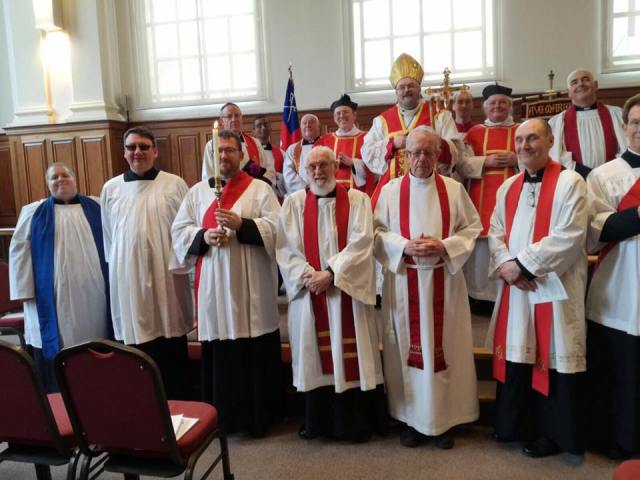
Fr Jonathan Munn did deacon, and we understood each other and everything went so smoothly. Several priests seemed to marvel at our knowing our stuff! We celebrated twenty-five years of our Diocese since its foundation in 1992 – and it is also the same number of years since I was ordained a subdeacon at Gricigliano by Cardinal Alfons Stickler. The coincidence was not planned!
After Mass (which was filmed and will soon be on YouTube), we all had our photo taken:
The Synod meeting was quite mundane, and indeed our Bishop repeated the words of Bishop James Mote, saying that the best Synods are boring! It means that there is no conflict or division. Those who call our Church fractious can put that in their pipe and smoke it! Business came to an end, and I drove my ailing van to Lydd on the south Kent coast where Bishop Damien lives in his beautiful medieval house. I dropped off the plywood altar that was surplus to my needs and which I donated to the Diocese. I picked up my new boat engine, all new and gleaming, which I ordered a couple of months ago and which Bishop Damien was storing for me. I hope to try my new toy soon on the back of my boat!
Another bright and early morning on Sunday, and Roy was getting his breakfast. I joined him and then we went to see the Bishop’s basse-cour, the chicken run with no fewer than ten good laying hens. They all have names.
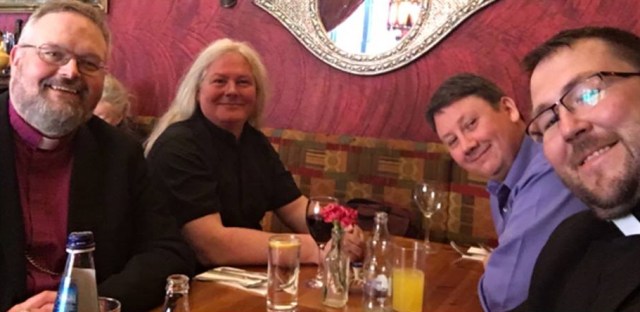
I played the organ for Sunday Mass, and there were some new faces at our Pro-Cathedral church in Canterbury. It gives me a real joy to accompany the liturgy, play the grand old hymn tunes I remember from my schooldays and accompany Catherine, the church’s cantor, as she sang Bach’s Sheep may safely graze. After Mass, the Bishop invited me to join him with Roy and Deacon Richard to the Mediterranean restaurant in Canterbury where they do Italian, Lebanese, Moroccan – and English food.
Deacon Richard took a photo of us at table. It was quite hot, so I took out my collar and let my hair down – literally.
If that isn’t an image of joy in a Church, I don’t know what is! I thank God for guiding me to the ACC. It was a wonderful weekend of ecclesial communion, friendship and Christian love.
PS. Another photo pinched from Facebook of our Mass showing the choir and our maestro at the organ.
Reading one of Cardinal Ratzinger’s books in the 1980’s, I was quite struck by his reminiscences of Corpus Christi processions in Bavaria in places like Altötting and other towns. The tradition spreads into Switzerland in some places, and Fribourg where I was at university was known as L’Etat du Ciel, the State of Heaven, by its fidelity to the Corpus Christi processions in which brass bands and the many religious orders participated. There is a great feeling of joy in this manifestation of faith in this Germanic culture which is neither Protestant nor Latin.
Father Hunwicke has written a new article, but with a previous posting asking readers not to send comments. I understand him perfectly, and I too have my “secular retreats” by going sailing for several days, relying only on my boat for getting around and visiting new places of beauty and peace. I thus look forward to the Semaine du Golfe during the last week of May, when there will be times of solitude but also milling crowds of people and about 1,300 boats already registered for the gathering. I don’t do many priestly things during that week, but I have my daily Office for when the boat is at anchor, moored to a pontoon or beached.
Fr Hunwicke wrote on The Prisoner in the Tabernacle. I remember a series of lectures on Eucharistic devotion when I was up at university, and this typically post-Tridentine theme came up. Theology and liturgy have been embellished by analogy and allegory for a very long time, but the tragedy occurs when the poetic is taken literally. There has always been a difficulty when we try to explain the notion of transsubstantiation (bread and wine into the Body and Blood of Christ at Mass) in materialistic terms to counter the entirely conceptualist view of the Reformers. It is a Mystery of faith which cannot be understood any more than the Resurrection. In the latter mystery, the Gospel texts are bewildering. People who knew Christ in his incarnation did not recognise him after the Resurrection, until he performed a familiar ceremony like at the Last Supper of the multiplication of bread and fish. The resurrected body was of no ordinary material. It could go through closed doors. There is something we miss if we try to explain this in terms of Newtonian physics or suchlike. Perhaps quantum theory might come nearer, whilst we remain just as confused when we think about it too much.
Post-Tridentine devotion carried medieval devotion that bit further and attempted to rationalise it in Cartesian fashion, and we end up with the idea of a “little Jesus” shut up in a little box on or above the altar. What does he do all day lying in the bottom of the ciborium, veiled, and then in a veiled tabernacle? The idea becomes absurd and something people grow out of when they stop believing in Santa Claus!
In the 1980’s, I investigated Orthodoxy to some extent, and was quite surprised to know that they reserve the sacred Species on the altar in a little pyx, but they do not act in a particular way towards the Blessed Sacrament – whilst they teach the Real Presence like we western Catholics do too.
Methods of reserving the Blessed Sacrament have changed over the centuries. The tabernacle only became standard from the Renaissance and Tridentine era, mainly for the sake of security: to prevent the Blessed Sacrament being stolen by people with evil intentions. Two other methods have existed in northern Europe, the Sakramentshaus in Germany, a tabernacle set not on the altar but on the Gospel side. The aumbry of middle-of-the-road Anglican churches is certainly inspired by these beautiful structures in Germany.
In France, England and elsewhere, we had the hanging pyx, which I use in my own chapel. It is raised and lowered by a simple counterweight mechanism, or simply by means of a “halyard” and pulleys inspired by rigging on a boat. The tabernacle is practical for when constant access is needed to take Communion to the sick or give an undetermined number of hosts to the faithful at Mass.
I have always been opposed to Mass facing the people, but Fr Hunwicke mentions this in his article. When then is done with the Blessed Sacrament? In a dedicated chapel behind the high altar or in a side chapel like in cathedrals? The hanging pyx directly over the free-standing altar brings the Blessed Sacrament into prominence, and is independent of which way the priest is facing. I think this has been done in a few monasteries. I don’t like versus populum, but such an arrangement would be coherent and would focus the celebration away from the interchange between the priest and people facing each other. Pope Benedict XVI emphasised the placing of a cross at the centre of the altar even when the celebration was facing the people. It restores a certain notion of orientation.
I would tend to something between the “materialistic” devotion to the Blessed Sacrament of Roman Catholicism over the past five centuries and the seeming indifferent aloofness of eastern Orthodox practice. In the Use of Sarum, genuflections are much rarer, and the reverence is usually expressed by a profound bow as often done in monasteries. Naturally the presence of the Blessed Sacrament in the church will bring us to conduct ourselves accordingly and not engage in profane chatter.
This is always an exciting moment on the second weekend after Easter as is our custom. I am getting ready for setting off to Calais, getting on the ferry to Dover and driving up to London. I will probably find my usual parking slot (free over the weekend) near Westminster Abbey and camp overnight in the van.
On Saturday morning (29th April), Bishop Damien Mead will celebrate Mass (Votive of the Holy Ghost) and it will be as solemn as we can make it. As most years, it will be at Westminster Central Hall facing Westminster Abbey, and there will be an organist and a nice little mixed-voice choir. Everyone is welcome to attend the Mass and hear the Bishop’s Charge to Synod.
In the afternoon, we will have our Synod meeting and discuss all the new developments in our Church as well as things that need improving in one way or another. I intend to stand for re-election as a clergy member of the Bishop’s Council of Advice, and we’ll see how the Assembly will vote. I appreciate being able to serve our Church in whatever way I can.
Our Diocese celebrates its twenty-fifth anniversary this year. Things haven’t always gone smoothly as I was able to observe in 1995-96, and as I heard from a distance in 1997. I rejoined the ACC in 2013, and the transformation was total. We now have a Diocese built to last and sincerely serve God in selfless dedication and determination. I celebrate four years of being a priest in our Diocese, and I intend to stay put.
I will not be at the Provincial Synod this autumn in the USA – I can’t afford it, but I take a great amount of encouragement from the movement of convergence of the four main Continuing Anglican Churches. I will be following it as best as possible from a distance. Synods aren’t just meetings, but real manifestations of Communion. These Continuing Anglican Churches are comparable in size and coherence to some of the smaller Orthodox Churches.
Back to getting things ready and making sure nothing is forgotten…
A kind correspondent has written to me, particularly to draw my attention to an article written by (Fr) Tony Equale, a Roman Catholic priest who left the priesthood and became highly critical of classical Catholicism, especially the heritage of the Council of Trent. The article is Sex, Celibacy and the Nature of God. I have a link to this blog, but I have always come away from it unsatisfied by his “materialism”. What I mean by this word here is not the “consumerism” of the masses but the idea of considering matter as an absolute rather than an illusion created by energy. What is “spiritual matter”?
I haven’t had the energy to study Fr Tony’s work in detail, but I suspect he is more influenced that he would want to admit by nineteenth century philosophies from the likes of Nietzsche, Darwin and Marx. Institutional Christianity does have a lot to answer for, but I see no good coming out of its destruction. As I corresponded by e-mail, I saw a blog article coming out of this, so here it is, reworked and refined.
Like the Modernists of the 1890’s and the early twentieth century, I do think that presenting God in a similar way as we relate fairy tales to children does the Church and the Christian message a tremendous amount of harm. We need to find new and different ways to present the ineffable Mystery in such away as people at different cultural levels can relate to it and develop human knowledge and spirituality. In terms of knowledge of God, the eastern Fathers tended to present an apophatic approach, the so-called “negative theology”, an attempt to approach God by negation. We can only say and think what God is not. We find ourselves in adoration before an ineffable Mystery, something beyond our rational understanding, but recognised to have some kind of ontological reality. Some dimensions of modern science speak of a universal consciousness in which we as humans and living creatures participate by our own consciousness of self, the cogito ergo sum of Descartes. I think and know, so therefore am in existence. Already we have a new approach to which many thinking people of our times can relate as opposed to the usual catechetical teaching given to children, out of which they grow when they become adults. In this, I share the view of someone like Fr George Tyrrell who got himself into hot water in the 1900’s with the Pope (Pius X) for Modernism. If you actually read him, you will see that he was opposed to the demythologising exegesis of German liberal biblical scholars. He sought a notion of God that would be credible to men of science and more spiritual than legalistic and rationalistic.
Fr Tony has a similar kind of aspiration, perhaps to “save” a notion of God from the ruin of institutional religion. However, I am deterred by his insistence on the absolute of matter rather than energy. Traditional theology has distinguished the creator and the created, super-nature and nature. I would tend to favour a more pantheistic notion of everything, including evil and suffering, being divine or participating in divine consciousness. Such a notion might do more to give a spiritual outlook on everything than the “material” that comes into being and dies its death. Without doubt, I have not studied Fr Tony’s work enough to avoid coming out with a caricature, but at least I would say something to contribute to the discussion.
If everything is consciousness and energy, there are certainly more things than are dreamt of in our philosophy, to misquote Shakespeare. Matter would only be an illusion to us who live on that “wavelength”. I can well believe in the ideas of multiverses, or universes existing in parallel, but on different “wavelengths” of energy. Sometimes, there would be a certain measure of communication between the universes giving rise to unexplained phenomena: angels, ghosts, UFO’s, so-called aliens, near-death experiences and many more experiences of sincere people.
What comforts me in the idea that human consciousness, in which universal consciousness subsists, can live independently from the brain and the physical organism. What exactly happens, we don’t know, but the general idea is that we continue to be conscious with personality and memories intact. Tony Equale seems to suggest that our consciousness “goes somewhere” but we no longer have personalities or memories. That seems depressing. There is the possibility of reincarnation, but that creates philosophical problems and is incompatible with traditional Christian eschatology.
We see very quickly that the article is not so much about repressed sexuality but the entire religious construct that brought about such sexual moral teachings. We can easily get obsessed about the issues of sex, celibacy and sensuality. It all exploded in the 1960’s and ended up with disillusionment and AIDS. Many of us have had to deal with moralism and legalism, both very unhealthy. Materialism is no solution, and I have seen few westerners adapt well to eastern religions and philosophies. We can recover aspects of Gnosticism and monastic spirituality that haven’t been institutionalised.
Tony Equale isn’t easy to read and his “line” isn’t easily identifiable. He is not someone I would want to follow uncritically.
Since the US presidential election, I have come to discover a young American by the name of Tarl Warwick living in the Vermont countryside. He is a current affairs pundit, writes books, is a professed Pagan and shows a great amount of talent as a Youtuber. Don’t be put off by his “Satanism” because it doesn’t seem to mean what we find in horror films. Here is an interesting talk –
This young man talks very eloquently and makes sense, both in his political commentaries and his spiritual view. He is not above criticism for his appearance, but it’s a free world. He comes over well on YouTube. I would be too introverted for such work, and have put very little on YouTube. He has written and done video presentations on Gnosticism, Paganism, his journey away from his original Evangelical Christianity and his world view. He is quite gritty, and likes f*** words! Again, it’s his way. He’s something of a character!
One thing that I did appreciate was his idea that wiping the slate clean can be good for some people. After a phase as an atheist, he began to research into what he called satanism, but he tells us that he was not worshipping an evil entity in the way we Christians usually understand Satan, the Devil, or whatever you want to call that dark entity. He seems rather to be interested in pre-Christian paganism, the old Mystery Religions, folklore and things like Druidism or the spirituality of the Native Americans. I think we certainly need to acquire knowledge of such phenomena in history in the same way as St Paul brought Christianity to the Hellenic and Roman world. Keep an open mind, but a critical one.
A part of our pilgrimage is to question and rediscover ourselves and what we believe in. Two forces have been in play from the beginning: Christianity for Jews and Christianity for Latins, Greeks, Egyptians, Persians, etc. – the heritage of the Mystery religions which expressed ideas that either influenced the “myth” of Christ or prefigured a fulfilment. I think we need contact with those who live according to a “natural religion” and try to understand something.
At the stage where we are, post-Tridentine Catholicism is a red herring, with no more influence than those who think the earth is flat or hollow with cities ruled by alien reptile Nazis! The real problem in today’s world is the spectre of the jihadist caliphate and the complete rolling back of humanism, the Enlightenment and the Renaissance. We face humanity at its worst, at its cruellest and most base. That is the real enemy along with some kind of Orwellian dystopia brought about by the moneyed elites. We are returning to feudalism with an “aristocracy” far more merciless than in 1789.
Evolving moral consciousness? Only a few of us who think about these things. Maybe the “fools gold” of classical Catholicism is an illusion, but the coming tyranny isn’t! Many priests have abused children, but children are openly sold as sex slaves in countries like Libya and everywhere ISIS / Daesh is found. They don’t have sacraments, priests or liturgies. If we get rid of Christianity, what do we replace it with?
I do think Christianity has to be more personal and spiritual than institutional or clerical. This is happening. I am a priest but very much live the life of an “ordinary guy” with few outward trapping, except when I am in contact with the small institutional Church I belong to.
Where are we going with our reflections? What do we want? A “pure truth” of some kind? A way of life that brings happiness and satisfaction? It is easier to destroy than build anew. This was the lesson of the Marxist ideology that is only seeing something of a resurgence through the opposition of “populism”(both left and right) against elite globalism. The “magic church” now only exists in our imaginations. It is dead and not worth fighting against. But, not all Churches are peddling stories without credibility. It all just needs to be looked at differently.
I am fascinated by the idea of quantum theory, multiverses and consciousness. I was quite overcome when I saw a comparison between a microscopic view of human brain neurons and then a view of galaxies strung together with something looking like nerves. Is it the same thing at the level of the atoms that make up what we can sense? Could the immense view of the universe(s) only be a microscopic view of something even more immense and so forth to infinity? This kind of thinking kept me awake many times as a small boy. Everything is so mysterious and beyond our finite rational understanding. There are those who say that even the sub-atomic particles (protons, electrons, etc.) are pure energy and that there is only empty space or nothingness between them. There goes the matter, but we only experience “matter” because we are on its “wavelength”. However, I admire Fr Tony for his courage and open enquiry into what he seeks to understand and teach.
My correspondent mentioned Jean-Yves Leloup, a French former Dominican friar, who is fascinating. I have read some of his introductions to translations of Nag Hammadi texts into French and have heard some talks he has given via YouTube videos. The Gnostic paradigm needs to be looked into, but not taken literally as we are wont to do. “Fundamentalist Gnosticism” or a “Gnostic Church” would be something quite ghastly! It would be worse than anything else. But at a personal level, it is a breath of fresh air.
There you have it, a few reflections without any real conclusion. Will pre-Christian paganism or Jewish or Islamic monotheism bring us happiness and fulfilment? Would we do better becoming Buddhists or Hindus? We can’t change our culture and our fundamental world view. Materialism and atheism have shown their fruits in the bloodbaths of the twentieth century and to the present day. Does Christianity harm us? Certainly some Christian-based ideologies harm individuals and societies. Christianity has always been more humanist and humane than anything else, notwithstanding the excesses of the medieval Church, the Inquisition and the Crusades. Something is not necessarily true because it pleases us or gives us a pleasant “fix”.
There are apologetic arguments for the truth of Christianity, but they have their limits. There is some evidence of Christ from ancient non-Christian sources. It has endured centuries of persecution and change. Other religions have too. The question keeps coming into my mind: what would we be without Christianity? We would surely be worse rather than better. It isn’t an argument, but it is a good and valid question.
I choose to go on with Christianity, both in my Church and following my own pilgrimage as a priest and a believer.
Almost on the eve of the first ballot in the French Presidential election, we consider the many threats facing this country and the rest of Europe. Rod Dreher has just written The Grave Crisis Facing France. It is an analysis that will need several readings to capture the essential themes. I am not at present a French citizen even though I have lived in this country for donkey’s years, so I cannot vote in anything other than a Municipal election for a new mayor. Looking at the array of candidates, the prospect of “more of the same” like under Sarkozy or Hollande fills me with La Nausée! If Marine Le Pen wins, she will push for Frexit. Together with Brexit, the days of being allowed to live and work freely in another European country are limited. I will need to apply for French citizenship and ask to be allowed to keep my British nationality and passport. Perhaps it will be Melenchon, a Communist populist, the French counterpart of Jeremy Corbyn – but does that message have any credibility after the collapse of Soviet Communism and the impending end of the regime of North Korea?
The conditions are quite daunting, but I should be able to satisfy them. I speak the language and accept the general principles of democracy and human rights that came out of the early phase of the Revolution. I work for a living and pay my taxes and social contributions to the welfare state. I was described at seminary as being the most “French” of the English. I could be said to be integrated, though emotionally and culturally, I do not relate to many things. Unfortunately, my “Englishness” is something that does not correspond with the real England of our own times! As I write this, I am listening to Elgar’s Enigma Variations. We now arrive at Nimrod, which was played at my mother’s funeral.
The threat is radical Islam based on jihadism and terrorism. We really need to learn more about Islam, its history and different denominations. I have still known a time when I could walk around Marseille in my cassock and walk round the Muslim neighbourhoods buying spices and other foodstuffs in their shops. They dress in long flowing thobes and wear a white cap on their heads. There seemed to be a feeling of respect between these men who lived according to their spiritual tradition that seemed not so far removed from ours as Catholic Christians. Then came the jihadists.
I have heard about the threat of civil war for decades, ever since I was in seminary more than twenty years ago. The idea of civil war and persecution seemed to validate a more radical commitment to Christianity. It is a great temptation, but the day seems to be drawing near. A political regime that decides actually to do something about this threat would trigger a bloodbath between radical jihadists and native French people. This is no time to live in a city! However, we country dwellers sometimes have to go into town, and we are at our most vulnerable when travelling. Calais is a frightening place, though less so than a couple of years ago.
The fall of the European Union, massive Muslim immigration and their right to our money and resources – and the resentment builds ever more. There was the Terror, the Napoleons, the various republics and attempts to restore the Monarchy. France has only known excess and instability through the twentieth century, the anti-clerical era, the Nazi Occupation and the changes of the 1960’s. Many believe in a messianic role of France on account of its illustrious Christian past, but I wonder. Maybe we might see a great miracle of grace! Pray for France and Europe, for my native England and for the world faced with a real threat of World War III and a nuclear holocaust. We still don’t know what North Korea is capable of, especially with their submarine and satellites in space.
I am filled with foreboding but yet a feeling of hope and peace. We can only go on with our Christian lives and prayer. A la volonté de Dieu!
The results are in and the run-off will take place on 7th May. Most of us with any interest in politics would have read mainstream news articles and the fact that the old mainstream conservative and socialist parties are in the minority. The real opposition is between globalism and the elites on one hand against populism which expresses itself through the ideology of Trotsky via Melenchon and the nationalism of Marine Le Pen on the other. As mentioned, I don’t have the vote because I have not applied for French citizenship (but will certainly need to because of Brexit).
Most friends with whom I discuss the question are wary about Macron, seemingly a vacuous puppet of the bankers and globalist elite. They tended to vote for Fillon, the mainstream conservative. The choice is now clearly between Macron and Le Pen. I am not a Le Pen fan any more than for Trump. I just see with Macron the problems of multiculturalism and the rise of Islam (the radical and anti-human variety) not going away, and the old institutional corruption becoming ever more entrenched until something really horrible happens. Of course, if Le Pen wins, I think the “snowflake” backlash could be worse than in the USA. I’m just so glad to be out of the cities and in a relatively safe place. France has been polarised and unstable ever since the Revolution of 1789 and the Terror of 1793.
All we can do is pray. I think we would be better with Le Pen, if she knows her stuff and can get the right people in her government to manage the money and the mundane aspects. Either way, we are in trouble, whether the European Union goes into pallative care or collapses, or saves the essential, that of the right of someone from one European country to live and work in another.
I am very confused by the fake news coming both from mainstream journalism and conspiracy theorists or alt-right sources. We just can’t know the truth about anything. At least there haven’t been any nukes going off, until now at least. There is a God in heaven, and he is looking after us! I live in France, I speak the language, but I am not French. I feel alienated from England and its very dark heart.
I pray that God will send us a sign to his lost and confused humanity…
This is my personal blog concerning my philosophy of life as a Christian following the Romantic world view. I am a priest in the Anglican Catholic Church – Original Province and live in France.



 Methods of reserving the Blessed Sacrament have changed over the centuries. The tabernacle only became standard from the Renaissance and Tridentine era, mainly for the sake of security: to prevent the Blessed Sacrament being stolen by people with evil intentions. Two other methods have existed in northern Europe, the Sakramentshaus in Germany, a tabernacle set not on the altar but on the Gospel side. The aumbry of middle-of-the-road Anglican churches is certainly inspired by these beautiful structures in Germany.


 The Blue Flower