What is Catholicism?

This question comes up in my mind, and not for the first time. The idea came from a blog post written by a convert to Roman Catholicism with a highly critical attitude in regard to Continuing Anglicanism and even to the Ordinariates in the RC Church. He is entitled to his view as I am to mine. I have linked to his blog before, but this time I don’t want nastiness, whether on this subject or other issues recently discussed.

I am not embarking on a piece of apologetics or nastiness in regard to the Roman Catholic Church. My subject is not strictly theological or ecclesiological, but some such ideas may well creep in. The article I have in mind is remarkably secular in its criteria of Catholicity, very American, with a business analogy of market. Etymologically, the word Catholic means universal, for all. Apologetics often interpret the concept in different ways to sound convincing – in view of the fact that Roman Catholics are very numerous in the world, but are a minority against non-religious people and other world religions. The RC Church is open to all, but so are other Christian Churches and communities.

We tend to associate the word Catholic with the notion of liturgical and sacramental Christianity that appeals to more senses than simply hearing the words of Scripture. Rome doesn’t have the monopoly here, because there are many liturgical and sacramental Churches that aren’t formally and canonically in communion with the Pope. I find nothing more natural than the idea that Catholicism subsists in Anglican, Orthodox and Old Catholic Churches as well as the Roman communion. Ecumenism in the RC Church softened the old Extra Ecclesia nullus salus position, but it is still implicit in official teachings and opinions of Roman Catholics.

The problem, the way I see it, is the profound change brought to European Catholicism by the Reformation and the Counter Reformation, which correlated with the Renaissance and Enlightenment movements. Much as my own mind has been formed by scientific and philosophical rationalism for the sake of serving humanity and the modern notion of human rights, I do believe that we need to recover much more of medieval Catholicism. What is in my mind is what an English parish in the fifteenth century would have had in common with a comparable Orthodox parish in the Greek islands or mainland. What I would like to emphasise is a spirit, not so much academic theology or liturgical minutiae. Much of this notion persisted in parts of Europe, France in particular, but was ruthlessly destroyed in the Protestant world and heavily reformed and rationalised in post-Tridentine Roman Catholicism.

My Bishop and most of my brother priests tend towards a Tridentine liturgical expression with trappings like lace and baroque vestments. I have no problem with that, and I still have both from my Institute of Christ the King days. I prefer a more medieval or monastic expression with plain albs and simple vestments in keeping with the spirit I mentioned above and my option of using the Sarum liturgy. Our Church is broad enough to encompass everything because these things concern culture and human sensitivity more than faith or morals. I have not rejected the Baroque expression, but feel more at ease with things like neo-Romanticism, Arts & Crafts and the yearning for things medieval. This is reinforced by my experience of French Catholicism through “recusant” parishes and the heritage of Gallicanism that formed and gave shape to the early Traditionalist movement of Archbishop Lefebvre in the early 1970’s.

One can be criticised for flights of Romantic imagination and fantasy, idealising the artistic expressions of the past whilst accepting Enlightenment ideas and the benefits of modern technology and science. After all, who would want medieval medicine, sanitation or cruel punishments of wrongdoers? We Anglican Catholics often do come under this criticism, and are encouraged to “get real” and learn about contemporary (Roman) Catholicism. In most of Europe, such “real” Catholicism is confined to metropolitan cities and is nearly dead in small towns and the countryside. It is essentially secular and rationalistic, and would only appeal to those who might also be attracted to Evangelical Protestantism, with few exceptions like in the Diocese of Versailles where Catholics are convinced and well-to-do.

Am I the only one to “get it right”? Far from it, I argue not for a totalitarian, regimented or uniform expression – but diversity and a spirit of freedom, joy and all the positive aspects of Renaissance humanism. We need to abandon the “one true church” or “we are right and everyone else is wrong”, and offer something beautiful and appealing in contrast with the bleakness of our modern urban world and the threats facing us in the coming years. I prefer to approach Christ in freedom, love and attraction to beauty, not the old threat of being thrown into the outer darkness and tortured by demons for all eternity. Anglicanism doesn’t need to be “liberal” or unfaithful to be loving, tolerant and ready to discuss rather than dominate or dictate. Perhaps it is Anglicanism and Lutheranism that have remained closer to medieval liturgical Catholicism than post-Tridentine Rome.

A part of being Christian and Catholic is living the dream, the dream of Christ and the Gospel, in a world that tells us that Christianity is finished and that the future is Orwellian globalism and head-chopping jihadism. I am reminded of Wordsworth’s elation on seeing the back of the Ancien Régime and then his nausea on seeing the baskets of severed heads and stinking corpses being taken from the Place de la Concorde to the Picpus cemetery. What a memory to take back to England and the daffodils of Grasmere! Sometimes, dreams and imagination are the only way to keep ourselves sane in spite of the adversity we or others live through.

We are not the “only” ones, but we try to do our bit alongside others in other places with similar ideas. That’s what is important and what really is Catholic.

Posted in Uncategorized | Tagged , , , , , , , , , | 3 Comments

Another Anniversary

I celebrate the fourth anniversary of my reception into the Anglican Catholic Church, Diocese of the United Kingdom. Here is the blog post of the time Received into the Anglican Catholic Church. It is quite a shock to see my hair the way I used to have it in a crew cut! I also remember being almost crippled by very painful gout in my left foot. I rarely get attacks of gout, but I always have my little packet of pills in case I need them.

Easter was earlier in 2013, and we always have our Synod on the Saturday after Low Sunday, so it was the day after, second Sunday after Easter in Canterbury. I will be travelling to England again for our Synod and will be providing some organ accompaniment and music at Mass in Canterbury the following day. It will be good to see my Bishop again and our people – and I also have my new boat engine to pick up for use on Sarum, my little twelve-foot cruiser.

Spring brings so much joy and brightness, especially when Easter is in mid April like this year. I saw a swallow flying around for the first time today as I did some gardening. I took the boat (Σοφία, not Sarum) out for the first time this year yesterday. The water was cold and I was glad not to fall in it. Launching was touch and go because it was high tide and the breaking waves were forbidding. The wind was perpendicular to the beach, making launching under sail impossible. I waited until the wind turned more to the north-east as forecast and high tide was past and the waves became smaller in the shallower water. It was quite good fun on the choppy sea with a light breeze, and I stayed out for only an hour and a half so as not to allow myself to get too cold! It is spring, but it is still April!

Four years have gone quickly, and this year will be my fifth Synod. I have been on the Bishop’s Council of Advice for quite a while, and am happy to take part in the work of our Diocese. If you look at our website and Facebook pages, you will see we are slowly growing. We all try to do our little bit to help. My belonging to this Church has given legitimacy to my priestly vocation and a true mission as one sent by Christ through my Bishop. For this I am thankful.

Posted in Uncategorized | Tagged , , , | 1 Comment

He is risen, Alleluya!

I wish all my readers a happy Easter, after presumably having celebrated the various ceremonies of Holy Week and the Triduum.
There is always a lot to do, between the Maundy Thursday Mass and the stripping and washing of the altars. In the Use of Sarum, we don’t have an altar of repose like in the Roman rite, but the Easter Sepulchre on Good Friday which receives the third host consecrated at the Maundy Thursday Mass and the crucifix that was venerated on Good Friday. Then everything is prepared for the Paschal Vigil ceremony and put away afterwards.

I was entirely alone this year, since Sophie was with relatives to help with preparing the food for some anniversary celebration. However, the entire Church is present in spirit at in every place where these ceremonies re-actualise the Mystery of Christ in his salvific work of the Incarnation and Redemption.

I am about the remove the Blessed Sacrament from the Sepulchre this Easter Sunday morning prior to Mass and put it in the hanging pyx.

May these celebrations renew in us the grace of our Baptism and commitment to persevere in faith and the Christian life, in joy and hope in spite of everything the world can throw at us. The victory is already won! Alleluya!

Posted in Uncategorized | Tagged , | 3 Comments

The Stripping of the Altars

As the liturgy of Maundy Thursday instructed me to strip and wash the altars of my chapel, the thought came into mind of the title of a famous book by the historian Dr Eamon Duffy. His subject was the English Reformation and the iconoclasm that occurred in the sixteenth century, the worst happening under Oliver Cromwell and the Roundheads during the English Revolution in the mid seventeenth century.

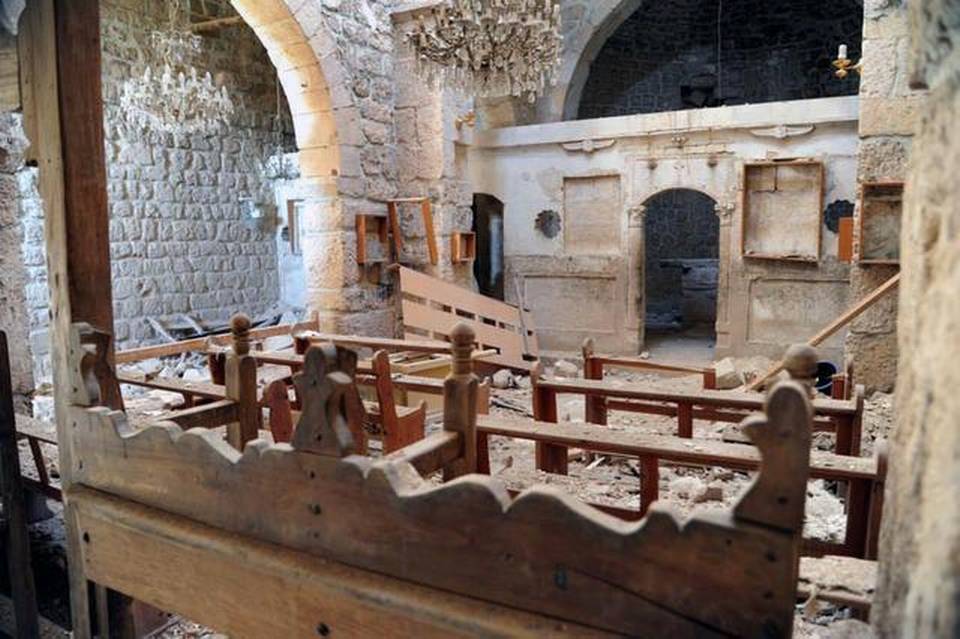
Christendom has seen fanaticism and hatred over the centuries, but nothing in comparison with our own times. As I write, churches are destroyed and Christians are martyred by Daesh and other jihadist Muslims. Once again, churches are destroyed, gutted, burned and desecrated, all in the name of a divinity that millions of people in the world worship.

I hope and pray Mr Trump will look at these pictures too before blaming everything on the secular regime in Syria and launching any further attacks on the very forces defending Christians. This is my particular intention as I celebrate the succeeding elements of the Mystery during this Triduum.

Let us pray also for Europe, that we may never fall under the same scourge as befell England in 1649 and in the Middle East now, as we discover horror after horror on reading the news on the Internet and seeing videos on YouTube.

Άγίος ό Θεός, Άγίος ίσχυρος, Άγίος άθανατος, έλεήσον ήμάς.

Posted in Uncategorized | Tagged , , , , | 7 Comments

Hair Update

An old posting from January 2014 – Vestri Capilli Capitis – has been looked at four times today. I wrote about long hair on men. OK, mine has grown a little longer since then. Here’s a quick selfie from February this year:

It has just about reached mid-back length and ties up nicely into a queue when I’m in clericals.

Posted in Uncategorized | Tagged | 2 Comments

A Reflection for Holy Week

Doing my rounds this morning, I came across this article The Virtue of Despair. I immediately identified with the reflection of the nihilist philosopher Nietzsche:

Out of such abysses, from such severe sickness one returns newborn, having shed one’s skin, more ticklish and malicious, with a more delicate taste for joy, with a more tender tongue for all good things, with merrier senses, with a second dangerous innocence in joy, more childhood and yet a hundred times subtler than one has ever seen before.

I had the impression of having been through something like that from about last November until a couple of months ago. I have to say that I emerged freer and more myself, able to deal better with various feminine shenanigans.

For us in the northern hemisphere, it is no accident that the Paschal Cycle falls in the lunar cycle of spring, and that the Passion and Resurrection of Christ are reflected in nature – including ourselves and the effects the changing seasons have on us. The experience of more daylight and sunshine does wonders!

We should see this reflection on despair as an analogy. At a moral level, despair is the sin against the virtue of Hope. If there is hope, despair is never absolute but a passing period of suffering. I often mention the quote of Léon Bloy: Souffrir passe, avoir souffert ne passe jamais. The idea is also found in the writings of Saint Thérèse de l’Enfant Jésus. Perhaps she had read Bloy’s writings. Pain leaves us, but we remain marked, as the risen Christ will remain with the stigmata of his Passion.

These thoughts should accompany us as we approach the sacred Triduum and the Transitus Domini of which we find the archetypes in the Old Testament, the Mysteries of the ancient world and in our own lives.

Posted in Uncategorized | Tagged , , , | 1 Comment

Diocese of Amritsar and Rome

I have just received some information from Dr William Tighe to answer a question I asked back in 2012 about the Anglican Diocese of Amritsar in India.

“The Diocese of Amritsar is curiously mentioned by Cardinal Levada in his announcement of 20th October 2009: “Sometimes there have been groups of Anglicans who have entered while preserving some “corporate” structure. Examples of this include, the Anglican diocese of Amritsar in India, and some individual parishes in the United States”. This being said, there is no knowledge of an Anglican diocese of that Indian city being received corporately into communion with the Catholic Church. I don’t know what to make of the Cardinal’s words. However, the churches of this diocese are the original buildings of the Anglican Communion of before the formation of the Church of South India.

The Diocese of Chotanagpur has seven parishes and eight priests. The Archdiocese of Lucknow, headed by Archbishop Prakash has six churches and eight priests. I have no information about the numbers of faithful. The Diocese of Nandiyal has 41 congregations “with 2672 communities”. The Diocese of Travancore & Cochin has eight priests, a seminary, an orphanage, a house for elderly people and a nursery school. Two new churches have been built.”

I quote Dr Tighe’s message:

* * *

Your question about the Diocese of Amritsar and Rome posed here in 2012: https://sarumuse.wordpress.com/2012/12/27/the-anglican-church-of-india/

seems to be answered in the course of Bishop Lopes’ lecture, here:

https://www.ordinariate.net/documents/2017/4/Bishop_Lopes_28March17_Lecture.pdf

“Third, one of the things that became clear from that internal examination of the CDF files on the various attempts at corporate reunion is that the CDF has always exercised particular care for the liturgical life of those Anglican communities seeking full communion with the Catholic Church. Your own colleague here at the University of Vienna, Daniel Seper, has done some important research on the petition of the Anglican Diocese of Amritsar, India, to enter into full communion in 1977-1982. In that case, the very same decree of the Congregation which authorized full communion for this group of Anglicans also articulated a rather robust liturgical provision for them, identifying which rites could be pulled from the Book of Common Prayer and which sacraments had to be celebrated from exclusively Roman sources. Sadly, this is one of the cases which really did not work, as the implementation of this decision was left to the local Conference of Bishops in India and someone at that local level decided that this liturgical provision was not necessary and so it was never implemented. Perhaps consequently, the clergy and faithful of that Anglican diocese of Amritsar faded away and only two priests and maybe 200 lay faithful were reconciled.”

Posted in Uncategorized | Tagged , | 3 Comments

Terrena despicere?

Someone thoughtfully forwarded a link to me this morning – Reading Dreher with Schmemann and MacIntyre (and thus Marx). The subject is the so-called Benedict Option expressed in writings by Rod Dreher and others, especially in America. The article is quite long and challenging, and is worth a good read.

I have mentioned before that the idea quite intrigued me, and I could see the obvious comparisons with monasteries, less enclosed religious orders, the Brüderhof, charismatic communities, various intentional communities based on ecology or other common themes. There are also the Amish communities in the USA which, perhaps, are to be “admired but not imitated”. If such a community is founded and those in it find fulfilment, I can only encourage them to continue in this vast human experiment in known history. The New World was a powerful archetype in history, but now the new world has become the old in terms of human impiety and iniquity. The first European Americans set out to found something new, not merely escape from the world that oppressed them. The Benedict Option seems to be different in that it seeks to create new micro-societies or tribes away from society. The difference seems to be subtle but real.

Several things emerge from this article. One is the analysis of the modern world. Another is how the micro-society is intended to work, not fall victim to the worst aspects of human nature. Can Christianity only subsist in a Christian society, or can it live in a neutral or hostile world like in the Roman Empire before the Peace of Constantine? We are constantly reading things on the internet, full of foreboding warnings of a collapse of civilisation or the end of the world – neither of which have occurred despite prophecies that they were imminent. Many such prophecies are tired out and old. Apocalypticism seems to be a psychological need for some people, like conspiracy theories that turn out to be fallacious.

The article discusses the theme of the guru, the leader of a totalitarian sect or cult. A monastery has its prior or abbot, and unquestioning obedience is demanded of the community’s members. Where is the dividing line between asceticism and spirituality, and depersonalisation and abuse by an amoral leader? It also happens in non-religious communities, unless, perhaps, a democratic or collegial system is put in place where the leader is bound to consult his peers. How many dictators in history asked their people to choose between “me or chaos”?

The argument is put forward that the plight of the Church and Christianity are never beyond hope, since both have been threatened in the past. The Church rebounded where it was least expected. Is Christianity finished in western mainstream society?

There is also a danger of like-minded people seeking to build a society in which thinking alike is a prerequisite. That is something that needs thinking about. I usually find that people can get very nasty the more they share an interest. I have even found this in the sailing world where there can be bad disputes about whether one may have an engine on his boat for when sailing isn’t possible or what kind of life-jacket should be worn. These are purely practical matters, and are compounded when it is a matter of ideology! This happens in various identity groups like gays and people with Aspergers. One can only take so much in the hothouse.

Is Christian living to be another “lifestyle” for those who can afford it and come from a yuppie or bourgeois-bohemian background? In the intentional community world, the choice is essentially between a guru and unpaid work – or buying-in at more than it costs to buy a house in the countryside. A solution? I don’t think there is any one solution for the future of Christianity. It depends to a great extent on where we live, in cities, suburbs or the countryside. Then, whether it is with families and children, alone, with an intense social life, involved in local community activities and politics, whatever. All communities are exposed to the risk of human nature: corruption, abuse, exclusion of “others” and everything else that has happened, causing the community to reform itself or fall apart.

It is a good thing that I have been exposed to monastic life for my six-month stint. The Abbot made it easy for me, because he knew that I did not aspire to a monastic vocation. I had interesting work to do corresponding with my knowledge and skills. I had some realistic idea of the life of the monks. It is essentially a totalitarian “Orwellian” society where each person allows his personality to be eclipsed by the collective. It is the most radical Communism that exists, the only difference being that it is voluntary – accepted by the pronouncement of the Vows. Not everyone is made for that. I am not. Monastic life is everything that is the most ordinary, commonplace, boring and earthly. The corridors smell of sweat and boot polish. It could almost be compared with the Army except for the absence of noise and weapons! The various bits of advice for a young man thinking about monastic life have a ring of realism – go and get some boring job in an office or a factory and don’t think of yourself as anyone special. The almost-nihilism of it is quite surprising! It is the exact opposite of Romanticism, in which the creative imagination is exalted, but Romantics are not always very holy people…

Fr Charles de Foucault comes back to me. He was a hermit, though he intended to found a very austere monastic community. The people around him were all Muslims. There is something to be said for “monastic” life in a city without any trappings or habit, just service to others. I have thought of leaving my present life to live alone in some remote place – but it just won’t work. It would be based on wrong, and that can’t be justified. Nor would I be justified in joining some intentional community where I would be followed by — myself.

Those are a few of my reflections on reading this article, which might be a little too hard on Dreher’s idea and desire to escape the quagmire of modern American or western life. Usually, we do God’s will by staying put, being where He put us so that we can do good in some small and insignificant way. Communities do exist and are said to do good and work out for the best. There are none anywhere near where I live, apart from a couple of Roman Catholic monasteries, so it seems to be something of a non-sequitur. That is the limit of the internet unless we have the lack of responsibilities at home, time and leisure to travel.

Thomas Merton once said succinctly, the entire wisdom of the desert fathers and mothers, thus: “Shut up, and go to your cell!”

Indeed.

Posted in Uncategorized | Tagged , , , | 26 Comments

European Deanery

I have this news from our Bishop which is now public: Establishment of European Deanery.

On March 14th The Most Reverend Mark Haverland, Metropolitan of the Original Province and Acting Primate of the Anglican Catholic Church appointed the Right Reverend Damien Mead as his Episcopal Commissary for Europe (i.e., for those portions of Europe not in his own Diocese of the United Kingdom). Since continental Europe is not part of an existing diocese, it falls within the jurisdiction of the metropolitan.

This appointment gives Bishop Mead formal authority to deal with ACC clergy (two live in Europe at present) and persons interested in joining the ACC or forming congregations there.

The Deanery of Europe will be administered for the time being by Bishop Mead on behalf of the Metropolitan and will be treated as an ‘honorary deanery’ within the Diocese of the United Kingdom.

There is also a dedicated page on our Diocesan web site: ACC European Deanery. This need in our Diocese began with my reception into the Anglican Catholic Church in April 2013 and the establishment of the Chaplaincy of St Mary the Virgin, Hautot Saint Sulpice, France. I originally applied to Bishop Damien Mead, and he needed to obtain special permission from Archbishop Mark Haverland to establish something outside his territorial jurisdiction (the United Kingdom). We are now two Chaplaincies in Continental Europe, the other being of my brother in the priesthood Fr Gregory Wassen Chaplaincy of St Boniface / Gemeenschap van Sint Bonifatius, Orvelte in the Netherlands.

In concrete terms, little will change. Fr Wassen and I remain under Bishop Damien’s jurisdiction as before, and we will continue to attend Synod each year in England and any Deanery meetings that might come up.

Neither France nor the Netherlands are Anglican countries. The Church of England has a European diocese whose Cathedral is located in Gibraltar, and its local communities are known as Chaplaincies. There are Chaplaincies for British expatriates and tourists in most major cities including Rome and Paris. Some French chaplaincies have attracted people who were hitherto Roman Catholics and sought something different for one reason or another.

We have also adopted this concept. I have always welcomed French people to services in my chapel when they wished to come, and I have prepared a translation of Mass in French which still needs a considerable amount of revision. They have invariably been my in-laws when coming to our house for Christmas or Easter. I have always avoided any proselytism in my area, because Anglicanism is not sectarian and must not appear to be so. There are very few English expatriates in my area. They tend to go to the Vendée (where I was from 2001 until 2005) and further south-west in areas like the Dordogne.

My main ministry at present is this blog. I endeavour to promote a liturgical, contemplative and humanist kind of Christianity in accordance with the doctrines of my Church (Affirmation of Saint Louis) and a philosophical approach. On any particular day this blog is read by people in the USA, the UK and Australia, since my language is English. I usually have 4 to 8 French readers able to read English, but who have never commented on postings. Some time ago, I tried a blog in French, but it never attracted any interest.

Here in Continental Europe, it is a spiritual desert. Roman Catholicism occupies the same place in society as mainstream Anglicanism in the British Isles. It is there for occasional Sunday attendance at Mass, the main feasts, weddings and burials. Within the “unwashed masses”, there is certainly a minority attracted to spiritual themes and alternative medicine, very much a “consumer mentality”. I am not interested in “marketing” to bring in “clients”. It works in America but not here.

Why Chaplaincies in Europe? I can’t speak for Fr Wassen, but I live here and I am a priest. We are all non-stipendiary priests in our Diocese, and therefore live in our own houses wherever they are and have our own chapels. Fr Wassen’s chapel is a room in his house and mine is an outbuilding which is a part of my property. The existence of a chapel depends on the existence of the priest. That would change if groups of laity got together and decided to set up a stable chapel and an association to manage the money coming in and being spent. They would the call on a priest. Such a community would imply their being English expatriates, Anglicans and motivated to leave the Established Church to join us. Most Roman Catholics are dubious about our Orders (Leo XIII’s Apostolicae Curae of 1896). The mentality and “lie of the land” are totally different in America and the British Isles.

What of the future? I think that other priests, more or less suitable, will present themselves and any communities they might have. Many in France, Italy, Belgium and elsewhere have gone the way of the “independent sacramental movement” with various results. They require a considerable amount of discernment as to their fundamental agreement with our way in the ACC and their essential stability and sense of vocation. A few are quite dubious characters, so we have to be very careful. To what extent can we “inculturate” outside the English-speaking countries? Do we present a fundamentally traditionalist ideology which is less extreme in political terms? Our history and struggles are not theirs.

We need to be ourselves. Fr Wassen with his experience of Orthodoxy and my own interest in the medieval and Renaissance underpinnings (local rites, high culture, etc.) give us something unique to offer, a Catholic vision which is neither Protestant nor Counter-Reformation, and which is humanist and gentle in pastoral terms and our manner of dealing with people. The vision is subtle, but needs to be expressed and explained, as I do in this blog. If we have something unique to offer, and that appeals to people, they will eventually approach us, and we can be of service to them in the communion and fellowship of the Church. We are not parish priests but chaplains, priests available to serve those who call on us.

Posted in Uncategorized | Tagged , | 15 Comments

Twenty-Five Years Ago

It was on the feast of St Benedict 1992 that I was ordained a subdeacon by Cardinal Alfons Stickler. The ceremony took place in the chapel of the Institute of Christ the King seminary at Gricigliano, and this photo was taken in the main reception hall of the villa.

From left to right: Fr Frank Quoëx, Jean-Paul Descolas, John Fallon, myself, the head of Fr François Crausaz peeping out from the back row, Msgr Gilles Wach, Msgr Rudoph Schmitz, Cardinal Alfons Stickler, Fr Philippe Mora, Fr Dominique Vibrac, Gabriel Steylaers, Timothy McDonnell, José-Apeles Santolaria de Puey y Cruells, Joseph de Pautremat, Dominique Vattan.

These were still relatively early days of the Institute and the ghastly blue choir habits they now wear had not yet come into being. Late March is usually rather pleasant down there in Tuscany. The usage was (and still is) to confer the Tonsure, the four Minor Orders and the Subdiaconate before the Diaconate and the Priesthood.

Twenty five years already. Next year will be the twentieth anniversary of my own priesthood. My subdiaconate come under the patronage of St Benedict, and his holy Rule for monks and all who want to seek holiness has had a great amount of influence in my life.

Posted in Uncategorized | Tagged , | 5 Comments