Horror on my own doorstep!

Update: the attackers are confirmed to have been Daesh terrorists.

* * *

I was horrified to hear about the hostage situation in the church of Saint Etienne de Rouvray near Rouen, about an hour’s drive from my home. By now, there will be news articles all over the internet. Two attackers seriously wounded members of the tiny congregation at the weekday Mass and barbarously killed the 84-year old priest celebrating the Mass. The two attackers were then shot dead by the police.

I can hear the radio as I write, and there is no confirmation yet about the motive, but a religious motive is preferred over the acts of people with mental problems (there is a psychiatric hospital next to the church).

Such a barbarous attack leaves me without words, whether committed by persons with motives of revenge or Islamist ideology. I suppose the police had no alternative to killing the two attackers, otherwise some information could have been extracted in a soundproof cell with the judicious use of a carving knife and a pair of pliers! They took the priest and tiny congregation as hostages, so logically would have tried to obtain something.

What do we do? Support political movements which would advocate a tough line like Le Pen or Trump? Turn the other cheek, which is usually a euphemism for cowardice? As a priest, I feel awkward with the usual platitudes of churchmen. We need to look within ourselves, not so much to make ourselves feel guilty, but to know ourselves, be ourselves and ascertain the quality of our own commitment to Christ both in his sacramental mystery and the way of life he taught us in the Gospel.

That is about all I can say in a time when we are troubled by atrocity after atrocity and the duplicity of politicians and world leaders.

At this stage, as it becomes clearer that this was an Islamist attack, my feelings are presently not very Christian and perhaps not very edifying. I am not of the political extreme-right in terms of ideology, but rather more socialist in the 19th century meaning of this idea – but Nationalism now seems to be the only way: a realistic degree of repression of any radical form of Islam, including the use of torture to obtain the information needed to destroy organisations like Daesh. I am in no way motivated by racial hatred, but, at the same time, had Churchill lived in our times, he would have vowed to “fight them in the trenches…”. It is clear that these atrocities are designed to provoke this feeling in us all – until the day when terrorists will curse their mother for giving birth to them.

As a French bishop has just said on the radio, we have to go on living and not let terrorism win in terms of maintaining us in fear for our own lives. It is easy to act tough and run a mile if actually faced with terrorists intending to kill us.

BBC News on the situation.

Posted in Uncategorized | Tagged , | 13 Comments

Dog Days

I was corresponding with a friend and mentioned the Dog Days. He asked me what they are. I had mentioned this period of the year in the northern hemisphere as when we get hot and lethargic, frustrated and perhaps peevish. I’ve written about this before, four years ago – Dog Days.

The Dog days are the period between 3rd July and 11th August (Gregorian) which is typically the hottest period of the summer. In Latin – Dies canicularis. In French – La Canicule currently meaning simply a heatwave period. Sarum mentions the sun in Leo and the Dog Days from 14th July (Julian) but doesn’t mention when they end. This time is marked by the rising of Sirius the “Dog Star” with the sun. The time is also marked by mad dogs and Englishmen going out in the midday sun in countries like Italy or Spain as Noel Coward used to sing. Most dogs lie down in some quiet and cool place and pant to get their body temperature down. If we listen to Summer of Vivaldi’s Four Seasons, you will hear the double notes of the cello, representing the barking dogs in Venice.

Posted in Uncategorized | Tagged | 6 Comments

Liturgists and Terrorists

It’s an old quip: the difference between a terrorist and a liturgist. You can negotiate with a terrorist – unless he cuts your throat with a knife or blows you up with a bomb shouting the middle-eastern equivalent of Heil Hitler! What is a liturgist?

I read Fr Hunwicke’s article Trained Liturgists I have met. I too had my training in the subject at Fribourg with Fr Jakob Baumgartner, a Swiss-German priest belonging to a missionary congregation (only slightly less numerous than the number of women’s orders). I worked under his supervision as I produced the basis of what ended up being published as a chapter in Fr Alcuin Reid’s T&T Clark Companion to Liturgy. I avoided much of the pastoral mish-mash by showing an interest in liturgical history, and liturgical theology as I read it from the point of view of Dom Odo Casel or many eastern Orthodox authors. I never saw Fr Baumgartner celebrate Mass, but I was told at the time that it was just fumble and playing about. The chasm between theory and practice, in contact with some liturgical scholars, just blew my mind!

I admire Fr Alcuin as he labours to beat the liturgists at their own game, debunking ideologies and outdated theories of old men (we all get old one day if we don’t die first). We have to remember that the idea of the old dinosaur being replaced by young conservatives is a misleading myth. Christianity is dying in the west and being transformed into a kind of Evangelical cult in Africa, Asia and South America. It remains only to be seen whether Orthodoxy will go the same way. Benedictine monasteries are wonderful places, but relevant only to the monks and the twenty or so lay people who travel long distances to attend their Offices on a Sunday or during a retreat. For all Fr Alcuin’s energy and devotion, to which I have contributed in a small way, it is only relevant to bookworms and intellectuals in libraries. One can only hope that Fr Alcuin and his age-group will live longer than the fossils still claiming that Mass facing the people was the practice of the primitive church, perhaps like the phantom women priests.

It’s all being discussed, but presently it is cujus rex ejus religio. Pope Francis will kick the bucket one day and the spiritual equivalent of the National Front might get in having beaten the Champagne Socialists in the election. That’s what it really seems to come down to.

In good King Charles’ golden time, when loyalty no harm meant,
A zealous high churchman was I, and so I gained preferment.
To teach my flock, I never missed: Kings are by God appointed
And damned are those who dare resist or touch the Lord’s annointed.

(Chorus):

And this be law, that I’ll maintain until my dying day, sir
That whatsoever king may reign, Still I’ll be the Vicar of Bray, sir.

When royal James possessed the crown, and popery came in fashion,
The penal laws I hooted down, and read the Declaration.
The Church of Rome, I found, did fit full well my constitution
And I had been a Jesuit, but for the Revolution.

(Chorus)

When William was our King declared, to ease the nation’s grievance,
With this new wind about I steered, and swore to him allegiance.
Old principles I did revoke; Set conscience at a distance,
Passive obedience was a joke, a jest was non-resistance.

(Chorus)

When Royal Anne became our queen, the Church of England’s glory,
Another face of things was seen, and I became a Tory.
Occasional conformists base; I blamed their moderation;
And thought the Church in danger was from such prevarication.

(Chorus)

When George in pudding time came o’er, and moderate men looked big, sir
My principles I changed once more, and I became a Whig, sir.
And thus preferment I procured From our new Faith’s Defender,
And almost every day abjured the Pope and the Pretender.

(Chorus)

The illustrious house of Hanover and Protestant succession
To these I do allegiance swear — while they can hold possession.
For in my faith and loyalty I never more will falter,
And George my lawful king shall be — until the times do alter.

(Chorus)

Posted in Uncategorized | Tagged , | 7 Comments

A Basket of Crabs

Un panier de crabes doesn’t mean very much in English, but I was appalled on reading The Sacra Liturgia Conference has set the cause of the Reform of the Reform back by 20 years. That may not be a bad thing. The subject of this piece by the LMS chairman reflects what I put up yesterday. I suppose that the essential theme of this posting is that the more the Novus Ordo is prevented from taking a more “traditional” form, the more people would be attracted to the Pius V liturgy. Perhaps…

The article conveys to me the shocking reality of parish life ruled by technocrats like in the dioceses, the episcopal conferences and in Rome. No “reform of the reform” is possible and the agenda of the former Pope is forthwith cancelled. No surprise. It also means the same thing as everyday life.

I mentioned the other day that I spent a night with my boat in a fishing port. I simply tied up my boat is a vacant space and left the following morning. It is a bit like the distinction between illegal camping and bivouacking. You just do it, and the worst thing that can happen is being told by a policeman to move on. You ask official permission and you have to jump through hoops all the way, producing the registration documents of your boat (mine don’t exist) and all sorts of prohibitive conditions.

Ask your RC bishop for permission to celebrate using Sarum or the Novus Ordo in Latin facing east, and you might as well be asking for permission to (you name it…). With such official inertia, who wants to be a priest or attend church as a lay person, unless it is for some kind of power trip manipulating other people and making them as helpless and unhappy as possible. As a result of Cardinal Sarah’s words, no different from those of Cardinal Ratzinger’s or Schönborn’s in a different era, a priest has to jump through hoops to say the Novus Ordo on the church’s old altar (assuming it hasn’t been wreckovated). That said, I don’t suppose the English Oratories will be visited by goons to enforce the repression.

It all reminds me of Victorian Anglo-Catholicism in the days of anti-Ritualist repression and priests being sent to jail for very little – just a pair of candles and eastward celebration with very simple vestments. The problem for Rome and the RC technocrats is that they can’t use the civil and criminal laws of the state – Separation of Church and State! But anyone who goes the way of anarchy becomes marginal. You are no longer comfortably mainstream with the money and respectability. That is the agony of the conservatives – certainly not mine!

The point is made: The golden rule in such matters is that you don’t press for clarification unless you are sure things will be clarified in your favour. In short, like in France, you just do something until you are told that it’s not allowed – like parking your car or mooring your boat. Everything is forbidden but everybody does it. English RC’s have become like the Germans – everything is forbidden unless it’s allowed. Churchill put it the other way round for England. Everything is allowed unless it’s forbidden.

The status quo in the RC Church is permanent, inevitable and graven in the rock – at least as much as in the Thousand Year Reich, the Soviet Union or the Brussels Bureaucracy. Earthly empires only last so long before they collapse. When this one goes, I don’t see the conservatives winning. Christianity will be perceived as “rubbish” by many more people. The Church, as sacrament of Christ, will continue to subsist and will survive in the little marginal communities that come and go like each of us comes and goes.

It is ironic that the Pius V liturgy is more “respectable” than the Novus Ordo dressed up as the old liturgy or simply celebrated eastwards. The Pius V option can be contained, whilst the Novus Ordo is the “mainstream”. In 1860, there was a hell of a lot of difference between St Albans Holborn or St Peter’s London Docks and your average respectable Squire’s parish in the country where the organist went fishing during the extremely long sermons of the day! Comparisons can be made, however imperfect they may be.

I had the experience as a Roman Catholic deacon in a parish in the Sens-Auxerre archdiocese of trying to go “brick by brick” as certain American priests would put it. It was a disaster. Everything has become so polarised between those who are effectively Evangelicals and the priests trying to bring back a more contemplative liturgy and making their flocks learn different things. They are stick in the mud, because the Novus stuff is what is traditional for them. It’s now forty seven years since the Novus Ordo was promulgated by Paul VI! That’s a hell of a long time – and it’s now as permanent as a body with malignant cancer. It’s a cultural issue. The old liturgy – Pius V, Sarum, Ambrosian, whatever is only relevant to cultured and contemplatively-minded priests and folk. It will never be anything but marginal. The old idea from the Benedict XVI era that the “progressives” were dying dinosaurs soon to replaced by young conservatives was a fallacy. Thus Benedict XVI abdicated, probably knowing that Bergoglio was waiting for his place! The mask is off and all the discussions of 2011 and 2012 are now moot, as dead as fossils.

I learned many things from my fifteen-year stint in the RC Church. I have had to rethink my own priestly vocation. I am irrelevant to absolutely everyone in the place where I live, so it can only have any meaning in a “contemplative” kind of way, except that I don’t have the regularity and asceticism of monks. The pearl hangs by a slender thread, especially through my Bishop’s fatherly encouragement and tolerance of my wild eccentricities. I don’t have the same judgement of the traditionalists as my friend Patrick. Simply they and I don’t live in the same world. I am increasingly alienated from their categories and priorities. For them I am dead, and for me they are a distant abstraction.

For me, as for most in my little Church, we don’t have to face the agony and cognitive dissonance. We just get on with what we have and are, and do not have to justify or prove anything to anyone outside our own canonical chain of command and hierarchy. We have the eastward-facing liturgy, whether it’s Anglican Missal or Sarum, even if almost no one is interested in attending it. The RC traditionalists, whether they are SSPX or Fraternity of St Peter or Gricigliano, have their own history and cultural references.

The western world will be decreasingly Christian, and the Roman Catholic Church simply seeks to preserve it assets and capital like the Anglican Communion or the Methodists. We enter the mouth of the vacuum faced with the spectre of Big Brother and crazy jihadists killing everyone in sight. There was what appeared to be a new spring, but it was false and as fleeting as a mayfly.

Any real spring will have to be preceded by realism and an extremely sober attitude. The present dark age will not be dispelled by Benedictine monasteries or anything. It doesn’t mean either that we should cease to be Christians, give up and die. It just means that truth and holiness are elsewhere and within ourselves as tiny seeds waiting to be sown. Indeed, the Parable of the Sower.

Posted in Uncategorized | Tagged , , | 5 Comments

Eastward position back in the news

I don’t look at Roman Catholic news very often these days, so I go from hat tips coming from Dr Willam Tighe and Fr Hunwicke. On Orientophobia: Coming out of the Liturgical Closet. Update: Who’s Afraid of Ad Orientem?

We won’t see the “chopping blocks” and the distinctive symbolism of Mass facing the people disappear from Roman Catholic churches any time in the near future, since Cardinal Sarah has been slapped down, but at least the question is being discussed. It is perhaps for the first time since the Ratzinger / Benedict XVI era.

The problem in the Roman Catholic Church is the continuation of post-Tridentine uniformity, selective uniformity of course. Of course, ad orientem celebrations in the modern rite were never forbidden. Many French abbeys of the Solesmes Congregation were doing it throughout the 1970’s and 80’s, as were the English Oratories in London and Birmingham. I was once in a small American community in Rome, housed at the Czech College, where we had ad orientem Mass in the new rite in our private chapel on the first floor. That being said, there has always been enormous pressure to make the exceptions conform to the versus populum norm.

There are many arguments for either position, but the meaning is obvious as soon as you go into a church and see the effect. I don’t think I am alone in being drawn to the Mass in which the priest is facing the symbolic east of the church (when the church is not pointing to the magnetic compass east or the morning sunrise on the 21st June of the Gregorian calendar). Mass facing the people makes me want to walk out of the church and leave them to their own devices. I’m not interested in arguing it out or getting involved in polemics and single-issues. I have never said Mass facing the people, and would feel intensely out of place if I were asked to do so. The symbolism is fundamental.

In Rome, it is all ideology masquerading as ecclesiology. There is the fear of giving in to the traditionalists and a rolling back of the ideology that has been in place essentially since the 1960’s, though it was implicit much earlier and contained in the centralist papal ideology. Ironically, those most afraid of going back to the days of Pius XII and the heavy-handed repression of heresy are the most influenced by what they fear.

In the Anglican world, one of the most significant aspects of the Reformation was the destruction of the altar and the arrangement of the priest facing the little handful of communicants across a movable wooden table placed between the choir stalls of the church. In England, north-side celebration would restrict the Eucharist to a small elite of communicants. In modern Roman Catholicism, the church has become a place for entertainment and teaching ideologies and ideas to the masses. As an alternative to the traditionalists, there are the charismatics who have progressed over the decades since the 1980’s and the contemplative monasteries.

Most of us would agree that the answer to the bitter polemics and divisions between “conservatives” and “liberals” would be to remove the barriers, take away the sanctions inflicted for diversity and daring to move on, removing the “chopping block” and using the old altar – or building an altar to replace the one that had been destroyed. There would be a spontaneous movement if the opening-up is accompanied by a sensitive pastoral attitude on the part of parish priests. Common sense is hard to come by these days, especially in large collectivities.

Unfortunately, the Roman Catholic Church has become the spiritual equivalent of the old Soviet Union and the present European Union. It is ruled by unaccountable technocrats. Traditionalists often sin by a lack of common sense reasoning. Not all the 1960’s reforms were bad. For example, there are loads of prefaces, many of which were revived from medieval uses and early sacramentaries. The Bidding Prayer is something very traditional. Not everything is good in the Pius V liturgy, such as the continuation of the underpinning rationale of the Low Mass being the basis, filled out with “optional extras” to make a High Mass. An attempt to reform this fault was made in the 1964 edition. Had my opinion been asked at the time (were I an adult at the time – because I was in fact a very small child), I would have recommended a rolling back of post-Tridentine rubricism and uniformity in favour of reviving local usages and supplementing them with later saints’ feasts and suchlike, and allowing them to be celebrated in the vernacular following sound and literary translations.

The eastward position is a point that sticks out like a sore thumb in the perspective of the reconciliation between Rome and the eastern Orthodox Churches. Ecumenism is love and hate, selective and manifestly hypocritical. It is a mere euphemism, a red herring that conceals the prevailing technocrat ideology that will one day collapse from its own top-heaviness. The Jesuit Pope has given impetus to the “old guard” in Rome, but this dinosaur will only last for so long. The problem is ensuring the vitality of a way of thinking that transcends the old Tweedledum and Tweedledee I have often criticised over the years.

The problem is that the dinosaur is taking a long time a-dying. I could never imagine being a Roman Catholic any more than being an anonymous factory worker in Leningrad in the early fifties. It has all become so irrelevant to me, as to the vast majority of the erstwhile Christian populations in Europe. They are not alienated from Catholicism because they have jumped on the consumer bandwagon, but because it has become nonsense to them. They have moved on or have accepted substitutes for transcendence and the spiritual. The traditionalists have only attracted a small ideologically-motivated minority, and they lack the auctoritas to continue into the future. Certainly, the same can be said of us continuing Anglicans too. We can just hang on and wait for the turning of the tide. I doubt we will see it in our lifetimes.

Ye are the salt of the earth: but if the salt have lost his savour, wherewith shall it be salted? it is thenceforth good for nothing, but to be cast out, and to be trodden under foot of men (Matt v.13).

* * *

Whilst I am on the subject of contemporary Roman Catholicism, I come to the subject of the Ordinariates. I suppose my ignorance about the English one is from my own doing, since I do not bother to seek information from their various web sites and magazines. I do sometimes look at Fr Hunwicke’s blog, and sometimes wonder why more inspired material would not come with such a cultured priest. However, it appears that the American situation is different.

John Bruce in St Mary’s Hollywood: The Cold Case File has been banging the drum for a while in his opposition to anything other than run-of-the-mill diocesan Roman Catholicism such he has chosen as his spiritual home. He called me a “crank” some months ago for criticising his more outrageous claims about St Mary’s in Hollywood and the former Primate of the TAC. I have to understand the inner coherence of Mr Bruce’s writings. He may well be right about the American Ordinariate, that it has nothing to offer other than extra work for overburdened RC diocesan bishops. So it all about conformity to the “spiritual Big Brother“. But, surely, this is a question for “cradle” RC’s, those who grew up in Roman Catholic families. The present day RC Church lays no further claim to be the “one true Church” but rather seeks to ingratiate itself with the status quo of the world in which it finds itself. It is of no interest to those who originate outside it – unless of course we are motivated by wanting to belong to a particular community like a parish or whatever. The more he writes on this subject, the more his Church becomes irrelevant to most of us.

We all struggle in our little way to lead Christian lives and be in communion with a tangible community. It is the ACC in my case. Perhaps, for Mr Bruce, I should be held at gunpoint to convert to his Church or return to the mainstream Anglican Communion. I am simply grateful that he does not hold political power to put religious dissidents in jail, haul them up before inquisitions and perhaps torture them into his particular orthodoxy. He represents the absurdity of conservative Catholicism in a Church that does not give it auctoritas or legitimacy.

We should not be in any illusion or express an attitude of resentment against sour grapes. The RC Church attracts lots of people to its services. Football matches and TV shows do too. It is surely a Christian organisation that is open to all those who are attracted to that kind of worship. Plenty of people go to mega-churches. They pack into those immense halls and the neurones really react together to the same stimuli. At the same time, it is all rubbish to the majority of the population, and not always for reasons of atheism or materialism.

Few are attracted to the “transcendent” and “contemplative” type of liturgy. It is irrelevant to the humanity of the masses. Some of us hate crowds, the latest fashions and social conformity for its own sake. I almost never watch television. I find sources of news (both mainstream and “alternative”) on the internet, and I watch films on DVD or Youtube. A few of us are attracted to the symbolic world of the liturgy in which there is not only the word for the ears and the intellect, but for the whole person. The RC Church caters for such people through monasteries and small communities, but such are few and far between.

The alternatives to the mainstream western churches are Eastern Orthodoxy, for those who can adapt to it culturally, or continuing Anglicanism. Lay people can find their home in a mainstream parish that does things to their taste, which is fine for as long as the parish has the same priest.

I emphasise the point again – which certainly makes me a “crank” – that we can no longer speak of a “true Church” but rather of local communities in which the Church as sacrament of Christ subsists. Let there be diversity and freedom, so that there is something for all to relate to! This question has already been discussed at length on this blog. Were there this diversity and respect for freedom, there would be no need for dissident communities and small Churches. That only seems to make sense.

Posted in Uncategorized | Tagged | 3 Comments

La Fête Nationale

I live in France, and tomorrow, the 14th of July, it is a national holiday that celebrates the storming of the Bastille in 1789. It was a symbolic event, since there were few prisoners in the place. One was the undistinguished Marquis de Sade.

The French Revolution is a complex chapter of history, and I would be a fool to try to analyse everything in a short blog article. In the video I show here, we find the conclusion that the liberal ideas of the Revolution survived the cruelty and fanaticism of Robespierre, and so did the hatred and terror of those who declare war against humanity. We have the satisfaction of knowing that this vile man died on his own guillotine, in the same way as our ancestors heard on the wireless in 1945 that Hitler had poisoned and shot himself in the Führerbunker in Berlin.

The Revolution marked the end of the Church and the Monarchy working according to the principles of medieval Christian society. In the founding stages, it brought hope to many: the poor, ordinary people, those who could not follow the old regime. The Romantics were fascinated with the new ideas coming out: human rights, equality, fraternity and freedom. They were naive, but put their hope into what they believed to be a new spring. We see the same kind of thing happen now with movements of revolt such as we experienced in the 1960’s. In the 1790’s, the Revolution set fire to France and much of the rest of Europe, leading to lasting instability throughout the nineteenth century, and established the roots of World War I. The Terror began in 1793. Here is a video to watch on Robespierre:

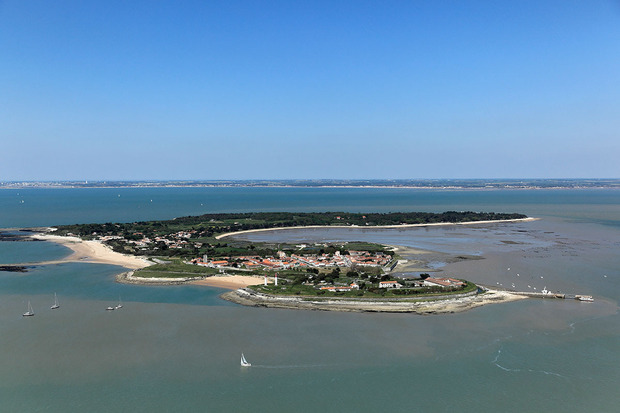
In 1793 to the following year, the blood flowed as the guillotine claimed its victims. They were not only the nobles and priests, but anyone under suspicion of being an enemy of the state. Robespierre lost his head in 1794 and the Jacobins were overthrown by the Thermidorean reaction. The Revolution declined and Napoleon took France with an iron fist. Napoleon was a revolutionary with royalist trappings. As I mentioned in the light of my visit this week to the Isle of Aix, I appreciate the devotion many French people have for Napoleon’s military genius, energy and vision for a new Europe. By 1815, when Napoleon was defeated at Waterloo and exiled to the Island of Elba, the Revolution and the vicissitudes of nineteenth-century France were no longer of any interest to Romantic idealists.

My wife and in-laws are deeply Napoleonic in their ideas, not royalists or legitimists. I see their point. France is a country one both loves and hates. There is a cruel undercurrent in this country that is unmatched even by the British Empire of yore and the atrocities in India and Australia. This country of human rights can be remarkably callous. France was twice divided in the twentieth century, over the Dreyfus Affaire and which side people buttered their bread under the Occupation and the Pétain regime south of the Ligne de Démarcation. Many collaborated with the Nazis out of self-interest, and most of those involved in the Résistance were Communists by ideology as well as those loyal to De Gaulle. The lines of division are felt to this day. In a highly polarised country, I am glad to be an English expatriate.

It is humanity and the Mark of Cain, the broken and sinful spirit of man who sought something other than the knowledge of God.

I hope and pray that this celebration of a tragedy of tragedies will bring us to self-knowledge and repentance for our foolish ways and hatred for other humans. I see the hollowness and hypocrisy of French republicanism through the self-serving politicians at the Elysée. It is no different in England with the absolute fiasco over the Brexit referendum. Perhaps the gunpowder, as dry as ever, will one day again be ignited. We all feel it in the air.

Dear Lord and Father of mankind,
Forgive our foolish ways!
Reclothe us in our rightful mind,
In purer lives Thy service find,
In deeper reverence, praise.

In simple trust like theirs who heard
Beside the Syrian sea
The gracious calling of the Lord,
Let us, like them, without a word
Rise up and follow Thee.

O Sabbath rest by Galilee!
O calm of hills above,
Where Jesus knelt to share with Thee
The silence of eternity
Interpreted by love!

With that deep hush subduing all
Our words and works that drown
The tender whisper of Thy call,
As noiseless let Thy blessing fall
As fell Thy manna down.

Drop Thy still dews of quietness,
Till all our strivings cease;
Take from our souls the strain and stress,
And let our ordered lives confess
The beauty of Thy peace.

Breathe through the heats of our desire
Thy coolness and Thy balm;
Let sense be dumb, let flesh retire;
Speak through the earthquake, wind, and fire,
O still, small voice of calm.

Posted in Uncategorized | Tagged , , , | 2 Comments

Photos of my Cruise

I have been doing some light editing with Photoshop. The later photos were blurred by seawater on the lens and salt deposits. This is something to be constantly watched!

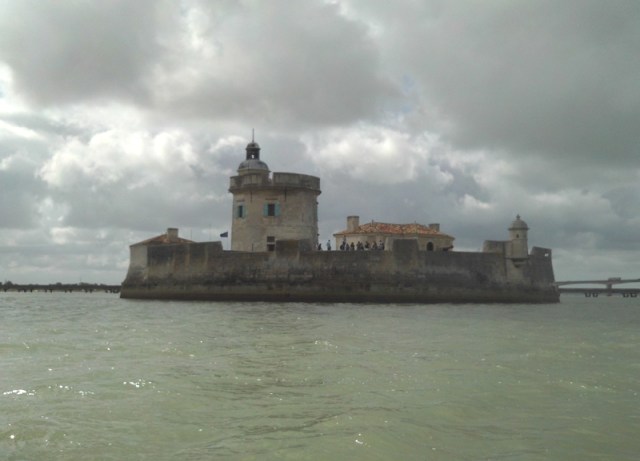
pertuis2016-01This was my first point of interest just after I passed under the bridge between the mainland and the Isle of Oléran. The Fort Louvois dates from the seventeenth century and had something to do with resisting colonisation by the not-so-invisible Empire (sorry, Romantic Ladies!). Today, it is a tourist attraction and is accessible at low tide by a causeway.

pertuis2016-02As I approached the Ile d’Aix, a tad too far to the east for my liking and having to tack to correct my course, I passed Fort Enet off the Fouras peninsular. This would have been yet another defence against the same old enemy!

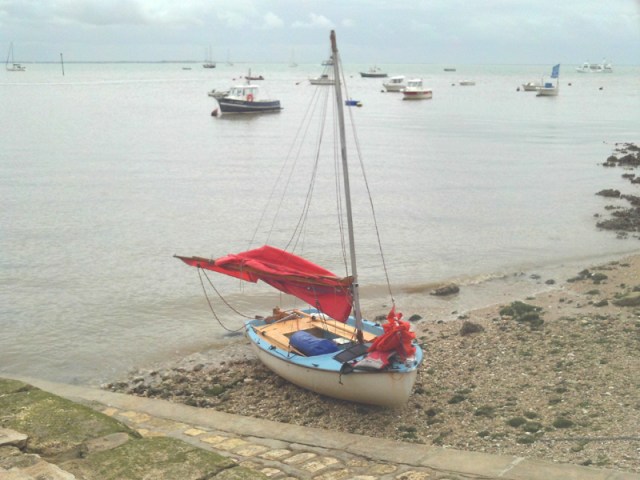
pertuis2016-03Here is Sarum dried out on the beach, giving me three hours to visit the island. More than that, she would have needed bow and stern anchors and my rubber dinghy to get to her. The black object on my foredeck is a solar battery charger to boost up my mobile phone a little – and my little mp3 player to give me some music on board. Both devices have to be kept dry, so not whilst under way. The mp3 player churns out my favourite pieces, but in a plastic box.

pertuis2016-04We English could have taken Napoleon out and shot him or hanged him from the nearest tree. The defeated French Emperor was treated with respect and lodged in this beautiful house before being taken to Elba. He was a formidable foe, but I can only admire the energy and vision of Bonaparte in his reconstruction of France and an idea of Europe so far ahead of his time.

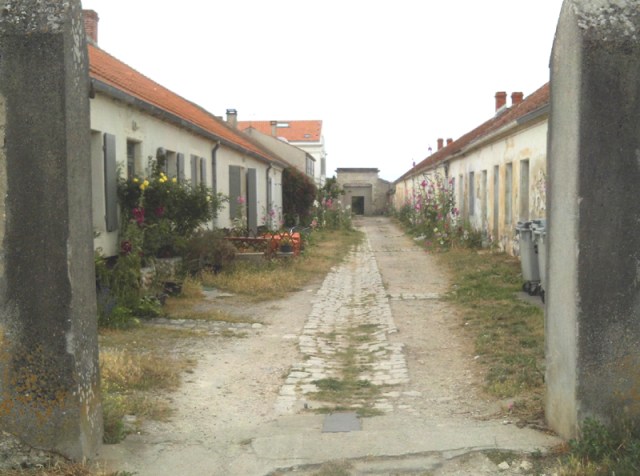
pertuis2016-05A street that has not changed since the early nineteenth century – just the two plastic dustbins!

This is the old abbey church of the island. The old wall of the nave is visible to the left, and all that remains are the transepts and the crypt.

The crypt (professional photo).

This church bares a tale of man’s inhumanity to man, that of Robespierre and his guillotine orgy in the 1790’s. He got his own neck shortened in 1794. The translation of the above: “On this Ile of Aix between 3rd May and 20th August 1794 were interred 226 of 829 priests who were deported to the Hulks of Rochefort during the Terror. 64 of these priests were beatified in Rome on 1st October 1995 by HH Pope John Paul II. Among them, 37 rest in this Ile. Some of their ashes were laid under the floor slabs of this church.

See Martyrs of the Hulks of Rochefort.

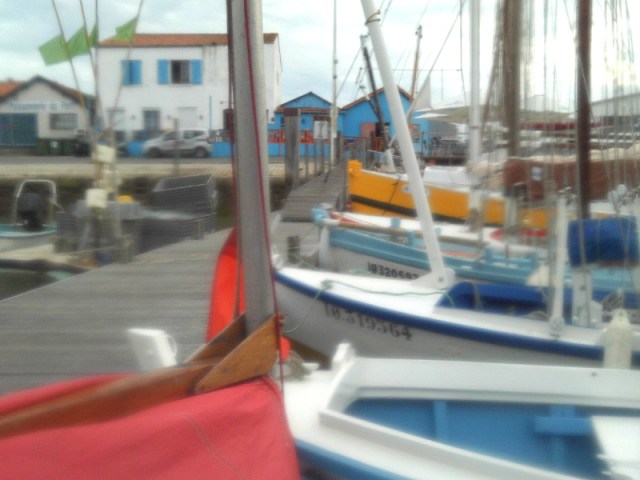
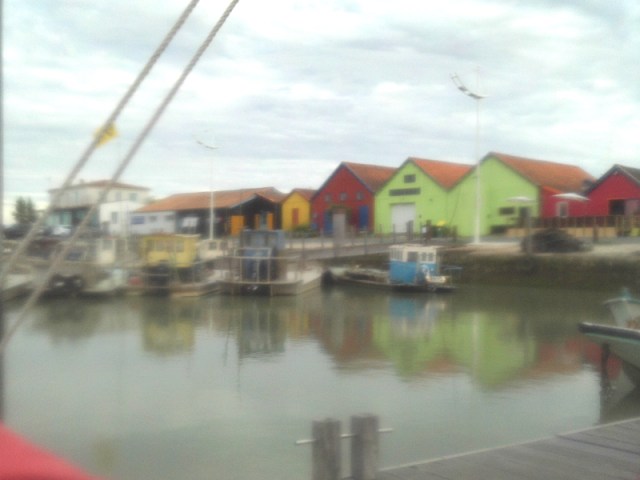
pertuis2016-06At this point, my camera lens was covered with seawater salt, and the ensuing crappy photos are all I have. The scene is the port of Château d’Oléran taken from my boat. The port reminds me of so many little fishing ports along the south and east of England with the wooden buildings, most of which are workshops.

pertuis2016-07The other side of the port with the coloured workshop buildings and the flat-bottomed fishing boats.

pertuis2016-08Leaving the port the next morning at about 8.30 am.

pertuis2016-09The weather was not as bad as it looks here. Cloud formations can be absolutely amazing sometimes!

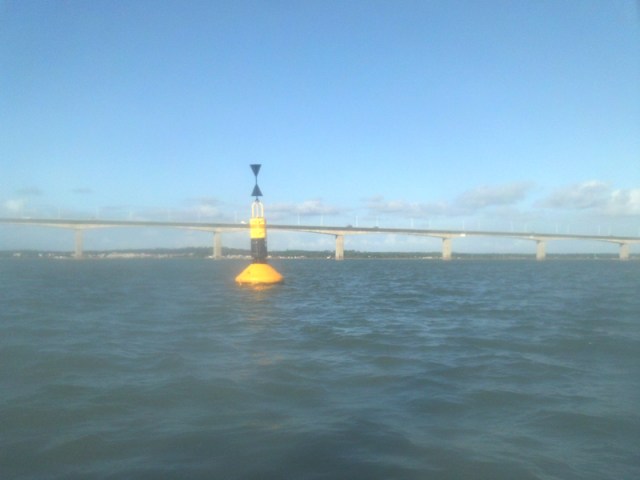
pertuis2016-10This is the west cardinal buoy just before the bridge to the Seudre. On a south-east course, I was to the right side of it – though now the tide was high.

pertuis2016-11The Seudre is an immensely wide river with fascinating ports like along the coast of Louisiana (according to photos I have seen). The street is a channel with individual houses and moorings for the traditional fishing boats.

As the wind freshened, I had a harder job to do to sail the boat and took no further photos. What good does it do to take a photo and lose the camera and a lot of other stuff in a capsize? Bach’s Brandenburg Concertos were still playing on my little mp3 player, but I had to close the plastic box to keep everything dry from the spray. I close-hauled Sarum out of the worst of the chop and had the mooring ordeal ahead of me.

pertuis2016-12This is the boat used by the friendly young harbour master to take me ashore with my cruising stuff, having only just enough depth to dock the boat. It felt amazing to step aboard this ultra-stable work boat after being in my dinghy. This photo, taken about 5 minutes ago, shows the harbour master’s dock dried out.

pertuis2016-13Here is Sarum taken from the harbour master’s dock, dried out. Anything moored here is only afloat for about three hours a day, perhaps a little more for Sarum since she draws so little depth. The harbour master’s boat operates strictly within those times. The alternative is using my rubber dinghy or wading in mud and cockles! I’ll certainly take my wife for a little turn round the bay on Thursday or Friday when the wind turns to the north-east and starts off nice and gently.

We’ll be back in Normandy next Sunday.

Posted in Uncategorized | Tagged | 3 Comments

Les Pertuis

Update:

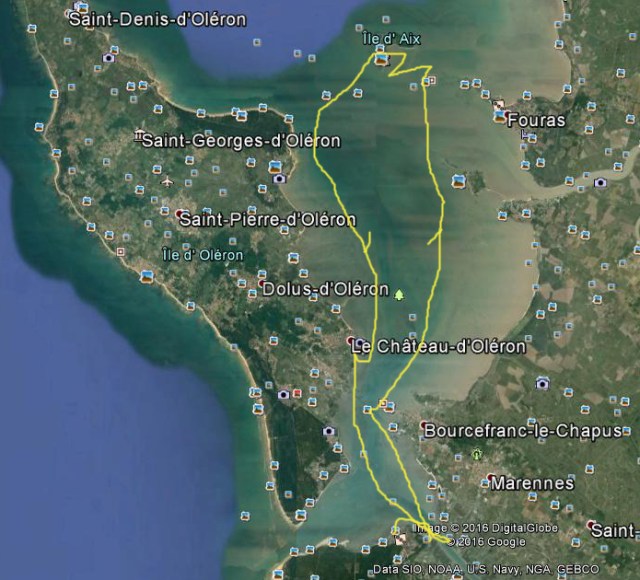
pertuisI did it, about the greatest distance I have covered at once in my 12 foot dinghy. I have yet to enhance my few presentable photos through Photoshop, so will do so on a following post. The problem with photography at sea, using a crappy waterproof camera, is that what appears to be close is really quite far – and the photos lack the impression a sailor sees on approaching something of interest.

I sailed on a close reach northwards under the Oléron bridge and made towards the Ile d’Aix, Napoleon’s last view of France before his exile. It took me four hours to cover twelve nautical miles and beach on the island. That gave me an average speed of three knots, not bad for a heavily-laden cruising dinghy. My enjoyment of the long reach was offset by my long drift to starboard having to be corrected by tacking between the peninsular of Fouras and the Fort Anette, all surrounded by rocks and treacherous oyster farms. I quickly discovered that at anything other than high tide, I had to be accurate with my coastal navigation. I don’t have a GPS, and do it the old-fashioned way using a hand bearing compass, chart and Portland plotter. The area is quite well marked with cardinal buoys and twigs sticking up through the surface showing the positions of the oyster fields.

I landed on the Isle of Aix about an hour and a half before low tide, so I could visit the island leaving my boat dried out on the beach. The church is a former abbey where the remains of thirty seven priests barbarously murdered during the terror and beatified by Pope John Paul II are interred. The nave and the choir have disappeared, leaving only the transepts and the Romanesque crypt. There was a striking feeling of the sacred in this church. Being in July, there were quite a few tourists in the car-less village. The place is remarkably unspoilt, and the house where Napoleon spent his last days in France is impressive. It is now a museum and can be visited, as my wife and I did back in 2012. I spent about three hours on the island until the water was deep enough to float my boat.

I had the idea of sailing to the north-west to pass the Fort Boyard, but the tide was flooding and the wind was from the same direction – north-west. It would have been a very slow and laborious close-haul and I was concerned about getting to the south of the Isle of Oléran before nightfall. I crossed over to the Isle on a single port tack, well off the wind for speed and power through the chop. I was unconcerned about current and drift, seeing that the crossing was little more than a nautical mile. I did not call in at Boyardville, but continued down the coast, well away from the osyter fields. My centreboard did touch something very lightly, but I took the precaution of not lashing it down. I was ready to “spring” my rudder at any time. After about two hours at sea, I found the port entrance at Château d’Oléran, which was very narrow for a close-hauled entry. As I passed through, I was facing the wind, and had to row very laboriously until getting more deeply into the port. It was difficult to drop my sails without getting blown up against other moored boats. The wind decreased, and rowing became easier as I reached the inner port and found a place among the vieux gréements, as most of the pontoons are reserved for fishing boats. I set up my tent and sleeping boards for my “hard bastard’s” night. I had a simple meal at a restaurant serving English-style fish and chips – rather good and reasonably priced. No one asked me what I was doing in port, so it was don’t ask don’t tell. Permission to moor in the port would have been clumsy and bureaucratic in usual French fashion, so the old idea goes – In France, everything is forbidden but everyone does it all the same! All the same, I was away at about 8 am the following morning when the water was deep enough.

I sailed south on a broad reach towards Ronce les Bains, and found I had a spare hour with the flooding tide. Having reached the Seudre bridge at 10 am, I gave myself half an hour to see some of the amazing little fishing ports. I had to close-haul out of the river with the current in my favour but against the wind, which gave quite a stiff chop to bash through. The wind freshened and I had to heave-to and reef the mainsail.

My man overboard routine came in useful when catching my mooring buoy at the beach of Ronce les Bains, which yesterday was a lee shore. I caught the buoy in a constant wind of fifteen knots, gusting at eighteen to twenty knots. I managed to drop the mainsail with my left hand alone as I held the buoy with my right. I took a mooring line from the bottom of the cockpit and got it through my bow fairlead using my gaff. I breathed a sigh of relief as I cleated off the line with the final round turn and two half hitches.

I was about to blow up my rubber dinghy to get ashore as the port keeper, a smiling young man in his late twenties, kindly came with his motor barge to give a hand. I took most of my cruising stuff out of my boat and we got ashore just before the water was too shallow for him. All in all, I covered about thirty nautical miles at and average of three knots within two tides, including my night in port. I think this “hard bastard” should be able to cope if the Challenge Naviguer Léger goes ahead next year and my wife doesn’t mind my going to that as well as the Semaine du Golfe. We’ll see…

* * *

I am in Ronce les Bains this week with my wife and in-laws, and I have my trusty Sarum with me. I have a new plan in view for tomorrow morning.

I will be launching tomorrow morning under the bridge of the Point de Mus de Loup that crosses the Seudre, the river that flows into the Pertuis de Maumusson. I intend to launch shortly before high tide to allow for about two hours of current-free sailing northwards, because the currents in the Maumusson can be quite strong.

I intend to sail northwards past the Ile Madame and between the Fouras peninsular and the Ile d’Aix, a place with historic associations (the exile of Napoleon in 1815 after his defeat at Waterloo) and the charm of a little village with no cars or other motor vehicles.

I then intend to pass the Fort Boyard, another monument of France protecting her virginity against we British.

I will continue west to the Ile d’Oleran

and visit Boyardville. I’ll probably spend the night in or near Château d’Oleran on the lee side of the island, therefore in calm water or dried out.

I have to be back at Ronce les Bains on Tuesday late in the morning to catch the high tide (a window of only three hours) and avoid the forecast heavy wind in the afternoon which may gust at up to 22 knots. I could manage that with a reefed sail and little sea swell or chop, but I prefer to avoid trouble. I will then moor to a visitor’s buoy for the week and take my wife out for a few little daysails.

One purpose of this little adventure of 25 to 26 hours will be to test my sailing skills and endurance for an event next year called Challenge Naviguer Léger which involves a three-day sail over one hundred nautical miles. It is quite gruelling and involves complete autonomy, so I want to be sure that I am up to it. Therefore this little test. Let’s see if I can do about forty nautical miles within two high tides. I am confident.

Posted in Uncategorized | Tagged | Leave a comment

A man after my own heart

Thanks to the internet, one can come into contact with the most amazing characters who like me mess about in boats. I have often mentioned Roger Barnes who has quite a high profile on Facebook and is an architect by profession. He sold his yacht to devote his sailing passion to small open boats.

I came across an original type of boat (which I will discuss below) and it has been promoted by a friendly looking gentleman by the name of Dylan Winter, who lives near London and in his old twenty-six foot Centaur twin keel yacht. He is sailing around the UK is stages, because he still has to work. An engineer by profession, he has worked as a journalist and now makes short videos of his sailing and a modest living from the internet. I admire his English eccentricity, ingenuity and inventiveness. One of his inventions is a simple and cheap way to heat a small room in the winter using tea lamps (like the little votive lights we use in churches) which you can buy very cheaply at your local supermarket – and two concentric flower pots. The inside flower pot absorbs the heat from the flames and converts it into convected energy. The outside flower pot also absorbs energy and prevents it from being dissipated too quickly. I’ll give it a try. I might not have to wait until winter given this awful weather we are now suffering in Europe!

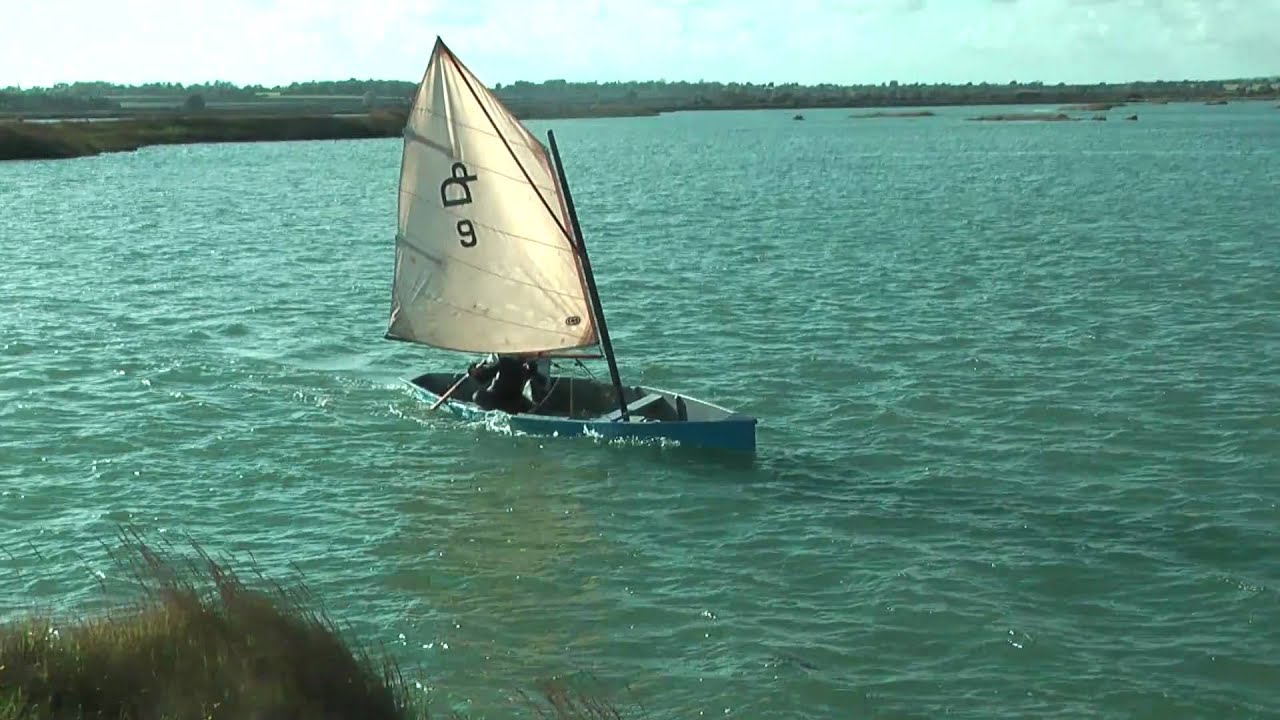
Mr Winter runs a blog called Keep Turning Left, from his desire to circumnavigate the British Isles anti-clockwise, following the coastline. I mentioned above a “different” type of boat. It is called the Duck Punt, basically a sailing canoe which can be built in as little as one week by an amateur with a minimum of woodworking experience – and very cheaply. The Duck Punt uses the sail and sprit rig of the famous children’s dinghy the Optimist. It is steered with an oar instead of a fixed rudder and has no need of a centreboard. It is not a sea boat and does badly in waves. On the other hand, it can sail on no more than four inches of depth and is excellent in calm conditions on rivers. It can be rowed and paddled, and can be hauled out of the water up a steep bank, put on a portable trolley with wheels and re-launched the other side of a lock (most lock keepers don’t allow boats without an engine). I am fascinated and have decided to make one myself.

Naturally, I will keep Sarum (a tough sea boat) and Sophia (a good beach launcher). I am open to ideas for the name of my future Duck Punt.

He and I are almost the same age, like Roger Barnes, and I discern a philosophy of life that pleases me: being himself, finding solutions for every problem, refusing to give up in any difficulty – and knowing that money isn’t everything. Perhaps we might sail together in Duck Punts over some flooded meadow in January – Brrrrr! I think I would feel guilty about having fun sailing where people have suffered adversity from floods – but a field out in the country that becomes an enormous lake could be fun. If the boat capsizes, you just step out with your wellies on, bail the boat out and get back in.

Perspectives in view, and who knows – Mr Winter and I might meet up one day.

Posted in Uncategorized | Tagged | Leave a comment

A response to Patrick…

As promised, I give a few ideas in response to Patrick’s post A response to Fr Anthony… that responded to my recent posting on the Beast of Nazism and similar ideologies.

As William Tighe suggested in his comment, there is a difference between Germany and Prussia. The history of that piece of land is long and highly complex. Much of it came together under the influence of Luther and cujus rex ejus religio. Some parts like Westphalia and Bavaria remained Catholic, but Prussia and much of the north gave that Kruppstaal hardness that favoured the sympathy some of the old military elite had for the Nazi ideology. Most of what I have seen personally of Germany has been of the Catholic parts with colour in the towns and a sense of joy. I admire the spirit of German Romanticism and the greatness of German music from Buxtehude and Bach to Brahms, Richard Strauss and Max Reger. There is a rigour and purity in that kind of music that I admire. Elgar, Stanford and Parry all worked in the “tradition” of Brahms and developed their own lyrical styles on that basis. Culturally, England owes much to Germany through the Royal Family and a sense of fair play, honesty and hard work.

The roots of the Beast are everywhere. Anti-Semitism (not merely an opposition to Zionism but the hatred of all Jewish people) was everywhere. I am old enough to remember schoolboys insulting boys by calling them “dirty Jews”. The Dreyfus affair in early twentieth century France is also a facet of the developing ideology. The Church in Italy was not exactly sympathetic either. It is known that the Gestapo based many of its methods on the old Spanish Inquisition.

I mentioned in my article that regimes like that of Hitler were Socialist (Nationalsozialistische Deutsche Arbeiterpartei). Mussolini began with social reform and popular policies and actions. Taxation was very heavy, but everyone had a job and a home. The Volkswagon (people’s car) was launched at Wolfsburg near Hanover by Hitler. He also had the first motorways built to allow this little wonder of mechanical engineering to drive at high speed. One problem with the EU, as many rightly say, is that it resembles the old Soviet Union or may have the potential of becoming something like Hitler’s Berlin. Totalitarianism comes indifferently from nations and multi-national entities and bureaucracies. Of that there can be no doubt. A vulgar American would say – Either way you’re screwed.

There is also the notion that immigrants are being brought in because (if pushed up against a wall) they would work longer and less well-paid hours than white Brits. Perhaps. That has been so for a long time. I remember boys at school in the 1970’s going on about the “pakis” and the “wogs” in Bradford. That is more than forty years ago.

The big problem about “purifying” society is how far you go. After having deported or exterminated all immigrants, who do you go for next? Tramps? Unemployed people? Anyone not conforming to the precise type of human being? There is a legitimate concern about uncontrolled immigration and the strain they put on the Welfare State and the lack of respect they have for the culture welcoming them. That question has to be addressed, but within the limits of humanity and morality.

From the almighty cock-up in England, something will come of it. Much will depend on how other European countries relate to the EU and seek independence like the UK, the general implosion and collapse of the EU or some way to profit from the tightening noose and march towards globalism and the world bank. I am still confused, but seek to reason at a deeper level than English right-wing Conservative rhetoric.

I admire Patrick’s imagination of some Orwellian / Sharia future dark age. It may well turn out like that, a kind of third-world hovel one would find in the Middle East. I pray not to live long enough to see such a world. We can do much to delay the process’s effect on us by moving to the country and to remote places away from the towns, just as long as we have a means of survival. That is OK for as long as we don’t become afflicted with cancer or some other awful medical condition – then we either need a medical system or pray for a quick and painless death! We are only human and depend on the system to some extent. I too have read Orwell’s Nineteen Eighty-Four and seen the film with Richard Burton.

I do make a distinction between nationalism and totalitarian national socialism or another kind of socialism (international). What we often call far-right is actually left-wing. The main principle is stealing the resources from the “haves” to distribute them equally to all (and keep some under the table). It is known that there is really no essential difference between the Nazism of Hitler and the Communism of Stalin. They glorified strength and power, and mercilessly killed and tortured those who did not worship the leader as their god.

Something needs to change.

Patrick is right as we stand poised at the brink of big changes in our life and our assumptions. Most of us will have to take initiatives and take responsibility for our own destiny. As Sartre once said in a cynical moment L’enfer, c’est les autres. Hell is not other people themselves but our utter dependence on them even in sin and foolishness. We have to be ourselves and make our own way. Most people cannot, but those of us who can must not be held up by those who cannot or will not.

In the end, the political upheavals that occupy our minds are of lesser importance than our self-knowledge which has to begin in ourselves before spreading to others with the potential for understanding. Qui habet aures audiendi, audiat.

Posted in Uncategorized | Tagged , , | 6 Comments