Ponerology

This is a term with which I have been familiar for a few years. The term is based on the Greek word πονηρός, an adjective which is also used substantively, meaning pain-ridden, and by extension evil. Those who use the term ponerology invariably mean the study of evil. Demonology is a discipline within the study of theology, and the mystery of evil has been the most profoundly studied by Russians like Dostoyevsky and Berdyaev to name just a couple.

I haven’t time to go into it completely, but I will attempt a brief summary. This topic has been provoked by the reflection of capital punishment, itself related to crime and human depravity. Jesus said plainly in the Gospels that we were to love our enemies, including people like Hitler, the SS guards at Auschwitz and the ghouls who would rape, murder and eat your children. But, what does that love mean? If evil is not stopped or at least resisted, it will become the kingdom of hell on earth. This has been seen in history from Nero, Vlad the Impaler, the Turkish Sultans, Pol Pot, Stalin, Hitler and so many others. We cannot come to a satisfactory conclusion about the question of killing tyrants and criminals so dangerous and horrible that they cannot be incarcerated in normal prisons. We really need to move on, and ask ourselves where all this evil comes from.

Heinous sin is obvious in genocide, military aggression, colonialism, the destruction of the environment, destroying the economy to make big money, and then on a smaller scale in child abuse, rape, bullying, manipulation, waste, neglect and so many other signs.

How can this be when all the people we know, or nearly all, are decent, hard-working, caring about other people, honest with money, generally virtuous whether or not they believe in God or the principles of a religion? Most of us dream of a better world, care about those we love and those who obviously need our help. Throughout history, good people have been unable to bring about lasting peace, justice and harmony.

Why do we get evil people? What makes them evil? I’m not talking about people who sin by weakness, but those who revel in the misery of others? I have written on Gnostic themes like the Archons, which more or less correspond with the Devil and demons in orthodox Christianity. There are more modern views too, which need to be critically studied.

Some Catholic moralists have ventured onto speculations about “structural sin”, which shows intuition, though such are often incomplete. It would seem that some environments and contexts are more conducive to people turning bad, though not all people from an identical context would turn out to be evil? Is there an intrinsic predisposition, fitting the nation of total depravity as found in Calvin’s interpretation of Saint Augustine’s theology? I personally am more convinced by the more Christian humanist notion that sees more good people than evil people, unlike the pessimism of the Jansenists and Puritans.

There is the old quote from Pastor Martin Niemöller (1892–1984):

First they came for the Socialists, and I did not speak out—
Because I was not a Socialist.

Then they came for the Trade Unionists, and I did not speak out—
Because I was not a Trade Unionist.

Then they came for the Jews, and I did not speak out—
Because I was not a Jew.

Then they came for me—and there was no one left to speak for me.

Our complicity with sin is usually one of omission. We tolerate evil, and then become complicit in it. This is what happened to the German people in the 1920’s and 30’s, and it can happen again. It is happening with the refugee crisis in Europe, the rise of the Right, Islamic jihadism and the continuing war in the Middle East. We do tend to deny what doesn’t immediately concern us. To what extent do we become responsible for this kind of evil?

Certain groups of people and institutions are strongly drawn to causing harm, destruction, cruelty and suffering in others.

The biggest and most soul-scouring question is to what extent can and should we prevent and resist evil, above all in the name of Christian love and “turning the other cheek”. This is surely the criterion by which Christianity is judged as too weak to be of any use in the “real” world. Strict Islam would seem to fit the bill better – but unfortunately that religion has shown itself not to be free from evil!

The struggle against evil seems futile and we make little progress in identifying the real issues. A most interesting theory is that of psychopathy, exactly like the ghouls who have usually ended their lives on the gallows or the electric chair. At an individual level some on the most impressive work has been done by the Canadian psychologist Robert D. Hare in his check-list of characteristics that define the psychopath, the sociopath and the malignant narcissist. Dr Hare is specialised in the study of criminals and the possibility of their rehabilitation.

He proceeded by studying factors containing sets of characteristics, the proportions of which would differ from person to person. Such characteristics would be for example: impulsiveness, aggression, Machiavellianism, persistent criminal behaviour, lack of empathy, shallowness, superficial charm, manipulativeness, etc.

Psychiatrists have found that psychopathic personality disorders cannot be cured and the person himself will not have the self-knowledge needed to recognise that there is a problem. When they commit criminal acts, the only way to deal with them is to keep them locked up or kill them (in countries that have capital punishment). Not all psychopaths are criminals and thus do not end up in the courts and prison. They are gifted leaders and are particularly suited to a highly competitive environment. They run businesses, banks and political parties ruthlessly. They are only called to book when they are overthrown, convicted for crimes against humanity, big-time tax fraud or whatever. The successful psychopath takes over a country, and the unsuccessful one goes to prison or quietly lives off the energy of other people, sucking their spiritual life blood like vampires.

Looking at it like this, we would seem to be faced with intrinsically evil people. We are brought to the Augustinian notion of total depravity. Because of original sin, fallen man cannot follow God, refrain from evil or accept salvation unless endowed with grace. There is no free will. In Augustinian and Calvinist teaching, this is the condition of all of us, and only a very small number (identified by their financial success, naturally) are the predestined Elect. God created man in the same way as a turtle lays a thousand eggs to produce three or four viable turtles. Perhaps a few percent are afflicted with total depravity like an equally small percent are mystics and saints, and the rest of us have our lives to work everything out with God’s help. Could this be so?

In practice, when a psychopath commits criminal acts, he is treated as one with moral and legal responsibility and free will. It would appear that the psychopath is not suffering from a mental illness, but is – evil.

Human society has evolved from families and tribes to nations and groups of nations living hierarchically in dense cities. Technology and science have evolved for the best and the worst. All that incites and encourages the competitive “alpha” man. The scope for destruction becomes greater with “mega-societies”. Fortunately, the same technology has strengthened our ability to unmask the shenanigans of the psychopaths by means of alternative news websites and to blow whistles on Big Brother. We might not be able to do much against corrupt businessmen and bankers, politicians who lie through their teeth and would like to start World War III for money – but we can blow their covers of deceit and secrecy, out them if we dare.

I don’t think that psychopathy accounts for everything. If psychopaths are humans, then they are at a disadvantage in terms of knowledge of God and salvation. I have read theories according to which they are not humans, but the offspring of reptilian beings – demons, archons or beings descended from the nephtalim who were beings from before the Flood recorded in the Book of Genesis and the holy books of most of the religions of the world. I find such an explanation à la David Icke difficult to swallow, but it would leave humans as fundamentally good though capable of sin and evil. Apart from evil deeds and the characteristics of a psychopath, how do we tell the difference? Is our intuitive judgement infallible? Another thing to consider is that it suffices to believe that so-and-so is not human – and therefore we don’t have to respect his life or human rights. Is that not how the Nazis got so many people to hate and kill Jews? That would be too easy.

An interesting study is on by the Polish psychiatrist Andrzej Łobaczewski, who wrote Political Ponerology: A Science on the Nature of Evil Adjusted for Political Purposes, (Grande Prairie: Red Pill Press, 2006). I have a copy of it, but it makes heavy and difficult reading.

His main preoccupation was psychopathy in politics, the so-called pathocracy, rule by the sick. He saw history as oscillating between “bad times” like Nazism from 1933 until its defeat in 1945 and “good times” like the 1950’s and 60’s until the energy crisis of the 1970’s. Similarly, there was the Belle Epoque from about 1890 until 1914, then there was World War I, the growth of totalitarianism (Nazism and Communism) and World War II, a period spanning over thirty years. However, the 1920’s were quite jolly, despite the fact that so many families had lost their young men in the trenches.

Perhaps this is what happened with Atlantis, the Roman Empire when they fell, as seems to be happening today with American hegemony in the world. If enough psychopaths and narcissists get into power in a country, that country becomes a totalitarian state and turns against the people by means of surveillance and violence. A kind of ‘anti-morality’ comes in together with a perversion of language and conceptual thought. The Orwellian dystopia illustrates how far things could go, at least in theory. From this comes the cult of the infallible leader who can never be wrong. Eventually, a pathocracy contains the seeds of its own destruction, and it collapses. This happened in the past and is happening now. However, the process is rarely “clean” and many innocent people suffer when the collapse does occur. One cycle closes and a new one begins.

This might serve as an explanation to all the cloak and dagger lying that goes on surrounding issues that touch on American hegemony in the Middle East and Eastern Europe. I am particularly horrified by the would-be resurgence of the Ottoman Empire in Turkey, the corrupt royal family in Saudi Arabia who are little more than a “successful” Daesh – with just about the same religious ideology and callousness. We are constantly lied to by by our ruling classes and politicians. What are they hiding? Yes, I know that this sounds like conspiracy theory thinking and paranoia. I now hear this way of thinking from my father who has always been a moderate English conservative who eschews all extremes and irrationality. Things are just not the same as years ago!

The fall of a pathocracy is always tragic, violent and destructive. We think of the defeat of the Nazis from June 1944 until the executions of most of the war criminals after the end of the Nuremburg Tribunal in October 1946. Many of the rats escaped to South America and the Communist bloc, but their rule was over. For the drama of their downfall, I recommend Der Untergang, the famous film that shows Hitler raging at the Generals, accusing them of betrayal and how he would drown them in their blood or hang them from meat-hooks with piano wire. People were committing suicide, like a scene from I Claudius and the fall of the Roman Empire. The kingdom divided against itself can but fall.

Pathocracy is like cancer in the human body. The disease goes too far and kills its host. The pathocrats become greedy and turn against each other. This stifles the system they promote and competence becomes subservient to cronyism and corruption. By 1944, it was said that Hitler was fighting for the Allies by making too many strategic errors to the exasperation of professional Army officers and strategists! When we see this, the end is not far away.

Finally the flesh rots away and the bones begin to show. The mask is off and citizens begin to react. The first of the heroes die like martyrs, and the popular movement gains momentum. The downfall and defeat of the Nazis cost countless lives and too many cultural treasures in Europe. Amazingly, the Soviet regime collapsed bloodlessly and without a war in 1989. This may happen with our European Union and the USA, leaving people to reorganise their lives is small communities. We can only pray that we be spared from a nuclear holocaust, now that Saudi Arabia has the Bomb.

We will never be through with evil in this world. It comes and goes, up and down throughout history. The important thing is that we ourselves should recognise the potential for evil within ourselves and “put on the armour of God”, that we may be able to withstand. Evil is a terrifying mystery that none of us will ever fully understand.

Posted in Uncategorized | Tagged | 11 Comments

Sail on the Seine

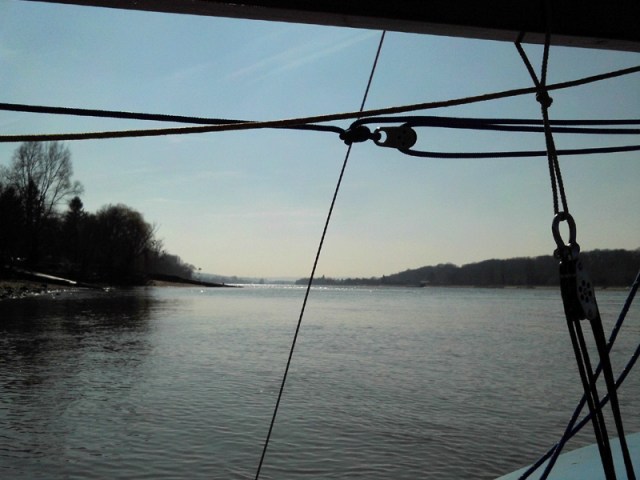
This was my first time out this year, and I have wanted for some time to try the tidal part of the Seine. I launched from the slipway next to the sailing club of Hénouville. The tide was going out, and I had little time for a sail, so it meant going out against the current to make sure I could get back in with the current. The Seine is not to be underestimated, especially the tidal part downstream from the lock of Poses, even though the present engineered banks of the great river have done away with Le Mascaret. Upstream from Poses, the Seine is controlled by locks and is slow flowing, and it meanders its way to Paris and beyond. It is still navigable to river barges. On the tidal stretch, there is the current (fluvial and tidal), so you need a good wind to beat it or an engine. Secondly, big ships sail up the Seine between Le Havre and Rouen. One needs to be careful and be ready to face the bow wave wash from the ship. Here I had just finished rigging Sarum.

seine_tidal01Today is a beautiful sunny day, but the north-east wind is still quite cold. I was OK with my wellies and my sailor’s vareuse over my life jacket.

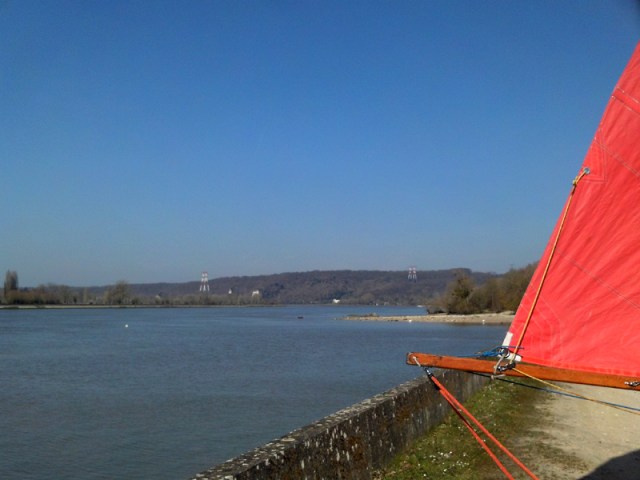
Here’s my trusty Sarum, launched and ready to go.

seine_tidal02Looking south in the direction of where I was going.

seine_tidal03One very big cargo ship, going slowly but still not to be underestimated.

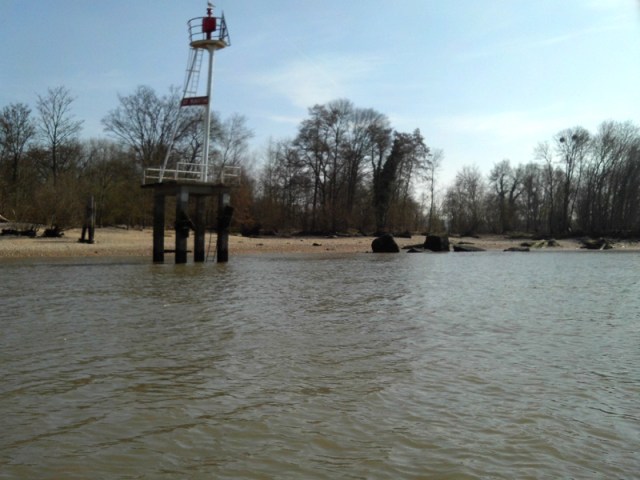
seine_tidal04One of the port channel buoys with a south cardinal marker. I don’t need much depth but the ships do.

seine_tidal05You can just about pick out the ship on its way to Le Havre.

seine_tidal06

Posted in Uncategorized | Tagged | Leave a comment

Let us glaze our arses…

Sometimes, our brains race ahead of our ability to communicate with human language, and words get switched around in a sentence. It is something akin to the order of letters in words being inverted, yet they are legible if the first and last letters are in place. Many such errors come from typing errors rather than ignorance of correct spelling. So it is with the spoonerism.

My wife often teases me because I often commit such errors in speech, like “Je vais mettre du poèle dans la pétrole” – I’ll put some stove in the heating fuel. The nonsense of such a sentence make make any reasoning person conclude that words had been switched.

Dr Spooner was a legend in Oxford in his day. The list of examples in the Wikipedia page doesn’t include, or dumbed down, the most outrageous, as he stood with his glass of champagne in his hand to drink to Queen Victoria’s health:

Let us glaze our arses and roast the queer old Dean, instead of Let us raise our glasses and toast the dear old Queen!

Here are the others from the Wikipedia article:

  • “Three cheers for our queer old dean!” (rather than “dear old queen,” which is a reference to Queen Victoria)
  • “Is it kisstomary to cuss the bride?” (as opposed to “customary to kiss”)
  • “The Lord is a shoving leopard.” (instead of “a loving shepherd”)
  • “A blushing crow.” (“crushing blow”)
  • “A well-boiled icicle” (“well-oiled bicycle”)
  • “You were fighting a liar in the quadrangle.” (“lighting a fire”)
  • “Is the bean dizzy?” (“Dean busy”)
  • “Someone is occupewing my pie. Please sew me to another sheet.” (“Someone is occupying my pew. Please show me to another seat.”)
  • “You have hissed all my mystery lectures. You have tasted a whole worm. Please leave Oxford on the next town drain.” (“You have missed all my history lectures. You have wasted a whole term. Please leave Oxford on the next down train.”)

Another interesting phenomenon in England is (or has been) Cockney rhyming slang, a kind of code for thieves and swindlers in the low places of the East End. Right mate, we’ll go round the Jonny Orner, down the frog, up the apples, and ‘ave a butchers at the Tower Bridge.

Jonny Orner = corner
Frog and toad = road
Apples and pears = stairs
Butcher’s hook = look

Posted in Uncategorized | Tagged , | 6 Comments

Hanged by the neck until dead

There is a discussion on capital punishment on The hanging judge… and Death, part two…

I think I have discussed this moral problem to an extent on this blog. Just type keywords into the search box, or look at the Moral questions category. My own opinion is about the same as it always has been – abolitionist. However, there are horrifying cases of serial killers, terrorists, cannibals who rape and eat children, etc. that seem only to deserve execution after a fair trial with rock-solid evidence.

One problem is that human justice is fallible, and many cases call for mercy as well as justice. For example, a man who has murdered his wife because she abused him. He has committed something heinous and terrible, but is he a danger to society generally? Would it not suffice to give him a relatively short prison sentence in an open facility where he can reflect, expiate, put his soul right with God and seek psychological help if appropriate?

There are solutions by which society can rid itself of dangerous individuals without killing them. In the past, there were penal colonies, but they were usually rife with corruption, rape and bullying like in normal high-security prisons. There are successful examples in Northern Europe of open air prisons, where inmates are not allowed outside the outer walls, but live a more or less normal life inside. They can get a job and engage in hobbies, and socialise as human beings. The ideal is that the facility would be entirely paid for by the work of the inmates so as not to be a burden on the taxpayer.

What about the really depraved psychopaths? There are perhaps cases where they should be killed because no other solution can be envisaged. Method of execution? Nothing fancy, just a single bullet in the back of the head in a prison cell, Russian style. The body would then be certified as dead by a doctor and then cremated in an officially witnessed event. Perhaps, this could be a discretionary sentence in very extreme cases.

It is a difficult moral problem, and we can easily develop an unhealthy interest in electric chairs and guillotines (simply type those words into Google). Some people take the same interest in guillotines as in classic cars! It is tempting, and we English have a dark sense of “gallows humour”. It is unhealthy.

Justice should be positive and merciful whenever possible, and as concerned for the offender’s rehabilitation as for the safety of society. We are sickened by the way Jihadist groups and countries like Saudi Arabia still behead and hang people in public, and we discuss the possibility of bringing all that back into western society! There are no simple solutions, yet I am not a lawyer. There are principles so that the law should be impartial and apply to all alike, but there is a notion of equity and mercy. This should be considered next time any of us is called for Jury Service (I can’t be because I am a clergyman).

Posted in Uncategorized | Tagged , | 12 Comments

Et in Arcadia Ego II

It just goes to show… I tend to regurgitate old stuff and add subtle things to old posts. See Et in Arcadia Ego. At my age, I tend to go on with the same fundamental thoughts. I arrived at Fr Montgomery’s presbytery already quite tired on the ways of the $$PX and their dour drabness. He could get away with being an Anglican (canonically a Roman Catholic priest) with “medieval” quirks. At 23, there was no way I could go back to the 1940’s, go to the diocesan seminary at Bayeux and become a parish priest. He was born in 1914, not me! If I wanted to become a priest, it would be through Ecône and then the life of a missionary changing places every couple of years – no continuity of ministry, no differences from the conformity mould, no stability. This is something the $$PX has in common with the post Vatican II Church, the mega-church with all the power concentrated in a small elite clique. It took me a while to understand these issues intellectually, but at the age of 23, I could only “feel” that I was being sold the wrong goods and that conversion to Roman Catholicism was not a good idea.

It isn’t going to be easy to communicate my “feelings” in words intelligible to other people, you readers, but I will try. Many of us Romantics are idealists rather than realists and try to project our own fantasies onto reality. That can bring about artistic genius, or provide excellent material for the nut-house! Reading about Gnosticism, I read about many of the aspects including nostalgia for the life we lived before we were born, a life which was certainly in another universe. That sounds very much like an idea of reincarnation, but may not be. I have experienced this “nostalgia” throughout my life, as if I had known things I could not possibly have known in my childhood. The “feeling” is very blurred. There are no sights or sounds, but something that touches my existence. Maybe, a psychiatrist would say I am suffering from this or that disorder. Others would compare it to St Paul’s For now we see through a glass, darkly; but then face to face: now I know in part; but then shall I know even as also I am known. Some things and associations bring it on, certain pieces of music, medieval churches, some things I see from my boat whilst at sea. When I read Romantic poetry, I recognise the experience in those men, but who were able to express it in poetry and music, which would be a better communicator than my English prose.

My dear friend Rubricarius wrote a touching comment to my last posting on Fr Montgomery. He seemed to incarnate, to some extent, that archetype I was looking for. The “Sarum” that had disappeared from England and was no longer to be found even in Anglican parishes. Perhaps, there were other isolated parishes and perhaps a diocese. The Institute of Christ the King was originally the result of priests like Fr Montgomery founding the Opus Sacerdotale in the 1960’s. We still had more or less that spirit in 1990 when I joined them, and the extremes of high camp canonial disguises only came in after I left and when the priests running that community were more reassured in their relations with Rome and the Archbishop of Florence. There was also my friendship with Dr Ray Winch (convert to Orthodoxy from Roman Catholicism in the 1950’s) in Oxford during my student days at Fribourg. He referred to a medieval chapter of canons that had survived from before the Reformation and had the right canonical privileges to exempt them from every kind of authority outside themselves. Of course, this canonry existed only in his imagination, but it was his arcadia from which he could express himself. I loved the idea, but it didn’t exist, and no ecclesial authority would allow such a thing to be founded.

I think many “mainstream” traditionalists from the Opus Sacerdotale branch rather than the Society of St Pius X (though Archbishop Lefebvre was quite close to the old French parish priest rather than the military model of priestly life) got close to establishing good communities. There are the various Benedictine abbeys in France, though they are highly influenced by the 1950’s liturgical movement. The Fraternité de Saint Vincent Ferrier is an interesting little religious community using the Dominican rite. There is a community of canons regular, the Chanoines Réguliers de la Mère de Dieu (site in English). They helped Fr Wach and Fr Mora to get going in the late 1980’s before the house at Gricigliano came up. The priests of Gricigliano are styled as secular canons, but the whole thing lacks authenticity and is characterised by snobbery and high camp. The bottom line is that someone who thinks he may have a vocation for this kind of life just has to go through normal channels and knuckle down to reality.

I have already mentioned a book that has marked me by the French author Pierre de Calan, Cosmas or the Love of God. Brief review. It is an excellent parable for us all. A young man, son of a veterinary surgeon (as I am) seeks his arcadia with the Trappists, but the reality of monastic life is something else. He never solves the problem and only finds resolution through death. It gnaws away at the soul and will never let go, until a person can come to some kind of a compromise and live his life outside the regimentation of a community. That is my lot, diocesan priest of a minor church of Anglican tradition, but with enough freedom to “do my thing” within the limits of Christian morality and seemliness. Being on the fringe is the price to pay for keeping our personalities, our archetypes and our own relationship with God.

I was quite taken back by my friend’s:

All that remains of any claim to authentic Western liturgical patrimony is being kept alive now by flickering flames on the ‘outskirts’ like yourself Fr. Anthony. Those videos bring home, painfully, how so very much has been lost over the last thirty years, especially galling after the heroic efforts of the proto-Traditionalists who worked so hard to keep things going through the late 1950s and the 1960s only for their contemporary descendants to have cast most it aside.

It is flattering to be entrusted with this responsibility, but I can only do it for as long as I am alive and in good enough health. Then I will go the same way as Fr Montgomery, Fr Ronald de Poe Silk and others. I would like to see this responsibility assumed by my ACC diocese and others, who should have the prospect of surviving the present generation. I would like to see more Sarum, though the standard Anglican Missal (influenced as it is by the Roman rite) is a sound basis with the old Holy Week rites and without many of the innovations from the Pius XII era. The ACC needs more support, not only from ordinary folk looking for a good Church, but also from those concerned for the integrity of the liturgy. We can’t have our cake and eat it – belong to the RC Church or the Church of England and still expect to have a bit of freedom for our quirks and eccentricities! Mind you, we are a Church and not a clique of specialists. The balance has to be kept. I do what I can with only occasional attendance by my in-laws. Otherwise, I’m practically on my own doing everything like old Fr Montgomery. I just have my chapel, not three village churches.

Rubricarius may seem to be exaggerating when there are traditionalist communities and parishes, many more than back in the 1980’s. The determining factor would seem to be the use of the various Pius XII and John XXIII modifications that bolstered the prestige and god-like power of the Papacy. I have published the The “Restored” Holy Week by Msgr Léon Gromier, Papal Master of Ceremonies during the Pontificate of Pius XII – a conference given in 1960. This was quite an acid criticism. My own diocese uses the old Holy Week, in English, according to the Anglican Missal. I use Sarum, which is so “obsolete” that it has had no modification other than translation into English since about 1526. The Warren translation dates from the early twentieth century but is done in “Cranmerese” style. It can also be celebrated in Latin. The cause for taking a critical position in regard to the 1950’s and 1962 Roman missals is still quite marginal, but less so than in the past.

In the end, we can only put in our little bit. I can do that much more because I am a priest. Lay people can pray the Office, or the main Hours of it. We will never find the arcadia in this world, because it is not of this world. We see it through a glass darkly as we gaze on the stones of a cathedral, or when I hear the Variations on Dives and Lazarus by Vaughan Williams, or am transported by some other earthly sign.

This piece for me evokes a lost world, that certainly never existed on this earth, even in the Middle Ages. Paradise is elsewhere, or right here but in a different “frequency” or “dimension”. Sometimes we are privileged to “see” shadows from our Plato’s Cave, but we cannot experience the whole whilst we are earth-bound. Christianity calls this paradise Heaven, and warns us that we cannot even imagine what it is like or the degree of beatitude we will experience if we have aspired the right way during our life on earth. That is where we will find everything to which we have aspired, the celestial Salisbury Cathedral with St Osmund himself celebrating, with J.S. Bach at the organ and everything we could imagine. Perhaps we little ones would be crushed by the greatness of it all.

According to some “apocryphal” sources, we would pass through some dark purgatory and then be rescued and taken to various levels of light and beauty. Perhaps as we let go of our ego, we would become a part of the universal consciousness we call God – an idea that we just cannot comprehend. That is the object of our nostalgia, and is also our origin before we were incarnated into this world. There is the tradition of the Christian Church, and there are the Scriptures, and many things are said. I do not refuse information or ideas from other religions and possibly even private revelations – because they build a bigger picture. At any rate, we will never know the whole truth this side of the grave, unless, perhaps, we undergo a near-death experience by being clinically dead, but not quite dead and brought back by doctors or spontaneously. There are many strange things, and I don’t disbelieve them all.

Whilst we are still here, let us build the dream at least as much as we can. That is why I have my little chapel and the boat to sail out to sea. May these dark windows bring us closer to the inaccessible and more filled with love and beauty, that others may also seek the same spark of divinity within themselves as well as beyond us all in Transcendence.

Posted in Uncategorized | Tagged , | Leave a comment

With the passing years…

I have been delighted to find this video on Fr Quintin Montgomery Wright, which dates from 1988. Two indicators, his age of 74 and the controversy in that year over the four episcopal consecrations conferred by Archbishop Lefebvre. No one could care less nowadays!

My attention was drawn to this video by The Way We Were, itself referring to Fr Ray Blake’s website. My own association with this priest goes back to 1982 and my own disastrous conversion to Roman Catholicism. Also significant for me is the video on the SSPX UK History. I was received by Fr Black, and it was Fr Montgomery who had me re-confirmed by Archbishop Lefebvre at Saint Nicolas du Chardonnet in the following year, 1983. It was a Fr John Coulson, a former Camaldolese monk and World War II veteran looking after a small traditionalist chapel in Wimbledon, who pointed me to Fr Montgomery Wright.

At that time, I suffered considerably from the stifling bigotry of traditionalists in England and thought things would be better and more “natural” in France. I set off in July 1982 on a bicycle with a few belongings to explore the French traditionalist world. I took the ferry from Newhaven to Dieppe, and cycled all the way to Fr Montgomery’s parish. I was 23 and had the naivety of a child. I had the idea that if there were still parishes like Le Chamblac, there might also be a diocese of the résistance. There were none, and the only option for anyone wanting to become a priest was Ecône and the Society of St Pius X. That meant my learning French and endearing myself to the Society in France. Thereupon began an extremely unstable and painful period of my life. Only recently would I begin to find answers in my own life rather than blame my shortcomings on others.

Fr Montgomery is probably the reason why I am living in France and a part of this country I link closely with England as he did. Though I aspired to being a country priest in a parish, my life would turn out in a totally different way. And fortunately. He had his life, and I mine. I arrived at the presbytery in July 1982, and Fr Montgomery was welcoming and charming. I spent until October 1982 with him and Christian, and then moved on to “pre-seminary” with the SSPX at a school near Chateauroux. Daily routine took us to Bernay and Mass with a small community of sisters looking after an old folk’s home, and we went each Sunday evening to Alençon where Mass was said in a hired hall.

The thing that most marked me about Fr Montgomery was his naivety, which I attribute at least partially to his age and experience of another era. He saw no difference between the gentle but determined Archbishop Lefebvre and his own life as a priest. Interestingly, Fr Montgomery Wright was involved in the worker priest movement in the 1950’s, which for him would have been a continuation of the radical socialism of the English slum priests of the Victorian era. He saw France through the eyes of an English gentlemen, and his eccentricity would allow him this distance not allowed for anyone younger.

This video was made at the time when I was a student at Fribourg and it would be a long time before I returned to Normandy. Fr Montgomery died in 1996 as a result of a car accident. I remember that he was quite a reckless driver as are many priests who are constantly on the road. Christian was in the car with him and was killed outright. I have visited Fr Montgomery’s grave, which is located in the corner between the south transept and the choir of the church at Le Chamblac. I should also say a word about the area where he lived. The Eure area of France is much more “backward” and France profonde than the Pays de Caux where I presently live. They are both rude areas with high winds and a climate that is very similar to southern England, conducive to apple trees and cows. He could become very attached to his pays, and I feel alienated just about anywhere!

For all his years in France and the traditionalist world, he seemed to have little understanding of the dialectic oppositions between “us and them” or “all or nothing”. He was fond of Archbishop Lefebvre, but had little understanding for the nasty aspects of intégrisme, which has its parallels in English and American radical conservatism. He was sheltered from it all by his being a parish priest, left alone by his exceptionally tolerant liberal Bishop (just as with Anglo-Catholic priests under Evangelical bishops in the Church of England). In his mind, everything was transposed, but there was nothing remotely “Anglo-Catholic” about the intégristes. His age protected him from accusations of being too Anglican (not sufficiently indoctrinated by the bullies and authoritarians of the traditionalist world).

He probably influenced me in many more ways than I would care to imagine. My own idea of “projecting” my Anglicanism onto the Roman Catholicism I experienced certainly did more than anything else to “undo” my illusory transition and return to some point where I could find my place. There is no comparison between the 1980’s and our own era, any more than with the 1950’s, 30’s or the Victorian era. Le Chamblac as it was then just would not be possible now. Many traditionalists became mainstream with Ecclesia Dei adflicta and the pontificate of Benedict XVI, but nothing has that lack of regulation and supervision of Fr Montgomery’s parish life or indeed or the parish of Bouloire (Le Mans) where I installed an organ and spent time with Fr Pecha (French from Bohemian roots).

Another thing with that era was that people were for or against anything. Now, the same people don’t care. Would it be the hypothesis of post-modernism where people shed off their “meta-narratives” and are content with nihilism? As we all get older, we get set in our ways and decreasingly in touch with the issues that matter to younger folk.

Illusions were still possible in the 1980’s, though they were vanishing like the morning mist. There are things that exist now that didn’t exist then, like the Institute of Christ the King that I joined in 1990. There are other religious communities. Of course, with the “mainstream” traditionalists, there are the issues of the 1962 liturgy, which would be perceived differently in rural France and suburban London. Oddly, I find much of the spirit I sought then in the ACC. We are very little regulated (as long as we don’t do anything really wrong) and we know each other. We don’t have the village folk, who had a good time riding on the piggy back without giving much in return. Fr Montgomery’s world ended in his little tomb in the corner between the transept and the choir of the church he loved. Ours on this earth will end too as I look over my even more fragile religious world.

If we are Christians, we are undaunted by the prospect of passing from this world, judging ourselves more harshly than God would judge us, and entering a world we cannot presently imagine. I shed my illusions many years ago and have learned to live with the reality of despicere terram et amare caelestiam.

Posted in Uncategorized | Tagged , , , , , | 7 Comments

The Conservative Rhetoric

Perhaps if I didn’t read it, I wouldn’t get steamed up about it… Perhaps this applies as much to me as to the conservatives who are hammering on about abortion, euthanasia, same-sex “marriage”, transsexualism, etc.

Going round some of the more active blogs, there are some musings by Monsignor Entwistle who leads the Australian Ordinariate. What strikes me is when we try to dig deep and search out the underlying thought. This is something I have known about for several years. The real bottom line is that such conservative Christians (they are found in the Roman Catholic, Orthodox, Anglican and Protestant churches alike) would like to have some powerful secular power in their pocket so that they can play “Christ the King” over the whole world. Would Trump fit the bill or what? I won’t go any futher down that avenue, because it’s going to become excruciating until the election and inauguration next November in Washington.

I’m not pointing any fingers at the good Monsignor, but I find his reflections typical of a certain tendency. My first question is – You and whose army? How are you going to roll back the permissive laws on homosexuality, abortion and other moral issues? You can do that only with your private Generalissimo Franco who would have the dissidents quietly garrotted in the cellars of the State prisons. All that is no problem when it is the secular arm. This kind of thing has been going on for centuries.

Certainly, abortion, euthanasia and the homosexual caricature version of marriage are not in line with Christian ideals, but very few people are Christians. Why keep banging the drum? It is one thing hearing the confession of one of your own faithful and other to tell secular society what it should be doing, when the clerical Church’s record is far from pure in terms of human rights and freedom. I don’t approve of sin either, but there is a way to winning people’s hearts without banging the anti-“liberal” drum. I think that a part of the cause of the paedophile cover-up accusations is the constant drum-banging. It is now time for us in the Churches to assume what has happened.

I think we have got to understand why things like the French Revolution happened. People were sick and tired of clerical and aristocratic arrogance and callousness in the face of poverty, disease and the lot of the underdogs. I am no Marxist, but I understand why this pent-up energy happened. You can’t say “Let them eat cake” and blame it all on their materialism and ras-le-bol. For every priest who went to the guillotine, others in earlier periods of time were burned at the stake, imprisoned or tortured for matters of belief and conscience.

Of course, the so-called “liberals” are the most intolerant of all, as were Robespierre and the Jacobins in the 1790’s. I don’t approve of their intolerance and obscurantism either.

For me, this state of affairs heralds the end of the Constantinian Church that claims the right to lord it over everyone, whether or not they are Christians. Compulsion is a thing of the past – and fortunately! They go on about relativism, but hardly seem to understand the deepest thought of Joseph Ratzinger. Secularism is a fact of life in general society, and that is the way it is.

I have heard all the stuff about counter-revolutions here in France, the Grand Monarch, the Grand Pope and the Marquis de la Franquerie until it came out of my ears. They hanker for their secular arm and their inquisition, but those things are in the past – and never had anything to do with the message of Christ. The banging goes on, but the idea is completely academic and illusory. I have also read about restoring Christian culture, setting up intentional communities based on Hilaire Belloc’s distributism. Nothing has ever worked or lasted, because human nature got the better of it!

We have to understand that no one cares about what we do in our Sacramental Churches. People can be got to become religious “drug addicts” and the “dealers” make a killing out of it, but the soul is ever left unsatisfied. Humanity is as indifferent as the sea. The difference is that the sea’s judgement is fair even if it is often tragic for those who founder.

There is a glimmer of light at the end of Monsignor Entwistle’s rhetoric. The liturgy has collapsed in the Church and this was a part of the crisis of Catholicism. However, it does not goes back to the 1960’s but many centuries. We will not bring people back – and still less enforce our moral teachings – just by offering a pretty liturgy with nice vestments and a puff of incense smoke. People are beyond caring.

All that sounds depressing and extremely pessimistic. Should we give up? Do ourselves in? What? None of those things. We have first to start being realistic.

Do we ourselves care about the liturgical and spiritual dimensions, or do we just want a platform for political ideologies? Do we really believe in it? Are we hanging onto notions that are totally untenable and which lost all credibility centuries ago – or does Christ speak to a part of us that is deeper and more real? Until we clear up some of these issues, it is pointless for us to go on crusades and empty moralistic rhetoric, laying ourselves open to the consequences of sins committed by our own. The future is up to us.

I can only suggest more humility, a more contemplative approach to our faith, relationship with Christ and our self-knowledge. Perhaps that might be a basis on which the mustard seed can grow and produce fruit long after our own deaths. I don’t wish to offend Mgr Entwistle. I have met him and believe him to be a good and pious priest, but this way of expression got me going. It converges with my posting of yesterday (on fashion) which provoked a comment almost challenging me to choose between political conservatism or the morass that passes for “political correctness” (reference made to Orwell’s 1984). I refuse both political “tendencies” because the truth is in neither. It is above. It transcends and appeals to the spirit, not the psychic soul.

I am afraid of what is now in store for us, be it Orwellian or according to the tenets of jihadist head-choppers. Christians have known worse, whether it was Hitler’s lot or the Roman Empire with their sadistic executions and tortures. Many of us will be small enough to pass under the radar and the net, and may even survive to bear witness of our little way that failed in worldly terms – as did Christ by ending up crucified rather than kicking out Herod and the Romans – and nurturing hope for better days.

I believe that our vocation is inwards and contemplative, finding ourselves and radiating with a joy that the world will never know. Perhaps we might share the gift with pitifully few, but that is unimportant. Perhaps it is because of such an awareness that I most often say The Lord be with you to empty choir stalls. That is another aspect of Pope Benedict’s teaching that gets so easily forgotten. Besides that, here in France, people care only about politics or their personal health problems!

Also, I am not an extrovert and a marketer. Perhaps I should not have become a priest for this reason but rather told to be a Brother in a monastery. Some have said exactly that to me. All the same, something keeps me going, and I’m not about to give up… Pray for me.

* * *

I ought also to mention a blog article that I have mulled over the last few days: Religion and Politics (the Two Most Dangerous Words in the English Language).

Although there is a level of caution that ought to be shared among those subsets who clamor for a return to a pre-Constantine Christianity, it is worth acknowledging that for the first three hundred years Christianity operated by working around the dominant political system. After Constantine, Christianity became the dominant political system. Since then, it has found itself unable to conceive of itself outside of the political system, save for perhaps the monasteries and other communities that consciously reject said system. Would it were that those who would politicize Christianity reflected upon this.

* * *

If this following article can be believed, then humanity faces much greater threats against which churches can do nothing. Genetically Modified Organisms: The sterilization of humanity? I don’t know if there is any scientific basis about this effect of GMO’s but it seems conclusive with lab rats. According to the article, some of the world’s elites would find it convenient to reduce the world’s population to a fraction of what it is now. The Church needs to learn to live without elites, and do so quickly!

Posted in Uncategorized | Tagged , , , , | 5 Comments

Apparitions

fatima-apparitionRad Trad has just put up a posting on apparitions – Josephology Appendix 1: Apparitions & Visitations. It is often a tiresome subject when people for whom faith, belief and religion are an external mask that affirms their personal agendas.

I have visited Lourdes and Fatima, and am deeply moved by the heroic piety of some of those on pilgrimage. Many seek healing from sickness and disability. Others seek redemption from a life for which they are deeply ashamed. Each is seen walking on his knees with discomfort visible on his face, touching the rock of the Lourdes grotto, drinking holy water. Who are we to judge when we don’t know ourselves, let alone others?

I added a comment to the Rad Trad posting:

My own mind is attracted to a notion of a holographic universe made of universal conscience and energy, and that matter is only an illusion. Don’t ask me how, because I don’t have scientific training in quantum theory. The universe would be a kind of “multiverse” comparable to a band of radio frequencies to which a single radio set can listen one at a time. Our experience as human beings represents only a very narrow segment of the whole. Another analogy is the narrow frequency width of light that we can see.

In an “altered state of consciousness” a human being may experience something of another “frequency”, very near our own, but not quite. Thus, what we describe as heaven, hell and purgatory may be in the exact location of where we are, but on another “frequency”. The same idea would extend to UFO’s (I have never seen one) that would travel through the “frequencies” rather than through space in the fashion of an Apollo rocket sending three astronauts to the moon. This idea would revolutionise psychiatry, giving credit to those who are called psychotics and schizophrenics of an experience of voices, visions or “feelings” that no one can describe.

Perhaps what I write seems crazy or sceptical in religious terms, but I see it as a way of escaping the usual dialectic between materialism or an infantile caricature of God. Thus I do believe that people have experiences with beings from other “dimensions” who identify with characters from our Christian scriptures. Perhaps more of us than would want to admit it have had some kind of experience that escapes materialism, but only exceptionally do people hear voices and see a transfigured Mary or one of the saints. I often wonder how such an experience would change my life!

We seem to be on a track that can transcend the usual soul-destroying war between fundamentalists and atheists.

There are “Fatima fundamentalists” like there are fundamentalists referring to Scripture, canon law, Papal documents and just about everything to give certitude to their doubting or tortured souls. Certainly, such apocryphal messages are open to allegorical interpretation as are the canonical Scriptures. We should not discount them. I have mentioned before that I tend to be sceptical, and have an extremely enquiring mind. Faith does not come to me easily. Miracles can be a lot less convincing to the sceptic than many of us would like to think.

Perhaps if we try to take a higher view, things might become easier to grasp when we accept the illusory nature of everything we believe to be real, even our very lives.

Posted in Uncategorized | Tagged , , , , , , | 2 Comments

Fashion

My attention has sometimes been attracted to a phenomenon called Steampunk, and I got something of an exposure to it when I visited Jules Verne’s house in Amiens. Fascination for things from the nineteenth century is a two-edged sword. One quickly becomes saturated with gigantic technology and human arrogance with social status and progress. I have seen many films depicting the nineteenth century, but the view is partial and selective, even with views of the evils of the era like workhouses, poverty and disease so decried by William Blake and Charles Dickens. The Elephant Man is a poignant portrayal of the freak show, cruelty and exploitation. It also showed the noble generosity of the more altruistic of the moneyed classes. When we delve a little into the more exotic aspects of Victorian eccentricity and the modern steampunk optic, we will discover some very surprising things about an era reputed for its prim and proper moralism.

It is a story of human aspiration, but also of evolving fashions and trends in society. As a cleric, fashion was never my “thing”. As a child, I wore things not because they were in fashion, but because I liked the feel or appearance. Fashion can be a way to hide individuality. Nothing did that more than our clerical cassock and Roman collar, or our school uniforms in England. My own experience led me to a critical stance and a profound alienation from a society that has overtaken me – as for many people who arrive at middle age and are getting on in years. My wife is a little more fashion conscious than I am, since she works in town and has more social contact than I have. She tends towards a slightly 1930’s style with her “bell” hat and shoulder-length hairstyle. When we go out together, there is a distinct contrast between her style and my fashion-blind mixture of long hair and various articles of modern casual dress. For more formal family events, I do make the effort to put on the right things – though I stop short of wearing a suit (unless it is clerical dress with the collar). I then tie up  my hair into a ponytail (the queue) or a tight bun.

Here in France, the cassock creates a bad impression through its association with traditionalists with “extreme” right-wing political views and a generally intolerant view on life. That being said, the cassock with hair tied up into a tail, eighteenth-century style, leaves a different impression, since the right-wingers often have very closely cropped heads. We long-hairs often unkindly refer to them as “clones”. Being the only priest of my Church in France, I have little contact with church people since the downfall of the TAC and my renewed obscurity as far as the traditionalist Catholic world is concerned. I am happy with my little lot in life, working to earn my living, pottering about in my boat and going about my most essential priestly duties in my chapel.

We have arrived at the notion of fashion that I find most unpleasant: conformity and surrender of personality and critical thought. Fashion brings people to dress in the same way and present the visible parts of their bodies.

Fashion goes way back in history as we look at what people wore in different periods according to their social status, how men and women wore their hair and other visible aspects. In many historic civilisations, fashion rarely changed, whereas fashions in our western world are changing all the time. New fashions came with people beginning to travel and discovering other cultures in the world. Rapid changes in fashion go back essentially to about the fourteenth century. Things became increasingly ridiculous in the seventeenth and eighteenth centuries with exaggerated hairstyles and hats. The French Revolution brought sobriety as did religious puritanism in different forms. The nineteenth century brought a different kind of exuberance, to a point resumed from the old order and partly influenced by the new dogmas of progress and status.

Unisex dress originated in the 1960’s, and men and women would become less distinct by their dress and hairstyle. Also, from this time, fashion began to make big money for designers and marketers. In our days, we have a wide choice of things to wear according to our tastes, cultural references and our place in society. Fashions are often set by film and music stars, and the fans of those stars begin to identify with them. There is also the question of age, since older people might look a little odd dressed as a very young person. I have that tendency – to dress like people in their twenties, and I seem to pull it off! I would feel very awkward dressing in the way my father does.

Fashion in clothes took off with mass-production in factories with standard patterns and sewing machines. More elaborate clothing could be afforded by more modest people through retail outlets. Fashion is a highly globalised industry, and styles cross cultural boundaries. Fabrics would often be bought in the Far East, clothes made in Chinese or Taiwanese sweat-shops, finished in Europe and sold in the USA and Europe at inflated prices. I have learned many things about this industry through my translating work. Fashions are often dictated by mass media, social networks and the internet. It is all very accessible and enticing, as I found when I translated a complete web catalogue for a large French casual menswear company (they make some very nice things like hoodies, and reasonably priced). That being said, my philosophy is always the same. I go out and buy something because I need or like it, not because the vendor has manipulated me for his profit. That being said, none of us is totally immune to the mental manipulation of advertising and modern marketing.

It is easy to take a caustic attitude in regard to our consumerist culture and mass fashion. I tend to look at it from a philosophical point of view rather than in terms of business. It is human for each of us to think of ourselves as “special” or different. The human person is unique and constituted by relationship with the other, as we read in Eastern Orthodox Trinitarian theology. We live in tension between our desire to stand out on one hand, and conform to the mass on the other.

As a cleric, I am used to being “counter-cultural” especially with the cassock that is associated with traditionalist Catholic ideologies combined with long hair, seen as an expression of anti-conformity. I tend to shock, and I have learned to live with it. Most of the time, I “dumb it down” by wearing modern casual dress and tying my hair up in public. It is often advantageous to slip through a crowd without being noticed – when I am not on duty as a priest.

The notion of fashion and anti-fashion is interesting. The cassock is a uniform like any other, and is worn only by clerics. Long hair on men was last in fashion at the beginning of the nineteenth century – two hundred years ago. Even the Beatles only had shoulder-length hair – and that was quite outrageous in the 60’s! The fashion to which Steampunk refers is the complex attire of the later Victorian era when gentlemen wore large moustaches and sideburns and cut their hair short, but much less short than during and after World War I. Fashion changes very quickly. Anti-fashion remains stable and changes only rarely and then only in a very conservative way.

One thing stands out in our world, that of subcultures associated with tastes in popular music. The Steampunk movement is associated with sounds one would never have heard in the nineteenth century. We are confronted with modern technology looking like things from the Victorian era, computers for example. I have already written in this blog on the fascinating subject of retro-futurism – projecting our current knowledge and technology onto an earlier historical period. From thence comes the fascinating and absurd idea of the Great Invisible Empire of Romantia. Apparently, the Ladies have changed the name of their Empire, and it is dottier than ever!

One can only go so far with eccentric quirks and anti-conformities. I am aware that being too odd alienates people and has a discrediting effect. I have often thought that it must be very pleasant to wear a Tunisian thobe in summertime, an alb-like garment worn by Muslim men suited for the desert – but I don’t because of what it means to other people. Already, people freak out when they see a man in a cassock! One has to gentle with people at the same time as creating a degree of tension with the all-consuming conformity.

Quentin Crisp’s attitude could be summed up in these words:

It takes a man to suffer ignorance and smile,
Be yourself no matter what they say.

He did so by being as “camp as a row of tents”! The rest of us have to walk the knife edge between social acceptance and claiming our personality that is ours, God-given and unalienable.

* * *

I also quote this from Quentin Crisp, of which I find little to dispute:

The object of having a style (as opposed to merely being stylish) is not to be different from other people, but to be more like yourself than nature has made you. A really good portrait is more like you than your own face. Ignore other people. Mr. Sartre says, “Hell is other people.” But not if you ignore them.

You must decide who you are and be it like mad. Do not decide on a lot of bizarre mannerisms with which to encrust our self — just as a writer does not decorate boring material with bejeweled phrases (as Mr. Wilde was wont to do). Take away all the words that are irrelevant to your meaning. In other words, style is a process not of accumulation but of denudation.

Mr. Sargent said, “A portrait is a likeness with something wrong about the mouth.” But really a portrait is more than that. If you are not spectacular in any way, the unspectacular is your style. You must be able to imagine someone saying to one of your acquaintances, “Come to my party and bring that hum-drum friend of yours.” And everyone knows that it means you.

I was asked on one occasion if one could be dowdy and have style, and I thought immediately of Eleanor Roosevelt.

The reason why style is so important is because if you are sure of yourself you do not seize upon a group style — your class, your nationality, your sex. You can avoid this pitfall if you never use the word “we” except to mean yourself and the person to whom you are speaking. It is a mistake to say (or even to think) “we lost a football match” — I didn’t loose it, you didn’t loose it. Eleven other people that we don’t know and have never even heard of us lost it. So, do not go raging through the streets of the Netherlands breaking everything in sight and killing many of the inhabitants.

Stay with it! Never give up!

Posted in Uncategorized | Tagged , | 14 Comments

Flattering…

semaine-golfe20In my statistics page, I have found sailing forums in Italy and Australia referring to my page on the Huntingford Helm Impeder. It is a simple home-made device for holding the helm of a boat when the skipper needs both hands free, albeit for a short time. For yachts, various devices are available, but the usual thing is self-steering either by an electronic device or a mechanical set-up based on a wind vane and a mini rudder. The latter piece of equipment will reliably steer the boat to the wind as set by the helmsman. The Huntingdon Helm Impeder is not a self-steering device. It simply fixes your helm wherever you want it, and it is released in an instant to take over the helm manually. Self-steering does not work well with dinghies, but this device does.

Before I found the idea, I used a piece of bungee cord across the boat, and did a loop around the end of the tiller. I works, but I was glad to have something a little more refined. I have to emphasise that it is not my invention, but that of John Huntingford who is a member of the Dinghy Cruising Association in England. It features in Roger Barnes‘ book The Dinghy Cruising CompanionTales and Advice from Sailing a Small Open Boat, published by Bloomsbury in 2014. This wonderful book is full of ideas and the fruit of this sailor of long experience. It doesn’t teach you how to sail – you can do that at any sailing school. It teaches you what sailing schools don’t teach! I would like to emphasise that I refuse any credit for other people’s ideas and inventions. That being said, I help to put out the delightful message of dinghy cruising as an alternative to competitive sailing or investing large sums of money in a “big white yacht”.

March has begun, and most years, I get at least one precocious outing on the sea or an inland waterway. It is still on the cold side – I do prefer a minimum of 10°C air temperature, which can be more pleasant if it is dry and sunny. As in the old song The Old Superb, we look to the Peter – which is a metaphor of the old Naval custom of flying the Peter to give the order to get under way:

We looked towards the Admiral, where high the Peter flew,
And all our hearts were dancing like the sea.

Winter is long, and it feels almost a great achievement to take the wintering tarpaulin off the boat. My new lazarette needs another coat of varnish, as – really – do my spars and oars. The time is coming, just for a daysail or two, and then there’s June to look forward to with my exploration of the Rade de Brest and that bucolic event on the River Aulne, the Route du Sable.

Some of us had a discussion on Facebook about the name for our activity as an alternative to Dinghy Cruising, Sail-Oar or Voile-Aviron in French. I had the idea of “Swallows and Amazons for Grown-Ups‘.

That gets the mind and imagination going! That being said, Windermere or Derwentwater are not lakes to be underestimated – any more than the sea.

Posted in Uncategorized | Tagged | Leave a comment