
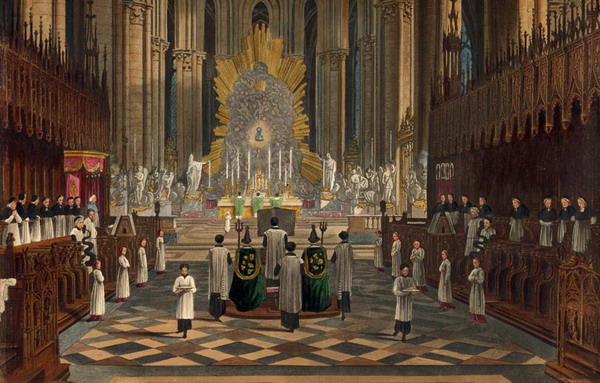
There are presently quite a few discussions about Anglo-Catholicism. By far, the most interesting articles are from Archbishop Peter Robinson. He has been writing about the north-end position, a subject upon which I touched a few years ago in North End Celebration. I have only known that in the evangelical parish in Kendal, St Thomas’ church, where I was christened back in October 1959. They still had north-end celebration in the mid 1970’s – that is, on the altar table up against the east wall, so truly at the end. Since then, they have removed the old carved wood altar and put a simple modern communion table in the middle of the chancel, the choir stalls and the organ also removed. In evangelical Anglicanism, it makes more sense to celebrate the Eucharist facing the people like in the Roman Catholic Church.
It is significant that most things seem to hinge upon this question, symbolic of the theological emphasis of the Eucharist as a shared meal like the Seder or the Christian version of Temple worship of a transcendent God involving a sacrificial act, albeit the bloodless sacrifice of Melchisedech realised in the New Testament by Christ. This question was one of the most debated at the Council of Trent in the thick of the Reformation polemics. I am thankful for the influx of ressourcement and Eastern Orthodox theology over the past century or so.
Some polemicists of our days still try to push high-church clergy and lay folk of the established Churches and the continuing Churches into a dilemma according to which one must be Protestant or high-church as the term was understood in the late seventeenth century, or become a Roman Catholic. The most stabbing argument is asking the question of how a believer can claim to be Catholic and be in communion with bishops who ordain women and approve of homosexual practices. What happens if we side step the issues and are elsewhere? That really gets the bullies where it most hurts!
I have written a number of articles, which can be found easily through this link. I don’t have all the answers. My own experience over the past ten years has been limited to say the least, being isolated except on occasions of meetings and synods and living in an area where precious few are interested in parish Catholicism, let alone upstart “sects”. I continue as a priest on the reassurance of my Bishop that I fulfil my priestly ministry through the Mass, the Office and trying to “teach” through use of the internet. Priests have always done all kinds of different things according to how their bishops used their talents and disabilities.
Many of our problems are caused by worrying about how we can make other people conform to our beliefs in order to confirm our own conviction – if it is not our lust for power, money and sexual gratification. Most people operate according to the demands of social conformity and fashion, and political correctness. A few persons in this world eschew this dehumanisation and set out on the lonely and painful path of self-discovery and individuation, which bring liberating knowledge.
I am thankful that we have some measure of diversity in our continuing Churches, between the “old high church” position based on a moderate bending back from the extremes of Calvinism and the violent language against “Popery” but without rolling back to the pre-Reformation norms or referring to post-Tridentine Roman Catholicism – and the revival of Sarum or adoption of Tridentine doctrine and praxis. The ACC is based more on the Orthodox-leaning formularies of the Affirmation of St Louis rather than the strict Prayer Book, Homilies and the Articles. That is something for which I am thankful. My Bishop tends to be much more “Tridentine” though he usually uses the Eucharistic Prayer from the 1549 Cranmerian rite. I tend to be more “pre-Reformation” with some influence from the old French Church, and celebrate according to Sarum, sometimes in Latin, sometimes in English. I imagine that someone unversed in liturgical minutiae would find it difficult to find differences between the way my Bishop celebrates Mass and the way I do. The two are visibly similar. That is for the liturgy. In the ACC, our theological studies tend to centre more on the Fathers and Orthodox theologians rather than Scholasticism, though many of our priests are very fond of St Thomas Aquinas (as we all are to some extent).
Historically, one thing that made English Anglo-Catholicism stand out in the nineteenth century was its socialism. Continuing Anglicanism tends to follow American conservatism, and English conservatism by extension. It is true that modern socialism is more a question of “other people’s money” rather than humanitarianism, popular religion and care for the less fortunate. It is more difficult to justify oneself through philanthropy because the Welfare State has just about monopolised hospitals, schools and poverty, leaving but few niches open to Christians.
The advent of the Ordinariate has situated things differently. Its origins were mired in obfuscation and deceit from just about every side. England appears to be going well, and America has replaced its first Ordinary with a newly consecrated bishop. Australia is never talked about. I have now said all I will say about the Avignon Patrimony which will certainly be still-born.
It appears that I am a crank for my pains. The word comes from the German word Krank, meaning ill or sick. There is also the idea of eccentricity, which in mechanical engineering is associated with crankshafts. My own Bishop affectionately chides me for my eccentricity. I wrote several articles on my own suspicion that I might be somewhere on the autistic spectrum at the Asperger’s Syndrome level. Though I have not been for a psychiatric diagnosis (at least not yet), it would answer many questions about my life known only to myself and in my secret garden. It is both a gift and a cross to bear in my discipleship of Christ. So perhaps I am a crank, and will join the many little people who cried out in the way, “Jesus, Son of God, have pity on me”. Perhaps that is the best way to be a priest and not a clerical tin-god. One thing that strikes me about the whole “scene” is how few are interested. Very few bothered commenting on my posts on Archbishop Hepworth, which hardly surprises me, even though I know the numbers of readers who consulted the articles. I blog for other people. I don’t need to attract attention to myself. What would I feel I have to sell? Not a lot? On this subject, enough said.
Does Anglo-Catholicism have a future? Compared with the Evangelical churches and mega-churches in America, it has no future at all. Numbers are certainly not on our side in England in the ACC. Our existence is due to the devotion and professionalism of Bishop Damien Mead, together with his heroic perseverance in spite of being dogged with poor health. Beautiful churches are becoming redundant in England by the day, and nobody cares. Our time can be compared to the eighteenth century in that respect. Even with cause for discouragement, what would be gained by giving up? Nothing. So we continue, even if we say The Lord be with you to empty churches and chapels. We either believe in it or we don’t.
Perhaps in a few years, we will get sent to an Orwellian torture camp or get our throats slit for being Christians. For the time being, we are free, socially unacceptable but free. We have to value this freedom and respect it in others, to continue in the same way or change churches or religions. Many polemicists and apologists hate other people’s freedom. I don’t, and believe in freedom very firmly. This freedom includes sin and abuse, and it also includes what is most beautiful and noble in humanity. This is the gift of little Churches made up of people who value this freedom from the tyranny of conformity and fashion.
There is no future of Catholic Christianity among the hylic masses, but there is with persons and little groups of friends and intimate communities. There is a different way of looking at things. I hate crowds, and large numbers of people frighten me. Many of us need a life that is neither socialist or capitalistic, but human. So we continue with our archaic and irrelevant rites of worship, uninterested as we are in what else there is on offer.









 The Blue Flower