More Grave Digging

Further to my post of a couple of days ago asking what was going on, Mr Bruce has just sent in a new posting, The Patrimony That Won’t Die!

This new posting really convinces me that there was never anything to report. The only information about the erstwhile Patrimony goes back to 2012. There is nothing new. All that remain are semantics over meanings of words and whether this or that canonical act had any validity.

The real issue is about a priest who was a part of this Patrimony, was deposed by the present hierarchy of the TAC in America, and who is claiming St Mary of the Angels church in Hollywood against the claim of the ACA. This dispute has been grinding through the American legal system for years, and is as boring as watching paint dry. I have no vested interest in the matter or any independent opinion.

I see no evidence that Archbishop-Emeritus Hepworth is doing or claiming anything. There is nothing to report.

It would seem that the ACA and the TAC tribunal held in South Africa acted irregularly in regard to the TAC’s in-house rules. Now, it seems hardly to matter, when history is changed and old memories are buried, unresolved. That is life in this unjust world.

As far as I am aware, Archbishop-Emeritus Hepworth has no standing in any known ecclesial body. He works for an educational association, and it would seem that he still uses the title of Archbishop. I am told that he still has a chapel in Adelaide, and I can only suppose that he continues to celebrate Mass. I would doubt that he submitted to Rome to be a penitent layman in the Archdiocese of Adelaide. I think we should now leave the matter in silence and in the hands of God, to coin a cheesy cliché.

I resent the insinuations of Mr Bruce about what is canonical or not. It pleased him to be a continuing Anglican at one time. His understanding of ecclesiastical law is highly arbitrary, as are his criteria for extending the courtesy of ecclesiastical titles. All one can say is to wish him good luck in what he has freely embraced, which is run-of-the-mill American Roman Catholic parish life. That particular Church has long ago abandoned the characteristic positions of conservatives, and now dialogues with anything “mainstream” and in tune with modern world affairs and institutions, and with secular tenets.

That’s it as far as I am concerned. No other information has come in, so this particular conspiracy theory can be killed stone dead.

* * *

He’s still shaking the rat! So, Can Samuel Prakash Actually Dissolve The Patrimony Of The Primate?

Maybe the Patrimony of the Primate was not formally dissolved, but it is de facto. There is no one in it. Nobody claims to lead it or belong to it. I belonged to it, but as soon as Archbishop Hepworth was out, I considered myself as belonging to the diocese in England of the TAC, which was confirmed by letter by Archbishop Prakash. This was because I had become an “ecclesiastical orphan”. I since resigned from the TAC in England to join the ACC, and therefore left in due form and on good terms. Any claim to its continuing existence is as absurd as claiming that France is still a kingdom!

What could possibly come out of the woodwork would be Archbishop-Emeritus claiming to be leading a “Patrimony”. If he were doing so, he would be putting it on the internet or publishing something – and we would know about it. This is not so and the whole thing is a product of the fertile imagination of Mr Bruce.

This silly hypothesis has nothing to do with the present hierarchy of the TAC.

Posted in Uncategorized | Tagged , , , | 4 Comments

Living in a Cruising Dinghy with Roger Barnes

My sailing companion has produced a new Youtube film from last autumn. What do we do at night? I put up three articles last summer of my adventure at the Semaine du Golfe:

Here is a nice little story of Roger Barnes’ night on his lug-rigged Ilur dinghy Avel Dro:

He was on his own in his lovely spacious vessel, everything precisely organised and in its place. That is Naval routine at its best.

Sleeping aboard isn’t easy, and I have a lot less space on Sarum than he has. To compensate, my boat dries out flat. I have improved the sleeping arrangement with two self-inflating mattresses on wooden boards. A new lazarette (stern board and locker) will provide more length for my body. I’m beginning to anticipate the new season with improvements to my trailer and the project of the lazarette. Time and money permitting, I hope to make a new and higher tent to give me more headroom, which will involve a higher boom prop.

It feels quite strange to wake up in the boat, dried out and completely immobile, or floating and feeling the movement of the water and the lapping wavelets. The peace and silence are awe-inspiring. It is a rare privilege that you won’t even find in a monastery!

It gets better every year! All I need now is the end of the winter and the bad weather, and a little more warmth in the air for my first daysail of this year. Perhaps I’ll do a jaunt on the Seine before braving the sea – once the Atlantic swell dies down a bit. We took a battering from Storm Imogen just a couple of days ago, but much less than in southern England! As I said on a sailing e-mail list “I take it no one will be sailing“…

Anyway, enjoy Roger’s film, and I hope he will make others to promote dinghy cruising. We will see each other in June at the Route du Sable.

Posted in Uncategorized | Tagged , | Leave a comment

The Old Dream

I have been captivated by this myself. I am talking about the old theme of integral traditionalism as it is known by some among other names. I have a bookshelf full of René Guénon, Soloviev, Frithjof Schuon, Berdyaev, Mircea Eliade, Jung and others who might have been more or less influenced by the New Right movements in Europe. I was once fascinated by Distributism and a so-called Third Way, only to find out that people responsible for that movement had committed terrorist acts. I did well never to have anything to do with that kind of thing! Disappointment after disappointment… Perhaps we have a lesson to learn.

After reading the thought-provoking posting The Great Restlessness, I thought of my own stories to tell. In the 1990’s, I bought a book about independent Catholic and Orthodox bishops – as I have been a little too curious about that less than healthy subject. I won’t give the title of this book, because I feel the need to conceal the identity of the person (X) I am about to discuss. X had a friend who died of cancer at a very early age who was a medievalist and something of a “Romantic”, and wrote books about integral traditionalism. They were both fascinated with René Guénon and founded a kind of confraternity of like-minded souls. X decided that being in charge of the confraternity justified his being ordained a priest and consecrated a bishop, which was conferred by an episcopus vagans. The confraternity proved a failure and X joined the jurisdiction of a bishop affiliated with the Metropolis of Milan. When the bishop in question had his own problems, X joined the local jurisdiction of the Moscow Patriarchate, and was re-ordained. Something went wrong, and now X lives as a layman with his family and earns an honest living. What happened? We can never be in the skin of another person, but this kind of thing (theme and variations) happens to a lot of people. Myself too to an extent.

Perceptio seems to have hit a note, the utter incompatibility between modern western life and metaphysics, any notion other than materialistic. It is then that we have the idea of secession from the system to form small communities, inspired by monasticism, university life, whatever – so that some people can “reconnect”. It is appealing, and some little communities go some way towards satisfying this aspiration, between monasteries, continuing Anglican dioceses, what we do on the internet with our blogs, forums and e-mail lists. We try to avoid being alone. Sometimes, solitude is of the essence!

I try to forge on in my own way, and this is why we need to salvage the aspects of Gnosticism which can be reconciled with what is most constant in Catholic Christianity. Then, we need to examine other mythologies with the right keys of interpretation and understanding. There have been many foolish mistakes, illusions and failures. And, so there will be in the future. We cannot give up without submitting to the morass of materialism and the crass stupidity of the hylics. I have no formula of success, any more than had other thinkers and dreamers. Each of us finds our own way, however crazy that might seem to others.

I have concluded that eccentric and spiritual ways are only for individual persons who try to be true to themselves. At the level of communities, we have to learn to get by with conventional exoteric Churches – in the same way as we live in the general population. Some Churches are more conducive to others. Some believe they have found “it” with Orthodoxy, and one can only leave them to discover reality over the years. Others join a Church which is less exclusive in its “truth” claims but in which worship is uplifting and human relationships draw at least some inspiration from teachings by Christ, St Paul and others on charity (ἀγάπη). A Church is always a compromise between our idealism and the common denominator of humanity. We cannot expect too much from Churches, any more than from the civil institutions of the country in which we live: government, law, police, armed forces, welfare state, education and so forth. Churches give some attention to the metaphysical and spiritual, and give the first guiding steps. We are responsible for our own spiritual adulthood and the discovery we are called to make throughout life.

There, we are on our own – and it will lead to holiness or insanity!

Posted in Uncategorized | Tagged , , , | Leave a comment

What are you giving up for Lent?

Yesterday, I listened to an interview with Quentin Crisp, who, in spite of his flamboyance, ate almost nothing. He claimed to live on a kind of white powder bought from the chemist’s shop to which he would add plain water. Apparently, this plaster-like substance was “quite nutritious”. Asceticism is also practised through eccentricity or being too lazy to cook one’s meals. Becoming vegan or vegetarian, even temporarily, can be a part of one’s choices of life, but they don’t necessarily bring us to holiness.

The question comes up each year without fail. I have provocatively asked whether one might give up religion for Lent, with the idea that one might become kinder with other people, more critical of ideology and more human. If that is a challenge to someone, perhaps such would be a good idea.

Someone might say flippantly that he has given up hope for Lent – and never found it since last year! What is Lent if it is not a time for self-torture by semi-starvation or looking miserable to others and to oneself? Lent usually starts when we are still in the midst of foul weather and the sight of a wintered boat on hard standing. We just feel like curling up and staying in bed rather than going to work or Matins or whatever we do each day! It’s typically a time when we are at our lowest, unless we live in the southern hemisphere. It’s depressing, dark and cold! All we need then is a letter from the bank manager informing us that the overdraft limit has been exceeded, or a big bill for Social Security contributions! The cup fills to overflowing…

Strangely, I find Lent a peaceful time. Little happens, and I am left to get on with daily routines with few interruptions. When the blogosphere yields little in the way of news or stimulation for our curiosity, the time has come to read books. As Lent wears on, we get an extra few minutes of light each morning. Nature gives its little rewards from snowdrops to crocuses and the first daffodil buds, and we only pray that we won’t get a short sharp shock of ice and snow! But, overall, more is taken away from us in Lent than we would give up.

Almsgiving? We are overloaded with the world’s miseries. Our compulsory social security payments are used in part for giving benefits to refugees and migrants from abroad. We can only give so much before being challenged to give voluntary contributions to organisations that are not part of the Welfare State. Do we become hard of heart, cynical, disillusioned and bitter? That doesn’t seem to be the purpose of Lent. I would prefer to be of help to people closer to home: hospital visits, spending time with a relative going through difficulties – much more nutritious spiritually than turning ourselves into dairy cows to be milked for the money we don’t have!

Lent was originally intended for the catechesis of those who were preparing to be baptised during the Holy Saturday night liturgy. Originally, the course was three years, and catechumens were treated with rigour during their scrutinies. Precautions had to be taken against informers pretending to be converts to Christianity! Eventually, the time of Lent would be a lot shorter, and the various stages like the Exorcisms and the Salt of Wisdom determined the choice of Gospel readings at Mass just before the catechumens were sent out of the church. As time went on, the Church thought about how this time could be applied to the faithful who are already baptised. It became a time of asceticism and conversion, a time of deeper commitment to God, in preparation for the Paschal Mystery.

The thing is that a year is short for an adult. Lent, like Easter and every other feast, comes back again and again. We become jaded with the same old message and superficial attempts to adapt it to our modern consumerist mentality. It just seems to me that fresh approaches are essential. One approach is studying the liturgy and its symbolism and spiritual meaning. Ash Wednesday brings us to the same level as contemplating bones in a charnel house! We are reminded that we are not the almighty beings we think we are. We will die one day, and we will be buried, cremated, thrown into the sea, whatever. Within fifty years of that event, we will be totally forgotten as if we had never existed. Only those of us with major achievements would be remembered as famous people. Otherwise, “cemeteries are full of indispensable people”. Only the thought of an afterlife is of any consolation, but that might be much more unpleasant than we imagine as our way towards the Light is made in pain and toil.

It is above all about reality, our own reality as well as what we all have in common. If that is our basic attitude in life, called humility by the saints, then we will never be disappointed when we are not up to our illusions of grandeur. Over these past few weeks, I have been searching my entire life for the real me. On one side, I bewail the way I have failed myself and others, and am only a mere shadow of former ambitions. On the other hand, I find the answers to old questions, a sense of resolution. This is a part of our Lenten labour of self-discovery and nakedness before God. Few people ever get anywhere near it. I am also so far away!

I think that many of us will be reading more than usual. Some will go for the Church Fathers, the great pioneers of the monastic life or more recent saints. I need to go further into the themes of Gnostic mythology and their modern understanding in psychology and anthropology. The theme of Sophia is immense and goes way beyond the human mother of Jesus. There are elements that have to be apprehended in order to make real sense of Christianity that is often reduced to a children’s story! This all relates to ourselves if something is to come out of it. I get the idea that the mystery of evil would no longer ravage our faith.

Last night, I began to watch All Quiet on the Western Front, the heartbreaking story of World War I from the point of view of a young German soldier. All I was able to bear was the scene of the battlefield, the futility of so much bloody loss of life for so little in the way of devastated territory. I switched off the film totally drained emotionally and then burst into tears. This was a film, and we see death and violence all the time. Why should this be different? It was the futility of it all, the inhumanity of the officers who sent their men “over the top”, the inhumanity of those who gave orders to the officers in the trenches. The only thing I can compare with the trenches of a hundred years ago are the films of the concentration camps in 1945, the sheer horror of the depths to which humans can descend. Why can’t God send a really big meteorite or a comet and have done with us? And it is still happening with Daesh, the Taliban, Al Qaeda and all the others – and those who continue to support and finance those monsters! This is all a part of the ashing of tomorrow. We are dust and to dust we shall return. Is anything worth saving?

In fact there is, and this is our resurrection like that of Christ. We are made for love and knowledge of ourselves and God. From that comes beauty and all that is sublime, the best of humanity. I am overwhelmed with the current state of the world. Where is hope? Where is beauty? Where is humanity and love? It must still exist if we believe that some of these things reside in ourselves. We have to know ourselves and be ourselves.

That for me is the task of Lent, which goes far beyond all the “traditional penances”!

Posted in Uncategorized | Tagged , , | Leave a comment

What’s going on?

Bishop John HepworthThe saga about a little church in Los Angeles and its disputed tenancy has been an ongoing soap opera for quite a long time on St Mary’s Hollywood: The Cold Case File. The most recent posting Mr Bruce has put up is Parish Annual Meeting February 7, 2016.

In it he mentions:

Another remarkable feature was the news that retired TAC Archbishop John Hepworth is actively supervising the parish [ed. St Mary’s Hollywood]. Its renewed or continued membership in the Patrimony of the Primate is active and not simply a legal formality. Abp Hepworth underwent a serious health crisis at the time of his “expulsion” from the TAC and the ACA’s seizure of the St Mary’s property in 2012. It appears that he has recovered and is beginning to resume an episcopal role.

For several years, the parish had been canonically isolated, with the US-Canadian Ordinariate denying any connection and the ACA impersonating a parish through a bizarre and disreputable group of phony priests and unbalanced dissidents. The renewal of the Patrimony is a very important event, visually as much as canonically.

Is Mr Bruce making this up, or are we seeing a remaking of the former Primate of the TAC? If a “Patrimony of the Primate” is being resurrected, which Church does it belong to? Obviously, the present leadership of the TAC would deny any recognition of such an entity. Is there a “true” TAC and a “bogus” TAC?

Does anyone know what is going on?

PS. I extend my condolences to the TAC in Australia on the recent death of Bishop Pope.

* * *

I seem to have put the end of a stick into the ants’ nest. Mr Bruce has read my inquisitive posting and attempted an answer with Archbishop Hepworth Redux. All of a sudden, the phantom Patrimony of the Primate seems to be useful for a certain agenda. It reminds me somewhat of the old Order of Corporate Reunion, all about a kind of Rome-ward pilgrimage that will never get there and would enjoy some kind of legitimacy for as long as it doesn’t. I suppose this ghostly Patrimony that no longer represents any institutional Church must be terribly secret. That should keep us all in suspense for a few years…

Oh well…

Of course, I’m not taking any position about that little church in California. I have never been there and have never had any contact with anyone involved with it. I am no longer with the TAC, or (as far as I am aware) the Patrimony of the Primate (of what?).

If Abp Hepworth’s health and morale appear to have been restored enough for him to consider resuming the work he’d begun, under whatever auspices, I can’t see this as anything other than a very positive development. Please continue to pray for the St Mary of the Angels parish. its vestry, Fr Kelley, Abp Hepworth, and Bp Lopes.

As all this is tied to the Ordinariate in Mr Bruce’s mind, and if Archbishop emeritus Hepworth is to have any influence in the matter, then I think Rome might have something to say about the matter. Generally, if something exists, it is known about.

I am thankful to belong to a Church that is what it says on the label and just gets on with life.

All the same, I would be curious if anyone does have any information.

Posted in Uncategorized | Tagged , , , | 3 Comments

Wennington School

There are many “lost causes” in this world, and among them is keeping a community of human beings going in spite of distance and having lived our lives in so many different ways. This modest posting draws attention to a school in England that closed in 1975. All that remains are the memories of a small group of ageing men and women, an archive, an association with its website and Facebook page. The establishment was Wennington School near Wetherby in Yorkshire.

I was a pupil there from September 1971 until March 1972, by which time my father had observed disturbing tendencies and made the decision to pull me out and have me put through more traditional methods of education. Truly, in the early 70’s, the school was on its last legs through poor leadership and financial problems.

The initial philosophy was the idea of involving teachers and pupils alike in a healthy community life to promote the development of personalities and help children with social difficulties. The school was founded in 1940 by the Quaker educationalist Kenneth C. Barnes. The headmaster who succeeded him was the translator and poet Brian Merrikin Hill, who was a fine thinker and man of literature but had poor leadership qualities. I lived through a brief part of the declining period of this school under Mr Hill. Wennnington closed in 1975 and the building (Ingmanthorpe Hall) has been rescued from near ruin to be split up into flats. I have chosen to write a little article about this school, because it left its mark on me even though I was there for only two terms. It was my first experience as a boarder at the age of 12.

At that time, I had very little in the way of belief in God. Reports from my previous school mentioned my finding that Moses and the Prophets were not “with it” and that I was profoundly sceptical! The 1960’s had “got” me more than I wanted to believe later on. This is the condition of the “baby boomer” that is so despised by conservatives. We “never had it so good” as Prime Minister Macmillan lamented in the 1950’s. At Wennington, I arrived in a world of 1960’s sub-culture and liberal Christianity seen through Quaker and Methodist eyes. We had no religious services, but we did have Sunday Evening Assemblies when Mr Hill would try to teach us some kind of philosophy of life. There was only so much a twelve-year old boy could take in. We could do pretty much as we wanted, whereas the founder wanted pupils to like what they did. Kenneth Barnes had been controversial and was both loved and hated.

One theme that comes out of that school is the notion of intimacy, the existence of the small in the face of modern gigantism and bureaucracy. In society as it has developed essentially since the late eighteenth century, the more visionary men and women of literature, philosophy and science have tried to fight for the human personality and the whole man. I have written a good amount of stuff on Romanticism and its reaction from the collective and the impersonal. Modern education has been largely based on the same ideas. My schooldays were a time of reform in the most conservative establishments like St Peter’s where I went soon after leaving Wennington. They marked the war against bullying, fagging and corporal punishment, seeking humanity rather than conformity to mindless codes of rules. Kenneth Barnes was a forward-looking pioneer. So was Peter Gardiner at St Peter’s.

In a strange kind of way, my experience of this educational philosophy would remain dormant for many years. I remembered it strongly as I lived many years later in another stately home – in Tuscany and in a very different educational philosophy – when I was in seminary. This is something that would never been seen in the gaunt brown-haired English seminarian playing the little baroque organ for the Latin offices in chapel. I fitted in, but yet fought to keep my own personality. In its first years, Gricigliano was a house of eccentric ecclesiastical dappers, and is now approved by Rome as some kind of institute of secular canons with strange blue garments. Was I going against Christ’s injunction saying that those who value their soul in this world will lose it in the next? Perhaps I could think of the fate of Winston Smith in Orwell’s Nineteen Eighty Four as he finally gives up and affirms his “love” of Big Brother. Clearly, such is not what Christ meant!

Though I didn’t appreciate it at the time, Mr Hill was an enquiring personality who sought to discover as well as teach truly humanist values. I vaguely remember the slim figure with a beard and glasses, holding a copy of The Guardian, the left-wing national newspaper in England. My memory is vague, but he seemed to try to teach moral values that sounded a little stuffy to some of us. Such was the gulf between a man born during World War I and a load of unruly kids from the 1960’s.

Wennington was a place of discovery. We were left to manage. The electricity was cut off a lot in 1971, and we would find ways to manage – like stealing candles from churches. We were taught practical skills like wood and metal work, art, cooking and sewing – boys and girls alike. Wennington was closed in 1975. It was a lost cause, either because it would have seemed that children needed a more traditional education or because the progressive ideas went nowhere. Mr Hill was something of a Christian believer and made much of the Parable of the Mustard Seed and the Salt of the Earth. He hoped against all hope that the school would survive in some form. The school closed down as a lost cause, but many of us who went through it are still here.

wenningtonIts philosophy has rubbed off in a most unexpected way: I fail to find anything wrong with small and marginal Christian churches like the one I belong to. I have been on many sinking ships, and took something with me as the bow disappeared beneath the waves – figuratively speaking of course.

I remember the reflections of my father about the progressive education movement and Wennington in particular. It all depends on a personality and charisma of a born leader. Kenneth Barnes was that, but Brian Hill was not. Conversely, the eighteenth century was not over when the Royal Navy discovered that ships were sailed better by captains who were loved and respected by their men – and did not rely on keel-hauling, flogging and abuse as Captain Bligh did. Progressive eduction is a science in itself and is a strong theme particularly since the late nineteenth century. It was fostered particularly by the Quakers. The idea declined in the 1970’s as did Wennington. The end came with the tail end of the baby boom and mainstream schools were able to provide a system of options as there were fewer pupils. The economic crisis of the 1970’s made it impossible to run shoestring schools. Again, progressive education was too reliant on headmasters who excelled in their vision and leadership.

The most well-known progressive school in England, Summerhill, is still going. Times have changed and we are no longer in the 1960’s or that winter of 1971 to 1972 during which I was cold and alienated, lost and rudderless. What becomes of children who go through Summerhill? Perhaps someone who reads this blog went there or has experience of schooling and parenting. Much will depend on the family background of a child and his general mental health and stability. As Kenneth Barnes said, children don’t do what they like, but like what they do.

Posted in Uncategorized | Tagged , , | 4 Comments

Keep it personal and tolerant

I was sent this interesting little article: On the Down Side of Institutionalized Religion – An Analysis by Lawrence Davidson.

A better lesson learned seems to be: if you want to be religious, keep it personal and tolerant, avoid tendencies toward institutionalization beyond the level of local charity and organized good works, and stay clear of political alliances.

Anything that becomes big and political seems to bring out the worst of human nature.

This seems to be another indicator of the future of Christianity, in little family-like communities, families, our little ACC diocese consisting of a bishop, a handful of loyal priests and laity who like the simple things of life.

The other key “thing” is to be ourselves – persons, individuals, eccentrics, people with quirks and differences. If we are doing these things and being ourselves, we are not killing, torturing, enslaving, bullying and making life hell for others. Perhaps we should try it!

Posted in Uncategorized | Tagged , , , , | 1 Comment

Candlemas

I didn’t write it up yesterday, but I blessed the pair of candles for my Lady Altar and celebrated the Mass of the Presentation / Purification. It was all simple because I was on my own. The texts are rather beautiful and show the relative complexity of the old Jewish rite compared to the much simpler Churching of Women after Childbirth we have in the medieval western tradition.

Where my Mass was rather simple, here is the liturgy according to the Sarum Use as it was briefly revived in Oxford – Candlemas Celebrated in the Use of Sarum – Videos from 1997. The videos are still available on Youtube in a long series of ten-minute parts. Someone ought to join up the parts and upload a single file of the whole ceremony – like what I did with the Quentin Crisp film yesterday (except that I did not upload it anywhere). The film of the Candlemas ceremony gives us a good idea of the full high ceremonies with a lot of people involved.

In the NLM article, a wistful commenter expresses his hope for the interest of the Ordinariates in the Sarum Use. It just won’t happen, and their liturgical books are published. I seem to be the only priest in the world using Sarum regularly – either in Latin or English. Whatever… I’m not complaining. The Roman Catholics are hag-ridden about whether it is allowed. Some Orthodox use it but in versions that are heavily interpolated with material from other sources. It is often talked about by some Anglicans, but I seem to be the only one just getting on with it – with my Bishop’s blessing.

The way the world is going, we seem to have bigger problems to think about like the collapse of the European Union and … World War III?

Posted in Uncategorized | Tagged , | 12 Comments

Hello, Ducky!

quentin-crispMy colleague in the blogosphere Patrick has been writing about Quentin Crisp (not for the first time) in relationship to some of his own experiences of being given the cold shoulder by some of those “among his own kind” as he quoted from the Naked Civil Servant (in eight parts – go to the sidebar on Youtube for parts 2 to 8). The film is touching, though I haven’t yet seen it all. I’ll watch the whole of it this evening.

Quentin Crisp lived to the ripe old age of 90 and made a name for himself as an entertainer but also a person who was himself his entire life. He makes me think of Oscar Wilde. The camp affectation makes me squirm somewhat. But, why not? He and other “old queens” did and do less harm than the bullies and liars of this world who are considered as so “normal” and masculine. There is a sign of contradiction with some of those men mincing around and flapping their wrists. I wondered what there was at the basis of it. My enquiring mind would just not let it go.

I was quite flabbergasted that some psychological studies had revealed a relation between high-functioning autism and Asperger Syndrome with effeminate personalities and physical characteristics. Here is one study. Of course, not all men “on the spectrum” are effeminate or androgynous. The article is interesting even if it might not convince us conclusively. The idea is interesting, and I would like to read further into the subject as I research my own life.

I do believe that whatever may be our quirks and feelings, we do have to make some effort to live in society. Someone who is effeminate might have an easier time of it nowadays than in the 1930’s or until very recently. I have read quite a few criticisms written or said by “conservatives” about effeminate men and their attraction for liturgical forms. I saw the connection with high-functioning autism with regard to set liturgical forms. The usual accusation is that liturgical “tat” can be the object of a perverted sexual fetish. Perhaps that is so in some cases, but I hope not in all. In any case, no one should be excluded from churches, and we all have to work our salvation and our peace with God and ourselves.

I met a number of “queens” when I lived in London as a student between 1978 and 1982. I never found their dress or manner appealing. There were a few men like this at a city church where I was assistant organist there when I was about 20. I kept my distance but sympathised. I remember the Curate of the parish announcing before the sermon “My dears, next Sunday, we will not have one – but two – bishops and an orchestra“. Are we assimilating liturgy and worship to cheap entertainment? I am tempted to be hostile, but are not these men loved by God as anyone else?

In my own life, I have found it very helpful to live in the country and I took up sailing shortly before my fiftieth birthday. It is a sport, but not a competitive one – and I have always loved boats and the sea. I am good with my hands and enjoy practical work around the house, garden – and of course maintaining and improving my boat.  My experience at Gricigliano, full of preciousness and lace (no arsenic), was instructive. It was not nearly as blatant as in the London Anglo-Catholic “spikes”. Anyone found involved in homosexuality was very quickly told to leave the seminary, but there was a side to Italianate liturgical flamboyance that would give me cause for reflection. I just don’t have that kind of thing in my way of life, but at the same time I am extremely sensitive to the violence and unpleasantness of the ultra-masculine.

We have to live in society. I tie up my hair when “on duty” as a priest or when in town (apart from practical / safety reasons such as using power tools). I am not effeminate or even “foppish”, but I do like people to be themselves. I have learned many things from reading about the autism spectrum (which may concern me given the many coincidences I have found) and many things fit. A priest has to have some social skills, and the “aspie’s” tactlessness can prove a setback. We have to learn to compensate and think about what we are tempted to say for that bit longer before going and offending someone. The same goes with anyone who wants a friend or two in life and some sympathetic company.

Quentin Crisp had a long life. I find knowing about his having been a “rent boy” quite repugnant. I can only begin to imagine what life would have been like for someone like that in the 1920’s and 30’s, being harassed by the police and bullied by local yobs. The little film brings home the ugliness of bullying for any reason – and the need for prudence when we live in such a hostile world. There is no need to provoke or tempt the Devil! I hope he found peace with God at the time when he died alone of a heart attack. Understanding such people is costly, because we have to get over our own egos and social masks in order not to judge them as degenerate, immoral of whatever. To what degree is affectation part of that personality or a mask to conceal something really rather ugly and deformed. I don’t think we will ever know in this life.

See his obituary in The Telegraph. Evidently, he was a complex personality who refused to give any support for the modern LGBT movement, and was quite a misanthropist in many ways. He did not practice any kind of religion but did not seem to be a complete atheist. I certainly wouldn’t have known what to make of him had I met him. He seemed quite contradictory and bitter on the surface.

People are not always to our “taste” and are often beyond our understanding. Perhaps this can bring those of us who do care about other people and our effect on them us to greater humility.

* * *

What was his attitude about God and religion? He himself gave us a few notions in Do you believe in God? I quote the main consideration which resonate perfectly with many of us. 

I am unable to believe in a God susceptible to prayer as petition. It does not seem to me to be sufficiently humble to imagine that whatever force keeps the planets turning in the heavens is going to stop what it’s doing to give me a bicycle with three speeds.

But if God is the universe that encloses the universe, or if God is the cell within the cell, or if God is the cause behind the cause, then this I accept absolutely. And if prayer is a way of aligning your body with the forces that flow through the universe, then prayer I accept. But there is a worrying aspect about the idea of God. Like witchcraft or the science of the zodiac or any of these other things, the burden is placed elsewhere. This is what I don’t like.

Posted in Uncategorized | Tagged , , | 9 Comments

Dysphoria

Our good friend Dr Tighe has sent out a link to an interesting page in his e-mail list – Gender identity and the plastic nature of self-definition. It is about English schools trying to make life easier for pupils who don’t fit into one stereotype or another. At the head of this article is a somewhat frightening multiple choice of self-identifying types according to various words used nowadays to describe what I have called the androgyny continuum. The article itself is presented from a conservative Christian point of view suggesting that all this is merely an aspect of modern hedonism and that the remedy would presumably be a return to the old methods of the 1950’s and early 60’s.

My own introspections over the past few days and review of my school reports, full of gentle talk and euphemisms, have brought me to remember older notions of education and parenting. Masculinity was generally associated with the competitive type and the refusal of sensitivity and emotion normally associated with girls and women. The genders have been stereotyped for quite a long time, and this makes it much less difficult to understand what they are doing in English schools. There has certainly been a big problem with bullying as soon as a child or adolescent steps out of a very narrow orthodoxy. Children can be incredibly cruel, even with insignificant differences like wearing eye glasses, being a bit overweight, “nerdy” (austism spectrum), etc. I am not involved in education, and fortunately. My mother was a teacher and definitely told me that teaching would be a no-no for me. That doesn’t mean that I would be unqualified to give some opinions on the basis of having been a pupil in the 1960’s and 70’s.

I am rather glad that things are being done to solve the root cause of bullying: the refusal of diversity of temperament as well as race, culture and religion. I might be accused of going along with modern gender theories, whereas my thought is much more original. In the “trans-gender” culture, freedom is supposed to be found by a boy becoming a caricature of a girl. The old binary thinking has not changed: it has simply flipped over to the opposite extreme. I have always contended that we are human beings, male and female according to our gender-defining chromosomes and whether we have a penis and testicles or a vagina and breasts. The older gender-defining criteria would define the genders with characteristics that have nothing to do with the question of gender. Either gender has an infinite continuum of temperaments and quirks of persons.

I have been through the English school system, and I am old enough to remember corporal punishment. Some teachers would be extremely careful to make sure the pupil understood why he was being punished, and others were little more than sadists. The school uniform was designed to abolish differences due to background and social class. There are other indicators like the accent and the way a kid talks. It’s obvious that such and such a boy is the baker’s son and not from the family of the doctor or the bank manager. One problem with clothes is the association with social status through the brands of the firms that made and marketed the garments, thus increasing children’s expectations and sense of entitlement. You can’t put boys into traditional girls’ clothes, but you can allow choices where the differences are not so distinctive. The real problem is the school itself and its leadership, whether you have a character the pupils respect and follow or whether the community is broken down by ideologies and conflicts. You need a head teacher of the calibre of Dr Arnold or Kenneth Barnes.

With the right kind of person in charge, distinctions can be made for the good of the school and each pupil. The notion of dysphoria is a scary one, because it involves both psychology and political ideology. There is often a “copycat” phenomenon that makes some impressionable kids think along these lines simply because another person has done so. I do believe that many of the issues involves with “transgenderism” could be resolved by ceasing to make children conform to the older stereotypes of what it is to be a male or a female. When I was in prep school, my teacher saw that I was useless at football and unmotivated, and asked the rhetorical question in my school report – What does it matter? My talents and abilities would lie elsewhere.

Just a paragraph or two above, I mentioned Kenneth Barnes. He was headmaster of Wennington School in Yorkshire, which was one of the most fascinating experiments in modern education. I was a pupil there from September 1971 until Easter of 1972 under Barnes’ successor, Brian Hill, who had been the Latin and English literature teacher. Hill didn’t have the charisma or the personality for the job, and morale plummeted. The experiment failed, but the ideas from the Barnes era were inspiring. My short experience there brought me to appreciate the co-educational ideal and the integration of boys and girls, thus reducing the smutty talk and discrimination, and increasing mutual respect. The theory becomes fact under good leadership, and it flops when it is a dead-letter ideology.

We should know that even in modern secular society, people don’t get “sex-change” operations on a whim. They go through extensive psychological and psychiatric evaluation and only then are they brought to understand everything before anyone goes ahead. I personally find the idea revolting, but I am not in the skin of someone in this situation. I believe there are more constructive ways to live one’s life without becoming a caricature of the opposite sex and something completely bogus. Some men can live like women whilst not having their bodies modified. They might seem to be odd, but who isn’t odd in some way? We are free in living our own lives if we don’t hurt anyone else.

An educator has to have vision and charisma, and he or she has to discern what the kids are going to be like without supervision. The real bane of a school is a culture of bullying, and you’re going to get that everywhere. There was quite a lot of it at Wennington. It only takes one or two perverse narcissistic personalities, and they manipulate the entire system to their advantage. Schools can be awful places for some kids. If you’re going to create complex rules for all sorts of “types”, that might aggravate the culture of bullying and corruption.

Another problem with some of those schools is that they’re so damned big. My own alma mater, St Peter’s School in York, had 400 boys in the 1970’s. Since then, they have taken over the neighbouring Queen Anne’s School for girls and become completely co-educational. I find the web site impressive, and the smiles on their faces shows something much more open, constructive and positive than what I knew in the 1970’s. Institutions need constant reform, and I have the impression that St Peter’s is vastly improved. New ideas and methods might sometimes be scoffed at, but the proof of the pudding is in the eating. Are the pupils happier and more successful in their achievements?

For too long, school was a nerve-racking experience of conformity and competition. I suffered greatly under it. I never had the idea of wanting to be a girl, but I did want to be less “masculine”. I could do so through preferring activities like the choir and music, rowing and sculling rather than team games like rugby, soccer or cricket. Things were going the right way under Peter Gardiner, a generous and liberal-minded headmaster. To the contrary of the conservative Christian article, self-identity is paramount in the pursuit of happiness and a successful achievement. How does that fit in with religion? That is another question, and one which will depend on a good chaplain who gets on well with the headmaster.

There need not be any opposition between identity and personality on one hand and the honest service of God on the other. One big problem in churches that is probably a leading cause of atheism is the assumption that grace and virtue have to be contra naturam. There has to be constant conflict instead of peace and harmony allowing self-discovery! School RE is pretty gruelling, and is but thin gruel most of the time. It is mostly about the refusal of personality and individualism in the mechanics of grey conformity. If we want young people to be spiritual seekers and believers, we have to do better than in the bad old days! With a more “gnostic” outlook, self-identity – as I still find – is a part of discovering the immanent divinity or “image of God” in all of us.

The end of the article rants on and on about the evils of allowing a child or adolescent self-discovery, identity and happiness instead of the worship of an oppressive Demiurge and being guilt-ridden. It is such an attitude that caused the shifts in the 1960’s and 70’s that I myself experienced in spite of teachers making every effort to understand and accommodate the changes. Whatever, the conservatives will not get the genie back into the bottle. It is true that we all have to learn the role of disinterested love that involves self-sacrifice and the quest for truth. That is a part of all of us, if only it can be allowed to grow in the person together with the rest. I remember the rhetoric of Remembrance Day and how hollow and hypocritical it all sounded. If you want to see what I mean, I recommend seeing Lindsey Anderson’s satire, If… When I was at St Peter’s, our film club showed the film in about 1973, and it made a big impression. Our school was sufficiently modern to resist the criticism, but the satire is sufficiently close to the reality of the English public school for us to relate to it. I still have my tuck box! It is now used as a travelling chapel.

Are we going to go back to that, to bullying, abuse and sadism? I welcome the vision of modern educators. The trick is not to swing to the opposite extreme. We need to ask ourselves honest questions about what school did for us before preaching about returning to the floggings and the fagging.

As for trans-sexualism, I can only hope that the medical profession will continue to keep a close eye on copycat phenomena and other illusions. I would prefer reassignment surgery to be made illegal except in the case of birth deformities because of genetic errors. At the same time, gender roles need to be more blurred. When I was at Wennington, the boys had cooking and sewing lessons as well as woodwork, and we had girls doing woodwork. It was wonderful, and I have seen wonderful work done by those little hands. Thanks to “domestic science”, I was able to cook meals as a bachelor and make vestments for the chapel. We had nude swimming, boys and girls, and I did notice that the lewd conversation between boys at other schools was almost absent here. I was sent to Wennington because I had difficulties with the “traditional” system, and the failure of the Wennington experiment had me sent to a more Establishment school. I still live with it all as I have written in my last couple of postings.

As for some of the comments after that conservative Christian article, they are really quite lewd and infra dignitatem, almost encouraging the culture or bullying, beatings and rape. We have our choices to make. I don’t have any children, but if I had, I would give great attention to the way they would be educated.

* * *

Currently, there is a story on Facebook about a young woman in Norway who believes that she should have been a cat. It brings me to wonder how far the notion of dysphoria can be taken. Species dysphoria is a known concept. I am not a psychiatrist, and so could only idly speculate about hysteria or autosuggestion. The other extreme would be to conclude that mental illness is nothing more than what the person in question can control under self-discipline or external discipline. The subject is related to the notion of gender identity. I remember reading Jung and finding that he saw as much sickness in the world as in his patients. What is normal? What are the limits of normality? Do we all have to be identical to what is perceived to be the majority? If so, religion would have to go out of the window because most people are not churchgoers, whether they are atheists or just simply not interested in church. What is reality? What is sanity?

A girl who wants to be a cat seems so outlandish that we wonder if other people want to be elephants or ants! It just seems to be too ludicrous for words. If the girl is sincere, there is also the way the story has been reported. We are all used to jokes about insane people who think they are [whatever], card games played by four Napoleons in a lunatic asylum. The possibilities are endless.
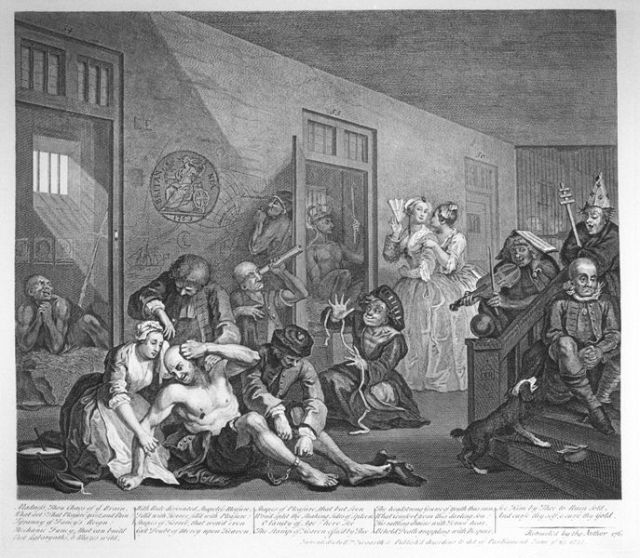
bedlamBut what is this problem of self-identity? Who are we? Perhaps it is when we have learned to let go that we will find everything in Christ.

The association between female humans and cats is known. It is usually limited to woman having one or several cats as pets and being extremely attached to them like children, especially if the woman in question has been unable to have children for medical reasons. It is the case with my own wife. Perhaps this bonding between a woman and a cat can lead to identity issues in a few rare cases. The girl in Norway is either drawing attention to herself through an elaborate joke, or she might be suffering some kind of psychosis (which involves a distorted understanding of what most people agree on as “reality”).  I will at this stage cease looking for a psychiatric explanation because I simply don’t have more than a few notions of that scientific discipline.

The alternative explanation is what psychiatrists call dissociative identity disorder, formerly known as multiple personality disorder. Exorcists call it demonic possession by one or several entities. If you go back to works like the Malleus Mallificarum, one will see associations made between black cats and evil spirits. These unfortunate animals were often the victims of this belief by being thrown alive into fires. Black cats are very much part of folklore in many cultures, because of their alleged association with witches. Cats were not massacred to the same extent in England as in some other European countries. In the instance of the girl in Norway, the black colour seems to have nothing to do with it, and I have seen no sign of her being involved in occult or satanic worship. Also, I don’t know whether she believes that she is a cat or both human and feline.

It is easy for most of us to lose patience. First it is homosexuality, then transsexualism and now people taking on non-human identities! Is this some kind of joke? Should these people be killed or locked up? Some would seem to think so. Fortunately, there are laws stipulating under which circumstances a person should be sent to jail or a psychiatric hospital.

I appended to a comment in Facebook an old Yorkshire saying: There’s now’t so queer as folk. How true.

Posted in Uncategorized | Tagged , | 14 Comments