Church and Politics

We are often confronted with the eternal temptation of Christian churches: riding piggyback on the secular state or political parties in order to achieve its mission. Recently, we have seen scenes of Russian Orthodox priests blessing high-tech weapons of war. There is nothing more unfavourable to the clerical Church than socialism. Working in collaboration with a right-wing party is tempting, because the party in question finds the Church useful. Is this a good thing, especially if the right-wing political party advocates killing or banishing certain categories of human beings?

It is no new problem, and is presented in different ways in the US than in Europe. The American situation depicts this relationship between neo-conservatives and Zionists with fundamental Protestants. Here in Europe, we have the variations on the theme of Italian Fascism and the various authoritarian regimes of countries like Spain that had differing relationships with the Nazis during the 1933-1945 era. Attitudes vary considerably in France in regard to the Front National of Mrs Marine Le Pen. I have to say she is a temptation in regard to the nullities and scoundrels who represent the other parties in France!

In particular, the right-wing parties are opposed to the old socialist anti-clericalism of the late nineteenth century with personalities like Jean Jaurès and Emile Combes. Perhaps it can be argued that the cause of anti-clericalism is clericalism. When bishops and priests get too big for their boots, they can only expect a backlash from those who have lost the faith, in some cases because of them. In the present day, there is terrible pressure against the clergy because of large numbers of child sex abuse cases. It is often ignored that this phenomenon is probably more widespread in political establishments, business, education, the police and just about every instance that deals with children and vulnerable adults.

Superficially, the Church and right-wing politics may have a lot in common, but the differences do cause friction. In the early twentieth century, Charles Maurras with his Action Française and its integral-nationalist ideas incurred the displeasure of Pope Pius XI in the 1920’s. Maurras’ ideas were more concerned with politics than with religion.

Pius XII is often accused of having been too “close” to the Fascists and Nazis. He rehabilitated Maurras, and the French episcopate sided with Marshal Pétain (who collaborated with the Nazis under the Occupation). In justice to Pius XII, we do know that he was strongly opposed to Hitler and did all he could to save Jewish people from extermination. Much of the “crisis” caused in the French Church after Vatican II was an opposition between an episcopate with politically ambiguous ideas and a rank-and-file clergy that sided with the Résistance, the communists and socialists. This opposition panned out in the 1960’s and produced the famous reaction of May 1968. The current went along with De Gaulle.

The traditionalist reaction in France was opposed to De Gaulle’s policies and sided with what remained of the extreme-right, weakened as it was by the defeat of the Nazis in 1945. Already in 1946, there was a new organisation of young people in France, inspired by ideas from extreme-right army officers in Algeria. When Vatican II seemed to go down the road of socialism, this also reinforced links between nationalists and ultra-Catholics.

The Front National was founded in France by Jean-Marie Le Pen, who was of the anti-Gaullist tendency in the French army serving in Algeria. It prospered in the most dechristianised parts of France rather than among the old Catholic bourgeoisie. Only at the end of the 1970’s did Le Pen begin to appeal to traditionalist and nationalist Catholics.

Supporters of the Front National would not be restricted to the Society of St Pius X founded by Archbishop Lefebvre. When groups of traditionalists rallied to Rome in 1988 as a result of disapproval of the four episcopal consecrations, many took the same political ideas with them. Some, like my old superior at Gricigliano, had never been with the SSPX, but rather with Cardinal Siri in Genoa. He also strongly supports the Front National, or at least he did when I was in his institute. Many of the issues held in common between nationalists and traditionalists are connected with legitimate resistance to the worst excesses of socialism, like the abolition of independent schools, abortion and the erosion of the family.

Marine Le Pen has refined the image of her party to some extent, getting rid of the embarrassing comments from her father affirming that the Holocaust was only a “detail” of the history of World War II. Such statements are usually construed as implying “denial” or an attitude of belittling. The French nationalists maintain the republican secular line (separation of church and state), but apply it in relation to Muslim immigrants rather than the way the old socialists applied it against the Catholic Church. This would be a further motivation to uphold the nation of Christian civilisation in some way.

The temptation is there. The next presidential election in France will be in 2017. Present day prognostics for central and left-wing politics are not bright, and the resentment is felt. Many challenges from outside the country may influence things somewhat. What would life be like under Le Pen’s presidency? We should not exaggerate – there will be no concentration camps or genocide, but there may be an exit from the European Union and crackdowns on immigrations and problems with law and order. How sound will it be in economic terms?

Nationalism is tempting, but we do have to ask the question about whether we are attracted through hatred and intolerance for people outside our direct experience. If we refuse multiculturalism, do we have any culture left ourselves. Many of the jackbooted thugs of the 1930’s and 40’s showed little in the way of culture or love of humanity. We live in a political and spiritual vacuum from all points of view and “colours”. When we arrive at that point, things become very frightening.

A see the rise of Vladimir Putin, and am myself tempted to see him as someone who can save us from ourselves, get rid of all those nasty head-choppers in the Middle East and American oligarchs and self-interested elite. I wonder if he is too good to be true! What can I believe of what I read?

Probably the answer is to continue to go along with the worn-out conservatives and socialists, which are only really two facets of the same thing, whatever that is – and try to live in parallel. The Church has lived in the catacombs before and can do again. We don’t need to be affirmed by worldly power or secular politics, and more that Christ did when he said that his Kingdom was not of this world. Of course, without the money, we have to downscale – we have no choice about it. In the end, the only Christianity with any credibility and worth anything will be what has survived going it alone contra mundum. Of course we run the risk of ending up with an Orwellian dystopia or a Caliphate, but that seems to be life.
Posted in Uncategorized | Tagged , , , | 5 Comments

Fr Robert Hart on our Provincial Synod

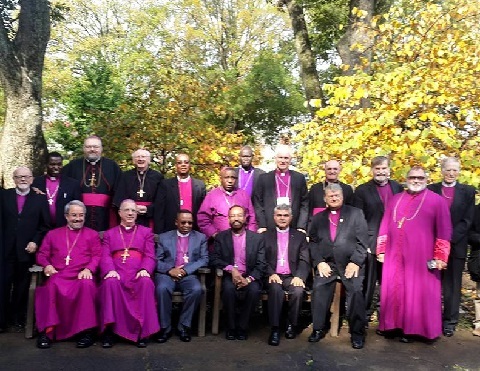
bishops_at_synod2015Reflections on Provincial Synod XXI of the Anglican Catholic Church, Original Province.

The keynote seems to have been one of getting on with the job, being businesslike and open to the bishops of the other Continuing Churches. Bishop Brian Marsh of the Anglican Church in America and Bishop Walter Grundorf of the Anglican Province of America were present. In the words of Fr Hart:

The feeling and atmosphere of Provincial Synods (which I attended every other year since 2009) is one of peace and joy. All things are done decently and in order. The business conducted on the Synod Floor is always about genuine and relevant issues upon which to vote. Spiritually, the whole experience is always rich and rewarding.

I will doubtlessly hear more about it from my own Bishop who was also there. Perhaps I might be able to go to the next one if I am delegated by my Diocese and if I can afford it.

I also draw your attention to the article in our official Church site Communion ties among Continuing Churches affirmed at ACC Provincial Synod.

Posted in Uncategorized | Tagged , | 1 Comment

Byron’s Darkness

Perhaps it could almost be called a Romantic Dies irae. Let us earnestly pray for those most in need and who dwell in darkness and the shadow of death.

* * *

I had a dream, which was not all a dream.
The bright sun was extinguish’d, and the stars
Did wander darkling in the eternal space,
Rayless, and pathless, and the icy earth
Swung blind and blackening in the moonless air;
Morn came and went–and came, and brought no day,
And men forgot their passions in the dread
Of this their desolation; and all hearts
Were chill’d into a selfish prayer for light:
And they did live by watchfires–and the thrones,
The palaces of crowned kings–the huts,
The habitations of all things which dwell,
Were burnt for beacons; cities were consumed,
And men were gathered round their blazing homes
To look once more into each other’s face;
Happy were those who dwelt within the eye
Of the volcanos, and their mountain-torch:
A fearful hope was all the world contain’d;
Forests were set on fire–but hour by hour
They fell and faded–and the crackling trunks
Extinguish’d with a crash–and all was black.
The brows of men by the despairing light
Wore an unearthly aspect, as by fits
The flashes fell upon them; some lay down
And hid their eyes and wept; and some did rest
Their chins upon their clenched hands, and smiled;
And others hurried to and fro, and fed
Their funeral piles with fuel, and looked up
With mad disquietude on the dull sky,
The pall of a past world; and then again
With curses cast them down upon the dust,
And gnash’d their teeth and howl’d: the wild birds shriek’d,
And, terrified, did flutter on the ground,
And flap their useless wings; the wildest brutes
Came tame and tremulous; and vipers crawl’d
And twined themselves among the multitude,
Hissing, but stingless–they were slain for food.
And War, which for a moment was no more,
Did glut himself again;–a meal was bought
With blood, and each sate sullenly apart
Gorging himself in gloom: no love was left;
All earth was but one thought–and that was death,
Immediate and inglorious; and the pang
Of famine fed upon all entrails–men
Died, and their bones were tombless as their flesh;
The meagre by the meagre were devoured,
Even dogs assail’d their masters, all save one,
And he was faithful to a corse, and kept
The birds and beasts and famish’d men at bay,
Till hunger clung them, or the dropping dead
Lured their lank jaws; himself sought out no food,
But with a piteous and perpetual moan,
And a quick desolate cry, licking the hand
Which answered not with a caress–he died.
The crowd was famish’d by degrees; but two
Of an enormous city did survive,
And they were enemies: they met beside
The dying embers of an altar-place
Where had been heap’d a mass of holy things
For an unholy usage; they raked up,
And shivering scraped with their cold skeleton hands
The feeble ashes, and their feeble breath
Blew for a little life, and made a flame
Which was a mockery; then they lifted up
Their eyes as it grew lighter, and beheld
Each other’s aspects–saw, and shriek’d, and died–
Even of their mutual hideousness they died,
Unknowing who he was upon whose brow
Famine had written Fiend. The world was void,
The populous and the powerful–was a lump,
Seasonless, herbless, treeless, manless, lifeless–
A lump of death–a chaos of hard clay.
The rivers, lakes, and ocean all stood still,
And nothing stirred within their silent depths;
Ships sailorless lay rotting on the sea,
And their masts fell down piecemeal: as they dropp’d
They slept on the abyss without a surge–
The waves were dead; the tides were in their grave,
The moon their mistress had expir’d before;
The winds were withered in the stagnant air,
And the clouds perish’d; Darkness had no need
Of aid from them–She was the Universe.

Posted in Uncategorized | 3 Comments

Some interesting articles

Perhaps it is the same phenomenon from different points of view:

Oblivion about secularism in the western world. I find it difficult to discern what David Sullivan’s thread is through this article, but I can understand how our world can discourage us from raising families. Secularism really does bring us face-to-face with mortality, because in such a perspective – we are already dead in a way (notions of St Paul). Might I detect the notion of combining the demographic strength of Islam with the technological achievements of the west? Whose dream would this be? Paradoxically, does the family do any better in a totalitarian theocracy or the old Communist regime? The question is there and we can think about a few possible answers…

Gold, Silver, and Dross looks at the somewhat marginal status of those (including myself) pushing an interest in old liturgical forms. I do have to admit that I do not find this interest among family men or many women. I won’t go into the issue of the 1962 Roman liturgy, because it is simply not my concern. The families go to the Ecclesia Dei / Summorum Pontificem centres or the Society of St Pius X, or they remain conservative members of the more middle-of-the-road Novus Ordo parishes. None of those people have any interest in Sarum or old versions of the Roman rite. Interestingly, we in the ACC have a more “mainstream” parish life with the Anglican Missal, which amounts to the pre Pius XII Roman rite in classical English.

Do I postulate that “the end of the Latin tradition has begun”? I am not sure it ever really began. It is the whole story of Christianity in the old Jewish world and its missions to the Gentiles. The Church had its highest point of influence several centuries after the Peace of Constantine and when the Papacy had become a worldly and political authority, even over all other kingdoms and empires. What do we mean by “Latin tradition”? The entire liturgical tradition that is not Byzantine or Pre-Chalcedonian? The use of the Latin language and reference to classical Latin literature from the pre-Christian era? If I expressed this idea, I regret doing so because I do like to be a little more precise in my expression. The first challenges to the Latin tradition (defined as the western Church and the liturgy in that language) came from the least Latin or Jewish countries: England and Germany. We are not naturally Latin, even if we have been influenced by the Roman and Norman conquests, and have cultivated Latin and Hellenistic culture in our schools and universities. Eventually these northern forces brought the Reformation and its iconoclasm. Perhaps one country very near our culture has grown differently – Orthodox Russia. A good reading of Vladimir Soloviev will help us understand these differences.

So as not to “beat about the bush”, the only traditions with a future are determined by strongly reactionary conservative people who identify with the three Roman Catholic options I mentioned above. That doesn’t mean that they are right, but they prevail in the minority Catholic reactionary movement. Without any pride on my part, I think of the spiritual aristocracy theme, close to Gnosticism, that I have already mentioned which formed a great part of nineteenth and early twentieth century Russian thought. There are some people who just don’t belong to the mainstream world, but have to suffer for it.

I suppose we are indeed condemned to an existence of poor eccentrics, irrelevant to all and faced with our own mortality. We can alternately go along with one mainstream or another, knowing that we will never find our home with them. For me, it is much more than liturgical rites. If I had to join a church and be a simple layman, I would probably go for Methodism rather than Eastern Orthodoxy, something where the worshipping family is intimate and not “corporate” in its spirit (corporate here meaning something that is impersonal and bureaucratic). If I have to give up liturgy, then it is better to do so completely.

I know the argument of the reductio ad absurdam: wanting a liturgical form of one historical era. The question is – Why not go further? Perchè non andare oltre? If we want something from 1911, 1474 or 1350, then we should logically go back to the very beginning of church history. After all, is this not archaeologism, a vice condemned by Pius XII’s Mediator Dei of 1947? Pacelli’s double-edged sword would not only run through those who wanted Mass facing the people, but also those who resisted modern reforms. Was not the Church of England right to enforce the 1662 Prayer Book until it ceded to pressure from the revisers – 1928 to the present day? The same problem is transposed onto another context.

Some of my own thought had been influenced to some extent by my German friends at Fribourg University: Martin Reinecke, Andreas Bröckling and Markus Schulte. Fr Martin continues to help out in parishes (don’t ask me what he uses) and writes articles on the liturgy. Fr Andreas, ordained in something like 1989, ended up as a police chaplain in Germany. Markus Schulte from the Rhineland took on the most radical attitude, one that I had heard before, namely that the Latin liturgical tradition had seen its day and had only to be discarded. He emigrated to Greece, studied in Thessalonika, became Orthodox and married. I don’t know whether he become a priest. I have often heard this theory, and was also struck by the idea expressed by the near-Fascist Italian thinker Julius Evola and paraphrased by Troy Southgate:

Catholics, however, are far too dogmatic and would merely seek to make Tradition “conform” to their own spiritual weltanschauung. This, says Evola, is “placing the universal at the service of the particular.” Furthermore, of course, the anti-modernists who are organised in groups such as The Society of St. Pius X and the Sedavacantist fraternity do not speak with the full weight and authority of the Church. They are, therefore, powerless because “the direction of the Church is a descending and anti-traditional one, consisting of modernisation and coming to terms with the modern world, democracy, socialism, progressivism, and everything else. Therefore, these individuals are not authorised to speak in the name of Catholicism, which ignores them, and should not try to attribute to Catholicism a dignity the latter spurns.” Evola suggests that because the Church is so inadequate, it should be abandoned and left to its ultimate doom. He concludes by reiterating the fact that a State which does not have a spiritual dimension is not a State at all. The only way forward, he argues, is to “begin from a pure idea, without the basis of a proximate historical reference” and await the actualisation of the Traditional current.

Where do we go with this? Evola did not actually support Mussolini’s political system, but sought a kind of perennial tradition from beyond the origins of Christianity. Perhaps the “pure idea” of Christ can be found, identified, isolated and injected into a new cultural context. I have played with that idea too. I would have to read a lot of Evola’s work to get a better understanding. I have read a little René Guénon (he ended up converting to Sufism in Egypt) but his thought can only go so far. Many attempts have been made to do something with “perennial traditionalism”, but they have all come to nothing other than a few books.

Perceptio plays with the idea of Orthodoxy. I set up the Blow-out Department as a venue for people to argue about the use of the western rite under eastern jurisdiction and various other points. In his text, we can observe that he did convert to Orthodoxy and tries to take an original view of it. He speaks of his nostalgia for his western Christian past, but concludes that only the single and childless are concerned for the western liturgy in an Orthodox context. When I saw the Oblivion article about western secularism, the link between two apparently opposing worlds leapt off the computer screen and I saw the connection. Some of us are geared to the future of humanity in a traditional context of some kind, and others of us are out of phase and unable to relate. We are doomed to our own oblivion. What an indictment!

I will say that Orthodox liturgical life has both provided me with some additional perspective on these matters as well as squelched the sense of “crisis” about them. One has a better understanding of what certain figures of the original liturgical movement were after in their proposals. Silent prayers and the use of the vernacular are put into some sober relief. One’s attention is gradually drawn away from the Latin liturgy; the Orthodox liturgical tradition overwhelms and demands much of one’s attention if one wishes to remain liturgically invested. Whether or not this is good is a matter of dispute. Certainly, it leaves little room to act on the occasional nostalgia one feels for one’s former modes of prayer/liturgical observance. One could persist privately and make so doing one’s discipline and observance. Yet, belonging as I do to an Orthodox diocese that has a number of Catholics who migrated away from Rome, one finds the only people who make any such determination are single or childless. Liturgical prayer is inherently corporate prayer. Having made the transition to the Orthodox Church, one finds that family life is the single greatest factor determining the degree to which one’s observance of Orthodox liturgical forms begins to take one’s attention away from classically Catholic observance.

So why not go to our nearest Orthodox parish? We are westerners and live in the west. My friend Markus felt he could not make the step without going to live in Greece and becoming Greek to the greatest extent possible for a German. He married, probably did not become a priest, and no trace of him can be found anywhere (Facebook, etc.). In America’s multicultural society, there are whole ethnical communities where one can integrate, buy a house, send one’s children to school, melt in. I remember visiting a Greek town in Florida, an amazing place. Perhaps in Europe, in the biggest cities like Paris, London or Berlin. Frankly, my becoming Orthodox is not a prospect that interests or stimulates me, any more than returning to Roman Catholicism (in which I spent only fifteen years of my life). The Anglican Catholic Church has given me a canonical basis for continuing in the priesthood, and my connections tend to be by internet, plus a number of Council of Advice meetings and Synod. It is that or nothing, as simple as that. I admit that it is fragile, but without it, I can no longer relate to anything. Check mate.

I married nearly ten years ago, but we were unable to have children. I suppose I fit into the category of “single and childless” eccentrics facing only my own demise and oblivion. The idea brings suffering. Life often seems wasteful and irrational. Perhaps that is a part of Christ’s “pure idea” that is waiting to find its expression. All we can do is wait and discern the divine will, something that seems so elusive and intangible…

I finish with a letter of Fr George Tyyrell that has haunted me since I first read in a couple of weeks ago. It was written to an independent bishop by the name of Vernon Herford who had been consecrated in India and had founded The Church of Divine Love, hoping to make of it a nucleus of Christian reunion.

April 14, 1907 ?

Dear Bishop Herford,

Much ill-health has put me in everybody’s black books, as an infamous correspondent. My lucid intervals are crowded to repletion with neglected work, the struggle with which throws me again. It is a most vicious circle. I wanted much to write to you immediately after your pilgrimage to Storrington, just to explain the fundamental question on which, in spite of so much sympathy, I should find it hard to agree with you. All that I see of myself and others in these troubled times has convinced me that the best way to overcome the lamentable divisions of the Church cannot be to create new divisions; but for all of us to stick fast as far as honesty will stretch to our several communions, and work there for the widening of the conception of Christianity according to the particular exigencies of that communion, in the face of the new enlightenment. Thus it may come to pass that these widening streams may at last debouche in a common ocean. I would not so much mind passing from one of the existing Churches to another as any attempt to add a fresh element to the universal confusion. Frankly, that is why I look a little bit askance at the Church of Divine Love; and would so much rather see you working hand in hand with the liberalism in some of the big communions. God knows it is a slow, cramping, thankless task, but, as a Roman Catholic, I feel that, though I am a small atom, yet I belong to a well-knit universe where everything tells on everything else remotely, perhaps, but far more surely and lastingly. Again, assuming that the magical conception of priestly power is of the past, I feel that the true repository and source of the power of sacred order is the whole community, which acts through and in its appointed organs; that the difference between, say, a Wesleyan minister and myself is that in him it is the Wesleyan, in me it is the Roman, communion which acts and teaches, and blesses. Whom do you stand for? that is the question. Who and how many would acknowledge you as their representative? God s Spirit is immanent in every Christian communion; but in different measure. He is with two or three who are organised into a body; but still more with two or three millions; still more with a continuous, world-wide, world-old organism like the Catholic Churches of East and West. And I feel sure that the spiritual power of a man is proportioned to that of the body whose organ he is. For that reason again I cannot sympathise with your isolation so far as it is not the result of persecution or necessity. I feel I ought to say this to you quite openly. And indeed I do not speak dogmatically, but as one who is groping after truth in so many respects, and can readily make room for other points of view. Only, you seemed from your conversation to have got to somewhat of an impasse and to be searching for some path of greater utility; and to me that path seems to lie in the direction of aggregation to some work already in process, rather than in the inauguration of any new work. The most fruitful workers all feel that they could do more alone, but surely this feeling is just what needs discipline and sacrifice. This comes ill from a rebel like me. Yet God knows how gladly I would keep quiet were I once convinced that to do so were really the interest of the body I serve. There are times when a soldier is bound to disobey if he knows his officer is drunk or mad or misinformed. If his venture succeeds he is crowned; if not, he is shot. I shall probably be shot, “aber ich kann nicht anders”.

The source of agony for the severed branch is finding that the trunk of the tree is gone. Ich kann nicht anders – I can do nothing else. We have arrived at the beginning of November when we celebrate the Saints and the many souls who have gone before us. We have no idea what became of them as we know nothing of what will happen to us. Shot or crowned? There is only faith, hope and love – perhaps the purest idea that ever flowed from the Christian ideal.

Posted in Uncategorized | Tagged | 53 Comments

Multiculturalism and the Immigration Crisis

jungle-calaisI have already had a comment in this blog to the effect that we in England and Europe should arm ourselves and prepare to emigrate by the summer of 2016. My wife this morning showed me a photo on a far-right website depicting occupying Germans arriving in Paris in 1940 and the caption telling the “socialist” reader to get used to the immigration, implying a comparison between Islamic immigrants and the Nazi occupation of 1940. Some of that stuff is really grubby! I think it’s time we tried to take stock of this problem.

We have had multiculturalism in Europe for a very long time. Every large city has its Chinatown, and I for one like Chinese food. Since the demise of the British and French empires, we have had people coming from India and North Africa including large numbers of Muslims. Mosques in our cities are nothing new. I lived in Marseilles for a few months from late 1992 to 1993, and enjoyed going to the “Arabic” districts wearing my cassock. It has always been known that most northern African Muslims respect traditionally dressed Christian clerics (I was a deacon at the time). There are sobering reminders of the volatility of those people when we learn of the murder of the monks of Tibhirine in 1996. I bought things like couscous spices in their shops in the little streets off La Canibière and felt relaxed with the men wearing the thobe or the jubba with or without turbans on their heads. I admired their courage in avoiding the western secular mould. I wore a cassock, and they had their traditional dress.

We have always had immigrants with professional qualifications like doctors, computer specialists and engineers. They came willing to work their own way and learned enough English to get on with the indigenous population, and no one thought any the worst of their keeping their own cultural identity, language and religions. I remember seeing a black girl at school for the first time in the 1960’s. Our head teacher was terrified with the concern that we would bully her. My own thought as a small boy was to ask why anyone would want to bully her. She’s just the same as us, except coming from somewhere else in the world. I began to read about Africa and became fascinated with the animals and human tribes. I find it stimulating to know other cultures. I have travelled in Europe and the USA, but nowhere else. There are many places where I would love to go. I am myself an expatriate, living in a country elsewhere than where I was born. France and England haven’t been hostile to each other for the last couple of hundred years! We are close and share very similar cultures. Any immigrant has the right to his identity as a person and what made him in his original environment.

I have often asked myself what I would do if life was made so hard that I would have to walk away from my home, leaving everything behind (perhaps after everything is destroyed) and find somewhere to go. I think I would try to come up with an original idea, completely “out of the box” and not with thousands of other people, many of them paying “people smugglers” and passers. I am fortunate to be a British citizen with a passport, and able to go many places on a tourist visa or better prospects of a temporary or permanent visa. Depending on whether I had any money, I would probably stay in Europe or even in France, and go to a more remote area like the west of Brittany (wonderful area for sailing by the way). I would almost say tongue-in-cheek that Europeans could go to Syria or Irak once the Russians get rid of the terrorists!

What are we afraid of? The big problem is numbers. I think L’Elysée would have problems with hundreds of thousands or millions of English people coming over in makeshift boats. The English immigrants would be mostly white and nominally Christian – but too many of them asks the same questions, particularly whose money… We British immigrants are few and far between in France. Most of us speak French fluently, have set up businesses to earn our living and don’t pose any threat to anyone. At the same time, we still speak English with each other, eat roast beef and Yorkshire puddings or fish and chips. We like Oxo and Marmite to the disgust of the French and remind them that Napoleon lost his war in 1815! But we are not a problem. I came to France for a number of complex reasons, but not as a political refugee or to live on benefits.

When large numbers of foreign people arrive, we in a country become concerned about whether our country can afford it and to what extent there would be less of our taxpayers’ money to provide for our own needs. Beyond a certain limit, there is a risk of civil unrest and social tension. This is happening in Germany and Sweden – and elsewhere. We are rightly livid when we hear that they complain about the service, show signs of not being destitute and in need of help, cynicism and then proclaim their intention (whether or not such is realistic) to colonise our world.

My own concern would not be the introduction of several mutually tolerant cultures in a country. If we have twenty different Christian denominations in the little market town where I was born (Kendal), I see no problem with adding a mosque, a synagogue, a Hindu temple and a Buddhist place. We had a visit by a Hare Krishna group when I was at school. They explained everything to us and we said their prayers with them. It was all very odd, but something different. But we do become concerned if they show a racist or colonising attitude towards us. That is where their rights and freedoms end! If they want to impose Shariah Law in France or England, public executions and mutilations that have been abolished since the eighteenth and nineteenth centuries after hard campaigning and political action, we are concerned to keep our humanist and cultural Christian values. Rightly!

As things are, I think the risk of Europe being colonised and made into a totalitarian Muslim regime is exaggerated. I am concerned that people can come and live in Europe without being properly regularised. If I tried that in the USA, I think I would find myself in serious trouble as an illegal alien – nothing to do with my race or religion. If I wanted to go to the USA, I would have to have a Green Card on the basis of a guaranteed income from some organisation that has legal status in that country and that has employed me for a number of years. It is different for political refugees – if they really are political refugees.

We need to relax and take a deep breath. Immigration does need to be controlled by the proper authorities as we would expect it to be if we want to go and live in Asia, Africa, Russia or the Americas. People from Africa, Asia and the Middle East are finding that Europe is going to be more difficult than they think when they will have to pay for their own housing and start applying for jobs on the open market.

Multiculturalism, whether we like it or not, seems set to stay with us, unless we revert to something like Nazism! There are those who talk of having guns and usual “prepper” paraphernalia. We need to be be cautious. Those who take up the sword will die by the sword. I prefer to be out in the country, and consider going somewhere more remote. At least, we need to stay out of the cities, because things could really start heating up.

We also need to be concerned for peace in the countries from which people are being forced to run because of jihadist and fanatical Muslims imposing their reign of terror. I hope and pray the Americans will make peace with Russia and China so that the world can be rid of this new form of barbarianism, and then start rebuilding the waste places so that people can simply go home. If we helped places where people are victims of war and are made destitute, then our countries need to help them and work for peace and dignity for all. It often takes a simple irrigation machine to enable tribes to earn their own living from farming in their own land. That’s what we need to spend money on instead of trillions on nukes and guns! Perhaps a few of us might volunteer and go and help when the fighting and killing are over.

Posted in Uncategorized | 19 Comments

Sarum Calendar 2016

I would like to remind readers that current Sarum calendars are available on Dr William Renwick’s site. Like the various Roman rite ordos available, they enable us to get everything right for Mass and Office in terms of precedence and what needs to be commemorated.

If you go from Advent to Advent, you will need Kalendar 2015 and Kalendar 2016 (right click, save as), because these calendars run from 1st January to 31st December. They are produced in pdf format and are in English. Dr Renwick gives the following explanation:

The Kalendar appearing here contains in the third column the information provided in the printed Sarum Kalendars such as that found at the front of the Breviarium 1531. In the fourth column appears the information found in the Pica which appear scattered throughout the Breviarium. Generally speaking the latter takes precedence over the former where they differ. This Kalendar is provided firstly as a guide to those who wish to follow the Sarum Liturgical Kalendar throughout the course of the year, and secondly for those who wish to gain an understanding of the nature of a typical Sarum or pre-Tridentine liturgical year. These Kalendars follow the Gregorian or Western calendar rather than the Julian calendar.

The calendar can be printed directly onto “normal” format sheets of paper and bound in a ring binder, or exported into images which can then be imported into Microsoft Publisher and reduced in size to make a convenient booklet.

Dr Renwick’s site is steadily growing as new material is edited and becomes available both in Latin and and English. This is an invaluable resource for those using the Sarum liturgy in practice and those studying it from an academic or cultural point of view. The Advent and Christmas parts of the noted missal are already available. The Office in both Latin and English seems now to be complete – it just needs to be printed and bound.

Posted in Uncategorized | Tagged , | Leave a comment

Let the Mayhem begin, just as long as it doesn’t affect me!

plague

Click on the image for an enlargement and the details of this horror.

I often read alternative news sites to try to get a different slant on what’s going on in the world. I naturally look for signs of hope, but it is all very subjective. Hope in relation to what? If I read what Putin says, I would be led to blame the banking cartels, the American elite and the powers-that-be under their influence. The conspiracy theorists say the same thing. I have no faith in the French political authorities, nor the English ones. The situation seems so hopeless. I suppose it depends on the way we look at it. The glass is half full or half empty.

Human beings are complex creatures. We have different personalities and ways of seeing reality – or making reality. The older I get, the more I doubt Aristotelian metaphysics and the notions of truth and reality. Things can go a long way along that path!

We read all over the place about prophecies of doom and what we have to do to “prepare” ourselves and survive. Many things threaten us in our day. In particular, there is the possibility of World War III (which can turn nuclear), countries in such massive debt that the prospect would be one of a total collapse of the economy followed by collapse of civilisation and culture. We are reminded of this possibility when considering local cataclysms like hurricanes, big earthquakes, war, persecution by ISIS / Daesh throat-cutters. Terrible things have happened before in history. There is the super volcano in the Yellowstone National Park, the effects of extreme weather – perhaps caused at least to some extent by human industry and greed, the possibility of the earth being struck by a comet or asteroid. So the possibilities go on, and I have already had occasions to express my fears.

After all, what is the worst thing that can happen to us? Simply death. The way we go might be more or less painful, but we are brought to face our mortality. If our consciousness does not depend on our physical brains and bodies, we have hope and faith. If there is no life after bodily death, then there is still nothing to worry about, but the idea – usually expressed by atheists – leaves us only with absurdity in this life, the complete pointlessness of our culture, society and everything we care about. That’s about it in a nutshell.

For most of us, for the foreseeable future, things won’t change very much from today until tomorrow. There are contingencies we take into account, like accidents and illness. We read about this or that end-of-the-world prophecy, and it always fails to happen. The date goes by and nothing happened. We still have to pay the bills! The gutters still need repairing and my translation order has to be sent to the agency on time. I still have to pick up my wife at the railway station. Perversely, there is a sense of disappointment that the “big bang” didn’t happen. All those things we bought from the “prepper” store will be for nothing and will have to be replaced as they go past their shelf life dates. How dull…

This is something I find odd, and there aren’t many studying the question. If we get World War III or a meteorite strike, we are simply going to die or find that our day has been well and truly ruined. What makes us think we are any more privileged than those who will perish? We can prepare for some things, but not for others. Looking at things another way, we have to run a check on ourselves and see if we are in some way looking forward to something that would bring a conclusion, to end the waiting. This is the business of apocalyptic cults and the more “extreme” elements of religions like Christianity and Islam, and Judaism also to an extent.

Running through the Old Testament is the theme of the Messiah and the many prophecies. The Evangelists went to great pains to demonstrate that Jesus Christ fulfilled these prophecies and was the true Messiah. Not all the Jews accepted Christ, and at least in theory still wait for the Messiah. If we are Christians, what difference did the Messiah make? Was there really a redemption or an atonement? If not, Christianity is simply a moral philosophy, a peaceful and appealing one, but no more than that. If so, all fallen creation was re-created and transfigured in an anticipation of God’s Kingdom. Sin and death no longer mean the same thing and man can hope for ultimate happiness and all he has sought on earth.

Why hope for death and catastrophe? Any answer to that will not only enable us to understand jihadist Muslims and fundamentalist Christians, but we will also get more insight into ourselves and our “dark side”. It is more or less extreme in each of us, going to the extreme of the jihadist head-choppers and various doomsday cults in the world that also commit acts of terrorism and murder. It is present in many films and books, the dystopias of Orwell and Huxley, stories of the Antichrist and a final victory of the Devil over God. In a less extreme form, there is the “prepper” community in America, but also in England and Europe, who store quantities of food and other supplies to face any possible adversity. I have to admit that such a way of thinking was a part of my motivation for wanting to live in the countryside. It would seem that apocalyptic beliefs have increased over the past fifty years or so. In the 1960’s, we had the Cold War and I had nightmares about the nuclear war and the mushroom clouds.

It has been present in history all the way along. We have the eschatological passages in the canonical Gospels in which Christ affirms that terrible things will happen before “this generation” passes away. What does “this generation” mean? During the great plague times of the middle ages, it was rife. That is not surprising. Millions died leaving humanity on survival mode. The two world wars were a fact, as every other war ever since. Dresden, Hiroshima and Auschwitz happened and left their mark on our history and collective consciousness. We face the same thing today as we fret about the Middle East and all the other things we read about in the news.

The explanation may seem to be quite simple. The problems we face are beyond our capabilities for solving them. Only God can solve them. Perhaps God will only help us by means of destroying everything and rebuilding anew, hopefully a world “with me in it”. There is something very wrong with our present existence, but we still believe in a higher good and purpose. Of course the atheists would say that if we get rid of the higher good and purpose, we would be incited to solve our own problems. There is also a form of Christianity that does away with the “pie in the sky” and emphasises the same goals as secularists and atheists. If Christianity is merely a moral philosophy, why not?

Prophecies of doom have invariably failed. Evidence of that is that we are still here. Only two nukes have ever been exploded in anger, back in 1945, and many other threats like Ebola have been (more or less) halted in their tracks. It is tempting to see even Christ’s prophecies as “failed”, unless there is some extraordinary interpretation of his words. What do we make of the prophecies of Fatima and La Salette? Some people go on and on about them. There is a psychological dimension. The failed predictions lead to new predictions. 2012 passed by three years ago – and we are still here.

What is perverse is the expectation or even a delectation in doomsday, and expecting to survive it. If survival is not by our own means (“prepping”), then we find that some exegetes have gleaned notions from the Gospels and the Epistles of St Paul of some kind of “rapture”. The good guys would be plucked off the face of this earth before everything gets blown to smithereens. The “prepper” world is just as odd as the cults. Some get satisfaction from the idea of surviving a nuclear war, a meteorite hit, a total financial crash or some other Mad Max scenario. We just need our “bug-out” bag that we buy from such-and-such a retailer advertising such goods!

I think some of this comes from the idea of existing outside the norms of western society in terms of money, status, fashion and so forth. I like to live in the country and go camping with my boat and a little tent. We like to be children again and enjoy our little adventures, like Swallows and Amazons! But, it can only last for a few days or the space of a summer break, and then we have to be back to normal life. That is something we have to accept as responsible adults. We don’t have to go along with everything in society, but that is perhaps an advantage of liberalism, multiculturalism and modernity. Perhaps going away for a little minimalist break is good for us. I do it a couple of times a year with my boat. Others go hiking in the mountains or forests, living on as little as possible. It’s great fun, but we are also glad to get back to a comfortable home.

How many of us could survive a winter outdoors like so many people who are homeless? Perhaps we should try it and develop a little more empathy…

We are faced with dangers and miseries, and we are right to be concerned. We face our own deaths sooner or later and the causes are infinitely variable: accident, getting murdered, illness or old age. Why fret? It’s going to happen. The rub is finding our vocation in this world before it’s too late – not surviving something that is going to kill everyone else, but doing good and caring for others at cost to ourselves if necessary. The world will end, or perhaps it never existed in the first place except as an illusion. I am tempted to think along those lines as quantum physicists deduce from their experiments and calculations.

We are faced with the problem of evil, the greatest obstacle to faith in God, depending on what we believe to be the cause of creation and evil. Genesis gives the mythological narrative to which orthodox Christians and Jews subscribe. Gnosticism offers another. Every world religion and philosophy has its myths of our origins and and explanation for our sufferings. When someone asks us the question, we blush with embarrassment when we try to offer an answer. There isn’t one in real terms, so we invent myths like our ability to survive the end of the world. We still go in our struggle for meaning and resolution.

These are thoughts I offer in these last weeks preceding Advent, as the autumn season (here in the northern hemisphere) ebbs away and we face the coming winter. Winter seems to stare us in the face also in metaphorical terms. The signs of the times… But, we do have to realise that things were no better in the past. There have always been wars, catastrophes, inhumanity and death. There is no refuge in the past!

I struggle with these things as we all do. There are no easy answers. Whatever God means to us, we have only to trust in him and care for others.

Posted in Uncategorized | Tagged , , , , , , | 10 Comments

Updated Statistics

This blog, set up in January 2012, is nearly four years old. My statistics page informs me that it has had 585,742 views and 7,075 comments. It contains a total of 1,072 postings excluding this one.

My peak day was 14th March 2013, the day after Cardinal Jorge Bergoglio’s election to the Papacy. There were 1,281 views by 306 visitors. Just having had a look at those articles I wrote that day, I see that I was not particularly negative about the election – somewhat detached. This was exactly a month before I was received into the Anglican Catholic Church.

For comparison The Anglo-Catholic, of which I was a co-author from 1st December 2009 until August 2010, extended from 18th November 2009 to 13th November 2013. I have no access to the blog’s statistics, but I would say that it was widely read and made my reputation as a blogger for good or ill. I was more or less booted off the blog by its moderator for what he considered was disloyalty on my part. A part of that “disloyalty” was setting up a blog with the title The English Catholic, which I closed down in the early months of 2012. Most of my postings concerning the TAC from August 2010 until early 2012 are contained in The TAC Archive for historical reference.

This blog has been largely free from the polemics which surrounded my previous incarnation in The English Catholic. There are 50 e-mail and IP addresses on my moderation list of commenters who gave me trouble in the past (a new one had to be added yesterday after a long time of having had no trouble), but many of those addresses are probably now obsolete. In this way, many lessons I have learned and gratuitous rudeness is kept at a distance.

The fourth anniversary of this blog will place on 17th January 2016.

Posted in Uncategorized | Tagged , | 1 Comment

Washing a Quilt

It is quite amazing how things follow on from each other. Our quilt got pissed on by one of our cats, and the time came today to wash it. Too big for a domestic washing machine, so I had to go to the public launderette where there is a machine big enough for quilts. Once the money is fed into the machine and the button pressed, the process takes half an hour. I naturally took a book with me, Bernard M.G. Reardon, Religion in the Age of Romanticism, Cambridge 1985.

Half an hour is just enough to skim through chapter 1 on Romanticism, idealism and religious belief, which I needed to read again after nearly thirty years. Like modern Existentialism, itself a late form of philosophical Romanticism, Romanticism does its best to escape definition. It can be seen as analogous with “negative” theology as often expressed by Eastern Orthodox scholars. God cannot be defined, only set apart from what he is not. Romanticism is conventionally opposed to classicism. It is essentially a “temperament” or a kind of personality, seen in terms of known historical personalities: Pope and Racine are classicists, whereas Shelley and Victor Hugo are seen as Romantics. It escapes from even the late eighteenth century and the early nineteenth, for some of the Romantics read this world view into Plato and even Christ. We have this from Oscar Wilde:

Nor is it merely that we can discern in Christ that close union of personality with perfection which forms the real distinction between the classical and romantic movement in life, but the very basis of his nature was the same as that of the nature of the artist—an intense and flamelike imagination.  He realised in the entire sphere of human relations that imaginative sympathy which in the sphere of Art is the sole secret of creation.

Some of the other Romantics interpreted Christ’s personality and mission in this kind of light. Schlegel went much further and characterised the entire Christian era as Romantic. The idea is exciting, but is it true?

The early nineteenth century is generally seen as the most important era of the Romantic movement. It extends to earlier and later periods. I am inclined to see twentieth-century existentialism as an extension of Romanticism, just like some of the sub-cultural movements in the 1960’s. Many of the themes extend into some contemporary sub-cultures like the Goths.

Reading the chapter reminds me of the dialogues in Zen and the Art of Motorcycle Maintenance, which revolves around this very contrast of classicism and romanticism.

The Romantic prefers ‘imagination and constructiveness’ to ‘analysis and criticism’, and teaches ‘the appreciation of every standpoint’ and ‘sympathy even with that which repels’.

I recommend Reardon’s book as a good introduction to the philosophical dimension of Romanticism.

As I drove home with the wet quilt in the back of my van, I went past one of those little shops where people can get tattoos and piercing. They also sell metal body ornaments and printed tee shirts. I was lucky to be in slow traffic to get a really good look. The two young men seemingly running the establishment were standing outside smoking cigarettes and sporting their own art. I was taken back to my article of yesterday.

A couple of comments arrived, which I have deleted together with my response to the first. The first comment was of someone bragging about his tattoos, to which I responded by asking the rhetorical question of whether he was “taking the mickey”. This followed a little research of the name contained in the e-mail address. He took great exception to what he perceived as an accusation of insincerity or lying, and offered to send photos of his tattoos. The thought came into my mind that I don’t mind what other people do to themselves when they are adults and compos mentis. What I do find objectionable is that such people want to exhibit themselves and impose their message – in exactly the same way as billboards, commercials on TV and cold calls on the telephone. Opinions about tattoos are very diverse. That much is obvious even in Christian circles.

The quilt is now drying on a line in my kitchen…

Posted in Uncategorized | Tagged | Leave a comment

Tattoos

Interesting article: A theory for tattoos

I have always cringed when seeing tattooed skin. My father warned us his children particularly against hard drugs and tattoos. I didn’t always heed his advice, but I did in these matters. I have never understood this desire to make our bodies something “man-made” and to be modified at will.

We dress in clothes and style our hair, but those things always remain exterior to us and are reversible. Women have make-up, but it comes off. Tattoos and “aesthetic” surgery are irreversible. The thought is awful!

Posted in Uncategorized | Tagged , | 6 Comments