Where’s the ACC in this mix?

I received a brief e-mail this morning from an Orthodox correspondent with this link from David Virtue’s site.

Some things in this article made me bristle somewhat, making me grateful to know that our Metropolitan Archbishop Haverland is always open to dialogue, but there are certain principles governing any question of formal relations between the ACC and other churches of Anglican tradition. I am very happy as a simple priest not to be involved in such decisions.

Traditionalists of all kinds have been discussing problems of “liberalism” (intolerant anti-conservatism) for almost fifty years. Some get the “big picture” and others are mired down in single issues like homosexuality, abortion, marriage issues and the ordination of women. These are, of course, important moral issues – but there are different ways of addressing them.

I recently spent a pleasant evening with a priest who serves a Forward in Faith parish in the south of England. One reflection he came up with was that the “Constantinian” Church is nearly dead, but let’s not kill off what is still going. In a parish, there is the hardcore of the devout, but there are also many other people who are of good will but less “single-minded”. Can a church be a church of the people, or must it be an enclave of the devout and holy? I am a priest in a Continuing Church, but I can sympathise with this good priest. Thus I can sympathise with all gatherings of Anglicans, both “mainstream” and traditionalist, whose heart is essentially in the right place in spite of all the differences between Catholicism and Protestantism, high church and low church and the various little pet issues related to doctrine and moral teachings. Their frustration with the “seas of post-modernity” is understandable. It is a part of our own vocation as continuing Anglicans to oppose the forces of destruction as well as ploughing ahead with what we believe to be right.

It is rightly argued that strength is in unity, and conservative and continuing Anglicans would unite in an ideal world. What usually puts a stop to this is when bishops and priests of one institutional body deny any legitimacy in another body, accusing it of being in some way false. I could say really facetiously that such is hardly an icebreaker. And so our Churches continue separately along parallel tracks. Dialogue is improving, but there is a long way to go. My own Bishop in England has suffered from such treatment by Established Church clergy.

There is much hope in continents like Africa, Asia and South America, but we should not forget that the churchmanship is usually Evangelical. At the same time, we do need to work for unity at a human level, forge friendships and combat irrational prejudice.

Three enemies of Christianity are identified: Islam, secularism and materialism. There are undoubtedly more, but these are things of which we are all made aware in our daily lives. What is our response? It is essentially that of the Saints: service, abnegation, self-sacrifice, refusal of power, ambition and desire. This has been the Christian message from the beginning.

Now something made me quite angry:

Strong stuff but necessary for Anglo-Catholics, especially the Continuers, who have been fragmented since 1977 and the St. Louis Convention. A number were at this conference, signaling that perhaps it was time to come in out of the cold and ally with the ACNA. One can but hope.

More of the same… If they trash us, they can hardly expect us to come knocking on their door! Is the ACNA thinking of offering ordinariates for converts from the “bogus” continuing Churches. If that is their attitude, then they can go and take a hike!

It is encouraging to see Episcopalian bishops refuse to jump of the same-sex marriage bandwagon. A careful distinction is made between the civil marriage contract and the Sacrament of Matrimony. They are often combined, when the priest has the civil power of a registrar. It is becoming much simpler when couples make their civil contract before going to church for the sacramental wedding (if there are no canonical impediments). Under such circumstances, a priest is free to make this distinction.

Something in this article makes me quite nauseous, which is the Archbishop of Canterbury’s plan to save the Church of England.

There’s a fantastic article this weeks’ Spectator entitled ‘God’s management consultants: the Church of England turns to bankers for salvation’. It’s the sort of piece that is bound to send many clergy and lay members of the Church of England into a big flap, accusing Justin Welby of attempting to turn their beloved church, with all of its woolliness and eccentricity, into an efficient and hard-nosed organization full of managerial types who have more interest in numbers and “talent pools” than theology or the pastoral wellbeing of parishioners.

Oh dear! It seems that they see the Church of England finally folding up within a few short years, and that there needs to be a shake-up. Certainly. But, is the brave new managerial bureaucracy not akin to injecting cancer cells to cure a strep throat? Estimate mention the possibility of seven years left for the Church of England before the buildings go to the developers for whatever they want to do with them.

I find the fantastic cost of the incessant meetings to be mind-boggling, £360,000 for the logistics of getting 600 people together to discuss sweet nothings and platitudes about purely secular environmental concerns. Is this the sort of Church we want to negotiate with. I understand those priests who feel called to parish ministry in those places where it is still possible, but the cause is lost. We have nothing to ask for. That isn’t arrogance or aloofness on our part, but simply acknowledging reality.

This may cause conservative Roman Catholics and Orthodox to adopt an attitude of triumphalism and Schadenfreud. Who could afford to buy and maintain all those churches in England and elsewhere? There isn’t a lot we can do about all that, other than continue to worship in our rented chapels and converted outbuildings.

Perhaps, if our conservative brethren want to open dialogue, they could do well to adopt a more respectful attitude and give our bishops credit for getting the house in order over the years after the worst of the fragmentation. Then, perhaps, we could talk shop

* * *

I have just received this message from one of our priests in Canada:

I was there, with Canon Gunn Walberg from Wilmington Delaware & Canon Charles Nalls from Richmond Virginia, as board members of the ‘Fellowship of Concerned Churchmen, but with Archbishop Haverland and Bishop Scarlett for the ACC contingent. I spoke with David Virtue, and am surprised that he did not mention Abp. Mark, as preacher at Evensong, & participant with Bishop Nazir-Ali in a lunchtime forum.

Bishop Janzen from the ACCC/TAC was there with a priest, as well as several African & Asian clergy, & Bishop John Fenwick, of the ‘Free Church of England’, who, by the way, lives in Ulverston….(he has met Bishop Mead, also…..)

He also sent me the text of the Statement from the International Congress of Catholic Anglicans meeting in Fort Worth. Several continuing Anglican bishops were present, including Archbishop Haverland. This statement seems to be very positive.

Posted in Uncategorized | Tagged , , , | 1 Comment

A Twitch on the Sarum Thread

It is nice to see signs of interest outside my own mind. Liturgical Boutique: Is Sarum Possible? has just appeared on the Rad Trad blog. His reflections sound as weary as my own, seeing that there has been a lot of academic interest in Sarum but very little done in practical terms. The problems are different in Roman Catholicism (both mainstream and traditionalist), Anglicanism (both Establishment and continuing) and Orthodoxy (Russian and Antiochian western rite groups).

The opportunity was there for the Ordinariate, but it was passed over once again. There is no point to discussing the question. In my own Church, I am grateful for the tolerance, but there is no interest in Sarum outside myself. I will continue in the sobering knowledge that it will only last for as long as I do.

It can be argued that questions of liturgical rites pale into insignificance compared with the threats we face from the neo-feudalism of the bankers and oligarchs on one hand and “medieval” Islam on the other. I sympathise with Pope Francis’ indignation at the way Greece is being financially colonised (though it can be argued that Greek socialism had it coming – running out of other people’s money and all that), and sigh when I see him holding a “Commie” crucifix like a character in a Don Camillo film. So much claptrap as spiritual darkness envelops the world as in the period leading to the Nazi takeover of Germany in 1933!

Only Anglican cathedrals still put on Choral Evensong most days of the week and some form of Sunday Mass. The devout always know where a Benedictine monastery can be found for a full liturgical life. The big problem with reviving liturgy of any kind is twofold: human and material. On the human side, you need priests, other clerics and lay people whose lives are compatible with giving the same priority to worship as monks. You also need churches and the money to maintain them. A third factor is not being fettered to ecclesial institutions whose legal systems rely more on positive law than custom (it’s forbidden unless authority says it’s allowed). On the other hand, if it is a “marginal” operation, no one is interested because it doesn’t have people, money or buildings. Who wants to attend a Sarum Mass in a private home, a garage or a converted shop?

Anyway, I appreciate others trying to make headway through the morass of legal positivism and all the other obstacles. In particular, I can only thank men like Dr William Renwick who have the perseverance and motivation to do the work necessary to avoid the old excuse claiming that there are no books or extant documents.

Sarum attracts interest, but the obstacles seem insuperable. Perhaps all we can do is maintain the availability of information and hope that another opportunity will occur in a couple of hundred years and that it won’t again be “blown”.

Posted in Uncategorized | Tagged , | 3 Comments

Abbé Julien Bacon (1920-2015)

julien-baconI have just learned of the death of Fr Julien Bacon at the age of 95 years. He was born in Beuvry (Pas-de-Calais) and had been Prior General of Opus Sacerdotale, an association of French priests founded in 1964. He was ordained in 1945 in the Diocese of Arras.

Most of his priestly career was involved in school teaching, but also helping out in parish work. In later life, through Opus Sacerdotale, he taught moral and pastoral theology at the seminary of Gricigliano, and it was there that I got to know him in the early 1990’s.

He was a gentle kind of priest, very much of the old school but completely in the lines of the post-war pastoral movement. That did not always endear him with the more reactionary elements of our seminary. He continued to help out in parishes around Beuvry until the end of his life.

Posted in Uncategorized | Tagged | Leave a comment

Hymn to the Sea

eagle-crewI found this written by Fr Claude Babarit (left of the group), my skipper at the Naviclerus regatta (priests and seminarians on eight 34-foot yachts) in August 2011. He is a retired priest at Les Sables d’Olonne in the Vendée and he does a lot of good taking young underprivileged people sailing.

I was second from the right with my buzz cut!

I give my translation below this beautiful text.

PAROLE & SILENCE AU CŒUR DE l’ETE.
Au commencement était la parole dans le silence éternel des espaces infinis.
Laisse-là te rejoindre dans le silence de l’été.
Ecoute la mer. Elle te parle d’avenir, au-delà de ses colères.
Ecoute la terre. Elle te dit son histoire. C’est aussi la tienne.
Ecoute le ciel. La parole délivrée par les livres saints, depuis Moïse et les éclairs du Sinaï.
Mer, terre et ciel ne cessent de parler au cœur qui écoute.
Rien ne saurait les arrêter. C .B.

WORD & SILENCE IN MIDSUMMER.
In the beginning was the word in the
eternal silence of infinite spaces.
Let it come to you in the silence of the summer.
Listen to the sea. It speaks to you of the future, beyond its anger.
Listen to the earth. It relates its history to you. It is also yours.
Listen to heaven. The word delivered by the Holy Books, from Moses and the lightning bolts of Sinai.
Sea, earth and heaven never cease to speak to the heart that listens.
Nothing will be able to stop it. C .B.

Posted in Uncategorized | Tagged , | 2 Comments

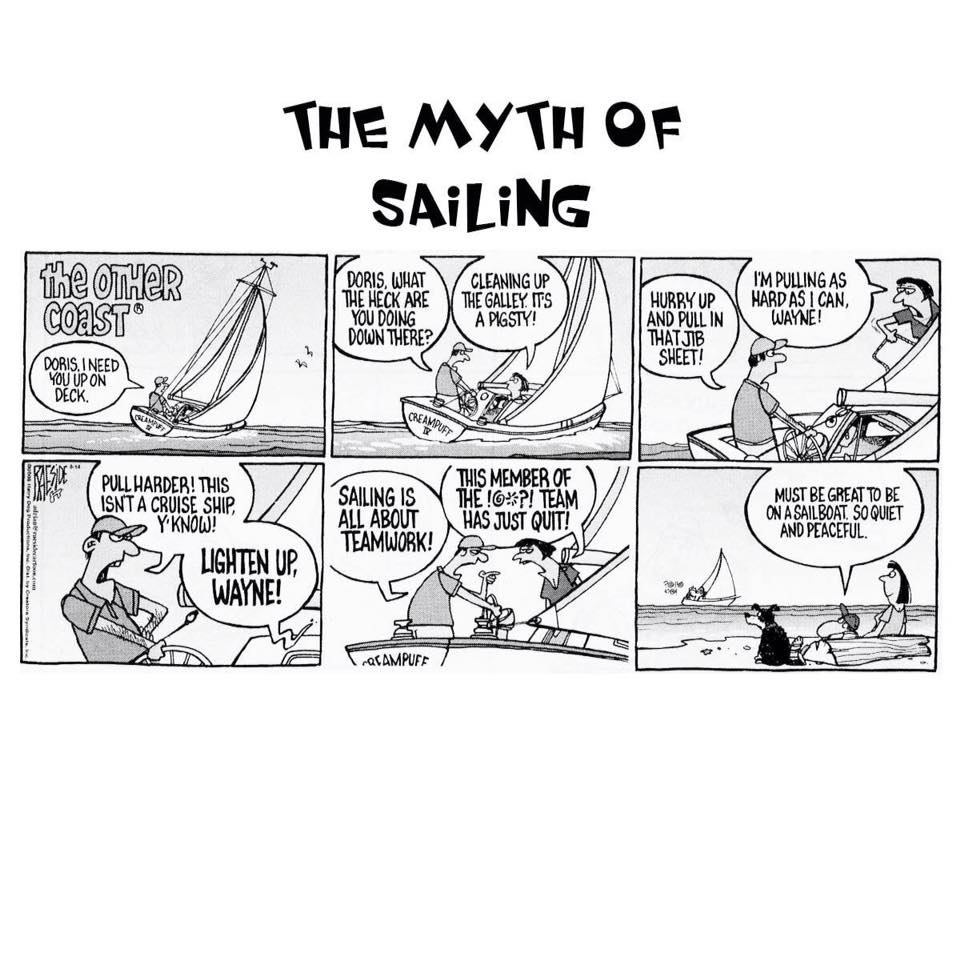
The Myth of Sailing

myth-sailing

Posted in Uncategorized | Tagged , | 1 Comment

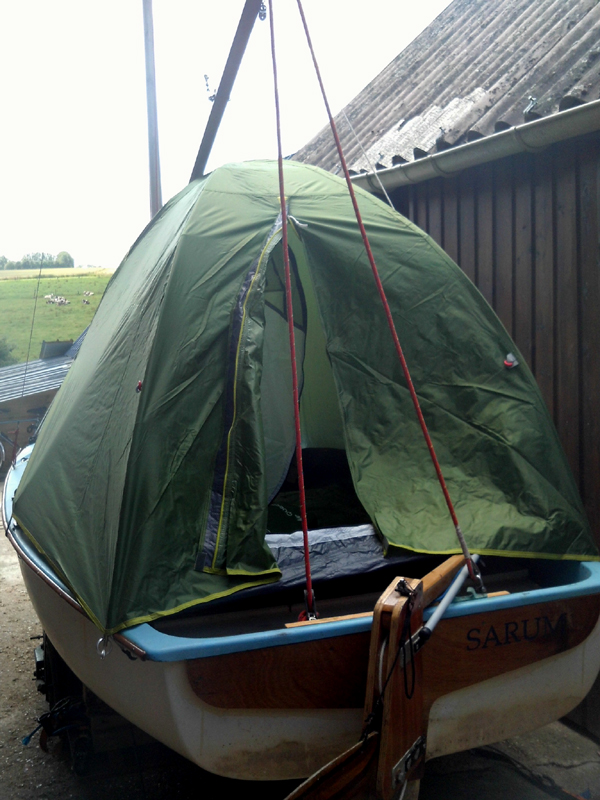
New Boat Tent

I have just set up my new boat tent after my less than comfortable experience at the Semaine du Golfe. See What a damp place to spend the night! and Life on a Twelve-Foot Boat. I squeezed in between the centreboard case and the port buoyancy tank, which was narrow enough to cause stiffness and cramp.

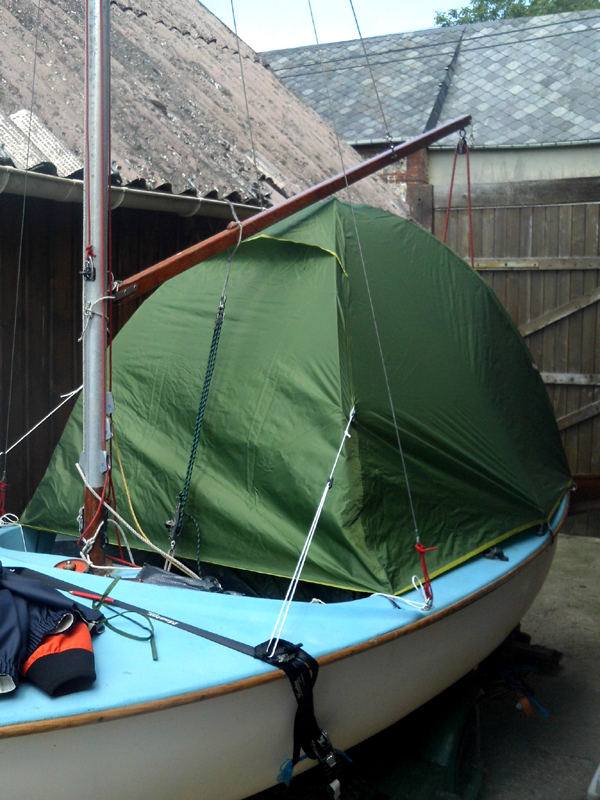
I have now used the method that consists of three planks and a support plank at the stern (the other ends of the planks supported by the thwart). Whilst the sleeping accommodation is not in use, the planks will be stored either side of the centreboard case, leaving the cockpit clear for sailing manoeuvres. This will give the entire width of the boat, which is more than enough for me and my two plastic boxes (galley and “captain’s cabin”).

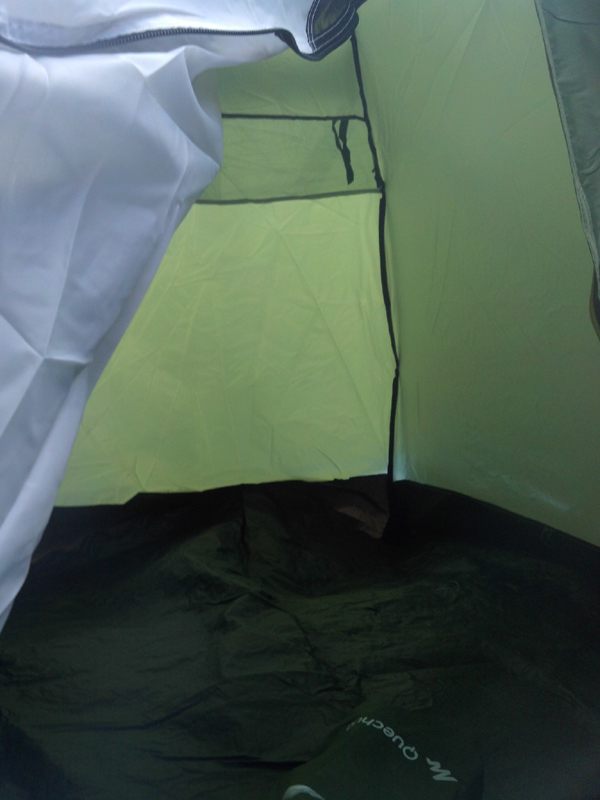
The tent is one from the lower end of the Quechua range, a French brand of camping and bivouac tents and camping equipment.

new-boat-tent01new-boat-tent02new-boat-tent03The tent is no longer supported by the boom but by its own structure as on land. I have made no modifications to the tent, so the conditions should be drier at night. I will need a try in real conditions. The boom is hauled higher than the tent using the topping lift, which dispenses with the need of a boom prop. The helm is pushed over to the side opposite the boat’s mooring. The tent top is secured to three hooking points either side of the boat.

This set-up is ideal when the boat is dried out and is accessible on foot from any side of the boat. I am a little concerned how I would get on whilst moored at a pontoon, a river bank or at anchor. The boat’s tender can conceivably be used for moving around outside the boat whilst afloat.

Perhaps this autumn, a little cruise on the Seine or the Rance and the river to Dinan. I have heard it is quite idyllic! There are also many places along the north of Brittany just screaming out for a visit!

Posted in Uncategorized | Tagged | 1 Comment

You are not machines!

So many times, I have listened to this speech by Charlie Chaplin at the end of The Great Dictator, the parody of Hitler he made in 1940. For the first time, in the light of what I wrote yesterday, the same theme comes in as it has since the days of William Blake. We are humans and technology is meant to work for our higher happiness and not to enslave us. There is so much in common between the 1780’s, 1933 to 1945 in Germany, indeed the one “great” war from 1914 to 1989, and our own times which may even be but a continuation of the same permanent war.

The “romantic” and “rationalist” themes shine through, and this new hearing of the speech will reveal another dimension of Chaplin.

Posted in Uncategorized | Tagged , | 4 Comments

Repairing Engines and Inner Peace

At last, I have begun to fulfil my intention of January 2013 to read the famous philosophical novel Zen and the Art of Motorcycle Maintenance. I had obviously understood very little before acquiring the book and beginning to read it. Last weekend, I had a lot of time to kill, waiting at the port to board the ferry, the two-hour crossing and whilst eating alone.

It was quite a surprise to me that this book has nothing to do with young people in the 1960’s going to the far east to look for the ideal mystical religion or philosophy. It is a tale of the narrator and his son together with two friends on a long journey by motorcycle in America. I related immediately to the book, since a motorcyclist has to be completely autonomous on roads where there are few professional motorcycle mechanics. It is the same in a boat at sea, where you find few professional riggers and ship-chandlers. In most situations of difficulty, you find your own solution, and only in the extreme of dire necessity would a sailor call to be rescued.

What the book is really about, at least so far – and this is what I really relate to – is the reconciliation of the classicist and the romantic within ourselves and the discovery of what life is really about. The author of this book argues that it is possible to reconcile the rational world of technology and science with the intuitive universe of the heart, the imagination, love of beauty and the spirit. History has oscillated between these two extremes, and I have often written on the end of the “age of reason” and the era of William Blake, Keats, Shelley and Wordsworth. He appeals to the notion of bridging the chasm between reason and emotion, classicism and romanticism, subjective and objective.

This has been the history of my life in which I have found it very hard to find a unifying point between two conflicting parts of my personality, essentially a romantic, yet with a love of mechanical things, the pipe organ, working with my hands and solving problems. I love navigation by dead reckoning – the least reliance of charts and instruments and the greatest scope given to my sense of spatial perception. Places have to be recognised, but there are forces to compensate for – the leeward drift of the boat and the tidal current. With all that, we do need to have checked the weather forecast, the tides and planned our route. I always have a chart and a sighting compass in my kit together with safety items. I have always been fascinated by technology and science, which are a part of my being from my earliest childhood. Yet, I warmed to music, churches, prayer, beauty in both art and nature, my constant daydreaming.

I relate very intensely to what I am reading. I am not very interested in motorcycles. I rode one when I was twenty years old, and my longest distance was London to York via Oxford. I find internal combustion engines filthy and tedious. I change my own oil for my van, because it is a lot cheaper than what the garage takes. I have two metal ramps onto which I drive the front wheels of the vehicle. With the vehicle in first gear and the handbrake firmly on, there is no danger of getting crushed as when using a mechanical or hydraulic jack. There are three things to replace each time: the engine oil, the copper sump seal and the oil filter. I have the correct references written down in my maintenance logbook. The old oil has to be disposed of into a plastic drum and periodically taken to the municipal dump for proper disposal. Apart from that, I change my own pre-heater plugs when needed. I leave the rest to my professional mechanic, especially the stuff that requires special skills and tools. Each man to his own trade!

On the technical side, my first love on leaving school was organ building, and I have always taken pride in playing the instrument as well as working on the mechanical parts, tuning and regulation. More recently, when I took up sailing, I made it my business to learn about rigging, sails, the balance of the boat (weather helm and lee helm) – and making modifications using parts and materials I could find at affordable prices. I owe so much to the intrepid dinghy cruisers David Sumner and Roger Barnes, as I do to my instructors at the FFV school in Veulettes sur Mer and the Glénans.

The stereotype romantic is a person devoid of any manual aptitude, skill or interest in anything technological or practical. Most women switch off when hearing men talk about science or technology, yet many will operate a complex sewing machine and use domestic appliances at home – and drive a car. I have known men at seminary who claimed to be pure intellectuals and were incapable of anything mechanical or manual. It is the same with musicians and the man in Zen who eschewed using bits of metal from beer cans to repair a problem on his expensive motorcycle. I prefer playing the organ to repairing it, sailing a boat to making a replacement mast. I am certainly more of a romantic than a classical rationalist, but I do see rationalism as important, indeed essential. As a theology student, I sympathised with Thomas Aquinas’ primacy of the reason over the passions and the will, the antithesis of Francis of Assisi and the later Jesuits. On seeing the limits of scholasticism, I began to resonate more easily with patristics and German idealism. Thomist rationalism has its limits, as for the Saint himself when he said of his theological works that it was all straw in comparison with the mystery of God.

I will doubtlessly have more to write on this subject as I progress through the book.

Posted in Uncategorized | Tagged , , | 6 Comments

Principles of Law

In England, everything is permitted except what is forbidden. In Germany, everything is forbidden except what is permitted. In France, everything is allowed, even what is prohibited. In the USSR, everything is prohibited, even what is permitted.

Winston Churchill

Posted in Uncategorized | Tagged | 5 Comments

Taking Positions

I have been away for the weekend, notably being at our Council of Advice meeting in London. Despite the strike in the port of Calais, I planned an alternative route thanks to my ferry company allowing passengers onto ships at Dunkerque. The roads were well policed from the point of view of parked lorries (trucks) and desperate folk trying to get to England by any means possible. So, I was able to get to the port and be put on a ship in very good time and with much less waiting than I expected.

It wouldn’t break any confidences to mention a reflection that came up between us. There are so many issues in our world and in the Churches on which many people do take harsh positions, like so many single issues – instead of trying to see the whole.

Every day in my e-mail, I find so many links to articles, always about the same subjects: women bishops in the Church of England, legislation allowing same-sex “marriage” (as opposed to the Sacrament of Matrimony) and communion for divorced and remarried people in the RC Church. The subjects go on and on. Couldn’t the RC Church get some two-bit dictatorships going, governed by greasy Latino types in military uniforms and moustaches, chewing on  Havana cigars and sending all those “liberals” to the torture chambers and firing squads? They did it before, and the Pinochet affair was quite messy, to say the least.

There is no constraining power as some of our single-issue people would like. Modern politics has nothing to do with Christian churches. Islam has jumped into the breech in some countries. That is another problem. Even the idea of trying to influence the public space seems as ludicrous as the image of the roaring mouse!

So I find it best to avoid these “positions”. Many of these matters concern civil law in western countries and people who have nothing to do with churches. Frankly, who cares if two men or two women want to get a registrar’s office wedding and presumably stay together for some common purpose? It is indeed better for churches like ours not to be licensed for marriages that are both civil and sacramental. People who want to get married go and contract a civil union like we do in France, and then be sacramentally married in church at the discretion of the priest and according to the norms of canon law. A priest has the right and duty to refuse to marry a couple for reasons of canonical impediments, even if they are civilly married. Of course, things are different in America.

Things can be explained when one avoids the “single issue” mentality of our increasingly polarised, intolerant and violent world. Common sense is a rare commodity these days. This is one reason why I like this blog to be a place for intelligent discussion without readers becoming angry and taking everything personally. We live in a world where many people do things we believe to be wrong, and we can’t do anything about it, other than pray for those we believe to be sinners. We are all sinners ourselves.

The more I get together with my Bishop and brothers in the priesthood, together with the wonderfully devoted lay people also on the Council, the more I am uplifted by this experience of the Church’s communion. The Church is chiefly sacramental and mystical, but is also built of friendship and human empathy. Long may it continue, and long may we shine as a prophetic witness for the future of Christianity!

Posted in Uncategorized | Tagged , , , , , | Leave a comment