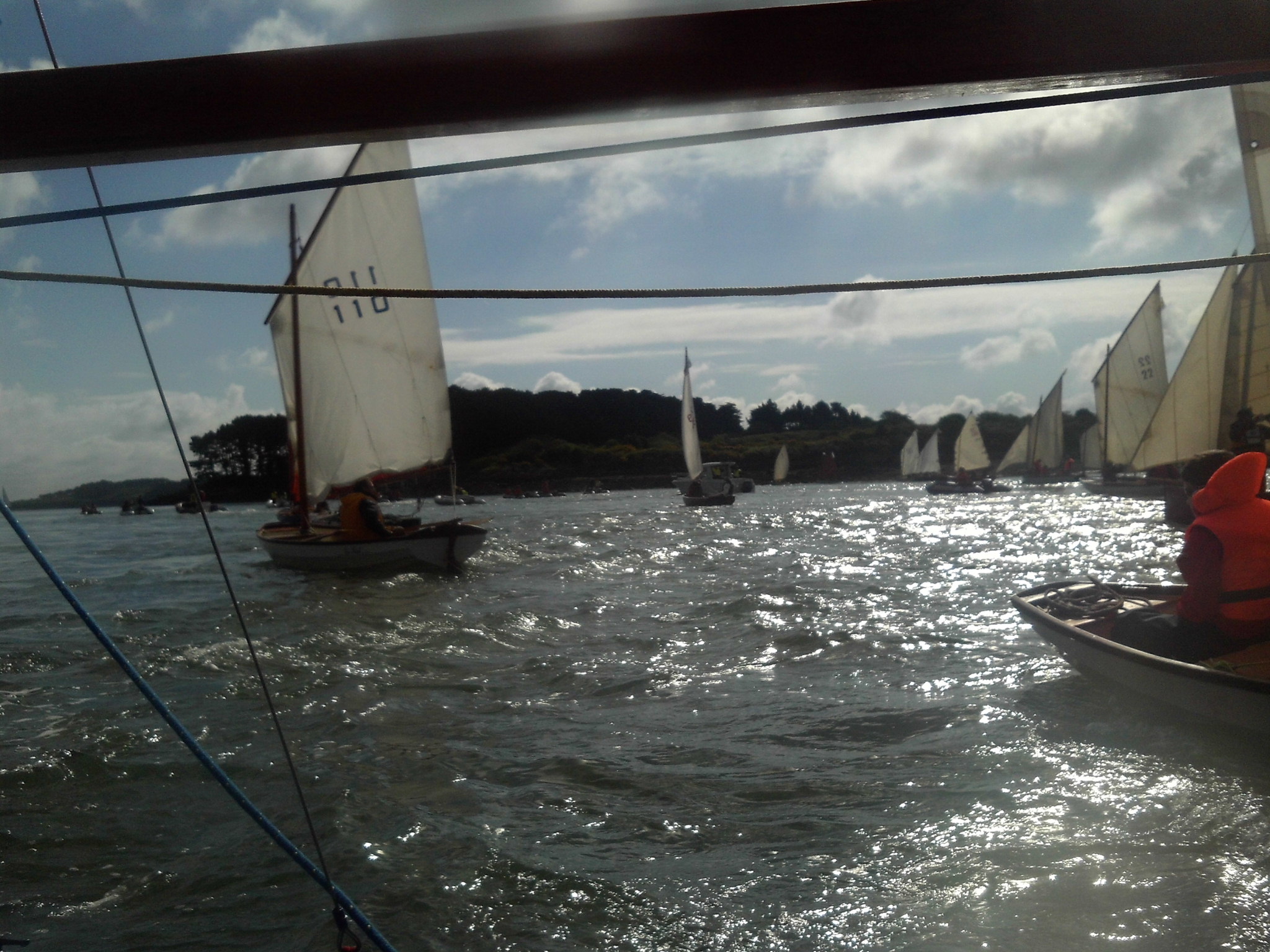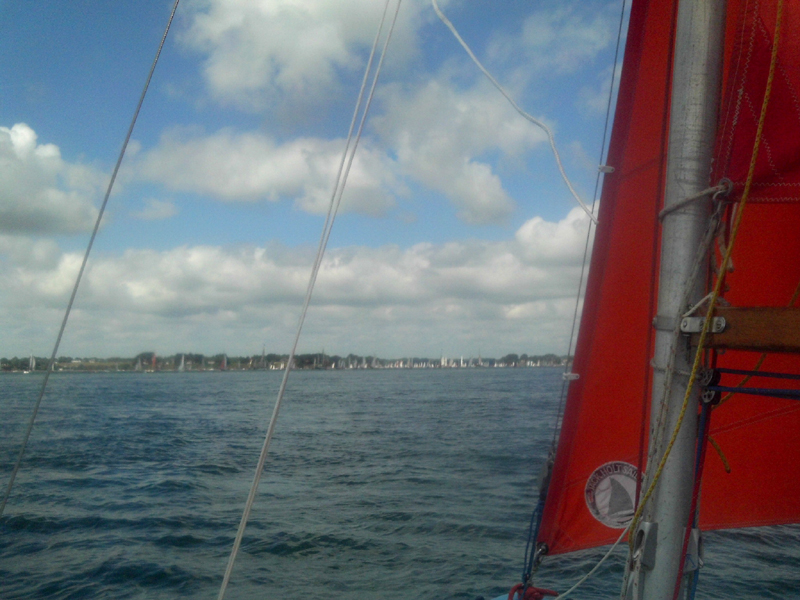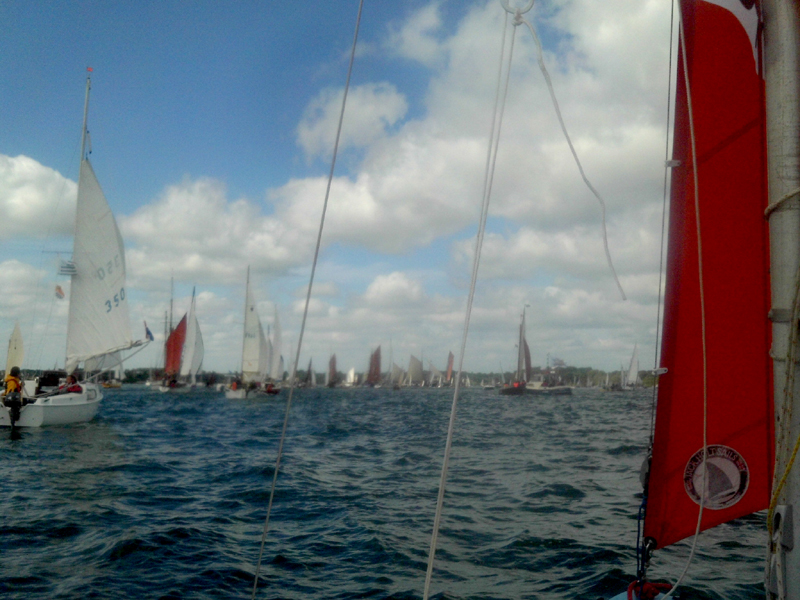
Maman, les petits bateaux!

Such would be a cry of delight from a little child on discovering that there were not only ships and schooners at the Semaine du Golfe – but also little boats! Here is a video about Flotilla 2, the type of small dinghy, usually lug rigged, that can be sailed and rowed (with an optional outboard engine).

My boat is seen in a very brief flash from 21 seconds. It is identified by the blue deck and the red mainsail with a number on it.

For those who understand French, there is an interview with our flotilla captain Xavier Hubert and some nice sequences of our stopovers and festivities.

Posted in Uncategorized | Tagged , | Leave a comment

Have Rubber Dinghy will Sail!

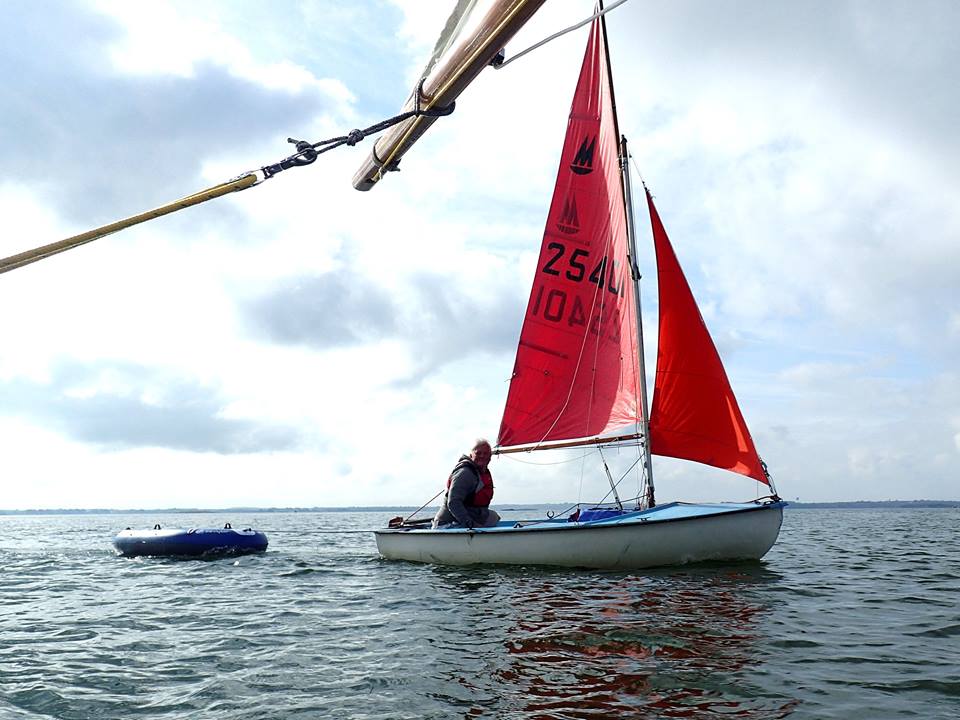
This photo (acknowledgement to Ronan Coquil) has just gone out on Facebook, so I thought I would reproduce it here. semaine-golfe20This was taken last Tuesday as I followed my Flotilla to the opening festivities on the Isle of Arz. Towing my inflatable tender slowed me down much less than I feared, but it was certainly needed for getting ashore when I had to moor my boat afloat. Sailing is very much like scouting. You make do with what you have and you value it. That goes for us all!

Posted in Uncategorized | Tagged , | Leave a comment

My Semaine du Golfe in Photos

Here are the best of the photos I took with a waterproof camera. All the same, the lens needs cleaning from time to time to get rid of the salt build-up. I arrived last Sunday afternoon (10th May), rigged and launched the boat, parked my van and trailer in the designated car park and my whole existence was in the boat.

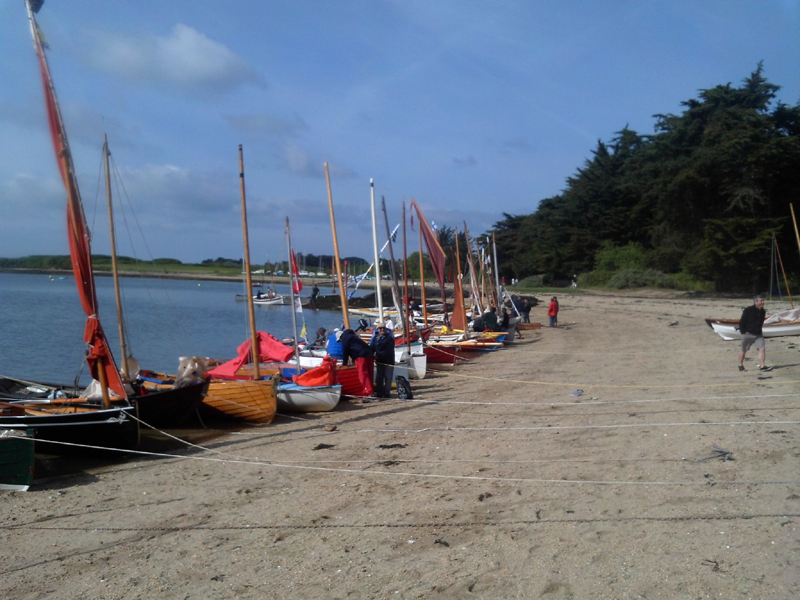
I sailed / rowed to Vannes for the completion of my registration and spent the night moored near my launching slipway. The following day, I sailed to the mouth of the Gulf to find the boats that would be in the Little Parade, but I think I was much too early. Anxious about the tide, I returned to the north of the gulf, and moored at the north of the Isle of Arz, not knowing where my Flotilla would spend that night. My answer came on Tuesday morning when I saw my flotilla mates sailing for the east and south of the island. I followed them and managed to catch up. We spent the day on this island. Sarum can be seen beached about third of the way from the left of the photo.

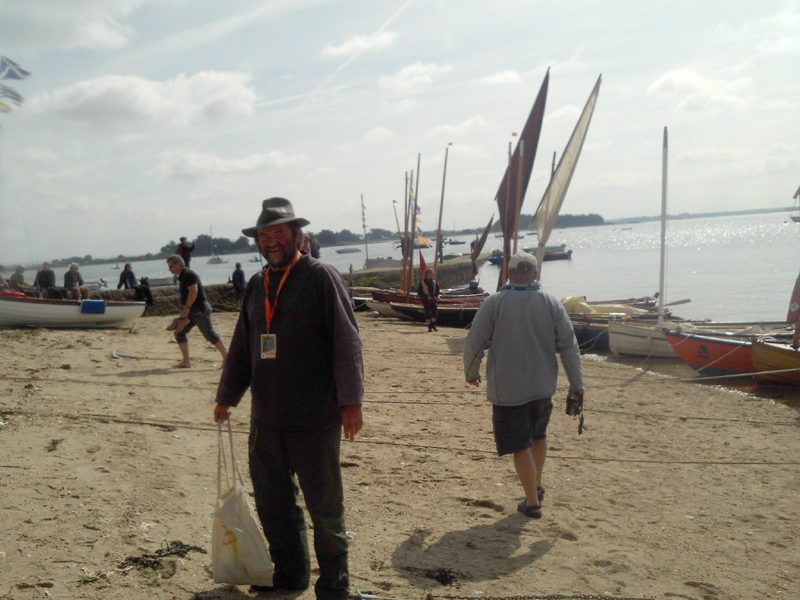
semaine-golfe02Finally, I found Roger Barnes, the author of the Dinghy Cruising Companion on the beach. He had spent Easter with me this year.

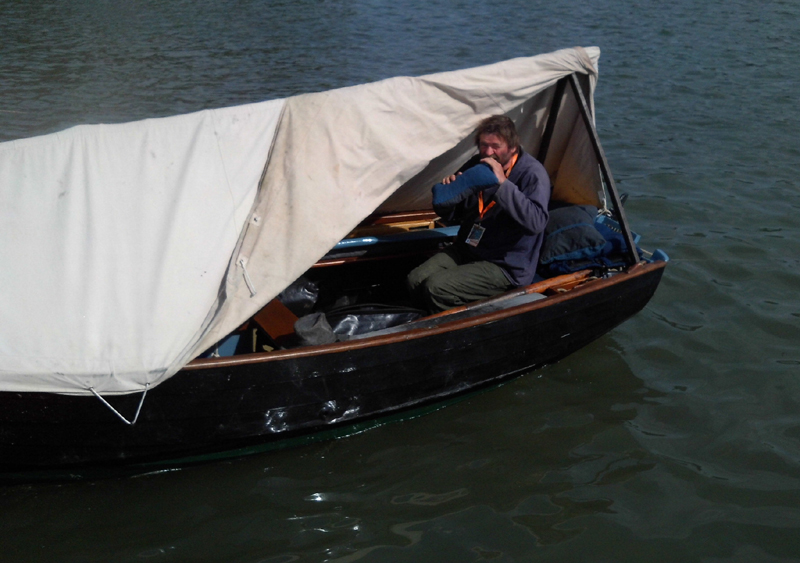
semaine-golfe03Here he is packing up his boat ready for the day’s sail. The tent arrangement is described in his book.

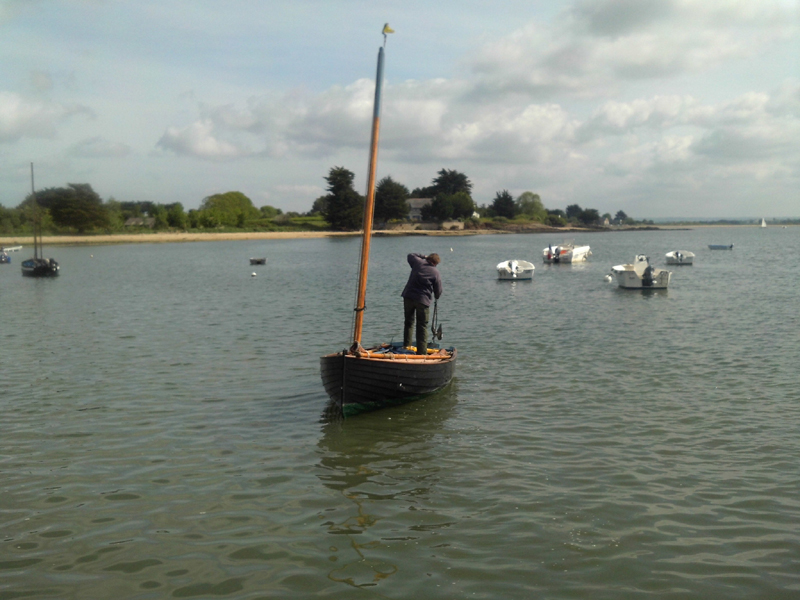
semaine-golfe04He has just pushed away from the beach and appears to be looking at something very attentively before hoisting sail.

semaine-golfe05We sailed to our next port of call, Port Anna, where we spent Tuesday night after the festivities on the Isle of Arz. The wind died and the current was to be changing before long. I graciously accepted the offer of a tow behind these kind gentlemen from Marseilles (though the boat was local). Allez, un bon pastis et un jeu de pétanque!

semaine-golfe06This is Port Anna where we moored afloat.

semaine-golfe07We set out on Wednesday for Le Logeo on the south of the gulf. The wind was fresh and gusted at about 20 knots or force 5 Beaufort. My mainsail was reefed and we close-hauled almost all the way. I cleated both sails and regulated the boat just with the helm and my weight on the gunwale. It was exhilarating!

semaine-golfe08Thursday was washed out with rain and violent winds gusting at 7-8 Beaufort. Sailing was cancelled, so we spent the day on land. There was little to do other than talk with people, shelter as best as possible and eat as necessary. Friday would take us to Port Blanc via three possible routes. We needed to stay together as a flotilla, so we had waiting points to allow the slowest to catch up. One remarkable boat Roger and I saw was what we called Le Méchant Seil, an eighteen-foot pram in wood or plywood to a François Vivier plan. They are very fast!

semaine-golfe09Here we sail with the current.

semaine-golfe10The thrill of the day was a very narrow gap through which the entire tide would flow. It was like a weir. It was perhaps a little foolish to photograph the moment of whooshing through, but it was fun all the same. Crowds of people watched us do that! As you can see, we were looked after in case of accident.

semaine-golfe11From now, it is the Grand Parade of Saturday. I had some problems getting out of Port Navalo and found myself a considerable distance behind. I caught up before being back at Port Anna.

semaine-golfe12The photo is unclear, but that bit of land is full of spectators and journalists.

semaine-golfe13Here is where I caught up, though not yet with my own flotilla. We are all kinds of boats together, and we had to watch out for the ships!

semaine-golfe14I was in butterfly position (in a dead run with the mainsail on one tack and the jib on the other). The boats off my fore quarter were sailing on a port tack before the wind.

semaine-golfe15As we approached the entry to Port Anna, the sea was full of boats, including the passenger ferries that made a terrible wake when they went at any speed. Here, it was going very slowly at about 3 knots.

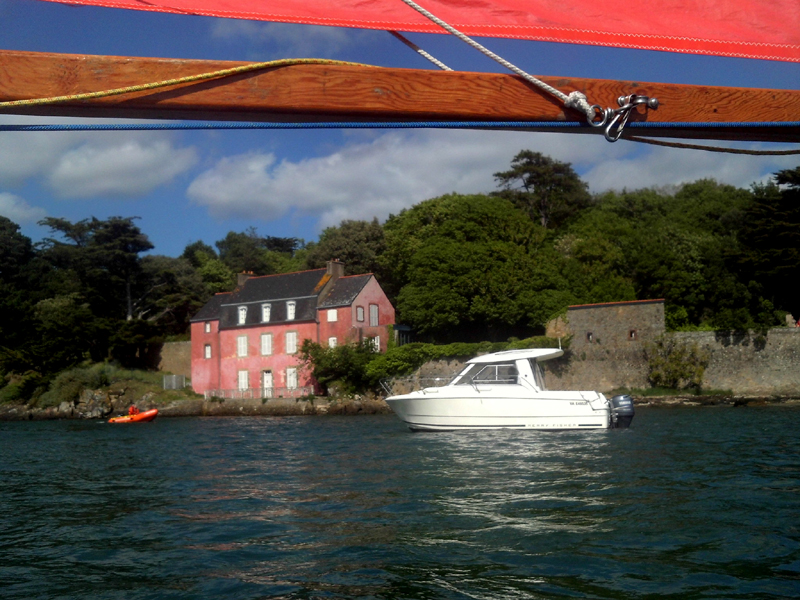
semaine-golfe16Here is the famous Maison Rose of Port Anna, built in 1879. It stands out as you sail past, and the pink colour is required by the nautical authorities.

semaine-golfe17It was also a sad moment, because it was the end of the Parade, the end of the Week and time to take the boat out of the water. As I write, I can still feel the effects of a week on the water in the form of a kind of vertigo that gives me the sensation of being at sea whilst on land. It will pass, but it is very strange.

I may have some more photos as they are sent to me by those who took them and to whom I gave my e-mail address.

Posted in Uncategorized | Tagged , | 4 Comments

Life on a Twelve-Foot Boat

HPIM0001I was relating the Semaine du Golfe with Sophie last night, and she pointed the discussion towards the “domestic” aspect of life on a boat rather than descriptions of places to which she could not relate or the technical aspect of sailing. This would in my mind become a dimension to discuss here on the blog. It would certainly put some of the arguments over “churchy” matters into perspective.

Obviously, we dinghy sailors had an option of commuting between a camp site or a hotel to the place where we had left the boat for the night. Most did, being brought by coach to the port in time for the morning’s briefing and getting the boats ready for sea. Three of us “roughed” it by sleeping in our boats and staying in port overnight. Sometimes the boat would remain floating moored to a pontoon or at anchor. Other times, the boat would “dry out” when the tide went out and the movement would stop, leaving the boat surrounded by wet mud, sand and seaweed. We did what we could, sometimes having to moor to other boats and trusting the solidity of their moorings.

The two words that come into my mind are cramped and dampness. There is nothing romantic about living in a small boat or indeed living rough in any way. We humans need dry conditions and the possibility of daily washing to maintain any degree of dignity. Beyond a certain time, the health goes. I have known or heard of clergy living for a determined time as down-and-outs in the streets in order to develop empathy for people living in that state because they have no choice about it. Their state is even more radically stripped than someone who has a boat, clothes, bedding, food and money. I spent six nights on my boat, which I equipped for this purpose.

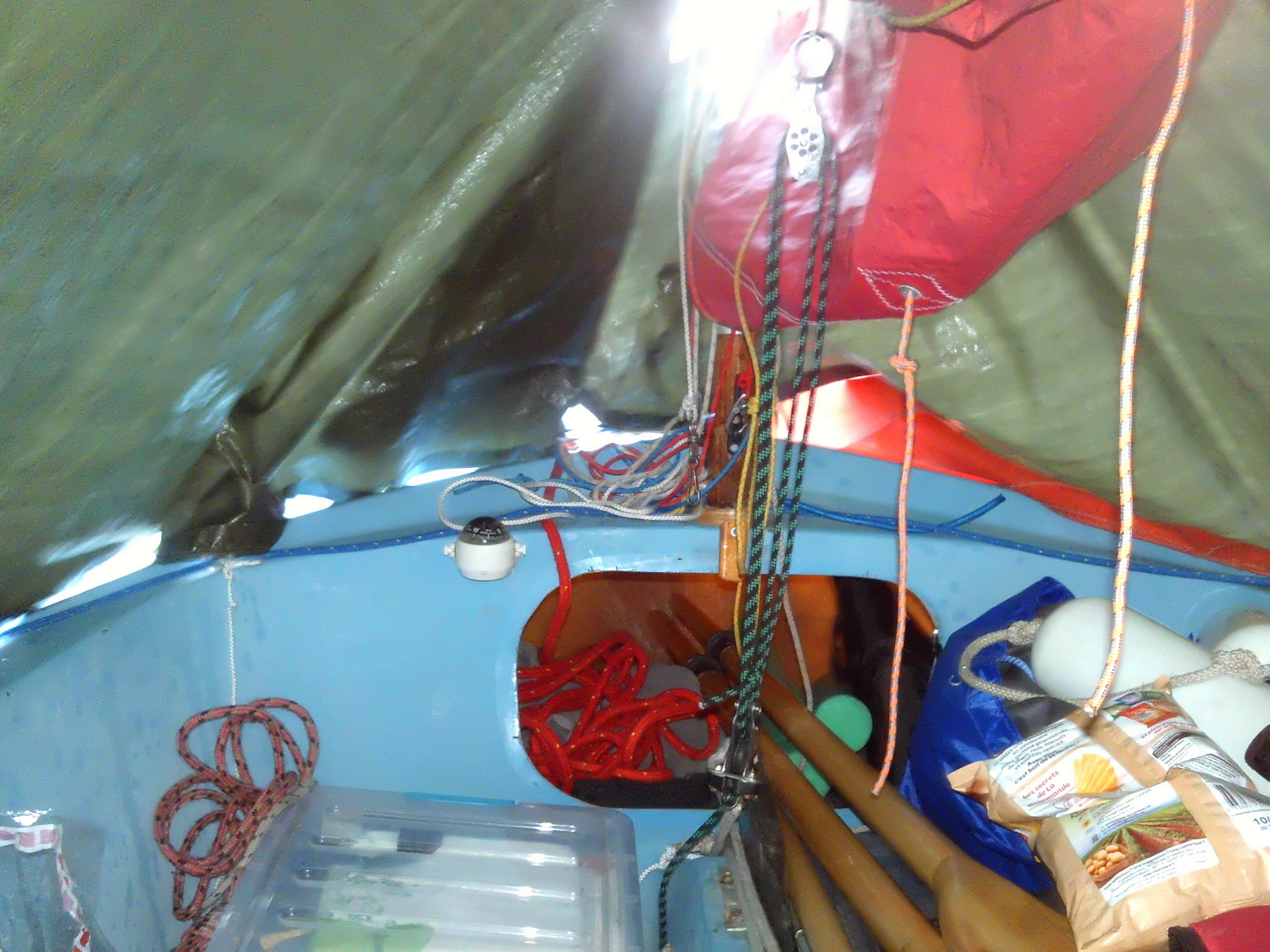
The first thing is to remove the two halyards from the boat’s gaff / yard and the topping lifts (which prevent the boom from going into the bottom of the boat when the mainsail is lowered). Next, there is a support made from two hinged pieces of wood to hold the gaff / yard and the boom at a set height at the stern. Then a tarpaulin / rudimentary tent is thrown over the gaff / yard and hooked to some brass rings screwed into my gunwale. Fore and aft, the tent needs to be attached from outside – from neighbouring boats, on the beach or by standing in the water if it is shallow enough. That creates a very cramped space as can be seen in the photo above. Bedding consists of a self-inflating mattress, a sleeping bag, an inflatable pillow and a camping pillow. The legs squeeze between the centreboard casing and the floatation chamber at the side of the hull, under the thwart. My torso and head had more space at the stern as long as the tiller of the rudder was pushed over and lashed.

My arrangement revealed some design problems. I should make the boom support much higher. I intend to make some plywood boards that would make it possible to establish the bed at the level of the thwart rather than in the bottom of the boat, but which would fit into the bottom of the boat when not in use. I have learned many things.

In the morning, the transition between bed and breakfast is interesting. The mattress, sleeping bag and pillows have to be put away in my bow locker. Bedding and clothes to be kept dry go into a “dry bag” specially designed for the purpose. That leaves space. Then, depending on the weather, the tent is left in place or taken down partially or completely. If completely, by attaching the halyards to the gaff / yard and the topping lifts to the boom, I can get better headroom, especially with the boom to one side rather than dead centre. Two things – you get somewhere for your head, and you don’t risk burning the sail with the primus stove! The next stage is clearing away all the clobber to get access to the “galley”, a splash-proof plastic box containing my gas burner, scout mess tin kit and food. I insisted on real coffee, which I made with a plunger type pot. For food, I would have bread and cheese the first days. I had access on Tuesday to a shop for more perishables. For the rest of the time, food is tinned meals and instant pasta. Most days, it was possible to get a sausage and chip take-away if the queue wasn’t prohibitive as a price to pay for so little. My “galley” would at least give a hot meal.

That is for the fundamental human needs of sleeping and eating. Was there anything spiritual about this experience? Precious little. When we are concerned for basics, the instinct is not existential or spiritual. This is a fallacy believed by many who think that belief and piety decrease proportionately with material comfort and that people return to God and the Church when they suffer deprivation. The two world wars in the twentieth century brought many to belief and radical vocational decisions, but also destroyed the faith of others – Vaughan Williams and Elgar to cite examples of two English composers having experienced the horror of World War I. It may seem paradoxical, but this fact can help us understand those who are destitute or in any survival situation. That was far from my case of someone like me having gone for a week’s adventure as an “overgrown scout”!

In the evening before going to bed, when I was satisfied that everything was in shape, I would spend some quiet moments in the beauty of nature, the silence of the night. Using a battery powered lantern, I could read. I took a breviary and Elaine Pagel’s The Gnostic Gospels, a book I had been wanting to read for a while. Much of orthodox Christianity is so woefully inadequate for explaining or comprehending at an intuitive level many of the issues that dog us. It is necessary as a discipline and a framework, but we are on our own to work out the things that really matter. Like in the boat, go out too far on your own and you can get into trouble. Fr Tyrrell had that experience back in the 1900’s as a Modernist theologian.

The Gulf du Morbihan in south Brittany is like an immense lake with islands, but it is open to the sea via a narrow mouth. This creates the incredibly complex system of tides and currents that can exceed seven knots. Simply, you cannot sail against the current except in a very powerful motor boat. The art of sailing in the Gulf depends on your knowledge of the tides and the currents. The laws of inertia produce situations where the tide is still ebbing when the new tide is flooding in. That creates turbulence and whirlpools. You either have to know those waters extremely well or be guided. Last week, it was the latter. We were guided, organised and watched by rescue boats ready for any kind of accident. I and another boat had to be pulled out of a whirlpool and from the path of a ship! The worst is when the boat is becalmed, has no steerage and cannot keep a stable heading. Oars come in handy, but are no match for the relentless current. I was grateful to be in a “mainstream” and organised situation. Freedom would only been in little things, but we followed what we were given at the morning’s briefing. Each fleet had its leader, and ours was in a powerful Zodiac with a black flag and a siren like the American police.

I could make the comparison with churches, except that I trusted Xavier and the rescue boats, the extremely well-organised event. What faith can I give the Church of England or the local RC parishes around where I live? I feel the alienation acutely, and I am thankful to my little ACC diocese in England for keeping the flax smouldering and my priestly vocation alive. My religious life is a little like the cramped and eternally damp boat, having to make do and to value the smallest comfort.

I turned on my computer last night for the first time in a little over a week. I have seen the few comments in the Interesting Reflection on Quo Primum. My immediate reaction was one of nausea and inability to relate. I cannot subscribe any more to “suck up and conform” than to the eternal dissatisfaction of others. During the Semaine du Golfe, there was not the slightest sign of any religion. Ascension day was gloomy, wet and windy. Sailing was cancelled. Church bells rang from this or that village or island, in a place where the piety of seafarers was once very fervent, though perhaps a little pagan for many monotheistic tastes! True, we were pleasure sailors, on the sea in our spare time and in fair weather – and protected from dangers to our lives. Most lived it easy, and a few chose it “hard”. As the paganism was got rid of by the “socialist” monotheism of the 1960’s, nothing replaced it other than the preachy moralising of the bourgeoisie and those working for national education and the civil service. Nausea sets in and the knowledge of God is to be sought elsewhere.

Sophie said to me this morning that I probably wouldn’t do this again, but would prefer to join the grey line of commuters on the bus between the camp site and the port of the night’s stopover. I replied that there were improvements to make in terms of usefully used space, a better tent to give more headroom and better ways of dealing with damp and cold. I will make a new and more snugly fitting tent using modern tent fabric, which is much lighter and easier to work on a domestic sewing machine. I am determined to do it again, beating the “system”, but with a learning curve based on experience. There will not only be the two-yearly festival, but also the north of Brittany, the possibility of going with a few friends on something informal but yet with each other to rely on for safety. There are also the Chausay Islands to the west of the Cotentin. The west Finistère is challenging as is the Rade de Brest. We can’t be tough indefinitely, but I am determined not to become one of those old men needing more than a certain level of creature comfort. It is something of the hermit (and the anarchist) about me!

To those who get things out of proportion, I might suggest that he “go thou and do likewise” – buy an old boat, sail somewhere wild and learn to make do…

Posted in Uncategorized | Tagged , , | 3 Comments

Back Home from Brittany

I have just returned from the Semaine du Golfe in Brittany, one of the major seafaring festivals of the world involving sailing ships, classic fishing boats and small sail-oar dinghies – more than a thousand vessels. It was a great honour to participate in it.

Here is the Grand Parade of yesterday afternoon. I doubt whether my tiny boat could be spotted!

The third video shows our fleet of sail – oar dinghies. My boat (red sails and white hull) is seen from 1m37 and I am seen to turn towards the bank because of loss of wind and steerage. I was helped by a nudge on the bow by a kayak and I then passed the gué without problem. It all looks very tame, but the currents in that gulf are tremendous. The sailor needs to learn how to use them to his advantage.

I have a number of photos and other links to professional videos. I arrive home shattered with tiredness. I camped on the boat each night in cramped and damp conditions, the price of independence from being shipped around each night on buses to camp sites and hotels. The pile of seawater-sodden laundry is enormous! During the course of this week, I will write a day by day account of the event as I lived through it.

Posted in Uncategorized | Tagged , | Leave a comment

Interesting Reflection on Quo Primum

Fr Hunwicke’s new entry S Pius V: the BIG MISTAKE, THE UNIVERSAL MYTH is worth a look-in. This piece of liturgical legislation is of no relevance to Anglicans, even though many of us are using the Anglican Missal or the English Missal, heavily based on the 1570 Roman missal.

I think Father Hunwicke’s main point was to resist the tendency of some RC conservatives who would claim that Pius V’s bull was only an earlier form of what Paul VI did in 1969 in a series of “updates” of the absolutely uniform Roman rite. That question is of no interest to me as an Anglican. However, he makes the point of Pius V wishing for the continuity of traditional local rites of Sarum, Lyons, Paris, Milan and others.

The standardised Roman missal was to be implemented where the local rite was shoddy and corrupt, as some were in the mid sixteenth century. It did involve a wholesale revision of the Roman rite, from which many valuable elements were lost. I have studied this “codification”, and would probably find more with a more thorough and less partial methodology. Sirleto’s commission left very little information on the revision of the missal, and more about the Breviary and the calendar. The result was quite draconian. Pius V, that grand Inquisitor, did leave the possibility of continuing with local rites. Unfortunately, motivated by the growing ultramontanist ideology, many dioceses that had the right to their own rites and uses did not keep them, but voluntarily switched to the Pius V rite.

Our own times are different from the end of the middle ages and the Renaissance. We have lost our intuitive understanding of liturgical symbolism, and my experience of “traditionalism” has not been a good one. The liturgical life in its fulness is no longer in the mainstream, other than in monasteries. The cathedral liturgy is gone, and the only thing that remains of that tradition is Anglican Mattins and Evensong in the English cathedrals, university college chapels and Royal Peculiars. Liturgical life is reduced to its minimum like in persecuted Churches, said masses and offices in makeshift chapels.

I could take the reflection further, but I feel it would not be healthy. We can’t put the world right, only do the best we can with what little we’ve got. We could lament, but that would do no good unless we wish to become atheists and nihilists. We just carry on as we can…

Posted in Uncategorized | Tagged , | 23 Comments

Back to Barfleur

barfleurWe’ve been there before, and we are very attached to Barfleur on the east coast of the Cotentin. See:

We were supposed to be going there today, a week before I take my boat to Brittany for “the big one”. My wife and I bought a caravan in early 2013, and I was doing it up until the moment when my mother died. We stored it in the garden of a friend, and now we are going to use it. When I brought it back to our house to do the remaining work, one of the tyres blew out as I arrived. I saw that both tyres were just as old and perished. I put on the spare tyre and took the wheel with the punctured tyre to the garage that services my van. The special size of the wheel made it difficult for my garage man to find the right tyre, and finally, he promised it for Saturday morning. Great, I will go and get the wheel with the new tyre tomorrow morning, put it on the caravan – and we’re off.

I took the boat yesterday, since one can’t tow a caravan and a boat at the same time. We are going to leave the caravan stored at the camp site owners’ farm for a reasonable rent outside the time we will be using it at the camp site for the normal cost per night. I was never keen on a caravan in the first place, but my wife finds it difficult to live in rough conditions like in a tent. I will be sleeping in my boat the following week!

There should be some reasonable sailing days next week on the open sea, and it would be good to sail further along the coast than I did in my old boat, to Saint-Vaast-la-Hougue and the beautiful island of Tatihou. Perhaps my wife will sail with me if she isn’t too afraid of getting cold!

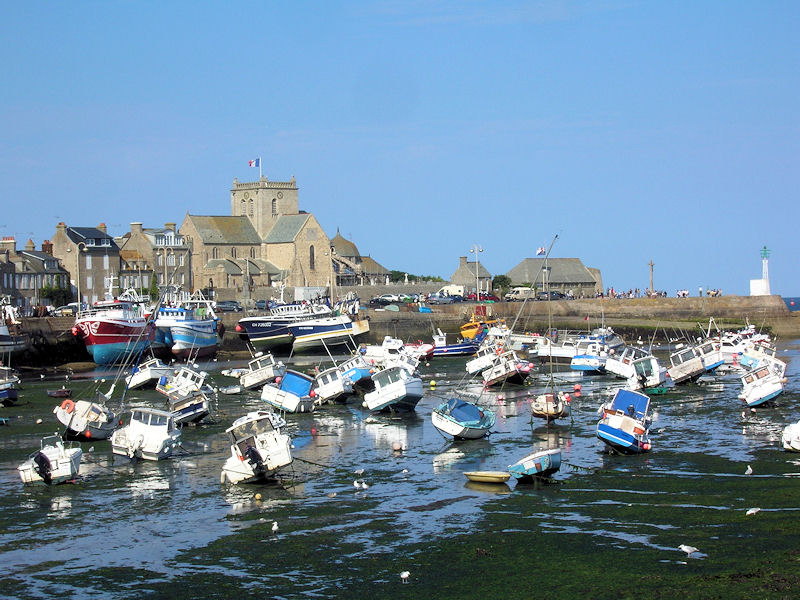
We are getting used to going to this “old place” for weeks off. It is unspoilt unlike a lot of Brittany where the coasts have been increasingly built-up with secondary houses. Barfleur is still very much a fishing port with a few workmanlike open boats and the bigger metal trawlers. The fish and seafood is sold at the quay, and it is all fresh, delicious and cheaper than in the supermarkets. There will be nice long walks for when the weather isn’t right for sailing, and a quiet time for recharging batteries.

We will return home on Saturday 9th May, and I will be setting off on Sunday 10th for the Semaine du Golfe. That will be different from the caravan holiday: no computer or internet, sparing use of the mobile phone, a little transistor radio for the news, weather and music (France Musique). Apart from that, it will be a life without electricity (other than what works on batteries) or modern technology other than evenings ashore to buy food and socialise with my flotilla mates. I am counting on this to be a spiritual retreat like none other! I have just received the navigation plans for my flotilla (Voile-Aviron) and everything is extremely well organised.

I will have my computer at Barfleur, but with only a limited internet connection (I will have to go into town to get wi-fi at the Mairie). Given this, please be indulgent if I am slow to answer comments on the blog or private e-mails. I will be totally off-line from 10th to 18th May.

Posted in Uncategorized | Tagged , , | 1 Comment

May Travels

voiles_avironI will be spending about half of May away from home, and the 11th to the 17th offline – in my boat at a huge gathering in Brittany, the Semaine du Golfe, of more than a thousand vessels from three-masted ships to dinghies like mine. I am presently going through the list of everything from my Swiss knife to my various boxes representing the ship’s workshop, the bosun’s kit (repairs to the sails and minor damage to the hull), the galley, captain’s cabin (another plastic box with navigation equipment and personal things), fo’c’sle containing the anchors, warps, fenders, bucket and bailer, etc., dry bag for clothes and bedding and essential equipment for the boat. It is a detailed and meticulous job and nothing is to be forgotten. During that week, I am offline and accessible only by mobile telephone and VHF radio. We will be a load of grown men playing at schoolboys! I think it will be good retreat, with my breviary and some spiritual reading in my waterproof “captain’s cabin” box. There will be contemplative early mornings whilst those sleeping at a campsite arrive at their boats by bus. Some of us are camping in our boats, and will be drinking coffee as they rush around like chickens with their heads chopped off!

I had a pleasant letter from a reader about the scourge of clericalism. He mentioned some of the things discussed on blogs. Indeed, a lot of what is being discussed is quite sterile, for example calling modern theological tendencies by the names of ancient heresies like Nestorianism or Pelagianism. There may be some characteristics in common, but there is an entirely different historical context. This annoys me about as much as reading about the way Gregory the Great or Pius X answered the issues of the Novus Ordo or paedophilia in the clergy!

I am profoundly alienated from the Roman Catholicism in which I was a little more than a guest for about 15 years of my life. Its clericalism taught me to recognise the same thing in every human collectivity in which there is a pecking order. We humans are not unlike many species of social animals that establish their hierarchy of dominance. The nastiest and strongest gets the top of the hog – and in this way, Nazism was the quintessence of human nature. The same paradigm is emulated to a less extreme extent in all bureaucracies and political parties, all the elites. What Christianity seems to be about is reversing that fatality – and any monotheistic religion that favours “might is right” – and bringing out empathy, love and kindness. In the thoughts of many martyrs as they faced their deaths – If love has no place in this world, then I want no part in it.

Any institution goes the same way. I find an even more clerical outlook with the left-wing agendas, the female clergy being especially sanctimonious and lacking in empathy. François Hollande’s socialism in France is all about the vested interests of the elite and the plutocrats, and there is plenty of talk about issues going through the meat grinder of steering committees and this and that – and nothing being done to address issues of things like unemployment, homelessness and unaffordable housing.

We live in a grim world. Some write about what they would do if they were King of England for a day, to which I sent a comment about the Invisible Empire of Romantia and the dotty ladies who invented it. Here’s some of what they published in the 1990’s. As something of a Romantic myself and attaching great importance to man’s creative imagination, I find that escapism on the Isle of Cocaigne is a necessary part of us. We all like fantasy films and books. I certainly do, but too much of anything isn’t good – like a good vintage Port or a bottle of Cognac.

I try not to think too much about the state of the RC Church. Pope Francis apparently has his good points, but he makes me think of Obama in America and Hollande here in France. He got to be Pope because he was able to pull the right strings. He would certainly know a lot about the Ratlines of 1945 and much more about how the Vatican Bank started raking in the dosh. Who knows? My country had a bad time with his, back in 1982 over a territory whose entire population other than two Argentinians wanted to remain British. Have no illusions. All I wait for is something like what happened in Russia in 1989, a system reboot and a chance for humanity to establish itself on a new basis. France’s elites went to the guillotine in the 1790’s and then the extremes like Danton and Robespierre killed each other off. Something along the same lines will happen again, though I would never wish for anyone’s death. Something needs to change.

I have lots to do now, things like boat lists, the spare wheel of my caravan and interior fitting – and some translating work. so I’ll close.

Posted in Uncategorized | Tagged | Leave a comment

Multum in Parvo

Thank you, Fr Jonathan on ACC Diocesan Synod 2015: Impressions of smallness and A mast full of colours. Indeed, I hoped to do a little more at our Synod Mass in Bolton – music-wise, but I had not yet sung with Fr Jonathan and his lovely wife Katherine. We had but little time for a rehearsal, so it was a question of finding a simple piece for three voices. I have a little collection, and quite a lot can be found from the RSCM.

We sung Palestrina’s Jesu Rex admirabilis. This is the full choral version, but we sung it for soprano, alto and tenor, transposing it down a tone. It worked well. I accompanied the rest of the Mass on a battery-powered keyboard with a “church organ” tone, which was better than I feared. It was on a table with a music desk I had brought with me to hold the hymn book and the various scores.

Indeed, we are a little Church and we make do with little, but we make the most of it. I admire my fellow clergy. Fr Jonathan talks of being a southerner when mentioning our northern clergy. I am from even further up north, but having lived all over the place has brought me to get on with everyone – north and south alike. I was born further north from the north (without being Scottish!) and live further south than the south (south of the English Channel).

We English can be a funny lot with religion and trying to get things right, even perfect. I do believe we should do the liturgy properly and as best as possible, but we have constantly to compromise because we don’t have everything. We do seem, in the Anglican Catholic Church, to have more of a “medieval” spirit than purist Roman Catholic traditionalists and conservatives.

I do think that Fr Jonathans blog O cuniculi! Ubi lexicon Latinum posui? needs to be better known and read. I appreciate his attitude, rather like my own. We are not here to combat the world’s “heresies” or differences in theology or simple opinion. We are here to worship God and live our lives in accordance with the Gospel ideals.

We don’t have to justify ourselves. Fr Jonathan often uses the nautical term of nailing one’s colours to the mast. Nailing the colours to the mast is a traditional sign of defiance, indicating that the colours will never be struck, that the ship will never surrender. It is not something I need to do on my little boat – and in peacetime.

We live in a time when Christians is some countries are persecuted and martyred, especially in Egypt, Irak and Syria – but we in other places all live in an increasing spiritual vacuum and a world that favours materialism and atheism. We are in the catacombs and it is no longer the moment to be triumphalistic. We must be humble and above all spiritual in our discipleship with Christ.

Fr Jonathan’s articles are so full of good sense, and we need to encourage him. He and I have become good friends and brethren in the same college of priests.

Posted in Uncategorized | Tagged , | 2 Comments

Voile-Aviron

This is a fine presentation by François Vivier in French about the movement of sailing boats that can be sailed and rowed, and which are transportable – therefore not incurring mooring costs in a marina. François Vivier is a professional boat builder and sells complete boats, kits and plans for amateur building. This is his site in English. I gladly give him a free advertising place. Maybe one day I will build a boat…

Posted in Uncategorized | Tagged , | Leave a comment